Author Archives: Alan Brill

Critique of Kugel #1

“Open my eyes so that I may see wonders of Your Torah” (Psalms 119).

I have a few observations on Kugel’s book that I have not written up because I expected someone to get there first. But neither the Orthodox or Conservative critics went in this direction. I knew people were writing reviews so I naturally assumed they would cover these points. I am not writing from the perspective of a Biblical scholar but as a theologian. I am not looking to reiterate what has been said already but I also cannot guarantee that I have seen everything out there on the web. I write this as notes for a first draft of a summer essay, so I am willing to correct anything that is overstated in this contextual understanding.

When Kugel’s book first came out, it was reviewed by the NYT (David Plotz Sept 16, 2007) as having rejected literalism and that “He also seeks a safe haven for rationalist believers. In other words, having broken all the windows, trashed the bedroom, stripped the wires for copper, sold the plumbing for scrap, and jackhammered into the foundation, Kugel proposes to move back into his Bible house.” Well, look at this review. The New York Times does not have a problem with the documentary hypothesis and it rejoices in daring works like the Book of J. So why was Kugel seen as trashing and stripping the Biblical house? My major point is that Biblical criticism is not the message of Kugel. And the problem with Kugel is not per se, the Biblical criticism. The problem is loss of the Biblical enterprise. Yes, the book is an important book and a great read. But I do not think that the critics of his work and looking at the right aspects.

1] Kugel’s concern with the possible Iron Age meanings and his not seeing any moral teaching in the Bible has little to do with the documentary hypothesis. One finds similar statements of the lack of morality in the Bible in Voltaire and other 17th-18th critics of the Bible as well as by early 20th century free thinkers who wrote books with titles like “The Bible Unmasked,” which showed the immorality of the Bible. Many of Kugel’s readings that Sommers argued against are offensive even without any Biblical criticism or separate documents.

2] For Kugel, the Bible has no moral lessons or theological ideals. He has a materialistic skeptical sound to him. There are no grand ideals or religious claims in the Bible. Contradiction and parallel texts in the text do not teach anything. Kugel’s position at this point is similar to Freidrich Delitzsch in “Babel and Bible”. Delitzsch maintained that many Old Testament writings were borrowed from ancient Babylonian tales, there is no unique ethical message or religious message. In fact, the Bible needs to be unmasked as immoral. Delitisch was the rare voice that the Bible has nothing to teach theologically and should be treated as part of Babylonian and Canaanite religion. In later years, Deliitsch saw Christianity as the moral solution, so those parts of his thought are not to be impugned to Kugel, but the implication of ancient near east parallels is similar. I do not think he is as extreme as Delizsch, but he is heading in that direction.

2] In the context of Kugel’s writings I am surprised that no one mentioned Peter Enns, a student of Kugel, was dismissed from Westminster Theological Seminary. The problem at a Protestant seminary was not the human element or the weak theories of revelation. Enns however even quotes and accepts, the anti-documentary hypothesis works like Kenneth Kitchen. The problem was that Enns says that the morality of the Bible is that of the Iron Age. He advocates accepting the moral critiques of the new atheists – that the Bible is not a moral exemplar. Kugel’s method takes the sanctity out of the Bible. There is something very skeptical about the method. Furthermore, Biblical texts are depicted as not knowing the original meaning of a story. The human part of the Bible is all too human. So human that it strips the ability for a more theological-literary-document reading. I am surprised that the Enns debate did not come up in the discussion of Kugel.

3] Why did the Introduction to Bible written by Marc Brettler not create the same stir? Why did Jon Levenson’s work create the same buzz. Both use Biblical critical methods, and both were in the broad sense of Orthodox culture. The answer is that there is a skeptical voice in Kugel. Brettler concludes his book that the Bible is great. He writes that he likes the Bible and here is how we moderns use Biblical criticism. Levenson sees the Bible as teaching Torah and mizvot, a covenant at Sinai and the giving of the land of Israel. Kugel’s tone is bursting myths and slaughtering sacred cows. Kugel reads more like Freud’s Totem and Taboo.

In his recent post, Kugel’s clarified his position from his earlier response. Kugel rejects all of the prior Jewish names in the field who use theological, integrationist, and canonical methods.. Certainly Kaufman, Sarna and Greenberg who were more theological about the virtues of Biblical religion over the pagans may be too theological. But also integrationists, that seek to combine the best of both worlds- Weinfeld, Zakovitch, Milgram, Knohl, Tigay, Fishbane, Levenson, and most other professors with whom Jews do graduate work- are too theological. Kugel has a clear disjunctive between the Bible and the Scribes of the Oral Law. There is no integration of the critical and the traditional. Kugel denies any attempt at synthesis or integration. Many of Kugel’s readers mistakenly thought that since the integrationists used Kugel’s work on Second temple period interpretation to justify their own integration of the Bible and the interpretation that Kugel would agree.

4] The Bible as the sacred scripture of Judaism in a canon needs to be seen as special, as moral, and as a religious guide. Those who reject that are usually skeptics not Biblical critics. The four qualities of later Biblical interpretation are usually assigned as qualities of the Biblical documents themselves. These four points (1) The texts are cryptic and symbolic. (2) The texts are prophetic and homiletic. (3) The texts are consistent. (4) The texts are divinely inspired/given. Most of the Jewish scholars who see Biblical criticism and the documentary hypothesis as helpful also assume that the Biblical authors themselves already ascribe those qualities to earlier Biblical material. They study topics like Intertextuality and literary prophecy that assume these points.

5] In addition, Kugel rejects literary approaches to the Bible. Already in his work on the Biblical Poetry, he presented literary methods as a modern construct based on human subjectivity having little in common with a fixed Divine meaning. Kugel based himself on Herder studies of the primitive Hebrew approach. Since Kugel’s own doctorate is in modern literary criticism and his immense sensitivity to the literary voice of a text, many people mistakenly thought he was an advocate of literary approaches to the Bible. Most scholars not only find the Bible a great work, but also the epic of Gilgamesh is fine literature. Kugel’s rejection of literary methods is the innovation, not his use of Biblical criticism.

5] The last chapter on the potential for revelation did not alleviate anything because it did not understand revelation. Theories of revelation answer how a Divine can reveal in a naturalistic order. But acceptance of revelation is not pixie dust to magically wave over a human document. Traditional theories of revelation assume a Divine in the content – that there must be a supreme content greater than other books, a verbal content, a historical transformative content or an experiential moment of communion with God. Even the most liberal Protestant theories of revelation such as Tillich assumes that the Bible is not counter to reason, rather the Bible is revelation since it offers answers to our ultimate concerns and presents models of highest ideals. For Tillich, it may be written by humans but the revelation is the model of our highest ideals. One cannot treat the Bible as primitive and then call it revelation. Revelation must transcend its context. For Rosenzweig, revelation is our love relationship with God that transcends our finitude and teaches us that “love is stronger than death.”

6] Most scholars who teach the Akkadian documents and archeology together with the Bible call themselves scholars of “Israelite Religion.” They do see a disjunctive between Israelite religion and later Judaism but they in turn respect their boundaries and do not offer up advice on Judaism or the Hebrew Bible.

I am not sure if this is completely analogous but those who teach Icelandic sagas and their use in English literature are not considered Shakespearean scholars.

7] Finally, to return to the NYT article. If one is unmasking the Bible then one is not teaching how to read it and if one is teaching the Bible then it is within a context of history, theology, and culture- from liberal to fundamentalist. The NYT called out that he wants to be both skeptic and defender of the Bible in the same breath.

Another question: why did this book wake up Orthodoxy from their dogmatic slumbers more than other works? Why are Orthodox still interested in the book?

1] It could be that just be that he speaks in Orthodox synagogues whereas Levenson and Knohl do not.

2] Or it could be that Kugel is tapping into a skeptical streak in the community, that appreciates his message. An audience with an inner skeptical voice that does not know or have patience with liberal theology. His slaughtering of sacred cows is the zero sum dichotomy that the community understands.

3] Another element is that since Modern Orthodox intellectual types have not read Brevard Childs, Fishbane, Levenson, or most canonical approaches defended by Ben Sommers, Kugel is closer to what they think is over on the heretic side. Kinda like the Chussid who goes off the derekh and eats in McDonalds but never considers Modern Orthodoxy. The Modern Orthodox who gets tied up in Biblical criticism does not consider liberal approaches but wants the skeptical approach.

4] It could just be another parallel with the evangelical world that is now trying to open up to Biblical criticism
See Kenton Sparks, God’s Word in Human Words
Enns, Sparks and the others all have blogs and post on each others blogs

5] It could be that Kugel’s rejection of literary interpretations hits home. It is right now fashionable in the Modern Orthodox world of educators to think up a novel literary interpretation in a weekend and then return on Monday to the classroom and teach that this novel interpretation is what it always meant, it was the original intention, and QED it solves all critical problems with the text.

6] The attraction could be the radical perspectivism in Kugel’s writing’s. Kugel has the Bible and the Midrashic interpretation as a complete disjunctive. At an AJS – fifteen years ago, may of the elders saw his choice between modern criticism and ancients as somewhat post-modern. Truth is perspectivism Orthodoxy may like his perspectivism. Everyone is entitled to absolute and exclusive non-foundational acceptance of one’s own view.

Even though his reply also mentioned the objective facts of archeology If the goal was irrefutable facts then he should have started with Biblical History and shown the progress away from trusting the Biblical account. Rather, he frames things as “this is the critical perspective.”

7] It could be that since he does not seem to be theologically coherent and his own religious views may be those of his book On Being a Jew Sometimes vague or ambiguous works can generate more heat because everyone can project on it.

8] Finally, this book may be important because Modern Orthodoxy has built up a confidence level that orthodoxy can handle all scholarship or at least has been inoculated to have a rejoinder to all scholarship. This book explicitly shatters the assumptions on which this rests, whereas most books on the Bible just present the critical perspective without needed to reject the Orthodox view.

Any others?

If you comment, please help me think though the issues to a more formal presentation.

I could have loaded this post with links, but I didn’t. I might make them separate posts.

Copyright © 2010 Alan Brill • All Rights Reserved

Eleven Maskilim

In the Haaretz Passover supplement there is a nice introduction to the important maskilim of the end of the 19th century. In their time, they were the intellectuals who were read by everyone who wanted to sustain the Jewish community.

Some of these Russian haskole figures are the banes of the 1890- 1940 Yeshiva world and one finds many allusions and refutations to the writings of the mussar movement or the writings of the Yeshiva world. (Anyone have any favorite citations? Let see who has the best one. Bear in mind that Schulman was the translator of Graetz and that Hasidic tales are based on the model of Zweifel.)

The Mizrahi movement of Reines and his followers Zev Yaavetz and A. M. Lifshitz incorporated the changes to Jewish education advocated by these maskilim. Modern Orthodoxy does not really come from Rabbi S.R. Hirsch and Germany but from the hundreds of Russian rabbis who moved to the US and turned to the Maskilim and the Mizrahi rabbis to help create a Hebrew education system. Between the two wars most of the Mizrahi movement lived in the US and only made aliyah in the early 1950’s. Figures in US Orthodoxy like Pinchas Churgin, Moshe Seidel, Wolf Gold, Shimon Federbush, Meir Bar-Ilan are the forgotten creators of our elementary school system of Hebrew, navi, maps, charts, and “mi amar le-mi.” These Russian born Mizrahi educators are nearly forgotten in American Jewish memory. Day school curriculum is based on these Mizrahi movement figures and their use of the haskole works.
High Schools used to present many of these haskole figures as if they were all observant, some were and some were not.

Lights on in the park By Haim Cohen
Along with shady paths and playgrounds, Tel Aviv’s Haskalah Park offers a history lesson on the Jewish enlightenment

Like the names of 11 streets in the adjacent neighborhood, Bitzaron, the park commemorates the Jewish Enlightenment movement (the Haskalah). Portraits of 11 Enlightenment thinkers (maskilim) adorn the shelter in the south of the park,

The maskilim called for education, tolerance, love of mankind and morality, the spread of knowledge and the valorization of the Hebrew language. They expressed their ideas through journals, newspapers and books. Among the key maskilim were the philosopher Moses Mendelssohn, who is considered the father of the Jewish Enlightenment, and Isaac Eichel, its founder; Isaac Baer Levinsohn, one of the first maskilim in Russia; Samuel David Luzzatto, from Padua in Italy; philosopher and historian Reb Nachman Krochmal; the poet Y.L. Gordon and many more.

Leading lights

Each of the 11 maskilim represented in the park was given an appropriate nickname. There are The Linguist (Yehuda Leib Ben-Zeev), The Satirist (Isaac Erter), The Itinerant Maskil (Abraham Baer Gottlober), The Translator (Kalman Schulman), The Reconciler (Eliezer Zvi Hacohen Zweifel), The Scientist (Chaim Zelig Slonimski), The Scholar of Jewish Studies (Solomon Rubin), The Concordance Compiler (Salomon Mandelkern), The Bibliographer (Yitzhak Isaac Ben-Yaakov) The Teacher (Israel Haim Tavyov) and The Typical Maskil (Mordecai Aaron Guenzburg).

The Concordance Compiler

Salomon Mandelkern (1846-1902) established the impressive project of the Hebrew-Latin Bible concordance “Heikhal Hakodesh” (Leipzig, 1896), the exhausting distribution of which cost him his mental health. Mandelkern was a Hebrew poet, a Bible scholar and a philologist. He translated German and Russian masterpieces into Hebrew, served as a government rabbi in Odessa and was active in the promulgation of the Haskalah.
At the southern edge of the park is a table with his Hebrew translation of Lord Byron’s poem “So We’ll Go No More A-roving” (Leipzig, 1890).

The Scientist

Chaim Zelig Slonimski (1810-1904) wrote and published many scientific texts in Hebrew on mathematics, astronomy, optics, engineering and more, and reported to Hebrew readers on innovations in science in his newspaper Hatsfira (the first Hebrew newspaper published in Poland). Slonimski invented many things, including a calculator in 1844, and served as the head of the Zhitomir rabbinical seminary and as censor of Hebrew and Yiddish books for the Russian government.
Etched on one of the handsome tables in the park is the title page of his work on astronomy, “Sefer Kokhava Deshavita,” which was published in Vilna in 1835, along with an illustration of the solar system from the book’s appendix.

The Teacher

Israel Haim Tavyov (1858-1920) ran an “improved heder” (traditional primary school), wrote textbooks in Hebrew and briefly (1908-10) published a vowel-pointed daily newspaper for children, Hehaver. He was also a playwright, author, translator and researcher of language and folklore who earned his living as an accountant and teacher.

The Satirist

Isaac Erter (1791-1851) was one of the key figures in the Hebrew literature of the 19th century (as well as a teacher and physician). In his works, he criticized the ways of the Hasidim, describing Jewish life in Galicia in a sarcastic and amusing way.

The Reconciler

Eliezer Zvi Hacohen Zweifel (1815-1888) criticized the way in which the Haskalah’s bitter enemy, Hasidism, had developed, but in his work “Peace on Israel” (1868-73, in four volumes), he described the early days of Hasidism in a positive light. His moderate and tolerant approach was a source of tension with his fellow maskilim. He was also a historian and wrote essays and fictional works, but earned his living as a preacher and teacher of young children, and as a teacher of Talmud at the Zhitomir rabbinical seminary. On a table in the park there is a quotation from his “Peace on Israel” about the exhausting work of a maskil:

For nigh 30 years I’ve been writing this and I’m fatigued.
For whom? And why? It’s a mystery even to me.
For my sake? For heaven’s sake? No! On different grounds
On grounds embracing all the wheels of reality and life
Grounds that keep species, persons and health alive
Grounds obvious to some and to others unfound.

(from “Peace on Israel,” by E.Z. Zweifel, Volume III, Vilna, 1873).

The Linguist
Yehuda Leib Ben-Zeev (1764-1811) published pioneering, widely distributed books of grammar and syntax, textbooks and dictionaries, such as “Talmud Lashon Ivri” (1796) and “Otzar Hashorashim” (1807-1808).

The Typical Maskil

Mordecai Aaron Guenzburg (1795-1846) was one of the earliest maskilim, and an outstanding figure in the Jewish Enlightenment in Lithuania in the first half of the 19th century. He translated many books into Hebrew and Yiddish, aiming to expand the horizons of the Jewish public, and wrote books on Russian history and the Napoleonic wars. His autobiographical work “Aviezer” was published posthumously. This is a rare book for its time, written in the 1840s, in which he frankly described his life and childhood and touched upon fundamental problems of the traditional society.

The Translator
Kalman Schulman (1819-1899) translated modern literature into Hebrew, as well as books on history and geography that were published in many editions. The most outstanding of his translations is that of the French writer Eugene Sue’s “The Mysteries of Paris” which is considered the first modern novel to have been translated into Hebrew. He taught Hebrew literature at the rabbinical and teachers seminary in Vilna, and was active in the Society for the Promotion of Culture among the Jews of Russia.

The Scholar of Jewish Studies

Solomon Rubin (1823-1910?) was one of the most prolific of the Haskalah writers. His research covered many areas of Jewish studies, including history, Hebrew literature and folklore, linguistics, Jewish philosophy religions of the ancient East. He also translated books and plays into Hebrew. He wrote a doctorate at Goettingen University in Germany (1868) and earned his living, inter alia, as an accountant and teacher.
The Itinerant Maskil

Abraham Baer Gottlober (1811-1899) is known mainly for his autobiographical memoirs of his wanderings, in which he described Jewish life in Eastern Europe, Hasidism and the Haskalah. Gottlober was a writer and poet in Hebrew and Yiddish, a translator, a teacher of Talmud and a historian. In the last years of his life, he was a member of Hovevei Zion, an organization that promoted Jewish settlement in the land of Israel.

The Bibliographer

Yitzhak Isaac Ben-Yaakov (1801-1863) was a publisher of ancient Hebrew manuscripts and a book trader. His greatest bibliographic project, “Otzar Haseforim” (1877-80), listed about 17,000 Hebrew books in print and manuscript. He published a special edition of the Hebrew Bible in 17 volumes with Rashi’s commentary, new notes and a translation into German in Hebrew letters from Mendelssohn’s commentary (the Biur) on the Pentateuch.

Full Version
Copyright © 2010 Alan Brill • All Rights Reserved

Drawings by David Chaim Smith- Thursday April 1, John Zorn at 6PM

A former student is having a gallery opening tomorrow and intimate concert at opening by John Zorn and friends.

Blood of Space: Drawings by David Chaim Smith
Special Music Performance by John Zorn, Trevor Dunn, and Kenny Wollesen- April 1st at 6PM
Presented by Cavin-Morris Gallery
April 1, 2010- May 15, 2010
Reception: April 1, 5:30 pm – 7:30 pm
David Chaim Smith is unstuck in time. David Chaim Smith makes drawings. These drawings are not about the art world. Yet he is not an Outsider Artist. In fact he is a perfect argument for the futility of any attempt to define O
utsider. They are not about Contemporary Art’s self-referential contexts. Nor are these drawing about David Chaim Smith. They are incandescent utterances from the nexus point of unutterable ecstasy. They are inchoate maps of the un-mappable places of Original Creation. Is it dangerous to document these things? Yes it is. Throughout the history of Man it has been dangerous for the Mediators between Tangible and Intangible to absorb and expose Esoteric Teachings.

There is nothing New Age about this mysticism. It isn’t at all user-friendly. These intricate beautifully rendered chart-like drawings compel you to give up your own time frames and become absorbed and changed. The images settle into your psyche as well as your aesthetic reference zone. But for some reason these involved mad dances through words and sacred geometries, biomorphic and astral thought forms, incantations and exhortations are not in the least solipsistic. No more so then the constellations are or wave patterns seen from the sky or the mating dances of bees, and that is because David Chaim Smith is also a great artist who, under the pretence of being narratively self-effacing, organizes and arranges non-visual information into amazing hyperbolic cascades of visual information and composition. His ever-present artistic micro managing is kept invisible. He is a Keeper of Mysteries but his desire is for you to enter them as well so there is a tremendous amount of generosity in his Vision.
Cavin Morris Gallery is proud to introduce the work of a true Mystic. He has thrown his artistic Body in front of us to take the Bolt of Lightning and transform its crackling hyper-intensity into black and white images of Primal Insight.
For further information, please contact Shari Cavin, Randall Morris or Mariko Tanaka by tel (212) 226-3768, or email: Blugriot@aol.com.
Website http://www.cavinmorris.com
Address 210 11th Ave, 2nd Fl
New York (Chelsea) NY, 10001
Website of Drawings by David Chaim Smith

Hag Sameah

Have a Hag Kosher ve Sameah and א זיסן פסח

I have a backlog of about 12 posts ready to post but I realized that I should not put them up when everyone, myself included, is busy before the holiday.
So check back during Hol Hamoad and I will put up a whole batch of already written posts. Topics covered include more on Kugel and the Bible, Art Green’s new book, more on day schools, a few conferences, and the British movement of radical orthodoxy. There will be dates for more book signings. I will also have time to continue the discussion of Buddhism and Judaism.

Rabbi Eliezer Ashkenazi on Pour out thy Wrath

Rabbi Eliezer Ashkenazi (1513-1585), rabbi in Egypt, Italy and Poland, was a rational thinker and major influence in his era. He wrote an important Biblical commentary and defended the traditional medieval rationalism against Maharal. The following passage played a role in subsequent early modern legal discussions and seems to have been forgotten in twentieth century discussions. Ashkenazi removes his, and our, current gentiles from the curse.

“Pour out thy wrath upon the nations”

Some of the Gentiles among whom we are exiled under their protection have thought that God forbid we are cursing them.

It only applies to the nations that do not know Him, that deny the Exodus from Egypt because they don’t accept the miracles and wonders. It is quite clear that the Gentiles among whom we are exiled all know about the Exodus and believe in it, and know its details…We only curse the idol worshipers who don’t believe in creation and who destroyed the Temple, not the nations who became Edom and Ishmael (Christianity and Islam) because they were still not created…But now our Gentiles and the Ishmaelites know God, and acknowledge the Exodus, forefend for us to curse them from our religion.
And when we do curse those who afflict us and unjustly persecute us, that curse is not from our religion, forefend, but as a person who curses one who afflicts another…
Our holy Torah announces this in the name of the head of the faithful [Abraham] that God does not desire this, as it is written, “Will you destroy the righteous with the wicked?” And the master of the prophets [Genesis 18:23] said, “One person will sin and the whole community should be cut off?” And from the writings it is clarified that we are not allowed from our religion to curse nations that acknowledge the Exodus from Egypt and know God even if they have not received the Torah…
That is why it was not permitted for Israel to conquer the land of Canaan until after the Exodus, that even after they know about God they did not believe or accept….

Rabbi Ashkenazi acknowledges that Gentiles accept God, creation and even the providential Exodus story. Ashkenazi draws a distinction between the negative attitude toward Gentiles in the Talmud and the attitude toward contemporary Christians by stating that Gentiles at the time of the Temple were idolaters without a belief in God. He further distances himself from prior teachings of contempt by stating that the curses that the Midrash heaps upon Rome have no connection to the later nations of Edom. Ashkenazi proclaims that Jews do not curse others. Even when Christians persecute Jews, the persecution stems not from their religion but from unfortunate occurrences between people. One cannot hold a people accountable for the injustice of some of them, and certainly one cannot hold their religion responsible for the injustice committed by certain members of it.

Ashkenazi also explains the four sons as the wise son is Isaac, the wicked son is Christianity, the simple son is Jacob, and the son that does not know how to ask is Islam. There is a recent dissertation written under the direction of Menachem Kellner on Ashkenazi, Neta Ecker, Universalism in the Thought of Rabbi Eliezer Ashkenazi” Unpublished Dissertation Haifa University 2010)

The importance of this passage of Rabbi Eliezer Ashkenazi is that it is quoted as a source text by R. Moshe Rivkes in the eighteenth-century as a general halakhah.

The rabbis of the Talmud meant by the term ‘idolaters’ the pagans who lived in their time, who worshipped the stars and the constellations and did not believe in the Exodus from Egypt and in the creation of the world out of nothing. But the nations under whose benevolent shadow we, the Jewish nation, are exiled and are dispersed among them, they do believe in the creation of the world out of nothing and the Exodus from Egypt and in the essentials of faith, and their whole intention is toward the Maker of heaven and earth, as other authorities have written…
So rather than a prohibition not to save them [if they were idolaters], on the contrary, we are required to pray for their welfare as Rabbi Eliezer Ashkenazi wrote at length on the passage from the Passover haggadah “Pour out thy Wrath.” King David prayed to God to pour out his wrath on the idolater who did not believe in creation from nothing or the signs and wonders that God performed for us in Egypt and at the giving of the Torah. The nations
In whose shadow we live and under whose wings we are protected do believe in all of this. Therefore, we are always required to pray for the welfare and success of the kingdom and the ministers, in all their provinces. Indeed, Maimonides ruled according to Rabbi Joshua, that the pious of the nations have a portion in the world to come. (Be’er haGolah to Hoshen Mishpat 425:5)

Translation and comments – Copyright © 2010 Alan Brill • All Rights Reserved
Levinas: Mature Jewish faith and Conference on Difficult Freedom

This week I had the opportunity to teach this wonderful passage of Levinas again. Levinas exhorts his reader to have a mature faith and get rid of one’s primitive and childish views of God. A person needs to understand that God does not promise anything or follow one’s magical thinking about God. He asks: “What kind of strange magician did you project as the inhabitant of your heaven.” Only an empty heaven allows one to take on the responsibilities of justice in this world. Only a heaven empty of childish perceptions allow an adult’s God can have an inner sense to fight evil and seek good. The eternal covenant is a Divine demand for goodness and justice, the deepest significance of the covenant between God and Israel.

What is the meaning of the suffering of the innocent? Does it not witness to a world without God, to an earth where only man determines the measure of good and evil? The simplest, most ordinary response would indeed be to draw the conclusion that there is no God. This would also be the healthiest response for all those who until now have believed in a rather primitive God who awards prizes, imposes sanctions, or pardons mistakes, and who, in His goodness, treats people like perpetual children. But what kind of limited spirit, what kind of strange magician did you project as the inhabitant of your heaven – you who today state that heaven is deserted? And why are you still looking, beneath an empty heaven, for a world that makes sense and is good?

Yossel son of Yossel experiences, with renewed vigor, beneath an empty heaven, certainty about God. For his finding himself thus alone allows him to feel, on his shoulders, all of God’s responsibilities. On the road that leads to the one and only God, there is a way station without God. True monotheism must frame answers to the legitimate demands of atheism. An adult’s God reveals Himself precisely in the emptiness of the child’s heaven. That is the moment when God withdraws Himself from the world and veils His countenance. “He has sacrificed humankind to its wild instincts,” says our text. “And because those instincts dominate the world, it is natural that those who preserve the divine and the pure should be the first victims of this domination.”

But by the same token, this God who veils His countenance and abandons the just person, un-victorious, to his own justice – this faraway God – comes from inside. That is the intimacy that coincides, in one’s conscience, with the pride of being Jewish, of being concretely, historically, altogether mindlessly, a part of the Jewish people. “To be a Jew means… to be an everlasting swimmer against the turbulent, criminal human current… I am happy to belong to the unhappiest people in the world, to the people whose Torah represents the loftiest and most beautiful of all laws and moralities.” Intimacy with this virile God is attained in passing an ultimate test. Because I belong to the suffering Jewish people, the faraway God becomes my God. “Now I know that you are truly my God, for you cannot possibly be the God of those whose deeds are the most horrible expression of a militant absence of God.” The just person’s suffering for the sake of a justice that fails to triumph is concretely lived out in the form of Judaism.

Translation from the VBM shiur of Tamir Granot- Read full Version Here

This coincided with the web announcement of a great conference on Difficult Freedom, Levinas’ early Jewish writings. First published in 1963, with a second edition appearing in 1976, Difficile Liberté is considered Levinas’ most accessible book and constitutes an excellent introduction to his work: philosophy, Biblical and Talmudic commentary, a traditional yet new approach to Judaism, and an educational mission.
« Readings of Difficult Freedom» is the largest international conference ever devoted to Levinas and his work. For an entire week, more than 180 speakers from 41 countries will present and discuss the ideas presented in Difficult Freedom. In addition, during the entire conference week there will be lectures and debates in a number of cultural centers in Toulouse as well as screenings of movies and documentaries. The conference and events are all open to the public.

Here are the plenary sessions.
Here are the concurrent sessions.

Alan Lew Z”L – Between Paul Williams and Paul Knitter

Rabbi Alan Lew, (1944- 2009) was the spiritual leader of San Francisco’s Congregation Beth Sholom. He was in the forefront of attempting to cultivate a spirituality bridging Judaism and Buddhism.

Lew’s coming of age as a Jew actually happened as he sought to deepen his Zen Buddhist practice. Disillusioned by the Judaism he’d experienced as a child, Lew was considering becoming ordained as a lay Buddhist priest. But he found himself unable to sew a priestly garment while on a retreat in the 1970s at Tassajara, a Zen center in Carmel Valley. As he meditated on that resistance, Lew said that “there was some sense of conflict between my being ordained as a Buddhist with my being Jewish.” It became a turning point, leading Lew toward Judaism, and ultimately to rabbinical school.

Lew seems to have a Buddhist view toward reality, its root metaphors without the religion itself. Life is a great sea of Being, an endless flow, we are all interconnected, and feel other people’s suffering. He formulates Judaism as mindfulness using the metaphor of “layered grid of awareness” as a bridge idea, both Buddhism and Judaism have a layer grid of awareness. Jewish prayer is about energy exchange and mindfulness.

That we are afloat in a great sea of being, an endless flow of becoming in which we are connected to all beings.” (This is Real, 16)
We die to the world every time we breathe out, and every time we breathe in, every time our breath returns to us of its own accord, we are reborn, and the world rises up into being again. (Ibid, 17)

Every spiritual tradition I am aware of speaks of a kind of layered mindfulness, a sensibility that works up and out of the body, to the heart and then to the mind and then finally to the soul. The Buddhist sutra On Mindfulness describes this kind of layered grid of awareness, and the Kabala, the Jewish mystical tradition, speaks of it too. According to the Kabala, we start out with our awareness in Asiyah – the world of physicality, the world of the body, our most immediately accessible reality. Then we become aware of the heart, yetzirah – the world of formation or emotion, that shadowy world between conception and its realization in material form. From there we move on to the world of pure intellect, Briyah, or creation, and then to Atzilut, the realm of pure spiritual emanation. (Ibid, 190)

I would visualize the words as an energy exchange – the words going up to God and God’s attention coming down. Prayer began bringing me to the same place my Zen practice had taken me… Before I prayed, I would study, in a prayer shawl and teffilin, sitting in half-lotus (One God Clapping, 154)

So yoga and directed meditation became part of the practice I offered at my synagogue. The meditation group changed the whole tenor of the Friday night minyan. Suddenly the service had great density and feeling… My goal was to help Jews deepen their Jewish practice with Buddhist-style meditation techniques, (Ibid 287)
Meditation and Jewish practice lead us to experience the oneness of all beings. We are all connected; each of us is created in the divine image, and other people’s suffering is our own. (Ibid 296)
But the first noble truth is that everything is suffering, and both Judaism and Buddhism insist that the only appropriate response to this suffering is to turn toward it, to attend to it. Avalokiteshvara, the Bodhisattva of Compassion, is “The Hearer of the Cries of the World,” and the Torah God is repeatedly described as hearing the cries of the oppressed. (Ibid 297)

I am used to the critique that Bu-Jews remove the religion from Buddhism and only leave the meditation However, I found in one review of Lew compare him unfavorably with Paul Williams, The Unexpected Way. So I read the latter work. Williams was a trained professor of Buddhism, familiar with the languages and the religion of Buddhism, who converted to Catholicism later in life. Williams study of Buddhism lead him to reject a religion without a theistic God, revelation, redemption, reward, and providence. He wrote a coherent, rational, and theological critique of Buddhism from a catholic point of view. The book was not one of those bad books for Jewish outreach kiruv that know neither Buddhism nor Judaism, and have little rationalism. This was a defense of theistic religion. Reading Lew in light of Williams, one is struck by the lack of any engagement with the theology of Judaism or Buddhism, beyond the metaphors. Lew comes off as more pragmatic than grasping the path of enlightenment, in either tradition. Or here is the debate in another context:

Rabbi LEW: It’s perfectly all right to use elements of one practice to nourish another, but you have to have a sense of what your central practice is, and you have to have integrity about following that path.
Nathan Katz practiced Buddhism for 15 years, and thinks there are irreconcilable differences between the two religions.
Professor NATHAN KATZ: I would say the fundamental difference between the two traditions is one is theistic and one is not. And even if you take the most esoteric, Judaic concepts of God, they still don’t reconcile with the Buddhist criticism of all concepts of God.

On the other hand, I just read Paul Knitter’s Without Buddha I Could Not Be A Christian. Knitter as a progressive catholic, ex-priest, boldly proclaims himself a syncretic who follows two religions. Knitter describes how his seminary students see it as adultery. Buddhism lets him give up the traditional categories of God, religious language, and revelation. The book harvests the last quarter century of American appreciation for Buddhism as a contribution for religion. Alan Lew avoided Buddha, Buddhist ritual, and Buddhist holidays and created what he called “Buddhist style” practices for import into Judaism. Knitter is not satisfied with Buddhist style and feels that accepting refuge in the Dharma does not conflict with being a Catholic.

Are there other solutions for Judaism? Are there other places to make the division between Judaism and Buddhism? For example, one of the sometimes readers of this blog who lives a haredi life in Brooklyn wants to write a book on non-dual Judaism from the sources of Judaism- Chabad, Rav Nahman, Nefesh HaHayyim, and Ramak. This would directly present Jewish thought, in a way that Lew does not. But at the same time, it would not reject the insights of seeing oneself in the Buddhist mirror. A Jewish theist who knows Kabbalah may not have to throw out the best that they see reflected elsewhere. Any thoughts?

Copyright © 2010 Alan Brill • All Rights Reserved

Pour out thy Love Upon the Nations and Miriam at the Seder-Updated

Years ago before the computerized library age, I was asked to check if a certain library in Europe possibly had a copy of a small book “Shefokh Ahavatkha” by Chaim Bloch, the famous Neturei Karta forger. Bloch claimed in another work that he wrote such work and it provided evidence for a medieval tradition of “Pour out thy Love upon the nations.” Since he forged the Anti-Zionist letters and was involved in the Kherson forgeries, it was more of a wild goose chase. What is interesting is that in recent years both the Mekhon Hartman Haggadah and the Midrasha Oranim include the forged version in their haggadot, with a very mild caveat that “scholars debate the issue.” They like the universal sentiment regardless of its source. To see it in the Hartman’s Haggadah see pages 142-143 in A Different Night.

This year I noticed that in 2009 an Israeli paper helped spread the false story as true, So I was gratified to see there is a nice article by Rabbi David Golinkin on the topic. Golinkin also has a nice discussion of the custom of dressing up a Elijah, but his discussion of the forged Maharal Haggadah and the prayer for salvation did not catch that one of prime reasons for the forged Maharal Haggadah was to spread the Kotzker-Izbitz practice of drinking a fifth cup.

In Hatza’ah L’Seder, a new Israeli Haggadah published by the staff of the Midrasha at Oranim Teachers’ College in 2000, the following addition appears after the three traditional Shefokh verses:

A piyyut which exhibits a different attitude to non-Jews (found in a Haggadah manuscript from the early 16th century):

Pour out your love on the nations who know You
And on kingdoms who call Your name.
For the good which they do for the seed of Jacob
And they shield Your people Israel from their enemies.
May they merit to see the good of Your chosen}
And to rejoice in the joy of Your nation.

This prayer was first published by the bibliographer Naftali Ben-Menahem in 1963. It was supposedly discovered by Rabbi Hayyim Bloch (1881-ca. 1970) in a beautiful manuscript on parchment from the estate of Rabbi Shimshon Wertheimer (1658-1724).

The Haggadah was supposed to have been edited in Worms in 1521 by “Yehudah b”r Yekutiel, the grandson of Rashi”, but the manuscript was lost during the Holocaust.

However, a number of scholars have pointed our that this prayer was probably invented by Hayyim Bloch himself, who was born in Galicia and later moved to Vienna (ca. 1917) and New York (1939). He was one of the rabbis who published the Kherson letters attributed to the Besht and his disciples, which later turned out to be forgeries. He also published a letter from the Maharal of Prague, whose authenticity was already disproved by Gershom Scholem.

Finally, from 1959-1965 he published three volumes containing over 300 letters of great rabbis opposed to Zionism, but Rabbi Shemuel Hacohen Weingarten has proved that these “letters” were invented by Rabbi Bloch himself. Therefore, we may assume that “Shefokh Ahavatkha” was not composed in Worms in 1521, but rather by Rabbi Hayyim Bloch ca. 1963.

On the other hand, the traditions of connecting Miriam to the Seder are traditional as are customs connecting Bitya to the Seder. From an article in Ynet in 2006.

The most basic practice was a piece of fish placed on the Seder plate to commemorate Miriam.

We have two cooked foods on the seder table – an egg and a shank bone.The Talmud explains this as reflecting the holiday’s two sacrifices, the special Paschal lamb and the general holiday offering.

It turns out, however, that the number of dishes at the seder wasn’t fixed.

Rabbi Sherira Gaon of 10th-century Babylon noted a custom of putting three foods on the plate.
“Those three cooked foods are fish, meat, and an egg corresponding to the foods that Israel will eat in the Time to Come; fish corresponding to Leviathan, egg to Ziz (an enormous mythic and fabulous bird), meat corresponding to wild bull.” The foods symbolizes the mythic creatures from the realms of sea, air and land that will be eaten in the Meal of the Righteous in the Messianic times.

A second reason offered by R. Sherira , however, is one that resonates more strongly with our generation: “There are those who put an additional cooked food in memory of Miriam, as it says, “And I sent before you Moses, and Aaron, and Miriam” (Micah 6, 4). According to this, Miriam and the role she fulfilled in the redemption from Egypt is represented by the third cooked food on the seder table.

Another rabbi cognizant of the importance of women to the Passover story was Rabbi Abraham Grate of Prague. His 1708 Haggadah commentary explained several seder rituals, including the initial hand washing, as referring to Pharaoh’s daughter Bitya and her rescue of Moses from the Nile.

And if these proto-feminist commentaries are from relatively forgotten sources, how to explain the fact that a basic interpretation of haroset revolves around women – and almost nobody knows it? According to the Talmud, haroset is in memory of the apple tree, and Rashi in his commentary makes reference to the midrash in which, the women would go to their working husbands and would conceive children between the fields. When the women were ready to give birth, they would leave their homes out of fear of the Egyptians. They would lie underneath the apple trees and give birth. Apple haroset, then, is about the fact that the Jewish women did not lose hope in those difficult times.

Update- It turns out that Jonathan Sacks also has the pc version of “pour out your love.” but he puts it below the line as an “there is a manuscript.” The Tabori JPS haggadah places this version in the introduction

The official source is Heichal l’divrei chakhamim upithgameihem (1948) where Bloch adduces this quote, and in the extensive footnote
says he published a reproduction of this page-and the shaar of the manuscript in his fictitious book Der Judenhas. Here is the source Look at both pages 591 and 592.

Marc-Alain Ouaknin, Haggadah

One of the most interesting commentaries on the haggadah of the last decade was the one by
Rabbi Marc-Alain Ouaknin, Haggadah: The Passover Story (Paperback)

Ouaknin, a follower of Levinas and Lacan who teaches at Bar Ilan, when he is not busy writing profitable coffee table books, does some serious engagement with contemporary French thought, especially in his The Burnt Book. For him, the Talmudic project of the Eastern European beit midrash has no closure, ever changing, ever forgetful and driven by desire. He freely mixes R. Hayyim of Volozhin, Rav Nahman, Reb Zadok with psychoanalysis, symbolist poetry, and semiotics. Ouaknin has a reading of Judaism as indeterminacy. “Man must reject the illusion of thinking that life is already written and the way is drawn.” He are various fragments from the web that give some indiation of his approach to the Passover haggadah.

My favorite section is his explanation of Yachatz, breaking the middle matzah, as the Lacanian Real sending us on our quest through the seder for our ever receding Real , creating a symbolic order in the Lacan sense. Breaking the matzah creates an open space for our symbolic registry to occur. We are throw in the seder just as we are thrown into our quest for the recovery of the real.

On the telling of the Passover story, he writes:
“The words of telling emerge from that break, from the empty place left between the two pieces of matzah.”
The act of telling the story of the Exodus occurs through an exchange of conversation and ideas. We take the one whole matzah and break it in half because discussion and conversation occur when there is a minimum of two — me and the other.

On opening the door for Elijah, Ouaknin quotes the story in which Elijah goes alone to a cave on Mount Horev in the desert. God brings a great wind, and then an earthquake, and then a fire—but God was not in any of these. Instead, after the fire, he finds God in ‘a still, small voice.’ (1 Kings 19:11-13) Ouaknin comments that one must reach the level of Elijah, self-forgetfulness in the desert.

One must have sharpened one’s hearing, to be led to the absolute level of attention, to become capable of perceiving such a tenuous breath. One must have sounded oneself, have explored oneself in the darkest places of consciousness, to the furthest of thoughts, to have made the circuit of one’s inner domain many times, in constantly growing but nevertheless tightening circles, so as to attain the intimate desert of self-forgetfulness, to be able to be stroked lightly, touched, visited by such an inaudible sigh.
The point of concluding the seder with opening the door for Elijah is to signify that this journey in ‘the intimate desert of self-forgetfulness’ is the ultimate intention of the seder. While we aim to find ourselves on seder night, to reconnect with the story of our people and see ourselves as having personally left Egypt, remembering who we are paradoxically requires losing ourselves at the same time.

For his approach to “my forefathers worshiped idols” he quotes J.L. Marion about idols as false forms that distort reality and fill in the gap between us and the divine.
What the idol tries to reduce is the gap and the withdrawal of the divine… Filling in for the absence of the divinity, the idol brings the divine within reach, ensures its presence, and, eventually, distorts it. Its completion finishes the divine off… The idol lacks the distance that identifies and authenticates the divine as such–as that which does not belong to us, but which happens to us. (Ouaknin, The Burnt Book, p. 65)

Egyptian Religion in Rabbinic texts

Rivka Ulmer, Egyptian Cultural Icons in Midrash (New York: Walter de Gruyter 2009)

I just read the work and I liked her collection of materials. There is an article by Gideon Bohak on some of the same materials that I am trying unsuccessfully to get via ILL. Ulmer was interested in everything culturally Egyptian, I am only interested in the religion aspects. The translations below are hers and the rest are selections and summaries of what she concluded. All knowledge of Egypt is hers.

Egyptian religion in Jewish thought goes back to the bible itself and the rabbinic homilies on the biblical verses. The Bible paints Egypt as having magicians, priests, and many false Gods. The rabbinic texts looked to their contemporary Egypt of the first centuries to flesh out the Biblical account.

The rabbinic texts consider the Nile to have been one of Egypt’s gods. “Pharaoh and the Egyptians worshiped the Nile. Therefore, God said that he would smite their god first” (Exod. Rab. 9:9). In rabbinic texts, Joseph in his coffin was thrown by the magicians into the Nile on which it floated. This is similar with the ceremonies which feature Osiris’ body.

The Nile’s annual overflow is expanded as “…because this is the manner of the Nile it increases and it deceases, and the ministers (sarim) go and celebrate at the river, and it is to them like a festival of idolaters.” Pesiq. Zut (Lekah Tov) Gen. 39,:

According to Rivka Ulmer, the Egyptian term for the overflow of the Nile is Hapy (h pj), which is a divine figure, is the personification of the overflow, which brings abundance and prosperity to Egypt. In the later Roman era, there was a new concept of one Nile god, Neilos. “The rabbis assumed that the Egyptians worshiped the Nile. However, the transformation of the Nile into a divinity with a major cult transpired only during the Greco-Roman period. Prior to this era…fecundity figures related to the Nile” overflow… “were not major gods.”

The “Nile festival,” mentioned in rabbinic texts is very akin to the Egyptian Opet festival. According to Ulmer, the “people joined in a dramatic procession honoring Amun that commenced at the Karnak Temple and ended at the Luxor Temple.” The midrash offers a glimpse into both types of worship in Roman Egypt. A worship festival to Nelios and a dramatic procession to Amun.

It came to pass on a certain day, when he went into the house to do his work (Gen. 39:11). [R. Judah and R. Nehemiah, each has his own explanation of this]. R. Judah said: [On that day] there was a day of idolatrous sacrifice to the Nile; everyone went to see it, but he [Joseph] did not go. R. Nehemiah said: It was a day of a theatrical performance, which all went to see, but he went into the house to work on his master’s accounts.

Amulets with Serapis, the Egyptian-Hellanistic deity, and his consort Isis as well as representations of Isis lactans (Isis as a breastfeeding mother) were prevalent in late antiquity and there are numerous depictions and cameos from the Roman era depicting Isis and Serapis together. The mishnah warns against objects with “the image of a breastfeeding woman or of Serapis.”

Rabbinic texts acknowledged that the Bible may still be using terms from the Egyptian language as a means by which the God of the Israelites displaced the Egyptian gods. The best example is the Hebrew word Anokhi as the first word of the ten commandments in is associated with the Egyptian ANKH, the symbol for eternal life possessed by all deities.

R. Nehemiah said, What is anokhi (ex 20:2)? It is an Egyptijan word. Why did God find it necessary to use an Egyptian word? Consider the story of a king of flesh and blood whose son had been captured. The son spent many years among his captors, until the king, full of vengeance, went to free his son, brought him back, and then found he had to talk with him in the captor’s language. So it was with the Holy One blessed be He; Israel had spent all the years of their servitude in Egypt where they learned the Egyptian language. Finally, when the Holy One redeemed them and came to give them the Torah, they could not understand it. So the Holy One said: I will speak to them in their captor’s speech therefore, the Holy One used the word anokhi (‘nky),which is a form of the Egyptian “nwk so that the Holy One began His inauguration of the giving of the Torah with Israel’s acquired way of speaking;’ I am (anokhi(nky) the Lord, your God. Pesiq. Rab. Kah 12:24

In some rabbinic texts, Egypt has become more of a typology for assimilation or immorality than a real place. Egypt was perceived as the ultimate rejection of one’s heritage and the return from Egypt was a return to the people Israel. Joseph and Moses were used as exemplars of both he process of assimilation and the process of return.

Book Update and Book Signing

I thank everyone who bought my book the first week.
Amazon raised the price on my book- but it keeps fluctuating.
The best way to get it online is currently Barnes and Noble – with free shipping.
On March 20, Amazon as lowered the price to the same as B&N again, which was he original pre-publication price.

I will be having a book signing this Sunday March 21st.
* Judaism and Other Religions Book Signing
* Sunday, March 21, 2010
2:00 p.m. – 4:00 p.m.
* Location: Seton Hall, University, Walsh Library , Ground Floor , Room Beck Rooms
He will be lecturing on his new book and signing copies of the book after the lecture.(& kosher refreshments)
* Contact: lawrence.frizzell@shu.edu or (973) 761-9751
The price at the signing is $44- the school gets an education rate. (I cannot get it for that price.)

Teaching Meditation

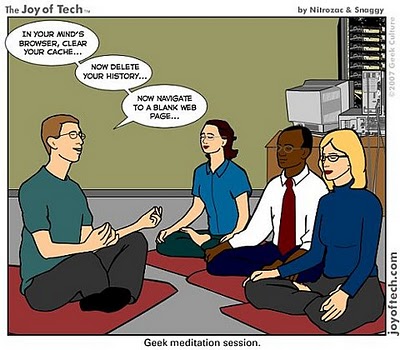
The cartoon seeks to make fun, but I find it quite serious. Is there any other way to teach meditation than in the language of those you are teaching. If one teaches a kavvanah from Rabbi Isaac the blind or Rabbi Moses Cordovero does one teach medieval cosmology and medieval science to explain it? What if it is a once a week meditation class and one wants to get down to practice. Should one use the language of bittul or of “clear your cache and history? Should one imagine light at the bottom of emanation or a blank web page? Is this modernizing into new age like neo-hasidism or the only way to do things?

Citizen Ethics in a Time of Crisis

An important booklet on social justice and religious social justice just came out in the UK, called Citizen Ethics in a Time of Crisis.
Authors include Michael Sandel, Rowen Williams, John Milbank, and many others. Many of the articles are snippets from other speeches and books but collectively they are the start of the new values and justice movement of sustainable economics and will sure to be copied and quoted by Jewish authors (think Jonathan Sacks 2011).

I will post more about it after I work my way through it.
Here is the full down-loadable text. If this does not work, then it is available from several other sites. Make sure it prints in a large enough font for reading.

Here is their website.

Blurb from movement website.

How do we decide our values?
How can we do economics as if ethics matters?
What kind of politics do we want?
What sort of common life can we share?
There is a widespread concern that the winner takes all mentality of the
banker, and the corrupted values of the politician, have replaced a common
sense ethics of fairness and integrity. Many worry that an emphasis on a
shallow individualism has damaged personal relationships and weakened
important social bonds.

What’s required is a vigorous debate about who deserves what, and the
ethics required for humans to reach their full potential.
The Citizen Ethics Network exists to promote this debate and to renew
the ethical underpinnings of economic, political and daily life.

Robert George and David Novak

I was going to post this in December and never got around to it. I taught David Novak today so it was important. The question is how much the Tikvah fund, A Jewish version of the Witherspoon institute, under Novak will create Jewish cadre of natural law theorists? Will this effect Jewish denominational lines? Will it create conservative Jewish thinkers who accept intermarriage because it is biological? I ask again – How much are Jews reading Novak?

The Conservative-Christian Big Thinker (Here are some selections)
By DAVID D. KIRKPATRICK NYT Published: December 16, 2009
Robert P. George, a Princeton University professor of jurisprudence and a Roman Catholic who is this country’s most influential conservative Christian thinker.

George had drafted a 4,700-word manifesto that promised resistance to the point of civil disobedience against any legislation that might implicate their churches or charities in abortion, embryo-destructive research or same-sex marriage.

Two months later, at a Washington press conference to present the group’s “Manhattan Declaration,” These principles did not belong to the Christian faith alone, the cardinal declared; they rested on a foundation of universal reason. “They are principles that can be known and honored by men and women of good will even apart from divine revelation,” Rigali said. “They are principles of right reason and natural law.”
Even marriage between a man and a woman, Rigali continued, was grounded not just in religion and tradition but in logic. “The true great goods of marriage — the unitive and the procreative goods — are inextricably bound together such that the complementarity of husband and wife is of the very essence of marital communion,”

FOR 20 YEARS, George has operated largely out of public view at the intersection of academia, religion and politics. In the past 12 months, however, he has stepped into a more prominent role. With the death of the Rev. Richard John Neuhaus, a Lutheran minister turned Roman Catholic priest who helped bring evangelicals and Catholics together into a political movement, George has assumed his mantle as the reigning brain of the Christian right.

As the first systematic rebuttal to Mario Cuomo and other Catholic politicians who support abortion rights, the letter kicked off a now-familiar debate inside the church. “Whenever I venture out into the public square, I would almost invariably check it out with Robby first,” Myers, now the archbishop of Newark, told me. Many of the bishops, Myers says, rely on George as “a touchstone” and “the pre-eminent Catholic intellectual.”

Last spring, George was invited to address an audience that included many bishops at a conference in Washington. He told them with typical bluntness that they should stop talking so much about the many policy issues they have taken up in the name of social justice.
Conservatives, in contrast, speak from the high ground of nonsectarian public reason. George is the leading voice for a group of Catholic scholars known as the new natural lawyers. He argues for the enforcement of a moral code as strictly traditional as that of a religious fundamentalist. What makes his natural law “new” is that it disavows dependence on divine revelation or biblical Scripture — or even history and anthropology. Instead, George rests his ethics on a foundation of “practical reason”: “invoking no authority beyond the authority of reason itself,” as he put it in one essay.Aristotelians, like St. Thomas Aquinas, hold that there is an objective moral order. Human reason can see it. And we have the free will to follow or not. “

In practice, George and his allies have usually found the rules of sexuality quite absolute, while the church’s teachings about social justice come out more contingent. That may be why he is almost uniformly popular among evangelicals but controversial among many of his fellow Catholics, particularly those who prefer the church’s peace-and-justice liberalism to its conservative bioethics.
On the question of capital punishment, George says he is against it but he considers it a matter of interpretation about which Catholics can disagree. The intentional killing of innocent civilians in war is as grave a moral crime as abortion, George says, but what constitutes a “just war” is a more complicated judgment call.

The “rights” to education and health care are another matter, George told his seminar. “Who is supposed to provide education or health care to whom?” George asked. “Health care and education are things that you have to pay for. Resources are always finite,” he went on.
But the argument for banning abortion and embryo-destructive research is “straightforward,” George told me several times.
He admits the argument for marriage between a man and a woman can require “somewhat technical philosophical analysis.” It is a two-step case that starts with marriage and works its way back to sex. First, he contends that marriage is a uniquely “comprehensive” union, meaning that it is shared at several different levels at once — emotional, spiritual and bodily. “And the really interesting evidence that it is comprehensive is that it is anchored in bodily sharing,” he says. The second step is more complicated, and more graphic. George argues that only vaginal intercourse — “procreative-type” sex acts, as George puts it — can consummate this “multilevel” mind-body union.

It is safe to say that not many contemporary philosophers — whether secular or Catholic — agree with George’s marriage argument. Many balk at the mystical “unitive and procreative” qualities George ascribes to sexual intercourse. The idea of “one flesh” union seems far less obviously intelligible than other “basic goods” like friendship, knowledge or religion. Even fellow Catholic Thomists who oppose same-sex marriage question the esoteric quality of George’s argument.
George and his wife, Cindy, who is Jewish.

As a side show, over at the blog of predominately law professors, Mirror of Justice there were some blog posts about Novak and a letter from him and then a cat fight of posts betweeen Jan 29th and Feb3rd that were quickly taken down (I saved copies from cache). David Novak wrote a blurb for liberal pro-abortion theortist Martha Nussbaum. One of the bloggers questioned the hypocrisy and Robert George came to the defense of Novak, which lead to accusations of special pleading. By the time it was over, there was a new blog RelgiousLeftLAw.

Jewish respect and admiration for Muslim religiosity

Here is something from last week by Zvi Zohar, Jewish respect and admiration for Muslim religiosity

A full English translation of the original account is here. The original Hebrew article, with extensive footnotes was “An Awesome Event in the City of Damascus” in Tolerance in Religious Traditions (Shlomo Fisher ed., 2008).

Here I consider one such source, found in the writings of Rabbi Yitzhak Farhi of Jerusalem (1782-1853). It tells of a relationship between two outstanding men in late 18th century Damascus: a great Sufi sheikh and the Chief Rabbi of Damascus.
One of the two heroes of Farhi’s tale, the Sufi sheikh, attained great mastery of the Seven Wisdoms, i.e., the body of universal human knowledge. Since a person’s perfection is contingent upon mastery of these wisdoms, the sheikh was more perfect than all the Jews of his generation, with the exception of the rabbi of Damascus, who was his equal and even slightly his superior in the realm of universal wisdom.

But the Seven Wisdoms are of course only one aspect of religious perfection: the highest form of religious accomplishment is the encounter with God and closeness to Him. In this realm, the realm of religious-mystical experience, it emerges quite clearly from Rabbi Farhi’s account that the sheikh was on a higher level than the rabbi. In that account, it was the sheikh who guided the rabbi along the paths of mystical experience, by way of the garden and the pool, until their joint entry into the Holy of Holies to encounter the Divine Reality reflected in the holy name YHVH. The words on the golden tablet they gazed upon were: “I envision YHWH before me always”. This formula is to be found in every synagogue. Yet as related by Farhi, the one who actualised the promise born by this verse, the person who was indeed able to envision in his consciousness “He Who Spoke and the universe was created”, was not the Jewish rabbi but the Muslim sheikh.

At the end of their joint journey, the rabbi shed copious tears, acknowledged the sheikh’s advantage in this crucial realm, and concluded: “It is becoming upon us to do even more than that”.

Rabbi Yitzhak Farhi, addressing his audience in Jerusalem and the Ottoman Empire in the fourth decade of the 19th century, presented the Sufi sheikh as an ideal spiritual figure reaching the greatest heights of awe of God.
And above all else, there are shared elements and a partnership in the mystical experience itself—and in the joint focus of this experience: “He Who Spoke and the universe was created”. Not a Muslim God, and not a Jewish God, but the God of all existence, the Creator of all.

* Zvi Zohar is a professor of Sephardic Law and Ethics at Bar Ilan University, a Senior Research Fellow at the Shalom Hartman Institute of Advanced Judaic Studies in Jerusalem. A full translation, analysis and discussion of Rabbi Farhi’s account will soon be published in Jewish Studies Quarterly under the title “The Rabbi and the Sheikh”.
Read Full op-ed Version here.

Update: I received a comment of Islamaphobia with an IP number from the Israel Tel Aviv Ministry-of-finance. Dont they at least tell people not to make such statements from work? Or at least not in English?