Author Archives: Alan Brill

Pesach Sheni as a therapeutic holiday

This is an update of a short 800-word post from 2010, now it is seven times larger. It is another one of my loose observations of lived religion. 

It seems that before our eyes Pesach Sheni became a holiday of second chances, reminding everyone to make sure that everyone is included and that no one is excluded. This folk practice has connections to Chabad, contemporary American sociology, and current trends in theology

Traditionally, Pesach Sheni was a minor vestigial day, which some especially Hasidim treating it as a minor festival. The practice of Pesach Sheni was originally a day for those who could not bring the Passover sacrifice to be allowed to bring the sacrifice a month later. There are customs among some Hasidim to eat a piece of matza on this day or to hold a seder – a tisch for Hasidic Torah.

The homiletical Torah in later centuries for this day was about those who carried Yosef’s bones. In the Middle Ages it was the last chance to see the miracle of the Exodus and bask in how God is above the natural order. And there is some Polish Hasidic Torah about hametz and matzah being at the same time. There was an important section in the Zohar and it was the holiday of Rabbi Meir Baal Hanes charity (see below).

A decade ago, about 2008 there was a burst on the scene of this Pesach Sheni practice within the broader Jewish community. This day became a day when all those who need a second chance have their holiday. Almost any metaphors of 12 step, broken pieces, therapeutic religion, or shattered lives have made their way into Pesach Sheni Torah, from all sorts of outreach/kiruv and self-help sources. (There is enough for grad student to collect and sort it out.)

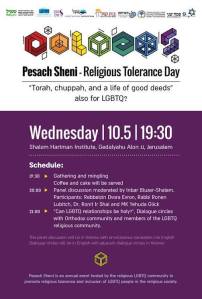
Originally, it applied to those released from prison, recovering from addiction, or having mental health issues. In the last five years it was further extended to broader questions of diversity to include feminism, LGBTQ. In 2010, Kolech – the Israeli Orthodox feminist organization and initiated by Bat-Kol, the organization of religious lesbians, proclaimed it a day of inclusion of all. The holiday picks up steam in 2016 year when was a widely circulated blog post discussing it as a holiday for GLBT exclusion. In addition, Rav Cherlow gave a Pesach Sheni talk on the need to confront the other and this year on the need to accept gays in the community. In 2017, Pesach Sheni was a declared religious tolerance day.

But what I am noticing on this one is that the individualism of the kiruv organization, yeshivish self help and Neo-Hasidism is overlapping in metaphors and folk holidays with the liberal voices of diversity. There is a social reality of exclusion needing homilies of inclusion and a reality of therapeutic Torah.

Since the practice of Pesach Sheni had little current actual practice except for the pietistic custom of eating a piece of matza. It was an ideal underdetermined date with underdetermined practice ready to be filled in by a contemporary cosmology. Much of the language for this holiday comes from Chabad sources.

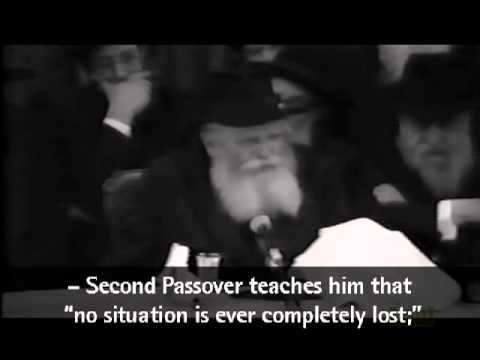
rebbe-pesach sheni

Origins in Chabad Theology

The Sixth Lubavitcher Rebbe Yosef Yitzhak Schneersohn arrived in the United States, first as a visit in the 1929 and then permanently in 1940. Already from his first trip the United Sates, he emphasized the piety of the common person over the Rabbinic elite. In his sermons from his visit to Chicago, he categorically stated that the simple Jew who burns in his heart is greater than the intellectual scholar who is religiously cold. He also produced many stories of holy people who appear as sinners or ordinary people. He taught about how simple unlettered Jews are not far from God – in contrast to the rigid hierarchy of Lithuanian Jewry. He was showing inclusiveness for those whose journeys took their personal narrative far from the imagined ideal in contrast to the Rabbinic establishment seeking to exclude.

In 1944, the Rebbe Riyatz (Rebbe Yosef Yitzhak Schneersohn) wrote that Pesach Sheni is a second chance for all those who were far away. It was a noble message for an era of immigration and dispersion. This concern for simple yidden and their probelms, however, went out of fashion in the post WWII era.

In his diary of daily advice (edited by his future successor Rabbi Menachem Mendel) he wrote:

Iyar 14, Pesach Sheini, 29th day of the omer 5703

The theme of Pesach Sheini is that it is never too late. It is always possible to put things right. Even if one was tamei (ritually impure), or one was far away, and even in a case of lachem, when this (impurity etc.) was deliberate – nonetheless he can correct it.

Rebbe Yosef Yitzhak Schneersohn in his sermons was dealing with actually displacement of war, famine, and struggles to survive. Now we have an acute sense by many in the community that many people are excluded and need to be made welcome again.

In 1978, his successor the Rebbe Menachem Mendel Schneersohn told over the teaching of Pesach Sheni from the prior Rebbe as an opportunity for a second chance.

Pesach Sheni gives those who did not offer the Pesach sacrifice the first time the opportunity to do so a month later. Its message is that nothing is irretrievable, that a Jew can always rehabilitate himself.
One clear lesson from Pesach Sheni is that a Jew need never give up hope. In the words of the Previous Lubavitcher Rebbe: “The idea of Pesach Sheni is that nothing is irretrievable; we can always rectify our behavior. Even one who was ritually unclean or who was on a distant journey – even willingly – can still rehabilitate himself.” A Jew is intrinsically good, his soul “a part of G-d Above.” Sin is completely antithetical to his nature. If he does transgress, it is an aberration that cannot touch his essential self. He may be temporarily unclean, but he is of the loftiest levels. Thus no sin, no omission of service to G-d, is irretrievable. A Jew can always return to his real identity. Likkute Sichos XII 5738, emor 216-220

In later talks, as paraphrased on the Chabad website, the holiday is an opportunity to change our lives. However, this opportunity is available specifically to those fell from the envisioned path. Their fall is the catalyst for greater growth. A form of spiritual decent for the sake of ascent.

Pesach Sheini embodies the approach of teshuva. In order to return to the proper path, it is not enough to merely avoid impropriety; the individual must address the fact that he has succumbed to the forces of evil and use this fact to strengthen the weak point in his relationship with G‑d. When he does this, he transforms the power of evil into holiness and his previous sin into a source of merit, thereby obtaining G‑d’s forgiveness for his misdeed. This capacity – the ability to change that which is already done and to overcome wrongs that have already been perpetrated – is drawn from a source of transcendent spirituality, a level beyond merit or iniquity. It taps into the essential relationship between man and G‑d, which is not predicated on our obedience to His will. This connection can never waver, for it is intrinsic in nature; the essence of the Jewish soul is one with G‑d whether they obey His will or not.The leaven need not be banished, since we are ready to elevate it…

Because Pesach Sheini, is an exercise in transcendence, it does not require the methodical preparation required by the regular Pesach. The leaven need not be banished, since we are ready to elevate it, too. Earlier impurity no longer matters, for it cannot destroy this intrinsic connection. And one day is enough, for this connection transcends time as well as behavioral issues.

If, as has been explained, Pesach Sheini embodies a higher degree of divine service, why is it reserved for those who became defiled? Why could one who brought the sacrifice on the first Pesach not enjoy the sublimity of the second? How was he to achieve the advantages of transcendence?

It was only those who had deviated from the proper path and had never begun a proper journey of growth that needed to skip directly to the transcendent. They required a catalyst, an offering to be brought in the second month, because without that “jump”, they would have remained helpless and unchanged.

Why do we celebrate the Pesach Sheini nowadays? We were not obligated to bring the sacrifice on the first Pesach. Why do we mark the secondary choice?

The answer is that we celebrate its spiritual meaning. We celebrate the added capacity to achieve a higher degree of spiritual connection. And, we celebrate its lesson: no matter what may have happened in the past, no matter what we may have spoiled, it’s never too late. We still have the ability and opportunity to change – not only our futures, but even the effects of the past.

Typically, Chabad spirituality since the Tanya has stressed the proper path of Torah teaching that one should avoid sin or things that take one from the path. In Chassidic language. It is overcoming temptation (itcafya). However, here we have the other Hasidc option discussed more in other groups of transforming the spiritual energy of the deviation to a higher service (ithafcha). This is closer to an Izbitz of transforming sin into merit teaching than popular Chabad approach.

Nevertheless, this homily follows from the other homilies of Rebbe Menachem Mendel teaching there is a transcendental place, a higher connection, that can transcend ordinary approaches. In most places, the Rebbe calls this Kesser (keter), the point of pure devotion and giving of the will higher than medieval sefrotic hierarchies or specific mizvot. Here we have an ordinary day in which we can work and eat leavened bread that is paradoxically higher then Passover itself.

There is also speculation that the Rebbe’s Pesach sheni teachings are somehow also connected to the yahrzeit of Yisroel Are Leib, the Rebbes brother, who left the religious path.

Reb Shlomo Carlebach added these ideas to his repertoire of stories from Rebbe Riyatz on holy sinners, ordinary people, and deepest desires as a path to a high service. The Carlebach Torah for Pesach Sheni was already on the web back in the days of Web 1.0 and majordomo mailing lists letting the ideas diffuse widely.

By the new millennium these ideas had migrated into English Breslov, outreach literature, and web Torah, but as part of other homilies. It was turned into a day of second chances for convicts, addicts, abuse, sexual and gender alienation, divorce, second marriages, and GLBT identity.  It seems to have happened very quickly both here and in Israel.

Prison and Released Prisoners.

The first group to make use of these ideas was for Chabad organized conferences for prison chaplains. Prisoners and those families touched by cycles of incarceration needed a second chance.

But there is a deeper story here; once again a Chabad story.  Chabad under the Rebbe Riyatz and Rebbe Menchaem Mendel reached out in their outreach to prisoners, mentally and psychologically challenged in mental hospitals, the elderly and infirm, the substance addicted, the handicapped, soldiers, and the deeply assimilated.

I recently supervised as an outside reader an Israeli social work MA on the principles of inclusion of the Rebbe. Whereas, most Jewish communal work is focused on the core of those committed or bringing people into the core, Chabad as expressed in the Rebbe’s talks includes everyone. They can fill an empty synagogue space by going door to door and inviting the elderly and infirm, or bring people from a local institution or assimilated merchants. They can ask tattooed musicians or intermarried storekeepers: “Are you Jewish?” Many say they want to learn from Chabad in doing outreach but then miss the point by doing outreach only to comfortable and well-organized suburbanites. Then you are only doing marketing and not imitating Chabad who are doing inclusion. I am not saying that Chabad always has the knowledge and professional skills to handle the problems of these constituencies, but they include them.

Hence, one of the first groups to make much of this day were the Chabad groups engaged in outreach to prisoners.

It’s a most opportune day to change for the better, notes Rabbi Moishe Mayir Vogel, the executive director of the northeast chapter of the Aleph Institute, an international organization that aims to help incarcerated Jews and their families, in addition to Jewish service men and women in the U.S. military.

The nonprofit entity will host its seventh annual Re-Entry Symposium, a training program for Jewish chaplains who serve people in prisons, hospitals or group homes. “The way forward is to teach” people who are incarcerated, emphasizes Vogel, “and give them the rehab they need to become productive citizens.”

“We all trip in our own ways, and we have to know that there is a second chance,” says the rabbi. “We can always repent. We can start off life anew. We can fix the errors that we have made.”

Here is where this blog post comes in. These concept of second chances and these activities of inclusion are mainstream in the 21th century among many Americans. When the Chabad chaplains were organizing, so too the Christian and non-affiliated groups have been organizing for the last decade. Most of you are probably unaware that in April 2017, the month of April was adopted in a bipartisan action as “Second Chance Month for those affected by Crime and Incarceration.” The United States has institutionalized April as a time of Second Chances and it coincides every year with Pesach Sheni

In 2017, the U.S. Senate unanimously passed a resolution declaring April “Second Chance Month,” a time to focus on giving those who have committed a crime, done their time, and have been released back into the community a second chance to be productive and contributing citizens. The 65 million Americans with a criminal record experience limited access to jobs, education, housing, and other things necessary for a full and productive life.

Make your church a welcoming place for people affected by crime and incarceration with a message on redemption and a special prayer time for impacted families.

Someone even wrote a speech for President Trump on this theme of reintegration in society after incarceration.

During Second Chance Month, our Nation emphasizes the need to prevent crime on our streets, to respect the rule of law by prosecuting individuals who break the law, and to provide opportunities for people with criminal records to earn an honest second chance.  Affording those who have been held accountable for their crimes an opportunity to become contributing members of society is a critical element of criminal justice that can reduce our crime rates and prison populations, decrease burdens to the American taxpayer, and make America safer.

pesach sheni

Further Extensions to the Holocaust and to Acceptance of our defects.

As noted, this idea of a second chance moved to many directions. There are dozens of applications online, but I only want to note a few.

It has been extended as a way to understand how Holocaust survivors were given a second chance, helped by the proximity of Holocaust Remembrance day to Pesach Sheni. There are stories online connecting Pesach Sheni to the liberation of Buchenwald and the Passover eating of matza held that year on Pesach Sheni. “All Jews were invited by Rabbi [Herschel] Schacter to attend services and to eat Matza, since it was Pesach Sheini that day. The second Pesach, for Jews that couldn’t observe the holiday of Pesach at the proper date…The prisoners of Buchenwald never dreamt they would be given a second chance.

Here is one where the Holocaust theme become a model for accepts our defects and moving beyond things that hold us back.

The Gift of Second Chances 

Some apply the concept to their personal narratives as children of Holocaust survivors and their own having to learn compassion as second generation of survivors. “My parents’ lives were replete with second chances. My mother lost her entire family, yet she was able to pursue her life-long dream of becoming a physician. My father survived numerous dramatic encounters with death…”  Yet this author notes they became critical and perfectionist with their children.  “My parents survived on second chances, but they were unable to offer me (or my siblings) the same. Perfectionism ruled our home. Mistakes were not an option. Compliance was survival. Criticism was the language of lullabies; I was nursed on negativity.”

Today I have compassion. I know that my parents could not have done any differently. With their pain, they built the best lives they could. They endured unimaginable horrors. They lacked the gift of faith.

In their plea for a second chance to bring the Passover offering, our ancestors gave expression to our own inner truths: Just because we have inherited traits and adopted behaviors that do not serve us well, why should we miss out on the joys of life? We, too, want fullness and richness and serenity in our lives, true closeness in our relationships.

The same author then extends this framework of not  missing out on the joys in life to brader issues of Judaism and serving God with our imperfections.

The gifts of recovery stem from our connection with our Creator. Biblically, bringing offerings was about coming close to G‑d. In our days, we, too, bring our offerings as a way of coming close to G‑d. We present our defects of character. We offer our addictions, our passions, our habits. We beg G‑d to remove the obstacles to our spiritual, emotional, and physical well being.

Many recovery groups study Step Five this month. We admit to G‑d, to ourselves and to another human being the exact nature of our wrongs. This is Pesach Sheni/Second Chance work! In admitting our shortcomings in this manner, we have another opportunity to renew our relationship with G‑d. We can become acquainted with our true selves.

Pesach Sheni as a holiday for Feminism and LGBTQ inclusion

Pesach Sheni can represent the inclusion of women for example using the daughters of Tzelophechad as an example.  This Year JOFA is hold a women’s seder on Pesach Sheni as part of a message of inclusion. An example of an Orthodox feminist application is the following:

Nowadays Pesach Sheni is a symbolic date on our calendar, but we can imbue it with contemporary significance by lending it to the ongoing debate around the inclusion of women in rituals from which they have traditionally been exempt. The debate, comprised of numerous elements, both halakhic and hashkafic, would be richer if it included the sociological role of belonging that many of these rituals invoke.

It may well be that in strict halakhic terms a woman is exempt from a particular ritual, but as Pesach Sheini informs us, exemption often comes at a cost. In the case of women and ritual, the cost can be alienation and disconnection from the sacred community. The important question then is, can we afford to bear this cost?

An analogy between the celebration Pesach Sheni and the allowance of same sex marriage as an act of inclusion. Several online statements argue that this Torah portion tells us God instituted a new holiday to enable all people to be involved even if they were different.

They usually connect this inclusion to general diversity issues related to gender and sexuality, but also race, ethnicity, and class

Our Torah portion tells us God instituted a new holiday to enable all people to be involved even if they were different. Putting this notion into modern times makes it easy to believe God wants us to be able to marry if we choose to, since today, marriage can be perceived as analogous to Pesach observance for our ancestors many millennia ago: it demonstrates a kind of “fitting in” or adherence to “expectations” and we all deserve to be able to do this if we feel so inclined.

Second, all people, according to the Torah, are held to the same standards no matter when they celebrate Pesach. Similarly, no matter whether a marriage is same or opposite sex, God expects the same level of commitment, respect, etc. within the relationship; simply being different doesn’t mean we are held to a different-no matter whether it’s lower or higher standard than other people are.

toelerance

American Popular Psychology Applications of Pesach Sheni

This topic of second chances is playing a bigger role in American culture. For example, there is a journalistic pop psych book “The God of Second Chances,” by Marcia Z. Nelson in which the author traveled the United States in search of people whose lives were transformed by religion.  She found people who returned to religion as a second chance after drugs, after tragic loss of family in premature deaths, after involvement in extreme political groups.

None of her stories told how everything has been wonderful since they found God, the struggles continue, even after divine presence has entered into their lives and transformed them. Rather the book showed that shows something that American organized religion tends not to see: “the extreme highs and lows that characterize the lives of many people, including people of faith.” And it showed the complex ebb and flow, the forward and backward movement of divine transformation. “Sometimes, there are permanent scars. The Jewish man, for example, lost his once-powerful voice to throat cancer – an experience he understood as God taking him by the throat and insisting, “Shut up. Stop talking. Start listening.” The important thing about second chances is that the past can and will influence your life forever. A person uses their struggles to fuel the second chance.

In a similar manner, there are human-interest stories from Jewish journalists about their second chances and their overcoming a sense of disconnection. Websites such as Aish can sanctify people getting their lives in order as part of the Torah concept of Pesach Sheni.

Pesach Sheni: The Holiday of Second Chances Karen Wolfers Rapaport

Disconnection is often a byproduct of unconscious living. When we let our conditioning be our compass so that our paths never change, neither will our landscape. Whether it’s in relation to ourselves or to others we will feel disconnected from the inroads that lead to our essential self.

But life gives us many second chances. And each time we choose to live consciously and move from judgment to compassion, apathy to care, idleness to activity, we begin to reconnect and travel towards home… Pesach Sheni, the Second Passover, thus represents the power of rerouting to our core, to our Divine connection.

American Society and Second Chances

Prof David Newman, a sociologist at DePauw University delivered a paper on “The Practice and Promise of Second Chances in American Culture” and will have a forthcoming book The Promise, Practice and Price of Second Chances in American Culture (Lexington Books), projected to be published in 2019 (Lexington Books). He shared his unpublished paper delivered at the ASA with me.

Newman notes that the news is filled with stories of high-profile people making serious mistakes, crimes, or acts of bad behavior, followed by apologies, then a period of non-visibility (in rehab, in prison, on the disabled list, under suspension, or simply in seclusion). The conclusion is inevitably the individual claiming to experience an epiphany about the misdirection of his or her former life and promises to be a better person from now on, allowing him or her to make a comeback.

But our American lives are filled with adults shifting the trajectory of their lives, divorces remarrying, or fortunate patients overcoming a life-threatening medical condition. According to Newman, “in every facet of our lives” including “intimate relationships, academic performance, occupational choices, financial well-being, run-ins with the law, spiritual happiness, physical health” Americans “expect and seek out opportunities to overcome past misfortune, fix past mistakes, amend past transgressions, or correct past failures.”  Newman notes that the concept of a second chance is a “quintessential cultural paradox,” which represents “individual hopes for redemption, while at the same time it reminds us of our harshest proscriptions and darkest suspicions about the intransigence of human nature.

We find the concept of a second chance “in some form, in societies around the world, it has an especially American appeal.” It combines “Judeo-Christian tradition’s allowance for sinners to repent or atone for their sins and be fully redeemed” with American “therapeutic ideology, providing a progressive, optimistic, curative setting for individual rehabilitation while simultaneously rebuffing the notion that people are inherently, permanently flawed.”

Newman counted over 2,000 listings in the Library of Congress “for novels with “Second Chance” or “Starting Over” in the title.” In addition, “second chance imagery is especially strong in our popular cinema.” We use the phrase second chance in diverse aspects of our life ,” there are second chance checking accounts, second chance credit cards, second chance auto loans, and second chance low-rent.”

In short, we want each phase of our lives to lead logically and progressively to the next… By connecting past transgressions or mistakes to future opportunities for a second chance, we allow our life stories to unfold in a comprehensible trajectory. We are thus able to create order out of a life that might appear on the surface to be muddled and aimless.

When you combine this sort of cultural ethos with the equally powerful western value of individual achievement and the drive for success, it is not surprising that a narrative has taken hold that rhetorically and pragmatically provides people who have somehow fallen short with opportunities to reboot and start over. The second chance serves as road repair—renovating the cracks, filling the potholes, and ultimately smoothing the route to future accomplishment and fulfillment.

As the therapeutic second chance industry has grown, it has become highly specialized. Yet Newman’s analysis of these agencies revealed that they are split roughly equally between those that exist to help people whose misbehaviors have gotten them into trouble, including ex-prisoners, former substance abusers, rebellious teens. And those that seek to help people who are victims of some unfortunate life turn that they couldnot control, including homeless people, transplant recipients, cancer survivors, domestic violence victims.

Newman notes with surprise “that a significant number of agencies… make no distinction at all between the various types of suffering that lead people to a point where they need a second chance… “Indeed some agencies pride themselves on the fact that they attempt to serve the needs of anyone who needs a second chance, no matter who or why.” The philosophic and theological concept of a  second chance takes precedence over the causes of that need. Hence, troubled teens, substance abuser or ex-criminals are treated together with cancer survivors, homeless, and violence victims.

Newman contrasts this new narrative with the concept of the permanent stigma narrative. One cannot have any do overs or second chances in this model. As F. Scott Fitzgerald once said, “You never get a second chance to make a first impression. This more traditional alternative stress that  “Once a ________, always a ________,” for Newman this model “resonates in this culture just as much as the redemption rhetoric.”

Contemporary Theology

These popular ideas of second chances and finding a means for inclusion of those who were excluded is also important in contemporary theology. There are dozens of books on the topic and American theological schools and seminaries offer courses on inclusion and second chances. Courses teach about offering hospitality to those in our population considered strangers and to enable students to use that moral framework in developing a pastoral response to contemporary issues of diversity and inclusion in church and society.

Persons with disabilities help theologians to rethink theological assumptions about God, humanity, and the church. They are also helping ministry practitioners to make worship more inclusive and hospitable to all people. For example, religion cannot only be for the smart, able, and wealthy.  The courses discuss diversity, race relations, homelessness, refugees, migrant workers, and persons with disabilities.

The goal of these courses is to teach that we are not our limitations and our limited bodies, or conversely we are our bodies and limitations. The community has to learn to be accepting without being patronizing, rather the fundamental anthopology has to be inclusive.

Here are some examples:

On Disability read Nancy Eiesland, The Disabled God  and Amos Yong,  The Bible, Disability, and the  Church. Then discuss How do contemporary perspectives about disability change how we think of human nature? How does our view of disability affect pastoral care and welcome for those with disabilities?

When I read these theological works on physical disability, I wanted to blog about how that changes our views of Maimonides, of Soloveitchik, and of Modern Orthodoxy but never had the chance. If most of our conceptions of our prior conceptions Torah are intellectualist then where do the mentally challenged, the person with cerebral palsy, or the deaf fit in? Not the question of whether they can be called to the Torah for an aliyah but what is our religious anthropology?

On Gender read Sarah Coakley,  God, Sexuality, and the Self,  then discuss how do women’s voices change discussions of gender and sexuality? What is the relationship between theology and pastoral care in matters of gender

Older classics from twenty years ago on these topics that won awards include:

Miroslav Volf, Exclusion and Embrace.  Nashville: Abingdon, 1996.; Bernard Adeney, Strange Virtues: Ethics in a Multicultural World. InterVarsity Press, 1995;Brett Webb-Mitchell, Unexpected Guests at God’s Banquet: Welcoming People with Disabilities into the Church. NY: Crossroad, 1994.

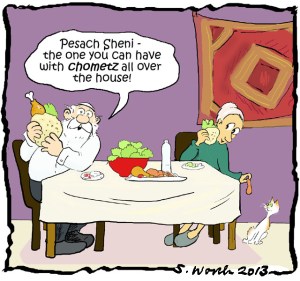
pesachsheni2

Traditional Sources on Pesach Sheni not related to Second Chances

Pesach Sheni is the Yom Hillula -Yahrzeit of the Tanna, Rabbi Meir “Baal HaNess” (“Master of the miracle”), on which the charity Kupath Rabbi Meir Baal HaNess Kolel Polen, founded in 1796 in Poland named after the tanna Rabbi Meir.  The charity was founded by Rabbi Abraham Kalisker, leader of the Hasidim in Tiberias. He secured the assistance of Rabbi Mordecai of Nieschiz, who issued a proclamation urging all Jews of Poland regardless of age, gender, or living conditions, to pay a fixed sum every week for the support of their countrymen who had settled in the Holy Land. The amount was to be paid quarterly, in addition to special donations at weddings, circumcisions, and other religious rejoicings.

In the Ra’aya Meheimna (The Faithful Shepherd) section of the Zohar, an early 14th-century work that makes Moses the faithful shepherd, not Shimon bar Yochai as the hero and protagonist. In this reading the divine Matron descends to be seen in her full regalia for a full month which ends on Pesach Sheni. (It is like a darshan of Shakhti in Hinduism). This second passsover is from the left-handed side of gevurah from binah in which all human impurity is burned off in the fire of gevurah.

It is a commandment to make a second Pesach for those that were unable or were defiled by any other uncleanness. If the secret of Pesach, which is the secret of the faith in which Yisrael entered, dominates in the month of Nissan and then it is the time for rejoicing, how could those who were unable to prepare it on time, or were defiled, make up for it in the second month, seeing that its time had already passed?

Once the Congregation of Israel is adorned with its crowns in the month of Nissan, she does not remove these crowns and adornments from herself for thirty days. The Matron sits in her adornments all these thirty days, beginning with the day of the exodus of Israel since the Pesach lamb and all her legions are in a state of happiness. Whoever wishes to see the Matron may look.

A proclamation calls: Whoever did not get a chance to see the Matron should come and look before the gates are locked. When is this proclamation proclaimed? It is on the fourteenth day of the second month, since the gates remain open from then on for seven days following. Following that, they lock the gates. Therefore, this is the second Pesach.

The Shekhinah is the first Pesach from the right side, and the second Pesah from the left. The first Pesach is from the right where Hokhmah prevails. The second Pesach is in the left where Binah prevails. In Gevurah all foreign fires are removed, which are like straw and chaff in relation to the fire of Gevurah. The unclean are delayed until the second Pesach.

For an example of a non-hasidic homily, I offer Rav Gedalia Schorr who read Hasidut including Izbitz and Rav Zadok, yet treats the holiday as our chance to show our yeshivish effort and earned merit unlike Passover itself which was God’s hand.

Rav Gedalia Schorr in Ohr Gedalyahu explains that Pesach is a great gift from Hashem.  Normally for us to get something from Hashem we must make the first move towards Hashem and then he reciprocates by opening the floodgates.  You open up a miniscule opening for Hashem and Hashem will open a gigantic opening for you.  We didn’t make the slightest move towards Hashem in Egypt yet Hashem ignored that and came our rescue anyway.

Sefira is a time where after having received Hashem’s great chesed on Pesach we go back slowly and earn it day by day… When we demanded Pesach Sheini Hashem opened up the Heavens and graced us with this wonderful opportunity.  The whole point of this second Pesach was that the inspiration come from us below.

Finally, as I was writing this blog post a lecture with a restrictive message of not missing the boat appeared on YUTorah on Pesach Sheni. It was given in Israel by an Ivy League law graduate and former law partner whose entire emphasis was about exclusion or a narrow life boat. We need to find a way to submit to the fixed system in order to be counted, the opposite of all these recent trends. The lecturer basic showed how without keeping Passover you are entirely excluded from the Jewish people and without believing in God’s miraculous hand in the Passover story, you are excluded and deserving of excision from the people (karet). If one is excluded, then one is outside the foundations of Torah and hence excluded regardless of the reason. Pesach Sheni is way to make sure you don’t miss the boat in submission in thought and action and find yourself excluded or cut off (karet).

Shlissel Challah, Bread Baking, and the Relief of Anxiety -An Update

This is an update of a post from 2016 with revisions based on extensive Facebook discussion. New posts are coming within a few days.

For those who do not know, in recent years there has been a revival of the folk practice of baking a key into Challah (Shlissel Challah) during the week after Passover as a charm to insure successful livelihood.

In short, I will treat the ritual as modern home ritual focusing on baking bread after Passover, not as a magical act, and sometimes as an act done to relieve the anxiety for making a good livelihood because people are very concerned about paying their bills and making a living especially after the economic downturn.  But, it is more connected to the trend of challah baking parties and contemporary spirituality. It has become a form of annual symbolism, the same way one buys a round challah for Rosh Hashanah, one buys a key challah this week.

This post is not about the Hasidic community or  those who were doing it thirty years ago. It is only about the progress of the custom in the modern community within the last dozen years. If you were from a community doing it thirty years ago, then I am not addressing you. 

Malinowski in Teaneck

For more than decade, I have wanted to do an article entitled “Malinowski in Teaneck.” This is just the tip of the iceberg of many related observations on this topic. I do not think one needs to accept all, or even most, of the functionalism of Malinowski, but the insights are valuable.

Already fifteen years ago, I was taking note of the huge amount of magical acts, healing practices, segulot, and rituals to affect or change bad situations that took place among the modern Orthodox Jews of Bergen county. Keeping track and documenting of the magical practices was easy through the local community shul list serve, currently at over 14,000 members, where invitations to practices were openly posted.

The famed anthropologist Bronisław Malinowski  (d. 1884-1942) wrote seminal articles in the 1920’s and 1930’s showing that people turn to magic when they are doing everything right but things are still coming out wrong.  For example, when a person did everything right in one’s farming or fishing, but one still had well-placed anxiety about this year’s harvest since life is never certain. One released the tension through magical practices. One did magical practices to ensure a good catch even though you still knew it was based on skill and hard work because life remains fragile and contingent.

My original intention was to post about the magic practices by those in Teaneck stricken by illness. Last decade there was a boom in these new practices. They know they have to go to doctors and specialists, along with second and third medical opinions; they know it depends on modern science and the best procedures. But when that fails they turn to magic to deal with the anxiety about the failure and that they have exhausted all possible means. In addition, in their minds they did everything right religiously, they went to the right gap year programs, they followed the rules for social and professional success-so they are left the question: why did this happen? The halakhic universe of duty and obligations does not address their anxiety. Telling them it is nonsense or forbidden is beside the point in relieving anxiety and fear. They will just seek the relief elsewhere.

According to Malinowski:

Wherever there are situations of danger or uncertainty, rift between ideals and realities, or human crisis and resulting in anxiety and fear, religion and magic steps in and attempts to resolve, mediate and/or lessen, and provides chart and procedural knowledge to give order and control.

He must admit that neither his knowledge nor his most painstaking efforts are a warranty of success. Something unaccountable usually enters and baffles his anticipations…Man feels that he can do something to wrestle with that mysterious element or force, to help and abet his luck.

There are no peoples however primitive without religion and magic. Nor are there, it must be added at one, any savage races lacking in either the scientific attitude, or in science, though this lack has been frequently attributed to them.

Malinowski wrote that: “Magic therefore, far from being primitive science, is the outgrowth of clear recognition that science has its limits and that a human mind and human skill are at times impotent.”  These practices are non-pseudo- science; people know what they have to do rationally.  Rather, they are means to deal with the frustrations of real life.  Malinowski confirms the Talmud when it says: “Most sailors are pious, He that will learn to pray, let him go to sea,” (Mish. Kid. iv. 14).

Magic is to be expected and generally to be found whenever man comes to an unbridgeable gap, a hiatus in his knowledge or in his powers of practical control and yet has to continue in his pursuit. Forsaken by his knowledge, balled by the results of his experience, unable to apply any effective technical skill, he realizes his impotence. Yet his desire grips him only the more strongly. His fears and hopes, his general anxiety, produce state of unstable equilibrium in his organism by which he is driven to some sort of vicarious activity.

Malinowski still acknowledges the rituals of social order and heightened tension but some are the result of psychological anxieties. What he is rejecting it the approaches of the 19th century E. B. Tylor who developed the evolutionary scheme where people need to be taught to move past their superstitious past based on a lack of knowledge of science and accept the rational world of science.  For Tylor, magic is attempt of bad science cause-effect For Malinowski, magic reduces anxiety and is integrated within proper knowledge of procedures for success, hence it is still part of the life of modern scientific people.

According to Malinowski, the ritual eases stress, mental conflict and possible psychic disintegration. In addition, magic serves not only as an integrative force to the individual but also as an organizing force to society when the stress is collective.

Most practitioners of anxiety magic are middle-class professionals. To take a noticeable case that has been subject to several studies is the great American pastime of baseball . Most baseball players , similar to Talmudic sailors, engage in various magical practices because one can still have bad days despite their training, hard work, and skills.  They have million dollar contracts, managers, and coaches. Yet, they engage in many magical rituals to relieve the stress of winning. They are not following Hasidic customs or pagan practices; they are not ignoring their training or thinking that is all they need. Rather, they are attaching their hope and fear onto a practice as a way of relieving anxiety. Many professions, even those in the upper middle class, or maybe especially those in the upper middle class, partake of a variety of magical practices.

Alternately, Michael Taussig, the Australian anthropologist,  points out the role of magical ritual in capitalist production of wealth, in that, wealth is a limited commodity and requires magic and contact with the devil to obtain a share of it. Michael Taussig’s discusses how societies that come into contact with capitalism for the first time tend to find this fetishistic process pretty weird, and associate it with magic and sorcery—Columbian rural farmers, when introduced to capitalist agriculture, developed myths about how one could, by dealing with the devil, plant money in hope that this money will grow, a practice which only strikes outsiders as strange because the would-be devil worshipers weren’t going about it the right way, using savings accounts, mutual funds etc. The observant life style would be be a form of creation of capital. The desire for wealth creates a need to perform magical acts. This would be a fruitful alternate line of thinking to Malinowski.

Shlissel Challah and Segulah

Now to the segulah of Shlissel Challah, which is to either bake a key into a challah, or to form the challah in the shape of a key for the first Shabbat after Passover . The key is supposed to allow the opening of the gates of heaven for money and making a living. The custom has early 19th century roots in a custom of the Ukrainian Hasidic Rebbes, Rabbi Pinchas of Koretz and Rabbi Avraham Yehoshua Heshel of Apt, popularly known as the Apter Rebbe (d. 1825).  (For the current Ultra-Orthodox debate on the topic, see here.)

In addition, there are scores of practices involving the connections of the sacredness of the twelve loaves  of show-bread, the manna in the desert and sacred eating go back to Second Temple times and are further developed in Midrash and Zohar. These themes of the holiness of sacramental bread have not been emphasized in recent history.

Segulot are the Jewish magical and folk charm and remedy practices, of which there are thousands.  Some date back to Second Temple times and the tradition of using them continued unabated through two millennium of Jewish life. They collected in large volumes with names like Sefer HaSegulot, Sefer Ha-Refuʾah Ve-HaSegulah, and Sefer haZekhirah. The Talmud advises that Psalm 91 wards off mazikin (evil spirits or demons), the priestly blessing has been seen as having healing powers since antiquity, and there are dozens of segulot to help retrieve lost objects, prevent fire, remember Torah, to use as love potions, or ward off wild beasts.

A widely accepted magical practice in Judaism is to spill wine while reciting the ten plagues of the Passover seder as a means of either inflicting punishment on our enemies by sympathetic magic or as a general prophylactic against evil forces. For those who want a catalog of thousands of medieval Jewish magical practices from the Ashkenaz lands, one should see Joshua Trachtenberg, Jewish Magic and Superstition: A Study in Folk Religion (1939), dated but still offering a window into traditional folk Jewish practice.  (The book is available online here.)

For a wonderful up to date book on magic in the Talmud and rabbinic Judaism, see here in my interview with Yuval Harari on his excellent book Jewish Magic Before the Rise of the Kabbalah (2017).

Non-Jews also do magic, have symbolism in their baked goods for the holidays, and have folk customs, not only Jews. There is no reason to assume influence. These practices go back at least a millennium. And Gruenbaum’s Kosher bakery in the Heights used to bake a variety of Christian symbolic cakes and breads during Holy Week for their Christian customers.

In the early 20th century, the most common Jewish magical practices were done to ensure a successful pregnancy, to ward off small pox, and to prevent croup, crib death, and other dangers to infants.  Every child’s room had a talisman to ward off childhood illness. With the rise of modern medicine they receded from common practice.   But the practices returned in the twenty first century.  Much of it is due to the loss of faith in progress and science conquering all. Susan Sered, in her book Women as Ritual Experts (1992) noted the role of amulets for infertility in 1980’s Jerusalem.

Nevertheless, a current sociologist notes that there has been more magic in the West in the last 35 years than the entire 200 years prior in the age of Enlightenment

Shlissel-Challah-Final-Photo-1

So Why Shlissel Challah?

Shaping challah into seasonal shapes was a regular family practice in the old county as part of weekly baking. Ukrainian Jews shaped the challah before Yom Kippur in the image of birds for an ascent and that sins should fly away, they shaped them into a hand for Hoshanah Rabbah for our fate to be sealed, birds also for shabbat shirah, a key for Iyyar in that the manna stopped falling, and a ladder for Shavuot for a ladder to heaven (and sulam numerically equals Sinai).

Of all the varied traditions of baking, only the custom of the challah in the shape of the key returned about 12 years ago as a quaint custom but caught on about five years ago. It became widespread 2011-2012 and continues to be mainstreamed.  Of all the various Challah customs, this one was specially chosen and the others ignored because of the anxiety about making a living and as a transition back to bread baking after Passover

All of the well-rehearsed discussions of the high cost of Orthodox living show the anxiety about making a living, This ritual acknowledges the very unspoken knowledge of people unemployed or underemployed or have lost their homes.There is a real anxiety about making a living even among those with good jobs, even dual income with six figures each.

(As a 2018 update, the staying power of this custom has more to do with the return to chametz after Passover. People are looking forward to Challah this week. Now Bagel stores and bakeries make key-challah this week for the symbolism. You do not see Bagel stores engaged in other segulot, this custom has now become like the symbolism of round challot for Rosh Hashanah, not like the segulot done by faith healers.)

I must point out that this is not a general turn to Hasidic customs. People are not picking up the very traditional and pious ritual practice of celebrating the seventh day of Passover as a holiday of God’s power, or dancing through water to celebrate the splitting of the sea, despite the hundreds of sources nor are they following the dozens of other post-passover segulot.

Challah and Home

But why choose Challah? The contemporary books of segulot list many practices to insure a livelihood and most of them can also be given Hasidic approbation.

Segulot for making a living include sharpening knives for the Sabbath, buying a new knife for Rosh Hashanah, putting Havdalah wine into one’s pockets, letting Havdalah wine overflow in abundance, and not to throw out any bread. The table and Rosh Hashanah are the traditional locations where the anxiety to make a living plays itself out.

The most famous practice to make a livelihood as quoted in the Shulchan Aruch is to say with intention the section on the giving of the manna every day after prayers, a practice fallen in observance.

Rather, than these traditional practices that are in the Shulkhan Arukh, people are picking something home based and originally gendered as a woman’s activity. The anthropologist Tamar El-Or in an article  “A Temple in Your Kitchen” notes the treating of the separation of challah at home as a Temple service, as a special new collective ritual activity beyond just the need to make weekly bread

She argues that there is currently an inversion in the categories associated with the Temple sacrifice: “The placement of the Temple and the kitchen side by side in the public hafrashat hallah ceremony challenges the division between the public and the private, between male and female…” The Biblical commandment of sacrifice meant to be carried out in the public space of the Temple, moves into the home. “Instead of a private act accomplished by each woman inside her house, the ceremony offers a public spiritual event.”

The renaissance of hafrashat hallah is an “event.” A halakhic practice… has been refashioned to suit contemporary audiences. It has become a celebration of womanhood, an opportunity to shop, to pray, and to learn new recipes. The mass hafrashat hallah ceremonies are policing entertainments, fun targeted toward education and discipline, and a good traded in a bustling and competitive spiritual market. These ceremonies mark a gendered old-new realm of action and a creative initiative within the teshuvah industry.

In the busy schedule of America, this is a chance to create a home ritual in the context of the recent return to cooking and being a foodie. The baking of shlissel challah is an artisan endeavor and part of the new custom of the large group challah-baking events, which I see as a related phenomenon. Far fewer people bake or cook consistently compared to a half a century ago but they like episodic cooking and baking. The bread is not baked out of necessity rather a sense of do it yourself.

This leads to the ritual being picked up on Kosher cooking and Jewish family interests blogs  even for a wider Jewish audience who do not have the anxieties. It becomes a once a year nice Jewish home activity. The internet has played a tremendous role in the rapid spread of this custom in the wider community, which in turn normalizes the activity. Synagogues now have events this week for a collective baking of challah.

Some have made claims that this is a return of chassdic custom but as stated above chassidc practice was to make special challot many times in the year since they had to bake every week. And there are thousands of other chassidc customs that modern orthodoxy is ignoring.  I even have found several who say this is a way to reconnect to almost world of Europe in that it cannot be a “coincidence that Yom Hashoah, Holocaust Rememberance Day, falls around the time of the shlissel challah.”  They are using the Chassidc label to create an aura of authenticity to a do- it-yourself artisan activity.

The custom also points to the role of women in needing to generate income and take on the struggles of the family. But this week, they take the time to bake a challah symbolic of making a living.

challah-MJE

Passover

There is another element -the new found binary relationship between Chometz and Passover. A clear demarcation of donut and matzah.

In our age of Passover plenty and also weekly plenty, few are looking forward to the Passover treats. Rather we like our routines.  No, I should say that we love our routines. There is a new widespread folk ritual in local modern Orthodoxy of specifically going to Dunkin Donuts for one last Coolatta  and donut, or to the bagel store for one last everything bagel with a smear. You see the new Jewish ritual of waiting in the long lines at Dunkin Donuts, then sitting with the little kids on the curb in a strip mall or walking in circles around the block as one eats one’s last leaven bread.

On the other side of the holiday,  the transition back to normal life after Passover  is an anticlimax and involves a great deal of work in returning the house to the normal non-Passover dishes. People need a transitional ritual of a return to leavened bread and what could be a better practice than baking challah. (Update- there is an increase in pizza parties and Maimouna among Ashkenaz Jews on the night after Passover. As noted above, people are looking forward to challah this week.)

Most busy people ran back to work and had little sense of closure so challah is a treat after two weeks without fresh bread.

Meanings

I received this week from two rabbis statements of the meaning of the ritual for their congregants in both cases the message is connecting to God.

The first one addressed the critics of the ritual and the second one made a spiritual case for it.  “I think if you are the kind of Jew who thinks – ‘what does working have to do with earning a living, G-d will provide, especially if I do shisel chalah?’ – then they you should NOT do it. But if you are the kind of Jew who thinks ‘What does God have to do with earning a living, I have a great job?’ then you should do it!”

The second one said the purpose was  spiritual engagement . One takes something mundane and elevates  it to a higher level. The Biblical, Rabbinic and Hasidic sources connecting  this challah making to a form of self-sufficiency and helping others as part of a community. The key message is how to improve our connection with the HaKadosh Barukh Hu (the Holy One Blessed be He)and use this as a moment to be spiritually engaged.

The Mishnah in Rosh Hashanah teaches us that on Pesach we are judged on how much grain we will have for the coming year. The Apter Rebbe connects this to the Shabbos after Pesach to wit baking the challah in the sharp of a key. When Israel finally arrived in the land  after Pesach the manna stopped and they ate from the produce of the land. It was at that point that they had to make their own food . So the Apter Rebbe said now they had to move from passivity and complete reliance on Hashem to actually being productive with the ability to create things and support things and move towards self-sufficiency. Parnassa then means taking the wheat and making the bread-taking what G d gives us and then in partnership building on that.

The Forward posted a nice piece on the topic similar to the second rabbi based on the need for self-sufficiency. It concluded:

The movement from manna to bread, the movement from Egypt to Israel and the movement from Passover to Shavuot are all linked through the commitment to human activity. I’m putting a key on my challah this Shabbat to remind myself of that moment, that first communal moment where we stopped waiting for bread to fall from the skies and started making it ourselves — and perhaps to remind myself that the keys to those gates may be in my hands.

Another homily was found on the Aish HaTorah website in the name of Rebbetzin Tziporah Heller. It should be noted that during her long and successful career she contributed to making many long forgotten midrashim,  wild aggadah, and kabbalistic legends into mainstream Torah. She makes ordinary activities fraught with spiritual meaning.  The reader should notice in this excerpt of a long article how she moves from the universal to the feminine and then to why this is not idolatry.

Everything is in its essence holy, kodesh, and always will be. God gives us permission to use His world for a “mundane, chol” purpose, under one condition: that we preserve its holy essence…”Ordinary” life has a holy source, and it is our responsibility to use it well. This is especially true in regard to bread. Nothing is more “ordinary” than eating. Yet on an intuitive level we can connect to the mystic energy of the earth itself while making bread, in its feel and texture. It is meant to touch us deeply, and halacha (literally, “the way to walk”) tells us how use its power well.

Humans, as a combination of body and soul, flour and water, are like a dough.

The Shlah explains that everything we observe in this world has a spiritual parallel…  The Torah is telling us that while bread alone may sustain the body, it is the word of God — concealed within the physical properties of the bread — that sustains one’s soul. And separating challah initiates this process of spiritual nurture.

It is instructive to note that in the biblical text (Numbers ch. 15), the mitzvah of challah is juxtaposed to the laws prohibiting idol worship. What possible connection exists between uplifting bread and polytheism? The nature of idol worship is to see the Creator as being removed from His creations… By taking challah, we are saying that God is here! He is the source of our souls, bodies, and the forces that sustain them. He is One, and nothing is separate from His transcendental unity.

Our matriarch Sarah achieved this level in her own lifetime. The Talmud tells us that her bread stayed fresh from Friday to Friday. The life force that she was able to identify — the Shechinah presence of God — did not depart. In her role as matriarch, Sarah laid the foundations for the future of every Jewish woman’s spiritual journey. God allowed her to experience a miracle week after week — leaving an indelible imprint not just on her, but on each of her future descendants.

In the last few days there have been posts from Reconstructionist rabbis and new age-Chabad rabbis and cooking blogs all giving spiritual and symbolic interpretations of the new practice.

The Best of Physicians is destined for Gehenna

The same Talmudic passage above about the the piety of sailors (and baseball players) continues by decrying  that “the best of physicians is destined for Gehenna.” Why? The most common answer is because they see their lives as not dependent on God. They trust their skill and personal talents to solve problems without seeing anything higher.

The public face of Modern Orthodoxy is very professional and ordered -trusting in its skill as doctors, lawyers, accountants, and IT personal to solve problems.  They do not say I wont become a physician because the Talmud condemns doctors. Their religion is very self-sufficient and not magical. But how does this play in an era of spirituality and placing greater emphasis on the spiritual self over the organizational?

Ordinary people, for whom the anxieties of life are still the traditional concerns of “children, health, and livelihood” still need to turn to divine help. They need something to relate to their fears and hopes against a backdrop of the age of spirituality. For them the magic and supernatural and the possibility of faith remains a concern, even if they live in a scientific non-magical world. For many, if not most, ordinary people, religion is about having God in their lives life.

As a side observation, last decade there was a local synagogue based drive for better prayer. They mailed everyone an Orthodox book that said that the way to pray is to ask for all your personal needs to God: health, children, job stress, cooking stress, laundry stress, computer problems, burnt food.  It had follow-up by speakers teaching the same points. One turns to prayer in order to solve daily problems. In a ritualized world, it was inevitable to generate ritual. This was one of the many moments of the last decade that laid the groundwork for seeing God in one’s daily problems.

It is interesting to note that members of both the right and left of the Orthodoxy world unite in having written articles condemning the practice as superstition  For them, their deep anxiety is over the boundaries and purity of Orthodox. The left is anxious  about the perceived right wing distortion of Orthodoxy and the right is worried about the left wing distortion of Orthodoxy. For both of them, the practice of turning to God does not relate to their concern for the future of Orthodoxy.  And for both of them it does taint their rational visions of a legal centered Orthodoxy that keeps direct experience of God out of their lives.

The critics mistakenly think  that the performer of segulot is practicing bad science and superstition in the nineteenth century E. B. Tylor patronizing way of telling the natives that their practices were just bad science. It also similar to the 19th century works ascribing Jewish rituals such as dietary laws to bad science.

The same 19th century anthropologists such as Tylor and Frazer cited to show the cross-cultural phenomena of such practices also showed the pagan superstitious totemistic sources of tefillin, shofar, and four species. Many books of the early twentieth century use these arguments to show that all Jewish ritual is just pagan. The current Orthodox rationalist critics of the practice are selectively using sources that undercut the very roots of any observance.  There are magical aspects to spilling drops of wine at the seder and many other practices.

The critics think that the person baking a key in the challah needs to be demeaned by being told that if they want a job they should learn to polish their resume or get job training. They are oblivious that every modern Orthodoxy article and sermon viewed it as a holiday of self-sufficiency or as only symbolic. They are not using it as magic, just a nice shape of challah. At most it is the need for the relief of anxieties of making enough of a livelihood done in a spiritual content. The critics are projecting magical thinking onto others when those who do it only treat it as a symbol, and even a symbol of self-sufficiency.

In addition, many of the critics have a clear sense of mansplaning against gendered women’s challah practices and practices outside of communal synagogue life.

There are similar phenomena among Evangelical Christians who create a rational understanding of their faith and then decry the popular practices of Christmas and Easter with their eggs, bunnies, and magical practices, which they reject. These Evangelicals separate out a core rationalist belief from their personally perceived popular and pagan elements. They assume that if one removes these practices as non-rational then the rest of their belief system becomes rational. One sees the same trends here. In both, the rationalism of their personal views overrides the imaginative, symbolic, and human.

In the end, I do not think one needs to accept all the functionalism of Malinowski and almost no one takes it as primitive science the ways the critics portray it. All we have is a ritual of challah baking, new women’s customs, and using the mundane a a way to turn to God, nice for families, and a special event of challah after Passover done in an age of anxiety.

h/t and deep thank you to all those who responded to my FB call as I was writing this and the two years of FB comments that modified the original.

Still Here- Will Resume This Week

Yes, I am still here.  People were beginning to contact me asking me what is the story with my three months of blogging silence. Basically, I had the horrible flu that you heard about on the news combined with a very busy speaking and travel schedule. Every time I returned from a trip, I started coughing again. Only to have to prepare for my next speaking gig.  (Don’t worry, I am under medical care & I know about things like Ayr for the flight). Now, I am better and Passover is done.  So I will resume blogging.

Among blog posts that have been waiting since January include a book review of Rav Dov Zinger’s book on prayer, a look at the Orthodox Rabbinic statement Between Jerusalem and Rome: Reflections on 50 Years of Nostra Aetate, an interview with Alon Goshen-Gottstein, an interview with Prof Eliyahu Stern about his new book Jewish Materialism: The Intellectual Revolution of the 1870s,   another half dozen interviews in the pipeline, some pomo process theology, maybe some Jewish reflections on Billy Graham, and much more.

Among the activities that kept me busy, sick, and away from blogging include a fun popular talk on Judaism and Hinduism.”Rabbi on The Ganges” or directly here at the Valley Beit Midrash. 

A talk at the Center for Catholic Jewish Studies at St Leo’s in Tampa on the recent Vatican document “The Gifts and Calling of God are Irrevocable–  “Can the Vatican Recognize Rabbinic Judaism?”

A presentation on the theology of Peter Berger at a conference at CUNY as well as a whole bunch of Shabbat Scholar in Residences.

BERGER poster 3-page-001


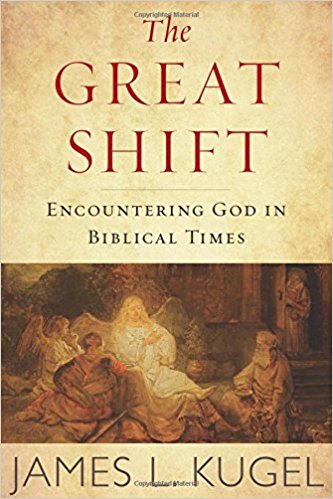
Interview with James Kugel – The Great Shift

Why do we not see God anymore? Why does He not walk around our neighborhoods the way He did in the Bible? Why do Biblical figures not ask what the law should be? James Kugel seeks to answer these questions in his new book The Great Shift, Houghton Mifflin Harcourt (2017). 

great shift

In graduate school, instructors spoke often spoke of the Axial Age shift (approximately  8th-6th century BCE, but sometime stretched out from the 8th-3rd BCE), a term first coined by Karl Jaspers in 1949.  The Axial Age was when ancient consciousness of eternal religion gave way to a new consciousness based on an internal self. For Jaspers, the sacrifice of Leviticus gave way to the prophetic call,  the sacrifices of the Vedas became the theology of the Hindu Upanishads and Buddhism, and when Confucius and Zoroaster arose.  It also includes the shift between the many gods of the Greeks to philosophic Platonism.

In the classes I attended, the theory was mentioned to explain the shift between the Biblical descents of God to humanity as opposed to the visionary ascents of heikhalot. The Midrash itself senses the changes when it asks: What should the sinner do? And portrays Leviticus saying to offer a sacrifice and the rabbis saying to repent. Interestingly enough, the 19th century Hasidic thinker Reb Zadok Hakohen of Lubin has a version of it when he notes the change from Biblical religion to Rabbinic religion parallels the shift from ancient pagans to the philosophers of Greek, with the Torah responding correspondingly. (zeh leumat zeh). However, Jasper’s theory is, at best, only a heuristic tool since the theory is somewhat of a shaggy beast in that it does not have clear dates or causality.

James Kugel in the exciting new book The Great Shift discusses a great change, similar to the Axial Age theory, between the era when God walked with people and the era when he no longer did. Kugel quotes the Catholic author Flannery O’Connor “I do not know You, God because I am in the way. Please help me push myself aside.” For Kugel, our modern selves get in the way of our knowing God and, more importantly for this book, understanding the Bible. Biblical people had very different semi-permeable senses of self, different than the modern self, that allowed a direct experience of God. This is the thesis of the book. But conversely, our modern sense of the self causes us to misread the Bible as if it shared modern concepts of the self.

Accepting this shift, Biblical religion was entirely an external affair. Biblical figures do not have internal soliloquies debating whether to follow God. Obedience to God, love of God, and rejoicing before God are all physical and external activities of obedience. The classic work  Mimesis by Erich Auerbach is, therefore, incorrect about the Bible. The Biblical narrative is not fraught with background waiting to be fleshed out by the reader. The early reader did not expect such a background. Rather, it did not play any role.Abraham and Homer’s protagonists have a common worldview.  In addition, the modern concept of faith does not play a role since God is part of one’s cosmology.

In other later parts of the Bible,  Kugel shows that God has changed into a long range planner of human destiny so on-the-spot intervention by the Divine is unnecessary. The future has already been planned and determined. There is also a shift from monolatry the worship of a single God while not denying the existence, and efficacy, of other deities toward monotheism. There is also a shift toward following a fixed law as a means of obedience to God.

During the Second Temple era, conversing with God gave way to the presence of angels and demons, and then in later centuries even the divine messengers stopped. (Reb Zadok also notes this shift).

This is the fourth time Prof Kugel has graced this blog. The best and longest was the third time, a precis of his book  The Kingly Sanctuary (2014).  For those interested in the larger vision of James Kugel then read the first interview followed by the second. (For those, who want a window into contemporary Protestant Biblical criticism, I refer back to my interview with David Carr.)

Kugel leaves us with a deep divide between the world of the 21st century religious  reader of the Bible and the world of the Bible. At the end of this interview, Kugel acknowledges that this  approach is not for the pulpit or day school. Our current understandings are discontinuous with the Bible in context. Flannery O’Connor’s Catholic apologetic  is quoted a second time in the book as a way of rejecting 20th century literary readings of the Ancient Near East that made the Bible inner psychology and symbolism. “If it’s just a symbol, to hell with it!”

But where does that leave us 21st century folk who willy-nilly cannot return to an 7th century BCE understanding of the world? Theologians insist on integrating later canonical interpretation into our religious understanding of the Bible. For example, Cardinal RatzingerWalter Brueggemann, Michael Fishbane, and  Benjamin Sommers. For them, each in their own way, assume a text is read with tradition. In contrast, anthropologists defend that we may never be able to return. For example, Lucien Lévi-Bruhl, Jonathan Z. Smith, Evans Pritchard, Marshall Shalins and Clifford Geertz. In this book, Kugel clearly comes out on the side of the anthropologists. Our 21st century sense of self and the Biblical self remain unbridgeable.

As usual, this book is well-written. But this book  offers an especially wonderful capstone to the world of James Kugel’s views of the Bible.

1) What can you tell us about the subject of your last book?

My field is the Hebrew Bible, but for the past six or seven years, I have been working in an area more familiar to anthropologists (as well as psychologists and neuroscientists) than to biblical scholars, namely, the “sense of self,” that is, the idea that different peoples have about themselves, about what a human being consists of and what constitutes his or her “self.”

2) What does this have to do with the Bible?

All humans have a sense of self, but that self differs greatly from society to society and from period to period. For example, our own, modern sense of self is very different from the one that most non-Westerners today think they have. We tend to view ourselves as unique individuals, whereas elsewhere on the globe, people see themselves principally as part of larger group—a tribe, a clan, a kinship group—and they also believe that they are basically the same as all the other members of the group. We prize our individual achievements, whereas others consider such things as secondary, focusing more on family prosperity and wellbeing.

In fact, some scholars refer to our mentality by the acronym WEIRD, that is, Western, Educated, Industrialized, Rich, and Democratic—all of these being traits that are not characteristic of the rest of humanity today, and almost certainly were not common in the West until a few hundred years ago. So we are probably misreading a lot of the Bible if we think that the biblical self was basically the same as ours.

3) What difference would this make to our understanding of biblical texts or biblical religion?

Scholars know that there is nothing physical in our brain that acts as its central clearinghouse, nothing that a brain scientist can point to and say, “This is the part that puts together all a person’s sensory inputs and memories and so forth to make up ‘I,’ the person speaking to you right now.” Almost all agree that our self is basically a construct, something with no particular physical reality, but something that we construct in our own minds. Some elements of this construct seem to be universal: we all think of ourselves as continuing to be the same person minute after minute and decade after decade (although we might have good reason to conceive of ourselves otherwise). We also seem to believe that we have a body, but that somehow we are not identical to that body; “I” is some floating entity that is somehow distinct from the body and mind that the self “owns.”

But then there are other things that make people’s sense of self in one society radically different from others’. Now, what interested me is how some of these differences are expressed in biblical texts. Perhaps the most striking thing in early biblical narratives is the relative lack of reference to a person’s insides, the thoughts and emotions that people experience. Everything important happens out there or comes in from out there.

So, for example, when God tells Abraham to kill his son Isaac, Abraham sets out the next morning to do it. What was Abraham thinking, and what was Isaac, the intended victim, thinking? Apparently, these inside things are not important: it’s the outside that counts, the fact that Abraham is willing to carry out this commandment.  It’s not that Abraham doesn’t think. It’s just that, at this relatively early stage of things, everything important still happens outside, so what Abraham thought is just not important.

The same thing is true of Abraham when we first meet him: God commands him to leave “your homeland and your kindred and your father’s house [i.e., your immediate family] to the land that I will show you.” No doubt this wording was designed to stress the difficulties Abraham would face: far from his homeland and kindred and even his immediate family, he would become a homeless alien, with no one to protect him. How did Abraham react? He did what he was told to do. We know nothing of what he thought about all this (on the inside)—it was just not important. What was important was that he did it (on the outside).

But when the Jewish historian Josephus retold these same events many centuries later, he felt he had to do what the Torah did not, namely, turn this departure into Abraham’s decision: “he, thinking fit to change his dwelling-place, at the will and with the aid of God, settled in the land of Canaan.” (Josephus was not alone, by the way; other retellings of Abraham’s departure in the book of Jubilees, the Apocalypse of Abraham, the writings of Philo of Alexandria, and other texts from the end of the biblical period all feel the need to tell what Abraham was thinking.)

But in earlier times, things still needed to take place on the outside. In another incident from Abraham’s story in Genesis, God comes to him disguised as three strangers stopping off at his tent; still later, his grandson Jacob wrestles with an “angel,” a divine emissary, all night. These things are also depicted as happening outside, even if they seem to be altogether visionary.

  1. Was there something special about biblical narratives, or was this preference for the outside demonstrated in other parts of the Bible as well?

This may be another manifestation of the same phenomenon in biblical law: What does it mean to love someone in the Bible? Sometimes it seems to means love in our sense: for example, Jacob loved Rachel (Gen 29:18).

But I was always curious about the fellow in the law described in Deut 21:15-17. He has two wives, one of whom he “loves” and the other he “hates.” I used to think, “What a coincidence! Two wives and two exactly opposite emotions!” (And by the way, if he really hates the other one, why doesn’t he seek to divorce her?) But this text is not talking about (internal) emotions; these two terms are used to represent the wives’ (external) standing. So the husband may rank the “loved” wife above the “hated” one in all sorts of external behavior, giving her all manner of benefits, but when it comes to passing on his inheritance, he is not allowed to favor the son of the loved wife over the hated one’s son.

Again, this is not a reflection of his feelings toward one or the other—the text couldn’t care less about that!—but the external matter of status, namely, which son gets the firstborn’s share of the inheritance. Though she may be the less favored wife in other external matters, the “hated” wife’s son comes first in inheritance.

My former colleague at Harvard, the late Bill Moran, wrote a famous article about the use of “love” in ancient Near Eastern vassal treaties. There too, emotion has nothing to do with it. When the Assyrian overlord Essarhadon commands his vassal, “You shall love Assurbanipal like yourself,” he is surely not telling the vassal to fall in love with his son’s winning personality. Love here, Moran said, is not the inside emotion but the outside expression of loyalty. The same is true of “love” in Lev 19:18, “And you shall love your neighbor as yourself.” The text is not talking about the internal emotion, but external behavior.

Then what about the obligation to love God “with your whole heart and soul and power”? This may be a more complicated example, but when love of God is mentioned elsewhere in Deuteronomy, it is coupled with “keeping His charge and His laws and His statutes and His commandments” (11:1), “serving Him with your whole heart and your whole being” (11:13), “walking in all His ways” (11:22) “walking in His ways at all times” (19:9) “to keep His commandments, His laws, and His rules” (30:16)—clearly, these passages are all talking about “love” in the sense of external performance, not internal emotion. In short, for much of the biblical period, the focus is not on what people felt on the inside, but what happened on the outside.

5) Then what is the “great shift” of your title?

Gradually, things shifted from “out there” to “in here.” So, as in the above examples, people at first are not said to think; instead, they say, an outside event, even when the text probably means to tell us what they were thinking. Sometimes the text says that someone said something  in his heart, and this is clearly a kind of thinking: for example, Esau “said in his heart” that “when the days of mourning my father are here, then I will kill my brother Jacob” (Gen 27:41). Strange to tell, however, , this internal thought of Esau’s somehow was heard by his mother Rebekah, as reported in the very the next verse.

How could that happen? But it could, because important things still somehow belong on the outside. Lots of Jews nowadays are puzzled today by the commandment to be happy on a festival (Deut 16:14). How can you command someone to be happy? But vesamachta doesn’t mean to be happy—an inside thing—it means to celebrate or rejoice, on the outside.

All this began to change in later centuries. On the one hand, God was now deemed more remote; it is His angels who intervene in human affairs. Even prophets stop hearing from God directly; angels deliver God’s words to them. At the same time, people now had minds, and saying what was going on inside them became a necessity. It’s not that they didn’t have minds before, but the way that they conceived of themselves had come to involve this inner self much more than before. This is evident in late biblical psalms, and still more in the prayers and hymns of the Dead Sea Scrolls. Once you know this, I think, your whole way of reading biblical texts has to include the possibility that Abraham, Moses, earlier biblical psalms as well as biblical laws suddenly acquire a very different sense.

6) How did you, James Kugel, get involved with this stuff?

But as I mentioned, I’ve been reading anthropologists and neuroscientists for some years, and what I’ve been saying so far is really not controversial to them. Everyone agrees that the human self is a construct, and that this construct differs greatly from period to period and from one society or civilization to another. So it’s pretty clear that throughout the biblical period, ancient Israelites did believe that their minds were open to penetration from the outside, by God or by demonic spirits. For example, God inserts His words into the prophet Balaam’s mouth, making him say the exact opposite of what he wants to say. This should not be a minor item for biblical scholars: here is an operating assumption in the biblical sense of self that is very different from our own conception of the human mind, its fundamental permeability.  I’ve always thought that the scholar’s principal task is to try to enter into the world of the Bible, to get inside the head of these people and live their reality. And all this, I think, is very important to that task.

7)      What did you agree with in The Origin of Consciousness in the Breakdown of the Bicameral Mind by Julian Jaynes, and what do you disagree with?

Jaynes’s book covered some of the same ground that I have in the “Great Shift”—that is, he tried to explain what seems to be a basic shift in the way human beings perceived the world— including the divine—and themselves.

But Jaynes (who, incidentally, wasn’t much interested in the Bible; he was a psychologist and brain scientist) tried to argue that the shift was attributable to a fundamental change in brain function, suggesting that originally there were two independent speech areas in the brain’s two hemispheres. But that this feature of the “bicameral mind” ultimately gave way to the unified, modern consciousness.

It was an interesting idea, but I agree with most scholars today, who doubt that the change was one of the brain’s hardware or basic functioning. Rather, it was a matter of “software,” that is, of the gradual emergence of a new way of conceiving of the human self. What I tried to do in my book was specifically to document this shift via the different ways that God is represented in the Bible.

8)      How do you disagree with the chapter on the Bible in Mimesis by Erich Auerbach?

I love Auerbach’s book—except for the first chapter, the one about the Bible, where he describes the biblical account of the Akedah (Genesis 22, when Abraham is commanded to offer Isaac as a human sacrifice) as “fraught with background.” Auerbach relates to the text as if it were Western literature: there are thus three “characters,” God, Abraham, and Isaac; “their speech does not serve, as does speech in Homer, to manifest, to externalize thoughts—on the contrary, it serves to indicate thoughts which remain unexpressed.”

I’m afraid I have to disagree. This narrative isn’t fraught with background at all. For all we know, Abraham may be some kind of automaton: God commands him and he sets out to obey. The text says nothing about what Abraham was thinking because thinking, that inside the brain activity, is still not on the map, at least not very often.

9)      How is Abraham really like Homeric heroes?

Well, in the story of his nearly sacrificing Isaac, Abraham behaves (contra Auerbach) very much like a Homeric hero. Actually, the person who investigated this (a few decades before Jaynes) was the German classicist Bruno Snell, in his book The Discovery of the Mind in Greek Philosophy and Literature.

9)      How did biblical figures not worry about faith since they encountered God?

People in the Bible have faith in God in the sense of trusting that He will come to their aid or save them. But they don’t have faith in God’s very existence—no one even raises that issue. It’s not that ordinary people had all personally encountered God, but that God’s existence was simply obvious to everyone, like the rising and setting of the sun or the regular changes of the seasons.

Little by little, however, things did change. It’s as if the center of gravity was slowly migrating from outside to inside. People now interrogate their own souls while lying on their beds late at night; in fact, they come to be “in search of God”—something people  weren’t in earlier times. They pray to God not because they need something, but simply to “establish contact,” and they sometimes pray regularly far from the Jerusalem temple. Now, retellings of biblical narratives—such as those of the 2nd century BCE Book of Jubilees, or the Genesis Apocryphon found among the Dead Sea Scrolls, or Josephus and later writers—have to give some account of what motivates human beings or how they react to changing developments. All these seem to indicate the emergence of a different “sense of self.”

10)      What is the revelatory state of mind? Why do you say biblical were only surprised by an encounter with God, but not flabbergasted?

This is another striking difference between us and ancient Israelites. In those biblical stories of people meeting up with God or an angel, at first all the people see is an ordinary human being. They converse for a while, and then, at a certain point, the people suddenly realize that their interlocutor is really an angel or God Himself. At that moment, they are surprised but not altogether bowled over; such things do occur, apparently.

Nobody says, “Wow! This just can’t be happening!” Usually, they bow down in reverence, not surprise. Similarly, prophets may not want to be prophets, but when God summons them, they don’t think something’s wrong with their brains. As one biblical scholar put it, they are already in the “revelatory state of mind,” in which such things are possible.

11)      How is the biblical God different from the God of later generations?

My overall theme is that God’s nature—or rather, the way that He is depicted—changed strikingly within the biblical period itself. There is a gradual move from the outside to the inside. People’s inside souls become the true meeting-place of God and humans (the old meeting place was the outside temple).

In addition, God is no longer described as having a human-sized and human-shaped body; He becomes more abstract and, eventually, omnipresent. An omnipresent God must exist on a completely different plane: He no longer enters or moves about, so (I also tried to show this in the book) all those earlier stories about Abraham or Cain and Abel or the Tower of Babel had to be reconfigured by later commentators or interpreters to accommodate their new notion of who God is.

12)      How in other places is God a long-range planner? 

Eventually, God ceases to intervene directly in human affairs: when intervention is needed, it is accomplished by God’s angels, while He remains in heaven. In keeping with this, He is sometimes represented as having arranged everything in advance, sometimes for centuries and centuries, so on-the-spot intervention is unnecessary; He, and we, can just watch the divine plan unfold.

This understanding of God is in part anticipated in the biblical story of Joseph. Joseph’s narrative presupposes that dreams (his own and his interpretation of others) are essentially a peek into a future that has already been planned and determined. Thus, Pharaoh’s dreams inform him of events that are to take place over a period of fourteen years in the immediate future (seventy years of plenty followed by seven of famine). In later times, the book of Jeremiah represents Jeremiah as saying that seventy years will have to pass before the end of the exile (25:11, 29:10). Still later, Daniel is said to revise the understanding of Jeremiah’s seventy years: what he really meant was seventy “weeks” of years, that is 490 years (Dan 9: 24).

The book of Jubilees, written still later (the early second century BCE), divides history into chunks of seventy years apiece: there will thus be exactly 50 jubilees from the time of humanity’s creation until Israel’s entrance into the Promised Land. All these present God as a long-range planner—more and more so!

13)      How was the Bible an enchanted world of monolatry? 

Biblical scholars have shown that monotheism only came to be espoused as such somewhere toward the middle of the biblical period. Before that (and, in some places, after it as well), monolatry seems to define biblical religion, the worship of a single God while not denying the existence, and efficacy, of other deities.

The Bible makes no secret of the fact that other peoples had their own gods—indeed, the book of Deuteronomy (4:19) at one point suggests that God had assigned to ther nations the worship of deities associated with the sun and moon and stars; that just wasn’t for Israel.

14)   Was the Law always important in Biblical religion?

Well, it is striking how little reference to keeping biblical laws there is in early times. Why don’t the various people in the books of Judges or Samuel or Kings keep the Sabbath? When David commits his great sin with Bathsheba, why doesn’t the prophet Nathan say to him, “David, you’ve just violated two of the Ten Commandments,” instead of giving him that parable of the poor man’s lamb? But after a while, keeping God’s laws becomes the whole focus of Judaism, not only in the Bible, but in all of post-biblical religion. The service of God, or what is called ‘avodat ha-Shem, truly became the essence of Judaism—as it is to this day.

You might see this as part and parcel of the great shift from the outside to the inside. After all, who is going to police laws commanding you not to hate your brother in your heart, or serve God with all your heart and soul, and dozens of other rules that have no outward manifestation? Keeping them was a matter between you and God, carried out—or not—in that inside world.

15)   Why read the Bible in its original context if the biblical God is not ours, and their sense of self is not ours? And their view of religion is not ours? What happens to canonical context?

You might as well ask, “Why bother with the Bible at all?” But the Bible depicts the reality out of which all of later Judaism developed. That’s why studying it—and getting inside the heads of ancient Israelites, as I said earlier—is crucially important.

16)   Do you believe in the God of the Bible? The God of the 5th century BCE? The God of Yalkut Shimoni? Or a 20th century God? 

All of the above. But I generally try to keep myself out of the discussion.

17)   Should Rabbis teach the content of your book from the pulpit? Should the contents be taught in day schools?

Definitely not. But maybe in an adult education class.


Interview with Elchanan Shilo

Think of the many blogs of the last decade in which an Orthodox person publicly documented his or her loss of faith in Orthodox dogmas and the equally large number of blogs in which people questioned the halakhah. In many of these discussions, the people discussing theology had never read Spinoza, Hobbs, or Hume and without any sense that philosophers disproved the theistic arguments centuries ago or of the corrosive to religion naturalism of the Enlightenment or modernity.. They also argued without any knowledge of Maimonides’ Guide of the Perplexed, or modern Jewish philosophy, or any history of Jewish thought.

Elchanan Shilo has a PhD and was trained in Jewish thought, Kabbalah, and Jewish literature, as well as having attended Yeshivat Har Etzion. His first book was The Kabbalah in the works of S. Y. Agnon [Hebrew] (2011) and he has written on Lithuanian Mitnagged Kabbalah, with articles on Rabbi Isaac Haver and Rav Kook. He put out a volume called Yahadut Kiyumit  (May, 2017) [Heb.] a Judaism of Existence, that we can live by. In this book, he tackles all the perennial issues discussed on the blogs. but with PhD.

(The official translation is Existential Judaism, but he uses the word the way Netanyahu uses the word when he says Iran is an Existential threat, meaning directly connected to  existence, not as influence by Camus or Sartre.)

In the volume, we see his loss of faith in Orthodox doctrine and his loss of faith in Orthodox halakhah as well as his attempt to create a new Jewish movement, the same issues as all those American Bloggers, but with a PhD.

srvrutil_getImg

I blogged about Elchanan Shilo’s ideas already seven years ago, when he proposed having a continuous Judaism between religious and secular, in which everyone could work together as part of one community. A noble idea in an age of polarization. That is still a good part of the book.  His article elicited a full response from Rav Dovid Bigman of Yeshivat Maaleh Gilboa.

In his recent book Yahadut Kiyumit, he collects his thoughts and newspaper articles of the last few years into a single volume. The book has been widely received in the Relgious Zionist world included a positive review by Prof. Ron Margolin of Tel Aviv University as well as by Hagai Hoffer.   Here is an hour long youtube interview he did last month about his book. 

The book has two parts. The first part contains his articles about faith from the newspaper in which he moves from his Religious Zionist position to the acceptance of Biblical criticism and the human elements in the Bible, the keeping of mizvot without believing they are commanded by God and a denial of providence because of the Holocaust. Needless to say, he was fired from the religious school (ulpnana) in which he taught becuase of these non-Orthodox ideas. He also rejected the authority of the halakhah because of it attitude toward modern life, legalism, and oppressive laws of personals status. In its place he wants the keeping of Judaism as a voluntary practice, each person taking as they see fit.

Unlike the American bloggers who either leave the fold or want to remain “Orthoprax” (their own self-defining neologism) of full observance despite not believing, Shilo seeks to also reject halakhah. He wants a full spectrum traditionalism without law or belief. Shilo does, however, like Jewish ethno-nationalism.  In many ways, his book has much in common with Yoav Sorek’s The Israeli Covenant (Hebrew), but this book is more about the impossibility of maintaining faith, than a new nationalism. I did not find myself concurring or consenting with the first part of the book. I found it distancing and derivative.

The second part of the book, however, is a contradictory collection of ideas that were quite interesting. They are his personal reflections which he compares to Rav Kook pensées, but to me seems like all so many blog posts or Facebook statuses. They are clearly the best part of the book.  They are all designed to elicit response. If you saw them on Facebook, and you were interested in the topics you would likely be compelled to respond, to amplify, or to reject his thoughts. Here are some selections to give you a taste. Any thoughts on these?

The rhetoric of the using the word “avodah zara” (idolatry) for all sorts of modern phenomena and for other religions is demagoguery and the whole way one can laugh along. Isaiah Leibowitz used this phrase often but one can claim that Leibowitz himself is idolatrous because he does not worship God, rather the halakhah.” (165)

Rav Shagar discusses the Hardal position on women. He says that the negation of the values of modernity is denial of the self…He gives the appearance of being torn. I say “appears” because being broken and including both sides can only exist in the realm of thought.  In the practical realm, one needs to decide and Rav Shagar already decided. He decided against modern values and for the halakhah when there is a conflict between them. He prays in synagogues that exclude women. (162)

[…] Rav Kook’s Kabbalah remained in isolation and its students remained “Lonely men of secrets” but to the outside world he appeared as if the wellsprings burst forth. (188)

Combining the study of Bible in a religious university (Bar Ilan) with liberal a Yeshivat Hesder education, brings on the positive side– aspects of scholarly analysis and critique of things without historicity, on the negative side it brings blindness to the theological aspects of scholarly study. They bring sublime pilpulim to justify the traditional positions and present scholarship as lacking logic. (142)

Dividing society based on praxis – who goes to the beach on Shabbat and who goes to synagogue, or those who do both- is shallow and does not say anything about ones inner life. (144)

The 21st century practice of liberal [Religious Zionist women] to cover their hair symbolically- for example with a bow-has a symbolic function of status similar to a wedding ring, rather than actually covering the hair. (149)

The request of Rav Bigman for the simple Jew to sit and wait for “a new generation of rabbis” more than it changes reality, silences it. The redemption of the people and the return to the land did not come from people who waited. Rather it came from people of action who broke through what was accepted in their time. So too in the halakhic plane, a simple person has to work below without waiting for miracles from above. (154)

What appears in my eyes as God appears to another person as Satan. The God who commanded to kill the one who chopped wood (Numbers 15) is not God in my eyes, rather Satan…. From an external perspective it seems that people who pray together are all worshiping one God, in practice they are all worshiping their own God. What one calls God, the other calls Satan. (178)

I have found many Haredim and Baalei Teshuva, but I have not even one percent as many of those who seek the truth. This is proved by the small number of students in University Bible departments. The number is negligible compared to the  multitude who seek yeshivot. (175)

I want to propose a less radical solution to the conversion problem [in israel] that does not require a conceptual change from the accepted methods of conversion. This solution was told to me by my father Z”L who heard it from Rabbi Moshe Tendler, Rosh Yeshiva at RIETS, afterwards I head it directly from him.

Since infants have no data (awareness), their conversion does not require the acceptance of mizvot, just mikvah and circumcision. Therefore, we need to build permanent mikvaot in courts and hospitals. After every child is born to a couple considered an “Other” in their identity papers, we should do this process. The Rabbinic judge should immerse the child in front of the mother before they leave the hospital, and be registered as a Jew. If it is a male, the parent will also be obligated to circumcise him. This way we solve the problem of conversion… I want to return to the halakhah. The Rambam wrote, pace the Talmud, “We immerse a minor who seeks to convert based upon the guidance of the court. For it is an advantage for a person [to convert]. (Forbidden Relationships 13:7) (189)

Shilo sees his book as a manifesto and his ideas as the start of a new movement. However, I see his book as part of a bigger trend of Israeli traditionalism. I could give an entire course, or create a reader placing Shilo’s book on the shelf with a number of similar works including: Yoav Sorek’s nationalist vision that is conservative socially but religious liberal with Meir Buzaglo’s defense of the Sephardi mesorati position, with Dov Elbaum’s presentation of the tradition for those outside, the studies of mesorati Jews by Yaacov Yadgar, and with Tomer Persico’s religion and spirituality for those coming from the secular perspective.

Yet, Shilo’s thought in the first part of the book most reminds me of the liberal Conservative Mordecai Kaplan influenced authors of the 1940’s and 1950’s- Jacob Agus, Ira Eisenstein, and Milton Steinberg, with an emphasis on peoplehood over dogma or halakhah. There were many articles in the Reconstructionist journal, in its prime, about commandments without a commander. Or see the Israel educator, Mordechai Bar-On, “The Commandments and the Commander” (Reconstructionist, 1977).

I did not find myself in much agreement with Shilo, but his book reflects the debates in Israel today and it is important to note that his book is reviewed within the Religious Zionist world. It is an enjoyable quick read and worth reading, However, while covering similar ground it is not a classic like Mordecai Kaplan’s Judaism as a Civilization, rather editorials and blog posts.

1)   What is the story of your book

In the second half of the 1990s, I began to write aphorisms – fragments of thoughts, similar to the style of Rabbi Kook, Pascal and Nietzsche. At that time, I considered naming my book: “The Song of Thoughts”.

At the same time, there were parallel processes developing in society such as plans for the establishment of joint religious-secular pre-military preparatory programs.

When I began to write, I felt as if I am a voice calling in the desert. When I finished my writings, I found myself in a new social movement, Called “Israeli-Judaism,” which includes pluralistic Batei Midrash, and pre-military religious-secular preparatory programs, see in this link:http://www.panim.org.il/en/organizations

For many years I was worried that publishing my thoughts could harm my relationship with my workplaces. And that’s exactly what happened. Two days after the publication of my article on Biblical criticism, (“Divine revelation in human text” Makor Rishon 6/19/2009), which edited some of my aphorisms related to this subject into an article; I was notified by telephone that my work at Orot College (a religious college) had ended.  At the Nezer David Institute, that publish the Nazir writings, (a disciple of Rabbi Kook), my work was stopped when I finished publishing the Nazir’s commentary on a book attributed to the Ramhal book Kalach Pitchei Hokhmah. I was told that only if I retracted what I had written in Makor Rishon, I could continue my work. I could not acquiesce to their offer. since I could not go back to Orthodox dogma even if I wanted to.

Volition does not bring belief.  Belief is outside of freewill- Shadal in the name of Crescas Or Hashem 2:5:2. Many people want to believe, but cannot. (Site editor’s note Cardinal Newman says the opposite, that belief is entirely volitional.

The burning of the bridges with these Orthodox institutions liberated me to write what I had in my heart. After that, continuing for six years, from the beginning of 2009 until the end of 2014, I published some more articles in Makor Rishon. This ended when I submitted the article “The Question of Evil and the Ability to Believe” (the fifth chapter in my book). It was not accepted, since the paper was bought by Sheldon Adelson, and he made the editorial position of the paper more conservative. This is the point I moved to the next step, preparing my articles in a book form.

2) Why did you create the book in two parts, a regular book and then aporhism Resesei Mahshavot? The first part 120 pages and the second 80 pages.

My meditations are like poetry raising ideas from different points of view. It is not always possible to unify all points of view that I present within my chapters. My reflections contain complexity, in which the resolution cannot always be ascertained at first glance. For example, regarding the subject of abortions, in my aphorism. I wanted to show that despite my liberal views, I am not captive by the liberal discourse, and can criticize it.

There are short passages that belong to some of the chapters, but reflect a point of view that I have once experienced, but not anymore. Another example: when I become aware of internal contradictions in some of the miracles in the Bible, I wrote it under the heading “Epicurus (Heretic) against his will”. “I really want to believe that miracles are possible, that there is truth in the miracles recounted in the Bible, that there is justice in the world, and that God intervenes in the world and changes the laws of nature when he wants, but these desires break on the rock of reality.” I discussed these issues in the main chapter. Yet, it is important to show that there was a genuine search for truth and I did not mark the goal in advance, it was forced upon me.

The inability of Orthodoxy to provide a real and not apologetic answer to the proofs of biblical criticism, compelled me to abandon the traditional position with which I began to explore the topic, with a surplus of self-confidence in the justice of its path. I then adopted the historio-critical perspective on the Torah, as a text written by many authors, written hundreds of years after the events described in it.

When I submitted the book to the publishing house, I placed my short thoughts at the end of each chapter, but the editors did not like the leap from genre to genre, and this is the reason why all the short thoughts are in one section and all chapters in another one. Every decision has pros and cons. There were people who like the short thoughts, which sometimes are thought-provoking and suitable for study groups. ( In the review of my book by Prof. Ron Margolin in Makor Rishon, (4/10/17, “Saving the faith from itself”) more quotes were taken from the second part than from the first part.

 3) What does it mean to create a continuity between halakhah and secularity?

This means that instead of a society divided into sectors of religious and secular, there should be a continuous Jewish society ranging from secular to religious. In which each individual can find his own place according to where he comes from and according to the root of his soul.

The philosophical basis has two assumptions (1) The Jewish way of life today derives from a process of human development and creativity throughout the generations, and therefore it is not absolute. Not every person at any time and place can fit to this lifestyle. The awareness that this is a human development leads to the conclusion that seeing the observance of the commandments as a divine command is fiction. The meaning of the Mitzvot must be constructed from the content itself, and not from a belief in God who commands them. 2) There are different types of people. Some people are religiously inclined and for some people the religious world is alien to them. In the middle, there are people who are partially suited to a Jewish lifestyle. They feel it intuitively, but they lack a philosophical basis, and that’s what I’m trying to do with my book. To present a model that is softer than the halakhic model, and to show the meaning it contains.

4)      How are you different from  Israeli mesorati or the Israeli Reform movement?

Judaism of Existence” (Kiyumit) suggests double states of consciousness, religious and secular. For example: entering into a state of religious consciousness while praying and entering an atheistic state of consciousness while facing evil. This is even more left than what the Reform movement that see itself as a religious movement that believes in God.

In terms of the everyday life, the model of Sabbath observance, of using electricity in certain need or distress, is practically close to the Orthodox model, and differs from the characteristics of the Reform Sabbath, which is a model of a “secular Shabbat” + prayer, lighting the candles and Kiddush.

With regard to kashrut, non-eating some non-kosher animals takes on significance because it identifies with the moral ideal of vegetarianism. Since it is morally problematic to eat animals, reducing the types of meat to a small number of animals is an intermediate state between the celebration of flesh and vegetarianism. This form of keeping kosher is a softer model than the halakhic model, which forbids eating from vessels that are cooked with unkosher flesh.

Most of the traditional Jews in Israel do not experience a crisis between traditional beliefs and their modern world. Their perceptions of religion are Orthodox, but their lifestyle is different. Traditional existence is a will to continue the legacy of our Fathers, whereas for the Jew of Existence (Kiyumi) this is not enough. He must identify with the content itself. The difference is not limited to a certain lifestyle – like another model of Shabbat, but also to matters such as kashrut, in which the Jew of Existence will be similar to the traditional Jew, but In terms of his inner world, his consciousness, will be completely different.

5)   What is the weakness of Neemanei Torah veAvodah?

The weakness of the liberal wing within religious Zionism is that it is still bound within the halakhah, which often reflects an ultra-Orthodox world view.

To use sexuality as an example. Why does the liberal Religious Zionist complain about the need for separation between boys and girls in order to prevent halakhic prohibitions of “transgressions”? Halakha, and the ultra-Orthodox society, sees a sin in every erotic expression that is outside of the framework of married life, and calls it yetzer hara (evil inclination). Halakha forbids all forms of art that contain erotic elements, or alternatively, a touch of affection or even a touch without affection, between men and women. The liberal national religious are in conflict, between their modern conception of sexuality and their commitment to halakhah.

Another example, attitude toward general culture. Liberal Religious Zionist see the figure of a rabbi who has a broad general education, but according to the Shulchan Aruch, “it is permitted to study by random external wisdom, only so long as there are no species books of heresy (Yoreh Deah, 247,4). That is why the Liberal Religious Zionist is inferior to the more conservative parts of religious Zionism.

The liberal religious parents will have to submit to these stricter decisions because of their commitment to halakhah. What I am trying to do is to liberate the liberal religious from their commitment to halakha, so that they can present their positions without having to apologize. If my book convinces them to abandon their commitment to halakhah, they can feel comfortable standing up for their positions.

6)      How can you have mizvot without a commander?

The question is not how to perform mitzvot without a commander, rather  how do people continue to deceive themselves, and to identify with a way of life that has been developed by ordinary people over thousands of years into a divine command. In addition, the model of man as subordinate to God, is contrary to the consciousness of the modern free man.

The observance of mitzvot without a commander stems from a will to continue the Jewish culture and national heritage that is a part of you. My starting point is the will to connect to the practical level of observance, and I turn only to those who are interested in it and try to give it a philosophical foundation. I am aware that a large part of the secular population is not interested in this, and therefore my vision is to create a continuous Jewishness, between halakhah and secularism.

7) What is your view of revelation as from heaven but creating a human text?

There are two questions. 1) The emergence of the texts. 2) Dealing with immoral things written in the Torah.

The ignorance or apologetics of the Orthodox in dealing with biblical criticism, and the failures of it which I show in my book, creates a softening that enables us to deal with moral questions as well. The strict faith in “Torah from Heaven” is crumbling, which also create moral damages, such as the prohibition of homosexuality, which causes a life of suffering for homosexual religious people. Some of them remain in loneliness and do not have sex, because they think that God dictated this commandment to Moses.

The dissolution of the traditional concept enables a softer conception of God’s revelation. The groundbreaking moral concepts and ideas that we find in the Bible can be seen as ideas inspired by God. As opposed to other content, which is human, especially when it has negative aspects.

8) How should we view God in the new age?

The awareness that all the perceptions of divinity over the ages are human ways to perceive what is beyond all perception, brings to choose one of many perceptions, one that is best suited to the modern era, and to give it dominance. The concept of mystical divinity, as developed by Rabbi Kook, is the most appropriate because the divinity is not a personal God that commands, but as all of reality perceived as divine abundance. In this perception, the rupture between the holy and the secular consolidates and unites, and the secular values ​​become an expression of divine abundance.

9) You seem like another datlash (formerly observant) who does not believe anymore and does not accept all of halakhah anymore? Lots of Israelis are like that.

You can call me a “former Orthodox,” but my attempt to connect to the  world of prayer and to softer model of Shabbat, which is close to the Orthodox Sabbath, distinguishes me from the datlash, whose religiosity is a thing of the past, a “former religious.” I am not only a person who has lost the innocent faith, and then would become a secular Jew. I am a person who in addition to the loss of his innocent faith tries to build and to connect to tradition from a new point of view, which will enable me to maintaining important and essential parts of the Jewish tradition, and to make them meaningful and relevant.

10) You seem very similar to the American liberal movements such as Conservative or Reconstructionist?

The Conservative Movement sees itself as halakhic, whereas “existential (kiyumi) Judaism” is not halachically obligated and I observe the commandments according to my ability to connect to their content.

One of the major innovations of my book is breaking the division between religious thinkers and secular thinkers such as Brenner, in whose world God does not exist. And at the same time still working with Heschel, Soloveitchik and Zalman Schachter-Shalomi, who deal with different types of a believer.

I present a new position between them, which places the ontological issue of God’s existence in brackets (on the side), and focuses on the subjective experience. My goal is not to deny our various emotions and to allow the possibility of entering a state of consciousness of faith in the living God when you pray or celebrate Independence Day the ingathering of the exiles to the Land of Israel. At the same time, to be able to enter an atheistic state of consciousness when facing the blindness of evil and death, such as earthquakes.

11) Are you just a liberal form of Yoav Sorek?

You are not the first person to similarities in our visions. Nevertheless, we have many differences. I would like to accentuate three of them: )1) Sorek speaks of a discourse of commitment to halakhah, even if it is a “soft” halakhah. Whereas “existential (kiyumi) Judaism” is not halachically obligated and observes the commandments according to the ability to connect to their contents. (2) His thought gives no room for total secularism and atheism, which will continue to be part of the mosaic within the various possibilities it offers. (3) In addition, I claim that on many  values ​​of Western-modern culture which are against traditional Jewish values, the Jewish values should be rejected. In many cases, we should accept Western-modern culture over Jewish values.

12) You claim to be a new movement. But, you do not have an organization, money, institution, speakers? If so, how are you a new movement?

In one of the letters that  I received from one of my readers, I was asked: “Do you intend to establish a stream/Beit Midrash/party?, I would be happy to be a partner and hear more.” Since there is no such stream, I leave things in the open deliberately, and write about it only in one of the inner pages of the second part of the book: “If there are enough people who identify with the idea of ​​existential Judaism, a website will be set up, and if it is joined by people with economic capabilities, a Beit Midrash or pre-military academy will be established in the spirit of these ideas. I am  aware that a movement will not be established without it.

The vision of establishing a movement or institution in the spirit of the ideas of this book is a dream that will probably not materialize, but maybe in another twenty years or in another generation it will arise, who knows?

Rav Shagar and Secular Studies: On Translation and Living in Multiple Worlds

What did Rav Shagar think about secular studies? He answers in a twenty page, 7000 word homily on Hanukah On Translation and Living in Multiple Worlds.  – go read the 20 page essay.  I provided a guide to the essay below to be used alongside the original text.I  planned on posting this essay the week for Hanukah already in August, without connection to the recent spate of free floating op-eds about the idea of a Rav Shagar. If you have not grasped his vision yet, this 20 page essay is one of the best places to see what he is trying to achieve.

We have once again to thank Levi Morrow for his translation of the essay. Please let me know of any errors. (For links to our more than 18 prior posts on Rav Shagar,  see herehere. here, here, and here.) As an important side point before you start the essay. If you were looking for an Orthodox postmodern theology, then the Sephardi Algerian thinker Rabbi Professor Marc-Alain Ouaknin wrote such a work twenty years ago, The Burnt Book: Reading the Talmud (Princeton University Press, 1998). Rav Shagar is not that; see my excursus on Torah Umadda below.

shagar5

On Translation and Living in Multiple Worlds

A Sermon for Hanukkah

Shagar starts his homily as follows. The Chanukah candles are placed in the doorway between one’s home and the outer world, which for Rav Shagar means we cannot retreat into the safety of our homes of just having Torah. In Shagar’s view “we have no choice but to exist in the space between inside and outside, between identity and strangeness.

The homily works with the Chanukah tension between the Hellenistic Greeks and the Jewish world of Torah. Shagar assumes that “to Jew” and “to Greek” are two fundamentally different attitudes to life. His question is: how to bring the two together? He offers (1) Rav Kook’s idea of translation, (2) Rav Nachman’s personal grappling with the evil klipot of the haskalah, in which he distinguishes between idolatrous language and holy speech. and (3) his own view that we are all now Rav Nachman and we are all now required us to decent into klippot.

Rav Shagar claims that the “wisdom of the Torah and the wisdom of Greece, along with the holy language and Greek language, were originally clear and distinctive signifiers.” Over the course of history” they no longer “signify specific languages or books, rather ways of learning and existing. Greek wisdom, therefore, is… able to exist even within the walls of the traditional Jewish study hall.”

The term “Greek wisdom” changed over the course of history to the term “external wisdom” which is knowledge that lacks the intimacy of “being with itself,” and at its source is an objectification of the knowledge. Hence, the conflict [between Torah and Greek Wisdom] does not have to focus on the context of the wisdom or the language used, but on intimacy and personal identity, the intimacy and identity that are the eros of the wisdom.” A distinction between “wisdom that is beautiful and effective, but lacks all passion and intimacy” and “a wisdom overflowing with meaning and intimacy, a revelation of existence and substantive content.” Notice that the term Greek wisdom could just as well apply to Torah, or Torah uMadda, while Torah as the wisdom of existential meaning that touched one’s identity may apply to any wisdom.

Rav Shagar on Secular Studies

I will start with his own opinion before we return to how he used Rav Kook and Rav Nachman. He says Rebbe Naḥman’s guidance toward naiveté and simplicity does not respond to our form of life.” Further,  Rav Shagar applies Rav Kook’s bold statement about spirituality to secular studies: “anyone who does not suffer from spiritual descents has no chance of religious ascent.” There is danger in this decent “but only this descent-endangerment can lead to ascent.” He seeks a decent into secular studies for the sake of religious ascent.

Rav Shagar thinks that we have to accept the inevitable and acknowledge that we live in multiple cultures and not fight it with sectarianism by blocking out the wider world of knowledge. “For better or worse, we are citizen of multiple cultures and we live in more than one world of values. We are not able to deny this situation, nor would we deny it if we could. Denying it would be self-denial, leading to deep, radical injury to our religious faith itself.”

Rav Shagar thinks that the confrontation with the Greek, even in Israel, is not at the university level but already from an early age via the media, literature, and our culture. “We therefore need a substantial religious-spiritual-Jewish alternative.”

Rav Shagar is firmly against the bifurcation of religion and secular into compartmentalized identities, like that of Prof. Yeshayahu Leibowitz who opened “an unbridgeable gap between them; he would never bring them together. Leibowitz lived with a contradiction.” Instead, Rav Shagar wants everything to reach “his subjectivity or personal identity.” In contrast to compartmentalization, Shagar wants the Religious Zionist soul to live “not in one world but in many worlds, which it likely cannot integrate. It does not compartmentalize them -Torah versus labor, faith versus science, religion versus secularism- but rather manages a confusing and often even schizophrenic set of relationships between them.”

In his essay: “My Faith: Faith in a Postmodern World” Rav Shagar suggests that the believer in modernity such as Rav Soloveitchik and Yeshayahu Leibowitz live in what he calls a “two-world approach.” “This approach establishes a boundary between the internal and the external, between one’s faith and the world in which one resides.” He argues that this worldview is  “at its core [it] is an attempt to fend off modernism’s criticism by isolating faith from the world and its values.” Within this modern worldview, “faith is not perceived as a substantive assertion about reality.”

However, in his view this “belief” in knowledge and its bifurcation from faith has collapsed, and in its wake much of what modern Jewish theologians taught, including Rav Kook, has now become “obsolete.” Not obsolete as a subject of study but obsolete as that which can adequately inspire a religiously devotional life today.

I will quote fully a paragraph of what Rav Shagar envisions as way of offering clear contrast to the modernists or Torah uMadda.

A new type of religiosity has therefore developed nowadays, one that cannot be defined by its location on any graph; it is scattered across many different (shonim), you could even call them “strange” (meshunim), centers. This religiosity does not define itself with the regular religious definitions, but enables a weaving of unusual identities, integrating multiple worlds- in a way that is not a way. [Rav Nachman of Breslov] presents a deep personal faith that, in my opinion, carries the potential for religious redemption. Where does this capacity for integrations and combinations come from? Answer: that very same deep personal faith. This faith is not faith in something, rather an act of self-acceptance. It recognizes a deep core of covenantal eros, which enables the freedom to translate and to make integrations, combinations, and connections that our fathers never dreamed of making.

A person accepts their thrown situation of life embracing it fully to make new integrations and connections, however strange or disjoined they seem. It is not located by any one rubric rather similar to Gilles Deleuze’s ideas of rhizome or  chaosmos, it avoids categorization.

To this base, Rav Shagar returns to his core ideas of seeking faith through accepting life in its complexity.

The existence of faith is not dependent on some sort of faithfulness of a given individual, because its roots are much deeper than the consciousness of its bearers. It is present as a fact, and this gives rise to the covenant. Only thus can a person accept his faith and his way of life, a necessary condition for the novel religious phenomenon we are suggesting.

For him, faith is not an assent to doctrine or affirmation of halakhah, nor is faith a Hasidic  or Rav Kookian “essence that a person discovers after removing all the excess, superficial layers around his true, stable identity.” Rather, for him, faith is “a leftover excess that a person cannot remove or digest, which destroys “dichotomies and definitions of identity, readying them for encounter and creation.” Reframing Rav Kook’s essentialism using the Lacanian term of remnant (not in its original meaning) he thinks our innate inner Jewishness still exists despite not having a stable definition or identity.

Compare the milquetoast bifurcated cognitive idea of Torah uMadda to Rav Shagar’s vision below of his ideal as ecstatic, primordial depths, and psychoanalytic.

Ecstatic and multivalent figures are sprouting up before our eyes, and they cannot be located at any one place in society, for their faith comes from a much deeper place, from times gone by. This faith is a remainder, a psycho-theological symptom manifesting as inexplicable stubbornness, as a willingness to be on the losing side of the world simply because “this is who I am and this is who I want to be,” without conscious justification… [It is] the harmony of an individual with who and what he is, without locking himself into a specific identity; he can be who he is, whoever that may be.

I will add that self-acceptance opposes attempts by a religious community to enforce observance of yarmulke, prayer, fringes, phylacteries, etc. These attempts makes religiosity forced, cowardly, and alienating, one of the causes of the spiritual superficiality of the religious community. A religion that sees itself as at war for its survival is a religion without depth and roots.

Instead of this religious enforcement, Shagar wants “a religious reality overflowing with eros. “I am who I am, which is the innermost aspect of the highest will.” He associates this eros with a dimension described in Hasidic texts that exists “beyond and in excess of its meaning.” Ḥabad discourse says that this dimension “cannot be named, nor alluded to by any extraneous detail of the conventions of language at all.” He concludes the essay stating that this is about self-revelation. “This is not the type of identification that compares the concrete manifestation of a person to a picture, symbol, or idea that exists “outside,” beyond him, but the revelation of the person as he is, without any “beyond” – this is me.”

I jumped to the last part of the essay first in order to present his view of worldly knowledge. I will now return to the other parts of the essay on Rav Kook and Rav Nachman.

Rav Kook: Greek Language on its Own

I was once at a major Israeli academic conference of Jewish studies that allows open submission of proposals. In one of the sessions devoted to Rav Kook, there were papers on his mystical diaries, his kabbalah, and his rejection of secular studies for his closest followers. There was also a paper by a clueless American frum attorney who presented on Rav Kook’s Torah uMadda. The audience did not receive his paper well.  Afterwards, he complained to me when he returned to his seat about all this misplaced focus on mystical and pietistic nonsense, when we know that Rav Kook was a modern Torah Umadda Jew, as presented by Norman Lamm in his book of that title. The attorney grumbled: how could Rav Kook be against secular studies when that is not the way he is presented in the English works he read?

This is part of a wider misreading of Rav Kook in American Modern Orthodoxy as less haredi than he was, and it certainly does not take into account his explicit instructions to his close students to minimize secular studies. More importantly, it ignores the historical trajectory created by his student Rav Moshe Tzvi Neriah who forged a committed core of Merkaz students already in the 1950’s who avoided secular. And it ignores that the interpretations of Rabbi Abraham Isaac Kook by his son Rabbi Zvi Yehudah Kook are totally against Western culture. This view of Rav Kook as anti-secular studies is the approach of Merkaz HaRav Yeshiva is what Rav Shagar is responding to in his talk.

The Rav Kook text that Rav Shagar choose to look at was given at “the inauguration of the Mizrahi movement’s study hall (beit midrash) for teachers, during Hanukkah 1932. In the talk, Rav Kook cautioned against external knowledge but language, even conceptual language, as a means of expressing ideas.

 Greek language on its own and Greek wisdom on its own” (Bavli, Baba Kamma, 83a). We see that the main intent was to distinguish between content and style. Greekness as wisdom, as a worldview – harshly injures holiness, profanes it and defiles it. Greek language, however, the language in terms of its expressive capacity, in terms of how richly it describes things – this is an entirely different matter. In the latter, there is no clash between the contents of frameworks of beliefs and ideas. Rather, only an external improvement, which in and of itself does not make contact with or impinge upon internal matters […]. The content we need not accept other than from our holy Torah […]. This is not the case when it comes to style, to the external beautification of things […].

Rav Shagar presents Rav Kook as delineating a boundary between using the Greek as the content and the container, between the medium and the language. For him, “Greek language on its own and Greek wisdom on its own.” a rabbinic phrase “means that the emptying of the light of Torah into the Greek container cannot damage and change the light of Torah, but it is capable of contributing an external improvement, which does not make contact with or impinge upon internal matters.”

Shagar presents Rav Kook as allowing the tools of Greek culture, meaning Western culture writ large. “These tools are, for examples, the tools of the academy – the reflection of research, philological and historical investigation, philosophical, literary, and linguistic richness, which Rav Kook was not afraid to make use of in writing his inspirations.”

In this statement, Rav Shagar rejects the approach of Rav Tau and the Yeshivot HaKav, a breakoff from Merkaz against all secular influences, including influence of modern educational psychology, historical and philological tools, and modern approaches to the study of the Bible.

Rav Shagar then works with Rav Kook’s text to come closer to his own view of seeking personal meaning. Rav Kook asserted in his book Eder Hayakar that the thinking individual can be trusted in his personal searches for truth.

Any idea or thought that comes from research, investigation and critique in its own right, in its pure freedom, could never come to evil, not in the general faith shared by all straight of heart and knowledgeable people […] nor in the foundation of eternal Israel and its connection to the God of its strength […]. Only an evil heart, a licentious heart […] is what causes all the disturbance. (52)

Rav Shagar says that Rav Kook’s

 thought should be seen against the background of the Hegelian understanding according to which the spirit clarifies itself and advances by way of reflection. The spirit, which is the Jewish jug of oil, clarifies itself by way of Greek language, which examines it from an external perspective, investigates it, gives it definitions and conceptual characteristics, but does not defile it internally. According to his position, the problem of Greekness only appears when we try to import an “idol” into the temple of God, meaning the content itself, attempting to integrate with the wisdom of Greece.

Notice both the historicizing of Rav Kook as seeing the theory as spirit (geist) which is crucial for Rav Shagar’s declaration that in our era is the end of Hegalian thinking and its needing to be replaced.

But Rav Shagar also notes and does not develop that Rav Kook thought that sometimes universal ideas needed to be translated and embedded in Torah. In Rav Kook’s case, he thought the ideas of freedom, nationalism, and universal morality needed to be translated into Torah. For Shagar, there are elements within Existentialism, psychoanalysis, and post-modernism that have to be translated into Torah. But the same way, Rav Kook is not trying to write academic essays about Hegel and Schopenhauer or even worried if he is reading it correctly, Rav Shagar is not concerned with the secular fields of philosophy or psychoanalysis.

Rav Nachman

The second position that Rav Shagar looks at is the anti-intellectual position of Rav Nachman. Notice that Rav Shagar did not choose to consider the more intellectual or more cultural positions about secualr studies of of Maimonides, Vilna Gaon, Hirsch, or Reines. He chooses Rav Nachman because he wants to create a path to a deep relationship with God using the secular.

In contrast to Rav Kook, Rebbe Naḥman of Bratslav identified any external wisdom or Greek knowledge as a deep threat and attacked those who connected the two. “Someone who, God forbid, learns books of research and philosophy introduces doubts and heresy into his heart […] therefore we do not find any person who was made fitting and God-fearing by books of research.”  (Sihot Haran 5) Rav Nachman “exhorted his devoted followers toward naiveté (temimut) as a way of life.” Rebbe Nachman proclaimed:“Fortunate is one who does not know at all from their books [=of research] and only goes naively… It is wisdom and great service to be like an animal,” meaning naiveté and simplicity.”

Rav Nachman limited the study of the world only to the true Zaddik. “In truth there is a great prohibition against being a scholar, God forbid, and against teaching books of wisdom, God forbid. Only the very great tzadik can enter into this.” This entering into heretical ideas is permitted to the Zaddik in order for him to extract the fallen souls that fell there into their traps, due to the knowledge and skepticism of the enlightenment.

[I am skipping over a section in the homily about language in Rav Nachman compared to Wittgenstein and Walter Benjamin because Rav Shagar’s views on language deserve their own discussion.]

Rav Shagar turns to Rebbe Naḥman’s book, Likutei Moharan (I:19), where he teaches about three languages: the holy language, idolaters’ language, and the language of translation.  The first language, the holy language is entirely self –referential without any connection to the outside world as its own reality, which

 can be experienced through the practice of Bratslav or Ḥabad-style learning, with their various jargons, intuitions, movements, and deviation. This practice reveals that this is not study that refers to reality but study that itself becomes reality. It does not have an object, but rather exists in itself – existence as a Bratslav world or existence as a Ḥabad world.

The second language, the idolaters’ language of “the seventy nations” corrupts the covenant. According to Rav Shagar in his interpretation of Rav Nachman as anti-capitalist, anti-Neoliberalism and anti-instrumental, the language of the idolaters is about  capitalism, profit, and instrumentalism. “The will to conquer and control via the word leads to corrupted sexuality.” This language creates gaps between the self and world, between meaning and activity and between the individual and reality. This type of speech presents itself as beautiful, wise, and refined, but does not get to the core or a person.

Quoting Rav Nachman, Shagar accepts that “this is the language of the demon-scholar (shed-talmid hakham), who uses his linguistic aesthetics and rhetoric to create an impression on the other and dominate him via language:  (LM 1:28:1)”  Much of the cognitive gestures of American Torah uMadda would fall into this category.

In his essay on the disengagement that I posted last year, he followed this line of thinking and proclaimed that secular studies are corrupting and we have to do jihad against secular studies. But he wrote there following the idea of dispute in Rav Nachman combined with Franz Rosenzweig  that in the conclusion of the battle the secular should be integrated into a revitalized religious life.

The Third Langauge: Translation

The third language for Rebbe Naḥman is the language of translation, which is an instance of the Tree of Knowledge of Good and Evil, that contains both holiness and the impure spiritual entities (kelipot), and between the holy and the idolaters’ languages. This knowledge can go for either good or bad depending on who uses it. One must eat the good of the tree and avoid the bad.  Rav Shagar when following this line of thinking, explicitly rejects the idea of a clean distinction between language and ideas. Language always unavoidably contributes something, so what language you use matters.

Rav Shagar portrays Rebbe Naḥman’s teaching on translation as effecting a change from a concrete language to a signifier of reality used to create holiness. The language of translation is born in the sin of the Tree of Knowledge of Good and Evil, which is not  the wholesomeness (temimut) of the holy language. Rebbe Naḥman teaches that, from this position, it can turn in one of two ways. “It can make you smarter (maskelet) or it can make you bereaved (meshakelet), knowledge of good or knowledge of evil.”

However, it is important to note that this is not “in a meager instrumental manner, rather the translation “illuminates the letters of the holy language.” A quest for holiness.

Rav Shagar on first thought said “This seems similar to Rav Kook’s Hegelian outlook” of an eternal spirit placed in new vessels. But then, Shagar reverses and says that “Rebbe Naḥman… does more than this. It also transforms the holy language itself, changing its primary sense.”  Making him a paradigm for transforming Judaism by grappling with the ambiguity of the Tree of Knowledge.

The interesting example given by Shagar is Rebbe Naḥman’s telling of fantastic tales “of kings and princesses, fantastic lands and wondrous creatures, including giants, spirits, men of the woods, and a prince made entirely of precious stones.”  For Rav Shagar, “Naḥman’s main purpose with his stories is to translate to transport the listener to a magical, mythical, world “from the days of yore.”  Rebbe Nachman takes stories without a “Jewish or religious characteristics at all” and uses them to serve God by exposing “the listener to a world of experiences, which is entirely disconnected from the religious experience and its normal, accepted, forms in the traditional Jewish world.”

In a lecture Rav Shagar gave in 1987 about Hasidic stories, on which I was asked to speak about this past summer, Shagar pointed out that in the 18th century Rabbi Yaakov Yosef of Polnoye used a ribald story from the Decameron to teach hasidut through finding a message in a adulterous story. Rav Shagar used the ribald story and its Hasidic retelling as a way to speak about the role of eros, sin, journeys, and confession as a way of meeting God. This is a good example of his idea of secular studies.  We use films, stories, postmodernism, psychoanalysis, and anything else needed to wake people up for the needed teaching of Torah.

The goal is not to discuss secular studies or post-modernism or be intellectual. The contemporary goal of Greek wisdom is for the religious seeker to be exposed to new experiences that are not part of the current religious world- such as music, art, psychology, literature, India, movies, science fiction- and use the non-religious material experience to embrace a richer experience of the divine

Appendix: Excerpt from Lecture on Lekutei Moharan I 19

In the above lecture he quoted his own lectures on Rav NahmanLekutei Moharan I:19. The quote below from Rav Shagar in the hasidic lecture is important for this Chanukah homily.

Rav Shagar asks is this activity of translation ideal? And answers that we have no choice today. But he also says that academic language is generally not the language to be used for translated, rather we should seek items something that will help the holy language of Torah bloom.

Is translation less than ideal, only for those who have fallen to low places, or is it an ideal project? This question is irrelevant for us, who have no other option; we have no choice but to translate if we want to turn the Torah we learn into a Torah of life. Every person and student must ask himself what is his place. For example, we cannot study Rebbe Nahman’s writings the same way that Rav Koenig learned them and taught them in his lectures. If we tried to do so, we would just end up with a poor imitation that misses the whole point. On the other hand, it is possible that a Bratslav hasid would not feel the deficiency of staying in the world of the Holy Language. Furthermore, we must note that not all languages external to Torah are fitting to serve as a language of translation. Academic language is not necessarily a language of translation, because it is often superficial, and constrains the Holy Language rather than encouraging it to bloom. Every now and then, there is a flicker, but in general it cannot express the world of holiness.

shagar6

Torah Umadda

A few words of his view of Torah uMadda, his relationship to the late 20th century modern Orthodox idea of studying secular studies.

TL:DR Rav Shagar is not Torah uMadda.

Shagar’s approach is not a cognitive gesture of combining contemporary thought with Torah, nor is he just another interesting book to be discussed in a once a week class in Jewish thought. Some have been forcing Rav Shagar into their procrustean bed of the familiar by framing him in American terms as just the latest rabbi in long series of formulations of synthesis of Torah and secular knowledge. He is not.  Rather, he is offering a different approach to the observance of Judaism after being straightjacketed by the ideology of forbidding Western knowledge. Shagar’s approach does not fit the usually categories of a theology of synthesis nor a humanistic model.

Another misreading of Rav Shagar’s thought reads him as a Fundamentalist position of their own device. Some Evangelical Christian theologians, such as Stanley Grenz, claimed that postmodernism supported faith in religion since it destroyed foundationalism and through it denuded the critiques of religion. Therefore, one can be a firm Evangelical believer without worrying about critiques to religion. Therefore I was surprised to see one op-ed treat Rav Shagar the way Evangelicals treat postmodernism, as if Shagar was claiming in a postmodern age we don’t worry about questions and critiques to religion anymore and can just fortify our dogmatic Orthodoxy using postmodernism.

Rav Shagar, however, explicitly said that in our age without fixed answers one has a sharp choice. Either seeks greater certainty like the Hardal in Israel who have Fundamentalist certainty, or one has to be open to new ideas and accept the new paradoxes. The old synthesis approach is not applicable in our age. There is no compartmentalization of Torah and secular.

Another way of denaturing him is to say that just like in the past there has been Torah uMadda with Neo-Kantian categories, Hegelian syntheses, and Kierkegaardian faith, now we apply postmodernism for the cognitive gesture. However, it is not so simple. Unlike Modern Orthodoxy, Rav Shagar followers can, and do, study the Yoga Sutras, Derrida, Spinoza, and Talmud criticism in the beit midrash as part of the Yeshiva seder or they can study film making or critical Bible in the University. They have changed the study hall and the religious life. They have gone places that Modern Orthodoxy never went. They go headlong into the big questions, they just dont worry about answers or resolving contradictions.

If one applied his ideas to a United States day school, then one would change one’s school to go headlong into Hasidut, Agadah, Kafka, yoga, and Franz Rosenzweig for a month instead of Talmud and halakhah. One would also bring in experts to lecture on Biblical and Talmudic scholarship, who are not engaged in apologetics. Then, after that month, return to Talmud but bring questions of 21st century meaning and values to the Talmud study.

Finally, to sum it up clearly. Rav Shagar used worldly knowledge to expand his life not create a text. He is in the person (gavra) and not a text (heftza).

The only recent current English article who understood and had insights into Rav Shagar was by Julian Sinclair, who was able to do because he spent time studying with Rav Shagar.


Thanksgiving Prayers

Happy Thanksgiving -Here are the links to  three of my prior posts in which I posted Thanksgiving prayers.  I am posting tonight to give everyone a chance to print out before the holiday. In future years, I hope to post a few more historic Thanksgiving day services from earlier in the century.

Service for Thanksgiving Day 1940 – Rabbi Joseph Lookstein (2014)

Rabbi Joseph Lookstein’s Thanksgiving prayer was exceptionally universal and was picked up from my blog by several widely read online sites as a wonderful universal prayer- ideal for Thanksgiving reading. Here is a pdf of just the service.Thanksgiving Service at KJ 1940

Service for Thanksgiving Day 1945 – Rabbi David de Sola Pool (2009)

Here is the 1945 Minhat Todah- Service for Thanksgiving Day, Congregation Shearith Israel, NY by Rabbi David de Sola Pool. A version of this service is still done at the synagogue. (If anyone wants to send me a pdf of the current version, I would appreciate it.) Thanksgiving Service- 1945 Rabbi de Sola Pool (pdf of service)

Service for Thanksgiving Day 1905- In Commemoration of 250 Years of Jews in the US(2016)

There was a special convocation in 1905 to commemorate the 250th anniversary of the settlement of Jews in the United States. It was held the Sabbath before Thanksgiving and the prayer was written by Rev H. Pereira Mendes of the Spanish- Portuguese synagogue of NY.

thanksgiving-prayer

Elsewhere on the Web

1789 Sermon Gershom Mendes Seixas

There is also the historic sermon from 1789 at the start of the US by Rev Gershom Mendes Seixas 40-page sermon for the first national Thanksgiving (1789) or an easier to use version here.

To jump forward to contemporary prayers. Here are two contemporary prayers. 

A Thanksgiving Prayer by Rabbi Naomi Levy  of Nashuva in Los Angeles via RitualWell

A Prayer for Thanksgiving by Rabbi Zalman Schachter-Shalomi via Opensiddur.org

Here are two sermons 50 years apart.

America, Bless God — A Thanksgiving Day Sermon by Rabbi Norman Lamm

THANKSGIVING SHABBAT 2011 by Rabbi Edward Feinstein Valley Beth Shalom with a Thanksgiving prayer or as she calls it, a kavannah, by Ina J. Hughes

Traditional Judaism: The Conceptualization of Jewishness in the Lives of American Jewish Post-Boomers

Facebook CEO Mark Zuckerberg posted a photo of himself giving his baby daughter a century-old family heirloom, a kiddush cup, which he said belonged to her great-great-grandfather, also named Max. Nearby is a marble kitchen counter topped with two lit Shabbat candles and challah under a white cover.

“For shabbat tonight, we gave Max a kiddush cup that has been in our family for almost 100 years. Her great-great-grandfather Max got it after our family immigrated here and it has been passed down through our family ever since,” Zuckerberg wrote in the post. He felt strongly that he was following the tradition in his family. In this case, we have the observance of Jewish ritual with concern for the ideology, halakhah, or meaning. There is no concern whether one is technically Jewish, with God, or any concern about denominations. The observance itself is meaningful as traditional.

Zuckerberg’s approach has been documented is recently published study called Traditional Judaism: The Conceptualization of Jewishness in the Lives of American Jewish Post-Boomers by Ari Y. Kelman, Tobin Belzer, Ilana Horwitz, Ziva Hassenfeld, Matt Williams.  Jewish Social Studies, (Volume 23, Number 1, Fall 2017, pp. 134-167- requires subscription) I saw it because Matt Williams posted it on FB.

zuckerberg

In the new study, they show that post-boomer Jews do not look at Judaism as a religion or as an ethnicity, rather as the pull of traditional practices, yet without any sense of being either voluntary or binding.

In 2000, Steven M. Cohen and Arnold M. Eisen, a demographer and a historian of modern Jewish religion respectively, wrote an important work called The Jew Within: Self, Family, and Community in America, which showed that for baby boomers, American religion is now individualistic, a market place, focusing on personal journeys, spiritual moments, self-help, and the inner self. Cohen and Eisen conclude that Jewish life is entering the era of a breakdown of a grand narrative of Jewish peoplehood. Their refrain for the last seventeen years has been to proclaim that the denomination identity through belonging to a shul has broken down. Therefore, the sky is falling. How do we put people back into the post-war era of belonging to a synagogue?

Their focus on identity through religious denomination obscured the role of the non-religious aspects of Jewish culture in Jewish life such as Jewish literature, politics, summer camp, social action, Federation work, Sephardic culture, Yiddish, art, and family connections. Hence, someone who did not believe in theism or have a synagogue membership, but spent their time professionally and socially in Jewish life would still be listed as a “none.”

In this new study on Jewish traditionalism, the authors of the article limit their scope to ritual without connecting it to all those other forms of Jewish life. Nevertheless, they show that even those who keep religious ritual, go to synagogue, or pray may still be among the “nones.” Those post-boomers whom they studied referred to themselves as not religious, even when performing mitzvot as a ritual.

These post-boomers reject religion and  “described themselves explicitly as not  religious  typically associated  religion with wisdom or  expectations that came  from  a divine source  manifested in legal formulations.” For them, “Religion,  they held,  existed  “out  there,”  in the  realm  of the  divine, the  faithful,  the  biblical,  the  legal,  institutional, and  prescribed.” Those post-boomers whom they studied tended to offer a stricter definition of religious than  those who identified as religious.

The important point of the study is they they are not weak forms of the 1950’s which are petering out but a full affirmation of the ritual reconfigured to work and be meaningful for the 21st century.

Both  the  1990  National Jewish Population Survey (NJPS) and  the  2013 Pew report on American  Jews used  religion as a key indicator for determining whether a possible interviewee might  qualify for  inclusion in  the  study.   The  Pew Research  Center foregrounded distinctions between  “Jews by religion”  and  “Jews not  by religion,”

Despite  the  persistence of religion as a term  that  might  describe them,  on  the  whole American  Jews do  not  actively or regularly  participate  in  activities  or  institutions that  look  terribly  religious.  Just over one-quarter (26  percent) of American  Jews say that  religion is very important in their lives, whereas 56 percent of the general public makes that  claim.  American  Jews also attend religious  services with far less frequency than  do other Americans;  only 23 percent of Jews attend religious  services once  a month or more,  whereas  62 percent of Americans  in general claim to do so.

As incoming college  students, Jews were among  the  least  likely to score  strongly on  measures   of  both  religious  commitment and  religious  engagement,   scoring  in  the  single  digits,  alongside Buddhists,   Unitarian Universalists,  and  those  incoming students who  have  no  religious preference… Sociologist Nancy Ammerman found that Jews were also outliers in the use of theistic  and  spiritual  discourse”, in which only 30% used theistic language. The next lowest group was at 60%

The majority of those they interviewed described themselves as not religious. They avoided God language and public worship, but still performed ritual. Notice how much of their findings could also apply to those who do actually belong to synagogues, even to Orthodox synagogues.

Here are some of the vignettes they present:

Sam, who was involved  in  Jewish youth  groups through high  school,  explained, “I didn’t  really believe in what most people would call God,”  and  “I still very much  enjoy songs and prayers, the experience, and I still connect  to the  community, and  I still feel connected to friends  and  family, especially [those] who are  Jewish. That’s  a part  that  wouldn’t  be there without the religious  aspect, but to me, it doesn’t  feel religious  anymore.”

Jacoba  explained, “The religion itself means  very little to me. I wouldn’t  say that I’m a religious person at all; I would say that  I practice certain  observances,  but the  reason  I do them  is not  out  of belief  in God or belief  in halakhah [Jewish law], no. . . . It’s more  out  of being  part  of a community that’s very warm, and  being  part  of a family that  has some  positive attributes in itself, like having a day to rest and  hang  out with your family. I think it’s great.  And the  holidays can be lovely because  you spend  them  with family, so it’s really more  about  a family community for me, in terms of Judaism now.”

For Diana,  “Judaism  offers a lot of tools for us to discuss important things,  and  you were born into a family where this is the language that they have and these are the tools that you were born  into that you have that we can use to help talk about the universe, ethics, culture, identity, and let’s find out what this culture says about  those  things  and  how we can look at them,  and  then you can decide  what your place is in that and if you want to continue.

So how do these post-boomers explain what they do? They don’t. But they don’t like the expectations of established denominations.

Regardless  of whether our  interviewees  described themselves  as religious  or not  religious,  they all generally  rejected the  notion of a meaningful framework  emerging from their  understandings of faith, law, the  Bible, and  direct  divine intervention.

[T]hey referred to religion as something abstract,  judgmental, and irrational. They shared  a common sense that religion had limited authority over  their  lives, regardless of how  personally  meaningful they found it. To be not religious was to reject  the authority of rabbis and Bible, liturgy, Hebrew,  obligatory  laws, empty rituals, and unrealistic expectations of prayer and the like. Yet rejecting religion did not require them  to abandon Jewish rituals,  holidays,  or other practices that they called tradition.

Traditional Judaism

But they do like ritual. The performance of ritual is up. Once upon a time, when Marshall Sklare did his Lakeview studies of the 1940’s, he found that only 6% thought ritual was important to be a Jew. Now, ritual is seen as an important part of religion and for many the most meaningful part. This was already noted in Tom Beaudoin,Virtual Faith: The Irreverent Spiritual Quest of Generation X (1998), that compared to the Boomers, post-boomers like ritual. The trends documented in the article help account for the success of methods of Chabad offering discrete ritual without asking for belief or commitment such as giving shumarah matzah to a non-kosher seder, or encouraging lighting candles without asking further question.

The point of the article is that their informants called what they do- “tradition” to describe  the  elements of Jewishness that  they incorporated into their lives. They themselves use that word “tradition.”

Michelle explained how she and her  fiancée  were “figuring  out”  how to incorporate Jewish ritual  in their  lives… [Lighting Shabbat  candles] would have meaning for me, I guess, not necessarily because it’s this religious thing. . . . We do want it. We are both into tradition and  sentiment and  family, and  that comes in hand with all this religious  stuff. You know what I’m saying? We’ll take it because  that’s the tradition, and we care more  about  it as a tradition, I guess.

Yair  offered  a similar  description of his observance of Yom  Kippur, the Jewish Day of Atonement, which for him included fasting but not attending synagogue.  “I don’t fast on Yom Kippur because of religious reasons  . . . I view it as a tradition.” With perfect  ambiguity.

Generational Connection

The  generational-connection trope  allowed  interviewees  to connect their  actions  and  beliefs to a past and to an envisioned future, as in the case of Zuckerberg above.

Sarah,   “Religion  is not  a way I connect to Judaism,  but  tradition is. So it’s the  sense of pride  for me to do things  that  are part  of tradition that has been  happening for generations. I feel like they’re  part  of carrying that  on to the  next  generation.”

I just  don’t  give any  thoughts to  things  like  biblical  stories,  [or] the [dietary] laws of kashrut. . . . I don’t  want to know what [Hebrew prayers] mean.  I hate  when  we translate them  into  English  ’cause  I don’t  like talking about  the “Almighty God” and all of that. But I really like lighting candles.  I really like celebrating Jewish holidays. I like those traditions. I like the idea that  people all over the world, for thousands of years, have done  these  traditions, that’s what they mean  to me. They don’t  mean  to me like whatever they’re supposed to mean  about  God.

Brian shared  one of the most illustrative stories of someone whose commitment to tradition rests not on religion but on his connection to the future.

To give you an  example, my girlfriend’s  not  Jewish. The  other day for Hanukkah, I decided to light the  candles.  She asked me, “Why are you lighting  the  candles?”  I said, “Well, it’s Hanukkah.” She’s like, “I know it’s Hanukkah, but you’re not really religious.” I said, “I want to do it for myself. I just want to know that I know the tradition, the ritual.  I want to do it for myself just to reinforce it.” I’m not  doing  it because  I want to make  sure that  God is listening,  that  He knows that  I care. I’m doing  it because  I want to be able to tell my kids, “This is how you light the candles on Hanukkah.” I guess that’s kind of how I look at it.

Despite the good-natured teasing of his girlfriend, Brian lit Hanukkah candles with all of the religious overtones and content intact, provided… that  he made  sense of his performance as tradition and  did not take the formulaic blessing or its theological content to heart.

Getting Together

Besides tradition, they also identified ritual with contemporary social and  familial  networks.

For Elizabeth,  the ritual  of a Friday night  dinner proved  especially appealing. Friday night  marks  the  onset  of the  Jewish Sabbath,  and Elizabeth  approached the  ceremonial dinner as an  opportunity for socializing and education but not for religion.

For us [her and  her  husband], a lot of it is educating our  friends,  both Jewish friends and our non-Jewish friends.  We are sort of that couple  that always has like people over for like Shabbat  dinners and  holidays,  and like I said, Jewish and  non-Jewish. It’s not  meant to be like an outreach kind of thing or try to make people religious because we’re not religious. It’s just like a way to sort of make  everybody stop for a second  and  put down their  phones and  like have a proper dinner and  have like proper conversation.

Penelope and  Sally pointed to their  affinity for synagogues  as important sites for connecting to Jewishness, though not necessarily  with religion. Both  women  described themselves  as not religious,  yet both  explained that they seek out synagogues  and  their communities when  traveling  for work. Penelope enjoys the  “cultural traditions” of Jewish life, “but  not  necessary  the  organized religion aspects of it.” Still, “when I go to places where I don’t  know anyone,” she said, “I still go to the Jewish community. That’s my way of meeting people.” Likewise, Sally, who used to travel for work a great deal, made a habit of going to synagogue  on Saturday mornings no matter where she  was.

I did continue to go to synagogue  in every city. I found some  beautiful temples. I still am close to people I met for one Shabbat  in the middle of the  country.  It really kept  me grounded. I was really grateful  for it. Just the feeling  of prayer,  not religious. . . . Not being  religious  but a celebration  with food  and  with music…

Penelope and  Sally approached synagogues  as centers for socialization,  for  grounding, and  for  finding   community while  away from home.  The  traditional elements and  established space  and  time  of synagogue  practice helped them  locate  Jewish connections in unfamiliar places.

Not Nones

The article argues that these younger Jews might be considered as religious “nones,” or excluded from demographic of Jewish life since they claim to be not religious, not synagogue members, and not theists. These Jews claim an affinity for religious tradition, but avoid religion as they define it. This opens up the bigger question of the very possibility of a Jewish “none.” The idea of faith and synagogue membership as defining belonging is very Protestant, but does not work for Jews (as well as Muslims, and Hindus). The article cites those who seek to differentiate Judaism from Protestant categories, but without the broader historical sense of historians or global sociologists who would show how much of this would apply in other ritual based faiths.

The study offers as a conclusion.

First, the  preference for the  language of tradition suggests that the  sociological  distinction between  Jews by religion and  Jews of no religion emphasized in studies  like the  1990 NJPS and  the  2013 Pew report creates  a sharp  distinction between  groups  that  are,  in reality,  more  fluid.

This argument against  the  use of religion as a meaningful way to understand distinctions among  American  Jews should  not  be taken as a case for the rise of secularism.  What appealed to so many of our interviewees  was not  an explicitly or independently secular  realm  of Jewish life but  a way of making  Jewish life enjoyable  and  meaningful. Casting such occasions  as traditional instead  of religious  allowed our interviewees to activate those associations  while disregarding any theological overtones or  moral  finger-wagging.

Similarly, their  almost total avoidance  of the term  ethnicity suggested  that  it had  even less significance  in their  conceptualization of Jewishness, insofar as they did not offer it as a meaningful or useful term  to describe  their  Jewishness.

Eisen & Cohen understands this quality of tradition to be problematic because it is a breakdown from the 1950’s-1960’s..  Eisen framing  it in between  “the way of being Jewish as determined by God and by age- old  authorities” and  that  epitomized by more  “fragmentary, variable,  and  individualized” engagements.”

Yet this study shows that despite Eisen’s imagined future, the tenacity  of tradition that  holds  a kind  of authority, albeit one  rather distant  from  the  external and  eternal kind  that  he seems to  both  imagine  and  prefer.

For post-boomers, tradition may offer  a way of conceptualizing “the  only authentic response to the past,” but it should  not be mistaken  for a weak version of a strong central  Jewish religious  authority. Instead, it should  be understood as a mechanism for retaining connections to Jews and  Jewishness over time, within which change is a reasonable expectation and adherence is flexible.

Our  interviewees  revealed  no  such  deal  and  expressed no  such tension. They  seemed  largely uninterested in “elites of the  center” and were quite willing to engage  with the authority of tradition, even when  it did  not  make  immediate sense  to  them…  The  inconsistencies that  so bothered Eisen,… did  not  seem  to plague  our interviewees, who were well aware of the contradictions and tensions inherent in almost any commitment—ideological, interpersonal, cultural,  or otherwise.  Tradition, in their  view, offers a way to accept  an authority that one already understands has no power to enforce itself.

Paradoxically, as Jews beyond ethnicity, ritual allow them to open up Judiasm beyond the tight bonds of organized religion. For example, Zuckerberg’s Shabbat candles, challah, and kiddish with his daughter and wife.

Our  interviewees, many of whom have non-Jewish parents, peers,  and  partners, offer no  such  connection between  the  traditions that  they embrace and their sense of a normative, ethnonational identity. Instead, tradition affords  a way of opening up the  exclusivity of ethnicity  and  easing the  limitations of religious  obligation. Rather  than  reinforcing a boundary, tradition offers a kind of cultural resource that  could  be shared  with everyone  in their  social circles, Jewish or not. Tradition offers  all  of  the  positive  valences—occasions  for  gathering, and structures for  socializing  that  are  often  associated  with religion— without  any of its prescriptive obligations or its limitations on who can participate. It is neither as commanding as their  notion of religion nor  as exclusive as associations  with ethnicity.

One final point, the authors note that this is not the traditionalism of Israeli mesorati who have a  ‘thick’ sense of ethno-national (Jewish)  identification.” Here they can be non-traditional and without the ethno-national identity.

Rabbi Pamela Barmash on Rabbi Ethan Tucker

I originally asked for a wide variety of responses to Rabbi Tucker’s book and my interview with Rabbi Ethan Tucker.  We already received a nice series of responses so far. The first response was  by Dr. Malka Simkovich, the second response was by Yoav Sorek, the third response was by Rabbi Ysoscher Katz, and the fourth response was by Rabbi Aryeh Klapper. The fifth response was by Rabbi Professor Yehudah Mirsky. I sought diverse responses including ones from the OU and from a Sephardi perspective, they never arrived. However,  below is a sixth response from a Conservative movement perspective.

Last week, I received one from the Conservative movement written by Rabbi Prof. Pamela Barmash who is a professor of Hebrew Bible at Washington University in St. Louis. She received a B.A. from Yale University, rabbinic ordination from the Jewish Theological Seminary, and Ph.D. from Harvard University. She is the author of Homicide in the Biblical World (Cambridge University Press). She is finishing a book on the Laws of Hammurabi. She has served as the rabbi of Temple Shaare Tefilah, Norwood, MA.  She has served on the Committee on Jewish Law and Standards of the Rabbinical Assembly since 2003 and has served on the Joint Beit Din of the Conservative movement since 2008. She has written many teshuvot for the movement.

barmash-cover

In specific, she wrote a recent responsa for the Rabbinical Assembly of the Conservative movement’s Committee on Jewish Law and Standards entitled “Women and Mitzvot” asking the question:  “Are Jewish women responsible for observing the mitzvot from which they have traditionally been exempted?” To which she answers on behalf of the assembly: “We rule therefore that women and men are equally obligated to observe the mitzvot. We call upon Conservative synagogues, schools, and camps to educate men and women in equal observance of  mitzvot and to expect and require their equal observance of mitzvot.”

So the question in all of this for some of my readers is where is the push for egalitarianism among liberal Orthodox, Israeli liberal Religious Zionism and halakhic egalitarianism is different than the Conservative movement? This post will allow the reader to decide.

Particularly important is Rabbi Barmash’s special note about the role of women in society, in that, it touches on some of the prior responses that were posted here. It was an aside, a special note in the responsa, but the focus of our discussions here.

A Special Note

It is the case that learning to integrate the performance of mitzvot into our daily routines  takes time and reflective effort for all of us, both women and men. For those in our communities  who are in their beginning steps in the journey of mitzvot, and even for those of us who have  integrated many mitzvot into the path of our lives, it must be emphasized that we are all trying to  increase the holiness that mitzvot bring to our lives and that each mitzvah observed causes  holiness to suffuse our lives more and more. Each mitzvah allows us to walk another step in the  journey toward and with God. In the process of learning the observance of mitzvot, no one is  expected to learn to fulfill every mitzvah all at once.

For many women who grew up in a different atmosphere regarding women’s roles, the  call to observe mitzvot heretofore closed to them will be inspiring and deeply spiritual. They will  feel ready to fulfill many mitzvot, and they will eagerly learn new habits. But for some women  who were raised in a non-egalitarian or not-completely egalitarian atmosphere, it is  understandable that they may be hesitant to take on new mitzvot. Learning new mitzvot may be  challenging, and some women may find certain mitzvot daunting for a significant span of time.  However, it is the calling of our communities, synagogues, schools, and camps to teach men and  women to consider themselves equally obligated to fulfill mitzvot and to educate them equally in mitzvot.

Rabbi Pamela Barmash on Rabbi Tucker

I largely agree with Rabbi Ethan Tucker’s assessment of the unfolding of halakhah. I have written three teshuvot that I would like to bring into conversation with his interview.

In his discussion of the changing social status of women, Rabbi Tucker points to an analogous development in the assessment of the deaf. I wrote two teshuvot dealing with the deaf who use sign language, here and here.

I argue that the rabbinic categorization of the heresh (deaf-mute) together with the shoṭeh (mentally incapacitated) marginalizes the deaf.(Babylonian Talmud Hagigah 2b) By contrast, those with other physical disabilities are restricted only when their particular physical limitation prevents them from participating in a particular act: their impairment hinders them from specific practices. For the deaf-mute, their physical disability disenfranchises them completely. They are thoroughly excluded because their disability is associated with a mental incapacity, not solely a physical limitation. The rabbis categorized the deaf-mute in such a way because the rabbis were unable to determine their mental functioning. A person must have sound cognitive ability (דעת) in order to be a fully functioning individual in the realm of halakhah.

The ruling about the heresh arises from the rabbi’s inability to determine the mental function of a deaf-mute person as illustrated in Babylonian Talmud Yevamot 113a-b. Two questions are analyzed: 1) Terumah must be intentionally separated from other produce. The question arises as to whether terumah separated by a deaf-mute remained unconsecrated produce. 2) If a man had intimate relations with the wife of a deaf-mute, would he be required to offer the sacrifice of asham talui because the marriage of a deaf-mute was valid only according to special rabbinic enactment. A number of rabbis contended that if a deaf-mute separated terumah from other produce, even though he was prohibited ab initio from doing so, his separation of terumah could be considered valid ex post facto because it could be that he did so with the proper intention. Therefore, the terumah cannot revert back to unconsecrated produce. In regard to the second issue, the marriage of the deaf-mute, the rabbis were unsure about its source of authorization. If the deaf-mute were allowed to marry only by special rabbinic enactment, then another man who was intimate with the deaf-mute’s wife did not transgress a biblical prohibition and therefore did not have to offer the sacrifice of asham talui. However, some rabbis argued that the offender does need to offer that sacrifice because the source for the deaf-mute contracting a marriage might be the same as for all Jews because the deaf-mute has the same mental capacity as other Jews do, and no special rabbinic enactment was necessary.

Rav Ashi asked: What is Rav Eleazar’s reason [for not permitting the terumah that a deaf-mute has separated to revert to unconsecrated status and for requiring an asham talui for intercourse with a deaf-mute’s wife]? Is it obvious to him that the deaf-mute is weak in cognitive ability? Perhaps, he is doubtful as to whether [the deaf-mute’s] mind is sound [and therefore the deaf-mute can understand the proceedings and so his separation of terumah is valid and his marriage is not only valid according to rabbinic enactment] or not sound [and therefore the deaf-mute cannot understand the proceedings and so his separation of terumah is invalid and his marriage is at most valid through rabbinic enactment], though [in either case] his cognitive ability is always in the same condition [the deaf-mute’s mind is always in the same condition, unlike the mentally incapacitated who might be lucid at times].

Or perhaps, he has no doubt that the [deaf-mute’s] mind is weak and never lucid. [Rav Eleazar’s doubt] here is due to this reason: Because [the deaf-mute] may sometimes be in a normal state and sometimes be in a state of mental incapacity.

In what respect would this constitute any practical difference? [It makes a difference in respect to] releasing his wife by a letter of divorce. If you grant that his mind is always in the same condition,  his divorce [would have the same validity] as his betrothal.  If, however, you contend that sometimes he is in a normal state  and sometimes he is in a state of mental incapacity, he would be capable of valid betrothal, but he would not be capable of giving divorce [because he might be of weak mind at that time, in which case his divorce would be invalid]. What [then is the decision]? This remains undecided.

The confusion of the rabbis about the mental capacity of the deaf-mute extended to divorce. In extending a divorce, the deaf-mute must be in the same mental state as when the marriage was contracted.( Mishnah Gittin 2:6 ) If the deaf-mute were only intermittently impaired, the divorce could not be executed because it would be unclear whether at the moment of divorce the deaf-mute was lucid. The quandary the rabbis faced was that they could not determine the mental state of the deaf mute and, therefore, could not decide the questions before them.

Starting in the nineteenth century, significant advances were made in the education of the deaf-mute, and their soundness of their cognitive ability became evident. Nonetheless, the assumption that deafness was evidence of flawed intelligence continued to prevail in the general community. Sign language was maligned as a broken version of a spoken language. Only in 1960 did a professor of linguistics at Gallaudet University (then College), William C. Stokoe, Jr., publish the first analysis of a sign language as an ordered system governed by syntax.  In 1979, two linguists, Edward S. Klima and Ursula Bellugi, demonstrated that sign languages are as complex, abstract, and systematic as spoken languages: they are controlled by the same part of the brain as spoken languages and are mastered in developmental stages like spoken languages.

A number of Jewish communities began to establish schools for the education of deaf children. Among halakhic authorities there has been a slow drift toward recognizing the cognitive ability of the deaf.

My teshuvot rule that 1) the categorization of the deaf-mute as mentally incapacitated is to be revoked and that they are to be considered completely lucid, and 2) sign language may be used in matters of personal status (such as weddings and divorces) and may be used in liturgy This is mandated by a new understanding of the cognitive ability of the deaf. Their social status has changed due to two factors: a transformation in the understanding of hearing people, who now comprehend that the deaf who use sign language have sound cognitive ability, contrary to the assumptions made in the past about them, and the increased educational and societal opportunities for the deaf.

An analogous developed has occurred with regard to women, the topic of another teshuvah of mine.  Cultural attitudes have shifted dramatically in society in general, and doors into business and the professions formerly closed to women are now open. Women participate in public life in ways unimaginable a century or two ago, or even a few decades ago. This is an intellectual and psychological transformation in how women perceive themselves and are perceived by others. Women are now seen as equal to men, in social status, in political and legal rights, and in intellectual ability by both men and women. A new world-view has resulted in new roles for women.

It must be emphasized that the rabbis of the Mishnah and Talmud did not doubt the intellectual abilities of women. Women were charged with responsibility for certain domestic mitzvot, mitzvot whose breach incurred serious consequences for the members of the household, including the (male) head of the household. Women were given responsibility for separating hallah from dough at home. (The mitzvah for bread baked outside the home was fulfilled by men, who served as professional bakers, and the Mishnah does mention dough prepared by herdsmen, such as in Mishnah Hallah 1.8) Women were given the responsibility for the preparation of matzah, and despite the seriousness of the preparations for Passover, they were not supervised by men. The (male) head of the household had the responsibility, according to the Mishnah, to make sure that food kept warm on the Sabbath was done without violating the Sabbath. The Talmud shows that women took care of this task, with many references to women knowing the many details on keeping food warm on the Sabbath.

Women were given responsibility for ritual tasks that took place in the home without any concern for any lack of knowledge, reliability, or intellect on the part of women, according to the Mishnah and Talmuds. At the same time, women did not serve in public ritual roles, nor were they required to perform the mitzvot to be performed by those of highest social standing.

The exclusion of women from public ritual roles was due to two principles. The first is that an individual who is not obligated for a specific mitzvah cannot satisfy the obligation of another individual who is obligated for a specific mitzvah.(Mishnah Rosh Hashanah 3:8) The second is that social standing matters and that those of higher social standing would lose their dignity if some of lower social standing functioned on their behalf. In the case of the public reading of Scripture:

A minor may translate for an adult (who is chanting from Scripture in public) but it is beneath his dignity for an adult to translate for a minor.

(Tosefta Megillah 3:21)

The reader’s social status mattered: a woman or a minor was eligible technically but nonetheless could not represent the congregation, and to do so would infringe on the dignity of the congregation. A woman could not fulfill the obligation of a man because she had a lower social status.

Often, the discussion of women’s status vis-a-vis the mitzvot revolves on the traditional exemption of women from what were deemed time-triggered positive mitzvot. The problem with this exemption is that women were required to perform many time-triggered positive mitzvot. Moreover, many of the time-triggered positive mitzvot did not have to be performed in a narrow window of time. They can be performed at home, and a number of them require only a slight amount of time to fulfill. Women were exempted, for example, from hearing the shofar, a mitzvah that could be completed at any point during the day and one that does not take much time to fulfill.

Women were put into the same category as minors and slaves with an essential difference: minors could grow up and slaves could be emancipated, but women deemed to remain in the same social status.(Babylonian Talmud Bava Kamma 88a and Berakhot 47b)

Women were exempted because the acts of those who are subordinate to an earthly master honor God in a lesser way. It must be emphasized that the subordination of women was about their social status, about their place in the hierarchy of family and society.

When social customs change significantly, the changed social reality requires further unfolding of halakhah. I argue that women are now to be held as equally responsible for the mitzvot as men have been and that the social status of women entitles them to participate in public ritual and may fulfill mitzvot on behalf of others.

Other significant social changes need to be considered: if both men and women are now taking responsibility for infants and young children as well as for frail relatives and friends, it may be that they should be released from the mitzvot that interfere with care-giving for the duration in which they bear those duties. An essential principle of rabbinic tradition has been that an individual who is busy with one mitzvah is exempt from another.(Babylonian Talmud Sukkah 25a). Caring for the young and the elderly and frail are religiously significant tasks, and if a person is busy caring for those in need of care, s/he ought to be released from specific mitzvot that might interfere. It must be noted this exemption should be limited to that particular span of time when an individual care-giver is occupied with care-giving and that otherwise that care-giver would retain the responsibilities and privileges that he/she would otherwise have. This exemption would apply only to individuals during the time they are fulfilling a mitzvah and would not be applied across the board to them as a class. Care-givers would be included in the minyan because they still are obligated for prayer, even if at times they may be exempted. This exemption would be a powerful statement of the importance of care-giving.

Rabbi Tucker’s interview concludes with a discussion of a number of Conservative/Masorti movement teshuvot from the 1980’s, so I would also note a number of more recent teshuvot. The teshuvot of Rabbi Myron Geller and Rabbi Susan Grossman on women and edut (testimony) were approved in 2001, and Rabbi David Fine’s teshuvah on women and the minyan was approved in 2002.

Barmash’s own Summary of her Responsa (from the end of the Responsa)

Summary

The general exclusion of women from many mitzvot is based on the characterization of those mitzvot as positive and time-bound. A number of reasons have been devised for the link between this category and the exclusion of women from those mitzvot. However, it turns out that this category was devised for exegetical (formal interpretive) purposes, and only later was the category extended to other mitzvot from which women had already been excluded. It was never a generative principle.

Instead, women were excluded because they had subordinate status. They were exempted from the mitzvot that Jews are obligated to observe in the normal course of the day, week, and year because the essential ritual acts should be performed only by those of the highest social standing, those who were independent, those who were heads of their own households, not subordinate to anyone else. Only males were considered to be fitting candidates to honor God in the most fit way. The acts of those who were subordinate honor God in a lesser way and,therefore, women were excluded from them. Furthermore, social standing matters in relations between human beings, and those of higher social standing would lose their dignity if some of lower social standing functioned on their behalf. Women were endowed with ritual responsibilities for others inside the home because the rabbis thought that women had the intellect and reliability to do so. It was social status alone that determined whether women were exempted from certain mitzvot. Women were also not involved in public ritual ceremonies because of their position in social hierarchy.

The involvement of women in Jewish religious and liturgical life has changed significantly in the past century and even more in the past few decades. Jewish women are aspiring to the privileges and responsibilities enjoyed by Jewish men through the millennia. The halakhah has recognized that when social customs change significantly, the new social reality requires a reappraisal of halakhic practices. The historical circumstances in which women were exempted from time-bound positive mitzvot are no longer operative, and the Conservative movement has for almost a century moved toward greater and greater inclusion of women in mitzvot. In Jewish thought and practice, the highest rank and esteem is for those who are required to fulfill mitzvot.

For other reactions and responses to Rabbi Barmash’s opinion- see these links, especially for the discussion here one should see the abstentions and dissents.

Pamela Barmash, “Women and Mitzvot” YD 246:6.2014a


A Jewish Reflection on Peter Berger’s Theology   Part II – Mysticism and Interfaith

I will continue with my tribute to the work of Peter Berger as a theologian from a Jewish perspective. I dealt with question of theology and the sacred canopy in the first part- here. read that post first for the basic insight into his value for Judaism.  This second part deals with mysticism, interfaith miracles, and the return of non-pluralistic religion.

However, before I do that, a few topics came up in the FB discussion that are worth dealing with. First, someone asked, if he is a sociologist, then does he agree with Feuerbach’s reduction of religion to human projection? The answer is no. In fact, he is explicit in his rejection of Feuerbach, claiming the converse that the  world is a projection of God. The “World is a fragmented face of God.” He has been called a Christian humanist and a Lutheran Rabbi, reflecting about himself that  “I’ve always had a weakness for divinity”

Many sociologists, such as Bryan Wilson did not approve of Berger’s theology and sociology mix. Berger considered the functional sociology of the Chicago school as the human condition, while theology is outside of human condition. Berger sought faith, transcendence, hope and seeking a confrontation with God, he nevertheless considered institutional houses of worship as social in orientation, as following Durkheim. He considered most houses of worship and their followers as inauthentic and self-serving. At points, he even considers organized religion and socialization as Weber’s iron cage or as original sin.

Berger’s goal is to relativize the relativizers and show that atheism of Western sociological functionalism was itself a product of a narrow plausibility structure.  He rejected the late 1990’s Fundamentalism project thinking that the only people who don’t know that the ordinary public take their religion seriously are the sociologists.

Another thread thought that Peter Berger’s ideas were just Mordecai Kaplan’s sociological naturalism, but that misses Berger’s original ideas of the sacred canopy of existential meaning, his quest for transcendence, his thinking naturalism is reductionism, and his thinking that Jewish Centers are iron cages.  Berger’s writings have been positively used in the full spectrum of rabbinic seminaries, and as one FB commenter noted: to account for the changes in thought since the 1930’s someone else in the 1970’s should have updated Mordecai Kaplan’s ideas.

other side God Berger

Mysticism

Berger’s views on India and mysticism were the parts that I felt the need to respond in a blog post. To understand his views on mysticism, we need to return to the late 1970’s and the early 1980’s, when a new series of books appeared- The Classics of Western Spirituality, which produced nicely edited translations of Western mysticism. The series included for the first time as part of the same set works by Jewish, Christian, Muslim, and Native American authors. The idea was partly an outgrowth of the counter-cultural turn to mysticism of the 1960’s, but more importantly for its conceptual frame and the frame of the volumes of World Spirituality was a rejection of Peter Berger’s denial of mysticism in Western culture.

Berger, in his early writings present a sharp divide between two types of religion, the religion of Jerusalem or the religion of Banaras.  Western religion based on Jerusalem is a religion of divine confrontation. Eastern religion based on Indian culture is a religion of interiority.

Berger’s chapter in The Heretical Imperative “Between Jerusalem and Benares: The Coming Contestation of Religions,” posits two major forms of Divine encounter. A confrontation with the divine (epitomized in the West with the monotheistic tradition, such as Judaism, Christianity, and Islam); and the interiority of the divine, exemplified in the East with such religions as Hinduism, Buddhism, and Jainism. For Berger, these two forms of divine encounter are antagonistic to each other. Western monotheism has a transcendent God, while Eastern interiority have a merger into divine immanence in which human consciousness dissolves into a greater oneness.

Berger was not concerned with empirical studies of mysticism or religious experience, rather with theology. The Protestant theologians of the 20th century dialectic movement such as Karl Barth rejected “every form of mysticism as unbelief, it was converting God into an object. They considered it self-serving and not based on God’s demand.

Berger follows this theological trend in general, and in particular relies on the Protestant theologian Freidrich Heiler whose work Prayer A Study In The History And Psychology Of Religion. The latter work made a sharp distinction between prophecy and mysticism, or more specifically between Biblical prophetic prayer of confronting God and/or petition to God, as opposed to mystical prayer of enthusiasm and absorption into God. Heiler’s two groups are the proper Lutheran prayer as opposed to pagan and enthusiastic prayer such as German spiritualists or Shakers. Berger included in Western prayer two aspects -confrontation and personalist identity- corresponding to prayer in Soloveitchik and Heschel respectively.

It is important to note that this same distinction about prayer used by Freidrich Heiler was eagerly adopted by Jewish studies. Jospeh Heinemann in his Prayer in the Period of the Tannaim and the Amoraim, & Prayer in the Talmud  presented rabbinic prayer as prophetic and confrontational as opposed to the mythic-mystical prayer at the margins of the rabbinic world. Moshe Greenberg presented Biblical prayer as prophetic without myth or mysticism.

Actually, Jewish prayer may be neither of these categories, or at least has more than these two, in that it is also adoration, doxology, magic, theurgy, contemplation, and chant. There are many Jewish educators, and even Talmudists, who because of their lack of interest in theology are still stuck using only Heiler’s Protestant categories.

Berger accepted this dichotomy and globalized it as the West as prophetic and East as mysticism. Nevertheless, Berger does concede that there are Western mystics but says that we have to distinguish mode from content. There is a mystical mode in the West but Western mystics do not have oneness of reality, while Eastern religion can be faith without any mystical experience but their essence is oneness of reality even without the experience.

The Other Side of God

In order to investigate the divide between the religion of the East and of the West, Peter Berger hosted a series of seminars for several years, starting in 1978, called “Monotheism and the World Religions.”   The papers were published in 1981 as The Other side of God: A polarity in world religions.

Berger asked: how can we reconcile these mystical traditions with our firm monotheistic confrontation. Berger’s fellow-scholars criticize this theological dyad of confrontation and mysticism in the light of their own phenomenological research.  Among those invited to attend included Ewert Cousins, the general editor of the new Classics of Western Spirituality (and my doctorate advisor), as well as the quite young Jewish representations, Michael Fishbane and Arthur Green.

Michael Fishbane adapted this distinction to the Bible as similar the distinction of the nature worship of Baal and the goddess as opposed to the worship of the Biblical God.  He supports Berger in showing that the vision of Ezekiel was transcendent and not one of merger. Yet, he then boldly reversed the dichotomy by saying that the Bible exaggerates the battle of God and Baal. On the popular level, the people mixed the cults and practices. Nevertheless, the mythic element comes back, as a return of the repressed, in Midrash and Kabbalah. In the kabbalah, once again god-man- world become one. Kabbalah has the mythic and mystical aspects.

Arthur Green presented Hasidism as a mysticism outgrowth of Judaism in which there is indeed an interiority and absorption into God. Green presented Hasidism as beyond the strictures and institutions of Judaism. A direct outgrowth of their experiencing oneness with God in their minds and within the natural order. Green cites Rabbi Yitzhak Isaac Epstein of Homel who clearly expressed their pantheistic view that “all is God” (als iz Got).

Parenthetically, Berger repeatedly misquoted this in the name of Rav Nachman and credits him with Chabad organizational zeal. “The famous Kabbalist Nachman of Bratslav (1772-1810), corresponded with kindred individuals all over the Jewish world from his obscure locale in Ukraine.” Berger’s version compared Hasidism to the pantheistic heresy of the Islamic mystic al-Hallaj, in which, “that “everything is God”, an idea obviously blasphemous in Jewish law.” Nachman  of Bratzlav “wrote this sentence in one of his letters, but he did not dare to write it in Hebrew, the sacred language of Torah—so he wrote that one sentence in Yiddish.”

Fishbane established the approach of treating the Bible and Rabbis as mythic and both Fishbane and Green gave an emphasis to experiential God consciousness and mysticism to their studies of Kabbalah.

Ewert Cousins in his response to Berger used the medieval Neo-platonic tradition to show that a mainstream Western mystic such as Francis of Assisi had a unified vision with natural realm, a nature mysticism without pantheism or absorption into God. Cousins showed how Francis saw a divine plenitum in the world as a unity in the difference. For Cousins, the Neoplatonism tradition, long buried finds mysticism in the plurality of this world.. After the series of seminars, Cousins was the major drive behind the Classics of Western Spirituality and World Spirituality volumes. Only recently, have Jewish scholars such as Adam Afterman returned the study of Jewish mysticism to Neoplatonic concerns

Yet, Berger continued to treat Neo-Platonism as mythological more than Western, the way Protestant theologians such as Barth did in some of their writings. Berger understands Rudolph Otto’s sense of mysterium tremendum”/”ganz andere” as supporting the Western idea of confrontation and not the concept of mysticism.

Turning to Hinduism and my intest in Banares, there was a nice article by John Carmen on Hinduism as a theistic interiority and showing that the Bhagavad Gita presents a confrontation with God. Nevertheless, Berger never retracted his position to see Hinduism as devotion to a theistic God in which one seeks God help in prayer and to attain merit.  (See my forthcoming book for more on this.)

In his introduction to the volume, and in later essays, Berger treated Gershom Scholem as the reappearance of mythological forms in Judaism despite Judaism as being the most anti-mythological. He concludes that myth is a primordial human experience.  He places Eliade in the same group. Berger acknowledges that his own idea of a sacred canopy bears commonality with the mythic vision of Scholem and Eliade, but thinks the sacred canopy is meaning and plausibility, not myth.

Gershom Scholem saw mysticism as just a symbolic understanding of an ultimate reality, a universal phenomena that plays itself out in non-reducible languages and systems. However, in this case Peter Berger’s phenomenology, based on Alfred Schutz, can be more useful to explain diversity. Berger is willing to consider the various phenomena of mysticism, psychoanalysis, demonic possession, magic, ascents of the soul, meditation, as different plausibility structures. There are different and non-reducible ways to experience reality. Berger acknowledge the diversity of actual people. However, he speaks as an advocate for Western confrontational religion.

Unlike Scholem, Berger does not think that relgion should be reduced to its mystical core or “what William James called the “mysticism of infinity” in which self, world, and divinity merge in ecstasy.” For Berger, mysticism is only a relatively small area within the vast array of human religion.

Finally, as recently as this decade, Berger questioned the compatibility of Yoga with Western religion because they share different views of human destiny. Yoga is self-liberation and Berger’s reading of Western culture is a need for revelation and redemption outside the self. He acknowledges that many just do Yoga as an exercise but he asks “Could one say the Lord’s Prayer while sitting in the lotus position? Conversely, could one seek “emptiness” while receiving communion? The short answer is: One could, but it would be awkward.” Once again, Berger lacks a sense of Yogic Kabbalaists like Abulafia or Hindu theist yoga.

Interfaith to Seek Truth

Berger advocated a non-pragmatic motive for engaging in interfaith activity, which is, quite simply, to engage in a renewed search for truth. For him, “Obviously, such a statement contains an implicit theological assumption, one that is, broadly speaking, liberal. Which is to say, it will make no sense to any orthodoxy holding to the belief that, short of the eschaton , everything has been revealed that is going to be and therefore there is nothing new to be learned of religiously relevant truth.”

For Berger, this is the dialogue between Jerusalem and Benares, between the faiths that descend from the biblical tradition and the faiths of South and East Asia, which to him is the most promising and most challenging questions intellectually.

Nevertheless, Berger cautioned about interfaith and intergroup activities  that harmony will always come from a better understanding of each other. Intergroup tensions and conflicts are based on hard vested interests, on ancient and newly invented hatreds, and on emotional and ideological needs. However, he was in favor of pragmatic purpose in helping to reduce tensions through mutual understanding and empathy. But bearing in mind that it will not effect  the more determined bigots.

Despite being a sociologist and advocating that we have to acknowledge that, we live in an age of pluralism. Berger thinks that the pluralistic situation forces us to choose our religious belief, and every religious affirmation we then make is the result of choice, even if we choose this or that orthodoxy. It becomes very difficult to say innocently, “we believe”; even if we use such words, what we are really saying is, “ have chosen to identify with this we .” At the same time, I must remain faithful to my own experience, even though I know this experience to be relativized by my historical and social location.

According to Berger, the first insight makes it impossible for him to be “exclusivist,” thinking his religious views are the only way. The second insight make it impossible to be a “pluralist.” Because relgious truths are contradictory or some of them are. They cannot readily be put together into a better picture like pieces of a jigsaw puzzle; some of them belong to different pictures.

Berger sees three broad interfaith challenges. The first challenge to Western monotheism is the experience of the mythological matrix . Anywhere in the world, if one goes back far enough, one comes upon a worldview that can be described quite adequately as mythological, characterized by fluid, permeable boundaries between the realms of men, of nature, and of the gods. The radical rupture of this world that took place in ancient Israel and is at the root of the biblical tradition almost certainly served to reinforce these boundaries. He never did accept Michael Fishbane’s ideas.

The second challenge of the religions of South and East Asia is their experience of Buddhist emptiness of nirvana, an-atta, shunyata, satori .  Here he learned something from his seminars from Ewert Cousins and Arthur Green, acknowledging those who “tried to reconcile the insights coming out of this experience with the monotheistic affirmations of biblical faith”such as Isaac Luria, the principal theorist of the Safad school of the Kabbalah…or Bonaventure, who sought to retain the speculations of radical Franciscanism within the fold of Catholic orthodoxy…”

Finally, Berger thinks there is the third challenge: the experience of other particular revelations because of the particularistic and historicized character of Israel’s understanding of God’s revelation. “ If God chose Israel, could He have chosen any other people and if so, how are these two elections related to each other?”  Speaking in a Judeo-Christian voice, Berger asks: “Is there any way in which a Jew or a Christian could understand God as speaking in the Quran?” He was the issue with Rabbi Jonathan Sack’s Dignity of Difference, the award winning first edition said yes. While the revised safer second edition removed those lines.

In conclusion, Berger writes about maintaining religious differences: “I am convinced that interfaith dialogue, while acknowledging areas of agreement, must also be frank in stating disagreements. In other words, it is as important to say no as to say yes .”

Lutheranism, and the Heretical Imperative

In my prior blog post, I noted that in his book The Heretical Imperative, he distinguished between the Orthodox deductive position and liberal reductive position, between the positions of a return to certainty despite modernity and the position of accepting the rationalism of modernity. Instead he advocates, a theological pluralism of always seeking to balance the extremes using social science.

However, in some of his later works, he surprises us by crediting his pluralism scheme directly to Lutheranism. On the orthodox side, Catholics have “the miracle of the Mass,” where the “transubstantiation” was supposed to occur.  On the other hand, there was the Swiss view of Zwingli  that the Eucharist was a simple memorial. These are the extremes of reductionism and deductionism, while only the Lutherans understand that the Eucharist, Christ is present in, with, and under the elements of bread and wine: neither transubstantiation nor a simple memorial, rather a balance.

Returning to our opening about Berger’s mixture of theology and sociology, for him the Church is a thoroughly human institution, with all the vices and follies of such an entity, possessing no intrinsic authority and certainly not the power of infallibility. God’s revelation is communicated in, with, and under an all too fallible institution.

In many ways this also fits, the middle range of contemporary Jews who treat mizvot not as supernatural nor as merely a symbol. Rather, they are the ways we come to God. Modern Orthodoxy is in its classic mid-20th century form approached Berger’s Lutheran middle position. Moreover, even now when it leans more to the deductive side, it still rejects the miraculous for a Weber sense of rationality, or even Lutheran balance. Therefore, until the recent influx of magical ideas in Modern Orthodoxy, it avoided the miraculous in daily life.

Two years ago, I gave my talk on the “Varieties of Modern Orthodoxy” at a major University. They arranged for a Catholic professor to respond to my talk. She responded that modern Catholics share many of the issues of Modern Orthodoxy Jews, including that both combine their faith and secular studies. However, she added that Catholics have a third element besides the modern and the Orthodox, that of the miraculous.  For her, one must always balance faith with both modernity and with the miraculous. The Catholic Church has been supernaturalist in principle, but cautious in practice: Saints are expected to perform miracles, but these are juridical investigated and bureaucratically regulated; miracles outside these procedures are frowned upon.

This struck me because it was never a Jewish perspective. However, with the return of Neo-Chassidus and magical thinking to Modern Orthodoxy, it may play a bigger role in future thinkers.

However, what is noticeable is that in some issues like the origins of the BIble, Modern Orthodoxy is unlike Lutheran middle  rather closer to the Evangelical deductive. Right wing Conservative is closer to Berger. According to Berger’s “Lutheran view, in which the Bible is a collection of texts produced by human beings under specific historical circumstances, neither directly inspired nor inerrant. God revealed himself in, with, and under these contingencies of history.

Modern Orthodoxy has traditionally been closer to the Protestants who have been more wary of the supernatural: God speaks to us through the kerygma , the proclamation of the Word, yet keeps the miracles  of the past open. Modern Orthodoxy, in some ways, has a similarity to American Evangelical theologians (very non-Pentecostal ones) who have developed a doctrine called “cessationism”: Miracles have ceased because they are no longer needed, or after the canon was completed.

Pentecostals, New Age, and the turn to Ultra-Orthodoxy

Berger writing from a personal biographical perspective of Lutheranism has never been attracted to  Pentecostalism. But as a sociologist he have been fascinated by it. And furthermore, he sees that it improves people’s lives by providing comfort and community for people. It preaches a morality that encourages sobriety, discipline, and devotion to family. Those who do, begin to experience social mobility and will indeed improve their lives. Pentecostalism is itself a modernizing movement in the developing world.  This is an important point for those Modern Orthodox authors who have an animus against the more right wing Yeshivish or Chabad and do not see their value in modernizing, in social mobility, and in producing a disciplined life.

On the other hand, Berger originally supported the need to bring religion into the public sphere as part of conservative trend of the Institute on Religion and Public Life, founded in 1989 by Richard John Neuhaus. Yet, he subsequently broke with them over their obsessions with abortion and same sex relations.

On the other hand, Paul Heelas, one of the leading scholars of the new age movement, points out how Berger never really understood the turn to spirituality. scholars of 21st century religion, note that Berger is not useful for dealing with the new age, therapeutic, and the immanence of religion in our lives. And Berger certainly has fewer insight to apply to the return to non-pluralist religion. Berger understood interiority- the lonely man of faith-  but not how people find God in social activities of helping other, of therapeutically helping themselves, in use of Asian religious ideas, in small groups, and in the arts. He could not see the current immanent form of religious humanism, in which the homeless religious mind found a new home in the immanence of daily life. Berger had too sharp of a sacred and profane distinction. He would not be helpful in understanding the plethora of new age and therapeutic forms of Chabad and yeshivish.

Modern Orthodoxy

Gerald Blidstein  notably compared Rav Soloveitchik’s constructivist  approach of  “world-building and world-perceiving” to “certain  facets  of  the  work of people like [Peter] Berger, [Clifford] Geertz, [Charles] Taylor,  [Michael]  Walzer,  and  others..”  An important point.

But by the time, Blidstein wrote those words, Modern Orthodoxy stopped caring and in an undereducated and frightened but belligerent way thought  Peter Berger was post-modern, and therefore oppose to religion. However, Berger himself had to clarify occasionally his own positon before the misreading of his pluralism and constructivism. Berger’s pluralism is a form of realism in which the modern believer has to have discernment to choose between the options and  not rely on dogmatic deductivism or reductionism. However, the word pluralism twenty years later by other thinkers meant that we have no truth or that all truth is just a subjective construct.

A different distortion seemingly common among Modern Orthodox is to misread Berger’s pluralism and heretical imperative as if he was the first to discuss the voluntary nature of religion after the Enlightenment and Emancipation, as if he is a liberal affirmer of individual conscience. (Get ready for a short screed.)

There is an Orthodox interpretation of Peter Berger, almost a meme, crediting him with the Enlightenment saying that we are all freethinkers today and not locked into a socially imposed religion, as were the pre-moderns. Therefore, these modern Orthodox think he is similar to the Hazon Ish’s statement that there is no heresy today because the social-religious framework cannot the taken as a given. The Hazon Ish notes that in Jewish modern life after the Emancipation if one chooses a non-observant life, it is not an act of deep rebellion. There also seems to be some sense in which these meme users think this misreading distinguishes themselves from Haredim.

However, the Hazon Ish is just responding to the 19th century. Almost any thinker from Locke, Lessing, Hume, Jefferson, Mendelssohn, or Kant says we no longer have an established religion and follow our own conscience. Jews after the Enlightenment and Emancipation can choose to remain Jewish or to leave. Many 20th century books on the modern Jew make a statement to that effect in the first chapter.

In contrast, Berger’s pluralistic choice is about the believer needing to forever be mediating and negotiating using current academic study. Berger was a firm conservative believer against freethinkers since they are giving up the needed pluralist negotiation and seeking of transcendence. For Berger the need to choose is not the decision to be religious or not. It is a philosophic position of a need to create a sophisticated faith- choice means sophistication and the need to apply critical methods, especially of sociology.  Think of his position as the need to affirm Torah Umadda or Tradition and Modernity, or a critical modern faith. Berger is not about autonomy and finding one’s “religious preference”. He is not Rabbi Eugene Borowitz and is against such liberalism. As noted above in the interfaith section, Berger simultaneously affirms that all choices are personal, but we then fully accept them as our Existential choose. Those who follow the meme comparing the Hazon Ish and Peter Berger are themselves guilty of not have a heretical faith informed by social science.

Conclusion

In conclusion, what was the attraction of Berger’s writings for Jews? In a Jewish context, his ideas were generally formulated his ideas as a tension to be negotiated, a hallmark late 20th century of Jewish religious thought. Among the specific Jewish tensions are autonomy and rabbinic authority, between legitimation by personal choice or by Rabbinic tradition, between identity and status in a Jewish community, and critical studies and rabbinic tradition. Different Jewish denominations resolved the tension in different ways.

There were, however, Jewish critics of Peter Berger who bristled against his definition of Judaism as a religion and faith commitment, when they instead defined Judaism Jewish peoplehood or the Jewish historical experience, especially the Holocaust. Yet, the Reform movement even consulted Berger when they considered a campaign of outreach to non-Jews. (I did not deal with these aspects in this essay.)

Nevertheless, Berger remains the model for attaining clarity about a certain form of 1960-1985 form of middle point religion. Jews used Berger’s socio-theological faith as a way to show how to negotiate religious options in tension with each other.

Prayer without Hoping- Rav Shagar  

Rav Kook described prayer as a means to “deepen our feelings of holiness and our sense of closeness to God.” It will be so intense that the “immediacy can be felt by others due to the “exalted sense of Divine immediacy.” And from the midst of all its influence upon the world in the past, present and future.”Rav Kook assures us that “When that prayer of the people of Israel comes, the entire world will be astonished at its glory and splendor, its strength and grace.  It will come from the midst of that perfect will that makes the entire world one bloc of holiness, that turns all of life into one chapter of supernal song, a new song, a song of Hashem upon the land of Israel, a song of Zion redeemed and filled with eternal redemption.” (Orot Hakodesh III, p. 227)

However, what happens when your prayer life and the prayer life of your friends and seemingly your entire generation no longer senses the promise described by Rav Kook? What does one do if the hope of a transformed reality through prayer has vanished? What if prayer does not seem to offer benefits and all one has is silence from the act of prayer leaving one without any hope?

To answer this problem, Rav Shagar turns to the thought of Jacques Derrida, the Algerian -born French Sephardi thinker, via a Hebrew secondary source, to respond to the current impasse of  prayer without hope.  (For links to our more than 17 prior posts on Rav Shagar,  see herehere. here, here, and here. We have once again to thank Levi Morrow for his first draft of a translation. Please let me know of any errors.

derrida prayer

Rav Shagar acknowledges that for many their prayers are without benefit or hope. To offer a path of continuing to pray despite this lack of  hope, he finds a parallel to Derrida’s prayer as without hope in which Derrida nevertheless  says despite the despair and lack of hope, there is always a possibility of that one may be answered.

Shagar interprets the traditional Hasidic concepts of offering as prayer without hope. Shagar equates Derrida’s prayer without hope to Rebbe Nachman’s Void, the Halal Ha-Panui, which is seemingly empty without hope. However, according to Shagar, prayer has the possibility to cut through the void. In addition, God must be in His seeming absence. Not because of a holism in which everything is God, rather because there is always the possibility of breaking though the void. In the meantime, prayer is an imposibilty, yet we still pray.

Shagar compares the negative theology of Derrida to the negative theology of Maimonides and kabbalah. Yet, Derrida himself said negative theology was precursor to his concept of différance but clearly differentiated his thought from medieval thought in that medieval negative theology was still tied to a higher reality. Derrida was especially adamant that différance was not God.

In contrast, to the actual thought of Derrida, or his major interpreters, Shagar make Derrida into a mystic and treats deconstructionism as similar to the kabbalah. He also thought Derrida’s différance is God as a higher reality and it is our higher self in the transcendental and existential senses sthat Derrida rejected. In this, Shagar was probably just following the Israeli presentation by Michael Govrin, who combined her own kabbalistic views with those of Derrida in the same volume. Shagar’s usage of Derrida is basically a few unexplained quotes that are contextualized in his own Hasidic thought.

Shifting back to Rebbe Nachman, Shagar considers all prayer as a grace of God  and all the words are a grace in that they are not guaranteed in a natural way.  Here Shagar shifts Rebbe Nachman’s ideas of divine gift and divine miracle into the ideas of possibility, or even without hope.  There is no transcendence, we do not experience the promise of the Kabbalah or Rav Kook, only the possibility.

The essay ends on a more radical note claiming that God lacks independent meaning of our prayer or any transcendence. God is not outside standing above, rather God is  our deep self or in the language of Hasidut, it is the root of our souls. This harkening back to the end of the introduction to his work Kelim Shevurim (2002) where he reads Rav Zadok HaKohen in this manner. He concludes by identifying God with the Lacanian Real, thereby collapsing self, God and divine immanence. (see his Hanukhah homily for more on this.) Shagari s using Lacan’s  idea that at one stage of development the “I” is an empty signifier within the field of language and one enters via language into the symbolic order. In order essays Shagar identifies Torah with this self-creating symbolic order.

In the 1980’s Shagar used modernist existential themes to interpret the alienation from prayer. For example his student, Rabbi Dov Zinger, head of the yeshiva high school, Mekor Chaim has the students do Buber I-Thou dialogue with their classmates and then has them turn to God with the same I-Thou intimacy. Another student, Rabbi Benny Kalmanson of Yeshivat Otniel, reflects a more frustrated Existential moment by speaking of Elie Wiesel’s concept of the need to argue with God even if one does not belief or expect an effect. Prayer is like story telling it is a form of witness and memory. In this essay, we see Rav Shagar use of postmodern language from the last decade of his life.

It is worth noting that in all of his work Rav Shagar identifies with the breakdown not the solution. When Buber, Heschel, and Soloveitchik use Existentialism, they all see prayer and faith as an answer to the absurdity, meaningless, and futility of life. In contrast, Shagar accepts that our thrown situation is absurd, meaningless, and in this case hopeless. His goal is to explain this hopelessness and absurdity as our religious life, then to channel it back to a religious perspective.

To conclude as we started by returning to Rav Kook, one can still use the words of Rav Kook but now we can relate to them in a new Rav Shagar post-Derrida understanding. “When we pray to find our purpose in life and our path to serve God, such a prayer is an authentic reflection of the soul’s inner desires… prayers express our true inner will.” (Olat Re’iyah vol. I) Prayer, in this new reading, becomes the Lacanian Real and the inner self of Hasidut, both of them only a possibility.

Interlude on Prayers of Derrida as needed for this essay.

For those not familiar with Derrida, here are his ideas of prayer and atheism that will add to understanding this essay of Rav Shagar. If you wish, you can skip this interlude and go directly to Rav Shagar’s essay below.

Derrida, the “father” of deconstruction, was nothing like the stereotypical caricatures. The philosopher/theologian John Caputo in his many works especially for this essay The Prayers and Tears of Jacques Derrida (1997) presents a religious use of Derrida and in Caputo’s recent works (2011-2017) of the last few years, brings us a position that is similar to what Shagar is struggling to articulate this  essay.

Caputo writes on Derrida’s prayer:

The religion of Derrida, is quite paradoxical. He considered himself an atheist, but yet he would pray at least nightly, sometime to the point of tears. What is so interesting to me is not so much the atheism, nor the fine intricacies that Derrida went about to define his religion as a “Religion without religion” and who prayed to a “God without God.”But rather what has been so moving to me is the sincere humility Derrida went about his religion and prayers…

In short, Derrida realizes first and foremost, that he is human. and thus he is fallen and fallible. And the human tendency is to think that our world revolves around each one of ourselves. But yet, we know the world doesn’t revolve around us, and we are not the center of the universe. Thus prayer in a way, is a way Derrida seeks to rid himself of self. He wants to love people, and thus in prayer he attempts to repent of himself so that he won’t get in the way of love.

Thus, for Derrida,  prayer is not just a lifting up of God, but it is also just as much a repositioning of one’s self in relation to God as to not distort our view of God.

“My prayers have more than one age, one layer, in the same instant. There is something very childish, in the imagery, iconography of God as a stern grandfather and at the same time as a mother who thinks I am innocent, who is ready to forgive me. God is just and forgiving at same time. This is the childish layer of my prayers.

“On top of this layer there is another layer: my culture, a very critical, experience of religion, referencing the philosophers and scholars I have studied… In this layer of sophistication, I ask who is praying and who is receiving the prayer.

Thinking about the unnameable, etc.: it is a very skeptical prayer. Skepticism is part of the prayer. The suspension of certainty is part of the prayer.”

My assumption is I must give up any expectations regarding The One or the more than One to whom I address this prayer if this is still a prayer.”

There is at the same time some suspension of any calculation. I’m not hoping. It’s a ‘hopeless’ prayer. Hopelessness is part of what a prayer should be.There’s hope, calculation, economy.

Caputo on theism/atheism

Derrida has continually drawn attention to the “porous boundaries” between atheism and theism. He speaks of a certain type of “theism” that “at times so resembles a profession of atheism as to be mistaken for it,” as well as a certain form of “atheism” that has “always testified to the most intense desire for God.”

Derrida is drawing attention to the “structure of belief/unbelief” itself, as that which always underlies any particular claim, including atheistic and theistic claims. In this way, Derrida was avoiding and critiquing the “dogmatism” that applies equally to any “strong atheistic” or “strong theistic” claim that fails to honor the fact that whatever one believes, belief and unbelief are always inextricably linked.

Prayer and faith are based on  “trust,” in God and trust always demands a certain level of “risk.” In this sense that a confessing believer can admit that at times she “quite rightly pass[es] for an atheist.” (For more on this topic, see this NYT interview

Praying without Hoping 

Translation by Levi Morrow & Alan Brill  Here is a downloadable version of Praying Without Hoping in Word to create handouts for synagogue and classroom. At 1500 words it can be covered entirely in a single class. The original Hebrew is here The Redemption of the Postmodern- On the Messiah of the Matrix. This essay on prayer is an appendix at the end of a longer essay on the movie The Matrix. If you have suggested improvements to the translation, then please let me know


Both Rebbe Naḥman of Bratslav and Jacques Derrida taught that prayer, as well as faith, are only possible through absolute renunciation, praying without hope or future.

Rebbe Nachman wrote: “This is when you pray without any intent for personal benefit, without thinking about yourself at all, as if you did not exist. Following the verse, ‘It is for your sake that we are slain all day long’ (Psalms 44:23).”[1]  Derrida’s version: “Prayer does not hope for anything, not even from the future.”[2]

Prayer without hope does not demand the typical religious self-sacrifice (mesirut nefesh), in which a person nullifies (mevatel) his self and his needs in favor of God. Rather it embodies self-sacrifice, in that the purest prayer is located in its impossibility, as total self-sacrifice, purposeless suicide.

[According to Derrida,] Prayer turns “to the other without future hope, only towards the past. It returns, without a future. However, despite this, you pray. Is this possible?” If this is so, we might ask: why, indeed, should you pray?

[Derrida answers:] Is it possible to pray without hope, not just without any request, but while renouncing all hope? If we agree that this prayer, pure prayer, cleansed of all hope, is possible, would that not mean that the prayer’s essence is connected to this despair, to this lack of hope? […] I can imagine a response to this terrifying doubt: even then, at the moment when I pray without hope, there is hope within the prayer. I hope, minimally, that someone takes part in my prayer, or that someone hears my prayer, or someone understands my hopelessness and despair. Thus, despite everything, there is still hope and future. But perhaps not. Perhaps not. At least perhaps. This too, in regards to the terrifying nature of prayer.[3]

Prayer is empty mechanical speech, but in some form or another, it cuts through what Rebbe Naḥman called the void [lit. empty space] (haḥalal hapanui) thereby overcomes the gap, even though it remains in the negative space of complete silence:

It requires you to affirm two opposites, Aught (yesh) and Naught (ayin). The empty space comes from the contraction (tsimtsum), as if God had removed himself from that space, as if there was no divinity there, otherwise it would not be empty […]. But in the absolute truth, there must be divinity there despite this […] and therefore it is impossible to understand the idea of the void until the future yet to come.[4]

Even though both of them recognize the impossibility of prayer, Rebbe Naḥman and Derrida do the opposite – they pray. Paraphrasing Maimonides’ statement that God “exists, but is not in existence,”[5] Derrida and Rebbe Naḥman ask if the Naught cannot also be Aught? Is it possible to pray without hoping? Is it possible to despair of hope and thereby to receive it, as a despairing hope? Then there is a hope and a future, and someone hears my voice. The connection to Maimonides is not incidental. Derrida saw the idea of negative attributes, Maimonides’ negative theology, as the basis for deconstruction, and thus also for prayer. [6] Similarly for Rebbe Naḥman: “this is prayer, for when we call to God with the attributes of flesh and blood, and it is improper to describe and call to God with attributes and praises and words and letters.”[7]

Some found Derrida’s statements about prayer incredibly shocking for “the philosopher who for years was considered the standard-bearer of anti-metaphysical radicalism, the guru of believers in materialism lacking any ‘beyond.’”[8] Indeed, Derrida was forced to defend himself from criticism by thinkers including Jurgen Habermas, according to whom he was nothing less than a Jewish mystic.[9]

Is this claim not correct? Derrida’s worldview is far from rationalist or anchored in philology. His deconstructive games sometimes seem, not coincidentally, like Kabbalistic-Hasidic homilies. He defended himself, claiming that his project was “a deconstruction of the values underlying mysticism,”[10] and in this, he was correct. However, Habermas’ accusations are not wiped away or confronted by Derrida’s claim since the passage from deconstruction to mysticism is not just possible, but is, perhaps, obvious. Derrida’s project denied all positivity, but this goal clears the way for the mystical leap, for the hope “that someone takes part in my prayer […] At least perhaps.”

The difference between Derrida and the mystic is a matter of pathos. Someone once said that the mystic and atheist say the same thing, “nothing.” The difference is that the mystic says it with a capital “N,” with a feeling of tremendous freedom that breaks him loose from the constraints of reality. Meanwhile the atheist says it as a depressed and “terrifying possibility.”

Rebbe Naḥman and Derrida perhaps expressed better than others did the gap, the différance between the word and what we expect to accomplish.[11]  The void is the source of the structural contradictions of reality itself, what Rebbe Naḥman called “the questions without answers.”  [12]

And yet they prayed?! This miracle happens in present tense. This moment has no external justification nor is it a result, rather an event. This is grace that is a possibility; a possibility for prayer without promise. “Prayer is when we call to God using flesh and blood qualities. He is then present for us in our calling to him. This is the grace of God. Without the grace of God, it would be improper to describe and call to God with attributes and praises and words and letters.”[13]

The question becomes one of grace, and paradoxically this grace is dependent on the human renunciation of the will to transcend. Self-acceptance, giving up on transcendence, “is not true or false. It is, word for word, prayer.”[14]

Self-sacrifice, suicide, is a condition for prayer because it liberates a person not just from the language, but from its logic as well. Prayer is therefore divine grace because it is impossible and yet occurs, or at least, perhaps occurs. This “perhaps” is important, because the “perhaps” elevates it to the realm of worldly possibilities; it therefore exists, if only as a possibility.

Perhaps someone hears and takes part with me in the prayer? Is this enough to create hope? I pray, but am I certain that I will be answered? No, I am not certain. I am also not certain that I will not, but the prayer does something. Someone hears. Who is this someone? We say “God,” but this word lacks any independent meaning. It is enough for me that “I” hear, but who is the “I” that hears? I believe in the deep “I”, an “I” with a transcendental horizon. This is what the Hasidim called the root of the soul. Where there is an “I” like this, there is God.

The problem of attributes that Rebbe Naḥman pointed to is the impossibility of language actually doing what it claims to do, actually making contact with the real/Real. If I understand God as something that exists outside of me, I have strayed from the Real. Yet, in truth, [Lacanian] psychological reduction of faith is possible when raised to the Lacanian Real.

Reaching the Real requires the human renunciation of the will to transcend itself, and only after this, it is correct to say that this “someone” is the “I”.

[1] Rebbe Naḥman of Bratslav, Lekutei Moharan, I 15:5.

[2] Jacques Derrida, Guf Tefillah  tr. Michal Govrin (Tel Aviv: Mekhon Mofet Vekav Adom Keheh/Hakibuts Hame’uḥad, 2013), 87.

[3] Ibid.

[4] Naḥman of Breslov, Lekutei Moharan, I 64:1.

[5] Rabbi Moses Maimonides, Guide for the Perplexed, I:57, Unlike Maimonides, Derrida rejects the second part of Maimonides’ teachings, which believes in the knowledge of God, in the unity of the knower, the knowing, and the known, in the possibility of “if I knew him, I would be him,” which according to Derrida is simply death.

[6] Derrida was not familiar with the theory of attribution from Maimonides himself. See Gidon Efrat, Derrida Hayehudi: Al Yahadut Kepetsa Ve’al Haguto Shel Jacque Derrida (Jerusalem: Ha’akademiah, 1998), 68.

[7] Naḥman of Breslov, Lekutei Moharan, I 15:5.

[8] Michal Govrin, “Setirah Petuḥah. Lelo Siyum, O Segirah,” Ha’aretz – Musaf Tarbut Vesifrut, October 22, 2004. The article was written following Derrida’s death.

[9] Efrat, Derrida Hayehudai, 112.

[10] Cited in Efrat, Derrida Hayehudi, 111.

[11] In the language of Rebbe Naḥman: “There needs to be a separation, so to speak, between the filling and the surrounding. If not, then all would be one. However, through the empty space, from where God contracted his divinity, so to speak, and in which God created all of Creation, the void has come to encompass the world, and God surrounds all worlds, surrounding even the void […] and in the middle appears the void from where God withdrew his divinity, so to speak” (Rebbe Naḥman, Lekutei Moharan, I 64:2).

[12] Ibid.

[13] Rebbe Naḥman, Lekutei Moharan, I 15:5. Based on this paradox of impossible prayer as the only possibility of prayer, the possibility of a miracle, Rebbe Naḥman and Derrida claim that they are the only people who really pray.

[14] Jacques Derrida, cited in Govrin, Setirah Petuḥah.


Rabbi Yehudah Mirsky responds to Rabbi Ethan Tucker

Here is the fifth response to my interview with Rabbi Ethan Tucker. The first response was  by Dr. Malka Simkovich, the second response was by Yoav Sorek, the third response was by Rabbi Ysoscher Katz, and the fourth response was by Rabbi Aryeh Klapper. Finally, we have a response by Rabbi Professor Yehudah Mirsky.

Yehudah Mirsky is Associate Professor of Near Eastern and Judaic Studies at Brandeis University, and is on the faculty of the university’s Schusterman Center for Israel Studies. He is the author of Rav Kook: Mystic in a Time of Revolution (Yale University Press, 2014) and tweets @YehudahMirsky. He appeared on this blog in fruitful interview on his Rav Kook biography.

Mirsky reminds us that halakhah is law, with its implicit sense of obligation, power structures, and connection to justice. He cites Robert Cover’s indelible point that as law, the law is violent. “Legal interpretation takes place on a field of pain and death.”  And those interpretations have consequences. As Cover notes: “When interpreters have finished their work, they frequently leave behind victims whose lives have been torn apart by these organized, social practices of violence.”

For Mirsky, the issues of synagogue inclusion are connected to the injustices of a system that is not responsive to agunot, tolerates get refusal, and is many times unjust to women appearing before the rabbinical court.  Our directive should be to avoid cruelty.

In addition,  Mirsky declares: Jewish marriage and divorce on the one hand, and Jewish prayer on the other, are intimately connected.” In Israel, the private and legal realms have become muddled so that there is coercion even in the voluntary private realms. While in the diaspora,  “policing the boundaries of marriage and divorce is for traditional rabbis, as it is for traditionalists in other religious traditions, almost the only power they have left.”  Mirsky lays down a gauntlet for the opponents of egalitarian prayer to explain “why non-egalitarian prayer does not contribute – wittingly or not- to the terrible cruelties that the institution of Jewish marriage has tragically come to inflict in our time. ” In short, choose kindness over cruelty.

kookcover

Communal Prayer and the Meaning of Law and Dignity, or, Counting the Agunah who is Always in the Room

Yehudah Mirsky

As I once told Ethan Tucker, I regularly have a running conversation with him in my head – as he challenges us to think harder and more clearly about halakha with rare creativity and sensitivity. I haven’t yet had the chance to read the new book he’s written with Micha’el Rosenberg (indeed, Amazon has already run out of copies!), though I’m confident it is  an important intervention in contemporary discussions. My comments, then, are limited to his post at this blog,

Rabbi Tucker is admirably open about his position and presuppositions, and I will try to be here. My own practice, since the early ‘90s and the founding of the (sadly now late) Kehillat Orach Eliezer, is to belong to and participate in partnership and traditional egalitarian services as often as possible (and when those are unavailable I generally go to Orthodox services).  I am in very deep sympathy with his arguments and conclusions, but wish to suggest that the meaning of legal obligation and claims of human dignity he puts forward run even deeper than he suggests. There is, in other words, an elephant in the room, as I hope to make clear below.

His argument that “(w)e are not coming with an outside critique of halakhah.  Instead, we are trying to apply halakhah’s internal logic to a changing reality” is bracingly refreshing,. It offers a way out of regularly unsatisfying arguments over ‘meta-halakha’ and the like, which effectively lock participants into rigid positions of Legal Realism and Legal Formalism, neither of which do justice to the history and reality of halakha, or for that matter of most any legal culture.

In looking at the internal logic of the halakhah, he argues that gender was for Hazal, not about sheer biology, at least not when it came to communal prayer, but rather a proxy for other categories: honor and dignity, and maximal obligation in mitzvot. One of the many virtues of this approach is that it can make sense of why excluding women from communal prayer made sense for a long time, even if we conclude that it no longer does, as modernity has shifted the ground under so many things, to the point of creating Orthodoxy as a self-conscious ideology of resistance to change. (I’ve written at greater length about the socio-historical dimensions of Orthodoxy’s emergence and my understanding of the theological reach and limits of that emergence.)

In truth, gender does seem more essentialized than that in Rabbinic literature, certainly when it comes to theology and utterly when it comes to Kabbalah. Indeed, one way of framing the deepest divides between the Jewish philosophic and kabbalistic traditions is whether God can in any ways be discussed in terms of gender at all. 

Rabbi Tucker’s starting point of gender being, when it comes to prayer, not an immanent category but a proxy or signifier for issues of obligation and dignity is prima facie reasonable, and squarely within a formal-rational understanding of the halakhic process.

I will first say a brief word about the legal freight of the very term “obligation,” and then move to my core points, about the legal meaning of human dignity.

I suspect I am not alone in sensing that to many non-orthodox critics of Orthodox prayer (and of Orthodoxy in general) fail to understand that Orthodoxy, takes religion as law. Halakhah is for Orthodoxy as it was for pre-modern Judaism, as Prof. Gerald Blidstein so well put it, “the normative structure undergirding Jewish life in both its private and public dimensions.”  Because halakha is law, it has, or at least works towards, the internal morality and coherence of law. (Gerald J. Blidstein, “Halakhah – The Governing Norm,” Jewish Political Studies Review 8:2 (1996), 37).

In other words. someone who is not obligated in a mitzvah cannot help another person fulfill that obligation, the same way that under the laws of the United States the Postman can’t write you a parking ticket and you can’t be arrested by a diplomat from the State Department.  In this light, reckoning with degrees of male and female obligation, makes eminent legal sense.

For non-Orthodox Jews (and for many Orthodox laypeople too, one suspects), Judaism is not about law, but about “religion,” that distinctively modern Western notion that our relationship to transcendence is something that exists outside or alongside law, and takes shape under the rubrics of “community,” “ritual,” and “ethics” – all terms which, whatever their premodern antecedents, mean very different things now than they did in the many centuries when people’s primordial, civic and transcendent identities were knotted more tightly together. (I go into this a bit more here and with specific reference to Israel and Zionism here).

One of the myriad changes wrought by modernity and its disestablishment of organized Jewish community, is its changing the very existential stance and meaning of communal prayer, from something utterly continuous with the socio-political and legal life-world to a privatized space, standing as an alternative to the life-world shaped by law. Indeed, for those to whom Judaism means ethics and ritual, the exclusion of women, not to mention the fine distinctions of devarim she-bi-qedushah and eyno metzuveh ve-‘oseh, make little sense. But if halakha is law, then those distinctions make all the sense in the world.

Thus, a key claim of Orthodoxy, and indeed of the word halakha, whoever employs it, is that whatever else Torah is, it’s law. Indeed, in some ways Orthodoxy’s problem is that it sees halakha as law, but not all the way down. I say that because to take halakha seriously as law, means, at the very end of the day to see it as being about the legitimate use of force, or at the very least, of other means of coercion and social control. As my late teacher, Robert Cover put it in his less-well-known but important essay, “Violence and the Word”: “Neither legal interpretation nor the violence it occasions may be properly understood apart from one another.”

The idea that a quorum of adult males constitutes the public and coercive face of community seems to me implicit in the very proof texts used to establish it, at BT Megillah 23b. The word edah is the very word used in Mishnah Sanhedrin 1:6 to establish the quorum necessary to inflict capital punishment. This linkage seems not merely semantic but essential.  Minyan is the public face of the community at prayer. Minyan is the public face of the community enforcing its boundaries.

Which brings us to the elephant in the room when it comes to the role of women and communal prayer and that is the structure of Jewish marriage.  If communal prayer is indeed communal, it is all about the community and its boundaries, and not only in public, in synagogue and on Shabbat mornings. Communal prayer is inextricably connected to Jewish marriage.

To disallow egalitarianism in the synagogue is to disallow it under the chuppah and ultimately in the beit din.  The most potent female figure in the moral universe of communal prayer is, to my mind, not the ba’alat tefillah or kriyah, but the agunah,  potential or actual. The way we structure our community in prayer will further chain her or help set her free.

In other words, the moral claims of egalitarian prayer arise not only from women’s legitimate concerns for spiritual self-expression, but from what is in many ways the only thing that matters, and that is the avoidance of man-made cruelty.

Now, part of being human means that we cannot ever fully be rid of our abilities to inflict cruelty on one another.  I regularly tell my students that I often hope that future generations will find it as hard to understand how we lived with our moral failings today as we find it hard to understand how people lived for so long with slavery.  Nevertheless, the humbling knowledge of our own inevitable moral inadequacy is no reason to give up trying to minimize as best we can the cruelties we can avoid. The attempt to avoid man-made cruelty in our processes of governance and law is itself the deepest meaning of human dignity, and whatever kavod ha-tzibur may be, the avoidance of organized cruelty is surely a part of it.

I freely declare that much of what has driven me to egalitarian services over the years is the recognition that at the very end of the day the system that excludes women from the public space and public speech-acts of communal prayer is the system that runs roughshod over them in court. And in matters of domestic relations regularly treats them with great cruelty.

Jewish marriage and divorce on the one hand, and Jewish prayer on the other, are intimately connected. The cord connecting the two is that both take the form of law. This relationship is regularly muddied in both Israel and the Diaspora, each for its own reasons.

A key feature of the State of Israel, and the source of many of its dilemmas, is its being a nation-state created to answer the problems of both sovereignty as well as the crisis of modern Jewish community. As a result, the lines between the state, as the monopolist of legitimate coercion, and community, as an essentially voluntary association, are regularly, and hopelessly, blurred. Rabbinic authorities regularly wield a coercive power to which much of the citizenry has hardly given informed consent.

(See on this Rivka Lubitch’s extraordinary new book recounting her nightmarish experiences as a to’enet rabbanit working with agunot, converts and others in Israel’s regularly Kafkaesque rabbinic courts. But is also certainly true in Diaspora communities, as many of us who have been involved in one agunah situation or other can attest. I do think pre-modern halakhists, for whom evidentiary issues predominated, were regularly more morally responsive to the dilemmas of igun, than their modern successors, but that is for another time.)

In the contemporary diaspora halakha is the circumscribed dance of a community nestled in the larger framework of the liberal state – indeed what makes today’s diaspora communities distinctly modern is precisely their lack of the corporate identity, and regularly coercive frame, of the pre-modern kehilla.

Diaspora communities are voluntary and their power of suasion is a mix of the social and the spiritual, therefore we can lose sight of the arenas in which coercion is still central to the enterprise. Indeed policing the boundaries of marriage and divorce is for traditional rabbis, as it is for traditionalists in other religious traditions, almost the only power they have left.  (I am indebted for this observation to Prof. Frank Vogel, formerly of Harvard Law School.)

Which is another way of saying that I understand why egalitarian prayer is genuinely and understandably threatening to many observant Jews. Especially when pursued – in partnership minyanim – by people who know what tradition is, who are committed to it, and who cannot simply be waved away as lukewarm Jews.  Because, indeed, once women are treated as equals in the form of communal structure of prayer they can only with much greater difficulty be unequal in the communal structure of law.

We are by now deeply inured to the privatized nature of prayer in the modern world, including its being encapsulated in this category called “ritual.” Prayer is of course ritual, as we understand it, and is deeply expressive, indeed the claims of self-expression regularly twist and press against the necessary conformities of public prayer. As Rav Soloveitchik so powerfully wrote so often, we regularly turn to prayer, and prayerful community, precisely as a haven from the relentless and regularly terrifying daily pursuit of getting and spending and accumulating power. (See, for instance, his essay, “Redemption, Prayer, Talmud Torah.” )

But in as much as prayer is about halakhic community it is also about power, much as we might wish it were not so.

I certainly don’t mean to argue that gender’s place in Judaism starts and ends with the problem of igun or that legal equality and its corollary of egalitarian prayer do or should exhaust the range of religious experience.

As I’ve written elsewhere, Maimonides call to imitatio dei itself implies a spectrum of religious life embracing both sides of the gender divide and going beyond them as well, though what I’ve called “a shtiebel of one’s own.”  But once the shtiebel is no longer just one’s own, but of the community, we must be aware of the ways we are talking about boundaries and power.

I see power at work in many places, but not anywhere and everywhere, nor do I think the power entirely defines and circumscribes the range of human action, choice and freedom. I am not a disciple of Michel Foucault, for whom power is so all-encompassing that escape is impossible. I do not believe escape is impossible and we can choose our lives. But in order to do so we need to understand the ways in which power shapes and determines our lives and especially our religious lives.

While I am very much in agreement with Rabbi Tucker, and see his overall project as a vital contribution to the renewal of Torah in our time, I urge on him, to be frank, a more suspicious hermeneutic of halakha, and not only because the texts we are studying have all been written by men.  I say this because Torah is too precious to be deformed and be made an instrument of cruelty as it has so often been, and is today, precisely through the renewal of Jewish sovereignty.

Rabbi Tucker’s powerfully attractive stance as a student and practitioner of halakha assumes someone who not only stands before law but also is analytically prior to the law, with their own moral and religious judgments.

I envision someone with commitments, including moral commitments, some of which are shaped by tradition, and some of which we come to by ourselves, given this historical moment in which we find ourselves caught up. Now one could assume human being are constructed entirely by the tradition.

Indeed, some forms of Orthodoxy have been very busy trying to construct that very kind of person, or at least the idea of that kind of person. But it is unclear if such a person actually exists. And even if such a person does exist, he or she must, when faced with the suffering of other human beings, make a decision.

Invariably a person must choose to be cruel or choose to be kind. The law we hope will guide us to choose kindness. At least not affirmatively to choose cruelty. Those are the stakes of egalitarian prayer – and the challenge for its opponents is to answer how and why non-egalitarian prayer does not contribute – wittingly or not- to the terrible cruelties that the institution of Jewish marriage has tragically come to inflict in our time.

Rabbi Aryeh Klapper responds to Rabbi Ethan Tucker

Here is a fourth response to my interview with Rabbi Ethan Tucker. The first response was  by Dr. Malka Simkovich. The second response was by Yoav Sorek and the third response was by Rabbi Ysoscher Katz. The fourth response is by Rabbi Aryeh Klapper. I would have liked also responses from the left/progressive side or a non-polemical one from the Haredi right, but as of now it has not appeared.

Rabbi Aryeh Klapper is Dean of the Center for Modern Torah Leadership which organizes many programs including his long running Summer Beit Midrash Program. More of his articles and approaches to topics can be found at his website by topic from a pull down menu including the topics of : gender, halacha, and halakhah and public policy. Klapper’s approach is that of  treating the halakhah as a system of law and authority to which he applies his own talents of what the Talmud calls “up-rooter of mountains” (oker harim), the ability to interpret the text as clay in the hands of a potter.

Rabbi-Aryeh-Klapper

Rabbi Klapper was part of the panel discussion and public conversation for the release of R. Ethan Tucker and R. Micha’el Rosenberg’s Gender Equality and Prayer in Jewish Law along with R. Judith Hauptman and R. Joanna Samuels. (June 13, 2017)- Full recording here.  Rabbi Klapper’s talk on that panel will be published in a forthcoming issue of the JOFA Journal.

Klapper’s reservations about Tucker’s approach revolve around his rejection of legal originalism or the quest for a stable original intention or the original reason for the command.  Klapper avoids originalism in the context of halakhah because he thinks that it weakens commitment to observance, as well as the fact that mitzvot are multivalent over times and places and that  mitzvot may have many reasons, or embody a balance of values.

Klapper’s own approach is to treat a particulalaw as a chok, a law without a reason, when it seems to present an irreconcilable conflict with our values, thereby creating space for practical solutions in the application of the law. He is worried  about disparaging those who have lived honestly without achieving such resolution of values and halakhah. Based on prior practice of the halakhah, he refers to the new approaches as “identitarian” rather than egalitarian.

Even though, he opened by stating that he was going to work within Rabbi Tucker’s need to reduce submission and tension, by the end of the response Klapper advocates living with tension and a less than ideal relationship, the same way we tolerate faults in spouses and friends.

At the end of the aforementioned panel at Hadar, Klapper mentioned that a legal authority has great power of interpretation but needs authority going so far as to say that a rabbi could permit swine flesh by interpretation. When asked: how could it be permitted? He answered: pigs were genetically very different than the chazirim mentioned by the Torah.  One could find distinctions in  morphology, behavior, social significance, etc.  In context, Klapper’s point was that without authority, anything is possible. For him, this was parallel to Rabbi Tucker’s move regarding women. It is all in the hands of the authority of those who accept the law as it is practiced. His answer was seemingly tongue in cheek or for the rhetorical effect, yet it shows how he approaches the issue differently than Rabbi Tucker’s earnest application of rabbinic values.

Are Rabbis Klapper and Tucker speaking to two different communities, two ends of the same community, or one single community? Does it even matter?

As a side point, Rabbi Klapper asked rhetorically in this response as an obvious incorrect approach “about limiting minyanim perhaps only to the wealthy, or the graduates of exclusive colleges.” However, in this entire thread of discussion from all the respondents there does seem to be unacknowledged issues of class and education that are worthy of exploring.

Rabbi Aryeh Klapper- Response to Rabbi Tucker

Rabbi Tucker’s humility is evident in his recommending me as a respondent despite, or because of, the “sharp critiques and criticisms” he thanks me for in the book’s Introduction.  I fear that I will not disappoint; but I want to preface my comments with as clear a statement as I can of personal appreciation.  No matter how strongly or deeply we disagree, it is a great pleasure and privilege to know him.

My focus here is not on the book, rather it will be on Rabbi Tucker’s treatment in his interview of the interrelationship among halakhah, autonomously derived values, and rationales for mitzvot.

I argue in response that the costs of his method should outweigh its gains even for those who fully agree with his values and fervently welcome his halakhic outcomes. Those costs are shown in least two areas.  First, in order to salvage contemporary halakhah for his values, he binds halakhah throughout history to an ethic of social exclusion.  Second, he radically devalues the lived experience of past and present observant Jewish women and men.

I will try to conduct the discussion on Rabbi Tucker’s terms, that is to say without any of what he describes as “bludgeoning our values with the formal discipline of submission”, or “hiding behind the Torah’s authority in order to dodge the conflict”, or “overruling a position with the force of more precedents on my side or with my presumed ethical superiority”, or even “valorizing the conflict between morality and Halakhah”.

This does not mean that I agree with these harsh characterizations.  Indeed, it seems to me that Rabbi Tucker’s concept of “making our ears into hoppers” should encourage a fuller and fairer hearing for the undeniable thick strands of our tradition that he portrays so unsympathetically.

Halakhah and Legitimization 

Please note that each of the core terms above in my preface- autonomously derived values, rationales for mitzvot, and halakhah –  should be more tightly defined.  We should really provide separate treatments of

  1. values derived via practical reason, values derived by pure reason, and values derived by intuition;
  2. rationales for specific Torah commandments (=taamei hamitzvot), rationales for halakhic principles, and rationales for halakhic details;
  3. halakhah as a practical legitimization or delegitimator of human actions, and halakhah as a source of philosophic truth or inspiration etc.

However, for the purposes of this discussion, I insist only the distinction between halakhah in its role as the practical legitimator or delegitimator of human actions, and its other roles and purposes.  In this essay, the unqualified term “halakhah” will refer only to that first role of legitimation.  For example, it will not include the formal legal outcomes of discussions about the Laws of Meal Offerings, so long as those rulings have no practical contemporary legal effects.

Halakhah is a legal system that simultaneously claims Divine authority and at the same time recognizes its own fallibility. In other words, it acknowledges that the law is not always what it should be.  However, as within any legal system, an action’s legitimacy is determined by reference to the law as-it-is, not the law as-it-should-be.  This is so even if one agrees that the law should be changed by contemporary authorities.

Let us begin from halakhah’s explicit internal validation of autonomously derived values.

The Talmud derives that there are three sins that one must die rather than commit: avodah zarah, giluy arayot, and shefichat damim (Sanhedrin 74a). How does the Talmud derive these points?

Avodah zarah is derived from Deuteronomy 6:5: “You must love G-d with all your heart and nefesh” – even if He takes your nefesh/life.

Giluy arayot is derived from the explicit analogy between adulterous rape and blood shedding in Deut. 22:26.

What is the source for shefikhut damim/bloodshedding, so that it can become the basis for gilui arayot?  There is no Biblical source. There is only the argument, in Rava’s formulation: “What have you seen that makes your blood redder than his?!”.

Since the Torah’s analogy between gilui arayot and bloodshedding can be properly interpreted only on the basis of Rava’s reasoning, this passage not only validates autonomously derived values, it declares that Torah cannot be understood properly except in the context of such values.

Rava’s principle also appears to contradict Rabbi Akiva’s authoritative interpretation (Bava Metzia 62a) of Leviticus 25:36: “And your brother shall live with you” – your life precedes your brother’s.  The Talmud does not raise this issue, but all later halakhah is compelled to distinguish the cases.  But this distinction is beside the point; the fact that Rabbi Akiva is not used to delegitimate Rava demonstrates that autonomously derived values can even overcome a strong textual challenge, and compel a reconciliation between text and values.

Values

At the same time, how can we develop our values properly other than by studying Torah?  Do we not have the obligation to put Torah at the core in developing, refining, and sometimes reconstructing our moral intuition and reasoning?

Let us assume that we should resist the temptation to idealize this sometimes tempestuous dialectic between the study of Torah and values. Rather, we should instead try to harmonize halakhah and values.

The question is what we do in the interim, when we individually or collectively experience unresolved conflict between halakhah and our autonomously derived values.

The fully integrated religious life may be a noble aspiration, but there are many ways to go astray in the attempt. We should be very wary of personal claims to have achieved it (and also of daas Torah claims that others have achieved it).

We must be clear that genuine integration does not involve reducing halakhah to ethics.  There are legitimate grounds of autonomous value other than ethics, such as morality and holiness.  These can conflict with each other as well as with halakhah, therefore any halakhah may reflect a balance among those separate grounds of value.

Conflict between halakhah and values can happen either on the level of practical outcomes, or on the level of fundamental values.  In the former case, my values lead me to think that the halakhah as-it-is is wrong, even though it was instituted for proper purposes. The disparity is either because of a mistaken policy decision in the past or because circumstances have changed.  In the latter case, my values lead me to think that the values embodied by the halakhah were wrong from the start.

Rabbi Tucker argues that with regard to gender, he has no remaining conflicts on the second level – his values and those of the halakhah are in perfect accord.  Nor does he express interest in challenging the policy judgments of the past halakhic tradition.  He contends, however, that because of changed circumstances, the halakhah no longer properly expresses its own values, and therefore it must be adjusted.

But how can one reliably know what the halakhah’s values are, if its mandates no longer express them accurately?  Won’t you end up changing halakhah to match your preconceived notion of what its values should be?

Rabbi Tucker responds to this question by adopting an originalist approach to explaining mitzvot and halakhah.   He provides rationales that make sense in a speculative reconstruction of the spiritual, moral, and intellectual universe in which a specific obligation arose.

(He does not raise the thorny question of when a mitzvah is supposed to have arisen.  But it seems to me that an originalist approach must be very subject to the position one takes about the dating and composition of the Torah, and of the provenance of other elements of halakhah.)

Originalism 

I am not a fan of originalism in the context of halakhah, for four reasons.

My first ground is pragmatic.  In my experience, originalism tends to weaken rather than strengthen contemporary commitment to observance.

One lesson I learn from Maimonides’ efforts in the Guide of the Perplexed at providing originalist rationales is that they tend to make mitzvot feel obsolete.  Maimonides himself generally avoids using those rationales to frame specific halakhic rulings.  We should not model our tzitzit on the specific forms used by ancient idolatrous priests, even if we are convinced that tzitzit were initially intended by the Torah to visually mark us as “a kingdom of priests”.  Similarly, very few Jews feel religiously bound to eschew pork because pigs once carried trichinosis.

I have three other grounds for rejecting originalism in principle.

1) mitzvot may have different purposes in different times and places.

2) mitzvot may have many reasons, or embody a balance of values.  (For example: We wear tzitzit as did idolatrous priests, because we are a kingdom of priests, but we don’t wear shatnez, because – wait for it . . . that’s what idolatrous priests wore.)

3) mitzvot may accumulate meanings as a result of their practice over time.

I prefer to conceive of taamei hamitzvot in the following terms:

(1)   Each mitzvah or practice has a complex set of purposes

(2)   The specific forms of mitzvot often reflect a delicate balance among competing values (3)   Some purposes for some mitzvot will be relevant or intelligible only to some communities at certain points in history

Furthermore, when social change makes the generally accepted import of a mitzvah less intelligible, Halakhah and halakhic societies rarely react by changing the law.  Instead, our job is to infuse the sociologically antique meaning into the mitzvah.

Take shofar as an example. Many rationales have been offered over time for the mitzvah of shofar.  The two for which we have the best originalist evidence (i.e., clear parallels in Tanakh) are: (1)  To announce the coronation or at least arrival of a king  (2)  To raise an alarm.

I think it is clear that if the mitzvah were given today, with the same intent, we would use either a brass band or artillery to fulfill the former reason, as we do at the arrival of a president, and an air raid siren to fulfill the second reason.

Yet I presume that Rabbi Tucker agrees that one cannot fulfill the mitzvah today without an animal’s horn.  Why not?  The Torah says only “teruah”, and gives no explicit instructions about a specific instrument.  If one is not to resort to formalism, one must say that the ram’s horn has acquired a significance over time that is distinct from the originalist meaning.

Note also that if the mitzvah is intended to fulfill both originalist purposes, no contemporary practice could likely fulfill the obligation.  On a superficial level, this is because we do not use marching bands to raise alarms, or sirens to inaugurate presidents.  On a deeper level, this is because the president’s arrival does not arouse fear that we will soon be on trial for our lives.  Therefore, the two purposes are not compatible in contemporary semiotics, whereas they were once identical.

With this introduction, we can turn to the question of whether it remains true that only males can blow the ram’s horn in order for their fellows to fulfill the mitzvah of hearing it.  I think it is clear that the mode of analysis above creates a very strong predisposition against changing the law in this regard, even if the meaning of gender-distinction has changed in exactly the way that Rabbi Tucker postulates.  We would instead seek to carry out the mitzvah as before while preserving the historical significance of gender in our minds and souls, as we preserve the significance of animal horns.

This approach has the advantage of humility.  If we are wrong about the reason, we still preserve the formal practice, and sometimes our hearts are drawn after our actions.

Rabbi Tucker’s response must be that the cost is too great, because continuing the gender requirement for the shofar-blower offends his autonomously derived values in a way that using the horn of an animal does not.  So here, it is necessary to make our aspiration a reality, and move the halakhah to match our values.

I think we should be very conscious of three dangers in such efforts at integration of our values and the halakhah. Two of these are apparent and mirror images of each other.

(1) We might fall into self-fufillment and constantly see in Torah only a reflection of our own image.

(2) We might develop an akeidah complex, in which we think that the goals of serving G-d with all our heart and soul can be achieved only through submission to religious mandates that violate our moral reason and intuition.

Rabbi Tucker is aware of, but not cowed, by the first danger, and hyper-alert to the second. I think that Rabbi Tucker overreacts to the second risk.

My Opinion: chokifying and  respect for the past

I prefer two alternative approaches to his concern lest we overvalue submission.

First: one can preserve the conflict by assigning mitzvot to a category of laws with no humanly intelligible purpose (hukim), a “chokifying” of the mitzvah.  There is no reason to suspect that this will result in our preferring unintelligible mitzvot over the intelligible. This approach creates space for many less radical approaches to reconciling the halakhah that one practices with one’s values. (For more on his idea of chokifying, see here, here, and here).

Second: even if one holds that reconciliation is the ideal, that does not justify disparaging the profound religious experiences of those who live and have lived honestly without achieving such resolution.

Sacrifice and Conflict 

We should not go through life looking for ever-greater opportunities to offer our values up as a sacrifice to G-d, in order to ensure that our motives are purely submission to His service.  Rabbi Yisroel Salanter might have said: Each time we set out to sacrifice our own ruchniyus (spiritual needs or desires), we end up being sacrificing someone else’s gashmiyus (physical needs or desires).

But every serious observant Jew lives with some degree of conflict between their religion and their independent sense of right; we have all eaten from the Tree of Knowledge of Good and Evil.  G-d’s choice to express His Will in the form of law, and for that law to become a national-collective religious enterprise, means that there must be enormous value in obeying the system’s outputs even when one disagrees with them.

Another way to frame the issue is that the ideal Jew lives in a deep and joyous relationship with G-d and Torah.  Relationships build over a lifetime; joy does not require perfect agreement; and genuine relationships can require you to find meaning in things that fulfill your friend or spouse or parent’s values rather than your own, even when those choices are painful, and even though you surely do not seek them out.

It must be noted that this discourse is once again being conducted largely among men.  For those interested, a model of the discourse I think is needed can be found by reading my article on Tzeniut, found here, and then Miriam Gedwiser’s beautiful, powerful, and challenging response. The dedicated can go on to this longer article by Miriam Gedwiser.

3) A third danger, lying between the extremes of imposing self-values and submission to incorrect values, is that in the attempt to integrate values and halakhah, we may end up reading a hybrid morality into and then out of Torah that conforms neither to the text nor to our souls.  This risk inheres in all efforts at integration, but I think Rabbi Tucker’s method exacerbates it.

Rabbi Tucker’s method requires a contextual morality, and ironically ends up binding prior halakhah to a speculatively reconstructed premodern morality.  His readings of the Rebellious Son and the Akeidah leave room for the halakhic Jew to condone the execution of disobedient children (in cultures where parents are sort of like contemporary police), and perhaps even human sacrifice (in non-Jewish cultures which find human sacrifice meaningful).

More immediately, his halakhah prioritizes the dignity of ritual over the dignity of human beings.  He confirms that social inferiors should not be allowed to play prominent roles in public liturgy etc.; it is just that contemporary Orthodoxy has incorrectly identified women as a socially inferior class.  Perhaps only the wealthy, or the graduates of exclusive colleges, should count to Modern Orthodox minyanim today, albeit regardless of gender, because of kavod tzibbur.  This to me does not seem a moral improvement.

These difficulties seem endemic to the method.

Many of the issues raised here hark back to intense conversations Rabbi Tucker and I had twenty-five years ago at Harvard Hillel; some of them take me back even further, to conversations with my dear friend Rabbi Elisha Anscelovits when we were students at Yeshiva University.  I am glad that some elements of those conversations will now have a broader audience.

Other Gender Discussions with Rabbi Tucker

Readers may be interested in two efforts to share other elements of those conversations with Rabbi Tucker.

1) In a response to Rabbi Tucker’s article on Women and Tefillin several years ago, I took strong issue with his claim that women can be full citizens only in a halakhah that eliminates gender as a relevant category, and that past gender distinctions can only be understood in terms of women’s incomplete citizenship. I highlighted what seemed to me a failure to consider non-sexist rationales for specific halakhot:

“Failure to imagine the hava amina – to treat one’s own position as unproblematically peshitta (so obvious that it goes without saying) –  results in a vicious cycle: texts are read exclusively through the lens of ideology, and then cited as evidence for that same ideology”,

and a failure to respond religiously to the reality of gender differences:

“religion must take into account and ideally channel the differences between male and female experiences, rather than denying them”.

Raphael Magarik, (a student of both Rabbi Anscelovits and Rabbi Tucker at Yeshivat Maale Gilboa & Yeshivat Hadar, now a PhD Candidate in English, University of California, Berkeley)  critiqued my critique here, and I responded here.

2) My forthcoming review of Gender Equality and Prayer in Jewish Law (JOFA Journal) states that

The quality and humility of Rabbi Tucker and Rabbi Rosenberg’s work can serve as a model for private and public halakhic conversations about such issues.  But despite my deep personal appreciation of its authors, this book does not succeed in gaining practical halakhic legitimacy for gender-identical, or “identitarian,” prayer services.  

My central point is that the personal and communal authority to change halakhah to what it should be rests solely with those who accept the authority of halakhah as it is.

Nothing I have written here, or previously, is intended to deny the reality of the challenges Rabbi Tucker raises, or the value of his effort to create a systematic and authentically halakhic response.

We agree that a halakhic system, which speaks to only a minority of Jews, and commands the allegiance of even fewer, has failed, regardless of where one puts the blame.  We agree that the solution is not to abandon halakhah, but rather to seek to expand its constituency.  We agree that this requires thinking systematically about halakhah. These are no small things.

I look forward to his response, and to ongoing conversation, with gratitude and appreciation for the past, and in recognition of the ways in which my own thinking on these issues has been developed and deepened by engagement with Rabbi Tucker.

Rabbi Ysoscher Katz responds to Rabbi Ethan Tucker Interview

Here is a third response to my interview with Rabbi Ethan Tucker.  The first Response was by Dr. Malka Simkovich. The second response was by Yoav Sorek.  The third response is by Rabbi Ysoscher Katz, chair of Talmud at YCT and Rabbi/posek of the Prospect Heights Synagogue

Rabbi Ysoscher Katz received ordination from Rabbi Yechezkel Roth, dayan of UTA Satmer. Rabbi Katz studied in Brisk and in Yeshivat Beit Yosef, Navaradok for over ten years. He is head of Talmud study at YCT . For a full presentation of his views, see his statement called “Torat Chaim ve Ahavat Chesed” as well as here and here.

Rabbi Katz, while respecting the great learning and erudition of Rabbi Tucker, finds himself on the other side of a divide from the latter’s position. Katz rejects seeing Biblically mandated laws and concepts as subject to social and historical contextualization. For Katz, gender roles is part of the halakhic understanding of the Bible, In addition, Katz does not think we can ever extract the original value behind Jewish law in an act of retrieval of original values.  We only have the flexibility of the halakhic system with which to work.  Katz finds the concept of intuiting the divine moral direction, using the text as a moral compass, as, at best, conjecture. Finally as a coda, Katz declares that he is worried that changes weaken the integrity of the religious fabric that holds the community together. He is worried about questions of reverence and the community as being able to withstand challenges. Katz sees the embrace of progressive social idea predominately as a way of bring a religious message to a broader array of people.

Rabbi Ysoscher Katz’s Prospect Heights Shul recently hired a woman as “Rosh kehilla” Michal Kohane, a Maharat-in-training.

ysoscher-katz

Demarcating God’s Presence and Interpreting His Words

Rabbi Ysoscher Katz

Rav Ethan is an important contemporary thinker and teacher of Torah. To use a common paraphrase of the gemara in Avodah Zara (5.): הוא הגבר אשר הקים עולה של תורה; Rav Ethan’s unique Torah is responsible for bringing many people closer to Torah and yiddishkeit. It is a real merit to dialogue with him.

Before I start, please allow me to mention two things:

  • I do not represent any organization or institution. I speak only for myself.
  • The interview provides tremendous insight into Rabbi Tucker’s thinking. I encourage the reader to also read the linked essays on women and tefilin and women as rabbis. They nicely compliment this interview. Combined, they provide a fuller understanding of Rav Ethan’s well thought out and beautifully articulated Halakhic philosophy, along with its theological underpinnings.

With that I will begin.

Even though some people conflate my approach with Rav Ethan’s, they are very different. While there is overlap in our respective philosophies, at a certain point our approaches diverge. My method exists on a continuum of what Modern Orthodox pesika has always done, but I am limited by the parameters of that philosophy. Rav Ethan traverses those parameters, suggesting an approach which is of a whole different magnitude.

Modern Orthodox psak is informed by a belief in a halakhic system that is in dialogue with contemporary norms. While poskim might differ on the specifics of that philosophy or how broadly to apply it, they all endorse the basic ethos of reconciliation, as best as possible, between these two value systems; halakhah and modernity.  Much of what Rav Ethan says in his book Gender Equality And Prayer In Jewish Law operates on that continuum. He too attempts to resolve the conflict between traditional exclusionary attitudes and modern notions of egalitarianism. However, in order for his argument to work perfectly, he ultimately needs to make a Halakhic leap from the outer limits of Modern Orthodox philosophy of psak towards a place where it, in my opinion, cannot go.

Egalitarianism

Rav Ethan needs to embrace a robust egalitarianism which encompasses the entire Halakhic corpus, one that believes that every gender based distinction in Halakhah is sociological, not biological. According to Rav Ethan, whenever we encounter a gender based distinction, in Chazal or the Torah, it is not about women per se, but instead is referring to someone who is part of a trio of individuals “known to be adjunct or second-class citizens in the larger Greco-Roman world in which the Sages lived” (the other two being minors and slaves). It is not gender essentialist and would therefore not apply to the women of our time.

Consequently, when the Mechilta says that women are exempt from wearing tefillin because the word בניכם (Devarim 11:19) means sons, not daughters, or when some poskim say that women do not count in a minyan because the word בני that is used in the context of devarim she’be’kedusha (Va’yikra 22:32), that distinction no longer applies. Similarly, when Chazal infer from the biblical gendered language used in the context of Jewish monarchy, שום תשים עליך מלך (Devarim 17:12), that a woman cannot serve as a queen (“מלך ולא מלכה”), that distinction also no longer applies today. Again, the origins of this gendered distinction was sociological; women at the time were “adjunct and second-class citizens.” Today’s women are culturally equal and accordingly not subject to the biblical exclusion.

While I am in agreement with Rav Ethan’s overall feminist critique of gendered observance, I am unable to accept his all-encompassing dismissal of the category of women in modern times. Instead I believe that we need to apply it in a more limited fashion. An egalitarian critique, in my opinion, is legitimately applied to de’rabanans, but de’oraita based distinctions, which are derived from the Torah’s gendered language (בניכם ולא בנותיכם, אנשים ולא נשים), are immune from such critique. When God makes those distinctions, it is perhaps capricious (descriptively speaking), but is certainly not discriminatory-in a moral sense. God’s words are eternal and transcend cultural influences or human values. To import a cultural based definition of women in the Rabbinic context to its appearance in the Torah is a conjectural leap. The latter’s speech is obviously informed by contemporary norms, the former’s is not, at least not according to conventions of traditional biblical theology.

Rav Ethen goes from women in Chazal, to gendered language in the Torah. While rabbinic women can easily be explained as referring to a sociological construct, it is much harder to make that claim about verses in the Torah where the gender-specific language is solidified in Midrash Halakhah.  These drashot, from a traditional perspective, are merely interpretive, revealing what the text means when God uttered those formulations.

While Rav Ethan indeed provides multiple proofs for the claim that rabbinic categories are culturally subjective, none of them, however, are categories with a specific basis in the Torah. (Rav Ethan, in his various writings, has employed different examples to prove his claim. He either mentions “nochri” “cheresh” (Gender Equality And Prayer In Jewish Law P. 145, n. 80) the obligation to air out once a month found books,” (in the interview with Dr. Brill) or “the inability of women to offer things for sale at the market” (in the above linked essay on women as rabbis). The common denominator in these examples is that they are all rabbinc concepts or formulations, none of them is predicated on an explicit biblical formulation.  

Practically then, in the context of Jewish monarchy, according to the drash adopted by the Rambam, women are excluded, by divine decree (or perhaps even divine caprice or whim) from any authoritative position. Those terms (מלך ולא מלכה, or the comparable case of tefillin or minyan, where women are excluded because it saysבניכם  or בני respectively), uttered by God, are clearly about essentialist gender and not about a subjective social construct.  The Torah exists outside of a particular social construct. This, essentially is the idea behind concepts like גזירת הכתוב, לא דרשינן טעמא דקרא, or מה אעשה ואבי שבשמים גזר עלי. They imply that God’s commands can be capricious, and that we cannot know definitively the purpose, reason or intent of Biblical commands or their seemingly arbitrarily imposed boundaries, gendered or otherwise.

Can We Know the Divine Will?

Rav Ethan believes that mankind can (and is perhaps even obligated to) discern and fully comprehend the Divine will, to “know what God wants from us.” That ability is partially attainable because of the “kernel of prophecy” embedded in the “Halakhic instincts” of “the Jewish people.”

A corollary of this confidence in humanity’s ability to comprehend God’s inner workings is the assumption (attributed to my dear friend Rav Elisha Anscelovits) that we can definitively “identify what a mitzvah or practice is about, what are the values that are guiding it.” Rav Ethan consequently sees “as problematic an aversion to seeking out reasons for mitzvot.”

Beyond expressing discomfort with those who refuse to say definitively why God wants something, Rabbis Ethan and Elisha also reject the traditional notion that Halakhah is “like an electric fence.” They instead believe that its purpose is to function as a “compass.”

I am uncertain about the theological postulates which provide the framework for Rav Ethan’s Halakhic philosophy. The ability to negate biblical categories which are incompatible with contemporary norms is informed by a belief in our ability to “know what God wants” and that we can “identify what a mitzvah or practice is about, what are the values that are guiding it.” (Rav Ethan and Rav Elisha would argue that He is presumably guided by our value system and therefore “wants” a religious life that is universally egalitarian). I believe that such a level of certainty about the will of the ineffable is impossible.  We can be certain about what He wants us to do, but extrapolating from that what it is that He really wants, is at best conjectural.

The sources that express this unbridgeable gulf between His will and our capacity to decipher it are innumerable.  One, however, is particularly evocative. It expresses the idea with brevity and precision. Chazal tell us in masechet sukkah (5.)  that the Shekhinah perpetually hovers ten cubits above earth, never descending completely. The gap between God and mankind is indeed small and our charge is to continuously shrink it. Yet, despite our best efforts, Chazal tell us, the gap will never be completely closed.

While the statement is primarily mystical, its implication for psak is dipositive. There will always be a categorical difference that separates God from us, our values, and sociological categories. It is noteworthy that they use the Shekhinah aspect of the Divine. Shekhinah in kabbalah represents the immanent aspect of God, the one that interacts with our world. For them, even an immanent God remains somewhat aloof and unattainable. Denying the gap is akin to anthropomorphism. It sees God and mankind functioning on a level playing field. He is lowered to this world, made to conform to our moral and ethical constructs.

Parenthetically it is worth noting an informative similarity. Rav Ethan says that his belief in our ability to discern the divine will is informed by a modicum of contemporary prophecy. He believes that there are traces of “prophecy” in our “Halakhic instincts.” This notion has echoes in 11th and 12th century Ashkenazi poskim’s disproportionate reverence for minhag. The Rishonim’s exaggerated awe for their communities’ cotemporary practices, to the point where they have the ability to challenge the authority of codified Halakhah, is understood by many to be informed by a belief in the inherent sanctity of their community. Their martyrdom during the persecution of the Crusades sanctified their practices and intuitive behaviors, infusing them with the power to force the Rishonim to reevaluate assumed norms and established textual interpretations. Ultimately, those Rishonim, like Rav Ethan, attributed transcendental value to the practices and intuitions of the observant community.

The comparison is informative in the breach. While Rav Ethan allows the communal “prophecy” to challenge established norms which have their basis in the biblical texts, the Rishonim limited that power to the Rabbinic realm. Rabbeinu Tam and others in the group of Ashkenazi poskim who gave Halakhic credence to their contemporaries’ behavioral traditions, drew the line at biblical norms. Communal practices indeed have the power to make us reexamine assumed Rabbinic laws and requirements, but never where they allowed to upend established biblical norms.

(Another pillar of Rav Ethan (and Rav Elisha’s) Halakhic philosophy is the claim that the purpose of the Rabbinic project is to serve as a “compass,” not as a “fence.” It is my sense that such claim would be counterintuitive to most traditional learners. The general impression is the exact opposite, that they see their role as gatekeepers, not as guides. To fully explore this additional disagreement is beyond the scope of this essay. I hope to address it more in depth at a future time.)

Conclusion

Rejecting Rav Ethan’s two fundamental postulates makes it impossible for me to embrace his all-encompassing negation of gender differences, regardless if the source is biblical or rabbinic. I believe that certain gender-based Halakhic distinctions, because of their biblical origin, will (unfortunately) continue in perpetuity. It will, of course, always trouble us, but we will never be able to change that. Our religious mandate, instead, is to, subserviently, accept the burden of divine capriciousness. Rav Ethan’s attempt to alleviate that burden, cannot work because we disagree on the fundamentals.

Postscript on Community

Rav Ethan’s sefer highlighted for me an oft-repeated critique of the entire progressive enterprise. After 183 pages on the Halakhic legitimacy of a robust religious egalitarianism, he spends a scant two pages exploring its sociological implications. This discrepancy is not unique to Rav Ethan, it is true for all of us who are involved in this project. We pay insufficient attention to the socio-religious implications of such drastic changes, introduced at such a fast pace.

The modern religious landscape has been radically transformed in a mere fifty to sixty years. Such rapid change will obviously cause major socio-religious convulsions. We, therefore, need to remember that we are not just rabbis, responsible for our communities’ intellectual growth. Rather, we are also pastors who have been entrusted with our congregant’s spiritual wellbeing. We, therefore, cannot afford to merely focus on the intellectual aspects of the feminist critique, we also need to ensure that these changes are implemented with caution and sensitivity. These changes, if done wrongly, could potentially rent the religious fabric that sustains our communities.

Reverence for tradition is what scaffolds our communities’ infrastructure. When that is gone, the communal edifice falls apart, leaving our congregants exposed and religiously vulnerable. That is a price we currently cannot afford. Our immunity to the potent anti-religious elements that envelop us everywhere we turn are weak and depleted. It would be difficult to justify the progressive agenda if the end result of these changes is a depletion in our religious antibodies instead of an increase.

The real goal of this intellectually challenging and emotionally draining project, at least for me, is to provide an all-encompassing religious arena whereby everybody, regardless of their gender or sexual orientation, feels that they have optimal access to a robust and comprehensive spiritual life. For me, progressiveness is merely a platform which allows a broader array of people to grow religiously, and spiritually excel.

Yoav Sorek responds to Ethan Tucker Interview

Last week, I posted a widely read and discussed interview with Rabbi Ethan Tucker. This week, I will be posting several diverse responses.  The first Response was by Dr. Malka Simkovich. Here is the second response by Yoav Sorek. Rather than just looking at technical details, Sorek thinks such decisions need to be grounded in bigger questions of family and society.

Yoav Sorek is the Editor in Chief of the Shiloach Journal of for Policy and Thought (Tikva Fund). He created the Musaf Shabbat section for the Makor Rishon newspaper and was its editor for seven years. He is the author of The Israeli Covenant (Hebrew) and has published numerous articles on Judaism, Zionism and public policy. He is a graduate of Mercaz yeshivas and holds a BA and MA from the Open University in Jewish History. . Yoav is currently pursuing doctoral studies at Ben Gurion University.

In theory, Sorek agrees with Tucker’s method and his conclusion, however is unsure on issues of whether the laws are based on discrimination and not a Jewish vision of the family. Sorek’s views of halakhah compared to others is shown on this report of a panel at Yeshivat Siach Yitzhak that he was on seven years ago in which he spoke alongside Rav Eliezer Melamed, Rav Baruch Gigi, Rav Shlomo Dichovsky and Rav Yair Dryfus. As reported by Tomer Persico. (article is in Hebrew), Sorek stood out on the panel for advocating changes to the halakhah to respond to the major changes of the last century. Halakhah, for Sorek, should not exclude the majority of the Jewish people. On the other hand, he is an active social conservative editing a Tikva Fund publication.

sorek1

Beyond Technical Details:What about the Family?
Yoav Sorek

I cannot recall any previous experience in which I read a conversation about Halakha and enjoyed it so much. Reading Rabbi Tucker, on the background of the contemporary discourse of halakha, was extremely refreshing. His attitude is not only brilliantly articulated but first and foremost very precise, and deeply loyal to the essential basics of halakha. This is a manifesto of a real talmid hakham

He is a true Talmid Chachm – like the one he mentioned, Dor Revi’i (Rabbi Moshe Glasner, the great-grandson of the Hatam Sofer), of whom I am writing my PhD dissertation. Glasner is relevant in another aspect also: He was probably the first modern Jewish scholar to promote post-denominationalism. After defending the concept of Orthodox separatism in his middle days, he powerfully went beyond it in his last years – believing that when and where there is no danger of assimilation there is no justification to the creation of separate communities.

Nevertheless, as to the topic discussed in the interview, I don’t accept Tucker’s position easily.

I understand his case: when dealing with American Orthodox discourse, Tucker finds himself confronting Jews who believe morally in egalitarianism, but believe that the Halakha can’t adhere to it because of formal considerations. We believe in X, but we can’t touch the Halakha that says Y. Justly, Tucker argues against this approach, which turns the rich and meaningful halakhic tradition into a mere formalistic and stagnated position. Halakha should not challenge our moral believes; it should cultivate them.

As Tucker beautifully articulates, halakha should never be isolated from values. Learning halakha contains the mission of listening to the values that Jewish law echo – which can differ from that we collect from the surrounding zeitgeist. Nevertheless, maybe this is the case here. Maybe, the halakhic rulings cited by Tucker are not merely a reflection of the social and economic status of women in the age of the Sages, rather they contain values that we should learn from.

Tucker is so captured in his egalitarian approach, that he does not really consider its own biases. For Tucker, there are only two possible explanations to excluding women from the minyan: The first is their social status at ancient times, and the other is their “xx chromosomes” – a code that represents a discriminating approach. I believe that Tucker is right and that many of the halakhic rulings towards women are a function of their legal and economic status in ancient times; but I believe that this is not the full picture. Halakha thinks that men and women are not identical, and sees them as having different roles in a way that is essential for family and society. God could have created humanity as a single sex. He did not do so.

Where should we draw the line? Which rulings are based on social status and which have to do with the positive differences between men and women? I don’t know. I think this is one of the biggest challenges that are on the table of this generation’s sages. My personal tendency is to count women for minyan, and I think this will become natural; but I am not sure.

Take just one application: a minyan is not just an instrument to allow certain rituals; it is the core of a Jewish community, or edah in halakhic discourse. While we were counting only adult men, we needed ten Jewish household to create a community. If we will count the women also, then we can be satisfied by five. This is a huge change, which is far from being technical. By counting two adults in every family, we reconstruct the meaning of a Jewish family or household. If until now the family was treated up to now as an organic unit, it is now closer to be an umbrella of two adults who share some kids.

I acknowledge that this is the real world we live in. A world of individuals who share their lives, rather than the old world where the family was the basic unit of society. However, isn’t this change destructive to the concept of family? Is it not worth it to consider the that Jewish tradition conserves a different approach to family worth consideration? Do we accept automatically the attitude that treats traditional institutions as oppressive and ignore their benefits?

When we ask about egalitarianism and family, we should not just focus on the technical question of who will stay with the kids. This is not the point (and men can do stay with the kids just like women). The question is what is a family? Does it have any structure? Is there a “head of the family”? Is hierarchy only a bad word, which represents power – or is it also a key for responsibility, accountability and division of labor? These questions are hard to hear for a liberal ear geared toward egalitarianism. However, I think that when learning Torah we should be open for also for these questions.

Because of these considerations, I am not rushing to create egalitarian minyanim– although I can hardly question their halakhic legitimacy. I am afraid that we have not yet really thought through all of the consequences, and we never investigated the question of where differences are discriminating and where they are real and good. This is a huge challenge which I would like Rabbi Tucker, as well as other brave and devoted Torah scholars, to take upon themselves. I will be more than happy to take part.

Tucker’s attitude towards Halakha is loyal and precise, more classic than classic, in the best meaning of this term. Is he also ready to question his liberal egalitarian preconceptions?