Author Archives: Alan Brill

Rabbi Aryeh Kaplan’s God

To continue with the discussion of Rabbi Aryeh Kaplan’s method, we turn to his view of God.  In these passages we see Kaplan portray God as computer system, as a cloud containing the data of our memories, and as a system of providence in which God does not reveal himself. God is also portrayed as an abstract principle similar to math. But ultimately, he thinks God is beyond our categories, similar to Buddhist Nothingness, and is only know through an expansion of consciousness. Should we follow his method and take the medieval philosophy and Kabbalah and adapts them for 21st century cosmology. Kaplan remains a theist with the traditional attributes of God including volition, but he uses computers, consciousness, and Buddhism to explain God instead of Aristotle or Kant.

This is part V in a series on Rabbi Aryeh Kaplan- see Part IPart II, Part III  and Part IV for prior biographic discussion much of which has already been incorporated into Wikipedia. There will be Part VI within the next two weeks.

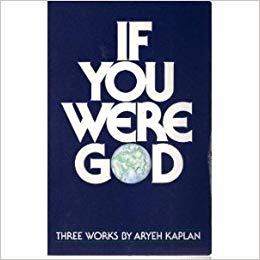
if you were god

I listened to the audio of the classes on which the book Sefer Yetzirah was based. In the discussion, he defined meditation as an expansion of consciousness, alternately he said “I believe that meditation is the channeling of the spiritual energy.” This expansion of consciousness is not mystical or intellectual but a third item called expansion of consciousness. That consciousness give the adept knowledge of God.

In the tapes, he discussed the Rabbi Elazar of Worms, Sodei Razaya meditation I discussed in the last post. comparing Sodei razaya to complex analysis in calculus, where according to him, infinite lines come together. At that point of infinite, there is insight. He compares it to the expansion of consciousness in  Zen Buddhism when is hit by one’s teacher.  One of the people in the class said this consciousness is like the force from Star Wars. Kaplan added it is was similar to hypnosis and they discussed the bio-feedback levels. Kaplan quoted in the discussion to explain consciousness Alan Watts, Andrew Greeley’s book on Ecstasy and Aldous Huxley.

Huxley’s two essays appear as a single book “The Doors of Perception”  “Heaven and Hell”, they both played a major role in Rabbi Aryeh Kaplan’s thinking. Whereas most Jews who learned to meditation in the 1970’s tended to mean practices like TM or Zen, Kaplan definition of meditation was about opening to a higher consciousness, a unified state bringing everything together allowing a new insight into reality, an opening of windows to a deeper understanding. In various places, Kaplan used the word meditation as a synonym for mysticism, magic, and altered states of consciousness.  But the fact that he talked about meditation was enough for many in the 1970’s even if he did not teach meditation techniques beyond visualize letter, rebono shel olam and the slow shema. His practice was basic but letting people know about the extent of advanced texts and the potential within Torah was eye opening.

Before I go further, I must point out that Huxley points out that the way to maintain this consciousness with human relations, chores, charity, and compassion is by the right living and constant attention shown in the religious life, properly understood.  For Huxley, “Ideally, everyone should be able to find self-transcendence in some form of pure or applied religion.”  This seems to be an influence on Kaplan’s view of mizvot.

I am also finding that Rabbi Aryeh Kaplan’s NCSY pamphlet “The Real You” is predominantly based on Aldrous Huxley’s Door of Perception /Heaven and Hell discussion of mescaline and consciousness opening. It seems the strategy was that we are going to keep kids off of drugs by saying they can have altered states of consciousness, synestheia, and opening their door of perception by knowing about Kabbalah. Huxley sees our minds as holding more data than we are aware of and the goal is to attain a higher consciousness to gain access to these levels of self.

In his pamphlet, The Real You, Kaplan asks the big questions about the soul and afterlife. Few ask those questions in Orthodoxy and fewer give cogent answers.

Here we see Kaplan’s contribution of reading and translating Kabbalah into modern cosmology. In this case, the nature of our souls as presented by R. Hayyim Vital is entirely digested and explained that for our era when the medieval kabbalah means that our minds are computers and God is the backup of the data.  In 2018 terms, our minds are mother boards that can be removed from one computer and placed into another one keeping the data intact. God is the cloud where we keep our data.  So that after we die, God holds our memory and personal identity the way the cloud holds your data after your devise dies. In everything that follows in this blog post, ask yourself if you think that was a good way to put medieval cosmology into 20th century terms. If he had lived longer, he probably would have loved string theory.

Kaplan turns reincarnation and gilgul into more modern theory of memory. This definition allowed him to completely reject Indian forms of reincarnation because those do not keep your memory and personality intact.  He was adamant to reject the opinions of those students coming to his classes with a more TM universal sense of soul that reincarnates without memory and personality. Kaplan, in contrast, argues that Judaism is about personality.  Since we are memory, Kaplan found it useful to explain heaven and hell as based on confronting our memories of past events, similar to Huxley.

A brain transplant raises enough questions. How about a memory transfer?

GOD’S MEMORY

What happens then when a person dies?  God does not forget, and therefore all of this information continues to exist, at least in God’s memory.

(An allusion to this is also found in the Kaballah. Gan Eden or Paradise is said to exist in the sefirah of Binah — the divine understanding. This may well be related to the concept of memory. Souls, on the other hand, are conceived in the sefirah of Daas — knowledge. One may say that while we live, we exist in God’s knowledge; after death we exist in His memory.)

This sum total of the human personality existing in God’s memory is what lives on even after man dies…

CUTTING DOWN AT STATIC

In “The Doors of Perception,” Aldous Huxley quotes Prof. C.D. Broad’s comments on this. He says that every person is capable of remembering everything that has ever happened to him. He is able to perceive everything that surrounds him. However, if all this information poured into our minds at once, it would overwhelm us. So the function of the brain and nervous system is to protect us and prevent us from being overwhelmed and confused by the vast amount of information that impinges upon our sense organs. They shut out most of what we perceive and remember. All that would confound us is eliminated and only the small, special selection that is useful is allowed to remain.

Huxley explains that our mind has powers of perception and concentration that we cannot even begin to imagine. But our main business is to survive at all costs. To make survival possible, all of our mind’s capabilities must be funneled through the reducing valve of the brain.

Much of what we know about this static is a result of research done with drugs that eliminate it. According to a number of authorities, this is precisely how the psychedelic drugs work.

The disembodied soul spends much of its time learning how to focus. It is now seeing without physical eyes, using some process which we do not even have the vocabulary to describe. The Kabbalists call this frightening process Kaf HaKela

If God is guarantor of memory, a form of a data cloud, then where does a theory of God fit into all of this? For Kaplan, God wanted to bestow goodness on the world through letting human have freedom and make moral judgement on their own. Hence, he had to hide himself, only operating the world by means of the Kabbalist system of four world and sefirot.

If we were to imagine the spiritual domain, therefore, it could be described as an infinitely huge spiritual computer. This computer is programmed to fulfill God’s one ultimate purpose of bestowing good upon his creation. The main difference between the spiritual domain and a computer is that the components of the former consist of intelligent, sensitive, spiritual beings. (Innerspace 8)

Below, God is portrayed as computer, specifically as a computer feedback system where God as the highest world of Atzilut is the CPU and the lower divine worlds are the memory, program, and peripheral equipment of the computer. Providence works only through this Star Trek type deity. Yet, if you read the passage slowly, you will see that Kaplan is, in his mind, working with Ramchal’s Derech Hashem, a volume he had translated a few years before.

A computer system can provide us with an analogy to the constant interplay between the spiritual and the physical.  The programmer sitting at the console corresponds to the “Man” of Atzilut.  The CPU, Central Processing Unit, is the brain and memory bank of the computer, corresponding to Beriyah, the world of thought.  Suppose that the computer is programmed to control traffic lights throughout a large metropolitan area.  Transmission lines would then be coming out of the CPU, connecting it to traffic lights all over the city.  These transmission lines correspond to the universe of Yetzirah.  The traffic lights themselves are the peripheral equipment.  These lights correspond to the world of Asiyah, controlling traffic in the physical world.

We mentioned that the relationship between the physical and the spiritual is always dynamic.  Accordingly, God’s providential direction of the universe never ceases.  He is always acting in the world, guiding events based on our actions.  In effect, therefore, this is a “two-way” process with a built-in feedback loop to allow for changes in programming.  On the one hand, God is directing an ongoing input into the universe, irregardless of our actions.  On the other hand, God looks at what we do, judges it, and puts into the universe what He decides is appropriate relative to what we do.

In our model of the computer, the peripheral equipment will also contain this feedback loop.  On the one hand, the traffic lights are programmed to control traffic automatically.  On the other, sensors will record traffic flow.  For example, if the traffic on one street is blocked, the sensors will detect this, giving rise to a green-light command from the CPU to get the traffic flowing again. (Innerspace 34)

maxresdefault

Later in the same volume, we are offered contrasting views of God. The first, God as Being to whom we relate to personally as an at of anthropomorphism. The second is God as an ever present immaterial Principle, the same way 1+1=2. A principle valid everywhere that avoids anthropomorphism and exists outside of time and space.  This is a God of mathematics. Kaplan concludes, that God as Principle is also inexact and only a mental construct. Instead, Kaplan seeks an image of God via meditation as a ground of existence. God is only know in this higher state of consciousness between verbal and non-verbal. Here is where computers meet Huxley and Buddhism.

We can speak of God as the Creator of the universe, thus conceiving of Him as a “Being.”  On the other hand, we can speak of God as the creative Force that gives existence to the universe, thus conceiving of Him as an abstract “Principle.”  The main thing that characterizes God as a being is that we can relate to Him personally. When we view God as the Creator and Master of the universe we are ascribing anthropomorphic concepts to Him that are most fitting to an omnipotent sentient being. (Innerspace 98)

The main thing that characterizes a principle, on the other hand, is that there is no place where it does not exist. This is like taking a mathematical principle such as 1+1=2. This simple equation is a good example of something that does not exist in space, and yet, at the same time, exists everywhere.

For many reasons, therefore, it would be useful to think of God as a principle rather than a being.  For one thing, it would make it readily understandable how He exists outside of space and time and yet fills all space and time.  For another, an idea such as this breaks down the stereotyped anthropomorphic concepts that people have about God. (Innerspace 98)

Actually, both “principle” and “being” are approximations that we use because the mind has no categories into which it can place God It may be that third, intermediate category would be a better approximation, but the mind has no example of it. Nevertheless, through meditation, one can gain a glimmer of the nature of this third category.  This involves a deliberate oscillation between verbal and non-verbal states of consciousness.  It is alluded to in the Sefer Yetzirah’s statement that one should emulate the living angels (Chayot) who are constantly “running and returning” (Ezekiel 1:14). (98-99)

Thus, when we commune with God, it is as if we are in touch with existence itself, but at the same time speaking to it as if it were a being to whom we can relate. Still, we realize that God is more than this. He is the infinite Being and absolute Principle that allows existence to be. (Innerspace 99)

Even within this system, we have still cannot grasp this God who is beyond our understanding, called  Atik Yomin, the Ancient of Days. We only know the lower  aspect of the divine called Arikh Anpin, the Long Face of mercy and compassion

Even if we say that God can place restraints on Himself, we still have an unknown will that transcends our understanding why He is placing restraints on Himself.

In essence, therefore, we see that God’s will has two aspects in relation to us.  On the one hand, we cannot fathom God’s will because it originates at a level that completely transcends our logic.  This is the level of Atik Yomin, the Ancient of Days, which is totally unknown and goes back before anything can be thought of.  On the other hand, there is a part of God’s will that operates through logic.  This involves God’s constricting His will so that man can have some understanding of Him.  This is the level of Arikh Anpin, the Long Face of mercy and compassion. (Innerspace, 100)

Kaplan identified this unknown aspect of God who is beyond our understanding with the Buddhist concept of Nothingness. He said that the ideas of Ayin and Effes was Nothingness. He did this years before Daniel C Matt wrote a famous article making that equation. Kaplan’s sources were books on Zen Buddhism, where the Nothingness is the emptiness of satori, a higher consciousness. He did not seem to know Theravada Buddhism.

As the text notes, this represents the unity that preceded the concept of number.  It introduces a device very much like Zen koan, asking, “Before one, what do you count”?  What is the number that precedes all number?

Both the point at infinity and the koan are meant to train the mind to visualize absolute nothingness.  The Ari notes that Keter, the highest of the Sefirot, is often designated by the word Ayin, meaning “nothing.”  The Infinite Being, the level above Keter, cannot even be designated by this word.  The only word that can be used is Effes, which, according to the Ari, denotes a nothingness that thought (Binah) cannot grasp at all. (Sefer Yetzirah 89)

As in many places in his book, the Ari, Rabbi Isaac Luria was used to explain a word in Sefer Yetzirah and the entire Kabbalistic concept needs to be grounded in modern categories.

Rabbi Kaplan was strict to keep his entire discussion within a rational framework of Saadiah’s and Maimonides’ rational theology of avoidance of anthropomorphisms. God does not sit as we do, rather sitting means God lowers his providential power to interact with the world.

As discussed earlier (1:4), when we speak of God as “sitting,” it means that He is lowering His essence so as to be concerned with His creation.  His Throne is the object upon which He sits, and hence, it denotes the vehicle of such lowering and concern.

While “sitting” is a lowering that one does on one’s own initiative, prostrating oneself and bowing is a lowering that one does because of a higher power.  The tools of God’s concern are the Sefirot, since it is through them that He directs the universe.  As a result of the concept of God’s Throne, the Sefirot must also lower their essence and interact with the lower world.  The Sefer Yetzirah therefore says, “before His Throne they prostrate themselves.” (56)

These quotes are from his Kabbalistic works. For his more popular views, see As if you were God and Handbook of Jewish Thought


Rabbi Aryeh Kaplan – Creating 20th Century Jewish Meditation

This is part IV in a series on Rabbi Aryeh Kaplan- see Part I, Part II, and Part III for prior biographic discussion much of which has already been incorporated into Wikipedia. There will be Parts V and Part VI within the next two weeks, maybe even later this week.

How did Rabbi Aryeh Kaplan take an obscure medieval Ashkenaz description of the Godhead and turn it into a meditative practice of infinite space similar to the 1960’s understanding of meditation? Answer: The same way Swami Vivekananda took the medieval Kurma Purana and turned it into modern meditation about sitting straight and focusing. Should we follow his method and take the plethora of kabbalsitic texts published by scholars and adapt them as 21st century meditation? What if this had been the path into modernity for Judaism the way it was for Neo-Hinduism? What if the Reform and Orthodox movements of 1910 had turned to transcendental idealism to create a meditative Torah?

SY- cover

Kaplan’s approach to producing a Jewish meditation is what he calls the “practice of verbal archaeology.”  He assumes the prophets were meditating to reach prophecy, which basically stopped after Ezekiel. Now, one can only do verbal archaeology by looking at meaning of words as translated in older commentaries which may preserve the true meaning. (Meditation and the Bible). Among the older commentaries are the works of the Kabbalists.

The early 13th century Sodei Razaya by Rabbi Eleazer of Worms (also called Rokeach) describes God’s Glory and the limitless Creator above. Within the book are a few paragraphs about the infinite of the Creator and the need to direct our hearts to the ten limitless dimensions when addressing God. They are the Sublime, depth, above and below, east west, north, south, past, future, good, evil), a spatial approach to God, rather than the more familiar scholastic philosophers who discuss God’s essence and attributes. The next paragraph after the ten dimensions moves quickly to the relevant point that God does not appear to us as these limitless dimensions but rather as the ever changing shekhinah. Most academic scholarship focuses either on the abstractness of the Creator or on visualizing the shekhinah/kavod. In contrast, Kaplan turns the presentation of the creator into a meditation on Infinite Space. I specifically choose this passage rather than the hundreds of other possible passages in Aryeh Kaplan because it shows the gap between the scholarly reading of a cryptic text and Kaplan’s reading.

The creator has no limit, boundary or appearance. If He possessed a limit the way every creature has limits, how could he be in the midst of all and not be touched by all…

Every blessing requires one to think in one’s heart for intention to Our Father in Heaven. To consider the unity of the ten directions and there is no other. By what means? Consider the sublime (lit. above) without giving end to ones thoughts. Rather, think of the creator as sublime (above) and none else and the impossibility of understanding Him. Similarly, below into the depth, the depth who can fathom, and none else. He is impossible to understand.

Think of the expanses of the sky and below as well as the directions of east, west, north and south. Think about before the world from the beginning until the end [lemaaleh]. Do not place a limit to your thoughts that you think about the creator. Rather, He exists from the primordial past until now, there is none other. Similarly, for the end of days, from now until forever.

Begin thinking from the beginning of time without limit to your thought except He is God and there is none else. Similarly, for the ends of the depth of good and depths of bad, which show beneficence to the good and to destroy the bad. To exist in exaltedness and variations. The creator is completely desire and filled with knowledge and power.

We find changes in the Shekhinah [appearing] sometimes as a young man and sometimes as an old man. Know that the reason is because the Kavod (glory) appears to the prophets according to the needs of the moment.   (Sodei Razaya 40-41)

Aryeh Kaplan in his book Sefer Yetzirah turns these intentions to the infinite Creator- Father in Heaven into mental and nonverbal meditations on infinite.  The Sefer Yetzirah speaks of depths of the world in Mishanh 1:5. Kaplan identifies those depths with the Kabbalistic sefirot and with the depths described by Rabbi Eleazar of Worms.

Kaplan converts Eleazar of Worms into meditation by adding the imperative “to picture” and the instructions about letting “the mind travel.” Kaplan in his introduction to the book wrote that he is translating the book as statements but that he really feels all statements of Sefer Yetzirah are imperatives. He also places the ten dimensions as a temporal sequence. He also removes reference to this as done at the time of prayer or to the personified Father in Heaven.”

The Sefer Yetzirah does not speak of directions, but of depths, an idea that if difficult to understand and far from one’s comprehension, is also said to be deep….

Although the depths of these directions is infinite, it can be described mentally. The first technique involves verbal thought… Gradually, then, once can learn to depict these infinite depths non-verbally.

The first exercise is to try to depict the “depth of beginning.” Attempt to picture an infinity of time on the past. Let the mind travel back to a moment ago, and an hour ago, a day ago, a year ago, continuing until you reach a level where you are trying to imagine an infinity ago. Then do the same with regard to the future.

The next exercise involves trying to imagine good and infinite evil. The limits are pure ideas, which cannot be verbalized.

Finally, one must imagine the limits of the spacial [sic] dimensions. One must perceive the height of the sky and beyond the sky. The depth of the earth and beyond the earth.

In this manner, one gradually trains the mind to depict the infinite.  (48-9)

These exercises are actually described by R. Eliezer of Wormes [sic] (355 ftnt 112)

Kaplan took an obscure medieval text and made it sound like a 20th century meditative path.

His idiom was contemporary for the 1970’s in which the higher states of meditation were about infinite space. The American scholar, Harvard psychologist Daniel Goleman in his pioneering works on meditation portrayed meditation “the need for the meditator to retrain his attention” not the softer forms of mindfulness currently practiced. Goleman also focused on Buddhist meditation on infinite space as starting in the 5th level of Buddhist meditation.

Just as important, Anagarika Brahmacari Govinda in his Foundations of Tibetan Mysticism (New York : Samuel Weiser, Inc., [1958, 1975] p. 117 also portrays this infinite space. This was not the era of meditation as mindfulness, rather meditation was considered as great acts of mental focus.

However, Kaplan did not actually teach these techniques in his classes nor did he practice them. He did not create a meditative school. Most of those who came to him because they were interested in Asian meditative techniques returned to their Hindu and Buddhist teachers, even among some of his closest students. His accomplishment was presenting texts only known by scholars and only discussed in their harder to find articles in the public domain. And for the last forty years, English language books on Jewish spirituality are indebted in his popular presentations and adaptations.

Rabbi Aryeh Kaplan’s method of popularizing obscure and cryptic texts, for example taking a 13th century text and presenting it in 20th century terms should be seen as part of broader methods. Instead of contextualizing that maneuver in the culture of the 1960’s and 1970’s, where NCSY meets TM,  his texts are similar to the work of Swami Vivekananda, the Hindu teacher who revolutionized the way the West thought of Hinduism with his appearance at the 1893 World Parliament of Religions. Vivekananda’s works took millennium old texts and breathed new life into them by creating a modern method of meditation. He argued that Hinduism is not temple worship to statues but a modern cultivation of the mind, an activity eminently progressive form of New Thought and philosophic idealism. Largely because of him, we use the words mantra and yoga in English. Almost anything taught by today’s Ashram leaders is based on Vivekanada’s method of modernizing prior texts.

Vivekananda took a few pages of the medieval work Kurma Purana, a long work of legend, mythology, geography, pilgrimage, and theology, as his base by which to abstract a system of meditation. According to the Kurma Purana, yoga (which in this context means meditation as purifying the mind) gives knowledge and identity with God.  Here is the medieval version.

From yoga comes knowledge; knowledge, again, helps the yogi to obtain freedom. He who combines in himself both yoga and knowledge─with him the Lord is pleased. Those who practice maha-yoga [meditation on the Self] either once a day, or twice, or thrice, or always─know them to be gods. Yoga is divided into two parts: one is called abhava-yoga, and the other, maha-yoga. That in which one’s self is meditated upon as a void and without qualities is called abhava-yoga. That in which one sees one’s self as blissful, bereft of all impurities, and as one with God is called maha-yoga. (Quoted in Raja-Yoga, by Swami Vivekananda)

Vivekanada turns the medieval work into directions for modern people by telling them to sit straight, have positive thoughts, chant a mantra, visualize space, flames, one’s heart, and God. Rather than a medieval language we have a modern physics language of “makes one’s mind a channel for thought waves.”

Sit in a straight posture. The next thing to do is to send a current of holy thought to all creation. Mentally repeat: “Let all beings be happy; let all beings be peaceful; let all beings be blissful.” So do to the east, south, north, and west. The more you practice this, the better you will feel. You will find at last that the easiest way to make ourselves healthy is to see that others are healthy, and the easiest way to make ourselves happy is to see that others are happy.

Another meditation is given: Think of a space in your heart, and think that in the midst of that space a flame is burning. Think of that flame as your own soul. Inside the flame is another effulgent light, and that is the Soul of your soul, God. Meditate upon that in the heart.

Then the wise man should meditate upon the luminous, benign form of the Lord…Then he must meditate upon his oneness with the luminous form of the Lord.  Lastly, he must let the form vanish and meditate upon the Atman. (591, 620)

Meditation is cultivating a single thought reminiscent of the subject of meditation by repeating it over and over again. By following the same method and concentrating on the same subject at the same center of consciousness, that single thought becomes a giant thought-wave. In course of time the mind develops a channel for that thought-wave and the practice becomes effortless. No practice, however mechanical or intermittent, is ever lost.

Kaplan used the language of mantra and meditation that Vivekanada bequeathed to the English language. Many of these same adaptation techniques in his translations of a medieval text were done by Rabbi Aryeh Kaplan.

Now imagine, if Kaplan had lived in 1900 and wrote works against Western and Eastern European Jewry arguing that a modern Judaism should be meditative and about the elevation of the mind. Further imagine if he had established in 1910 dozens of meditation centers and centers for Jewish Innerspace or a modern denomination of meditation. If he had done this, then we would now know Judaism as a meditation religion. Modern Jewish thought might have been about consciousness and mind cultivation.

However, Kaplan himself would have not actually done this since he did not practice or teach the meditations, such as the one above. He would as part of a public presentation teach his audience to say the shema slowly, to visualize the divine name, and/or repeat ribono shel olam. But the 1000’s of meditations in his work, he did not practice or teach as meditative paths. If he had not died, he would have been more interested in string theory in the kabbalah than a Jewish ashram.

Now let us return to Kaplan’s interest in visualizing the infinite where verbal and non-verbal meet. As noted above, much of this comes from the psychologist Goleman and Lama Anagarika Govinda’s work on Tibetan Buddhism. But was the latter a valid source of meditative knowledge? Why did Kaplan gravitate to that work? Lama Anagarika Govinda (1898-1985), polymath scholar, mystic, writer, painter and poet, was not a real lama, rather a German philosopher and artist who moved in India and thought Buddhism was the path to enlightening our minds and leading to creativity. Govinda thought Buddhism was the best form of German Lebensphilosophie “philosophy of life” to produce a superior person.

Govinda wrote essays on the relationship of time and space and the need to reach a point of infinite space above these categories. For Govinda, “all the powers and faculties of the universe are within us, unless we have activated them through practice or made them accessible through training they will never become realities that influence our life.” He wanted us to combine the potentials of the unconscious mind or depth conscious mind with that of our rational conscious mind.  For him, “as little as we can live by the intellect alone, can we live by the “unconscious” alone.” For Govinda, meditation means “putting ourselves into a state of intuitive receptiveness, in which the gates of the past and the present are open to the mind’s eye. “

The above foray into Vivekananda and Govinda offer a basis for understanding Kaplan’s amazing adaptation of Rabbi Eleazar of Worms. Hoever, Kaplan has many more influences including Aldrous Huxley, Charles Tart, Werner Heisenberg, Sir John Woodroffe, and W. Y. Evans-Wentz.

Academic scholarship in its discussions of Ashkenaz Piety and early kabbalah translate many passages about contemplative visualization done in that era. The soul must visually imagine or think about the creator, the glory and images of sacred space.

If we were to continue Kaplan’s method, how would we modernize these other passages? Here are some passages from E. Wolfson’s Through a Speculum that Shines- Vision and Imagination in Medieval Jewish Mysticism, Princeton University Press, 1994. How would Kaplan have read them as imperatives and as about cultivating the mind?  Kaplan did not read texts as visions, he did not a visionary path but one of internalization and mental contemplations. Kaplan also removed as much as possible any anthropomorphism or direct visions of God. So, if we wanted to apply his method, how would he have scripted the following texts?

Eleazar of Worms,

A person should not think only about the glory that appears opposite the exalted throne but rather about the Creator of all who manifests His glory to those who are righteous in their hearts, for He is one and nothing resembles Him, blessed be He, and thus He ‘is near to all who call Him’ (Ps., 145-18).

The Creator is outside the images (mar’ot) and within them..

Since it is written ‘For I fill both heaven and earth’ (Jer. 23-24), why does one need to pray in a Synagogue or in the Temple? Yet, there is a place in which the Holy One, blessed be He, shows the created glory to the prophet according to the need of the hour. One might ask- how can one bow down to something created? And consider these verses- It is written, ‘For I granted many visions, and through the prophets was imaged’ (Hosea 12-11)… Rather the [vision] is nothing but a wonderful image (dimyon) and it appears as if he actually saw but it is nothing but a strong image. It is written, ‘upon this semblance of a throne there was the semblance of a human form’ (Ezek. 1-26); so too here [in the case of Isaiah] it is only an image.

Two responses to Rabbi Shai Held- Prof Sam Fleischacker and Rabbi Zach Truboff  

Welcome back after the holidays. Before Rosh Hashanah, I posted an exceptionally good interview with Rabbi Shai Held on his moral musar as shown in his Biblical commentary- Torah of the Heart. A Torah of chesed- compassion, gratitude, responsibility, respect for others, loving the stranger,and hearing the pain of others. Rabbi Shai Held presented a journey to develop our moral character until we are ethical beings like Abraham. Here are two responses to the interview. I wanted to post the responses before Sukkot for continuity but it was not to be.

Gratitude-rock

The two responses both appreciate the turn to ethics and musar but have opposite premises about the nature of ethics.

The first response of Prof Sam Fleischacker, who has posted on this blog before, agrees with Held’s message but wants a more rigorous grappling with the philosophic issues.  (1) What is the role of justice in the system? He is especially emphasizing the cold role of law, din, and justice. (2) Why Jewish love of fellow? Every great teacher has a similar message, so what resources does Judaism offer to make us good that other traditions do not. (3) How can we overcome self-deception? How can we move from knowing what to do to actually doing it?

The second response of Rabbi Zach Truboff lauds Held as grounding morality in a covenantal theology of God’s love thereby rejecting a purely autonomous ethic. Truboff also likes the emphasis on gratitude, lovingkindness, and a renewal of moral language. However, Truboff finds that there are times where Held’s approach downplays Divine command and the land of Israel, both themes of his own teachers.

chesed

#1 Response of Prof Sam Fleischacker

I am very sympathetic to Rabbi Held’s project.  I have argued in my own work that, as Held puts it, “Torah without ethics is not Torah at all, but … Torah that’s only ethics is … incomplete” (that’s the core idea in my Divine Teaching and the Way of the World and The Good and the Good Book, discussed here and here on this blog).  I also agree whole-heartedly that this aspect of Torah tends to be missing from (Orthodox) day-schools and yeshivot today, which “accentuate the particular to such an extent that the universal human [is] often lost.”  Held brings out the universal beautifully and he has a gift for close readings that unearth rich and subtle implications:  his use of Ibn Ezra on Exodus 22:21-3, and interpretation of Ezekiel 29:3, in the interview, are especially nice examples of this.

My own local rabbi has also been using Held’s commentaries in his drashot:  a terrific one on the word tzur, for God, in Haazinu formed the basis of his talk recently. From what I heard, and from the readings in the interview, I look very much forward to acquiring and using The Heart of Torah.

But there were places in the interview where I felt a deeper grappling with the tradition of non-Jewish moral philosophy could be helpful.  Below are some examples.

1) Held talks in the interview about our duties to the poor and the stranger entirely in terms of chesed:  love, kindness, compassion — the warm, emotional virtues.  What happened to justice — the cold, rational virtue that can sometimes lead to far more comprehensive and effective ways of helping people on the margins of society than any warm feelings towards them?  In his lectures on ethics, Immanuel Kant writes that giving alms to the poor “flatters the giver’s pride” while “demeaning” those to whom the alms are given, adding that beneficence to others should “be commended as a debt we owe, [rather] than as a piece of kindness and generosity.”  I’ve always found this admonition very powerful.  It makes clear, among other things, that we owe aid to poor and oppressed people whom we don’t particularly like as well as to the ones who touch our heartstrings.  (For a fascinating non-Kantian version of this thought, see Sarah Pessin’s critique of a politics of love at https://politicaltheology.com/americas-love-problem/).  Perhaps we could say that helping people out of justice is a form of love (chesed), but it’s probably better to distinguish din from chesed and appreciate the great moral value of the former as well as the latter.

2) Held is understandably annoyed by people who respond to his teachings by saying, “So, basically, you’re saying I should be a good person.”  But I’d like to hear more about how he means to fend off this dismissive reaction.  In the interview, we are given some wonderful readings of texts, but at the end of the day, they all seem to say, “Be loving” (or at most:  “Devote yourself to a loving God, which will enable you to be loving.”)  And if that is the end of the story, a dismissive shrug seems not inappropriate.

To be sure, it’s highly intriguing to present Judaism as centered around love:  that’s how we Jews usually think of other religions, not our own.  But by the same token, Judaism is hardly the only religion or philosophy that teaches the importance of love.  Christianity teaches it, and Buddhism teaches it, and Frances Hutcheson and Gandhi taught it.  What is distinctive about Judaism that should lead Jews, or anyone else, to turn to it for a message of love?  Why bother with Torah as a source for such a teaching, rather than just cultivating a kind heart — or turning to the Gospels or Gandhian satyagraha?

In a way, this is one instance of a larger problem faced by all moral teachers, whether in a religious or a philosophical context:  how do we make what we have to say interesting?  The most important ethical prescriptions are fairly obvious, after all.  Don’t deceive;  don’t be violent;  be kind;  help those in distress.  None of this is exactly news.  What is interesting, what is deeply disturbing, is that we all, regularly, fail to live up to these prescriptions — often rationalizing our failings to ourselves rather than correcting them.  Why do we do this?  How can we stop doing it?  What can a text or tradition teach us that will help us carry out the duties that we all know we should carry out?  If Held can answer these questions, he will do us a great service.  Telling us just what we ought to do, by contrast, is not very exciting.

3) One issue that can make a moral teaching interesting is the way it deals with the issue of self-deception — a pervasive source of our failure to live up to the demands of morality.  (“I don’t need to be honest to him,” I tell myself, “He did _______ to me”, where the blank is filled in with a self-serving description of a harm that I have blown up into an excuse for bad behavior.)  Self-deception is also a particular danger for moral philosophers themselves.  All too easily, we who teach morality convince ourselves that the fact that we talk a good game is enough to excuse us from actually behaving in decent fashion to the people around us.

That said, there are fascinating discussions of self-deception in moral philosophy.  Søren Kierkegaard makes the danger that one’s teaching will come apart from one’s life a central theme of his Concluding Unscientific Postscript.  Before him, Bishop Butler gave two wonderful sermons on self-deception (one of these focused on Balaam) and Adam Smith devoted a brilliant chapter to it in his Theory of Moral Sentiments.  Kant also makes illuminating remarks on it and I think it is an subterranean, but crucial, theme of Plato’s Republic.  I’m curious about whether Held takes up this theme, and if so, how.  There are characters in the Torah who seem to exemplify self-deception:  Pharaoh, of course (see, especially, Exodus 10:7-11, for a paradigm of bad behavior rationalized as good), and perhaps also Korach and Dathan and Abiram.  It would be interesting to see if the Torah’s way of dealing with self-deception contributes to a distinctive moral philosophy — and a moral philosophy that helps us actually carry out our duties rather than telling us simply what they are.

All-you-need-is-love

#2 Response of Rabbi Zach Truboff  

The German Enlightenment philosopher Immanuel Kant vehemently argued that the moral law was not be found in Divine revelation or religious traditions, rather was accessible to any rational agent. An act was good if it could be applied universally. Kant had little use for the

God of the Bible who commands subservience. Once it could be shown that morality was not dependent on religion, doors were opened even wider for those who wanted to abandon traditional Judaism.

Shai Held often cites a statement coined by Michael Wyschograd that the story of Judaism in the last two centuries is predominantly a “Judaism of self-liquidation” (Body of Faith, 181).  If the most important aspect of Judaism is its ethical message and that message can be found outside of religion, then why would one remain committed to outdated religious beliefs and practices? If anything, Wyschograd argues, modern thinkers assert that the “liberation from God constitutes the purification of the ethical. The ethics of religion it is maintained, is an ethics of punishment. But without God, the ethical is obeyed for its own sake, and this is surely a higher stage of the ethical” (181).

Even for those who ostensibly choose to remain committed to Judaism, Kant’s shadow lingers.

However, a Jewish theology authentically rooted in the Bible’s world view must by necessity push back against the revolution initiated by Kant.

The Biblical narrative repeatedly shows us that God can never be divorced from the good. Held’s shows that the story of the Torah begins with a God of life who creates human beings in His own image and affirms their unconditional dignity. Most importantly, the God of life is also a God of love who chooses to share His love with the descendants of Abraham. God’s love means “we are asked to love God in return. More than that, we are asked to love those who God loves: the neighbor and the stranger” (xxx). The Bible singles out God’s love for the vulnerable and oppressed, asking us to do the same.

The moral imperative created by God’s love is not limited only to the life of the individual but rather penetrates all aspects of society. For the God of love, there can be no separation between the moral and religious realms. Rather, “To embrace the covenant between God and Israel is to be summoned to embody the good and the holy” (xxix). God’s love is also essential to understanding that the good must always be at the heart of Torah.

Held cites the midrash, which emphatically states that, “The beginning of the Torah is lovingkindness, the middle of the Torah is lovingkindness, and the end of the Torah is lovingkindness” (296). The Torah begins with God clothing Abraham and Sara after exiling them from the Garden of Eden and it ends with God burying Moses after his death. In the middle, God visits Avraham while he is in need of healing after undergoing circumcision.  In effect, this expresses the idea that “The very essence of Torah, the sages thus insist, is a God of love and kindness who calls Israel to love and kindness” (296).

Deeply aware that such statements often end up as little more than empty platitudes, Held instead argues that it must be read as a radical challenge to all those who hold the study of Torah to be among the highest of Judaism’s ideals.  With powerful prose, he explains:

“Torah can elicit staggering degrees of goodness and generosity of spirit; it can motivate us to love when hate seems much easier, to care for the pain of others when indifference seems the surer path. But Torah can also be made to serve the opposite ends: It can serve to deepen selfishness and self-involvement; it can be cited to bolster chauvinism and cultivate hate… The Torah we learn and teach should help us become kinder, more generous, more empathic and willing to give; if it merely buttresses our biases and hardens our hearts, then it is simply not Torah” (298).

Mussar and Middot

Throughout nearly every essay in The Heart of Torah, Held contemplates various ways in which the Bible helps point us towards moral transformation. Held’s focus on ethics has coincided with a renewed interest in Mussar by many segments of the American Jewish community. At a time when most Jews lack a common moral language, an emphasis on character enables a broader discourse that transcends denominational boundaries.

Held draws inspiration from the Biblical interpretations of the Mussar masters famous for their harsh critique of traditional Jewish practice. For example, when God demands of Moshe that Israel must be annihilated for the sin of the Golden Calf, God highlights the stiff-necked character of the Jewish people even more than the transgression of idol worship (Exodus 32:9-10). Rabbi Nosson Tzvi Finkel, the Alter of Slobodka, explains that, “From here we see that defect in character is even worse than a defect in action- more serious even than a grave sin like idolatry” (203-204). According to Held, “What Finkel is suggesting- in the most dramatic possible terms- is that Judaism is concerned not just with what we do, but also with who we are. Jewish ethics is focused not just on conduct but also on character. From a Jewish perspective, character matters, and the cultivation of good character lies at the heart of religious life” (204).

Held returns often to the idea of gratitude. For the Bible, gratitude is fundamental to the religious personality. Unlike other attributes, it is inherently relational and therefore is always directed towards another, whether it be our fellow human beings or God.

I found myself particularly drawn to a close reading that he offers of the narrative of Leah, a reading that  illustrates the complexity and significance of gratitude. Held is aware that it is all too easy to see Leah as a pathetic character in the context of the narratives of Bereshit. Despite the knowledge that she was not chosen by her husband, she still yearns for his love. It is her hope that by providing him children, she will finally win Jacob’s affection.

Held cites a strange Talmudic claim that until this moment no human being had truly expressed authentic gratitude. He explains that this makes sense if we recognize that Leah’s gratitude is unique because it is accompanied by terrible disappointment. With the birth of Judah, she has come to the conclusion that Jacob will never love her as she desires. Nevertheless, in the midst of her pain she has also come to recognize with gratitude the good she has experienced.

From her example, Held draws an important lesson, one that resonates with me more and more as the years pass.

“Disappointment need not preclude gratitude, and nor need gratitude crowd out the very real possibility of disappointment. Judaism does not ask us to choose one feeling or the other, but rather makes space- indeed, seeks to teach us to make space- for the sheer complexity and contradictoriness of human experience. Who better than Leah to teach us that a broken heart can also have moments of profound fullness” (63).

Can the God of Love also be a God of Law?

A focus on “loving the stranger” and character can be morally uplifting, but does the Bible have anything to say about the role of Jewish law in moral life?

For a religious thinker such as Held who focuses on the idea of covenant, it is surprising that command is minimally addressed in his essays. Held’s call for a return to a God centered morality is to be lauded, but one must question whether such an approach is even possible without repeatedly emphasizing that the God who loves is also the God who commands.

For Held, God’s love is so foundational to the covenant that it precedes and at times takes priority over and above God’s commandments.

However, Held’s own teacher, Jon D. Levenson, makes clear that the love of God can never be separated from obedience to God’s commands. After carefully analyzing a series of Biblical verses that describe the Jewish people’s love for God, Levenson explains that “’Those who love [the Lord],” it would seem, are synonymous with those who “keep His commandments’… Love, so understood, is not an emotion, not a feeling, but a cover term for acts of obedient service” (The Love of God, 4).

Levenson also turns to the writings of Franz Rosenzweig to show that on an existential level, God’s love can never be separated from a sense of command that accompanies it.  Rosenzweig asks: “Can love then be commanded? Is love not a matter of fate and of being deeply touched, and if it is indeed free, is it not sheerly a free gift? (Galli, 190.) Rosenzweig answers with the following: “Yes, of course, love cannot be commanded; not third party can do so, but the One can. The commandment of love is not an alien commandment; it is nothing other than the voice of love itself” (Galli, 191.)

Levenson writes that “love makes man com[e] out of the boundaries of his ego.” (Levenson, 190.) We live at a time when a rampant culture of social media combines with a pervasive philosophy of radical individualism to trap so many within the walls of their own ego.  We would do well to remember the ways in which Divine love at the heart of the covenant serves not only to inspire us but also engenders a sense of command that can help us transcend our selfishness.

Covenantal Morality and the Land of Israel

One particular line of thought also deserves further development within Held’s writing. As stated by Prof. Alan Brill in his original interview, there are times when Held’s philosophy seems to “desiccate the elements of historical narrative and collective nationalism from the Biblical text.”

It is hard to claim that love is at the heart of covenant without also making clear that the Land of Israel is an essential part of it as well.

This is clearly the case from even just a straightforward reading of the Torah in which the land of Israel serves as both a symbol and guarantee of God’s covenantal relationship with the Jewish people. However, this is also true on a philosophical level as well.

In the words of Yitz Greenberg, another mentor of Held’s, “God calls his covenantal people into existence to serve as a paradigm and witness to the true nature of and destiny of human life… This people needs land, security, health; it is affected by war, drought, death; it must meet the challenges and temptations of existence as best as it can” (Land, People, and Faith: A Dialectical Theology, 62.) In the end, Held’s Biblical theology of morality tends to focus on the individual, and in doing so, ignores the ways in which the Jewish people’s collective moral development is rooted in the attempt to build a just and moral society together in the Promised Land.

What exactly is to be found at the heart of Torah?

Held’s essays are full of penetrating insights into the Biblical text, and his covenantal vision of God’s love is a perspective that many will find stirring. However, there is an additional reason that makes “The Heart of Torah” a compelling work, Rabbi Soloveitchik explains that his own philosophical and theological explorations of the Biblical text are at the end of the day an attempt at “finding my own acute problems and questions, my own torturing anxieties and fears, my own inspiriting hopes and aspirations in the story of Biblical heroes. The detection of one’s own self in Biblical man is an exciting experience… It is a redemptive and enhancing awareness” (4). Rabbi Soloveitchik’s words remind us that while God and morality may be found at the heart of Torah, we must also find ourselves there as well.

Shai Held’s essays retain a quality rarely found in most contemporary Jewish scholarship, because they are infused with his own fears, his dilemmas, his hopes, and his dreams. Reading his writings is an exciting experience, and if it helps nudge even just a few to open their hearts a little wider to both God and the good, it is perhaps a redemptive one as well.

Interview with Shai Held- The Heart of Torah

“The world is built on chesed” (Psalm 89:3), best translated when dealing with Jewish thought as loving-kindness, or a loving approach towards other people. Maharal (d. 1609) sees our acts of chesed as flowing from the chesed shown to us by God. This is made a principle teaching of musar teachers of Judaism, especially those including Rabbi Eliyahu Dessler in his Miktav mi-Eliyahu and Rabbi Sholom Noach Berezovsky in his Netivot Shalom. The emphasis is that it is not enough to do acts of chesed, but one must be a chesed personality.

Rabbi Dr. Shai Held considers that chesed as love and kindness is the core of his Biblical message, along with the corollaries of gratitude and responsibility toward others.  The “heart of Torah,” of the Torah and of all religion is “about softening our hearts and learning to care.” To present these ideas, Held has recently published a two volume set, The Heart of Torah, Essays on the Weekly Torah Portion: Genesis and ExodusThe Heart of Torah, Essays on the Weekly Torah Portion: Leviticus, Numbers, and Deuteronomy both (The Jewish Publication Society, 2017). Shai Held is President, Dean. and Chair in Jewish Thought at the Hadar Institute. Rabbi Held has twice graced this blog with interviews. Seven years ago, he was interviewed as an introduction to Hadar and then in 2013 he was interviewed about his book Abraham Joshua Heschel: The Call of Transcendence. Much that I could say in this introduction was already covered in the prior interviews.

held-cover

In the interview below, I treated the book less as a Biblical commentary and more as a musar book exhorting us to lead a life of showing chesed. The two volumes allowed Held to work out his moral vision. I tried to capture that moral vision in the interview. In many ways, I see this work of Held’s as a midpoint on the theoological way to his next book to be published by Farrar, Straus, &Giroux (forthcoming in two years) about the centrality of love in Jewish theology, spirituality, and ethics. For Held, Judaism is, at heart, a story about a God of love who summons us to lead lives of love.

How do you know that one has this obligation of showing chesed? For Rabbi Saadiah Gaon, these imperatives are known through reason and intuition,  for the Musar masters, following Maharal, these imperatives are a divine decree of how the world is structured, and for the Religious Zionist Moshe Unna, they are a conscious choice to read the texts in a moral, rather than immoral way. Held accepts all of these approaches in his moral theory.

Another major point in the ethical theory in the book, similar to the musar masters use of Maharal, is that God’s love for Israel is not on account of Abraham or Israel’s merits but is “pure grace.” God chooses humanity, Abraham, or Israel as an act of giving of himself. In addition, biblical chosenness requires a higher degree of demand, accountability and moral responsibility.  In Held’s reading, that choosiness in the Biblical message is not limited to Jews, rather it extends to humanity.

In addition, Held emphasizes the dialectic of God’s as both transcendent and immanent. God is known in both forms. But he does not work with the midrashic-kabbalictic-musar dialectic of din and rahamin, judgment and mercy,  and hate and love. His vision is on the love. At points, the volumes can be sermonic and moralistic as a work of musar homilies. But he is motivated by a sincere quest to restore the concern with chessed to the Jewish community. The reader should also be aware that the style of the writing is of long independent essays with footnotes, to scholarship, to Christian theologians, and to many commentaries. The work is not short paragraphs to read in synagogue, but something to savor on the long Friday nights of the winter.

Chesed is not just volunteering for a synagogue chesed project or writing a check. For Held, chesed is an entire approach to life. One is to be like Abraham, an embodiment of chesed. When one hears about events in the news, or government policy, or the affliction of contemporary poor and afflicted then one should respond from the responsibility of living a life of chesed.

In this book, when Held writes about society, the discussion in this book goes to the ideal Edenic society and not the realistic politics in our 21st century American long after Eden. In our after Eden American life, Held affirms that attacks on “other people’s humanity is by definition an assault on God.”  Nevertheless, this book with its emphasis on a Biblically mandated concept of human dignity lets the reader understand the basis behind his reactions to contemporary American politics. This is how to respond to God’s gift to us by showing responsibility to act with chesed. Held certainly has an ideal communal project, but his political vision is best known from his public actions and posts on social media.

If one wanted an Existential reading of the weekly Torah portion, then one turns to Martin Buber. If one wants a psychoanalytic literary reading, one turns to Aviva Zorenberg, If one want a Neo-Hasidic reading, one turns to Arthur Green (among others). If you want a reading about continuity of a covenant people, one looks at Jonathan Sacks. But if one wants a modern ethical reading, this is the book.

In the amusing picture below featured in the local paper, Held is portrayed as balancing in his thought the works of Rabbis Heschel and Soloveitchik. After this book, we should add a third picture to the image showing him also balancing the musar masters. Held’s book is an appropriate book to buy for the High Holy Days and then to be used throughout the rest of the year.  Or at least, print out this long interview to read during this penitential period.We can certainly use a moral vision.

HeldDoubleHandedVer21
(Larry Yudelson/Graphics: Jerry Szubin/The New Jersey Jewish Standard)

1)      What is the role of Hesed and Compassion in the Chumash?

I have always been struck by one particular law in parashat Mishpatim.  The Torah declares: “If you take your neighbor’s garment in pledge, you must return it to him before the sun sets” (Exodus 22:25).  So far, so good– a concrete law aimed at protecting the impoverished borrower.  But what follows is unexpected, and frankly stunning: “It is his only clothing, the sole covering for his skin.  In what else shell he sleep?” (22:26).

Rather than just laying down the law, the Torah makes an emotional appeal– understand the predicament of the poor and respond in ways that reflect that understanding.  This is not the kind of language that one would expect to find in a dry code of law.  It’s as if the Torah can’t contain itself, can’t limit itself to delineating the laws.  It is unwilling just to demand that we act in ways that are sensitive to the plight of the needy; it wants more from us, and so it reaches in and makes a claim on our emotional life, on our inner world: you have to care about people, even and especially those who are powerless, and all too often forgotten and neglected.

The same type of emotional logic animates the prohibition on oppressing the ger, or stranger/sojourner, in Mishpatim: “You shall not oppress the ger,” says the Torah, “for you know what it feels like to be a ger.” Why so?  “Because you yourselves were gerim in the land of Egypt” (23:9).  Here again we are commanded not just to avoid oppressing the stranger, but also to avoid doing so at least in part with a deep understanding of the experience he or she is presently enduring.  (As Rabbi Eliyahu Mizrahi notes, it’s important to be clear: the experience of suffering in Egypt is not the source of the law.  After all, no one can legitimately say, “Well, I wasn’t a stranger in Egypt, therefore this prohibition does not apply to me.”  Rather, I think, our experience– or better, the way we choose to remember our experience– intensifies a moral obligation that is always already in place.)

What we see in both these laws, and in many other places in the Torah, is a commitment to compassion as a virtue, as a disposition integrating both emotion and action.  If we care for people but do nothing for them, then our care is not really care.  Conversely, if we act on people’s behalf but feel nothing for them, we have done concrete good (returned their garment, treated them with dignity), but we have not yet reached the Torah’s ideal of integrating emotion and action.

The same will be true in Rabbinic texts where the mitzvah to walk in God’s ways is interpreted both in terms of virtues/character traits– “just as God is merciful, so too should you be merciful, etc.– Sifre Devarim, Ekev 49), and in terms of actions– “just as God clothes the naked, visits the sick, etc. so too must you clothe the naked, visit the sick, etc. (Sotah 14a).  As Rambam notes in Sefer HaMitzvot (Aseh #8), we are bidden to emulate God both in concrete actions and in “noble attributes.”

Ultimately, from a religious perspective, compassion becomes a kind of ethos, a way of carrying ourselves in the world and responding to other people in moments of suffering and vulnerability.  The fact that the Sages call this walking in God’s ways points to its enormous importance but also to its difficulty– growing in compassion and the capacity/willingness/eagerness to be present with others when they suffer is the task of a lifetime.  And there is no higher form of serving God than this.

2)      What is the role of human responsibility in the chumash?

I think the answer to this question is wonderfully encapsulated in another law from parashat Mishpatim:  “You (plural) shall not ill-treat any widow or orphan.  If you (singular) do mistreat them, I will heed their outcry as soon as they cry out to Me, and My anger shall blaze forth and I will put you (plural) to the sword, and your wives shall become widows and your children orphans” (Exodus 22:21-23).  Ibn Ezra was struck by an obvious grammatical anomaly in the text: why do the verses move back and forth between addressing Israel in the plural and addressing the individual oppressor in the singular?  His answer is at once arresting and daunting: the Torah wants to teach us that the legal status of those who witness oppression and keep silent is equivalent to the legal status of those who commit the oppression themselves.

Put in more contemporary language, the Torah wants to teach us that there is no such thing as an innocent bystander.  If we see cruelty and abuse and we do nothing about it, then we too are implicated in the crime.  (Imagine how differently we would all live if we truly took what Ibn Ezra is saying to heart.)  In other words, we are responsible even we ourselves do not directly participate in the oppression.

This is true all the more so, presumably, when we ourselves behave in ways that are unacceptable.  As I show in the book, Bereishit repeatedly holds characters accountable and exacts retribution from them when they act in problematic ways.  Perhaps most famously and powerfully, Yaakov pays for his act of deceit (taking the blessing from his brother by deceiving his father) doubly– when Lavan deceives him into marrying a woman he does not love, and when his brothers deceive him into believing his beloved son is dead.  As the Mishnah puts it, “A person is always responsible/accountable [for their actions]” (Bava Kamma 2:6).

3)      What is the role of gratitude?

One of the most fundamental intuitions a religious person has, I think, is the sense that none of us did anything– none of us could ever have done anything– to earn the gifts of life and consciousness.  As the Rambam, following R. Saadia Gaon, notes, the existence of the world is entirely an unearned gift, as a hesed or grace, that which we receive although we did nothing to deserve it (See Guide 3:53).  The urge to worship and serve God begins, very often, with the realization that we did not create ourselves (Bereishit Rabbah 100:1, following the ketiv of Psalm 100:3, “[God] created us, and not we ourselves.” ) Perhaps not surprisingly, according to the book of Yehezkel, Pharaoh, the great biblical villain, brazenly declares that he did indeed create himself—see Ezekiel 29:3 (The Hebrew “ani asitini” can be rendered either as “I created it [the Nile] for myself” or as “I created myself.”

Why is this so important?  Because the religious person begins with an awareness of how much she has been given, and therefore of how much she owes.  It is not a coincidence that for the past several hundred years, Jews have begun their day with the first word we utter being ”grateful” (modeh, or modah).

The main point about gratitude, as I understand it, is that it is not just a feeling that I have that I’m glad that x or y happened.  Gratitude is constituted, in part, by an urge to repay or pay forward what the giver (or Giver) has given to us.

As Rav Yitzhak Hutner wonderfully puts it, when someone does an act of hesed for us, a seed of hesed is planted within us, and if it is allowed to flourish and blossom properly, it cannot but elicit more hesed from us.  In other words, hesed flows through the world, from God to us and onward to others.  To borrow an image from Maharal, we must not become dams that impede the onward flow of God’s gifts.  That’s why, as I’ve argued in the Heart of Torah and as I argue at greater length in the book I’m currently writing, from a Jewish perspective gratitude and generosity are inextricably intertwined.

4)      Your commentary seems almost a musar book about compassion gratitude, and responsibility.Do you have a worked out moral path or path of growth behind your exegesis?

I don’t think I yet have a worked out moral path in the way I suspect you have in mind.  What I have, so far at least, is a series of mandates that have the potential to help us grow kinder, more compassionate, and more generous.

That includes things like cultivating gratitude through awareness of breath (if you find it hard to access gratitude, notice your next inhalation and ask, who made that?– see Rabbi Levi in Bereishit Rabbah 14:11).  It includes working to restore the flow so that gratitude becomes generosity, and asking ourselves on a regular basis what it is within us that blocks or impedes the onward flow of Hashem’s hesed.  It is also crucial to develop an awareness of our own suffering and wounds so that we do not inflict them upon others (I take “you know what it feels like to be a stranger” not just in the indicative but also an imperative).  We also have to learn to sit with fear so that we don’t flee opportunities to be with people in their pain.  More generally, we have to believe, in our guts and not just in our minds, that we are in part authors of our own character, shapers of our stories who decide what to learn from past experiences, etc.

I think a lot of one of the ideas attributed to the Kotzker: we are forbidden to ever see ourselves as finished products.  We are capable of growing in love and kindness.  Yalkut Reuveni offers an beautiful reading of the idea that God wants to create us “in our image, after our likeness.”  God creates us in God’s image (tzelem), he says, but whether we become a likeness (demut) is in our own hands.  That is not a bad description of the spiritual life as a whole: a journey from tzelem, which is a fact, to demut, which is a project, a task, and an aspiration.

5)   How is Torah an ethical challenge?

We learn from Tanakh that God loves widows, orphans, and strangers.  God sees those whom other tend to neglect, or worse, exploit.  (Recall what Hagar, “oppressed” by Sarah– Genesis 16:6– calls God: “You are the God who sees me.”)  To worship a God who loves the vulnerable is to strive to love the vulnerable ourselves.

One of my greatest anxieties as a religious person is that I don’t know whether I’ve ever truly served this God, the God who loves the weak and downtrodden and summons me to do the same.  And since I want to love God and serve God, I have to strive to do just that, hard as it is, demanding as it is, unpopular as it might make me in some quarters.

And then there’s the mitzvah of walking in God’s ways.  The God of Torah asks us to live lives of hesed, of love and kindness and compassionate presence with others.

Every once in a while, when I teach sources about this aspiration, someone will try to blow it off with a platitude like “So, basically, you’re saying I should be a good person.”  But this is a profoundly cynical response, one that indicates an unwillingness to really hear the challenge Torah lays down before us.

In a world suffused with suffering, are we committed to visiting the sick and comforting the mourners even when it’s inconvenient, or tiring, and even when it scares us?  In Ashrei (Psalm 145) we say that “God is good to all” and “God’s mercy is upon us all.”  We usually take that to mean that God is merciful to all of God’s creations, but in a stunning passage in Bereishit Rabbah it is taken differently:  God is good to all, and God has given of God’s capacity for mercy to all of us, so that we are capable of treating others with compassion.

As Musar teachers like Rabbi Yehezkel Levenstein teach, that is real devekut, or cleaving to God.  We attach ourselves to God’s mercy and become merciful ourselves.  Needless to say, this is far more demanding than “be a good person.”

6)   Can Judaism be reduced to ethics?

I think morality and concern for others is at the heart of religious life, but it most certainly does not exhaust it.   The idea that Judaism is ultimately only about ethics is a distortion of Torah (I admit I much prefer it to some other common distortions of Torah, but it is still a distortion).  In the long run a Judaism that is only about ethics, even radicalized ethics, is an assimilatory, self-liquidating Judaism

But I want to be clear here: the answer is not to swing to the other pole.  Michael Wyschogrod writes at one point that “ethics is the Judaism of the assimilated.”  Well yes, but (as he well knew) it is also at the heart of the Judaism of Moshe Rabbeinu, of Amos and Hoshea, and of Rabbi Akiva and the Rambam.   Torah without ethics is not Torah at all.  But Torah that’s only ethics is an incomplete Torah too.  We have to live inside that tension, not attempt to dissolve it.

7)      Can you explain God’s love and the relationship of love to Torah?

Rabbi Akiva teaches that every human being is beloved simply because we were created in the image of God.  Note: we are loved by God before we do or accomplish anything in the world.  God creates us, cares about us, wants us to flourish, and has expectations of us.  We don’t earn God’s love; rather, we strive to live up to it.

This idea has revolutionary implications.  First, if we are, all of us, loved by God, then we don’t need to spend our lives competing and comparing ourselves with others.  We can cultivate an ayin tovah, a generous eye, and we can avoid envy and schadenfreude, because other people’s successes don’t undermine us or call our worth into question.  In other words, having a sense of being loved by God enables us to more fully fulfill the mitzvah of ahavat ha-rei’a, loving our neighbor.

Judaism has always treasured the life of the mind, and the Beit Midrash has accordingly been one of the centers of our religious life as a people.  But without developing the heart, without growing our capacity for compassion, and love, and mercy, we will be humanly stunted, and hence our Torah will be, at best, a distorted reflection of God’s Torah.  Remember: Hazal say that “the beginning and end of Torah is love and kindness” and this is a statement of what Torah is truly for, and what it’s ultimately about.  A God who loves us summons us to live lives of love.

8) What is the role of anxiety, anguish, and struggle in the religious life?

Torah is about relationship with God, and yet our world can appear totally godless.  One of the reasons I fell in love with Tanakh is that it is so honest about the tension—it often feels like a chasm– between the story it tells about the world, on the one hand, and much of what we experience, on the other.  Faced with enormous, unbearable suffering, Tanakh does not revert to a “gam zu le-tovah (this too is for the good) theology” but instead protests and screams.  One psalm tells us that the Guardian of Israel does not sleep, yet another laments, “Wake up!  Why do you sleep, O Lord?!”  The anguish of that psalmist is part of biblical faith, and it is part of our lives.

In the modern world, our questions are not new, but some of the answers we are willing to consider are.  Writhing in pain, the author of Psalm 44, for example, could ask why God had forgotten God’s people; when we writhe similarly, the possibility that there is just nobody out there looms real to most of us.  We fear not only that God has abandoned us, but that the sky might be empty, as it were, that there might not be a God at all.   And so our anxiety and anguish has a different texture than the anxiety and anguish of ages past.

9)      How can moderns without a yeshiva background love Torah? What do you say to those contemporary Jews who think Torah study is only for the day school educated?

I almost never talk to Jews about learning Torah.  What I attempt to do instead is to invite them into the conversation itself, ask them to experience being inside the conversation rather than standing outside it and looking in on it (or looking down at it).  It’s like the difference between hearing a friend describe someone he thinks you should meet and actually meeting them.  The latter is so much more real, and so much more powerful.  That, and that alone, gives you a real sense of what Torah is.

There have been occasions when a day school-educated Jew has asked me, with some condescension, whether I really believe it’s possible to learn Torah with Jews who have little or no Jewish textual education.  And my answer is that as long as you have a heart, a soul, and a mind, you can learn Torah.  Now, the deeper you want to go, the more you have to learn the language (both literally and metaphorically), but you can encounter Torah and be transformed by it without that too.  And conversely, by the way, you can spend years in a Beit Midrash and not really learn Torah in the sense that I mean it, with a truly open heart and a truly open mind.  Recall the well-known quip of the Kotzker, “I know how many times you’ve been through shas, but how many times has it been through you?”

When I learn with Jews who do not have vast background in Jewish learning, one of my hopes that they will each catch at least a brief glimpse of heaven from the Torah and that will inspire them to want to make Torah more deeply their own.

10)      What is the role of your quotes from scholarship and history of the Ancient Near East, if in the end you always give a modern ethical reading?

Well, first, I think there are theological and ethical dimensions of the text which we cannot fully understand without considering its ancient Near Eastern context.  For a long time, I kicked and screamed against this position, but now it seems obviously correct to me.

Let’s return to Genesis 1 for a moment.  The Torah teaches that we are all created in God’s image.  But a look at the context reveals the idea in all its revolutionary glory.  In other places in the ancient Near East, it is the king of a society who is created in the image of the god that that society worships.  That means, in part, that he is destined from creation to mediate God’s blessings to everyone else, and to rule over them.  The Torah comes along and says, It is not the king who is created in God’s image, it is every human being on the face of the earth.  This is a radical democratization of an ancient notion and what it means is that we are all royalty, all kings and queens, and that none of us is destined from creation to rule over the rest of us.

This also translates to the realm of moral responsibility.  In much of the ancient world, it is the king who is responsible to look out for the widow and the orphan.  But in Tanakh moral responsibility is democratized– you and I too are responsible for the fate of the downtrodden.

The same democratization takes place in terms of the Jewish people.  Instead of the king alone being God’s son– see Psalm 2 for a biblical reflection of this idea– all of Israel are now considered God’s children– banim atem.

I would also add– and I mean this sincerely– that I don’t set out looking for a modern ethical reading.  I set out to read, to learn, to struggle with the text.  Very often, that process leads me to, and leaves me with, a modern ethical challenge.  But that’s not because I care about ethics but because Torah does.  Now, I am not naive– I realize that we bring who we are and what we care about to our encounter with Torah and that these exert great influence on what we find there.  But I still think a certain kind of integrity and radical openness in reading is necessary.  Otherwise, why bother reading at all?

11)      Can you explain your use of Moshe Unna concept of Jewish humanism?

Moshe Unna (1902-1989) was a fascinating person, a visionary of a kind of religious Zionism that has largely and tragically now passed from the world.  He was a Member of Knesset from the NRP and a founder of the religious peace movement (it’s more or less impossible to imagine such a combination today).

In addition, he was a serious educator and educational theorist.  He worried that Torah could be interpreted in all kinds of different ways, some that would sanctify God’s name and others that would desecrate it.  More concretely, he believed that Torah sources could be marshaled to demand love and justice and moral goodness but also that they could be used to legitimate hatred and bigotry and every form of cruelty.  We know from the Talmud that Torah can be an elixir of life but that it can just as easily become a deathly poison (Yoma 72b).

But Unna felt that as inheritors of tradition we need to be conscious of our moral commitments as we go about interpreting sources.  Without that, we will open the door to all kinds of barbarism being perpetrated in our name, and even worse, in the name of God and God’s Torah.   So he stated, without equivocation or apology, that those who interpret Torah ought to be committed to a kind of Jewish humanism– a commitment to the dignity, worth, and moral standing of every human being, and a resolve to interpret Torah accordingly.

Unna’s formulation is stark and powerful, but it also dovetails with the ideas of many other Jewish thinkers.  He was not a Kookian but Rav Kook also talked about how yirat shamayim must never lead you to act in ways that you know are inhumane and immoral; yirat shamayim that leads you to act less morally than you’d have acted without it is what he calls yirat shamayim pesulah, an illegitimate fear of God.

Rabbi Shlomo Aviner, who is at the opposite end of the spectrum from Unna on almost every conceivable issue, argues similarly that we needed Avraham before Moshe because without a prior commitment to hesed and moral goodness (Avraham), Torah (Moshe) would be a dangerous and potentially even toxic thing.

I think about Unna’s ideas often as I read sources, because I believe we are mandated to ask ourselves at all times: are we reading in the most humane, compassionate ways we can?  This is not a secular import to tradition– far from it, I think it’s the natural consequence of believing that we interpret in order to serve a God of love, hesed, and moral goodness.

12) You seem to desiccate the elements of historical narrative and collective nationalism from the Biblical text. Is this intentional?

That’s an interesting question and one that I’ve struggled with myself as I look back on the 101 essays that make up the book. Consciously or not, my goal was to find something striking about the text that would leave people with a non-cliché challenge of some sort– an action to take, a new way to think, a feeling to cultivate, or whatever.  That ended up yielding a fairly ethical approach rather than a historical or national one.  It’s not that I don’t think the latter two are important– quite the contrary; it’s that given the nature of the project I was engaged in, they ended up taking a backseat.

I am increasingly drawn to and preoccupied with questions of moral philosophy. Universal questions- about compassion, and gratitude, and the quest for a more just, equitable society- tend to end up front and center, while some of the more particularistic pieces of Jewish theology, which are in fact crucial to me, end up getting short shrift.  This a problem I feel I need to attend to in my writing and thinking.

Autobiographically, I’ve come to realize that I am still seeking to make space for some of the things I felt were missing from my own religious education.   Some of the schools I attended– day schools, yeshivot in Israel, etc.– accentuated the particular to such an extent that the universal human was often lost.  (I also witnessed no small measure of explicit racism in various yeshivot.)  When I came to understand over time just how distorted a picture of Jewish theology that really is, I set out to highlight some of those more submerged themes.  Yet, most of my teaching takes place within the American Jewish community, which presently struggles with too much emphasize on universalism so that the particular threatens to become submerged (a trend of which I have been extremely critical).  That requires some re-calibrating on my part, I think.

13)   Which are your favorite Jewish sources to use?

In terms of classical commentaries, I’ve always felt somewhat more drawn to Talmudic and midrashic elaborations of biblical stories than I have to medieval commentaries. I regularly consult and learn from the latter, but the midrashic openness, playfulness, willingness to look at a problem from multiple angles simultaneously and to flirt with the theologically outlandish make the latter more compelling to me.  I could happily spend my life just reading Bereishit and Bereishit Rabbah together. Ruth and Ruth Rabbah is another stunningly provocative pair.

I love the moments when classical commentators discuss ethical issues. So, for example, Radak on Genesis 16:6, where (in the wake of Ramban) he argues that when we finally have the power to cause suffering to someone who has hurt us, the ethical ideal is to refrain; or Ibn Ezra’s insistence that the purpose of Torah is to “straighten out our emotions,” or his claim about innocent bystanders that I mentioned above, etc.

I find myself frequently coming back to the commentaries of Abravanel, Netziv, R. Samson Raphael Hirsch, and Malbim. In terms of Musar, my interests (reflected more in my current book project than in The Heart of Torah) are in more recent musar figures:  R. Eliyahu Lopian, R. Yehezkel Levenstein, R. Chaim Friedlander, and R, Shlomo Wolbe.  In all kinds of ways, I inhabit a very different universe from theirs, but I consistently learn a lot from them and feel challenged by them to grow as a person and as a Jew.

Interview with Leon Wiener Dow- The Going: A Meditation on Jewish Law

Franz Rosenzweig (1886–1929), one of the most original Jewish thinkers of the modern period, writes in a 1927 letter about the need to be present, a form of “here I am” in the eternal “now” of one’s own individual standpoint, but the standpoint remains that of an individual human being. One does not transcend her individual, finite standpoint in order to attain a standpoint that would pretend to be Absolute. A person, according to Rosenzweig, does not “have to take out his own eyes in order to see right.” It is no doubt true that a person’s eyes limit his perspective, but it would be an act of idiocy to poke out one’s eyes in order to see properly.” How would this play out in halakhah? What would a halakhah of an individualized standpoint look like?

These are some of the questions that animate the writings of Leon Wiener Dow, a research fellow and member of the faculty at the Shalom Hartman Institute. He received his BA from Princeton University, his MA in Jewish thought from The Hebrew University of Jerusalem, private rabbinic ordination from Rabbi Professor David Hartman, and a PhD in philosophy from Bar-Ilan University. Wiener Dow recently wrote two complimentary books. The first, based on his PhD thesis, U’vlekhtekha Va’derekh (Hebrew, Bar Ilan University Press, 2017) constructs an approach to halakha based on the thought of Franz Rosenzweig, then compares Rosenzweig to prior halakhic approaches and to Hasidut. His concurrent English book, The Going: A Meditation on Jewish Law (Palgrave Macmillan in 2017) is a personal meditation on living a life of seeing the halakhic life as an individualized path.

The going

Rosenzweig wrote in a letter that he had intended to write a book on the halakhah, but his paralysis and early death kept him from the project. Leon Wiener Dow develops the statements in Rosenzweig’s earlier works upon which to construct a theory of halakha. For Wiener-Dow, the “now” is the lynchpin of the life of mitzvot. The Divine did not give us the Torah in the past; but rather gives us Torah: now, at this very moment, in the present. The aspiration of halakhah is to transform the laws into the performance of mizvot in the moment, where we hear the voice of the commander. The transition from the halakha to the mitzvah, from an institutionalized norm of the past to a commandment issuing forth right now, is dependent upon me, upon my ability to hear the command.

Torah is instruction, and is only wisdom if it is lived out. At the same time, the Torah is Torat hayim in the deeper sense of being connected to life, which means that it has at its base a resolute vitality. The ongoing development of halakha – which includes it reaching into new, previously-uninhabited places – is fundamentally an invitation to address ourselves to the Divine.

Our performative actions are not only testimony to the Divine, they are invocations, allowing the Divine to enter into our midst. For Wiener-Dow, if that’s not ultimately what the halakha is after, then it becomes nothing other than folklore. In addition, living a halakhic life requires anticipating how others will view my actions. I must assume full responsibility for by my actions and the community’s perception of them. Finally, with a nod to Polish Hasidut, he wants us to acknowledge the potentially positive role of sin in cleansing a religiosity of excessive certitude. If you hold open the possibility of error – and of learning from error as part of one’s service to the Divine, new religious possibilities abound.

Nevertheless, Wiener-Dow acknowledges that his thoughts are meditations on Rosenzweig and not the great German thinker himself. Rosenzweig’s journey was outside-in. He coupled passion with an unwavering commitment to honesty and authenticity. He showed the possibility of finding one’s way to the tradition in a manner that is spiritually rigorous without entailing compromise in one’s integrity. For Wiener-Dow, to those already in the center, he offers insights regarding the nature and telos of halakha that often someone who comes from outside the system is uniquely qualified to do.

Wiener- Dow’s books are part of a larger turn to Franz Rosenzweig within the Israeli Religious Zionist world. His works were available in Hebrew as part of heritage of the German- Jewish Neo-Orthodox educators who moved to Israel but eclipsed in recent decades. Rav Shagar in his own thought and in his students helped bring Rosenzweig in the Hesder yeshiva beit midrash. And recently, Mechon Herzog of Herzog College in Alon Shevut published a guide to Rosenzweig for yeshiva students: Omer ṿa-esh : sheʻarim le-haguto ule-ḥayaṿ shel Franz Rosenzweig = Utterance and fire : pathways to the thought and life of Franz Rosenzweig By Ehud Neeman, edited by Eitan Abromowitz (Mechon Herzog, 2016). These new Israeli readings emphasize the role of halakhah, minhag, love of God, prayer, and living a religious life. One should not confuse the American readings of Rosenzweig with this religious reading. These new works let us see Rosenzweig afresh as a religious thinker and a thinker offering an individualism outside of Hasidism, yet complementing it.

Wiener Dow’s The Going opens with a person narrative of his religious journey, letting us see his move from the synagogue based ritual world of American Conservative congregational life to the halakhic life of Modern Orthodoxy and Religious Zionism. This journey to a progressive halakhic life serves well as a counter balance to those who journeyed to right-wing Orthodox positions. The book also has summary of main points at the end of each sections. The book consisting of a biographic narrative and a few short chapters with highlight boxes seemed more of a Jewish Lights publication than Palgrave-Macmillan, it is a slim volume, almost a very large article of an individual vision. Because his goal was personal, he intentionally was not directly engaged in historical analysis or history of ideas, at times, therefore, the volumes falter in these dichromic elements. But overall is this is a highly original theological work offering many new insights and potential for future avenues of halakhic thought. He is selling his books here. 

dow-heb

1)      Explain how and why you choose to focus on the path–the going, the life of Torah, the life of action in community?

Torah is instruction, and the minute that it loses that telos, it has become something else. It may be wisdom, but only of the applied kind, only if it is lived out. We cannot imagine someone who is גדול בתורה, gadol baTorah, but who fails to live according to its dictates. A great doctor may well smoke; someone great in Torah must be great in deed.

At the same time, the Torah is תורת חיים – Torat hayim not just in the sense of a Torah that needs to be lived out in life, but also in the deeper sense of being connected to life, which means that it has at its base a resolute vitality. It is attentive to, and nurtured by, time. We must understand the Torah’s ‘eternity’ – should we choose to embrace that concept – in a way that does not suggest immutability. Quite the opposite; it’s ‘eternity’ is the constancy of the flow of its relevance and applicability .

The halakha “speaks” in two senses: it allows the individual to express through outward action a divine truth that would otherwise remain sealed in the silent chamber of theological discourse; and it allows the formation of the community of individuals that gathers itself around, and devotes itself to, this commitment to the Divine.

2)      How are we always addressing the divine in halakhah?

What does it mean to take seriously a (blessing) bracha, when we address the Divine as “you”? It can only mean that we are making an effort to bring the action that we are about to effectuate into the context of a life in which we place our actions in relationship to the Divine.

When the rabbis of the Talmud ask (Shabbat 23a), “Where did the Divine command us to light the Hannukah candles or to read the Purim Megilla?” – people often read that as an opening for discussing rabbinic authority. It is that, but it gets at something more fundamental. The real issue is their bold willingness to claim that they hear divine command.

Put otherwise, the rabbis are suggesting that the ongoing development of halakha – which includes it reaching into new, previously-uninhabited places – is fundamentally an invitation to address ourselves to the Divine.

3)      If we cannot speak directly about the divine then how does halakhah as action help?

We can address the Divine directly but talking about the Divine we cannot do and is destined for failure.  Action manages to express that which lies beyond words. We can articulate our beliefs verbally, but our lived lives give expression to our commitments in a more profound, precise, and convincing way than our mouths can articulate. If that is true in general, it is especially true in the realm of theology, where words prove so inadequate.

We sometimes forget this and fall into trying to talk about the Divine. But as Gabriel Marcel said, “When we speak of God, it is not of God we speak.” Maimonides’ negative theology grapples with the same challenge. And, I would submit, the very essence of the halakha as a form of religious praxis is predicated upon the same aspiration: to allow action to express and realize religious truth in a way that language cannot.

The halakha is deed, so it offers an avenue to respond to the Divine rather than to talk about it. That is the halakha’s fundamental, unspoken insight: the Torah may speak, but the halakha does, and through this doing it manages to express truths and commitments that escape that area enclosed by the word.

But there’s another important and related way in which the halakha allows us to do what words can’t say. Community is created not through shared belief, but through shared action. We become we by sharing praxis.

The formation of community is crucial to this discussion because one of the deepest insights of Jewish theology is that kedusha, holiness, is fundamentally a communal endeavor. The Torah is uninterested in the individual’s spiritual fulfillment, except and insofar as it is part of a communal aspiration.

So the halakha, by design, brings together these two areas where action does what words cannot: in responding to the Divine and in the creation of community.

4)      How is Kiddush Hashem the pillar of halakhic endeavor?

The overarching and underlying injunction of the Torah is to live a life of kedusha, holiness; that is how we fulfill the commandment, repeated three times daily, to love the Divine.  But how do we do that, asks the Talmud (BT Yoma 86a).

The answer it gives is as profound as it is theologically shocking. We love the Divine by acting in our daily lives in a way that is exemplary and inspirational to the people who see us. If our actions cause an observer to ask: “Where did that person learn Torah? Who were that person’s parents and teachers?” – then, according to this stunning passage, we have caused that person to love the Divine. This inspiration constitutes loving the Divine. According to this model, therefore, holiness is not some ontological entity that can be measured by an external standard; rather, it is a quality emergent from – and determined by – the way in which our behavior is evaluated by those who surround us.

So living a halakhic life is our effort to realize and make manifest the divine presence in the world, to testify to its presence. Rabbi Shimon Bar Yohai gives this idea radical expression in the Pesikta deRav Kahana (12 6): “If you are my witnesses, said God, then I am God, and if you are not my witnesses then it would seem [כביכול] that I am not God.” The models of binding law of halakhah have, at their very root, theological aspiration.

In that sense, our performative actions are not only testimony to the Divine, they are invocations, allowing the Divine to enter into our midst. If that’s not ultimately what the halakha is after, then it becomes nothing other than folklore.

5)      How do we each have to write our own sefer Torah?

Taking the Torah seriously as a spiritual typology demands that we realize that it tells a Jewish story that begins with the first commandment to Abraham, “lekh lekha” – “Go forth!” or, put colloquially: “Get Going!” No less significantly, the Torah ends before the people of Israel enter the Land of Israel. I’m not talking politics. Rather, I’m suggesting that the ultimate meta-halakhic command is to be on the way. It is surely not coincidence that Jewish law is “halakha” – going.

The bookends of our journey are birth and death, and each of our actions is the Torah that we speak in the form of deed. We speak Torah to our children through our mouths, but the most effective speech we have, the most effective Torah we teach, is through our deeds.

The high holiday image of sefer haHayim, the Book of Life, is a once-a-year effort to push us to take seriously our deeds. But the rigor of the halakha demands that we live that once-a-year consciousness in our daily grind, week-in and week-out. The daily minutiae of the halakhic life, how we conduct ourselves when we walk on the streets and enter our workplaces, and leading all the way to the inner attitude with which we go to sleep: all of this affords opportunity – and demand – to live a life of holiness.

6)      What is the role of the community and debate within the community in this endeavor?

One of the deepest impulses of the halakha is that kedusha, holiness, is fundamentally a communal endeavor. The halakha rebels against the mystical model of constructing a religious life by eloping with the Divine and, in essence, turning one’s back on the world. Devarim she-biKedusha – matters of holiness – are reserved for moments in which a quorum, or community, is present out of conviction that there are possibilities – and commands – of holiness that open up only in the context of community

But the halakhic community never achieves fruition, and this for two reasons.

First, there is never just one halakhic community: from the Mishna in Hagiga 2:2, we know that the halakha is predicated on maḥloket. When Menahem agrees with Hillel – they send out Menahem and bring in Shammai. This commitment to maḥloket is borne of a deep sense of how we get at truth, and how we live it out. Because Hillel and Shammai each has a following, a community of adherents who follow their leads, it is through the disparate interpretations and divergently-lived lives that the broader halakhic community is formed, but it is a community riddled with disagreement.

But there’s a second way, as well, in which “the” halakhic community never exists, at least not in some ideal or pristine version. Even within a given halakhic community, there exists an unresolvable tension between the individual and the community. There are moments of principled dissent; gaps between the community’s norm and the adherence (or lack thereof) of some of the individuals in that community; and struggles between the understanding of the posek (halakhic arbiter) and the practice of the community.

What’s remarkable is that the halakha views these disagreements – those within each halakhic community and, no less, those between halakhic communities – positively. Because we are trying to live out an infinite divine command in a partial, fractured world, any expression, every discrete action, will be partial. And yet, viewed expansively, the argument-in-deed expresses a higher unity, pointing to a divine oneness that lies beyond this world.

7)      What is the role of maarit ayin (how an observance appears)?

Mar’it Ayin – what I call ocular community – gets a bad rap. With mar’it ayin, the question that concerns us is how our actions are perceived, how we are viewed by others. In its lower form, we’re submitted to a sense of unfair judgment by others, and, on our end, we are concerned only with what others think of us.

But at a deeper level, mar’it ayin comes to remind us that our actions have a presence in this world and an influence on it irrespective of our intention. Contra Kant, what is paramount is not our intention, but rather our discrete actions.

Mar’it Ayin is predicated on a deep understanding of community as local – both time-specific and place-specific. My actions will be judged not in some abstract, universal fashion – but by particular people who view it in a particular time and space. Here, too, the contrast to Kant is instructive: the halakha views actions not through a lens of universality but through a lens of specificity.

Living a halakhic life requires that I somehow internalize a third eye, anticipating how others will view my actions. I must assume full responsibility for by my actions and the community’s perception of them, for the communal norm is affected by my adherence or disobedience. Every action and every inaction somehow amalgamate to form communal norm and standard.

8)      How is your approach different than Soloveitchik’s Halakhic Man?

Let me begin by contrasting my approach to halakha with Soloveitchik’s Halakhic Man. First, Soloveitchik posits a religious prototype, an almost mythical religious figure that the halakha forms. The first chapter of The Going describes my own journey to and within the halakha. That is a very important difference, and it’s not merely stylistic. A philosophical and theological ravine runs between the two works. I do not speak of an ideal “Halakhic Man” but rather of, and from within, my own experience of the halakha. I prefer to spend my efforts carving away at the human experience of the command.

Second, Soloveitchik views the halakha as a kind of principled, a priori phenomenon through which halakhic man approaches the manifest world. This is what allows halakhic man– upon seeing a beautiful sunset – to focus not on the sheer and awesome beauty of the moment but rather on the fact that he has yet to fulfill his obligation of the afternoon prayers. I find that passage – and indeed, the way in which Soloveitchik’s halakha wedges between the human being and the world – problematic. The halakha, as I understand it, is the way we live in this world, not an a priori yardstick with which we approach reality.

Third, and intimately related to the previous points, the halakha that Soloveitchik paints is a magnificently grand edifice, with mathematically-determined proportions and design. Soloveitchik has a strong affinity for math. I, by contrast, focus on – and hold in the highest regard – the halakha’s lack of unanimity; the existence of mahloket, disagreement, deep in the heart of the system; its markedly unsystematic nature; and the sprawling way in which the rabbis allow the halakha to ooze into and out of daily existence. He likes it neat; I like it messy. Here, too, what’s at stake is not a difference in taste or style, but a deep disagreement about the telos of the halakha.

9) How do your ideas relate to those of your teacher David Hartman?

There are, no doubt, certain affinities between my approach and that of my rabbi and teacher, David Hartman. Hartman would often point out that he titled his major work A Living Covenant, rather than The Living Covenant, for he wanted to acknowledge the possibility of other paths.

However, where we depart is in Hartman’s repeated insistence – odd as this may seem – to avoid theology. In a certain sense, he was a product of the American pragmatist tradition, so he was interested in staking out what he called a “covenantal anthropology,” avoiding metaphysics and ontology and sticking with a more measurable, empirical standard: what kind of person does this religious system fashion? That, for Hartman, was the touchstone of Torah and halakhic life: What kind of person does it breed?

For me, too, this is a question of paramount import: it touches upon what Rosenzweig called “verification” of our theological truth. But there is an undeniably theological moment that leads to our actions, and we do ourselves – and the halakha – a disservice by overlooking that moment. This experience of the Divine offers what Rosenzweig calls, referring to prayer, “orientation”: it grounds us and sets us on our way. Through our action we articulate our belief and our theological encounter. Halakhic commitment requires a willingness on our part to take drag our theological intimacy into the broad daylight of a lived life. But we have to be willing to acknowledge the centrality of that theological thrust – and to find some way, however inadequate, to articulate it.

10)      What is your reading of Rosenzweig’s “Not yet” —“Edayin Lo”?

Anyone who knows something about Rosenzweig’s Jewish path is familiar with his statement that he does “not yet” don tefillin.

This is commonly understood to indicate that Rosenzweig was a typical ba’al teshuva who was on a steady path of incremental, increased observance, and that his answer of “not yet” indicates that it is only a matter of time before he will begin to lay tefillin. Yet there’s a depth to his use of the phrase “not yet” that usually goes unappreciated.

Rosenzweig isn’t merely saying that he’s on a path of becoming more observant, but that he has yet to begin donning tefillin because he’s been busy koshering his kitchen for the first time and has yet to make it to the sofer stam to buy his first set of tefillin. Rather, he’s demanding that all religious observance be actively, mindfully assumed. At that moment the halakha (Gesetz) becomes commandment (Gebot): I hear the divine command that, merely moments ago, lay quietly and unassumingly in the nexus of laws that were merely “on the books”.

One of the major claims that I make in my book U’velkhtekha Va’derekh – is that “not yet” plays a very significant role in Rosenzweig’s system of philosophy, which I will explain briefly here.

For the individual who encounters the Divine, only to discover his own need of the love of the Divine, the soul issues forth a “defiant ‘I am still here’” (das stolze Dennoch). Concerned lest she lose her individuality, she asserts her freedom with this defiance. The religious moment of standing in the presence of the Divine – what Levinas called, in referring to Judaism, “beyond freedom” – requires a relinquishing of this defiance. At one level, then, the “not yet” of tefillin is the “I’m still autonomous” of the undeveloped personality; he stands in stubborn refusal to live a life of heteronomy.

At a second level, the “not yet” refers to the world as a whole, for it has yet to be redeemed. The love of the Divine has yet to infuse every corner of creation – such that even if the world has redemptive moments, each of them has an edge which indicates that redemption has yet to come – it is “not yet” here. The “not yet” of tefillin connects to this deeper religious typology, as well, for it places my own process of being on the way to the world’s process.

Without going in too deep, it’s important to add two things. Rosenzweig claims that Christianity is about being eternally on the way, whereas Judaism has already achieved eternity and brings it into time. Thus when I suggest that the “not yet” points to the fact that the world has not yet achieved full redemption, we need to qualify that statement: Judaism (and the individual Jew) may have infused time with moments of redemption, but it has not spread to all of humanity and to the entire world.

Second, I need to add one important qualification about the “not yet” of tefillin. As my teacher Rabbi Professor Yehoyada Amir of Hebrew Union College pointed out to me, the “not yet” has another side. Had Rosenzweig regularly donned tefillin and been asked if he does so, he might respond by saying, “Yes, I still do.”

That is, the process could be reversed; taking time seriously entails taking seriously the possibility of change. That is – it would be a misunderstanding to think of observance – or indeed redemption itself – as a clear process of progression.

11)   What was Rosenzweig’s attitude toward halakhah?

Upon the opening of the Lehrhaus in Frankfurt, Rosenzweig introduced an old-new form of Torah learning. “It is a learning in reverse order,” he wrote. “A learning that no longer starts from the Torah and leads into life, but the other way around:  from life, from a world that knows nothing of the Law, or pretends to know nothing, back to the Torah. That is the sign of the time. It is the sign of the time because it is the mark of the [people] of the time.”

The same is true with his journey to halakha: it was outside-in. But that should not be mistaken for ambivalence. He observed halakha the way he taught Torah: by coupling passion with an unwavering commitment to honesty and authenticity.

Might that weaken his standing as a teacher of Torah or halakha? I would argue the exact opposite: namely, that part of his greatness and much of his insight stem from his biography. His journey from the periphery to the center benefits both audiences, those on the periphery and those in the center. To those on the periphery, he testifies as to the possibility of finding one’s way to the tradition in a manner that is spiritually rigorous without entailing compromise in one’s integrity. To those in the center, he offers insights regarding the nature and telos of halakha that often someone who comes from outside the system is uniquely qualified to do.

12)   Why is the letter to Dr. Joseph Prager so important for his view of halakha?

Rosenzweig’s letter to Joseph Prager in July 1925 manages to put in about ten lines some of the most significant things that can be said about tradition and authenticity in our context of living after modernity.

His basic claim is that the halakha does not need a Reform Movement in order to effectuate change because it has, built within, a self-corrective mechanism: the ability or inability of the constituent members of the halakhic community to observe its dictates. Classical Reform distills Judaism down to a number of sacred, prophetic, guiding principles, subsuming all halakha to these principle’s dictates. This top-down approach causes a naturally-sprawling, defiant Judaism to lose its inner power. Judaism becomes a pale version of the guiding moral commitments of the day.

So what is a Jew who cannot live an Orthodox, halakhic life to do? Rosenzweig suggests to Joseph Prager that he must “set up tent” outside of the building of halakha. The protection over her head will not be identical to the roof that the halakha provides, and yet, the placement of the tent across from the entry to the world of halakha indicates that this non-halakhic Jew continues to live her life in relationship to normative communal life. Over time, avers Rosenzweig, as more and more tents are erected on its front lawn, the building of halakha may well move. That is the self-reform that characterizes the halakha: it never fully excludes those Jews who live according to their own ability and who insist upon maintaining relationship with the communal norm.

13)   What is the “now” in the life of mizvot according to Rosenzweig?

The “now” is the lynchpin of the life of mitzvot. It is the moment in which the halakhah (Gesetz) becomes mitzvah (Gebot), when the law assumes its lifeforce and becomes command. This happens in the present moment. The Divine did not give us the Torah in the past; but rather gives us Torah: now, at this very moment, in the present. So, too, in the life of mitzvot: the command isn’t a relic of the past, but rather it can be heard in the present.

In many ways, the highest aspiration of the halakha as a system and a way of life is to transform its laws into commandments – for in them, and only in them – can we decipher the voice of the commander, the presence of the Divine. To the extent that we are able to hear the commanding voice of the Divine, the halakha will become mitzva.

Note that the transition from the halakha to the mitzva, from an institutionalized norm of the past to a commandment issuing forth right now, is dependent upon me, upon my ability to hear the command. With religious sensitivity and with philosophical precision, Rosenzweig points to the irreducible centrality of the individual in the life of the halakha. Kabbalat ‘ol mitzvot, the acceptance of the yoke of the commandments, is a constant process that the individual must undergo; without it, there may be an issuing forth of command by the Divine, but there is no one on the receiving end.

It is important to add that Rosenzweig’s emphasis on the present moment in the life of mitzvot has a highly-esteemed lineage within the halakhic tradition. As I argue in my book U’velekhtekha VaDerekh, Hazal’s entire corpus is dependent upon this idea – namely, that the meaning of Torah continues to be revealed, today.

Rosenzweig couples the “here” and “now” in the spiritual life is more akin to hinenei – “Here I am,” spoken by Adam as well as by Abraham. It points to an attentiveness and alertness, as well as a willingness to respond to a call, resting upon the fulness of personality and experience.

As he writes in a letter in 1927, it is no doubt true that a person’s eyes limit his perspective, but it would be an act of idiocy to poke out one’s eyes in order to see properly. We have no vantage point other than our own.

This image of Rosenzweig’s echoes Rava’s famous dictum (BT Bava Batra 130b), “The judge has only what his eyes can see.” Rava is preparing his students for how to issue judgment after he dies, and he refuses adamantly to allow them to recycle his judgments. They need to make the judgments new, and they need to make them theirs, emergent from their vantage point.

14)   What is the role of sin in the religious life?

Not all sins were created equal – let’s begin with that axiom. Some are so severe that we are commanded to die rather than commit them. But if we can limit this discussion to certain, less deleterious kinds of sin, I would say that sin can have a very positive role in the religious life.

As a parent and an educator, it’s clear to me that there is a uniquely powerful form of growth that takes place in overstepping a boundary and in making mistakes. It’s not exactly that I want my children to disregard me or slip up, but I do want them to benefit from that thick knowledge and understanding that only comes from misstep.

This is equally true for religious life. That’s why Reish Lakish suggests (BT Yoma 86b) that one’s intentional sins can become a source of merit!  Rabbi Zadok of Lublin combines this teaching with another Talmudic teaching (BT Brakhot 34b) that the ba’al teshuva – the person who has committed a sin but undergone a process of reformation and transformation – arrives at a higher level than the tzaddik gamur, the righteous person who never sinned. R’ Zadok explains that the sin itself is transformed into a merit in that the ba’al teshuva has an option unavailable to the person who never sinned.

Not acknowledging this potentially positive role of sin fashions a religiosity of excessive certitude – about where the line lay, about what the is the right understanding of the divine command. If you hold open the possibility of error – and of learning from error as part of one’s service to the Divine, new religious possibilities abound.

Isaac Nahman Steinberg’s My Socialist Ani Maamin “Mayne Socialistisher Ani Ma’amin.”

In 1917, Isaac Nahman Steinberg, a representative of the Socialist-Revolutionary party joined the coalition socialist government and was appointed by Lenin as the commissar of justice. Steinberg once derailed a council meeting of people’s commissars headed by Lenin by forcing a recess so he could daven mincha — putting him in direct conflict with the Bolsheviks and ultimately landed him in prison. Besides this vignette of his frumkeit, Steinberg penned a Yiddish work of his Socialist beliefs “My Socialist Ani Maamin” “Mayne Socialistisher Ani Ma’amin.”

revolutionary1
(A picture of the council meeting where Steinberg broke to daven mincha)

In this work, just translated from the Yiddish by Hayyim Rothman, Isaac Nachman Steinberg seeks to awaken the eternal voice of moral consciousness. For him, the economy is destroying relationships, feeling, and natural forms of life; we are subservient to production and technology. Instead, we have to envision an ideal world as it should be; we have to be guided by our moral consciousness and inner voice. By achieving this ideal, there will be a renewal at all levels, individual, national, humanitarian, universal – it is hard not to hear the parallel Rav Kook’s four-part song. Steinberg advocated an anarchistic socialism, the socialism restores the family, mutuality, and deep feeling, while the anarchism restores our individuality. As you read this, think of all the references to the socialists in the recently published early writings of Rav Kook while he was still in Russia.

steinberg2
(Isaac Nachman Steinberg)

This translation was done by Hayyim Rothman who is a Fulbright postdoctoral scholar at Bar Ilan University. Rothman was awarded a Fulbright Postdoctoral Fellowship to pursue his research project titled “No Kings but the Lord: Varieties of Jewish Religious Anarchism” at Bar Ilan University. This research looks at late 19th and early twentieth century Jewish religious anarchists influenced by Tolstoy and other anarchistic trends including Judah-Leyb Don-Yahiya, Abraham-Judah Heyn, and Nathan Hofshi, and in the past I have corresponded with Rothman about Rabbi Shmuel Alexandrov, Volozhin graduate anarchist and correspondent with Rav Kook. Rotman does not approach these thinkers as a historian, rather as a thinker armed with a PhD in philosophy from Boston College where he focused on Spinoza, Kierkegaard, Nietzsche, and Neo-Marxist thinkers. Hayyim is an ordained rabbi with a degree from BRGS. Currently, Hayyim is at work on a book-length study of Jewish religious anarchism in the 19th and 20th centuries. Rothman provides the following biographic sketch of Steinberg as well as the translation.
steinberg1
(I.N. Steinberg)

Isaac Nahman Steinberg (1888-1957) was born in the Latvian city of Dvinsk to a highly learned religious mitnagdic family that traced its lineage to R. Moses Isserles (the Rema). Tutored at home because attendance at government schools would mean violating the Sabbath, Steinberg excelled in both secular and religious subjects. He attended gymnasium in far away Kazan, Tartarstan where state antisemitism was less rigid and it was possible to obtain medical waivers to avoid exams on the Sabbath. During this time — and especially in Parnu, Estonia, where he completed his final year of gymnasium — Steinberg continued his intensive talmudic studies with a series of rabbis and scholars; most notably, Zalman Baruch Yehoshua-Heschel Rabinkow, a ilui and libertarian socialist better known for having tutored Erich Fromm in Talmud. It was also during this period (and likely under Rabinkow’s influence) that Steinberg forged more formal links (his initial exposure had come much earlier) with the Narodnik folk-socialist movement and its inheritor, the Socialist-Revolutionary (SR) party.

Upon graduating, Steinberg matriculated at the University of Moscow as a student of jurisprudence and joined the Socialist-Revolutionary party, taking leadership roles on campus. For these activities, he was arrested and imprisoned in the Bolshaya Lubyanka prison. Besides donning tefillin and praying while other prisoners enjoyed their limited recreation time. Steinberg’s piety is attested to by the socialist passover seder he held there, and especially by the fact that he delayed his own release on account of the fact that this would have required signing paperwork on yom tov, only relenting when instructed to do so (due to concerns of pikuah nefesh) by the beyt din of Moscow. Steinberg was subsequently exiled to Germany where, at Heidelberg, he completed — with the support of Rabinkow, who followed him there from Russia — his J.D. with a dissertation on criminal law in the talmud and also continued as a prominent figure in the Socialist-Revolutionary party. In 1910, he returned to Moscow, where he became a criminal advocate and played an active role in the Jewish intellectual life of the city. In 1917, as a representative of the Left-Socialist-Revolutionary, Steinberg joined the coalition socialist government and was appointed commissar of justice. In this role, he resisted Bolshevik efforts to undermine the rule of law and embrace state-terror in the name of the revolution — i.e. party-power consolidation.

Upon release, Steinberg fled Russia with his family and resettled in Germany. There, he composed a play entitled Der Veg fun Feyn (The Thorny Path), a semi-autobiographical piece dealing with the moral questions raised by the Russian revolution, for which he won the prestigious Bremen prize (more on his literary contributions later). After this time, he remained active in the Left-Socialist-Revolutionary movement, but also began taking a more active role in exclusively Jewish organizations. Most prominently, the Jewish Territorialist Organization — a movement that once competed with Zionism and which was recently written about by Gur Alroey in Zionism without Zion — over which he eventually assumed leadership and to which he dedicated the rest of his life. After a short period in England, Steinberg resettled in New York City, where he died in 1957.

Steinberg was prolific writer and among his many non-fiction works he composed Maximalism in der Yiddisher Velt, in which he translates the political vision of the Left- Socialist-Revolutionary into Jewish life. I assume Rothman is translated selections from this work.

proletariat arise
(USSR, Yiddish, 1929 “Proletariat in all countries, arise!”)

Steinberg, I.N. “Mayne Socialistisher Ani Ma’amin.” Fraye Arbeter Shtime. January 29, 1932. P. 2
A pdf of the file is here Socialist Declaration of Faith

[Starts by talking about the wonders of the modern world, but then points out contradictions]

The tremendous progress of the economy has enslaved working people to economic organization and to machine technology. In consequence of the economic process, relations between men are not transparent; they are almost mystifying. Due to its international character, every step of this process leads to the deepest human suffering in the most diverse places. Whether the economic process is governed by private capitalist trusts, or by state-Bolshevik institutions, the working man stands helpless before powers above him.Technology has enabled man to conquer nature, but it has also robbed men of the capacity for simple, natural forms of life. To the detriment of both [man and nature], nature itself has been technologized. Art represents and colors, writes and sings of the beauty of nature and man. Yet, it is unable to conceal the ugliness, the shame, and the dirt of the social condition in which millions upon millions of people live and die… The working man casts about in a world full of dangers: unemployment, competition, war, pogroms, zealous embitterment, and moral chaos.

Opposed to the world as it is, the mind poses a world as it should be. Moral consciousness rises above the surface of the prevailing society and formulates for itself the unadulterated (umboygzame) and absolute demands of an ideal. Thus, the mind considers the eternal voice of humanity, the voice that does not allow itself to be drawn into the elemental flow of history, and which bears in itself the activism of human action. Some say “even the mind was born in [the process of] human evolution, it too must have a social and historical source.” But such arguments ignore the most important thing: that there lives in man a voice that… steps forth like a warrior (straynger moner) against the laws of history, that — by the force of suffering and joy, drives man to actively realize his spirit. Only thanks to this spirit is the natural history of mankind transformed into human history.

Above all, the moral ideal longs for the liberation of humanity. In every new historical epoch, this striving assumes a new social visage (partsuf). One must certainly take note of the social face of the ideal during the period of capitalist downfall (untergung). In my mind, one must seek a union between the two great revolutionary doctrines of our time: socialism and anarchism. With great force, socialism emphasizes the idea of human mutuality (tsuzamengebundkayt), community (gezelshaftlekhkayt). With deep feeling (hush), anarchism expresses the idea of the freedom of the human individual. Yet, there is a danger in the force with which socialism dedicates itself to the strong union of science and society on the one hand and, on the other, also a danger in dividing men from one another in the name of anarchist freedom. Neither the social utility in socialism, nor the personal force of rebellion in anarchism are alone sufficient to build up a new society. The ‘equality’ of the former system, and the ‘freedom’ of the latter, must be united in the name of human love and happiness (liebe un friede), in the name of a society of brotherhood in which both ideas find their creative renaissance, having then flowed from a common source.

Striving and fighting for such an idea cannot be split into two unequal parts, the program maximum and the program minimum — the maximum shining (like the ideal) with the most regal colors on the white heaven of the future, the minimum, a prosaic… compromising life-program. This division of the ideal from life, of sacred from secular, destroys the holism (gantskayt) of the fighter — for his fight is, in substance, maximalist. Obviously, one may not, even for a moment, weaken the striving to better and beautify daily life. Rather, one must always have in view the distinction between charity work and the fight for redemption. The great achievement of the socialist movement (in all its forms) in relation to the life of the working man is, in substance, not different than a system of social philanthropy. The redemption idea permeates not one of its achievements so long as the giver and the receiver — consciously or not — continue to live in the present social world.

The social image of a free society consists, in my view, in three types of organs: [those governing] production, consumption, and men in general. All men who produce — be it material or intellectual goods — must be united in a production-association (local, central, international but on a federation foundation) in which they decide everything related to their creative work. But the same men are also consumers of social goods. As consumers, they must unite in consumer associations that decide as to the necessity of the, or some, products, articulating the needs of various social circles, controlling and protecting the productive work from one-sidedness and patriotism. The branches of production and consumption associations regulate the circulation of the free social organism. But the highest task of society, the question of its moral and cultural-philosophical fortune, is determined not only on the basis of production and consumption. They must be determined in arenas wherein man feels himself holistically, as an individual (an indivisible unity) who constantly revises the whole order, or the first tendencies of his social life in general. If the established order of production and consumption is static, the man in a free society must guarantee the possibility of a lively dynamic. If society is built on a system of certain and fundamental needs, the free man must also be able to review and to change the tablets of these needs.

Thus, in today’s struggle for freedom, there are two primary objectives: striving for the social reorganization of humanity, and concern for the inner, spiritual and moral needs of man. The many struggles of today can be regarded as reformist or rebellious movements, or as revolutionary אומוועלצונגען (earthquakes?). They remain stuck in reform as long as one deals in the technical-organizational changes that, in substance, affirm the old society. Fighters become social rebels when, like the Bolsheviks, they institute fundamental changes in the economic structure of the old society, but at the same time create a new statist society of violence. The fight is lifted to the level of a socialist revolutionary only when it also brings about the spiritual transformation of the fighters themselves.

The historical mission of the social revolutionary consists in the revolutionization of society and of the individual. The prime objective of a lively socialist movement consists in the flowing together of both streams of revolutionization such that each of them is nourished by the other. In the external battle, the revolutionaries cast off present political forms of formal state democracy so as to facilitate the rule of the working and creative man. The revolutionaries are not pleased with apparently peaceful means of struggle — those of pacifist monks who see the unbearable pain of the oppressed, their spiritual and זיילישע slavery, and let the oppressed wait until the new society is peacefully revealed. This means suppressing pain and painful feelings that are awakened in their moral consciousness. The violent means that the revolution uses are tamed (געמילדערט) and געהאמעלן by this same moral consciousness of human pain and cruelty that lives in the revolutionary — herein lies the distinction between violence and terror. In the end, the revolutionary strives that in the motives, the fields, and in the great economic centers of capitalism, the worker and the peasant should systematically take over control and guidance of the economic process.

In the inner struggle, the revolutionary also strives for the sole rule of the moral idea of struggle. Above all temporal economic, political, and national motives, he raises himself to the idea. This leads him to the realization that even economics, production, proletarian power, national pride, and so on are nothing more than the ways and means to the united life-goal: brotherhood. That this goal should shine through humanity, the revolutionary work must penetrate every cell of individual, intimate life: the family and the education of children, relations between men and women, between coworkers and between friends, the hierarchical relations within associations, parties, and unions. A cultural bond must uproot motives of dominion and submission among men. So that the moral idea of the future should, even today, break its way through, the fighting man must zealously avoid being enchanted by the requirements of technology: civilization, luxury, fashion — these distractions (farvaylungen) of capitalist society. Socialism is actually trying to free itself from material need and slavery. But in no way is it a material striving. Because socialism wants to free the fettered, zealous powers of enslaved men, [men] must not fear [the] primitive material comportment of humanity. So long as modern socialism is taken with the treasures of modern civilization, it cannot take man over into the new world. It remains chained to the old world.

Who can wage the awesome historical battle to lead man into a new era? The workers, the enslaved, the suffering masses of humanity — they are the first to feel the call of the objective. Moral consciousness is fitting to be awakened in them and to be transformed into an active force — this, due to the difficult condition in which they live and suffer. Therefor, the socialist movement is, above all, a proletarian movement. But not every proletarian movement is socialist. They become so only when the economic and zealous feelings of the working man are purified by the fire of moral protest, preparedness for sacrificial struggle, for understanding and yearning for human brotherhood; when the working class war is fundamentally a war for humanity. Naturally, the goal of socialism is not to raise the worker in dominion over men but, rather, to free and elevate the man in the worker. The natural partners of the worker are the laboring peasant and all other classes that are trodden and made to suffer by the present society, that yearn for the just life.

The present world economic crisis, and also that for socialism, has shaken the broadest groups of the people and spread despair. Under the difficult clap of the capitalist world order, the tumultuous radiance of what came of Bolshevism, the victory shouts of the fascist camps, it appears to them that the flame of socialism has been extinguished. This impression is an error. Only the false flames of faux socialism have been extinguished. The more disappointed in its external forms people become, all the more must the suffering man of history — especially youth — listen to the hidden depth of the soul. In these depths, he will rediscover the sources of his moral and socialist striving. In these fresh sources will he immerse his worn-out (tsuhitsen on farumten) vision and with fresh powers begin his march to the highest goal of history. In this renewal of the moral idea of socialism, some degraded walls between socialist parties and directions will fall. In this renewal, [socialism] will sprout again, beginning with brotherly relations among workers within one people, and ultimately among workers of all peoples internationally.

A guarantee of the triumph of the revolutionary idea in the future: this is the eternal voice of moral consciousness. Standing in its service and realizing its demands — this will cause more than one heart to beat.

My meeting with Hocaefendi Fethullah Gülen

This week I was privileged to spend the night at the Pennsylvania compound of Fethullah Gülen, the Sufi influenced Turkish modernist. I had two sessions to ask him questions in front of his followers and was allowed to sit in on his evening meeting with followers as well as attend his two-hour class for his disciples in the morning. I am trying to formulate what people, especially my Jewish readers would want to know about the meeting, so these are first thoughts. I am writing up my observations with the eye of an observant Jewish and trying at points to explain Gulen’s ideas in Jewish terms.

Gulen is an Islamic modernist with a large following around the world and he founded the Hizmat movement whose motto is about service to others. This discussion will be limited to the religious and theological aspects. I will not be discussing the political elements of his life or dramatic events in other countries; I do not have first-hand knowledge of those. I will focus on his modern religion. If you want to compare this report to others then I recommend the reports of Prof. Mark Juergensmeyer, Rabbi Reuven Firestone, Prof Pim Valkenberg and a 2013 Atlantic Interview.

Gulen1

Part I – The Class

Visiting clergy-rabbis, priests, and ministers-usually only attend his evening public meeting with followers; few attend or report on his class. Therefore, I will start first with a discussion of his class. I will return to my discussions with him afterwards.

The setting is a modern style masjid on the 2nd floor inside a rustic Pennsylvania building. The room is tastefully modern, solid red and white clothes. The masjid has built- in cushioned seats around the perimeter of a room the size of half a ballroom. The central floor is open for prayer. There are nine mini cupola with modern Turkish floral patterns.

Gulen is called by his students Hocaefendi (Master Teacher), an honorary title of respect. Hocaefendi sits on one of the cushioned chairs on the perimeter. He is surrounded by about 35 disciples sitting on the floor who are spending 3-11 years studying in his compound while doing graduate degrees elsewhere, often in interfaith. (One at Seton Hall, several at Hartford Seminary, Niagara University, University of Scranton, and Moravian College.

All the disciples have small tabletop book lecterns (shtenders) on the floor, which open up in a V shape., a few have larger lecterns that require them to sit in a chair, and three of the students have laptops which they are using to search online databases for hadith and other sources that allude the rest of the group. Except for sitting on the floor, it seems like a higher Talmud shiur in its group dynamics. Gulen leans back on the cushions absorbed in listening to the person reading the designated text. He comments as needed, goes off into explanation based on talks he has given in the past, and answers questions.

Around the perimeter sits the older members of the compound, scholars, authors, and managers, as well as about 25 guests, members of the movement, mainly businessmen, who are visiting with their families to connect to their religious teacher. I sit on the perimeter with a mathematician who translates for me the Turkish discussion. Throughout, Gulen is relaxed and everyone knows his role. Much of it is public discussion like a Jewish Rosh Yeshiva sitting at a table with students. Those listening talk in his presence, but at no point did he need tell them to quiet down. People could explain things to me without whispering.

Similar to a Christian clergy person visiting an advanced Talmudic shiur, my attendance at this class is as an outside observer, more attune to generalities, atmosphere, and sensibility than to the finer points of the discussion.

The class consists of three parts, Sufism, Fiqh (Islamic jurisprudence), and a variable third part which today was Al-Ghazzali’s section on humility and arrogance from the Ihye Ulam al-Din. The texts were projected onto a screen for the guests to follow along. The students all had copies of the book

The first third was a selection from Said Nursi (1876-1960) was a Kurdish Islamic modernist who founded the nondenominational Nur Movement (Nurҫuluk), which advocated for a reinterpretation of Islam according to the needs of a modern society, an attempt to reconcile Islam with constitutionalism. He believed that change would only come through the cultivation of a new mindset.

In 1907 he began advocating for the creation of an academic curriculum integrating religious and secular sciences, with modern pedagogy. Nursi accepted many Sufi ideas and integrated Sufi books but did not advocate a new Sufi order or the need to be on a Sufi path. The Gülen Movement of Fethüllah Gülen emerged from this background.

The text read from Nursi dealt with not treating the Quran literally, one should know that examples are used to illustrate points and in other places they are only allegories or parabolic knowledge. Nursi is rejecting the Salafi literalists in principle and adding also a certain amount of Sufi spiritualization.

The next passage from Nursi that we read in class, discussed the principle of Islamic fiqh called “the people who came before us” (shar’u man qablana). According to this principle the laws of previous heavenly religions are also Islamic as long as they do not contradict with the essence and essentials of Islam. The text also discussed the Sunnah based on material from Judaism and Christianity, the Isra’illiyat material. Some people who were previously Jewish or Christian embraced Islam brought with them their previous concepts and beliefs, which in turn, also entered Islam and Muslim teachings. However, some of this previous information should be considered wrong and thus irreconcilable with the essentials of Islam. But the material which does not contradict Islam can be integrated into Islamic teachings. Many strict interpretations in other Islamic schools reject entirely the Jewish material as unreliable Sunnah, Nursi said to accept them. They are reliable as religious truth as long as they do not contradict the truths of Islam. Gulen did not discuss this because I was there, rather it just fell out in the material they were covering.

The second text was from a Turkish primer of Fiqh, Islamic jurisprudence with Sufi influence. Here too it bore a more modernist and more liberal orthodox style in its interpretation of Islamic law. The work presented the fact that there were many interpretations of Islamic law. One needs to go back to the Sunnah and figure out the appropriate interpretation. Rather than rely on the stringent later interpretations, one goes back to the original texts. It also rejected authoritarian reading. On the other hand, the fiqh book rejected the historical research of Ignác Goldziher (1850 -1921) who rejected the reliability of the Sunnah.

In his interpretation of this fiqh text, Gulen repeated stressed that the actions of Muhammad are more than his words. Mohammed was man of action and law is about the proper action (not unlike Gulen himself.) Gulen said that some of Mohammed’s decisions were made based on prior practice, [Jewish & Christian] and it is to be relied upon. His prophetic teachings parallels with the previous religions.

In addition, oral tradition in Judaism affected Hadith tradition in Islam. Gulen also said the uniqueness of Hadith tradition lies on its strong chains of tradition and methodology

The third text was Al Ghazzali’s Ihya Ulum Al-Din the section on arrogance. Here it was part moralism and part Sufism of not boasting, serving others, and to be humble. Preachers have to prepare and practice their sermons and not be so arrogant to just speak without preparing. Preachers much be concerned with people not self-glory. On this Gulen went off in a flourish of saying many of those out there today are arrogant and interested in self-glory. I tried asking to those sitting next to me, which preachers does he like, but did not get a response. Afterwards, I was told that Gulen mostly refers to the preachers under the influence of politicians. Such preachers talk according to the will of politicians rather that the will of God. Gulen has refers to them many times.

When Ghazzali wrote of not being proud of one’s spiritual level, one of the disciples in the room asked: What if someone cannot reach God or spiritual levels but is devoted in action, is that good? Gulen answered that it is better. Once again, he shows his interest in action as typified by the name of his movement Hizmat – service. I am told that it is likely that when they finish Ghazzali on arrogance, this third section of the lecture will be replaced with Ibn al-Arabi to compare.

gulen-banner
Chief Rabbi of Israel Eliyahu Bakshi Doron, left, gives a vase as gift to Islamic spiritual leader Fethullah Gulen, right, during his visit to Istanbul on Feb. 25, 1998. (AP Photo/Murad Sezer)

Part II The Visit and Reception

Let me now return to the beginning of the story. I arrived at Gulen’s compound in the woods. After a brief tour of the grounds and my insisting that I do not need to be taken to my room in the guesthouse to unpack, I am taken to the masjid inside on the second floor of a four level building. Visitors and disciples fill the perimeter of the room reciting Quran as part of the pre-dusk prayer preparations. After ten minutes, they stop reciting and everyone faces Gulen, who is sitting in a chair in the back of the room directly opposite where he sits when giving class. Since I know the time of sunset for Jewish prayer, I knew it was not Muslim prayer time yet.

I see Gulen had a receiving line in front of him and he is giving out Turkish candy bars to all the children visiting with their families. He gives them a smile and a nod of a blessing. Similar to the Lubavitcher Rebbe. A few adults are also given candy.

I am ushered in to sit parallel to Gulen. I expected to meet him in his study later in the evening as described in several other accounts of clergy meeting him. Instead, I am meeting him in the masjid before the full attendance. There is a microphone and this quickly takes on protocol that is more formal. I am formally introduced to him, even though I have already been vetted. It is announced who I am, my biography as rabbi, professor, and author is recited. Everyone moves to sit in a semi-circle around Gulan and myself. I present him with copies of my books on interfaith, which I had wrapped together in a thick bright ribbon as a gift. He tells the translator, who is one of my graduate students, that he will place them in his personal library. Later that evening, I do see them in his personal study with several other books he received as gifts.

Gulen receives visiting clergy every week, so the question and answer session is someone stylized because I have already read what he answered to others and he expected my first round of questions. I ask him about creating stronger relations with the Jewish community. He has a ready mini talk that he has obviously given before. Nevertheless, it is good that he rehearses it and that the assembled audience hears it. The response touched on the Ottoman Empire accepting the Spanish exiles, historic ups and downs of Jewish-Muslim relation, he acknowledges the Holocaust, he mentions that he has met chief rabbis of Israel, of Turkey and various Jewish organizations, and regrets the unfortunate role that contemporary politics and political sides are playing in today’s relationship.

He concludes with a refrain that he used to answer many question for the two days I was there, “it is going to take time.” Whenever he was asked about creating proper Muslim schools, or committed Muslims in the US, or full cultural dialogue, he answered it will take time or he answered give it 2-3 generations.

How to improve Jewish-Muslim relations? His answer: it will take time; the same way Jewish –Christian dialogue took time.

When asked a follow-up question about greater knowledge of Judaism for his followers, he answered that there is an American Imam of Turkish background, who has been involved in Jewish-Muslim encounter and visiting Israeli Jewish institutions, who has spoken to his followers. I get a sense that this has not been done recently or often.

Now that the formal questions about the Jewish community are done, I get to the questions that let me understand his current goals. He has always wanted to engage the modern world by accepting democracy, science, Western knowledge, and cultural diversity. He wants a modernist Islam. But his method has changed from before.

In order to accomplish this for this decade, he currently sends his disciples to study interfaith for their master’s degree. Afterwards they can study psychology, social work, or a doctorate in Islamic studies. In a similar manner, in the era of 1950’s -1960’s modern Orthodoxy, there was a modernist ideal of a doctorate in philosophy, or English or history. In addition, for the Conservative movement and all three Germany Jewish seminaries, there was an ideal of academic study of Judaism to be modern. For the current disciples of Gulen the ideal is a degree in interfaith studies.

Hence, I asked Gulen: What does he want his disciples to learn in these programs? How does he want them to use the interfaith knowledge? As their teacher, what does he want them to gain from my classes? He answered that they should figure it out for themselves.

This emphasis on self-knowledge and autonomy in decision-making comes from his Sufi influences, from Said Nusri, and from various shards of Kant and Existentialism that he has picked up. But, for me this question shows his true beliefs about Judaism and Christianity. In many ways more important than directly asking him about Judaism.

There are still skeptics out there who question Gulen’s sincerity in interfaith. Maybe he is just being political and apologetic. Maybe it is just symbolic. However, if you take your best and brightest and tell them to study interfaith, the way modern Orthodox once wanted philosophic study, then you actually see a value in the synthesis. When he says that his disciples will figure things out for themselves, he is basically letting rabbis, priests, and reverends, influence how his students see the world. The interfaith is not for show but an act of modernism. On the interfaith, he is leaving it to the students to develop new theologies of other religions. Hence, I will influence those at Seton Hall and others will influence those at Hartford Seminary.

This answer of his is also the best answer to those enemies of his who dredge up his attacks of Judaism and Christianity from his former days as a preacher in Eastern Turkey. Before he immigrated to the US, Gulen spent years as a preacher in rural Eastern Turkey. When one reads those sermons, they are only mildly modern. Yes, science, democracy, the West, and interfaith are good, but these modern things are not too good and they have many bad sides. After immigrating, he became much more liberal. Some of Gulen’s entourage was expecting me ask about these early writings, and preemptively told me how much he changed.

But with my knowledge of the Jewish community and the Enlightenment, his trajectory made sense. Back in Turkey, he was rejecting Salafi influence that said men and women couldn’t be in the same room or the same car. His leniency in the old country, similar to a modern Haredi, was to allow men and women to talk to each other from separate couches. Now he allows his disciples to attend co-ed colleges. In Turkey, he had little knowledge of Jews and Christians outside of traditional texts. Then he started doing interfaith and made it an ideal for his students, as a way of opening up minds.

When he said that his disciples would figure out, it means he sincerely wants them to be open to possibilities. He is not concerned with his earlier pre-immigration views. These disciples will be the ones to determine what the future direction of the movement holds.

When I ask, what should I tell the Jewish community about my visit? He answers: “you are smart- you will figure it out.” This is a standard answer of his to many question.

When asked later in the evening about how to bring religion to his community and create a modern but religious Islam, he also answered, “It will take several generations.” At this point, he is looking to the future, behind his lifetime.

The repeated themes in his answers are (1) It will take generations, (2)Decide for yourself (3) There is wisdom from other sources outside Islam and (4) that there should be dialogue between cultures and religions, dialogue meaning personal friendships and contacts.

We broke for late supper, a light meal of fruits, yogurt and vegetables. (I had my own food in my bag in case this was a meat meal.) I had a chance to sit with the visitors and hear their stories of immigration to the US, their building their businesses, and their relations with local Jewish communities.

After dinner, Gulen has a daily 45-minute audience with his followers in his more intimate study, a room the size of a living room. I had originally expected to be introduced to him here and to converse with him here, as most visitors had.

He is, however, running late, so I am ushered into a nearby anteroom, the study of his personal physician and lifelong assistant. Here are a half dozen scholars and authors sitting on the couches waiting for the evening to start. We were there for about 20 minutes, in which time they passed around dates, water, and the obligatory Turkish perfume for men, a vestige of Ottoman culture.

During this time, one of those in the room, a sociologist involved with the movement who documents its activities, preemptively gave answers to the usual criticisms of Gulen. I already knew these answers from the web. Why does he edit his earlier book and remove whole pages? Answer: He changed his views and became more liberal when he got to America. He was speaking to backwards provincial Eastern Turkey in these earlier sermons. What about his nasty statements about Jews and Christians, why do we remove them? Answer: he did not know better then. He was coming out of a conservative and reactionary community where even saying that Western culture has merits was questioned.

One of the people in the room receives a text message that Gulen is ready and we walk down the hall to a rectangular living room with bookshelves lining the wall on both ends. He chair with side table is at one end and a big screen video is at the other. To my embarrassment, Gulen insisted that I sit in his own chair. I tried to decline saying that he needs the back support in the chair and footrest, but he persisted, so there I was in his seat before 40 of followers.

I asked him questions for about another 15 minutes, some of them related to before but with greater consultation with my graduate student who is one of his disciples, who was sitting at my feet. (Yeah, I know, the hierarchical sitting arrangements are foreign to Americans. I got more accustomed to them in India where I was treated as a Brahmin Professor).

Since the graduate student had taken my course on theology of other religions, and he himself could not place Gulen into the theological categories. We asked him: is he is an inclusivist, universalist, or pluralist. The student explaining the fuller categories in Turkish. Gulen answered that it is about meeting people on a personal level, not worked out theology.

I asked him about maintaining religion amidst the distractions of the long hours of having a well-paying career in the US, combined with distractions of popular culture, the internet, and university life. For this one, I spoke directly to the assembled, and received many knowing nods and smiles from them. Gulen quickly replied that many Christian leaders ask him this same question. Despite this, Gulen’s answer returned to an earlier era of traditionalism as opposed to modernity. He said technology, education are good, if you use them for a good purpose. Just make sure not to be fundamentalist or secular. You will figure it out.

After a bit of back and forth on these themes, I tell him that I am done with my questions. I move out of his chair to a chair next his special chair. I expected him to return to his own seat but he did not. At this point, he give me as a gift a pair of plush Ascot slippers to wear in the building. Islamic law allows slippers in cases where one must take off one’s shoes.

To continue the evening, a video is shown of a Turkish singer lamenting the strain of life as a sacrifice, just like Abraham and asking for God’s forgiveness.

Gulan gives musar (Ethical reproach in Judaism) for the next quarter hour on the need to overcome life’s struggles and sacrifices. All the Quranic figures of Abraham and Moses had to struggle. They also all had to migrate to new countries. Yet, look how much they accomplished. The migration and sacrifice was part of God’s plan. We need forgiveness, which God’s mercy and patient endurance in our lives, and in imitation of God so too you show others tolerance, forgiveness and serve them with action. Much of this talk on suffering, sacrifice, and surviving hardships and migration had a Shver tsu zayn a yid sound to it, but here is was the difficulties of being part of the Hizmat movement. The talk left those assembled with a charge and a mission to serve others as part of the hizmat movement.

Gulen opens the floor for questions and is asked by the visiting businessmen a few basic questions about the meaning of various Quranic stories. The session ends with one of his assistants, reading off from his phone the many difficulties and difficult triumphs of the Hizmet movement around the world. Finally, a closing exhortation to serve others.

A legal points of interest to Jewish readers. I asked my graduate student why could I wear slippers in the masjid, are they not shoes? Do they have a criteria for what is a shoe? I was told that the criteria is whether it is leather or not. The law comes from the Isra’iliyyat material of the Jewish law of shoes, which many consider as not binding.. I was told there are now leniencies to wear running shoes or deck shoes if not made of leather. But out of custom and tradition, everyone still takes off their shoes no matter what they are made out of. However, a learned scholar knows otherwise. Slippers are fine because they are designed never to wear outside. They are only indoor shoes, hence not considered shoes.

Part III  Islam

As stated above, Gulen is called by his students Hocaefendi (Master Teacher), an honorary title of respect.  Gulen has no tariqa, no Sufi order, and he does want to be one a murshid, a leader or a Sufi leader. The movement was formed during the decades when the Turkish government banned all formal tariqa. Therefore, his movement functioned as a Romantic modern appropriation, a Neo-Sufism. It has no zhikr, no initiations, and no dance.

Our goal is to communicate what You have taught us to those whose hearts are sick as our hearts are, and whose minds are barren…. We have made mistakes, but we have made them while seeking You and trying to guide others… O Ruler of my heart. To the Ruler belongs the Royal manner that befits Him…If You forgive us, we should wish to study the book of Your universe anew so as to pay attention to the voices that tell of You. We should wish to witness the signs of Your Existence, and to be enraptured by the songs about You, so that we may reach Your holy realm. By your Graciousness, assist those in need! (Gulen)

They do tell stories of the devotion in times of old and have art work of dancing Sufis in their living rooms. They are like Heschel, or Samuel Dresner (Heschel’s early student) or the psychologist Abraham Twerski or even the Lubavitch Rebbe’s Essence of Chassidus. It is a Neo-Sufism about ethical musar, helping others, showing devotion, and working on community. The message of the Hizmat society consists of “All is based on love” so serve people. Gulen is called by his followers a Rumi for a Neo-Sufi modern age. “Love is one of the most subtle blessings that the All Merciful One has bestowed upon humanity. It exists in everyone like a seed.”

Fethullah Gulen is a liberal Hanafi imam when it comes to law, (think of Rav Uziel or Rav Nissim- a study of the relationship of Jewish pesak and Islamic modernism is a desideratum). In one of his books he has a chapter on the many early 20th century Islamic modernists who influenced him including Muhammed Hamdi Yazır, Ferit Kam, Babanzade Ahmed Naim and Ahmad Hilmi of Filibe. (This is a diverse list akin to a Jewish list that included C. N. Bialek and Rabbis Hayyim Hirschenson, Solomon Schechter, Shmuel Hayyim Landau, and Bernard Revel.) Here is an Oxford MA thesis on his Modernism. 

The movement still relies heavily on ethnic immigrant identity – it is “tradition” like American Jewry circa 1930 – rather than educating them to higher levels of knowledge. They will use a few basic legal guidebooks and not worry about the details.

Members of the movement chose to keep daily worship or not. Hizmet does not intervene with personal matters. Gulen himself encourages people to pray prescribed prayers in Masjid or eat halal foods whenever possible. However, Hizmet does not reject those who do not do pray or not eat halal foods. Those are personal matters and in Gulen’s philosophy worship is expression of the relationship “between man and Allah” nobody can enter between them. The movement has those who in Jewish terms would be Modern Orthodox, it has those who would be old –time Conservative, and those who are not that observant but the observance they do not keep is traditional.   Hocaefendi’s position is that he does not judge people on their devotions. He accepts everybody regardless of their level.

Are they like the Conservative movement of the 1940’s – traditionalists following accepted practices of the people? Are they a romantic modernism as their base a universal reading of Sufism as tolerance, love, and intercultural understanding? Are they Modern Orthodox for their insistence on women covering their hair and everyone only eating OU kosher as their halal– both inside and outside the home? The range of practice varies from those who will not trust airline food as being Halal to others who will eat everything out. Are they like the former European Orthodox community kehillot of Einheits gemeinde- communautés consistoriales?

The movement produces a modernized Islam that keeps the commandments but has little to do with the vast corpus of Islamic works as studied in a traditional madrassa. For the laity, the only Islamic teaching that they study are the writings of Fethelulah Gulen, who defines Islam as love, tolerance, interfaith and cultural dialogue, science, and caring for others.

They are lenient in the practical keeping of Islamic law in many aspects. For example, if you are busy with work and school, then you do not need to pray in a masjid. College students are exempt during their busy school years and it is sufficient if they pray privately. Men will shake women’s hands in a business context.

The role of women in the movement will hit them hard in the next half century. Currently, women are excluded from the classes and the evening audiences with Gulen. At the retreat center, the women eat first and then the men to avoid comingling. Surprisingly, or not, one of the few items of Islamic law they are strict about is women covering their hair. I was told “most women in the movement have conservative background thus even before embracing the movement they used to cover their heads. There are other women in the movement who stay unhijabbed as they were before any affiliation to the movement.” However, I did not see any women in the movement without a hijab either in Pennsylvania or Turkey. There is no standard code of women’s clothing. However, Gulen stresses in his sermons modesty in women’s clothing.

My colleague  Prof. Pim Valkenberg, who wrote a book on the Hizmat movement, had a different experiences than mine.  He has have met women in the Hizmet movement who did not wear a veil, both in Turkey and in Washington D.C. and even though they are a minority he never got the impression that they were seen as maybe less good examples. I have seen quite a few examples of veiled and non-veiled women working together. Gülen has been quoted to say that the veil is a personal matter and it does not make one a good Muslimina.

The masjid has a separate women’s gallery, what Jews would call a mechitza, with a thickly woven wooden lattice allowing women to peak through the lattices like in Hasidic Synagogues. There was also a second floor balcony women’s section with one way glass, the men only saw a mirror. This is a strict interpretation of Islamic law on the need for a separation. In some of their schools, men and women are separated, but there is no physical division.

When Gulan gave his morning lecture, there was one women with her teenage daughter in the women’s section. I sat right in front of them on the other side of the partition. Whatever the mother expected in woman’s learning, what would the daughter want for herself and her daughters in the future? Will it be enough to be allowed to quietly sit in the back of a men’s class?

The events the Hizmat organization holds for outsiders- the non-Muslims who attend Hizmat events- the diners, public forums, and trips are co-ed. They have a distinction between insiders and outsiders.

The movement is lay driven and always regionally organized. They have set up summer camps, afterschool programs, and gap year programs for their members to instill Islam in their children. Each regional center is independent and makes its own material or independently decides what to use.

Gulen is official the mujahid (posek, rabbi) of the community but that is more as honorary title of respect than reality. Therefore, what do they do for having a mujahid in each community. I emailed someone this question and he answered ” throughout the communities in different places the decisions are taken on the basis of consultation( shurah). An example would be the boards members of the cultural or dialogue centers. Thus when new issues arise they are discussed by the members of the communities” They do it by committee as a ritual committee.

In this, they seem more 1930’s Jewish immigrant community than a modern denomination. These members on the committees do not have advanced training but they have done some studying like the reverends, shamashim, and old-timers who acted as rabbis in Jewish immigrant communities. I assume that at most, they have a year of training or they went to an Islamic High School.

Gulen himself writes about consultation “There may not be always unanimity (ijma’) in consultation. However, in a case where there is no general concurrence or consensus of opinion and decision amongst those present, the decision is taken and people act according to the opinion and conviction of the majority.”

Already in 20th century secular Turkey, the traditional madrassas were abolished as part of “Atatürk’s reforms”. Instead they created an alternative, the İmam Hatip school is a secondary education institution to train government employed imams. A similar process went on in soviet central Asia. They taught skills of running a mosque and basic Arabic and laws, but without the legal structure and traditionalism Islam was from textbooks. (There were similar such schools created by the Russian Tsar and the Austro-Hungarian Empire for Jews, a way to create government employed rabbis without rabbinic authority.) Gulen schools that taught Islam in Turkey, before the recent political events, followed this model.
The textbook on fiqh that Gulen taught when I visited was a book produced by a professor for these schools. It is like studying Menachem Alon’s Mishpat Ivri along with Mamonides’ Mishneh Torah in lieu of a traditional beit midrash. (As side points of which I do not have first-hand knowledge, Erdogan has allowed more right wing instructors into these school in Turkey. )

Right now they don’t turn outside the community, so in the future they may turn outside for legal guidance or some of their disciples will find themselves the premature gedolim of the community. What will be their religion when the ethnic identity wears off and they have to form their own American Islam?

Most of those in the US in 2018 chose the Hizmat movement as their path over secularism or more fundamentalist versions of Islam. They are successful in the broader Ottoman countries of the Balkans and Cental Asia. Now, as they set up centers all over the US and beyond, they will be the Islam in town for many others, the place to go for festivals, Islamic after school and camps for the kids, and for Islamic single sex dorm houses on college campuses.

Similar to Chabad, the very message is to go out and serve other, build institutions, build connections with people. They are both trans-national religions of the age of globalization taking over by showing up. They currently have 2 million students in 1000 schools in 40 countries including Japan, Australia, Germany, Nigeria, South Africa and Tunisia. (Salafi dawah is more about building Mosques and staffing them with Salafi preachers and Salafi books). The majority of their current publishing is, after Turkish, in English followed by German as their second language along with thirty other languages including Spanish, Urdu, Chinese, Indonesian, Polish, Thai, and Bosnian. Right now, they are mainly publishing in English and German. The next generation will definitely switch to vernaculars from Turkish

Synthesis 
If one advocates the combining of secular studies and Islam, then what are the parameters? If the goal is to combine democracy with Islam and tolerance and Islam, then what does one do with prior texts, especially those that take a harder line? If the goal is to combine interfaith and Islam, then where are the lines?

If a college student who grew up in the Hizmat movement looks to get guidance on these question and finds it lacking, he will look to authors such as the very liberal Sunnism of UCLA Prof, Khaled M. Abou el Fadl or Emory Prof. Abdullahi Ahmed An-Na’im, who advocates a secular state for Islam. Alternately, they could like the answers of a variety of feminist or progressive Muslims. I am sure others will say we cannot go any further than Gulen did and reject change.

Since each disciple is given independence and each center is both independent and lay driven, this will naturally create greater diversity and multiple approaches in the future. It will also cause some to look for new leadership.

Disciples can question his ideas among themselves but do not do it to him. They can easily say to me, that they follow something else or don’t agree with his reading. The class had questions addressed to him but not a questioning of him. Those were left as comments among themselves. They wanted Gulen’s wisdom of how to apply this text in terms of service and modernity. They were not really looking for lamdanut or peshat (analysis or close reading) but his religious views. (No one questioned the Lubavitcher Rebbe or Rav Shlomo Carlebach about their quotes from Maimonides, it was not the purpose of the talk, which was charismatic).

He is telling them to rely on his charismatic message and to refer to his writings. They are publishing his writings and distributing them. There is no heir and no succession plan. Each community is led by its own lay board. As of now, they do not have standardized textbooks or uniform classes for summer camps and after-school programs. But his writings embrace a charge of educating the youth without a clear direction of implementation into the complexity of democracy, human rights, science, education, or interfaith. They are only now beginning to discover the lack of depth, but Gulen encourages them to be their own people and that they can differ with him

Future
As I noted eight years ago in my blog discussions with various members of the movement. I talk to a 21-year-old economic major who describes how the movement took Islam from the folkways and tradition in his small town and made it into a religion. Now the religion of Islam that he follows is by conscious choice and he sees that it can be treated as Turkish-Islamic culture. This would sound like a religion of self-conscious Orthodoxy, the Jacob Katz thesis on Orthodoxy. Their own newspaper quoted anthropologist Ruth Benedict that “Our faith in the present dies out long before our faith in the future.” They are a transition that is still taking place in which the plausibility structure of the past has died and the Gulen movement offers the potential of a future plausibility structure that works.

Another vignette: I am speaking to an 18-year-old recent graduate of the Gulen boarding prep school in CT. He explains to me how Islam was not part of the curriculum but they have prayer and chaplains. He tells me that he is going to study Political Science and pre-law in a major Midwestern mega-university. What will his Islam be without any book knowledge?

A third vignette: I am speaking to a 50-year-old organizer in one of the centers. Someone shows him a keychain and asks: what is written on it? He says he thinks the first Surah of the Koran but that he cannot translate it and would need to look up its meaning. Since the first Surah is known to every school child who learns Koran-and even to any Jewish studies teacher who has ever taught the second Surah because of its Judaic sources- what do I make of his lack of knowledge of the Koran? it is not hard to remember.

In general, they say to trust one’s own heart in religion. Don’t be a hypocrite and try to be sincere in your practice. They have created an Islam of knowledge of the basic rules and Mosque etiquette but no real learning of Islamic sources. They say to trust the heart for matters of interpretation. Imams, kadis, and scary sources of authority do not play a role in their thinking.

How can I evaluate if the next generation will return to sources of authority and which ones they will choose? Strict ones, progressive ones, Sufi ones, legalistic ones. When asked about restrictive fatwas, salafi interpretation or about Islamic reformers, they tend to shrug it off and say: Don’t question others or engage in polemics- love all – don’t fight with the right or the left.

What happens when the kids open the books of these other trend? Is this a viable long term movement. Will the second and third generation either follow Hanson’s law and move towards Islamist  or Fundamentalism or completely assimilate, or a majority becoming something like a liberal progressive Islam once they are financially established. What does our experience as American Jews (or American Catholics) show?

Interview with Batsheva Goldman-Ida-Hasidic Art & the Kabbalah

The presentation of history using objects is currently the trend in many books and exhibits. There are books on the history of a given topic in 8, 10, or 50 objects. For example, I recently saw an exhibit on the history of Frankfort am Main with 100 objects.

Scholars in religious studies are also turning to material culture, where they apply anthropology, art history, performance studies, and aesthetics in the investigation of belief in everyday practices. They look at the images, objects and spaces of religious devotion and the sensations and feelings that are the medium of experience. The new questions include those of embodiment, sensation, space, and performance. Here is a podcast on the topic of material religion.

In a new book, Hasidic Art and the Kabbalah (2018) by Batsheva Goldman-Ida, she connects material culture and Hasidism, the textual world of Kabbalah meets the art exhibit. In several ways, this is the best book I have seen on Hasidism in many years. This may seem like hyperbole but for teaching and understanding the movement, the new book Hasidic Art and the Kabbalah gives a new angle of access to Eastern European life.

Batsheva Goldman-Ida, Ph.D. (2008), The Hebrew University of Jerusalem, is Curator of Special Projects at the Tel Aviv Museum of Art and specializes in visual culture, especially in the early modern period. Born in Boston, MA, she studied Decorative Arts in New York at the Cooper-Hewitt Museum and Parsons School of Design, then studied Jewish thought at Hebrew University.

hasidic art

In the past, Jewish ceremonial art was treated as decorative and functional. This book, in contrast, explicitly investigates the symbolism and theological meanings of the objects. It is as if we merged the studies of Moshe Idel with art history. Hasidic Art and the Kabbalah presents eight case studies, almost as exhibits, of manuscripts, ritual objects and folk art developed by Hasidic masters in the mid-eighteenth to late nineteenth centuries. Goldman-Ida investigates the sources for the items in the Zohar, German Pietism, Safed Kabbalah and Hasidism. She shows Kabbalah embodied in material culture, not just as abstract ideas.  In addition, we are treated to discussions of magical theory from James Fraser and on the subjective experience of the user at the moment of ritual using the theories of Wolfgang Iser, Gaston Bachelard, and Walter Benjamin.”

Goldman-Ida  also curated a recent exhibit and catalog Alchemy of Words: Abraham Abulafia, Dada, Lettrism (Tel Aviv Museum of Art 2016), which juxtaposes the medieval mystic with early modern innovators of linguistic mysticism as well as contemporary performance artists.

The book shows that the concern with liturgical objects as used in the life of the Hasidic court was built into the theology and fabric of Hasidism. The concern with special garments, crafted ritual objects, and folk arts were part and parcel of the movement. So too, the 19th century movement focused on objects blessed by the Rebbe or used by him, which then had magical powers. There was no pristine point where the movement was not involved in how one dressed, how one performed a ritual, or how one prayed. All of this concern for objects was part of a Hasidic imagination of divine immanence. Tobacco pipes, drinking cups, and synagogue art were all infused with a quest to serve God through physical objects, what we would now call material culture.

Everyone acknowledges that foods such as borsht, pirogies, stuffed cabbage and pączki were Eastern European foods, eaten by Jewish and non-Jewish inhabitants alike. About foods there is little debate, except for the occasional squabble in historical cookbooks about who contributed the food item to the region. But when discussing Jewish liturgical material culture-such as Purim groggers, wimples, or havdalah sets with Polish eagles – there is a deep reluctance to admit that one can learn the most about the history of these items by studying the non-Jewish folk arts of the region. For a good example of contextualizing a Jewish object, see the award winning essay by David Zvi Kalman, The Strange and Violent History of the Ordinary Grogger.

Batsheva Goldman-Ida’s book shows how the Hasidic movement used the material culture, the arts, the crafts and craftsmen’s of the wider culture. They took the designs of Germany, Austria, Poland, and Russian and made them their own. It was never a mystery to Jews of the era that these crafts were also done by the non-Jews surrounding them. Hasidim were embedded in their broader culture as much as acculturated Italian or British Jews. Hasidic arts were embedded in the world around them

However, Hasidism made the arts their own. They connected the objects to Kabbalistic and Hasidic thought, or broader Jewish ritual themes, or to a special status of the Rebbe.  Silver tableware used by German non-Jews or by wealthy German court Jews became symbolic seder plates or kiddish cups. Sometimes the difference for the Jewish version was in method, such as the woven silver brocade made on a special loom and not by hand.

There is an old Yiddish phrase, translated as “know your poritz,”- know the Polish noble (Polish pan or Hebrew- Yiddish poritz) for whom you work because your relationship with him determines your life and livelihood.  In the arts, this book also shows that they knew the arts of the non-Jewish superior, in that, Hasidic art used models from the wealthy nobility and life of the princely court, not the church or its chalices or church liturgical objects. The Hasidic court was to be like the royal court, showing kingship and royalty, especially in the court of Rabbi Israel of Ruzhin and his descendants. The book left me with the question of: why further East did they turn to Russian folk arts? The book also shows that some of the same arts were shared with Non-Hasidic Jews, for example in Prague.

Recently, the Metropolitan Museum of Art curated a costume exhibit of Catholic inspired clothing. On the walls, the curation cited the 2000 book by sociologist Andrew M. Greeley, The Catholic Imagination. Greely defined this imagination as referring to the Catholic viewpoint that God is present in the whole of creation and within human beings whereby material things and human beings are channels and sources of God’s grace. God is present in the world discloses Himself in and through creation. According to Greely, the Protestants on the other hand, assume a God who is radically absent from the world. Which is Judaism? Batsheva Goldman- Ida clearly shows that the Hasidic imagination finds God manifest in material objects as part of serving God through corporeality and that no place is devoid of God.

I would be delighted to have similar books combining kabbalah and the arts for the Jews in Egypt, Iran, and Turkey, or  especially Morocco. Three years ago, I interviewed Marc Michael Epstein about his book Skies of Parchment, Seas of Ink: Jewish Illuminated Manuscripts, edited by Marc Michael Epstein (along with many contributors), where he also weaves together Jewish thought with Jewish art.

The book is a 450 page gold mine of the Hasidic theological imagination expressed in material culture. This wonderful book reads like a curated exhibit moving from object to object based on the eight representative objects. Reading it makes one feel as if one spent several days wandering around a well-curated special exhibit on the topic. However, if you want to have a sense of chronology and regional differences then it would be profitable to read it a second time to piece together the historical narrative.The book is worth reading more than once for a new way of seeing the movement. Similar to a return walk through a well-curated museum exhibit a second or third  time to collect the details.

The major flaw of the book rested with the regrettable cost of the book at $165, I look forward to a reasonably priced paperback edition. Another issue is that the book came out as a monograph book size at  6.1 x 9.2 inches when it should have been a coffee table book size 9.5 x 11.8 inches to display properly the abundant photographs and illustrations. If you can get a hold of the book despite the price, then read and work it into your courses on Hasidism and into your thinking about the movement.

All pictures are property of Batsheva Ida Goldman and copyrighted© . I thank her for use of the pictures. 

  1. How did you get started in this project?

The project began gradually. When I first approached the university, I came with an idea to combine Jewish studies, especially Jewish thought, with the study of objects. It was a long process. I had to first complete art history studies through the MA, and only on a doctoral level could I concentrate on my initial interest in the symbolism behind Jewish objects.

On a personal level, I had a direct connection through my brother-in-law to a Hasidic dynastic family, whom I joined for holidays such as the Passover Seder. As Assistant Curator of Judaica at the Israel Museum from 1977 to 81, and through inventorying the collection, I became very familiar with the field of Jewish ritual objects.

As an art historian, I looked for symbolic Jewish art, while most viewed those objects as solely functional. I felt this was a new field, a last frontier of Jewish art. What I love about the early Hasidic traditions is their creativity in thought and action, and I wanted to discuss the subjective experience of the user.

jul03_38 close up
(King David dressed in Hasidic garb)

2) Why is there an emphasis on material culture in Hasidism?

Hasidic objects are important because Hasidim have an inclination to raise up mundane or everyday objects not considered under the category of tashmishai kedusha (sacred objects) or tashmishei mitzvah (ceremonial objects) under Halacha, and attribute to them higher levels of sanctity (pp. 7, 395; BT Megillah 26b)); this is called ma’alin be’koshesh (raising the level of sanctity).

In this category are most of the objects presented in the book, since in these objects Hasidim were able to be creative and invest the objects with Kabbalistic and Hasidic significance. These include the Prayer Book, the Kiddush Cup, the Seder Plate, the Sabbath Lamp, the Atara, the Shmire (amulets), even the Pipe and the Rebbe’s Chair. My point in my research is that these are not to be presented solely as functional, rather as theological and symbolic.

The reason behind this radical move of investing objects with holiness is rooted in a general Hasidic approach to worship through the mundane, also called Avodah be’Gashmiut (Worship through Corporeality) (pp. 389-391). This approach was very much part of early Hasidism and is generally attributed to the Baal Shem Tov.

We have two approaches to beauty in Hasidism. The first approach of the Baal Shem Tov insisted on actually focusing and seeing the letters in the Siddur and through this intent gaze – by a direct encounter with the material world – to experience the Divine.

In contrast, the Maggid of Miedzyrzecz chose a different path, of cognition – upon seeing a beautiful object, to reflect on the Divine source of that object and hence encounter the Divine (pp. 5-6).  In both cases, the true beauty is that of the Divine.

Among the Hasidic followers, Rabbi Yaakov Yosef of Polonnye, the scribe of the Baal Shem Tov, and his son Rabbi Shimshon of Rashkov, who wrote the Siddur I describe below, both felt strongly about following the Besht’s direct encounter.

Others, such as Rabbi Shneur Zalman of Liadi, a disciple of the Maggid, continued on to a more rarified, conceptual standpoint. However, rather than a strong dispute, I think the third and fourth generations of Hasidim chose a combination of the two approaches.

3) What is the concept of hidur mizvah as a Hasidic concept of beauty?

The concept of hiddur mitzvah is closer to that of kavod (respect) (p. 3) and relates to the user and to his approach to the ritual object that as part of the commandment should be a respectful one.

The Hasidim use a more emotional and extreme term of hibbuv mitzvah (liking or loving the commandment as a term of endearment), so, when leaving the Sukkah, they kiss the coverings as if they were a mezuzah. This also refers back to the user and his approach, rather than to the object itself.

Unlike the Maggid of Miedzyrzecz conceptual thought of the Divine source, here it is a general idea that hiddur mitzvah and hibuv mitzvah as describing a person’s approach of respect or emotional ecstasy respectively  to a ritual object

There is also the concept of pe’er (grandeur or splendor), which is used to describe the extra-large size of, for example, the atara on the tallit of the Rebbe (p. 241).

This, in turn, when applied to the Ruzhin dynasty and its related Chernobyl dynasty, refers to their status as a royal family – derekh malchut (the Royal Way; also possibly carrying more complex connotations to the tenth and lowest sphere of Malchut). The Ruzhin dynasty traces its ancestry back to King David (p. 390-91), and this sense of royalty is expressed in all the ritual objects, buildings and furnishings, costume, etc. In all of these, the finest workmanship and materials are used (gold, silver, velvet, silk, etc.) as befitting royalty.

4)      What are the different shapes of Kiddush cups and what do they signify?

The most important Kiddush cup is the Epl-Becher (apple-shaped beaker), whose form was designed by the Maggid of Miedzyrzecz, according to Hasidic tradition. The apple-form is symbolic of the Shekhinah (also called: the Assembly of Israel), as the “rose among thorns” which is “surrounded by five petals” as depicted in the opening page of the Zohar,

HyperFocal: 0

The Hasid is requested to hold the cup upright in his right hand (equivalent to the sefirah Hesed or Compassion) with all five fingers; and the “orchard of the holy apples” referred to in the Ari’s Sabbath hymn (p. 102). The apple-shaped cup stands on a winding chain with generally three leaves and a trefoil base. Over time, the petals underneath the cup were multiplied to 13 corresponding to the 13 attributes of Mercy and to 26 petals, corresponding to the name of God. The finial on the cover is sometimes in the form of an olive and other times in the form of a dove with outspread wings, both referring to the Assembly of Israel.

A second kind of cup relates to the Hasidic custom of Tikkun, which has become a familiar custom in general, that is, to recite Kiddush on Sabbath morning from a shot glass or small beaker for whiskey or alcohol (Schnapps) (p. 312; Fig. 133, p. 313). The original custom was to greet a new member or share a simcha with a ceremonial drink and wish a le’chayyim (to Life).

The third Hasidic Kiddush cup is of no particular size or shape (being sufficient to hold 150 ml). However, it relates to a unique Hasidic custom since it is forged or melted down from Shmire coins blessed by the Rebbe and treasured as talismans, mainly among the Ruzhin and Chernobyl dynasties, and their related branches.

5)      How was Hasidic material culture affected by non-Jewish
material cultural? Did they follow German, Polish or Russian folk arts and crafts?

The non-Jewish Austrian and German Courts were an influence on the Hasidic art in the ornamentation of silver and gold objects.

The use of figurative scenes reflects the influence of the Russian Lubok or folk print, which featured figures and texts and were distributed widely.

The carved wood decoration on the Chair of Rabbi Nahman of Bratslav on the one hand reflects Polish or Russian (now Ukrainian) folk art motifs of the flowerpot, for example, but also motifs from the Empire style (pp. 355-356). However, whereas the Ukrainian folk art is highly geometrical, the Hasidic wood carving of Reb Nahman’s chair is symmetrical, with motifs paired, but much less rigid in design. The chair shares motifs with Ukrainian folk art, but although symmetrical, is much less geometrical displaying more rounded forms.

_MG_9480

An interesting trend in Hasidic appropriation is the tendency to use materials from the urban or city folk in terms of costume, headgear or objects rather than look to the church and the clergy.

This availability of visual materials from the surroundings is best explained by the scholar of the Yiddish Language Max Weinreich, who explained that the difference between Jewishness and non-Jewishness was in the “combination of the ingredients.”

There are two axes – the horizontal plane of the society around them and the vertical plane of past generations and tradition. “There is no marked attempt at horizontal legitimization in Ashkenaz. It identifies itself vertically, with previous generations of Jews.” (See pp. 381-2).

The apple form of the abovementioned Epl-becher, for example, is a smaller version of a type of non-Jewish naturalistic domestic cup designed by Albrecht Durer in the 16th century (pp. 87-92, Fig. 29, p. 90). It should be noted that a domestic silver cup was chosen rather than a Church chalice.
The Chernobyl and Ruzhin Seder plates, although they hold attributes of the Kabbalah in its design and reflect Hasidic life in their figurative scenes, are similar in size to 18th century large pieces of dinnerware of the period among European royalty

Bildnis des Joseph Hölzl
German table silver similar to those used for Seder plate

6)   What is a Henglaykhter? What does it mean and why was it popular?

The Henglaykhter (hanging lamp) is used for the Sabbath and was designed by the Lelov Rebbe Elazar Menchem Mendel Biderman, after he came to Eretz Israel in 1851. Its three levels of metal rings with apertures for shallow glass dishes echoes the diagrams of the ten sefirot with an upper level of 3, middle level of 6 and the lowest – a single ring for Malchut. It is simple to make of low grade metal rings and glass, yet it provides a very real vehicle for contemplation of the ten heavenly sefirot. Later on, a more elaborate one of 26 glass vessels was made, echoing the more complex parzufim diagrams.

Fig 89 Henglaykhter, Jerusalem 1979

The Henglaykhter is ingenious since it combines a Middle Eastern prototype of the hanging glass lamp with the Ashkenazi six to eight armed Judenstern, a hanging Sabbath lamp used from the Middle Ages in Europe. The original prototype was Islamic – ubiquitous throughout the Ottoman Empire in the 19th century but already in use in the Byzantine period but now combined with European Jewish lamps. In this way, the Hasidim were able to create new objects that built on their familiarity with their Ashkenazi background.

From the time of the Ari and later the Shelah (16th century), the custom spread to kindle 7 lights for the Sabbath corresponding to the seven heavenly spheres used to create the world, and then 10 lights for all of them (the three highest are considered to be in another realm).

7)   How were prayer shawls and atarot used as art?

The atarot (collars on the prayer shawls) in Eastern Europe were made among many Hasidic groups in the 19th and early 20th century using a unique Jewish technique of braiding silver thread on a loom, similar to bobbin lace. According to Milton Sonday, the textile expert from the Cooper Hewitt Museum, this is a uniquely Jewish technique. It emulates the couched and laid thick gilt embroidery found in  German or Austrian church vestments and Parokhot Torah Art Canopies for example in the synagogue, from the 17th and 18th centuries.

The silver braid was also used for gilt bonnets among Jews and Gentile women in the 18th century. The uniquely Jewish Shpanier loom was a Jewish response as a way to emulate these more elaborate bonnets and collars, without resorting to non-Jewish hand embroidery.

Fig 112 COLOR Yosef Greenwald spanier SAM_1860

The designs were various and related to the Hasidic dynasties. For examples, Ruzhin had a rosette and Sasow had a heart-shape. There was even the unlikely find of a Star of David found among the designs.

The Magen David Star of David was used in Prague in the 16th century. However, it became a national symbol – a Zionist emblem – only in the latter half of the 19th century. The Hasidim were on the whole firmly for making Aliyah but not all identified with the Zionist movement. So, the Star of David on an Atara seems to represent a Zionist background, which is unusual.

These atarot were made especially large and decorative for the Rebbe, who also had a narrow braided strip around the waist. The atara-makers produced these also for those outside of Hasidism, for example, for the Chief Rabbi of Prague or Warsaw, and even sent gilt collars to Paris! Hasidic women used the same technique and the same designs to decorate their Sabbath bonnets (sterntichel)

8)   How did the seder plate take on extra Hasidic meaning?

When the Chernobyl or the Ruzhin-Sadigora Rebbes designed and ordered the design of a silver Seder plate, there were already similar Seder plates from Austria and Germany in the 19th century with a platter on the top for the Seder foods and three drawers for the matzot. The combination plate is typical of Ashkenaz, but the Kabbalistic attributions to the parts of the plate are only found among the Hasidim.

Fig 54a COLOR Peshkan Seder plate frontIMG_9525

For the Rebbe all parts of the plate and the plate as a whole were given Kabbalistic significance. The platter with the six Seder foods were arranged according to the Ari in two triangle shapes, and corresponded to six of the seven lower sefirot. The three matzot refer to the three upper heavenly spheres. The plate as a whole was considered to be the lowest sphere malchut, symbolized by a small crown on top

This elaborate Seder plate is a combination object typical of Western Europe especially Germany and Austria, similar to the combination havadalah spice box which was combined with a candle holder. This plate which holds the matzas and the top part is the Seder plate with the symbolic foods.  The three-fold matzah napkin or porcelain and metal Seder plates continued to be in use even in this period among Jews and other Hasidim.

In Hasidic thought, hesed is always on the right, and all things move from left to right toward hesed to mitigate the gevurah or din with hesed, lovingkindness.

Noteboard: The diagram on page 178 has a problem. (The publisher did not agree to correct the diagram– but please simply switch the right and left. The Shank-bone and the Haroset should be on the right. I explain it properly on the previous page, 277. Please forgive me this mistake.)

9) Why was smoking, pipes, and snuffboxes important for Hasidic art?

Any object connected with the Rebbe is considered by the Hasidim to be precious. Many would only touch them after immersing oneself in the mikveh (ritual bath). For this reason, pipes or snuffboxes used by them are considered special. Later in the 19th century, smoking was associated with raising the divine sparks, a necessarily delicate act of tikkun according to the Lurianic doctrine of the Ari.

There is no special design here. Only the idea that a mundane and not especially healthy habit was uplifted through a conceptual relation to the object 1) as something the Rebbe had; and 2) related to the incense in the Temple.

10)      How do images lead to ecstasy or communion with God?

The ritual objects are used in real time, held with the sense of touch, utilizing other senses, and with a prayer or song said or sung in connection with them, intensify the ecstatic experience. (p.3).The combination of a text that is spiritual or otherworldly with concrete actions combines to create a magnified experience.

Moreover, the gaps between the actions, words and objects – gaps in space and gaps in the text itself – are completed by the user while enacting the ritual. The user is thus an active participant who brings the different aspects together and so feels as if entering a sacred time. The sacred is experienced as a kind of reality that is above time. The texts provide a context outside of time while the objects and ritual enacted in real time provide a context of reality.

11)   What is the role of magic in Hasidic art?

In Hasidism, the mystical and magical are intertwined – the ecstatic and the theurgic. The Baal Shem Tov who was a leading figure for the Hasidim began as a writer of amulets and talismans, inherent in the very name Master of the Divine Name. Regarding the shmire coin blessed by the Rebbe, it clearly seems to be sympathetic magic (magical ritual using objects or actions resembling or symbolically associated with the influence  sought.) However, the experience for the Hasid of meeting the Rebbe is on a very high spiritual plane.

There are two kinds of sympathetic magic as defined by James Frazer: involving direct touch (contagious); and influencing an action from afar (homeopathic or imitative). The Shmire coin is both. The Rebbe holds it (direct touch) but a Hasid can also receive one for a friend and bring the friend’s contribution or pidyon to the Rebbe (thus acts from afar). That is why I bring in a discussion of Marcel Mauss who explains that a person who brings a gift also gives over part of him or herself. (See p. 341). The Hasidic Rebbes also understood it in this way. That a blessing can only be made effectively when the Rebbe has possession in some way of part of the person, or has interiorized that person. Often other gifts are given to the Rebbe with the intention that they will be blessed, including ritual objects and also Siddurim prayer books.

Silver objects made of melted-down Shmire coins retain the same magical (or protective) nature. So there are soup tureens (See p. 310), Kiddush cups, even Torah crowns, etc. made from these coins. And there are many amulets written on parchment or metal that are used by Hasidim.

12) How were some of the printing houses producing beautiful books?

The son (Moshe Shapira) and later grandsons (Shmuel Avraham Abba and Pinhas) of the Rebbe Pinchas of Korets (Korzec) established a Hasidic printing press in Slavuta (from 1791-1835)   Their frontispieces are known for their beauty with red (and black) print on tinted blue or pink paper and open spaces on the page.

FIg 21b COLOR crop Menahem Mendel EE.011.019
(Hasidic manuscript from the GFC Collection, Tel Aviv)

In addition, Hasidim illustrated manuscripts, on paper or vellum, were produced within the Hasidic communities  This follows on the 18th century Bohemian and Moravian revival of manuscript illumination and illustration that served the Court Jews and other wealthy families, often copying the script of printed editions out of Amsterdam and this was encouraged within the Hasidic court, especially in the Sadigora court. Rabbi Israel of Ruzhin’s grandson (son of Rabbi Shalom Yosef Friedman) and the son-in-law of Rabbi Avraham Yaakov of Sadigura – Nahum Dov Ber Friedman of Sadigora had an amazing library of these illuminated manuscripts.

The illumination of hand-written manuscripts was a tradition in mid-18th century Central Europe (Prague, Bohemia, and Vienna, also Moravia, and parts of Germany like Hamburg). The Hasidim continued this tradition in the 19th century. The revival of manuscripts followed the very popular printed books and prayer books done in Amsterdam with a unique font that was used in printing there. It gained a reputation and the scribes would be proud to emulate the printed font in their manuscripts, so they called it “Amsterdam script.” The manuscript editions were generally made for Court Jews, and the Hasidic Rebbes especially of the Ruzhin-Sadigora and Chernobyl groups sought to have a similar royal lifestyle also expressed in their manuscript books. A kind of prestige item.

13) What is the role of the ilan hagadol in Hasidic art?

The Ilan ha’Gadol is a diagram of the ten sefirot according to the Lurianic doctrine of the parzufim (Countenances of God), spiraling down from the Ein Sof (Infinite One) and encircling the light of the Ein Sof as it penetrates the world. Such diagrams from the 18th and 19th century served as ways to understand the intricate Safed Kabbalistic contemplation. The Ilanot are a kind of map to explain the cosmography of the Lurianic doctrine. The contemplation comes when the various names of the Sefirot and the names of God are incorporated into the liturgy of the Siddur.

Fig 95 Ilan Hakodesh 028.012.016_008
(Ilan ha’Gadol, GFC Collection, Tel Aviv)

14)      How were prayer books used for contemplation?
The symbolic illustrations of the early Hasidic Lurianic Siddur Hechal Ha’Besht of Avraham Shimshon of Rashkov, the son of Yaakov Yosef of Polonoye, show the Sabbath table and Mikvah in a realistic, figurative way – following on the concept of Worship through Corporeality and according to the approach of early Hasidism to focus on the mundane

Generally, in Lurianic Siddurim, there are diagrams of the mikveh or the order of the 12 hallahs Sabbath loaves on the Sabbath table. The diagrams help the reader in organizing his kavanot or yihudim meditations while praying.

In the early Hasidic Siddur, however, instead of a diagram you have an actual depiction of a mikveh with an attempt to show depth or 3D and a depiction of an actual table with a table cloth and actual looking hallahs on the table. This idea of showing real objects expresses the Besht’s concept of “worship through corporeality.” In this way, even the Lurianic theosophy is brought before the worshipper in concrete terms as an image of a real object in the real world.
The Hasidim incorporated the Lurianic kavanot (contemplation) of the Ari of Safed from the writing of Hayyim Vital into their Ashkenazi prayer books, preferring, following the Ari, to use the Sephardi liturgy (13-15). For example, the Sabbath morning service follows the use of Lurianic kavanot to move the sefirot through the Four Worlds to the highest sefra of Keter, recited during the Kedushah by way of the Hechalot (Palaces), which are related to different paragraphs, such as the preliminary paragraphs to the Shema Yisrael prayer, and the Kaddish de’Rabanan (pp. 57-63). The symbolic drawings of the Hechalot and the angels of the Kedusha prayer (p. 35-36) aided the Hasid to contemplate or visualize this Lurianic contemplation.

Similar to other diagrams found in Lurianic Siddurs, the seven Hechalot (palaces) of the stages in prayer are generally shown as diagrams. However, in the early Hasidic siddur, the images are a quarter of the page, very large and ornamented, often with a significant number of motifs that carry a Kabbalistic significance.

Thank you to Rebbe Dr. Yisrael Ben-Shalom Friedman

One of the Rebbes who assisted me and passed away last year, was Dr. Yisrael Ben-Shalom Friedman (1923-2017) of blessed memory, a scion of the Buhush and Peshkan dynasties related to the Ruzhiner Rebbe.

Upon visiting him at Kibbutz Saad where he then lived, we were walking down a path and in his quiet voice he was explaining something to me. I do not remember what he said, but as he talked I began to see around me every detail of nature, and even the dots on the neck of a pigeon we passed, and hear the sounds around in a new way.  Of course, the story is told of the Baal Shem Tov and Reb Aryeh Leib of Polnoye, the Preacher, who wanted to learn the language of the animals. (Shivhei HaBesht [Rubinstein Edition, Jerusalem 1992], 298-300 (in Hebrew); but it really happened to me.

Rabbi Yehoshua Engelman responds to Rabbi Barry Kornblau

This essay is the fourth in a series. The first was Rabbi Barry Kornblau on the position of the RCA and the second was by Rabbi Ysoscher Katz on finding holiness with his Modern Chassidic approach, the third was by Shlomit Metz-Poolat Esq on Sanctity as an Observant LGBTQ Jew.

Rabbi Yehoshua Engelman is a practicing psychotherapist and teacher, has taught in various yeshiva’s and was rabbi and director of the Yakar Center in Tel-Aviv. He was a Ra”m at Yeshivat Hakotel and Yeshivat Hesder Othniel and taught at Siach Yitzhak Hesder Yeshiva. He has produced four widely popular albums of his musical compositions, and is currently working on his book of essays on the Torah.

I once received a phone call asking about Rav Shagar and LGBTQ issues. The rabbi phoning me asked: now that Rav Shagar is available in English he will certainly have the appropriate full leniencies for the gay community. I tried explaining to this person, that that is not what Rav Shagar is about, he is not American liberal Orthodox. This response essay by Rabbi Engelman, a student of Rav Shagar since the 1980’s, shows the difference in approaches between my caller and the the potentialities of Rav Shagar’s ideas.

Rabbi Engelman is primarily concerned with the question of how do we build lives of sanctity and holiness? Just being a member of the Orthodox community does not grant holiness, and certainly not sexual holiness.  We need to develop a theology of the body, of holiness, and of sexuality that will help us grow. The approach is closer to that of Catholic moral teaching of the body in Pope Benedict’s students or in Pope Francis’ recent exhortation Amoris Laetitia (On Love in the Family). This need for a theology of the body that includes heterosexuality, before further discussion is show in many current Israeli volumes on marriage. To take one example, Rabbi Yakov Nagan of Othniel, a student of both Rav Shagar and Rav Froman as well as Rav Lichtenstien, gave lectures this year on the Zohar as a source for holiness in relationship.  The Zohar is not part of the American Orthodox canon, let alone a source of aspirational ethics. This is not what my caller was hoping to gain.

More notably from this essay, Rabbi Engelman objects to rabbis as gatekeepers to the private clubhouse of Orthodoxy. It infantilized the congregation and it demeans the rabbi to a guard instead of a teacher. He considers it a form of magical thinking that pronounces people sanctified with words, or through membership in the club. They are confusing the path with its goal, similar to confusing membership in the gym with attaining athletic abilities. Engelman notes how this approach implies rabbis have a special knowledge and status by virtue of being rabbis. Some Orthodox gay or lesbian people actually like the rabbi as gatekeeper and Orthodoxy as a club, they just want to be included in the club. They are deeply hurt by their exclusion but are perfectly willing to follow the rabbis as guards as long as the rabbis let them in as LGBTQ.

In contrast, Rabbi Engelman’s vision is one of embracing doubts and struggles with the rabbi functioning as a midwife to attaining holiness and an educator for those in the community to discern what God wants from them. He rejects the certainty of who is closer to God and sanctity that Orthodoxy asserts. For Rabbi Engelman, no one can say who is closer to God. And for him “it is a problem that people consider matters of spirit and holiness as quantifiable.”

Holiness is not limited to those in a suburban marriage. Both gay and straight marriage, those celibate, and sexuality in general needs personal discernment. The psychological and sociological world we live in is not the same as that of the past. Engelman is a therapist who works with LGBT patients and recognizes a limit of the sources of our legal decisions.  For him, the rabbinate is similar to the therapist, or the Socratic teacher, helping the person work through issues. This is different from Rabbi Ysoscher Katz response who sees the rabbi as a caring rebbe offering pastoral advice.

Rather than emotional care, Rabbi Engelman asks: how do we become holy? How do we attain the lofty heights of being a servant of God, a title ascribed to Moses, Joshua, and the Messiah. To be a servant of God is one of life long hard work, not “given freely to anyone who will simply tow the Orthodox party line” Rabbi Engelman finds the discussion lacking practical steps toward holiness and certainly, lacking the lifelong struggle to attain such heights.

Years ago, I thought, somewhat facetiously, that this Orthodox thinking produced people who thought they got entrance into the world-to-come just by affording a mortgage in Teaneck without any need to engage in Torah or work on themselves in mizvot and middot (character traits) for the rest of their lives. Rabbi Engelman asked it in the opposite direction, as a positive question. Even in a heterosexual marriage, let alone a same sex relationship, who are our guides to help in discernment for this lifelong work of attaining sanctity, especially regarding sexuality?

yehoshua2

On Sanctity and Sexuality

Reading the title of the RCA’s statement, as presented by Rabbi Barry Kornblau, I thought: What a breath of fresh air, what a brave step, that rabbis are prepared to relate to these crucial aspects of Judaism. It is hard to imagine Judaism without certain concepts, such as brit (covenant), faith, Torah min hashamayim (revelation), and kedusha (sanctity) is certainly a concept without which one cannot imagine Yiddishkeit.

Is there anyone who does not desire kedusha? Every day we say Asher Kideshanu BeMitzvosav, and we pray constantly Kadsheinu Bemitzvotecha – both meaning sanctify us with Your Commandments. The area of sexuality is always a thorny one to discuss as Torah. In its broader sense it encompasses our very being since Gan Eden, and so I expected and hoped to read rabbinic advise on how to make our lives holier. How disappointing to find ne’er a word on this in the whole declaration.

A famous rabbi once stated “Unmarried Orthodox” is an oxymoron. He was not casting aspersions at the level of observance of any singles or divorced observant Jews, only stating what for many of them is clear – that there is only one (real, legitimate, true) way to be Orthodox – and that is: Married. He was but expressing what many unmarried people know and feel – הן אני עץ יבש’ “God has separated me from His people, Yea, I am a dry tree”. In my work as a communal rabbi, and as psychotherapist I meet Orthodox men and women who feel ostracized. It is subtle. No one, God forbid, rejects them from the community, but they are aware that ‘the community’ means the married couples and families.

Sometimes it is blatant, as when shuls give discounts to couples and families; sometimes it is more subtle, a feeling given from the lack of invitations. But beyond this, and deep-rooted in the fabric of most communities is the feeling that as things stand – Judaism is a ‘family religion’, one tailored primarily for families, whether laws of Shabbat, festivals, mourning or, of course, modesty (tzniut).

As a Rosh-Yeshiva once said to me: “Ravina and Rav Ashi, Rambam, Shulchan-Aruch, even Mishneh-Berurah, never imagined a society in which many people, even a majority, would not be married by the age of 20”. All Orthodox Jewish thinking till 50 years ago, Halachic or theological, is the thinking of married men. Even though this may have no practical ramifications – this needs to be recognized, recognized as a limit of the sources of our legal decisions (pesikah).

Unmarried people who earnestly seek closeness to Hashem through the path of Torah and Halacha – and I have been privileged with meeting many such people – repeatedly come up against a ‘glass ceiling’ of how much a part of an Orthodox community they can be. Of course, we believe that standing before God all are equal, that HaShem does not ask “First of all – are you married?” But communities themselves still have a way-to-go so as to catch up with their maker in this aspect, and unmarried people do feel outsiders. In addition, paradoxically – LGBT’s desire that their “marriages” be recognized by the Orthodox community is an expression of their desire to belong davka to the Orthodox community. Needless to say, such recognition cannot be expected from the Orthodox rabbinate, but the question of how to relate to such people who seek to live their relationships within orthodox communities – to these the document relates.

Most notably, it relegates rabbis to the role of gatekeepers. Their role and the role of community rabbis is to surround their communities with a fence, to guard the safety of their Kehilah (community), to affirm firm boundaries. As I see it – it is sad when rabbis see their role as gatekeepers rather than as educators. One cannot be both, to the degree that one is a gatekeeper one is not an educator, time spent doing one is time not spent educating, not spent inspiring people. A case could be made for their role being to educate people to keep and create boundaries. Everyone needs laws and boundaries, these are what parents are expected to educate their children to know and live, a healthy person is one who keeps laws and respects law. But it is sad when parents think that the only thing they have to teach their children are rules and regulations, rather than values and faith (emunah) and ideals and love of HaShem (love of God) and kedusha (sanctity) , and sad when teachers believe that this is their primary role.

Such an attitude seems to express lack of faith. Not necessarily a lack in the faith of the rabbis themselves in Torah, but their lack of faith in congregant’s firmness of belief and keeping of the commandments (Shemirat Torah uMitzvot) as coming from deep conviction and commitment, based on a sense of love of HaShem and Brit. They seem to believe that their congregants need their borders affirmed and strengthened: Strengthening and reaffirmation of boundaries and laws is always a result of inability to teach and educate people to act from within the boundaries.


Of course, it can be said that this is missing the point: The real problems are those facing the institution of marriage. Marriage, and structure of the traditional family in general, is indeed in a crisis, and some would say that recognition of LGBT’s endangers the value of the traditional family intrinsically, but also as the only true way of Avodat HaShem (serving God). Although I firmly question this theory.

As a therapist who works with Orthodox gay patients, I have yet to meet anyone who consciously chose to be gay. My work with such patients’ is just like my work with anyone else,  amongst other aspects, which is to facilitate them hearing their own unique voice and desire, all expressions of which are extraneous to the soul, actions not essence, to be able to make whatever choices they make from within themselves, not from habit or societal pressures. What I often hear is the depths of their yearning, like most people, for deep committed loving partnership, and that these be recognized as such; rather than choosing a Queer position of distain for any such institutions, they too want matrimony, and the continuity of this form is important to them too.

Such an attitude of the part of the Rabbinate is itself a problem, in their relating  to marriage as both a crucial institution and an endangered one. I believe it is neither. And I hope that no-one would doubt that Ben-Azzai who famously declined marriage and was one of the “Four who entered Paradise” together with R Akiva was treading the path to saintliness, as did many righteous Torah giants.  Indeed, many sages such as Maimonides, the Vilna Gaon and down to our times lived monastic lives and were married only in name.

Marriage is a path, Mitzvot are a path, Torah is a path to kindness and closeness to Hashem and to sanctity. There are no guarantees. There are no promises that such a path will bring those who walk it to their goals. However, ascertaining that whoever walks on a certain path has attained its goal is akin to saying that one who walks on the running track is a marathon runner.This is the severe mistake that those who wrote this statement make – confusing the path with its goal, and thinking that one can attain sanctity simply by denotation.

No one can really believe that simply by getting or being married one is, or becomes, holy. No Torah book that I know of ever imagined anyone making such a disastrous mistake. קדושים תהיו  – You shall be holy – is an instruction for everyone forever. One can only hope that this mistake is an innocent one.It is a problem that people consider matters of spirit and holiness as quantifiable

Perhaps, to strengthen marriage and family values, the writers of the statement thought to provide this encouragement: “Look!” they say, “You’re holy, sanctified by matrimony, by home and hearth and having your nuclear family. You can be proud of this (another Jewish value), and it needs to be protected from those who would – no less! – defile it with their imperfection and difference”. However, calling someone, an athlete never even made him or her healthier, let alone athlete, and describing something as sanctified does not make it holy.

To return to my previous point – it saddens me to discover again how so many rabbis see their primary goal as gate keeping, as delineating what may and may not, should and should not be done. Many rabbis used to see their main role as inspiring people and facilitating their closeness to Hashem through the mitzvot, sort of marriage counselors for one’s relationship with Hashem. Few vocations are higher than being an educator – why aspire for less? True – little in the traditional rabbinic training teaches rabbis how to inspire and empower people; this certainly needs to be addressed.

However, even in allowing rabbis leeway in decisions re LGBT the RCA position as presented by Rabbi Kornblau is still setting the role of rabbis as that of gatekeeper (shomrei hah-homot). A rabbi as teacher can do so much more than that! I felt this way ever since I taught in Yeshivat HaKotel, later at Othniel, and afterwards as a community rabbi: That my job was NOT to tell people what to do but to discuss the issue at hand, explain the Sugya and various aspects, so that a person can work hard to decide what Hashem wants specifically from them.

Midrash Shmuel writes הספיקות עשו את האנשים חכמים  Doubts make people wise. Why deny a person the opportunity to be wise? When a person deliberates what Hashem wants from them – they are very close to God in that deliberation. Similarly – a rabbi can discuss various aspects and sensitivities with the community and let them decide what rules to adopt. Is this not a higher vocation than telling people what to do?

These words in the RCA document struck me:

For every Jew, striving for and achieving sanctity require sacrifice and life-long effort. The limitations of the human condition often result in our failing to accomplish what we seek; we often must settle for partial victories and for the need to try again in the future. We believe that the effort, pain, and sacrifice we each invest in this struggle bring the potential for great personal fulfillment and ultimate Divine reward. Such lifelong struggles and yearnings towards sanctity are the summom bonum of religious life.

I would be so very grateful – maybe even inspired! – to read of the sacrifice and effort, settling for partial victories and life-long struggles that the writers of this document attest to having to go through in their life. Is it that they gave up running multi-million dollar corporations? Was it not playing sports or performing concerts on Shabbat?

I have been privileged to know many rabbis whom I highly respect. Very few of them have made sacrifices different from those made by any professional, such as outstanding academics or dedicated artists. Yet such people do not necessarily think that their sacrifices accord them privileges, or make their lives more ‘lishmah” (for the sake of heaven) than that of other people.

It seems that some rabbis labor under the illusion that their training gives them access to some knowledge superior to other’s. Tosafot certainly did not think so. The Talmud stated: “I (a talmid hakham) am a creature and my friend (the ignoramus/Am HaAretz) is a creature” (Berachot 17a) Tosafot write on that line: “This means: He has a heart like mine to discern between good and bad.” Of course the person unlearned in Torah does not know Torah, Talmud, Halakha etc, but, according to Tosafot, he is able to discern no less than the talmid hakham (scholar) between what is right and what is wrong. Is not helping another person deal with doubt and make choices the highest of vocations? Can rabbis not apply this approach of helping people with discernment choices also be done with communities?

I suspect that the lives of these rabbis being similar to that of the vast majority of orthodox Jews for whom orthodox heterosexual married life is a pleasure which demands few sacrifices, is what makes it easy to expect sacrifice from others. However, even were their lives to have demanded sacrifice from them, I am reminded of Nietzsche’s famous words: Self-sacrifice is what makes it easy to sacrifice others without feeling guilt.

Similarly, in Rabbi Kornblau’s article: Repeatedly he mentions servant of God “eved Hashem” “avdei Hashem”. Is it that simple? All that is needed is to be (heterosexually monogamously) married and Pronto! One is a servant of God!

How has it come to be that this highest of accolades, ascribed to Moshe Rabeinu and to Joshua, one by which Isaiah denotes the messiah, is so easily bandied around and given freely to anyone who will simply tow the Orthodox party line? I assume that the addressees of this statement are people who desire to serve HaShem, and it is to this desire that the words are aimed, at telling them that you, by keeping strict boundaries, are and will be sanctified. But how did this come around that people allow themselves to thus see themselves, as servants of God with such ease?

(For accuracy’s sake: The Maharal in Gur Aryeh does say that while we are all commanded קדושים תהיו –  to become more and more holy,  we are all already קדושים – Holy by virtue of not eating all types of insects. Perhaps it would be better to agree on this inclusive minimum requirement to merit the title given in the essay).

This talk of sanctity in sexuality – before looking into other’s sanctity I would ask whether any of the writers of this paper, in their own sexuality, experience sanctity and in what ways? Have there been any directives how heterosexual relationships can be sanctified?

Is naming something ‘Holy’ enough and no awareness is needed? All denotations of holiness in Halacha, whether of people, places, objects, or food, have practical implications. Does calling marital relationships “sanctified” make them so? As a rabbi of a community, I was repeatedly challenged by congregants to be explicit, not just use words but also expand on precisely how Orthodoxy may be an experience of The Holy. We are not priests who sprinkle holy water on people and pronounce them sanctified, but I fear we may often do something similar, just replacing water with words.

Finally: There used to be one place of service of God that required the most stringent purifications to enter. Not only gentiles, but also any impure Israelite was not allowed to enter the temple and, sometimes (depending on type of Tum’ah) even parts of the surrounding areas on the Temple Mount. Punishment for transgression could be as severe as excision (karet). Yet, nowhere in the Talmud or other Halacha literature do we find that there were guards positioned to make sure that forbidden people would not enter Temple precincts. Even though the prohibition was severe, – much more severe than any entrance by any ‘forbidden’ person could be today – a prohibition that central parts of Yom-Kippur service were to atone for, yet responsibility for this was left in the hands of each individual.

Indeed, the Talmud tells of a gentile who managed to eat of a Korban Pesach (Pesachim 3b). Would this not be a more beautiful model for our shul’s – places where everyone is welcomed and no gatekeepers guard the gates, where the central focus indeed is on service of God, on depth and sublimity of prayer rather than worrying next to whom one is sitting and who is in or out? Can we not try to make our synagogues akin to the Temple?

Shlomit Metz-Poolat Esq. responds to Rabbi Kornblau on LBGTQ in the Modern Orthodox community.

Protestant congregations across the United States are facing congregational splits from confronting the issues around LGBTQ issues. There are hundreds of articles in the last few years on how the Presbyterians, Mennonites, Lutherans, and Episcopalians are dealing with the issue in their congregations, for example here, here, here, here, here, and here, Even ostensibly conservative groups such as the Mennonites have to avoid congregational splits over LGBTQ issues.

At this point, there are professional consultants that help congregations avoid splits and many books and articles on the topic. Most of the advice given is that the split starts at the top with the clergy and board. Church splits do not happen suddenly and without warning. There are usually signs of impending disaster. LGBTQ issues are usually connected to other issues of authority and organization. Leaders, if they wanted, should have taken the proper steps to protect the church. Does the clergy worry more about the image of the purity of the congregation and its doctrinal correctness or about division in the Church? The leadership has to ask which bothers or grieves them more the division or the lack of purity. If leadership draw lines in the sand or asserts their theological agenda, then the church splits. However even if there is a split, all is not lost. One can conceive of the split as a needed break between conservative and liberal elements within the community and still have the two congregations work together on bigger communal issues or you can conceive the break as creating two unreconcilable groups. They advise the former.  They also advise that God and God’s will is greater than any clergy or leadership.

The same tensions are currently found in Jewish Modern Orthodox congregations. This essay is to hear from a person who actually bears the pain and real life misery of these theoretical discussions. Much of the discussion below is on her alienation from her beloved congregation, the birth of a split in a congregation, and the assumptions made by rabbinic leadership. The essay focuses on how in real life the LGBTQ congregant is stigmatized with assumptions.

This essay is the third in a series. The first was Rabbi Barry Kornblau on the position of the RCA and the second was by Rabbi Ysoscher Katz on finding holiness with his Modern Chassidic approach.

Shlomit Metz-Poolat Esq. is the President and Founder of Kehilat Ahavat Yisrael, a Modern Orthodox and inclusive synagogue on Long Island, which was a split in the community. She is a career legal prosecutor. She studied at Hebrew University, The Oxford Centre for Post Graduate Hebrew Studies, and Brooklyn College. Shlomit received her law degree from Hofstra Law School (1998).

Shlomit spoke on a panel at the RCA’s (Rabbinical Council of America) conference in 2016 on the necessity for inclusion of the LGBTQ community in the Orthodox world, and the impact that exclusion has caused to that community.She has been an advocate for the LGBTQ community blogging about her efforts at The Blogs: The Time of Israel and raising her daughter, along with her partner of thirteen years, within her Modern Orthodox community.

Shlomit

Practicing Sanctity as an Observant LGBTQ Jew

In 2016, the RCA issued its statement on homosexuality and its place, or really lack thereof, in the observant world. The resolution entitled “Principled and Pastoral Reflections on Sanctity and Sexuality” was a direct reaction to concerns over the legalization of gay marriage in all 50 states and the consequence of western ideals pushing up against halakha. It concluded with the following disturbing statements:

Complying with the Torah’s sexual structures can be challenging for many. We recognize that these strictures provide no permitted outlet for those with homosexual desire, thereby creating the extraordinary demand of lifelong abstinence as well as the absence of companionate love. Although some overcome these and other challenges, we deeply empathize with those who face them.

Particularly because we recognize that homosexuals often leave the Orthodox community, we are inspired by and have tremendous respect for those who seek to remain loyal to God, Torah and the pursuit of sanctity in their lives. Each of us must encourage and support all members of our families and communities to shape lives imbued with the fullness of Torah and holiness.

The essence of these words is clear. Comply, practice abstinence and remain alone while we have empathy for you. And if you choose to leave Orthodoxy, we recognize that it is because you choose to violate halacha and have no place for God, Torah or sanctity in your homosexual life. That is the message sent, as I see it. But I will not leave it at that and will elucidate further.

The fundamental problem with the resolution is twofold:

First, its premise does not begin with providing LGBTQ Jews with the benefit of the doubt. Instead, there is an assumption that LGBTQ Jews automatically violate halacha when they declare that they are LGBTQ. It absolutely sexualizes the LGBTQ Jew with the belief that declaring oneself as LGBTQ is a declaration of “I violate halacha” when it comes to sex. In citing Rav Lichtenstein’s zt”l point of LGBTQ Jews marching in the Israeli Day Parade as akin to Sabbath violators wanting to march – I say this most respectfully – Sabbath violators make a choice – we do not when it comes to being LGBTQ.

It may be desirous to remain neutral on the nature vs. nurture argument, but it is simply embarrassing in the face of what science and psychology know today about the LGBTQ condition. In fact, I would argue, that no one would choose to be gay (and observant) and go through the pain inflicted on us by rabbis, family, and community members who learn that we are LGBTQ.

Indeed, LGBTQ Jews who march in the parade in support of the state of Israel – do so with the knowledge and support for the fact that Israel is a democratic country, a haven for all Jews, and a safe place for Jews who are LGBTQ. They march in recognition of the Israeli courts that have ruled to protect LGBTQ rights in many circumstances, including within the realm of family law and while serving in the IDF. LGBTQ Jews march to show their existence, so others will not feel alone, to show a love for Israel, and march with gratitude for its moral position of recognizing that LGBTQ lives matter too.

LGBTQ Jews who march do not hold signs that say: “we are nashim mesolelot” or “I commit mishkav zachar” and as such, most respectfully, that position must fall because we are simply prejudged as violators of halakha. In fact, we too “seek to remain loyal to God, Torah and the pursuit of sanctity” in our lives, but as LGBTQ Jews. The two are not incompatible.

Second, the position that there is admiration “for Torah observant homosexuals living with the ‘extraordinary demand of lifelong abstinence as well as the absence of companionate love’” is inherently dangerous and in fact, is a death knell for us. That is wonderful for rabbis that they can stand by and admire the celibate, lonely LGBTQ Jew and hold him or her on a pedestal, but at what cost? And the answer is, the spilling of blood. Their words are directly related to the suicide rates among the LGBTQ Jews; for we cannot survive alone without the support of our families, rabbis and communities.

In surviving this predicament, I choose to turn to the words of Hashem – “it is not good for man to be alone.” So, to those who tell us to remain celibate, or closeted I simply say that your words are akin to killing us – because Hashem’s words are greater than those of any person.

So, Rabbi Kornblau turns to the privacy argument – “Obvious and unstated: a homosexual who keeps his/her desires and actions entirely private is treated as any other synagogue member.” Really, this is a clear euphemism for “the closet.” There is a reason that the word for closet in Hebrew is the same as the word for coffin (aron).

I am sure that if rabbis search within themselves, they would agree that marital relationships are not all about sex. Do these rabbis not have physical contact with their wives without leading to sex, not make financial and health decisions together without leading to sex, care for each other in sickness and in health without leading to sex? And long after age has taken over our bodies, when sex is lessened or disappears, are their souls lonely? No, they are not, because they each have a helpmate (ezer kenegdo).They have “companionate love,” something the RCA is hoping to deny us, based on a complete oversexualization of us and a lack of understanding of how we truly wish to live Torah lives as LGBTQ Jews.

Not viewing us as beings greater than our carnal sexual relationships completely ignores our existential ones. I return to the example of the sabbath violators. Why find a halakhic tool such as tinnok shenishba to allow the sabbath violators in your midst, with the belief that one day there is hope that they will embrace halacha and the rules of shabbat? Why not do say the same for us, even if you are alleging that we are engaged in impermissible sexual acts? We too will come around. Again, that presupposes and pre-judges that declaring oneself LGBTQ is akin to saying, “I violate halacha.”

The sad reality is, that homosexuals are not restricted “in proportion” to their “synagogue’s similar restrictions upon other violators of halacha.” In my own community, we have convicted felons, individuals who are arrested for visiting prostitutes, commit adultery, sabbath violators whose funds are happily accepted, and kashrut violators who happily post their pictures of their treif meals on social media. All of them are welcomed into the community shuls, lose no ceremonial rights and continue their existence as equal members of the community. Not one of them has been summarily removed. Whereas my membership was removed and where I was not permitted to join any other shuls This directive on proportionality, quite frankly, is a pipe dream.

Looking further into the resolution I noticed the following phrase “Undeterred by contemporary norms and practices that often profane sexuality, we emphasize the sanctity of the sexual component of human nature, which best thrives in privacy and modesty.” Why is the LGBTQ Jew not granted the same level of modesty (tzniut) and privacy? Why are married men and women given the benefit of the doubt that they comport with sexually permissible acts and keep hilchot niddah, while the LGBTQ Jew is assumed to violate halacha?

What is clear to me, is that rabbis know little of our daily existence, our struggles and our hopes and dreams to practice the only Judaism we know and love. “You can’t be  outwardly gay” leaves no room for discussion.

The fact that rabbis think we can approach them with the most shameful of secrets is laughable, at most times. Indeed, there is not only perceived, but real hostility, exhibited by rabbis towards members of our LGBTQ observant community. And since, like much of the Jewish world, that is a small world, word of such acts spread very quickly and simply adds to our fears. Frankly, making most rabbis unapproachable for us.

Additionally, when someone says, “Rabbi, what is the halacha in this case?” – what are they really saying to the rabbi? I propose that rabbis understand that the fundamental question behind the actual one being asked is: “What does Hashem want me to do in this case?” So please recognize and understand that your answer is one in which people searching for the correct way to practice halacha, are actually asking each learned rabbi, please speak in the name of God. At that realization, I, if I was a rabbi, I would be trembling before God; I would be thinking of the phrase “know before whom you stand” before I open my mouth. And I would choose my words very, very carefully. Unfortunately, that is not done and the hostilities from those we turn to are not perceived, they are real.

With that in mind, the position that the resolution was written “from the perspective of synagogue rabbis” with its center being a “guideline relating to homosexuality in a communal synagogue setting” is flawed at best and dangerous at worst. The variation of rabbis amongst the congregations of the US are as plentiful as the variations among all human beings. The statement leaves a clear message for each individual rabbi to do what they want in their shul. Therein lies the danger. There is no unified position on how to treat the LGBTQ Jew in their midst and so we are at the mercy of the whims of imperfect men, some who are homophobic, some who are unkind, some who are merciful, some who are uncomfortable, and some who are focused on maintaining their positions, fearing an outcry should any of their stands be taken as supportive of LGBTQ Jews.

And finally, as to the argument that Rabbi Kornblau puts forth regarding “family values” and his concern for the destruction of our civilization, I simply say, most respectfully –such language has been used in the extreme to further white supremacist ideals, to prevent marriage between blacks and whites, and today is the language used by those preaching homophobia. Again, simply seeing us as sexual beings who allegedly violate halacha, by equating our statement of being an LGBTQ person, with someone who does not wish to be an eved Hashem, and thus incapable of establishing a Jewish and observant home with Torah values, I simply say – join us for a Shabbos.

Personally, I can only say that America has improved since Loving v. Virginia and Obergefell v. Hodges, and I am grateful for that change. I have a dear family friend, who married a black convert, and they raise two beautiful frum little girls. Their “family values” are beautiful ones. I married my partner in a civil ceremony, recognizing that there is no such thing as halakhic gay marriage, and the sky has not fallen, my community has not crumbled, and in fact, ask those around us – we are building a beautiful, progressive and inclusive shul in our home town, living observant lives, and raising our observant child.

The sad reality of this debate is that I do not see a place where these two opposing views will meet. What I do see, is that you are encouraging Modern Orthodoxy to split in two. In a progressive approach to Modern Orthodoxy, women are not only seen but heard, agunot are freed, converts are supported and accepted, and LGBTQ Jews are included. I prefer that to live in that world, though I am sad to see that you are encouraging splitting the community into two. Despite that, I have hope that as we each practice Torah and mizvot, we will continue to treat each other with the mutual respect and dignity deserved by all of Hashem’s creatures.

My Journey

In the summer of 2014, I learned firsthand what it was like to contend with the power of the rabbinate. My journey began with my removal from a shul membership I had belonged to for nineteen years. I was not called to a Beis Din, let alone a rabbi’s office, or before a shul board. I was not informed of my “crimes” or even so much as told of any issue. I learned of my removal only after I had called the treasurer of our shul, asking for a membership bill that I thought he had simply forgotten to mail out. Instead, I was told to call the Rabbi. I knew something was up and so I did call.

Soon after, I met with the Rabbi, along with my partner, and was told, or rather accused, of publicly and intentionally flaunting my gayness. I had hyphenated my name and, despite being careful not to use it on any shul notices, or announcements, I had inadvertently posted my name to the shul cloud directory when I had signed up, as instructed by the shul.

Had I known I could opt out of the directory, I would have done so in compliance with the Rabbi’s wishes that my hyphenated name not appear on shul documents (other than my private tax receipts which the Rabbi had agreed to for my accountant). So, my unintentional error was accused of being done intentionally. I told the Rabbi in no uncertain terms that it was unintentional. He did not believe me and accused me of hyphenating my name to make a statement.

I was never asked before decisions were made about my membership, or rabbis were contacted at YU via the associate Rabbi, what my intentions were when I hyphenated my name; I was simply accused with no one to complain to because all was conducted in secrecy and behind my back.

In fact, I still do not know how was the question posed? Were their facts presented in my favor, or were all questions based on assumptions of intentionality on my part? Because the reality is something very different. I had taken my partner’s name not with the intent of flaunting my gayness, but rather with the intent of seeking safety under the law. However, I quickly learned from some insiders that the board had met in secret, with the Rabbis of our shul, discussing accusations based on false information. An alleged wedding ceremony and party two years earlier (2012), allegedly held at my home, had been discussed as another flaunting of my gayness. Too bad no inquiry of me was made as I would have been able to discuss the truth.

The truth being that I quietly, without frum community members present, except for my best friend, married my partner in a civil ceremony in a judge’s chambers to protect our home, assets and medical decisions from family members who under DOMA (still the law in 2012) would have greater right to those than my partner or I would have for each other in those arenas.

The alleged wedding party was in fact a Lechayim and a post construction house warming party, ten days after my civil ceremony. We were very careful not to call it a wedding or marriage reception. In fact, I still refer to her as my partner, recognizing the unease I may cause others in the frum world by referring to her as my wife. We were simply grateful to create a home filled with a love of Torah, Jewish values, such as kashrut, shabbat and hachnasat orchim; a place for sanctity, despite our sexuality.

The worst thing in all of this is that it came on the heels of our applying to Modern Orthodox high schools for our daughter. A task that became ominous and replete with emotional upheaval. At one point, at the open house of the school I wished my daughter to attend, I burst into tears worrying that rabbis out there would punish my child and prevent her from obtaining a truly Orthodox education; something I could not live with. The emotional toll was immense. I do not remember a more stressful time in my life than that first year after I was removed as a member from a shul I had loved and helped build.

Thus, I have the same problem when the resolution declared that “sensitive questions relating to the yeshiva and Jewish day school education of children being raised by homosexual partners” should be left “to rabbis and others who run such institutions.” Why? Why leave that decision to the whim of rabbis or homophobic board members who don’t want their child sitting next to the LGBTQ’s kid? Are we a people that support the punishment of innocent children for the alleged sins of their fathers and mothers? Thank God, in the end, a rabbi issued a halachik heter for our daughter to enter a Modern Orthodox high school, recognizing that she was an observant child who had only known a yeshiva education and should not be prevented from continuing that education. Those are our “family values.”

Why not issue a resolution that states that Jewish observant children, who are not born into the “normative institution through which men become fathers, women become mothers” are still “children created and loved” by their parents, mother and mother, father  and father, passing on the Torah tradition “from generation to generation?”

Do these rabbis actually mean that the laws of kashrut, shabbat, family and community minhagim, halachot relating to pesach, tefillin, tzitzit, lighting of shabbat candles, celebrating a bar or bat mitzvah, giving tzedakah, learning of Torah, gathering around the Shabbos and Yom Tov tables, dedicating oneself to the mitzvah of hachnasat orchim, to the mitzva of kiddbud Av v’Em, to kvod zkeneim, to kvod habriyot, all must be lessened because our families do not look like the traditional heteronormative Jewish families?

So to all those pulpit rabbis who signed on to this resolution and who stand in front of their congregants each week speaking about the fate of the world we live in I say – to all those who hope to rally their congregants to do acts of chessed, acts of Kiddush Hashem, acts of kindness, acts of Ahavat Yisrael, acts that unite us as a people rather than tear us asunder, acts that bring light into the world not darkness – this is your time.

You just simply have to love your fellow Jew enough to see it. It is called kavod habriyot. We do not ask for anyone’s blessing. We do not ask for a change to halacha. We do not ask for a statement declaring whether this is right or wrong. We simply ask for you to love us. The way the Torah commands each of us – “love your neighbor.”

I recognize that in the Modern Orthodox Jewish world we are trying to find a way to fit a square peg into a round hole. I suggest that it is not that difficult. All you need, is a little love – Ahavat Yisrael. But know that love for one’s fellow Jews, is a platitude – one that is easy to follow when the Jew is like you. The real test of Ahavat Yisrael is in loving those that are different from you. Embracing, the single person, the widow, the orphan, the aguna, the convert, and even me – the LGBTQ observant Jew.

I am confident that as a people we will find a way to move in the right direction, guided by Ahavat Yisrael. I believe it simply by the fact that I could never have imagined a day when the RCA would have invited someone like me, and other LGBTQ Jews, to sit on a panel and  speak to their Rabbis, about our struggle to remain in the observant world. The fact that there are Rabbis in the RCA willing to do  so, gives me hope that bridges will be built. Turning to halakha, guided by love, we will succeed in finding a place for every Jew.

Judaism has three protected classes, the ger (the convert), the yatom (the orphan) and the almanah (the widow); ones most in need of protection, inclusion, and compassion. We in the LGBTQ community are like all of them: we are the “stranger” among you, even if we are from within you, we are the “orphan” as we are often orphaned by our families who abandon us, and we are the “widow,” who is the epitome of loneliness, when rabbis and members of the community exclude us. I ask each rabbi reading this to protect us, include us, and have compassion for us. Build communities with us and practice “family values” that are rooted in Ahavat Yisrael, for we cannot afford as an observant community to lose even one of us. Every one of our lives matter. Please practice and preach that, for in doing so you will be committing acts of pikuach nefesh – so that we may all live to practice Hashem’s mitzvot and find sanctity even in our sexuality.

Rabbi Ysoscher Katz responds to Rabbi Barry Kornblau

Last week, the newspapers reported that the grandson of Rav Ovadiah Yosef, the former chief rabbi, was marrying his long term same sex partner. The grandson is gay, out, and proud. The papers reported that they were maintaining their Religious Zionist- Orthodox status. The wedding was performed by a gay Orthodox woman. How does a rabbi treat the social change from an on the ground level of reaching people? Rav Ysoscher Katz  in his vision of modern Chassidic leadership sees holiness in the religious lives of same-sex unions. This post is the first in response to a prior post by Rabbi Barry Kornblau.

Rabbi Ysoscher Katz is the Chair of the Talmud department at Yeshivat Chovevei Torah and the senior Rabbi of the Prospect Heights Shul. He received ordination in 1986 from Rabbi Yechezkel Roth, dayan of UTA Satmar. R. Katz studied at Brisk and Yeshivat Beit Yosef, Navaradok, for over ten years.  During the past six years, he has taught a well-attended weekly Gemara shiur on the Upper East Side of Manhattan. In addition, R. Katz writes extensively on issues pertaining to Jewish law and society. His articles have appeared in numerous places, including the Forward and Times of Israel. He also lectures widely, most recently in London, Melbourne, Liverpool, Zurich and Brooklyn. He has written for this blog before -here is his modern chassidic worldview,  and here is his view of halakhic change. 

Katz wants to reach people on the ground in a warm pastoral way without worrying about policing denominational ideology.  His only boundary is the halakha itself. Katz treats the entire prohibition as a law without a reason, a chok, therefore one does not extrapolate anything beyond a formal prohibition. This position is complemented by his treating same sex desire as due to nature.

The Orthodox community, therefore, has to understand that those in same-sex relations share “our hopes, values, and aspirations.” Katz encourages the Orthodox community should celebrate them, feel for their pain, and help them with their journeys. We should understand the tension they live under and make them feel as welcome  in our institutions by sharing their lives and life passages. Yes, we can publicly acknowledge their relationships and their life cycle events. His basic position is that we should help them as much as possible to lead holy lives of Torah and mizvot, which are their attempts at transcendence in their lives.

Katz’s theoretical framework is his concept of being a Modern Chassidic rebbe and that everyone strives for transcendent holiness. Also note that he uses the terminology of LGBTQ in lieu of the RCA’s term homosexuals.

ysoscher-katz

“And You Shall be Holy” (“קדושים תהיו”)

I. Introduction

I am grateful to Prof. Brill for giving me the opportunity to participate in this important conversation. Orthodox Jewry’s attitude toward the observant queer community is one of the most vexing religious and theological issues of our time, with ramifications far beyond the observant LGBTQ community.

This issue, rightfully or not, has become emblematic, in that, for many, the LGBTQ question is the litmus test for keeping halakha, the prism through which they explore their relationship with observance. It has come to embody the larger tension of living a religious life in the twenty-first century, where the religious observer has to constantly grapple with the dissonance created by the seeming conflict between one’s innate values and one’s deeply held beliefs. For some, the tension is so great that rather than living with such paralyzing dissonance, they resolve the conflict by letting the weight of their passions overwhelm the power of their beliefs. In the process, they often negate Judaism’s role in their spiritual development. Orthodoxy’s religious and legal stance toward matters pertaining to the Jewish LGBTQ community, therefore, affects the larger observant community, not just those identifying as queer.

Such a magnitude of consequence obligates anyone willing to explore the intricacies of these issues to tread carefully. Otherwise, they run the risk of failing God, the observant queer community, and the many others whose relationship to Torah is contingent on a halakha that is authentic but also welcoming and inclusive. Satisfying these varied imperatives is a herculean task that runs the risk of failure when relying on our own prowess. Only with a lot of סייעתא דשמיא (divine help) can such an undertaking succeed.

Preliminary Assumptions

Before I begin, allow me to share several preliminary ideas that underpin my thinking on the topic:

  1. My views neither represent any organization nor do I speak for any one institution. I speak only for myself.
  2. The dialogue between the observant LGBTQ community and the halakhic community is relatively new. Only recently has the halakhic community started to address, comprehensively and with rigor, the legal challenges raised by those among them who identify as queer.  My thoughts on the various questions raised by this exciting but fledgling phenomenon are, therefore, also new and evolving. What I am sharing now, as a result, is said לפלפולא, to generate discussion. It does not have the finality of a psak. The purpose is not to adjudicate halakha or dictate behavior. Instead, the goal is to share ideas and experiment with them.

A concurrent goal is to pry open the doors of the (real and virtual) beit midrash so that the discussion is not limited to the study hall natives but is also open to anybody who cares enough about these issues to get involved. Hopefully, this will generate a robust conversation about the issues between people on either side of the Orthodox LGBTQ divide, those who identify as queer and those who do not. Such a conversation will generate new and creative ideas which will be mutually beneficial for both, the halakhic and queer communities.

Even though psak is decided by an ordained posek, this topic requires a different paradigm of psak. The enormity of this project makes it impossible for the posek to carry the weight of such responsibility all by themselves, the burden has to be shared by the community. To employ a common Rabbinic idiom, מינך ומינאי תסתיים שמעתתא; only if we combine our intellectual resources can we arrive at decisions which are just and also correct; שמוצאות חן בעיני אלוהים ואדם, which find favor both in the eyes of God and mankind.

Additionally, by having the two communities jointly explore these challenging halakhic and theological issues, which currently breed estrangement between the observant LGBTQ and halakhic community, will we be able to minimize, if not eradicate, the mutual distrust and instead allow this newfound inter-communal relationship to grow and flourish, to the spiritual and intellectual benefit of both communities.

  1. Finally, I must make clear at the outset that I, of course, am bound by the classical reading of the oft-repeated biblical verses in Leviticus (18:22;20:13) and their concument texts in the Talmud and the codes, but at the same time recognize that these texts impose severe prohibitions on the observant queer community, impeding their ability to reach optimal happiness or experience full actualization of their identity. Those severe impositions are overwhelmingly challenging, ethically and theologically, they weigh heavily on me. I, therefore, accept halakha’s behavioral demands-grudgingly. Beneath the surface, there is a holy rage, steaming at this “seeming” injustice. Existentially, I wish these prohibitions never existed.

While an intellectually rejectionist stance toward these prohibitions seems irreverent, I actually draw inspiration from the tradition itself. In the Midrash (Sifra Kedoshim) the Rabbis advocate a reluctant stance towards religious observance in general. They state, “Do not say I do not eat pork because I am repulsed by it. Instead, say, I wish I could eat it but unfortunately the Torah prohibits it.” (אל תאמר אי אפשי בבשר חזיר, אפשי ומה אעשה שהתורה אוסרתה). Here observance is about subservience. We observe because God commanded it, not because those behaviors are compelling or beneficial to us. Furthermore, Rambam (In his introduction to tractate Avot (chapter 6) calls the prohibition against gay sex a chok, a law capriciously (descriptively speaking, not judgmentally) imposed by God, without any known reason.

Similarly, Rabbis in the Talmud (Chulin 60b), according to some interpretations, make the shocking theological claim that even God needs forgiveness for (what seems from our anthropomorphic perspective) divine transgression. Inspired by this audacious theological trope, I muse at times whether this is also true for other seeming “transgressions.” Is God remorseful (metaphorically speaking) for those prohibitions which we mortals, finite beings with severe intellectual limitations, perceive as incorrect or unjust? In the context of our dialogue, is God pained by the suffering the Torah inadvertently inflicts on our LGBTQ brothers and sisters?

(As an aside, in the nature vs. nurture debate, I am personally inclined towards the nature approach, believing that sexual orientation is informed by a person’s genetic makeup. Nonetheless, the debate is immaterial to our discussion. Whether it is nature or nurture, queerness is a genuinely experienced identity and the aforementioned Torah prohibitions impedes their ability to live a full and satisfactory life, one that is true to their innately felt sense of themselves.)

4. The Rabbis (Berachot 28b) quote a prayer R. Nechunya recited whenever he entered the beit midrash to teach. His request was twofold: a) that the Torah he teaches should be correct and not anger God, and b) that it  be morally just so that it does not upset his cherished colleagues. Rarely have these requests been more appropriate. I enter the fray with trepidation, afraid that I will, God forbid, say that which should not be said, or not say that which has to be told. Like R. Nechunya I plead אנא ה’ הושיעה נא.

II Heroism and Sanctity (kedusha)

I will start where R. Kornblau finished, with his powerful closing sentence. He writes, in conclusion of the first part of his thorough and thoughtful essay, that “finally, because in a free society homosexuals can and do leave the Orthodox fold, we must remember to take pride in homosexual spiritual heroes who remain loyal to God, Torah, and the pursuit of sanctity in their lives.” (emphasis mine) In these few words R. Kornblau managed to convey the compassion and courage this conversation deserves. He succinctly articulates two of the important tenets which deserve to be at the forefront of our conscience when interacting with the observant queer. They are indeed “spiritual heros,” courageously choosing a path filled with pain and numerous obstacles. We in the Orthodox community, in turn, owe them a huge debt of gratitude for that. Further, underlying the queer community’s passionate quest for recognition and inclusion is a desire to be given the opportunity, innately accessible to everyone outside their community, to live lives of sacredness and transcendence.

To elaborate further:

1)  Heroism

Our community should celebrate the existence of people who define themselves as gay-and-Orthodox. It was not very long ago that the gay-and-Orthodox moniker was an oxymoron. People identifying as LGBT left Orthodoxy, rejecting Yiddishkeit completely.

Today that is no longer the case. Many LGBT individuals are embracing Orthodoxy despite their sexual orientation. They love Judaism and cherish observance. Even though they oftentimes feel marginalized and isolated from halakhic communities, they nevertheless embrace the observant lifestyle. Such heroic choices are reason for gratitude and celebration. Blessed is the generation in which members of the LGBTQ community find Yiddishkeit meaningful enough to hold on to it despite of what halakha asks of them.

We in the Orthodox community need to reciprocate. Their heroism behooves us to, in return, proactively welcome them into our shuls (as full halakhic citizens: being called to the torah, invited to participate in lay-lead honors, asked to lead davening or read from the torah, or appoint them as a halakhic witness; a mere queer identity should have no impact the person’s halakhic standing), invite them to our homes, commit ourselves to working as hard as we can to minimize the pain halakha imposes on them, and, most importantly, support them as they traverse this complex and challenging journey.

Being gay and Orthodox sets individuals on a lonely journey of self-discovery. Their bodies tell them one thing and God demands from them something else. Their self-identity, as a result, is broken. Their emotions pull them in one direction while their conscience guides them in the opposite direction. Healing is hard and takes time. Our current call of duty is to accompany them as they navigate this treacherous terrain, not to reject or ostracize them. They are on a lonely, existential journey, and Orthodoxy’s responsibility is to make sure that they are not walking alone. We need to offer them acceptance, not rejection; to be supportive, not dismissive. We must do our utmost to provide a supportive environment in which they can succeed in the difficult task God has set forth for them.

2) Kedusha

In “othering” the LGBTQ community, we have at times managed to obscure the obvious: that our LGBTQ brethren and sisters are us, sharing our hopes, values, and aspirations. Primary among the values we have in common is the pursuit of kedusha; holiness.

Kedusha is the belief in human beings’ ability to infuse life with sacredness and transcendence. We all crave those moments of sacredness and transcendence. It allows us to overcome life’s vicissitudes, pain, and frustrations by enabling us to take time out from the daily grind.

When we encounter kedusha we enter into an out-of-body, transcendental space. Then, when we return to our routines, we feel vivified and refreshed. We were given a few moments of intimacy with that which is greater than we are. During those moments we feel caressed and embraced by something holy and divine; an electrifying touch whose power stays with us for a while.

Life without those momentous pauses would be unbearable. Life is difficult – for all of us. Finding a partner is hard, maintaining a relationship is difficult, making a living nowadays is extremely tough, and providing for our families is incredibly challenging. Kedusha provides moments of reprieve during those difficult pursuits. It is an island of rest in the midst of the choppy tides of life, affording us a momentary transcendental break from the misery of our routines. It is our imperative to help our friends, relatives, and dependents find those islands of sacredness.

With kedusha as an elixir, the queer community needs access to it even more than the non-queer community. The harder the life, the more important it becomes to have access to those moments of transcendental reprieve.

Making sure that every human being has optimal access to those sacred moments, and is also equipped with a spiritually rich vocabulary that will enable them to infuse those moments with transcendental significance, is, therefore, crucial. That is our role as rabbis and spiritual guides.

Those who are tasked to provide our communities with spiritual sustenance help make those sacred moments accessible by championing the pursuit of friendship and relational partnership. Human connectedness, friendship or relational, the Rabbis tell us, is a primary conduit to kedusha.

The Talmud says (Sotah 17a) איש ואשה שכינה שרויה ביניהם, God is at the center of our pursuit of intimacy. The Rabbis believed that God can be found right there, in the middle of the intimate sensual encounter between two human beings. Kedusha then, according to Chazal, is immanent. Holiness is achieved by immersing ourselves in materiality and sanctifying it.

According to the Rabbis then, our pursuit for companionship is partially fueled by our innate desire for transcendence. We search for someone we connect with deeply so that we can together generate those electrifying transcendental sparks which are ignited by the passion created when two beings mesh and become one, behaviorally, emotionally and intellectually. (While the text in Sotah mentioned above is gender-specific, the premise it articulates is gender neutral. Kedusha, according to the Rabbis, is generated whenever two people develop a deep emotional connection, which is based on a multi-tiered commonality.)

That is partially the reason those who are heterosexual pursue life-partners. Just the same, those who identify as queer, pursue relationships because they are in search of kedusha.

For observant people the parameters of a partnered relationship is, of course, circumscribed by halakha. Halakha imposes limits on the way our emotional intimacy can be expressed physically. While there might perhaps be more severe restrictions on the way those who identify as queer can give physical expression to their emotional and sensual intimacy, the limitations exist on a common continuum. For our purposes, however, these restrictions are irrelevant. Every religious person needs to navigate the impositions imposed by halakha on the physical aspect of their relationship, the emotional and sensual aspects, however, are not circumscribed at all. Every person, queer or not, is entitled to a loving and intimate companionship. Its pursuit is sacred and should be celebrated and encouraged. All the while we must emphasizes that for the observant every relationship, heteronormative or queer, is bound by the limitations imposed upon it by halakha.

III. Law and Spirit: the RCA and Myself

The belief in the centrality of kedusha nourished by relationships and human connectedness, is also why I instinctually had a different reaction than the RCA to the Supreme Court’s decision to legalize gay marriage. It, in the process also reminded me why I am Modern Chassidish and not Modern Orthodox.

The RCA, undoubtedly, needs to be applauded for their thoughtful statement. They have articulated a nuanced approach which advances the cause of the observant queer community, by urging us to make our homes more welcoming and our shuls more inclusive. Those of us pushing for greater acceptance are building on the courageous stance the RCA took, relative to the norms of the time their statement was written. They set the tone for Orthodox discourse on this issue. We amplify that voice and expand upon it.  My Chassidic theological ethos, however, puts me on a different pastoral path.

There are many theological differences between Chassidim and non-Chassidim, but the defining distinction is this: their views differ greatly over the role of halakha in the religious life. The Modern Orthodox Jew experiences the world predominantly through the prism of Halakha, while the Modern Chasid’s view is more encompassing. Halakha informs the Modern Orthodox rabbi’s judicial thinking and is also what inspires his pastoral passion. It is also the primary barometer he or she uses to determine the validity of one’s life and legitimacy of one’s choices. On the other hand, for the Modern Chasid, halakha is merely a framework, a way of life which creates an infrastructure in which the religious persona can grow and flourish, but he or she allows for a broader mix of theological considerations to inform his or her religious attitude toward others.

These differences have significant bearings on how members of each group reacts to the Supreme Court decision. It also informs the way their religious authorities understand their pastoral role when responding to this legislative landmark. The RCA and the general Orthodox leadership’s reaction to the Supreme Court’s decision, has been primarily halakhisist. Even the pastoral care, while kind and extremely sensitive, its outer boundaries are, nevertheless, proscribed by halakha. A spiritual leader guided by a Chassidic ethos reacts differently. They understand that they need to supplement the rabbinic admonishing voice with the soft supporting voice of a Chassidic rebbe. Currently the observant queer community needs just that-a rebbe.

Thankfully we are blessed with numerous rabbis opining about the Supreme Court’s decision and its implications for our community. What we are desperately missing is the voice of a rebbe. Their clerical roles on this issue vary considerably. The rabbi’s role is to judge; the rebbe’s to provide boundless pastoral care. Halakhic punctiliousness matters to the rebbe too, but it is not a prerequisite for helping someone navigate treacherous halakhic and spiritual battlefields.

While the Chassidic theologian whose pastoral devotion is not contingent on their interlocutor’s punctiliousness draws on many traditional sources, one Talmudic source, in particular, comes to mind.

The Talmud (Berachot 63a) lauds the criminal who pleads for divine support before committing a crime. This provocative teaching intimates that there can be spiritual significance even in those moments when an individual’s life is perhaps not perfectly in consonance with halakha’s religious prescripts.

This audacious text endorses a robust and self-sustained spirituality which is not contingent on one’s standing in the eyes of halakha. The rebbe is the one charged with facilitating this pluralistic spiritual embrace.

The rebbes should be the observant queer community’s spiritual chaperones. They should walk alongside them on their arduous journey of reconciliation between their religious convictions and their sexual predisposition. The rebbe helps them sanctify this tortuous path.

A beautiful story is told about Rabbi Levi Yitzchak of Berditchov. Once when walking down the street he noticed a follower reciting his daily prayers while oiling the wheels of his carriage. Instead of reacting with opprobrium, he set aside his legalistic discomfort, turned towards the heavens, and said: “God, look at your wonderful people! They love praying so much that even while they are oiling the wheels they still turn to you in prayer and supplication.” As a Chasid, he allowed his pastoral sensitivity to trump his judicial sensibilities. Instead of scolding the Chasid for his legalistic shortcomings, he chose to sanctify the seemingly transgressive behavior, believing that such a stance would lead to greater spiritual growth.

The legalistic voice has dominated the Orthodox public sphere, but our religious queer brothers and sisters deserve to have the harshness of moral certitude dulled by the tenderness of spiritually infused pastoral care. History will determine how the journey of Orthodox homosexuality will turn out. The Modern Chasid’s role is to ensure that this journey, which will hopefully lead people toward greater religious observance, is as sacred as it can be. I hope that the important voice of the rebbe will soon be added to the cacophony of religious voices on this issue. Our gay brethren need it and deserve nothing less.

I, for one, very much cherish being part of that team. Although I study and practice halakha, I, for the most part, leave the legalism of this particular issue for my rabbinic colleagues. My Modern Chassidish soul leads me in a different direction, predominantly gravitating toward the pastoral angle of this complex issue. Here is where I encounter the divinity embedded in every human being, regardless of deed, creed, or sexual orientation.

My divergence from the RCA approach, however, is complementary, not contradictory, reflecting the rich diversity of our theological tradition.

With God’s help we will go from strength to strength, continuing to create together an Orthodoxy that is ever more inclusive while, at the same time, remaining unequivocally devout. Erring on either side is equally transgressive. Being too stringent is no less abominable than not being stringent enough.

ויהי נועם ה’ אלוהינו עלינו

The blog format does not allow for further explication but I wanted to briefly mention two additional points which I hope to explore in greater depth in the appropriate fora.

  1. If we are honest with ourselves we would have to acknowledge that the current halakhic stance towards the LGBTQ community is by default discriminatory. There is a group of people who for no fault of their own is denied that which is innate to all of us; the ability to pursue, within the confines of halakha, a full fledged and uninhibited emotional life. The community in general, and those of us charged with facilitating halakhic observance in particular, therefore, need to ask the observant queer community for forgiveness for this indiscretion. Granted, the discrimination is sanctioned by our understanding of halakha but that is not exculpatory. A justified transgression is still a sin. The recipient of that discriminatory standard is not hurt any less because it is prescribed. The fact that according to Orthodox understanding of halakha those exclusionary practices have the divine imprimatur does not make it less discriminatory. While no individual is guilty of any crime, the community as a whole needs collective expiation. Our value system is one which inadvertently causes pain to numerous people.
  2. An added benefit to halakha’s embrace of the observant queer community is that the relationship tremendously enriches our halakhic discourse. The questions raised allow us to explore areas of halakha that have previously been ignored or overlooked. This is not the place to share the specifics, but being the rabbi of a shul with a significant LGBTQ population has given me the privilege to explore practical and conceptual angles of halakha unique to this community. Aside from engaging in halakha and helping interlocutors navigate the complexity of halakha, particularly as it pertains to the LGBTQ community, the process also constantly sheds new light on existing norms and established practices, outside of the queer purview. Halakha in its entirety is nourished and enhanced by these new encounters.

Rabbi Barry Kornblau on the RCA’s “On Sanctity and Sexuality”

If I were writing an article on the relationship of institutional Modern Orthodoxy to the changes of this era, I would focus on the November 29, 2016 RCA document entitled  “Principled and Pastoral Reflections on Sanctity and Sexuality,” which mainly concerns same-sex relationships. This pastoral reflection opens up to a wide range of the changes to Modern Orthodox and to society of this decade. It can be used to focus a discussion of Orthodox support for the court cases of Hobby Lobby and Masterpiece Bakery along with the Evangelical churches as well as their political views. The document’s antecedent was the June 2015 Supreme Court decision Obergefell v. Hodges granting a fundamental right for same-sex marriages, I made a mental note that June night, and actually written notes to myself in the following weeks, on how the decision was going to have a strong backlash among conservative religious positions and define religion in the upcoming years.

Recently, Rabbi Barry Kornblau posted the 2016 RCA document on Facebook to elicit a discussion of what he thought was an important document. Over the next few days, Kornblau fielded a thread of more than 500 comments, most of them highly critical. He defended the document in detail and explained why he rejected all the criticism of it. Behind his answers, he displayed a clear vision of the “family values” theology of the document. From his thorough answers, we have a richer understanding of one of the creators of the current worldview of the RCA and institutional Modern Orthodoxy. Hence, I asked him to write up the thread as a blog post.

There will be several responses to the post to elicit a full discussion.  The first one will be by Rabbi Ysoscher Katz and the second by Shlomit Metz Poolat Esq. others will follow in the course of the next weeks. You may not agree with either side in this discussion, but it will articulate the current positions.

Barry Kornblau is graduate of Yale College where he studied music theory and music composition, and was ordained by RIETS.  He has served as rabbi of the Young Israel of Hollis Hills – Windsor Park since 2003, and served on the rabbinic staff of the Rabbinical Council of American from 2005-2017.He is the rabbinic adviser to Canfei Nesharim, an Orthodox environmental group.

kornblau

The acceptance of same-sex relationships in American society has been a major social change, which has been rapid speeding up in the last decade. In July 2010, a broad coalition of Modern Orthodox rabbis issued a Statement of Principles affirming tolerance and acceptance of Orthodox Jews with a homosexual orientation. The 2010 document rejected conversion therapy and encouraged hearing their emotion distress. There was a variety of other statements issued at the time, see here for more details.

For some background to this discussion from 1970 to 2000, there is a bibliography of Orthodox positions by Rabbi Uri Cohen and a review essay by the historian Yaakov Ariel on these decades. There are also many articles written by psychologists working in the field. Many of these sources have been collected on the website of the Orthodox psychologist Rabbi Dr. Bin Goldman.

The 2016 RCA document was done explicitly without reference to prior statements, such as the 2010 statement, but as their own vision of policy and society. This statement reflects the input of a variety of voices. Rabbi Kornblau’s conclusions are as follows:

They concluded that Orthodox homosexuals should be empathized with in “the struggles, loneliness, and alienation and communal marginalization. They also concluded, “Personal abuse, by words or actions, is forbidden.”  They regret that “some Orthodox rabbis and Jews use hostile language towards homosexuals in our communities.”

However, on the other hand, Rabbi Kornblau stated, “Halachah plays play hard ball with its adherents, insisting that they give up their lives before violating its eternal prohibitions against sexual immorality, idolatry, and murder.” The only halakhic position from an Orthodox perspective is heroic celibacy.

They also reject “personal identity based on sexuality”.  Kornblau notes that this excludes “gay” as an “identity” from a Torah perspective, and that a Torah Jew’s only “identity” is “servant of God”.  If some are not comfortable with that, then communal splintering may result.

They still sanction reparative therapy when an homosexual willingly participates in it, and when performed by a “licensed and trained practitioner” as sanctioned by local laws.

There is to be no public acknowledgement of same-sex relationships. “Regardless of the couple’s personal happiness, love, or mitzvot they perform together, there can be no “mazal tov”, no kiddush, no celebration, no joint listing on a membership roll…”
An abstinent homosexual has the same rights and duties as any other synagogue member, but an active homosexual may be restricted by a community’s rabbi from congregational leadership or ritual activity in proportion to other similar restrictions in his community””

What struck me most about Rabbi Kornblau’s presentation on Facebook and now in this article is his worked out theology of culture and society, not necessarily shared by all his RCA colleagues, but nevertheless reflective of a comprehensive worldview of how gay rights, as part of an atomized family, are opposed to the traditional family.

Rabbi Kornblau relies on works such as Carle Zimmerman’s Family and Civilization (1947) as accurate empirical data, as a reliable guide to history, and as useful to him for reflecting on the Torah’s viewpoint. Zimmerman’s work is a Spengler-influenced work showing the decline of the greatness of Western culture when the domestic family breakdown. Zimmerman revives the position of the 18th century author Edward Gibbons who famously wrote that the Roman Empire declined due to homosexuality. Zimmerman credits the strong families of the Barbarians as the cause of their victory over the decadent families of Rome and

Conservative and Evangelical authors treat this 70-year-old work as monumental and prophetic, especially that he advocates strict divorce laws, and the rejection of homosexuality in order to maintain Western greatness.  Therefore, many conservative op-eds, books, and editorials cite Zimmerman as the part of their reason for banning gay rights. For example, Rod Dreher made extensive use of Zimmerman in his book The Benedict Option in which he cautions Christians about having too much to do with society in that it is currently in decline from its values. For Dreher in this op-ed, and elsewhere, warns that “Civilization depends on the health of the traditional family.” Dreher claims that: “The late Harvard sociologist Carle C. Zimmerman believed it was true, but he also knew why. In 1947, he wrote a massive book to explain why latter-day Western civilization was now living through the same family crisis that presaged the fall of classical Greece and Rome… Religions that lack a strong pro-fertility component don’t survive over time, he observed; nor do cultures that don’t have a powerfully natalist religion.” (For Dreher on homosexuality and the Evangelical statements- see here and then here.) For Dreher, the West is unlikely to head Zimmerman’s call. But, Dreher thinks that those who do hear the call are traditionalist Catholics, “full-quiver” Protestants, “Orthodox Jews, pious Muslims and other believers who reject modernity’s premises.

Rabbi Kornblau has heard a similar call and used Zimmerman as a tool to understand Torah. He has little use for Zimmerman’s decline of Western civilization thesis but finds some of the ideas useful to explain the Rabbinic policy position by contrasting the atomised family structure with traditional family values.  Kornblau thinks: “Orthodox Jewry must explicitly articulate the details of the Torah’s “domestic” familial and societal vision, argue for its virtues in positive terms, and seek to embody and make visible that vision as much as possible.” For him, by itself the RCA’s statement “does little to win over and retain young and other Orthodox Jews immersed in an ever more “atomistic” society and its (unstated) assumptions and approach to sexual and family life and who therefore challenge the Torah’s views.” Kornblau concludes that the stakes are high and that we are playing for the very future of the community.

On Sanctity and Sexuality- Rabbi Barry Kornblau

In 2016, the membership of the Rabbinical Council of America (RCA) voted upon and formally adopted a resolution, “Principled and Pastoral Reflections on Sanctity and Sexuality,” to articulate some of its perspectives on changing sexual mores of our times in general, and regarding homosexuality in particular.   I am pleased to have been asked to share some perspectives into its genesis, purposes, and significance.

Since I have never been, nor am I now, an official spokesperson for the RCA, my remarks here are those of an individual, an American Orthodox rabbi, an RCA member and former employee; indeed, this essay has intentionally not been reviewed by any RCA official prior to  publication.

Prophecy is for fools, and mores regarding these and other matters within the Orthodox Jewish community and in Western society as a whole continue to change rapidly.  Nonetheless, I believe that the positions set forth in the RCA’s resolution can and will serve as an enduring intellectual and practical framework for a stable, honest, and mutually respectful relationship between Orthodox homosexuals loyal to halachah and Orthodox synagogue communities in contemporary Western cultures.

Genesis of an RCA Resolution about Homosexuality

Established more than 80 years ago, the RCA is the primary voice of the English-speaking, Modern Orthodox rabbinate, particularly those who serve as synagogue rabbis.  I had the privilege for a dozen years of serving on the RCA’s staff, working on a wide variety of matters until my departure, without rancor, in 2017. In particular, I worked closely with each year’s Resolutions Committee.  Adopted by direct vote of all its members, RCA’s annual resolutions are a primary vehicle through which it expresses views about a wide variety of contemporary matters.

The genesis of the “Sexuality and Sanctity” resolution was straightforward.  For decades, the RCA expressed its support (e.g., here, here, and here) for the nuclear family, and its opposition to increasing societal acceptance of homosexual relationships  In 2015, the landmark Obergefell v. Hodges decision of the US Supreme Court legalized gay marriage in all 50 states.  For this and other reasons, the 2016 Resolutions Committee – chaired by Rabbi Chaim Strauchler and including Rabbis Jeffrey Bienenfeld, David Brofsky, Jerold Isenberg, and Menachem Schrader – and others within the RCA recognized that the time had come for it to address comprehensively some of the challenges posed by changing societal attitudes towards homosexuality to Orthodox communities.

The resolution incorporates the input of people within and without the RCA, including men and women, young and old, lay and clergy, homosexual and heterosexual, Jew and non-Jew.  It underwent countless revisions, including a complete rewrite, in response to feedback received.  Each word and phrase was selected carefully, and the entire document is intended to be read closely; my present remarks assume the reader has done so.

The resolution reflects the diverse personal and professional experiences, policies, and general attitudes of RCA rabbis regarding homosexuality within their communities; their personal and professional experiences with homosexuals, their friends, and family; and, their understandings of the faith challenge that homosexuality poses to young Orthodox Jews and others who struggle to understand this Torah law.  Other American and Israeli rabbinic statements about homosexuality, including Orthodox ones by ad-hoc and other groups of rabbis, played little role in its drafting.

At its center is a four-point guideline relating to homosexuality in Orthodox synagogue settings.  It does not address sensitive questions relating to the yeshiva and Jewish day school education of children raised by homosexuals, leaving these matters to rabbis and others who run such institutions.

While understandable to all readers, the resolution’s language and conceptual categories are those of its primary audience, the Orthodox Jewish community.  It does not engage with the views of other Jewish denominations or non-Jewish faiths.

Finally, the precise relationship between Obergefell and related legal developments and the first amendment of the US Constitution remains an active subject of litigation, regarding which the RCA and other conservative religious groups continue to take stands.  Given its orientation towards synagogue-based communal life, the resolution briefly notes but does not delve into those issues. Instead, this statement about the theological and pastoral issues facing Orthodox synagogue communities complements the focus on legal issues that are the appropriate focus of many on the religious political right.

A Public, Positive Attitude Towards Sexuality; and, Rabbinic Confessions

Western culture has made overt discussion sexuality culturally omnipresent.  In the spirit of eit la’asot (“it is time to act for the Lord, as they have negated Your Torah”), this resolution sets aside traditional reticence to discuss sexual matters openly in favor of forthright, public analysis.

Rejecting ascetic rabbinic attitudes towards sexuality which persist among some in the Orthodox world even today, the RCA also openly embraces as normative a bold, modern view of Rabbi Aharon Lichtenstein zt”l that “our [positive] commitment to sexuality” is “partly carnal, partly existential”- i.e., that the physical pleasure of marital relations and the relationship-binding aspect of marital relations are positive.

The resolution also includes two remarkable rabbinic confessions.  First, the RCA “recognizes and regrets” Orthodox homosexuals and their families widely reject its rabbis.  Moreover, it “recognizes and regrets” that such individuals find “perceived and real hostilities” in Orthodox communities.

Three Contextualizations

The resolution contextualizes homosexuality in three ways.

First, it notes that homosexuality has existed in human societies throughout history.  This simple acknowledgment underlies its dispassionate analysis, tone, and language, all of which contrast strongly with the overwrought, charged language (“toeiva marriage”, etc) common in other contemporary Orthodox Jewish writing on this topic.  It also forms the basis of the resolution’s open respect for Orthodox homosexuals who struggle with the challenges posed to them by the Torah’s prohibitions.

This contextualization also minimizes the importance of the complex nature vs. nurture debate regarding the origin of homosexual desire – which the resolution intentionally omits.  These views, in turn, undermine the primary impetuses favoring reparative therapy, which the RCA sanctions only when an homosexual willingly participates in it, and when performed by a “licensed and trained practitioner”.  The availability of such licensed practitioners varies by local law.  They also reject the related theological view, held by some Orthodox rabbis, that God could not have created people with inborn homosexual desire since a good God would not test people in such a difficult way.  This accords with the RCA’s rejection, in other settings, of specific claims about how God runs His world.

Second, the resolution places some of the challenges faced by Orthodox homosexuals in the context of challenges and failures experienced by all Jews.  This is why, for example, the resolution devotes entire paragraphs to recognizing the exceedingly demanding nature of the Torah’s sanctified sexual restrictions for all Jews, and to recognizing the difficultly of fulfilling these requirements.  Although not mentioned in the resolution, consider heterosexual Orthodox Jews’ violations of halachic sexual requirements, including masturbation, yichud, negiah, improper gazing and pornography, violations of mikveh/nida laws, extramarital sex, sexual abuse or incest, the use of prostitutes, adultery, etc.

Third, the resolution contextualizes some experiences of Orthodox homosexuals by including them alongside “the struggles, loneliness, and alienation experienced by those who feel marginalized from the Jewish community and from Jewish life. This includes those who do not participate, for various reasons, in heterosexual marriage with children, or who believe that they do not fit into our communities which prioritize heterosexual marriage, children, and family.”  This is a large number of people, including some single and divorced people, childless couples, single parents, and widows and widowers.  At the same time, it specifically acknowledges and expresses admiration for Torah observant homosexuals living with the “extraordinary demand of lifelong abstinence as well as the absence of companionate love”.  Public recognition of these painful realities by a major Orthodox rabbinic organization is remarkable.

Eternal Prohibitions

The above points notwithstanding, the resolution insists that the halachic prohibitions against homosexual acts neither can nor will ever be reinterpreted or delimited by Orthodox rabbis in such a way as to permit them.  The “eternity of the mitzvot of the Torah” which are “not subject to reinterpretation” precludes, for example, historicizing the Torah’s prohibition in order to nullify or limit its scope.  This rejects the argument, for example, that the Torah’s prohibition applies only to once-common, domineering homosexual acts and its corollary that contemporary non-domineering and consensual homosexual sexual acts can therefore be permitted.

Permanent prohibition also explains why the resolution does not address whether these prohibitions are rationally understandable (and if so, what their reasons might be) or are rather a Divine mystery (chok) which a religious person obeys without understanding.  Regardless of rationale or Orthodox rabbinic interest (or lack thereof) in changing them, they are not subject to change.

Similarly, the resolution does not relate to the halachic distinctions between different types of homosexual behavior (male vs. female homosexual sex, different male homosexual acts, etc.) because, such distinctions notwithstanding, all homosexual acts have always been and always will be halachically prohibited.

A public rabbinic statement is neither a written responsum nor an oral reply to an individual’s personalized inquiry, where such distinctions might possibly be relevant. (“Rabbi, I am incapable of refraining from all homosexual sexual activity but wish to minimizes the degree of prohibition. How shall I proceed?”; “Rabbi, we are, in fact, a gay couple. Can/should we sit next to one another in shul?”; “Does the prohibition of yichud/seclusion or negiah/touch apply for me, a homosexual, with members of my sex?”)

Halachah plays play hard ball with its adherents, insisting that they give up their lives before violating its eternal prohibitions against sexual immorality, idolatry, and murder.  For example, if a thug threatens to kill a Jewish man unless he has sexual relations with a married Jewish woman, then the commandments to sanctify and not desecrate God’s Holy Name obligate him to allow the thug to kill him instead of committing adultery with her.  This duty for a Jew to sacrifice his life to uphold the Torah’s sexual prohibitions applies even if the married woman and her husband were to beg the threatened man to have relations with her in order to save his life.  This is true, as well, were the thug to threaten the Jewish man with death unless he has homosexual intercourse, even with a willing man.

A Deep Philosophical/Religious Conflict.

There is a complete contrast between the above halachic view and the dominant secular view in the contemporary West regarding homosexual sex. The prevailing Western view is basically that state laws and hence, to a great degree, morality, justly impinge on individuals’ otherwise absolute autonomy only when one person’s action damages another person; this is J. S. Mill’s famous ‘Harm Principle’.  Particularly in the years since the sexual revolution in the West, this has come to mean permitting – and eventually celebrating – all consensual activities between adults that do not harm others.  Hence, this view strongly affirms gay identity, gay legal rights, and gay marriage and offers no reason to oppose it.

Given the acculturation of many Modern Orthodox Jews who strongly embrace Western culture in so many other ways, it is easy to see why many have adopted Western moral reasoning in this area. Hence, some contemporary Orthodox Jews are not only homosexual (as has always been the case), but also personally identify as gay, in the contemporary Western sense of that term which includes definitional aspects of personal identity, pride and public assertion of that personal identity and group affiliation, political activism and cultural and legal advocacy for rights implicit in such an identity, and more.  Along with many heterosexual Orthodox Jewish allies, gay people are “facts on the ground” in many Orthodox families, social circles, institutions, and communities.  Many young Orthodox Jews have never known a world without these realities.

The resolution recognizes all of this, even devoting an entire paragraph to a detailed history of the contemporary gay rights movement.  However, it also explains why Orthodox halachah can never accommodate these facts while remaining true to its essence, which is the quest for kedushah (sanctity, as defined by God’s revelation) in every area of life.

Liberty for a Torah Jew is not, as it is in the West, freedom from outside coercion in order to accomplish one’s own purposes in life.  Rather, it is the freedom to adopt, and then freely act upon, the only religiously legitimate “identity” that exists from the perspective of the Torah’s truths: the complete identification and subordination of one’s self as an eved Hashem (servant of God) who happily and wholeheartedly seeks to fulfill His Will.

Each of one’s opinions or traits – whether inborn or consciously adopted (including sex, race; intellectual, physical, artistic, or medical or physical conditions; political, socioeconomic, national, and cultural affiliations) – is acceptable in a Torah perspective only to the extent it does not contradict and is entirely subordinate to one’s only ‘true’ identity as an eved Hashem.

This is why the RCA’s resolution rejects “founding personal identity upon sexual desire” and hence the category of “gay” (in the cultural sense defined above) as an independent “identity”.  They cannot be recognized by halachah or by Orthodox institutions and their representatives – even as it recognizes, as a human “fact on the ground”, the equally true reality that beloved Orthodox homosexuals exist, including some who identify as gay.

Guidelines for its Communal Negotiation

Negotiating these conflicts is the heart of the RCA resolution, its four-point guideline.  Building upon the three contextualizations mentioned above, it provides a framework for proper relations between Orthodox synagogue communities and their homosexual members.  It achieves this with a fourth contextualization: namely, noting how Orthodox communities in free societies relate to all Jews whose personal conduct may not “fully reflect Torah standards of sanctity” in a variety of other areas (Shabbat, mikveh, financial dealings, kashrut), and applying such standards to homosexuals.

Some applications of these guidelines include:

  • “Personal abuse, by words or actions, is forbidden.” Unfortunately, this statement is necessary due to the aforementioned commonplace reality that some Orthodox rabbis and Jews use hostile language towards homosexuals in our communities.
  • “Torah institutions and their lay and rabbinic leaders must not, in any public venue, sanction or acknowledge any relationship or marriage between two individuals prohibited to marry by Jewish law; this includes homosexual relationships and marriages.” This is similar to Orthodox synagogues’ existing practices regarding, say, a marriage between a member and a non-Jew, or a marriage between a kohein and a woman prohibited to him. Regardless of the couple’s personal happiness, love, or mitzvot they perform together, there can be no “mazal tov”, no kiddush, no celebration, no joint listing on a membership roll; indeed, no public mention of such a relationship at all.
  • “[B]ehavior or words [that] demonstrate public disregard for halachic strictures against homosexual behavior or romance, or who seek communal approval or acknowledgment of the same” is “unacceptable [and] has no place in Orthodox institutions.” This is similar to Orthodox synagogues’  welcome of Jews who do not observe Shabbat in their private lives while concurrently prohibiting them from smoking or using their cell phones in shul on Shabbat: individuals are welcome, public non-halachic behavior or words are not.
  • Aharon Lichtenstein zt”l made precisely this point in remarks about New York City’s annual Israel parade: “The mechallelei Shabbat [Sabbath violators] of America don’t want to march in the parade under the banner of “mechallelei Shabbat of America” – they… march… as the Rotary Club, the junior high school of Great Neck, or whatever, and that will pass muster [with Orthodox groups who will march with them] – they will not flaunt. The homosexual community today has created such a ferment because it is very aggressive.”
  • An abstinent homosexual has the same rights and duties as any other synagogue member, may discharge communal duties on behalf of the congregation, and may serve as a communal leader. Rabbis or others must not interrogate individuals who keep their sexual desires and actions entirely private.
  • An active homosexual may be restricted by a community’s rabbi from congregational leadership or ritual activity in proportion to the synagogue’s restrictions, if any, upon other violators of halachah (Shabbat, the many sexual prohibitions list above, or kashruth).
  • “Many other circumstances are more complex, requiring wise, individualized decision by a community’s rabbi.” The complexities of communal life, in this area and many others, are beyond the scope of a resolution, and are subject, like other local circumstances, to individualized rulings by a synagogue’s rabbi.

The above applications and interpretations of the resolution’s text are mine.  If other responsible readers think they mean something else, so be it.

Although unrelated to communal settings, it is unfortunately necessary to emphasize that every human being is made in God’s Image, and that every Jew is one of His beloved children.  A person with same-sex desire is neither disgusting nor contagious.  Harassment, threats, sexual or physical assault, etc, against such individuals are outrageous.  (How awful that reality requires the recitation of obvious facts!)  Family members and friends must not cut off relations with such individuals but, even more than other Jews, must love them.

Finally, the vast corpus of halachah applies fully to homosexuals.  Even if they transgress sexual prohibitions regularly, they must fulfill all other mitzvot; an “all or nothing” approach to mitzvah fulfillment is not the Torah way.

Orthodoxy and Homosexuals: Plenty of Work Ahead

Much work lies ahead regarding this defining challenge for Orthodoxy in this generation.  Orthodox Jews and institutions must emphasize that the only legitimate identity for its members, young and old, is ovdei Hashem (servants of God)for whom sanctity as defined by God’s Truth and Will, not contemporary Western morals, is its lodestar in every area of personal, communal, and national life.

Some homosexuals and their Orthodox allies must realize that gay identity and pride cannot be incorporated with integrity into Orthodox synagogue communities, and, in some cases, abandon fruitless thinking about the possibility of changing unambiguous halachic prohibitions.

Some rabbis and communities need to cultivate a deep understanding of the profound, existential challenges faced by sincerely pious Jewish homosexuals.  In this way, instead of homosexuals experiencing abuse and discomfort among their own communities and clergy, they can find in them the warm, loving home they, like all Jews, profoundly need.

We all must humbly recall the degree to which we all fail in striving towards sanctity and so act and speak with love, kindness, and decency towards others who may also sometimes fail as we do.  Finally, because in free society homosexuals can and do leave the Orthodox community, Orthodox Jews must learn to take quiet pride in our community’s contemporary heroes – homosexuals who, despite all the struggle and pain required to “subdue their desire” (cf. Pirkei Avot 4:1), nonetheless remain loyal to God, Torah, and the pursuit of sanctity in their lives.

Some Additional, Personal Perspectives

Until now, I have elaborated upon the RCA’s resolution while hewing to its approach to the best of my ability.  Below, I offer my own perspectives about the issues at hand.

Changes in the West?

Attitudes and laws regarding homosexuality in Western countries, including in Israel which is quite gay-friendly overall, have changed dramatically and rapidly in the past decades.  In principle, political, philosophical, scientific, or other critiques or shifts within the West could reverse those changes, leading to more restrictions on gays, and pleasing some conservative people, including some religious conservatives.

I believe that such changes are very unlikely because the position of gays in society is founded upon basic ideas of contemporary Western moral and legal reasoning as a whole.  The primacy of the individual and his/her self-identity, freedom of personal belief and action, the language of rights and equality, and so on – these are foundational for the entire West, not only gay rights.  Reversing progress made by gays would require a fundamental moral reordering of the West, signs of which are presently absent.

Once the gay rights movement adopted an equality- and rights-based approach, protests against the “normalization” of the “gay lifestyle” within American and Western society by numerous conservative groups, including the RCA, had no chance of long-term success.

I remember back in the early 1990s when gay rights were heating up as a political issue in the US, a middle-aged, secular, Jew with conservative political views told me that he opposed such rights.  I replied that his opposition made no sense from his secular perspective, that gay rights would surely win the day, and that his opposition was either a matter of personal discomfort or leftover Biblical sensibilities that, inconsistently, he had yet to expunge from his worldview.  I’ve made similar points from the pulpits of Orthodox synagogues where I’ve served, often to the consternation of conservative congregants.

Nowadays, young people of all political and religious persuasions who live within the West’s moral framework increasingly accept and celebrate gay rights and marriage as unremarkable and fundamental.

A Civilizational-Familial Framework-Carle Zimmerman

One longstanding, unsuccessful argument against “gay rights” is to favor “family values” which assert that “marriage is one man and one woman”, that children are best reared by their biological parents, one of each sex.   A typical rejoinder is that plenty of contemporary gays embody “family values” by marrying and even raising children, often adopted ones.  Besides, how does gay marriage damage heterosexual marriage?  The argument continues from there, likely in ways familiar to many readers.

In thinking about that dispute, I find helpful the historical perspective and analytic framework of Carle Zimmerman, in his book “Family and Civilization”.  In enormous detail, he describes changing modalities of family life (primarily in the West, with references to other civilizations, as well) from ancient Greece through the mid-20th century.  It describes three primary approaches to family life, the “trustee”, “domestic”, and “atomistic” family systems.

The “trustee” family system is dominant when central authority and institutions are weak.  Most societal powers and functions, include marriage formation and child-rearing, reside in extended tribal families which maintain strong identities across multiple generations.  (Early Greek, early Roman, and Europe of the “Dark Ages” included such families.)

Often after great social conflict, the “domestic” family system develops from a “trustee” system.  It thrives in somewhat more commercial settings.  Significant societal powers and functions reside in centralized institutions and laws.  Autonomous strong nuclear families, consisting of a distantly related husband and wife and their children, constitute the foundation of society and its institutions, and are supported by its laws, customs, and mores.  (Later Greek, Roman, and Renaissance Europe saw the flourishing of this family type.)

In recent centuries, contemporary Western society, like late Greek and Roman societies before it, champions an increasingly “atomistic” conception of family  Populous cities and centers arise, and societal power resides almost entirely in a centralized state which concerns itself primarily with individual residents and their mutual relations.  The transition from “domestic” family structures is more gradual and less traumatic than transitions from the “trustee” to “domestic” family systems.  “Domestic”-style marriage continues to exist but declines in status, duration, and strength as more flexible and varied household structures flourish, and exist primarily to fulfill the needs of its individual members.  Similarly, previously unaccepted, more permissive sexual activities (specifically including, as Zimmerman documents in chapters 15 and 16, homosexual sex) become increasingly prevalent and, eventually, culturally normative.

Zimmerman argues that this “atomistic” family structure is too weak a foundation, over the long term, to sustain a civilization.  Describing “the decay of the family into extended atomism”, he argues that “the disease is not divorce, adultery, homosexuality, etc.  These are but symptoms of the final decay of the basic postulates upon which the ‘human’ part of society is built.”  Those “basic postulates” and “fundamental value systems…upon which society is built” include the supposition that “basic human relations are considered as products of a system of values coming from the infinite world…”

Zimmerman’s analysis further allows one to see how essentially ineffective, it is, in the context of our ever more “atomistic” society to advocate for “family values” that are rooted in a minority “domestic” family system of homosexual sex.

The RCA resolution makes a similar claim: “We reassert our belief in the central importance and value of monogamous heterosexual marriage as the foundational norm of civilization.”  This position may provide a deeper meaning for the midrash [Bereishit Rabbah 26:9] that connects the celebration or legalization of male homosexual marriage with the world’s destruction.  (The Seven Noahide laws which embody halachah’s requirements for non-Jewish society also prohibit and punish homosexual sex and couplings.)

Generations from now, future historians of Western civilization will debate the degree to which such current predictions were correct.  Regardless, I think such claims are definitional and true regarding the civilization the Torah seeks to foster for the Jewish nation, and what it expects, to a lesser degree, from non-Jew nations, as well.  I cannot see how halachah and the Torah’s values, overall, can conform with an “atomistic” family system and its worldview.  Instead, I think its overall vision for Jewish families and society is essentially a “domestic” system that also includes elements of the “trustee” system which likely characterized settled, agrarian tribal life during much of the Biblical period.

I hope to develop these ideas fully on another occasion, and to respond some obvious potential criticisms about them.  But for now, note that the RCA resolution’s language asserts that precisely this view is normative: “Heterosexual marriage is a critical foundation of Torah law and society built upon many factors, including the differences between men as a group and women as a group. It is the normative institution through which men become fathers, women become mothers, children are created and loved, and the Torah tradition is passed from generation to generation.”

Five Practical Consequences

This above analysis has many consequences.

First, Orthodox Jewish communities seeking to thrive in the West must continue work – as the RCA resolution rightly notes – to secure, and maintain once secured, religious liberty protections for themselves (and other conservative groups) to the extent possible under various local laws.  Barring the unlikely (see above) event that the West changes direction, this will become increasingly difficult as it continues progressing along its “atomistic” path.

Second, the increasing Western acceptance of transgender people, gender fluidity, and polyamory (marriage between three or more adults of different sexes) for interested individuals, all accord well with the West’s “atomistic” approach to families and related matters.  While problems intrinsic in these developments may limit their appeal or cultural acceptance, I believe that protests against them from Western conservatives advocating for “domestic” family values will be just as ineffective over the long term as were their past protests against gay rights.

Even if one agrees that such protests are unlikely to lead to social change, one still might choose to make them in order to clarify Torah law and values for its adherents, or for other reasons.  When doing so, I believe that their formulations should expressly recognize the internal coherence of the “atomistic” view they critique (just as the RCA resolution does, though unlike most other such statements), and note where and why they dissent from it.  This is especially true if such protests are intended (quixotically, as per my above view) to engage contemporary societal interlocutors.

Third, this analysis provides a framework for “answering” some vexing questions.   A society or worldview built upon and devoted exclusively to a “domestic” family structure (such as the Torah’s, in my view) has no need to “explain” its prohibition or even punishment of homosexual sex or couplings, even if homosexual desire is natural; it is simply obvious.  I think this is the most straightforward way to explain “why” homosexual acts are prohibited and punishable according to Torah law and other similar, non-”atomistic” systems of law throughout history, as well.

It also provides a framework for “answering” the question, “What harm does homosexual marriage inflict upon heterosexual marriage?”  Identifying such “harm” is necessary under the West’s prevalent, sexual morality which, as noted above, is rooted in J. S. Mill’s “Harm Principle”.  No such obvious direct or even indirect “harm” can be identified – for otherwise such marriage would never have achieved such rapid acceptance in the contemporary West at all.  As posed, the question effectively includes its own answer; no serious retort is possible.

The only credible response is to advocate for a completely different, “domestic” vision of society.  This is my fourth point: Orthodox Jewry must explicitly articulate the details of the Torah’s “domestic” familial and societal vision, argue for its virtues in positive terms, and seek to embody and make visible that vision as much as possible.

Consider, for example, how the RCA resolution rightfully declares that Torah Jews are proudly indifferent to current Western epithets such as “bigoted, discriminatory, and judgmental”.  Their sting, after all, derives primarily from the West’s own moral vocabulary which differs greatly from the Torah’s.  Yet this approach convinces and fortifies primarily those who already believe. those to whom “they can’t push me around!” may appeal, and those who, for whatever reasons, are not bothered greatly by these questions.  But it does little to win over and retain young and other Orthodox Jews immersed in an ever more “atomistic” society and its (unstated) assumptions and approach to sexual and family life and who therefore challenge the Torah’s views.

To date, the families, institutions, and leaders of Modern Orthodoxy and other conservative religious groups readily criticize the “atomistic” family structures around them.  Rarely, however, do they articulate and elaborate upon the Torah’s entirely different, compelling, and comprehensive vision of Divine sanctity permeating every aspect of an entire nation.  (The RCA resolution briefly asserts this.)

This is a monumental task and one which, frankly, is beyond my imagination for all but the most insular diaspora Jewish communities who shun their surrounding powerful cultures to the extent possible.  Building such a comprehensively wholesome, sanctified society and family/tribal life for the Jewish people in contemporary Israel also seems, at the moment, impossibly distant – but as a religious Zionist, I pray that if He and His people together will it and work towards it, it will be no dream.

My final points relate, in the meantime, to here and now.  Different homosexuals and others respond to the RCA’s resolution differently, probably in keeping with their respective views of their own sexuality, of homosexuality in general, and other considerations as well.  Many will object to it strongly.  Yet others clearly find that it represents their view.  One Orthodox man, for example, even confided his struggles with his homosexuality to me as a result of the resolution – just as others have similarly confided in me and other Modern Orthodox rabbis in the past.

Some Orthodox synagogue communities have already splintered over issues described in the resolution. Although regrettable, the intensity of the human, faith, and even societal stakes at play in these issues mean that more such splits are likely, particularly in societies with strong religious freedoms. When a given rabbi/community and its resident homosexuals (and their allies) cannot find a way to abide by some variation on these (or similar) guidelines even after good-faith discussions, then each will need to decide how to proceed.

For now, though, I conclude as I began: “I believe that the positions set forth in the RCA’s resolution can and will serve as an enduring intellectual and practical framework for a stable, honest, and mutually respectful relationship between Orthodox homosexuals loyal to halakha and Orthodox synagogue communities in contemporary Western cultures.”

Joshua Shanes responds to Eliyahu Stern on Jewish Materialism

Joshua Shanes is Associate Professor of Jewish Studies at the College of Charleston. He received his B.A. from the University of Illinois and his Ph.D. in History from the University of Wisconsin. Professor Shanes’s research interests focus on Central and East European Jewry in the 19th and 20th centuries, specifically turn-of-the-century Galicia and the rise of Zionism as a counter-movement to the traditional Jewish establishment. Dr. Shanes became the Associate Director of Jewish Studies in Fall 2017. He is the author of Diaspora Nationalism and Jewish Identity in Habsburg Galicia (Cambridge University Press, 2014).

shanes


Response to Eliyahu Stern

Thank you for the invitation to respond to Eli Stern’s important new book and his interview on your blog. Following your prompt, rather than offering a comprehensive book review, I’ll highlight what I think constitute the most salient contributions of the project, point to some pitfalls that need to be avoided in assessing its value, and then offer some personal reflections on the contemporary implications that Stern raises in his interview.

Non-Territorial Zionism

Historians are particularly prone to choose subjects whose absence from contemporary discourse distorts our understanding of a particularly personal contemporary issue. To this end, for example, frustrated at prevalent myths about Jewish national uniqueness, my first book (Diaspora Nationalism and Jewish Identity in Habsburg Galicia) documented how early Zionists engaged in precisely the same national project as their non-Jewish peers, with whom they closely interacted. I traced how Zionists at the end of the last century pursued a radical and secular project to nationalize Jewish identity. The concept of Jews constituting a modern nation that warranted national rights – not a territorial state, but rather national minority rights in Europe – was a tough sell, but eventually won the day.

Stern’s book likewise seems to be countering a contemporary narrative that Zionism has always been a project focused on that particular land and political statehood. Stern is revisionist in this sense, though he acknowledges there are others, such as the Israeli scholar Dimitry Shumsky. I have likewise documented how few early Zionists cared about the actual land of Israel, beyond the mythic value it worked in propaganda. I argued that Zionism is best understood as one of the many innovative models (denominations) of Jewishness competing on the Jewish street following the disintegration of the autonomous community and pre-modern traditional Judaism.

Stern’s new work significantly deepens this story. The key intellectual transformation for Stern was the impact of materialist philosophy discovered by Russian Jews in the 1860s and 1870s, who then blended this worldview with Judaism itself, drawing upon biblical, kabbalistic and Hasidic sources, especially Chabad monism. Their categories, Stern repeats often, were above all “land, labor and bodies.” He contrasts this theology with Western denominations that transformed Judaism into a Protestant model focused on spiritual ideals.

By going back to the materialism that was critical for some Zionists – but not all – we also rediscover the centrality of Diaspora for Zionism itself! The point of “land” was not mythic, but rather practical; where could a healthy Jewish economic existence be assured? Thus it is no surprise that Zionists could support even emigration to the United States, where they saw the material structure to support Jewish national life.

Stern dutifully acknowledges scholars into whose work he is integrating his own contribution, but I notice a tendency of his to claim greater innovation than is warranted. To be sure, this is a critical piece of the puzzle that has been ignored for too long. I believe the argument would be strengthened, not weakened, though by narrowing the claim of his innovation. In a sense, Stern is less discovering something new – although I am not familiar with any work that traces this intellectual pedigree so thoroughly – then returning us to the materialist interests of some early Zionist historians themselves.

Post-war scholarship has trended against such materialist focus, and Stern’s work brings us back to this fundamental transformation of those early decades. He’s telling us that we have overreacted and are missing something important thereby.

When understood this way, it actually opens up new avenues of thinking. For example, my own work proved that Zionists were far more interested in building Jewish national consciousness and securing national minority rights in Diaspora than they were in any state building project in Palestine. This was an inherently secular project, focused above all on this world, not the world to come. Materialism lets us focus on land as a physical space.

Indeed, one of Smolenskin’s most remarkable comments noted the sand quality in Palestine for glass manufacturing, emphasizing it was not the Garden of Eden but an actual place on Earth. Focused on economic viability and healthy bodies. Smolenskin is a great figure to include, as he exemplifies the bridge between the Haskalah and its successor movements in the East, what Israel Bartal and others call the “National Haskalah.” Indeed, I think Stern’s distinction between post-maskilic Jewish materialism and the ideals of the Haskalah itself is overstated at times.

Limits on these Claims

First, any intellectual history bears the challenge of proving influence, both within the intellectual biography of an historical figure, and beyond that elite circle into a broad social movement. In some cases, this can be easily solved by intellectual genealogy. For example, Mordechai Kaplan was clearly quite influenced by his teacher, Joseph Sossnitz, and thus Stern’s argument for connection between the latter and the development of American Jewish notions of peoplehood is quite strong.

Actually, this book serves as a terrific prolegomenon to Noam Pianko’s Jewish Peoplehood: An American Innovation, perhaps suggesting it wasn’t quite so American after all, as well as Pianko’s earlier work on Kaplan in Zionism and the Roads Not Taken. I note that Stern intends to continue to pursue this line in his future work, which I eagerly await.

But other connections are more tenuous. I don’t recall a single leading Zionist – or Orthodox figure – in my own study of Galicia whose political philosophy connects to Jewish materialism in this way. Their attraction to Zionism came from other influences, although I imagine with this new perspective I will find evidence of it in some cases when I return to look for it. More fundamentally, proving the connection between an intellectual elite and a broad social movement is virtually impossible, even if intellectually exciting to consider.

I will leave it to specialists in Russian intellectual history to evaluate the accuracy of his portrayal of his pantheon, although the book was meticulously documented and is quite persuasive. However, his comments in the book and especially in the interview expanding beyond that elite group to explain the entire spectrum of modern Jewish politics – indeed even just to explain Zionism itself – overreaches to my mind. For example, Stern’s description of Ahad Ha’am as focused on “spiritualizing the idea of Jewish land, labor, and bodies” strikes me as a problematic reading of Ahad Ha’am.

Stern’s work should be used to enrich our understanding of the variant paths of Zionist leaders, rather than seeking to fit them into a single mold. For example, Gideon Shimoni famously distinguished between “disillusioned integrationists” – highly acculturated Jews who came to Zionism after experiencing anti-Semitism – and “modernizing ethnicists,” Jews who came out of a thickly Jewish cultural milieu but sought in Zionism a form of Jewishness that was modern, secular and still felt authentically Jewish. The latter category tended towards models of cultural Zionism that were far more interested in Jewish cultural questions than material existence, while the former tended towards precisely those material issues.

This is the distinction famously made between Theodor Herzl and Ahad Haam, but I found precisely this dichotomy in almost the entire leadership of Galician Zionism in its first decades. So stark was the distinction that a century before Gideon Shimoni ever noticed it, they were already discussing the phenomenon. Modernizing ethnicists were not especially interesting in Jewish materialism, in the Jewish body, and even less so in the Jewish land.

Perhaps the classic Zionist leader from the “disillusioned integrationist” category is Max Nordau, Herzl’s number two, but far more famous in his own day. No discussion of the Zionist obsession with remaking the Jewish body can avoid addressing Nordau and the Zionist Turnbewegung, or gymnastics movement. But even here, I personally don’t see how Nordau and the Jewish Turnbewegung comes out of the Jewish materialists of the 1860s and 70s, rather than the zeitgeist of nationalist sports clubs. In any event, it’s an elephant in the room that needs discussion.

I don’t imagine most of the non-academic readers excited by the implications of Stern’s ideas from the interview will find in the book the exploration that they seek. It is a hardcore technical intellectual history, closely and comprehensively tracing the intellectual development of a dozen key figures and following another dozen slightly less comprehensively. It will be required reading for all specialists. That said, the interview – and to a lesser extent the book itself – does raise some exciting questions:

American Jewry and Modern Orthodoxy

Stern argues that his research proves the “deep spiritual background to [American Jewry’s] progressive character.” The question of the anomalousness of American Jewish political behavior continues to vex specialists. This was immortalized in Milton Himmelfarb’s quip that Jews “earn like Episcopalians but vote like Puerto Ricans”, that is, they maintain a liberal politics despite achieving economic success. Certainly, Stern’s research suggests that the intellectual legacy of Judaism as demanding “fair distribution of the social surplus” and the protection of laborers warrants serious attention. But there are many other factors at play, and this pedigree alone hardly suffices to explain it all.

I am especially interested in Stern’s musing on contemporary Modern Orthodoxy. He cautions us to focus on the economic implications of religious life, as his subjects did 150 years ago. That wealth or the willingness to live off charity are critical aspects of choosing a modern Orthodox life in America is incontrovertible and warrants serious discussion. And this does have political consequences, above all in regards to the endless struggle for private school tuition vouchers.

But Stern’s penchant for broad statements misses the mark. He declared that Orthodox, “vote for Trump for the same reasons that they support school vouchers and day schools; it advances the reproduction of their wealth.” No, this explanation of recent Orthodox voting patterns is avoiding the critical role of Modern Orthodox culture and ideology, and there are many signs that point to this.

First of all, non-Orthodox Jews are not poorer than their Orthodox counterparts. Indeed, with more disposable income they should be even more inclined towards conservative candidates. But they are not. Non-Orthodox Jews voted against Trump in higher numbers than any demographic, besides African-Americans. Moreover, poorer Haredim were more likely to vote for Trump than their modern counterparts.

The economic argument only goes so far. People vote and act against their economic interests all the time. Countless studies have emerged since 2016 documenting that race and racial identity was the most consistent marker of voting patterns in 2016. To ignore Trump’s white nationalist politics – and the studies that demonstrate its effectiveness – is to repeat the mistake of Marxists a century ago who confidently predicted no world war could break out because socialists would prevent it. Instead, even the socialist parties themselves voted for war. Nationalism – tribalism – cannot be reduced merely to economic motivations.

I have written at length elsewhere about the crisis in Orthodoxy today in its embrace of Trump; evidence is widespread, and not just in dark red islands like Boro Park, Flatbush and West Rogers Park.

Thus the Orthodox Union, for example, swooned over Trump – a hate-mongering demagogue – for withdrawing from the Iran agreement. But they had nothing to say about the erosion of CHIP funding; about the deliberate separation of children from their parents *legally* seeking asylum in America; about Mike Pence praising Joe Arpaio as a man of law; or about countless examples of Trump’s hate-mongering, dehumanizing rhetoric, just to name a few examples in the week prior to the Iran decision. The exaltation crested in America and Israel during and after the opening of the embassy office in Jerusalem, a christening ceremony blessed by purveyors of hatred and even anti-Semitism John Hagee and Robert Jeffress.

“Political tribalism has trumped decency,” I wrote at the time of the inauguration, “as Orthodox Jews turned out in droves for a man who ran on xenophobic hatred, gross misogyny, race baiting, calls for violence, ignorance and conspiracy paranoia, an alliance with neo-Nazis and white nationalists, and a narcissistic cult of personality unlike anything in American history.” In the 18 months since that appeared, the situation has sharply deteriorated. And Orthodox support for Trump has sharply increased. It is not an economic issue, even less so than it is for the country as a whole.

Without minimizing the need to address the economic crisis, I believe instead that this moral crisis in Orthodoxy is far more essential to the meaning of Orthodoxy and its future. Our relationship to Trump and Trumpism is the single most important moral issue of our generation, and Orthodoxy is largely failing it. This will have a lasting impact on the meaning of Orthodoxy, as it will on Evangelical Christianity as well. We can’t escape ideology, identity and, yes, racism by focusing on economics and materialism.

Israel

I likewise reject explanations focused on Israel, per se, because it too is based on cultural assumptions and selective memory. President Obama, flaws and all, was a solidly pro-Israel president. On a personal level, he was almost certainly the most believing Zionist. (I urge anyone who has not yet seen it to watch his eulogy for Peres, which he personally wrote on the plane to the funeral.) His widespread rejection by the Orthodox reflects a broader American trend of Evangelical politics, to which Orthodoxy is increasingly connected, as well as racialized space of discourse that at least passively believed this black man could not have Israel’s interests at heart.

It also reflects the fact that he was a believing liberal Zionist, and even Jews who profess such ideals are often attacked as anti-Israel, and even anti-Semitic. What I wrote last year remains true today: personal attacks, comparisons of the president to Antiochus (and calls for both to be blotted out), explosive vitriol totally divorced from reality, racist attacks, “stab in the back” rhetoric and horrific iconography remain widespread today in many Orthodox circles. This is not about economics; derision of Obama and slavish praise of Trump have become integrated into much of Orthodox religious culture.

Finally, returning briefly to Stern’s reflections on Israel and Zionism. Stern’s observations that the religious fetishization of the land is relatively new are spot on. However, I think he exaggerates the extent to which Zionism was focused on achieving greater economic equality, although that was a goal of the Labor Zionists most responsible for founding the state. The key ultimately was Jewish self-realization, understood in starkly secular terms.

But there is a broader connection between contemporary Zionism and its earliest decades in the nineteenth century, and Stern points to it in demonstrating how his thinkers reconfigure Judaism itself to reflect their materialist ethos. Zionism has always constituted a range of “religious” denominations, forms of Jewishness.

Zionism answers the same basic questions as its Liberal, Haredi, and other competitors: What are a Jew’s essential obligations? What are its most important “holy” days and rituals? Who is a member of the community in good standing and who, by their actions or beliefs, has moved beyond the pale? What texts and traditions are most important and how do you interpret them? What texts and traditions are ancillary and can be discarded? Contemporary rhetoric that outs anti-Zionists – and that term has become quite elastic in the hands of the current Israeli government and its supporters – as “heretics” and “enemies of the Jewish people” reflects this reality.

In any event, I applaud Stern’s call to recognize the economic consequences of a modern religious life and to create spaces, and forms of Judaism, that break this pattern. I would hope that the search for new models of Orthodoxy would consider the moral crises outlined above.

As a religious denomination, Orthodoxy should easily be able to separate from this Judaism of right-wing politics. We supposedly have a world of Torah depth – notions of God’s presence, or at least daily prayer, study and mitzvot – on which to base our Jewish communities and identities. And yet in many communities, the “heresy” of supporting Liberal Zionism – or God forbid advocating for a binational democratic state — brings greater social consequence than outspoken atheism or even openly violating Shabbat. We should be able to build a religious community as committed to the prophets as it is to the Code of Jewish Law Orach Chayim, as committed (as Jewish values) to condemning racism and hate-mongering as it is to learning, as committed to legislation and social policy that protects the vulnerable as it is to shabbes and kashrus observance.

And, finally, a community that does all of this without setting those values aside when it comes to Israel, and without replacing any of those core pillars of Judaism with the civic religion of nationalism, which so easily becomes a form of idol worship, elevating land and stones over people and God. For myself, in any event, it should avoid confusing our relationship to Torah and God from the political goal of Jewish democratic sovereignty. It can recognize the importance of Israel and its legitimacy and avoid demonizing language against Jews that privileges Palestinian sacred narratives over Jewish ones. At the same time, it can understand that project as a secular enterprise without exploiting Jewish symbols and eschatological language out of their original context for secular purposes. And can recognize the validity of competing Palestinian narratives, their right to equal treatment, and the immorality of the occupation.

Scattered communities of Jews approaching this model do exist, although they tend to blend progressive opposition to racism and social injustice with a messianic Zionist theology – and a commitment to Israel’s presence in the West Bank – even more radical than most.

Perhaps academic research such as Eliyahu Stern’s can help us challenge the myths, the sacred narratives, that block us from seeing these possibilities, assuming the community can accept its findings.

I’ll conclude with my final thoughts on why these matters on not just economic but also cultural with a quote from an op-ed that I wrote 18 months ago:

Recently, the iconic Orthodox superstar Mordechai ben David – performing in Jerusalem – shared his joy that the “kushi” would leave the White House, a Hebrew term that in this context best translates as the n-word. The audience cheered, comfortable with the racist slur and blending their rightwing Israeli and American political agendas with their identity as “Orthodox” Jews. The singer assumed (safely) that his audience agreed with the sentiment and with his manner of expressing it. We have work to do.

Interview with Eliyahu Stern- Jewish Materialism.

Several years ago after he finished his book on the Vilna Gaon, Professor Eliyahu Stern thought he was going to write a book about trends in Russian Jewish entry into modernity, a book reflective of a survey course.  There was going to be Mitnagdim and Hasidim as well as Zionist and secular. However, the more time he spent with Russian Jewish ideas, the more he found that the shift in the 19th century was not to secularism and Zionism but to materialism. When Stern found Mitnaged Orthodox rabbis who were Marxists and Darwinists and simultaneously Kabbalists, he knew he was onto something. Therefore, Eliyhau Stern recently wrote a book on this important aspect of Russian Jewry entitled Jewish Materialism: The Intellectual Revolution of the 1870s (Yale 2018)

materialism cover

Elli Stern is Associate Professor at Yale University. He received his Ph.D. from University of California, Berkeley in 2008 having studied with Daniel Boyarin and Martin Jay. Prior to that, Stern was ordained by RIETS. From 2009-2010 he was Junior William Golding Fellow in the Humanities at Brasenose College and the Oriental Institute, University of Oxford. His first book entitled, The Genius: Elijah of Vilna and the Making of Modern Judaism  (Yale University Press , 2012). He has served as a term member on the Council on Foreign Relations a fellow of the Shalom Hartman Institute, and a consultant to the Museum of the History of Polish Jews in Warsaw, Poland. Most importantly, he now has tenure at Yale. Accordingly, some people should be afraid; he will not suffer fools lightly.

Jewish Materialism: The Intellectual Revolution of the 1870s is a tour-de-force of rewriting the history of Russian Jewish thought away from intellectual issues- that parallel Western Europe- such as Enlightenment, haskole, nationalism, secularism, or Zionism- and toward their own 19th century Russian concern with materialism.  The volume shows mastery of Russian and Yiddish sources as well as important bibliographic sleuthing showing how 20th century Zionist editions of 19th century works removed the Russian literature and the materialism and replaced with Zionism

Example of his cast of characters include: Rabbi Isaac Baer Levinsohn (RIBaL) (1788–1860), who should not be situated just in the enlightenment project, rather he should be seen as dealing with questions of economic base and productivity.

The father of Jewish socialist Aharon Shemuel Lieberman (1843–1880), should not be seen as secular but as materialist, in that, he combined the Lurianic Kabbalah of Ramhal (Rabbi Moshe Hayyim Luzzatto) with Karl Marx, a move of materialism not secularism.

Rabbi Joseph Sossnitz combined Kabbalah with Darwin; the innovation is the materialist turn to Darwin while remain an Orthodox rabbi who wrote Kabbalah.   In someone else’s hand, this might of become a rouges gallery of obscure kabbalists and Jewish scientists, but in Stern’s hands, the book become a major study of the Jewish entrance into modernity.

Why should I care about this materialism? First, it changes the narrative of Russian Jewish modernity.

Second, as an analytic category it has vital uses to explain many diverse aspects of contemporary Jewish life. For example, the best way to explain the difference between the creation of Modern Orthodoxy and Religious Zionism is that the former was a cultural middle class project while the latter was a materialist project of jobs and self-sufficiency.

Or one can reframe much of the Russian Jewish immigrant experience as a materialist movement creating Lower East side socialism, or even modern synagogues with names such as Hebrew Alliance or Hebrew Institute were originally aimed to uplift the working class. They do not fit into our current denominational models. It is also worth noting that Rabbi Mordecai Kaplan received ordination from the religious Zionist Rabbi Reines and studied with the scientist Darwinist kabbalist Sossnitz allowing for a reconceptualization of the project of early 20th century modernizing rabbis.  Or that the cultural project of Ahad Haam was relying on these prior materialists.

Third, it opens up new ways to read other works. Contemporary historian Jeffrey Veidlinger notes in his Jewish Public Culture in the Late Russian Empire (Indiana, 2009) that the books most read by late 19th century Jews in Jewish public libraries were the materialists Nikolay Chernyshevsky & Dmitrii Pisarev. Zionism, Jewish worker’s movements, the musar movement, Mitnagdut, and early 20th century Hasidism were all responding to Russian materialism. After Stern’s narrative, we can go back to these movements and see what they were responding to in their works.

Stern’s book is however incredibly restrained and terse. The writing is so clipped that one needs to look up the biographic details as well as the philosophic details elsewhere.  A reader unfamiliar with Russian materialists such as Nikolay Chernyshevsky, Dmitrii Pisarev, or Nikolai Dobroliubov would not know the oblique references about Narodism or materialist theories.

And more tragically, the classics of Russian Jewish intellectual life have never been translated into English and are nearly forgotten compared to common knowledge of German Jewish thinkers. The books of Isaac Baer Levensohn, Rashi Fuenn,  or Moshe Leib Lilienblum are unknown today despite their importance in their own time. A reader of translations is sorely needed to create a canon of Russian Jewish intellectual history to correspond to the German one. However, Stern tight prose assumes great familiarity with these works and does not offer introductions or extensive translations.  Stern also does not directly deal with the bigger issues of Werner Sombart or Jews and capitalism.

In order to keep a crisp narrative on materialism, Stern has already spun off two side articles from his research. The first is entitled “Catholic Judaism: The Political Theology of the Nineteenth-Century Russian Jewish Enlightenment” which deals with how Russian Jews – focusing on Levinsohn and Fuenn- defended the Talmud as tradition, the same way Catholics defended their reliance on the teachings of the Church. And the other article is “Marx and the Kabbalah: Aaron Shemuel Lieberman’s Materialist Interpretation of Jewish History,” which was removed to be a separate article because he was not writing a history of the Kabbalah in Russia.

This interview concludes with some application by Stern of his ideas to contemporary forms of Modern Orthodox and Zionism. His views on Modern Orthodoxy in Question #10 is meant to challenge those who ignore materialism.

stern-eliyahu-1425658942

  1. What is the thesis of your book Jewish Materialism? And how does it change the way we see 19th century Russian Jewish history?

The book tries to answer what accounts for Jews’ over-representation in late nineteenth and twentieth century political-economic movements such as Communism, Capitalism, Socialism, and Zionism.

Jewish Materialism argues that before we look at immigration patterns (to Palestine and the United States) class, anti-Semitism or marginality, we need to take into account the way in which Judaism itself in the 1870s was redefined around a new set of categories, namely around land, labor, and bodies. It was this conceptual shift that laid the groundwork for Jews’ involvement in movements ranging from Zionism to Communism to Bundism and in some instances capitalism and minority rights.

Jewish Materialism challenges the narratives of modern Jewish politics and modern Judaism by overcoming the bifurcation of “Judaism” as a religion and “Jew” as a secular political description. Scholars of modern Judaism have largely focused on the way Jewish metaphysics, eschatology, revelation, and ethics were reinterpreted to reflect models put forward by modern Protestant and German idealist thinkers. On the other hand, modern Jewish historians have studied the secular nature of modern Jewish politics and labor movements. This division between Judaism as a set of religious ideas and beliefs and Jews as a secular historical-political category is pronounced in the way the modern Jewish experience is most commonly divided in the American academy between departments of Religious Studies (Judaism) and History (Jews). The new agenda put forward in Jewish Materialism challenges this distinction and in so doing explains the experiences of late nineteenth and early twentieth century Jews more accurately. It also wagers that such an approach will better illuminate the historical underpinnings of the major contemporary markers of Jewish identity in United States and Israel.

Instead of concentrating on Western European lands, where the division between “Jew” and “Judaism” was conceptually developed and economically reified through a set of institutions and practices, Jewish Materialism focuses on the Russian Empire, where these categories were often employed interchangeably. By focusing on Russian Jewish thinkers, the book returns Marx and Darwin’s economic and scientific writings (rather than the various forms of idealism and ethics promulgated by Immanuel Kant and his followers) back to the center of modern Jewish thought. It was in Russian lands where Jews began to read Marx and Darwin through a specifically Jewish lens. Conversely, it reveals the kabbalistic, Hasidic, and biblical sources for today’s supposedly “secular” modern Jewish politics. Jews in Russia read Marx as part of a Jewish prophetic tradition and identified the project of historical materialism as reflecting a new form of tikkun olam.

2)      If your book is about a revolution in the 1870s why do you begin in 1795?

The material condition of Jews living in Russia in the 1870s was a by-product of political events that occurred at the end of the eighteenth century. In 1795 the Russian Empire, along with the kingdoms of Prussia and Austria, completed the third and final partition of the early modern Polish-Lithuanian Commonwealth. Russia acquired large swaths of territory spreading east of the Nieman River and down into Volhynian Ukraine. With its territorial expansion it also gained a number of new religious and ethnic groups. Now, Russia ruled over not only Orthodox Christians, Muslims, and Catholics but also over roughly one million Jews. This Jewish community had existed for two hundred years as a corporate entity–a state within a state. Under the Polish-Lithuanian Commonwealth, Jews were allowed to establish their own courts and civic institutions in return for taxes paid by leaders of local Jewish corporations. The corporate leaders negotiated these taxes, as well as the Jews’ legal and residential rights, with the Polish aristocracy. The Polish-Lithuanian Jews did not fit into any preexisting socioeconomic category of the Russian Empire. Their customs, dress, and languages appeared foreign and strange within the largely Christian, agrarian world. Jews were for the most part not agriculturalists. And as Jews they were barred from owning property or joining Christian guilds. The empire struggled to determine how best to rule its new population.

Russia was not the first state to be confronted with a seemingly independent Jewish population. For at least two decades, France and Prussia had been taking decisive steps toward dismantling medieval corporate institutions and assimilating their Jewish populations into new confessional and economic structures. In France and Prussia, Judaism would be increasingly restricted to family law, rituals practiced in the home, and services conducted in the synagogue.

In contrast to their coreligionists in Paris and Berlin, Jews residing in Russian lands in the second half of the nineteenth century remained landlocked, sidelocked, and locked out of major labor markets and state offices. Unlike Jews living in Prussia, France, and Britain, Jews living in the Russian Empire did not experience any material improvement to their lives. In fact, Jews in the Russian Empire were still denied basic access to land and labor markets even late in the nineteenth century. The state identified Jews as a foreign entity. Jews dressed in different clothes from those of other Russian subjects, they worked in circumscribed labor markets, and, for the most part, they resided in designated lands. They were not alone in their polarization: the Russian Empire also discriminated against Catholics and Muslims at various times.

The Russian Empire was not simply unable to provide basic material necessities for Jews well-being; increasingly, it began to appear that it was precisely because Jews were Jews that they were being materially discriminated against. For Jews living in Russia “the Jewish Question” quickly turned into a material question:  Would Jews ever be able to obtain the necessary means for ensuring their survival.

3) What happened in the 1870’s in Russia that warrant the focus of your book?

In the 1870s there was a reevaluation of Judaism through the material & physical world:We can point to at-least three factors.

  1. When the serf population was emancipated in 1861, Jews, for the most part remained circumscribed and limited in their professional options. By the 1870s, the stagnant Jewish population begins to experience the economic repercussions of the emancipation of the Russian serfs. The newly emancipated serfs flooded Jewish handcrafting markets creating a glut of laborers and fierce competition for jobs. Jews began to become acutely aware that being Jewish in Russia meant that you had a limited economic profile.
  2. Jews begin to experience increased physical threats and decreased access to resources. In 1871 the Jews of Odessa suffered a pogrom. Their bodies were being marked and punished for being Jewish. Anti-Semitism was not something social; it was becoming something physical and violent.
  3. Marx’s and Darwin’s writings begin to be translated into Jewish languages in Russia. The reception of Marx among Jews in the 1870s was unique. Marx made Jews see themselves as political actors through their labor. One did not have to be a citizen of State to see oneself as a political actor with the capacity for revolutionary activity. Russian Jews read Darwin through a uniquely Jewish prism and attempted to redefine Judaism through the struggle for survival.

4)      What are the three types of materialism, social, scientific, and practical?

As the Jewish memoirist Pauline Wengeroff remarked, a “whole new set of household words” emerged in the 1870s. These included, “nihilism, materialism, assimilation, Anti-Semitism, and decadence.” The term materialism was used to describe various intellectual movements and likewise, when employed in Jewish contexts materialism meant a range of different things.

Even in the 1860s and 1870s there was no consensus about what the term materialism meant. Scientists, social commentators, economists and philosophers all used the term in multiple and often competing ways. For example, F.A. Lange’s grand work The History of Materialism–praises “scientific materialism” in the context of critiquing L. Büchner’s “philosophical materialism.”  In my work, I explore the various discourses in which the term materialism was employed, using each as a locus of discussion.

For Moses Leib Lilienblum, being a materialist meant promoting “a materialistic perspective on life,” in which social practices and religious institutions were scrutinized according to universal scientific principles of efficiency and utility.

For the Darwinian Rabbi Joseph Sossnitz, it translated into being a proponent of a “materialistic religion” based on reading the Bible and Kabbalah through the works of Darwin and Vogt.

For the Marxists Aaron Shemuel Lieberman and Isaac Kaminer, being a materialist entailed practically transforming the world through a critical analysis of history with “labor being the first principle of life.”  All these social, scientific and practical definitions of materialism circulated throughout Europe in the last quarter of the nineteenth century, often overlapping with monistic and certain strands of positivistic thought. What is unique, however, about this book’s protagonists is the way in which they connected these forms of materialism to their identity as Jews. Their Jewishness was defined by the way they related to physical world, to land, to labor and bodies.

5)      Why do we do we need to know about Lilienblum, Sossnitz, Shur, and Lieberman?

Jewish Materialism addresses people’s biographies only insofar as it illuminates something about their political and intellectual significance.

Moses Leib Lilienblum’s role as the founder of Zionism in Eastern Europe turns on his conversion from a melamed to the political upstart who said “in taten aryin.” His break with the rabbinate and critique of the Jewish enlightenment was based on the fact that in Russia both were equally impotent at helping him to procure the necessary means of survival.

The father of Jewish socialism, Aaron Shemuel Lieberman’s embodied the very political revolution he helped to put into motion. His transformation from a husband and supporter of the Russian State to an outlaw and a bisexual occurred while he was turning the pages of Marx’s Capital and Moses Hayyim Luzzatto’s 138 Gates of Wisdom. Lieberman’s life expressed in bold relief the radical sexual and political impulses in the kabalistic tradition and allows us to see why the concept of tikkun olam animated Jewish revolutionary activity.

Joseph Leib Sossnitz’s path from Habad Hasidism to proponent of a materialistic religion laid the groundwork for the idea of Jewish peoplehood developed by his American student, Mordechai Kaplan. Sossnitz’s own crisis with Habad’s acosmicism brought him to identify God in nature and to see the Jews as a distinct species.

Finally, the future Communist revolutionary Hasia Shur’s experience of being pelted with stones for taking a Shabbat walk hand in hand with Eliezer Tsukerman provides a window onto the way sexual and social liberation went hand in hand with political liberation.

The book tries to explain why these colorful vignettes in fact reflected a crucial turning point in Jewish politics.

6)      How did this effect Zionism?

Zionism was first and foremost a movement that redefined what it meant to be Jewish: Judaism went from being understood as a religion focused on rituals, reason, and study to a collective identity whose touchstones were the protection of Jewish bodies and the fair and equal distribution of resources. It is for this reason that Leon Pinsker and Judah Leib Levin and even Moses Lilienblum originally saw the immigration of Jews to the United States and Palestine as being part of the same movement. Zionism was not founded on the fetish for a particular parcel of land in the Middle East, it was directed at ensuring Jews physical protection and diversifying their labor profile. For the Jewish materialists, the choice between Palestine and the United States was rather minimal; the viability of one or the other was based on a cold and rational calculation of what option would offer greater forms of material protection and opportunities.

Zionism, as understood by the Jewish materialists, stood in opposition to Orthodox economics and politics: the shuls, yeshivot, hechsherim, and rabbanim, and the idea that Jews should be passive subjects to rulers of the various nation-states and Empires in which they resided. Lilienblum made Jews aware that they were starving because of a religious lifestyle and a set of values that drained their resources, and because of their support for a Tsar who could not adequately protect them.

7)      How have people read Klausner incorrectly?
Joseph Klausner is the scholar who came closest to identifying my thesis, but ultimately he also became the largest stumbling block to my research. Klausner was the first to recognize the novel historical impact Marx and Darwin had on eastern European Jewish thinkers in the 1870s. He knew that the Jewish reception of Marx and Darwin (and for that matter Chernyshevky and Pisarev) had radically changed the way Jews understood Judaism and related to their surroundings.  But Klausner submerged these insights into a broader theory of Zionism.

In his writings Klausner consistently insinuated materialism into ancient Jewish sources making it difficult to see the ways in which the materialist idea emerged in Jewish circles in the 1870s. “What do you mean Jewish materialism is a new idea?” Klausner might say, “look, here it can be found in the Bible!” To be sure, Klausner knew that Marx and Darwin could not be found in the Bible. but due to his own disputes with Marxist Zionists and Bundists, he asserted that the conceptual provenance of Zionism could be traced back to the words of the biblical prophets. It was only a matter of time until the writings of Marx, Darwin, and Chernyshevsky would be passed off by Zionists and Bundists as a form of “biblical messianism.”

In this regard Klausner followed in the footsteps of Asher Ginzburg, Ahad Ha-Am (who followed in the footsteps of Smolenskin). Scholars often forget that Ahad Ha-am’s insistence that Zionism was a spiritual movement was built on the material premise first put forward by Lilienblum and Lieberman via Chernyshevsky, Darwin and Marx. In other words, Ginzburg in the 1880s and 1890s was not secularizing ideas that could be traced back to Hasidic or Biblical sources; rather, he was spiritualizing the idea of Jewish land, labor, and bodies first articulated by the Jewish materialists in the 1870s.

8)      How does this change the way we see the breakdown of the religious world?

This is one the most important claims made in the book: the breakdown of the religious world did not come through what are often identified by scholars’ as a secular Jewish modernity:  the rejection of God and religious reform.

It came through the rejection of Orthodox economics and Jews’ revaluing the physical world. The Jewish materialists explained how the resources Jews were putting into yeshivot, synagogues, schools, and rabbis had come at the expense of protecting their bodies and developing their labor capacities.

As the founder of Zionism, Moses Leib Lilienblum explained in 1871, “[Jews labor profile primarily consisted of] the professions of preaching, religious adjudication, teaching, cantoring, matchmaking, writing, kabbalistics, synagogue work, psalm recitation, prayer recitation, seminary studies, asceticism, those who make their living from dowries, creditors, the fear of heaven and thievery.” Lilienblum’s answer to this problem was not to reform the Jewish soul-changing Jews beliefs reinterpreting Scripture or reforming Jewish rituals–but rather to see the Jewish body—its sustenance, maintenance, and protection—as the primary site of identity and then to ask how Jews might go about healing that body.

9)   Is this a book just about the 1870s, or does it have a message for contemporary Jewry?

The book concludes with a cliffhanger: Lieberman, Smolenskin, and Lilienblum debating the pros and cons of joining Russian revolutionary politics, immigrating to the United States, or traveling to Palestine. This debate, of course, foreshadows the big story of modern Jewish politics and present day debates over identity politics and economics and I touch on some of those issues in the Conclusion.

But for American Jewry, the most important takeaway is the deep spiritual background to its progressive character.

The poverty stricken Russian Jewish immigrants who followed in Lieberman and Winchevsky’s footsteps and arrived on these shores became leaders in progressive, socialist, communist, and other left wing political and economic movements. Inevitably, these movements were directed at rectifying America’s discriminatory economic system. From progressives (such as the future Supreme Court Justice Louis Brandeis) to socialists (such as Forward founder and publisher Abraham Cahan) Jews advanced a political agenda for the fair distribution of the social surplus and the protection of citizens’ rights as laborers. “The labor question is and for a long time must be the paramount economic question in this country,” Brandeis once remarked.

Their investment in these movements was not simply an attempt to be American or a rejection of their Jewish backgrounds. It reflected the kinds of sensibilities and assumptions about Judaism that were first outlined by the Jewish materialists. As I have detailed elsewhere, for these thinkers there is a clear line that runs from Luria to Luzzatto’s kabbalah to Lieberman’s Marxism. The American Jewish Left’s employment of Tikkun Olam to describe their commitment to social and economic equality was rooted in a long tradition that runs back to the very first yeshiva bochruim who read Marx in the 1870s and became the founders of Jewish socialism, Zionism and Communism.

10) …And what would the Jewish materialists say about contemporary Modern Orthodoxy?    

Jewish materialists, like Lilienblum and Lieberman, would have chuckled at a recently published 100-page sociological survey on Modern Orthodoxy. Its authors asked participants every ideological, halakhic, and theological question that you could imagine. But they forgot to ask them the most simple and basic question about their own lives: What do you do? What is your profession?

Lilienblum and Lieberman remind us that it is a mistake to examine Orthodoxy’s beliefs and spiritual positions independent of its adherents’ class profile. As I detail in Chapter Two, Lilienblum wanted Jews to realize the full implications of what it meant that religious life was an economic choice.

That means instead of understanding Orthodoxy by asking its adherents about their beliefs regarding God, Jewish law, and Torah U-madda, they should first ask them what kind of labor they perform. The Jewish materialists insist that if we want to understand Orthodoxy, we should not begin with its scholastic debates over the status of philosophy or secular knowledge. Instead we must look at its adherents’ marital patterns, zip codes, and the maintenance of boundaries (membership and conversion) that ensures a certain kind of social economy.

By starting with questions surrounding class, you will be able to better understand the cost of day schools, shul membership, and the adoption of various halakhic stringencies far better than if you begin by asking people if they accept or reject a certain paragraph in Karo’s Code. If the Judaism being promulgated by Modern Orthodoxy costs too much it is not Maimonides or Karo fault; it is because ultimately, Orthodoxy’s adherents are invested in it costing that much and want to ensure that only certain individuals can afford to be Orthodox or Jewish.

Applying Lilienblum’s insights to contemporary Modern Orthodoxy we might entertain the possibility that the high tuition fees at Jewish Day schools exist to enforce a desired socio-economic boundary: to be Modern Orthodox one must be wealthy. We might ask, do the schools ensure that only wealthy people (or those that willing to be charity cases) can be part of that community? To what extent do those who support the study of Torah together with secular subjects (Madda) do so because it costs double and ensures that only people who can afford to pay double can be part of their communities? We need to understand why only wealthy people can convert to Orthodoxy Judaism. Generally speaking, the RCA tries to convert only people that can afford to be Orthodox.

Materially speaking you cannot be part of a Modern Orthodox community and be poor; you cannot identify as a Modern Orthodox family and be working class.  To be sure, sometimes this approach will still fail to explain the full range of people’s behaviors. Checkbooks alone do not fully account for commitments.

Today’s Orthodox, however, in their voting patterns, ideological beliefs, and religious practices, reinforce a very defined class profile. They vote for Trump for the same reasons they support school vouchers and day schools: it advances the reproduction of their wealth.  It is certainly interesting and important to study the ways in which various ideas and beliefs –“love of Israel” and “halakha”—reinforce and shape this class structure. However, what Lilienblum reminds us is that if we want to understand why a group votes the way it votes, educates the way they educate, and resides where it resides (in the wealthiest zip codes in the United States), we need to first see its adherents in material terms. We must look at their labor profile and per capita income, and ask in what ways their cultural institutions and political proclivities support a certain class profile.

Lilienblum would insist: there is no such thing as “a conversion crisis” or “a Day School crisis.”  Instead, he would demand that we ask how the high cost of Day School tuition and conversion reinforce Modern Orthodoxy’s class profile. How many poor Modern Orthodox Jewish families do you know (a net income beneath $25,000)? It is a chutzpah for laypeople and rabbis to blame that on Karo or Maimonides, however it is educational malpractice for scholars and academics to continue to perpetuate these “crises” by ignoring the issue of class when examining Orthodoxy.

Channeling Lilienblum and Lieberman, I find it deeply troubling that Orthodox Jews think it costs so much be Jewish. Every time I go to a Shabbat table in an Orthodox community someone inevitably talks about how expensive it is to be Jewish. Do people really believe that Judaism was meant to be given only to rich people or that Jews are allowed only to engage in a few niche professions. Wasn’t the Torah given to the poor?

Once we understand the class profile of Modern Orthodoxy the next step would be to go about creating a space for Jewish practice that would not be classist.  We should develop forms of Jewish observance and culture that are accessible to civil servants, janitors, artists, and chefs, a Judaism for a public-school teacher or a struggling musician. That means ensuring that whatever is being taught does not require one to be able to pay a fortune or be indebted to the largess of philanthropists. We want an educational system that helps people tap into their full capacities. This does not mean that there will not still be lawyers and accountants; it means ensuring that the Judaism being promoted would be one that reflected the full range of people’s labor abilities.

11)   What is economic Zionism? What does it have to do with contemporary Israel?

Economic Zionism was an antidote to Orthodox economics and imperial politics. It attempted to ensure that people did not need to pay double to be Jewish.

Its goal was to ensure that Jews could explore the full range of their human capacities and protect themselves without recourse to institutions outside of their control. Specifically, economic Zionism promised Jews that they could be observant without necessarily being wealthy or recipients of charity.

From Lilienblum and Pinsker, to Herzl, to Borchov and Ben Gurion, Zionism was first and foremost about ensuring greater forms of economic equality. As Herzl stated in the first sentences of the Jewish State: “It is astonishing how little insight into the science of economics many of the men who move in the midst of active life possess. Hence it is that even Jews faithfully repeat the cry of the Anti-Semites: ‘We depend for sustenance on the nations who are our hosts, and if we had no hosts to support us we should die of starvation.’”

There are deep contradictions between the economic and political programs of the Zionism put forward by the Jewish materialists and that proffered by contemporary Israeli and American Jewish political actors. This is confirmed by other recent studies on related subjects. Most notably, James Loeffler has shown in his work, Rooted Cosmopolitans, the strong ties between the early twentieth-century Minority Rights Movement and early twentieth-century Zionists.  According to Loeffler, Zionism and international law were conceived of, and built, alongside one another as complementary protectors of endangered and oppressed ethnic and racial groups.

Similarly, the Israeli historian Dimitry Shumsky has revealed the way in which Zionist thinkers (from Pinsker to Ben-Gurion) stood in opposition to the fetishizing of land and the nation-state. One of the points that emerge from these new histories of Zionism is the deep discontinuity between much of historical Zionism and contemporary Israeli and American Jewish politics. The latter, unfortunately, is largely based around the fetish of a specific landmass, messianic aspirations, Orthodox economics, and the promotion of capitalistic industry and maximalist definitions of a Jewish nation-state.

It is more than ironic that a movement that was founded on the principle equality and the protection of Jewish bodies has flourished into an Israeli State with one of the highest poverty rates in the Western world.

Likewise, a movement that justified itself through an argument about economic mobility and the fair and equal distribution of resources to all groups of people has given rise to a State that seems incapable of applying the same principles to its Palestinian inhabitants.  Finally, and perhaps most shocking it not only tolerates the economic unproductivity of its Orthodox citizens, it encourages such behavior through a vast network of state-based welfare.   It makes one wonder what if any relationship there is between the current version of the State of Israel to the Zionism of Smolenskin, Lilienblum and Pinsker. But that’s a subject for a different book.

12)   What are your next projects

A small-pamphlet on the relationship between Jewish Orthodoxy and the Right Wing of the Republican Party. A large-scale history of the reception of Marx as a Jew. And I will explore the continuity of the ideas in the book in the formation of 20th century American Jewry.

Interview with Rabbi Bradley Artson on Process Theology

Welcome CESJDS High School- Oct 6th, 2020

What sort of philosophy of God do you have? Theist, Pantheist or an Ultimate Reality or Cosmic Force? Is God all-powerful or limited? Concerned with our daily lives or not? Last week, the Pew foundation released statistics that a third of Americans treat God as a cosmic force and half of America are Biblical theists. These results should not be taken as anything new because much of American religion- from the Deist founding Fathers to the 19th century Transcendentalists, to the 21st century New Age- has always treated God as a cosmic force. However, the more important question is what are the properties of this ultimate reality? Pew, as usual, did not ask any follow up questions to determine the nature of the Ultimate Reality. Is it a disembodied Mind, a theopoetic metaphor for our own best selves or inspiring us with love and justice? Rabbi Bradley Artson has recently developed over several books a Jewish Process theology of love, compassion, and justice to address those who seek a religiously robust Ultimate Reality.

Bradley Artson holds an A.B. Degree from Harvard College, ordained by Jewish Theological Seminary and received his D.H.L. at HUC-JIR in Contemporary Jewish Theology, Artson served as the rabbi of Congregation Eilat in Mission Viejo. In 1999, he started at the University of Judaism (now the American Jewish University) where he is currently Abner and Roslyn Goldstine Dean’s Chair of the Ziegler School of Rabbinic Studies at the American Jewish University and University Vice-President. He is also dean of the Zacharias Frankel College at the University of Potsdam in Germany, ordaining Conservative/Masorti rabbis for Europe. Among his many books are the recent works of process theology Renewing the Process of Creation: A Jewish Integration of Science and Spirit (Jewish Lights, 2015); God of Becoming and Relationship: The Dynamic Nature of Process Theology (Jewish Lights, 2016).

artson- becoming

Already thirty-three years ago, while still in Rabbinical school, Artson defined his view of God as ethical and simultaneously based on Torah.

Credo – Rabbi Bradley Shavit Artson 1985

The two core assertions of  traditional Judaism, assertions  which I cannot prove but upon  which I stake my life:

The first axiom is that God is loving, compassionate, wise, and passionate about justice.

The second is that the Torah and  rabbinic tradition is the preeminent  vehicle for Jews to articulate a sense  of God’s will and to concretize that will in our daily lives and our social  structure.

I refuse to read halakhah or the Torah in such a way that it makes  God seem cruel, nor will I sever the  intimate connection between God’s  will and God’s Torah.  God is just, and halakhah embodies  God’s love and justice.

From these two points, a Torah of compassion and social  justice emerges organically.

Compare this to the other Jewish Gods available in the 1980’s. Some chose a God that demanded an intellectual mastery of a corpus of halakhic books with a concurrent remaking of reality to match the vision of the books, others chose a territorial God on the verge of a messianic return to a Jewish kingdom, and still others chose an experiential and emotional God found in the personal heart. How many would have chosen this moral deity if given a choice?

Artson felt the need to develop a Process Theology of God when his tacitly assumed prior orthodox theistic theology failed, as explained in the interview.

Process theology is a form of theistic naturalism developed by Alfred North Whitehead (1861–1947) in which God is located in the natural order as a panentheism, ever changing and affected by temporal processes. Unlike traditional theism, God is not all knowing, not all-powerful, not engaged in supernatural acts. God is temporal, mutable, and affected by the world.

To get to today’s views, I am skipping over many subsequent thinkers such as Charles Hartshorne (1897–2000) or Henry Nelson Wieman (d. 1975). In later decades, the theologian John B. Cobb (b. 1925) wrote many works applying these abstract metaphysical ideas to a working practiced religion, religion of prayer and compassion, which emphasizes event, occurrence, or becoming over against substance. Many moderate and progressive members of liberal religion in the United States find Cobb’s view a viable religion. They find it a theology able to preach, teach, and inspire an integration of spirituality, social action, and care for the earth.

In this post-Cobb version, process theology presents a dynamic interdependent universe, congruent with the insights of quantum physics, biology, and the ecological movement. Second, experience is universal, valuable, and variable. Process theologians believe that we live in an organic lived universe in which all things have some level of experience. Third, creativity and freedom are real for God and us. God does not, and cannot, determine the experience of any creature or the future of the planet. God does not determine our lives, have a plan for the details of our lives, or respond to events in our lives. Finally, God is creative-responsive love. God and the world constitute a dynamic synergy of “call and response” in which God inspires and energizes each moment of experience and, conversely, embraces the ongoing history of the universe as part of God’s own experience.

Process theology of the Whitehead variety used to be popular in American liberal rabbinic theology.  In the 1950’s Rabbis Max Kaddushin, Milton Steinberg and Levi A. Olan, and Harry Slominsky were influenced by process theology. Olan was publicly committed to defending in the Jewish journals the concepts of process theology. In later decades, William E. Kaufman and Harold Kushner shared much of this view of a limited divine.  Mordecai Kaplan is famously quoted as defining “God as the power that makes for Salvation.” Whatever Kaplan actually meant by that phrase, Milton Steinberg, a rabbinic theologian sharply and publicly differed with it by affirming a theism, a process theism in which God acts in the world through inspiration and the creation of possibility, and not by miracles or violations of the laws of nature. He claimed that the universe is dynamic, creative, rational and purposive and contains consciousness: “The entire universe is the outward manifestation of Mind-Energy, of Spirit, or to use the older and better word, of God.” On these older trends, see Jewish Theology and Process Thought eds. Sandra B. Lubarsky and David Ray Griffin (1996); William E. Kaufman, A Question of Faith: An Atheist and a Rabbi Debate the Existence of God and The Case for God.

Rabbi Brad Artson’s position is, in many ways, similar to that of Milton Steinberg but with the influence of Cobb, Clayton, and many later process thinkers who emphasize experience, compassion, and creativity. However, more importantly, Artson is deeply invested in ethics, ritual, and devotional life. When one compares Artson to Steinberg or Levi A. Olan, besides the greater systemization, one sees Artson’s commitment to a life of justice, compassion, and love as well as the importance of prayer, Torah study, and mizvot.

As a coincidence, this week I inherited a copy of Levi A, Olan from an older colleague cleaning out his office.  When perusing the old volume, Olan seems more abstract with a weaker theism, almost deist, allowing only basic universal values. In contrast, Artson’s Torah is robust with many classes, lectures, articles, and dvirei Torah bringing out the ethical meaning of Torah, parasha, or a Rabbinic passage. Artson finds rabbinic texts that support his position and reads them as process theology. This interview is one of the cases where, if I could, I would have redone the interview to focus on Artson’s ethical and Torah views instead of his metaphysics.

Here are three samples of his thinking. Love and Justice, Ethics and Ritual- Achrei Mot-Kedoshim, Justice –Passover. For those who want more, Artson has dozens of divrei Torah and videos online.

An earlier version of his process theology was published eight years ago and is still online as a primer for his thought. BA-DEREKH: On The Way —A Presentation of Process Theology. This is a good place to start his thought after reading the interview. There was also a special issue of Conservative Judaism (Vol. 62 No. 1-2 Fall-Winter 2010-2011) dedicated to this preliminary version, comparing his thought to already known entities such as Milton Steinberg, New Age, Kabbalah, and Heschel. There was a solid discussion by Rivon Krygier  “The Force of Bradley Artson’s “Process Theology” and Its Limitations.” Here is a nice excerpt from God of Becoming & Relationship.

When all is said and done, process theologies may have little appeal in broader discourse and all the more so for a Jewish audience. The patriarch of process theology John Cobb was recently asked in an interview: why process theology has gained little traction? Cobb answered “The worldview that dominates most universities excludes both subjects and values a priori… Because this exclusion is a priori, no argument is needed. It is this metaphysics that still runs the world.”

Maybe, but a Jew who does not want a supernatural God but still wants a theism may be happier, and more comfortable, with neo-Hasidic, spinozistic, or New Age conceptions of God, not process theology. In addition, many Jews choose not to believe in theism altogether and prefer a secular humanism. Artson also does not engage the alternatives in a rigorous manner, of why his approach is better than weaker open theisms, than immanence, or than a non-personal God of peoplehood. Other Jews speak of God as a healer of shattered hearts, as having a plan for his people, and as experienced in mysticism. If one already has a theology then one would not be drawn to this. Artson assumes, just like Cobb, that everyone needs a metaphysics, so his is useful and adequate. However, many Jews just do not seek a metaphysics.  And those that do seek metaphysics, may be in the 50% of Americans comfortable with Biblical theism. In addition, his scientific worldview is optimistic, unlike those who sense a forthcoming global catastrophe.

Could there be an Orthodox version of process theology? I have met many Orthodox who interpret their Neo-Hasidic or Kabbalistic worldviews in process terms. But could one make a sustained theory?  (There is already a shallower version of process theology done by a contemporary Orthodox rabbi who adds Tony Robbins to produce a more gnostic New Age Secret Life of God. But he shows his complete lack of seriousness by concluding a 200-page book of process theology by tacking on a disingenuous two page affirmation of Kuzari theism).

In the end, both in this interview and the two recent books, Artson presents a Jewish process theology of God, focusing on the novelty of his process theology ideas of God. However, his ideas would have more traction if he stopped focusing on process theology and instead used these ideas to form a new narrative of Judaism and Jewish peoplehood, especially an ethical covenantal narrative of the Jewish people, in which the process ideas are implicit rather than explicit. He should also concern himself more with alternatives to his approach, such as open theism and transcendental theism, and defend his position. He has all the elements of Torah, worship, and acts of loving-kindness in his books, but they get lost in the novelty of process theology. As a prolific author, Artson may already be writing the needed volume of Jewish narrative.

artson - creation

1) How did you get involved and discover process theology?

I grew up an atheist and turned to belief in God in college as a result of ethical philosophical questions (is morality reducible to majority consensus or is there a ground for what is good?) and then as a result of personal experience of the divine.

My theology was conventional for liberal theology (God was more or less the same God as the Orthodox but didn’t sweat the details quite so much). That carried me through college, working as a legislative aide to the Speaker of the California State Assembly for two years after college, rabbinical school, and into my new congregation in Southern California.

After about 5 years, my wife and I had twins and it soon became clear that my son Jacob struggled with a pretty intense form of autism. That threw my conventional theology (everything happens for a reason; it’s all for the best) into a tailspin. I could no longer affirm those platitudes without betraying my son. For two years, I simply avoided talking to or about God. I never stopped believing in God’s existence; I just felt it was better for both of us if we took a break from each other. But after that time, I needed to confront how this reality was possible: what kind of universe do we live in?

I knew I needed an organized program to see this investigation through, so I enrolled in the doctoral program at Hebrew Union College with Rabbi Dr David Ellenson as my supervisor. My first task was to read broadly in scientific literature to get to know the universe we actually inhabit.

I read in cosmogony, quantum physics, relativity theory, explorations of Dark Energy and Dark Matter, evolutionary biology, cognitive neurobiology, among other areas. I started to develop an understanding that the world isn’t made up of solid components that react against each other externally, but rather is made of recurrent patterns of energy that react both internally by responding to the shifting realities around, and externally by exerting an influence on other patterns of energy.  That means that the universe is profoundly dynamic and relational, and that the divine is not radically separate from creation but permeates creation and impacts it from within (naturally, persuasively). Creation impacts the Divine in the same way.

I was reading a book on different approaches to panentheism (the idea that God and the universe permeate each other but are not reducible to each other) when I came upon a chapter on Process Panentheism and discovered that my invention of Process Thought had been preempted a century earlier by Alfred North Whitehead and others. I started reading Process Theology writings and found a ready fellowship of people who share my core convictions and were personally among the warmest and most encouraging theologian/philosophers I have ever encountered.

2) You speak of the impact of your son Jacob’s struggle with autism on your emerging understanding of Process Theology. How has his autism influenced you?

I’m sure that I am not at all the same person I would otherwise have been. Having Jacob as a son has touched every aspect of my life. In terms of Process Theology, I can think of three areas of particular impact:

(1). Jacob is only moderately verbal, although he is able to type deep and sophisticated thoughts. Process Thought directs our attention deeper than rational, verbal expression, holding our deepest insights as “prehensions.” Jacob lives that reality and he has guided me past our Western obsession with words and analytical critical thought as the only, or primary, road to understanding. Seeing the necessity of knowledge for wisdom, but recognizing that the goal is wisdom, not knowledge, is a gift I got from my son and then found in Process Thought.

(2) I adore my son and see God’s love and generosity in the gift of being his father. Jacob took my commitment to diversity and different ability and vastly deepened it by sharing his life, his struggles and his triumphs every day. Walking through life with him has opened my soul to human and non-human diversity in all its beauty, courage, and resilience.

(3) For Jacob to forge a life of meaning takes such strength, such determination, such refusal to surrender. I see the ways that God is also self-surpassing in my son, as I also see God’s lure to Jacob to join in also being self-surpassing. When Jacob surprised all his doctors and experts by earning a high school diploma and walking across the stage to claim his certificate, I saw the finest example of God’s persuasive power, of listening to the lure, and of naturalist theology capable of gracing us with an additional measure of understanding, courage, and achievement. Jacob says that Torah saved his life, and that Process Theology saved Torah for him. It did for me too.

3) What is Process Theology?

Process Thought understands reality not as the bumping together of solid substances in absolute space and time, but as a cosmos of shimmering particles of energy which interact constantly and eternally. Every creature is really a resilient pattern of interlocking energy, each in a developing process of becoming.

Because “becoming” is concrete and real, and “being” is only a logical abstraction, the distillation of becoming in pure thought, Process Thought focuses on becoming as the central mode of every creature, of all creation, and indeed of the Creator as well.

The universe is recognized to be a series of interacting recurrent energy patterns, but not one that endlessly loops in the same repetitive patterns. Instead, the surprising miracle of our universe is that it seems to generate novelty with each new moment of continuing creation.

Process theology recognizes every “thing” is really a series of events across time, a process, that emerges in relationship. We are each a process, and creation is a process. God is a process, revelation is a process. All emerge in relationship, meaning that no thing can be understood in isolation. Each event has an interiority in which it integrates the reality around it with its own choice about how to proceed. In addition, an exteriority in which it has an impact on the choices of every other event around it.  We are all part of something interactive and dynamic.

In such a worldview, God is not outside the system as some unchanging, eternal abstraction. Instead, God permeates every aspect of becoming, indeed grounds all becoming by inviting us and every level of reality toward our own optimal possibilities. The future remains open, through God’s lure, to our own decisions of how or what we will chose next. God, then, uses a persistent, persuasive power, working in each of us (and all creation at every level) to nudge us toward the best possible outcome. But God’s power is not coercive and not all powerful. God cannot break the rules or unilaterally dictate our choices. Having created and then partnered with this particular cosmos, God is vulnerable to the choices that each of us makes freely as co-creators.

4) Is Process Theology Theist or Panentheist?

Process Thought sees itself as theistic. God has personal and impersonal aspects, eternal and timely manifestations. What most Process thinkers affirm also is that God permeates creation but is not reducible to it (panentheism) and that the two are mutually-influencing. We also reject the notion that God uses coercive power or can break the rules.

Can one ignore God or have a meaningful understanding of life without belief in God? Sure, but ignoring this force doesn’t mean it isn’t a force. One can choose to ignore gravity, but gravity manifests whether we attend to it or not.

Process Thought sees God not just as a character in a novel (with specific lines or actions), but more akin to the presence of the author of a play. Shakespeare, for example is never manifest in particular scenes or as a distinctive personality within one of his plays, nonetheless he permeates the entire drama, every line and as a whole. So, with or without a self-conscious sense of God’s impact or presence, a non-theist lives and moves in a cosmos in which God permeates the entirety of creation and powers its unfolding within and among each of us.

I am a panentheist not a pantheist. A classical theist believes that God is completely separate from the world. I don’t believe that. I believe that the world Is marinating in God, and that God is marinating in the world. If I were a pantheist, I would affirm that God and the world are one and the same.

I believe that both permeate each other, but that there are aspects of God that don’t involve the world, and aspects of the world that don’t involve God. Both have an irreducible reality beyond the other, but both permeate and influence and constrain each other. God influences the world by holding all potentialities, by keeping the future open, by offering lures to each created event, and by forever retaining our choices and all reality. The world influences God by the choices we make, which can either give God pleasure (when we rise to choose the Lure) or pain (when we do not). God’s memory becomes a permanent aspect of God, and it is shaped by our choices and behavior.

5)      How is God relational? How is God loving, caring and wise?

Every reality has an inner aspect (its own self-determination) and an outer aspect (its connection and relationship to the rest of creation. God is no exception: what God shares in common with all creation is a dynamic relationship that responds to the choices and becomings of others, which in turn shapes and constrains divine choices and becomings too.  That means that God influences creation (as I described above) and creation has an impact on God by providing the content of unfolding reality that God will eternally know and remember.

So, God has an internal aspect, choosing how to respond to the newest shiftings of reality. And God has an external aspect, impacting and shaping the Lure that makes our own choosing possible. Because God has timely aspects (ways in which God interacts within time and in the world) and eternal aspects (required by logic to be outside of time), God’s manifestations are beyond our own. One of the ways that God differs from the rest of reality is that God is able to relate to all of creation as a whole (that is part of God’s eternal attributes) and to every entity within creation (as the unifying ground of all becoming), and that God forever holds our choices and journeys in the divine memory (integrating the unfolding our choices into God’s eternal being). Nothing real is ever lost for God.

God’s goodness (love, care, wisdom) is absolute in all frames of reference. God is forever luring us (and all creation) to make the optimal choice facing us at the present moment (optimal in terms of love, experience, compassion, justice). God never gives up on us, never stops offering us the optimal possibility and empowering us to implement that lure if we so choose.

One of the great achievements of Process Theology is to declare that God is a force for good, but not the author of our suffering. As the Book of Genesis recognizes, there was tohu va-vohu (chaos) when God began the work of creation, of inviting the chaos to become cosmos. That chaos always exists, always threatens to destabilize cosmos. And God is always working to bolster the cosmos – the order, patterns, and reliability of creation. God is that force within nature allowing us to thrive, to grow, to surpass ourselves. That is the root of my religious optimism (and of Judaism’s): that our God is a God of righteousness, of justice, of hope. The Holocaust was an eruption of the tohu va-vohu and the outrage of the German nation choosing evil and rejecting the Lure.

6) What is the right way to read the Bible with process theology?

Process thinkers read the Bible as revealing deep wisdom, but not necessarily on the level of literal, historical facts. The stories and guidelines are divine in their insight and capacity to further human thriving, regardless of whether or not they actually happened. In this reading, Process Theology shares a great deal with other non-literalists.

A God who is not outside of time and space is one who can bubble up within human consciousness, removing the false dichotomy of the Bible having to be either God given or a human product. God works in, with and through us. We wrote the Bible together, our ancestors distilling the Lure into words: paradigmatic stories and wise behavioral guidelines that reflect our listening and distillation of a divine/human conversation across generations.

Revelation is the recording of the prehensions (intuition) that God inspires and which, in turn; Israel’s prophets and poets record in writing. That writing is both temporal and involves a series of events across time, making revelation both an ongoing series of punctuated events (the oracles of a particular prophet or the teachings of a particular sage, for example) and also a process that moves through time (hence, the open and ongoing nature of torah sheh be-al peh, the Oral Torah).

7)      How is your approach better than a generic agnosticism or being a “none”? Most Jews don’t care about God and don’t care about any theology, why process theology for these Jews?

One of the fatal challenges of contemporary Jewish thought is the segregation of scientific information and theory from cultural memory and practice. Among today’s Jewish thinkers, Judaism is just a culture, which means it does not help us in relating to the actual physical world, nor to addressing any real existential questions outside of a sophisticated notion of “myth.”

Most people find that approach barren and broken, and I believe that is one powerful reason by so many Jews reject the idea of God or divinity: because it is often presented in contradistinction to (and ignorance of) science. I teach my students that they must cultivate scientific literacy if they hope to be able to say something relevant to the actual world.

Science itself is an ongoing research method and a process of investigation, so it isn’t enough to read up on a field and then stop. Contemporary findings in astronomy, physics, chemistry, biology, cognitive sciences, to name a few unfold in a dazzling array of new insights and challenges.

I have given this general presentation to research scientists at NIH, who affirmed my scientific claims and descriptions as accurate. Both of my books are grounded in speculating on contemporary scientific data and research, for example the significance of Higgs fields (a relational process) rather than the insignificance of particular Higgs bosons (a thing).

8)      What is gained in your approach compared to other theological views of God?

I think we lose people to Judaism if we can’t provide a single coherent narrative that explains the universe from the beginning to our own cultural emergings and an agenda to make our own future meaningful and worthy. Contemporary people need an integrated description of reality and their place in it and guidance for how to live lives of beauty and purpose. That renewed unified story has to include all we know from the natural and social sciences, which will in turn shape new readings of our tradition and new ways of living that integrate Torah in our communities and our lives.

Process Thought offers several benefits:

(1) It integrates our scientific knowledge with our speculative thought and cultural heritage, Process Thought makes it safe to be rational again, and invites people beyond a false vision of religion as a shortcut around science or science as eviscerating morality. It allows us to know everything we know about the world and to take inspiration from that knowledge.

(2) A God of persuasive power is no longer the bully who torments us or torments our loved ones. That means that theodicy (why bad things happen) is no longer either an intellectual trap or a moral monstrosity that makes religious people blame the victims.

(3) God becomes our cosmic companion, seeking our thriving and making that thriving possible. Just as God is always luring us to an optimal choice and giving us the strength to choose that lure, so we can renew our hope and our strength in the light of this realistic faithfulness,

(4) Finally, a process faithfulness allows us to put our energy into this world: the work of building inclusive compassionate communities, living in harmony with creation, doing the work of justice.

9)      If you say God is our GPS then how does this work? What is gained by process theology that guides our life more than any other non-supernatural approach?

God lures us by an immediate perception or intuition (Whitehead calls that “prehension”) of the optimal next choice for each of us (“lure”). That lure is unique for each one of us, the integration of our own past, personality, character, talents, and possibilities. This is not a specific method, it is a comprehensive explanation of why the future is open, why we have agency and choice, and why some choices allow us to thrive better than others. We can discern the lure through prayer, meditation, therapy, nature, study, mitzvot, and  a host of other paths. They are dipolar too: meaning they are complementary rather than mutually exclusive.

What is certain is that we all have the prehension within, and we need training and discipline to be able to discern its content above the clatter and din of modern life. Religion is such a training and discipline; a life of mitzvot can offer such access, if approached with an open heart and a willingness to discern.

Process Theology prioritizes actual events above speculation or conceptions of those events. That prioritizing of real life also elevates a naturalist view of the world, as opposed to a supernatural realm somehow outside of space and time.

Why does that reconfiguration matter? We now know that the cosmos is pretty super all by itself, and it continues to reveal wonders previously unanticipated. Nature itself is super, and wondrous (one might even say, miraculous!). There is neither need nor room for another realm.

10)      It seems you are basically a liberal theologian since you do not take God, Revelation, or reward literally. Are you not just a Jewish Unitarian?

There is a difference between taking something literally and taking it seriously. I affirm that God is real, not simply a useful fiction in my life or our culture. I affirm that God communicates with us and seeks our good (revelation) even if I don’t think that the mechanism God used was dropping a Hebrew book on us around a mountain one day. So, can we clarify: Process thinkers are God lovers, striving always to discern God’s message and God’s will. And we turn to our respective scriptures, to creation, to conscience to distill that message in our own lives and times. That’s pretty religious, isn’t it?

artson

11) Can I just be an ethical ethnic Jew with theology?

I have no need to argue someone out of ethnic Jewishness. But ethnicity doesn’t guide how to live, to rise to what is right, to stand against injustice. So it seems to me a rather trivial goal, one that many contemporary Jews justifiably abandon as marginal. I think many people want to know what is asked of them now, this moment. And they want to live lives of significance and uplift.

Process Thought opens Jewish scriptures (Bible and rabbinics) to help today’s people renew their strength and clarify their life purpose while enlisting the best of today’s knowledge and information into that worthy effort. For others, what it might offer would be a coherent explanation of the cosmos and life that includes what western thought divides up into science, social science, and the humanities. .

12)   You cite the musar masters as process theology, but they used Maimonides and Kabbalah to express and develop hesed.

Finding scattered quotations doesn’t replace the need for a coherent system. And an overarching systemic understanding would then seek instantiation in the insights and sources of a wisdom tradition like Judaism. The metaphysical system of Process can deepen and clarify how a value-concept (to quote Max Kadushin, an early Process influenced rabbi) like hesed works in a way compatible with our scientific and contemporary understandings.

And if that metaphysics is “True” (in the sense of explanatory, predictive, coherent) then we would expect to see multiple Jewish sources that would reinforce its assertions and provide examples of its interpretive utility.

Many have recognized that Aristotle himself was a proto-Process thinker (explaining the world as dynamic, interactive, responsive), and that would entail that the medieval neo-Aristotelians (like Maimonides) also prepare a path that later explicit Process thinkers can extend.

13)   Where do mitzvot fit in to process theology? Your theory of authority of the tradition, a traditional Conservative position, is not itself generated from your process theology. 

In Process approach, the doing of mitzvot as a manifestation of God’s presence and concern would be of greater importance, not less.

Judaism is not reducible to an abstract set of principles, because it has to be lived in actual relationships – between real living entities, between us and other peoples, between humanity and all the earth, between contemporary Jews and Jewish tradition, between Jews and God. Science can inform us about the physical aspects of reality, but the making of meaning is a human action, mediated through culture and character. Hence the humanities are the proper address for that decision making and affirmation. Talmud, in this case, not test tubes.

Of course, bringing a cosmic, Process perspective to our Jewish practice will make that practice more pluralistic and fluid. Some will resonate to a fairly traditional and halakhic Shabbat. Others might discover Shabbat community and connection in a less traditional framework, or outside of any halakhic reference whatsoever. A Process approach won’t adjudicate between these possible Shabbat days, other than to continue to insist that our practice enhance experience, justice, love, relationship (hence, community). The authority of the system is the wisdom the system manifests, not simply how it came to be written down.

14) What is prayer in this approach?

Prayer can engage hope, reminder, struggle. It can be a pouring out of words, song, postures, and crying out. It can be solitary or communal. Maybe the key Process tool here would be to recognize that “prayer” isn’t a thing to be measured against some objective criteria. It is a name we give to range of human activities. People pouring out their hearts, articulating their hopes and pains and aspirations, affirming or smashing assumptions of power, utilizing established liturgies or sitting in silence, dancing to music  or sitting in silence have all been prayer acts in different times and places. I refuse to choose among them.

15) Where do you go beyond Whitehead? What do you take from other Process theologians? Should your readers read them?

One place where I deliberately go beyond Whitehead is to prioritize morality. Whitehead was reacting against the moralistic fundamentalisms of his day, but I think he pushed too far. He correctly saw God as portrayed in Tanakh as moral and the prophets of Israel held an ethical yardstick to their assessment of religious authenticity. We need to restore that priority today as well, so I specify the lure in those terms (love, experience, compassion, justice) to make that moral voice primary.

John Cobb is the living grandfather of Process Thought, and as fine a human being as I have ever met. His introductions to Process Thought (two volumes of Q&As) are worth their weight in gold. Phil Clayton is also a first rate mensch and his scholarship on emergence and on panentheism opened doors for me that I traverse daily. Catherine Keller is my favorite theologian ever! Her audacious heart and her soaring use of English are simply unparalleled. Reaching her book On The Mystery is itself a religious experience. Jay McDaniel has written a great work on the place of animals in a creation theology and a great anthology introducing Process Thought. He has also created a raucous Web site of Processy articles from all faith traditions (http://www.openhorizons.org/home.html). All of these wonderful people have become my treasured colleagues, mentors and friends.

Mordechai Kaplan in his later thinking surpassed his youthful naturalism (a more mechanistic view of nature) into a richer transnaturalism that has more than a few explicit references and hints of Whitehead and Process.  Steinberg and Kadushin also acknowledge the impact of Process thought and manifest it sporadically, but none of these great thinkers addressed themselves in a systemic way to a comprehensive and underlying metaphysics.