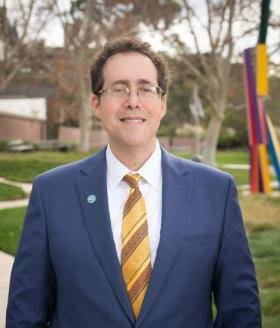
Rabbi Prof Bradley Artson offers a response to my interview with Sam Lebens. Here, the discussion is kept brief, but the issues could be debated in much longer form. Artson has written extensively on chosenness from a very different perspective than Lebens, offering us a solid contrast. Artson reacts to the analytic premises as hiding Lebens’s subjective viewpoints. He also singles out the rejection of the apersonal God as not sufficiently defined or delineated. Finally, he points out there is still too much superiority in Leben’s approach. For Artson, choseness is a fact-supported theory calling for responsibility, calling, and distinction.
Dr. Rabbi Bradley Shavit Artson is the AJU Goldstine Distinguished Scholar and previously served as the Abner and Roslyn Goldstine Dean’s Chair of the Ziegler School of Rabbinic Studies since July, 2000, while also serving as Vice President of American Jewish University in Los Angeles. Rabbi Artson is the author of 12 books and over 250 articles. He is currently publishing a new book, Judaism Beyond Belief: Wisdom for People who Simply Want to Thrive (Monkfish Book Publishing).
As background to the discussion, I did a long and thorough interview with Artson a few years ago. I just reread it and it remains a comprehensive introduction to Artson’s theology.
As a direct taste of Artson’s views, here is a nice quote from one of his earlier books God of Becoming and Relationship:
In the dominant theology with its either/or dichotomies, either the Jews are chosen, hence superior, or all peoples are equal, and none are chosen. If God is the active choosing partner, then Israel must be the passive recipient of God’s choice. But Process Theology’s dipolarity allows us to transcend these binary dichotomies. Israel is an active partner in the process of chosenness … . Jews choose/are chosen to live Torah in the world, both to build communities of justice and inclusion and to model that it is possible to embody such a life. But other peoples choose/are chosen, too, in ways that match their particularity and distinctiveness . … Jews choose/are chosen for Torah and mitzvot, although most emphatically not because of intrinsic superiority. Other peoples are chosen/choose their own paths to holiness and righteousness (104f).
Bradley Artson, Choseness, Personhood, and Metaphysics: A Response to Samuel Lebens
It is a pleasure to engage the thought of Professor Samuel Lebens, and the invitation to respond to his interview with our colleague/teacher, Professor Alan Brill, is a privilege. I approach the task with some concern: it is patently unfair to judge a person or their thought based on a single interview or even a review of his most recent book. Indeed, going online and sampling a few of his interviews reveals a thinker of great passion, breadth, and depth. Lebens is a thinker worth engaging, even in those points of particular curiosity or dissent. So, in that spirit, having pondered his interview, here are some places where my questioning crystallized.
Lebens begins by explicating five central Biblical models of closeness, which is a helpful fleshing out, but creates a false impression that these are distinct and separate categories. Yes, he notes that they are not “exhaustive” because there are instances of choseness that do not neatly fit one of the five. But he doesn’t note that these are not so much categories as emphases — the Bible does not seem to think of them as separate entities. Particular instances mix and blend, perhaps emphasizing one facet of chosenness over others, but they are not hermetically sealed from each other, as Lebens also acknowledges when he says, “my aim is to trace all of the major lines of development and to find, where possible, the best fit between them all; without pretending that all of the sources are in agreement.” I would only add, also without pretending that there are hardened categories in Biblical or Rabbinic thought on the topic.
That recognition raises a larger concern I often have with so-called “analytical” thinking: the pretense to scientific objectivity, while surreptitiously smuggling in deeply subjective opinions, often with invisible assumptions, often retrojecting the contemporary perceptions of the viewer to recontextualize the more intuitive organic thinking/feeling of the original work itself.
So with the very important, to Lebens, matter of God being a personal being, which he strongly advocates: The main consequence of this insistence, from his perspective, is that God can enter into particular relationships with any individual or community and his rejection of the “apersonal theology that motivated it.” But an inkling of his subjectivity (he’s fine saying Rambam is 100% on the apersonal side), is to criticize Wyschogrod for taking the personality thing “too literally. His God seems capricious.”
It turns out that Leben’s invocation of a personal vision of God isn’t scientifically or linguistically objective and precise. Apparently one can be too hot or too cold, and he means to distinguish an intuited subset of what “personality” normally evokes. In this case, the invisible assumptions are that somehow God lacks a body yet can impact the physical, has personal attributes of emotion, consciousness, and will, yet doesn’t get angry, moody, or have favorites (despite his choosing of Abraham and family as being biblically contrasted to God’s assessment of everyone else! Despite the predictable invocation of Amos 9:7, the Biblical more than once frames Israelite choseness as being in contrast to (and above) all other peoples or nations). Apparently, the tools of the analytic philosopher allow one to dope out the parameters of God’s personhood even at odds with the Peshat of Biblical verses. Which attributes of personality remain and which are dropped is never made explicit, systemic, or distinguished from the predilections presupposed by the individual philosopher.
I find it difficult to understand how even Lebens’ sanitized choseness doesn’t imply superiority, despite his sensitivity to this challenge. In his own words, his Two-Track Model (Jews be Jews, Gentiles be Gentiles) still shows “equal love” through “God allow[ing] the people of the world to see, just a sample of the saving grace and love that He [sic] has in store for all human beings in the eschaton.” You Gentiles get French cuisine and the Parthenon. We Jews, get intimacy, firstborn status, the Holy of Holies, and a verbal transcript of God’s love. That sounds co-equal, doesn’t it?
Oh, and God is somehow still a male. Boy, that part of personhood sticks, unquestioned!
Finally, there is the way language, properly understood, needs to be employed to address this core challenge. My reading of Rambam diverts a bit from Lebens, influenced no doubt by Solomon Schechter, Mordecai Kaplan, Alfred North Whitehead, John Cobb, and Catherine Keller among others. Turns out that not only God, but every “thing” (what Whitehead would call an occasion) is in process, dynamic, and on some level ineffable. Certainly any human description of God falls short from the literally true, even if it points toward some deeper reality. And I would add that this limitation of language remains accurate for descriptions of any of us or any other creature or occasions within Creation. We are all of us on the way, changing across time and retaining continuity with our former selves.
There is no Being (an abstraction from a series of becomings), there is only becoming. That is true for God no less than for the rest of us.
That being the case, it isn’t a choice between personal and apersonal, as the analytic thinkers would have us believe. God can have attributes we experience as personal and attributes we experience as apersonal, both. God is, literally, neither a person nor an aperson (monstrous term!), just as there is no literal North north of the North Pole. The concept simply is poetry at that point, but not literally real. If so, the poetry of personhood illumines crucial experiences of the divine, as do images of apersonhood. Lebens acknowledges Biblical images of God as fountain, mountain, Life of the Cosmos, etc. Are those literally true or false too?
If we recall that language can only point toward a reality that lies just beyond language, then we can crawl out of the constricting dichotomy of either or to a more nuanced and embracing both. Jewish precedent for this insight is found, as Lebens notes, in the grand thinking of Rabbenu Saadya Gaon, Rabbi Nathaniel bin Fayumi, and to my reading, the Rambam himself. That metaphysical claim (really, Process Thought) opens us to a broader understanding and articulation of these apparently-conflicting claims, to a better hermeneutic for the welter of biblical language and portrayals, and a reconciliation with much of contemporary philosophy and science.
For my own take on Choseness, I invite the reader to check out my presentation on the subject at the lecture I gave; here is the YouTube video.
In that discussion, I present a Process-influenced demonstration that the Biblical/Rabbinic assertion of chosenness is no longer a theological claim, but the best explanation and integration of the facts of Jewish and world history. No longer a faith-based creed, Choseness is a fact-supported theory (like evolution or the Big Bang). And then I flesh out what choseness entails as responsibility, calling, and distinction.
Conclusion
I am not here meaning to doubt that Lebens isn’t both a serious thinker and a good, compassionate leader. He is both of those and he is struggling to articulate a Jewish theology of God that is both authentic to the central impulses of the sacred sources and at the same time responsive to a contemporary philosophic critique. Kudos to him on both scores. I have lots of concerns and questions about what strikes me as a false dichotomy (either a person or not, as though that is a literal claim that is mutually exclusive) and a brute method of analysis that holds reason to be a separate distillate from feeling, and one that precludes poetic metaphor, with its attendant sloppiness, not to mention what appears to me to be an inadequate appreciation of the way language both reveals and masks and renders (as Rambam alerts us) every event/occasion and instance ineffable in some important ways. The gap between description and what is described, between systemic speculation and the reality itself, is built in. We can only use reason and experience to grow asymptotically closer. But, as the British remind us, we still need to mind the gap.