Sometimes I like reading hagiography, currently called sacred narrative, such as saint, zaddik, or mystic tales, not because of the historical truth or the miracles but because they sometimes reflect a worldview better than explicit statements . Adin Steinsaltz in his new book My Rebbe (Maggid Press, 2014) gives a completely romantic ahistorical account of the Lubavitcher Rebbe that is a good read and offers a few gems of insight. The book is written as a form of world wisdom literature so that it can be excerpted in general spirituality magazines on myth and story such as Parabola, to which Steinsaltz is a frequent contributor.
The book is a human exploration stressing the universal aspects of the Rebbe as a spiritual hero- for example think of the books on Rumi or Francis of Assisi, or one of the romantic retellings of the Baal Shem Tov, with chapters with titles like lover of common people, wagon driver stories, mysticism, and humble beginnings. So too, this book is only loosely arranged chronologically, it is more of a topical arrangement -leadership, adulation, shlichus, outreach, nurturing, farbrengen, politics. The chapters try and capture a human essence of the soul as a personal reflection of Steinsaltz’s relation with the Rebbe. The book goes out of its way to quote Non-Jewish and non-Orthodox sources and combines that with culling fanciful gems from the oral histories. One important note is that Steinsaltz is a non-messianic, a non “meshichist.”
Compared to other books on the Rebbe, this one is smooth, clear, and lacking all local color, the same way Steinsaltz retold Rav Nachman’s tales without any Eastern European detail. This is the exact opposite of the wonderful book by Sue Fishkoff, The Rebbe’s Army which is filled with local color, real stories, and gritty journalistic details. I am sure that those vested in historical study of Chabad will jump to criticize this book with a vengeance but history and documents are beside the point of a sacred narrative of a saint. More importantly, Joseph Telushkin just released what is claimed to be the definite biography of the Rebbe- we shall see the reaction to that book in the upcoming weeks.
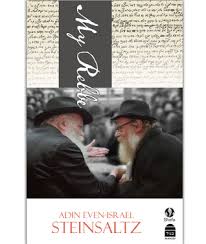
The book tells some good stories and reveals much about Steinsaltz as image creator. Steinsaltz describes Isaiah Leibowitz on the Rebbe and gives a ridiculous story taken from the oral reminiscences about Rav Soloveitchik and the Rebbe.
‘I knew him [the Rebbe], but he [later] went crazy.’ The caustic comment was typical of Leibowitz, but in Berlin they were on good terms.
Rabbi Joseph Soloveitchik recalled that he once rescued the rebbe-to-be from jail. It was the joyous day of Purim, and the Rebbe observing the usual practice of the holiday – was on the Humboldt University campus, somewhat tipsy. Climbing onto a chair, Menachem Mendel began to speak loudly about religious observance and the meaning of the holiday. Holding a public event without a permit was illegal, and he was promptly arrested for creating a public disturbance. A man on the scene, a respected physician, telephoned Rabbi Soloveitchik and said something about Schneerson being in jail. After securing his release, Rabbi Soloveitchik joked with Menachem Mendel, telling him that he could now become a rebbe. He had been imprisoned as all of the Lubavitcher rebbes had once been.
With a Disney talent for painting evil villains who are predestined to be defeated, Steinsaltz depicted Rabbi Gurary, the family member who was passed over to become Rebbe.
Unlike Rabbi Gurary, who was the official head of the schools, the Rebbe’s relationship with the students was personal.
Barry carefully chose the books he took; he did not hurriedly scoop them off a shelf by chance. Because Barry was not a collector himself, he had an ally in Rabbi Chaim Lieberman, one of the former rebbe’s followers who had never fully accepted the new rebbe. He was the librarian who pointed him to the most valuable books. Rebbe Yosef Yitzchak had not left any valuable personal property – goods, real estate or money – after his passing, except for these books. Many were first editions, rare and important works. Barry must have needed the money; within the first two years, he sold over one hundred books.
Steinsaltz captures the nature of the Rebbe’s messages, and conversations with the Rebbe for a wide audience.
For Rebbe Menachem Mendel, however, stories were a kind of scientific instrument, only useful as they would impart lessons. He did not fill his stories with emotional detail and character analysis. Instead, each story he told had a purpose and a point. When King Midas touched everyday things, they turned to gold. When the Rebbe touched a story, it turned into a lesson.
Chabad’s adulation of the Rebbe is unusual even among the Chasidic movements. In our times, movie stars and rock idols are similarly adored. In the eighteenth and nineteenth centuries, extraordinary individuals were considered geniuses, and sometimes their personae even defined a period. Voltaire is perhaps the best example of such a figure; Goethe is another.
The Rebbe would never flatter. He was always polite and considerate– yet always spoke with authority. He spoke to everyone as a royal personage would speak: polite, attentive and considerate, yet without lowering himself to any extent. Whether he agreed or disagreed with his distinguished guests, he would express his own opinion. The Rebbe was courteous to everyone. In personal meetings, his politeness – which had nobility about it – was particularly remarkable. His courtesy was widely perceived as a true, unguarded expression of his personality.
So what went on in the private conversations with the Rebbe or in yechidus? What did he advise? Did the advise work?
The Rebbe was always optimistic, and would guide the petitioner to try and see things in this way. When people asked how to repair their misdeeds, he would offer them ways to correct and improve. Mainly he would encourage them to think less about the past, and more of the future, encouraging them to increase their good deeds and focus on positive action. To a woman who despaired and wrote that “all is bad in my life,” the Rebbe responded: “In this world, good and bad are mixed together. One has to choose what to emphasize, what to look at…. In our lives, there are always two ways to see the good that happens to us or the opposite. For us who have a firm belief in the superiority and eternity of the spiritual, the good always wins over the bad. That which is good is everlasting, unlike the bad.”
The Rebbe used to quote Rebbe Shmuel, the fifth Lubavitcher rebbe, who urged people to jump a hurdle rather than go under it – to go the harder way.
Even when the Rebbe’s advice was followed, things still did not always work out well. That can happen. With so many questions and answers involved, it is likely that some of the outcomes will be unsatisfactory no matter how obedient the participants. That the Rebbe’s advice might fail certainly did not seem to deter any of his Chasidim, just as it does not deter people who go to a doctor for medical advice. However, a rigorous assessment of the Rebbe’s advice is beyond my capability.
We often wondered what was the source of his advice – besides his experience. His answers often depended on common sense or obvious vast knowledge, but from time to time his answers were inexplicable and seemed to be drawn from another wellspring. A partial answer may be that he served as a channel – sometimes consciously, sometimes not – of the world beyond our daily reality, touching on the transcendent.[Reform rabbi from South Orange, NJ] Rabbi Herbert Weiner once told me that he asked the Rebbe, “How is it that you can give advice?” The Rebbe answered, “People come to me and complain that the gate is locked and the way is closed before them. They do not know that they carry the key with them. All I have to do is to turn the key in the lock and open the closed door.”
An important part of the Rebbe’s teachings was his acceptance of many aspects of the 1950’s emphasis on Americanism and democracy as well as his acceptance of civil society and even civil religion. His writings defend equality and more striking Steinsaltz says he supported American law. Compare this to his current followers who has endless appeals, litigation and cries of Anti-Semitism to defend their severe crimes.
The Rebbe believed that governments’ monies should be spent on quality of life and not on weapons of war. The injustice of the income disparity – the great gap between rich and poor – was not an unfortunate economic byproduct but a universal issue.
The Rebbe referred to the United States as a malchut shel chesed, a “benevolent society.” It is true that the Rebbe was grateful to the country that had saved the life of his family. Beyond the personal, however, the Rebbe saw the country as a force of good in the world. While he did not approve of every aspect of American life and government policy, he always spoke about the nation with deep appreciation. The Rebbe valued the legal and civil fairness of the United States, the equal opportunity to all its citizens, and the equality that Jews enjoy under the law.
For the Rebbe, America was a nation of great moral character, characterized by a strong religious bent. Since America treats all its citizens with decency and equality, the Rebbe emphasized that every Jew is bound by Jewish law to uphold the laws of the land – and not to subvert, let alone break them. For this reason he refused to protect his Chasidim or others who had been caught breaking American laws.
The Rebbe also saw the United States as a true supporter of Jews and the Jewish state. More than once, he commented that the source of problems in America’s relationship with the State of Israel lay in Israeli errors in judgment: Israeli political leaders often misjudge the strength of American support.
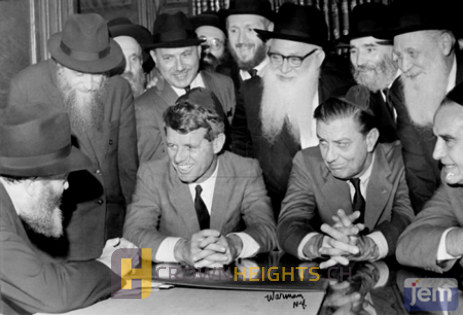
Here is an interesting section. In the Freidman/Heilman work they speculated that the young Rabbi Schneerson was a man who “must be feeling desperate in his anxiety, loneliness, confusion and survivor guilt, whose prospects are unclear, looking for a way out, an answer from God.” Here we have that isolated hypothetical passage turned into a theory of the Rebbe as the Lonely Man of Faith.
The Rebbe’s loneliness was perhaps inevitable. Those who had once been his peers, workmates and colleagues became his subordinates and Chasidim. Although their relationships continued, these were no longer ordinary friendships. Having assumed the responsibility of solving his Chasidim’s personal problems, he could no longer talk to them as an equal. This created an existential choice for loneliness, which might even be termed “aloneness.” From his deep relationship with his family, we know he had the capacity of intimacy with others. Yet, in the official role that consumed his life, it could not be expressed.
What about the stories of supernatural precognition? Steinsaltz does not give us lots of colorful stories of people coming to the Rebbe and him saving them against all odds. Rather, we get a universal call to the possibility of Enlightenment and prophecy within all of us.
Those with the gift of ruach hakodesh describe it as a kind of sight-seeing, perceiving or experiencing things that are physically or tempo¬rarily at a distance. In the nineteenth century, the second and the third rebbes of the Komarno dynasty described their experiences of ruach hakodesh in the book, The Scroll of Secrets. Both state that they had this ability since a very young age. Given only someone’s name, the Kom¬arno rebbes could provide a full physical description of a person whom they had never met.
A college student once had the temerity to ask the Rebbe if he had supernatural powers. The Rebbe answered that these powers are within the grasp of every Jew. The ability to control nature and to rise above it comes from a devout and complete adherence to God’s will, from the observance of mitzvot and the study of Torah. Each of us can rise above our situation. The question before us, the Rebbe continued, is whether we have the determination and the commitment to reach our potential.
Finally, what about the messianism? Steinsaltz portrays the Rebbe as concerned with the topic since his youth, that he did not see himself as the mashiach, and that his followers are now adrift and forlorn.
From childhood, the Rebbe had dreams about the coming of the Mashiach. In a letter to Israel’s second president, Yitchak Ben-Zvi, the Rebbe wrote: “From the day I went to cheder [religious primary school] and even before, the picture of the final redemption started forming in my mind – the redemption of the Jews from their last exile, a redemption in such a way that through it will be understood the sufferings of exile, the decrees and the destruction….”
At a 1991 farbrengen, just a few months before his first stroke, some of the Chasidim began a song which clearly named the Rebbe as Mashiach. The Rebbe stopped them quickly and said, “I cannot leave here now, but after hearing such a claim I should leave this room as a protest.”
We may think of the famous Walt Whitman poem about Abraham Lincoln: “O Captain, My Captain.” But for Chabad the situation has been more perilous; the Rebbe’s ship has not reached port. It has not come to rest at the end of its intended course. While in the middle of the sea, it lost its captain.