Author Archives: Alan Brill

Arthur Green, Hasidic Spirituality for a New Era: The Religious Writings of Hillel Zeitlin

Did you ever want to create an elite group dedicated to perfecting spirituality? Did you think it was going to change the world? Did you ever wish that you were part of the elite circles around the Ramak in Safed, Ramhal in Padua, or the Magid of Mezeritch. Hillel Zeitlin’s writings offer an imaginative plan for creating such a community in 1920’s Poland. And the new translation by Arthur Green, Hasidic Spirituality for a New Era: The Religious Writings of Hillel Zeitlin (Classics of Western Spirituality, Paulist Press) allows one to dream with Zeitlin about such utopias. This is a great volume to bring to synagogue to be inspired for love of God, to argue with the places where you think Zeitlin is wrong, or to fantasize about one’s own ideal world.

Hillel Zeitlin (1871-1942), broke with the faith of his pious Belorussian Hasidic family in order to became a long haired journalist for the Yiddish papers writing about European philosophy and literature, Spinoza, Nietzsche and Lev Shestov. Later in his life, Zeitlin turned back to the Hasidism on which he had been raised; he again dressed as a hasid He still earned his livelihood as a journalist, writing about religious affairs and Hasidism for the secular Yiddish press. Zeitlin was killed by the Nazis wearing tallit and tefillin, holding his beloved Zohar.

The recently translated volume focuses on Zeitlin’s thoughts on the meaning of Hasidism for the modern age. Green comments “But every time he wrote about a Hasidic master, he would compare him to the 19th-century Hindu mystic Ramakrishna, a character in a Tolstoy novel, or a Christian saint. No one knew what to make of this unique and dramatic figure.”

Zeitlin considered his current Hasidism as in decline. They focus on the externals of dress and customs, they seek wealth and glory sometimes even more than non-hasidim, they castigate others and spend their lives in petty politics about the Hasidic courts, slaughterers and religious officials. They are fanatic, foolish and push Jews away. For those who want to know more about the intense decline of Hasidism 1880-1930, see Mendel Piekarz, Hasidut Polin, where give you details on many people rapidly fleeing and the ossification of most of the courts. Zeitlin also points out the corruption of political parties, the nationalists, the communists, and all others. Zeitlin complained how the nations yoke us and torment us, and wails about the slaughters, pograms, anti-Semitism and exile of the early twentieth century.

Zeitlin envisioned a renewal of Hasidism that takes the best of Western culture. Zeitlin called his envisioned movement Yavneh, and in other places they were the members of the elite, the bnai aliyah or the yehidim. This new Hasidim would be completely devoted to God, Torah, and Israel. Zeitlin’s role models are a bit surprising and probably not the list of your own fantasy team, his are Elazar Rokeach, Yehudah HaHasid, the Besht, and Hayyim ibn Attar. Zeitlin finds Bahye ibn Pakuda and Maimonides lacking in their intellectual focus, without enough burning passion and religious lust.

The Besht saw the Divine light in gentile folk tales and tunes, Zeitlin, in turn, exhorts his readers to expand on the Besht and find God in all arts and worldly wisdom, as well as considering the Divine light in social justice. The Hasid of the future senses the divine light when praying and studying, works by his own manual labor, and has love and compassion for Jew and non-Jew.

Zeitlin offers 15 principles or hanhagot for his new Hasidism. They include the need to keep away from all luxuries since luxuries combined with a true Jewish life are like immersing in a mikvah with sheretz in hand. Therefore avoid theater, parties, and expensive food & clothes. Unlike the contemporary Neo-Hasid, for Zeitlin the Hasid of the future needs to work on shimrat habrit and sexual holiness. He must be strict in kashrut.

Shabbat must be holy within, in contrast “sons are being prepared for empty careers where Shabbat is kept in an external way.” They pray, and when they have the opportunity, they fulfill commandments and customs, but everything mechanical.” He pleads “Don’t allow your house to become secular and commercial.” Speak Yiddish, live among Jews. Remove yourself from party politics. Any party, even Jewish ones limit the communion of Yisrael. When you work for a party (including Agudah) and it causes division between Jews then it is contrary to the Jewish spirit which is love justice and holiness. One should: Learn mussar works everyday, especially the classics such as Duties of the Heart, Way of the Righteous, Path of the Upright, Tanya, Likkute Etzot. If you follow these 15 rules, then he says to contact him.

The next part of the book are translated sections of Zeitlin’s Zohar visions written in Zohar Aramaic, which describe the activities of this envisioned elite group in the same way the Zohar protagonists are portrayed in the Zohar.

A highlight of the volume is Zeitlin’s The fundamentals of Hasidim, in which he explores Hasidic metaphysics in terms of German idealism. Schopenhauer, Nikolai Hartmann, and Nietzsche frame discussions of being and nothingness, tzimzum, creator in the created, raising sparks, raising up distracting thoughts and bad middot, sweetening judgments. I would definably assign this section to a class. It grapples with what it means to use Hasidic metaphysics in the modern world. Yet, modern for Zeitlin is for us in the 21st century a category of a prior century, it has little to do with the current remake of Hasidism as psychology, personal meaning, and private commitments.

The book has Zeitlin’s reflections on his recent reading of William James, Varieties of Religious Experience called in the original “be-Hevyon haNeshamah, the Hidden Places of the Soul.” Zeitlin still does not have a word for mysticism or religious experience. Green translates this section as “Judaism and Universal Religion.” Zeitlin states that we need a science of religion, but those who those who know social science are far from religion; and those who practice religion are far from the ability to create a science. Among the documents Zeitlin looks include Berdychevski’s musings, kabbalistic texts, and Dostoevsky. We live in a sorrowful world- Zeitlin blends Brothers Karamazov with descriptions of hell from Chaim Vital. Zeitlin discusses the need to reawaken wonder and astonishment, which Green credits as having an influence on Heschel. There is a need to reawaken love and knowledge of God. The highlightsof this section is Zeitlin’ discussion of the various types of revelation in Judaism, he cites texts for each: Voice of God in nature, Symbols, Dreams, pangs of Conscience, Longing of soul, Inner voice, Feeling of Divine Closeness, and Ascent of the Soul.

The final essay in the volume is an interesting defense of spiritual beauty in Judaism. It includes a defense of Moshe Taku and others who wanted a corporeal God for Judaism. Zeitlin admires how – Aggadah can depict God, especially the shekhinah. Zeitlin finds a rare beauty of holy people, miracle workers, messiahs, and Hasidim. The book concludes with Zeitlin’s poetry of yearning for God, reworked Rav Noson of Breslov but also reworked St. Augustine confessions.

My main reaction to this book is that I want more. There are so many essays of Zeitlin that could use translating, more than enough to fill a second volume.

The romantic reclamation of the Zohar is mentioned in this volume but I would have wanted to see a translation of Zeitlin’s essay on translating the Zohar, and his essay on the history of the kabblah where he refutes the critics of the Zohar. Zeitlin never finished did translate the Zohar but his colleague Fischel Lachover did translate it.Lachover’s translation became known as Mishnat Hazohar and is usually called the name of the introduction editor Isaiah Tishby.

The book has a narrow focus on Zeitlin as proto Neo-Hasidiism and does not involve itself on his intense relationship to Zionists, Yiddish and Hebrew authors, Polish revisionists, Shomer Hatzair, and fellow new kabbalists such as Rav Kook and Ashlag. Zeitlin wrote the first reviews of Rav Kook, Rav Ashlag, and the Piesetzna Rebbe –not included in the volume. He also has an important essay mediating between the Socialism of the Mizrachi and Ashlag as opposed to the free enterprise of the Revisionists. The book also does not investigate his relationship with Russian nihilists, Spinoza, or Tolstoy. Zeitlin has almost half a volume of essays on Lev Shestov, who is important because Shestov’s meditation on doubt, atheism, and faith become the basis for Zeitlin’s and Green’s portrayal of Rav Nahman.

Zeitlin is hard to translate. His original mixes languages and Hebrew/Yiddish is rapidly changing. For example, Zeitlin’s education gives him the vocabulary of Early Rav Kook, so Zeitlein does not have a word for relgious experience since that word “havaya” was only coined by AD Gordon. He works with nevuah- prophecy, hevyon haneshama- hidden places of the heart, and kol dammah dakah– small inner voice. These were Hebrew phrases in the original Yiddish. Tovia Preschel translated the Yiddish into Hebrew and Green worked mainly with the Hebrew, glad to use our current available vocabulary. Green himself notes that he translated the medieval phrase “red bile” as “erotic energy.”

The book lacks any mentions of Zeitlin’s interest in para-psychology, supernatural, and powers of the mind similar to his contemporary Menachem Eckstein, and Zeitlin’s son Aharon Zeitlin wrote a tome on the subject ha-Mitziut ha-Aheret.

Green considers the citation of gentile authors by Zetilin not a continuation of the selective adaptation of secular literature as shown in the approaches of Hebrew authors, Rav Zadok or Rav Kook, but rather a form of commitment to multi-culturalism and universalism. So Green’s pluralism is greatly taken aback by Zeitlin’s eulogy for the 1921 murder of his friend YH Brenner in which Zeitlin calls the Ishmael murderers “forest beasts.” And elides Zeitlin’s particularism, especially his reworking Maharal exclusivism in a poem as “This people to whom was revealed eternal love, to whom were given laws and statutes no other people were given!” or Zeitlin’s poem for shofar blowing, which cries for revenge against the nations that slaughter us.

The book includes letters to Mizrachi leaders in the yishuv about his Yavneh project. Green acknowledges that Mizrachi workers party and the early Agudah workers party were the closest to the revival that Zeitlin envisioned. Yet, throughout the volume Zeitlin is not compared to Shmuel Hayim Landau of Mizrachi or to Isaac Breuer’s followers in Poalei Agudah but to the birth of Neo-Hasidism in the United States. The preface of the book is Zalman Schachter-Shalomi’s description of his creation of the neo-Hasidic Bnai Or (later changed to Pnai Or) based on the Essenes. Yet, the Mizrachi movement produced the festschrift for Zeitlin Oskar (Yesha‘yahu) Wolfsberg and Tsevi Harkavi, eds., Sefer Tsaitlin (Jerusalem, 1944/45) and they published his writing through Mosad Harav Kook.

When I open Zeitlin’s works, I am overwhelmed by the many directions to take the discussion, his relationship to the Homel school of Habad, his personal relationship with the Gerrer Rebbe, his relationship with Gershom Scholem, or his co-workers at the newspapers Haynt and Der Moment. Zeitlin was answering the question of Agnon: Where do we go now after the breakdown? Most chose secularism. Zeitlin says of Y. L. Peretz (1852-1915) that he had a heaven but that there was no God in his heaven. Peretz responds, however, by calling Zeitlin the Prophet of Yesterday. Zeitlin offered Hasidut as a solution for a modern age before it became the variety of counter cultural and new age.

We have to thank Art Green for sharing one of the books that inspired him and his Neo-Hasidism. Zeiltin’s journey holds many gems for the new readers that will now find them because of this translation. In the introduction, Green paraphrases Zeitlin about the persecution and exile restraints of Jewish life not allowing for renewal. The question for us now is whether our peace and prosperity is the era that can realize his vision of a renewed love of God, intentional community, and the creation of a Bnai Aliyah.

For more info:
Sheraga Bar-Sela‘, Ben sa‘ar li-demamah: Ḥayav u-mishnato shel Hilel Tsaitlin (Tel Aviv, 1999);
Jonatan Meir ‘Longing of Souls for the Shekina: Relations Between Rabbi Kook, Zeitlin and Brenner’, The Path of the Spirit; The Eliezer Schweid Jubilee .
Idem, ‘Hillel Zeitlin’s Zohar, The History of a Translation and Commentary Project’, Kabbalah: Journal for the Study of Jewish Mystical Texts 10 (2004)

Cardinal Martini on Judaism and Jerusalem

Italian Cardinal Carlo Maria Martini, died Friday. He was a contender to have become pope and he was a liberal who was still respected and worked together with Papal conservatives. For more on his positions see the obituaries of the AP and NCR. Martini retired to Jerusalem and was active in Jewish-Christian relations. In a nutshell, he advocated that Catholics should study Judaism and understand Judaism in its own context; he also was working toward a Catholic theology of the land of Israel that acknowledges Israeli sovereignty as well as a greater Catholic appreciation of the land.As rector of the Pontifical Biblical Institute in Rome, Cardinal Martini created a program under which Catholic students go to Israel to study Judaism, biblical archaeology and Hebrew language. The two most important documents are his November 2004 speech at Rome’s Gregorian University and his book Verso Gerusalemme (Towards Jerusalem).

Martini was known for having potentially liberal views, at least by Vatican standards, on birth control, brain death, same-sex marriage, and celibacy. We will never know what he would or would not have done if he had become Pope. But what we do know is that when you look in European book stores, both religious and secular, there are copies in the window Verso Gerusalemme (Towards Jerusalem); people are reading and enjoying his thought. The second thing we know is that the attraction is because of his open engagement with the thoughts of his readers. In his book “Towards Jerusalem”, he says he does not divide the world into believers and non-believers, but into those who think and those who don’t

In the 2004 speech at Gregorian University in Rome, Cardinal Martini said that Catholics could not fully understand their own faith without a meaningful understanding of Judaism. He recalls anti-Judaism and anti-Semitism with sorrow and a need to help eradicate it in the future. He sees a continuous link of the Jews with God and the need to entirely eradicate the Patristic supersesionalism. In one of his other books “Christianity and Judaism: A Historical and Theological Overview” he explicitly rejects Augustine’s thinking on the Jews- the ‘theory of substitution’ whereby the New Israel of the church became a substitute of ancient Israel.” He wants all aspects of Catholic liturgy, doctrine and spiritual life to reflect this new understanding of Judaism.

Here one recalls the painful history of the past, with centuries of closures, ostracisms, reciprocal misunderstandings and calumnies. It is a history that we cannot remember without a deep sense of sorrow and humiliation, all the more so as we gradually realize how, in this respect, many Christians have behaved in opposition to the Gospel, and thus have obscured the truth and the love that ought always to flow from the Church of Christ. Today things are changing, but we need time and energy, even because new events in the history of our times give the virus of antisemitism the opportunity to spread and to give rise to condemnatory theories and judgments.

We must make sure that the faithful gain a renewed awareness of their link with the children of Abraham, with all the resulting consequences for the doctrine, the discipline, the liturgy and the spiritual life of the Church, as well as her mission in the world of today.

It is necessary for the Church to elaborate a better self-understanding of her own nature and mission in relation with the Jewish people. Before anything else, this necessitates a heightened attention to what the Jewish people thinks and says about itself.

Martini thinks that it is not enough for the Church to be against Anti-Semitism but it needs to study post-Biblical Judaism and the entire history of the Jews. Priests need education in Judaism. Catholics have to see the State of Israel in modern political terms and keep out of the conflict. Leave the conflict to the experts and politicians. Catholics need to do daily teshuvah for the sorrows they caused. Christianity has to reground itself in Judaism and the Jewish tradition.

It is necessary to acquire an understanding of post-Biblical Judaism, which, until very recently, was almost totally lacking in the Catholic Church. For this reason it is necessary – and I have said it more than once – not only to know the books and the traditions that after the destruction of the Temple continued to maintain in life a [specifically] Jewish hope, but also to widen our horizons to the entire history, the customs, the artistic, scientific, literary and musical talents of the Jewish people. It is thus necessary to cultivate an attitude of esteem and of love towards this people. Simple anti-antisemitism is not enough. It is thus necessary to develop motivations for a friendship that in the heart of the other increasingly reads the thoughts that we share, and that finds a space for the differences, making sure however that these differences do not lead to conflict or dismissal.

First of all, in the formation of the future priests it shall be necessary to emphasize the knowledge of Biblical and post-Biblical Judaism. Over the last years, a certain progress has been made in this direction, but much remains to be done, especially because up to now only few have received this type of formation.

Where there are conflicts, as at present between Israelis and Palestinians, it is necessary to remain in the middle and to work so that all violence may cease and everyone may learn to understand the pain of the other. For this reason I have chosen to live in Jerusalem most of the time and I have set as my main priority the prayer of intercession, so that the people of the Middle East, and in particular Jews and Palestinians, might discover the ways of mutual trust and dialogue.

The second stage is the conversion of the heart, in Hebrew teshuva. For the Jew, every day is made for the teshuva of the individual and of the community. Indeed for us, therefore, every day is an opportunity to begin to ask God and our brothers and sisters to accept our sorrow for the evil that we have done and the good that we have forgotten to accomplish. Let us humbly approach our Jewish brothers and sisters, the history of their suffering, of their martyrdom, of the persecutions that they have undergone. Let us remove the tendentious interpretations of passages included in the New Testament and in other writings. Let us eliminate the misunderstandings that still make us suspicious of our reciprocal good will. Actually, we all ardently desire the same thing: to be authentic, to be faithful to the truth that we all know.

The third stage is that of study, and subsequently of dialogue. In its search for truth, humankind builds schools, research centers and universities.

I am convinced that a deeper understanding of Judaism and its currents is vital for the Church, not only so as to overcome a centuries-old ignorance and to begin a fruitful dialogue, but also to deepen the understanding that the Church has of itself. In other words, I would like to emphasize the importance, for the theology of Christian praxis, of the study of the problems derived from the interruption of the contribution that the theology and the praxis of Jewish-Christians was giving to the early Christian community. It is a fact that the first great schism, that between Jews and Christians, has deprived the Church of the help it would have received from the Jewish tradition.
Read the Rest Here

Even though Martini’s book on Jerusalem is in every Italian bookstore, it has not been translated into English. It has however been translated into Hebrew “Likrat yerushalayim: Masa el shoresheha hayehudi’im shel hanatzrut” (“Verso Gerusalemme”) by Carlo Maria Martini, translated from the Italian by Dov Ancona, Carmel, 189 pages

The traditional Catholic approach to the Holy Land (which is not the same as the diverse Protestant approaches) is to limit the discussion to the land where Jesus walked, similar to the holiness of the other Biblical lands of Asia Minor and Rome (see Robert Wilken’s superb book The Land Called Holy) Martini was attempted to return Catholic thought to the land, its actual earth and flora, its geography, its Jewishness, as well as celebrating figures such as Jerome who attempted to understand the Bible though Hebrew and Judaism. (On Jerome and the bible see the YU PHD, Jay Braverman, Jerome’s Commentary on Daniel. Washington: Catholic Biblical Association of America, 1978– a summary is available here in this article.)

Although in Jerusalem Christmas day is, in the civic calendar, a day like any other (this year it falls on shabbat, that is, on the Jewish day of weekly rest, but without reference to our feast), many people notice that this is a day of great rejoicing for Christians and are quick to offer their good wishes when they meet me. They say: «Hag sameah», which is the usual expression of good will on Jewish feasts and can be translated: May your feast be glad, may it bring you joy

I prefer to celebrate on the morning of Christmas, with some young students from the Pontifical Biblical Institute of Rome who are frequenting the Jewish University of Jerusalem. We say the mass in what is known as the cave of Saint Jerome… I am attracted and moved by the figure of Saint Jerome. This intelligent and tenacious scholar, tired of the ambitions and gossip of Rome, decided to withdraw to Bethlehem to pray and study intensely the Jewish and Christian scriptures, devoting himself above all to the work of translation into Latin from the original tongues… Like Saint Jerome, even if very far from his holiness, and from his ascetic and scholarly rigor, I also feel myself here in Jerusalem to adore the Lord born for us and to study the Scriptures of the Jewish people and those of the early Christian community. I would like thus to get to know more deeply something of the mystery of God and man, that I have met so often in my office as bishop.
Read the rest of this short excerpt Here

For the positive review of his book on Jerusalem in Haaretz- read here

Martini was awarded an honorary doctorate from Hebrew University- here is an excerpt from his acceptance speech.

Very soon I realized that the language of the Bible was somewhat different from languages used in the modern world. And I started to ask myself how biblical language related to these other ways of speaking: to the language of daily life, the language spoken in the market place, on the bus and on the train, the language of human love, the language of human work, especially of the agricultural world, the language which transmitted to new generations the simple rules through which we are able to relate to our neighbour and to survive in the daily competition of life. With these contemporary languages the way of speaking used by the biblical books has of course many similarities, with maybe the exception of the ethical and moral language, which in the Scripture is much more absolute and exacting.
The Bible, in effect, expresses itself usually in ordinary language, full of symbols, proverbs, parables, examples and stories, sometimes bringing paradoxes and provocative expressions. In this way, it tries to express things and values as they are felt by our sensitivity and emotions. On the other hand, scientific language, tries to describe things in their reciprocal and objective relationships, apart (as far as this is possible) from the personality of the observer. But once we have understood this difference, there is no more reason to be scandalized by the simple language of Scripture, the aim and purpose of which is different from that of a scientific affirmation, but has its truth, dignity and purpose.
Read the Rest Here

The Juvenilization of American Judaism?

A new book came out this summer The Juvenilization of American Christianity by Thomas Bergler that discusses the rise of Evangelical Christian youth groups and how over time they developed a religion based on youth culture. The book is receiving great reviews and it is filled with examples that parallel Jewish experience.

The idea of religious youth groups was created at the turn of the 20th century based on the research of E.D. Starbuck (William James’ research assistant). He showed that adolescents choose religion based on socialization, so liberal Protestants created groups that had outings, study, and social action. This new book shows the importance of Christian youth groups from the 1940’s until today noting how they changed over the decades. But the focus of the book is on the Evangelical groups that replaced the study and social action with emotionalism, popular culture, and anything goes. In a similar manner, Orthodox Jewish youth movements were just synagogue based youth groups in the 1950’s, then they became an outreach, then they became an entire emotional youth culture. Now they are shifting to media, spirituality, and beyond. Not everything in his book has a Jewish parallel, but much does. Many trends have matured and others ran amuck.

I will point out a few choice ideas and paragraphs. Let me know where it rings true for Orthodox youth movements. As you read it, think about those who spend their entire lives looking to reproduce their adolescent emotions that made them religious, think about the desire for pulpit rabbis who training is in youth work and not learning, think about the many who graduated youth movements and then had a lack of adult aspirations, and finally think of those whose Orthodoxy is a form of consumerism. Also think about those who would say or do anything for kiruv. Did youth kiruv dilute Judaism? Read the excerpts below.

For Bergler, the youth culture “set the stage” for the widespread juvenilization of American Christianity. They had, in fact, created a “full-fledged juvenilized version of evangelical Christianity” (174). The youth culture was beneficial in that it helped to create “an enduring and adaptive way to sustain a conservative Christian identity in American society.” These youth grew up with a sense for engaging cultural forms and have since carried that into the music and movie industry. Further, it provided an alternative version of conservative Christianity for those disillusioned with American fundamentalism.

Juvenilization happened when no one was looking. In the first stage, Christian youth leaders created youth-friendly versions of the faith in a desperate attempt to save the world. Some hoped to reform their churches by influencing the next generation. Others expected any questionable innovations to stay comfortably quarantined in youth rallies and church basements. Both groups were less concerned about long-term consequences than about immediate appeals to youth.

In the second stage, a new American adulthood emerged that looked a lot like the old adolescence. Fewer and fewer people outgrew the adolescent Christian spiritualities they had learned in youth groups; instead, churches began to cater to them.

Since the fate of the world depended upon winning as many youthful converts as quickly as possible, preachers at YFC rallies didn’t worry about ways they might be subtly altering the gospel message… Jim Rayburn, founder of Young Life, agreed: Accepting Christ as Savior did not mean giving up pleasure and wearing a long face. As he put it, “It’s a sin to bore a kid.”

At the same time, the new breed of evangelical youth leaders stressed that following Christ included absolute obedience to his commandments and separation from “the world.” This seemingly contradictory combination of fun and moral strictness actually worked quite well at capturing teenage loyalty in a competitive religious and entertainment marketplace. Mainline Protestant youth leaders often complained that YFC rallies were stealing young people away from more worthy, social gospel-oriented youth programs.

Bergler describes the simultaneous promise of fun combined with a renunciation. Religion became a product to consume. Bergler points out how the alloy of these two ingredients produced a product to be consumed- ice skating and giving one’s heart, guitars and submission- similar to the emotional attachment to a rock band. He also points out how it creates a serious divide of us and them for those who do not share in the purity.

Youth for Christ leaders promised teenagers that they could have fun, be popular, and save the world at the same time. But in order to do so, they had to give their lives to Jesus and maintain a pure “witness.” Many teenagers internalized that call to separation from “worldly” corruptions, but in return, they demanded that Youth for Christ leaders provide them a Christian youth culture complete with fun, popularity, movies, music, and celebrities. This combination of spiritually intense experiences, bodily purity, and youth-culture fun transformed thousands of young lives and guaranteed the long-term vitality of white evangelicalism.

But adapting Christianity so well to white, middle-class youth culture brought its share of compromises to the Christian message. The faith could become just another product to consume; a relationship with Jesus might become just another source of emotional fulfillment. And the obsession with teenage bodily purity made it difficult for white evangelicals to respond in love to those perceived to be impure outsiders, such as juvenile delinquents and African Americans (148).

Bergler shows that the values that attend the cultural forms that were used to reach youth seeped into the Christian youth culture. The values of pop-music, TV, and celebrates became the values of the religion. In Bergler’s own words, the process of youth group religion creates a religion that resonates with adolescent emotions, confused, inarticulate, self-obsessed and concerned with their own personal problems. It is an approach to religion formulated without theology. Compare the following passages to the emotional manipulation of an ebbing or kiruv kumsitz. The devotional moment of committing to God in the dark serves as a lifelong paradigm. Think of the recent literature of Tatz and other Yeshivish works that shift Torah study, theology, or ethics to finding people in one’s personal life

Juvenilization tends to create a self-centered, emotionally driven, and intellectually empty faith.In their landmark National Study of Youth and Religion, Christian Smith and his team of researchers found that the majority of American teenagers, even those who are highly involved in church activities, are inarticulate about religious matters. They seldom used words like faith, salvation, sin, or even Jesus to describe their beliefs. Instead, they return again and again to the language of personal fulfillment to describe why God and Christianity are important to them.

Smith and his research team labeled this pattern of religious beliefs Moralistic Therapeutic Deism. Teenagers learn these beliefs from the adults in their lives. It is the American cultural religion. Teenagers are “moralistic” in that they believe that God wants us to be good, and that the main purpose of religion is to help people be good.

The house lights go down. Spinning, multicolored lights sweep the auditorium. A rock band launches into a rousing opening song. “Ignore everyone else, this time is just about you and Jesus,” proclaims the lead singer. The music changes to a slow dance tune, and the people sing about falling in love with Jesus. A guitarist sporting skinny jeans and a soul patch closes the worship set with a prayer, beginning, “Hey God …” The spotlight then falls on the speaker, who tells entertaining stories, cracks a few jokes, and assures everyone that “God is not mad at you. He loves you unconditionally.”

If you ask the people here why they go to church or what they value about their faith, they’ll say something like, “Having faith helps me deal with my problems.”

The newly labeled ‘teenagers’ would from now on be increasingly seduced by the siren song of high school social life dominated by fun, sports, dating, movies, music, and fashion. While adult values and youthful tastes have often clashed over the centuries, what was changing was the relative balance of power between the two and the length of time between puberty and full adult status….

Finally, the book has some discussions of the phenomena of adolescent renunciation. Starting to keep the prohibition of negiah is a renunciation that allows one to feel a relief from adolescent struggles and in youth culture it is given a redemptive meaning making it worth it. Or the renunciation of no longer do prohibited work on the Sabbath such as gymnastics, TV, or part-time job now has a redemptive meaning of showing the Torah is true. If renunciation is the model for religion, then it is pretty hard to show renunciation after a certain age when one has already built a religious life.

The ultimate way for a teenage girl to prove her bodily purity and confirm her powerful Christian witness seemed to be to get elected prom queen and then refuse to dance… Such stories confirmed that Christians could be popular, have fun, and save the world at the same time, but only if they preserved their pure “witness.” This youthful spirituality held a powerful appeal because it reassured teenagers that their renunciation of youth-culture pleasures was contributing directly to the all-important Christian mission of saving souls. In contrast, Roman Catholic teenagers heard just as many urgent messages about sexual purity, but did not catch a vision for how their personal abstinence could save the world. As a result, the enforced sexual morality of the Catholic ghetto did not fare as well in post-1960s America as did the voluntary, mission-inspired evangelical version.

Quotes were taken from
Bergler’s article in Christianity Today
A blog review part 2
The same blog review- part 3

Rabbi Riskin Responds to His Rabbinic Critics

OK- We are not out of the woods yet. The discussion is not over. Rabbi Riskin has just written a 14 page broad response to his Rabbinic critics, which was just posted today. He also has an op-ed in the newspaper.

Riskin completely revises Rav Soloveitchik by saying that he did not oppose dialogue. The essay refers to and relies heavily on much of Eugene Korn’s writings and takes them further, almost Korn vs Rav Schechter. Riskin gives an opening narrative of how he encountered Christians learning about Judaism. He argues that he is not soft on missionaries as shown by his reaction to missionaries in Efrat in the 1980’s. He turns his story to his realization in the second intifada that the only tourists to Israel were Christians with a deep connection to Israel. Riskin argues that in a hostile world of Arabs and the hostile EU, we should pragmatically embrace the Christian Zionists.

Riskin asked Pastor Hagee: Do you want to convert us? Hagee said no! So Riskin takes that as good enough to develop a relation.

Are We Permitted to Teach Torah to Christians? He answers that we can teach then the Noahide laws and that knowledge and love of God, must naturally include theology.

He offers an unsupported novel reading of Rav Soloveitchik, in which he argues that Rav Soloveitchik only banned theological debates but not friendly discussion. If the Rav wanted to give a pesak then he would have written a halakhic pesak instead of a theological essay.

Riskin really slips on the idea of the double confrontation. Rav Soloveitchik did indeed argue for a double confrontation, a universal social confrontation and a particular Jewish confrontation from the Patriarchs. But Riskin defines the particular covenant of Abraham as universalism and reaching out to all people. If some err in one direction by treating Rav Solovietchik as only one confrontation of particularism without the universal confrontation, Riskin in contrast errs in the other direction by treating the particular covenant of the patriarchs (brit avot) as Hagee’s universalism of Abraham. Our particularism is really a universalism. There are many valid universalists in the Jewish tradition such as Shadal, Mendel Hirsch (son of Rabbi S. R. Hirsch), and Seforno, who is cited in numerous places in the essay. But Seforno and Rav Soloveitchik are not in agreement. Rabbi Reines, the founder of Religious Zionism, was a proponent of Seforno’s universalism but that is another path.

Riskin reads the word “confrontation” as if it meant engagement. However, the original 1950’s dichotomy was between dialogue, integration, and embracing as terms of closeness, while confrontation means one is confronting a challenge. For Riskin, Rav Soloveitchik would have allowed dialogue is there is no mission, no debate of articles of faith, and theological compromise. He feels that in his dialogue with Evangelicals fulfills all three criteria.

Riskin concludes with a novel twist of Rabbi S R Hirsch interpretation of “consider the years of many generations” as a need to be sensitive to the changes in history and the Torah should respond to the changes. (Somewhat the opposite of the original.)

The essay concludes “Rav Soloveitchik wants us to communicate what we believe in the secret chambers of our hearts, the differences in our religious commitments. However, as shown in my transcriptions of Rav Soloveitchik lectures, he thought the self could not communicate the depths of the heart, not to parents-children, not to husband-wife, not to friends or students, and certainly not to a different faith commitment.

Is Christian-Jewish Theological Dialogue Permitted? A Postscript to Rav Joseph B. Solovetichik’s article, “Confrontation”

My contention is that Rav Soloveitchik fundamentally permits theological dialogue with Christians, albeit under certain carefully-crafted guidelines, and that, under those guidelines, such dialogue is essential and critical to defending the interests of the Jewish people today.

Missionaries in Efrat: Strong Measures must be taken to Prevent Fraudulent Attempts to Convert Jews to Christianity

In the late 1980’s, the Jewish Agency arranged for 72 families from the Former Soviet Union to come and make their homes in Efrat. Some Messianic Christians missionaries heard about our new arrivals and thought that these people would be easy prey. The missionaries placed copies of the Tanach – the 24 books of the Bible – together with the New Testament in Hebrew and Russian in every mailbox in Efrat; the “Jewish” and Christian Testaments were bound together in one bind, so that the unsuspecting Russian Jews would think they were a single sacred text, with the Gospel as part of the Jewish Bible. The text was published in Hebrew on one side, Russian on the other.

As soon as I heard what had happened, I sent a letter to all the residents of Efrat, instructing them to publicly burn the entire Bible together with the Gospels. This was because the Talmud teaches that a Sefer Torah, (Bible Scroll) which was written by a Jewish heretic or someone who is attempting to cause a Jew to renounce his religion (and anyone who accepts Jesus as a Divinity and/or the Messiah has ipso facto renounced his privileges as a Jew) has to be burned (See Rambam Hilchot Yesodei Hatorah 6:8).

Israel Faces Fanatic Moslem Foes and Christian Religious Friends
More and more Christians kept coming to Efrat, expressing love and support for the Jewish State of Israel emphasizing our common heritage of the 24 Books of the Bible and seeking ways to help us socially and politically. I began to understand how crucial their newfound friendship was, given an international climate in which not only the Arab bloc, but also the European Union, the former CIS, more and more South American countries and indeed the United Nations as the “peacekeeping” force in the world, were questioning our legitimacy as a nation.

(For much of what is to follow in this regard, I am deeply indebted to my colleague and partner Rabbi Dr. Eugene Korn, and his essay “The Man of Faith and Religious Dialogue: Reviewing ‘Confrontation’ After Forty Years,” Modern Judaism, Volume 25, Issue 3).

In Dr. Korn’s words, [Pope Benedict] is an “eschatological supersessionalist.” (I cannot find fault with this position, since I believe that Maimonides teaches in his Laws of Kings 12,1 that in the eschaton, “all of humanity will return to the true religion” – that is, to Judaism, in accordance with the statement of R. Shimon ben Elazar in the Babylonian Talmud (Berachot 57b) and the words of the prophet Zephaniah (3:9). As long as we can respect each other in the fullness of our respective faith commitments without feeling beholden to convert the other, I can well appreciate the faith of each that he has the more perfect revelation, as will be proven by who converts to whom in the eschaton. This is also the position of R. Soloveitchik, as I later explain in this paper.

Nevertheless, since I was just at the cusp of announcing the opening of our Center for Jewish-Christian Understanding and Cooperation, I had to ask my question: “Tell me the truth, Pastor Hagee, do you love us because you want to convert us? Do you love us to death?” He flashed one of his signature smiles, amused by the hutzpah, or naivete of my question. “No, Rabbi, I don’t love you because I want to convert you; but neither do I love you purely out of altruistic consideration. I love you because of Genesis 12:3, where the Bible records that ‘God said to Abraham, ‘I will bless those who bless you, and those who curse you I shall curse.’ Rabbi, I want to be blessed, not cursed!”
Pastor Hagee has a ministry which is measured in millions; he is undoubtedly the most successful pastor in our generation. Rabbi Scheinberg reported to me that during the 49 years he has lived in San Antonio, Pastor Hagee had not tried to convert even one Jew to Christianity. Given the overwhelming charisma of Pastor Hagee, this can only be because he truly does not believe that Jews must be converted to Christianity.

Are We Permitted – or Perhaps Even Mandated – to Teach Torah to Christians?
Large numbers of Christians continued to come to our Center; they were, however, less interested in discussing politics or even in Israel’s right to a Jewish State (which they took as an axiom, since the Land of Israel was promised – even guaranteed – to the Jewish people by the Creator of the heavens and earth Himself), and more interested in learning Torah: the Written Law, chiefly the Pentateuch (five books of Moses) in accordance with traditional Jewish commentaries, and the Oral Law, the Talmudic Pharisaic Tradition which had been studied by Jesus. Hence, I had to face a fundamental question: Are Jews permitted to teach Torah to Christians?

From these sources it should be indubitably clear that if we are to teach the Christians the commandments (at least the commandments of Noahide morality, perhaps all the commandments of compassionate righteousness and moral justice) as well as a deeper understanding of God (remember, the Noahide laws do not include faith in God, and Maimonides derives outreach to the Gentiles from the command to “know and love God”), how can we not be speaking to the Christians in theological terms? After all, when one teaches, one must always listen to one’s students, and learn from their responses. Theology means the study of God. Making God known and beloved to the Gentile world is all about theological dialogue!

Rav Soloveitchik’s “Confrontation”
Contrary to what many Orthodox rabbis have maintained, “Confrontation” is not to be seen as a cut and dried halakhic responsum permitting Jewish-Christian dialogue on “universal problems,” which are “economic, social, scientific and ethical,” but categorically forbidding dialogue in areas of “faith, religious law, doctrine and ritual” (Rabbinical Council of America, Mid-Winter Conference, February, 1966). Were that the case, Rabbi Soloveitchik would have written just such a precise halakhic responsum setting down these guidelines replete with Talmudic citations and halakhic precedents, rather than the highly nuanced, theologically rich, and dialectically infused “Confrontation.” Moreover, the very RCA statement of 1966 forbidding discussions of “faith and religious law” concludes (italics are mine – SR), “To repeat, we are ready to discuss universal religious problems. We will resist any attempt to debate our private, individual faith commitment.”

Apparently, how to define “religious” issues is neither simple nor clear-cut. In fact, Rav Soloveitchik defined his philosophical school of thought as that of an “Halakhic Existentialist” – committed to the proposition that halakha deals with the most fundamental existential problems of humanity! Rav Soloveitchik himself often cited in his writings Christian theologians such as Soren Kierkegaard, Karl Barth and Rudolf Otto (See, for example, the beginnings of “Halakhic Man”) and the first reading that he gave of his “Lonely Man of Faith” essay prior to its publication took place at an Inter-faith Seminar (sic) at St. John’s Seminary in Brighton, Mass. (See Korn, “The Man of Faith and Religious Dialogue,” Note 8).

Perhaps, what the RCA was really saying in its 1966 statement was that “we resist any attempt to debate our private faith commitment,” whereas “discussion (or dialogue) of universal religious problems” is perfectly permissible. Perhaps, much more in line with the Rav’s thought is the statement adopted by the RCA [and probably written by R. Soloveitchik himself] at its Mid-Winter Conference in Feb ’64, which is appended to the “Confrontation” article in Tradition ’64 and calls for a “harmonious relationship among all faiths” in order to combat the “threat of secularism and materialism and the modern atheistic negation of religion and religious values.” Combating the negation of religion requires, at the very least, basic theological discourse defining “religious” values.

Indeed, it is the covenantal confrontation which defines and directs our national kerygma (mission) towards the universal and the universe: “Through you shall be blessed all the families of the earth,” was God’s charge to Abraham. “But only in this (not in wisdom or strength or wealth) shall be praised the one who is to be praised: be intelligent, and come to know (understand) Me, that I am the Lord who does (acts) of lovingkindness, moral justice and compassionate righteousness on earth (the whole of the earth), for in these do I delight, says God,” was Jeremiah’s message to the Israelites, as well as the citation with which Maimonides concludes his final magnum opus, “The Guide to the Perplexed.”

In other words, Rav Soloveitchik is not against religious dialogue with Christians; that is why this essay is entitled “Confrontation,” and not “Non-Confrontation.” The only thing he insists upon, however, is that the confrontation be in the spirit of religious equality, of mutual respect for the individual faith commitments of each which are not subject to logical debate, or traded compromises in matters of our unique covenantal faith values and rituals.

These are the three things that Rav Soloveitchik was against and these are, likewise, my red lines in dialogue with Christians:

We will never dialogue with Christians if they represent missionary movements, if their avowed or surreptitious purpose is to convert Jews.

We will never debate unique Jewish ritual or faith issues with Christians. We will attempt to share with them unique Jewish points of theology and ritual practice if they wish to better understand them, but we and they must realize that each faith community has religious expressions which transcend rational logical discourse and which are not subject to debate.

We will never enter into dialogue with Christians in which we are expected to compromise our religious values or doctrines in order to be more in consonance with Christianity.

In addition to universal social human concerns, Rav Soloveitchik wants us to communicate what we believe in the secret chambers of our hearts, the differences in our religious commitments. He opposes a debate on these unique issues with the other faith community, but not our teaching of these issues to the other faith community.

This excerpt was less than two pages. Read the rest of the fourteen pages –here.

Which Jewish group uses Social Media the most to talk about their Judaism?

The article below states that White Evangelicals are using social media more than other Christian groups. So, which Jewish groups are most on Facebook? Who is most on Twitter? Which groups talk about their Judaism most in daily updates? Which group is most likely to fill in their religious affiliation? The actual study had a negative conclusion in that most Americans dont list a religious affiliation or give updates of their religiosity life.  Go check your accounts! Discount those that are active ideologues or program directors. Look at ordinary users. Who posts about their religious life? Better question:Who downloads the most sermons, shiurim, and lectures? Everyone claims their group does. How many synagogues or study groups have an active Facebook page or twitter updates?

 White Evangelicals Use Social Media More Than Other Religious Groups

A recent survey suggests that white evangelical Protestants are “significantly more likely than other major religious groups to use technology for religious purposes.” The Public Religion Research Institute (PRRI) study also suggests that few Americans use social media to interact with faith communities online, though critics say the survey does not accurately measure online religiosity. Case in point: evangelical dominance of Twitter engagement

.

According to PRRI, about 20 percent of white evangelicals have noted their church attendance on Facebook or other social networks, compared to 6 percent of white mainline Protestants and 2 percent of Catholics. In addition, 25 percent of white evangelicals said they’ve downloaded a sermon online or a podcast compared to less than 10 percent of white mainline Protestants.

Almost half of white evangelicals (49 percent) said that their church uses television screens for worship services, compared to 29 percent of white mainline Protestants. Also, 40 percent of white evangelicals said their church has an active Facebook page or a website where people regularly interact.

Just one-quarter of white evangelicals said they don’t post their beliefs to Facebook, compared to half of survey respondents. 

From here

Besht – Pillar of Prayer

For those looking for something to contemplate in shul for this Elul/Tishrei, I recommend the recent translation of the Amud haTefillah ascribed to the Baal Shem Tov and recently translated by Menachum Kallus as Pillar of Prayer.

Before WWII, Dunner and Wodnik collected every statement attributed to the Besht and published a volume called Besht on the Torah. It is a great teaching tool because all statement on a given topic is collected into one place. Everything on creation is in Bereshit, everything on prayer is in Noah, everything on freeing oneself from inner bondage is in Shemot to Beshalah and everything on Torah study is in VeEthanan. The volumes accept all the material from the school of the Magid of Mezerich and that of the Zlotchover Magid told in the name of the Besht. Both Scholem and Green cautioned that the learned commentary contained too much Galcian, especially Komarno material, which was too Lurianic for their conception of Hasidism. The volumes also do not contain the recent minted statements and stories of the Besht emanating from Rebbe Riyatz. Rather they contain the God-intoxicated aphorisms that were quoted, transmitted and followed in the late 19th century and in the footnotes how they were interpreted in later Hasidism, mainly Komarno.

Kallus recently translated the section in Noah on prayer with a commentary based on that of Wodnik. Read it, learn to pray with ecstasy and focus. This is not neo-hasidism or any of the recent soft repacking of Hasidism for pop psych or new age. This is fierce and demanding as the Greek Orthodox Philokalia or Tibetan Nyngma practice. Everything in the world is about God, or God’s emanted energies. It is not of self, psyche, or human potential. If you do use the sources for teaching, I would recommend softening the often abstract language of the translation and relegating the internal cited sources and parallel texts to footnotes.

The volume was recently reviewed and praised by Micha Odenheimer, Israeli journalist and founder of Tevel BeTzedek to help the unprivileged of Nepal. Micha reports on both Kallus and the sefer. The article is available from Haaretz online, but I also have a pdf of it-page one here p6 odenheimer 1 and page 2 here p7 odenheimer 2

Kallus made a journey from Hungarian Hasidc Brooklyn to practitioner of Lurianic kavvanot via Tibetan texts helps set the volume in its proper context of Komarno Hasidiism and actual meditation practice. As Odenheimer puts it “In this vision, our will, minds and emotions − the totality of our inner selves − can and should be marshaled at all times, and in all situations, in order to serve God by breaking through the illusion of separation and darkness and revealing the ecstatic truth of his unity, which includes and integrates everything…”

How does one raise distracting thoughts that arise during prayer? “through an array of contemplative tactics…” Three of those highlighted in the article are 1) hakhna’ah “surrendering” − by realizing that the content of all thoughts emerge from the divine; 2) havdalah − shifting one’s mind, for example, from desire for earthly pleasure to longing for the divine; and 3) hamtakah – sweetening our thoughts so that they connect with the divine source itself, the fount of all pleasure.

From the review:

It was not until the beginning of the 20th century, however, some 140 years after the Baal Shem Tov’s death (the 250th anniversary of his death was marked in 2010 and “Pillar of Prayer” is one product of that commemoration), that two Hasidic scholars from Warsaw, Rabbi Natan Nata Dunner and Rabbi Shimon Mendel Wodnik, began to systematically collect these quotations. They spent 16 years at the task, poring over more than 210 books and manuscripts. By comparing nearly identical teachings, gleaned from sources disparate in geography and lineage, so that one’s versions could not have influenced the other’s, they were able to convincingly demonstrate that these words did in fact authentically reflect the words of the Besht himself. Mysteriously, their work, finished by 1916, was not published in Eastern Europe
until 1938, just as the world began to collapse around Eastern European Jewry. Republished in 1948, in Brooklyn, as “Baal Shem Tov on the Torah,” the implications of the collection were largely ignored by scholars Although the reigning scholarly authority of the past generation, Gershom Scholem, refers to their opus as “the most thorough anthology of all the teachings of the Baal Shem Tov whose value will doubtless be appreciated by any serious investigator of this literature,” almost no academic writing on his teachings, as they appear in the material culled by Dunner and Wodnik, has been published (though important biographical studies of the Besht have appeared ).

Instead, the Baal Shem Tov conveyed faith in the power of each individual to touch, experience, unite with and even influence the divine spheres in order to bring spiritual and material blessing down into the world. He speaks with authority, but also sounds as if he is speaking to equals. The idea that access to mystical knowledge must be democratized if the world is to achieve the spiritual transformation promised in the prophecies of messianic times is the theme of the most famous of the few surviving letters written by the Besht himself. Writing in 1746 to his brother-in-law, who had moved from Podolia, in Ukraine, to the Holy Land, the Baal Shem Tov describes putting his head down on the prayer lectern while leading the Rosh Hashanah services, while, his body inert, his spirit rises through dimensions populated by souls and angels until reaching “the Palace of the Messiah.” As any good Jew would do he greets the Messiah with a question: “When will you come, sir?” The Messiah’s answer startles him. “When your wellsprings flow outwards, and when everyone can do the unifications and soul ascents of which you are capable.”

What emerges from this book is a vision of human consciousness in constant contact with the divine in forms hidden and revealed, fallen and elevated; in darkness and light, majestically enthroned and in continuous process; aspiring to liberation and already redeemed. In this vision, our will, minds and emotions − the totality of our inner selves − can and should be marshaled at all times, and in all situations, in order to serve God by breaking through the illusion of separation and darkness and revealing the ecstatic truth of his unity, which includes and integrates everything, including the material world and our selves and the secret core of all our desires.Exactly because of this potential for goodness and revelation, prayer is almost invariably accompanied by distracting thoughts, as if the dark matter that is a necessary part of the weave of selfhood must inevitably offer resistance. The Besht’s innovation is in seeing opportunity in this dynamic.

Rather than resisting the resistors, the Besht encourages practitioners to follow their distracting thoughts to their roots in the divine. This is accomplished through an array of contemplative tactics: first by hakhna’ah “surrendering” − by realizing that the structure and content of all thoughts emerge from the divine; then by separating (havdalah ) − shifting one’s mind, for example, from desire for earthly pleasure to longing for the divine; and finally, by sweetening our thoughts (hamtakah ), so that they connect with the divine source itself, the fount of all pleasure.

What is practiced intensively in prayer is meant, on some level, for everyday pursuits as well. “The perfect person,” the Baal Shem Tov teaches, “would be able to unite with the Divine Presence in every step she or he takes and through everything such a one does − even in physical acts such as eating or business dealings − in all of them one is able to unify with God’s presence and recognize the Divine origins of one’s occurrences, in a particular way.”

Both the translation and the commentary are also evidence of the potential gains for all of us when a scholar of Jewish mysticism is also learned in other traditions. In this case, it’s Tibetan Buddhism, which has a highly developed language for states of consciousness. Kallus draws upon his knowledge of Buddhism to elucidate terms that are embedded in the intricate cosmological and redemptive structure of Lurianic kabbala and would thus otherwise
be incomprehensible to the lay reader. He can do this only because he knows kabbala so thoroughly − otherwise the risk of inauthentic comparisons and superficial similarities would be great.

Prada, Tznius, and Unintended Irony

Last week I visited a museum exhibit of Prada clothes with my wife. She commented as we faced a row of long dresses with long sleeves and high neck lines: “You can always find something tznius to wear in her fashion lines.”

I look down at the explanation accommodating the case to see:

Prada: Many critics have said that my spring 2000 collection referenced surrealistic fashions. In truth, it referenced …the bourgeoisie, especially those depicted in the films of Buñuel and Antonioni. The entire collection was based on the pretense of propriety, the facade of the bourgeoisie.

Meaning her goal was to play and contradict the “pretense of propriety” of the bourgeoisie. She gave them the propriety they wanted but with hard edges, ugly colors, and ideas pushed to extremes.

Bad taste is part of our culture, ” Prada is quoted as saying,
And City Arts reviewer, Mona Molarsky allows the fact that “Prada’s clothes tend to have a dowdy line that conjures up images of harried housewives, Catholic schoolgirls and disheveled cross-dressers.” It is clear the choices Prada makes are deliberate. What underlies those choices, however, is a dose of condescension uglier than any of the clothes she might design. A nasty choice, I think, for a self-avowed Communist, when the idea of mocking the bourgeoisie is more appealing than teaching or leading.

Ironic Tznius?

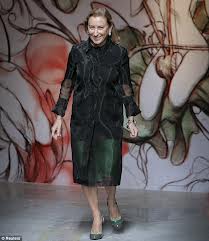
Above, Miuccia Prada (born 1949) has a Ph.D. in political science specializing in Marxism and she studied mime for 5 years. Below, more Prada tznius.

Rabbi Hershel Schachter rejects the Common Covenant with Christians.

It seems that Rabbi Hershel Schachter is responding to the recent work of Rabbi Shlomo Riskin in interfaith dialogue. Since I reported Rabbi Riskin’s conference here and then again here with the Evangelicals, then this is a response. My post is not a critique, just presenting both sides. Rav Schachter should not be disagreed with. You may want to read the two Riskin posts firsts; they contain positive versions of the points condemed here.

Here we have Rabbi Hershel Schachter rejecting those who seek a combined Jewish-Christian covenant or any Christian claim to the holy land. He rejects making a distinction between idolater and ben noah when Christian. Since as long as the Christians still believe in Jesus, then it does not matter that you are educating them in mizvot. He condemns those who reinterpret Confrontation or say it does not apply today.

What’s interesting here is that the writings of Rav Schachter and Rabbi Riskin are the two basic building blocks of Centrist Orthodox Zionism. Torah centered Religious Zionism

The talk does not differentiate Evangelicals from Catholics. On the current approach of the Church toward Israel, Pope Benedict stated: “The Holy See joins you in giving thanks to the Lord that the aspirations of the Jewish people for a home in the land of their fathers have been fulfilled,”which may be seen as a theological justification of the return of the Jewish People to Israel – indeed, an acceptance that has placed all previous Catholic denials of Zionism in the shade. They are not locked into the positions of 1902, 1947, or 1967. They recognized the State and sovereignty of the State of Israel in 1992. They do not seek political or sovereign internationalization. On the history of the changes- here, important speech that often gets distorted and quoted out of context, and TV report on the current issues.

Experimental Judaism: Playing with Fire

It is very painful to see that there is missionary activity taking place in Eretz Yisroel. The official Catholic response to the Zionist movement (when it first began) was that this “dream” will never be realized. They argued that Eretz Yisroel is “the chosen land” set aside for “the chosen people”, and the Jews lost their special status as “the chosen people” when they rejected oso ha’ish. The establishment of the medina in 1948 clearly contradicted this claim of the church. To defend their position they “explained” that the medinah did not include the makom Hamikdash, the old city of Jerusalem, or Chevron, i.e. all of the holy locations of ancient Eretz Yisroel, and as such was not considered to be “the chosen land”. Immediately after the 1967 war, when all of these ancient holy areas were also under Jewish control, the pope proclaimed (and every year since then all of the subsequent popes have made the same statement) that Jerusalem should become “an international city.” Because Jewish control of the old city of Jerusalem is a glaring contradiction to the claim of the Church that we have forfeited our status as the am hanivchar, the Church would like control to be taken away from the Jews to defend their theological position. The church feels that their missionary activities in Eretz Yisroel will ultimately lead to the Jews accepting oso ha’ish and once again becoming “the chosen people” who rightfully rule over the holy land.

Every so often newspapers quote non-Jewish ministers claiming that they have “a covenantal connection” with the holy land. This is a repeat of their theological principle that Eretz Yisroel is “the chosen land” for “the chosen nation”, and that after the Jews rejected oso ha’ish they (the Catholics) became “the chosen nation” to whom G-d’s covenant with Avraham, Yitzchok, and Yakkov to give Eretz Yisroel to their descendants applies. How painful it is that some Orthodox rabbis also state that their “brethren” (the Catholics) have “a covenantal connection” to Eretz Yisroel. These rabbis don’t realize that by making such irresponsible statements they are playing into the hands of the avodah zarah.

These same rabbis pride themselves on educating thousands of Catholics every year in the mitzvos of the Torah. The Chumash speaks of our accepting korbanos from non-Jews (Vayikra 23-25), and the halacha speaks of non-Jews volunteering, as an eino metzuveh v’oseh, to observe additional mitzvos over and above the basic seven mitzvos required of all Noachides (see Mishnah Berurah end of siman 304 in the Biur Halacha). However, these rabbis are fundamentally mistaken in their understanding of this halacha.

We may only accept a non-Jew’s sacrifices in the Holy Temple when they are offered la’shomayim. As long as they believe in oso ha’ish and are sacrificing to him, this is outright avodah zarah, and we may not allow these sacrifices to be brought on our mizbeach. If a non-Jew is convinced of monotheism and wears a tallis and sits in a sukkah etc. as an eino metzuveh v’oseh, this is commendable. But if a non-Jew still believes in oso ha’ish and wears a tallis and sits in a sukkah as a means of identifying with that avodah zarah, this does not fall under the category of one volunteering mitzvos as an eino metzuveh v’oseh, but is rather an act of deepening his commitment to his avodah zarah. Woe unto those rabbis who are deepening and furthering avodah zarah commitments and practices.

Years ago Rav Yosef Dov Soloveitchik warned, both in his public addresses as well in his written essay (“Confrontation”) against having any such contact with the church. How shameful it is that people who claim to be “disciples” of his have “reinterpreted” his words to mean the exact opposite of what they really say, and have then added that even if at one time he did prohibit such interaction with the church, this clearly no longer applies today. To the best of my understanding, moshiach has not yet arrived and the world is still full of avodah zarah!

Achronim had a debate whether believing in the trinity constitutes avodah zarah for a Noachide or not; but for Jews there is no question that it is avodah zarah! And even for bnai Noach, Rav Solovetichik quoted in the name of his grandfather Rav Chaim that this understanding of the Remah and Shach was a shegagah she’yatz’ah milifnei hashalit and it makes no sense to distinguish between the definition of avodah zarah for a Jew and for a ben Noach.

The human desire to be mechadesh (to act as an original thinker) has misled these rabbis in Eretz Yisroel to play into the hands of avodah zarah and shemad. The words of this week’s parsha stand out clearly to teach us that in Eretz Yisroel we are required to be even more careful when dealing with the church. Time and time again the Torah warns us that in Eretz Yisroel we must not get involved with avodah zarah. Officially Hakadosh Baruch Hu is the King over Eretz Yisroel (see Mordechai to Gittin #401), and the midrashim refer to all of Eretz Yisroel as the “palace of the King”. The Ramban (end of Acharei Mos) explains that the main location for observance of all of the mitzvos is Eretz Yisroel, and one who sins there is compared to one who rebels against a king’s authority in his palace, which is a more brazen sin than sinning elsewhere(see Avnei Nezer, Yoreh Deah #454).

Apparently the sanctity of Eretz Yisroel arouses strong feelings of spirituality that one must take care to channel properly. These strong feelings can mislead even the wise to get carried away by their imagination and their desire to be original thinkers, and in turn to strengthen avodah zarah and shemad. Some rabbis have gained credibility by claiming to be disciples of Rav Soloveitchik, and then have proceeded to totally misrepresent his views on these issues of avodah zarah and shemad.
Original Here

While we are on the topic, last year YUTORAH posted a talk from 2002 where a different YU Rosh Yeshiva explained how when we see something positive in Christianity we should remember that these are the people that killed your great-grandfather, they are the ones personally responsible for the crusades, Inquisition, and Holocaust. He encouraged the contemporary saying of “shaketz teshaktzenu, ta’ev teta’avenu, “You shall surely abominate and abhor it, when passing a Church. (minute 48 to end).

Yoram Hazony-The Philosophy of Hebrew Scripture part I- review of Stephen Frug

Yoram Hazony has a new book out called The Philosophy of Hebrew Scripture and it is an interesting mixture of things. (1) An argument to include the Bible in the Political Philosophy canon (2) Readings of Biblical stories as political wisdom focusing on action centered pragmatic thinking (3) A vision of Judaism focusing on the Biblical text and his reading of it. I will review his book in future weeks, I am still working out my personal thoughts. I also have in the pipeline thoughts on Arthur Green’s new book and Peter Schafer’s book.) In addition, Hazony recently spoke for three lectures at Davar in Teaneck, so I heard how these ideas sound in person. My review will come later, in the meantime Stephen Saperstein Frug, Visiting Assistant Professor at Hobart and William Smith Colleges published a 10k review on his blog- feel free to read the other 8.5k on his blog. Frug, a self-professed atheist and non-reader of Hebrew lets us start the discussion and deal with some of the philosophic issues before we get to the specifically Jewish ones.

Frug notes that Hazony (1) equates reason and philosophy (2) He approaches philosophy partly as a national endeavor, almost 19th century volkgeist, and not an academic or individual one; there is a Jewish national project at stake.
For Frug, Hazony offers rich new readings of the Bible but is it a neglected work in the history of philosophy? (4) if it was neglected then it is not part of the history of philosophy. (5) The Bible is not philosophy in that it is not part of the philosophic conversation and does not offer philosophic arguments. It is more literary than philosophic. (6) Hazony showed that the Bible has philosophic ideas but he did not prove that we should take them seriously; he just assumes it. (7) Hazony does not show awareness of the nuances of contemporary philosophic debates. (8) Since the Bible is chosen as an important text not because it can offer better answers than Wittenstein or Habermas, then the choice is national -religious, bringing religion back through the rear-door.(9)All philosophy is always recast and molded by the later conversation. No one takes the writings of Plato or Hobbs in their entirely. People say this line we take but reject another, this line is outdated, this line is just wrong. Does he really want the Bible subject to such secular reason?

Frug on Hazony (excerpts)

Hazony writes in chapter two:

In this book, I propose that if we want to understand the ideas the Hebrew Scriptures were written to advance, we should read these texts much as we read the writings of Plato or Hobbes — as works of reason or philosophy, composed to assist individuals and nations looking to discover the true and the good in accordance with man’s natural abilities. I don’t mean that this is the only way to read these texts. Nor do I believe that the understanding that emerges from such readings has to give us the final picture of the biblical authors’ worldview. But… I believe that in reading the Hebrew Scriptures as works of reason or philosophy, we come much closer to the teachings of the biblical authors meant to place before us than we do if we assume these works were composed as reports of “revelation” — of knowledge obtained by means of a series of miracles.

Hazony’s text divides into two major parts, the first outlining how one would read the Hebrew Scriptures, or the Tanakh as I will call it here,* — what it means, for example, to read as philosophy a book that is composed primarily of narratives, prophetical orations and legal codes. The second part then offers readings of the philosophical stance of the Tanakh in five areas: ethics, political philosophy, epistemology (focusing entirely on the book of Jeremiah), the nature of truth, and the nature of reason and revelation.

First, note that Hazony’s paradigms –in the root sense of archetypal cases which are the purest and best examples of a phenomenon — for philosophy are Plato and Hobbes. And much of the surrounding vocabulary reflects this emphasis — in particular his repeated pairing of reason and philosophy as if they were all but synonymous, and his thumbnailing of the purpose of philosophy as works “composed to assist individuals and nations looking to discover the true and the good in accordance with man’s natural abilities”. This is a decidedly old-fashioned sense of what philosophy is and what it does. (Replace “Plato and Hobbes” with “Wittgenstein and Heidegger”, or “Kripke and Derrida”, and you get a very different sense of what to expect from philosophy). In a work that sets out to say what the Tanakh’s philosophy is, the fact that Hazony has a very particular, and in many ways a very dated, idea of what this thing called “philosophy” is is of some import.

A second feature to note about Hazony’s statement of purpose is one that is slipped in in a single word. Read again Hazony’s statement summing up “works of reason or philosophy” as ones which are “composed to assist individuals and nations looking to discover the true and the good in accordance with man’s natural abilities”.For him, Zionism is not merely about a simple desire to provide a refuge for Jews threatened with antisemitism, nor the creation of a place where Jewish culture (religious or secular or both) can flourish, let alone the ethnic colonialism that Zionism’s opponents see it as. Rather, he sees nations as concrete entities, much in the way that (say) Marx saw classes. They are unified; they have agency; they do things. As with Hazony’s view of philosophy, this too strikes me as a very old-fashioned view (albeit one that is still prominent in some circles), in this case a sort of Nineteenth-Century (ethnic) nationalism. Unlike Hazony’s view of philosophy, I find this particular idea far less defensible (which is not to say, of course, that defenses might not be interesting or illuminating). Hazony is a Jewish patriot (not quite the same thing as being an Israeli patriot), and I think one of his purposes in this book is to forward that cause.

Does Hazony succeed in his purposes? Are his arguments successful?

Hazony’s readings of the bible are, I think, quite convincing. His readings are very careful not to reduce figures to a clunky allegory, but to understand them as symbols while retaining their narrative and individual complexity. He is particularly good at drawing together separate strands of biblical narrative, showing how later ones complicate, shade and revise earlier ones — and vice-versa. As I will get into later, I would call these readings “literary” rather than “philosophical”, but whatever they are, they’re good. He makes the text richer, makes one wish to return to it while at the same time shaping one’s view of it. To the extent that Hazony is indeed trying to write a “How to read the Bible” book, he has succeeded magnificently.

First, does Hazony make his case that the Tanakh is a neglected work in the history of philosophy? Second, is in fact accurate to say that the method of reading that Hazony proposes (and demonstrates) amounts to reading the Tanakh as philosophy? And third, does Hazony make the case that the Tanakh is philosophically relevant for us, now — that it has valuable contributions to make to contemporary philosophy?

Hazony seems to be claiming both that the philosophical tradition has been unjustly ignoring the bible’s intellectual contributions, and that the bible’s intellectual contributions have been omitted from the standard histories of philosophy. But of course if the bible’s views have indeed been overlooked — then they haven’t made contributions to the history of philosophy as it actually happened.Here is where Hazony’s conflation of a work’s importance in the history of philosophy with a work’s current (or abstract) philosophical value tells. It’s quite possible to say that an important work was ignored — so that, while it had (and has) current (and abstract) value, that value wasn’t actually incorporated into the philosophical conversation.

And part of that is that he succeeds in demonstrating that the Tanakh has substantive philosophical positions on issues such as the role of the state, ethics, epistemology and the nature of truth. I am less sure, however, that that is adequate to qualify the work as philosophy. This is a tricky issue — as Stanley Cavell has noted, the question of what counts as philosophy is itself a philosophical question — but I think that the Tanakh, even granting Hazony’s readings of it, does not qualify as philosophy on at least two counts (or perhaps I should say in two senses), one minor, and one more central.

The minor one is simply that one might argue that an essential aspect for a work’s being philosophy is that it is engaged in the ongoing conversation that has made up philosophy since Plato, if not before. There are various versions of this idea — that philosophy is best understood as a conversation, or a series of texts, rather than actual issues –
Which leads me to my major concern, which is that while I think Hazony quite clearly shows that the Tanakh takes philosophical stances, I don’t think that Hazony succeeds in showing that the Tankah makes arguments. And insofar as the reasoned argument is central to what philosophy is, this is a disqualifying problem.

Now, it’s not the case that reasoned argument is all that philosophy is. Philosophers have always relied upon stories and fables to make points — Plato’s cave, Descartes’s demon, Nietzsche’s madman and Wittgenstein’s society of builders all come to mind. Most if not all of the fables cited above, for instance, are made in order to explain or advance arguments in which they appear. Whether a work that is, overwhelmingly, non-argumentative can be philosophy strikes me as questionable.

Related to this point, I’m somewhat unsure about Hazony’s own familiarity with contemporary philosophy. It’s far from nonexistent — he cites a bunch of contemporary philosophy, and seems fluent with it. Certainly he seems to know as much about it as, say, I do. For example, Hazony contrasts the biblical view of truth with the correspondence theory of truth, and with the coherence view of truth — two standards, two be sure. But there’s been a lot of recent work in this area, and how Hazony’s arguments would stand up for someone familiar with it I simply don’t know. I myself kept thinking of pragmatist views of truth, as I noted above; and an expert might contrast the (rather varying!) views of Peirce, James and Dewey with those of modern pragmatists such as Putnam and Haack. (And that’s just the neighborhood I live in; there are lots of others that I don’t know, and it seems Hazony doesn’t know either.)

But this, of course, raises the question: why should we take these views seriously?

This is an issue that Hazony does not actually address. He seems to take it for granted that the views ought to be taken seriously.. he doesn’t really try to argue that it’s a powerful and important voice in contemporary philosophy. He just assumes it.

There is a subtle sort of circular reasoning at work here. Remember that what Hazony is trying to do is establish the Tanakh as a worthy and interesting work of reason, apart from its role as a religious text (that is, apart from the question of its revelatory status if any, apart from its historical role in the development of Judaism and subsequent religions, etc.) But his ultimate argument for taking it seriously depends on the esteem in which we hold the Bible, which is entirely dependent upon those factors which Hazony is trying to sidestep. We are back, in other words, on the grounds of revelation — not reason.
I suspect — that Hazony seeks to argue for the importance of the Tanakh as philosophy not simply for its own sake… but also for reasons connected to his Jewish nationalism:

Which leads us to the final issue, namely, to the reason why Hazony himself — might themselves not even want the Bible taken seriously in the realm of contemporary philosophy: that if it were to be so taken, it would not be taken whole.
ut nobody these days is simply a platonist or a hobesian, full stop. Philosophers take parts of any given view with only minor revisions, take others with substantial ones, and fully dismiss yet other parts. Of course, what people accept differs from case to case (on both ends).
Are people who take the bible seriously as a religious text — really willing to see the philosophy of the Bible chopped up, accepted in part, discarded in part, updated, and generally disassembled in this way? To have it be routine that thinkers say such things as “the Bible has views on epistemology but they have been updated and improved,” or “the major work in the Tanakh stakes out a particular political philosophy which is now commonly accepted as untennable”. But are religious people really willing to go there? Because even if Hazony, personally, is (and from what I know of him I wouldn’t be at all surprised if he was), I doubt that most are.

Herbert Loewe on British Orthodoxy 1915

Herbert Loewe (1882–1940) was a noted scholar of Semitic languages and Jewish culture. Loewe was a graduate of Cambridge, then for most of his life he was a lecturer at Oxford from 1913, In 1931 he accepted an academic position at Cambridge. In addition, he served as Orthodox Jewish adviser at Oxford and had a University following that was similar in outlook to many aspects of the American Yavnah movement of the 1960’s.

He was one of the very few visible Jews teaching in Oxford and on return from war service in India in 1920, he made his house an open house for undergraduate Jewish students on the Sabbath and festivals. Sir Basil Henriques, QC, the famous Jewish social worker and founder of youth clubs, was instrumental in bringing him from Cambridge to Oxford to encourage young men in Judaism and Hebrew, at a very low point in Jewish life in the University. Loewe was noted both for his religious observance and tolerance and he conducted services that were inclusive as far as possible of the different Jewish traditions, as he made a point of including ‘English prayer’ to accommodate the Reformed and Liberal traditions. It may be that Loewe influenced Oxford Synagogue’s later celebrated accommodation of multiple traditions under one roof. – from here.

In 1915, he wrote a small book THE ORTHODOX POSITION that was to be start of a series to deal with contemporary issues. Below are some excerpts, the link has the full text. He argues for a self-evident theism and universal morality that needs Jewish ceremonies to make the ideals concrete. Why keep the ceremonies? They are Divine Will as known through rabbinic apostolic succession and because they consecrate life. His presentation of mizvot is aesthetic and ceremonial in a very British way comparing the Jewish ceremonial rules to British coronations or holiday plum pudding.

Loewe acknowledges that many dont live up to the mandated rituals, but laxity is a private matter. The synagogue as high church transcends the individual. One should not make one’s failings and adjustments to the modern age into changes to the tradition. He says that if you think the ceremonies are obsolete and harmful, that is only your opinion and should not effect the tradition itself. Throughout he appeals to individual conscience and does not seek to be engage in polemics or condemnation of other positions. Loewe avoids the ideological polemics of German Jewry between orthodoxy and reform. Throughout the tract he remains, as a good Victorian Anglican, an advocate of High Church about the Jewish ceremonies combined with a need to follow one’s conscience.

His work also is a fertile text for social historians, in that he documents the widespread British acceptance of carrying on the Sabbath, of playing golf and bicycling, and of taking transportation to see theatrical performances. (For a discussion of British observance that stops in 1850’s see Steven Singer, “Jewish Religious Thought in Early Victorian London.” AJS Review 10:2 (Autumn 1985).

For those interested, the Oxford Centre for Hebrew and Jewish Studies has an online exhibit on the Loewe family. Some highlights include sermons, pictures, a booklet he wrote in India as part of the Jewish War Services, and his wife’s diary of their time in the Middle East and India.

ESSAYS ON PROBLEMS IN JEWISH ORTHODOXY: PREFACE TO THE SERIES.

IN the fateful three years of academic life, most of us subject our religious beliefs and experiences to the same stringent investigation that we apply to other phases of human existence. We seek to discover what relation religious truths bear to the general body of truth, some branch of which our secular studies are striving to elucidate. Confronted with difficulties, we turn to our ecclesiastical authorities and look for guidance. Like Elihu we expect that ” Days should speak, and multitude of years should teach wisdom.” But hitherto our Rabbis and teachers in England generally have refrained from issuing any pronouncements. ”

Behold, we waited for their words, they spake not.” To take one striking illustration : the only orthodox contributions to Higher Critical study have been Mr. Wiener’s works, and Mr. Wiener is neither a Rabbi nor a teacher at a Jewish seminary, he is a layman. We wait in vain for some “official” guidance. We cannot nor do we wish to ignore modern difficulties, and we venture to hope that our efforts to arrive at conclusions compatible with our faith, to reconcile our orthodox position with facts and truths that seem to controvert that position, may perhaps be of use to others.
There is another reason, besides humility, that prompts us to write, and that is pride. In Cambridge we are far removed from strife. Questions of orthodoxy and reform that agitate Jewry elsewhere, have aroused our keen interest and discussion, but have stirred no bitterness among us. We may fairly claim to have achieved union without uniformity, and to have built up Jewish tradition without persecution

It will be our endeavour to keep these pamphlets free from the acrimony and uselessness of polemics, and we shall confine ourselves to the defense and justification of orthodoxy. It is not our purpose to attack the opinions of our Reform brothers. A statement of the orthodox attitude to various topics will be our aim. How far we succeed or fail either to convince or to remain faithful to these guiding principles, is a strictly personal matter.

THE ORTHODOX POSITION

When we examine the basis of our religious beliefs, we find ourselves at the outset dividing the whole field of inquiry into two parts. The former is of a general nature ” Why do we believe in God and revelation ? ” ; the second, which follows logically, is ” Why, admitting our belief in God and revelation, do we follow that particular form known as Orthodox Judaism ? ”

What we are asking ourselves is, why do we observe the Ceremonial Law The question that presents itself is obvious. ” If it is conceded that Christianity and Theism have the same moral teaching as Judaism, why should I be a Jew when it is so much easier to be a Christian ? I do not merely mean easier in the crude sense of the absence of the physical sacrifices demanded by the Torah, but easier also because, from the point of view of humanity, surely uniformity is preferable to diversity.”

Speaking generally, we certainly do not maintain that Jewish ” morality ” allowing for the moment the possibility of a special ” Jewish ” morality is superior to ” Christian ” morality. But in various aspects of life we claim for Judaism a different and, we believe, a better point of view. Thus we do not share the Christian belief that this world is evil ; we do not hold that the family tie impedes a man’s approximation to God or vitiates his ability to serve his Maker with all his heart, with all his soul and with all his might.

The reason why we remain Jews is because we believe that pure Theism, without that additional matter which makes it Judaism, is too colourless, too weak to influence men’s lives and actions, unequal to survive except perhaps among a few supermen whose strength of character is capable of making them impervious to their surroundings, who are self-sufficient, and who are able to dispense with all the aids to morality that the Mitzvoth provide. Theism teaches the transcendence, Judaism supplies the immanence. Judaism can appeal to every man, Theism only to the scholar and saint, for man cannot live by dogma alone. Further, Theism overlooks the essential fact that man is human. We cannot expect him to continue in the path of virtue fortified merely by general principles and vague rules of conduct. He needs the warmth of ceremonial.

Further, it will be agreed, much, if not all that has been said up to now could apply equally to Liberal Judaism, with possible reservations. We do not wish to base our faith on negative foundations. We do not believe in Judaism because Christianity is untrue.

What, then, is the value of the whole body of practice that belongs to Orthodox Judaism ? Why is it necessary to keep these observances, many of which seem so trivial ? The answer is twofold. We believe that these are divine ordinances, and that they represent the will of God, for Rabbinic interpretation also partakes, in a way, of the nature of ” apostolic succession,” being in strict spiritual and logical continuity with the past; and, further, that the observance of these ceremonies is essential to build up the Jewish life.

Far more ” faith-disturbing,” so to speak, to some of our brethren, are certain of the Mitzvoth which ought, they consider, to be superseded. It has been said that the Almighty does not take pleasure in them, no longer commands their practice, that they are at best, obsolete ; at worst, superstitions and impediments. ” What is the good of wearing Tsitzith ? What is the harm in eating shrimps ? ”

Well, Orthodox Judaism regards all these things as divinely ordained, as necessary, and as irremovable.
Nor had our teachers any material interests for the sake of which they might have been tempted to suppress the truth.. Every age has brought fresh questions for Judaism to face, it has had to adjust itself to every new scientific discovery. That our Rabbis men of learning and probity should regularly have maintained that there is a moral value in not eating shrimps and in wearing Tsitzith, is a convincing argument that we are not acting blindly, nor without due reflection.

The next answer is that all these Mitzvoth are necessary to establish and maintain Jewish life in its perfection. Every secular act of the Orthodox Jew is invested with some reminder, some association with religion in order to consecrate his whole life.

The year is a series of events, as artistically perfect as a Wagnerian cycle. Take, for example,the period from the first solemn call to repentance on the Sabbath eve, when the penitential season opens, until, after Sukkoth, the gaiety dies away peacefully on Sabbath Bereshith, a sober prelude to the coming of winter. In this period how wonderfully does each day fit into the general scheme, how the note of penitence rises in intensity until the consciousness of full pardon is reached in the grand diapason of Kippur, how the relief from the burden of sin gives way to rejoicing, until Tabernacles ends in the merry-making of Simchath Torah and the lengthening evenings invite us to recommence our study of the Law. Just as each sentiment, during these great days has its musical ” Leitmotif ” its canonical colour, so to speak so is the whole range of human feeling covered by the complex body of customs, precepts, prayers and poems which make up what we call the Jewish Life.

Possibly the most misunderstood of all our ordinances are those which regulate carrying and travelling on Sabbath. It seems a little thing to ride on a tram, to carry a parcel, or to make an Erub. Yet what is the object of all these rules? Simply and solely to prevent travel and keep people in their houses. Sabbath is the home festival, it is the strength and glorification of home life, home worship and home rest. Jews are to stay at home and thus create a love of home. Theatre-going, golfing, cycling and sight-seeing, harmless and even desirable though they be, are alien to the Sabbath spirit. If the “fence” is broken in the slightest degree, the Sabbath is entirely destroyed. The moment that ‘bus riding is tolerated, golfing is possible, and the whole Sabbath spirit is changed; it becomes something absolutely different

When then our dinim and minhagim go back, some of them, to the earliest dawn of history, shall we let them lapse while remaining faithful to others of modern date that we have adopted in England ? Shall we then go to the stake for ceremonies like the Lord Mayor’s show, or the picturesque but alas ! expensive function of taking a Degree, or the gorgeous displays of a Coronation, the peculiar customs of a regiment or a College, and at the same time be indifferent to our own usages, immeasurably older and more precious ?… Is a Christmas tree more significant, more elevating more interesting archaeologically or historically than a Hanuca lamp? Are ” Haman’s ears” less tasty than plum pudding?
We may have, some of us, our private “laxities,” but we have no right to “pasken” for others: our own faults are our affair.

” But what about an orthodox Jew who breaks the Law ? ” Every individual is free in his actions, for which he has to render account. But this account is a private affair in which no one has any call to interfere. Unless a Jew has publicly abjured his faith by embracing another religion, no one has the right to assume that he may not have repented for any former breach of the Law. To cast the first stone is no Jewish practice.
If then, a man breaks the Law, it is his business; but it is quite a different matter for an individual to declare that he regards the Law as obsolete, and therefore sees no harm in violating it. By so doing the Law disappears, and with its disappearance the unity and continuity of Judaism is destroyed.

” Ought I then to teach my son that which I myself do not observe, nay that which I believe to be obsolete and even harmful ?… If we are ” slack,” it is our own business, but we have no right to lead others astray. This is not hypocrisy, it is the “respect which vice pays to virtue.” Naturally, we do not like to admit ourselves wrong. It is more satisfying to our self-respect to say ” I do not believe in it,” rather than ” I ought to do it, but I am afraid I don’t ” ; the latter answer shews at any rate, that the speaker is not ashamed of his convictions. No one is morally entitled to call us hypocrites because we try to hand on Judaism unimpaired, irrespective of our own personal fidelity. We cannot take upon ourselves the responsibility of stereotyping our idiosyncracies, of committing the future irrevocably to the passing vagaries of the present…As custodians of a sacred legacy, we may only invest in “Trustee Stock,” even if we feel dissatisfied with the low rate of interest.

That Orthodox Judaism is beset with many problems no one will deny. They are designed to test our faith and to make us examine our beliefs. It is for each man to choose for himself what course he honestly feels to be right. We do not seek to force our views on others. Those who conscientiously differ from us are, in the highest sense, entitled to our respect and regard. But we speak for ourselves.
Read the Rest Here

#4 – Rav Soloveitchik- Religious Definitions of Man and his Social Institutions (1959) Part 4 of 7

Continued from part 3- here.
This lecture is the emergence, if not the origin, of the Lonely Man of Faith essay. We have his oblique thoughts on Biblical criticism fleshed out in that he used Cassutto, we have him as a “being for himself” who wants to flee his students, and his definitions of the isolated self of the inner life. He has some pessimistic ideas of human relations and we even have some interesting Holocaust reflections at the end.

This lecture allows me to start a first draft of an academic article on the history of The Lonely Man of Faith lecture (1957-1978). So please listen to it and let me know: what are the other differences from the printed 1965 version? Where do I have errors in my transcription/summary?

Man is defined as a “being for himself” with its Heidegger and Sartre overtones. In this version there is no cognitive or religious man. There is man as “being for himself” and man as having a religious kerygmatic message for the community.

The biggest difference from the printed version is the reversal of the inner self and the community. In these lectures the isolated lonely self has primacy and the community and its message is a distancing from the self. In the printed version, the community is primary and the individual is the deeper level. This version has the inability of the self to express itself or find articulation, the community reflecting just a pale shadow of the self. In later versions, the self finds fuller articulation in the community or the halakhah. The two sides of man in this version are closer to the distinctions of action and thought (maaseh and kiyyum). In this version dialogue is the social Adam, and incommunicable is the lonely Adam. Help me flesh out more differences.

Rav Soloveitchik relies on the pessimism of relationships as found in Ibsen, Strindberg, and Chekov; later he dropped some of his gloomy views of marriage and family life.

His single line in Lonely Man of Faith about “not being bothered about Biblical criticism” is returned to its fuller oral version. Rav Soloveitchik, following Lessing and Hermann Cohen, chooses philosophy over history as a hermeneutical method. In addition, he has read and was influenced by Umberto Cassuto. Of greater novelty, is that he refers to the stories of Adam and Eve as metaphor and symbols. Adam “fell to sleep” metaphorically means that the creation of Eve was not his choice. The phrase “took a rib” means that fellowship and community is part of man’s nature.

As an organizational matter, this recording is actually #3 and should be listened to before the one mistakenly labeled as #3, which is actually #4. The beginning of #3 that had no context is actually the end of this lecture.
Finally, the site seems to be the Catholic seminary in Brighton MA, the same location as the delivery of Lonely Man of Faith. (You can hear bits of Mass before and after 1:16 as if through a window down a corridor.) So it seems the entire series was delivered there.

The Self and Crisis – lecture #3 – labeled as #4
The self always remains lonely. However, we are more aware of it in our times of crisis, then we mention it. During crisis we have disengagement; we lose our interests, even interests in our family. There is a gradual extinction of interest in others. When doomed we retreat into self and solitary self.

Does the child know how much the parent loves him? No, because it is incommunicable. There is no experience, no existential experience. Even man and wife each remain solitary figures. He cannot exist with her but as a partner- but it is an illusion that they are not separable. The self is not entitled to marriage

My own experience: My father was very devoted He took sick and died quickly. My reaction was mental numbness, hysteria. But then I began to see life without father. I began to rearrange my life without my father even while he was alive. We see that here is no merger or communication between individuals, human existences do not merge. Am I really bound up with my father? [no!] there is an unbridgeable gulf. Only surface existence relates to other people. The human core does not. So too husbands and wives are not really bound together.

In the Bible man was created alone (Genesis 1:27) in his own image – male and female. However- in chapter two (Genesis 2:18) it is not good for the man to be alone, he needs a help-mate. In the first version, there was no communication between male and female because he was in the image of God. In chapter 2- where there is no image of God – he tries to step out of his loneliness.

There are two types of man: one with a kerygmatic message and one who is a lonely man engaged in recoil – these two types are in all of us. One is social and seeks to rejoice and share with others. And the other that intrinsically cannot share, has a limit for words, and feels the suffering of creation. He must look for sharing and communication.

Women are not created from Adam’s heart because then there would be togetherness and mutuality. Rather there is the bond of kerygma by dialogue and message. Adam and Eve loved each other but just a dialogue existence. Man remains alone, and in crisis he returns to being alone.

Two years ago my daughter [Atara] had her first child, Moshe. She said “you are my own.” But it is a mistake, he is not your own. To think that all is his as human accomplishment is done by kerygmatic Adam, but he forgets the permanent crisis and distress of Adam.

intercession questions not caught on tape.
After break – better audio

The uniqueness of man not in his intellect, as it was for Maimonides, but in his being for himself.
There are two forms of existence [external] action and hidden within, man is not what he does in action; man is his hidden within.
[kiyyum and maasah]

Biblical Criticism
The Bible is my book of knowledge. I read Genesis in order to understand social institutions and one must understand this dialectic between action and hidden. “Let us make man- singular, then “let them” –plural.

As you know Bible critics already pointed out these two accounts as differing. The Bible critics always claim two sources. The Bible critics, they make one mistake they don’t try to solve the problem philosophically.
[Umberto] Casutto says they substituted source criticism for philosophic ideas. [AB- Cassuto, Genesis, before second account of creation.)

I tell you this not because I am a rabbi and am dedicated to this text, and not because of fundamentalism. I like to understand the text.

The text is about how from estrangement we came to communication, and how fellowship came into being. The text expresses it as metaphor and symbolically as “taking a rib” and “sleep” to express these two aspects of loneliness and fellowship.
The basic Judaic fellowship is between man and women- introduced this dialectic into basic relation.

Even if you want to accept the Bible critics, but I am not interested in the source, rather the literary structure for the two accounts. The story is not something arbitrary. The story of bringing Eve was intended to show that one account is not sufficient.

The two theses are contradictory and Judaism accepts both-man created alone and together. There are two theories about society- the individual and the communal – Robinson Crusoe and the Hegel corporal state.

God is not a marriage broker – “he was asleep” means that the removal was not a consultation with Adam, rather the original intention of creation; nature itself has the contradiction of alone and together.

Marriage and loneliness
If we analyze our own experience: we want to escape people and become a hermit – I want to flee my students. On the other hand we crave fellowship and share experience, which is basic in our experience. We are in crisis because of the tension of loneliness and togetherness, the tension of the solitary Adam and a communicative Adam who wants to share with Eve. Having to give to others is a giving up of solitary self.

What of the sacrament of marriage? Catholics speak of a sacrament. But for Judaism divorce would be the natural state, for Jews marriage is a contractual idea. When I read in Israel about the [debates on] civil and religious marriage, I don’t understand it because all marriage is contractual. Marriage is sacred because all contracts are sacred. Contracts are not sacramental. Therefor divorce is basic institution; no marriage can ever attain perfection. Adam never totally committed himself to Eve. If Adam moves to the pole of recoil and solitude then the marriage is no longer valid. It is only valid as long as Adam upholds it. All commitments and contracts are relative, only the relationship to God is absolute-it is here God communicates His loneliness.

The numinous Adam is not involved in any commitment, the kerygmatic Adam seeks commitment. (AB- There is no numinous without the kerygmatic is a repeated phrase from Rudolph Otto to Karl Barth.) Human vocabulary is limited, certain experiences cannot be expressed at all. Language and metaphor are objective and intellectual, they do not convey the inner meanings.

Love is an inner experience, but passed on as expressed in language. I am not talking about introvert and extrovert, Judaism does not believe in [personality] types. It is dialectic of metaphysical experience in every person. The rebellion against fixed religion and state is the numinous and inner life, therefore it is not introversion. And writing, printing, and communication is kerygmatic, so not extroversion.

We treat even our mother and father as objects – we have no insight into them, we want to believe this lack of understanding is rooted in the numinous, but I don’t know. All human commitments are just relative. The numinous aspects of a person can never be passed on. Human institutions are a failure; Adam and Eve are a failure. They are [externally] one flesh but it is not a reality. Friendship, community, marriage are never perfect.

Voice
Voice is midway between physical and spiritual but not pure only with voice is pure. Voice is material but in between. [AB-source in Tanya] For example, take Beethoven – the music is only kerygma, a small part of the inner music that Beethoven heard–it was only the communicable part.

After Eve
The image of God is only in Genesis One concerning the numinous. Once he has Eve he does not need God anymore since he has company.

Unique Value of Each person (continued on prior tape)
What does this numinous Adam mean for social action? We must inequitably state that Judaism insists that the individual’s worth is not in the quality of kerygma he can deliver or even the beauty of the story he tells, or his accomplishments. Rather in the very fact that he exists. Dignity of man is for numinous not kerygmatic man.
Verse 24- “cattle and beast after its kind” means species and genus. What makes man different from the general pattern of creation? The answer that the Sages gave upset classical philosophy. Saving one life is as if saving the whole world. People are not based on their contribution.

The medieval said man was a microcosm. Each man is unique, because there is no mankind. A table is a universal with specific traits – abstracting from specifics. Man is not part of a mankind, he has no commitment to a universal- he rejects standardization and routine Judaism has an idealization of anonymity. The unknown individual, the vagabond and pauper are all equal to the greatest sage.

If a criminal said to a group of Jewish women give one of your number to us or else we will defile you. All need to surrender no matter the number. One must not sacrifice the dignity and individuality of even a single person – even if the woman was criminal. An individual cannot be exchanged for acrowd.

Question from moderator Avrach : What of participation in war? The individual is harmed for the greater good? Rav Soloveitchik- Judaism is opposed to war. We only recognize a war of defense. Self-defense is a basic right. For Judaism, there is no glory in war as in the Odyssey and Iliad. The prophets always condemned war.

Question: During World War II we gave up people to the Nazis in order to save the rest of the community. In Lodz and Vilna- the Jews went along with the Nazi request to deliver people. It is against basic Jewish law and not conformity with basic Jewish ethics. We cannot condemn them. Our religion was realistic but never wise.

Question from a woman- What of saving rabbis and scholars before other people? This is non-Jewish, but I myself may have been involved in it.

Now listen to the end of this lecture as part 3- here.


Adam and Eve-Marvin Werlin

AB- For some context, Rav Soloveitchik’s oscillation between loneliness and fellowship is someplace in between the romanticism of Hesse and the alienation of Plath.
“We must become so alone, so utterly alone, that we withdraw into our innermost self. It is a way of bitter suffering. But then our solitude is overcome, we are no longer alone, for we find that our innermost self is the spirit, that it is God, the indivisible- Hermann Hesse

“God, but life is loneliness, despite all the opiates, despite the shrill tinsel gaiety of “parties” with no purpose, despite the false grinning faces we all wear. And when at last you find someone to whom you feel you can pour out your soul, you stop in shock at the words you utter – they are so rusty, so ugly, so meaningless and feeble from being kept in the small cramped dark inside you so long. Yes, there is joy, fulfillment and companionship – but the loneliness of the soul in its appalling self-consciousness is horrible and overpowering.”
― Sylvia Plath

Rabbi Menachem Froman on the Theater

Rabbi Menachem Froman is the Rabbi of the Settlement of Tekoa, he is an advocate of peace, pluralism, and love. He has a Sufi influenced Orthodoxy. There is a recent interview that focuses on politics and his terminal illness. (No politics in the comments.) Here is a little gem from from the interview where he discusses theater from the perspective of experimental theater.

Despite your condition, you are still active and are now working to establish a theater.

A theotoron: toron referring to the Torah and theo referring to religion. A religious theater. Samuel Beckett said, “What is theater?” A group of people standing on a cliff while below there is a stormy sea in which a drowning man is crying for help − and they cannot help. The drowning people are the actors and the people on the cliff are the audience. In the theater, life is presented as distress. The audience cannot help the prince of Denmark, Hamlet, but is present and is confronted with the problem of human existence. [The late Polish theater director Jerzy] Grotowski proposes a different definition. He likens theater to a hill at night where someone has poured gasoline on himself and set himself alight, while around the hill people are standing and watching, their faces lit by him.

What I gather from this is that the actor gives his life, and his selfless devotion illuminates the faces of the viewers. A third definition is that in the theater the actors and the audience overcome gravity for an hour and a half. The audience is elevated. As [Rabbi] Moishe Levinger says, What is dancing? A person jumps up and overcomes the force of gravity. In Yiddish the “force of gravity” is the “force of gravitas” − in Hebrew “koved,” in Yiddish “koived.”

Is there no element of idol worship in theater?

A person in the theater jumps up, overcomes his ego, his self − the self-definition that does not allow you to be free. To play-act is to be free. Also, in the biblical sense, to love. That is certainly freedom. So this theater is a religious theater, not in the sense that it observes the halakha [Jewish religious law] or draws on the Jewish sources, but that it achieves the purpose of religion: to liberate man and cause him to love. This is the repentance of the religious public, from subjugation to the halakha and its rigidity to freedom and love.

When I sat with my son Shibi and we thought about what we were getting into, owing to my illness, Shibi said that the only thing we need to work on is the theater. That is the dream. In the past few years I have been teaching the Zohar, because it posits itself as an answer to the revealed Torah. It seeks to liberate us from religious dogmatism and from the halakha. “To be a free people in our land” − I am not enthralled by the national anthem, but when I hear that line I am moved. The idea that for certain moments you can liberate yourself from gravity and gravitas is truly wonderful.

Peace between a man and his fellow man, between a nation and its neighbor is all a kind of mental adjustment, a decision of the soul, which wants to move to the side of peace. It is necessary to purify the Jewish religion.

What do you mean?

On festive occasions I dress like my grandfather, who was a Gerrer Hasid. I put on a white kapote [robe-coat] and white spodik [tall fur hat]. I think Judaism has to be transformed from black to white. I spent many hours in meetings and in studying Islam, and this activity was undertaken to transform the religion into white. Rabbi Kook, whose picture is here opposite me, says that the whole of the Jewish religion is a process of purification from idol worship.

From what would you like to purify the Jewish religion?

From idol worship. From egoism. I feel that there is something very, very deep in the love between man and land. That has always been my image. Man is made from dust and to dust he will return. The connection between man and his land is the connection to his life source. That connection can derive from love or it can derive from possessiveness: meaning that you want to be the owner of the land, to control it. Instead of being swallowed up in your wife, you want to be the owner of your wife. When I met with [Turkish Prime Minister Recep Tayyip] Erdogan, he gave me volumes of the poetry of Jalaluddin Rumi. Rumi writes that one can be swallowed in the earth like sugar that dissolves in water. If you have an orientation toward being swallowed, of abnegation in the face of the objective truth, that is peace.
Read the Rest Here

The Sikh Golden Temple and the Beit HaMikdash’- Rabbi Yakov Nagan of Othniel

We offer our deepest condolences for the members of the Sikh gurdwara of Oak Creek, Wisconsin in the wake of the senseless shooting on Sunday. For those looking for a way to relate to Sikhism in Jewish terms, I offer a lecture by Rabbi Yakov Nagan of Othniel who is a R”M at Yeshivat Othniel. Rabbi Nagan has been to India and came away with deep respect for the Sikh faith. For, Nagan, Sikhism is not just monotheistic, but the closest to the vision that Judaism has for a world religion for humanity as spelled out by the Talmud. Below is a video of the lecture; there is more in the video than in the accompanying blurb under it.

Life is a Blessing: Spirituality in the Parsha – “Parashat Tzav” – Rabbi Yakov Nagen, Otniel
Sunday, March 29, 2012


‘ The Golden Temple and the Beit HaMikdash’ A monotheistic Temple sounds almost an oxymoron as the Temples existing today are by and large adorned with statues and idols. A notable exception is the Golden Temple in Amritsar of the Sikh religion, a temple which has neither pictures nor statues. Of world religions, Sikhism is closest to the vision that Judaism has for a world religion for humanity as spelled out by the Talmud. Comparing and contrasting the Golden Temple to the Beit HaMikdash, gives insight both in to the meaning of a concrete physical temple for an infinite Gd as well as highlighting the uniqueness of the Beit HaMikdash. The heart of the Golden Temple is a book, the original copy of the central book of the Sikh religion, as is in the Beit HaMikdash whose heart is the Torah and Tablets give to Moshe by Gd and contained in the Ark in the inner sanctuary. On the other hand the Beit HaMikdash reflects Judaism’s belief of sanctity of space which is absent from the Sikh religion. Judaism belief that together with the belief that Gd is omnipresent and infinite there are places that this presence is more manifested and this is what leads to the unique status and significance of the land of Israel, Jerusalem and the Beit HaMikdash.

John Connelly’s new book about Mgsr. Oesterreicher

Two of The Forward editors sent me some questions about the new book on the converts who played a big role in changing the Church’s attitudes. This was basically Q and A exchange: Will this lead to conspiracy theories? Have people heard of this before? Will it now be overturned?It was originally just going to be a blog post on one of the Forward’s blogs. By the end of the process, it became an op-ed.

Two things that did not come out in the piece that are relevant. The first is how much Oesterreicher gave the Jews the willys as a convert. Among Jews, he came off as an ethnic Jew who rejected his people. They saw little good from a conversion. the JTA archive articles are quite negative. I have been told that Rav Soloveitchik was still worried that Oesterreicher wanted to convert his co-religionists. He was not worried about many others. And last year, Rabbanite Prof Judith Bleich told me some less than flattering stories about how they remembered Oesterreicher.

The second point is that the role of converts was not just true about the Catholic-Jewish case but also of the Catholic-Muslim and Catholic-Hindu encounters. To have language to create a commonality took border-crossers and converts, for example Henri Le Saux, a Benedictine priest who lives in India became known as Swami Abhishiktananda.

Converts’ Permanent Revolution
No Going Back on Vatican II, Despite Converted Clerics Role

By Alan Brill
Published The Forward August 06, 2012.

I teach my classes at Seton Hall University in a seminar room known as
the Oesterreicher Suite, in which a photograph of Monsignor John M.
Oesterreicher looks down on the class as it is being held. The room
itself is comprised of glass cases with speeches and documents that
track and illustrate the Monsignor’s path from Catholic convert of
Jewish origin, encouraging others to follow his path of conversion to
a commitment to change the Church’s attitude toward the Jews.

In the 1930s, Monsignor Oesterreicher lived in Germany and belonged to
the Freiberg Circle, which opposed anti-Semitism and sought a
non-racist approach toward Judaism. After World War II, he founded an
institute for the then-oxymoronic concept Judeo-Christian studies and
was an editor for The Bridge, a 1950s journal which allowed Catholic
authors to develop positive approaches toward Judaism. These efforts
bore fruit as the 1961 publication, “Decree on the Jews” to which
Oesterreicher was the major contributor. It took four years of
ecumenical work to produce a fourth draft of the original document,
which became known as Nostra Aetate.

John Connelly, a renowned University of California historian, recently
wrote an excellent work, From Enemy to Brother: The Revolution in
Catholic Teaching on the Jews, showing the important role that Jewish
and Protestant converts to Catholicism played in the creation of Nosta
Aetate.

Is this a revelation? The answer is no, as all the pieces were known.
Oesterreicher ’s Jewish roots and his role are well known to those
involved in interfaith encounter. Connelly put the material together
in a new way with less emphasis on other figures and greater emphasis
on the converts.

Connelly’s new book focuses on Oesterreicher’s role, as well as Karl
Theme and Dietrich von Hildebrand, who both converted from
Protestantism. It should be noted that the Frieberg circle also
included non-converts who directly opposed the Nazi regime such as the
German Economic Minister Franz Bohm and the historian, Gerhard Ritter.

In this quest, Karl Theme pushed forward and was in dialogue with the
German Jewish thinkers Buber, Adorno, and Schoeps. Oesterreicher
dragged his feet in this endeavor and in discussion with Theme still
envisioned a conversion of the Jews.

Oesterreicher is remembered by many Jews with ambivalence as a 1960s
defender of the Catholic Church. Now, in this new reading, Connelly
agrees with the charitable approaches toward Oesterreicher as the
1960s a mouthpiece for the progressive words and ideas of Karl Theme,
which he used in the drafts leading to Nosta Aetate. Connelly also
shows the importance of the Jewish thinkers such as A. J. Heschel and
Ernst Ehrlich for their influence on Cardinal Bea.

Will this lead to new conspiracy theories focusing on the prominent
role attributed to Jewish-born theologians? Until this book was
published, most of the many online conspiracy theories blamed the
French Jewish historian, Jules Isaac, who in 1947, laid the need for a
change before the Church. The conspiracy theorists also blame the
B’nai B’rith as Freemasons and the American Jewish Committee as
maliciously manipulating the situation.

The conspiracy theorists will never go away, it is just that now, they
may just transfer their theories to the converts to Catholicism. One
might also ask: will it lead to new anti-Semitism? No, to give a
similar answer as before: none of this is new material. More
importantly, most Catholics have already accepted the full gamut of
changes of Vatican II, most are young enough to have never known
another Church.

The actual start of this process was the 1947 meeting in Seelingberg,
Germany by both Protestants and Catholics who thought that after the
Holocaust, Christianity must relinquish its teaching of contempt
toward Jews. It took a half century of hard work for most Christian
denominations to change their attitude toward the Jews.

The reception of Connolly’s book shows that many Jews are still not
aware of the message of Nostae Aetate. The document was part of a much
larger series of documents of Vatican II, none of which dealt with
Jews, that brought the Church into the 20th century. Nosta Aetate
states that there is a bond that ties the people of the “New Covenant”
(Christians) to “Abraham’s Stock” (Jews). It acknowledges that Israel
received the revelation first, that Jews remain dear to God, and that
Christianity grew out of Judaism. It rejects the deicide charges and
decries all displays of anti-Semitism made at any time by anyone.

One must remember that prior to this document, Jews were seen by some
documents as blinded, the Devil, and false; and that once the Jews
have served their purpose then God has forgotten them. Jesus had
transcended and had nothing in common with his birth religion,
according to this now-outdated view.

It took more than three decades for Pope John Paul II to acknowledge
Judaism as a living religion with an eternal covenant, to recognize
the Holocaust, and to actively acknowledge the state of Israel. Pope
Benedict XVI has moved the religions closer in Catholic thought by
teaching that Jews and Catholics share one common Abrahamic covenant
based on Genesis 15. Additionally, Pope Benedict strongly rejects the
idea of two separate but equal covenants. Situating Jesus in his
Jewish context is now taken as obvious.

Nostae Aetate was a revolution. But it did not in itself offer
pluralism, recognize Judaism as a separate religion or, even as John
Paul II did, grant continuous validity to Judaism. The document has
both progressive and conservative interpretations.

Current Catholic questions and dividing lines of progressive and
conservative interpretations have to do with how the Jewish covenant
functions, how are Jews saved, and how the Trinity works through the
Jewish people. These debates are not about Jewish self-understanding ,
rather Catholic doctrine.. For those interested in the official
Vatican thinking about Judaism, I would recommend the document
“Building on ‘Nostra Aetate’—50 Years of Christian-Jewish Dialogue,”
by Cardinal Kurt Koch and issued May16, 2012; it contains Pope
Benedict’s definitive legacy on Judaism.
(http://www.ccjr.us/dialogika-resources/documents-and-statements/roman-catholic/kurt-cardinal-koch/1116-koch2012may16)

As for the subject of Connelly’s new book, the author considers the
fragile, contingent, and almost accidental nature of this change. As
someone who works in a Catholic university with a seminary on campus,
this change is permanent. It is necessary, and part of the
self-definition of the Catholic mission.

Seton Hall University will be commemorating in 2013-2014 the 50th
anniversary of John M. Oesterreicher’s Judeo-Christian Institute.
There will be speakers, a conference, and translations of
Oesterreicher’s early work.

Joseph Heinemann on Torah and Socialism

Here are selection from a 1940’s Religious Zionist bestseller, Hans (Joseph) Heinemann’s tract Torah and Social Order. In the work, he claims that the social order envisioned in the Talmud and halakhah are against the spirit of capitalism, and currently socialism in Israel is the closest we can come.

I post this because readers were amused by my May Day post and the post of Isidore Epstein’s socialism of the Soncino Talmud. Many readers did not about the socialist Zionism that was produced by German Orthodoxy. The last of these German born Orthodox liberals was the recently deceased Yoshke Achituv.I had expected to post this in May with the other Orthodox socialism tracts, but this pamphlet turned out to be exceedingly rare even for interlibrary loan.

Joseph Heinemann, (1915-1978,  originally Hans) was the preeminent liturgy and Aggadah scholar of the 20th century. He was born in Germany and went to Mir for yeshiva. He served as rabbi on the kinder transport and for the kibbutz training. He spent the end of the war in Manchester. Heinemann became a leading ideologue of the German Religious Zionist Orthodoxy. He eventually got to Israel in 1949. His most famous work was Tefilah in the Era of the Tannaim and Ammoraim [Hebrew], translated decades later as Prayer in the Talmud, Forms and Patterns.

He is not to confused with his contemporary namesake in the same academic field, the Hebrew editor of Hirsch, and aggadah scholar Isaac Heinemann.

This work Torah and Social Order (Brit Chalutzim Datiim-Bachad 1944) was based on his MA. This little tract went through four editions and was translated into French, Hungarian, and Romanian. Picture immigrants to the kibbutz arriving with copies of this work in their suitcase.

Heinemann concludes from his study of the Rabbis that the system of capitalism can never lead to righteousness as required by the Torah. Socialism is the closest we can come today. He does not want to combine Marxism with Torah just to let the Torah’s ideal of communalism to come out. And as he says, he does not preach class-struggle, rather accepts it as Torah reality. Heineman also think halakhah will change to overcome the individualism of the exile and return to the true intention of the Torah contained in Rabbinic statements. He rejects legal loophole and wants to return to the true spirit of the law.  Heinemann wrote many articles and educational works for Religious Zionist community on topics ranging from Biblical criticism and how to teach Mishnah to economics, many of them are online

There are several other works in this Brit Chalutzim Datiim-Bachad series. Should I do Rav Amiel’s socialist work next the Izbitz influences first mayor of Jerusalem, Sh. Z. Shragai  ?

Heinemann- Torah and Social Order

This second edition of “Torah and Social Order” appears after a comparatively short time, owing to the great interest which this pamphlet has been received in wide circles. It has met with appreciation and serious attention among Jewish youth, many of whom were surprised to learn that Judaism does not altogether belong to the past, but still holds a meaning for the present and a message for the future.[1]

I have not attempted to draw a comparison between socialism as a philosophy, and Judaism. Still less do I advocate an amalgamation of Marxian materialism with the teachings of the Torah. I am concerned with socialism as a system of social and economic organization, based on common, instead of private ownership of the means of production, and this I sincerely believe to be the only sensible and workable social system for our age, as well as the only one under which the social ideals of the Torah can be translated into reality to-day… I do not “preach” class-struggle, but I accept it as an important factor of social reality.[2]

But now the time is over when the doctrine of laissez-faire letting economics look after itself—can be maintained. To-day decisions of far-reaching consequence have to be taken regarding the order of society: and in these decisions the moral aspect ought to play a decisive role. If so, it is up to religion to concern itself with this part of life again…The church has started to show a way. Judaism has not yet done so.[3]

Our society is based on egoism, acquisitiveness, competition and self-assertiveness, and continuously strengthens and develops those qualities in its members. It is therefore a mere illusion to believe that religion can leave social questions to the state and concentrate on its particular task of educating the individual to righteousness.[4]

What is to be the Jewish attitude to modern social problems? How can we apply the social legislation and social principles of the Torah to present-day conditions? It is clear that we cannot simply take over the social institution of the Torah as they are and attempt to introduce them to-day. Even if it were possible, the effect would not be the same under entirely different conditions. The cornerstone of the Torah-society is the distribution of the land among all citizens; in an agrarian society this ensures economic independence for everybody. Even if the same measure could be introduced to-day, it would be meaningless in our society, where the essential question is that of ownership of industrial means or production, and would leave the problem of economic dependence and exploitation unsolved.[5]

The rights of property are very limited, and he who possesses wealth must put it at the disposal of others without expecting any profit by doing so.
It is a society which is based on two main ideas:

  1. That all wealth ultimately belongs to G-d who only lent it to man: “Ki li haaretz.” (“For mine is the Land”).
  2. That men are brothers, with equal rights and standing, and with an equal claim to enjoy the fruits of the soil; obliged to co-operate and help, not to compete and fight each other; “ve-ahavta lere’acha kamocha.” (“Thou shalt love thy neighbor as thyself”).[6]

One thing has emerged clearly from what has been said so far: that the capitalist system is fundamentally opposed to the ideals of the Torah…This does not mean the Torah teaches Socialism… Those ideas are very much akin to those of the Torah: they are not identical with them, but they are the nearest approach to them which is feasible in our times. To-day, therefore, the Torah leads us to join in the struggle for socialism.[7]

What will be necessary, then, is new legislation, which will solve in the spirit of Torah those social problems, that would not be covered by the existing traditional laws. We must see to it, that social and economic relations as a whole should be governed by the principles of co-operation and mutual help rather than competition and egotism; that economic inequality, dividing the nation into an exploited and an exploiting class, will be avoided and that the main means of production will not be controlled by individuals or small groups to their own benefit.[8]

It will be a great task for our Rabbis in conjunction with economists to decide in what way exactly those and similar questions will be dealt with. But so much can already be said now, that the resulting social order will, broadly speaking be socialist in character—for that is only alternative to capitalism to-day.[9]

It may be asked how far such “modern” measures, such new forms of social organization could be said to be an application of the Torah; and how far we have the right to create the necessary new legislation which though in keeping with the Torah spirit will, after all, result in a society very much different from that of the Torah. This question is, however, unjustified. Through centuries of Galut-history, during which there was hardly any opportunity for Jewish social legislation, we may have gained the impression that new or additional legislation by Jewish authorities is impossible; but, in fact, the very opposite is true. The Torah itself makes it the duty, not merely the right, of the religious leaders and the state to create new legislation in accordance with the needs of the times … [10]

The Mishnah is full of rabbinic legislation of religious, social and economic character that is motivated by “Tikkun haOlam” which might be translated freely as “the promotion of welfare of the world.”… Jewish authorities have always realized and responded to the need of change in social matters. Their powers in this field of legislation are specially wide; they are based on the principle of “Hefker Bet Din Hefker,” by which any Jewish Court, even one the members of which have no Semichah (full authorization), may transfer property from its legal owner to another person or even alter laws concerning property. In the field of “Dine Menonot”—economics—then, there is full scope for change, wherever necessary… Our aim, then will not be somehow to satisfy the claims of Halachah; but to build up an order permeated by the true spirit of Torah, and, where necessary and possible even to go further than the “law” demands.[11]

There is a “Kavvanat Hatorah” (“Intention of the Torah”) in addition to its legislation… [W]e shall endeavor to create a society which corresponds to its true and real intentions as closely as possible. We shall not base our social and economic life on “Hetterim,” loopholes of the law, as the medieval Jew had to do and as the Galut (Dispersion).[12]

This individualistic way of life is so characteristic of modern European civilization is far from the way of life the Torah visualizes where everybody forms an integral part of an organic community.[13]

Read the Rest Here- Heinemann- Torah and Social Order

This next section was included in the volume. I do not know the author.

Brit Chalutzim Datiim Bahad Platform adopted at the fourth meeting 1943

The long unhappy history of the Jewish people since the dispersion has been punctuated by a series of crises and at each emergency some temporary movement has taken place which has enabled our exiled people to carry on until the next crisis arose.
But this is the darkest hour of all. Never before have ALL doors been closed to fugitive Jews; never before has such wholesale slaughter been carried out; never before has the outlook been so bleak.
Faced with this stark tragedy two things stand out clear to us. One, that only by a return to Zion can we really avert such disasters from recurring, and secondly that the salvation of the Jew depends on himself—that he must to-day take stock of himself, throw off the yoke of Galuth and undertake a change in his way of life—in thought, in word, in deed.
We call upon you to do this by accepting with us TORAH VA’AVODAH as the only ideal on which the Jewish people can re-establish themselves; RELIGIOUS CHALUTZUIT as the only means by which they can do so. You must in this time of crumbling spiritual values declare your faith in God, your loyalty to the eternal principles of our ancient faith…

You must see with us that realization of these ideals can only come about by a collective communal life. You must recognize Zionism without the will and readiness to Hagshamah and Chalutziut has no reality, for neither wealth nor political power can be effective without the chalutzic spirit to guide our people and our youth.[14]


[1] H.Heinemann, Torah and Social Order (London: Brit Chalutzim Datiim-Bachad, 1944)  1.
[2] H.Heinemann, Torah and Social Order 2.
[3] H.Heinemann, Torah and Social Order 5.
[4] H.Heinemann, Torah and Social Order 6.
[5] H.Heinemann, Torah and Social Order 6.
[6] H.Heinemann, Torah and Social Order 9.
[7] H.Heinemann, Torah and Social Order 9.
[8] H.Heinemann, Torah and Social Order 11.
[9] H.Heinemann, Torah and Social Order 11.
[10] H.Heinemann, Torah and Social Order 11.
[11] H.Heinemann, Torah and Social Order 15-16.
[12] H.Heinemann, Torah and Social Order 16-17.
[13] H.Heinemann, Torah and Social Order 17.
[14] H.Heinemann, Torah and Social Order 20.