EJ and Rawls

EJ the important blog commenter sent in the following guest post. I will offer a little intro on Rawls and then blog his comments. This is one of the pillar’s of EJ’s thought along with certain parts of Lacan. A yearning for a more Rawlsian halakhah.

The Harvard ethicist John Rawls was required reading in ethics, politics, law school for decades and was treated as open of the starting positions for political and juridical discourse. He offered a humanistic Kantianism based on equality, fairness, and justice. For many, it was a natural synthesis with Telshe, Brisk, or Maimonides. Rawl’s Theory of Justice (1971) was based on defining justice as treating others with fairness. Fairness was to be decided from what he called the “original position,” one makes decisions without knowing where in society one would fall. One created abstract principles of fairness not knowing where you would be in society. (For Kant, transcendence means beyond what our faculty of knowledge can legitimately know).

John Rawls’ Method

We are to imagine ourselves in what Rawls calls the Original Position. We are all self-interested rational persons and we stand behind “the Veil of Ignorance.” To say that we are self-interested rational persons is to say that we are motivated to select, in an informed and enlightened way, whatever seems advantageous for ourselves.
To say that we are behind a Veil of Ignorance is to say we do not know the following sorts of things: our sex, race, physical handicaps, generation, social class of our parents, etc. But self-interested rational persons are not ignorant of (1) the general types of possible situations in which humans can find themselves; (2) general facts about human psychology and “human nature”.

Self-interested rational persons behind the Veil of Ignorance are given the task of choosing the principles that shall govern actual world. Rawls believes that he has set up an inherently fair procedure here. Because of the fairness of the procedure Rawls has described, he says, the principles that would be chosen by means of this procedure would be fair principles.

A self-interested rational person behind the Veil of Ignorance would not want to belong to a race or gender or sexual orientation that turns out to be discriminated-against. Such a person would not wish to be a handicapped person in a society where handicapped are treated without respect. So principles would be adopted that oppose discrimination.

Likewise, a self-interested rational person would not want to belong to a generation which has been allocated a lower than average quantity of resources. So (s)he would endorse the principle: “Each generation should have roughly equal resources” or “Each generation should leave to the next at least as many resources as they possessed at the start.”

John Rawls’ principles of justice.
Rawls argues that self-interested rational persons behind the veil of ignorance would choose two general principles of justice to structure society in the real world:
1) Principle of Equal Liberty: Each person has an equal right to the most extensive liberties compatible with similar liberties for all. (Egalitarian.)
2) Difference Principle: Social and economic inequalities should be arranged so that they are both (a) to the greatest benefit of the least advantaged persons, and (b) attached to offices and positions open to all under conditions of equality of opportunity.
Source here
For those who want more – here is the Stanford Encyclopedia of Philosophy on Rawls.

EJ’s post

I find these five ideas useful in stating my moral complaints against certain types of Orthodoxy. I could probably organize a moralizing blog explaining why and how Jews are screwing up their future by everyone trying to get an edge on the other guy.
(1) endorsement of a morality defined by interpersonal relations rather than by pursuit of the highest good; (2) insistence on the importance of the separateness of persons, so that the moral community or community of faith is a relation among distinct individuals; (3) rejection of the concept of society as a contract or bargain among egoistic individuals; (4) condemnation of inequality based on exclusion and hierarchy; (5) rejection of the idea of merit.

Enclosed are 3 recent examples where I try to adapt Rawls in a comment.

1…R. Maryles…If you want to give up racism you have to give up the idea that others exist for the sake of frum Jews. Let’s not even talk about blacks…you don’t even see the 12 million Jews who are not Orthodox as ends in themselves. Their tachlis is to become frum through kiruv. As Rashi says, God created the world bishvil yisrael shenikra rashis, and yisrael in your theology equals Centrists..

Human beings don’t exist for the sake of confirming anyone’s beliefs. They are ends in themselves and are to be treated as such.
I can’t say this Kantian idea is the correct hashkafah, that’s for rabbis to decide. But if you reject this idea, if you believe the world is structured as a hierarchy, to the point where this hierarchy is an adequate reason for acting, then you have no systemic grounded way to confront racism.

2…R. Maryles…Hillel said, “That which is hateful to you, do not do to your fellow.” Many here seem to agree they don’t want Lubavitch mucking about with their own kids or with other kids from their stripe, like the bocherim in YU. The solution is not to turn around and do something that Lubavitch will find unpleasant.

A group proselytizes when they think the children are a davar shel hefker, i.e. the parents do not have the exclusive right to raise their children in accordance with the parents ends and values. Orthodox hold it is a mitzvah to be mekarev non-orthodox kids; they and their parents are tinok shahnishbas and because of their ignorance of the truth, the parents have no legitimate say in how their children should live. Centrists also feel they have a right to be influence young charedim to become more centrist…go to work, join the army, get a secular education. Charedim, rosh yeshivas feel it is OK to turn MO students into Charedim. But when some group like Lubavitch feels they have the hegemonic rights of turning klal yisrael into Lubavitchers, and then come into Centrist or Charedi communities, many, maybe most, are up in arms. You don’t die from a contradiction, so maybe this is just the way it is.

This entire mess comes from treating people as means. Each and every person and certainly each and every Jew is an end in himself, and his freely chosen values ought to be respected. When two people meet, each viewed as an end in themselves, kiruv is not unidirectional. Like all human interactions both parties can change. ”

3…XGH… This is how I see your problem. You are caught between two poles, neither of which are acceptable. You feel Torah is not real in some common sense plus empiricist conception of the real. Take that as a starting point. You also feel Torah is not imaginary, it’s much more than a novel by Dickens. How to take hold of the middle, what Lacan calls the symbolic world, the world of society, law, tradition, language. These are social constructs. Even if not real-real, they are kind of important. Try not paying your taxes or lying to the bank. We live in this symbolic world. Death, physics dog shit (to use some of Lacan’s examples) are real, but who would want to embrace only this world.

So the task is how to make a symbolic world, like the world of Judaism, justified in some transcendental way, or noumenal way? This was in effect Kant’s problem about morality. All through the 19th century Jews remained neo-Kantians, the most famous being Hermann Cohen, the subject of RJBS’s dissertation. Today Rav Kook, pantheism, Rav Nahman, Art Green, and kabbalah are in, Kant is out of favor.

An article that I found moving, and is in a Kantian mode is this one about the young John Rawls and his religion. The Christian part is clearly marked and not essential. Even without knowing much about his ideas, I think it can be understood.

Elmer Gantry on PBS 9PM

If you have never seen the movie Elmer Gantry, and live in the NYC area then get offline and watch the movie tonight (Saturday Dec 25th) on PBS at 9PM. It is the classic tale of the end of the third great revival and turn toward secularism of the 1930’s and 1940’s.

The story shows:
Uneducated outreach working making up the tenets of faith as they go along.
They are good at outreach but never studied in a seminary and do not have real ordinations.
The hypocrisy of financial, sexual, and criminal scandal among those preaching.
The emotional manipulation of the masses and peoples lives.
The egoism and narcissism of those involved.
It also show the complacency and acquiescence of the Established churches who should have know better.

For my Jewish viewers notice the shifts in preaching from New Thought to Methodist to pure emotionalism and ask yourself where a given Jewish kiruv organization fits in. New Thought is the secrets and powers of faith, Methodism is the regular public Bible reading and the emotional manipulation speaks for itself.
What one wont get from the movie and book is an sense of the grappling and loss felt by the ordinary believer. It is not about the struggles of living with the realization of chicanery, anti-intellectualism, and manipulation. The story is only about the self-aggrandized rise to power.

The original book was 460 pages and was scandalous when it came out in 1927, the movie used only 100 pages of the book and by the time it came out in 1960 was noted more for its acting than its social criticism. Go read the book- It is one of the classics of 20th century relgion.Elmer Gantry ranked as the number one fiction bestseller of 1927, according to “Publisher’s Weekly”.
For a complete copy of the book for those who read online- see here.

From wiki
Lewis did research for the novel by observing the work of various preachers in Kansas City in his so-called “Sunday School” meetings on Wednesdays. He first worked with William L. “Big Bill” Stidger (not Burris Jenkins), pastor of the Linwood Boulevard Methodist Episcopal Church in Kansas City, Missouri. Stidger introduced Lewis to many other clergymen, among them the Reverend L.M. Birkhead, a Unitarian and an agnostic. Lewis preferred the liberal Birkhead to the conservative Stidger, and on his second visit to Kansas City, Lewis chose Birkhead as his guide. Other KC ministers Lewis interviewed included Burris Jenkins, Earl Blackman, I. M. Hargett, and Bert Fiske.
The character of Sharon Falconer was based on elements in the career of Aimee Semple McPherson, an American evangelist who founded the Pentecostal Christian denomination known as the International Church of the Foursquare Gospel in 1927.

On publication in 1927, Elmer Gantry created a public furor. The book was banned in Boston and other cities and denounced from pulpits across the USA. One cleric suggested that Lewis should be imprisoned for five years, and there were also threats of physical violence against the author. The famous evangelist Billy Sunday called Lewis “Satan’s cohort”.

Baylor professor wrote a book a few months ago connecting Elmer Gantry to today.

Public fights over the role morality and churches should play in American life. Vocal evangelicals tripped by personal scandals. Heated debates over science versus religion, definitions of obscenity, a presidential candidate’s religious faith.
Welcome to — the Roaring Twenties?

As current as many of those topics seem today, they were equally vibrant in 1920s America, said Baylor University professor of history Barry Hankins in his new book, “Jesus and Gin: Evangelicalism, the Roaring Twenties and Today’s Culture Wars.” published this month by Palgrave McMillan.

“After a period of about a half century, from the 1930s to the 1980s, when religion was viewed more as a private, individual concern, I wanted to show how similar the place of religion was in the public arena in both the ’20s and now,” he said.

Try former baseball player Billy Sunday, whose dynamic preaching style and pop culture sensibilities packed his revival tents and tabernacles in the 1910s and 1920s. Or female evangelist Aimee Semple McPherson, whose dramatic stage presence and radio preaching drew thousands each week to her Angelus Temple in Los Angeles, including Hollywood actors and filmmakers seeking to learn from her style.

Today’s religious-flavored debates over abortion, science and intelligent design, homosexuality and morality in media had equally emotional counterparts in 1920s fights over Prohibition, the teaching of evolution, fundamentalism and book censorship.
Hankins said a popular misconception of the 1920s is that fundamentalism and conservative Christianity were defeated in the public arena in controversies over Prohibition and the1925Scopes Trial concerning the teaching of evolution. “(Fundamentalists) didn’t disappear. They were vigorously building Bible colleges and mission programs in the time between the 1930s and 1980s,” he said.

Likewise, viewing the Scopes trial as a fundamentalist-vs.-science battle overlooks the effort by liberal Protestants in that decade to discredit fundamentalism as preachers like Harry Emerson Fosdick argued faith and science could be reconciled.

Eliaz Cohen in Translation –Hear O Lord: Poems from the Disturbances of 2000-2009

After the second intifada, I was in Israel for a round of conferences, and as usual I buy the various local Hebrew papers for Shabbat. In one of the papers, there was a write up of a young poet Eliaz Cohen (b. 1972) of Kibbutz Kfar Etzion, a student of Rav Druckman, who wrote poetry. The article emphasized his then new poem Shema Adonai, which is a lament and proclamation to God that He is bound to the people Israel even as its blood is shed in the bombings. The article noted how the poem was read in some synagogues that year because it captured the mood of the intifada, that God should remember the committment of his people. The article also mentioned his early work Nigi’ot Rishonot (2000) on the tension, desire and distance of observing the laws of Niddah. I was hooked and started collecting his works, learning about the unavailability of contemporary Israeli poetry in America, and which select Israeli book stores carry new poetry. So, I was delighted when I received notice that a volume of his poems translated into English was about to appear Hear O Lord: Poems from the Disturbances of 2000-2009 (Toby Press, 2011).

Eliaz Cohen is part of a new generation of religious poetry writers. When the New Religious Zionists turned in the 1990’s toward individualism and the self they emphasized creative writing, poetry, and film. Think of the products of the Maaleh film school. Creative writing is considered a religious activity for the religious Zionists since poetry comes from the Jewish soul. This romantic individualism is even acceptable in many Charedi Leumi circles and among settlement hilltop youth. Rav Shagar z”l includes among his disciples several poets. However, self-expression in the back of beis medrash is not the same as good poetry. Eliaz Cohen has honed his skills to excellence against Yehuda Amichai and Mahmoud Darwish, Uri Zvi Greenberg and unnamed collections of American free verse. He is an editor of the “Mashiv Haru’ach” journal of poetry and author of four published collections of poetry.Cohen was the recipient of the “Prime Minister”s Award” for literature in 2006

Cohen is a second generation settler and committed to Jews living in the entire Biblical land. But wants to do it, seemingly integrated into bi-national landscape. He has an entire cycle of poems on the pain of the disengagement from Azza and imagines his own Kfar Etzion being evacuated. He dreams about reserve duty and the Utopian or apocalyptic life in the settlements, consisting of Palestinian refugee camps, suicide bombers, dangerous missions, and an elusive hope for peace. He stresses his knowledge of Arabic and interconnections with Palestinians

Cohen uses the language of Biblical verses, midrash, and the liturgy stretching them to new contemporary usages. Cohen emphasizes the commonplace tragedy amidst the cycle of life. He sees the transitory nature of things that seem permanent and which the transitory nature is itself permanent. He has a series actually called “Poems written in Sand” capturing the ephemeral quality of life in Israel. He rewrites classic Israeli songs like Bashanah Haba’ah and Eli, Eli she-lo yiga-mer le’-olam into meditations on the transitory nature of things. The Hebrew poems are well served by the translator,Larry Barak, especially the addition of the adjectival richness of English.

Here are three stanzas of a three page poem about the pain and loss of army duty in Lebanon

With Me From Lebanon
(a memorial poem)

Every one has his own Lebanon
a handsome dead soldier carried on my shoulders
I brought
with me from Lebanon.
His names mumble to me I do not want to remember
his face

why has your face darkened Lebanon the dawn does not rise caught
in the fog lowering a curtain on memory, a heretic flash.
Yossi.
Sitting in a patrol jeep long flexible legs gathered to
the deer-like body of a good Ashdod boy.
Doing a radio check with God.
God come in, over.
After havdalah he makes me coffee. Infantry instant.
The difference an instant makes?!
Yossi.

All night the fire burned consuming the cedars of Lebanon
identifying Danoch by the white teeth of his smile

This one came out the day of the bombing of a Passover Seder in 2002 and became emblematic of the event.

A Palestinian Passover
Until when will the evil not pass over our homes
look, we have already anointed the entrance with blood
each man enwrapped in his ancestral home, we cried out
in human silence

look, our four cups are filled
with flushed boiling wine
our tongues have become tongues of fire
like a slaughtered lamb

if our head is also bowed – and sadness surrounds us
let us flare up:
lush Jews burn well
and what will remain of us until the morning?
An empty chair. In the courtyard of the church of the dead messiah
waits for the Rais to be released
to come and redeem
I see him as before, Ishmael mocking
on that night
there is no house in the holy land where there is not
now he adds another measure
to the bowl of blood
soon will be baked the bread of great affliction
of both nations

This poem appeared in the holiday supplement of the newspaper “Makor Rishon” which came out on Passover Eve 2002. On that night the horrendous Seder night terrorist attack at the Park Hotel in Netanya took place. Less than 48 hours later I was on a tank preparing for battle in Nablus.

In this one, as in many of his other poems, we see Cohen wanting to be like his role model Amichai capturing the tension between the natural and the historical memory. A bloody universalism bespeaking religious symbolism tussling with the beauty of life.

Snow
Snow on bleeding Jerusalem
as though bandaging her wounds
all rests in tranquility now
filling the cracks of yearning in the Wall
children in your streets, Jerusalem
the sons of Isaac and Ishmael
are staging white wars
(and their blows are soft)
even the pigeons are hurrying today
cooing because they have found new footprints
on the way leading up to the Gate of Mercy

I am not sure that I need him to be Amichai since I already have Amichai. Instead, I need him to expand the language of religious Jews. To open up new religious insights via Midrash or human experience. I did not include excerpts from his long Midrashic poems, which would not work well in this terse blog format. But here is his rereading of Abraham covenant of the pieces with God. These are the exquisite pieces that easily translate into class discussion of modern midrash.

Among the fragments of the bus and your burnt
Jews I make a covenant with you saying:
to your seed you gave, your seed who shall be counted and numbered
according to the multitude of suffering and wrath
like stars ignited before their fall
(O who will be able to bear the wish)
to your seed now an old man forgetting his glasses
(which are on his chest or his forehead)
and unable to return to the agreement or to
those words of the play
Among the fragments of the bus I make a covenant with you saying:
do not slaughter the bird

This next poem Ultrasound is closer to his poems from Negiot Rishonot, Cohen uses the Biblical imagery from Exodus to apply to a very personal situation. I think he captures well the way religious imagery actually enters the minds of young couples fresh from Yeshiva when starting life.

Ultrasound
“And all the people saw the sounds”
look, we do too: a tiny heart dancing in red and blue
the spine a pearl necklace
(or sun rays)
five fingers searching
and five more
the sex organ is hidden
(in any case we didn’t want to know)
something is trembling inside us
wanting but unable to touch

And finally, the sort of poems where he becomes personal about life, love, and poetry.

And at night
I hide poems in the secret parts of your body
(like notes in the Wall)
a breeze caresses us healing limbs weary
from labor and pregnancy.
Soon it will be morning
the children will come in under the covers
and find the poems

From an Haaretz interview,

Eliaz Cohen was 7 years old when his family moved from Petah Tikva to Elkana in western Samaria. He later studied at the Or Etzion hesder yeshiva under Rabbi Haim Druckman. For nine years, he has been leading creative writing workshops in Gush Etzion and for the past four years has also been working as a social worker in various institutions. His first books of poetry caused an uproar. “Mehumashim” (“Pentagons”), published by Tammuz, was essentially constructed as an encounter between his personal biography and the weekly Torah portions.

His second book, “Negi’ot Rishonot” (“First Touches”), contained an erotic tension that some of the religious public found difficult to digest, while his most recent book, “Shema Adonai – Poems from the Events of 5761-5764,” has been interpreted in part as an alternative prayer to the traditional prayers. For example, Cohen offers a version of the familiar “Travelers’ Prayer” written in the singular instead of the plural. In this book, Cohen also holds a kind of dialogue with God, a dialogue that contains a broad spectrum of emotions, including, at times, defiance and anger. After the book was published, Cohen lost his job as a social worker in one of the well-known ultra-Orthodox boarding schools in Jerusalem’s Geula neighborhood.

From the start, Eliaz Cohen and his colleagues were banned from some of the yeshivas, but their pioneering work paved the way for others who wished to express themselves in this manner. Cohen was moved to write “Hazmana Lebekhi” (“Invitation to Cry”) out of “existential anxiety,” he says. Some of his relatives personally experienced the fall of Gush Etzion in 1948. He says that, in light of the anticipated evacuation, this poem and other such poems by him and his colleagues are filling a fundamental void in Israeli culture.

“There’s a pathology in this culture, that turns its back on everything that is supposed to be derived from the Jewish fate,” he explains. “It has directed all of this repressed pain toward identification with the other, with the Palestinian who is perceived as a victim, who is a product of our story. I also see the direct relation between our independence and their nakba. The question is how much you allow yourself to undermine your narrative. I long for the day when the ruling elite in our culture will show the same openness toward us as we have shown toward it, both in the last issue of Meshiv Haruah about the disengagement, and in previous issues.

“Over the years, playwrights, poets and cultural people have scolded us: `You’re settlers! How dare you write poetry after you’ve devoured two Palestinians for dinner?'” Cohen says. “As they see it, there couldn’t possibly be any art coming from the right, since we’re busy killing Palestinians all day long. I’m purposely exaggerating, but this is definitely the feeling that has been blowing our way for years. As I see it, when my friends and I write about a settler who is experiencing existential distress, whose friends are being killed, who loses almost his whole family and is now about to be evacuated, it’s more authentic than a famous poet who tosses a sock filled with money and medicines over the separation fence.”

More poems here.at the Gush Etzion site.
More at a poetry site
And even more From PBS

As a side note, the author of the introduction David C Jacobson is working on the following book:
Beyond Political Messianism: The Poetry of the Second Generation of Religious Zionist Settlers
Coming to Terms With a Religious Upbringing: Yoram Nissinovitch (1965-), Naama Shaked (1970-), Shmuel Klein (1971-), Eliaz Cohen (1972-) Avishar Har-Shefi (1973-), Nahum Pachenik (1973-), Sivan Har-Shefi (1978-), and Elhanan Nir (1980-)

Go Buy the Book. If you want to comment, then comment on poetry not politics.

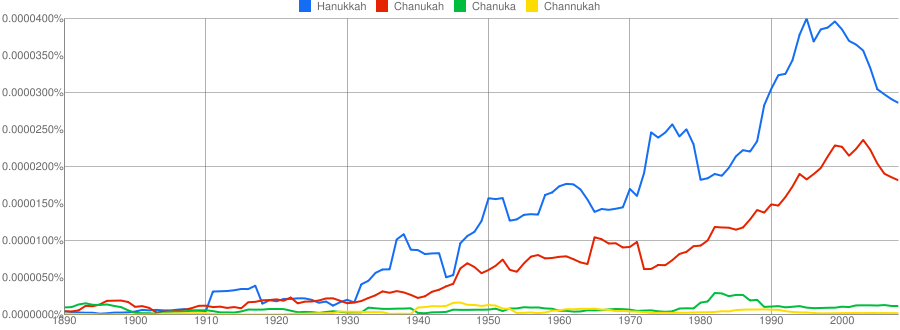
How do you spell חֲנֻכָּה?‎

Since everyone was more interested in חֲנֻכָּה‎, than Halakhah or Kabbalah, here is the chart. I started with all 13 possible spelling and kept the ones that moved off the bottom axis. Here we have two major contenders since the 1930’s. No major change from the EJ in the 1970’s. The question is what happened in 1930 to change the preferred spelling from Ch to H. And what happened to make Channukah with two n’s the preferred spelling of the 1940’s. Click on Chart to enlarge.

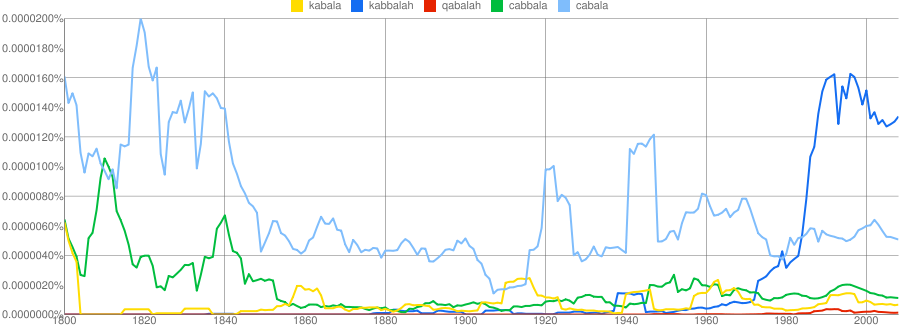
How do you spell קבלה?

Here is a history of how to spell קבלה. Notice the changes of the spelling and recent vintage of our current spelling of kabbalah. Most spell checks still use cabala. It seems that the publication of the Encyclopedia Judaica in 1971-2 changed the spelling to kabbalah. What other words did the EJ change? Qabbalah has still not caught on and cabbala has declined. Also notice the interest in the esotericism of the cabbala as a subject between 1810-1840. Click on the chart to enlarge.

Thanks to Yosef Rosen and Satya of Berkeley for the above chart.

Update- Here is one for halacha, halakhah, halachah, and halocha. The scale is smaller, before 1925 there were basically no references.

Rav Amital on Prayer and the Religious Life

VBM just translated one of the important interviews with Rav Amital. The Hebrew original was done in 2007 for Yad Vashem.

Here are some selections, the full version is here.

Religious Life During the Holocaust and After: An Interview with Rabbi Yehuda Amital

On Yom Kippur eve we received orders to go back..
Meanwhile the shooting was intensifying, to the point where the German soldiers guarding us ran away, because they were afraid that the Russians would capture them. And so we remained behind, and we got to the Jewish Community building, to the building where I had lived with my parents. We entered the cellar on Yom Kippur eve. We prayed on Yom Kippur in the dark. We had one machzor with us; one person read the prayers aloud, and thus we prayed with a minyan.

My whole concept of prayer comes from there. I saw people – fathers of children, men who had wives – they were alone, knowing that their families had been taken, but they didn’t know to where. And I said to myself, “How is it possible to pray?” We knew before then that the foundation of prayer is gratitude towards God. I said, “What gratitude? People are sitting here without parents, without children.” So I reached the conclusion – which I published later on – that service of God cannot be based on gratitude; there is something beyond that. “Though He slays me, I shall trust in Him” (Iyov 13:15). That is a higher level. That understanding was strongly imprinted in me then.

Did you have religious crisis points?

I can’t speak of crisis points. One lives in crises all the time. For me, every festival is problematic. On Simchat Torah, for example, I would speak at the yeshiva about the Holocaust [because it was the day of my liberation]; I couldn’t let Simchat Torah go by without mentioning the Holocaust. I spoke about it all the time. Every eve of Tish’a be-Av I spoke about it at the yeshiva; the subject occupied me.

Did it also affect your attitude towards prayer?
On the contrary – as Rabbi Yehuda ha-Levi said, “I flee from You – to You.” I have no other option. I need God; without that I’m not able to exist at all. Without this faith I lose everything. But it’s not as people think, that when a Jew is religious then all the problems are solved. There’s no such thing. But I need His closeness. Just as a person cannot be alone, he seeks some intimacy, some anchor. For me, faith in God is that strong anchor.

What, as you see it, is the place of the Holocaust in our religious world today?

Sometimes I encounter strange phenomena. They interview a religious person who says, “Why were some children killed there in a traffic accident? Because they didn’t observe Shabbat.” I said to him, “Okay, so you have an explanation for that, but why were millions of Jewish children killed? For that you have no explanation. So why are you trying to give a religious explanation? Be quiet.” It upsets me, but what can I do? Sometimes I keep silent.

Do you believe that we have more of a moral obligation than other nations, in the wake of the Holocaust?
I believe that it demands of us greater morality, greater attention to others.

Benjamin Lazier. God Interrupted: Heresy and the European Imagination between the World Wars

One of the most important books of Jewish thought in 2008 was Benjamin Lazier. God Interrupted: Heresy and the European Imagination between the World Wars. Princeton University Press, (I unfortunately have had it out from the library since early 2009 and they are finally recalling it. This core of this post was actually written ages ago). It deals with how three Jewish thinkers- Scholem, Jonas, Strauss- dealt with the loss of tradition. They wanted to avoid relativism and instead choose human value through pantheism, gnosticism, neo-platonism, and neo-aristotelianiism.

Why is this high brow book relevant? Why read this long blog post? The reason is the tension between physis and nomos and between relativism and ethical meaning. In 1975, Rav Aharon Lichtenstein wrote his classic “Is there an ethic outside of halakhah.” Many have not paid enough attention to the opening second paragraph where Lichtenstein reclaims the tradition by claiming that we care about nomos, not physis, law not the natural order. In turn, the Reform theologian Rabbi Eugene Borowitz complained about the counter-cultural centurions at the door and wrote that Reform needs its own ethical moment within nomos. Most of the recent discussions, therefore, in all three movements have been about nomos, for example medical ethics is done as a legal question.

Now, this year the hot book is Arthur Green’s Radical Judaism with its defense of pantheism. Most of the criticism of the book has been sociological or the invoking of nomos against Green’s physis. However, if there is going to be a serious response, then it must directly tackle the current quest for physis. The response must directly deal with the issues of those who feel that nomos is not the answer. One can either find a new defense of nomos for the next generation or find a more traditional form of physis. Saadyah, Bahye, Cordovero and Rav Kook among many others are all physis in that their Judaism is part of the natural order. Should one use one of those for a theology? Alternately, one of the followers of Hans Jonas is Jewish thinker Leon Kass, who rejects stem cell research as an affront to the natural order. Are people looking to become natural in that the law has turned out to not offer ethics? or should one respond to Green with Neo-Aristotelianism, or with Levinas? People want to look into their hearts, not to nomos, where the “deepest depths” are to be treated as the holiest.

I did not post Lazier to discuss the implications for Green, rather because it offers one of the best expositions and casuistry of the current issues about formulating theology today. My Catholic colleagues are all gaga about the work of the Notra Dame theologian Cyril O’ Regan, one of the leading theologians in the US today, who is writing a massive many volume exposition of modern gnosticism, heresy, and pantheism- in order to come out with a committed Catholic theology at the end. (I already have a draft of a future post on O’Regan.)Lazier’s book provides one of the basic interfaces between the Jewish heresies and the potential for a response.

The Paradoxes of Secular Heresy by Anna Yeatman
In this wonderful, erudite, and beautifully written book, Benjamin Lazier suggests that the legitimation problem of human artifice assumed a particular urgency and topography in the period between the world wars. His focus is especially on how three Jewish thinkers–Hans Jonas, Leo Strauss, and Gershom Scholem–responded to what their contemporary Arendt recognized as the context for Walter Benjamin’s work, the irreparable loss of authority for tradition, None of these thinkers wanted to reinstate orthodox Judaism; they could not avoid the modern freedom for human artifice, but they rejected a nihilist-existentialist celebration of the will–in the absence of God, the human subject is free to will its own being. They rejected this conclusion because it affirms an utter contingency or arbitrariness. Such freedom is without any normative orientation or restraint. It is as though the human subject arrogates to itself a divine creative power without the infinity or universality that is the divine.

In his own way, each of these thinkers insisted that it is vital that the human freedom for artifice not be mistaken as a freedom for self-creation. To make this insistence, each had to engage and learn from the two heresies of Gnosticism and pantheism that attend the development of the idea of a freedom for human artifice. These heresies are not new, but in the modern context they acquire the force of being the only possible intellectually cogent narratives of the divine. In Gnosticism, as already indicated, the divine is invoked in its absence from the world that humans have made, a world of destruction and sin. In pantheism, the divine is invoked as it inheres within worldly being. The problem with both heresies is that they are antagonistic to the world–Gnosticism by indicating the world as derelict in relation to the divine, and pantheism by conflating the divine with the world, thus robbing the world of its own distinctive being. Jonas offered a philosophical biology, a neo-Aristotelian account of the world as a living organism, as purposive nature. In so doing, he deliberately presented an alternative to the will to power, a normative reference point in ecology. Strauss offered a different conception of nature as a normative reference point for human artifice–this is a neo-Platonic conception of natural right, a conception of justice that precedes human artifice. Of the three, Scholem was most attracted to a nihilist celebration of a Jewish Zarathustra, a worldly messianism that, like pantheism, conflates human and divine creation.

However, he argued that “Nietzsche’s famous cry ‘God is dead,’ should have gone up first in a Kabbalistic text warning against the making of a Golem and linking the death of God to the realization of the idea of the Golem” (p. 194). The myth of the Golem, of course, is a story of the human arrogation of the divine power to create turning into a force for destruction of human beings and their world. Scholem recognized in Zionist messianism a contemporary Golem, and he argued against it, the tragedy as is now so clear of modern Israel.

For Lazier, God cannot disappear, for the modern sensibility continues to dwell with and in God, albeit heretically.
read the full version here.


Here is another great review

The Heretical Imperative by James Chappel

“Church Going,” a 1955 poem by Philip Larkin, describes the mix of awkwardness and reverence many of us feel when faced with the monuments of our religious past. The narrator, having removed his cycle clips to visit an old church, asks himself why he continues these debased pilgrimages, which “always end at a loss like this, wondering what to look for.” Larkin’s tourist is unwilling to embrace the rigidities of strict atheism or strict orthodoxy, and lives somewhere in the murky space between the two.

Perhaps the problem is the one diagnosed by Hannah Arendt: the collapse of orthodox religion has not caused us to turn towards the world with the piety and love once accorded God. Benjamin Lazier, in his inspiring and beautifully-written God, Interrupted: Heresy and the European Imagination Between the World Wars (Princeton, 2009), suggests that there can be no simple path between these two forms of reverence. A detour through the long tradition of heresy might be required in order to overcome religion without losing our faith. Through a study of the surprising influence of heretical thought on Hans Jonas, Leo Strauss, and Gershom Scholem—three of the most influential Jewish intellectuals of the twentieth century—Lazier attempts to resuscitate the lost art of heresy, with all its possibilities and danger.

Although European societies were obsessed for centuries with the identification and persecution of heretics, Gnosticism and pantheism refused to die (however many actual heretics were forced to)…In the tumult of interwar Europe, many attempted to reclaim this absent God through heresy: both Gnosticism and pantheism, the twin rivals of a discredited orthodoxy, reappeared and flourished. Jonas, Strauss, and Scholem, all of whom came to maturity in this postwar period, were indelibly marked by this revival.

Both Jonas and Strauss argued that the horrors of modernity stemmed from God’s disappearance. Against the Gnostics and pantheists, whom they relentlessly attacked, the two German Jews held that the world left behind could be reinvested with the transcendent value that used to be God’s alone. Modernity, in other words, could only be redeemed by filling the God-shaped hole in our society with nature. In Aristotelian terms, they see physis as an antidote to nomos. We need, that is, to understand nature differently: not merely as “that which surrounds us,” but as a metaphysical and ethical order that sets limits to human activity—limits that we are manifestly incapable of setting for ourselves.

For Jonas, the modern worldview was tainted with Gnosticism: we treat the earth, and one another, with such consummate lack of care because, in the absence of God, living things appear to us as mere matter to be used and abused at our convenience. Once we stop seeing nature as a stage for God’s creation, and God’s order, everything is permitted (to quote another famous heretic). From this insight he developed a robust philosophical biology and environmental ethics, premised on the final overcoming of the Gnostic heresy.

When we encounter the world, Scholem suggests, we are not faced with the bare nothing of the Gnostics or the flaccid everything of the pantheists; instead, we are faced with a unique something that is autonomous from God yet shot through with traces of its divine origin. Only a gap between God and world allows us the space to develop autonomously as ethical subjects, but this gap is not absolute: from our all-too-human standpoint, we can still sense God, and we can still glimpse redemption.

it shows us an alternative to strict orthodoxy that does not take the form of shrugging ecumenism. Lazier, it should be clear, is not attempting to found a new orthodoxy. Instead he is unearthing a style of thought and reasoning… This mode of engagement with the religious past replaces confused half-belief with exacting analysis, shaping the shards of exploded traditions into something new instead of leaving them in a mess on the floor. If the God of orthodoxy has lost his plausibility for many of us—for two-thirds of us, apparently—heretical reasoning allows us a path to piety that does not circle back to a bankrupted past.

To adopt Lazier’s title, the modern predicament is one in which God’s call is “interrupted.” The orthodox solution to this dilemma is to act as though she can still hear the word of God with complete clarity, while the atheist’s solution is to clap her ears against the ever-quieter echoes of past revelation. The Jewish intellectuals discussed by Lazier present us with a third option: to open our ears to nature, and to one another. The skeptic would argue that a circuitous route through heresy is hardly necessary to arrive at such a banal conclusion; in response, Lazier’s modern heretics would wonder why such a simple resolution was ignored in the tragedies of the twentieth century. As Scholem put it in a devastating formulation, whose simplicity belies the heretical complexity required to truly defend it: “Develop peacefully, and don’t destroy the world.” Read the rest here.

Rabbi Samson Raphael Hirsch on Idolatry

Rabbi Samson Raphael Hirsch (1808-1888), the important German rabbi, during his time officiating as Chief Rabbi of Oldenberg he published Horeb in 1838, his catechism and definition of Judaism. Help me think through the quote below from Hirsch. Any Rabbinic sources come to mind? I know he wrote statements in Frankfort that differ with these views, but right now I want to help analyze this passage. Anything sound familiar? Anyone develop it further? Thoughts?

Rabbi Hirsch defines idolatry as considering the natural world as separate than God. The world is filled with natural forces and the forces within man, some seen some unseen. One should appreciate that there is a Divine law of nature and God’s providence for human destiny. Human’s are given moral freedom, which can triumph over the tyranny of ruthless power or the bondage to the passions. Your moral freedom as a gift of God and one must use to it to subordinate to God’s laws for humanity.

The quests for wealth, power, and knowledge are all forms of idolatry in that one does not subject one’s forces to a higher purpose. Idolatry, the treating of anything besides God as absolute, consists of a loss of human dignity not an intellectual mistake. One must beware the idolatrous human bondage of sensuality. Polytheism is thinking you do not have to follow God’s duty and instead one can follow the passions For Rabbi Hirsch, seeing the world as many forces or gods is polytheism, which is avodah zarah.

Elsewhere, Rabbi Hirsch portrays the idolatry of Egypt as sensuality, as slavery without freedom, and as the power of mammon and the state. Roman is portrayed as the idolatrous brutality of the state and militarism.

Originally, idolatry meant a false god or a representation of God or gods. From the 17th century onward idolatry moved from its original reference to icons to false attitudes toward life. Most of time, the major forms of polytheism were materialism, the world of commerce, and sexuality. Henry Moore, the Cambridge Neoplatonist defined idolatry as polytheism, the multiplicity of sensuality and materialism. According to Voltaire idolatry never happened but there is the polytheism of superstition.

In the 19th century Wiemar Classicism, polytheism was the worship of nature or man himself and not the higher duties. Schiller’s Letters on the Aesthetic Education of Man (1795) warns against imagination and sensuality. Man should use his freedom and take charge of his destiny. Already in Schiller’s early Mission of Moses (1789) was “Reason’s victory over those coarser errors assured, and the ideas about the Supreme Being necessarily ennobled. The idea of a universal connection among things must lead necessarily to the conception of a single, Supreme Understanding.”

Here is the definition from Horeb.

Both minuth and zenuth lead to idolatry – riotous enjoyment leads to it directly; denial and misrepresentation of God usually over the bridge of pleasure.
And if then, in the embrace of sensuality, you have stripped yourself of everything spiritual, no longer retaining any feeling for the Divine, you will yourself become aware in your impulses of your feebleness, your instability, your inconstancy in pleasure, and you will fall prostrate before every creature that provides you with enjoyment and itself seems to you so noble and so everlasting in its enjoyment.
You can also reach idolatry, or rather polytheism, directly through the eye and the understanding of the senses, if Torah does not reveal to you the One and Only God; for with your physical eye and understanding you behold only particular beings and activities, but not the Invisible One with his dominating law. You see only gods, not God. This is avodah zarah.

You see on every side active forces and their carriers in Nature, elements and carriers of elements like the sun and the earth and the sea and the air; in the life of peoples, you see Nature, soil, rivers, mountains, and so forth; you see Nature, under the hands of man, raised to a power, and you see men with their wisdom and foolishness, power and weakness, passion and folly, fashioning, destroying and influencing the fate and the life of peoples; and an unseen force that holds sway over destiny and life. And in your own life you see the spiritual and the animal in you; you see yourself as a creative force, bestowing a blessing or a curse on everything around you.

But nothing of all this exists or acts by its own power or its own will. Nothing of all this is a god; all of it is created, the servant of the One all-ruling and omnipresent God. In Nature you see God’s law hold sway; in the life of peoples God’s providence supreme; in yourself a strength sent from God. You yourself, as far as your body in concerned, are subject to the laws of Nature. You enjoy your moral freedom only as a free and loving gift of the Omnipotent, and with that freedom of will you are called upon to subordinate yourself to the universal law as God’s first servant. That much you have learnt.

What you have learnt, however…you must recognize nothing as God apart from this universal sway of God: ‘you shall have nothing alongside his omnipresent and all-pervading dominion.’.

Beware lest, instead of building your material life of God alone, you base it on wealth or power or knowledge or cunning or the like. If you do any of these things, you sin against the law: ‘Thou shalt have no other gods before Me.’

Nor is this idolatry merely an error, a mistaking of falsehood for truth. In that case, it would be simply an intellectual mistake, a delusion, deplorable indeed, but, even at the worst, not the worst that might happen….But this is not the case. As soon as you set anything else beside God as God, and still more as your God, forthwith human dignity, purity and uprightness fall to the ground, the fabric of your life goes to pieces.

The only people who still speak like this are those influenced by Marxism: Erich Fromm (he was also a Hirschian) Herbert Marcuse, or Cornell West. Old time Christian Fundamentalists and left wing Muslim Marxists also speak like Rabbi Hirsch. Centrist Orthodoxy seemingly accepts the many gods of mammon, hedonism, militarism, degrees, self-fulfillment, and the professional drive to succeed.

Rav Soloveitchik and John Lennon

After John Lennon was killed in 1980, there was a massive public mourning in Central Park. All Tuesday and Wednesday there was an immense gathering in the park of people crying, wailing and flailing over Lennon’s death.

That Wednesday night, Rav Soloveitchik gave a weekly parashah shiur in Furst 501. The topic was the deaths of Jacob and Joseph in Egypt.
Rav Soloveitchik set up the Biblical verses to discuss the topic of the mourning laws, in which he emphasized how the Egyptian mourning practices of embalming and the encrypting process was not permitted according to teachings of the halakhah.

He then said: “This [the Egyptian practice] is a case of going to extreme in mourning just like the people are now doing for John Lennon.” In the audience, this elicited an outburst of chuckles, murmuring, and moving chairs closer. When everything quieted down, he continued:

“How do I know from Lennon? You are surprised I know from Lennon. Well, I know Lenin- no one can forget Vladimir Lenin, he was a real troublemaker.[last two words slightly garbled from the murmuring crowd] So I know about Lennon.”

Rav Soloveitchik followed this by using Jackie Onassis [Kennedy] as the model of the opposite extreme of callousness when after Kennedy was shot she shopped for a hat to wear during mourning .

Chabad and Paul McCartney
Since we are speaking about Beatles: The surprise guest at last night’s fundraiser for Rutgers Chabad in New Brunswick was Sir Paul McCartney, who’s apparently dating the daughter of the one of the honorees. h/t JustASC and more details here.

Joshua Berman Interview

Joshua Berman of Bar Ilan University/Shalem Center spoke at Davar in Teaneck two weeks ago. He discussed his new project of reassessing Biblical source criticism from an academic and Jewish perspective. When I probed him, he was nice enough to agree to answer a few bigger questions. Now we can return the favor and help him produce a better book by offering comments on his proposed project.

Berman attended Princeton University, and holds a doctorate in Bible from Bar-Ilan University. He studied at Yeshivat Har Etzion and received his ordination from the Chief Rabbinate. His prior book is Created Equal: How the Bible Broke with Ancient Political Thought . Go read it. It has gotten favorable reviews and even those who criticize parts of the book have been extremely charitable. It claims that the Pentateuch is history’s first blueprint for a society where theology, politics, and economics embrace egalitarian ideals, by reconstituting ancient norms and institutions. Created Equal is a popular work that used much of the current scholarly literature comparing ancient Near Eastern religion and Israelite religion, including those of Norman K. Gottwald who blurbed the book.

Berman’s new project is to respond, in some way, to Biblical source criticism as it is found today. He acknowledges that the traditional documentary hypothesis has been heavily modified and one should not set up a straw man to refute. He also directly refers to new approaches such as the supplemental model. He freely volunteers his affinity for Evangelical authors like Kenneth Kitchen, Alan Millard, Gordon Wenham (all in the UK, and all emeritus), and in the US, Richard Hess. But which version of the supplemental model is forefront in his mind is less certain. In the meantime, one can get a sense of the field from the much acclaimed Karel van der Toorn, Scribal Culture and the Making of the Hebrew Bible (available as pdf here and from scribd here), William Schniedewind, How the Bible Became a Book, and John Van Seters, The Edited Bible: The Curious History of the “Editor” in Biblical Criticism.

Berman’s approach to his task seems to have three parts. (1) To credibly add to the evidence showing affinity between the Torah and the literature of the Late Bronze Age and the era of Moses (2) To show that the repetitions and contradictions found within the Torah demonstrate unity in a manner foreign to our modern conceptions, but more apparent when seen in the perspective of a range of ancient Near Eastern literary genres. such as the Code of Hammurabi and the Gilgamesh Epic (3) To then show that the Bible has a unique message that transcends its ancient context and is still worth reading today.

In order to move his theories from possible ideas to a probable hypothesis, he needs to write peer reviewed articles that suggest a greater affinity to the literature of the late-second millennium, based on credible parallels with ancient Near Eastern literature. He also must be on his guard not to slip into a Bible as literature mode, such as explaining narrative repetition but does not actually answer historical questions. The project wont refute academic trends, rather offer a credible apologetic. If he does enough drafts and listens carefully to his critics, then he may possibly create the major apologetic work, that barring new archeological finds, will last for decades. Berman’s current project has the potential to be the new Umberto Cassutto or Nahum Sarna.

In his morning talk, he discussed Deut 13, which is universally taken in the academy to buttress a seventh century dating for Deuteronomy in light of strong parallels to the Vassal Treaty of Esarhaddon. Instead, he presented a 15c BCE Hittite text which according to Berman is much closer to Deuteronomy. He gave a version of the talk at SBL, available online, and it will be published in JBL in a few months.

The person sitting next to me who has read the scholarly literature asked: why does Berman assume an edited lack of contradiction? Why do we not assume that the scribal editor wanted to preserve all fragments since they considered them holy and prophetic?

Berman is part of the Shalem Center’s quest for a Biblical philosophy, bypassing Rabbinic categories, to be used for a broad conservative ideology. But Berman is actually trained in Bible. If one has read the literature in the field, much of what Berman says is a somewhat old-hat. It is a reworking and expansion of Mendelhall’s understanding of Ancient Near East vassal treaty covenants as relating to the Bible. One should compare Berman to entirely different presentations of the same material, such as that of Jon Levenson’s Sinai and Zion. So too, finding a polemical moral superiority to Israelite religion over polytheism goes back to John Selden in the 17th century. The Jewish authors Yehezkel Kaufman and Nahum Sarna, followed Hermann Cohen, and presented an opposition of Biblical ethical monotheism to the polytheist’s lack of morality. Berman manages to give  his own formulation connecting the Bible to social ethos and liberal communitarianism.Now, read his responses and help his project by asking thoughtful questions.

Question 1: Do you think reconciling biblical criticism is possible as an orthodox Jew without sounding like an Evangelical?

Answer: To be honest, I wish we were responding more like the Evangelicals, or at least some of them.  Like orthodox Jews, Evangelical Christians are spread across a wide gamut of positions.  Some are more fundamentalist and less sophisticated, just like in our own community.  But many are fully engaged with the world of scholarship, including biblical scholarship – more so, I would say, than we are.  There are literally dozens of evangelical scholars, whose work is respected, who ask tough about the reigning paradigms within the field, and produce thoughtful insights that have been a great source of inspiration for me.

Question 2: Are the responses to Biblical criticism written by of Rabbi Dovid Zvei Hoffmann and Umberto Cassutto still relevant today?

Answer: Rabbi Dovid Zvei Hoffman passed away in 1921, and Umberto Cassuto in 1951.  I can’t think of a field of inquiry where the questions of today could be answered by works in the field penned 60 or 90 years ago.  Each thinker had key insights,(See the Shalem Press reprint of Cassuto’s classic work, The Documentary Hypothesis with an introduction by Berman – A.B.). But the field of biblical studies has progressed enormously in the last half century. Today, the questions being asked are different, and the range of answers being offered is much broader.  Our knowledge and understanding of the ancient Near East is enormously greater. We now know more about Akkadian and Ugaritic texts, we have new texts from Ras Shamra, Ebla, and Elephantine. The field has new approaches to source criticism.

Question 3: Why do Orthodox Jews and Evangelicals still talk about the Documentary Hypothesis, when many have been using a form-tradition model based on Hermann Gunkel or a supplemental model based on John Van Seters or Rolf Rendtorff?

Answer: John Van Who?  Rolf Who? As someone working in the field, I am familiar with the work of these scholars, but I suspect that few of your readers are.  And that’s just the point.  Even in an age of internet, the vast majority of people don’t tune in to the proceedings of the Society of Biblical Literature – all these new theories are, for most people, the stuff of the ivory tower.

Julius Wellhausen, and his documentary hypothesis were different. A hundred years ago, Wellhausen’s theory spread like wildfire, it was debated in the popular arena , and was the uncontested truth about the Torah in much of the western world for a full century.  It explained everything in a nice neat package – what was written by whom, when, and why, and how one nice neat stage led to another.  Wellhausen was a late 19th century German, where big ideas were in vogue (think Hegel, Harnack, and just a little later Frued and Einstein).  Even though the academy has largely repudiated Wellhausen over the last 30 years, his work has become part of the fabric of western culture, and that’s what people know about.

Question 4: If the flood story appears to be based on the Mesopotamian accounts, then why look for moral teachings and deeper meanings in the Torah version? Why did the Torah teach the flood story at all?

Answer: I don’t know what really happened with the flood, Noah, or the animals. Even the Rambam allowed that it might not be literal.

I do know, however, that when we compare the flood narrative of Gen 6-9 to the Mesopotamian flood traditions we see one thing: that the Genesis account is engaged in theological polemic with the other known story.

The Mesopotamians were caught in a bind: since the gods created men to be their servants, why is there famine and disease in the world?  The Mesopotamian flood story gives the answer: the gods were troubled by overpopulation of the world, because – and this is what is says – there were so many humans, making so much noise, that they were disturbing the sleep of the gods!  So the gods sent all manner of suffering to kill off people, culminating with the flood, and following which, the gods introduced fertility problems into the world, to solve the problem.

The Torah spins all that on its head: humanity suffers not because it disturbs the gods’ sleep, but because of its misdeeds.  In the Mesopotamian story, the “Noah” figure escapes only because a rogue god tipped him off, and told him to build an ark. In the Torah, saving a remnant of humanity was always part of the plan, and the choice of whom to save was based on righteous deeds.  The Torah’s flood story ends with a ringing affirmation of human reproduction: “And the Lord said to Noah and to his sons, “Be fruitful and multiply, and fill the land.”

Question 5: Do you have any thoughts on the classical positions on Revelation?

I know that the classical sources of Machshevet Yisrael pursue this topic great length.  In a personal admission I will say that I was never very good at Machshevet Yisrael.  When reading the Torah or the Nevi’im I proceed from a supposition that the only way that I will properly understand the message of the text is if I take it literally.  An analogy: I know, intellectually, that it is pointless to describe the Almighty as “angry” “loving”, etc.  I know that mouthing the words of the tefillah is unnecessary for God to know what I’m thinking.  Utilizing these terms, however, is the best way for me to relate to the Almighty. Over-speculation on what He is really like, will actually detract me from the proper service of Him.  I don’t know what it means when the Torah says, “God spoke to Moses saying…” – but I do know (or, this is my operating belief, anyway) that I will only be able to grasp the Torah’s message (dare I use the Christian term “kerygma”?) if I relate to that phrase in its simplest manner.

The Disney-ization of Faith

This is from internetmonk.com by Chaplain Mike, my favorite watchers of all things post-evangelical. This offers further thoughts on the role of culture and relgion. How much of Centrism, year in Israel or kiruv – Is to provide magic moments? How much is heart-tugging sentimentality? How much is the state of Israel views as a theme park? And how did the super cognitive Rabbi Soloveitchik create a rabbinate of sentimental kitsch? Did the acculturation into Evangelical America override anything else? How much of the visions of Torah circulating have mawkish origins far from anything in the Talmud or classic Biblical commentaries, let alone the classic of Jewish thought? Why do we can this shallow frumkieit a form a Torah? At least, the Gra and his followers would reject the folk relgion of the prostaks. It seems we are not Litvaks anymore.

Disney does not fool me into thinking what they do is great art containing profound insights into life and the human experience. I accept and enjoy them for what they are, no more. Their artists and animators are first class and what they do, they do well… They take stories that are classic because of their universal themes and dumb them down so that the kids can enjoy them with mom and dad. They remove all the messiness, complexity, nuance, and grit from these tales and sanitize them for a G or PG-rated modern entertainment audience. They are enjoyable, but as subtle as a punch in the face; as deep as the puddle in my driveway after a light rain.

Unfortunately, many American Christian leaders seem to think the Disney way is the way forward for the church. I could write a long book about all the examples of this across our land, from the many ways we market Jesus in books, music, and media, to the kistchy excess of the televangelists and the corporate “excellence” of the megachurches, to iconic monuments like the Crystal Cathedral. So much of it represents the “Magic Kingdom” mentality.

In the cartoon world of contemporary American evangelicalism, it’s all about bigger, better, and simpler. Help folks think their dreams can come true. Create “moments” for people in the congregation that they will never forget, that will “bless” families in safe and sanitized settings. Remove the messiness and reality of day to day life. Instead, put a sentimental, heart-tugging version of life up on the screen and make people feel it. Embrace the possibilities.

The Creation Museum near Cincinnati has decided to expand and build an 800-acre theme-park style complex featuring a replica of Noah’s Ark. The project will cost an estimated 125 million dollars and is projected to open in 2014 in nearby Williamstown, KY.
Some have questioned whether it is legally permissible for the state of Kentucky to fund a religious theme park. I raise another question: Is it appropriate for Christians to “Disney-ize” their faith like this?

They know what they believe already. And believing, they have set out to shape reality according to that image and make a new “dream come true.”

• Noah’s Ark. The Ark will be the park’s central attraction. Guests will take a tour of the structure so that they may “gain an understanding of how it could have been built, and how Noah, his family, and all of the representative kinds of land animals were cared for, and then survived on board for 370 days of the Flood and its aftermath.” Given the fact that Scripture says nothing about any of this, one wonders about how “Biblical” these “themed presentations” will be. The highlight of each day will be a spectacular show “featuring the ‘parade of animals’ and the dramatic ‘eruption of the fountains of the great deep.’” Will there be re-enactments of sinners drowning and crying out in hysteria and panic? Carcasses of dead, bloated animals floating on the surface of the lake? A nearby ravaged landscape? Will the greatest historical example of God’s wrath and judgment being poured out on the earth be “fun” and “exciting” or will it communicate anything at all about the actual fear of God and the reality of Divine judgment?.

Please. I will respond as clearly and directly and forcefully as I can—this project has nothing to do with Biblical Christianity.
This is cartoon faith. It represents the “Disney-ization” of the Biblical story. I mean, seriously. Christian people are going to waste $125 million building this travesty, and then undiscerning American believers will spend countless millions more to be indoctrinated, wowed by spectacle and a thoroughly sanitized version of the Biblical story. Bus-loads of young people from entertainment-seeking youth groups will be “educated” in a “Biblical” interpretation of the Flood that had its “genesis” not in the Torah but in the visions of Ellen G. White, whose “inspired counsels from the Lord” guided the 19th century sectarian Adventist movement.

Those visions will come to life in true Disney-like fashion—with overwhelming kitsch, mawkish sentimentality, a thin veneer of credibility, and, most importantly, the absolute conviction of unwavering belief in spite of any contrary evidence or countering interpretations. This project is fundamentalism at its creative worst. Read the Full version here.

Why Cultural Authenticity is Becoming Impossible

Here is one blog quoting another blog, which itself is quoting another blog. I did not differentiate by font the four different voices. The content is a collective musing on the role of authentic in religious products and the role of kitsch in modern relgion. What was the role of kitsch in the year in Israel or the creation of Centrist Orthodoxy. If we one made fun of Reform homes for their dancing hasids on the wall, what will we make fun of in Centrist homes? And how much do they really believe the religious objects are authentic? Is the myth of authenticity essential to creating Centrists? Anyone remember when Peshischa and Kotzk were emblems of authenticity?

There is a problem of the white middle/upper class pursuit of authenticity – namely, that this pursuit itself can never be “authentic.” In response to counter-critiques against critics of consumerism (particularly when such consumerism is used as a means of attaining “authenticity”), he uses the metaphor of a sinking ship to point out the necessity of prophetic doomsaying even in the absence of a solution:

Of course criticism is cheap and easy, and there will always be folks demanding that the critics provide positive solutions. There is a certain banality here methinks. It may be banal to state that the ship is sinking, but it is even more banal to dismiss the man who points out that the ship is sinking because he has not provided an explanation detailing how it is all persons on the ship might survive. Sometimes there simply are not enough lifeboats and to reject the message of the person who says as much because that person’s message contains no positive element, or no positive element which we have any confidence in, is, well, not always prudent.

In a similarly depressing fashion, he notes that “many if not most Americans cannot now fathom a life, that is to say a lifestylization, not formed by mass media.” As a result of this mis-shaping of our entire lives, there seems to be little hope of the United States emerging from this “post-cultural” situation, one in which the dominant (and dominating) culture is both purposely contrived for the sake of profit and yet free from the would-be rational restraint of its contrivers. Because the genie is out of is bottle, there seems to be no path of return.

As soon as you self-consciously seek to be “authentic” you have guaranteed that you are not “authentic” and that you will not be so long as you seek to be. The rule here is akin to that which applies to a person who thinks that he is humble. As soon as you think you are, you are very much not.
This principle with regard to humility was vividly illustrated in C. S. Lewis’ Screwtape Letters , as the unwitting human target had little means of escaping from pride about his humility (and about his humility about his pride about his humility, and so forth). Similarly, cultural authenticity cannot be consciously possessed, although it can be reflected on in retrospect.

In the end, it is through the path of ascesis, of measured and rational self-denial that our souls might be saved, since even the minds of those who reject consumerism are so poisoned by sins of pride and greed:

Branding yourself countercultural or even “anti-consumerism” is itself often a form of consumerism, especially when the mind of such a person is formed in the age of consumerism.

American consumerism is driven by, even obsessed with, the seeking of “authenticity.” From the WalMart commercial which shows you “real,” “honest,” average joe Americans (and thus infers that authentic people love to save money at WalMart) to the Whole Foods marketing which suggests that expensive organic and free trade foods are more authentic

I am inclined to think that the extent to which America is post-cultural, there is no substantial “authenticity” to be found – and this seems to correspond to post-cultural America’s drivenness to sell and resell itself as authentic. The best we can do at this point is to find little corners of America where post-culturalism is not yet as homogeneous as it is in other places. But even that does not “make us authentic” – it may be nothing more than a more intent and focused hungering to escape rampant inauthenticity.

One might rightly here demand a definition for authenticity. One reason to abandon the word is that its definition is now quite problematic. There is an extent to which all notions of authenticity are in the eye of the beholder. There is an extent to which authenticity cannot rise above social construct. There is an extent to which authenticity is relative and thus malleable. I think that our contemporary hunger for authenticity is a hunger for that which is real in human life. When we buy a backpack from L.L. Bean, we want to think of real things like family hikes and cute kids on buses and relationships between real human beings like us. We do not want to think about such things as the one armed Indonesian 12 year old working 60 hours a week for $7 a day making a bag that costs L.L. Bean 1/30th of what we paid for it, leaving L.L. Bean nothing much more than a group of pampered cubicle jockeys, who stare at the computers which order backpacks from Asia, and ship them to retailers in America, and count the money which L.L. Bean makes from its rugged American image, an image which is a false and sterile façade .

It seems to me that the self-conscious desire for “authenticity” is part and parcel with participation in the establishment and maintenance of a community of individuals.

The same applies to religious kitsch. There is a difference between a poor Catholic peasant embracing some kitsch religious form for intent devotion in an act which in no way is motivated by a desire to become or to prove an “authentic” Catholicism (the Catholic peasant has nothing to prove in that regard, but takes his or her Catholicism for granted) than there is in the adoption of religious kitsch by a white person from the middle class suburbs who wants tokens of authenticity about their home to help them feel like they are a real Catholic.

h/t or really taken entirely from Medieval Leftist and The Ochlophobist. I only found through my research on popular culture and relgion.

Miracle – Matisyahu Hanukkah Song Music Video

Here is the new Hanukkah video by Matisyahu posted yesterday. Notice the interplay of Christmas and Hanukkah, first assault, then imprisoned in the culture of Christmas, oppressed by nutcracker, victorious in hockey, then appreciated for his own infinite miraculous light. Finally Greeks, Jews, Hasidim, Christians, Antiochus, and Santa dance together. (Thirty years ago, the organization Gesher was risque by having the lights of Hebrew and Greek letters dance together to show there can be a Greek-Torah synthesis.)

There is a blurring of holiday spirit and commercial making of music, hanukkah festivities and the internet, a mix of particular Jewish pride with universalism, and a very hip holiday spirit. The hanukkah message is the miracle to solve our struggles and falls, to win our fights. Dont miss Matisyahu in Santa Clause costume with tzitzis.The video “Miracle,” was produced by Dr. Luke protégé Kool Kojak (Flo Rida, Katy Perry, Ke$ha). This is real entrance into American culture. (And ej – as production and popular music goes this is top of the line. Just compare it the several local frum groups that issued videos yesterday.)

Matisyahu will be playing at YU tonight, Thursday. He will certainly sing this song. Attendees will learn it by heart on their ipod, and probably break out into cheer when he sings it. I have no question that I will be able to go around Teaneck this shabbos and hear people sing this as their hanukkah tune. We have come along way from singing dreidel, dreidel and the debate between modern and non-Zionist Jews about singing MiYemalel Gevurot Yisrael. Any thoughts on the role of popular culture in the community?

I posted the video because it relates to what I am writing/editing today. As stated in my previous post on pop culture, this certainly expands horizons of Jewish music, interfaith relations, role of the Orthodox Jew in America, Christian view of the Jews, and meaning of the holiday. So, how will all those young Centrists process the relationship of Thursday nights performance and the shiur given in the morning? Which will stick in their mind this week? During the course of their lives at points of “struggle and fall” will they turn to the message of shiur or to that of the Thursday night performance? Are their lives, as actually lived, very much different than than the video? Back to Certeau, how does a video like this allow them to accept the hierarchy, power structure, and vision of Centrism and then subvert it?

As a side point, Matisyahu as an ex-lubavitcher, ex-chasid- is an OK influence for YU. His religious views and cultural synthesis can serve as a mirror to people and a guide for navigating personal decisions. Notice how popular culture can work in ways not allowed to high culture.

Jonathan Sarna speculated about his future potential:

The comparisons to the late Rabbi Shlomo Carlebach were almost automatic, wrote Jacob Berkman in 2005 in the New Jersey Jewish Standard. It was Carlebach who started playing in Greenwich Village coffee houses in the 1950s. His audiences were typically disconnected young Jews. This movement took off for Carlebach during the Peace Movement of the 1960s and ’70s. “Matisyahu is really how Carlebach was in the ’50s,” said Dr. Jonathan Sarna of Brandeis University in the Jewish Standard piece. “Carlebach only really began building on his followers and creating communities in the ’60s, by which time he had already established his musical reputation. But looking at the trajectory of Carlebach, one could see in Matisyahu somebody who, if nothing else, could have a similar kind of trajectory. For those of us interested in the constant renewal in Jewish life, here is a figure who we may look back upon and say, ‘Yes, he helped renew American Jewish life.’ from here

From an interview in a Christian magazine:

(W)ithin evangelical Christianity there’s a big lack of appreciation for the Jewishness of Jesus as a rabbi, as a prophet and so on and so forth.

But one thing that i€™s known is that He could see that there was corruption and He got turned off by it, which is understandable. And then He kind of started a new wave of Judaism, but it didn’t work, which is kind of a danger, I guess, with anyone that starts a movement, you know, a breakaway kind of thing.

Interesting to see Matisyahu refer to Christianity as “a new wave of Judaism,” as if it were the Reform movement. – from here.

Judaism on Trial, Food, and humanities degrees– 3 short clips

A couple of items that came my way via Facebook.- Judaism on trial, food again, and humanities degrees.

1] The London School for Jewish Studies -LSJS is having a series of holiday break lectures that will put Judaism on trail against its critics. .Despite the disclaimer, I expect apologetic lectures, except on the issue of evolution. It has been a long time since we have seen this sort of program- 50 years ago we had programs- Judaism versus Freud, Marx, Durkheim, Darwin, and Dewey. People want to put Judaism on trial again.

Judaism on Trial travels the razor’s edge of Jewish tradition and 21st century thinking on: evolution, attitudes to non-Jews, dialogue with other religions, biblical criticism, and much more. This is an open and intensive text based exploration of Judaism in the modern world, warts and all.
20, 21 and22 December Session
Evolution and Torah Dr. Raphael Zarum
Value Clashes in Rabbinic Judaism R. Simon Mandel
Anti-Semitism and the Talmud Richard Verber and LSJS faculty
Who Wrote the Bible? R. Natan Levy
‘The Goyim’: Attitudes to Non-Jews R. Michael Pollak
The Female Jew: No Apologetics Maureen Kendler & Chaplaincy Rebbetzens

2] Steven I Weiss made a good call on Facebook by noting how many of this year’s award winning cookbooks are were written by Jews. Almost all are not observant of the dietary laws but the cookbooks will enter the broader Jewish community and raise the level of being a foodie by yet another notch. Kosher by Design and Spice and Spirit will be considered grandparent or old people cooking. What do you mean they don’t have a recipe for beet Carpaccio with fresh mint or Crevice with mango? How will one make shabbos? This will be a divider in the new configurations like dry wine and sushi used to be. Let us see who puts out a Jewish new cuisine cookbook first?

3] I don’t remember who posted this but humanities have been going up even so slightly but the decline was in the late 1970’s and 1980’s. In 1968, the course with the largest enrollment was religion, in 1978 it was economics. In the nineteen eighties everyone majored in business or economics. People complain about the decline of high culture or humanities since the formation of Centrism, but the very ideology was formulated and works well in a time of no humanities.

in 2007, just 8 percent of bachelors degrees were given to disciplines in the humanities.” So things are getting worse? Really? No, not really,
Compared to 17.4 percent in1967, yow! We are totally in trouble! … except that the decline was entirely a phenomenon of the 1970s and 1980s, when the percentage dropped to about 7 percent. And it’s been 8-9 percent for the past 20 years now.
But I just don’t know of any realm of human endeavor in which a precipitous decline from 1967 to 1987, followed by a couple of decades of stability, counts as breaking news. It’s the equivalent of saying “sales of Sgt. Pepper posters have declined sharply since 1967,”** and trying to pass it off as tonight’s lead story. But for some reason, when it comes to the humanities, it works every time.
The real story should be this: amazingly, remarkably, counterintuitively and bizarrely, humanities majors in the United States, as a percentage of all bachelor’s degrees, have held steady since about 1990—since the onset of the culture wars,
However, because we continually tell ourselves that we have fallen– O how fall’n! how chang’d
Read the rest here at the blog crooked timber.

The Benefit of Doubt: Coming to Terms with Faith in a Postmodern Era

Here are some excerpts from speech by Peter Enns, the student of Kugel’s who was not allowed to continue to teach in a Protestant seminary. Enns, a popular speaker and blogger, as well as a Bible scholar has turned into a critic of the certainties of the prior Evangelical age. Here he comes out in favor of the existential value of doubt – not new to reader of Graham Greene, Anne Dillard, or Walker Percy- He connects this to religion’s speaking in the name of God to validate their personal preference in books, ideas, politics, and institutional style- a return to the critiques of the Evangelicals written int he 1930’s. He offers the doubt of the Psalms, some mystical dark night, some saint tales (not included in the selection) and then the sharp perception of how modern Evangelicalism is vested in the certainties of modernity; converting relgion into a cognitive science like gesture.

The following is the text of public lecture Peter Enns gave at Asuza Pacific University on the evening November 16, 2010.

When God is real in your life, it makes sense of it all, it gives purpose to our whole lives no matter what is going on. Faith in God gives us stability and coherence. The world around us may be crumbling, but God, as the psalmist says, is a sure foundation, the rock of our salvation. Whatever happens around me, I know that at least God can be counted on. He is faithful.
But sometimes things happen in our lives—a big thing, a lot of little thing—and you start having a lot of doubts. And—my experience—it’s usually the little things piling up over the years are the hardest—those disruptive thoughts you keep burying and hoping they’ll just go away. They don’t. And you feel your faith in God slipping away—and it is scary to watch it happen. You doubt that he cares, that he is listening; you doubt that he is even aware of who you are—that he even exists.
There is a benefit of doubt. Let me put that more strongly: there are things doubt can do spiritually that nothing else can do. Doubt is not the enemy, but a gift of God to move us from trusting ourselves to trusting him. Doubt feels like God is far away or absent, but it is actually a time of “disguised closeness” to God that moves us to spiritual maturity.

Sometimes we think of our faith as a castle. It’s comfortable and above all safe. But what if God doesn’t want us to be comfortable and safe?
It is very, very, very easy to slip into this idea that we have arrived—that we really think we’ve got all the answers and that we almost possess God. We know what church he goes to, what Bible translation he reads, we know how he votes, we know what movies he watches and books he reads. We know the kinds of people he approves of. Funny thing: God happens to like all the things we like. We feel like we can speak for God very easily.
So, you have 150 psalms, and in about half of them something has gone wrong—some barrier has arisen between Israel and faith in God. The psalmist feels abandoned by God and he is holding on by a thread.
One example is Psalm 88. In summary, here is what the psalm says: God, I have been on my knees to you night after night. I am so troubled, and in so much agony, I might as well be dead. I am absolutely without hope…and you don’t care. All night and all day I call to you—I’m on my knees—but nothing. I am in absolute pain and the only friend I have is darkness.
Another example is Psalm 73. Basically this is what the psalm is about: “Yeah I know God blesses the righteous and punishes the wicked. I know how it’s supposed to work. I’ve read the Bible. I’ve been to Hebrew school. I get it. My problem is not that I have forgotten what the Bible says. My problem is that what the Bible says doesn’t work.”
Deep doubt about God is about the worst feeling a Christian can have. It is dark, unsettling, frightening. And I am saying not only “it’s OK, it’s normal.” I am also saying, “Welcome it as a gift of God. Don’t run from it.” Because once doubt occurs, it won’t just go away—you can try to bury it all you want to. Embrace the doubt. Call it your friend. God is leading you on a journey.

This experience of deep doubt is sometimes referred to as the “dark night of the soul.” That expression has come to us through the writings of two sixteenth century Spanish Catholic mystics: John of the Cross and his mentor Teresa of Avila. Many, many people have spent their lives thinking about what these and other mystics wrote concerning their experiences of God. I am not one of them, but I am learning. Let me boil down what they are saying.

The “dark night” is a sense of painful alienation and distance from God that causes distress, anxiety, discouragement, despair, and depression…. Everyone feels this way, though different intensities and for different lengths of time. But the feeling is the same: they lose their sense of closeness to God and conclude that they no longer have faith. And so they despair even more.
This is the dark night of the soul. Not too pretty. St. John’s great insight is that this dark night is a special sign of God’s presence. Our false god is being stripped away, and we are left empty before God—with none of the familiar ideas of God that we create to prop us up. The dark night takes away the background noise we have created in our lives in order to prepare us to hear God’s voice later on.

This is why TV preachers drive me crazy. They say God wants you to avoid the pain—the suffering, the dying. He wants you to be happy, rich, successful, whatever. No. God wants you to be joyful—but dying is part of that. There is no shortcut
Here is the point. Some careful thinkers have said—and I agree—that the war between Christianity and postmodernism is so intense because Christianity in our culture is comfortable in the modern paradigm. Fundamentalism is modernist Christianity. A cocky Christianity that has all the answers, can casually sweep away pressing problems in the world with a wave of the doctrinal hand isn’t “pure” Christianity but a modernist version of it
Doubt shows us that God is unsafe—and that he is good. Read the rest -here.