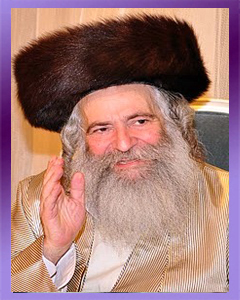
Rav Yuval Cherlow composes prayer for the situation in Syria

A group of religious-Zionist Bnei Akiva youth started organized prayers on behalf of Syrian civilians who are at risk due to the ongoing civil war in their country. The prayer initiative, which began with the Bnei Akiva volunteers who are doing a year of national civilian service in Petach Tikva, has now spread. .

While Judaism teaches that any individual can pray to God and be heard, prayers said together as a group can have special power. The young volunteers also wished to have a formal prayer to say, in order to ask for divine mercy with the best possible wording.

They asked Rabbi Yuval Cherlow, a leading figure in the religious-Zionist world and the head of the Petach Tikva hesder yeshiva, to help them find the ideal wording for their request for divine assistance for Syrian civilians.

Rabbi Cherlow suggested that Psalm 37 and Psalm 120 would be particularly appropriate for the occasion. Both psalms speak of the plight of the innocent righteous when evil men plot against them.

Rabbi Cherlow also wrote his own prayer, which is beautifully translated by Elli Sacks of Modi’in (be sure to give Sacks credit). Here is the original Hebrew. Read in English about story here.

Master of the universe, who makes peace on high

Though we are not accustomed to new formal prayers, we can no longer look at the slaughter taking place in Your world and fail to pray about it. Though we know that both sides in the war are guilty of wanton bloodshed, we are unable to keep silent when so many who are beyond the circle of conflict have fallen victim.

We beseech You in prayer to arouse in the killers their basic humanity and evoke mercy in their hearts, that they may recognize that we are all created in the image of God, and that there are limits even to human cruelty. May You bring to pass what is written in Your Torah: “He who sheds the blood of man, by man his blood shall be shed, for in God’s image was man created.”

Grant us the wisdom to know how to act in this hour of distress, when the dark face of humanity’s evil inclination is once again fully exposed and we are unsure how to stand against it. Enable us to act with all our energies to prevent bloodshed in Your world, above all in the Holy Land and its environs, as it is written in Your Torah: “You shall not pollute the land where you are for blood pollutes the land; and the land will not expiate the blood shed upon it, but with the blood of he that shed it.”

May God who makes peace on high, make peace upon us and upon all Israel, and let us say amen.

Orthodox Jewry and the Civil Rights Movement

In honor of the 50th anniversary of the “I have a dream speech,” here are selections from an unpublished BA thesis on the role of Orthodox Jews, Orthodox Rabbis, and YU students in the Civil Rights movement.It is not exhaustive because there were other Orthodox Rabbis such as Danny Landes of Pardes who spent the night in jail.

“Justice, Justice You Will Pursue?” Orthodox Jewry and the Civil Rights Movement, 1954-1970
A Thesis Presented By Lora Rabin Dagi, Bachelor of Arts with Honors, Harvard University, March 2006

On March 21, 1965, Reverend Dr. Martin Luther King, Jr. led thousands of marchers from Selma to Montgomery, Alabama in a political move that would ultimately lead to the Voting Rights Act of 1965. Though Rabbi Dr. Abraham Joshua Heschel’s presence at the front of the crowd has graced photographs of the event ever since, the story of Rabbi Saul Berman’s imprisonment in a Selma jailhouse just days before seems to have drawn a smaller audience.

Rabbi Berman was arrested on the Jewish fast day of Ta’anit Esther, which fell that year on March 17. At nightfall, when the fast ended, Rabbi Berman was not able to break his fast on prison food, for it did not meet traditional Jewish dietary restrictions; a friend rummaged through Rabbi Berman’s suitcase and brought back the salami upon which Rabbi Berman was hoping to break fast. This friend also found another cylindrical item in the suitcase – a scroll containing the text of Megillat Esther, the tale of a Jewish girl who became queen of a massive kingdom and saved her people from certain destruction. Both the salami and the Megillat Esther proved to be of great use to Rabbi Berman: having broken the fast, Rabbi Berman celebrated Purim, a holiday commemorating the story of Megillat Esther, by reading the scroll out loud to “about 250 people” crowded into the jail. One can imagine the power reverberating throughout the room as a young Orthodox rabbi, far from his congregation, read an ancient narrative recounting the deeds of a Jewish queen who saved her people from an enemy within the government – a story that could easily resonate with a group of people hoping to save blacks from their own government’s voter registration prejudices.

Just two years before, rabbinical degree in hand, Rabbi Berman arrived in Berkeley, California ready to work at Congregation Beth Israel. For the five years he served there, Rabbi Berman worked to better the rights of blacks in Berkeley and beyond. He returned to Berkeley after the 1965 Selma-Montgomery March determined to become more engaged with local civil rights politics. Though Berkeley’s high school was integrated, its lower education public school district lines were drawn in a way that separated white and non-white students. According to Rabbi Berman, two opposing forces were at work at once: one group wished to redraw the school lines so as to integrate the lower schools, while another group hoped to create a second high school that would essentially keep students segregated. Rabbi Berman primarily toiled to integrate the schools, though the community agenda additionally dealt with issues of free speech and, ultimately, the Vietnam War.

Rabbi Berman’s case, though not the norm for the majority of Orthodox Jews in America, is by no means unique. Rabbis and some Orthodox laymen throughout the United States of America not only endorsed the Civil Rights Movement, but also worked to end racism against blacks

Rabbi Berman’s colleague in New York, Rabbi Irving (Yitz) Greenberg, also contributed to the Civil Rights Movement. Along with his wife, Rabbi Greenberg first supported the Movement through donations to “various civil rights groups and voting for candidates that were sympathetic to the [Movement];” soon, the two were “attending rallies or special demonstrations” for the improvement of the status of blacks in American society. As a faculty member at Yeshiva University, a Modern Orthodox institution in New York City, Rabbi Greenberg took the opportunity to bring in speakers who discussed various aspects of the Civil Rights Movement. As a rabbi of the Riverdale Jewish Center, an Orthodox congregation, Rabbi Greenberg “spoke passionately” about the Movement’s necessity.

Finally, Rabbi Greenberg involved himself in HaTza’ad HaRishon, a controversial and ultimately unsuccessful group founded for the benefit of so-called black Jews. Certain American communities of blacks were presenting themselves as Jews, though the Orthodox community did not accept them as such. For instance, the Commandment Keepers Congregation of the Living God, based in Harlem, NY, identified itself as a sect of Judaism, though petition for institutional acceptance failed. Established in 1964, HaTza’ad HaRishon, or “The First Step,” hoped “to serve the Jewish social, cultural, and educational needs of New York’s Israelites, to unify their communities, and to integrate Black Jews into…mainstream” Judaism. It funded and organized social gatherings, Israeli dancing, “activities with other [white] Jewish youth groups,” prayer events, financial aid and placement in Jewish schools, educational discussion-based seminars, and edifying liaisons to white Jews who would discuss the existence of black Jewish communities. In addition, the group provided access to Orthodox conversion resources, should its members desire to ensure their full acceptance by all parts of the Jewish community. Ultimately, between incredibly charged questions of Jewish legitimacy, authority, and conversion, this group collapsed. HaTza’ad HaRishon, though not the norm, represents both the race-blind aspect of Jewish conversion, and the fact that at least some Orthodox Jews did not view blacks through the lens of ‘absolute other.’

In New York, Rabbi Greenberg was joined by the young Tsvi Blanchard, not yet a rabbi. Rabbi Blanchard was heavily involved by the late 1950s, and continued to take part in the Movement until the year after the 1965 Selma-Montgomery March. Splitting his time between college and yeshiva (a traditional Jewish institution of learning) in St. Louis, Rabbi Blanchard worked hard in Missouri and around his home in Rochester, New York to further the Movement’s goals. In St. Louis, he “was involved in redeveloping areas of the black ghetto.” In addition, Rabbi Blanchard participated in the boycotting and picketing of Woolworth’s and Eastman Kodak. The Woolworth’s story is fairly well known: in 1960, four black students started a sit-in at a Greensboro Woolworth’s to protest segregated seating; within weeks, the “Greensboro four” had inspired sit-ins and picketings across the country. In contrast, the Eastman Kodak narrative dealt with employment issues: Rabbi Blanchard joined Saul Alinsky, community organizer extraordinaire, to challenge Rochester’s Eastman Kodak to hire more black workers. At the same time, Rabbi Blanchard involved himself in “a whole series of various and sundry picketings of racist speakers,” and supported “black self-organization efforts” such as those surrounding the Kodak protest. The Selma-Montgomery March both highlights and marks the final stage of Rabbi Blanchard’s activity in this paper’s time period.

Even the South, homeland of the Jim Crow laws and their overt supporters, hosted at least two Orthodox rabbis who quietly worked to promote the message of the Civil Rights Movement. One rabbi from Atlanta chooses to remain anonymous, but writes that he participated casually throughout the time period; for instance, he would occasionally deliver sermons supportive of the Movement. At times he would host observant Jewish activists who had recently been released from jails in Atlanta, Birmingham, Montgomery and elsewhere. Finally, this rabbi took part in “informal discussion groups” on the matter. Another Southern rabbi, Rabbi Louis Tuchman of Durham, North Carolina, followed a similar pattern. Though his congregation hired him specifically because he was not a Civil Rights activist, Rabbi Tuchman was preaching pro-integration by 1957. He specifically incorporated the themes of freedom during the Jewish Purim and Hannukah holidays, relating the holidays to the black quest for full integration. Unfortunately for Rabbi Tuchman, that same year his congregation moved to the suburbs and to Conservative Judaism.

Rabbi Tuchman and his anonymous colleague in Atlanta deserve special recognition for their work. According to Mark Bauman, fewer than forty Orthodox rabbis served congregations in the South in 1954. The states of “Alabama, Arkansas, Kentucky, North Carolina, and Mississippi…claimed a total of three Orthodox rabbis,” and no Orthodox rabbis served Florida communities apart from those in Miami and Miami Beach. Bauman posits that the “limited” involvement of Orthodox rabbis in the South corresponds to the small number of Orthodox rabbis actually present. This theory relies upon only one incidence of Orthodox involvement noted in his book’s collection; however, one cannot ignore the fact that some forms of informal involvement may prove quite difficult to trace. For instance, more than one or two Orthodox rabbis may have presented this controversial topic to their congregants through holiday sermons. Since participation in the Civil Rights Movement can include actions outside of a certain model of 1960s volunteering, the judgment of ‘limited’ involvement may be based upon somewhat incomplete evidence.

Some, such as Chicago’s Rabbi Ahron Soloveichik, were better known; this leading Orthodox scholar passionately discussed the basis for equality in halakhah in the keynote address at a national convention for Orthodox affiliate Young Israel.
By 1964, supposedly motivated by competition for “allegiance of the young” liberals flocking to Conservative and Reform denominations, the Rabbinical Council of America publicly declared its support for the Civil Rights Movement. Young Israel, another Orthodox group, had already backed the Movement in a 1962 editorial. The Orthodox Union, in turn, preceded Young Israel by agreeing with a “strongly liberal” plan for “civil rights and civil liberties” in the 1950s, and it continued to support the “civil rights gains of blacks” throughout the 1960s.

Yeshiva University Students: The Civil Rights Movement and Other Priorities

Without question, YU students actively discussed the Civil Rights Movement, though not necessarily right away. The record for the 1950s is largely silent on the matter, and aside from late-night dorm-room conversations and a short editorial despairing over the bigotry extant at the University of Alabama, there may not have been much debate over the plight of blacks in America. However, analysis of student publications shows that by the beginning of the 1960s, students often discussed and educated themselves about the Movement. For instance, in 1961, Stern students listened to a Nigerian leader maintain the need for blacks and whites to work together. They later had the opportunity to hear the administrative assistant of the NAACP’s Executive Secretary speak about the history, purpose, methods, and goals of that prominent organization. In 1964, the YC Yavneh, an “Orthodox Jewish students organization,” hosted a panel on the Civil Rights Movement.

An entire supplementary edition of The Observer was dedicated to questions on the causes of black rioting, theoretical solutions to help alleviate racial tension, comparisons between blacks and Jews in the United States, and comparisons between blacks and Israeli-Arabs. In fact, from 1967 onwards, black rioting and episodes of black anti-Semitism clearly affected the rhetoric on campus. Musing over the previous summer’s black riots, one YC student wondered whether there was any possibility of calming the revolts. The editor of HaMevaser, the “official student publication of the religious divisions” of YU, acknowledged that SNCC had rejected Jews, yet felt that “a true religious person” could not blame all blacks for the actions of SNCC and its partners. Another Observer supplementary edition addressed issues of Black Power, Jewish racism, Jewish withdrawal from the black-Jewish dialogue, and black anti-Semitism. That same month, the grassroots campus publication Pulse published an author who was discouraged with the fact that black rioting and anti-Semitism had led some Jews to equate the push for black equality with extreme violence and fear, and thus to unsettling memories of the Holocaust. Rather than step away from American black society, this author hoped to encourage interracial discourse and the dissolution of negative black stereotypes among Jews. Still another student, disgusted with the turn of events, claimed that the Civil Rights Movement had generated a “Frankenstein” of violent militants.

YU students did not simply discuss the Civil Rights Movement; they also actively pursued its goals. For example, in 1960, YU was a member of the Metropolitan Students for Non-Violent Civil Rights Action, and YU students protested Woolworth’s Southern lunch counter policies by picketing and distributing leaflets in front of a New York branch. The next year, YU students started a tutoring program in a local public school; this program served as a model for other colleges. One wholeheartedly dedicated Stern student published her memoirs of the March on Washington, where Reverend Dr. Martin Luther King, Jr. gave his famous “I Have a Dream” speech; she later reported on a Washington, D.C. conference on apartheid, Southern segregation, and Northern discrimination. This student soon worked with other Yavneh leaders to organize a “mass boycott of New York City public schools,” in which Yavneh members taught freedom schools and picketed throughout Harlem and Washington Heights. In fact, YU even donated the use of one of its buildings for the endeavor. By the late 1960s, over 100 YC students were tutoring through the Yeshiva University Neighborhood Youth Corps (YUNYC), and SC started its own version of the same.

YU as an institution encouraged a positive perspective on the Civil Rights Movement. In 1961, it awarded an “honorary Doctor of Laws degree” to Chief Justice Earl Warren, who was quite influential in the 1954 vote to end segregation.

In addition, its medical school application did not ask for a photograph, and thus had color-blind admissions. This fact is noteworthy in a country whose medical schools were not fully open to blacks until 1966. Starting in 1969, the medical school’s King-Kennedy Medical Program subsidized lower-income blacks as they prepared their pre-medical curriculum, so that they could later improve medical care in their ghetto communities. That same year, a black Jewish YC freshman discussed his identity in The Commentator; clearly, a black Jewish student in the College was not only tolerated, but openly accepted.
Though the institution seems to have acknowledged certain values of the Civil Rights Movement, a vocal group also begged its contemporaries to work with caution. For instance, one student responding to the Woolworth’s protest unashamedly critiqued the Student Council for officially backing the picketing: because of this backing, the Student Council had turned YU students into unwilling representatives of all East-coast Jews. Rabbi Lichtenstein, a major figure in the school, felt that Orthodoxy’s slow response to issues such as the Civil Rights Movement was due to an appropriate sense of prudence; still others felt YU could not afford to critique society publicly when it was just proving the possibility of living religiously and functioning fully within America.

Yet another group of students may not have formulated extensive opinions on the Civil Rights Movement at all. Throughout the timeframe, The Commentator and The Observer published articles scorning the supposedly commonplace apathetic student lifestyle. Whether deriding the student body for voting half-heartedly, if at all, in the Student Council elections, or simply condemning students for displaying “indifference” towards non-academic activities, student leaders at SC and YC despaired over the seemingly “contagious” apathy displayed by their classmates. This laziness does not necessarily point to an entire generation of bookworms.

In May of 1961, The Observer reported that nearly half the graduating class was already married, and two women had already borne children. Interest in femininity encouraged the young women to bring a special instructor on “posture, hair care, make-up, and fashion” to the school three times during the 1963 to 1964 school year.

David b. Joshua Maimonides’s use of Suhrawardi’s Sufi idea of attentive Illumination—-courtesy of Prof. Paul Fenton

People seemed to like the Jewish- Derwish photo from 1922 but there is much more Jewish-Sufism out there, even beyond Bahye or Avraham b. Maimonides. The scholarship for the last half century on the family of Moses Maimonides has produced a new shelf of books in halakhah, letters, exegesis, and Sufism. And we have works by those who followed them or asked them questions. Those who published the material are publishing the texts for the first time from manuscript and are dedicated to editing other manuscripts. Currently, there is no synthetic work bringing all this data together in order to provide a narrative of the 250 years of Egyptian Jewish intellectual life after Maimonides.

Here is a text David ben Joshua Maimonides or ibn Maimoni, that would be 1) Maimonides 2) son- Abraham (Nagid) 3) 3rd generationDavid (Nagid), Obadia (The Treatise of the Pool) 4) 4th generation Abraham 5) fifth generation Moshe (Nagid),Joshua (Nagid), and finally 6) six generation David (Nagid) 14th-15th century).

David (b. ~1335), succeeded his father Joshua Nagid of the Egyptian community in 1355, being the last of the Maimonidean dynasty to have held this office. David left Egypt and took up residence in Syria for a number of years (ca. 1375-1386), in the cities of Aleppo and Damascus. During this period he continued, however, to be known and revered as “David ha-Nagid, head of the Yeshivah.”Nagid David’s wrote a commentary on his great great grandfather Maimonides’ Mishneh Torah in Judeo-Arabic. “The commentary is preceded by two laudatory poems in honor of Ibn Sina and another celebrating the virtues of Awhad al-Zaman (al-Baghdadi).”

Nagid David’s Al-Murshid ila al-Tafarrud wa-l-Murfid ila al-Tajarrud, was translated by Fenton into Hebrew as Maqalat fi derek ha’Chasidut, and also into French. The work guides the individual through the“spiritual stations to the exalted plane of Chasidut;” “it is the spiritual itinerary of the devotee which culminates in prophetical gnosis.” This work, Fenton explains, is “thoroughly imbued with Sufi ideology and terminology.” Finally, we see amongst the vast library of works attribute to Nagid David, that the work of Ibn al-`Arif (1088 – 1141) is cited as part of the collection of his copyings. In the Cairo Geniza shows from the numerous copies the famous Sufi Al-Hallaj (c. 858 – 922) and the writings of ibn al Arabi. A Genizah letter addressed and answered by Nagid David tells of Jews attending the meditation and zhikr (Heb: hazkarah) retreats of Sufi Shaykh Yusuf al-`Ajami al-Qurani (d. 1367), who supervised a zawiya hermitage on the Qarafa as-sugra Muslim cemetery east of Cairo. For more, see Fenton, Paul B.. “The Literary Legacy of David ben Joshua, Last of the Maimonidean Negadim.” The Jewish Quarterly Review 75, 1 (1984): 1-56.

Now here is a quote from Nagid David when he developed a Jewish-Sufi version of Suhrawardi’s concept of illumination through luminous intuitions, divine sparks, and mental flashes. This state is attained through constant contemplation, intense remembrance of God, and diminution of food and sleep. Thereupon, these lights shine upon his pure heart and an irradiance awakens an inner desire to receive this divine blaze and angelic flashes. For more on Persian mystic Suhrawardi (1151-1191)- see a website dedicated to him here, and Stanford E of P here and wiki here. And for those looking for Tishrei reading- here. We dont have a photograph of Nagid David in his Dervish clothes.

Of the first station [of the spiritual path] which is that of illumination (zehîrût).

The Hebrew term zehîrût (‘meticulousness’) can have two meanings. Firstly, it can signify ‘scrupulousness’, through striving to reach the goal by deploying painstaking efforts or by abandoning thoughtlessness and renouncing a life of leisure.
Secondly, it can signify ‘enlightenment’ as in the expressions of brightness (zôhar) in the verses ‘The Enlightened will shine as brightness of the firmament’ (Dan. 12:3), and ‘brightness as the colour of amber’ (Ezek. 8:2). Hence the term zehîrût designates illumination and the individual who reaches this station is called zâhîr or ‘illuminate’. The latter refers to the seeker of the soul’s enlightenment and the spirit’s illumination through luminous intuitions, divine sparks, and mental flashes.

This [state] comes about through constant contemplation of the angelic world, intense remembrance of God, subtle meditation of the world of sanctity, and diminution of food and sleep. Thereupon, these lights shine upon his pure heart in accordance with his progress through the successive stages and stations, each more noble and exalted than its predecessor.
For spiritual effort and illumination lead to further enlightenment and irradiance, awakening an inner desire to receive this holy effulgence, divine blaze and angelic flashes, and inciting the individual to prepare himself for their encounter. Each arousal is conducive to illumination and each illumination is conducive to further arousal. On this account our Sages stated: ‘illumination leads to zeal’ (TB ‘Abodâh Zârâh 20b), i.e. this station is conducive to the following one.

Commentary
The present text is a translation from the Judaeo-Arabic work al-Murshid ila t-tajarrud or ‘Guide to Detachment’ by David b. Joshua Maimonides (Egypt circa 1335-1410), last known nagîd (community leader) belonging to the famous Maimonides’ dynasty. The Guide to Detachment is a practical manual for the spiritual life divided into progressive stages based on the Talmudic dictum by R. Phineas b. Ya’ir : “Study leads to meticulousness, meticulousness leads to zeal, zeal leads to cleanliness, cleanliness leads to restraint, restraint leads to purity, purity leads to holiness, holiness leads to meekness, meekness leads to fear of sin, fear of sin leads to saintliness, saintliness leads to the holy spirit, the holy spirit leads to life eternal. Saintliness is the greatest of all of these” (TB ‘Abôdâh Zârâh 20b). The author construes these principles as the stages of the spiritual path or ladder of ascension similar to those found in Sufi manuals.

In this opening chapter, he specifies the prerequisites necessary to embarking upon the spiritual path. Having already discussed the initial prerequisite of knowledge, for ‘the ignorant cannot be pious’ (Aboth 2, 6), David Maimonides presents a very original interpretation of the term zehîrût (‘meticulousness’). In addition to its classical meaning of the ‘attentiveness’ which stems from knowledge, he lends it the sense of ‘enlightenment’. Interestingly, he uses as a locus probans the verse used in the opening passage of the Zohar, of ‘Book of Brightness’! However, David’s inspiration here is not Kabbalistic but Sufic, ultimately deriving from the ishrâqî or ‘illuminative’ spirituality of Suhrawardi (executed in 1191), for whom progress in speculative knowledge and spiritual illumination are intimately bound. Thus the starting point of spiritual awareness is a spark, an illumination which serves as a catalyser for the quest. This spark results from a meditative attitude – ‘constant contemplation of the angelic world’, ‘intense remembrance of God’, ‘subtle meditation of the world of sanctity’, – coupled with a corporeal discipline involving the reducing of one’s physical needs such as food and sleep.

Taken from here at the Elijah School

Jewish Sufi Dervishes 1922

jewish dervishes
Jewish dervishes Agha-Jaan Darvish and his brother, patriarchs of the Darvish family. Tehran, Iran, c.1922.

“Because of its specific association with Sufism and its ensuing identification with Islam, dervishhood is an order comprised almost exclusively of Muslim practitioners.
The two Jewish dervishes pictured here in this rare photograph are among the very few who had successfully been integrated into the order without converting to Islam.
Like the Jewish practitioners of a traditional Iranian sport in the houses of strength (zurkhaneh) — a sport that is profoundly intertwined with Islamic ritual — these dervishes represent a uniquely Iranian hybrid of Judaism and Islam.

Each of the Jewish dervishes seen here is displaying emblematic accouterments of dervishhood:
1) The cloak, an outward sign of his state.
2) A kashkul (begging bowl) often made of such materials as mother-of-pearl.
3) A gourd, a coconut shell, or carved wood suspended from the wrist by a chain.
4) A tabarzin (short axe or hatchet) carried in the right hand and intended to fend off wild animals or highway robbers.
5) A chanta (patched bag) slung over the shoulder to carry essential items.
6) Takht-e pust (skin bed), a small mat made of animal skin that served as his bed while traveling.
7) A long rosary.”

Photograph and caption from Esther’s Children: A Portrait of Iranian Jews, edited by Houman Sarshar.

For more on the Iranian Sufi orders, see here and here
For more pictures from Sufis from the era – here.

h/t touba.tumblr

رویش های ایرانی یهودی، تهران ۱۹۲۲
به دلیل رابطه تصوف با درویشگری و عجین بودن آن با اسلام، درویش بودن به نوعی مختص مسلمانان بود. در این عکس نادر، دو یهودی که با حفظ مذهب خود به خرقه ی دراویش درآمده اند به نمایش گذاشته شده

Datlash & Hardal according to Rav Shagar

Recently, the committee publishing the works of Rav Shagar z”l published a collection of Rav Shagar’s writings on post-modernity in a volume called Luhot veShivrei Luhot (2013). The essays were given as talks during the last five years of Shagar’s life and appeared in various out of the way conference proceedings or Religious Zionist journals. I am still processing the other essays which directly relate to theology however, there was a free-standing essay given at Maaleh Film School in 2007 which deals with those who are leaving observance and becoming DATLASH, a Hebrew acronym whose initials stand for dati le’she’avar (formerly religious).

Rav Shagar blames the parents and the establishment as opposed to those younger members who become Datlash and disassociate with Religious Zionism as he believes the latter has no choice in separating. Referring exclusively to Israel, he sees the generation of 1950s grandparents as having a tepid religion as part of their Mizrachi Relgious Zionsim. The children in the 1970s rebelled by creating the dedicated religious world of the Hesder Yeshiva, where everything was from derived directly the Book which thereby negated the living familial and communal religion. The grandchildren, having grown up with the sterile world of Judaism by the Book, were left with two choices: either increase the ritual obsession through becoming Hardal or give up the sterile religion by becoming DATLASH. Surprisingly, Rav Shagar thinks that Hardal is a relinquishment of the Relgious Zionist project of openness and fulfillment in the real world, while Datlash is a return to a basic sense of religion.

luhot

Rav Shagar opens and closes the essay acknowledging that while a child who chooses a datlash life brings immense pain to the parents, the older generation is to blame. The essay encompasses numerous cultural references to movies, TV, books that I am leaving out for my readers who have not seen the Maaleh films of the late 1990s. But it is nonetheless noteworthy that the Hardal world considers the world of movies and popular culture as forbidden, yet he used them for his teaching.(for more see, my review of Rabbi Stav.)

Rav Shagar cites a study by Mordechai Barlev (1998) on the graduates of religious Zionist high schools and their leaving religion. Unlike the rejection of religion to become a secular Israeli (hiloni) of prior generation, here the problem is the influence of the modern world on religious youth.

BarLev notes a phenomenon of “inner secularization” on some of the youth even though they stayed in the religious Zionist world. They didn’t change their manner of dress or take off kippah, rather they live lives that are secular in existence and secular in cultural. Even if the high school graduate does not watch TV on Shabbat and even if he goes to shul, the spirit and focus of his Shabbat is still a Shabbat of newspapers and secular books like his secular neighbor. If we compare these religious Zionist youth to a mesorati home that is traditional but not-religious in which they light candles and makes Kiddush, one finds there is little difference in their life. These graduates are now called dati-lite

Rav Shagar discusses two recent films. In the first movie, a widow has three daughters, one datlash, one Hardal, and one dati-lite. Shagar blames the old-time Mizrachi world for not giving enough emphasis to Torah or religion. (AB- the recently deceased reform Rabbi Herbert Wiener made a similar point in 1964 when he visited the land of Israel expecting to find a religious revival and instead found little interest in religion.)

The Second movie is focuses on a rabbinical father, a member of the Gush Emunim settlement movement who was also part of the religious revival that came in the 1980s. The father is portrayed as dogmatic and rigid, therefore his son rebels. The symbolism of the movie is setting a dog free on Yom haAtzmaut to show the need for greater freedom and naturalism in Religious Zionism.

Rav Shagar asks: What is nature of becoming secular (hilon) today? Our secular concepts of today are not those of once upon a time; the politics of today are not the Marxist politics of yesteryear. The new generation is something new, they are datlash. Today, unlike in the 1950s, one is not simply becoming secular from a loss of faith, an inability to believe in God, or even in the face of enticements or opportunities in secular world. It is just that religious Zionism is not relevant anymore in the lives of formerly Zionist youth; what we can see from the rise in datish is that religion slowly and reticently falls away. It is a social problem in which religion fell away from real experience.
The Hesder Religious Zionist World is a community of arbitrating and evaluation every action because lives are to be conducted and lived by the book. Even lived faith and religiosity has loss all spontaneity in one’s quest to do what the book says.

Today, according to Rabbi Shagar, we have lost all connection between the living voice of the prophets and the proclaimed political messianic age. The vision of Rav Kook once sustained the yishuv; now religion is an ideology. Some flee from it and others embrace the extra stringencies and obsession with modesty. Datlash and hardal are two sides of the same problem. The Hardal will end religious Zionism and the datlah only see part of the problem.

How are the hardalnikim different than the classical becoming haredi? In the Torani community of Hardal, there is an avoidance of learning the secular attributes and the former become artificially rigid and dogmatic to fight the secular. Since fighting the secular does not come to them naturally because of their open upbringing they create new rigid position on practices like modesty. For Rav Shagar, this creates a contradiction between the openness at the core of the religious Zionist project and Hardal isolation, sectarianism, and dogmatism

Rav Kook spoke of a revolution, a Torat Eretz Yisrael, based on hagshamah (working the land), and today, we need to seek new values beyond the Shtible. Now religious Zionism became dogmatic, frozen, and uprooted from life. The artificial strictness causes its younger members to flee.

The secular and religious are in continuity since most datlash are still connected to their religious home and upbringing. They form their own enclaves. Religion (Dat) is part of the name and very essence of datlash. The ex-religious group remains religious in social group yet give up belief and practice; however, members do not become completely secular like the 1950s.- Therefore there is continuity between religion and secular. The continuity is also found among the dati-lite who keep the social norms of kippah and synagogue even if they don’t pray or daven daily or say blessings. The difference of the two groups Datlash and Dati-lite is watching a movie on Friday night TV or the occasional travel on Shabbat.

However, the real definition and distinction is self-identification. Rav Moshe Tzvi Neriah said about the earlier secularization, “I worry more when a boy takes off his kippah than when he stops putting on tefillin.” It is all a self-identification. The psychological differences are great even if tefillin is from the Torah and kippah is only a custom. The former is a loss of identification while the latter is only laziness.

The datlash has no sense of victory or a new era or triumph; they know the grass is not completely greener on the secular side. There is a loss of religious identity more than a loss of halakhic observance (compared to the Dati-lite). This loss of identity is not just existential but also shown in body and society. There is a willingness to take off clothes in street, such as removal of a polo shirt which never done by a religious Zionist guy even if not technically forbidden. A datlash is not a removal of mizvot as much as a removal of restrictions. It is also the loss of connection to religious Zionist community. There is a removal of God and holiness from their frame of reference. For the sake of heaven (leshem shamayim) and sanctifying the physical as taught in religious Zionism is now seen as obsessive, rather than uplifting. Hardal is as oppressive as the Haredi society, and both think mizvot are the entire purpose of life.

Rav Shagar says that light and dark are mixed in the lives of the datlash. Their throwing off the yoke gets them more in touch with life. They are now paradoxically secular but with a connection to religion. They are creating secular study halls or traveling on Shabbat to study midrash and hasidut. As it says: “It is better that they leave me but keep my Torah.” They are Datlash because they found the prior generation lacking and regain connection and identification with Torah, paradoxically by leaving. They need to leave to find holiness and cleaving to God.

Datlashim are still in the margins of the religious Zionist community. They want a more fluid and softer religion – they want traditionalism – they want the soul of mizvot without the imposed unnatural rigor imposed by the yeshivot. n Yeshiva, we were taught to mock and disregard traditionalism and to reject our parents and their actions. For Yeshiva, baal batish- if it was not based on text was to be avoided. For Rav Shagar, the traditionalism was in many ways much better than the Hardal approach. Traditionalism has the soul of a lived religion, a lived chain of tradition. For Rav Shagar, “even though I think we need to keep every detail in the Shulkhan Arukh- it is the traditionalism that is the soul of the Shulkhan Arukh.”
Datlash is in some ways more advanced or a more vanguard approach tothe religious Zionists community, one that lost its roots. The observance of the Datlash after they separate from Relgious Zionism is in some ways more connected to Torah and mizvot. Rav Shagar sees hope in them and their children for the true holy rebellion.

There is much in this Israeli perspective that is different from the United States- on post-Orthodoxy-see here. Also in Israel, I must point out that there is an unpublished Hebrew PhD by Ari Engelberg that shows that indeed datlash is empirically a new group between religious and secular. His research shows that the historicity of the Torah does not play a big role for them. The Datlash have a new age holistic sense of religion, not in continuity with their former particularistic providential God of Yehudah Halevi and Rav Kook. Rav Shagar elsewhere in this book shares sympathy with a more universal holistic sense of God that he calls post-modern, but we will discuss that in a future post (or for those who live in Bergen county there will be a hug bayit on the sefer at my place Shabbat 5:45 for the next 5 shabbatot, excluding YK-contact offline).

Interview with Prof. Jacob Wright of Emory University

I am amazed that the current discussion about the academic study of the Bible is so uninformed on both sides. Somebody out there must not have read my interview with David Carr, or even tried to read his book.

As background, the problems of the Bible go back to the tenth and eleventh century Islamic critiques of the Bible by Ibn Hazm and others. Second, modern figures such as Spinoza and Jean Astruc sought to understand the Bible as a human book using the same tools that we use to understand Greek and Roman books. And in the 19th century, Wellhausen popularized a theory that the Pentateuch had four authors. But the important part of his theory was that the ritual and priestly material was a priestly Pharisaic digression from the original pure faith of the prophets necessitating Christianity for a restoration. Hence, Solomon Schechter called it higher anti-Semitism, David Zvi Hoffman showed that Leviticus is not in contradiction to the rest of the story, Kaufman showed that the prophets assumed the priestly material, and Cassuto showed based on Sumerian and Akkadian sources that the divisions fail.

Well, Wellhausen was writing a century ago, with the aforementioned defenses all formulated in a post WWI climate. For at least forty years the field was already given to authors such as Gunkel who assumes the Bible is legend, the way Gilgamesh is legend. And Martin Noth who assumed most of the narrative was formulated originally as oral traditions- read here. Questions of redaction were not tied to Wellhausen, or even literary documents, but to oral traditions.

What do historians currently think about the context of the Bible? They assume that it was written between 720 BCE and 587 BCE, between the destruction of the Northern Kingdom destruction of Jerusalem, with some editing until the end of Ezra’s life circa 440 BCE. (Minimalists make it more recent and Evangelicals defend the chronological dates.) They work from parallels to Assyrian texts, the nature of script, linguistics, and reconstructed context of author. Little of this has anything to do with literary doublets. If you want to reject historical criticism, then start learning ancient linguistics and texts contemporary to the Bible. No harmonization of passages changes this dating nor does anything from Cassutto or Hoffman affect it. (However, Prof. Josh Berman is seeking to shift the discussion from Assyrians to the Hittites in 1300 BCE, an effort that may be accepted by the Orthodox but does not promise to have much of an impact on the experts. But it is better than refuting Kugel, who is not a historian of ancient Israel or source critic so the critique does not help.)

This past May there was a major conference at Hebrew University on “Convergence and Divergence in Pentateuchal Theory;” if you are interested in these topics, then that was the place to be. The conference opened up with a clear statement that there are three approaches: a Documentary approach (not based on Wellhausen but on Noth and others) where there are separate documents; a Supplementary approach, where a single document get more and more complex; and a Fragmentary approach, where we cannot separate out authors or layers anymore.

Finally returning to Cassuto, he may have rejected Wellhausen but he accepted historical context, showing that all the numbers and genealogies in Genesis do not correspond to ages and events, rather are stylized number, ten generations, twelve children. He does this by reading the ancient parallels to the Biblical story.

With this background, our blog is delighted to welcome Dr. Jacob L. Wright of Emory University, Associate Professor of Hebrew Bible at Emory University’s Candler School of Theology and the Director of Graduate Studies in Emory’s Tam Institute of Jewish Studies. Wright is considered to be one of the most perspicacious interpreters of biblical literature working in the field today. His first book, Rebuilding Identity: The Nehemiah Memoir and Its Earliest Readers, was awarded a Templeton prize for the best first books in religion and theology. (I hope to have a follow-up post where he describes this book and his forthcoming one.) His bio was covered here at theTorah.com.

Wright is a member of a Young Israel congregation:

I’m a member of a Modern Orthodox shul (Young Israel of Toco Hills), and I usually reveal to my audience—whether it be during a shiur or at a Shabbat meal—how various biblical scholars think about the problems posed by the text. Indeed, I think it is condescending and disingenuous not to be forthright in this regard. In my experience, most observant Jews are eager to learn about the fascinating research conducted in biblical studies.

At Emory, Wright has supervised the dissertation of Rabbi Zev Farber who wrote on the traditions behind the book of Joshua.

Wright studied under Prof. Reinhard G.Kratz, who wrote The Composition of the Narrative Books of the Old Testament. Kratz argues that there are long narratives but that they do not coincide with the conventional sources and that they were heavily supplemented.(Since the dating is already assumed to be late, the Orthodox apologists are only proving a later single strong editorial hand when they resolve contradictions.)

1) Why is Cassuto irrelevant for current Biblical historians?
Cassuto’s book, The Documentary Hypothesis and the Formation of the Pentateuch, is a work that many Orthodox Jews read as a response to biblical “higher criticism.” Its value for scholars in biblical studies is however quite limited: The work may contain several valuable insights, but when scholars consult it today, it is primarily from the perspective of the history of research.
Why isn’t it a standard work? There are two basic reasons:

First, most of us in the field are completely convinced that the Torah, and with it, the rest of the Tanakh, is a work of many generations of authors. There are not many points of consensus in biblical studies, but this is certainly one. If, for one reason or another, you’re not willing to accept the Pentateuch’s multi-authorship as a PhD student, you will usually choose a topic that is safe from engagement with these historical concerns.

Second, Cassuto’s book responds to a view of the Pentateuch’s origins that many working in the field today would not embrace. Most have long rejected some of the basic tenets of the Documentary Hypothesis, with its demarcation of four continuous sources and its understanding of Israel’s history that underpins the whole theory.

Some scholars still defend the theory. And many who do are American Jews. The reason why is because the epicenter of research on the Bible’s composition history remains in Continental Europe. Scholars there work with fundamentally different premises from those informing the classical Documentary Hypothesis and comes to much different conclusions from the ones Cassuto has in view in his critique.

So what does this all mean for us? If you read Cassuto as a response to “critical biblical scholarship,” find it all convincing, and then conclude that it’s perfectly reasonable to assume to date the Torah to the time of Moses, you have failed to come to terms with the way that leading scholars for the past three decades have thought about the Torah’s prehistory.

2) Why is the Pentateuch basically ascribed by scholars to the 8th to 6th centuries?
When we trace the Pentateuch’s/Torah’s origins to these centuries, we mean that many of its constituent components were put into writing at this time. These components include the stories of the Patriarchs/Matriarch cycles, the Joseph Novella, the Exodus-Conquest account, and the cores of the law codes (Deuteronomic Code, Holiness Code, and much of the Priestly legislation). The Torah continued to undergo revisions (many of which were quite significant) for the next couple of centuries.
Some of the Torah’s contents may predate these centuries. It seems quite possible that rudimentary legends of the Patriarchs/Matriarchs, of Moses, of Miriam, of Joshua, etc., as well as many of the laws (especially in the so-called Covenant Code) are older than the 8th century.

Why would the basic features of the Torah have assumed literary shape from the late 8th century and thereafter? It is because this is when the states of Israel and Judah faced momentous political challenges.
The Assyrian armies conquered the kingdom of Israel in 722 BCE. The earliest biblical authors realized that if Israel were to survive this political catastrophe, it would be in a new form: as a people without a king. Now the kings of Israel may have been the ones who originally promulgated accounts of Yhwh’s great deeds, such as the Exodus story. After all, Israel’s kings would have seen themselves as the representatives of the state’s chief deity, as was the case in directly neighboring lands. Yet what sets the pace for the formation of the biblical tradition is a demotion of the king and a shift of attention to the people as a whole (“all Israel”) under the aegis of its God. Judahite authors, already before their subjugation to Babylon in 587 BCE, inherit this “demotic” project from Israel.

The Torah is the beginning of a longer history (stretching from Breishit to Melakhim) that tells how Israel emerged and existed for a long time as a people before its kings established centralized states. The history ends with the demise of these states, affirming the central message: All Israel is in direct covenant with its God. Its kings are, accordingly, not essential to its identity and its survival. What’s determinative is the nation’s corporate adherence to the conditions of the covenant (the mitzvot).

This message, which pervades the Torah and the rest of the history, is the reason why the Torah owes its penultimate form to the 8th-6th centuries, the time when Israel and Judah ceased to be ruled by native kings.

3) What function did the Pentateuch have in society that required it to be written?
My response to this question draws directly on the points I made in the preceding one. The Torah assumes the role once played by Israel’s and Judah’s erstwhile kings, who demarcated political borders and sought to establish a collective identity for their subject. In this sense, the Torah is to be seen as a project of re-imagining Israel as a people that owes its origins and survival not to its kings (as the special representatives of the nation’s God), but rather to its God directly, and the covenant between that God and the nation as a whole (mediated solely by a prophet).
The biblical authors were seeking to fashion an unprecedented corporate identity that was able to consolidate and sustain subjugated, dispersed communities. In inventing “a people of the book,” they were guided by the intuition that disparate groups inevitably coalesce into united community as they engage in the reading of a shared text. Their efforts in collecting, editing, and expanding these writings resulted in an exceptionally rich corpus of literature, which attracted dispersed communities of readers and formed them into one people. The Bible’s model of peoplehood embraces a significant measure of diversity, an ideal exemplified in the weaving together of competing ideologies and perspectives. Although Bible is a heavily edited work, it does not speak with a single voice. Instead of one view, the biblical authors set forth a common text.

4) Can you say more about how the origin of the Pentateuch relates to biblical history?
As we can see from early 19th century Germany and Italy, as well as from postbellum America, historians have had a critical role to play in modern political unification. They remind their readers that their fraternity predates the dissension and strife of the present. The goal of the biblical historians however was not to build a large and powerful state. What motivated them was rather the desire to consolidate a fragmented population in the face of discontinuity, displacement, and rupture.
As the first step toward an inclusive national identity, the biblical writers claimed that the states of Israel and Judah have common origins in a united kingdom. It was a great sin that caused this unity to split into two states.

Later generations of biblical authors went much further. Their expanded narrative situated the period of the political union in an extensive family history. In compiling their account, they sought to transcend divisions and demonstrate how ostensibly unconnected pasts are each part of a larger yet nevertheless unified story. The major figures of the Bible—the Patriarchs/Matriarchs, Moses and Miriam, Joshua and Caleb, etc.—represent rival traditions and competing communities. By grafting them into a single family tree and constructing an extensive unbroken narrative, the biblical authors paved the way for the corresponding communities and factions to come together as one people.
This narrative history set a precedent for the formation of other parts of the biblical corpus. The authors of the Pentateuch inserted into the national narrative a body of written laws. They formed this collection, once again, by combining what were originally separate, and in some cases competing, law codes. As we can see in the histories of England and America, the merging of disparate and rival law codes is an important step in the formation of a united people.

5) So what is your take on the Documentary Hypothesis?
As I noted, much of the most important work on the formation of the Pentateuch continues to be conducted in Continental Europe or by scholars directly influenced by their research. Their tendency is to be skeptical about the number of sources that comprise the canonical Torah. Most begin by isolating what belongs to P (the Priestly source) and then proceed to identify what remains as “pre-P,” “post-P,” or a supplement directly to the independent P source. Some are reticent to assign the remaining material to continuous sources or running narratives. Thus, most deny that a pre-P source—either the Yahwist (J source) or the Elohist (E source)—ever connected the Exodus account to the Patriarchal narratives. These two conceptions of Israel’s origins must have competed with each other until a very late point, being brought together for the first time either by P or by circles that directly anticipated P.

The tendency here has been to conceive of the entire Pentateuch in terms of discrete blocks of material that were chained together at late stages. This tendency needs to be held in check though. It seems unlikely that the exodus account ever existed independently from the conquest account found in the Book of Joshua. When God tells Moses in Exod 3:8 that he intends to bring his people from Egypt to another land, the narrative does not reach denouement until that happens under the leadership of Joshua. Hence I cannot accept the proposals that the portions of Exod 1-15 were gradually concatenated with other blocks of materials to form a larger narrative.

Today the traditional Documentary Hypothesis is witnessing a revival among Pentateuchal scholars in America. Thus, the division between the Patriarchal narratives and the Exodus account is now indisputable from a Continental perspective, but is completely dismissed by those who defend the Documentary Hypothesis and has barely been the subject of discussion.

Now there are many cases, especially in portions of Numbers, where we witness overlapping narrative threads. It’s difficult to ascribe these threads to disparate supplements, as Continental scholars are wont to do. Yet it’s also difficult to ascribe these overlapping threads to continuous sources. They surface in discrete episodes, but they don’t seem to be connected from one episode to the next.
It’s noteworthy that the episodes in question are considered by many scholars to be late compositions. What this may mean is that we have something in line with the phenomenon of “Rewritten Bible” from the late Second Temple period: As the Torah began to exert wider influence in the Second Temple period, multiple versions of prominent episodes proliferated. Instead of opting for one or the other recession, later generations incorporated pieces from what was available to them.

6) If I give you a Biblical text, how can you know if it is from the 13th century BCE? 8th century BCE? Or 6th century?
This is a big question, so let’s take one example: Jacob’s departure to Padanaram in Genesis 27-28. The older narrative presents Jacob fleeing after he deceived his father and brother. The later P narrative (Gen 27:46-28:9) offers a much different reason for his voyage: Esau marries Hittite women, and this causes anxiety for Rebekah. In response, Isaac exhorts Jacob to not marry a Canaanite woman and sends him to Rebekah’s family in Padanaram so that he would find a bride among Laban’s daughters.

The differences between these two accounts are easy to discern. And it’s also easy to see how they relate to each other. The P version must be later because it seeks to resolve an issue posed by non-P version: Jacob, the great patriarch of Israel, was not forced to flee for his life after his objectionable behavior in securing his father’s blessing. Rather his father sent him away so that he wouldn’t mimic Esau’s objectionable behavior in marrying Hittite women.
Now some scholars take issue with scholarly consensus by claiming that P was composed before the Babylonian exile (587 BCE). But their arguments fail to convince the majority of experts. In this case, the issue is clear-cut: Intermarriage emerges as a major concern in the post-exilic period (see esp. the Book of Ezra-Nehemiah). Such was not the case when Israel and Judah enjoyed territorial sovereignty.
Embracing a simplistic division of sources, one might argue that a pre-exilic text like Deuteronomy 7 also proscribes intermarriage. But scholars have long argued—for independent reasons!—that that chapter is both late and heavily supplemented.

7) In your Huffington Post piece “The Myth of Moses” on the supplemental additions to the story of Moses, how do you know it is legend and not historically accurate or at least historically based? How do you know, and how can you know, what the ancient readers thought needed rectification?

I don’t know anything for certain. And, more importantly, I don’t think the biblical authors arbitrarily made up stories. Like the makers of later midrashic legends who treated textual difficulties by integrating/harmonizing all the facts of Mikra, the biblical writers were quite conservative. They faced problems in the text, and they sought solutions that address those problems with the least amount of invention.

Thus in the case of Moses, they needed to explain why Israel’s leader has an Egyptian name and grew up at the Egyptian court. (My approach here, it should be noted, reveals the earliest facts about Moses that the biblical authors are working with.) To address the problem, they show that Moses was not an Egyptian, but a good Israelite—and a Levite at that. He bore an Egyptian name and lived at the Egyptian court because there was a problem with his birth. Drawing on a mythic motif that is well attested in the ancient Near East, the biblical authors tell how a Levite man impregnates a Levite woman who already has a daughter. The circumstances surrounding the birth are not clear, as the authors wanted to avoid presenting his parents in an overtly negative light. In any case, Moses is abandoned in the Nile, discovered there by the Pharaoh’s daughter, given a name by her, and then brought to the Egyptian court.

A later generation of readers/authors had problems with this explanation, since it presents the nation’s venerated leader as the product of what seem to be illicit relations. Acting conservatively, they did not eradicate the earlier account but revised it by composing a preface to the story. Now we know that Moses’s mother didn’t abandon him because of issues with his birth. Rather, the Egyptian king ordered that all Israelite male newborns be tossed into the Nile. His mother technically complies with the king’s orders, since he had said nothing about placing the boys in life preservation devices before depositing them in the Nile.

The secondary preface is clever, yet it doesn’t completely eradicate the problems and it creates new ones. For example, it’s strange that the Egyptian princess recognizes that Moses is a Hebrew child but can get away with raising him at the court when the king had decreed the death of all Hebrew male infants. Also the new preface doesn’t explain the origins of Moses’s sister: the text suggests that he is the first child produced by the union of his father and mother. As to be expected, the rabbis recognized the problem, and they added another layer of interpretation—the story of Moses’s sister, now explicitly identified as the prophetic figure Miriam, chastising her father for refusing to have sexual relations with her mother after the Pharaoh’s decree.

So what my interpretation does is reveal how the problems with the identity of the historical Moses provoked a progression of literary solutions, from the earliest biblical authors to Chazal. This approach does a much better job of explaining the complexities of the text than the attempt to isolate three separate sources that emerged in absolute isolation from each other, as defenders of the Documentary Hypothesis argue. Perhaps many of your readers will find the solution offered by Chazal to be even better than mine.

8) How can one be a shomer Torah uMizvot and accept historical criticism?
Our aim should be to embrace the truth instead of engaging in apologetics. There’s absolutely no doubt in the academic community that the Torah emerged over time. One should not think that scholars in biblical studies are out to destroy faith. If some within our communities have trouble with the findings of experts (whether it be in the natural sciences or biblical studies), then they need to deal with it, instead of looking for some marginal defense attacking outdated versions of the Documentary Hypothesis written by people who know very little about current Pentateuchal research.

Let me assure you: there are many of us who are firmly committed to living a life of shomer torah umitzvot, and who are not at all bothered by the historical origins of the Torah and, indeed, have an even deeper awe and reverence for the Torah because of these historical origins.

Why is that the case? Put most succinctly, when we understand how the biblical authors responded to catastrophic defeat and destruction by developing a very sophisticated road map for the future, by reinventing Israel in many ways, and by creating what we now take for granted as nationhood we can’t help being in deeper awe of the Torah’s power and potential to keep deeply divided communities on the same “daf” and to offer them a vision of hope for the future. That is, after all, what drives the biblical project: bringing together rival communities to form a common people. And that explains why the biblical authors overcame the elitist temptation of choosing just one law code or one tradition of Israel’s origins, and instead synthesized competing law codes and traditions to form a common law collection and narrative history (even if it meant including many contradictions and tensions between these formerly independent writings).
The Torah is not divine. HaShem is, and “hu Ehad.” Is the Torah authoritative? Absolutely. But is it divine? No.

Paperback of Judaism and Other Religions- requests needed

My publisher is finally getting around to issuing an inexpensive paperback edition of my book Judaism and Other Religions. My editor needs me to collect emails from professors or teachers who would want an inexpensive edition for classroom use. The editor has to collect them and submit it to the financial side of the firm. If you are interested in a paperback edition to come out this fall, then please send me a personal email listing your affiliation, not a comment.

Elul: Returning to HaShem– The new Haredi Hasidism

Two weeks ago I posted about the new Haredi Hasidism – Zilberstein, Erlanger, Morgenstern, Kluger, and Schwartz. For those who want a taste of this new movement there is a new pamphlet put out for Elul 2013 by Rabbi Chaim Kramer’s Breslov Research Institute. They are edited to be readable and edit out the original oral style. Here are some selections, read them and let me know what you think. Educators, why do you think people are turning to this?

Elul: Returning to HaShem Here is the pdf.
Rabbi Morgenstern works with the Breslov emphasis on prayer and overcoming hindrances. Rabbi Kluger works with the Breslov idea of confession amplifying it into a form of self-therapy in conversation with God.

ENTERING INTO THE AVODAH OF TESHUVA -Yitzchok Myer Morgenstern

Every Jew wants to repent and achieve every good and holy thing, but the moment he looks toward others around him he falls into doubt. When we pay too much attention to those around us, we lose our inspiration because living inspired is considered unusual.

a person must instead focus on the holiness of the tzaddikim of his generation, not just his normal acquaintances, and not even just the tzaddikim of his generation but the greatest tzaddikim of all the generations.

Even when a person feels inspired to serve Hashem, nevertheless the sitra achra interrupts him and tries to tempt him away from his purpose with all sorts of nonsense. The person strays blindly after these temptations …

Yet if a person is not sufficiently the master of his own appetites, the sitra achra quickly overwhelms him when he descends to do the avodah that draws him, like a predator rising from the depths.

The main purpose of our existence is to understand and know Hashem wherever we find ourselves. When we do this, we uplift and reveal Hashem’s presence from within the lower worlds
The first step in the process of genuine repentance is simplicity, as Rebbe Nachman said many times. One must be wary of stoking the heart into a state of burnout, because an overabundance of oil will quench the flame altogether

The most elementary level of approaching dveikus is through the letters of Torah study and prayer themselves, since Hashem enclothes Himself in countless garments until He is actually enclothed by the holy letters that we can read black on white. Even though this garment is relatively coarse, nevertheless we must begin by seeking dveikus at this level. We must contemplate them in the manner of accepting upon ourselves the yoke of heaven—this is the avodah of bearing the yoke of Torah and prayer expressed through the letters.

one can then rise to the next level of feeling love and awe of Hashem.

When one stands to pray, he must forget about everything, and only think of Hashem alone and bind himself to the letters of Hashem’s Torah and prayers. He must forget himself and all that he lacks.
Even so, one must be sure not to jump levels or abandon the path of simplicity, because this provokes the sitra achra. The Komarna Rebbe taught that true dveikus completely destroys all of the klippos and rectifies one’s soul through all of its former incarnations going all the way back to Adam HaRishon.

During this month of Elul we must learn to be “experts at running”—to rise to the level of the greatest of tzaddikim through full repentance—and at the same time we must be “experts at returning”—to move slowly and gradually in accordance with our level, so that the sitra achra does not cause us to fall.

ASERES YEMEI TESHUVAH – A TIME TO REPENT – Avraham Tzvi Kluger
TESHUVAH FROM WITHIN
Every year during Elul and the Aseres Yemei Teshuvah, we try our best to do teshuvah, to improve in areas in which we are deficient and undertake to do better the next year. Yet often, after the year has passed, we find ourselves in the same place, trying to correct the same issues we’d dealt with the previous year.We wonder, “Where did all my resolutions go? What happened with my sincere teshuvah?”

True repentance is the rectification of the root of sin. It is tackling the underlying problem, the thoughts and emotions that caused the sin, as it it written, “The evil one shall abandon his way and the wicked one his thoughts, and he shall return to Hashem, and He shall have mercy on him.” We must correct the faulty mindset that led us to sin,

sin, is also a result, an external symptom indicating something faulty inside a person. Undertaking to improve one’s behavior without addressing the underlying cause of that behavior is like a sick person taking a painkiller instead of healing the illness itself. What we need to change is our general attitude and perspective in life
To repent means to change one’s inner essence.

RETURNING TO OUR TRUE GOAL
The general root cause of all sin is that a person forgets his true purpose in life and makes his own desires his purpose.
The cause of sin is that a person forgets the purpose of his creation and becomes caught up in the trivialities of this world,

CONFESSION
As part of the teshuvah process, we are required to confess and express our repentance in words so that it emanates from the soul into our practical lives; the internal change should become something distinct and tangible that we could indeed put into practice. As we said, there is also a deeper kind of confession, the inner implication of this mitzvah. We can use the power of speech to reveal hidden roots in our soul.

Our holy sefarim extol the importance of intimate and natural conversation with Hashem, in the manner one talks to a friend. With time, a Jew learns to discern Hashem’s messages and answers in the form of thoughts that surface in his mind, thus enabling him to conduct a “conversation” with the Ribono shel Olam. We need to become accustomed to expressing ourselves naturally and openly to Hashem, even for a few short moments, on a regular, everyday basis and gradually develop a natural, open relationship with the Ribono shel Olam.

Through this intimate conversation and close connection with Hashem, we will be able to discover deficiencies that we couldn’t have identified on our own. Unwittingly, people tend to fool themselves, as they are afraid to face their shortcomings. Acknowledgement of one’s true situation could lead a person to despair, for he would think he is undesirable to Hashem in this way, chas veshalom. That’s why he will try to evade it. But when we maintain a close, regular relationship with Hashem, His closeness and love becomes so clear and tangible to us that even when we become aware of our most severe weaknesses, it is still evident to us that Hashem is with us,

Let us take the example of a woman who is habitually late for candlelighting on erev Shabbos. Somehow, she always finds herself rushing to complete last-minute chores after the siren signifying the imminent approach of Shabbos has sounded. Even If she resolves firmly to begin ushering in Shabbos on time, she will, in fact, remain with the same mindset and with the same challenge, and it is doubtful that she will be able to keep to her commitment.

The first basic step of her repentance would be to acknowledge and clarify for herself that her true foremost goal in life is to do Hashem’s will and reveal His honor. This clarity and true desire will help her withstand her challenges. Her priorities have changed; her inner desire has been revealed and her external desires have become less significant. On Erev Shabbos, she will repeatedly remind herself, “Ribono shel Olam, all I want is to do Your will.” This will give her the strength she needs to drop some of her expectations and greet Shabbos on time and in a relaxed frame of mind.

If she is accustomed to talking to Hashem, she can try to pinpoint the specific cause of the problem so she can solve the root of the issue. She might find a quiet moment and open up to Hashem: “Ribono shel Olam, what is really going on? Why am I always so pressured on Friday and cramming in more and more things to do?” She would pause for a moment to allow her thoughts to flow freely, and then express her thoughts: “What is really pressuring me on Friday?” After another moment of calm, she will realize, “I’m pressured because I want to make sure I am measuring up as a good and efficient balabusta. I do not like to admit it, but I’m not really so concerned about kevod Shabbos; it’s more my perfectionism that drives me. I want the Shabbos meals and the house to be just so.” But then she will become aware of inner thoughts that have been concealed even from herself, and she will express them in words: “Actually, I can’t really say that I don’t care about kevod Shabbos. I do care.

it is a relief to finally have the problem in front of her in plain view. It’s like having a load taken off her chest. She can now reframe the thoughts that were the root of the problem. She now realizes that she has to prepare for Shabbos the way Hashem wants. The following Friday, she will easily detect her pressure for perfection and be able to find within herself the true desire to do Hashem’s will. Now, with Hashem’s help, she is able to live with the correct mind-set and embracing the right goals.

As a second example, let us take a woman who often feels slighted by a neighbor’s or sister-in-law’s attempts to correct her or give her advice about her children’s chinuch or home-related issues, and finds herself talking lashon hara about them. Resolving not to speak lashon hara will achieve little.
But if she regularly talks to the Ribono shel Olam in a natural fashion, she will be able to solve the root of the problem together with Him.

She will then “listen” to her thoughts and discover deeper levels inside herself: ” I feel she looks down on me, underestimates my skill and understanding – and I can’t take that!” Then, with help of Hashem, she will try to pinpoint the source of the problem: “I really shouldn’t care so much what others think about me. You, Ribono shel Olam, know me best, and You know the truth. What do I care what my neighbor thinks about me?” With this new awareness, she will be able to change her inner reaction to her neighbor’s criticism, and thus reach true repentance.

This is an English translation of the chapter Aseres Yemei Teshuvah from the sefer Oscha Avakeish – taken from the shiurim of Harav Avraham Tzvi Kluger, shlit”a. The Hebrew sefer was published by Mechon Pe’eir Yisrael, Beis Hamidrash Nezer Yisrael, Beis Shemesh.

Other Topics
The pamphlet has discussions of Rav Nachman’s teachings on repentance and a nice write up of the Breslov customs for Elul from Dovid Sears. The essay by Nisson Dovid Kivak, and important Breslov teacher of the aforementioned new Hardi Hasidim was not appropriate for an excerpt. But the pamphlet has a great piece by Rabbi Elazar Mordechai Kenig from Breslov of Tzfat, an important voice of 21st century Breslov.

ravkenig

TESHUVA AND DESIRE –Elazar Mordechai Kenig
The foundation of our Divine service is ratzon/desire. Our ratzon/desire to come close to G-d and to please Him should always be strong. It may be the case that in general we desire to do what G-d asks of us and yet one should know that not all desires are equal. In a matter of a few minutes, we may experience tremendous differences and distinctions in our ratzon/desire. Nonetheless, the guiding principle is constantly to desire and yearn for G-d.

Reb Noson says that it is impossible to describe in writing the greatness of our ratzon and yearning to do the Will of G-d. He explains that the entire reason the soul is compelled to descend from the upper worlds into this physical world is only for the sake of ratzon. Only here can we merit to attain complete and perfect desire for HaShem and His Torah.

MATERIAL DESIRES
Moreover, without material desires, we would be overwhelmed by our innate desire for G-d – we wouldn’t want to be here at all. The desire of the soul to return to her source is so all-consuming that existence within a body would be impossible even for a short time. Therefore, G-d created us with a need to sustain ourselves through eating and drinking. This allows the soul to exist in the body, despite its innate and intense desire for G-d.

THE MITZVOS AND DESIRE
Reb Noson explains that it was out of G-d’s loving-kindness, that He gave us the 613 mitzvos of the Torah. The mitzvos purposefully involve material things. The essence of every mitzvah is that it is an articulation of the Creator’s Will.

Since the 613 mitzvos are an expression of G-d’s chesed, loving kindness, through their observance we can experience G-d’s love and desire for us, His people. In this light, we can understand that the Torah and mitzvos were not given in order to make our lives burdensome. Rather, the opposite is true. We should rejoice in them, since G-d gave them to the Jewish people in order to benefit us.

Therefore, a person needs to be very careful not to fall into selfishness and physical desire. If
he does, he creates a blemish in the Ratzon D’Kedushah, Holy Desire. This is why it is important to make do with a minimum of material things in this world, in order to prevent blemishing Holy Desire. Through simplicity and wholeheartedness, a person can fulfill G-d’s Will even through physical things, by using them according to the laws of the Torah.

Anger, too, flows from one’s blemished desires. When we are worthy to elevate all our desires to G-d’s ratzon, then we live in tranquillity, without anger or jealousy. We know that if G-d wants to give us something, He will give it; if He gives it to someone else, this, too, is His Desire. With this awareness, we can experience all of the other person’s pleasure and happiness without jealousy. Hate, anger, and jealousy all come from blemished desire.

Even when one stumbles by not acting according to G-d’s Desire, there is a spiritual remedy: teshuva -repentance, or return. The first step of teshuva is regret. One realizes that he would have been better off if he had not acted a certain way. He acknowledges that he really has no desire for what he did. Through teshuva, a person can repair anything.

Rebbe Nachman, tells us that it is forbidden to despair. Our misdeeds originated with blemished desire and now through teshuva and increasing our desire we can actually come to an even stronger desire for G-d.

When a person realizes that this world amounts to nothing, he will not be drawn after worldly materialism and cravings. Then even whilst feeling very distant from HaShem, it is in this distance, a person can begin to long and yearn for G-d. Through regret and teshuva, a person has the power to repair all blemishes.

Rest of the pamphlet- Elul: Returning to HaShem

Rules for Mizvot- Rabbi Avraham Danzig

Once upon a time, Eastern European Jews spoke of Torah and Mizvot, not halakhah. One studies Torah and performs mizvot. The halakhah was in the codes and the mizvah was the performance in the moment. This performance had to have a balance, follow rules, and involve the whole individual. For R. Hayyim of Volozhin, mizvot affected the higher worlds, sustained the cosmos, and were for the sake of God. For Chabad, mizvot were to connect oneself to God.

In time for Elul, here is a performance list of mizvot written by Rabbi Avraham Danzig (1748-1820), author of the Hayyei Adam (Chai Adom)(1804), which was the Lithuanian halakhah work for 150 years. I found a translation earlier this year by Reuven Brauner and decided it would be a good post. The translation below was checked against the original in siman 68 here, it is based on his but modified when needed.

25 Rules For Performing Mitzvot

1. ONE MUST NOT PASS OVER A MITZVAH THATCOMES TO YOUR HAND FIRST TO PERFORM ANOTHER MITZVAH
One must perform whichever Mitzvoh he comes across first. One must not leave one Mitzvoh aside to perform another Mitzvoh, even if he intends to perform the first one at a later time. Certainly, one must not set one Mitzvoh aside to perform another one and not return and do the first. Example: Although one should put his Tallis on before putting on his Tefillin, if he pulls his Tefillin out of his bag first, he should put them on before his Tallis.

2. A MITZVAH MUST NOT BE TREATED IN A DISGRACEFL MANNER
This means that:
a) One should not perform a Mitzvah in a light-headed manner and in a dishonorable way.
b) One should not be ashamed of or embarrassed about performing a Mitzvah. Nor should one be concerned about getting his hands dirty.
c) One should not derive ancillary benefit from the object used performing a Mitzvah while he is performing the Mitzvah. Thus, one cannot use his Tzitzit while they are attached to the Tallit to tie something.

3. MITZVOT MUST NOT BE GROUPED TOGETHER
Two Mitzvot must not be performed together as one since he will be unable to perform each one with the same level of attentiveness.
Example: The same cup of wine should not be used for both Birkas Hamozon and Sheva Brochos.

4. WHEN IN THE MIDST OF PERFORMING ONE MITZVOH, ONE IS EXEMPT FROM PERFORMING ANOTHER ONE

This is true if any effort must be invested in order to perform the second mitzvah. But, if no special effort is involved in performing the second mitzvah then, it too, must be done. The Rambam and the Geonim disagree and say that one is exempt from the second mitzvah even if there is no effort involved in order to perform it.

Example #1: “Agents of Mitzvoh” (Shilichei Mitzvoh) are exempt from sitting in a Succah,. This applies even at night when they are not traveling,

5. ONE SHOULD PERFORM MITZVOT IN THE MOST BEAUTIFUL WAY HE CAN
One should be invested in every mitzvah with all his strength to perform it in the most pleasant way possible.
One should always pick the best and choicest object available to perform the mitzvot.

6. ONE SHOULD PERFORM THE MITZVAH AT THE EARLIEST TIME POSSIBLE

7. IT IS BETTER TO PERFORM A MITZVAH YOURSELF THAN BY MEANS OF AN AGENT

8. ONE SHOULD ALWAYS PERFORM THE ENTIRE MITZVOH AND NOT JUST A PORTION OF IT
If one begins a mitzvah, it is he who should complete it. Chazal have said that a mitzvah is “called by the name” of the one who completes it.

9. ONE SHOULD INTENT TO FULFILL ONE’S OBLIGATION AS WE ESTABLISHED “MIZVOT REQUIRE INTENTION (KAVVANAH)”This refers to a Torah Commandment. However, a Rabbinical Commandment does not require intention to fulfill it.
Someone who performs a mitzvah expressly not to fulfill it, does not fulfill it.
Examples: One does not fulfill his requirement if he merely read Krias Shma or Remembered Amalek without intent of performing a Mitzvoh. But, if he blew Shofar (for music), or ate Matzoh (not knowing that it is Pesach), or waved a Lulav and Esrog in the Halochically-correct manner, even without the intent of fulfilling a Mitzvoh, he fulfills the Mitzvoh.
EVEN ACCORDING TO THE ONE WHO SAYS THAT MITZVOT DO NOT REQUIRE INTENTION, THAT IS ONLY FOR AN ACTION BUT FOR A MIZVAH THAT IS ONLY WORDS, EVERYONE AGREES THAT IT NEEDS INTENTION.

10. A MITZVAH MUST NOT COME ABOUT AS A RESULT OF A TRANSGRESSION

11. ANY MITZVAH WHICH CAN BE PERFORMED AS A GROUP WITH OTHER PEOPLE SHOULD BE DONE WITH OTHERS AND NOT ALONE AS IT SAYS “THE KING’S GLORY IS WITH MULTITUDES “(Proverbs 14:28)

12. ONE SHOULD PERFORM A MITZVOH METICULOUSLY WITH ALL ITS DETAILS AND PARTICULARS

13. ONE SHOULD HAVE NO GREATER JOY THAN IN THE PERFORMANCE OF A MITZVAH

14. ONE SHOULD RUN AFTER AND PURSUE MITZVOT

15. ONE SHOULD BE EAGER AND ANTICIPATE FOR THE NEXT OPPORTUNITY TO PERFORM A MITZVAH

16. ONE SHOULD PREFERABLY NOT DO A MITZVAH WITHOUT PAYING

17. ONE SHOULD PERFORM MITZVOHS BECAUSE OF HIS LOVE OF GOD-NOT FOR AN ULTERIER MOTIVE FOR THIS WORLDLY BENEFIT.
He should not perform a mitzvah because he feels obligated to do so and wishes to absolve himself of it, and it is a burden for him. Rather he should perform the mitzvah out of love.and feel that even if he would not have been commanded to perform it, he would have yearned to do it in order to give pleasure to God.

18. ONE SHOULD ALSO PERFORM MITZVOT OUT OF AWE
Even rational Mitzvot, such as Positive Commandments like Charity and Honoring Parents, and Negative Precepts such as Theft and Illicit Relations should not be performed or avoided because one believes they are rational. Rather, he should perform them because of his fear of the God Who commanded him to observe these matters.

19. ONE MUST PERFORM A MITZVOT EVEN IF HE HAS TO SPEND A TENTH OF HIS WEALTH

20. ONE SHOULD PARTICULARLY DO THOSE MITZVOT OTHER PEOPLE ARE NOT DOING
If we neglect them, these Mitzvot cry out, “How terrible we must be that we have been forsaken!” and become Accusers against us.

21. THINGS MAY ASCEND IN HOLINESS, BUT MAY NOT DESCEND FROM HOLINESS
For this reason worn-out “Objects of Holiness” are archived, such as old Mezuzahs, Tefillin and their straps and bags, and certainly Sifrei Torah. However, “Objects Used for a Mitzvah” must not be used for something ignominious such as using a worn Tallit for some secular purpose.

22. A POSITIVE COMMANDMENT DEFERS A NEGATIVE COMMANDMENT, BUT ONE POSITIVE COMMANDMENT DOES NOT DEFER A POSITIVE AND NEGATIVE COMMANDMENT

23. IT IS FORBIDDEN TO ADD A NEW MITZVAH TO THE EXISTING MITZVOHS
This is only true if one intentionally wishes to “add” a Mitzvah, such as saying that it is a Mitzvah to sit in the Succah on Shemini Atzeres or or if one wears both Rashi and Rabbeinu Tam Tefillin simultaneously and says that both are Kosher. However, if one merely sits in the Succah on Shemini Atzeres or eats because of the doubt that this might actually be the Seventh Day or wears both pairs of Tefillin because he is in doubt and says that if one is Kosher then the other is not, it is permitted.

One may not add to a mitzvah, such as adding a fifth string to his Tzitzis or a fifth section to his Tefillin. Just as it is forbidden to add to the Mitzvot, it is forbidden to subtract from the Mitzvohs, such as making Tzitzis out of three strings or taking only three species on Succos.

24. LAW OF THE BRANCH
A mitzvah may have a “Branch”, defined as a second mitzvah which should be performed before he performs the first one. Now, if the Branch does not, post factum, hinder the performance of the first mitzvah, then he should do the Branch mitzvah first, if he can. But, if he has no possibility of doing the Branch mitzvah first, and since it is not a hindrance to the performance of the first mitzvah, he may perform the first mitzvah straight-away.
Example: When bringing a Sacrifice, Semichoh (laying of the hands) must antecede slaughtering, but if it was not done, it will not disqualify the validity of the Sacrifice.

25. THE ONE WHO PERFORMS MITZVOT PROPERLY WILL KNOW NO EVIL DUE TO THE MITZVAH
One should not do mitzvot hastily and abruptly. Rather, he should perform them cautiously and with forethought. One should prepare himself in advance for their performance and not do them hurriedly and in a sudden rush, for one who does so will be unable to perform the mitzvah properly.
That is why we say “Behold I am ready and prepared to do the mizvah”(hineni muchan umezuman). And that why we call the God of Israel not to enter into the mizvah suddenly.

(The capital and lower case usage in this list does not correspond to the block and Rashi script of the original text, unless it made a difference in meaning I left Reuven Brauner’s eclectic use of large and small cases.- see the original here siman 68.)

Shavuot Night Syndrome

I was learning on Shavuot night with a small group in my house and we discussed Rabbi Yosef Karo’s magid (his angelic or divine visitor)vision in Salonika in 1534. One of the participants who was a former head of psychiatry at a major hospital -think Oliver Sacks type of doctor- said that he has seen this text lead to what he called Shavuot night syndrome. Haredi adolescents who study the “Holy books (seforim hakedoshim)” and expect a revelation or a magid or other angelic visitor for their efforts in piety and ascetic theology. Instead, they get anxiety and breakdown, which requires them to come to him as patients. I said we should apply for an NIH to study Shavuot Night syndrome.

A similar phenomena called Jerusalem Syndrome is found among people who go to Jerusalem and think they are the messiah,a prophet, or a Biblical figure. There are criteria to use to determine real from pathological, but this makes a case worth looking into. Here is a nice article on the topic. Below is the text responsible for the syndrome, it is also the source for the traditional tikkun to be recited on Shavuot night. Many important rabbinic figures during the period 1500- 1830 including the Vilna Gaon had magidim and heavenly voices.

Shavuot Night in Salonika 1534
Rabbi Shlomo HaLevi Alkabetz- author of Lekha Dodi

The pious one [Rabbi Yosef Karo] and I resolved to make a mighty effort to keep sleep from our eyes on Shavuot night, and not to stop learning for even one second. Thank God we were successful. When you hear what transpired, it will enliven your souls.
For the night of Shavuot, this is the order of study I prepared…. [Verses from Scripture *] All this we did in a spirit of great fear and awe, with melody and trepidation. But what will be told next won’t be believed.
After all the verses, we recited aloud all the Mishnah’s of Zera’im (the first of the Six Orders), and then we started again, learning it in the way of true learning, and we completed two tractates. At that moment, the Creator graced us and we heard a great voice coming from Rabbi Karo, the words unintelligible. The people nearby heard but could not understand. The voice was very pleasing but at the same time was growing continually stronger, and we fell on our faces from the great awe. No one dared to lift his eyes and face to see.

The voice spoke:

Fortunate are you…because you took it upon yourselves to crown Me… “Listen my beloved, those who most glorify the Creator, my loved ones, peace to you. Fortunate are you and fortunate are those that bore you. Fortunate are you in This World and fortunate you will be in the World to Come, because you took it upon yourselves to crown Me on this night. It has been many years since my crown has fallen, and there has been no one to comfort Me. I had been cast to the dust embracing the filth, but now you have restored the crown.

Strengthen yourselves my dear ones; forge ahead my beloved; be happy and joyous, and know that you are among the exalted. You merited to be in the King’s palace. The voice of your Torah and breath of your mouths arose before God and pierced through the surroundings and many firmaments, until the messenger-angels on high were quieted, and the fire-angels hushed and all God’s lofty army listened to your voices.

I am the Mishna that admonishes mankind. I have come to speak to you. If only there were ten of you, you would have ascended higher. Even so, you have elevated yourselves and those who bore you. You are fortunate, my dear ones, for because of you, sleep passed from the eyes of those who bore you. I have been summoned this night through those gathered in this great and prestigious city. You are not like those lying on their beds, sleeping a sleep that is one-sixtieth of death, besmirching their beds. You bound to the One and have pleased Him.

If you could imagine even one thousandth myriad of my pain, no joy could enter your hearts, no laughter could escape your mouths, considering that on your account I have been cast to the dust. Therefore, strengthen and fortify yourselves my children, my dear ones who glorify Me. Do not halt your efforts, for the thread of kindness is drawn to you, and your Torah is sweet before Him.

Therefore, stand my sons, my dear ones, on your feet and elevate me. With a loud voice, as on Yom Kippur, declare, ‘Blessed is the name of his glorious kingdom for ever and ever.'” Move to the Land of Israel…Do not value your belongings, for you will partake of the best of the supernal levels…

Standing on our feet, we recited aloud, as bidden. The voice then resumed:

Fortunate are you, my children. Return to your learning and do not stop one minute. Move to the Land of Israel, because not all times are equal, and there is no preventing salvation, whether by much or by a little. Do not value your belongings, for you will partake of the best of the supernal levels.
And if you desire and will obey, the choicest of that land you will consume. Therefore, hurry and travel there for I am the cause that sustains you, and will continue to sustain you. Peace to you in your houses, and peace in all there is to you. Eternal God gives strength to His people and blesses them with peace’.

The lack of a quorum had imposed a severe limitation, as we were told. They answered that they would afford us this opportunity on the second night (of Shavuot): we would join and be ten. We consented even though we had slept not a wink the first night.

On this occasion, however, the voice did not wait until we started to recite the Mishna. Nor did it wait until midnight (as it had the night before, when it began exactly at midnight), but it made itself heard immediately. As we were reading the verses of Shema, the voice of our cherished one knocked and began, “Listen my dear ones, those most glorifying God. Arise! And raise those who are lying in dust, through the mystical secret “of the dust from Above”. Many matters of wisdom He taught,

After another half an hour, we returned to studying the secrets of Torah. Exactly at midnight, the Voice returned a second time, teaching for over an hour and a half. These matters continued at great length. All who were present, resolved to turn to God with all their might.

Yoga as a Torah Shiur

One of the local synagogues posted an announcement recently about Yoga classes in the memory of the deceased, as if Yoga has replaced Torah as a way to raise his soul (le’ilui nismat). Here again we have popular culture entering unseen and modifying our basic assumptions. It also shows openness to a foreign culture/ another religion that passes under the radar. That yoga is now a practice that one can dedicate the way one dedicates mishnayot is fascinating, syncretism found in the oddest places.

Shalom Yoga with BNOT – Tuesday nights at 8:00 PM sharp in the Bnai Yeshurun Social Hall (Rabbi Steven Pruzansky]. Classes are dedicated to the memory of ———-.

American Yoga of the 1950’s was a form of calisthenics desiccated of its Indian origins, the new age brought some of the religion back into it and now the training of Yoga teachers in ashrams in India-or even MA programs in India- restore yoga to its original context. Any given yoga class can fall anywhere on the spectrum
Recently, the San Diego County Superior Court said, on July, 1, 2013, that kids taught yoga in school would not be aware of the religious elements, so it does not violate religion in a Public School- see here and here. I assume the synagogue accepts the court’s reasoning. On the other hand, the Hindu American Foundation while applauding the decision for distinguishing between two types of yoga, as a physical exercise and as a holistic spiritual path. Nevertheless advocates for Hindus in America to “Take Back Yoga” and generally find these kitschy titles like “Shalom Yoga” to be offensive. As a side point, we are now watching how Hinduism, like Judaism, which declares itself an entire way of life fit itself into the American Protestant concepts of religion.

This topic has come up on this blog several times, One, Two, Three, Medieval

And here is the article by Tzvi Freidman that went missing from Chabad.org when the BT’s went after him.

Is Yoga kosher? By Tzvi Freeman

Question:
Is yoga considered an idolatrous practice because it started out as a Hindu practice? What if one meditates on words of Torah or Psalms while practicing yoga?

Answer:
We’ve been getting this question quite a bit lately, most likely due to all the “Kosher Yoga” classes sprouting up.
The short answer is, no it is not prohibited. If it would be, the marathon, too, would be prohibited. So would wine and meat. In fact, so would any benefit from the sun, the moon, the ocean, the wind, fire and air, water and earth–all would have to be outlawed, since all of these have been either the object or device of pagan worship.

But they are all still kosher. Why? Because, as the Talmud rhetorically asks, “Because of fools, should we destroy G‑d’s world?”

Meaning that G‑d put all these things here with a function and a purpose. Unlike the idols and temples erected by idolaters, they were here before Adam was created. It was the mistake of Adam’s offspring to consider them autonomous beings—but that in no way changes the purpose for which G‑d made them.
The same with Yoga: When G‑d created the human being, He made innate to this creature’s nature that he would be able to stretch and relax in ways that would provide him greater resilience and mastery over his own body. While the Hellenists were running marathons and the Chinese were developing martial arts, the people in India developed this art of Yoga–each people according to their particular climate and social structure. It was inevitable that each culture associated these discoveries to their beliefs–just as they had associated wine and feasting. But because of this, should we outlaw a benefit G‑d placed purposely in His world for us?

Solomon the Wise wrote, “He made everything fit for its time.” Everything G‑d put in this world is necessary, nothing is extra. If the benefits of Yoga exist, it means that at some point in time people will need them—for good purposes, for the purposes for which we were created, to bring us and our world closer to our Creator and to an active connection with Him.

The same applies to those forms of meditation that can be useful in developing the mind and in relaxation. All of these must be used, stripped of their association with Hindu deities and the like, for the purpose for which they were originally placed in the world–to better serve its Creator and know Him in all our ways.

(It’s worthwhile to note that the true Hindu masters recognized that there is truly only a single oneness behind all of reality. Their mistake was principally in their presentation to the common people, allowing them to be misled into worship of literally hundreds of deities. Maimonides discusses this at length in the first chapter of his Laws of Idolatry.)

In Yoga, there are a few postures and sequences that are difficult to strip of their Hindu context. I’m thinking in particular of a sequence called the “sun salute.” None of these are indispensable.
In Transcendental Meditation, a commercialized hodge-podge of Hindu techniques and ideas, the initiated are assigned “secret” mantras. These are actually names of Hindu deities and are assigned according to age and gender. A Jew is prohibited from any mention of such names. But again, these can be replaced with kosher chants.

In general, any of these practices to the extreme will be detrimental. They have a place in healing, attuning and empowering the human being. But they must not be made an end in themselves. The Torah teaches us that a soul is sent into this world to act, to create change, to transform the physical reality–not to escape it. If any of these practices assists you to do so, good. But when they become a means of escape, disassociation or “transcendence” of this reality in which we have been placed, they become counter-productive–and often psychologically hazardous.

You suggested meditating on words of Torah while practicing Yoga. However, much of Yoga practice demands releasing the mind from attachment and focus, while at other times, the focus is directed toward the activity at hand. My suggestion is that you immerse your mind in Torah study before practicing Yoga, so that thoughts of Torah will be ringing around in your mind spontaneously as you practice. The Rebbe gave this advice to someone whose doctor advised him to exercise each day.
Since, as I wrote, many people are asking this question, I hope you don’t mind if we post this answer for all to read. Undoubtedly, we’ll get some more suggestions on kosherizing Yoga.

The new Haredi Hasidism – Zilberstein, Erlanger, Morgenstern, Kluger, and Schwartz

I was recently asked by a YU person about how the sharp rise of Hassidus at YU in the last eight years relates to American Neo-Hasidism of Reb Zalman, Art Green, Boteach, and the Kabbalah Center (the inclusion of the latter two shows how clueless he was), which he assumed must obviously be closely related. I said that it was not related in any significant way. The YU Hasidic Hevra all admit to reading the Neo-Hasidic works at some point but their connection to hasidus came from trips to Tzfat, to Chabad, to Meron and most importantly regular connection to the five major Hasidic thinkers, all in their 40’s or 50’s, Rabbis Zilberstein, Erlanger, Morgenstern, Kluger, and Schwartz- who are galvanizing a new generation.

This is essential for grasping the direction that YU’s new Mashgiah Ruhani- who is himself influenced by these figures-will lead the institution. In another few years, the rigorous halakhic parents of Bergenfield may find their children looking at them as religiously marginal because they lack the requisite Hasidic piety.

In the course of trying to explain the current scene, I found an article by Yoni Garb that addresses this new phenomenon for those not in the loop. Here are some selections.
Jonathan Garb- MYSTICAL AND SPIRITUAL DISCOURSE IN THE CONTEMPORARY ASHKENAZI HAREDI WORLDS Journal of Modern Jewish Studies Vol 9, No. 1 March 2010, pp. 17–36

The intensification of mystical and spiritual discourse amongst the Haredim has been largely overlooked by the emerging field of research on contemporary Kabbalah. the main schools of contemporary haredi mysticism are described, focusing on three Ashkenazi worlds in Israel: Hasidism, “Lithuanians”, and trans-haredi figures. New networks of younger leaders are identified as directing their followers away from standardized forms of generic haredi identity and towards inner-directed spirituality, which enables forms of mystical specialization. This plurality, resulting from dramatic demographic expansion, justifies the claim that scholars should move towards speaking of haredi “worlds”. The new leaders, openly addressing the unique needs of this generation, subtly critique accepted mores, as well as phenomena that most Haredim regard as signs of success.

Hasidic Networks

R. Tzevi Maier Zilberberg, head of the Nahalat Ya‘aqov fellowship in Jerusalem. Zilberberg is a prime example of an emerging Hasidic form of leadership, which breaks from dynastic and sectarian patterns to establish a trans- Hasidic world.Born into a Ger Hasidic family in the United States, Zilberberg has become one of the most influential contemporary Hasidic leaders or mashpi‘im (“influencers”).
Although he himself does not function as rebbe in the technical sense (as in accepting kvitlach or written supplications), Zilberberg nonetheless enjoys a following far wider than that of many rebbes.

The heart of his influence lies in the talks given before and after (and significantly extending) the Sabbath. These are attended by hundreds of listeners from virtually all Hasidic sects, as well as Lithuanian scholars, a scattering of Religious Zionists, and newly observant adherents.
The talks have been published in two media: one is the series of seven volumes published anonymously as Divrei Hizuk [words of strengthening]. These include five volumes, written in a mixture of Hebrew and Yiddish, on the weekly Torah portions. The second medium, which is quantitatively more significant, is a vast and ever-increasing series of MP tracks, which includes numerous talks (including talks in English) delivered by Zilberberg over the last decade in other locations, including many yeshivot in the United States, where he is in great demand as a speaker. It further undercuts the utility of the classical book-centred approach for the study of contemporary Kabbalah in general.

Zilberberg’s teaching is not kabbalistic in the classical or technical senses. He does not extensively quote from the classical writings of Jewish mysticism, and usually prefaces such quotes with the assertion that he is not aspiring to deal with mysteries, which “are beyond us”,

The collection of talks published as Sihot Hithazkut: Be‘Inyanei Diyun Lekaf Zekhut addresses the imperative of favourably judging others, whether individuals or collectives. Against the background of the fragmented and often harshly polemical nature of haredi public life, one can discern here a subtle critique of prevailing socio-political trends, which further accounts for Zilberberg’s harmonizing function as a trans-Hasidic figure.

“Once a Jew merits growth, he understands that one cannot interpret a Jew by his Study Hall or by his clothing or by a certain custom, as all this is only externality and this is a great foolishness and emptiness.”
“When one defines another Jew only through externals such as where he learnt or to which Zaddik he goes or what hat he wears… this becomes his reality and then my reality is also transformed into these things and the internal is lost.”

The second trope in Zilberberg’s addresses is expressed in a recent volume dedicated to the weeks of shovavim, six weeks which classical kabbalistic sources already set aside as a period of repentance.
The other is the application of these earlier statements to the specific and mostly psychological challenges of our generation, which is often described as exceptionally shvach, or weak and thus requiring special strengthening. Indeed, a useful starting point for understanding contemporary Hasidic discourse, as part of the history of the present, is to examine its various descriptions of the present, usually conceived in terms of “the last generation”.

R. Yitzhaq Moshe Erlanger is more of a classical kabbalist than Zilberberg, as he studied for an extensive period in the major Ashkenazi kabbalistic Yeshiva, Sha‘ar Hashamayyim, which can be seen as a major hub for twentieth-century haredi networks. Erlanger…presents kabbalistic digressions in a smaller and special font, together with the injunction that these passages are not intended for the general reader. Erlanger creates a two-tiered text, which demonstrates the known dialectic of esotericism, as it simultaneously contains and invites curiosity. Erlanger’s works are nonetheless similar to Zilberberg’s, both in their focus on the festivals, to which he dedicates two volumes in this series, and also in repeated discussions of the special needs of the current generation. As opposed to Zilberberg’s diagnosis, Erlanger writes of the positive opportunities of this generation, as follows: “most certainly there are also tremendous powers that only our generation can attain”. Another is the development of an independent youth culture, itself a result of the demographic explosion in the haredi world. However, one should bear in mind that the advisors that Erlanger is referring to, starting with himself, are actually quite young for a society accustomed to leaders in their nineties (such as the above-mentioned R. Elyashiv).

One of the youngest of these is the 43-year-old [now, 47] R. Yitzhaq Maier Morgenstern, head of the kabbalistic yeshiva Torat Hakham. Like the previously mentioned figures, Morgenstern conducts his classes in the new centre of haredi life in Jerusalem, the Tel Araza neighborhood. Morgenstern, who grew up and acquired his initial Jewish education in England, studied for several years with Erlanger at Sha‘ar Hashamayyim (thus demonstrating the general sociological pattern of formation of networks preceding the outward success of their members) and is in close contact with Zilberberg. He is the most kabbalistic of these figures, as is apparent both in his voluminous (and anonymously published) yearbook, Yam Hahokhma, as well as his slightly more popular D’ei Hokhma Lenafshekha (distributed in Hebrew, English, Yiddish, and French). These demonstrate a truly impressive synthesis of classical and often technical kabbalistic sources. On the scholastic level, Morgenstern’s main innovation is a kabbalistic reinterpretation of talmudic and halakhic texts, the most ambitious project of this nature ever essayed. Similarly to Milikowsky (AB- known as the Amshinover), Morgenstern is renowned for his lengthy prayers. These include a unique mix of kabbalistic techniques (kavvanot and yihudim), and the slightly audacious device of halting for Hasidic melodies (nigunim) at key points in the liturgy.

This delicate combination of the conservative and the radically hypernomian is also apparent in his resistance to the growing presence of alternative medicine and Far Eastern meditation techniques in the spiritual landscape of many haredi worlds, especially amongst the newly observant, as well as women, who turn to these fields as a new avenue for financially supporting their husband’s career of full-time learning. Despite his official position, in which one can discern subtle shifts, Morgenstern himself writes quite openly of what can be described as meditation, trance, and breath control, and as a result he has magnetized haredi counsellors with a background in alternative methods.

A final member of this network is a disciple of Morgenstern R. Avraham Tzevi Kluger, of the new haredi centre in Beit Shemesh…Kluger has anonymously published two specialized volumes, Nezer David, similar to Morgenstern’s writings in style and structure. However, he has published a collection of popular essays, entitled Divrei Hakhamim Benahat, which originally appeared in the mass-circulation haredi daily Hamodi‘a (which some say were edited by a student named Barukh Lev). Kluger’s main contribution is a strong espousal of inner-directed spirituality, accompanied by a critique of achievement-oriented study and practice.

Indeed, in an intriguing historiosophical move, he writes that the original Hasidic teachings were revealed prophetically, with the needs of the current generation in mind! Like Erlanger, Kluger emphasizes the positive qualities of this generation, which he describes in rather kabbalistic terms as “souls of inner quality”. In a very subtle manner, Kluger links this bold claim to his critique of the standard haredi comportment and to the positive effect of the addition of the newly observant to this world.

We have here not merely a challenge to standardized observance and learning, afforded by the fresh perspective of voluntary adherence. Rather, it is a generational critique of the senior scholars and leaders, on the part of a member of the emerging network of Morgenstern and Zilberberg, all currently in their 40s. At the same time, Kluger reflects the seeping in of contemporary and global spiritual influences in the direction of inner-directed spirituality, through the mediation of the newly observant.

Although in general I focus here on the developments in Israel, which are the most vibrant, one should mention some figures in the American Hasidic world, such as R. Moses Wolfson of Boro Park and the late R. Samuel Kraus, author of Siftei Hen, a popular interpretation of kabbalistic concepts in the light of Hasidic inner work.

Trans-haredi networks
Beyond the Hasidic and Lithuanian networks, one can observe the emergence of transharedi figures, whose influence extends beyond any specific centre or circle, as well as basing their ideas on a variety of sources, rather than any specific tradition.

R. Itamar Schwartz of the elitist and fast-growing haredi town of Kiryat Sefer (Modi‘in ‘Ilit) near Jerusalem. Although Schwartz was initially trained in the Lithuanian world, at an early age he went on his own path, and began anonymously publishing a series of original works on the ways of the worship of God, which acquired the title Bilvavi Mishkan Evne (“In my heart I will build a sanctuary”, based on a poem by the sixteenth-century pietist R. Eliezer Azikri). The first volumes were an unique development of the methods and ideas of the musar movement and received approbations from several leading Lithuanian and Hasidic figures, including kabbalists from the Sha‘ar Hashamayyim yeshiva. However, one of these letters, by the young Hasidic rebbe R. Yitzhaq Menachem Weinberg of Tolne, an intriguing figure in his own right, criticized the glaring absence of Hasidic sources. As a result, Schwartz expanded his repertoire to include Hasidic and later Sephardic sources.

One expression of his success is the adoption of his methods by spiritual directors in several yeshivot, in Israel and in the United States. Another is his enthusiastic reception in the world of the newly observant, as expressed in psychological books of his directed at the secular world, a popular website, and a book on the process of return to Judaism written by a student.

The key to the progressive spiritual path that he maps out is a transformation of self-awareness and identity, in which one comes to perceive oneself primarily as a soul, experienced as a concrete reality. Schwartz describes spiritual guidance as a process that helps the seeker to “reach” his soul, as “whoever has not tasted the feeling of his soul has never tasted the true taste of life”. Elsewhere, he describes this self-revelation of the depth of the soul as the revelation of the personal Messiah. Schwartz closely relates his other major theme— the purification of the heart—to this shift. The heart is purified through revealing one’s true will and desire, which is that of the soul. Schwartz bases the detailed spiritual practice, which he recommends, on the formative decision to set aside a daily period for deep contemplation (indeed, his website includes a poll asking the surfers if they do so).

He stresses that this choice must be taken in face of the culture of speed and haste, which for him is the “greatest problem” of the generation. The centrality of individual psychic life necessitates an individualistic structuring of spiritual guidance. Some souls require the more intellectualistic Lithuanian approach, whilst others are of the “soul root” of Hasidism.In other words, one’s spiritual nourishment is dictated not by familial or social identity, but by individual psychological inclinations.

The key to the progressive spiritual path that he maps out is a transformation of self-awareness and identity, in which one comes to perceive oneself primarily as a soul, experienced as a concrete reality. Schwartz describes spiritual guidance as a process that helps the seeker to “reach” his soul, as “whoever has not tasted the feeling of his soul has never tasted the true taste of life”.Elsewhere, he describes this self-revelation of the depth of the soul as the revelation of the personal Messiah.Schwartz closely relates his other major theme— the purification of the heart—to this shift. The heart is purified through revealing one’s true will and desire, which is that of the soul.Schwartz bases the detailed spiritual practice, which he recommends, on the formative decision to set aside a daily period for deep contemplation (indeed, his website includes a poll asking the surfers if they do so). He stresses that this choice must be taken in face of the culture of speed and haste, which for him is the “greatest problem” of the generation.

The centrality of individual psychic life necessitates an individualistic structuring of spiritual guidance. Some souls require the more intellectualistic Lithuanian approach, whilst others are of the “soul root” of Hasidism. In other words, one’s spiritual nourishment is dictated not by familial or social identity, but by individual psychological inclinations.

Under the tutelage of figures such as the above-mentioned Shach (1898–2001) and Alter’s successor, R. Yisra’el (1894–1977), the haredi world focused on ideological and halakhic uniformity, rather than on individual creativity. These forms were both expressed and enhanced by the emergence of the figures described here, who do not aspire to any political or institutional sway (indeed, some of them, most notably Morgenstern, have joined the growing movement to boycott Israeli political life).

Maimonides on Mosaic Revelation-Prof. Lawrence J. Kaplan

Prof. Lawrence Kaplan–who was part of the distinguished group that meet at Yarnton Manor, Oxford to discuss current theological issues–put forth his view of Maimonides on Mosaic Revelation, as expressed in prior articles that he had written. One can use Prof. Kaplan’s presentation to help in the current discussions of the origin of the Bible.

Maimonides in his Guide of the Perplexed dealt with the question of anthropomorphisms. In the first chapters, the great eagle taught that all emotions and all physical movement when applied to God are not to be taken literally. God’s foot, hand, and finger are anthropomorphic; God’s anger, regret, and pleasure are anthropomorphic; and even God’s sitting, rising, looking, hearing are anthropomorphic. The second part of the Guide applies this approach to the big theological issues of creation and prophecy, how we can understand these in a non-anthropomorphic way. What does it mean to say that God spoke at Sinai?

Maimonides on Mosaic Revelation-Prof. Lawrence J. Kaplan

Before I specifically discuss Mosaic revelation, let me make very briefly a more general point about prophecy in general. Maimonides sought a naturalistic explanation for theological events, including prophecy. When he wrote “Know that the true reality and quiddity of prophecy consists in its being an overflow overflowing from God, may He be cherished and honored, through the intermediation of the active intellect onto the rational faculty in the first place and then onto the imaginative faculty” (G 2.36, P 369), the whole first part of this definition “an overflow overflowing from God, … through the intermediation of the active intellect” is window dressing, since it elides the fact that, for Maimonides, everything that happens in the world, for example the fact that a plant grows, is owing to an overflow overflowing from God through the intermediation of the active intellect. Thus, Maimonides in Guide 2:12 draws an explicit analogy between God’s overflow being responsible for everything that comes into existence in time and God’s overflow of wisdom onto the prophets.

What is important is what the overflow perfects. The key part of the definition of prophecy then is its conclusion: “onto the rational faculty in the first place and then onto the imaginative faculty.” True, some have argued that only ordinary, non-Mosaic prophecy is naturalistic, while Mosaic prophecy is miraculous, but there does not appear to be any basis for their view. Now to Mosaic revelation.

In two of my articles I have argued that Maimonides’ true esoteric position, as hinted at in the Guide of the Perplexed, regarding the origin of the Torah, the divine Law differs from his exoteric position, as set forth in the Introduction to Helek: Thirteen Principles of Faith, Eighth Principle. In the Introduction to Helek Maimonides states that Moses received the entire contents of the Torah word for word from God like a scribe taking down dictation, in the Guide he suggests, though does not state explicitly, that Moses should viewed as the author of the Torah.

Briefly, Maimonides’ view, as it emerges from the Guide, is as follows.
Maimonides in Guide 1:54, equates Moses’ apprehension of the attributes of action with his cognition of the cosmos. More specifically, Moses apprehended “the nature [of all existing things] and the way they are mutually connected so that he [Moses] [knew] how He [God] governs them in general and detail.” This apprehension on the part of Moses was a purely intellectual grasp of God’s governance as manifested in the scientific order of the cosmos, that is to say, to use terminology suggested by Rabbi Joseph B. Soloveitchik, of the ontological law. The revealed law for Maimonides, I would suggest, emerged out of Moses’ purely intellectual grasp of the ontological law. How so? To answer this let us look at the continuation of Maimonides’ discussion.

Maimonides goes on to say “Scripture has restricted itself to mentioning only the thirteen characteristics although Moses apprehended … all His actions because these [thirteen characteristics] are the actions proceeding from Him …in respect to giving existence to human beings and governing them. This was Moses’ ultimate object in his demand [“Show me Thy ways”], the conclusion of what he says being `that I may know Thee … and consider that this nation is Thy people’ (Exod.33: 13)—that is, a people for the government of which I need to perform actions that I must seek to make similar to Thy actions in governing them.” Thus though Moses attained intellectual knowledge of the totality of the cosmic order (“all His actions,” “all existing things”), he was particularly concerned with the actions of the cosmic order as they impinged upon man. For Moses’ goal was to imitate the actions whereby God governed man, i.e., the thirteen characteristics, by performing actions similar to God’s and thereby governing the people. In a word, Moses’ political governance of Israel was an imitation of the divine cosmic governance of mankind.

But what were the actions that Moses performed, actions that were similar to, that imitated the divine actions? Maimonides does not tell us. I maintain that, for Maimonides, the actions that Moses had to perform in governing the people similar to God’s actions in governing mankind, or to put the matter another way, Moses’ act of Imitatio Dei, par excellence, was the formulation, the legislation, of the revealed Law. That is, Moses, through an act of pure intellectual cognition, grasped the scientific functioning of the cosmos, the ontological law; he apprehended God‘s governance of all things and man in particular. Then, in a second act, Moses, using his imagination, translated that intellectual apprehension of the ideal divine pattern of governance, of the perfect ontological law of the cosmos, into ethico-political categories and produced the revealed Law. The revealed Law is thus distinct from though intimately related to the ontological law, for the revealed law is a perfect imitation in ethico-political terms of the ideal ontological law.

My position was independently arrived at as well by the distinguished Maimonidean scholar Howard Kreisel, who in his book Maimonides’ Political Thought (Albany, New York, 1999), p. 15, states, referring to Guide 1:54, “In this passage … Maimonides alludes the view that the legislation of the law is the product of Moses’ `translation’ of the theoretical knowledge of all existence into a system of ideal rule in the human context.”

Despite the striking differences between Maimonides’ exoteric and esoteric positions regarding the origin of the Torah, what they have in common is the claim that “the Law is replete with wisdom in all its parts.”

My full argument on behalf of my position can be found in Lawrence Kaplan “`I Sleep, but My Heart Waketh: Maimonides’ Conception of Human Perfection,” The Thought of Moses Maimonides, edited by I. Robinson, L. Kaplan and J. Bauer (Lewiston, Maine, 1991), pp. 137-145, and idem, “Maimonides and Soloveitchik on the Knowledge and Imitation of God,’’ Moses Maimonides (1138-1204): His Religious, Scientific, and Philosophical Wirkungsgeschichte in Different Cultural Contexts, eds. Gorg Hasselhoff and Otfried Fraise (Ergon Verlag, 2004), pp. 491-523.

240px-Guide_for_the_Perplexed_by_Maimonides

For those who want some more on the general process of prophecy in Maimonides and the influence of Farbi, here is are sections from the Stanford Encyclopedia of Philosophy

4.5 Prophecy: Overflow, Actualization, Fitness, and the Naturalized Divine

The active intellect is a divine intermediary. Not only is it a cosmic overflow whose ultimate source is God Himself, and not only does it stands as governor of sublunar existence and key illuminating source in all human intellection, but active intellect is additionally identified as the divine intermediary for prophecy. As Maimonides notes,

Know that the true reality and quiddity of prophecy consists in its being an overflow overflowing from God, may He be cherished and honored, through the intermediation of the active intellect… (G 2.36, P 369)
And, drawing upon the epistemological ideas found in his Islamic philosophical milieu, he describes this process further in terms of active intellect’s causing the human intellect to “pass from potentiality to actuality ” (G 2.38, P 377).

At the heart of this epistemology and its notion of human receptivity (the human must receive an overflow of intelligibles from active intellect) there emerges additionally a notion of human fitness: human happiness is, as al-Farabi says, “given to the possible beings capable of receiving it” (PR, N1 35). For al-Farabi, human beings possess different natural dispositions, leaving some of them unable—by their very nature—to ever rise to the level of human perfection:

Prophecy is a natural phenomenon, stemming precisely from the cosmological structure of reality and the epistemological/psychological structure of human minds. The prophet is, in this context, the person whose ability to receive the overflow from active intellect is especially superb. And, following on this naturalized tradition of prophecy, there will be different levels of prophecy—as well as different levels of providence—corresponding to different levels of engagement with the overflow from active intellect.[32]

Following this naturalizing tendency further, we might note the fluid back and forth between natural and supernatural descriptions of the active intellect and other cosmic processes: In this context, the angels (the divine emissaries, as it were) are identified with the separate intellects, and active intellect in particular emerges as the bearer—or even, messenger—of prophecy to the human intellect. In this spirit, we find in Maimonides and in his Islamic predecessors descriptions of the active intellect in divine terms. For example, returning to the context in which Maimonides explains the Biblical notion (Genesis 1:26-27) of man’s being created in the image of God in terms of man’s possession of an intellectual faculty, we find the description of the active intellect—whence man’s own intellect receives its power—as a “divine intellect”:

…It was because of this something, I mean because of the divine intellect (al-‘aql al-ilâhî) (Munk 1931, 15) conjoined (al-muttasil) (Munk 1931, 15) with man, that it is said of the latter that he is in the image of God and in His likeness…[33]

It is in this spirit that we can approach Maimonides’ own account of active intellect as a divine overflow responsible for prophecy. Following al-Farabi’s idea above, Maimonides speaks of the perfected human as being as having his intellect in most full contact with the active intellect, speaking in terms of “the intellect that God made overflow (afâda) (Munk 1931, P 16) unto man” (G 1.2, P 24). And with al-Farabi, Maimonides too identifies this most perfected human intellectual state as the state of prophecy. Speaking of prophecy as active intellects’ mediation of divine overflow onto man, Maimonides adds,
…This is the highest degree of man and the ultimate term of perfection that can exist for his species… (G 2.36, P 369)

While the mechanics of active intellect point to a naturalizing tendency in Maimonides’ philosophical treatment of prophecy, we must not lose sight of what at least prima facie appears in 2.32 to be a more robust role for God in this story. “The opinions of people concerning prophecy are like their opinion concerning the eternity of the world or its creation in time…” (G 2.32, P 361) After addressing two other views of prophecy (one of which is described as the completely naturalized view held by the philosophers), Maimonides goes on to recount the “opinion of our Law,” which he contrasts from the completely naturalized view as follows:

Maimonides’ view on the exact mechanics of prophecy—and the precise role, if any, of God in that mechanics—is open to scholarly debate.[36] It is in part difficult to know for certain what Maimonides has in mind here since, as above in the case of creation, there are arguably different ways—some more naturalized than others—that one might understand Maimonides’ notion of “divine Will,” and hence, arguably different ways that one might understand the import of the above claim from 2.32.

Responses to Comments –Kenneth Hart Green

(AB- We have three responses here, a fascinating old-time modern Orthodox discussion of truth, faith, Biblical criticism, tolerating heretics, along with the need for serious Maimonidean investigation, a discussion of Maimonides in the Nineteenth century, and finally the nature of Straussianism and Orthodoxy. This post continues from Interview Part II here and assumes Prof. Green’s books Leo Strauss on Maimonides: The Complete Writings , and Leo Strauss and the Rediscovery of Maimonides.)

Reply to Saul Shajnfeld:
He wants to know: What would Maimonides have thought of us? And how would he have responded to our dilemmas? He seems to ask these questions with the aim of wondering whether Rambam did not hold a position which is altogether deficient for dealing with our modern situation and dilemmas.

It seems to me Saul asks two fundamental questions, (1) on the basis of Rambam’s position, are we not required to ostracize kofrim [heretics] in the sense of the ḥerem? (2) Is faith a sufficient basis on which to sustain modern Judaism?

(1) True, the challenges raised by the Higher Criticism (putting to one side the unprecedented discoveries of modern science about nature) are severe. This remains a problematic issue that it is not so simple to just deny, although denial probably is the most favored escape by some traditionalists. And if, as I tend to agree with him, the attempts so far made to salvage the idea of the divine Torah by those who accept the Higher Criticism are highly questionable at best, it seems we will have to continue to struggle with this challenge (whether or not we admit we are doing so). Maimonides would have been in favor of intellectual honesty, which excellence of mind dedicated to truth requires. However, he also believed we need to maintain certain doctrinal positions, and we also need to be able to rationally criticize the claims of reason.

However much we may want to disagree with the results of the Higher Criticism, we cannot close our minds to serious challenges, which this remains, and we cannot shirk the responsibility to think. (Even so, it is a question that it is still not disreputable to raise: whether the Higher Criticism is quite as solid as a science, which problem pertains to any sort of historical knowledge, and hence what its cognitive status truly is.)

Besides this, Maimonides would also seem to teach that the absolute duty to search cannot lead us to abandon the belief in the divine character of the Torah, in the sense of its being “Torah min ha-Shamayim.” So we are fully entitled to continue to doubt the veracity of the Higher Criticism as science (which serious scholars like Umberto Cassuto did); but even so, we are also not entitled as honest thinkers to ignore it as a challenge, or to pretend that history is something completely fictional, partisan, or polemical.

This is a dilemma and challenge which cannot be escaped, however much we may wish to bury our heads in the sand of dogma. We must consider the works of those who struggle with it, and respect their efforts, even if we cannot accept their results. We are intellectually protected for the moment, as a sort of extenuating ground for our persisting with legitimate doubts about it, by the continued hypothetical character of much of what presents itself as the Higher Criticism, however historically probable its advocates might legitimately claim it to be. (It’s not called the “Documentary Hypothesis” for nothing. The defenders of the Higher Criticism show it remains hypothetical by the nature of their defenses, which I can only urge readers to consider open-mindedly and honestly, but also critically.)

I can’t offer a definitive solution on a blog to this or any other problem (e.g., the age of the universe, the historicity of the flood, etc.), but I can only suggest a tentative “Maimonidean” approach to them: it is one which refuses to surrender our belief and which continues to press our doubts about the solidity of the results of modern science and historical scholarship; but it is also one in which we must open our minds carefully and critically to different and new ways of interpreting the texts which are not excessively literalistic, as Maimonides urged, if we are to penetrate what I called, in one of my nine points about why Maimonides matters, the “hidden depths” of the Torah.

Saul obviously carries much weight on his shoulders. As for whether Genesis 1-11 is myth, I do not believe Orthodoxy can say that, whatever the rabbi to whom he refers may say about this. Our difficulties with the Higher Criticism are precisely because as Jews we must take history seriously and cannot avoid it, since history is a crucial given basis of our faith and tradition. For a wonderful attempt to show how a modern rational (Maimonidean) approach to Genesis is possible, I recommend again Strauss’s article (as I already mentioned in part 1 of my post), “On the Interpretation of Genesis.” It’s a sort of intensive exegesis of the first three chapters of Bereshit, in the manner of our medieval sages, which they did so well, and which Strauss shows can still be done today.

I cannot claim to know what Rambam would do or say were he alive today, but I can perhaps say what I believe he would have done: he would have worked to save the tradition by rethinking it in light of the current state of knowledge, in terms which are consistent with fidelity to tradition, with intellectual honesty, and with spiritual excellence. (This is the venerable effort of rethinking that that I can’t dismiss, as Saul did, as mere “retrenching.”) I’m sure Maimonides would have been happy to teach at MIT or Harvard, but even if he were to have done so—with his deeply-held and deeply-grounded convictions about the search for truth in human life and about the perennial wisdom of Judaism with respect to human nature—it would not have allowed him to surrender to a radical secular modernism, which claims to have surpassed the truth of religion, since nothing shows the truth of religion to have been “refuted” by modern science or philosophy.

2. Yes, Rambam affirms that emunah in Hashem is essential, but as he also simultaneously affirms, this is not the same thing as emes—the truth. Truth, for Maimonides, is highest, but faith is an aid in our struggle toward it, points us in the right direction, and morally sustains us along the way, besides being necessary to make human society possible and decent.

I call it in the last chapter of my book (in the spirit of Strauss): “the Maimonidean revolution: Western tradition as reason and revelation.”

Such a life dwelling in spiritual tension is too difficult perhaps for most people, but this doesn’t make it less Maimonidean for that reason, at least for those who are capable of it. Their numbers are much greater in our time than could have been possible in his time, because education is much broader: at least the possibilities of enlightenment are much broader, if one has a soul which is equipped for it. More is expected of those who possess the intellectual resources, the quality of soul, the native ability, and the right circumstances to search and to struggle toward the goal. His addressee in the Guide is his student, Rabbi Joseph; and Maimonides urges us toward him as a model (if limited) student-searcher. He seems to be saying to his readers: you should imitate him; and like him ultimately you should transcend yourself and your own limits, and so following Maimonides as our highest model of the searcher.

Yes, as Saul claims, perhaps it’s “easier . . . for a thoughtful, educated Jew today to be a heretic that to be a believer”—but according to Strauss’s Maimonides (and Strauss himself, I would add), it’s not “more rational,” as Saul would also like to claim. “Easier” is one thing; “more rational” is something else entirely. In fact, Rambam’s challenge to us is to never take the easy way, but to pursue the truth, which is hard, since it is not given to us in textbooks or simple articles of faith as dogma. He demands of those who can, to ever keep in the mind the almost exclusive way to God, which is through knowledge of the truth, and which is the high road of intellectual excellence.

As Maimonideans in the modern world (which world I am confident he would’ve embraced), I believe that for him he would have made it an imperative for authentic Jewish teachers and leaders not to ostracize kofrim, neither for the “crime” of exercising their intelligence, nor for the “crime” of doubting or lacking emunah. I cannot promise that this modern Maimonidean imperative of decency toward honest searchers is or will be always obeyed, because not all Jewish teachers and leaders are “authentically Jewish” as he understood those terms. Even in the medieval period, Maimonides didn’t believe in being harsh toward the Karaites, although he clearly diverged from them on what Judaism is.

The function of his “13 roots” today is to be a guide to Jewish faith, rather than a rigid straightjacket, since we cannot prudently judge our situation to be in an essential way the same as his, and he would have called us to judge prudentially. But if Maimonides were to appear in modern guise, I believe he would instead call those of us who can, to lead the difficult life of walking the tightrope between faith and doubt, always open to the truth from whatever source it derives, but also willing to doubt whether what seems to be (secular) “truth” is actually so, and so calling for fidelity to the Jewish tradition.

The authentic Jewish faith, as Maimonides understood it (beyond the “13 roots”), is never the same thing as denying the most serious questions or avoiding the deeper problems.

Response to Prof Kohler and Prof. Kaplan

Professor Kohler rehearses in public a debate we’ve already conducted in private. So I hope it will not be amiss if I repeat how I ventured to reply to him on a previous occasion

If you read my book, I think you will see that I was aware (as Strauss was aware) of the revived interest in Maimonides among 19th century Wissenschaft des Judentums scholars. If nothing else, it reached a high point with Salomon Munk. Yet Strauss was also highly critical of Munk’s Maimonides, never mind of those who even less adequately preceded and followed, since they were much too ensconced in and dependent on modern thought in their approaches to Maimonides. Munk’s misstep was “historicism” (based on the modern belief in progress), which closed him to the unique nature of Maimonides’ thought.

As you say, these 19th century scholars (of which Munk was only one) “had good reasons to emphasize the Guide’s relevance for their own agenda.” More to the point here in response to your comment, precisely because they “used” Maimonides “for their own agenda,” as you so well put it, according to Strauss they did not see Maimonides as he actually was, and they did not understand him as he understood himself. This means that he would have only partly supported their agenda; the other part also would have criticized their agenda. To see this would have required them to see Maimonides whole, and at a deeper level. Strauss, if I may so put it, conceived of himself as more closely conforming with Maimonides’ own agenda in presenting his thought.

Strauss also was interested in Maimonides as a philosopher, i.e., as an original thinker, whom he believes no one really took seriously perhaps until Hermann Cohen, as Spinoza had made sure was the case by his harsh attack, since he was trying to bury Maimonides. (To be sure, Strauss was well aware of Salomon Maimon, who had not been blinded by Spinoza.) He thought Cohen understood Maimonides better than anyone since Spinoza, but Cohen did so by putting Maimonides in his own shadow, and hence used him highly selectively, if he did not badly distort him, while claiming to revere him. Those other 19th century scholars who “used Maimonides for their own agenda,” made had him perhaps a little more palatable to moderns than Spinoza had made him, but not much. The point of my Rediscovery is to show how the real

Maimonides helped Strauss, precisely as a philosopher. This is the point at which I think we diverge (and here I’m presenting Strauss’s view): not that anyone read Maimonides, but that no one read him seriously as a thinker, so as to allow him to judge modern thought, rather than act as past authority for modern changes.
As for Professor Kaplan’s comment, we could together write a tremendously long list of leading modern Jewish thinkers who sincerely claimed a deep affinity with Maimonides.

By the way, this is a curious and noteworthy fact: in Judaism, the moderns claimed a medieval as their model. It is dramatically different from modern Western philosophic thought rooted in Christian tradition: not one modern Western philosopher I can think of (who was not already a Thomist), would have claimed the medieval Thomas Aquinas’s legacy as the basis for his specifically modern philosophic thought. It is in this sense alone that Professors Kohler and Kaplan are right: modern Jewish thinkers often set the medieval thinker Maimonides as their ideal—which shows a unique of modern Jewish history, and makes it completely different.

However, my chief point—and for this one will have to consult my two new books—is absolutely not the same as theirs. My chief point is that Leo Strauss was radically different from any of these modern Jewish thinkers, because his approach to reading Maimonides was closely based on Maimonides’ own writings as well as on his modus operandi.

By the way, one subsidiary but still remarkable difference between Strauss and all the others was his eagerness to use the great medieval meforshim [commentators] on Maimonides, not as a mere footnote (as was the case with almost all the other modern Jewish thinkers), but as essential guides to the Rambam’s true teaching and often hidden meaning. Professor Kaplan recognizes this in a certain measure by admitting that Strauss hit the target in his critique of Cohen’s Maimonides, since Cohen made his impressive attempt to use Maimonides for a modern agenda only by disregarding Maimonides’ medieval context.

My leading view is that Leo Strauss (unlike anyone else) used Maimonides not to advance the cause of the moderns (as did everyone else), but he recurred to Maimonides for the purpose of standing in judgment on the cause of the moderns and of calling them to account, as well as of drawing on Maimonides for aid to help in the correction of the misdirections of the moderns. Strauss neither employed Maimonides as an ostensible authority for modern change, nor did he wield him as a battering ram against “fundamentalists” (if I may utilize an anachronistic term).

Reply to Rabbi Ira Rohde.

Rabbi Rohde asks why I didn’t discuss in greater detail what Maimonidean esotericism means for Strauss. The talk, on which blog post is based, was a popular talk. I didn’t feel it was the right context in which to discuss the sort of issues Rabbi Rohde raises, and I still don’t think so. I thought it would be less obscure and more helpful for most people to present the broader picture of Maimonides as seems to be implied by Strauss’s pioneering approach, as the right way to first make contact with the deeper issues, and I still do.

Certainly Strauss gives a very different account of Maimonides than that presented by David Hartman, and this difference revolves around how seriously to take the esoteric dimension and what its implications are. (As Eric rightly notes in a subsequent comment on Ira’s remarks, Hartman in 2009 admitted his true opponent all those years was not the Straussian reading of Maimonides, which is plausible and worth arguing about, but rather Prof. Yeshayahu Leibovitz’s approach, which is diametrically opposed to Hartman’s own. Leibovitz rejects the view of the Torah as based on an intellectual content, and hence he also rejects the exegetical search for contemporary meaning in halakha, since simple obedience to the law should be quite sufficient. Fackenheim once described Leibovitz’s view to me as “Prussian Judaism.”)

Rabbi Rohde makes an interesting statement of a plausible account of what Strauss means by Maimonidean esotericism, and he bases it on Allan Bloom’s approach. What he has expressed might be the basis for further, stimulating discussion in a different context, in which complexities and subtleties are better dealt with.

Jewish Orthodoxy for Strauss probably meant something like how Maimonides defined it—but since Maimonides was medieval and we’re modern, it can’t be precisely for us as he defined it (as Strauss recognized about Maimonides). Indeed, no version of Orthodoxy today is Maimonidean pure and simple: too much has happened in the subsequent centuries for anyone to follow him on every point.

In a previous reply to a comment, I mentioned that although Strauss couldn’t observe Orthodoxy, he defended the notion that Modern Orthodoxy in the form of Religious Zionism is the Jewish position with the most integrity today. (See his Hillel lecture, “Why We Remain Jews” [1962], in Jewish Philosophy and the Crisis of Modernity.) This is not to say or to imply that he dismissed or diminished the other forms of Judaism (religious and secular), each of which I believe he thought may play an essential role in the dialectics of Jewish life today. But in his view, none in this array of significant forces in the life of contemporary Judaism possess the same potential level of integrity—perhaps because they do not cling to both sides of the dialectic as vigorously as it does.

Why Maimonides Matters —Kenneth Hart Green-Part II

This post continues from Part I here. The post is a continuation of the nine points that Prof Green emphasizes in Maimonides. Here are the concluding four points as well as four great replies to comments, including replies to Micha, Moti, and Maimonides on prophecy. This is a very long post with the best at the replies, so print it out and enjoy.

By now you should have all bought for yourselves or your synagogues his books, one volume of Strauss essays and one volume of Green’s analysis to guide us. The former book is Leo Strauss on Maimonides: The Complete Writings , the latter is Leo Strauss and the Rediscovery of Maimonides.

KenGreen-Strauss

[6] Balance: According to the Maimonidean world-view, religion itself is in need of balance, in need of a moderate attitude. It has a tendency to lean toward extremism in the service of God. Now, someone may contend: surely God demands an absolute totality of surrender of the mind and will by each person. Not according to Maimonides: he’s the classic advocate for “the golden mean,” for not losing one’s sense of a complete and balanced perspective on life, which religion requires as much as anything else, and which keeps things in equipoise or well balanced. We live in a time in which extremist positions are considered more authentic, in which certain forces on the right and on the left like to push things to an extreme, both in the religious community, and in general secular society. Maimonides represents a wisdom which rejects both religious extremism and radical secularism.

[7] Moral Ideals Maimonides unconditionally rejects moral relativism (which he knew and encountered in a rudimentary form in his society), and he confirms the core moral ideals and teachings which are essential to Jewish religion as being of an absolute character. The dominance of moral relativism in the contemporary West is one of the most serious challenges facing anyone who wishes to adhere to Jewish law and moral teachings.
The Guide defines man in certain terms, beginning with the first chapter (1.1). Man is the being who is created in the image of God (as the very first chapter of the Torah states unambiguously), a key element which makes moral imperatives to be of an absolute character, since they follow from the “divine image.” Man is also the being whose intellect is the most God-like aspect of his being. It sets the standard for everything else, and everything is ranked in terms of it, which also tends toward an absolute goal and which defines man by its perfection.
But in order to achieve excellence of the mind, the character and soul must be properly trained in the right way, so as not to be sent on the wrong course (see Guide 1.34 and 2.23); the telos of human perfection requires certain ways toward it, which the Torah carefully defines and helps us to achieve, if we grasp what it is aiming for. These things are of a fixed character, and we must follow the rules which help us to become what we are meant to be according to the Torah.

It’s often difficult to withstand the arguments and allure of contemporary culture, which Judaism often must stand in judgment of—although prudently and with reason. Maimonides would likely say that these core ideals and basic teachings are as wise today as they were in the past, although this is not to deny that some of them may have to be adapted to so as to be in accord with the better modern realities. Of course, Maimonides insisted in his time, and he presumably would have expected it of us in our time, that such adaptations must be done with the greatest caution, care, and reserve, so that these adaptations do not lose or compromise those core values and meanings which the Jewish tradition has managed to preserve through the centuries.
The temptation to reject university philosophy or academia as wholly sunk in relativism is a powerful temptation for the religious Jew. But relativism has not pervaded all aspects of the contemporary university, or even contemporary philosophy—they are not of its essence. There are still many good and sound people teaching.

The fact remains: the university is the main repository of knowledge, and so we must utilize it if we are to perfect our minds and to encompass its knowledge in ourselves, as Maimonides directed us to do. Perhaps we must use it carefully, but use it we must. But this must be regarded as a challenge to us, and not a reason to hide from the academic world.
We are commanded to make the world better; we can do so only by teaching our children well and arming them spiritually against relativism, and by ourselves helping to fight the relativist faith, which will be antithetical to us, if we allow the world to surrender to it. We should not capitulate, but enter the university world, or the world of philosophy, ready to present our case confidently and articulately. We must grasp the good and leave the bad; we cannot pretend that this relativistic attitude will not infect us, if we do not work actively to excise it by studying the good.

[8] Politics: Maimonides asserted the value, meaning, and even imperative character of political wisdom, for Jews as well as for everyone else. Jews are not exempt from politics, even if in his day they did not possess political power. Whatever their circumstances, they must engage with the world, and must not withdraw from the world, and if possible, they must participate in the political order. One of the ways is to make themselves aware of and to study the political wisdom of the ancients as worthwhile for, and not opposed to, their Judaism. They must see it as a basic element that complements and/or challenges the teachings of the Hebrew Bible. Indeed, for Maimonides, Jewish life and Jewish teachings demand, for those capable of it, an understanding of the political, and for those free to do so it requires their participation in the political order, whether Jewish or non-Jewish. Politics is capable of being an ennobling pursuit or calling, and it is a requisite element in any decent human life, which is an idea that is fully accepted and endorsed by the Torah.

Thus, in his “Letter on Astrology,” which he wrote to the Jews of Marseilles, Maimonides faults the ancient Jews of the Second Temple era for turning to astrology, which he regarded as a kind of idolatry, instead of “learning the arts of war and conquest.” (I so confidently draw this conclusion about Maimonides’ view of politics from these remarks because he regarded the military arts as a subsection of the political arts and sciences.)

Sinat ḥinam [groundless hatred (among ourselves)], i.e., the traditional explanation for our defeat, seems to have been a smaller sub-cause for Maimonides, encompassed in the larger error of turning to magic or astrology, rather than rational interpretation as the best way to analyze our historical situation, ourselves, and our enemies. In Maimonides’ view, a high degree of political realism and prudence is imperative, as commanded by the Torah itself, if for no other higher reason than for the practical survival of the Jews and Judaism.

I don’t think in one’s wildest imagination that Maimonides could be accused of militarism, or could be accused of asking the Jews to cultivate militarism. This is to completely misread him, although I suppose I can perceive how he could be so misread. First of all, to repeat what I already said, military matters are always subordinate to political matters for Maimonides, and politics should be geared toward the pursuit of justice, peace, freedom, and wisdom, which prevents militarism however defined. One need only read “Sefer Shoftim” at the end of the Mishneh Torah to know that this is true for Maimonides. However, based on the centuries of galut, in which Jews tended to regard the very idea of concern with an army as entirely foreign to them, hence they also tended to despise military matters as goyishe sachen.

Maimonides made a very simple point, in his day and for the future (whatever one may make of his historical judgment about the Second Temple period): if the Jews are to be free, which is what the Messiah promises, and if freedom is to lead to the higher spiritual perfection for which it is ultimately aimed, it can only happen if we ever keep in mind that this freedom needs to be preserved and protected, and we are the only ones who can do the preserving and protecting if it is to be our freedom as a people. The Messiah will lead an army, and it will be an army of Jews, not mercenaries or gentiles. He will bring about the messianic state by conquering the enemies of the Jews. Is that militarism? I don’t think so.

But permit me to make one purely personal comment that readers can disregard if they do not wish to consider my own personal opinion about contemporary life: the state of Israel is a Jewish society in the full and proper sense that it has never become militaristic, whatever its hostile critics or enemies, both within the Jewish people and without, have accused it of. It has acted in the spirit of Maimonides. And yet it has never forsaken and despised or ignored the duty to “learn the arts of war” as a moral necessity of a free society if it is to survive.

[9] Zionism: I will venture to say that Maimonides anticipated Zionism, and pronounced a blessing on it in advance. Look at the last couple of chapters of the last book of the Mishneh Torah, in “Sefer Shoftim,” where the messianic age represents simply the return of the Jews to their own land, the land of Israel, by the hand of a great leader inspired by God. This leader will bring them back not by miracles, but by military conquest, will liberate the Jews from their oppression in exile, and will establish a free Jewish state. (To be sure, in its perfected and ultimate form, the Anointed one will also rebuild the Jerusalem temple and restore the Davidic kingship.) In other words, the legitimate end of a return of the Jews to their land, which is what the Messiah is for, will come about by human effort, and by natural means, and by Jewish historical and political participation in the process.

To be sure, Maimonides would surely not have declared the state of Israel a messianic state in any perfected and ultimate sense (as no one else I know of would declare), since no Messiah brought it about, and the other things I mentioned have not followed. But he would surely not have been bothered by a return to the land of Israel by human hands (albeit aided by devotion to God’s unchanged promises), since he could have viewed this as the first step in a historical process, which is entirely legitimate in terms of the classical Jewish sources

For the first five points- see part I here.

Four Multi-part Questions from the Comments

1] Answers to Comments of Moti:
First, of course Strauss didn’t invent the esoteric reading of the Guide; he never claimed he did. Yes, it began during Maimonides’ own life, and especially with his contemporary and Hebrew translator, Shmuel ibn Tibbon, and continued as the dominant reading for about six centuries. Strauss not only never claimed otherwise, but instead what he claimed was to revive a way of reading the Guide which had been forgotten, ignored, or even denied by modern scholars and thinkers. Solomon Maimon in the mid-18th century was probably the last modern to know about it or even to acknowledge it, even though he didn’t carry it very far.

Strauss thought it was worth paying most careful attention to how Maimonides had expressed himself in his book about what he was doing, how he was doing it, and why he was doing it. Thus, Strauss focused laser-like on Maimonides’ claim to be writing with utmost, meticulous care for each minute point, each word, and even each silence (not to mention employing deliberate contradictions), which though Maiminides declared these things, most modern scholars had chosen to regard them as irrelevant, or at best as some sort of medieval peccadillo or perversity of Maimonides, which should be passed over with an embarrassed silence. Strauss rejected this as an approach that could not do even the most elementary justice to “the great eagle.” So I also can’t accept that the issue of whether anyone has “has proved Strauss wrong about Maimonides’ esotericism” is a “straw man” argument.

Second, did Strauss turn off, or turn on, more readers to the Guide? I must say (even with the complexities of his prose), I’ve got no doubt that he turned on many, many more than he may have turned off. But Strauss also knew this act of seriously reading Maimonides’ book is a big commitment for anyone, as Maimonides intended it to be: he was unusual for concerning himself mainly with the “exceptions” (i.e., the few genuinely “perplexed”), who normally have to fend for themselves—the one in ten-thousand as he puts it. In other words, the reader of the Guide desired by Maimonides must be serious about thinking, about careful reading, and about dedication to or persistence in the search for truth.

Thus I would say those who were turned off were probably so affected as much, if not much more, because of the deliberate difficulty of Maimonides’ own book as by any difficulty of Strauss’s writings. But Masimonides aimed ultimately for an elite only, i.e., for those elevated suffering souls—educated, deeply confused, and yet capable of deep thought and potentially leaders of the Jews—whom he hoped to cure, to guide, and to “perfect.”

I believe the evidence supports the fact of Strauss being single-handedly responsible for reviving interest in Maimonides as a serious and perennial thinker of profundity, and in the Guide as a book of serious and perennial thought, which he claimed to be of utmost relevance to modern people, both religious and secular—a very, very unusual claim.

Third- Were the products of Strauss’s reading, i.e., the proportions as he divided them between exotericism and esotericism in approaching the Guide, appropriate and accurate? This is the great issue that remains unresolved and continues to provoke discussion as well as argument. I repeat again here what I have concluded in LS and the Rediscovery of Maimonides, although in gist, I try to make the case that Strauss’s Maimonides remains of the utmost and even urgent usefulness to contemporary Jewish and philosophic thought. True, it is two separate topics which I have combined, and which I never denied: “why Maimonides matters” and “why Leo Strauss matters.” I’ve presented the former as seen in light of the latter: Strauss matters if for no other reason because he helps us to perceive why Maimonides matters. But this is also because I believe that no one else makes Maimonides matter as much as does Strauss.

On the simplest level, what am I saying? What we can do now, if we remain genuinely open-minded—beyond controversial assertions, and beyond dogmatic acceptance by one side, or dogmatic rejection by the other—is to continue studying Maimonides’ Guide together with Strauss’s commentary, and try to answer the question about Strauss’s reading as each one of us must do for ourselves.

2] Answer to Comemnts of Micha: Micha brings three issues to light, each of which requires a separate response: the Rorschach test; science; Aristotle.

To say Strauss utilized the esoteric so as to turn the Moreh into a Rorschach test is to say that he did with this book whatever his unconscious mind told him to do, or whatever he thought our unconscious minds would do with it. As a result, only a psychoanalyst or perhaps a political psychologist can make sense of his reading: it was a projection of his own thought, if not of his own personality, or even of his own neuroses; or it allowed each of us to project what we want or need on it as a blank screen.

I just don’t think it’s adequate to deal with a serious thinker and scholar like Strauss, or with any other serious thinker and scholar, as tends to happen if what they say is portrayed as an expression of their unconscious mind or motives, or of his readers’ unconscious mind or motives, perhaps as manipulated or controlled by the analyst: it’s too reductionist, it’s too dismissive, and it conveniently alleviates us of the difficult task of the labor of thinking, which requires us to make sense of, to probe, and to penetrate by great efforts what a serious thinker may have to teach us, and how we may be helped in our thinking by his thinking.

As for science, Maimonides believed in it as passionately as did any of the moderns. To call it mere “natural philosophy” and so to dismiss it as somehow unlike what we do as “genuine” science (although admittedly modern and premodern science operate differently) is only a fragmentary solution to a deeper problem, a sort of Karl Popper-like escape from the challenges of philosophy, to which science will always remain beholden.

And it also has not dealt with or confronted the radical criticism of modern science, which is known by the name of “Nietzsche,” and which continues to plague modern scientists who think about the grounds for what they do, and the comprehension of nature and human reason which it implies. (Consider Thomas Nagel’s recent Mind and Cosmos, which argues for some sort of notion of teleology [!] as requisite in order to make sense of biology, even or especially of the biology based on Darwin. If plausible, Aristotle may not be quite so totally obsolete as modern science wished to pretend.) So it seems we haven’t escaped Greek as well as medieval thought so completely, even with all of the wonderful developments of modern science in all of its manifold stages.

Some ideas seem to be perennial even about nature, and “progress” is not the complete truth. The most plausible solution to the problem seems to be the need to rethink what science is, and why we pursue it. To say: “Aristotelian thought barely advanced in the 1,500 years” prior to the Rambam is to know too little about the history of science following Aristotle.

Modern science no doubt stresses evidence-based conclusions, and a spirit of progress, among other things, as primary methodical factors; but Maimonides (scientifically) challenged the medieval Aristotelians precisely on the basis of the visible evidence (i.e., the movements of the heavens); and he acknowledged the progress of science in the past, as much as he hoped for its likely progress in the future. (As he put it, someone else may in future show rationally how to escape from the impasse which the conflict between Ptolemaic astronomy and Aristotelian physics had made a scandal of medieval science, for he could not resolve it; however, he believed he did better than his predecessors, precisely because he based his criticism of the Aristotelians on what is observed, like any modern: see Guide 2.24.)

The challenge which faces us isn’t, fundamentally speaking, so very different from the challenge which faced Rambam—although this is not to forget the point I already acknowledged, that some of Rambam’s science undoubtedly is or will have to be obsolete for us. But I don’t believe that Maimonides would’ve been bothered by this in the slightest. In fact, Rambam was not in any sense averse to the progress of science, and he urged it on, accepting whatever it produced—so long as it is genuinely knowable as science.

This matter of Aristotle is a major issue, not as to science alone, but rather as to theology. Micha has isolated a serious obstacle to a modern appreciation of Rambam; but this is not because Maimonides was quite the orthodox Aristotelian that Micha seems to think he was. Strauss was certainly much concerned with showing how Maimonides’ thought was quintessentially linked with Plato’s thought (through Farabi), which helped to ground his world-view; his point was that this Platonism had not been sufficiently appreciated, because everyone tends to automatically view Aristotle as the thinker who exercised the deepest influence on him.

But the truest or deepest issue, as Micha recognizes, is: what is the relation between philosophic theology and biblical theology in Maimonides’ thought? By the way, contra Micha, Maimonides did not think it was a matter of how much thought counts; he believed thought was the characteristic of biblical theology or faith as much as it was of philosophic theology or science. We need rigorous thought to reach God; he only wondered how far thought could carry us in knowing God, irrespective of whether the thought is grounded in philosophy or the thought is grounded in Tanakh (i.e., prophecy) as well as our Sages.

To be sure, Maimonides neither diminished ethics and morality, nor did he forget the element of will (or “personality”) in God; but though he accepted these points, even so he viewed intellectual excellence as man’s supreme perfection, together with other factors (as characterizes the prophet). In other words, this makes it his view that ethics and Divine will must be seen in the light of what rigorous thought can comprehend of them. Modern philosophy has trouble with this notion of the supremacy of thought, since it regards the passions as supreme—which is not necessarily a reason to reject Maimonides, since as Strauss argues, he may be better able to deal deeply and comprehensively with our spiritual dilemmas and so to help us with them, than any available modern alternative. This is something to which we should give serious consideration, especially if one takes the full measure of our spiritual dilemmas, as Strauss tried to do, that being the key point of departure at which we should begin our reflections on Maimonides.

3] A Facebook query- “I wonder how this differs from Conservative Judaism, which had the guts years ago to recognize all the problems in OJ, and start out on a different path.
But if it evolves, then what we have received is not what Moshe was taught, as it’s been revised in response to changing times and new discoveries. How then is it anything but an evolved religion based on ancient myth and lore, and, if so, how can it demand our adherence and allegiance?”

Answer to Query #3- No doubt Conservative Judaism has done better than most modern Jewish religious movements in theologically confronting the problem of history. Yet in doing so, it has also often allowed itself to be swallowed by history, or it has succumbed to historicism, being unable to defend clearly those fundamental truths which transcend history for Judaism. Even so, the issue which you raise is not just an issue for Conservative Judaism alone. History and historical study is based on facts and has discovered facts, even if some Orthodox thinkers believe that they can avoid the consequences of this issue by resorting to dogmatic assertions, which do not establish themselves as facts by being frequently repeated, or by being enforced as law. The attempt to deny facts is not a sound approach for any version of Judaism; besides everything else, it’s self-defeating. And Maimonides surely would have thought so. The matter only concerns whether the facts discovered (or claimed) by history are genuine facts, or only so-called facts, i.e., hypotheses, speculations, or constructions. Historical-factual change as “progress” is only a certain way of construing such change or those facts. Strauss writes with much subtlety on the complex issue of “progress” in Maimonidean thought in his “Introductory Essay” to the Guide.

You ask about what to do with “an allegedly continuous mesorah . . . [which nevertheless] evolves. But if it evolves, what we have received is not what Moshe was taught,” since to revise, to respond to change, and to admit discoveries is apparently to abandon what Moses taught—if, it seems, we make the change by disregarding what Moses taught. Jewish tradition always construed legitimate change as continuous with what Moshe taught. To be sure, these are complex issues, but they do not need to defeat a philosophically serious Orthodoxy. Every Orthodox thinker who is honest knows about “change” in the tradition; as everyone admits (other than Karaites), we don’t do everything which is in the written Torah, because we also have an oral Torah. So change is not the issue (it’s almost a non sequitur); the tradition has always changed; the issue is, whether it’s good or bad change, change for the better or for the worse.

Much depends on what the basis for the change is, as to whether it’s for the better or for the worse in terms of the truths that are at the source of tradition in the Torah—and we need great thinkers (like Maimonides) to tell us this. The matter might also be summarized as: “legitimate” change vs. “illegitimate” change; lawful change vs. change which breaks or diminishes the law. But we all know that this too can be disregarded in emergency spiritual-historical situations (as Maimonides states at the beginning of the Guide, and as Judah ha-Nasi claims in the Mishnah). This too is not simple, because that fact about the past cannot be used to justify whatever change we today may happen to want or to think justified.

For they were extraordinary men; our difficulty is that this way of construing our situation, of framing our choice—“to progress toward the good,” or “to save the authentic, unchanged tradition,” which results in “progressives” (those who wish to change the tradition in a certain direction construed as “progress”) arrayed against “fundamentalists” (those who wish to unconditionally defend the tradition against any change whatsoever however slight)—is just too crude a formulation of thought, in view of what the Jewish tradition is and has been, to deal with the complexities of our situation, as Maimonides teaches us.

Query #4 What is Mosaic prophecy for Maimonides? In the Guide, Maimonides asserts that the greatest prophet, Moshe, is a humanly perfected, divinely guided human individual who receives the communication of truths and of laws from God through the human mind, which through this perfected prophetic capacity is immediately translated into imaginative language for non-prophetic human beings. The source is God.

Prophecy is, I believe, still a useful element of Maimonidean thought for us today, because it points us to how we should try to comprehend the phenomenon of prophets and prophecy in the context of human nature and the human mind. For prophets and prophecy are still something most of us want to make sense of, in terms which we can accept as cognitively compelling. We want to know how it corresponds with human nature and the human mind while not abandoning its connection with transcendent forces, with Divine aid.

But you may ask: how should we make sense of the “active intellect” if we not do adhere to Rambam’s science. This is a difficulty of some profundity; I certainly don’t believe that we can subscribe to the literal concept of the “active intellect” as linked with a celestial sphere, which is obviously as he believed in it. But what is most to be noticed is: he insisted prophecy is in accord with nature, which God created; God expresses His will via nature. Thus, even if we do not follow Maimonides on his precise notion of the “active intellect,” something of it is still relevant in our world. What? We still wonder, how do we make sense of great geniuses (an Einstein or a Newton or even a Shakespeare) and great leaders (a Churchill or a Lincoln or even a Ben-Gurion)? (I raise this not unreasonable parallel, even if I acknowledge that geniuses and great leaders are not quite the same thing as prophets.) Great truths do seem still to somehow “descend on us from on high,” as it were, from some mysterious beyond, even if only occurring “in” the human mind, which however much we investigate we still cannot explain.

Our current neuroscience as tends toward materialist reductionism seems evidently deficient at this point; we too are still in search of the non-material factor that makes sense of the human mind and how it works, never mind which interprets genius and the like for us. One solution to what was Maimonides’ problem as much as it is ours, is to resort to the simple element of faith in prophets, which is traditional. But even if we continue to hold to the value amd meaning of science in comprehending God’s world and His truths, we are entitled to maintain our doubts about any materialist reductionism as current science might seem to proclaim; and we may hope the search for the transcendent or non-material factor will be uncovered in the mere comprehension of what the mind is. And since we do not yet know better (in the spirit of Maimonides’ argument for creation), we are entitled to call (in anticipation) the non-material thing which would seem to be required to make sense of the mind—and which may also help us to comprehend how great truths are conveyed to us—“divine.”

According to Maimonides we must allow ourselves to be aided by science if we are to properly and truthfully elucidate what the Torah means by the word “prophet.” This is the only way, according to Maimonides, that we are able to maintain our intellectual integrity and honesty, which for him are the conditions of religious exceptionality as much as they are of natural human excellence. In other words, what Maimoinides’ account of prophecy might still be able to show us is not precisely what we should understand by prophecy as he literally understood it, but rather how we should understand it, in the sense of the form of thinking about the world and God which we require to preserve theological honesty and integrity.

For part I of this interview- see here.