Category Archives: religious zionism

Marc Shapiro interview- Renewing the Old, Sanctifying the New

For more than a century, many of the writings of Rabbi Abraham Isaac Kook remained in manuscript, hidden away from the public eye.  The works of Rabbi Kook that were published in the interim had many passages removed from them. Only in the last quarter century have these original manuscript works been published. The Shemonah Kevatzim are the original notebooks that Rabbi David Cohen (the Nazir, d 1972) and Rabbi Zvi Yehuda (d. 1982) used to produce the standard editions of Rabbi Kook’s writings. In these notebooks, we see many passages that the editors left out of printed editions. And in Li-Nevukhei ha-Dor, we see a Rabbi Kook grappling with many of the religious issues of late nineteenth-century thought. These new works present to the reader a vista on a Rabbinic thinker struggling with many of the issues of fin de siècle modernity. In a recent book, Marc B. Shapiro presents choice quotes of these writings for an American Orthodox audience.  

Marc Shapiro’s new book is Renewing the Old, Sanctifying the New: The Unique Vision of Rav Kook (Littman Library of Jewish Civilization, 2024).  Marc B. Shapiro holds the Weinberg Chair in Judaic Studies at the University of Scranton, Pennsylvania. A graduate of Brandeis and Harvard universities, he is also the author of Between the Yeshiva World and Modern Orthodoxy: The Life and Works of Rabbi Jehiel Jacob Weinberg, 1884–1966 (1999); The Limits of Orthodox Theology: Maimonides’ Thirteen Principles Reappraised (2003); and Changing the Immutable: How Orthodox Judaism Rewrites Its History (2015), all published by the Littman Library. Shapiro produced many videos and podcasts about his work on Orthodox rabbis and their ideas; he is deeply appreciated by his audience.

In the book, Shapiro picks out many of Rabbi Kook’s major ideas that would be new to his audience including the challenges of modern science, treating the Bible in a non-literal way, the notion of natural morality as a counter to book law. his view of other religions, even acknowledging the possibility of alternate revelations, his idea of how a future Sanhedrin will update Jewish law, as well as his defense of Orthopraxy for those who cannot accept all the dogmas. Shapiro uses his vast knowledge of other Orthodox thinkers such as Chief Rabbi Yitzhak HaLevi Herzog (d. 1959) and Rabbi Yechiel Yaakov Weinberg (d.1966) to contextualizes Kook’s statements. The focus of the book is on topics of interest within English-speaking Orthodoxy (or of interest to Shapiro) and not on Kook’s use of Hegel and Schopenhauer, his views of history, or individualist views of creativity.  At many points, Shapiro contrasts Rabbi Kook to the limits within American Orthodoxy, or has personal asides where he directly speaks to American Orthodoxy. These ideas of Rabbi Kook from 100 years ago were influential in the formation of Religious Zionism, which developed sharply different from American forms of Orthodoxy.

Version 1.0.0

The ideas in the book have dozens of well-known interpretations in Religious Zionist thought, so the book would not be an innovation to them or their students. To take one example that I know well, Shapiro presents Kook’s ideas that the religions of the world are all part of the dew of the divine light and part of a Divine plan to uplift the world. Contemporary interfaith work, however, is already situated in a context where Rabbi Eliezer Melamed, Rabbi Oury Cherki, Rabbi Shlomo Amar, as well as my friend Rabbi Yakov Nagen, as well as many others, have been working for decades within Rabbi Kook’s framework to encounter other religions positively as part of a divine plan.

Another example: Shapiro cites that Rabbi Kook encouraged the study of Jewish thought, and only those trained in it should comment on Jewish thought. But Jewish thought is standard, in a Religious Zionist education consisting of at least the six thinkers of the Relgious Zionist canon Maimonides, Halevi, Maharal, Ramchal, Hayim of Volozhin, as well as mastery of Rabbi Kook’s writings. From there, one branches out to Midrash, Kabbalah, Hasidut, or even Franz Rosenzweig’s Star of Redemption. If one visits a Religious Zionist bookstore such as Dabri Shir, the majority of books are of Jewish thought. Shapiro’s book works as a foil to American Orthodoxy’s omission and is not meant to comprehend the way these statements of Rabbi Kook about Jewish thought are presented and lived by the culture of Jewish thought as understood by Religious Zionist Rabbis such as Rabbis Melamed, Avinar, Ariel, Bin Nun, Shagar and Cherlow, each in a unique manner.

The pleasure of the book, for me, is in the details and notes. Lots of citations to interesting quotes from books and a wealth of parallel ideas to Rabbi Kook. I had forgotten that Rabbi Kook had a responsa about Bahai and I learned that Rabbi Zini, the editor of Eliyahu Benamozegh (d.1900), ironically rejects the universalism of Benamozegh and of Rabbi Kook. I do wish that the book had engaged with the proximal context of Rabbi Kook, including universalist thinkers such as Rabbi Shmuel Alexanrov, a fellow Volozhin graduate with whom Kook corresponded about Buddhism, who had more radical views about other religions.

In many ways, this book continues Prof Marc Shapiro’s lifelong interest in showing the limits of Orthodox theology. Shapiro shows that Kook’s thought is broader than American Orthodox thought and that many of Kook ‘s ideas have parallels in other Orthodox Jewish thinkers whom Shapiro has written about, thereby creating or advocating a broader spectrum of ideas. I recommend reading some of his other articles here for a fuller discussion. For many American Modern Orthodox and Yeshivish readers, the book will be eye opening. They are already familiar with and appreciate Shapiro’s wide-ranging presentations of historical figures with Orthodoxy. They will welcome the book. The book is a fun and easy read for those interested in the topic, and is worthy of a long summer Shabbat afternoon to enjoy the book.

1. Why did you write the book?

Starting with the publication of Rav Kook’s Shemonah Kevatzim, we have been fortunate to see the release of a series of new books from Rav Kook, including Li-Nevukhei ha-Dor, his modern-day Guide of the Perplexed (though he didn’t give it that title himself). These writings, some of which were suppressed, cover a range of topics that I find particularly fascinating, and which have not been the focus of much writing on Rav Kook. In these works, Rav Kook expands upon ideas he mentions only briefly elsewhere, such as his views on sacrifices and the role of the religious masses.

I wrote this book because I am deeply intrigued by his unconventional views, but also because I thought others, particularly those within the Modern Orthodox community, would find them of great interest. Many had only known him as the prophet of religious Zionism. I believe the book has struck a chord because already several people have told me how surprised they are at the breadth of ideas Rav Kook explored. His openness to other religions is one example, but there are many more. Rav Kook brought originality into nearly everything he discussed, so it is no surprise that his newer books contain such fresh and thought-provoking insights.

2)  You discuss evolution and the long evolutionary sense of a long history, including events long before the Bible, such as the Pleistocene age, but you mention that it is already accepted in Modern Orthodox High School textbooks. So, why do we need thinkers from 100 years ago to justify what is already accepted?

I don’t think it is a matter of needing thinkers from a century ago to justify anything. What I aimed to do is expose people to the perspectives of rabbinic leaders like Rav Kook and R. Herzog on these matters. That, in itself, has value, even if it doesn’t have any immediate practical implications. Furthermore, while it is true that Modern Orthodox high school history classes may accept that human civilization predates the traditional Jewish dating, I have seen very little reckoning with this from an Orthodox theological perspective.

How can one reconcile the biblical chronology of human development with the findings of modern scholarship, which show that humanity existed long before the timeline outlined in the Bible? At one time, the Modern Orthodox world devoted significant effort to reconciling an ancient universe with the book of Genesis. These efforts often focused on dinosaurs and fossils, and sought to show that creation could have occurred billions of years ago even though the Torah’s literal account places the world’s creation at less than 6,000 years ago.

Yet R. Herzog was not troubled by an ancient universe. His focus was on the next step: If humanity’s creation and expansion predate the Torah’s account, then the early chapters of the Torah must be understood in a non-literal fashion.

Rabbi Herzog hoped to write a book to define the boundaries of non-literal interpretation in the Torah. Unfortunately, he never had the chance to do so. Had he written this book, he would have needed to determine when the Torah shifts from “mythic history” to actual historical events. With his knowledge of history and science, he would have approached events like the Flood and the Tower of Babel differently than his predecessors in the traditional world. In his letters, which I published in the book, you can see how he struggled with the challenge of determining how far a non-literal interpretation could be extended, particularly as such an approach would break with the traditional views held by earlier commentators.

3) Why are you addressing American Centrist Orthodoxy with Rav Kook’s view when he is not the major influence on the community?

It is true that Rav Kook is not the dominant influence in the community, but he does hold a significant influence, and hopefully, that influence will continue to grow. As I mention in the book, I believe that many of Rav Kook’s insights which have nothing to do with Religious Zionism, on topics such as the appropriate curriculum, the place of halakhah, secular studies, literalism in Torah interpretation, heresy, halakhic change, natural morality, and other areas, will be of particular interest to the Modern Orthodox community. Yet the book is not only directed to them. Rav Kook’s ideas should be fascinating to all readers, regardless of their background or affiliation.

4) You seemingly paint Rav Kook as a modernist, yet we know he gave very anti-secular studies directives to his inner circle of students.

I would not describe Rav Kook as a modernist, especially given the associations that term carries. However, I would agree that he should also not be regarded as a traditionalist. It is true that Rav Kook spoke about the importance of secular studies, but we cannot ignore the fact that the yeshiva he founded did not include them in its curriculum. Moreover, most of his students did not engage with secular disciplines, and Rav Kook did not actively encourage them to do so. Even R. Zvi Yehudah, who had broad interests in his early life, ultimately embraced a “Torah-only” lifestyle.

A similar question arises when we consider Rav Kook’s stance on academic Jewish studies. He definitely valued these areas, as seen in a 1908 letter to Rabbi Isaac Jacob Reines, whose yeshiva included secular studies. In the letter, Rav Kook expressed his intention to establish a yeshiva that would include the study of “Hokhmat Yisrael” (Iggerot ha-Re’iyah, vol. 1, p. 148). In a letter to R. Isaac Halevy, author of Dorot ha-Rishonim, R. Kook reaffirms the necessity for new approaches in scholarship, arguing that the traditional approach will not be able to stand against the forces seeking to tear down tradition (Iggerot ha-Re’iyah, vol. 1, p. 188). Despite these sentiments, however, Hokhmat Yisrael was never incorporated into his yeshiva’s curriculum.

R. Ari Chwat has written two articles documenting Rav Kook’s positive attitude toward modern scholarship (Talelei Orot, vols. 13 and 14). Chwat explains that Rav Kook ultimately recognized that, at that moment in time, other priorities needed more emphasis, such as Jewish nationalism and the study of the Bible and “Emunah”. As a result, his dream of including an Orthodox Hokhmat Yisrael in the curriculum had to be postponed. I think a similar reasoning can be applied to secular studies. Rav Kook certainly appreciated them, but incorporating them into his yeshiva’s curriculum seemed too far a step for him. For those who were already inclined to these fields, he would be supportive, but not in the sense of making them part of the curriculum or encouraging students who had no such inclinations.

5) You mention that Rabbi Kook’s soul was aspiring to prophecy, Ruah Hakodesh and spirituality, and in his writings he preferred those over Talmud. Are you advocating those spiritual soul building forms of Torah?

I am not advocating for any forms of Torah that focus on spiritual soul-building experiences, but some are inclined in that direction. For example, the Nazir who was focused on the renewal of prophecy, perhaps seeing how Rav Kook sensed that he might have failed in this area could have been too much of a “downer” for those who wished to renew the prophetic spirit and saw Rav Kook as their guide in this matter. If there are Religious Zionist thinkers in Israel today who seriously imagine a resumption of prophecy, they intend this to come about through the study of Kabbalah. In this regard, they would be following the tradition of Rav Kook as carried on by the Nazir, rather than by Rav Zvi Yehudah, who was a more “this-worldly” figure.

 I would simply note that Rav Kook himself had doubts about whether his own inner spiritual experiences were genuinely from God or simply creations of his imagination. In a passage that the Nazir—who himself was striving for prophecy—censored, Rav Kook wrote: “I listen and I hear from the depths of my soul, from among the feelings of my heart, the voice of God calling. I experience a great trembling; have I so descended to become a false prophet, to say God sent me when the word of God has not been revealed to me.” I find Rav Kook’s honesty in this passage very refreshing, as it reveals his own self-doubts.

6) Where is Rabbi Hertzog the same or different than Rabbi Abraham Isaac Kook?

R. Isaac Herzog, who succeeded Rav Kook as the Ashkenazic Chief Rabbi of Eretz Yisrael, was quite different from Rav Kook. Unlike Rav Kook, he had a deep secular education, was fluent in many languages—both ancient and modern—and was fully at home in academic Jewish studies. His works primarily focused on talmudic studies and Jewish law, mostly from a traditional perspective, but he also produced academic works. Unlike Rav Kook, Kabbalah was not a central feature of R. Herzog’s life.

Rav Kook, as we know, was very much a mystic whose thoughts and his thoughts spanned the spectrum of ideas. While he also wrote on Talmud and halakhah, he did not view this as his primary contribution. Rav Kook had no formal academic training and did not produce works that could be categorized as academic. When faced with a conflict between science and Torah, Rav Kook looked at scientific conclusions—based on his understanding—and sought to harmonize them with Torah. R. Herzog, on the other hand, was deeply engaged with understanding how historians and scientists arrived at their conclusions. He carefully examined historical and scientific texts and reached out to leading non-Jewish scholars to hear their perspectives.

7) You discuss the Bible as not literal. Can you explain?

 I try to place Rav Kook’s perspective within a larger context by examining how other figures have addressed the apparent conflicts between Torah and science or history. Given that Rav Kook’s approach may seem unconventional to many, I felt it was important to show how others have approached these issues, including medieval Maimonideans. Years ago, I discovered a number of letters from R. Herzog on this very topic, and the book provided an opportunity to explore how he addressed the issue.

R. Herzog’s primary concern was the biblical chronology. Modern science and history suggest that humanity has existed for a much longer period than the biblical account would indicate. R. Herzog’s first step was to determine whether there is any doubt regarding the modern scientific and historical conclusions. If there are any doubts, the biblical narrative can be understood literally. However, if there is no doubt about the scientific conclusions regarding the timeline of human history, he believed there is no choice but to interpret the Torah’s account in a non-literal way.

8) You seem to advocating both Orthopraxy and Social Orthodoxy. You seem to use Rabbi Kook to advocate for  Modern Orthodox who are lax in mizvot and non-believers because they send their kids to day schools and give to Jewish causes.

I am not advocating for Orthopraxy or Social Orthodoxy. What I highlight are important statements from Rav Kook in which he demonstrated an openness both to non-observant Jews and to observant Jews who did not subscribe to traditional Orthodox dogmas. While Rav Kook did not support either of these approaches, he saw ways in which these individuals could still be included within the community. What we today call Orthopraxy fits squarely within the framework Rav Kook mentions, namely, that those with heretical beliefs, as long as those beliefs do not have an impact in the real world, should not be regarded as heretics.

When it comes to non-observant Jews, an important distinction should be made. Rav Kook did not embrace all Jews simply because they were Jewish, which contrasts with the approach commonly found in today’s kiruv organizations. When Rabbi Jacob David Wilovsky challenged Rav Kook on his relationships with the irreligious—after all, there are the explicit halakhot about how to treat them—Rav Kook explained that there is a difference between those who are irreligious yet possess what he referred to as the segulah, and those who lack it. In a formulation that distances him from the Chabad approach, Rav Kook wrote, “I do not befriend all transgressors, but only those whom I feel have a great power of segulah within them” (Iggerot, vol. 2, p. 188).

Today, especially after October 7, we can clearly see that there are many irreligious Jews who have the segulah that Rav Kook spoke about. They take pride in their Jewish identity and are connected to the Jewish people and the State of Israel in various ways. These are the very people Rav Kook was referring to. We need not limit his words to the early pioneers, who were driven by an ethical vision and were willing to sacrifice so much for the Jewish people and the Land of Israel. Even more ordinary, “run-of-the-mill” Jews—such as those in bourgeois America—can be included in Rav Kook’s category of those who possess the segulah.

9) At the very end of your book, you point out that Rav Kook was against giving women the right to vote. But we have given women the right to vote. Therefore, we cannot accept everything he said. How do you determine what to take?

With every great thinker one will find teachings that are enduring and others that are transitory. When it comes to determining which parts of the Torah should be interpreted literally and which should not, Rav Kook acknowledges that there are no clear-cut markers, and that the intuitive sense of the Jewish people will ultimately provide the answer. I believe we must adopt the same approach when evaluating Rav Kook’s own teachings.

To return to the example you mentioned, while communal sentiments can shift, it is hard to imagine ever going back to an era in which the denial of women’s suffrage, as advocated by Rav Kook, is considered “the Jewish” approach. In this regard, as in many others, it is often the people’s intuitive sense that leads the way, and later rabbinic decisions simply give their imprimatur to the collective feelings of the community.

10) You write that you heard a shiur by a Centrist rabbi on the topic of “lo tehonem” (not to give a gentile a present or a compliment). You say that we have to let it drop. How do we determine what to drop since there are lots of things that are not modern values?

The issue here is not that we have to “let it drop.” It had already been dropped, and halakhic justification had been offered in justification of this. What we are facing today is an attempt to revive it, so to speak. Normally, when reviving a forgotten practice, the main concern is whether the community is prepared to adopt a greater stringency. However, in this case, the “stringency” challenges our ability to live a normal life within a modern democratic society. R. Jehiel Jacob Weinberg already wrote about the need to declare this type of halakhah no longer relevant. In a letter to Samuel Atlas, after mentioning some discriminatory laws, R. Weinberg wrote: “We must solemnly and formally declare that in our day, this does not apply. Meiri wrote this, but the teachers and rabbis whisper to their students that all of this was written because of the censor.”

11) Rav Kook speaks of the evolution of animals to higher states. What does that mean?

I see myself in the rationalist camp, and the idea that animals will evolve to a higher state of consciousness is something that is difficult for anyone with a rationalist perspective to accept. While Rav Kook certainly draws on Maimonides’ Guide for the Perplexed, we often see that his ideas diverge from those of Maimonides in significant ways.

However, even if one cannot accept Rav Kook’s perspective on this issue, we must understand it as part of his broader vision of the world evolving toward greater perfection. It is also worth noting that his suggestion that animals will advance to a higher level helps explain why he that believes consuming animals will eventually become impossible. We kill animals to eat but if they advance to a higher level then they will no longer be “animals” as we now know them. Similarly, in such a world, animal sacrifices would no longer be applicable. The animals would no longer be the same creatures that were originally commanded to be sacrificed, so the Torah’s commandments regarding sacrifices would no longer apply.

12) You seem to write about two forms of natural morality. Can you explain?

Rav Kook speaks of trusting the natural instincts of the religious masses, and of natural morality as an inner sense that should remain uncorrupted. These are simply two expressions of the same phenomenon. Rav Kook believes that natural morality reflects divine values because the soul itself is implanted by the divine. As such, its intuitive feelings arise from this divine source and should be seen as pure, rather than as sentiments to be dismissed.

Rav Kook even describes these inherent natural feelings as characterizing the Patriarchs, who lived in a pre-Torah era and were thus forced to strive for perfection without the guidance of the written Torah.

Rav Kook’s perspective on natural morality, especially as it pertains to the masses, is particularly refreshing. In yeshivot we are taught that in matters of Torah, all valuable knowledge flows from the rabbis to the people; it is a one-way street. Rav Kook, however, turns this into a two-way street, where the masses also have something significant to offer to Torah scholars. While in the Haredi world, the idea of Daas Torah is often contrasted with Daas Baalei Batim, Rav Kook sees the religious masses as preserving Torah truths that sometimes elude the Torah scholars. This leads to a more inclusive vision of Judaism, in which a broader segment of the population can contribute in meaningful ways.

13) How would you answer those who critique your position on studying Jewish thought by saying that only halakhic authorities should decide such issues?

Rav Kook identified a significant problem: There are individuals who possess great halakhic knowledge but lack a deep understanding of Jewish thought. As a result, these individuals tend to adopt a “stringent” stance on matters of Jewish belief. They assume that everything they believe is a principle of the Torah, and if anyone expresses a differing opinion, they regard that person as a heretic. Therefore, even if one argues that halakhic authorities should be the ones to decide such matters, it is crucial that they also be well-versed in Jewish thought—a combination that has historically been quite rare.

In general, however, I do not accept the premise that halakhic authorities can “poskin” on matters of Jewish thought the way they decide questions of kashrut or Shabbat. I also do not believe that a view “accepted” years ago can now be ruled out of bounds. While some more recent Orthodox authorities adopt this position, Maimonides rejected such a conception, and I believe it lacks logical sense. I discuss this issue in my article, “Is There a ‘Pesak’ for Jewish Thought?” available here.

Rabbi Eliezer Melamed on Hinduism

The Israeli rabbinic world has finally begun to take account of the religions of the world, especially Hinduism and Buddhism, and has recently declared that they have the same status as Christianity.  

      Rabbi Eliezer Melamed, of Yeshivat Har Beracha, who is considered one of the leading halakhic authorities of the Religious Zionist world,d has recently issued a new volume of his comprehensive presentation of Jewish law entitled Emunah veMitzvotav (Faith and its Commandments), (Har Berakhah, 2025). In the new volume, Melamed presents a Jewish legal view of other religions, specifically Christianity, Islam, Hinduism, and Buddhism. To write these chapters, he consulted with several outside experts who were knowledgeable about both halakha and other religions (including myself).  I will discuss these views of Hinduism in this blog post and will deal with his approach to Buddhism, Christianity, and Islam in later blog posts. I will also cite the English summaries on the Yeshiva’s website so everyone can follow, even though I have the Hebrew original.

      The bottom-line conclusion is the Christianity, Hinduism, and Buddhism have been declared by Rabbi Melamed as forms of the halakhic category of shituf (associating something else with God), a category formulated because some Medieval Ashkenaz legal authorities who in their perception saw that Christian had the same Biblical God as Judaism but associated God with something else, Jesus.  The innovation in this book about Asian religions is that he treats the statues and images in Hinduism and Buddhism in the same manner as Christianity. He is decisive that for non-Jew,s “according to most halakhic authorities, there is no prohibition against practicing idolatry b’shituf. Therefore, as long as the idol worshiper also directs his worship to the one God above all the gods, he does not violate any prohibition.”

      Melamed naturally holds that this form of worship through images, intermediaries, and statues, where offerings are made and incense burned, is forbidden to Jews.  For him, the second commandment not to have images is addressed to Jews only because they have a special status. Non-Jews can have images, statues, and intermediaries (See Nahmanides Ex 20: 3).

      Many of us have been explaining for years that Hinduism today is not worshipping many gods. This was decaled in the Jewish- Hindu Rabbinic summits in 2007-2009, which was signed by the Chief rabbi and various rabbinic figures, but they have never been translated into Hebrew. He acknowledges that contemporary “Hinduism believes in a supreme source for all the gods.” This is a new start for a halakhic understanding of Asian religions, to treat them as believer in one supreme being. On some level already twenty five years ago, Rabbi Adin Steinsaltz was stating that Hinduism and Buddhism are monotheistic enough for halakhah.

      Even more importantly, Rabbi Melamed shows a great appreciation for the gifts of Hinduism, including meditation, religious pluralism, imagination, arts, personal expression, beauty, and sensitivity to all living beings.

It is important to note that the immense richness in Hinduism… the important place given to meditation that enables deep inner listening, has created an especially pluralistic position toward different religions and rituals…  From the wealth of thought and imagination about man and his soul, they can offer humanity an abundance of personal expression, and ways of dealing with the challenges of existence. Thus, the pluralism within Hinduism will coalesce into a movement toward the correction of the world and will not dissipate, wasting precious energy in vain. The rich and magnificent art that developed in India in literature, poetry, painting, sculpture, architecture, music, and more, will inspire people from all nations to add beauty and pleasure to the world. They will also be able to provide the world with the special sensitivity they developed toward all living creatures and plants, based on respect for all beings, and a desire not to harm them. The more they adhere to belief in one God and morality, the more they will channel this sensitivity toward the overall movement of correcting and redeeming the world.

This is an impressive acknowledgment from a halakhic rabbi, and he placed this statement in the middle of his legal discussion. This will be the mainstream position of his followers for decades to come.

      On the other hand, Melamed needlessly includes an essentialist reading of Hinduism from Christian sources explaining how they used to be demonic, worship idols, and of low morals. He reproduces the classic early 20th century Christian reading of world religions where each one is to found defective.  In this reading, Hindus are polytheists (a Protestant word) and demonic because 1 Corinthians 10: 20 affirms that Gentiles do sacrifices to demons and not to God. Following this line of thinking, he credits Hinduism with offering to demons. Yet, official forms of Hinduism since antiquity did not consider appeasement of various malicious spirits- Asuras and Rakshasas- as official Hinduism or as demonic. At best, they were forest spirits to be appeased when entering their realms. In contrast, Judaism has a large number of shedim, mazikim, ruhim, and lilin. The Talmud is filled with discussions of these beings and how to avoid, appease them, or even see them. We have many magical bowls and magical formula from the Rabbinic world. (see here in my interview with Prof Harari) The scapegoat ritual, as presented by Nahmanides, was to appease the demonic evil side, a clear act of demonic worship. Some have a custom at circumcision to place food for the spirits, and there are lots of Jewish customs of spilling water or wine to appease the spirits.

      In a similar manner, he condemns Hinduism for its former human sacrifice. But this practice is uncertain and may, or may not, have ever existed in the Bronze Age. Or it may have been done by marginal cults or non-Hindus. Yet, the Bible is explicit that Abraham thought he was to sacrifice his son, Jephthah sacrificed his daughter (Judges 11), there was the cult of Moloch, and King Ahaz sacrificed his son (2 Kings 16:3) and so did King Manasseh (2 Chronicles 33:6). If these Biblical stories are not normative, then the Hindu examples are equally not normative except through the colonial Christian gaze.

      Imagine if a Hindu would present Judaism as superstitious compared to modern Hinduism and trace how Judaism evolved from human sacrifice to a religion still inferior to Hinduism. This was the actual way that the Hindu Neo-Vedanta modernists such as Swami Dayananda, Swami Vivekananda, and the Scholar Surendranath Dasgupta saw Judaism as primitive compared to Hinduism and that Judaism is blind to its own idolatry and human sacrifice. (I dealt with it here and in my book).  They said this a full century ago, based on Christian anti-Judaism, we should not be hearing these things today. Jews do not see the Bronze Age idolatry of the Bible as in continuity with Rabbinic Judaism (circa 200 BCE to 200 CE), even if we claim cultural continuity. Hindus do not shy away from acknowledging that the Indus Valley Bronze age culture had primitive elements, even if they are not in continuity with the Upanishads religion (circa 200 BCE-200 CE)

      Rabbi Melamed also thinks the advancement of Hinduism in the modern era was due to the encounter with the ideas of Biblical Judaism as mediated by Christianity and Islam, which allowed them to find the best in their own tradition. “When it encountered fundamental ideas like those in the teachings of Judaism, about belief in one God and the moral imperative to correct man and society, it was able to give them a central place, as they resonated with deep currents that had existed within it for ages… Hinduism survived with vitality, as it has the ability to absorb lofty ideas, and progress through them.” Melamed is explicitly following the evolutionary thought of Rabbi Kook who wrote: “In every religion, there is a divine spark of morality that sustains it, through which it sets standards of good and evil. Thus, humanity can gradually advance towards the belief in divine unity and its moral teachings (‘Le’Nevuchei Ha’Dor’, Chapters 8; 14:1).” But Melamed adds that the “encounter with monotheism” from “the values of the Bible, whether consciously or unconsciously, became fundamental values in Hindu culture, based on which modern Indian society tries to build itself in the areas of governance, law, education, science, and economics.” He does not realize that in most of these fields, the Indian civilization was already advanced in antiquity; he has a British colonialist gaze.  We should note that the same Hindu modernists of a century ago ascribed the rise of the Biblical Abraham as based on the more advanced Hindu culture of the Vedas. And that many Modern Hindu thinkers of the early 20th century, including Swami Sivananda, the modernist teacher of Yoga, wrote that Judaism is derived from Zoroastrianism which itself is a corruption of the Vedic religion. Hence, the Abrahamic religions are Vedic at their core.

      To his credit, Rabbi Melamed accepted the ancient Upanishads quote proving Hindu theism from the Rabbinic author, Rabbi Yissachar Hyman, who wrote a Hebrew book called Judaism and Hinduism.

A student asks the sage: “How many gods are there?” The sage replies: “Three thousand three hundred and thirty-three.” The student says: “Yes, of course, but how many gods are there really?” The sage replies: “Thirty-three.” The student says: “Yes, of course, but how many gods are there really?” The sage replies: “Three.” The student says: “Yes, of course, but how many gods are there really?” The sage replies: “One and a half.” The student says: “Yes, of course, but how many gods are there really?” The sage replies: “One.”

It is an important quote for him to acknowledge that Hinduism did not just discover a single supreme being in the modern era. But Rabbi Melamed then has nothing to connect it with hisotriclaly or conceptually, hence he treats it as a hidden idea needing to be revealed in modernity through Biblical influence. However, the idea of one Supreme Being is in the Bhagavad Gita (~200 CE) and in the years 700-1000 CE, all the major religious commentaries and philosophers, including Sankara, Ramanuja, and Madhva, each taught a single divine being. It is like skipping in your understanding of Judaism from the Bible to modernity, thereby bypassing the Talmud and Maimonides.

      Nineteenth-century Europeans used to write that Jews had no ethics, certainly not compared to Christianity, and the Europeans did not think that Hindus had ethics either. Rabbi Melamed reproduces this Western critique of Hinduism ,not realizing that the same books said Judaism had little ethics. He does not seem to know about the extensive Hindu systems of ethics, hospitality, responsibility, duty, and of repentance,

      The need to bring up the caste system in ancient Hinduism was unnecessary and served no halakhic purpose or any purpose in contemporary discussions. It would be like a book on Judaism, starting with various difficult Biblical texts about marrying off a minor daughter or a discussion of contemporary Judaism, starting with Jews are divided into 12 tribes and the Levites don’t own land.

      In sum, Rav Melamed, because of his acceptance and stature has changed the discussion n Hinduism. His treating Hinduism as shituf and acknowledging the gifts of Indian culture is a huge advancement. It is certainly better than the Rabbis who declare anything from Hindu culture as forbidden or declare that it has an impure spirit hovering over it, or who use Wikipedia drivel to declare everything polytheistic. Rav Melamed is even better than those who use Joseph Campbell’s (or Heinrich Zimmer’s) universal vision of the ancient Aryans as polytheistic heroes, which has little to do with the actual Hindu religion. And we have certainly moved beyond the 2006 sheitel hair controversy, where the Rabbi just asked how it compares to the Mercury worship mentioned in the Talmud. (For more, see here).

      The article on the Yeshivat Har Beracha website includes a picture of a lined-up row of Ganesha statues waiting to be bought for use in worship. I am not sure that I would include such a picture of deities. Yeshivat Har Beracha would certainly not post a picture of a crucifix or even of a nativity scene. The fact that they posted a picture of a row of Ganesha statues indicates that the process of acceptance and integration of Hinduism is far from over. (Update: In response to my blog post, they changed the picture to someone meditating.)

Expressive Relgious Zionism: An Interview with Shlomo Fischer

How can you have Religious Zionists who write poetry and music as a religious quest but who also want to override government decisions? How can you have some who want meditation, spirituality, and trips to India combined with violence? Does the vision of Rabbi Kook expect adherence to the state or to an individual intuition? Shlomo Fischer wrote a book about religious Zionism as a romantic movement, in which he answered the questions.

The book is called Expressivist Religious Zionism: Modernity and the Sacred in a Nationalist Movement (Routledge, 2024), where he deals with Religious Zionism as a form of individual expressionism. Unfortunately, the book is incredibly expensive, even as an academic monograph,

Shlomo Fischer studied at Yeshivat Kerem B’Yavne and in ITRI yeshiva. He did his BA in Columbia College (History) and his PhD. in Hebrew University (Sociology). He has lived in Israel since October 1976.  Fischer taught in the School of Education of the Hebrew University of Jerusalem until his retirement. He is now a Senior Fellow, Jewish People Policy Institute (JPPI), Jerusalem, and the Area Head for Sociology and Jewish Identity. He has published extensively on the intersection of religion, politics, and social class in Israel.

Many of us are familiar with Fischer’s ideas from the numerous articles that he published over the years. They are all worth reading and posted at academia.edu. But this book collects his ideas into a single volume. There is great originality in his thinking,g making connections that seem obvious after he makes them. Religious Zionism is understood based on the tensions in Romantic thought, within the tensions with the French Revolution, and even with the ideas of Robespierre’s Reign of Terror. Religious Zionism is treated as a thoroughly modern phenomenon, akin to other modern revolutionary movements. After reading his essays, one understands how this movement, with its dual emphasis on the nation state and inner human will is different than the modern voluntaristic view of society and human interaction. The important analytic category is that Religious Zionism should not be compartmentalized into the categories of messianism or fundamentalism; rather, it should be compared to other movements.

The interview starts off with questions about his book, then a question on a paper he wrote comparing Religious Zionism to American Orthodoxy. The final two questions on Bezalel Smotrich and Naftali Bennett expand his paradigms to contemporary issues, as well as a conclusion with a comparison to Daesh. The book does not deal with music, poetry, or spirituality of the movement. Nor does it deal with the recent turn to Religious Zionist Indigeneity, where they seek to return to Biblical times to farming, winemaking, and adapting Bedouin dress as well as the recent turn to the Biblicism of Joshua-Judges in discussing war, which is chosen over the rabbinic tradition.

I must repeat, this blog is about theology and religious philosophy, not contemporary politics. Please do not contact me about Middle Eastern politics or the war.

The ideas in the book should be foundational to any understanding of Religious Zionism. Many of us have been positively influenced by Fischer’s articles for years. It is worth reading this interview in its entirety to understand his views.

  1. What is your book about?

    My book is about religious Zionism, but it is not a chronological history of Religious Zionism. Rather, it wants to make a series of analytical claims about the movement as a romantic nationalist movement with a strong emphasis on self-expression.  The book describes the two “moments” of expressivism – the first part of the book is devoted to the “collective moment” of expressivism in the period (1967- ca.1994), and the second part is devoted to the current “individual moment” of self-expression (1995-2025).

    2) Explain your concept of seeing in Religious Zionism, individual expressionism, and national bohemianism.

    Israeli Religious Zionism exhibits an underlying philosophical core rooted in the modern notions of self-expression and the realization of the free and authentic self. This shapes the way that it thinks about religion, politics, nationalism, the individual, and the collective.  

    According to the philosopher, Charles Taylor, who coined the term, the expressivist philosophical approach which was elaborated by such thinkers as Herder, Goethe, and Hegel, contains three central Ideas which are also represented in the religious philosophy of R. Kook and the school of Religious Zionism that is associated with him.

    (1) Spiritual ideas become ultimately clarified and realized when they are expressed in a material medium, such as language, music, painting, and social institutions.  Thus, God is concerned to express His Divine ideals in the mundane material world in order to complete His perfection.

    (2) All thinking is carried out by natural, material human beings whose true authentic inner will must be recovered. Religious Zionist ideology assumes that all created human beings have their inner will to return to their source in God. This inner will needs to be recovered since it is obscured by natural drives and passions.

    (3) The unity of life and existence. In principle, the physical and the spiritual, thought and matter, body and soul are not separate realms but are unified in holistic fashion.

    Religious Zionists applied these ideas to the collective plane as they sought to realize divine ideals in the Land of Israel. Thus, they engaged in founding the state, defending it , and developing the Land of Israel including the West Bank (Judea and Samaria) after the Six Day War.

    In the nineteen nineties, they  turned to the individual plane, to realize their inner will to connect to God through embodying spiritual ideas in the material world through poetry, cinema, performing arts, sex, relationships, progressive education, personal reading of the Bible etc. Hence, starting in the nineteen nineties, there was a turn to individual expressionism, however, without giving up collective commitments. Hence you have nationalist bohemianism. For example, wildcat, “outpost” settlements in the West Bank that offer “spa” like activities and Yoga and meditation.

    3) What is the relationship between collective will and individual expression in Religious Zionism, especially Rabbi Abraham Isaac Kook?

    Expressivist thinkers have to deal with the problem of recovering the true inner will. The early expressivist thinker, Jean-Jacques Rousseau answered that question in double fashion. His first answer is by entering into the social contract and identifying with the general will a person can overcoming  his/her particular, egoistic will, I recover, in my role as a citizen,  my rational and moral self.  The second answer, given in Emile: Or Treatise on Education,  is by bringing up a child in isolation from society and thus letting his natural self grow and flourish without reference to the wishes or expectations of others.  

    R. Kook and others in his wake also suggested these two paths. In certain passages he advocates identifying with the general collectivity of each ontological level – Israel, humankind and the entire universe in order to connect with the Divine All.  In other passages R. Kook takes the individualist path. He talks about connecting with the voice within one of pure, faith and natural morality, which he held had the quality of revelation. Contemporary Religious Zionist figures develop the individual approach to one’s inner voice. They  view Hasidic prayer and meditation, poetry and art, relationships and sex as paths to uncover the authentic voice within them.

    The more one delves into one’s soul, the more one finds at the root of one’s soul the organic connection to the national community. This combination is what is responsible for “nationalist bohemianism”  consisting of the simultaneous cultivation of one’s unique self together with commitment to the nation and nationalist aims.

    4) What’s new in your approach to Rabbi Kook?

    Unlike previous research that pointed out parallels in specific ideas between expressivist thinkers, such as Fichte and Hegel with the thought of Rav Kook, I show that the parallel is with the entire intellectual style of expressivist thought.  Furthermore, I show the relationship between this configuration of thought and modern nationalism. R. Kook’s religious philosophy takes place upon the background of modern Jewish nationalism, in which the idea of a national will has to be expressed.

    My major thesis is that Rabbi Kook’s thought embodies different inner tensions such as that between the emphasis on the individual or on the collective. There is also a tension between  the bottom-up path for effecting the unity of the material and the divine, that is, the path that starts with the human being and the recovery of his inner will to join to God  or the “top-down”  path that identifies with the divine light clothing itself in the mundane world in dynamic fashion. I show that favoring one or the other paths has had far reaching political implications in regard to the relationship of Religious Zionism to the Israeli government and its policies.

    5) How did the 1970s create an expressive political identity in Religious Zionism?

    Religious Zionism ideology needed to integrate the two separate components of their identity: their commitment to modern nationalism and their commitment to Orthodox Judaism. To solve that problem, the Religious Zionists developed the notion of the Torah State. This meant that they imbued modern nationalist activity such as settlement, agriculture, economic development, defense and military activity with religious significance and at the same time tried to bring it under religious regulation.

    In the 1920’s, members of HaPoel Hamizrachi, the Religious Zionist Workers movement,  developed this guiding idea first in regard to the local community – the religious kibbutz and moshav. In the nineteen fifties and sixties the generation that grew up under the state, organized the Young Guard  of the National Religious Party, trying to implement this idea on the national level.  However, they ran into difficulty as they tried to formulate a clear, consistent, and practical program.

    The Six Day War and the conquest of the Greater Land of Israel (including the West Bank, the Golan Heights and the Northern Sinai Peninsula) provided them with a solution. The program of settling and incorporating the Greater Land of Israel provided them with a clear practical program for implementing the Torah state. In this way, they developed a Torah program in regard to the key policy issues of defense and foreign relations. Because of the romantic-organic way of thinking that characterized the expressivist stream in religious Zionism, the Land of Israel was thought of as an organic unified entity which cannot be divided or reduced. You cannot have half of the Land of Israel  just as you cannot be half pregnant.

    Thus, R. Tzvi Yehuda Kook imbued the political program of incorporating the Greater Land of Israel with cosmic theological significance, and at the same time instilling practical, material significance into the religious philosophy.  The Greater Land of Israel  was a metonym for an entire theological approach and way of life, which is the implementation and embodiment of Divine ideals in the concrete, material and mundane world. Hence it its concreteness it “is bound in an essential way to the life of the nation” (Rabbi Abraham Isaac Kook Orot, 1,1).

    6)How did this expressionism lead to the anti-establishment position and the creation of the underground (mahteret), which culminated in the assignation of Rabin and the disengagement protests?

    The will to retain and incorporate the Greater Land of Israel was considered by expressivist Religious Zionists to be an expression of the objective, metaphysical inner general will animating the Jewish people, orienting them towards returning to their source in God. This idea, which was expressed in R. Tzvi Yehuda’s broadsheet, Lo Taguru , received its validation in the demonstrations against the Separation of Forces Agreement negotiated by Henry Kissinger in the spring of 1974 and in the settlement attempts  in Judea and Samaria in 1975, in which masses of people from different walks of life participated. With the government turnover in 1977 and the ascension of the Likud to become the ruling party, settlement of the Greater Land of Israel became official government policy.

    The Likud government, nevertheless, opened peace negotiations with Egypt and began to return territory – Sinai and Yamit- which was met with wide support for peace.

    However, R. Tzvi Yehuda stated “The public is not with us.” So, the dilemma that presented itself to the expressivist Religious Zionists was how to respond when the empirical general will of the Jewish people as expressed in its empirical political life differed from, or contradicted the objective, metaphysical general will that was attributed to the Jewish People.

    This dilemma was similar in structure to that of the Jacobins in the French Revolution: Should one follow, the objective general will given by reason and embodied in the rule of the enlightened and virtuous (Robespierre and Saint-Just), or should one follow the will of the empirical majority? Robespierre claimed that since he was uncorrupted and totally dedicated to the common good and exclusively used his reason, he had access to the objective general will even if the mass of ordinary citizens disagreed with him. Hence, he and the fellow members of the Committee of Public Safety were entitled to dominate France, including sending people to the guillotine.

    Here too in Religious Zionism, two approaches were formulated about embodying Divine ideals in the material world.  The revolutionary approach was formulated by Yehuda Etzion of the Jewish Settlers Underground in three remarkable articles written from his prison cell. This approach maintained that one should implement the “true” inner metaphysical general will.  Etzion argued that through the spontaneous engagement of the activist the activist recovered the objective, metaphysical  general will of the Jewish People. Through his active and conceivably violent response the activist “plugs into” the general and divine will and charismatically achieves “the lower rung of prophecy”, thus attaining religious authority and legitimating his violent actions.  

    The other approach, represented by Rabbi Tzvi Thau, derives from the “top down” path, in which the divine light devolves gradually into the lower material world – the state of Israel- shaping it according to divine ideals. The Divine Providence chooses to bring the redemption by natural means, through the empirical public collective life of the will of the Jewish people. The redemptive process necessarily involves setbacks and disappointments. Violent activism is the worst thing one can do because it weakens the very vehicle of redemption, the State of Israel, thereby constituting a revolt against God’s Providence and Sovereignty.  

    • 7) What is the relationship of the ideology of the post-1967 Gush Emunim and the current post-1990’s expressivist individualist Religious Zionists?

    My study interprets the earlier founding generation of Gush Emunim in the light of the developments of the last thirty years. My premise was that the newer phenomena of individual self -expression were rooted in the religious culture of the founding generation of romantic Religious Zionism.

    The first part of this study based on my doctoral dissertation was devoted to reinterpreting the founding generation (up to the Disengagement from Gaza in August 2005) as a movement focused on various facets of collective self-expression. The second part of the study is indeed devoted to the recent emergence of an emphasis on individual self-expression.  

    One of my conclusions is that there is no simple division  between “liberals” and conservatives, or “fundamentalists” vs. moderns or moderates. Not only does inward individualism go together with collective commitments but the same energy towards individual self-actualization that fuels creativity in music, theology, poetry etc. can also fuel self-actualization through violence and revenge.

    Thus, the broad milieu of the “hilltop youth and the outpost culture” fuels both violence and vandalism against Palestinians and significant musical, literary and theological creativity. Conversely, the conservative and authoritarian school of R. Thau advocates civic moderation and obedience to State authority figures and upholding as it were, the rule of law.

    • 8) You distinguish between two Orthodox cultures: American “Centrist Orthodoxy” and Religious Zionism. How do they differ?

    American “Centrist Orthodoxy” and Religious Zionism differ from each other in terms of their roots and underlying problem that they respectively address.  

    Centrist Orthodoxy addresses the dilemma generated by the possibility of integration into the surrounding American non-Jewish society: To what extent should one engage in non-Jewish practices and activities (such as studying secular subjects) in order to advance.  In Centrist Orthodoxy the issue is that of steadfast loyalty to the heteronymous  Halacha despite the integration.  This ongoing dilemma results in a discourse concerning Jewish practice formulated in terms of what is permitted and what is obligatory and wherein lie the true obligations.

    The assumption underlying Centrist Orthodox practice and discourse is that there are constant, social, cultural and psychological obstacles to fulfilling the will of God and hence rabbis must constantly encourage such fulfillment. Accordingly, the legitimation of such engagement with the secular studies offered by such figures as R. Lichtenstein z”l.is that secular knowledge, including humanistic knowledge and culture enhances one’s ability to do the mitzvot in an enhance and enriched way. Furthermore, it makes one God’s partner in the creation and maintenance of the world.

    In contrast, the engagement of Israeli religious Zionism is not with the non-Jewish world but with secular Jewish nationalism, consisting of the tension between the sovereign autonomy of nationalism and the  demands of religion. The basic thrust of nationalism is that the nation determines not only its own fate but also its own values and goals. This, of course, is a challenge to God’s sovereignty. R. Kook’s religious philosophy offers a resolution of this tension by identifying the inner will of the nation as a whole and its individual members with the universal cosmic striving towards God. Thus, the inner autonomous national will becomes sanctified and an expression of the highest religious aspiration. Israeli Religious Zionism culture is focused upon uncovering the authentic self and inner will of the collective and its members.

    In addition, the two communities differ in their relationship to the Haredi world. The American Centrist and Haredi communicates essentially address the same problem – loyalty to the heteronymous religious tradition in the face of the attractions of American modern society. This is one of the reasons why the boundaries between the Centrist Orthodox and yeshivish Haredim is not very sharp or non-porous. Centrists and the Haredim offer different solutions to their common challenge, but these can be arranged in a spectrum. More engagement with the modern world perhaps offers a richer and broader religious experience but it also increases the risk of defection. The Haredim will settle for a safer if poorer religious environment. They can also claim more prestige insofar as they are more authentic, rigorous and consistent in their adherence to the Halacha. Thus, they have influence over Centrist Orthodoxy.

    In Israel, Religious Zionists and Haredim live in different spiritual universes. They are not addressing the same issues. Israeli (Ashkenazic) Haredim tend to deny the sanctity of this worldly national phenomena and especially the national will. Thus, Israeli Religious Zionists do not feel beholden to the Haredim.

    9) What do you do at the Jewish People Policy Institute and what are your other activities?

    At the Jewish People Policy Institute, I am the house sociologist. I analyze Israeli society, and I also include within my purview research and analyses of Diaspora Jewish communities, especially North American ones. In recent years, together with colleagues I have written reports on American Evangelicals and on polarization in the American Jewish community. Every year in the context of a project called the Jewish World Dialogue I conduct focus groups with a few hundred American Jews. This year we are focusing on the relationship of young Jews at universities and other places to progressive identity politics. We are interested in whether and how young Jews are (re)negotiating their personal and collective identities after Oct. 7 I. Until my retirement, I taught in the School of Education in Hebrew University for over thirty years.

    My research on Religious Zionism expressivism stemmed from my educational endeavors. After the Rabin assassination, I founded together with colleagues an organization called Yesodot whose aim was to advance education for democracy in the State Religious  school system. It was a very tough sell. Aside from all the negative responses that we received we did receive one interesting response that repeated itself over and over. This response said that we are not interested in democracy in the political sense, but we are very interested in school democracy, dialogue, student choice, open education etc. In other words, they wished to include a degree of expressive individualism in their very Orthodox yeshiva education. I started to ask myself where does this interest in expressive individualism come from in this fundamentalist ultra-nationalist movement?

    10) Where do Bezalel Smotrich or Naftali Bennett fit in?

      The difference between the hard right wing of contemporary Religious Zionism headed  by Bezalel Smotirch (who is focused upon traditional concerns of land and settlements) from Naftali Bennet and Matan Kahana (who are more moderate, statist or civic) is precisely the question of the relevance and applicability of  the expressivist higher synthesis of religious elements with secular nationalist and liberal ones, as formulated by R. Kook in his concept of the Supreme Holy redemptive synthesis.

      The conservative elements have reservations about such a redemptive synthesis. Many feel that they can dispense with any partnership or even consideration of secular or liberal points of view and simply enforce hardline religious and nationalist policies. This is partly due to their perception of the widespread acceptance of religious nationalist ideology by wide sectors of the Israeli public.

      Rabbi Thau, leader of the conservative Hardal movement, has not rejected this idea of a synthesis of religious and liberal-secular elements entirely since he remains committed to R. Kook’s religious philosophy. Yet, he is very reserved about its immediate application.  For him, we should now use the current era to strengthen the religious element, so that when we do accomplish such a synthesis, it will be truly transformative and redemptive. In addition, according to him some liberal and secular ideas are simply too evil or unnatural to take part is such a synthesis.

      Looking at the other side, Naftali Bennet is not well versed, personally, in R. Kook’s teachings, nor is he mainly oriented towards theology. Nevertheless, among his supporters there are those  who were firmly ensconced in the Kookist, expressivist  tradition. These include Kookist intellectual and writer Motti Karpel, R. Eliezer Melamed (Rabbi of the Har Bracha settlement near Nablus) , Sarah Eliash and R. Yoel Bin Nun of the veteran leadership of Gush Emunim. These seem to be open to partnership with the secular and liberal or centrist hi-tech elites that Bennet is in close contact with. Through such partnership, they will “elevate” the secular elements religiously and nationally, but they will also benefit from the secular/liberal commitment to morality and universalism. Some of these rabbis and religious elites regard this partnership as providing “hints” or “footsteps” of the redemptive higher synthesis. Some of these religious figures affiliated with Bennet have implemented or advocated relatively liberal policies regarding non-Orthodox streams, conversion and Kashrut.

      11) This approach seems similar to Daesh’s, with its emphasis on expressive individualism and use of poetry.

          The comparison with ISIS is very valid. The case study of Religious Zionism reinforces the important insight that most of the violence of extremist religious or national religious groups is not connected to their anti-modern, “fundamentalist” religious nature, but to their modernity.This study is therefore continuous with Olivier Roy’s scholarly research on the European volunteers of ISIS, who were not particularly Islamic in their behavior or observance of Salafi norms. Rather, they were embedded in European youth culture. Similarly, their nihilist desire for death, both of themselves and their targets, staged according to the aesthetics of Hollywood action films and video games, is more connected to generational revolt and similar instances of contemporary mass violence, such as the shootings at Columbine and the Baader-Meinhof group, than it is vertically descended from the writings of Ibn Taymiyya and Hasan al-Bana.

          Even though the religious, sociological, and political contexts of the Islamic State and Religious Zionist Hilltop Youth are very different, as is the nature and manifestation of the violence, ISIS being vastly more murderous, there are crucial points of contact. Both participate in forms of youth culture claiming that their elders have “sold out”, are inauthentic, and practice inauthentic religion. Both seek authenticity in poetry and in various forms of expressive individualism. Both also tie this quest for truth and authenticity to violence. Thus, the violence of both the Hilltop youth and that of ISIS is modernist violence and links up to figures such as Conrad (Heart of Darkness), Ernst Junger, Jean-Paul Sartre and Frantz Fanon.

          Rabbi Dr. Yakov Nagen on Interfaith

          My friend, colleague, and fellow interfaith traveler Rabbi Dr. Yakov Nagen recently had his book “God Shall be One” – Reenvisioning Judaism’s Approach to Other Religions (Maggid Press, 2024) translated into English. Rabbi Nagen directs the Ohr Torah Stone’s Blickle Institute for Interfaith Dialogue and Beit Midrash for Judaism and Humanity, in addition, he is the Executive Director of the Ohr Torah Interfaith Center. He is also a  Ra”M in Yeshivat Otniel.

          The book His Name is One was actually only half written by Rabbi Nagen, the other half was written by his colleagues Rabbi Sarel Rosenblatt and Dr. Assaf Malach. They discuss Yehudah Halevi, Meiri, Emden, Benamozegh, Rav Kook, and Manitou. However, Rabbi Nagen wrote the essays given the book shape and character, providing an interfaith vision for the Institute. The book is a compendium of their Beit Midrash for Judaism and Humanity.

          For those who want to know more about the prior work of Rabbi Nagen on spirituality and Torah study, you can read two prior interviews on this blog about his work. The first interview is on his book of spirituality, Be, Become, Bless(2019). The second interview was on his approach to Torah study focusing on his books Water, Creation and Divinity: Sukkot in the Philosophy of Halacha [Hebrew] (Giluy 2008) and The Soul of the Mishna (Maggid Press, 2021).

          My interview focuses on some of the issues in the book and some that go beyond the book. Most notably, beyond the book, is that Rabbi Nagen advocates creating a mutually agreed document similar to Nostra Aetate between Judaism and the Muslim world. Just as the Catholic Church renounced antisemitism and recontextualized Judaism as the root of Christianity, so too Jews and Muslims, as religious leaders not as political leaders, need to create a document of mutual acceptance and recognition. (See question #9 below)

          In the book “God Shall be One”, Nagen looks to the 15th century thinker Rabbi Jospeh Albo to create an acceptance of a plurality of religions. In addition, Nagen accepts that Judaism acknowledges many names for God, each reflecting a different aspect of the Divine. Yet, there is but One God, who transcends form, time, and definition. He also advocates sharing Torah with the wider world.

           And most striking, he uses Rabbi Nathaniel ibn Fayumi, to accept that God sends prophets to other religions and as a way to say that other religions may have a God given mandate through their own prophets.  Nagen also lets people know that there are currently halakhic rabbis such as Rabbi Eliezer Melamed who are also going in this direction based on Melamed’s unpublished manuscript about other religions.

          Nagen acknowledges that we do have problematic and exclusivity statements about other religions in Jewish texts. But he states that” It is our responsibility to navigate these perspectives, choose thoughtfully among them, and at times, firmly reject those that conflict with our moral convictions. Unfortunately, extremists are often empowered by moderates who mistakenly assume that extremist interpretations represent the most authentic expression of Judaism.”

          A key element in Rabbi Nagen’s approach is his looking to an eschatological end of days when we fulfill the verse, “On that day, God shall be One and His Name One” (Zechariah 14:9). A messianic vision where we all call on the name of God in His Oneness, in which all religions are unified in this call to acknowledge the singularity of God. Our goal is to see that now or at least work towards that goal. Even though I attend interfaith events with Rabbi Nagen My own interfaith work of acknowledging diversity, universalism, wisdom in other religions, and the need for understanding is non-eschatological. I may return to this on the blog as I am finishing my book on religious diversity.  (forthcoming Fortress Press,2027).

          As an aside, as a personal pet peeve. Talking about rabbinic opinions toward interfaith of the 1960’s is like talking about the opinions LBJ, Moshe Dayan, Humphrey, and Khrushchev, when asked about contemporary politics of 2025. If you are interested in interfaith, then please learn about the major rabbis and thinkers involved in interfaith of the last 20 years, instead of rehearsing thoughts of sixty years ago. For example, start your discussion with Rabbi Yakov Nagen.

          Finally, Rabbi Nagen’s interfaith work proceeds from a deep love of humanity, following in the footsteps of Rav Kook. In a passage of Rav Kook, which Nagen quotes

          Ahavat Olam, love of all worlds, all creations, and all types of life…fills the heart…The devout among people…hope for the happiness of all, wish for the light and joy of all…when they come among the dwellings of humanity, and they find divisions of nations, religions, sects, and opposing ambitions, they try with all their might to include everything, to unite and bring together” (Shemonah Kevatzim 1:101).

          Rabbi Nagen with Muhammad Al -Issa , Secretary General of the Muslim World League

          God Shall be One-Interview with Rabbi Yakov Nagen

          1. Why did you write the book?

          The prophetic vision for humanity’s destiny calls upon the Jewish people to play a significant role in fostering global fraternity centered on belief in and service to one God. This vision is embedded the daily prayers of religious Jews, which conclude with the recitation of the Aleinu, which expresses the aspiration for all humanity to acknowledge God and call upon His name, fulfilling the verse, “On that day, God shall be One and His Name One” (Zechariah 14:9).

          However, that day will not come until we reimagine interreligious relations with our non-Jewish brothers and sisters. The Jewish people have a unique role to play, in part as Judaism forms the foundation of Christianity and Islam, which together encompass most of the globe. Even smaller religions, like Sikhism, and massive Eastern traditions have been influenced directly or indirectly by the Abrahamic faiths through the forces of globalization.

          There is need for a book to present a Jewish theology of religions that is deeply rooted in traditional sources while addressing contemporary challenges and dynamics. Our book presents paradigms—that see value, meaning and significance of other religions within a Jewish framework. Awaking consciousness to these issues and transforming it into a living reality is a long path but it is essential to define where we are aspiring to reach.

          Globalization is an undeniable reality, and the pressing question is how we, as Jews, engage with the broader world. Will our inner religious identity be an integral part of this encounter, or will it be sidelined? Today, the greatest threat to religiosity is the secular materialism of the West. Standing alongside other religions to confront this shared challenge can strengthen all faiths, including Judaism. In our globalized, secular world, interreligious engagement has the potential to make both religiosity and Jewish identity more, not less, meaningful.

          2. Do you think it will have any affect since there are so many Jews who have negative views to other religions?

          The greatest obstacle I see within the religious Jewish community is not negativity but indifference and apathy. What is needed is to awaken people, their eyes and hearts, to recognize how deeply rooted and essential this vision is, along with a defined approach for moving forward.

          I see the awakening to these aspects of the Jewish people’s role and destiny as parallel to the Zionist endeavor. The return to Zion was a core value in Judaism, but for centuries its practical realization was neglected. Gradually, this dimension grew more prominent in Jewish awareness, leading to a transformative change in both the Jewish people and the world. Similarly, we must now address why an insular approach of the past should evolve in light of contemporary realities.

          3, How is this tied into God’s name shall be one?

          A shared belief in and consciousness of One God is redemptive theologically but also meaningful on a deeply human level. Within the monotheistic religions, when we recognize—both in our minds and in our hearts—that the God we believe in, love, and pray to is the same God who loves others and is worshiped by them, our faith can profoundly transform our interpersonal relationships. This understanding foster empathy, unity, and a shared sense of purpose, bridging divides and elevating human connection through a shared devotion to the Divine.  

          Encounters with other Abrahamic religions highlight the centrality of Judaism in their narratives and can deepen Jewish pride and identity. When a Jew meets a Christian who regards Jews as their “older brother” or a Muslim who sees them as part of the “people of the book” (ahl al-kitāb) who received the Torah from Heaven, the reflection of Judaism’s significance in the eyes of the Other reinforces our collective sense of responsibility. Large portions of humanity model their lives on Abraham and perpetuate his legacy, a fact that adds universal significance to Jewish life.

          We must raise critical questions, such as: What do I truly envision as the fulfillment of what I pray for each day in the Aleinu? Once this question is posed in a context as this, it cannot be ignored, and its repeated reinforcement through daily prayer ensures its prominence in our consciousness.

          4.Can we treat Rabbi Nathaniel ibn Fayumi who wrote that God sends a prophet to each nation as normative?

          Rabbi Nathaniel b. Rabbi Fayyumi (ca. 1090 – ca. 1165) was the leader of Yemenite Jewry and the author of Bustān al-Uqūl, a Judeo-Arabic work of theology and ethics. Maimonides himself referred to Rabbi Nathaniel with the honorific “our master and teacher,” a testament to his esteemed standing in Jewish thought. Rabbi Yosef Kapach has noted that Fayyumi’s ideas had a profound influence on Maimonides’ Guide for the Perplexed.

          Fayyumi embraced the possibility of prophecy for non-Jews as part of the unfolding of religious history. He argued that just as the one true God of Judaism sent prophets to various nations before the giving of the Torah, it is possible that God continued to send prophets afterward, “so that the world would not remain without religion.”

          In more recent times, Rabbi Abraham Isaac Kook expressed comparable ideas, which scholars attribute to the influence of Fayyumi. In contemporary discourse, two leading rabbis from the religious Zionist mainstream, Rabbi Eliezer Melamed and Rabbi Uri Sherki, have invoked Fayyumi’s writings to underpin their theological perspectives on other religions, particularly Islam.

          5.Does Judaism recognize the multiplicity of the world’s religions, not just Christianity and Islam?

          I personally emphasize a perspective that acknowledges the legitimacy of religiosity as an expression of an innate human drive—to seek out and connect with the divine.

          These religious gestures arise from below, shaped by human initiative, rather than being solely delivered from above. Judaism’s foundational idea is that human beings are not merely passive recipients of divine revelation but active partners with God in shaping reality and religious expression. This principle is evident in the actions of Abel, who initiated a sacrificial offering to God, and the generation of Enosh, who began to call upon God’s name. Such examples underscore the collaborative and dynamic nature of human-divine interaction in religious life.

          We do not confine the legitimacy and respect of a religion to whether it stems from a specific divine revelation but instead evaluate religiosity based on its spiritual and moral content, the number of possible expressions becomes inherently unlimited. What truly matters is not whether Judaism is explicitly credited as the source of inspiration but whether the fundamental values and beliefs are fulfilled within the context of that religion. If these core principles are upheld, the potential ways to express and realize them are boundless. Diversity, much like the beauty found in nature, is a profound blessing.

          Rabbi Yehuda Leon Ashkenazi employs a powerful metaphor to convey this idea: the diverse identities of humanity are like a bouquet of flowers, each contributing its unique beauty to the whole. The role of the Jewish people, he suggests, is to serve as a unifying force, binding these flowers together to create a harmonious and radiant arrangement.

          To illustrate this from a non-Abrahamic tradition, I hold deep respect and appreciation for the Sikh religion. This respect arises from acknowledging that, like Judaism and Islam, Sikhism shares a belief in the One God, Creator of the Universe, and its core values align with many teachings of the Torah. The existence of different forms and focuses in fulfilling these values is, in itself, a blessing that can inspire others.

          For example, I am moved by the Sikh greeting, Sat Sri Akal, which means, “I see the eternal truth of God within you.” This resonates deeply with the Jewish belief in humanity being created in the image of God. Similarly, I admire the Sikh tradition of hospitality and openness to others. The Golden Temple, open to all, features no images or statues of the divine but instead houses the original copy of their foundational scripture, the Guru Granth Sahib. I see this sacred space not as a dedication to “their” God but to “our” God—the universal Creator.

          In this, I take joy in the fulfillment of the words of the prophet Malachi:
          “From where the sun rises to where it sets, My name is honored among the nations, and everywhere incense and pure oblation are offered to My name” (Malachi 1:11).

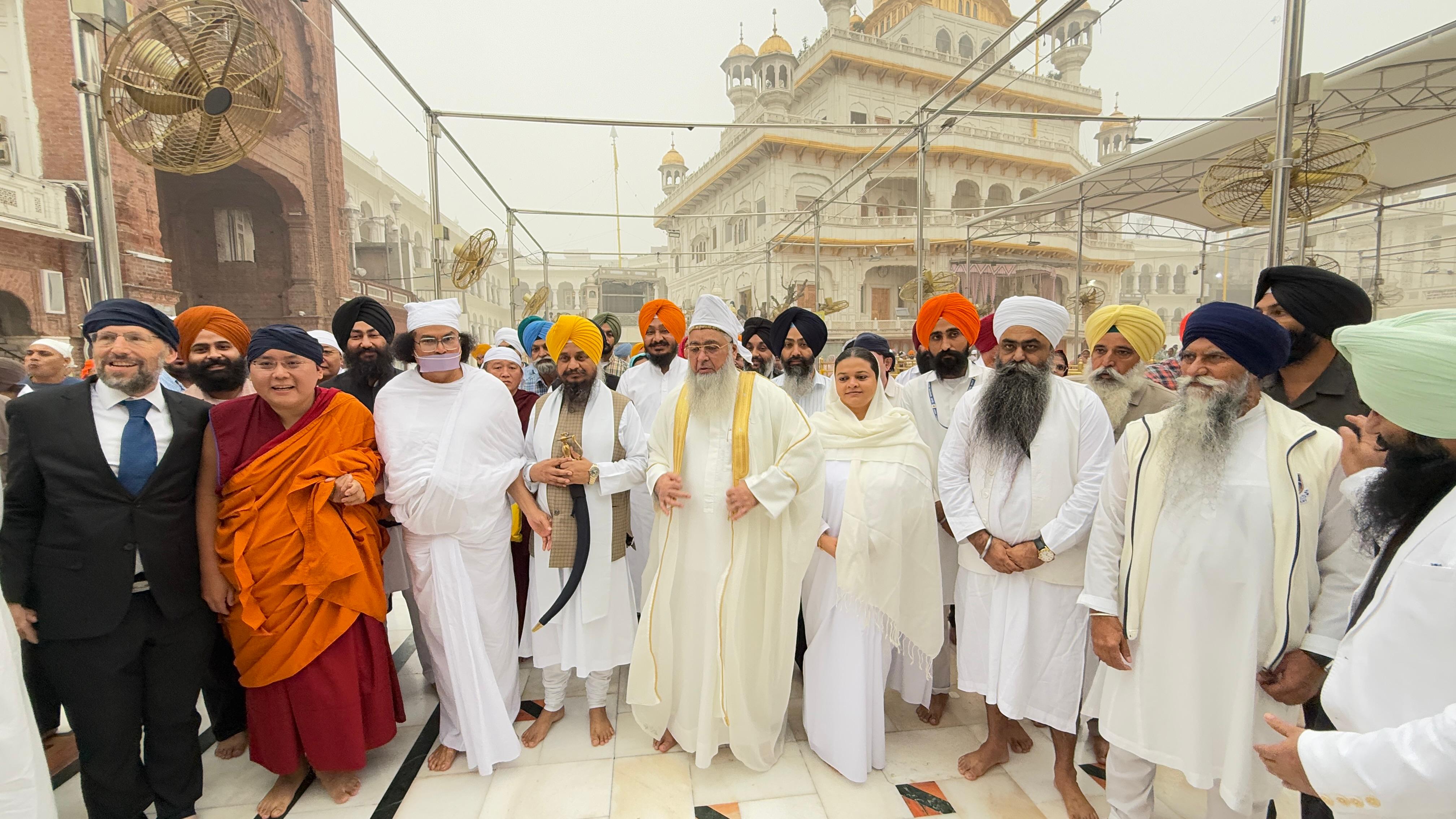
          Rabbi Nagen at the Golden Temple in Amritsar: the Sikh 555th Purab Mubarak Smagam

          6. How does Rabbi Joseph Albo contribute to the discussion?

          Albo locates the roots of plurality of religions in his conception of the Noahide Law. He considers the Noahide law as not a static set of laws but a dynamic religious framework that evolves in accordance with national temperament, ethical sensibilities, and environmental conditions. He writes that it develops “according to their respective national differences”. The profound cultural variability among nations shapes how Noahide law is realized.

          This concept is reminiscent of Rabbi Abraham Isaac HaKohen Kook’s vision of the evolution of the Oral Torah: “We feel that the unique character of the national spirit… is what lends the Oral Torah its unique form.” Religions, in this sense, can be viewed as a kind of “Oral Torah” for the Noahide law. Just as there are seventy facets of the Torah, the seventy nations each possess their own interpretations and expressions of the seven mitzvot.

          7.You discuss pluralism and John Hick. Are you a pluralist? Do we all just have different names for one God?

          Judaism acknowledges many names for God, each reflecting a different aspect of the Divine. Yet, there is but One God, who transcends form, time, and definition. What is essential is not the specific name used but the shared act of calling out to the One who is good and true. This unity is not diminished by the diversity of names humanity uses to refer to God; rather, it is enriched by it.

          Allow me to share an insight that came to me while giving a keynote address in Amritsar, India, on the occasion of Guru Nanak’s 555th birthday. I quoted the biblical vision of humanity calling together in the name of God but offered a reflection inspired by Guru Nanak’s teaching that the One God has many names. In this light, we might rephrase the biblical verse to envision humanity calling together in the names of God.

          Finally, I want to take this opportunity to thank you for introducing me, through conversations and through your groundbreaking books such as Judaism and Other Religions (2010), and Judaism and World Religions (2012) to the spectrum of approaches to other religions—from the wide embrace of pluralism to the firm stance of exclusivity.

          8.What do you do with the exclusivist texts in Judaism?

          The Talmud warns of the danger of turning the Torah into what it calls “a potion of death” instead of “a potion of life” (Yoma 72). This occurs when exclusionary and radical texts are elevated as the rule rather than recognized as exceptions. While such texts must still be acknowledged and addressed, they often reflect specific historical or cultural contexts that may no longer be relevant.

          Judaism embraces a wide range of opinions on virtually every issue. It is our responsibility to navigate these perspectives, choose thoughtfully among them, and at times, firmly reject those that conflict with our moral convictions. Unfortunately, extremists are often empowered by moderates who mistakenly assume that extremist interpretations represent the most authentic expression of Judaism.

          This debate—between what constitutes the rule and what remains the exception—is at the heart of my Beit Midrash for Judaism and Humanity. Our approach is not about reforming or rejecting halacha but about returning to its true fundamentals.

          9.What is your vision of a mutual Nostra Aetate with Islam?

          In 1965, the Second Vatican Council’s Nostra Aetate proclamation marked a transformative shift in Christian-Jewish relations. A similar bilateral effort is now urgently needed for Jewish-Muslim relations, particularly in the Middle East. The key question is: Will our identities connect us or divide us?

          From the Jewish perspective, this requires the creation of formative documents presenting a Jewish theology of Islam. These documents should be widely disseminated within both Rabbinical and lay Jewish circles, as well as within Muslim communities. The foundational elements for such a theology already exist, but they must be further developed and articulated. The goal is to foster mutual respect and recognition of Islam’s legitimacy and to encourage Jews to see Muslims as partners in a shared narrative—a grand, unfolding story in which each community plays a vital role. Together, we can strive to fulfill visions such as humanity collectively calling upon the name of God and serving Him “shoulder to shoulder.” We hope and pray this approach can contribute to resolving conflicts in the Middle East, where religion plays a significant role.

          The cornerstone of this approach is the affirmation of Islamic belief in God and His unity. As Maimonides stated, Muslims “unify God with proper unification, a unity that is unblemished.”

          This foundation can be strengthened by emphasizing shared reverence for Abraham, stories of the Prophets, and other biblical figures, as well as shared values and religious practices. A comprehensive Jewish theology of Islam should also address the status of Muhammad, offering a nuanced perspective. Among Arab Muslims and Jews, there is even a recognition of shared ethnic heritage, providing additional common ground. These commonalities are essential building blocks for fostering mutual acknowledgment of the legitimacy and value of each other’s religious identities.

          From the Muslim side, a similar effort is needed—a return to and affirmation of the Quran and Hadith’s clear acknowledgment of Jewish belief in God, the special status of Jews as Ahl al-Kitāb (“People of the Book”), and the Torah as a divinely granted guide to the Jewish people. This effort must include addressing claims of supersessionism and rejecting the notion that the current Torah is a forgery. Furthermore, it is vital to counter antisemitism fueled by misinterpretations of Quranic verses that critique certain Jews in specific historical contexts but are misapplied as blanket condemnations of all Jews. The Quran itself seeks to limit such critiques, explicitly stating, “They are not all the same.”

          To advance this vision, I have composed an unpublished essay or monograph titled Jewish-Muslim Religious Fraternity. In this work, I call on global Muslim leaders to compose formative documents on these issues.

          Shortly before his death, Fethullah Gülen, a leader of millions of Muslims through the Hizmet movement, authored such a document. This seminal text, available in Turkish, Hebrew, and English, addresses many of these critical points. It represents a significant step toward building bridges and fostering understanding between Jews and Muslims.

          Allow me to conclude with a quote from the King of Morocco, Mohamad the 6th that inspires me in this endeavor:

          The three Abrahamic religions were not created to be tolerant of one another out of some unavoidable fate or out of courtesy to one another. The reason they exist is to open up to one another and to know one another, so as to do one another good.

          10. Why and how do we share Torah with non-Jews?

          One of the great tragedies of religion occurs when exceptions are mistaken for the rule, and the true rule is ignored or forgotten. The issue of sharing Torah with humanity is a striking example of this. Bringing the light and wisdom of Torah to the world is not merely an option but a divine mandate for the Jewish people—a central role and responsibility rooted deeply in the Tanakh. The textual evidence for this mission is both explicit and overwhelming.

          This chapter further illustrates how the sages (Chazal) reinforced this principle. The prevailing rule, as stated by Rabbi Meir, is that a non-Jew who studies Torah is like a Kohen Gadol (High Priest).

          The exception, represented by Rabbi Yochanan, states that a non-Jew who studies Torah deserves death as a thief. This harsh view, however, is contextual as is for example the Talmudic critique of women studying Torah. Rabbi Yehiel Yaakov Weinberg explains that Rabbi Yochanan’s statement emerged in response to the early Christian use of Torah study to support replacement theology. Early Christians exploited their knowledge of Torah to claim that God had nullified His covenant with Israel and replaced it with a “spiritual Israel” (Christianity), effectively “stealing” the Jewish people’s identity. Similarly, the Rambam limited the prohibition to Muslims in his era, who studied Torah not with reverence but to discredit its authenticity.

          When these specific contexts do not apply, the broader mandate—to share Torah with the world—remains intact. In our era, the time has come to fulfill the prophecy of exporting Torah from Zion to humanity.

          Given the diversity of humanity, those engaged in the sacred mission of sharing Torah must consider the unique needs and perspectives of each culture they encounter.

          For instance, when I was invited to teach Torah in China, I began by identifying topics relevant to Chinese culture. Through preliminary discussions, I learned that the Chinese place great importance on the Jewish approach to disagreement, encapsulated in the statement, “These and those are the words of the living God.” In a culture that values deference to authority and often views disagreement negatively, the Jewish embrace of diverse opinions as a blessing—expressing the seventy faces of Torah—was a novel and inspiring concept. Similarly, the Jewish emphasis on the intrinsic value of every individual within society resonated deeply.

          Tailored engagement ensures that the eternal wisdom of Torah speaks meaningfully to the hearts and minds of people across the world, fulfilling its role as a light to the nations.

          11.What good does dialogue accomplish? Does it really help?

          My students sometimes ask me: “Rabbi Yakov, do you really think that just because you and an Imam meet and develop a relationship, that this will bring peace?” My answer is that it is not that such a meeting brings peace, but rather that it is already peace! When two people have a meaningful relationship, in which they connect from their inner essences, it is not just a path to shalom, it is shalom in itself. The goal is to scale this up by millions. I then call upon my students to become partners and create new relationships with the Other.  We need a massive partnership of leaders and lay people from both of our religions, and extensive grassroots encounters and educational initiatives to make Shalom and Fraternity ever broader and deeper between our communities.

          Rav Yehuda Amital Z”L

          This morning we mourn the death of Harav Yehuda Amital zt”l, a truly courageous and moral leader of our time.

          Here is the opening of an article that I wrote about him a few years ago in my review of Rav Amital’s book “Worlds Destroyed Worlds Rebuilt: The Religious Thought of R. Yehudah Amital” (the essay originally appeared in the 2006 Edah Journal) :

          * Rabbi Amital is a profound visionary driven by his memory of the past with a unique natural sense of Judaism. Yehudah Klein (later changed to Amital) was born in 1925 in Transylvania. As a boy he studied in heder and yeshiva and had only four years of elementary secular education; his teacher in Hungary was the Lithuanian R. Hayyim Yehudah Halevi, a student of R. Hayyim Ozer and of Reb Barukh Baer Leibowitz. R. Amital recounts a story of his youth in which he imagined a ball of fire in the sky. His vivid and active imagination took it as a messianic sign, and he persuaded his classmates to dance around a tree in celebration. R. Amital didn’t himself experience this envisioned messianic redemption, for in 1943 the Nazis deported him to a labor camp, and the rest of his family perished in Auschwitz. Upon his release, he came to Israel in December of 1944 and resumed his yeshiva studies, receiving ordination from R. Isser Zalman Meltzer and then married the latter’s granddaughter. R. Amital joined the Haganah and fought in the battles of Latrun and the Western Galilee. After the war, R. Amital became a rabbinic secretary in the Rabbinical Court in Rehovot, and two years later, he started giving a Talmud shiur in Yeshivat Ha-Darom together with his colleague Rabbi Elazar Mann Shakh.

          While at Yeshivat Ha-Darom, R. Amital formulated the idea of the yeshivat hesder, which combines yeshiva study and military service. The exemption from army service granted to yeshiva students increased the friction between the religious and secular communities, so R. Amital created the yeshivat hesder to unite these two communities, as well as to illustrate the religious significance of the accomplishments of the new state. This decisive move shifted R. Amital from his haredi background to a religious Zionist affiliation and distinguished his teachings from those of his colleague Rav Shakh, who came to lead the anti-Zionist yeshiva ideology at the Ponovitch Yeshiva in Benei Beraq. For R. Amital, there was no turning back: the secular state was a reality. The hesder form of Religious Zionism became a distinct variety of Modern Orthodoxy, one that consisted of helping to build the state under labor Zionism, and combining Torah study with army service. (One should note the difference between this form of religious Zionism and Hirsch’s diaspora keeping of mitsvot, Hildesheimer’s academic study of Talmud, or American suburbanization).

          Propelled by Holocaust memories, R. Amital became a force in the building of the modern state of Israel, and, after the liberation of the Gush Etzion in the Six-Day War of 1967, Rabbi Amital founded the yeshiva in Kefar Etzion. (In 1971, R. Amital invited R. Aharon Lichtenstein to join him as Rosh Yeshiva.) R. Amital later led the politically liberal religious party Meimad and served as a cabinet minister. He publicly displayed his pain over the 1973 and 1982 wars, especially the loss of some of his earliest students, and raised three generations of primarily Israeli students, teaching them to think independently, sensitively and subtly about the complex issues of morality, piety and politics that the modern Israeli faces. His combination of simple interpersonal directness and complex inner theology makes him, to quote a recent Ha’aretz article, “a simple Jew… a rare breed” and one from whom American Jews can learn much.

          Rabbi Ronen Lubitz as potential Chief Rabbi of Haifa

          According to Maariv, Ronen Lubitz, the Rabbi of Kibbutz Nir Etzion potentially could be the new Chief Rabbi of Haifa, to replace Rabbi Shaar Yashuv Cohen. Lubitz was part of the wave of the New Religious Zionists, that includes Rabbis Cherlow, Bigman, Gilad, Benny Lau, who wrote programmatic essays a decade ago in Deot, Amudim and Akdamot about the future of Religious Zionism and who formed Tzohar, as a more progressive rabbinical organization.

          Lubitz, who is less well known in America than the others, has already stated to Maariv that he seeks for greater tolerance of gays in synagogue and that he accepts the compromise of accepting that entertainment remains open on Shabbat.

          A decade ago he wrote a programmatic article on what is “modern religious orthodoxy” called in Hebrew AD”M (Orthodoxy ha-Dati haModerni. For my American readers I must point out that he is referring to an Israeli phenomena and not an American phenomena. With the rise of the aforementioned New Religious Zionists in the early 1990’s due to the breakdown of the older state-building and collective vision of the older religious Zionists, these younger rabbis turned to individualism and started calling themselves “modern.” (Note: Religious Zionism and Modern Orthodoxy are not co-extensive and have different origins and trajectories. Too big a topic for here). This group of Religious Zionists have no connection or sympathy with Haredim since they attend separate schools and form identity through army service. Rav Cherlow even advocates not learning Haredi seforim. The article seeks to distance AD”M from the Religious Nationalism of Merkaz Harav such as the followers of Rav Aviner.

          Man Searches for Meaning (Again) in Deot 7 April 2000

          Lubitz offers chapters toward a Orthodox Dati ha-Moderni AD”M
          We need to seeks our way. We used to have a clear path but not anymore. AD”M is between the national religious camp and the religious liberals, the former-associated with Rav Aviner-are connected to Religious Zionism but lack modernity and the latter embrace modernity but are sociologically separate from Religious Zionism.

          How do we relate to modernity? Confrontation, combination, synthesis, or even intergrafted?
          Now we have the new issues raised by Postmodernity where ideas are contingent. In the National Religious group many run away back to certainty and Haredi life. If modernity does not work the default is to reject it and seek certainty.

          Ronen Lubitz defined the struggles of the New Religious Zionists as consisting of five elements.
          Five characteristic of modern Orthodoxy (he mean Israeli Datiim Hadashim or AD”M, don’t confuse with America)

          (1) One needs to choose life- nothing in the fullness of the secular world should be foreign to Judaism.
          We need to identify with Western culture and still keep mizvot in their fullness. Correct action is required but we allow many opinions so we are more orthoprax than orthodox. (I am not sure if he means these terms in the American usage.-read the Hebrew) We embrace doubt pluralism, contingency, there is no one opinion or theology. Sometimes a moment of holiness in the secular and sometimes a moment of secular in the holiness- “there is nothing as whole as a broken awareness”

          (2) Doubt is serious; misgivings about observing mizvot, skepticism about belief, and questioning of Torah are all to be taken seriously.

          (3) Observant Jews can lead a normal life, and not conform to an ideal life. It is OK to relax with normal entertainment or to enter any profession. Legitimacy for modernity to permeate your life the way Israeli nationalism used to permeate lives. Torah Study does not override tasting and being part of the world.

          (4) There is a pluralism of truth, without a reconciliation of halakhah, mahshavah, and secular studies. AD”M does not see a contradiction of Torah and the pluralism of scattered and fragmented truth. In this we differ from the National Religious who treat western culture as fact and try to keep out its values. Every month they have a new worry, reaction, and restriction. We openly accept human rights, autonomy, freedom, equality. We recognize that Western culture contributed to the advancement of humanity, therefore we seek to ground these values in Torah. In time, we will succeed in integrating post-modernism as well.

          (5) We need to live in a religious language but we need a new religious language since the old language does not serve us anymore.

          Interesting other piece about Lubitz protesting for human rights in China from 2008

          In a small town in northern Israel Rabbi Ronen Lubitz is very happy to welcome his congregation’s leavened bread. It’s a token of solidarity to remember the days when the Jews had to cross the desert without it after they were freed from Egypt.But this year Rabbi Lubitz is adding something more to this ancient tradition. He’s asking everyone in his congregation to sign a petition against human rights abuses in China. His hope… to have his community know about the persecution of Falun Gong in mainland China.
          [Ronen Lubitz, Rabbi of Nir Ezion]:
          “I decided this year to use this opportunity to let people know about what’s going on in China. The persecution and torturing of the Falun Gong, and the prohibition of very basic civil rights to the people of China. I think it’s very much connected to the basic ideas of Pesach (Passover). Because during Pesach we celebrate our freedom. Our freedom as people, as a nation. Our freedom as individuals.”

          “I go in the way of Rabbi Kook. He talked a lot about our duty to love all human beings and he spoke about our Passover, our Pesach as a sign of freedom to all humanity…I would like to wish the people in China and in other places in the world that this spring of our nation will be a sign for spring for them as well.”

          Response by Rabbi David Bigman and others to Elchanan Shilo

          Elchanan Shilo’s piece garnered several responses. – teguvot
          For the original post of Shilo- see here.

          Rav David Bigman, RaM at Maaleh Gilboa stated his reservations as follows:

          The problem presented in the article is important and the discussion is critical from a personal, religious and national perspectives. The older common halakhah is fading away before smaller individualized forms of halkhah to which people cannot relate. And we have to get beyond the all or nothing approach.

          But Bigman completely disagrees with Shilo’s disregard of halakhah and his wanting to change the status of halakhah.
          The religious Zionists who live in a wider society have presented it all or nothing. On the other hand, the totalizing society of Haredim when you observe them first hand don’t actually live according to the halakhah

          Our poskim have lost a sense of normal life, work life, army life. They do not relate to the customs by which people arrange their lives and only view things through an ideal halakhic lens. (Bigman relates a story of yihud in an army situation.) We have lost the distinctions of Biblical law, rabbinic law, minhag yisrael, and custom. We need to allow different levels. We should not reject the halkhic norms but maybe seek a more intellectual reading of the sources. We need a more living and relevant halakhah.

          We don’t need a new system. We need the new generation of rabbis who will be relevant. We need to train rabbis to confront the other and appreciate any connection to Judaism.

          Some letters- praise Shilo. One letter written by a dat”lash, morid kipah said that he found the article just the help for clarifying his life. There was a screed by Dov Landau crediting Shilo with causing all evil in society -supporting the Clash of Civilizations, Post-Modernism, the breakdown of society, and uprooting any and all Torah values. (If he could he would have also credited him with the Asian Tsunami and all disastrous events in Gaza.)

          Shilo’s Response to Rabbi Bigman

          When you enter the halakhah one can soften the law only here and there and even then only a little bit. There is not as much flexibility in the law as you credit. And that ordinary people cannot wait for new generation of rabbis. Ordinary people work below without waiting for miracles from above.

          PS If you are in Teaneck, ir hakodesh this Shabbat

          Rabbi David Bigman will be at Davar on Shabbat June 4 & 5, 2010
          8:15am schachrit, kiddush after laining, lecture #2, musaf
          The Discrepancies in the Law of the First Born: Dealing with Biblical Criticism with Sincerity
          7:15pm mincha, seudah shelishit, lecture #3, mariv, havdalah
          Changes in the Procedure of Divorce: From Scripture to Talmud

          A Continuous Judaism Between Halakhah and Hiloni by Elchanan Shilo

          Here is an article By Elchanan Shilo, “A Continuous Judaism between halakhah and Hiloni” that appeared in the Shabbat Supplement of Mekor Rishon on May 7 2010 and it has been posted on Tzav Pius (One of the many inscrutable projects of the Avi Chai Foundation.)
          It is an interesting article and brings together many ideas currently floating around. Yet, I am not sure if he is not just recreating 1920’s Conservative Judaism or a European Geminde system. Nor am I sure that all the parts of his argument work together. Shilo, who teaches Jewish thought, wants to undo the division between those who keep halakhah and those who pick and choose. He brings together those who are halakhic, with those who pick and choose, and he includes in his expanded approach both those who only occasionally find something that speaks to them in Judaism and those leaving halakhic oservance. Here is a freehand summary and paraphrase of selected lines and an even more freehand translation of key lines.

          A Continuous Judaism Between Halakhah and Hiloni by Elchanan Shilo

          “The time has come to stop building bridges between the religious and the secular and instead to create a new wider existence. The religious Zionist community, whose strength is enough for both sides, is capable of building this expanse in order to break the divisions of the past.”

          Modernity brought (1)education (2)a bourgeois life (3) a halakhicification of Judaism.The first two are good. But the later creates a division between religious and secular. The division was originally encouraged for the pride of building an educated community who knew and kept halakhah. Now we need to erase the divide by mixed schools and individualized patterns of observance.

          We already have many people who have individualized approaches. Some people find halakhah and the religious life stifling and not life enhancing , others find it fits perfectly and enhances their lives. Generally we are happy when people discover observance but we should understand that it does not fit everyone and we should accept that people regularly give up observance. People go back and forth. His solution is to prevent absolute secularization- and see the community as a very wide range of observances with people going both directions at all times. In this approach, the formerly frum (Datla”sh) who don’t fit into the secular world would remain comfortably part of religious world. (Datla”sh is at least 25 % of the religious Zionist community)

          Shilo argues that his approach should not be confused with the liberalism of Reform and Conservative. The later movements judged Orthodoxy as primitive and that they are progressive. They created a new ideology with justifications for none observance. Shilo wants a broad tent without any judgment or ideology.

          He accepts the older American model of having a men’s section, a women’s section, and mixed section. No judging and no definite answer. Some people follow the halakhah and some people follow their need not to have a mehitza. {He emailed me to tell me that he thought these mixed pulpits still existed in the US. His American father remembers them. He did not know that they dont exist anymore.}

          Liberal religious Zionist weddings have mixed dancing after the officials leave combining both halkhah and actual practice. But he asks why not has both separate and mixed dancing right from the start? Halakhah without ideology or non-observance of Halakhah without ideology wont topple the edifice.

          There are no hard definitions of God’s will only soft ones that vary with the individual. Shilo advocates that we should turn to the writings of Rabbi Mordechai Leiner of Izbitz, the Mei Hashiloah. People can have different callings from God, some in the halakhah and some not in the halkhah. How do we know that God wants everyone to keep halakhah, maybe sometimes there is intentional sin for the sake of heaven or different paths for different people.

          We don’t want to delegitimize Jews or close options. He advocates a practical Judaism or an actual Judaism or a realistic Judaism. Many people want to keep Shabbat and even love Shabbat but are not interested in the details of squeezing, mixing, or smoothing on the Sabbath Many just want to keep up the tradition or the family values.

          A different case is that people can like Shabbat but also have normal sexual needs . They do not want to be told that it is the evil inclination, rather they want to enjoy sexuality and the Sabbath. They don’t want a dichotomy of either being part of the frum world or the secular world.
          Not keeping hair covering, going mixed swimming, and mixed dancing can be done without any ideology of either rejecting Orthodoxy or forcing people into a social ghetto.

          The beit midrash should be open to all. And the criteria for how to study and what to study is not determined by halakhah but by relevance, interest, meaning and poetics.

          People don’t want a Reform Shabbat in the synagogue they want a traditional Shabbat that they can mold to their own meaning.
          Halakhah has to stop fighting a radical secularism and secularist have got to stop fighting the halkahic world. A wide practical Jewish life can bring people together.

          OK, so is this new or old? Feasible or not? Are all details worked out or are their dangling elements. Read the full Hebrew article and let me know if there is something that will catch on here or is it just a idea.

          Update with a response by Rabbi David Bigman.

          New unpublished Rav Kook

          My reader Paul Shaviv showed up earlier this week and left the blogging equivalent of a baby in a basket in a comment on my About page. He posted a link to a pdf of one of the new Rav Kook works that have been recently transcribed. I had assumed that this was already discussed and linked elsewhere.

          Rav Kook left behind scores of notebooks of his thoughts. Many of those notebooks were used by the Nazir to create Orot Hakodesh as an editor’s synthesis. Others were used by R Zvi Yehudah to produce a different voice for Rav Kook. Recently, some of these notebooks have been published as Shemonah Kevatzim. In the last few years, even more material has come forth from the archives creating a serious academic and Merkaz haRav world debate on why were they hidden until now? what was edited out? Does it change our view of Rav Kook?

          For those of us in the field, none of this is new. It is the bread and butter of academic conferences. Back in summer 2009 at the World Congress for Jewish Studies in Jerusalem when others were heading home already, I attended session 352 held in the evening in the Senate room located away from the other sessions . The session was dedicated to the editorial changes and changes over time in rav Kook’s thought. The speakers were Neriah Gutel, Yehudah Mrsky, Udi Avramovitch and Bitty Yehudah. And the audience was the entire cabal of Rav Kook experts (minus a few for specific personal reasons.) Their papers and the discussion afterwards discussed all the debated issues of what do we learn from these new volumes? How was Rav Kook’s vision different at the beginning? And what was consciously changed and censored?

          Everyone had already read Avinoam Rozenak’s Hidden Diaries and New Discoveries: The Life and Thought of Rabbi A. I. Kook Shofar: An Interdisciplinary Journal of Jewish Studies – Volume 25, Number 3, Spring 2007, pp. 111-147, which first appeared in Hebrew. Rozenak showed that some of these writing had a more antinomian element to them and that the editors were more conservative.

          So here is the 250 page pdf of one new books, Harav Kook- leNevuchai Hazeman The work starts off following the Guide of the Perplexed for content but then veers off course. Very little of it is new, we have seen almost all of the paragraphs or at least the ideas before in his other works. What we gain is a turn a phrase here, a named interlocutor there, and an alternative organization illuminating Rav Kook’s thought pattern.

          We also have two recent articles in Kipa [in Hebrew]. One used the aforementioned Udi Avramovitch as its expert source. Udi finds the volume more radical than the printed version and he finds a greater identity of God’s will and the will of the people. He also claims that in this work Rav Kook claims a value for other religions and that they worship the one true God. The second article quotes the army and settlement Rabbi Yosef Kellner that the book is essential to read but they are confining distribution, and here is a letter by Rav Kellner about the book.

          Rav Kook started the volume while still in Europe and finished it in Jaffa. The book starts off discussing the image of God as volition- will. Human have a will to make manifest as creativity in the world. Yes, Schopenhauer’s definition of man as the guide for our generation. (Along the way Spinoza is deftly defeated by the volition of R. Moses Hayyim Luzatto)The second chapter tells me that Saadayah and Maimonides saw that books of sectarians (minim) multiplied so they were compelled to write philosophic works. That does not inspire me in its understanding of the medieval but tells me more about Rav Kook. In a later chapter, he tells me that “all revolutions are good for clearing away the small minded people and narrow visions” with a later in the paragraph phrase that “they all follow the pure knowledge of God” Holy Hegelian Marxist! What do I do with these grapplings with the sectarian writings of German Idealists for a Torah for the 21st century?

          Can we use this as a guide for social revolution now? Well, let look at what he said about the problem of favoritism, corruption and cronyism in rabbinic courts. Rav Kook was against any change to the institutional fabric and rejected secular oversight or higher courts to oversee lower batai din, threatening to return to the R. Hayyim Sonnenfeld camp. What of women in modern world? He did not think women should vote or study Torah. What of secular studies? The new diaries show that he encouraged his inner circle to avoid the wisdom of the gentiles and stick to the prophetic Torah.

          Furthermore, we tend to read Rav Kook as if he is the one pushing the envelope on the potential diffusion of God’s light in a new age. Rather than responding to forgotten correspondents who were more radical than he was like R Shmuel Alexandrov or R. Moshe Seidel. These newly released versions, at first reading, will make it easier to find the original dialogue partner. As you read through it, let me know if you find any especially unique passages or if you can detect changes from the beginning to the end of the writing process.

          For the meaning of these writings, I await the series of new scholarly articles that will be written in the next few years. The one thing these writings do show is his concern with making a new passionate Jew beyond cognitive focus of the Eastern European beit midrash. A new Jew concerned with volition, inner voice, volkgeist, a new age, love, and seeking a new knowledge of God.

          Immediate Update– both the article in Kipa and the file of Rav Kook have been take down, the link wont work. I can understand the removal of the unpublished book, but what benign or nefarious power took down a current news article. If anyone knows then please let me know. The article in Kipah is cached and one can still get to the Headline but not the article. Friends in Israel, what’s the story?
          Next Update– I just posted the pdf from my saved copy and the articles reappeared with minor changes.

          Tzvia Greenfield and Judith Butler

          Tzvia Greenfield, our haredi Meretz Keneset member, just published an appreciation of Judith Butler, the feminist literary critic, on Israel/Palestine.

          My first reaction was one of treating it as an extreme posture. I mean, come on, one could not get almost any rabbi or Jewish communal figure anywhere on the spectrum to read Judith Butler. I thought of Leib Weisfish, who was on the speaking circuit in the 1980’s as a Mea Shearim dwelling Haredi Neturai Karta who was a passionate admirer of Nietzsche. Weisfish maintained a correspondence with Walter Kaufman, the translator and wanted the grave of Nietzsche to be transferred to Israel.

          But my second thought was back to Greenfield’s haredism, which is not a sectarian culturally limited Haredism of Meah Shearim and probably should not be called Haredism. Her view seems to be closer to the older Rabbi Isaac Breuer influence world of Agudah from Germany where one can have a PhD in literature or biochemistry. But one holds that the Torah is above any politics, beyond any this worldly referent, and not subject to any personal choice- a radical separation of Torah and Derekh Eretz. Rabbi Breuer could discuss the secular world based on Nietzsche and Schopenhauer because the Torah was pure and entirely above society. He could also say that the Torah from a this-worldly perspective is biased against women but that is OK since Torah is to be considered from the eternal perspective. A few decades ago, there were still academics from the Poalai Agudah world that had such views.

          (In 1990, Rav Shakh basically dissolved Poalai Agudah, telling them that “Torah only” was the only acceptable career, source of ideas, or worldview. The approach of Torah and a sharply bifurcated derekh eretz was no longer to be tolerated.)

          So here is Greenfield’s article praising Judith Butler that the occupation needs to end because it would be the collapse of Israel as a democracy and as source of knowledge and talent. I am less interested in the political details as much as the synthesis of Meretz and Orthodoxy played out through Judith Butler. The reason for the sudden interest in Butler is because she passed through Israel a few months ago and obviously met with Meretz. In addition, Butler seems to at work on a monograph on Judaism, human rights, and Hannah Arendt.

          Greenfield From Haaretz

          Yet another terrifying possibility, of course, is that Israel would consciously renounce its own self-definition as a Western democracy. It would then gradually turn into a dictatorship that defines itself as Jewish. It would use armed force to continue to control all the territory west of the Jordan River, and would continue to deny the Palestinians’ right to either freedom or equality. A choice of that kind would destroy Israel as a modern state, and accordingly also its ability to defend itself and to develop as a secure, flourishing, 21st-century society.

          In this case as well, it is clear that most of the country’s intelligentsia, and indeed anyone with initiative, would leave Israel. Israel would remain with its religious population and its rightists – some of whom are capable of defending it, but most of whom are devoid of high-level development and management skills. The Israeli-Jewish dictatorship would thus suffer from a substantive weakness that would eventually lead to its defeat at the hands of its Muslim enemies.

          It is sad to think that this process has apparently already started: The collapse of education and higher learning, together with the political corruption and the tremendous growth of those sectors that are not prepared to share the social, economic and military burden, is encouraging the more talented and diligent Israelis to leave the sinking Jewish ship.

          Even if treating Israel as the country that embodies the ultimate evil in fact expresses a new and ugly incarnation of traditional anti-Semitism, which always viewed the Jews as the representative of all the world’s ills, the truth is still simple, but difficult to face: An Israel that does not allow the Palestinian situation to be resolved has effectively announced its own inexorable death, via the gradual destruction of the resources of knowledge and talent that have enabled it to develop and defend itself until now. In order to save Israel, we must immediately separate from the territories and their inhabitants.

          Butler in her own words
          Judith Butler: As a Jew, I was taught it was ethically imperative to speak up 24/02/2010

          Part one Part two

          Philosopher, professor and author Judith Butler arrived in Israel this month, en route to the West Bank, where she was to give a seminar at Bir Zeit University, visit the theater in Jenin, and meet privately with friends and students.
          Why Israel-Palestine? Is this directly connected to your Jewishness?

          As a Jew, I was taught that it was ethically imperative to speak up and to speak out against arbitrary state violence. That was part of what I learned when I learned about the Second World War and the concentration camps. There were those who would and could speak out against state racism and state violence, and it was imperative that we be able to speak out. Not just for Jews, but for any number of people. There was an entire idea of social justice that emerged for me from the consideration of the Nazi genocide.

          I would also say that what became really hard for me is that if one wanted to criticize Israeli state violence – precisely because that as a Jew one is under obligation to criticize excessive state violence and state racism – then one is in a bind, because one is told that one is either self-hating as a Jew or engaging anti-Semitism. And yet for me, it comes out of a certain Jewish value of social justice. So how can I fulfill my obligation as a Jew to speak out against an injustice when, in speaking out against Israeli state and military injustice, I am accused of not being a good enough Jew or of being a self-hating Jew? This is the bind of my current situation.

          Let me say one other thing about Jewish values. There are two things I took from Jewish philosophy and my Jewish formation that were really important for me… well there are many. There are many. Sitting shiva, for instance, explicit grieving. I thought it was the one of the most beautiful rituals of my youth. There were several people who died in my youth, and there were several moments when whole communities gathered in order to make sure that those who had suffered terrible losses were taken up and brought back into the community and given a way to affirm life again.
          So I agree with you. But I think we have to get over the idea that a state has to express a nation. And if we have a bi-national state, it’s expressing two nations. Only when bi-nationalism deconstructs the idea of a nation can we hope to think about what a state, what a polity might look like that would actually extend equality. It is no longer the question of “two peoples,” as Martin Buber put it. There is extraordinary complexity and intermixing among both the Jewish and the Palestinian populations. There will be those who say, “Ok, a state that expresses two cultural identities.” No. State should not be in the business of expressing cultural identity.
          I think that the BDS movement has taken several forms, and it is probably important to distinguish among them

          More Butler from this Spring

          Lastly, let me say this. You may feel fear in voting for this resolution. I was frightened coming here this evening. You may fear that you will seem anti-Semitic, that you cannot handle the appearance of being insensitive to Israel’s needs for self-defense, insensitive to the history of Jewish suffering. Perhaps it is best to remember the words of Primo Levi who survived a brutal internment at Auschwitz when he had the courage to oppose the Israeli bombings of southern Lebanon in the early 1980s. He openly criticized Menachem Begin, who directed the bombing of civilian centers, and he received letters asking him whether he cared at all about the spilling of Jewish blood. He wrote:
          I reply that the blood spilled pains me just as much as the blood spilled by all other human beings. But there are still harrowing letters. And I am tormented by them, because I know that Israel was founded by people like me, only less fortunate than me. Men with a number from Auschwitz tattooed on their arms, with no home nor homeland, escaping from the horrors of the Second World War who found in Israel a home and a homeland. I know all this. But I also know that this is Begin’s favorite defense. And I deny any validity to this defense.
          As the Israeli historian Idith Zertal makes clear, do not use this most atrocious historical suffering to legitimate military destructiveness–it is a cruel and twisted use of the history of suffering to defend the affliction of suffering on others.

          Here is a video of further musing of Butler about on Hannah Arendt And Israel delivered this past fall.
          For those interested, here is also an online discussion between her and Agamben on human rights.

          I am less interested in the politics and more interested in the cultural weave. Haredi religion as entirely a choice of the heart without any social, cultural, or political ramifications. Rabbi Isaac Breuer influence? Prof Yeshaya Leibowitz? In the 1950’s Orthodox Rabbis separated between Torah and American democracy- keeping them apart. Greenfield claims to be following a diaspora model. Can it it be reformulated for a half century later?

          Tzvia Greenfield: Israel’s first female Haredi MK- Meretz Activist

          From Haaretz- full version here

          Tzvia Greenfield. Israel’s first Haredi female to be elected to the Knesset, she is a fierce critic of her own community’s attitudes to the peace process and modernity; describing the Haredi community as being “incapable of compromise.” Yet she still lives in it, a resident of the Jerusalem suburb of Har Nof.

          Of course, her horizons are far broader than the narrow vista of ultra-Orthodoxy. The 62-year-old, who has a doctorate in political philosophy from the Hebrew University, was elected on behalf of Meretz last November. She advocates a two-State solution based closely on the pre-1967 War borders; a self-proclaimed egalitarian, she’s in favour of women rabbis and religious pluralism.

          The mother-of-five, who sent her children to national religious high-schools and both her sons to the army, arrives as expected wearing a sheitel (one that looks like a sheitel) and a long dress.

          She then speaks candidly about her prospects of influencing change: she is unsure that Israel’s left can be revived – she’s not sure they can awake secular Israel from its “slumber”- and feels compelled to channel change in her own back-yard, despite disillusionment about the trenchant positions of the Haredi world, which her Austrian “ultra-Orthodox Zionist parents” brought her into.

          She describes the “haredization” of parts of Jerusalem and Beit Shemesh as “killing” those places: “Once they take over a community no one else can live in – like in some parts of Jerusalem and Beit Shemesh – that’s unacceptable. That is something people won’t tolerate because they want to live their lives. One neighbour cannot impinge on the other’s rights; it’s true the Haredi community doesn’t understand its task in a democracy. It believes when its population grows in a territory, the whole area should be governed by its rules.

          She added: “An essential part of adjustment is in being a minority; the problem is when they become a majority. They are already driving people out of Jerusalem and not just the secular – but the modern Orthodox; because they cannot tolerate this. If the Haredi community gets large enough we won’t see nice developments.”

          Her non-interventionist liberal instincts means she defends its right to promote a school curriculum that bares little resemblance to the national model: she believes a “balanced” approach is necessary in seeking to bring the Haredi world into the modern age, without assaulting its delicate nuances. “Interfering in questions of education is particularly sensitive and fragile,” she argues. “Thinking from all sides, I think society has to ensure Haredim aren’t poor. Despite Israeli society’s investment it’s a very poor community.”

          Can Meretz deliver change? “I’m not sure. I think the left all over Europe and particularly Israel has severely failed on many assignments and I think the left should profoundly reconsider its goals and how it goes about them. To me after years of being a peace activist it’s a shameful situation and I think it’s unacceptable not to look at ourselves.

          Q and A

          Bearing in mind you say some religious people have difficulty with compromise how would you like to see change stemming from the religious world?

          Religious people have difficulty grasping essential ideas like peace, compromise and accepting others. These are difficult issues and they’ve got to be worked out.

          I’m writing a book on the subject. I decided I had to write down what I think and that would be the best way to explain how one could retain ones religiosity and faithfulness to ones position and yet encourage profound changes.

          I have one answer to your question. I think a religion ought to be concerned with human beings and not objects. Too often traditional religions have a great interest in objects and not enough in human beings. That has to be shifted completely. The emphasis and the concern should be entirely different and there are ways to do it.

          Do you think the demonstration of the human side of the Judaism has been lost?

          I think there is not enough concern about human beings, and I mean human beings in general, including non-Jews. As a religious person I believe that all human beings were created in the image of God.

          What we’ve seen in Israel in the last thirty or forty years ever since the ’67 War is a concern with land. That’s an object. It’s become the centre of attention for religious people and I think that’s a major mistake and I think that should be changed.

          Where do you stand on issues of religious pluralism and the rights of all sects of Judaism to have equal funding with regards to conversion programs and education?

          Of course I support pluralism. People have to make their choices and decide what’s for them. There’s no way the state should direct on what or how they should do things. Every citizen should be a free subject to make his or her decisions without any input by the state whatsoever.

          How would you, as a progressive Haredi, advocate it modernises its approach to self- governance?

          Education. Education is the answer to everything, The fact that it blocks general education to its community is part of the problem because they never really understand what is going on and make their own decision. I would try and allow these people to get education without breaking down the system altogether, without enforcing education on them in a way which cannot acceptable, not only for them, but even for me. I don?t believe in enforcing it brutally; it has to be done carefully.

          The very fact it’s living in the modern world, is affecting it. We are talking about the younger generation that will make decisions about what they are doing. In both America and Israel.  They are re-evaluating the world that their parents have brought them into. We’re probably going to see changes in the next 20-30 years. After all, they do not want to be poor.

          You hope that the secular and Haredi worlds can live side by side but at the moment even the modern Orthodox are getting annoyed with the Haredim as the recent riots in Beit Shemesh prove.

          Once they take over a community no one else can live in – like in some parts of Jerusalem and Beit Shemesh – that’s unacceptable. That is something people won’t tolerate because they want to live their lives. One neighbor cannot impinge on the other’s rights; it’s true the Haredi community doesn’t understand its task in a democracy. It believes when its population grows in a territory the whole area should be governed by its rules.

          The Haredization of Jerusalem is already here – how can this situation be clawed back?

          The community is poor, uneducated and very militant – the combination is lethal. It will kill Jerusalem.

          How can the Haredi leadership recognise the need to modernise?

          There is one factor in favour of modernisation- poverty. Some of the leadership recognizes and is concerned by this. Although the politicians would recommend poverty should be paid for, the leaders have a deeper approach. Certain changes must occur. First women join professions. Later on some men join. Things will change. Young men will be encouraged to join colleges. Already now there are a couple of colleges where Haredi girls are accepted to law or commerce school.

          What do you think about the status of women in the Haredi world?

          The big issue here is a very delicate one. That is children. Large families thirty years ago was six children; now there’s 13 or 14 – from one wife. I believes the glorification of bringing as many children as possible is a definite way of ensuring women can’t bring their advantages into effect – subjugation.

          It’s inconceivable for a woman to say to her husband, “I won’t have more than three children” – a cause for divorce. Inconceivable and non-existent.

          Do you think there should be Orthodox female rabbis?

          I’m all for it. I think if women want to serve as rabbis in religious function they should be given the right to do so. The issue of depriving women a religious position is part of deprivation of women from positions of power. Women don’t have equal rights in Judaism because they never had them in any field of life- a general result of subjugation.

          Why is there a lack of state involvement in social issues?

          The state has been run by conservatives who don’t want equal rights for women, Arabs, anyone; any progressive left issues. They want to sabotage these things.

          Menachem Ekstein Visions of a Compassionate World — A Post-Hasid?

          I was recently recommended to read the volume Menachem Ekstein, Visions of a Compassionate World : Guided Imagery for Spiritual Growth and Social Transformation (Urim 2001) (Hebrew- Netzah 1960) based on the original Tennai Hanefesh leHasagat HaHasidut (Vienna, 1921).

          I was told the book is an essential part of modern Hasidism along with the Piesetzna Rebbe. (In a recent PHD on the latter, there is a chapter on Ekstein.)

          The book is a 1920’s volume of guided imagery – image the sun, the entire planet, the animal kingdom, see all the fish in the sea. Then see your place on earth. Open yourself up to growth and infinite potential, see the potential for change and overcoming one’s limits. Avoid negative thoughts and images that hold you back. The goal is to wake up the senses and this is defined as Hasidism. As I was reading it, I realized that I read these visualizations before. They are from Jean Huston’s The Possible Human: A Course in Extending Your Physical, Mental, and Creative Abilities (1982). Jean Huston is a 1980’s hero of New Thought incorporating many 1920’s classic visualizations in her work. There are similar elements in Alice Baily Shakti Gwain, and Warren Kenton. A quick google search of any of the visualizations yielded dozens of new age sites with the same visualizations. I do not know which works Menachem Eckstein actually read in 1920’s Germany, I could not find a list of German New Thought books online (I already tried Wiki in German.)

          I have been told from other sources that the book is very popular in the neo-hasidic national- religious Habakuk crowd, especially the hilltop youth. There is even a CD to listen to the visualizations. This book offers a traditional Hasidic version of new age. It authenticates their individualistic spiritual quests.

          It is hard to see it as a Hasidic work, even if the author is a son of a Galitzianer Hasid because the book is printed in Vienna using modern Hebrew and the last chapter is a vision of a restored state of Israel after the Balfour Declaration.

          After WWI, many Hasidim entirely left the tradition to become Zionists, Bundists, secular educated or just left to enter the modern world.
          But there were also those, especially in Poland’s cities like Warsaw that remained somewhat Hasidic as they entered modern life. There were Hasidic journalists and authors, or least aspiring authors, and there was even a Hasidic boxing columnist . Some continued the traditional garb but living modern lives and other changed their garb but remained loyal in their hearts. The modern city makes all this possible. We could use a good study of interwar Warsaw. Hasidic story writers infused new vitality into Hasidic stories by using Rumi, the Golden Legend, and 1001 Arabian nights. Others advocated Kibbutz Hadati Torah veAvodah as a Kotzker holy rebellion against the establishment. This era rejected the stolid Hasidism of their parents 1880-1920, but still were sociologically part of the Hasidic world. Menachem Ekstein seems part of this world. He took the Western European NEW THOUGHT and metaphysical visualizations and cast it as the way of Hasidism.

          If anyone knows more about him, then please let me know. I have just been informed that there is a someone working on him for an MA.

          But should we call this inter-bellum period the post-hasidic?

          Copyright © 2010 Alan Brill • All Rights Reserved

          Eleven Maskilim

          In the Haaretz Passover supplement there is a nice introduction to the important maskilim of the end of the 19th century. In their time, they were the intellectuals who were read by everyone who wanted to sustain the Jewish community.

          Some of these Russian haskole figures are the banes of the 1890- 1940 Yeshiva world and one finds many allusions and refutations to the writings of the mussar movement or the writings of the Yeshiva world. (Anyone have any favorite citations? Let see who has the best one. Bear in mind that Schulman was the translator of Graetz and that Hasidic tales are based on the model of Zweifel.)

          The Mizrahi movement of Reines and his followers Zev Yaavetz and A. M. Lifshitz incorporated the changes to Jewish education advocated by these maskilim. Modern Orthodoxy does not really come from Rabbi S.R. Hirsch and Germany but from the hundreds of Russian rabbis who moved to the US and turned to the Maskilim and the Mizrahi rabbis to help create a Hebrew education system. Between the two wars most of the Mizrahi movement lived in the US and only made aliyah in the early 1950’s. Figures in US Orthodoxy like Pinchas Churgin, Moshe Seidel, Wolf Gold, Shimon Federbush, Meir Bar-Ilan are the forgotten creators of our elementary school system of Hebrew, navi, maps, charts, and “mi amar le-mi.” These Russian born Mizrahi educators are nearly forgotten in American Jewish memory. Day school curriculum is based on these Mizrahi movement figures and their use of the haskole works.
          High Schools used to present many of these haskole figures as if they were all observant, some were and some were not.

          Lights on in the park By Haim Cohen
          Along with shady paths and playgrounds, Tel Aviv’s Haskalah Park offers a history lesson on the Jewish enlightenment

          Like the names of 11 streets in the adjacent neighborhood, Bitzaron, the park commemorates the Jewish Enlightenment movement (the Haskalah). Portraits of 11 Enlightenment thinkers (maskilim) adorn the shelter in the south of the park,

          The maskilim called for education, tolerance, love of mankind and morality, the spread of knowledge and the valorization of the Hebrew language. They expressed their ideas through journals, newspapers and books. Among the key maskilim were the philosopher Moses Mendelssohn, who is considered the father of the Jewish Enlightenment, and Isaac Eichel, its founder; Isaac Baer Levinsohn, one of the first maskilim in Russia; Samuel David Luzzatto, from Padua in Italy; philosopher and historian Reb Nachman Krochmal; the poet Y.L. Gordon and many more.

          Leading lights

          Each of the 11 maskilim represented in the park was given an appropriate nickname. There are The Linguist (Yehuda Leib Ben-Zeev), The Satirist (Isaac Erter), The Itinerant Maskil (Abraham Baer Gottlober), The Translator (Kalman Schulman), The Reconciler (Eliezer Zvi Hacohen Zweifel), The Scientist (Chaim Zelig Slonimski), The Scholar of Jewish Studies (Solomon Rubin), The Concordance Compiler (Salomon Mandelkern), The Bibliographer (Yitzhak Isaac Ben-Yaakov) The Teacher (Israel Haim Tavyov) and The Typical Maskil (Mordecai Aaron Guenzburg).

          The Concordance Compiler

          Salomon Mandelkern (1846-1902) established the impressive project of the Hebrew-Latin Bible concordance “Heikhal Hakodesh” (Leipzig, 1896), the exhausting distribution of which cost him his mental health. Mandelkern was a Hebrew poet, a Bible scholar and a philologist. He translated German and Russian masterpieces into Hebrew, served as a government rabbi in Odessa and was active in the promulgation of the Haskalah.
          At the southern edge of the park is a table with his Hebrew translation of Lord Byron’s poem “So We’ll Go No More A-roving” (Leipzig, 1890).

          The Scientist

          Chaim Zelig Slonimski (1810-1904) wrote and published many scientific texts in Hebrew on mathematics, astronomy, optics, engineering and more, and reported to Hebrew readers on innovations in science in his newspaper Hatsfira (the first Hebrew newspaper published in Poland). Slonimski invented many things, including a calculator in 1844, and served as the head of the Zhitomir rabbinical seminary and as censor of Hebrew and Yiddish books for the Russian government.
          Etched on one of the handsome tables in the park is the title page of his work on astronomy, “Sefer Kokhava Deshavita,” which was published in Vilna in 1835, along with an illustration of the solar system from the book’s appendix.

          The Teacher

          Israel Haim Tavyov (1858-1920) ran an “improved heder” (traditional primary school), wrote textbooks in Hebrew and briefly (1908-10) published a vowel-pointed daily newspaper for children, Hehaver. He was also a playwright, author, translator and researcher of language and folklore who earned his living as an accountant and teacher.

          The Satirist

          Isaac Erter (1791-1851) was one of the key figures in the Hebrew literature of the 19th century (as well as a teacher and physician). In his works, he criticized the ways of the Hasidim, describing Jewish life in Galicia in a sarcastic and amusing way.

          The Reconciler

          Eliezer Zvi Hacohen Zweifel (1815-1888) criticized the way in which the Haskalah’s bitter enemy, Hasidism, had developed, but in his work “Peace on Israel” (1868-73, in four volumes), he described the early days of Hasidism in a positive light. His moderate and tolerant approach was a source of tension with his fellow maskilim. He was also a historian and wrote essays and fictional works, but earned his living as a preacher and teacher of young children, and as a teacher of Talmud at the Zhitomir rabbinical seminary. On a table in the park there is a quotation from his “Peace on Israel” about the exhausting work of a maskil:

          For nigh 30 years I’ve been writing this and I’m fatigued.
          For whom? And why? It’s a mystery even to me.
          For my sake? For heaven’s sake? No! On different grounds
          On grounds embracing all the wheels of reality and life
          Grounds that keep species, persons and health alive
          Grounds obvious to some and to others unfound.

          (from “Peace on Israel,” by E.Z. Zweifel, Volume III, Vilna, 1873).

          The Linguist
          Yehuda Leib Ben-Zeev (1764-1811) published pioneering, widely distributed books of grammar and syntax, textbooks and dictionaries, such as “Talmud Lashon Ivri” (1796) and “Otzar Hashorashim” (1807-1808).

          The Typical Maskil

          Mordecai Aaron Guenzburg (1795-1846) was one of the earliest maskilim, and an outstanding figure in the Jewish Enlightenment in Lithuania in the first half of the 19th century. He translated many books into Hebrew and Yiddish, aiming to expand the horizons of the Jewish public, and wrote books on Russian history and the Napoleonic wars. His autobiographical work “Aviezer” was published posthumously. This is a rare book for its time, written in the 1840s, in which he frankly described his life and childhood and touched upon fundamental problems of the traditional society.

          The Translator
          Kalman Schulman (1819-1899) translated modern literature into Hebrew, as well as books on history and geography that were published in many editions. The most outstanding of his translations is that of the French writer Eugene Sue’s “The Mysteries of Paris” which is considered the first modern novel to have been translated into Hebrew. He taught Hebrew literature at the rabbinical and teachers seminary in Vilna, and was active in the Society for the Promotion of Culture among the Jews of Russia.

          The Scholar of Jewish Studies

          Solomon Rubin (1823-1910?) was one of the most prolific of the Haskalah writers. His research covered many areas of Jewish studies, including history, Hebrew literature and folklore, linguistics, Jewish philosophy religions of the ancient East. He also translated books and plays into Hebrew. He wrote a doctorate at Goettingen University in Germany (1868) and earned his living, inter alia, as an accountant and teacher.
          The Itinerant Maskil

          Abraham Baer Gottlober (1811-1899) is known mainly for his autobiographical memoirs of his wanderings, in which he described Jewish life in Eastern Europe, Hasidism and the Haskalah. Gottlober was a writer and poet in Hebrew and Yiddish, a translator, a teacher of Talmud and a historian. In the last years of his life, he was a member of Hovevei Zion, an organization that promoted Jewish settlement in the land of Israel.

          The Bibliographer

          Yitzhak Isaac Ben-Yaakov (1801-1863) was a publisher of ancient Hebrew manuscripts and a book trader. His greatest bibliographic project, “Otzar Haseforim” (1877-80), listed about 17,000 Hebrew books in print and manuscript. He published a special edition of the Hebrew Bible in 17 volumes with Rashi’s commentary, new notes and a translation into German in Hebrew letters from Mendelssohn’s commentary (the Biur) on the Pentateuch.

          Full Version
          Copyright © 2010 Alan Brill • All Rights Reserved

          Akdamot from Beit Morasha- Call for Papers on Religious Experience

          ה’ אלוהי אתה?! (ישעיה כה,א)|
          דבקות כמיהה וניכור בחוויה הדתית

          קול קורא למאמרים

          למרות היותה מושג חמקמק מהווה החוויה הדתית מרכיב נפשי בסיסי בחייו של האדם המאמין והלא מאמין כאחד.

          לקראת גליון כ”ה של אקדמות העתיד לראות אור לקראת החגים אשר יציין גם י”ג שנים להופעת כתב העת אנו מזמינים את הציבור לשלוח למערכת מאמרים פרי מחקרם והגותם העוסקים בהיבטים שונים של החוויה הדתית מנקודות מבט שונות.

          אורך המאמרים לא יעלה על 7000 מילה (כולל הערות שוליים).|
          המועד האחרון למשלוח המאמרים הוא א’ באייר התש”ע (15.4.10).|
          כתובת למשלוח: press@bmj.org.il

          On the Economy and on Sustenance: Judaism, Society, and Economics [Hebrew]

          Al haKalkalah ve-al haMihyah eds Itamar Brenner and Aharon Ariel Lavi 2008

          I just got around to reading another volume in the “Jewish Thought and Cultural Criticism” series, they reflect the thinking going around Religious Zionist circles Below are short summaries of the articles  without the details to give you a sense of the volume. I will focus more on the ones that deal with Jewish thought.

          Section One
          The opening essay by Rav Shagar Z”l presents two understandings of the Sabbatical Year Shmita- a functional one and a spiritual return to harmony with nature and the Divine. He presents an ambivalence of inner and outer views of society. Hazal were ambivalent on carrying on Sabbath- it is one of the 39 prime categories but also a melakhah gerua but one can make eruv. He says that Hazal were more concerned with outer bounderies with the natural order than internal ones with the camp. He applies that back to the Sabbatical year. But along the ride, he discusses Midrash, Zohar, Heschel, and Mordechai Breuer, He concludes “Shimita is a catharsis, a disengagement and a purification from acquisition and civilization.

          Dov Berkovits offers a nice analysis of the agricultural laws as showing wealth as the blessing of God and we partake of God’s blessing. He compares this to John Locke where wealth is human initiative. For Locke, God mandates government and human are left free, while for Hazal there is an interaction of the Divine and the human.

          Roni Bar-Lev, who is working for a PHD under Avi Sagi discussed wealth in the writings of Rav Nahman of Breslov.He shows how for Rav Nahman, a kosher Jews should be far away from money or acquisition. Money is vile. In the story “master of prayer” the wealthy are so delusional that they organize themselves into angelic ranks based on their wealth. Yet, it is needed in the world. Greed is the only vice that cannot be transmuted to good, but desire itself can be transmuted.

          Motti bar-Or of Kolot also offers the distinction in zedakah between the functional and the getting closer to the Divine.

          Aharon Lavi, an editor of the volume doing a PHD in economic gives us a long article that is a gold mine of playing Jewish thought off of economic concerns. He major thesis is that Jewish thought offers a model of giving and receiving (mashbia, mekabel) , a connected societal model which he contrasts with Utilitarianism. He cites Chabad, early Hasidut, Zohar, Rav Nahman to create his model, more Chabad than others. For him, the Torah is pro Keynes and against Milton Freidman He also explores other images of tikkun, from above and from below. He concludes by rejecting Naomi Klein’s ideas of NO LOGO because she does not get the cultural elements.

          Section two
          Israel Auman, the noble prize winner offers a Hebrew translation of his English articles on Risk Aversion. Yaakov Rosenberg offers a Richard Posner analysis of hilkhot nezikin.Julian Sinclair offers a translation of his English article on climate change and Judaism. The political Kabbalist Yitzhak Ginzburgh creates a kabbblah of management. And Yossi Zuriah (I am not sure if this is how he spells his name) ponders applying ideas of Shimitah to the high tech industry- “shareware” “open source” and why this would still keep the company afloat.

          Section three

          Articles from a current Israeli halakhic debate on not relying on heter iska today. Rav Shlomo Zalman Auerbach was against using it today. Some say we should use Arab banks. So this volume has Rabbis Yaakov Ariel and Yoel Bin Nun on the topic on minimizing the use of heter iska as much as possible. This is a VBM shiur by Daniel Wolf that gives the background. Some of these arguments could use a review of Money Supply before writing
          The same section has an out of place article by Yael Wilfed presenting part of her Duke PHd comparing Roman and rabbinic concepts in philanthropy. Conclusion – Romans were concerned with the collective state and gave out bread, the sages were concerned on a personal level.
          There is an article by Yosef Yitzahak Lifshitz presenting his libertarian anti-socialist views, seems a translation from Azure. (It should have been in part II). And an article of Meir Tamari and an article by Edo Rechnitz, from the Beth Din for money, on targeting Zedakah

          Little prepared me for the afterword by Rabbi Menachem Froman Of Tekoa
          He start off by discussing how people found Religious Zionism from decades ago as all socialism and secular at its core but observant only on top of that. He turns to hasidut to discuss how we have to do things leshem yehud, to unify God, to sanctify the everyday. Then he moves to Rav Nahman to discuss how everyday life and money is the evil side and that God wants us to enter the evil side to redeem it. We then get a homily on the Zohar in which there is a disjunctive inserted between Lo (DO NOT) and KILL (Tirzah) meaning that sometimes you have to do what is normally forbidden. We then move to the importance of making an offering to the evil side as shown by the scapegoat offered to the evil side, but Froman’s question is why the second goat? Answer- we need to return to the non-spiritual, the mundane. We need to bring the spiritual work into the mundane into the evil side of dealing with money.
          Then he discusses Camus’s myth of Sisyphus and the Plague and concludes that Torah teaches us not to ask about the outcome; we need to do things lishmah. He concludes with a discussion weaving together the Zohar, that the world is the evil side and Doug Adams – Hitchhikers Guide to the Galaxy.
          I read the Rav Froman piece last Shabbat and right after Shabbat I read a great article on Rav Froman in the religious section of MAARIV/NRG.

          If you do comment, please comment on ideas, not people. And please  do not arrive to offer scatter shot citations of articles on economics and Judaism from the RJJ and TUM journal and the like.