Category Archives: bible

Where Judaism Differed, Abba Hillel Silver

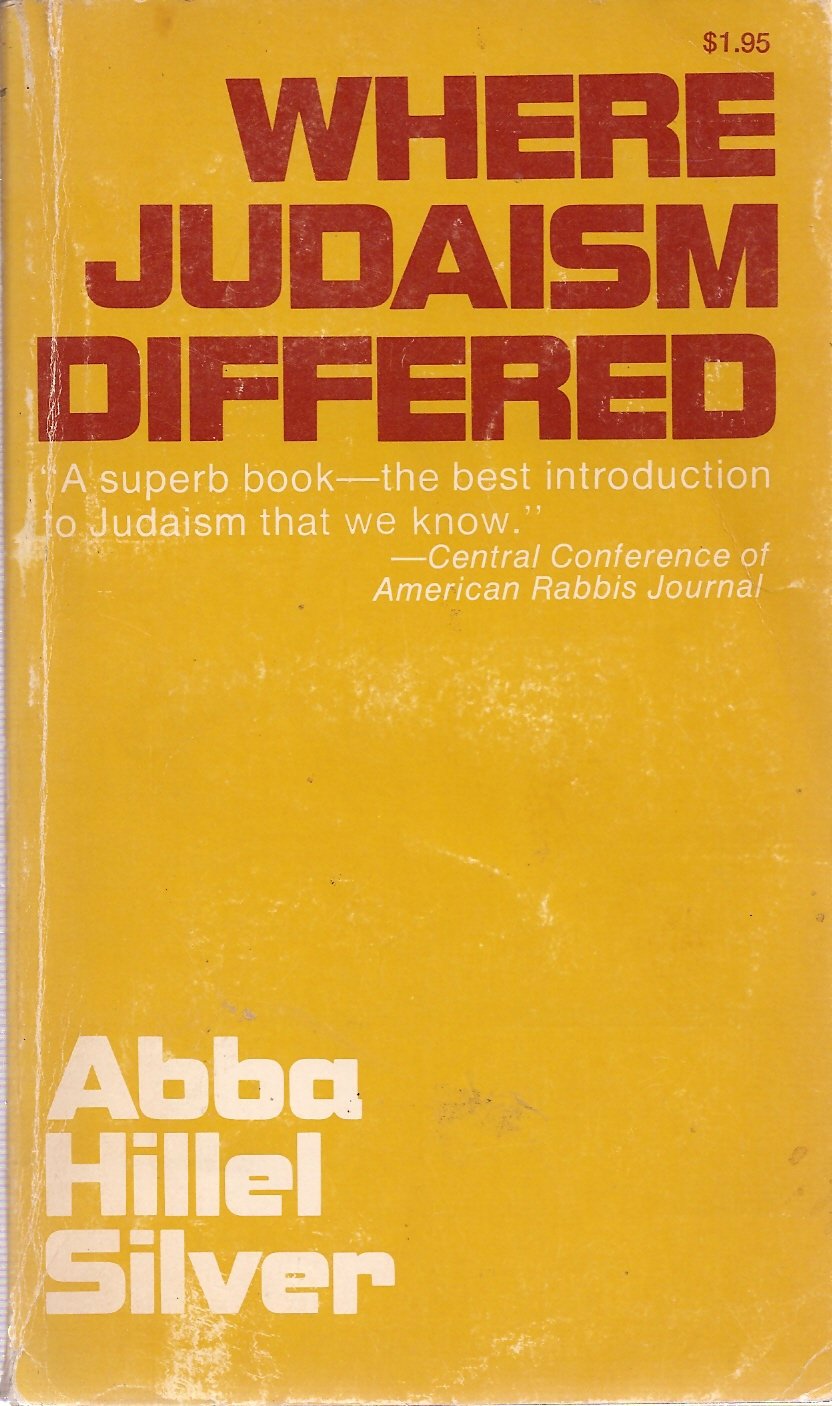
Before I continue my series on Rabbi Eliezer Melamed and post his views of Christianity and other religions, I will take a digression and present on the classic book by Rabbi Abba Hillel Silver, Where Judaism Differed (Macmillan, 1958). Rabbi Silver (d. 1963) was a renowned Reform Rabbi, a prolific author, orator, American Zionist leader, and fundraiser for the new state.. His most famous book, Where Judaism Differed, explained how Judaism is different from Christianity and other religions. The book was a pillar of the thinking of American Jewry. Whenever I explain my interfaith work to an older generation or explain what I am writing, I inevitably receive some form of  Silver’s words in response. I teach in a program in Jewish Christian Studies, so I know there are hundreds of better books, yet Silver’s ideas that Judaism is completely the opposite of other religions still percolate in the writings of other authors such as Rabbi Yitz Greenberg or in sermons from all denominations, or are found on social media, hence these ideas are often the basis for much in ChatGPT. (We also have the opposite on ChatGPT that Judaism and Christianity share Biblical values, the commandments, and the Golden Rule.)

In short, Silver assumes that whatever Christianity teaches, Judaism is the opposite. According to Silver, Christianity is elite, and Judaism is democratic. Christianity is about sin and salvation; Judaism has no concern with sin and salvation. Christianity is ascetic, Judaism is not. Christianity is mythic and magical; Judaism is not. Christianity assumes that all is predetermined without free will, and Judaism offers free will and social progress. Christianity advocates celibacy, Judaism does not.

Original Cover 1956

Christianity accepts a Trinity, Original Sin, Incarnation, a personal messiah, miracles, redemption through God, a virgin birth, and the need for salvation of the soul. Judaism rejects these concepts and every theological idea in Christianity. Christianity is a mystery religion, while in Judaism, “the moral life and the aspirations of man are the “sacraments: of Judaism.” (210) Christianity is otherworldly and concerned for the afterlife; Judaism has no interest in eschatology.

Christianity and Islam, in Silver’s view, wanted to be free from the law, meaning to break free from ethics and morals. (Hence, Rabbi David Novak had to pen an essay explaining to Jews that Christianity is not antinomian).

In his words, only Judaism of all the religions of the world believes in human progress. (171).  Only Judaism is kind to the poor, teaches humility, and has reverence for human life as shown in his comparisons to Roman Latin authors.   

Silver paints the other religions in terms of their most monastic other-worldly forms and he is especially negative toward Hinduism and Buddhism seeing them as world denying, ascetic, and having little to teach. They are fatalistic and life is predetermined; this is his explanation of karma. These Dharmic religions are pessimistic, focus on suffering, and afflicting the body. He credits Christianity and Islam with many of these same negative attributes. (Once should compare Rabbi Kook’s fascinating correspondence with Rabbi Shmuel Alexandrov for a sharp contrast, in which the Russian rabbis have positive appreciation of Buddhism). He paints the Asian religions as lacking any moral teachings. Needless to say, this is an entirely erroneous characterization. I do not need to show that they have extensive teachings on ethics, family life, forgiveness, correct speech, correct actions, and working on personal virtue.  

Silver paints Judaism as engaged in a continuous historic battle against idolatry, idolatrous Canaanites, against Hellenism, against ancient paganism, against Christianity, which for him is really just part of the synthesis with pagan Greco-Roman world, and against the otherworldly pagan Calvinists of our own time. In contrast, Judaism teaches sober morality, personal piety, and the “prophetic tradition of social progress”!!!! (85) This reading of Jewish history was canonized by Heinrich Graetz in his 19th-century classic History of the Jews and the reading of Christianity as Greco-Roman, not Judaic, was the definitive position of the German theologian Adolf von Harnack. Silver cites the historian George Foot Moore’s Judaism in the First Centuries of the Christian Era, but only seems to take from it that Judaism and God-fearers were  “waging war with great energy against polytheism and idolatry.”

The book also typifies a Jewish trend of creating false historical genealogies crediting many aspects of Christianity to pagan influence. In 2025, I still see on social media, by people who should know better, the acceptance of the statement that Christmas Trees are from Roman paganism, a false statement, the earliest possible record is the 15th century, or that Easter/Pascha has anything to do with Ishtar.

In the end for Silver, Judaism is a pure ethical monotheism that is unique in believing in human progress. In the background of this, one hears echoes of Hermann Cohen’s views of Judaism as a unique monotheism striving toward messianic social progress but adapted for the popular pulpit. Judaism is the only religion not death-obsessed or about self-effacement, but rather affirming human progress.

The late 20th century popular Jewish maxims that Judaism does not engage with theology or have any theology, let this book linger long in people’s conceptions. Popular ideas that Judaism has no afterlife or eschatology dovetail with this book. I lose any ability to engage with the content of Rabbinic Judaism, midrash, Aggadah, kabbalah, or even medieval Jewish philosophy. Judaism is an abstraction and defined by negation of others. There is no message of the High Holy Days, the three festivals, Chanukah, prayer, or Jewish life.

To his credit, Silver was responding to several prior decades of liberal Jewish rabbis proclaiming that Judaism and Christianity taught a common universal message of prophetic ethics. However, his solution was to negate every idea of Christianity as the definition of where Judaism differed, without offering any serious positive theology of Judaism. Basically, being Jewish means rejecting a Christmas tree and every positive Christian value. The book was written in a different era, it was before Vatican II’s Nostra Aetate, and he was formed in the heyday of social progress of the first half of the 20th century.

A recent book on religious polemics portrays Silver as driven by the need for apologetics, to stem the tide of Jewish self-hatred, to respond to the stereotypes about Jews. (Jay Newman, Competition in Religious Life, 92). Silver’s work is “vitalized by the exaggeration and caricature that characterizes almost all apologetic works.” He excuses Judaism from all its weaknesses and finds the worst in other religions. He violates one of the prime directives in interfaith comparisons: Do not compare your best to their worst.

At the time of its release in 1956, the New York Times reviewed the book with praise for showing that Judaism is different than Christianity. The CCAR proclaimed that “the best introduction to Judaism that we know.” While a more cautious Felix A Levy, a Reform rabbi, praised the book as a new apologetic Hizzuk Emunah, referring to the 16th-century apologetic work by Isaac Troki, but faults him for leaving out revelation and halakha.

On the other hand, Lou H. Silverman, Professor of Jewish Literature and Thought at Vanderbilt University, in a 1958 review, faulted the book sharply for reducing Judaism to oppositional negation. Judaism is defined as not Pauline Christianity, but we do not learn at all how Rabbinic, philosophic, and mystical Judaism understood the same issues. Silverman opines that the book fails to do full justice to the texture of the tradition.

Silverman points out that the Jewish prayer book in any version is about God having sin, God’s mercy on us, and forgiving us. To say that Judaism has no sense of superiority or racial thinking and is the only universal religion rubs Silverman the wrong way. He points out that the Reform Union Prayer Book referred to the Jewish race until 1933 and it took until 1945 to remove the racial elements.  Silverman as an exclamation, asks: Where is Yehudah Halevi, Franz Rosenzweig? Silverman asks: when Silver states that a concern with “eschatology represented a sharp deviation from Classical Judaism,” what does that even mean? Silverman notes that Silver certainly excludes explicit Rabbinic concerns. Silverman ends his review by wishing that Silver had written a confessional, mature statement of his beliefs as a Reform Jew, rather than just presenting Judaism as the negation of Christianity.

Msgr John M. Oesterreicher of the Institute of Judeo-Christian Studies at Seton Hall University wrote a nine-page negative review of the book. At the time, Oesterreicher was editing a journal called The Bridge which looked at similarities and differences between Judaism and Christianity, and was already working on the 1961 “Decree on the Jews” (Decretum de Iudaeis), which is considered the first draft of Nostra Aetate.

Oesterreicher points out that Silver removes any sense of the word of God or God’s call to Abraham, or Sinai, replacing those ideas with a prophetic Jewish religious genius and ideas that we follow Judaism as utilitarian, “opportune and useful for life.” He is especially irked that Silver refers to God as a due to the Jewish genius created the universal God idea, which Oesterreicher considers “not part of the truly Jewish vocabulary.”

Oesterreicher declares that “the light in Rabbi Silver’s book is not the light of scripture” and that he is at variance with Jewish tradition. For example, neither the Hebrew Bible nor Rabbinic texts see sin as degrading; rather, they have full theologies of sin, repentance, and atonement. (This is like Silverman’s critique above that you cannot state that Judaism has no eschatology). He also notes that Silver is against mysticism and mischaracterizes both Western and Eastern mysticism.

Oesterreicher obviously thinks Silver misreads and mischaracterizes Jesus, Paul, the New Testament, and Christian teachings in many places.  For example, the Sermon on the Mount is clearly rabbinic in context and not to be relegated to foreign “Greco-oriental” values. Silver psychologizes Jesus’ disciples as unable to admit their teacher was arrested and killed so they go into psychological denial, delusion, and imagine him as still alive. Silver shows no knowledge of Jewish memra theology or the variety of first-century Jewish ideas.

In conclusion, Oesterreicher agrees that Judaism and Christianity are different and cites Silver approvingly that “to gloss over differences as a gesture of goodwill is a superficial act” (289) But that does not mean they are opposites. Rather, Oesterreicher ends by saying that the discussion of similarities and differences should be pursued with an “Untiring, even painfully, open eye.”
The digitized American Jewish Archives preserve the letters that Silver received from publishers about his book. Harper and Bros rejected it based on Reviewer #2. Simon and Shuster rejected it  with a long letter including the following paragraph:

The third point is, I fear, a more sensitive one, but perhaps it would be best for our mutual understanding to state it baldly. All of us have been somewhat troubled throughout the book by the invidious comparisons of Christianity with Judaism. Enduring spiritual values, I feel, are self-demonstrative; they do not need to be singled out and lauded at the expense of something else. I realize that such comparisons have an enormous controversial value, but I also feel that they have the final effect of weakening your rich, positive statements, or detracting from the dignity of a great tradition. It is for this reason, as well as for the reason that such invidious comparisons may offend and repel people of other faiths, that I venture to suggest that you reconsider them.

In the end, Macmillan published it as written. But before publication, Silver had his friend   Ludwig Lewisohn read the manuscript to offer comments. Ludwig Lewisohn (1882–1955), was a novelist, outspoken critic of Jewish assimilation, and a founding faculty member of Brandeis University.

Lewisohn flags the book’s thesis that history “manifests a clear upward movement in human development,” noting that this “seems to me violently contrary to historic experience and to negate by implication the special redemptive function or the Jewish people and the meaning of its martyrdom. I do not like to see concepts like “development” and “progress” applied to Jewish history. Unless we died for the eternal Law, what did we die for?” This defense of Western liberalization (so-called) has been totally invalidated by history. After the Holocaust, pre-war optimism seemed misguided.

Also noted is that Silver credits anything he does not like in Judaism to outside influences. Lewisohn writes: “Too much importance attached to the theories of Babylonian influences, etc. These are all grounded in malice, conscious or not, and the desire to eliminate the reproach of Judaism’s uniqueness.”

Once interesting observation from the book “Here, my eye catches one of those usages that lower tone. “Judaism has little sympathy with the spiritual lone wolf.” (138) That’s a screaming incongruity–like chalk scratching on a blackboard. And were not the prophets lonely and hence embattled souls?”

Lewisohn does not want to reject the spiritual and theological teaching of Judaism just to engage in negations. Lewisohn rejects the sharp contrast with Christianity

Of course. “original sin” in the Augustinian sense is nonsense. But does not Judaism, too, recognize deeply man’s rebellion against God? Is not therefore teshuvah the end and aim of life. And does not the classical liturgy make it clear that we need God’s grace–vayihi razon milfanecba. I’m frightened for the nobility and inwardness of Judaism when these things are stated after this fashion.

I’m sorry. I think the notion of “progress” in that sense –social progress without inner change-is totally discredited and Jews and Judaism will discredit themselves by clinging to it… The essence of the whole matter is in the Alenu. Progress means obedience to God’s Law and abstention from idolatry–of man, of State, of all the idols or the market-place. And that, thank God, is Judaism.

In conclusion, we are now blessed with sixty-five years of work showing the similarities and differences between Judaism and Christianity. We have fine works on the New Testament, Patristics, Rabbinic, medieval philosophy, and modern thought. No one would write like Abba Hillel Silver anymore. But the influence of this book remains vast in common understandings. I am still greeted with citations of this work. And if you want to judge the knowledge of Christianity by contemporary rabbis and Jewish thinkers, or the recent works showing a more open approach, the benchmark was already set low.  So judge them, in this context.

Korach & Moses’ Meritocracy

Guest Post by Rabbi Avraham Bronstein
Rabbi Bronstein serves as North American Development Executive for Ohr Torah Stone. From 2006-2011 he was Associate Rabbi of The Hampton Synagogue. He tweets at @AvBronstein and launched a new blog, cloudpulpit.wordpress.com, where the following is cross-posted.

This is an adaptation of a sermon I delivered last week at a modern orthodox synagogue in the greater NY area. It is reworked slightly to include some material from other discussions and talks from Shabbat and beyond, and also eliminates some of the sermon filler. In conversation, I found that many people saw Korach as a sort of spiritual socialist, sort of a classic cold-war era sermon topic. I tried to make the discussion more contemporary.

Imagine a nation run as a meritocracy, where leaders rose to the top as they proved that they were brighter, more motivated, more assertive — true “leaders,” in every sense of the word. Things started well – there was a period of rapid growth and development, and everyone seemed to be sharing the rewards of the superior decisions and leadership that were coming from what was, by now, a trusted elite. Then, from out of the blue, something went very wrong. The leadership made a terrible collecive mistake, an epic misjudgment so out of line that the people assume they were collectively guilty of criminal negligence, if not outright corruption. As the grim, full reality of the disaster sets in, it becomes clear that all of the previous gains have essentially been erased, and the whole generation itself will go down in history as a wasted one.

Now imagine that, through it all, the meritocracy remains intact. The same leaders remain in charge, demanding the same levels of trust and of faith as though nothing had happened, with no effective safeguards in place to keep it from happening again. We would naturally expect the rise of popular movements to voice the people’s loss of confidence in the failed status quo. The truth is that this scenario actually happens quite often. In 2010, their motto was, “Don’t tread on me.” In 2011, they chanted, “We are the 99%.” And in last week’s Torah Portion it was Korach challenging Moses, insisting that “the entire community is holy, and God rests among them, so why do you lord yourself over the congregation of God?”

Continue reading

Walter Brueggemann (more Kugel and Criticism)

Walter Brueggemann is the William Marcellus McPheeters Professor of Old Testament at Columbia Theological Seminary in Decatur, Georgia
He has devoted his life to a passionate exploration of Old Testament theology, with an emphasis on the relation between the Old Testament and the Christian canonical works, and the dynamics of Jewish-Christian interactions. He has published more than 59 books.

Brueggermann criticizes Brevards Childs as being too Christian and not pluralistic enough (Jon Levenson in turn uses the same arguments on Brueggermann). Walter Brueggemann is the standard mainline Protestant approach. He is the Reverend Lovejoy not the Ned Flanders. He is the standard approach now in seminaries that locating meaning in Documentary History is so 19th century skepticism and positivism, on the other hand he rejects fundamentalism or apologetics as anti-intellectual and repressive. Does he have anything to teach about moving beyond the false dichotomy?
He thinks history removes the theological sense of the text. We lose God and Sinai with criticism. We also cannot create an ethical approach with historical criticism. He is also willing to question parts of historical criticism. But on the other hand, he questions the fundamentalist approach as more concerned with external dogma and affirming an external event rather than accepting the revelation of the text.

Passages from: Brueggemann, Walter. Theology of the Old Testament: Testimony, Dispute, Advocacy. Fortress Press: Minneapolis, 1997. (pp.726-29) Old Testament Theology in Relation to Historical Criticism

No doubt Brevard Childs is correct in his contention that the relationship between Old Testament theology and historical criticism is of crucial importance to any advance in Old Testament theology. Thus I take it as a truism that Old Testament theological interpretation must be seriously engaged with criticism, and any serious student of Old Testament theology cannot retreat into a “safe” fideism because he or she fears the results of critical inquiry.

The conclusion to which I am drawn is that the enormous apparatus of high historical criticism that reached its zenith in the nineteenth century and continued its dominance well into the twentieth century is not, in the first instant, of primary relevance to theological exposition at the end of the twentieth century. By such a conclusion, I do not intend any appeal to an anti-intellectual fideism; I appeal rather to criticism that is congruent in the two ways suggested. In drawing this conclusion, I only reflect what in practice has turned out to be the case for a great number of responsible scholars at the present moment, namely, that scholars have moved well beyond the critical categories that have come to represent historical criticism.

In my judgment, historical criticism (by which I shall refer to the entire Enlightenment enterprise that came to be associated with Julius Wellhausen and that now seems to reappear as neo-Wellhausianism) was committed to a Cartesian program that was hostile (in effect if not in intention) to the main theological claims of the text.

Thus what is required in a new, antipositivistic intellectual climate is a criticism that is not thinly positivistic, but that is open to the density of social and rhetorical processes that generate social reality beyond our “realism.”
I suggest that in a new settlement still to be worked out between criticism and interpretation

Serious energy needs to be given to discern what of the older historical criticism is to be retained and how it is to be used. There is much in the history of the literature and perhaps in the history of religion that still needs to be valued, even though almost every old “consensus” opinion is now under heavy assault. The challenge in retaining learning from the older historical criticism is to do so without a hidden commitment to the theological skepticism that seemed endlessly to accompany that criticism, but was not a necessary part of a critical perspective. There may be a place for skepticism, but it should be explicit along with its grounds, and not surreptitiously taken along with critical judgment.

The real issue in the relationship between interpretation and criticism is to be aware that fideism and skepticism are twin temptations, and that criticism is an effort to be thoughtful in a way that does not permit fideism and that does not require skepticism. In much “scientific” study of the Old Testament, it is generally assumed that skepticism is much more intellectually respectable than is fideism. With the demise of positivism, that unstated but widespread assumption might well be reconsidered. Skepticism, often voiced as hostility to theological claim, is in fact not a given element in responsible intellectual inquiry. What passes for uncommitted objectivity in Old Testament study, moreover, is often a thinly veiled personal hostility to religious authority, which is displaced on the interpretive task as though such hostility is an intellectual virtue. No doubt an oppressive fideism and a hostile skepticism endlessly evoke and feed each other. We may now be at a moment when totalizing fideism is exposed as inadequate and when skeptical positivism is seen to be equally inadequate, when a genuinely thoughtful criticism can engage the density and depth of the text, which is available neither to fideism nor to skepticism.

Or a more technical plea to look at the text and not behind the text. The social world of a text does not explain the meaning of a text. For example, the social world of the Talmud does not explain the logic and meaning of the Gemara.

A mere excavating of the social world behind the text, as if the text, itself, did not enter into the social construction of reality and provide an alternative “social” world of negotiation and definition, is a species of positivist reductionism. As Clifford Geertz once argued, this short-circuits the autonomous process of symbolic formulation. Geertz claims that such symbolic reductionism usually stems from theories whose “psychology is too anemic and whose sociology is too muscular” (Geertz 1973: 202). How what is said is crucial to what is said.

The Old Testament scholar, Walter Brueggemann, has recently eloquently argued that rhetorical criticism is an indispensable complement in biblical studies to sociological analysis. Echoing Geertz’s strictures, he deplores forms of historical criticism (of which the sociology of the Bible is a sub-set) which explain away literary cunning such that “what is interesting and dense in the text has been often forfeited” (Brueggeman 1997: 103). As he puts it, historical criticism “runs the risk that the methods and assumptions to which it is committed may miss the primary intentionality of the text” (Brueggemann 1997: 104).

Brueggermann reviewed James Kugel’s 2003 The God of Old: Inside the Lost World of the Bible and thought that Kugel agreed with his seeking theological meaning as more important than history. But Kugel’s recent book sings a different song.

On the other hand, Kugel refers to “The Project” by which he seems to mean a theological investigation into the “realness of things” that lies deep beneath the appearances that are so taken for granted among us: “They [the texts] can indeed come back to life, and their world, their way of seeing, can let us in to take the measure of things that are strange” (p. 3). At the end, Kugel concludes: “It is important to glimpse how things once were otherwise; certainly we then may better understand where the present came from. And perhaps also for another reason, somewhat more sublime: to remember that that ‘otherwise’ is, for all that has intervened, not unrelated to what exists in the fullest reality of today” (p. 199).
Thus in the most restrained and almost whimsical way, Kugel’s ultimate concern is not historical but contemporary.

So what can be used from Brueggermann for an Orthodox approach? What cannot be used?
(Since my proportion of hits to the blog compared to click to links is so small, less than 1/100, I left the links out).

Reb Yudel on Kugel or Kugel #2

Since nobody had any clarifying comments on the Kugel post and it just got 600 hits in a day, let’s try a different approach.
Here was one of the useful comments by Reb Yudel- any thoughts for an Orthodoxy?

1] How much history are you willing to give up to make a usable Torah both critical and as Talmud Torah?

I’m certainly willing to give up the scholarly agnosticism over things that are unknown and cannot be proven. Kugel ignores redactional history, presumably because it’s all hypothetical. I’m willing to assume a redactor, and throw R into the mix. I’m willing to assume that J played a redactorial role, collating and creating etiological folk tales. As a result, I can preach the moral growth of Judah, as cited by Sommers. Talmud Torah, unlike academia, does not require absolute proof.

> 2] How much are you willing to defend an ethical message in the Bible despite historical origins?

That’s really the wrong question. The real question is, when did Modern Orthodoxy decide that Torah was ethical (and then why did it more recently renounce that view)? I don’t want unethical texts taught to my children, regardless of whether they were composed in the Iron Age or the Ipod Age. If Kugel makes it easier to remove Joshua from the 4th grade curriculum, so much the better.

(There’s a related question: When did Modern Orthodoxy abandon Hazal in favor of literary pshat? Why does Rashi’s division of characters into Righteous and Evil (following Hazal, of course) seem less appealing than the grays of literary analysis peshat?)

3] What needs to be added to Sommers to make it useful for Orthodoxy?

I don’t think Orthodoxy — which we can now define as the portion of Judaism which rejects the ordination of women — is impacted by any epistemology of Torah other than that which attributes absolute Divine Revelation to its current leadership. (Sort of like Mormonism, except without the transparency). Grant Daas Torah, and then the whole thing works.

For Conservative Judaism, which took the claims of academic Rabbinic scholarship as a lesson in the plasticity of Rabbinic halacha, the Sommers approach works fine: Torah SheBaal Peh simply goes back to [the putative date of] Sinai, to the tales and ballads that accompanied the evolution of our people.

As you say, Kugel is not a theologian, and his final chapter is weak: It simply peters out. Had he simply said, “I believe that part of my service to God is by following the tradition of my ancestor, and looking to the sacred anthology of Iron Age documents for meaning, knowing that the process of that search will itself create meaning” — he could have opened a door for a certain liberal Orthodoxy. Unfortunately, Kugel evinces no awareness of Talmud Torah as practiced around the Shabbos table or in the classroom..

Brevard Childs

Apropos to the Kugel discussion- Here are some quotes from Brevard Childs who was at Yale from the 1960’s until the 1990’s. Childs treats the Bible as a Christian work through the eyes of the Church even as he uses Biblical criticism. His approach is called “canonical criticism” is “an examination of the final form of the text as a totality, as well as the process leading to it.” “Whereas previous criticism asked questions about the origins, structure and history of the text, canonical criticism addresses questions of meaning, both for the community (and communities – subsequent communities are regarded as being as important as the original community for which it was produced) which used it, and in the context of the wider canon of which it forms a part.”
Childs was criticized on both sides – by Biblical scholars who wanted the text to remain in its bronze age meaning or documentary meaning and by fundamentalists who rejected any criticism. I am not advocating Childs’ approach, I repeat I am not advocating Childs’ theories. I am posting this as a sense of what most non-Jewish Bible professors that I know had to read in graduate school and it served as a basis for any further thinking they did on the topic. It also serves as a basis for many of the readings in an undergraduate Bible course. Many introductory courses try to show continuity with the tradition.

Childs’ approach influenced Levenson, Fishbane, and other Jewish scholars who read the Bible with the Second temple and Rabbinic commentary, who look for intertextuality within the Bible itself, and treat the Bible as a Jewish work. The Jewish authors developed their own approaches but Childs is one of the many building blocks. Maybe I might post on some of the other building blocks. And as Benjamin Sommers pointed out – for many people Kugel’s book The Bible As It Was – his book on Midrash was taken as an extension of Brevard Childs.

Brevard S. Childs is author of Biblical Theology in Crisis, and The Book of Exodus and Isaiah
CHILDS: I have always objected to the term “canon(ical) criticism” as a suitable description of my approach. I do not envision my approach as involving a new critical methodology analogous to literary, form, or redactional criticism. Rather, the crucial issue turns on one’s initial evaluation of the nature of the biblical text being studied. By defining one’s task as an understanding of the Bible as the sacred Scriptures of the church, one establishes from the outset the context and point-of-standing of the reader within the received tradition of a community of faith and practice. Likewise, Scripture is also confessed to be the vehicle of God’s self-disclosure which continues to confront the church and the world in a living fashion. In sum, its content is not merely a literary deposit moored in the past, but a living and active text addressing each new generation of believer, both Jew and Christian.

Childs accepts a unified approach without separate documents and looks for intertextuality. He sees the text as having a revelatory message from God. Notice his description of the human and divine elements and his definition of revelation. Later parts of the Bible were already hearing fresh insights into God’s prior words. It is quite Christian but it was still influential on Jews. Notice the subtlety of his view of revelation. On needs to hear a powerful theological message from the Bible.

Of course, the Bible is also a human work written as a testimony to God’s coercion of a historical people, and extended and developed through generations of Israel’s wrestling with its God. The goals of interpretation can be defined in countless different ways, but for those confessing its role as sacred Scripture the goal is to penetrate deeply into its content, to be illuminated theologically by its Word, and to be shaped and transformed by its gracious disclosure which witness is continually made alive by its divine communicator.
The divine and human dimensions of Scripture can never be separated as if there were a kernel and a husk, but the heart of the Bible lies in the mystery of how a fully time-conditioned writing, written by fragile human authors, can continually become the means of hearing the very Word of God, fresh and powerful, to recipients open to faithful response.
First, I remain deeply concerned with the unity of the book which, I agree, cannot be formulated in terms of a single authorship.
Secondly, one of the most important recent insights has been the recognition of the role of intertextuality. The growth of the larger composition has often been shaped by the use of a conscious resonance with a previous core of oral and written texts. The great theological significance is that intertextuality reveals how the editors conceived of their task as forming a chorus of different voices and fresh interpretations, but all addressing in different ways, and in different ages a part of the selfsame, truthful witness to God’s salvific purpose for his people.

Taken from Brevard Childs’ Old Testament Theology in a Canonical Context.

If one asks what was God’s purpose, that is, his motivation in revealing himself, the Old Testament is silent. However, if one asks what was God’s purpose, that is, his goal toward which his self-disclosure pointed, then the Old Testament is eloquent in its response. God revealed himself that all may see and know who God is:

Any thoughts? What would you take from this? Why?

Critique of Kugel #1

“Open my eyes so that I may see wonders of Your Torah” (Psalms 119).

I have a few observations on Kugel’s book that I have not written up because I expected someone to get there first. But neither the Orthodox or Conservative critics went in this direction. I knew people were writing reviews so I naturally assumed they would cover these points. I am not writing from the perspective of a Biblical scholar but as a theologian. I am not looking to reiterate what has been said already but I also cannot guarantee that I have seen everything out there on the web. I write this as notes for a first draft of a summer essay, so I am willing to correct anything that is overstated in this contextual understanding.

When Kugel’s book first came out, it was reviewed by the NYT (David Plotz Sept 16, 2007) as having rejected literalism and that “He also seeks a safe haven for rationalist believers. In other words, having broken all the windows, trashed the bedroom, stripped the wires for copper, sold the plumbing for scrap, and jackhammered into the foundation, Kugel proposes to move back into his Bible house.” Well, look at this review. The New York Times does not have a problem with the documentary hypothesis and it rejoices in daring works like the Book of J. So why was Kugel seen as trashing and stripping the Biblical house? My major point is that Biblical criticism is not the message of Kugel. And the problem with Kugel is not per se, the Biblical criticism. The problem is loss of the Biblical enterprise. Yes, the book is an important book and a great read. But I do not think that the critics of his work and looking at the right aspects.

1] Kugel’s concern with the possible Iron Age meanings and his not seeing any moral teaching in the Bible has little to do with the documentary hypothesis. One finds similar statements of the lack of morality in the Bible in Voltaire and other 17th-18th critics of the Bible as well as by early 20th century free thinkers who wrote books with titles like “The Bible Unmasked,” which showed the immorality of the Bible. Many of Kugel’s readings that Sommers argued against are offensive even without any Biblical criticism or separate documents.

2] For Kugel, the Bible has no moral lessons or theological ideals. He has a materialistic skeptical sound to him. There are no grand ideals or religious claims in the Bible. Contradiction and parallel texts in the text do not teach anything. Kugel’s position at this point is similar to Freidrich Delitzsch in “Babel and Bible”. Delitzsch maintained that many Old Testament writings were borrowed from ancient Babylonian tales, there is no unique ethical message or religious message. In fact, the Bible needs to be unmasked as immoral. Delitisch was the rare voice that the Bible has nothing to teach theologically and should be treated as part of Babylonian and Canaanite religion. In later years, Deliitsch saw Christianity as the moral solution, so those parts of his thought are not to be impugned to Kugel, but the implication of ancient near east parallels is similar. I do not think he is as extreme as Delizsch, but he is heading in that direction.

2] In the context of Kugel’s writings I am surprised that no one mentioned Peter Enns, a student of Kugel, was dismissed from Westminster Theological Seminary. The problem at a Protestant seminary was not the human element or the weak theories of revelation. Enns however even quotes and accepts, the anti-documentary hypothesis works like Kenneth Kitchen. The problem was that Enns says that the morality of the Bible is that of the Iron Age. He advocates accepting the moral critiques of the new atheists – that the Bible is not a moral exemplar. Kugel’s method takes the sanctity out of the Bible. There is something very skeptical about the method. Furthermore, Biblical texts are depicted as not knowing the original meaning of a story. The human part of the Bible is all too human. So human that it strips the ability for a more theological-literary-document reading. I am surprised that the Enns debate did not come up in the discussion of Kugel.

3] Why did the Introduction to Bible written by Marc Brettler not create the same stir? Why did Jon Levenson’s work create the same buzz. Both use Biblical critical methods, and both were in the broad sense of Orthodox culture. The answer is that there is a skeptical voice in Kugel. Brettler concludes his book that the Bible is great. He writes that he likes the Bible and here is how we moderns use Biblical criticism. Levenson sees the Bible as teaching Torah and mizvot, a covenant at Sinai and the giving of the land of Israel. Kugel’s tone is bursting myths and slaughtering sacred cows. Kugel reads more like Freud’s Totem and Taboo.

In his recent post, Kugel’s clarified his position from his earlier response. Kugel rejects all of the prior Jewish names in the field who use theological, integrationist, and canonical methods.. Certainly Kaufman, Sarna and Greenberg who were more theological about the virtues of Biblical religion over the pagans may be too theological. But also integrationists, that seek to combine the best of both worlds- Weinfeld, Zakovitch, Milgram, Knohl, Tigay, Fishbane, Levenson, and most other professors with whom Jews do graduate work- are too theological. Kugel has a clear disjunctive between the Bible and the Scribes of the Oral Law. There is no integration of the critical and the traditional. Kugel denies any attempt at synthesis or integration. Many of Kugel’s readers mistakenly thought that since the integrationists used Kugel’s work on Second temple period interpretation to justify their own integration of the Bible and the interpretation that Kugel would agree.

4] The Bible as the sacred scripture of Judaism in a canon needs to be seen as special, as moral, and as a religious guide. Those who reject that are usually skeptics not Biblical critics. The four qualities of later Biblical interpretation are usually assigned as qualities of the Biblical documents themselves. These four points (1) The texts are cryptic and symbolic. (2) The texts are prophetic and homiletic. (3) The texts are consistent. (4) The texts are divinely inspired/given. Most of the Jewish scholars who see Biblical criticism and the documentary hypothesis as helpful also assume that the Biblical authors themselves already ascribe those qualities to earlier Biblical material. They study topics like Intertextuality and literary prophecy that assume these points.

5] In addition, Kugel rejects literary approaches to the Bible. Already in his work on the Biblical Poetry, he presented literary methods as a modern construct based on human subjectivity having little in common with a fixed Divine meaning. Kugel based himself on Herder studies of the primitive Hebrew approach. Since Kugel’s own doctorate is in modern literary criticism and his immense sensitivity to the literary voice of a text, many people mistakenly thought he was an advocate of literary approaches to the Bible. Most scholars not only find the Bible a great work, but also the epic of Gilgamesh is fine literature. Kugel’s rejection of literary methods is the innovation, not his use of Biblical criticism.

5] The last chapter on the potential for revelation did not alleviate anything because it did not understand revelation. Theories of revelation answer how a Divine can reveal in a naturalistic order. But acceptance of revelation is not pixie dust to magically wave over a human document. Traditional theories of revelation assume a Divine in the content – that there must be a supreme content greater than other books, a verbal content, a historical transformative content or an experiential moment of communion with God. Even the most liberal Protestant theories of revelation such as Tillich assumes that the Bible is not counter to reason, rather the Bible is revelation since it offers answers to our ultimate concerns and presents models of highest ideals. For Tillich, it may be written by humans but the revelation is the model of our highest ideals. One cannot treat the Bible as primitive and then call it revelation. Revelation must transcend its context. For Rosenzweig, revelation is our love relationship with God that transcends our finitude and teaches us that “love is stronger than death.”

6] Most scholars who teach the Akkadian documents and archeology together with the Bible call themselves scholars of “Israelite Religion.” They do see a disjunctive between Israelite religion and later Judaism but they in turn respect their boundaries and do not offer up advice on Judaism or the Hebrew Bible.

I am not sure if this is completely analogous but those who teach Icelandic sagas and their use in English literature are not considered Shakespearean scholars.

7] Finally, to return to the NYT article. If one is unmasking the Bible then one is not teaching how to read it and if one is teaching the Bible then it is within a context of history, theology, and culture- from liberal to fundamentalist. The NYT called out that he wants to be both skeptic and defender of the Bible in the same breath.

Another question: why did this book wake up Orthodoxy from their dogmatic slumbers more than other works? Why are Orthodox still interested in the book?

1] It could be that just be that he speaks in Orthodox synagogues whereas Levenson and Knohl do not.

2] Or it could be that Kugel is tapping into a skeptical streak in the community, that appreciates his message. An audience with an inner skeptical voice that does not know or have patience with liberal theology. His slaughtering of sacred cows is the zero sum dichotomy that the community understands.

3] Another element is that since Modern Orthodox intellectual types have not read Brevard Childs, Fishbane, Levenson, or most canonical approaches defended by Ben Sommers, Kugel is closer to what they think is over on the heretic side. Kinda like the Chussid who goes off the derekh and eats in McDonalds but never considers Modern Orthodoxy. The Modern Orthodox who gets tied up in Biblical criticism does not consider liberal approaches but wants the skeptical approach.

4] It could just be another parallel with the evangelical world that is now trying to open up to Biblical criticism
See Kenton Sparks, God’s Word in Human Words
Enns, Sparks and the others all have blogs and post on each others blogs

5] It could be that Kugel’s rejection of literary interpretations hits home. It is right now fashionable in the Modern Orthodox world of educators to think up a novel literary interpretation in a weekend and then return on Monday to the classroom and teach that this novel interpretation is what it always meant, it was the original intention, and QED it solves all critical problems with the text.

6] The attraction could be the radical perspectivism in Kugel’s writing’s. Kugel has the Bible and the Midrashic interpretation as a complete disjunctive. At an AJS – fifteen years ago, may of the elders saw his choice between modern criticism and ancients as somewhat post-modern. Truth is perspectivism Orthodoxy may like his perspectivism. Everyone is entitled to absolute and exclusive non-foundational acceptance of one’s own view.

Even though his reply also mentioned the objective facts of archeology If the goal was irrefutable facts then he should have started with Biblical History and shown the progress away from trusting the Biblical account. Rather, he frames things as “this is the critical perspective.”

7] It could be that since he does not seem to be theologically coherent and his own religious views may be those of his book On Being a Jew Sometimes vague or ambiguous works can generate more heat because everyone can project on it.

8] Finally, this book may be important because Modern Orthodoxy has built up a confidence level that orthodoxy can handle all scholarship or at least has been inoculated to have a rejoinder to all scholarship. This book explicitly shatters the assumptions on which this rests, whereas most books on the Bible just present the critical perspective without needed to reject the Orthodox view.

Any others?

If you comment, please help me think though the issues to a more formal presentation.

I could have loaded this post with links, but I didn’t. I might make them separate posts.

Copyright © 2010 Alan Brill • All Rights Reserved

Kugel responds to his critics again

I am surprised that this is not generating discussion

The current issue of JQR has a critique of Kugel by Benjamin Sommer, “Two Introductions to Scripture: James Kugel and the
Possibility of Biblical Theology,” Sommer advocates an approach like Moshe Greenberg, AJ Heschel, Michael Fishbane, or Jon Levenson and he has sympathies for Mordechai Breuer’s position.
However, Kugel wrote an online response to Sommer, where all the ambiguities about Kugel’s position are finally cleared up. Kugel rejects all of the aforementioned names. Biblical study does not contribute to Judaism or religion. For Kugel, the Bible has no moral lessons or theological ideals. There are no grand ideals or religious claims. Contradiction and parallel texts in the text do not teach anything. And there is a clear disjunctive between the Bible and the Scribes-Oral Law.

Here is the response.