Tag Archives: spirituality

Lurianic Kavvanot: from Vital to Rashash to Zhidichov-Jeremy Tibbetts

What are the Lurianic Kabbalistic intentions? How do Lurianic kavvanot work and how does one read the baroque pictorial notations of a Lurianic siddur? This is a very technical interview, very detailed, geared for those in the know. This is my second interview with Jeremy Tibbetts on Lurianic Kavvanot. It is a continuation of his contribution from 10 months ago introducing the kavvanot in Siddur Torat Chacham, a Siddur Rashash by R. Yitzchak Meir Morgenstern

This great article was written by Jeremy Tibbetts, a rabbi, who is the co-director of OU-JLIC for Anglos in Jerusalem and is the Director of Education for Yavneh, an intercampus leadership program. He is a student at Hebrew University in Jewish Thought, intending to focus on the Rashash and kavanot.

In this introduction, he walks us through the conceptual development of the kavvanot, starting the journey with Rabbi Isaac Luria (The Arizal, 1534-1572) who moved to Safed in 1569, where he lived and taught for three years. In those final years, R. Chaim Vital (1542-1620) learned from him and devoted the rest of his life, spent largely in Damascus, to developing a proper exposition of Lurianic Kabbalah.

A century after Vital died, R. Shalom Shar’abi or the Rashash (1720-1777) head of the Yeshivat Beit El became  a new link in the chain of Lurianic transmission, focusing on divine names and pictorial representations of the kavvanot. In addition, he focused on the immanence of the Eyn Sof in the practice. Finally,  the Hasidic rabbi R. Tzvi Hirsch of Ziditchov or the Ziditchover (1763-1861) focused more on the human experience, more on the human transformation, and how we become transformed into the divine qualities. 

  1. What are kavvanot?

Kavvanot are intentions to concentrate on when reciting the words of prayer or performing commandments (mitzvot). Often they focus on intangible realms and their particularities which are impacted by the kavvanot. The instructions are described in theoretical works or depicted in specialized prayer books. The Kabbalistic worldview hinges on the idea that the devotional mind can change the cosmos and the self at the same time.

Most people do not know about the kavvanot, due to access and accessibility. Regarding the former, the full set of Lurianic writings did not leave the land of Israel for over a century after Vital’s passing. As for the latter, Lurianic Kabbalah is extremely complex. Kavvanot necessitate erudite expertise in it and the ability to apply the most generalized principles and specific details of the system at once. Gershom Scholem considered Lurianic Kabbalah to be one of the most complex systems of thought in existence.

Kavvanot are not meant to undo or replace the simple meaning (pshat) of the supplications of prayer. Though one’s kavvanot take them to other realms, the practice must remain prayer fundamentally for it to work. Kavvanot work on the principle that as one gets to the peak of the experience, the more intentions there are to perform. The amount of kavvanot per word increases dramatically the more one prays.

2. For Hayim Vital, why do kavvanot?

Rabbi Isaac Luria told R. Chaim Vital that his kavvanot should focus on completing the worlds, yet at the same time, Luria understood the positioning of the worlds to directly impact human cognition and comprehension. These two aspects of completing the cosmos and attaining comprehension together are considered the fulfillment of humanity’s purpose.

For Vital, the ultimate outcome of kavvanot is to connect the light of the Infinite (Ein Sof) to our world, and then we need to draw it into vessels that can allow for non-overwhelming contact with infinite divine. Hence, “reducing the light is the ultimate intent of fixing the worlds (tikkun)” (Etz Chaim 9:4).

Kavvanot rectify the shattering of the vessels (shevirat hakeilim), whose broken pieces constitute our imperfect physical and spiritual reality. Our world is fundamentally broken, and as long as we do not do the fixings (tikkunim) necessary to fix it, evil and injustice will remain manifest. The tikkunim create partzufim, an infinite vessel made of ten sefirot which each contain ten sefirot and so on ad infinitum. These vessels, being infinite, can capture the light of the Ein Sof. Repairing these shattered vessels through kavvanot is the necessary prerequisite to making the light of the Ein Sof manifest within them.

This process of rectification followed by revelation also occurs within the individual. One grows spiritually as they perform the kavvanot, even in a semi-literal sense: they can fix and shine the light of holiness into the soul, and in their most idealized form, add completely new layers to it. Vital writes in Sha’ar haGilgulim that “when a righteous individual intends a complete and good intention (kavvanah), they can draw down a new soul” (Sha’ar haGilgulim Hakdamah #6).

There is a synchronicity between the completion of the worlds and of the self because the macrocosmic structure of the worlds and the microcosmic structure of the self mirror and influence each other. The fact that one of the names that Vital gives for the influx of Divine light into the partzufim is consciousness (mochin) is not coincidental. Corresponding to the upper sefirot of Chochmah, Binah, and Da’at, the mochin fill the “heads” of the partzufim before permeating the lower vessels too. As we strengthen and fill the partzufim, there is a direct impact on our consciousness in kind: “all of the forgetfulness that a person has is drawn from these lesser mochin. Whoever can, through their actions, draw them down below [to their proper place] by drawing in the greater mochin which push them… will have wondrous recollection in Torah and will understand the secrets of Torah.” (Etz Chaim 22:3).

This passage describing the interconnection between the ontological level of mochin and the commensurate mental outcomes of drawing them in was already considered extremely consequential in the early reception history of Lurianic writings.

  • 3. For Vital, what is the difference between Intention (kavven) and envision (letzayer)?

Vital states explicitly that “one should intend” (veyikhaven) when describing daily prayer kavvanot. However, in a few places, such as in the intentions for the blessing after meals (birkat hamazon), he deploys a different term: “in the first blessing, from start to finish, envision (yetzayer) before your eyes [the Hebrew letters] aleph, lamed, hey” (Sha’ar haKavvanot Drushei Shabbat Seder Erev Shabbat) For each of the four blessings, one envisions one of the letters of the name ADNY spelled out. Letzayer is extremely uncommon in writings on kavvanot and extremely common in writings on yichudim. Both can be contrasted in Vital’s writings with changes in the worlds which occur without our intention automatically (mimeileh).

Lechaven is a specific type of intention. Vital writes that “you should intend and think in your thoughts” (Sha’ar haKavvanot Drush Kabbalat Shabbat #1). It occurs in the mind. These kavvanot are focused and thought-based but not imagistic. Kavvanah is an applied form of thought.

In normal waking life, thoughts pass in and out of our mind quickly with little perceivable consequence for the world around us. Kavvanot are the practice of taking thought and using it to affect the spiritual worlds like our hands would affect the physical world around us. As one contemporary commentator writes, “one must intend actively, not just think in their thoughts that the matter occurs of its own accord (me’eilav)” (Sha’ar Ruach haKodesh Im Peirush Sha’arei Chaim by R. Chaim Asis, Vol. 2 pg. 561).

The experiential impact from this focused type of kavvanah has two aspects. First, as discussed above, the actual technique of utilizing the focused intentional mind as an experiential component linking between the worlds’ spiritual states and our own cognitive states. One finds oneself at the bottom of a chain of divine illumination.

There is another aspect though, discussed in the recitation of the Kedusha, when many of the tikkunim of the daily prayers have been completed: “When saying ‘the world is filled with God’s glory,’ which is a secret of Malchut, intend [vatechaven] that we are the children of Malchut and we receive holiness from our mother. Therefore, intend to absorb yourself within Malchut to receive the holiness drawn onto her” (Sha’ar haKavvanot Drushei Chazarat HaAmidah #3). The ultimate type of kavvanah is not visual revelation but absorptive transformation. At its peak, one is no longer acting on the worlds as something external but as something internal.

We reclaim our place in the constellation of worlds and “when drawing the supernal holiness to the Blessed One,” one can “draw an aspect of this holiness onto themselves as well… they are sanctified and God is sanctified with them and within them” (ibid.). The focus on fixing the upper realms, in particular the lower partzufim and Malchut above all, is not a blockage to experience but a gateway to experience, a reveling in the intangible effusion of the divine.

  • 4. Are Kavvanot individualized?

Kavvanot must be individualized. Vital writes that he was instructed to intend based on where his “soul is drawn from,” and so he must intend through one kavvanah particularly, and not the others” (Sha’ar haKavvanot Drushei Pesach #11). So too, the practice of meditating on combinations of divine names (yichudim) requires that one intend “according to their soul root” (Sha’ar Ruach haKodesh Yichud #12), expressed by punctuating the names differently.

This elevated type of knowledge, to identify the roots of different people’s souls, is exceedingly rare: R. Chaim Vital records that even great Kabbalists such as the Alshich, R. Eliyahu de Vidas, and Vital himself relied on the Arizal to inform them of their soul’s root. This could be conveyed in very basic terms, as one of the ten sefirot; more complexly as corresponding to a body part of Adam haRishon, who contained all souls in his pre-sin state; or more convoluted still, as part of a chain of prior reincarnations whose challenges in life recur and contour the tikkunim incumbent on them, such as when Vital writes that “the spark of Rabbi Akiva is closest to me out of all, and everything which happened to him happened to me” (Sha’ar haGilgulim Ahavat Shalom ed. pg.157).

In addition, the practice of kavvanot necessitates attention to our situational context and the world outside of us. If we do not pray with people who we are close to and whose challenges in life are understood intimately by us, the Arizal states that our prayers “will not bear fruit” (Sha’ar haKavvanot Drushei Birkot haShachar). Time and locale affect the mystical formulae of kavvanot

  • 5. What is the role of simchah in kavvanot?

Joy (simchah) has a central role in the efficacy of kavvanot. Vital writes at the beginning of Sha’ar haKavvanot Drushei Birkot haShachar that “it is forbidden for one to pray in sadness, and if they do so, then their soul (nefesh) cannot receive the supernal light which is drawn down to them at the time of prayer… the essential benefit and wholeness and attainment of the holy spirit depends on this matter.” One’s emotional state directly affects their soul’s ability to receive divine light.

Vital calls prayer the fulfillment of the mitzvah to “love your neighbor as yourself.” In particular, “if a person has knowledge and comprehension to know and be familiar with their fellow’s soul (neshama), and if there is something that is troubling their fellow, each one must join into their pain.”

6. Explain the three classes of kavvanot: perceptions, illuminations, and tikkunim.

Vital delineates three main classes of kavvanot and yichudim: hasagah (perception), he’arah (illumination), or tikkun. Yichudim of all three of these types are integrated into the practice of kavvanot,

The yichudim “to perceive some perception [hasagah]” (Sha’ar Ruach haKodesh Ahavat Shalom ed. pg. 39) center on a variety of prophetic practices and experiences that one can undergo. For example, these yichudim allow one who “has an awakening due to a soul which speaks with them… and doesn’t have the strength to bring out words from potentiality to actuality” (ibid., pg. 14). In another yichud in this section based on the name of the angel Metatron, Vital proscribes one to “close and shut their eyes and to isolate themselves [titboded] for one hour, and then intend to this yichud” (ibid., pg. 16). This also includes yichudim performed on the graves of righteous individuals to allow for “the cleaving of your soul to their soul” (ibid., pg. 33). At the height of this technique, one intends to sacrifice their soul, “raising up your soul combined with the soul of that righteous one” (ibid., pg. 34). When the hasagot of the Arizal are discussed in this work, they relate to his access to supernatural knowledge, such as the appearing of Hebrew letters on individual’s faces which indicate their merits or iniquities, dream interpretation, or the ability to learn secrets from the chirping of birds and the beating of a person’s heart (ibid., pgs. 51-61).

The second class of yichudim “clarify and illuminate [ta’ir] one’s soul to be a ready vessel to receive the supernal light continuously” (ibid., pg. 39). These yichudim are introduced by discourses on perfecting one’s character traits and ritual observance. These techniques strengthen the connection a person has to their individual soul, such as yichudim in which one contemplates being made in the tzelem Elohim [divine image] and how the body is constructed from divine names (ibid., pgs. 43-44). These yichudim utilize the soul as a bridge to greater experiences of spirituality and sanctity, like  intentions to draw the sanctity of Shabbat into each weekday (ibid., pg. 45).

The  third class “were given to human beings to repent” (ibid., pg. 61) and delineate the cosmic and individual impact of one’s transgressions. In these yichudim, Vital often records both an explanation of the disrepair caused in the worlds by a given transgressive act and then prescribes a series of penitential practice like fasting or rolling in snow alongside yichudim that one must perform. Gematriot [alphanumerical values of letters] feature prominently. For example, the tikkun for anger requires undertaking 151 fasts, the gematria of anger in Hebrew. During these, one intends to a form of the divine name Ehyeh which has a gematria of 151 as well (ibid., pg. 73).

7. How are Kavvanot arranged?

There is an inner lexicon, logic, and grammar to the kavvanot. They flow sequentially one into the next and cannot be performed out of order or be changed. Texts on kavvanot enumerate a variety of cognitive acts that are acceptable. The intentional mind can do a number of acts. It can draw effusion down (hamshacha), raise up (Aliyah) nitzotzot from among the kelippot, integrate (lichlol) its own soul with a given spiritual structure to elevate oneself spiritually, and much more.  For the Arizal, their transformative potential lay specifically in how they change the worlds, a byproduct of which is a shift in human cognition.

One should nor pick single kavvanot out of theit logic and grammar. However, there is a machloket (disagreement) between Sephardi and Ashkenazi Kabbalists: the former say that whenever one learns a kavvanah they should begin to utilize it, while the latter say that one should only start practicing after having covered the entire system (Rav Morgenstern’s Netiv Chaim pg. 34). But both would look down upon any method of learning which focused exclusively on meditating on the self and which would exclude the change to the worlds.  The Arizal himself maintains that one’s essential intention should be to the upper realms rather than the lower.

  • 8. For R. Shalom Shar’abi, the Rashash, what is the purpose of kavvanot?

The Rashash looked down on attempts by other authors to speak about divine worship in an experiential register, as he believed that their attempts to do so effaced the Torah and did not reflect its true depth. The experiential is so lofty that it’s purposefully excluded from an esoteric work which plumbs the secrets of the universe and the nature of divinity. The Rashash intentionally wrote tersely. He states “I was brief regarding divine service in places where it would have been fit to expand a bit. This statement is true, for I made it brief purposefully (lechatchila).” (Nahar Shalom 34a).

Yet, he states that the work of kavvanot, focused on external cosmic worlds, gives way to an experience of connection and divine service because they are one and the same.

“All of our prayers are to the Ein Sof… according to the measured amount of clarification (birur) that one clarifies and raises up [of the sparks of divinity]… from partzuf to partzuf until the highest heights where they are fixed and return to be drawn down as mochin…  then the ohr Ein Sof encased within, the spark and intermediary, is present and descends into every partzuf, from level to level to the end of all levels… then relative to us, we are justified in using names (kinuyim) [to address the Ein Sof directly]… and so too in the souls [narancha”i]” (34a).

The righteous individual is the vessel made physical; humanity is the partzuf which is trying to reconstitute itself, through a descent of the cosmic into the physical which causes it to “mitaveh” [congeal] (Etz Chaim 5:2). Our physical world is spirituality congealed. 

Based on Vital’s Sha’arei Kedusha, the Rashash hints further at the inner world cultivated through kavvanot. He calls the state of being where we cannot perceive the Ein Sof  “slumber,” but through the devotional life of kavvanot, one can “awaken” the soul and perceive the Ein Sof (Nahar Shalom 39a). This state of wakefulness is one where the individual is attentive to the presence of Ein Sof in all things through their soul.

Rabbi Shalom Sharabi -Rashash

9. How is the Rashash different than Vital?

For Vital, the journey of the kavvanot of prayer is relatively linear: as one progresses from the beginning of the siddur to the peak of it at the Amidah, one is ascending in the worlds, and tachanun marks the inflection point where one begins to descend back towards our lived reality. Ein Sof is relevant in a theoretical sense to the entire project as we strive to connect to Ein Sof, but the essence becomes the medium of spiritual structures which we can tangibly access.

For the Rashash  there is an immanent experience of Ein Sof which is possible because of prayer and that continues beyond it. Vital’s writings and the siddurim produced before the Rashash rarely, if ever, deal with Ein Sof directly.

The Rashash saw all of Vital’s writings as one fully unified corpus. Even concepts like the divine self-contraction (tzimtzum) with which creation began, largely beyond the scope of kavvanot in Vital’s conception, return to the foreground in the Rashash’s system.

Vital writes that the ultimate intent for creation was for the Ein Sof “to be called  ‘compassionate’ and ‘gracious” (Etz Chaim 1:2). However, these terms which come up at the beginning of creation rarely recur in Vital’s writings on kavvanot or yichudim. Some commentators took these to be primarily of philosophical import alone for understanding the nature of reality and Being.

For the Rashash, even these seemingly theoretical statements are eminently practical understandings of kavvanot. Understanding the creation of the world as driven by the desire of the Ein Sof to acquire names is necessarily part of the contemplative practice of kavvanot, to experience Ein Sof within us, allowing us to recognize its attributes and to channel that into our prayer.

This difference influenced many of the innovations of the Rashash in laying out his siddur. Unlike previous versions of the Lurianic prayerbook, which formulated the kavvanot primarily as instructions, the Rashash’s siddur depicts each instruction with a series of divine names that symbolize the different layers of light affected throughout kavvanot. The deepest layer is “light (Orot)… the names of the lights are the souls (narancha”i) and are always the same… and never change at all… and the blessed Or Ein Sof is encased within them” (printed in Rav Yaakov Moshe Hillel’s Sfat Hayam Sefirat haOmer pgs. 276-277).

10. Are the Rashash’s kavvanot tikkun or hasagah?

For Vital, hasagah can be considered a consequence of tikkun. What we get from fixing the worlds allows us to continue to fix them even better.The system is cyclical.  For the Rashash, the two could almost be said to be identical.

The Rashash believed that if we are truly meant to be considered as part of the cosmic realms, and if our experiences and perceptions fit into this schema, then tikkun and hasagah are basically identical, two perspectives on the same phenomenon.  A person who practices this properly reveals the infinity of their soul within their body and wakefully encounters the Ein Sof within everything, especially themselves. The experience is immanent and relational and deeply unitive. The individual’s unity with the Ein Sof leads us to perceive that “all is made into one unity… in the secret of ‘I have placed Hashem before me always’” (Nahar Shalom 34a). Wakefulness is a contemplative state where our inner world is permeated with the experience of Ein Sof.

In the ultimate stage of tikkun, this experience becomes a metaphysical reality. The Rashash explains that Adam haRishon’s body originally extended across all the spiritual realms. The upper realms were literally his inner world, and they in turn were a container for Ein Sof. In true tikkun, we have a hasagah of what this was like.

11. For the 19th century R. Tzvi Hirsch of Ziditchov what is the purpose of kavvanot?

Just like in Vital’s writings and in the Rashash’s, for the Ziditchover, tikkun and hasagah are coterminous. Similar to the Rashash, the Ziditchover states that divine names are the key to connecting to the Ein Sof, as “our essential weapons [to purify the world] are the blessed names, to unify in them the vitality and the souls of every world… and the names are the soul of the sefirot, and the Ein Sof is the soul of the names” (Pri Kodesh Hilulim 2b).

Unlike the Rashash, the Ziditchover writes openly about the personal transformation that one must undergo in order to practice kavvanot properly. Through learning Kabbalah, one can understand how to “imitate” them in our thought patterns and actions.  We must utilize the Lurianic writings as maps for how to develop our spiritual self as we approach the Ein Sof. Ultimately, one ascends high enough to essentially transcend the normative practice of Lurianic kavvanot and enters into a state of mind where they can pray in true connection to the Ein Sof. The kavvanot are the gateway to this altered consciousness.

12. What is the role of the Eyn Sof for Zidichov? 

A person directly relates to the immanence of the Ein Sof. The Ziditchover writes that the Ein Sof is revealed in the world through our actions: “drawing the Ein Sof into the divine names makes it become  ‘that which permeates all worlds’ (memaleh kol almin) through the power of its essential holiness. Without this, the Ein Sof is removed from the world and its holiness… then the Ein Sof would not be called ‘creator of all worlds’” (Pri Kodesh Hilulim 3b). But there is also a strong mental element as well: the Ein Sof is “the thought which descends into the world of emanation (Atzilut, the highest world)” (Pri Kodesh Hilulim 1b). One’s thoughts change in the kavvanot of this world.

13, Explain intentional kavvanah vs reflective kavvanah according to the Ziditchover.

 In the Ziditchover’s understanding, the light of the three lower worlds represents one’s thoughts, and the vessels represent one’s actions. One’s prayers are focused and intentional in the worlds of action, formation, or creation, which are called “the worlds of separation.” The divine light is not truly unified with the vessels that contain the light.

[The mind as it manifests when one is in the worlds of separation is not different from the mind that one exhibits in daily life: to focus on one thought, an individual has to continuously redirect their attention back to that thought as the mind naturally wanders, trying to keep its train of thought moving. In this state, the kavvanot are external to the mind. Hence, he writes that “the act of kavvanah shows a likeness to the world of creation” (Pri Kodesh Hilulim 2a).

In contrast, the higher world of emanation (atzilut) is called “the world of unity.” It exhibits total unity between light and vessel, hence the intentions performed there are reflective of this. In the world of emanation, one must change thought itself to a reflective internal practice. He characterizes this form of thought unified with action as essentially reflexive: “for when a person eats, they need not think first how to chew with their lips, nor how to lift their legs to walk” (Pri Kodesh Hilulim 1b).

There are two ways that this plays out. First, the desired result of prayer happens automatically, because one’s thought and the related action are completely unified. He writes that when one prays for healing in this state, “one does not direct thoughts to interpret ‘heal us” or certainly not to intend that there will be healing for them. It requires no intention because the healing is done on its own” (Pri Kodesh Hilulim 2b). This elevated state of mind unlocks the mental potential to create whatever change we wish to see in the world.

Furthermore, the embodied nature of them as a practice blurs the lines between the body and soul. In this state, the Ziditchover states that in prayer “at times, they will raise their right hand, and we then know that the vitality desires wisdom [as wisdom, hokhmah, is associated with the right side],  or he will raise their left hand, and we know that the soul and vitality desires to enrich itself.” (Pri Kodesh Hilulim 3b). In this elevated state of kavvanah associated with the world of emanation, new and timely kavvanot will also emerge as one observes their own body’s movements and interprets the meanings. Connecting to the immanent Ein Sof opens up a wellspring of creativity to create these new kavvanot.

14. How do the Rashash and the Ziditchover differ in their understanding of how kavvanot work mentally?

For the Ziditchover, when one practices kavvanot in the worlds of separation, one must constantly direct their mental activity to particular intentions. These are external, needing to constantly be reintroduced throughout the practice. As the mind wanders naturally, one must continuously reintroduce the thought of “intend.” Once one arrives to the level where thought and action are unified, one’s mental and physical activity is unified and needs no conscious redirection: all of one’s actions are the state of kavvanah. However, one can observe one’s physical activities and “learn” from consciously what is subconsciously expressed by the body’s movement in the act of intention.

As for the Rashash, the more one practices the kavvanot, the more one’s soul (the inner seat of the Ein Sof) expands within and controls the body. Thus, one’s internal and external perceptions are transformed as one sees the Ein Sof within and without. Without this understanding, one is called “asleep,” and one who fully achieves it is “awake.” The perception of a person who experiences this wakefulness not only sees the Ein Sof externally, but also internally as well.

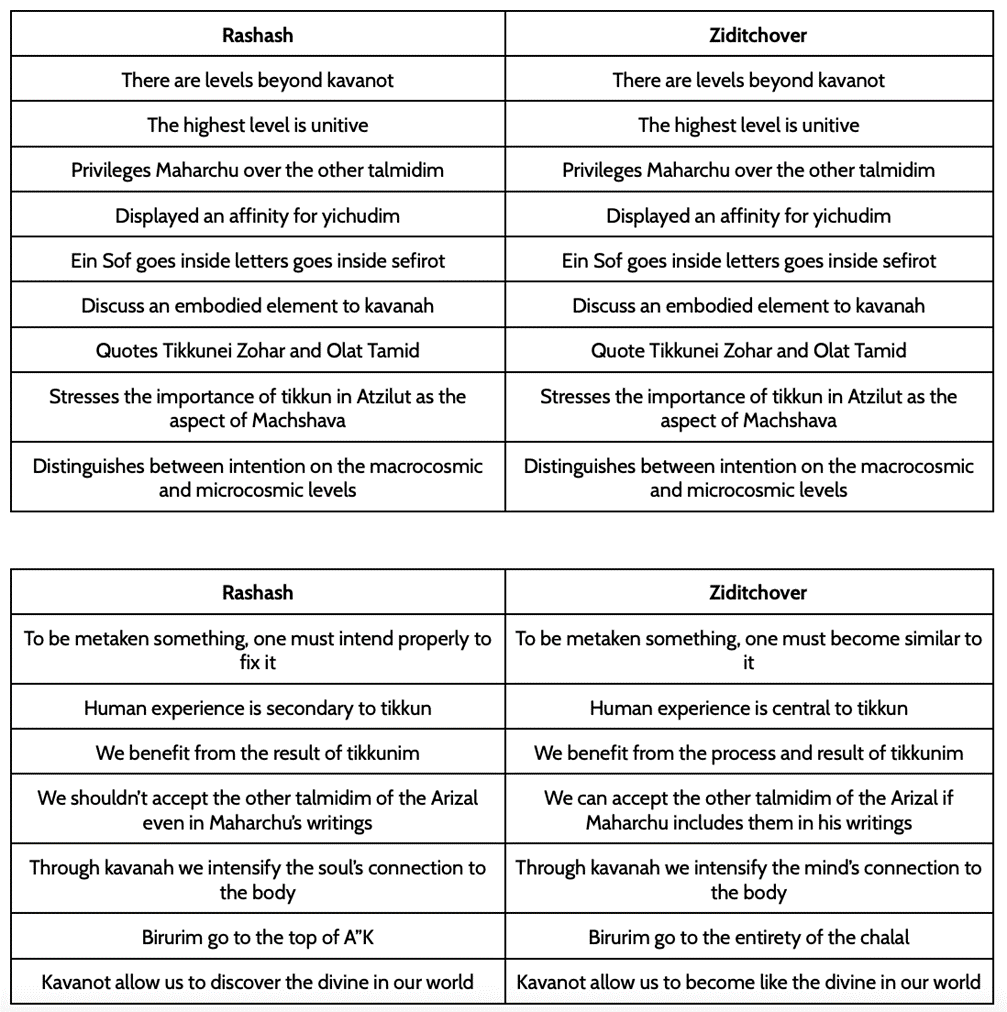
When comparing the Ziditchover’s and Rashash’s approaches to kavvanot, we find many important similarities. These include quoting shared source material, relevant historical leanings or beliefs related to kavvanot, and more. At the same time, we see important differences in the mechanics of the kavvanot and their results. It would be accurate to characterize the similarities as more theoretical beliefs about kavvanot and the differences as pertaining to practical elements. The first chart shows the similarities and the second chart shows the differences.
Screenshot

15. What is the subjective experience of kavvanot?

I can only really say at this point how it feels to me. The focus that kavvanot necessitate becomes an opportunity to slow down and savor the experience of prayer. Doing them for long enough strengthens my concentration and makes me more aware also of my body and my surroundings. Time feels slowed during this practice. I find that doing them draws my attention to a pleasant feeling in my body, particularly in my head. Over time, I have ascribed personal understandings and feelings to different kavvanot—there are parts that I connect with more, during which I feel more deeply.

Even though kavvanot are very mentally active and I am trying to follow the instructions of the siddur, my inner monologue is not only the words on the page but associations or prayers that I connect to these parts. It is an energizing and activating practice. They can awaken a feeling of intensity and passion, of movement even. I think of this as hitlahavut. Often, I will take a deep breath and pause for a moment within the practice and find myself awash in an “oceanic feeling,” one of calm and connection. This is what I think of as deveikut.

Rabbi Melamed on the Divine Spark in other religions

Continuing my discussion about Rabbi Melamed on Other Religions. I started with his statements on Hinduism and will now look at his broader premises- see “The Divine Spark among Other Religions”  and here “Rabbi Abraham Isaac Kook on Different Religions.” Once again, I will use the posted selective English translation because it is accessible; however, I do have the Hebrew original marked up with marginal notes and a full response.

      For Rabbi Melamed, all religions have a spark of the divine, some of the light of the divine, and help the world advance toward its moral perfection. The religions of the world educate towards the moral foundations, “each religion according to its level.” Through accepting these points, Rabbi Melamed removed any stigma of other religions as needing to be negated  or the need to call other religions as demonic, entirely false, or to teach a restrictive exclusivism where only Jews have religion.  Rather, for most people in the world, Melamed thinks that “it is right for every person to continue in the faith of their fathers, because with the loss of faith, moral corruption increases.”

      Rabbi Melamed also thinks that the religions of the world are progressing toward deeper and more abstract forms of understanding their religions, thereby removing “the dross of the crude material elements within it” allowing them to elevate their souls “to higher faith and morality.” Jews should not follow these religions; however, the religions of the world “serve as a moral and faith compass for all peoples.”  Rabbi Melamed acknowledges that religious ideas are evolving and progressing to deeper understandings, the ancient and medieval forms of the religion that most people know from textbooks do not reflect current ideas in those religions. He has spoken with many people and read many books to overcome the essentializing of religions in ancient forms. I am always surprised at people who think other religions are where they were in 500 CE or even 1700 CE, but at the same time have a modern understanding of Judaism.

      Rabbi Melamed’s fundamental starting point is the discussion in  Rabbi Abraham Isaac Kook’s Le’Nevuchei Ha’Dor and his other books. However, Rabbi Melamed draws out the full potential implications in some of Rabbi Kook’s statements, going beyond the prior understandings to create a new broader vision, melding his views with those of Rabbi Kook. To highlight the contrasting understandings of Rabbi Kook, it is worth noting that Rabbi Zvi Yehudah Kook had views, also based on Rabbi Abraham Isaac Kook, that were deeply adversarial to Christianity and other religions, as were those of his student Rabbi Aviner. One should treat the use of Rabbi A. I. Kook and the explanation of the citations of Kook by Rabbi Melamed as innovative and expansive, blending the ideas of the Kook with contemporary application by Melamed.

      Rabbi Kook wrote that the world’s religions serve a divine providential purpose, gradually elevating humanity towards its ultimate goal. There is an evolutionary unfolding of humanity from a crude understanding of God toward an abstract belief in one God. In the meantime, people need “a tangible belief in idols that provide them with basic principles of conduct and morality.” Therefore, Rabbi Kook thinks every religion has “a divine spark of morality that sustains it, through which it sets standards of good and evil” as they advance “towards the belief in divine unity “ (‘Le’Nevuchei Ha’Dor’, Chapters 8; 14:1).

Each religion contains a divine spark expressed “through different educational and cultural systems, aimed at improving human spirit and material conditions, the time and the world, the individual and the community (‘Orot: Ze’ron’im’, 6).Therefore, even concerning the lowest form of idolatry, “one cannot decide that the entire religion is erroneous,” as it may have been suitable for them in the past to uplift them somewhat. There are different levels among religions, and some are more refined “in morality, character, and conduct, and thus, their customs and idolatrous practices are not as detestable and filled with disgust as others” (‘Le’Nevuchei Ha’Dor’, 14:1; ibid, 39:1; ‘Rishon Le’Yaffo’, 91:1)

Even pagan and idolatrous religions may have served a purpose in their time. But no specific hierarchy is created. But the important element is the Divine spark in all things. God has a presence in the world and its cultures and is not limited to a single group.

      The reason for this acceptance of other religions is based the idea that there is a natural division and diversity of nations, an idea going back to the Second Temple literature and continuing through the Middle Ages and beyond. Each nation has their own spirit, either angelically above, internally as their animating force, or as volkgeist. In Rabbi Kook’s writings, we have a grand vision of the elevation of all of humanity. We also have kabbalistic ideas of divine sparks in all things. Finally, we also have neo-Platonic ideas of all things upwardly aspiring to the divine. No longer is the discussion of other religions limited to Talmudic discussions of stones on the road for Mercury or statues of Aphrodite.

      Rabbi Melamed explains Rabbi Kook’s idea to mean that even pagan religions serve a divine purpose and that even the representations of the gods through idols point to higher “values of truth and goodness.” Greek mythology teaches moral lessons. Melamed uses his textbook knowledge of Greek myths to state that even the gods are subject to Fate, thereby showing that there is a divine destiny and higher ethic even higher than the gods of the myths. For Melamed the “ancient myths where, despite the great power of the gods, it is limited, and they are subject to fate. Furthermore, their actions also affect their destiny, and any idol that crosses certain limits—such as excessive indulgence or pride, or extreme disregard for other gods—will be punished by more powerful, higher forces. These higher forces reflect a higher value system, in which a belief in the one true God is hidden.” Greek myths show a higher theistic vision and teach moral.

      Whereas Rabbi Moses Feinstein, allowed the Greek myths only because the religion was dead and considered the myths as showing that the Greek beliefs were nonsensical, non-ethical, and immorally licentious, Rabbi Melamed, in contrast, following Rabbi Kook see the guiding hand of divine providence in the narratives as part of God’s plan for uplifting each nation of the world and that the very myths contain moral lessons. Rabbi Feinstein’s approach limits knowledge of God and morals to Jews,  awash in an immoral world. Rabbi Melamed sees the knowledge of God in all nations and all nations are on a journey to ultimate perfection.

       As most Jewish universalists, he quotes  “For from the rising of the sun to its setting, My name will be great among the nations; and everywhere incense is going to be offered in My name, and a grain offering that is pure; for My name will be great among the nations, says the Lord of hosts” (Malachi 1:11). Showing that all religions are really worshiping the Biblical God in their various forms of worship. Rabbi Melamed is clearly an inclusivity, finding a place for other religions in categories of Torah, and he is Jewish-centered, but some of his ideas are moving to a universalism.

      For example, Rabbi Melamed cites the Talmud to claim that all religions are worshiping the true high God of the Bible even if they use representation. “Our Sages explained that all idolaters refer to God as “Elah de’elahaya” – “God of gods” (Menachot 111a).”Despite using idols, “there was a deep-seated belief in a Supreme God, the source of truth and morality.” Most people were not on the level to recognize this, but there “were exceptional individuals who delved deeply into their faith and directed their primary prayers to the God of gods.” Hence, he can acknowledge the Ancient Greeks Neoplatonists, or the Hindu Upanishads, and others as expressing the best views of the era. Nevertheless, these religions improved “the values of truth and goodness in people’s hearts. In these paragraphs, he is beginning to sound more like Rabbi Menashe ben Israel or Rabbi Eliyahu Benamozegh.

      Even more surpassing is that Rav Kook wrote that the sages of other religions even merited divine inspiration, (ruach ha’kodesh), a form of prophecy, through which they deepened their faith and educated their people. Rabbi Melamed accepts this. But in his printed book he cautiously does not mention the current discussions among these circles about acknowledging that Muhammad, Buddha, or Guru Nanak may have divine inspiration. The medieval position of Rabbi Nathaniel ibn Faymi (d. ~1165) that God sent prophets to all nations and establishes a religion for all nations, is becoming more accepted as a valid position. In general, one should compare Rabbi Melamed to Rabbi Yakov Nagen to get a sense of the current approaches- see Rabbi Yakov Nagen- here. One should note that Yehudah Halevi already called Plato, Aristotle, Hermes, and Zoroaster as divine (elokhi) and Maimonides granted Baalam the same prophetic status as the patriarch Jacob. Hence, even ancient pagans may have had some form of divine prophecy.

      Rabbi Melamed cites the later pietistic Aggadah Tanna de-Vei Eliyahu: “I testify by Heaven and Earth that whether it is a man or woman, servant or maid, gentile or Israelite, ruach ha-kodesh rests upon him according to his deeds” (Ch. 9).The original Tanna de-Vei Eliyahu is a parallel of Galatians (3:28) “There is neither Jew nor Gentile, neither slave nor free, nor is there male and female…” But here in the Jewish Aggadic text, we have a greater universalism and a noticeable inclusion of all the people of the world in Holy spirit, which originally may have meant divine connection or inspiration corresponding to a Christian sense of the Holy Spirit but it is being understood in the 21st century as referring to prophecy, probably because the phrase Ruah Hakodesh is used in contemporary Rabbinic language to refer to prophetic inspiration and prophecy. Rabbi Kook added that it is possible that the leaders of religions even received heavenly assistance to perform miracles, so that their followers would accept the religion that advanced their moral state (‘Le’Nevuchei Ha’Dor’, 14; 46; 57).

      Based on Rabbi Kook, Rabbi Melamed declares that one “should not denigrate other religions, including the more idolatrous ones.” This halakhic pronouncement seemingly undoes prior Rabbinic exhortation to make fun of idolatrous religions. Rabbi Kook taught that: “Such denigration is also against the very essence of faith and religion, and therefore, those who throw off the yoke will take the arguments and words of disparagement said about other religions and hurl them at Judaism, as happened in practice.” In making fun of another religion, the arguments against another religion can just as easily be turned around to attack Judaism causing Jews to lose their faith. Rabbi Kook taught: “we need to deepen our understanding of the value of other beliefs according to the Torah,” and show the greater and more comprehensive light that exists in the faith of Israel. In our age, greater respect for all religions leads to a stronger respect of the religious core of Judaism.

      Should the nations continue in their idolatry? He answers, “even the exceptional individuals among the nations who knew that God is the “God of gods,” the source of all powers, did not abolish idol worship. This is because they knew that belief in one abstract God was too lofty, and without faith being applied to tangible forces called idols, and reinforced by rituals, they would not succeed in establishing the moral values that would elevate their people and religion.” People are not ready to worship without images and statues. This is the same answer given by the medieval Hindu scholastics Shankara, Ramanuja, or Madhva, that the people are not ready to give up their representation. It is also the answer given in the 20th century by Sarvepalli Radhakrishnan, philosopher and former President of India. Rather than the more traditional and popular Orthodox Midrash Says dualism of Torah consisting of all truths and morals contrasting with idolatry as immoral and lacking any truths, the other religions, even idolatry, serve to bring people to God. The religions of the world are on a sliding scale, very similar to what is taught in Hindu textbooks since the early Middle Ages and even in the 21st century.

      Idols made of wood and stone still have the function of curbing evil inclination and keeping people from committing crimes. Even idolatrous rituals keep people on a virtuous path.  At the same time, “if they continue to observe the laws of their religion, they could gradually ascend, until they merit reaching the true level of faith, drawn from the light of Israel. Therefore, according to their value, their religion has religious significance.” Rabbi Melamed concludes that “we can recognize and honor them for approaching the light of God, according to their own way.” It is important to note, that Rabbi Abraham Isaac Kook also wrote this about prior philosophic understanding of Torah, declaring that contemporary understandings of Jewish concepts need to evolve beyond the medieval.

Christianity and Islam

Rabbi Melamed follows Rabbi Kook that Christianity and Islam are not foreign worship because they were influenced by the Hebrew Bible and thereby show greater divine light. These two religions display “a further stage of progress in the process of purifying faith and morality, from crude idolatry, towards pure faith in God. And as noted above, they possibly have been granted prophecy and the performance of miracles

      However, Christianity and Islam are flawed “in that they do not recognize the central role of Israel in revealing God’s word and blessing to the world, and instead, claim to replace them – while harming Jews. For him, “there is a necessity that over time, Christians and Muslims cleanse themselves of hatred of Israel, and become able to draw, from the source of Israel’s faith, illumination and guidance, according to what is appropriate and suitable for them for constant elevation and Tikkun Olam (repair of the world).” (Americans in the culture wars should take note that Rabbi Melamed used positively the word tikkun olam  a word freely used by Rabbi Kook, Rebbe Nachman, Rabbi Ashlag, and other Eastern European rabbis- for citations of its use by traditional rabbis  see here).

      In conclusion, Rabbi Melamed states that even now, when there is still hatred by Christians and Muslims of Jews, and they still have problematic elements, it is still “proper to respect the foundations of faith and morality in their religion, through which they succeeded in elevating many people to have better qualities and to achieve love and fear of God.

      Unlike those who differentiate Judaism’s attitude toward Christianity and Islam, Melamed notes “that Rabbi Kook consistently refers to Christianity and Islam equally. True, Islam is purer of idolatry, but apparently, this advantage is not decisive compared to the aspects in which Christianity is preferable to Islam.” Rabbi Abram Kook, in later decades when he was fighting the extensive Christian mission, has derogatory statements about Christianity, which were given emphasis by his son Rabbi Zvi Yehudah Kook.

      Rabbi Melamed concludes that Christians and Muslims are obliged to continue in their religion. Once again quoting Rabbi Kook: “The religions founded on the basis of the Torah and the Prophets, certainly have an honored value, for those who hold to them are close to the light of God, and knowledge of His glory” (“LeNevuchei Ha’Dor” 14:1). Rabbi Melamed is creating some form of Religions of the Book, in which the three religions are all based on Torah.

they have “the great moral principles they took from the light of the Torah, which also strengthened in them, with greater vigor, the pure human feeling”. And by way of this, arose from them “individuals with a pure spirit, from whose gathering they will establish for themselves religious customs, which fulfill their destiny, to elevate the soul to good qualities, to love of God, and fear of Him. Therefore, they are certainly obligated to follow the ways of their legislators, who are held in their nation as holy men, according to their value and nature”. Therefore “it is proper for every person perfect in knowledge to understand, that those who engage in them, according to the tradition in their hands, are engaging in the service of God, according to their level” (ibid 8).

Rabbi Yakov Emden’s approach of seeing great moral value in them, especially Christianity, has been accepted by Rabbi Melamed. In the past, one found it in Isaac Baer Levinsohn, Rabbi Benamozegh, Rabbi SR Hirsch, and in Rabbi Kook. But now, it has become mainstream halakhah in Rabbi Melamed. It has also been extended from just Enlightenment era Christianity to all of Christianity and Islam.

Conversion

Rabbi Melamed quotes Rabbi Kook that each nation has its own unique religion and therefore, one should generally not convert. Rabbi Kook wrote (“Le’Nevuchei Ha’Dor” 8) that it is not proper for a person to convert from their religion, including members of idolatrous religions. Because every religion also expresses the social and national character through which it was formed, and one who leaves it, betrays their family, their people, and their good values.

      According to Rabbi Kook, it is often beneficial to convert from a lower religion to Christianity or Islam, “because will grow from the recognition of the unity of God (which exists in Christianity and Islam) will, in any case, bring blessing to the whole world”. However, according to Rabbi Melamed, looking at 21st-century reality, this is not always true because sometimes religious ideas and virtues will be lost in the process of giving up native religion. “For we have learned that from every religion, one can remove the dross–until it remains clean of idolatry and bad qualities.” He cites the example of Hinduism, which has deep learning and morality and recognizes the one true divine source. Many times, “leaving it for Christianity or Islam may be considered a descent.” They lead less moral life or damage their spiritual lives.

Avodah Zarah Be-Shituf (Idolatry in Partnership)

Rabbi Melamed assumed that non-Jews are allowed shituf and in this he is quoting Rabbi Kook who wrote: “Noahides are not warned about shituf” (Shmoneh Kevatzim 8:44); and it is an aspirational goal for those who do not even have shituf” (Orot Yisrael ve’Techiyato 5). In addition, Rabbi Melamed singles out for accepting the same opinion on the permissibility of shituf for gentiles  his predecessors Rabbi Charlap (Mei Marom 10:35; 12:32, 2), Rabbi Menachem Mendel the ‘Tzemach Tzedek’ (‘Derech Mitzvotecha’ ‘Mitzvat Achdut Hashem’ and Rabbi Menachem Mendel Schneerson, as well (Likutei Sichot 20 p. 16 nt 44). For a full discussion of his position, where he cites many opinions, including those who think shituf is forbidden to non-Jews, see Rabbi Melamed’s discussion here.  But there is no need to email Rabbi Melamed (or me), the citations of those who think it is forbidden. He knows them and discusses them at the link

God Name will be One

In conclusion, Rabbi Melamed cites the universalism of Rabbi Kook, who advocated loving all humanity and all nations despite differences in religion or race. Moreover, he advocated for understanding the other nations, especially their religion, since it is central to nations.  Rabbi Kook wrote: “Love for people should be alive in the heart and soul, loving every person, especially, and loving all nations.” Any expression of hatred towards gentiles is “only for the wickedness and filth in the world.” This love should be maintained “despite all changes in religious beliefs, opinions, and despite all distinctions of races and climates.” (Middot Ha-Ray’ah: Ahavah, 5).For Rabbi Melamed,  one should “understand the views and characteristics of different nations and communities as much as possible, to establish how to build human love on practical foundations. Since religion is central to the spiritual and practical life of nations, Rabbi Melamed concludes that it is evident that Rabbi Kook’s intention also includes different religions. Thus, Israel will be able to fulfill its purpose, bringing the word of God and His blessing to the world

      Finally, since all religions can elevate themselves, there is no aspiration for religions to be nullified; rather each religion has a unique hue, reflecting the special character of the people in which it was created. Thus, the vision is for each religion to purify itself of all its flaws and reveal its unique path in serving God and contributing blessings to the world. This is the prophetic vision of “I will remove their blood from their mouths and their abominations from between their teeth, and they shall remain even for our God” (Zechariah 9:7).  And of “For then I will turn to the peoples a pure language that they may all call upon the name of the Lord, to serve Him with one accord” (Zephaniah 3:9). (This is unlike Prof Menachem Kellner’s Maimonidean universalism envisioning that all people will have to become Jews).

      Ultimately, every nation will maintain their own religion but be elevated in the messianic vision. “Alongside each nation’s special devotion to its religion, humanity as a whole will be united through the connection of all nations to Israel and its center in Jerusalem, as it is said, ‘For My house shall be called a house of prayer for all peoples” (Isaiah 56:7).

Siddur Torat Chacham, a siddur Rashash by R. Yitzchak Meir Morgenstern

What are the Lurianic Kabbalistic intentions? How do they work and how does one read the baroque pictorial notations of a Lurianic siddur? This interview may be one of the first explanations in English that gets to the core of the matter. This is a very technical interview, very detailed, geared for those in the know.

This great review was written by Jeremy Tibbetts, a rabbi, who is the co-director of OU-JLIC for Anglos in Jerusalem and is the Director of Education for Yavneh, an intercampus leadership program. He is a student at Hebrew University in Jewish Thought, intending to focus on the Rashash and kavanot.

Earlier Kabbalistic intentions from the early Kabbalah until Rabbi Moses Cordovero (d.1570) provided a concurrent mental intention or visualization for the words of the prayerbook. The performance of the liturgy needed an extra level of intentionality.

Rabbi Isaac Luria, the Ari, (d.1572), in contrast, taught a doctrine of an innumerable array of spiritual entities, arranged in a vast enormous system. The prayer intentions were not directly related to the words, but rather, mental operations with this vast system.

Rabbi  Shalom Sharabi, known as the Rashash (born Yemen,1720, Jerusalem1777) reworked the Lurianic instruction as pictorial images and not sentences. The siddur depicted the kavanot instead of describing them. In order to do this, the Rashash utilized divine names to map out and represent the different spiritual structures that the kavvanot act upon. Sharabi’s style about the spiritual realms Tibbetts calls “near trance-like lists depicting the different layers of spiritual constructs.” For examples, see the 2 pictures below from the Rashash prayerbook.

A new edition of the Rashash siddur was composed by the contemporary Kabbalist R. Yitzchak Meir Morgenstern called Siddur Torat Chacham, a siddur Rashash by R. Yitzchak Meir Morgenstern (born 1967). A full presentation of Lurianic praybook intentions for 1678 pages. Tibbetts proclaims that this is “a groundbreaking achievement in the world of Jewish mysticism and in kavanot.”

For many, Rabbi Morgenstern is their contemporary teacher in kabbalah and his influence is immense on this generation and the generations to come, due to his large number of students and the many rabbis and Hasidim who study with him. In addition, he publishes voluminously, generally about fifty pages a week which come out as edited books. His method is to integrate divergent schools into a harmony assigning a different function or a relational position to each one. In this case, he integrates, the Kabbalah of Sarug, Yehudah Ashag, Rav Nahman, Ramchal, and the Komarno Rebbe into the Rashash.

Back in the infancy of this blog in 2010, I did a blog post on Derekh Yihud, which is, Morgenstern’s pamphlet of visualization meditations. (From what I hear, it is not a part of his current teachings and the visualizations are not found in this siddur).

For those looking to understand this practice as a system of meditation, then skip down to question #9 on the psychology of this practice, question #12 on the visualization method, question #13 on this practice, and question #15 on why should one engage in this practice. Some of you, or many of you, might want to read these answers before the more technical answers.  

I am especially proud of this interview because of the accurate and detailed information that it provides. In contrast, most mentions of the Lurianic intentions in English are vague intoned mentions, without content or context, of tzimzum, yihudim, kabbalistic trees, and sacred power. This interview fills in the needed details.

  1. What is the siddur of Rabbi Morgenstern?

The siddur Torat Chacham, a siddur Rashash by R. Yitzchak Meir Morgenstern shlit”a (born 1967), just saw its new complete reprint in a pocket-sized print (even though it is a remarkable 1678 pages!). The first printing of the siddur was a full decade ago. This is the ultimate siddur for a student of R. Morgenstern or Kabbalah more broadly: it’s a groundbreaking achievement in the world of Jewish mysticism and in kavanot.

2) What is the siddur of the Rashash?

R. Shalom Sharabi zy”a, also known as the Rashash (born Yemen,1720, died 1777 Jerusalem). In his early years, he decided to undertake an arduous journey to move to Eretz Yisrael. Initially this brought him to Bombay in India, where he settled for awhile and was first exposed to Penimiyut haTorah and the Zohar. Eventually, he ended up taking passage through to Baghdad, Damascus, and ultimately from there, to the Old City of Jerusalem. Eventually, he becoming the next rosh yeshiva of Beit El, where he began to showcase his new approach.

The siddur Rashash was, for the Rashash himself, first and foremost a personal project. One of his most monumental achievements in the world of Kabbalah at all is his siddur. He worked on it over his life, continually writing, erasing, and rewriting. He never taught from it or attempted to disseminate it in his lifetime. In that sense, using a siddur Rashash is really entering into the Rashash’s personal world of prayer. His students took his siddur after he passed away and began copying and eventually printing it for broader use. The standard siddur Rashash is built around the Rashash’s reworking of Lurianic kavanot as depictions and not sentences.

Before the Rashash’s siddurim, prayer books which contained Lurianic kavanot described in full sentences what the practitioner should intend. One of the Rashash’s key innovations as a post-Lurianic thinker was in laying out a new version of the siddur which depicted the kavanot instead of describing them. In order to do this, the Rashash utilized divine names to map out and represent the different spiritual structures that the kavanot act upon.

These punctuated divine names are considered by many of the Kabbalists to be ideal both because they minimize the concern of one imagining something physical when praying with kavanot and because the names always refer back to Hashem directly and prevent one from getting caught up in the various spiritual tikkunim one is attempting to perform. The shem Havayah is the shem ha’atzmi, a name which uniquely indicates Hashem’s infinitude, allows us to intend towards something discrete while maintaining a connection to the infinite and undefined Or Ein Sof which animates everything.

The siddur Rashash is largely concerned with describing spiritual worlds and largely unconcerned with explicitly treating human experience and life. The Rashash offers very little in the way of a phenomenology of kavanot despite creating a nine-volume prayer book which takes hours to complete and is used on a daily basis.

A hallmark of Sharabi’s innovative style is his ability to take the Arizal’s logic of the spiritual realms and apply it iteratively on every level, often leading to what can only be described as near trance-like lists depicting the different layers of spiritual constructs. This is closely tied with the doctrine of arachin or “relativity” for Sharabi, which reads the map of Lurianic Kabbalah as applicable in any level. Just as a person is from one perspective a child and from another perspective a parent, what we call Malchut in one context could be considered Binah or Keter in another context, and so in this view, the map of the worlds as sketched in Lurianic Kabbalah is more epistemological than ontological.

3) What is unique in the siddur of Rabbi Morgenstern and his approach to the Siddur Rashash?

R. Yitzchak Meir Morgenstern’s siddur Torat Chacham is innovative precisely for its attempt at reintegrating other strains of post-Lurianic thought with the kavanot of the Lurianic siddur edited by Vital.

Perhaps most starkly, the additions in the siddur draw heavily upon the Kabbalah of Rav Yisrael Sarug zy”a (late 16th century – mid 17th century), an early student of Luria. Sarug’s approach was mainly rejected because Rav Chaim Vital, the main pupil and disseminator of Lurianic Kabbalah, casts aspersion on him as an authentic student. Many Kabbalists saw the Sarugian approach to Kabbalah as irreconcilable with Vital’s description of Lurianic Kabbalah. In particular, Sarug had terminology that was largely absent in Vital’s writings about tzimtzum and what he envisioned a whole series of worlds called Olam haMalbush at the very beginning of creation which Vital doesn’t mention. Sarug’s writings deal largely with worlds which precede those described by R. Chaim Vital, Furthermore, Sarug’s account of creation deals at length with the Hebrew letters and their formation which is also absent from  Vital’s account.

Rav Morgenstern has been working for nearly 15 years to try to reconcile and reintegrate the two systems. Part of his research has trended towards the historical, attempting to unveil hidden connections that Rav Shalom Sharabi and his students may have had to Sarug’s version of Lurianic Kabbalah. Perhaps most notably, Rav Morgenstern suggests that Sharabi’s version of Etz Chaim had Sarugian writings appended to it, implying that he considered them authentic to the Lurianic-Vitalean set of writings and that he studied them.

R. Morgenstern leans heavily on Hasidut Chabad for this project, in part because Chabad and its various offshoots accepted Sarug’s Kabbalah. R. Morgenstern uses these writings to develop a trailblazing anthropocentric reading of Sarugian Kabbalah. R. Morgenstern connects the concepts of Sarugian Kabbalah to the different ratzonot within the Divine mind which are meant to be realized through the process of creation.

4) Can you give an example?

Some of the most central and longest kavanot in the standard siddur Rashash are when one raises divine sparks up so that they can be transformed into shefa for us. The Arizal himself did not specify each and every level that they ascend to, only that they go up to “to the greatest heights.” The Rashash did spell out all of these ascensions in his theoretical works, he did not include those steps in his siddur. R. Morgenstern maps out this full ascent and adds in for the first time these levels of Olam haMalbush which in his view are also activated as part of the Rashash’s system of kavanot.

5) What about his use of Ramchal, Sulam and Komarno?

Alongside these innovative inclusions, kavanot are brought throughout the siddur from Kabbalists such as the Ramchal zy”a (1707-1746) and the Sulam zy”a (1885-1954) without clearly stating how they should be integrated with the standard kavanot haRashash.

This becomes even more of a question in sections lsuch as tachanun, where each of the 13 attributes of compassion is matched with one of Rebbe Nachman zy”a’s (1772-1810) 13 sippurei ma’asiyot. There is lastly a notable change in the actual nusach of the siddur.

While an Ashkenazi nusach of the siddur Rashash does exist, Rav Morgenstern’s siddur reconstructs the nusach of Hasidut Komarno from the Shulchan haTahor, the first Komarno Rebbe zy”a’s (1806-1874) commentary on the Shulchan Aruch Orach Chaim (though notably in a few sparse places he writes that he prefers the Breslov approach to nusach instead). Thus the siddur becomes a sort of weave of numerous Kabbalistic streams, most of which have never been brought together before in this manner.

6) Why is this siddur unique in its Kabbalah?

Rav Morgenstern, inspired by Rav Moshe Schatz shlit”a, is a proponent of a sort of “Grand Unified Theory” of Kabbalah. He takes it as axiomatic that the different schools of Kabbalistic thought are in harmony, not dissonance. The Ramchal’s Kitzur Kavanot, the Hasidic Saraf Pri Etz Chaim or Pri Kodesh Hilulim, and the Rashash’s Rechovot HaNahar are essentially describing the same thing in different levels of meaning and detail in this view. But it’s not enough to say that they align with each other: it is not possible from this perspective to truly understand Kabbalah without bringing these schools together. Each one constitutes a puzzle piece in the mosaic of sod. Kabbalah becomes a discipline not only of knowledge acquisition, but of integration.

7) How is this process of harmonization shown in the siddur?

This siddur is a monumental achievement as the first one to truly embrace this approach of harmonization and to connect it with the Rashash, the most difficult and the most conservative of the post-Lurianic schools. For those more steeped in the world of the Arizal, the Rashash, and his beit Midrash, they’ll find many additions to the siddur from the Torat Chacham, one of the most difficult works of Kabbalah from the Rashash’s talmid muvhak R. Chaim de la Rossa zy”a (early 18th century – 1786). One prominent examples would be the insertion of the kavanah for mesirut nefesh before any part of tefillah where one raises up divine sparks.

While the Rashash would not necessarily disagree with these additions, the fact that they are not included in the original siddur indicates that they were not as critical unlike the many kavanot which were codified.

The new small edition of the siddur chol also contains hundreds of pages of notes and essays in the back which explain why the siddur is laid out as it is, often citing and invoking different disagreements amongst the talmidei haRashash.

8) Why would a yeshiva student or student of the Kabbalah want to own or use this?

It is one of the most comprehensive and mature works of R. Morgenstern and his beis medrash, which may be a reason in its own right to own it. It can serve as a valuable window into the inner prayer life of one of the greatest Kabbalists of our time. Additionally, it is perhaps the only truly integrated siddur for those who want to stand at the confluence of the different strains of Kabbalah, not only by bringing in Hasidut, but by including kavanot from everything from medieval works of Kabbalah like Brit Menucha to the Gra zy”a (1720-1797), Ramchal, Sulam, and more. In this regard, it will serve as a textbook and guidebook rather than an actual prayer book, offering notes on nusach or different Kabbalistic ideas to integrate into one’s own prayer. Others still will buy it out of aspiration, more to make sure they have one rather than risking it running out and having to wait for a reprint years later.

9) How does Rabbi Morgenstern explain the process of psychologically performing kavanot?

This is sort of the big question with kavanot haRashash in general. Just like in any other siddur Rashash, the instruction to the practitioner throughout the siddur is simply “veyichaven,” “intend” that the worlds and sefirot are interconnecting in a given permutations by that corresponding word of tefillah. However, the Kabbalists would not consider the siddur Rashash to be a visualization guide.

They would in all likelihood be averse to one picturing the spiritual structures and sefirot which are part of the Kabbalistic siddur.

Neither the Rashash in his time nor R. Morgenstern in this siddur told us exactly what that means mentally. In fact,  in R. Yekutiel Fisch’s Sod haChashmal Vol. 5, there is a lengthy “teshuva” from R. Morgenstern on the subject of kavanot which quotes the Rashash’s son, the Chai baShemesh zy”a (mid 18th century – 1808), echoing this desideratum: “even though we have intention according to our intellect, each person according to their level, we don’t know what the explanation of ‘intention’ is… and what is ‘intend’ or how one attains ‘intention’” (pg. 207).

Nonetheless, there is one clue which Rav Morgenstern offers us from the siddur’s introduction which sheds some light on this question. He champions the Torat Chacham’s idea (building on the Rashash) that an individual’s kavanah must work on three levels: klal gadol, klal beinoni, and prat. He sorts the three central schools that his siddur aims to integrate into these categories: the Kabbalah of R. Yisrael Sarug, which speaks about the highest worlds of any post-Lurianic school, is the klal gadol; the Kabbalah of R. Chaim Vital, centered on Atzilut and the tikkunim which most directly impact our own world, is the klal beinoni; and Hasidut, which deals with the lowest and smallest levels of human experience, is the prat.

10) Which of these levels does he emphasize?

Paradoxically, the prat smallest level of Hasidut brings us the highest in R. Morgenstern’s view. On the micro-spiritual level, each individual sefirah and level of spiritual existence experiences whatever is above it as Ein Sof. Said differently, the more one zooms in to the details of the spiritual structures of Kabbalah, the more one experiences the system as open and ever-expanding. This is why this perspective is the most suited to truly understanding the infinitude of the Ein Sof, as each level constitutes a new self-disclosement of the infinite revelations of Hashem. This is the unity which R. Morgenstern sees between Hasidut and the school of the Rashash: for both of them, the divine is in the details.

Returning to R. Morgenstern’s teshuva in Sod haChashmal, he offers several more insights into the psychology of kavanot. First, he explains that the Rashash’s innovation of depicting the kavanot as punctuated shemot Havayah over the prior Lurianic siddurim which explained each kavanah in words was rooted in the Rashash’s desire to not separate the kavanot from the Ein Sof. The mechaven must always hold an awareness of the infinitude of Hashem alongside the particular kavanah at hand.

11) Where does separation from physicality fit in?

He quotes the Shemen Sasson zy”a (1825-1903) who riffs off of the Shulchan Aruch in OC 98:1 in describing kavanah as “to strip one’s soul, to separate it from physicality, and to awaken the upper worlds… as explained in the kavanot of Shema at bedtime and in the secrets of dreams and prophecy.” This seems to be a dual kavanah.

While the latter part might have seemed obvious given the focus of the kavanot on the upper worlds, the former is not only a powerful statement of how the kavanot should impact a person’s embodied experience but also should indicate that through Kabbalistic prayer, one first directs one’s soul away from this world in order to impact the upper worlds.

He goes on to quote the Hasidic masters the Maor vaShemesh zy”a (1751-1823) and R. Pinchas of Koritz zy”a (1725-1791) alongside the pre-Lurianic Kabbalist R. Moshe Cordovero zy”a’s (1522-1570) on the ability of kavanot to “purify the mind and increase devekut,” even without proper understanding.

This devekut for R. Morgenstern is itself the awareness of the Ein Sof behind each and every kavanah. The need to hold the unity of the Ein Sof amidst the plurality and intricacy of kavanot is central for R. Morgenstern, so much so that he writes that if the extreme details of the siddur Rashash distract a person from this devekut, then they should not use it.

12) What is the role of emotion vs visualization?

The truth is that R. Morgenstern’s Torah contains both: in works like Derech Yichud, a Kabbalistic meditation guide that R. Morgenstern prepared over several years to attempt to integrate meditation and Kabbalah/Hasidut, you see that he leans very heavily into visualization-based meditation, and at the same time in many places in De’ah Chochmah leNafshechah, where R. Morgenstern’s weekly sichot are recorded, as well as in Bayam Darkecha, written and published by a close talmid of R. Morgenstern, the emphasis is strongly on the emotive and psychospiritual impact of kavanot.

As mentioned above, the siddur is not meant to be a visualization guide. R. Morgenstern’s siddur does contain additions though which at first glance seem to involve some form of visualization. For example, when ascending the different heichalot in Shacharit, he adds in detailed descriptions of their layout and appearance from the Zohar. There’s no “kavanah” added alongside them. This is also the case with other additions in the siddur, e.g. the sketching of the malbush at the end of sim shalom and the addition of parts of the mishkan in each beracha of the Amidah.

Even more radically, there are numerous yichudim (letter-based meditations) from the writings of the Kabbalists which have been added in, despite the near universal consensus in the world of Lurianic Kabbalah that even yichudim which utilize words or pesukim which appear in the siddur should not be added as part of the daily intentions. R. Morgenstern defended this practice previously in his haskamah to the siddur Sha’ar Ruach haKodesh which also added in yichudim, as well as in the essays appended to his siddur, based mostly on Ziditchov and Komarno Hasidut.

 The fact that no specific intention is written for any of them calls into question their exact purpose: their very inclusion in the prayer book would seem to suggest that they are included to be part of the kavanot in one form or another, yet without a particular intention, they can also be read as associative companions which are meant purely to enhance and deepen a non-visual experience of kavanot.

13) If kavvanot are not visualization then what are they? Are they just things to think about when reciting the liturgy, like reading a book of kabbalah simultaneously to reciting the siddur?

This is a really hard question! On the one hand, they’re not supposed to bring one to a form of contentless contemplation as done in meditating on the on the breath.  On the other side, they’re not a scholastic or academic exercise.

They are meant to be somehow performed and not just considered. I think also that the Kabbalists did not see them as liturgy in the same way that the siddur is. We aren’t communicating to God or requesting that God unify the worlds with the kavanot.

They saw the “intending self,” the part of the self which is associated with conscious intention, as the highest part of the self which could act on one’s body or soul. It is through deep focus, one can use the mind like a hand to move the upper worlds. Some of the Kabbalists note that these mental acts cannot be affected without reciting the actual words of prayer.  In other words, one contemplates and focuses in on the kavanot as they stand independently, and that also forms the intention for when I say that word or phrase in the siddur. So it creates its own form of non-imagistic meditative concentration around and through the words of tefillah.

14) Should one start with this siddur?

I think probably not. If one is interested in exploring kavanot in general but does not have the prerequisite experience with Etz Chaim, Sha’ar haKavanot, Rechovot haNahar and the like, the siddur Rashash is nearly impossible to use.

When a person wants to actually start learning how to use the siddur Rashash, R. Yechezkel Bing shlit”a’s Nekudot haKesef (who is himself thanked in the siddur Torat Chacham’s introduction for offering guidance as it was being made) and R. Gamliel Rabinowitz’s Tiv haRashash both explain the siddur in depth, even line by line in some cases.

 When I wanted to start learning how to use a siddur Rashash, what was first recommended to me was to start with a more basic siddur and commentary which would give me a sense of the Kabbalistic flow of tefillah. The siddur Keter Nehora (also called the Berditchever siddur), the Shelah’s siddur commentary, the Matok miDvash siddur, and the Yesod veShoresh haAvodah are all great starting points as they are not overly caught in the particularist mechanisms of kavanah.

R. Mechel Handler shlit”a, a living Kabbalist in Boro Park, has a recommended and ordered reading list in his Peticha leKavanot haRashash for anyone who wants to start using a siddur Rashash: he suggests the classic Sephardi Kabbalistic starting point of Otzrot Chaim with the Matok miDvash commentary, followed by Etz Chaim, then Sha’ar haKavanot Drushei Keriat Shema Drush Vav (called drush ha’ikkar by some), and ultimately delving into numerous seforim which focus on the different parts of tefillah.

 I would add that before opening Otzrot Chaim, I gained a lot from using introductory seforim like Siftei Chen, Yedid Nefesh, Klalei Hatchalat haChochmah, and R. Handler’s sefer mentioned above.

15) Why do Rashsash/Morgenstern kavvanot? What not play Dungeons and Dragons? Why use these Baroque notations in the 21st century? Just daven

I’ll suggest three answers based on the Kabbalistic tradition. The first is about the largest layer of ramifications that the kavanot can have. R. Shaul Dweck haKohen zy”a (1857-1933), a rosh yeshiva in the Rashash’s tradition, wrote that the redemption will come after a certain amount of nitzotzot, divine sparks scattered in the world through the vessel’s shattering, are raised up. However, through the performance of proper actions we can bring that redemption more quickly. In this view, the siddur is the guidebook to how we can open the world to greater connection to Hashem, it pulls the levers which allow the hashgacha to come to expression.

The second answer is that they work on the most individualized level. The Arizal writes in the introduction to Sha’ar haMitzvot that “according to the greatness of the joy in truth and inner good heartedness will they merit to receive the supernal light, and if they do this continuously, there is no doubt that ruach hakodesh will rest upon them.” There are two things which this quote communicates about the inner experience of kavanot: 1) the kavanot and one’s emotional state are intertwined and therefore emotion is therefore not disconnected from kavanot, and 2) there is a shift in one’s cognition through the performance of kavanot, through the receiving of this supernal light and ultimately through experiencing ruach hakodesh as part of them. According to another Lurianic source (Sha’ar haKavanot Drushei haShachar 1), this light enters the soul through the performance of kavanot.

I’m not an expert practitioner, but I do find that they bring a greater sense of attunement, presence, and a sense of devekut as well.

Lastly, these kavanot are a body of thought which is already “home-grown” within the Jewish tradition. The Kabbalists developed these kavanot with reference to the full gamut of Torah. So, if someone is seeking some kind of meditative experience out of prayer, this is one of the most expansive Jewish answers.

The New Metaphysicals Post #2

I had posted a few weeks ago about the new book by Courtney Bender called The New Metaphysicals about the current practice of new age in America.

My post received no comments even though it touches on many topics that come up whenever I post on Neo-Hasidism. Specifically, how the narratives of believers and those of historians or scientists do not match. Here is a review of the book by Andrew Perrin dealing with some of the issues from a different angle. First off, when do we say that these new age practitioners are loony? The 1950’s saw all kabbalah, hasidut as off limits and would scoff at negel wasser or Tu beshevat. But now that new age is everywhere and neo-hasidism is everywhere, when can you tell someone that his new explanation is daffy?

Perrin spends more of his time asking about authenticity. There is already a huge anthropology literature showing that practices revived in the 1980’s and 1990’s in the US, Korea, and Japan, are done in the name of authenticity, even when the performer has no claim to authenticity, even if the person has no continuity with the past, the practice did not characterize the past, and the practice is not done like the past. Perrin notes that even if the practitioner investigates the matter, evidence wont change anything because they have a Platonic idea of authenticity. A similar but not identical phenomena has occurred in Jewish law, where tradition (mesorah) is invoked by people with no direct link, only a theological link based on imagined institutional ones, no similar practice to the old country, and an explanation of the practice that flies in the face of the older interpretation.

Perrin’s question to Bender is how can university educated people not know the refutations to their positions and not understand that the very Ivy academies where they received their degrees would not accept this pseudo-science. Perrin concludes that Bender offers a glimpse of how people believe but not why they do and how they reconcile it with the world around them.

Perrin’s own start of an answer is that they think that not everything is known by the official standards of the academy and that they have access to an authentic source of knowledge. It is authentic because it comes from a different source, a truer source, and a truer conception of reality unharmed by empiricism.

The New Metaphysicals offers a peek into a world that I found at once pedestrian and strange, and the information that it gives us about so-called “spiritual but not religious” people is invaluable. The new agers, mystics, yoga instructors, and other metaphysicals whose words animate The New Metaphysicals seem quite foreign at first blush, and it’s to Professor Bender’s enormous credit that she theorizes the milieu without undermining the authenticity claims and struggles in which her subjects engage. At the same time, I found myself wanting more of a critical stance, a more thoroughgoing interrogation of the epistemologies that these subjects espoused.
Authenticity is a constant struggle for Bender’s subjects, amongst whom a common theme is the sense that their metaphysical pursuits offer something more real, more genuine, than the routine life of urban Cambridge, Massachusetts, where Bender conducted her fieldwork. Hans, for example, had developed an extensive theory of ethnic authenticity, applied as “the coloring, the embellishment” of generic shamanism, and had sought vainly for a sufficiently authentic Germanic shamanism to match his ethnic heritage. Along the way, though, he laments the fact that Native Americans, who constitute for him a kind of Platonic ideal of indigenous authenticity, don’t really seem that interested in his shamanic group
I found myself wanting more of this sort of critique. While I admire the self-control that enabled Bender to restrain herself from dismissing her subjects as just plain loony, many of them do go through remarkable rhetorical contortions to make the elements of their narratives fit together adequately. Many of these contortions map onto terrain that has been covered over the past century or so by sociological, anthropological, and cultural theorists agonizing over precisely the same chimerical authenticity that seems to motivate many of Bender’s subjects. Why do these academic critiques not carry the same weight among the metaphysicals?
Philippa, an astrologer, uses recognizably scientific language (gamma rays, matter, Pluto, Prozac, Ritalin, even “a wobble in Mercury’s orbit”) all to establish the reality of the planet Vulcan. Each of these individuals engages in reasoning that strikes me as essentially post hoc, selectively deploying observations, likely random in origin, as evidence for a predetermined conclusion.
I assume that, were Philippa to take her talk to the Astronomy department down the street, the evidence she mounts would be unlikely to convince the faculty there that Vulcan exists. So why the attempt at a common language? Why not just adopt a dismissive attitude toward observational evidence, claiming spiritual, metaphysical space for themselves and leaving material, physical space to the scientists? Bender’s narrative provides great insight into what the new metaphysicals believe and how they engage that belief, but why they believe it and how they reconcile that belief with the outlook of less-metaphysical friends, neighbors, and family, are open questions.
Read the rest of Perrin here.

Nahmanides’ appeal in his introduction to the Humash commentary to the 49 gates of wisdom known only to Moses, the traditions of the Torah as black fire on white fire, and one long name of God, and the scientific traditions known to Solomon and King Hizkiyah serve many of the same functions of undermining the science of the day and creating an alternative authority and authenticity. The widespread use of Nahmanides in late 20th century Judaism has helped foster and coalesces with this deeper authenticity.

So, why does the Jewish community accept pseudo-science? And what are the alternate forms of authenticity?
I know one neo-Hasidic haredi author who writes complete pop-psych but claims he is authentic because he tangentially copies Idel’s footnotes (And mine and Aryeh Kaplan’s and Scholem’s). There authenticity is his claim to know texts, even if not these texts.

How do our Jewish new age practitioners ignore Western canons and also claim Torah authenticity?

There is still much meaty discussion of the book at The immanent Frame- we will return to the book again later in the week.

An interview with Courtney Bender- New Metaphysicals

New Book on Spirituality- Courtney Bender, New Metaphysicals I have not read it yet, but it is on my list for the summer.

Bender paints spirituality as in process, looking forward, and created in places in do not ordinary consider religion. Spirituality is created at the intersection of several realms we ordinarily consider secular such as art, health, and vacation. Spirituality is entangled in daily life and in many relams that we demarcate as special. And it also exists in the house of worship- Spirituality is now offered as yoga classes or healing circles in traditional institutions.

Activities like Yoga can show up as secular, as spiritual and as religious. Journal writing or many forms of healing have that same spectrum. People ask me about Yoga and Judaism and I am beginning to see that the issue is more complex since the same practice can be presented or interpreted in multiple forms and the forms keep changing.

Bender also deals with how spirituality embraces fragments of neuroscience with a theosophical veneer creating an unorthodox science. The practitioners know that it is indeed unorthodox and violating conventional science but they continue to use it .

Bender notes that the new spiritually avoids placing itself in a historical context of the history of American theosophy and New Thought, but it also does not like any analysis of its ideas relative to the sources it works with. She notes that contemporary spirituality does not see itself in the scholarly literature written about it. I certainly find this true. Neo-Hasidism does not see that it is not teaching the original Hasidism anymore not does it want to know the pop-psych and culture -culture that it has let into Hasidism. Kabbalah Centre practitioners assume that all kabblah is a science taught by Moses about getting what you want in life, and kiruv Torah would not see itself in a work comparing it to Evangelicals.

An interview with Courtney Bender
posted by Nathan Schneider
Courtney Bender is an associate professor of sociology at Columbia University. Her latest book, The New Metaphysicals: Spirituality and the American Religious Imagination (University of Chicago Press, forthcoming in June), emerged from her research in Cambridge, Massachusetts among people whose “spiritual but not religious” practices and outlooks have been unaccounted for by conventional methods used to identify and study communities of belief.

NS: How do you do scholarship—and, in so doing, take account of history—about a community that denies its own historicity? I was struck by your claim that “the puzzle of spirituality in America cannot be solved by locating it in a history it refuses.”

CB: But what is puzzling about spirituality is that, even as the number of monographs on the topic grows, these histories don’t seem to resonate with contemporary people who call themselves spiritual, or with most scholars who look at its present manifestations. One reason for this is that the living practices of spirituality allow people to cultivate ways of being in time that are future-focused, or that situate practitioners in perennial time. All religious practices place people in time and in space. In this case, the spiritual practices that I trace do interesting things to the kind of narrative history that most historians write, so paying attention to these practices, and chronicling how they unravel and decouple from most recognizable historical narratives, is just as important. That’s what I have tried to do.
Looking at all of this, I embraced a study of entanglements because it demands different starting points for analyzing religious life: experience, discourse, meaning, and practice. We can ask how religious practices are produced or carried in secular contexts, and we can think about how to conduct research on religion in those settings in ways that do not presume that everything is sacralized, but that recognize that things are often a bit more complicated than we have made them out to be—I’d say a bit more interesting too.

NS: If not in such traditional, formal contexts, where does one find the markers of spirituality?
CB: Well, first I should say that we do indeed find markers of spirituality in traditional religious institutions. In an early chapter, I focus on a variety of sites in Cambridge where spirituality is produced: alternative medicine, the arts (particularly amateur arts), and also various religious groups. There is a lot of interaction among these.

But in The New Metaphysicals, I followed a number of practices that are sometimes spiritual, sometimes religious, and sometimes secular. Yoga is one, but a more intriguing case, and a favorite of mine, is the transformation of medium- and spirit-writing, and automatic writing (popular in the nineteenth- and early twentieth-century Spiritualist circles), to “flow writing” and cathartic writing. An even more intriguing practice that sits at the core of the book is the emergence of “religious experience”—which is taken up in legal and psychological literature, then carried and reproduced in secular discourse about the self and private belief. In other words, these practices are not firmly or primarily located within “religion” or “science” or “health” or “artistry.” Part of their power for my respondents is in the ways that their multiple locations, and multiple linked sites of reproduction, add to the sensation that they are “everywhere” and universal.

Yes, some of their ideas are often uncritical mixtures of nineteenth-century Theosophical ideas, what they learned from any number of alternative health practitioners, and whatever David Brooks says about neuroscience in his New York Times column. But most Americans hold some combination of ideas about science that include heavy doses of misunderstanding, rumor, hope, and imagination.

NS: For many religious Americans, though, sins against science come rooted in suspicion and omission. Those in your book seem prone, instead, to an overzealous embrace.
CB: Perhaps it would be fair to say that the people I met in Cambridge are aware of the fact that they are drawing on unorthodox combinations of science, religion, and philosophy—probably more so than many others. The unorthodoxy of their expectations about science’s possibilities, and its relation to the character and quality of the universe as a metaphysical whole, makes them more aware than others that the science they think about is an imagined one. That said, the great majority of them also insisted that their views would some day be vindicated. As they see it, true spiritual laws never change, and given their universality and generalizability, they will someday—soon—capture the attention of mainstream physicists and neuroscientists.

NS: In particular, do you mean to offer a critique, as sociological accounts of American metaphysical spirituality often have in the past?
CB: Offering a critique is not what gets me out of bed in the morning, to be honest.

Read Entire Interview Here

Arthur Green–Radical Judaism #4 of 5

Chapter 3 of Radical Torah is on Torah and revelation. Torah points to the oneness of all reality and mitzvah is our sense of what creates holiness in our lives.
Green’s radical views on Torah go back to some of his first public statement.

In the 1960’s, the pulpit Rabbi David Hartman raised money to host annual SEGAL retreats in Quebec. The invitation list included depending on the year Rav Aharon Lichtenstein, Elie Wiesel, Emil Fackenheim, and Rabbis Wurzburger, Yitz Greenberg, Berkovits , Jacob Petuchowski, and Seymour Segal. The responses to each other’s positions formed the backbone of 1960’s Jewish theology. (Forty years later, a cross denominational retreat like this might once again force theologians to articulate their differing and mutually exclusive positions ).

In 1969, a young Arthur Green spoke to these assembled elders as a representative of youth culture. And the June 23 1969 issue of the NYT gave a lion’s share of its write up of the retreat to Green, who set out a radical position that his generation was looking for the sacred but he does not know if the traditional answer of eating beef is more holy than eating pig. Maybe today God’s voice is for us to eat natural foods or not to use cellophane or not to use migrant worker grapes.

A decade later in the Second Jewish Catalog , Green offered a subjective guide to religious practice, and scandalized the establishment for a Conservative rabbi to accept free love

In his first version of Green theology in the book, Seek My Face, the section on revelation was weaken than the section on creation.
In the second version of the book, E-hyeh, Green calls himself heterodox to distinguish himself from any sense of institutional obligation of practice. This third version of Green’s thought is more mystical and pantheistic.

The message of the Torah, read with mystic eyes, is that God alone exists as taught by the mystics in all religions This mystic oneness needs reinforcement through the world of the symbolic sefirot. Hasidic readings of the text are clearly the most useful in this scheme.
We cannot accept the world of the kabbalists as real science anymore but modern science does not have all the answers. We don’t know everything about reality but we cant take Kabbalah literally.The greatest insight of kabbalh today is psychological teaching about divine oneness. Torah is a vehicle for mystical consciousness.

From an Orthodox perspective, it would be unfair to judge a proclaimed heterodox position on Torah, revelation, and law. But what is lacking here from any perspective is the role of kabbalah as meaning creating in a post-foundational sense (see my last post). Green moves between ascribing an intellectualist approach to medieval kabbalah and concludes that it is fluid and symbolic. However, there is no need to situate kabbalah in the science-religion debate in post-secular age. I am not comfortable when he says that science has gaps in its explanatory power so he turns to kabbalah. Why are science and kabbalah even in the same discussion from a liberal perspective? If science is weak in immunology, cosmology, or oncology then the solution will come from further laboratory work, not by turning to the kabbalah to show that we can accept mystery in life. And the kabbalah is not symbolic because we have physics but because it has nothing to do with science.

[If one want to deal with the kabbalistic science of the Gra, R. Moshe Shapiro, and the Kabbalah Centre that would be a completely different discussion and focused on Orthodox thought.]

His view of revelation is as mystic teaching in our hearts. He explains this using Hasidic texts- that they only heard the aleph of creation on Sinai, meaning the mystic oneness of reality.

Green acknowledges that he is far from any traditional view and discusses that he has a God of disbelief, silent in our lives, and at best a projection for our needs. But he says that he really does accept revelation, a revelation of a God who pulsates as a wholeness of being in creation – inward in all things, an energy for evolution.This silent existence of God is everywhere So mitzvah are from this silent inwardness of creation and self. A panentheistic commander of mizvot. Green admits that this needs “unpacking,” which is his term. Mizvot are not a custom or folkway but to produce holiness and opportunity for encounter. Mizvot are a set of symbols to address the soul. Israel’s myth of sacred beginning.

Green considers Sinai as a great growth in religious consciousness and human awareness for freed slaves and the immediate commandment of not to have idolatry makes sense in their not wanting anything that constricts our minds.
But there is No God who makes a covenant with Israel. Only the One who calls from the heart to make this people his own. Green acknowledges that this is too personified and particualistic since God is revealed in all hearts, of all people – all revelation is based on culture. Israel said yes in the Sinai of the heart and the mind- Jews respond to an inner call. Jews are a channel for divine presence and blessing. No matter how secular they seem, Jews are priests at the alter of God.

Green asks: But does this mean that Sinai was merely human ? His answer : No, God is in the human heart The covenant is mutual, God is bound to it and we are promised by God that He will love us, the more you give the more you get. He has faith in reward.

I do not recognize traditional concepts of Torah, mizvot, and Sinai in Green’s presentation But then again he is proudly heterodox and speaks to those who are spiritual not religious. For crucial questions of canon, authority, and interpretation, Halbertal- remains the starting point. And for the meaning of Kabblah, sod, religious experience and Biblical exegesis, Fishbane is the place to start. But Green offers openness to the spirit and the therapeutic deism that guides contemporary lives.

Yet, before I let this chapter go, and post this review -I feel not satisfied. The Hasidism is not historical hasidism, the response to Biblical criticism seems fluffy, and the definition of mysticism is self-defined as his own unity of being unable to hold up in a study of mysticism. I might be faulted for wanting things more academic. Is this chapter just that he likes haimish language of Torah and mizvot and his pantheistic oneness of being is a justification for haimishness? I dont know! Martin Buber was a serious heterodox engagement with Torah, rigorous in history and philosophy. I have a gut feeling that this chapter reads like the homiletic logic so common in Orthodoxy.

I do know that many people are performing searches for Art Green’s new book, few for Fishbane, and even fewer for Novak. So it must be speaking to people?

Do I have any heterodox readers to evaluate this?

Continue to part 5 here,

More on Spirituality and secularization: Yoga, Jewish Yoga, and Hasidism

The Immanent Frame has a posting on     Taxing yoga: exercise or spiritual practice?

Earlier this month, the Associated Press reported on a controversy that erupted over the decision by Missouri tax authorities to require yoga centers to collect and pay a sales tax on their classes. Yoga instructors have argued that they should be exempt from the tax “because the lessons include spiritual elements.” In this week’s off the cuff feature, we’ve invited a small handful of scholars to comment on the legal and cultural status of yoga and on the right of states to levy taxes on yoga centers.

Courtney Bender, Associate Professor of Religion, Columbia University

While the yoga teachers interviewed in the article are quite concerned that the state of Missouri considers yoga to be “entertainment” or “exercise” (unless, presumably, it takes place in a temple or a church), the category confusion surrounding yoga is nonetheless generative and valuable for those who teach it. The yoga teachers I met during a series of interviews I conducted in 2004 moved back and forth easily in spaces where they taught yoga as primarily exercise, primarily meditation, or primarily stress relief. These multiple capacities actually made it possible for yoga teachers to make a living. Likewise, it seems to me that they reveled to some degree in this possibility. They could argue that even if you didn’t “believe” in yoga it could help you.
Of course, not everyone thinks that this separation is possible—some teachers, and many outside observers, agree that it is not. But in this regard, yoga’s “spirituality” surfaces as a concern, or a danger. This Monday morning’s New York Post gives us a clear example. Several years ago New York City’s Department of Education contracted with an independent group to teach yoga and movement in dozens of elementary schools. When the Post got wind of this, it ran a story with a headline reading “‘Cult’ program in NYC schools.” Even though the techniques described seemed innocuous (if not downright silly), the reported dredged up fears of yoga as a plan to infiltrate the schools and brainwash innocents (not surprisingly, the article links the “guru” to a sexual harassment case). Within several hours of the publication of the story the city suspended this program.

1] How does this relate to our quandaries over self help and Neo- Hasidism? If I have any criteria for Hasidism of the eighteenth century  is an immanence that is enthusiastic, devekut, and mindfulness of God. The 21st century versions the immanence is about self, expression, exercise, and marketing.  Midpoints are more confusing.

2] There are now studios claiming to teach “Jewish Yoga” to emphasize that it is not foreign and to incorporate it under Jewish spirituality and Neo-Hasidism. They will do a renewal chant instead of a Sanskrit chant at the end.  I have no problem saying it is not Neo-Hasidism. But is it Jewish, Hindu or exercise (as Missouri thinks)? I ask becuase there are teachers of the dharma who find the term Jewish Yoga as offensive as Hindu Kabbalah or Christian Talmud. When the Swamis wrote to the Jews, they received a reply that this yoga is Jewish. The swamis are going Huh?!? it is our India tradition. The Jews respond it is Hasidism. My Jewish-Hindu encounter  article elicited emails to me from the Dharma side to help fight the degradation of their tradition.

Which brings us back to The Immanent Frame

Stuart R. Sarbacker, Assistant Professor of Philosophy, Oregon State University

That there should be tension between the spiritual and material culture of yoga is not surprising, given its modern history. Modern yoga, especially the posture-driven variety that is popular in North America, is the product of a particular historical moment in which premodern forms of yoga (such as hathayoga) were merged with Indian traditions of martial arts and wrestling, European physical culturalist thought and callisthenic practices, Hindu universalism, and emerging ideas of “modern science.” The shift towards scientific and secular frameworks and the focus on the body (often through intense attention to the finest of alignments in posture, such as in the Iyengar system) broadened the appeal of yoga while often pushing its metaphysical moorings into the background. As a result of this, the contemporary yoga community in the United States represents a spectrum of traditions that extend from sectarian tradition-driven studios and ashrams to “free-floating” yoga courses offered at fitness centers such as Bally’s Total Fitness.

The fact that yoga brings together the exotic overtones of Indian spirituality with the more familiar exertions of Euro-American callisthenic and fitness traditions has certainly been a driving factor in the success of yoga in North America

Yeshiva U sponsors New Age Jesus speaker as Jewish values.

This Tuesday Shmuly Boteach’s  Jewish Values Network together with YU is sponsoring an symposium on Jewish values.  One of the main speakers on Jewish values is Marianne Williamson. I assume that no one at YU knew who she was or looked into it and now it is too late to change it. I don’t blame them. I assume that once they saw the conference had Michael Steinhardt, Dershowitz, Steinsaltz, and Tulushkin, then they could sponsor it, since these speakers represents Yeshiva University values. (This is an interesting topic in its own right.) But I find it quirky at the least but also disturbing since I know someone who almost converted out of Judaism because of her. full schedule here
Who is Marianne Williamson? The following account is all quotes from the web- so technically I should indent.

The story began in 1965 when Helen Schucman, a professor of Medical Psychology at Columbia University in New York, began receiving channeled messages from a speaker who would later identify himself as Jesus Christ. The messages began with the words, “Please take notes,” this is not optional. So Helen Schucman a atheist Jewish psychologist began writing and for the next ten years the voice is said to have dictated “in an inaudible voice” over 500,000 words contained in the three volumes. This was done through the process called automatic handwriting, (in which a spirit entity guides the hand )and clairaudience, (hearing from a disembodied spirit) Schucman wrote this hefty volume, and she claims the source of the words was Jesus Himself.

The primary reason for the Course is the “Correcting of the errors of Christianity…. To foster spiritual development through the study and practice of A Course In Miracles, a set of three books channeled by Jesus. …to teach the Course’s reinterpretation of traditional Christian principles such as sin, suffering, forgiveness, Atonement, and the meaning of the Crucifixion…” (Foundation for A Course In Miracles, “Forgiveness,” p.3- 4).,

Marianne Williamson’s full embrace of the Course led her to give talks and lectures on it, which eventually resulted in the publication of A Return To Love. The book A Return to Love, became immensely popular as an inspirational self help book. Here most famous new age quote which has been attributed to many:

Our deepest fear is not that we are inadequate. Our deepest fear is that we are powerful beyond measure. It is our light, not our darkness, that most frightens us. We ask ourselves, who am I to be brilliant, gorgeous, talented, fabulous? Actually, who are you not to be? You are a child of God. Your playing small doesn’t serve the world. There’s nothing enlightened about shrinking so that other people won’t feel insecure around you. We are all meant to shine, as children do. We were born to make manifest the glory of God that is within us. It’s not just in some of us; it’s in everyone. And as we let our own light shine, we unconsciously give other people permission to do the same. As we’re liberated from our own fear, our presence automatically liberates others.

With the strong Eastern influence in self-help writing, the Christian stance of A Return to Love stands out, but it is best seen as a spiritual work that happens to use the Christian terminology of the Course. Williamson is quick to admit that all ideas about God are expressions of a single reality (she herself has a Jewish background), and that people do not have to consider they have a personal relationship to ‘God’ to be an advanced Course student. Its students proceed according to how they treat other people. So to even think the name “Jesus” is to be reminded of one’s essential nature and one’s essential power. A Course in Miracles also says “you do not have to personally invite Jesus into your thought system to aid you in your journey.” But Jesus can do more for you if you did.

What Marianne Williamson Believes About Jesus

Remember I’m not a Christian, I am a Jew. My conversion to Christ, and to me conversion means “a conversion in thought-forms and a belief system.” I don’t feel that I was born a Jew and was supposed to become a Christian. But I do feel I was born a Jew, I am a Jew, and I was meant to meet Jesus on my journey. It is, above all others, my most predestined relationship. I feel blessed to have met him as a Jew.

1] So did no one notice? Was it because Shmuly Boteach took charge? How are they going to spin this as authentic Jewish values? I assume that no one looked over the program.

2] Is all new age, self-help, and popular spirituality OK as part of Judaism?  How does anyone teaching 12-step, “The Secret,” or Course in Miracles manage to call themselves Hasidism and Kabbalah?

3] Is new age really the new cosmology, meaning that it is invisible and taken as a given by common sense, in which it is OK to say Marianne Williamson is kosher and muttar in a way that Biblical scholars or historians are  not be kosher?

Spirituality at B’nai Jeshurun

There is a new study from Synagogue 3000— The New Jewish Spirituality and Prayer: Take BJ, For Instance  Ayala Fader & Mark Kligman S3K Synagogue Studies Institute. This one looks at the success of BJ in NYC. I have picked out the theological sections.  BJ preaches a spirituality of finding God in one’s own life through an emotional religious experience. Their deity is a therapeutic deism with psychological elements- it seems the true fulfillment of Arthur Green’s theology in Seek My Face, Speak My Name: A Contemporary Jewish Theology (1992) or the undated pop version Ehyeh: A Kabbalah for Tomorrow (2002).

Central to BJ is the claim by members and rabbis alike that in order to experience God, individuals must “let go”  of rationalism and the intellect. The goal is to access an emotional part of the self which opens the individual to experience the “energy” of God, something which is found within each person. When it comes to prayer, comprehension of Hebrew (loshn kodesh), Jewish ritual or traditional Jewish music is less important than kavanah (“sincere intention”). By privileg­ing kavanah, the emphasis of prayer shifts from “obligation” (the mitzvah) to what congregants describe as the “freedom” to choose those aspects of Judaism that best speak to each individual’s experience of God.

[The] aim is to have religious practice create opportunities for what they call “spiritual experi­ence,” meaning the experience of God; but God must be re-concep­tualized in order to be relevant in the contemporary world. Marcelo explains: “We have to change the paradigm from the idea of God to the experience of God.” The paradigm for today’s Jews requires what the rabbis describe as a “God of love.” Jews today, suggest the rabbis, need a “reason of love” or they will abandon God. [Their ] “God of love” is not necessarily a supernatural figure. As an entity found inside the self, God is, in effect, human.

To find God, each person must search inside the self. This concept of God echoes humanistic beliefs, but is clearly distinct from secularism. The rabbis elaborate a post- rationalistic God, located in the emotional interior of each individual, not the intellect. The point of the commandments (mitzvot), claim the rabbis, is not to force us to “give up things” but to “open us up and purify us for God.” Jew­ish ritual practice, particularly prayer, is an individual choice one makes in order to experience the divine.

Self-exploration is often expressed in therapeutic language, but with the goal of personal transcen­dence. When there is closeness to, and individual experience of, God, an individual can become more holy in the sense of ascending to a higher level of humanity. As the rabbinic intern said: “It’s not separating the two, God and psychology. We’re not going to pass it over to the therapists…it’s about finding out where God is in your life… It’s about how you can grow holy in this thing… It’s co-opting psychology and lacing it in spiritual terms.”

Now the contextualization in studies on Spirituality and Evangelical Churches. It confirms that much of the Neo-Hasidism of liberal Jews shares much in style with Conservative Evangelicals.

Embodied religious practice comes also through the use in services of practices from a range of minority religions. A number of people talked about the use of “breath” and meditation techniques. Others adopt meta­phors of “healing and wholeness” drawn from therapeutic contexts. This kind of combinative religious practice is a com­mon feature of New Age spirituality (Rothenberg and Vallely, 2008). Individualized picking and choosing from world religions in order to satisfy personal needs is a feature of postmodern religiosity, a “tradition” favored by Jewish baby boomers (Cohen and Eisen, 2000). But at BJ, combinative religious practice is institutionalized, not left to individual personal spiritual journeys; it is part and parcel of the synagogue, modeled publicly by authoritative spiritual leaders, and framed as the revitalization of Juda­ism’s authentic and shared religious heritage.

BJ shares many goals and practices with North Ameri­can megachurches and evangelical seeker churches. These churches focus on Christian spirituality in large settings where members can be part of a growing, successful and innovative ministry (Thumma and Travis, 2007:158). Like so many at BJ also, evangelical seekers, predominant­ly baby boomers, decidedly depart from the denomina­tion of their upbringing, searching out religious fulfill­ment through individual choice and a therapeutic ethos with an anti-institutional bias (Sargeant, 2000:163-4).

However, BJ has a distinctive definition of what indi­vidual fulfillment means. Seeker churches satisfy thera­peutic concerns for self-fulfillment through an evangelical understanding of Christ’s salvation (Sargeant, 2000). At BJ, individuals encounter God through individualized and, often, embodied expression of affect. Concep­tions of God, too, differ of course. Anthropologist Tanya Luhrman’s description of a “new paradigm” church (2004), for example, describes how congregants learn to conceptualize Jesus as a “buddy.” BJ members, by con­trast, find God inside themselves. However, God only enters the emotional, non-rational, vulnerable aspect of the self.

Regardless, what makes BJ seem modern to so many is the way that the traditional liturgy is made to engage modern forms of self-construction, including introspection, self-cultivation, and personal freedom as the path to happiness.

Full Article Here

Spirtuality and Technology

Spiritual Machines: an interview with John Lardas Modern posted by Nathan Schneider

John Lardas Modern, an assistant professor of religious studies at Franklin & Marshall College,  His book Haunted Modernity; or, the Metaphysics of Secularism is forthcoming from the University of Chicago Press.

This has drawn me to writers and artists who are also interested in the relationship between technology and the way we practice our humanity: people like Herman Melville, Don DeLillo, Laurie Anderson, Thomas Pynchon, and Ralph Ellison. They each inquire into what constitutes agency. If one takes into account technology, it’s no longer quite as clear that there is a single human actor that is determining what is in front of him or her. This doesn’t negate agency, but it definitely makes things more complicated. In the process, we find that the distinctions between the religious and the secular, or science and theology, aren’t quite as definitive as we would like them to be.

NS: This approach leads to apparent contradictions. Evangelicals, for instance, are generally thought of as promoters of a religious social order rather than a secular one. What, then, do you mean when you write of “evangelical secularism”?

JLM: My work on secularism gets at discourse, in an old Foucauldian sense: that there is a field of statements afoot in our world that determine how the concept of religion is understood, how people live it and breathe it. Obviously, you would be hard-pressed not to call evangelicals religious. But at the same time, they are at the cutting edge…of disseminating and advancing different aspects of what we understand as the secular—thinking in terms of the population, statistics, mechanical Utopias, and religion being an integral part of cognitive action and political access.

Read the rest here.

Our categories for religious and secular go back to an earlier era when being secular meant using technology and religious was the avoidance of technology. Think of the late 19th century debate over machine matzah, technology was the more modern. John Lardas Modern points out the terms are defined for an older century. He lets us understand why Chabad and its use of technology may make it a greater force of secularization than mainline Jewish denominations. He also turns us to start asking questions about agency of Jewish activities on the web, or TV.  Does the greater number of Ultra Orthodox blogs than Conservative blogs make the former a greater agency of transparency and secularization than the RA which does not give non-clergy access to decisions? It also opens up the questions of how Jewish spirituality works to balance claims of authenticity and authority with technological innovation and progress.

On Spiritual Choice

Over at Synagogue 3000, there is a post and my rsponse. I have been told there will likely be 2 more responses.

Beyond Spiritual Consumerism. . . Or Not

Rabbi Michael Wasserman, The New Shul, Scottsdale, AZ

He wrote in his opinion piece:

Lawrence Hoffman …  envisions people taking advantage of a wide menu of synagogue offerings according to their individual tastes, much as they shop for clothes (Rethinking Synagogues, pp. 174-175).  If we ask for no sense of shared responsibility, then aren’t we treating people, in essence, as spiritual consumers? Aren’t we inviting them, in effect, to “buy” spiritual experiences?

I commented:

Choice Does Not Always Mean Consumer Choice

On Sunday nights, I am glued to my TV watching the hit show Mad Men The show ostensively focuses on an ad agency in 1962 portraying the rise of advertising and consumer culture in America. But the real story is the sense of falling and anxiety that occurred when the certainties of the nineteen fifties gave way to the individualism of the 1960’s. I find that this post “ Beyond Spiritual Consumerism. . . Or Not” confuses the plot with the real story.

In the 1950’s people learned to accept culturally constructed institutions and model ideal attitudes whose expectations might not have been experienced privately. In the 1960’s people started to seek their own individual directions and overcome the split between the institutional and the personal. They moved from dwelling to seeking. By the 1980’s and 1990’s this individualism became the norm.
Jews aspired to a collective idea of peoplehood and accepted institutional attitudes toward Judaism, family life, and society. Mordechai Kaplan’s important re-evaluation of Judaism was based on the descriptive ideas of Durkheim in which individuals express themselves in collectives. But what comes after Durkheim, and the evident decline in self-definition through Jewish institutions?
Charles Taylor in his recent work A Secular Age points out that Durkheim’s approach — in which individuals expressed themselves in collectives and institutions — no longer holds true in its original meaning. Religion today, Taylor argues, can be found in “the continuing multiplication of new options, religious, spiritual, and anti-religious, which individuals seize on in order to make sense of their lives.” Taylor stresses the complex ways in which religion is now even more a part of our daily lives, and the importance of a multiplicity of practices and interpretations to deal with this variety.
In the post –Durkheim reality described by Taylor, we need to reframe the issue away from peoplehood to individual meanings and smaller social units, in short, religion in the human life.  We need to think in terms of changes based on the small changes of meanings and moral orders.
Take, for example, the variety of religious experiences and moral orders that could be found among the pews in a single congregation on Yom Kippur 2009. We will find people from whom Judaism is of varying importance in their daily lives, but for whom the content of that Judaism is different and varying. There will be those who adhere to old-time theology, those for whom Judaism is about being a politically conservative ADL supporter, those who are progressive, another who stresses social action, another who understands reality using 12-step language, and another who eclectically combines Chabad, feng shui, and Buddhist spirituality, those who are uplifted through art, and even moral majority Jews who embrace Judaism for its strong “family values.” There are dozens of other Jewish moral orders, no congregation has even half of them. People choose to obligate themselves to these diverse meanings because they help make sense of their lives.
Recently, many analysts of the Jewish community have picked up the phrase “spiritual marketplace” (first used a generation ago) and proceed to compare the Jewish choices made by today’s Jew to the choice of a “grande soy latte” in Starbucks – a simile implying a degree of pampering and meaningless luxuries. Viewing Jews making life decisions as Starbucks customers, their policy proposals emphasize the need to reach younger Jews through better marketing. However, religious choices, as Robert Wuthnow has stressed, reflect an attempt to create meaningful lives and a structure of moral orders. Multiple choices do not lead to the banal market pluralism, but to a variety of constructed finite religious identities.
When entering the contemporary spiritual landscape, the contemporary Jew experiences not three or four denominations, but dozens of flavors. Synagogues and Jewish organization become specialized into single products for specialized audiences. So of course, people enjoy the Synaplex model because it gives them a possibility, a chance, to experience what they find meaningful. If they are lucky, they can find their personal vision validated.
To return to the original issue of equating choice with consumer choice, we need to look at moral orders and meanings created.
Seekers, as Wuthnow categorized them, are not a single category but are many approaches and many moral orders. While some still seek naturalism, other seekers embrace traditional concepts of God. The literature in the field of spirituality divides spirituality into anywhere between four to ten different types. Many of the books from Alban Institute place the number at four.
Rabbis need to know that these different types of spirituality are not interchangeable and that congregants are not choosing them just for consumerist variety. Some congregants seeking certain forms of spirituality are actually repelled by some of the others. No one congregation can attempt all of the current varieties of spirituality. No Rabbi can offer all of them. But there is shopping because there in fact several different unique types of spirituality, each with their own sense of meaning, not because they have internalized the marketplace values.
The blog post asked “If we ask for no sense of shared responsibility, then aren’t we treating people, in essence, as spiritual consumers?”
The answer is no!  Judaism is capacious and has the possibility of many meanings constructed and many moral orders formed. That is, unless, the vision is to return the community to the 1950’s. We watch Mad Men to remind ourselves how much we have changed.