Category Archives: theology

Where Judaism Differed, Abba Hillel Silver

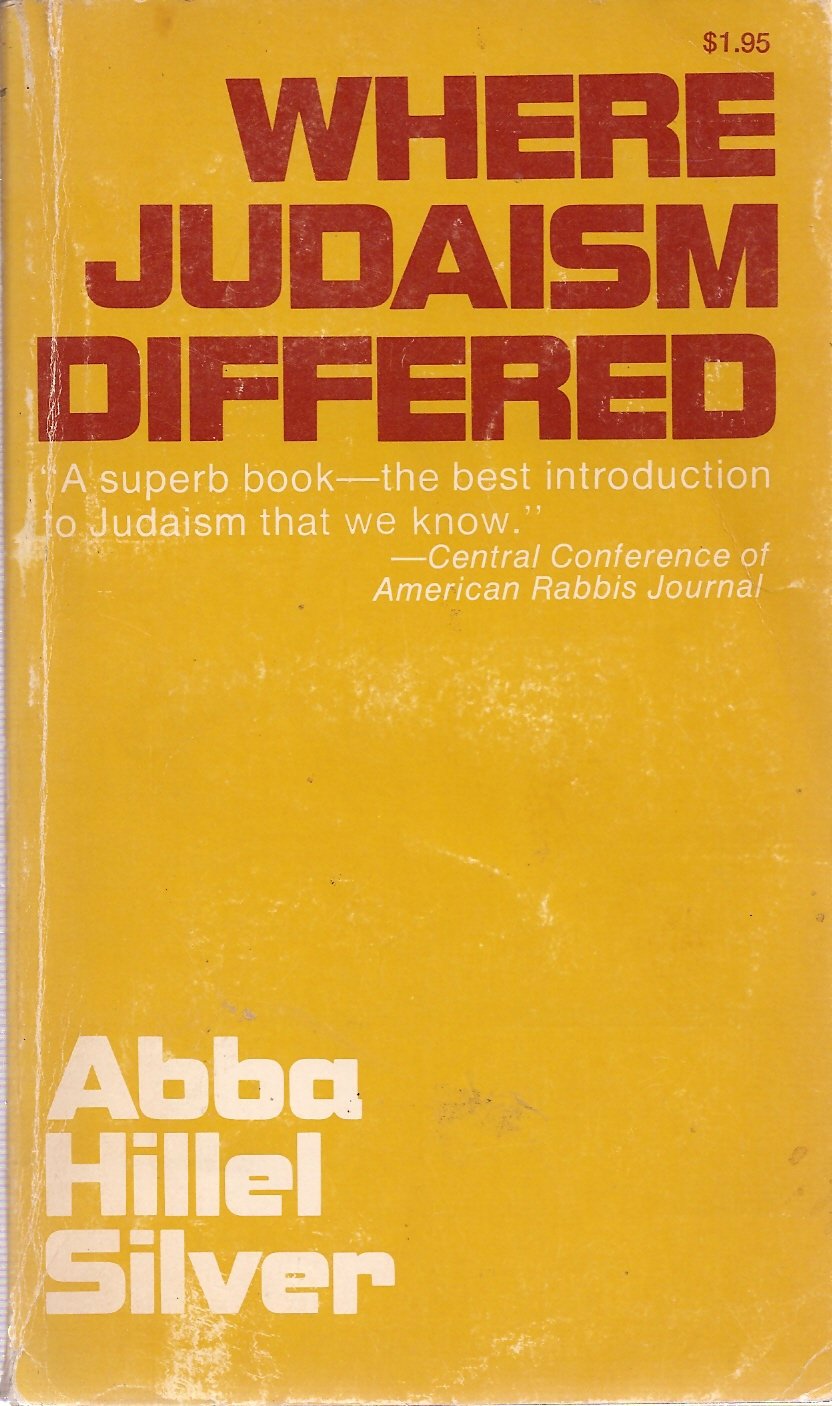
Before I continue my series on Rabbi Eliezer Melamed and post his views of Christianity and other religions, I will take a digression and present on the classic book by Rabbi Abba Hillel Silver, Where Judaism Differed (Macmillan, 1958). Rabbi Silver (d. 1963) was a renowned Reform Rabbi, a prolific author, orator, American Zionist leader, and fundraiser for the new state.. His most famous book, Where Judaism Differed, explained how Judaism is different from Christianity and other religions. The book was a pillar of the thinking of American Jewry. Whenever I explain my interfaith work to an older generation or explain what I am writing, I inevitably receive some form of  Silver’s words in response. I teach in a program in Jewish Christian Studies, so I know there are hundreds of better books, yet Silver’s ideas that Judaism is completely the opposite of other religions still percolate in the writings of other authors such as Rabbi Yitz Greenberg or in sermons from all denominations, or are found on social media, hence these ideas are often the basis for much in ChatGPT. (We also have the opposite on ChatGPT that Judaism and Christianity share Biblical values, the commandments, and the Golden Rule.)

In short, Silver assumes that whatever Christianity teaches, Judaism is the opposite. According to Silver, Christianity is elite, and Judaism is democratic. Christianity is about sin and salvation; Judaism has no concern with sin and salvation. Christianity is ascetic, Judaism is not. Christianity is mythic and magical; Judaism is not. Christianity assumes that all is predetermined without free will, and Judaism offers free will and social progress. Christianity advocates celibacy, Judaism does not.

Original Cover 1956

Christianity accepts a Trinity, Original Sin, Incarnation, a personal messiah, miracles, redemption through God, a virgin birth, and the need for salvation of the soul. Judaism rejects these concepts and every theological idea in Christianity. Christianity is a mystery religion, while in Judaism, “the moral life and the aspirations of man are the “sacraments: of Judaism.” (210) Christianity is otherworldly and concerned for the afterlife; Judaism has no interest in eschatology.

Christianity and Islam, in Silver’s view, wanted to be free from the law, meaning to break free from ethics and morals. (Hence, Rabbi David Novak had to pen an essay explaining to Jews that Christianity is not antinomian).

In his words, only Judaism of all the religions of the world believes in human progress. (171).  Only Judaism is kind to the poor, teaches humility, and has reverence for human life as shown in his comparisons to Roman Latin authors.   

Silver paints the other religions in terms of their most monastic other-worldly forms and he is especially negative toward Hinduism and Buddhism seeing them as world denying, ascetic, and having little to teach. They are fatalistic and life is predetermined; this is his explanation of karma. These Dharmic religions are pessimistic, focus on suffering, and afflicting the body. He credits Christianity and Islam with many of these same negative attributes. (Once should compare Rabbi Kook’s fascinating correspondence with Rabbi Shmuel Alexandrov for a sharp contrast, in which the Russian rabbis have positive appreciation of Buddhism). He paints the Asian religions as lacking any moral teachings. Needless to say, this is an entirely erroneous characterization. I do not need to show that they have extensive teachings on ethics, family life, forgiveness, correct speech, correct actions, and working on personal virtue.  

Silver paints Judaism as engaged in a continuous historic battle against idolatry, idolatrous Canaanites, against Hellenism, against ancient paganism, against Christianity, which for him is really just part of the synthesis with pagan Greco-Roman world, and against the otherworldly pagan Calvinists of our own time. In contrast, Judaism teaches sober morality, personal piety, and the “prophetic tradition of social progress”!!!! (85) This reading of Jewish history was canonized by Heinrich Graetz in his 19th-century classic History of the Jews and the reading of Christianity as Greco-Roman, not Judaic, was the definitive position of the German theologian Adolf von Harnack. Silver cites the historian George Foot Moore’s Judaism in the First Centuries of the Christian Era, but only seems to take from it that Judaism and God-fearers were  “waging war with great energy against polytheism and idolatry.”

The book also typifies a Jewish trend of creating false historical genealogies crediting many aspects of Christianity to pagan influence. In 2025, I still see on social media, by people who should know better, the acceptance of the statement that Christmas Trees are from Roman paganism, a false statement, the earliest possible record is the 15th century, or that Easter/Pascha has anything to do with Ishtar.

In the end for Silver, Judaism is a pure ethical monotheism that is unique in believing in human progress. In the background of this, one hears echoes of Hermann Cohen’s views of Judaism as a unique monotheism striving toward messianic social progress but adapted for the popular pulpit. Judaism is the only religion not death-obsessed or about self-effacement, but rather affirming human progress.

The late 20th century popular Jewish maxims that Judaism does not engage with theology or have any theology, let this book linger long in people’s conceptions. Popular ideas that Judaism has no afterlife or eschatology dovetail with this book. I lose any ability to engage with the content of Rabbinic Judaism, midrash, Aggadah, kabbalah, or even medieval Jewish philosophy. Judaism is an abstraction and defined by negation of others. There is no message of the High Holy Days, the three festivals, Chanukah, prayer, or Jewish life.

To his credit, Silver was responding to several prior decades of liberal Jewish rabbis proclaiming that Judaism and Christianity taught a common universal message of prophetic ethics. However, his solution was to negate every idea of Christianity as the definition of where Judaism differed, without offering any serious positive theology of Judaism. Basically, being Jewish means rejecting a Christmas tree and every positive Christian value. The book was written in a different era, it was before Vatican II’s Nostra Aetate, and he was formed in the heyday of social progress of the first half of the 20th century.

A recent book on religious polemics portrays Silver as driven by the need for apologetics, to stem the tide of Jewish self-hatred, to respond to the stereotypes about Jews. (Jay Newman, Competition in Religious Life, 92). Silver’s work is “vitalized by the exaggeration and caricature that characterizes almost all apologetic works.” He excuses Judaism from all its weaknesses and finds the worst in other religions. He violates one of the prime directives in interfaith comparisons: Do not compare your best to their worst.

At the time of its release in 1956, the New York Times reviewed the book with praise for showing that Judaism is different than Christianity. The CCAR proclaimed that “the best introduction to Judaism that we know.” While a more cautious Felix A Levy, a Reform rabbi, praised the book as a new apologetic Hizzuk Emunah, referring to the 16th-century apologetic work by Isaac Troki, but faults him for leaving out revelation and halakha.

On the other hand, Lou H. Silverman, Professor of Jewish Literature and Thought at Vanderbilt University, in a 1958 review, faulted the book sharply for reducing Judaism to oppositional negation. Judaism is defined as not Pauline Christianity, but we do not learn at all how Rabbinic, philosophic, and mystical Judaism understood the same issues. Silverman opines that the book fails to do full justice to the texture of the tradition.

Silverman points out that the Jewish prayer book in any version is about God having sin, God’s mercy on us, and forgiving us. To say that Judaism has no sense of superiority or racial thinking and is the only universal religion rubs Silverman the wrong way. He points out that the Reform Union Prayer Book referred to the Jewish race until 1933 and it took until 1945 to remove the racial elements.  Silverman as an exclamation, asks: Where is Yehudah Halevi, Franz Rosenzweig? Silverman asks: when Silver states that a concern with “eschatology represented a sharp deviation from Classical Judaism,” what does that even mean? Silverman notes that Silver certainly excludes explicit Rabbinic concerns. Silverman ends his review by wishing that Silver had written a confessional, mature statement of his beliefs as a Reform Jew, rather than just presenting Judaism as the negation of Christianity.

Msgr John M. Oesterreicher of the Institute of Judeo-Christian Studies at Seton Hall University wrote a nine-page negative review of the book. At the time, Oesterreicher was editing a journal called The Bridge which looked at similarities and differences between Judaism and Christianity, and was already working on the 1961 “Decree on the Jews” (Decretum de Iudaeis), which is considered the first draft of Nostra Aetate.

Oesterreicher points out that Silver removes any sense of the word of God or God’s call to Abraham, or Sinai, replacing those ideas with a prophetic Jewish religious genius and ideas that we follow Judaism as utilitarian, “opportune and useful for life.” He is especially irked that Silver refers to God as a due to the Jewish genius created the universal God idea, which Oesterreicher considers “not part of the truly Jewish vocabulary.”

Oesterreicher declares that “the light in Rabbi Silver’s book is not the light of scripture” and that he is at variance with Jewish tradition. For example, neither the Hebrew Bible nor Rabbinic texts see sin as degrading; rather, they have full theologies of sin, repentance, and atonement. (This is like Silverman’s critique above that you cannot state that Judaism has no eschatology). He also notes that Silver is against mysticism and mischaracterizes both Western and Eastern mysticism.

Oesterreicher obviously thinks Silver misreads and mischaracterizes Jesus, Paul, the New Testament, and Christian teachings in many places.  For example, the Sermon on the Mount is clearly rabbinic in context and not to be relegated to foreign “Greco-oriental” values. Silver psychologizes Jesus’ disciples as unable to admit their teacher was arrested and killed so they go into psychological denial, delusion, and imagine him as still alive. Silver shows no knowledge of Jewish memra theology or the variety of first-century Jewish ideas.

In conclusion, Oesterreicher agrees that Judaism and Christianity are different and cites Silver approvingly that “to gloss over differences as a gesture of goodwill is a superficial act” (289) But that does not mean they are opposites. Rather, Oesterreicher ends by saying that the discussion of similarities and differences should be pursued with an “Untiring, even painfully, open eye.”
The digitized American Jewish Archives preserve the letters that Silver received from publishers about his book. Harper and Bros rejected it based on Reviewer #2. Simon and Shuster rejected it  with a long letter including the following paragraph:

The third point is, I fear, a more sensitive one, but perhaps it would be best for our mutual understanding to state it baldly. All of us have been somewhat troubled throughout the book by the invidious comparisons of Christianity with Judaism. Enduring spiritual values, I feel, are self-demonstrative; they do not need to be singled out and lauded at the expense of something else. I realize that such comparisons have an enormous controversial value, but I also feel that they have the final effect of weakening your rich, positive statements, or detracting from the dignity of a great tradition. It is for this reason, as well as for the reason that such invidious comparisons may offend and repel people of other faiths, that I venture to suggest that you reconsider them.

In the end, Macmillan published it as written. But before publication, Silver had his friend   Ludwig Lewisohn read the manuscript to offer comments. Ludwig Lewisohn (1882–1955), was a novelist, outspoken critic of Jewish assimilation, and a founding faculty member of Brandeis University.

Lewisohn flags the book’s thesis that history “manifests a clear upward movement in human development,” noting that this “seems to me violently contrary to historic experience and to negate by implication the special redemptive function or the Jewish people and the meaning of its martyrdom. I do not like to see concepts like “development” and “progress” applied to Jewish history. Unless we died for the eternal Law, what did we die for?” This defense of Western liberalization (so-called) has been totally invalidated by history. After the Holocaust, pre-war optimism seemed misguided.

Also noted is that Silver credits anything he does not like in Judaism to outside influences. Lewisohn writes: “Too much importance attached to the theories of Babylonian influences, etc. These are all grounded in malice, conscious or not, and the desire to eliminate the reproach of Judaism’s uniqueness.”

Once interesting observation from the book “Here, my eye catches one of those usages that lower tone. “Judaism has little sympathy with the spiritual lone wolf.” (138) That’s a screaming incongruity–like chalk scratching on a blackboard. And were not the prophets lonely and hence embattled souls?”

Lewisohn does not want to reject the spiritual and theological teaching of Judaism just to engage in negations. Lewisohn rejects the sharp contrast with Christianity

Of course. “original sin” in the Augustinian sense is nonsense. But does not Judaism, too, recognize deeply man’s rebellion against God? Is not therefore teshuvah the end and aim of life. And does not the classical liturgy make it clear that we need God’s grace–vayihi razon milfanecba. I’m frightened for the nobility and inwardness of Judaism when these things are stated after this fashion.

I’m sorry. I think the notion of “progress” in that sense –social progress without inner change-is totally discredited and Jews and Judaism will discredit themselves by clinging to it… The essence of the whole matter is in the Alenu. Progress means obedience to God’s Law and abstention from idolatry–of man, of State, of all the idols or the market-place. And that, thank God, is Judaism.

In conclusion, we are now blessed with sixty-five years of work showing the similarities and differences between Judaism and Christianity. We have fine works on the New Testament, Patristics, Rabbinic, medieval philosophy, and modern thought. No one would write like Abba Hillel Silver anymore. But the influence of this book remains vast in common understandings. I am still greeted with citations of this work. And if you want to judge the knowledge of Christianity by contemporary rabbis and Jewish thinkers, or the recent works showing a more open approach, the benchmark was already set low.  So judge them, in this context.

Rabbi Melamed on the Divine Spark in other religions

Continuing my discussion about Rabbi Melamed on Other Religions. I started with his statements on Hinduism and will now look at his broader premises- see “The Divine Spark among Other Religions”  and here “Rabbi Abraham Isaac Kook on Different Religions.” Once again, I will use the posted selective English translation because it is accessible; however, I do have the Hebrew original marked up with marginal notes and a full response.

      For Rabbi Melamed, all religions have a spark of the divine, some of the light of the divine, and help the world advance toward its moral perfection. The religions of the world educate towards the moral foundations, “each religion according to its level.” Through accepting these points, Rabbi Melamed removed any stigma of other religions as needing to be negated  or the need to call other religions as demonic, entirely false, or to teach a restrictive exclusivism where only Jews have religion.  Rather, for most people in the world, Melamed thinks that “it is right for every person to continue in the faith of their fathers, because with the loss of faith, moral corruption increases.”

      Rabbi Melamed also thinks that the religions of the world are progressing toward deeper and more abstract forms of understanding their religions, thereby removing “the dross of the crude material elements within it” allowing them to elevate their souls “to higher faith and morality.” Jews should not follow these religions; however, the religions of the world “serve as a moral and faith compass for all peoples.”  Rabbi Melamed acknowledges that religious ideas are evolving and progressing to deeper understandings, the ancient and medieval forms of the religion that most people know from textbooks do not reflect current ideas in those religions. He has spoken with many people and read many books to overcome the essentializing of religions in ancient forms. I am always surprised at people who think other religions are where they were in 500 CE or even 1700 CE, but at the same time have a modern understanding of Judaism.

      Rabbi Melamed’s fundamental starting point is the discussion in  Rabbi Abraham Isaac Kook’s Le’Nevuchei Ha’Dor and his other books. However, Rabbi Melamed draws out the full potential implications in some of Rabbi Kook’s statements, going beyond the prior understandings to create a new broader vision, melding his views with those of Rabbi Kook. To highlight the contrasting understandings of Rabbi Kook, it is worth noting that Rabbi Zvi Yehudah Kook had views, also based on Rabbi Abraham Isaac Kook, that were deeply adversarial to Christianity and other religions, as were those of his student Rabbi Aviner. One should treat the use of Rabbi A. I. Kook and the explanation of the citations of Kook by Rabbi Melamed as innovative and expansive, blending the ideas of the Kook with contemporary application by Melamed.

      Rabbi Kook wrote that the world’s religions serve a divine providential purpose, gradually elevating humanity towards its ultimate goal. There is an evolutionary unfolding of humanity from a crude understanding of God toward an abstract belief in one God. In the meantime, people need “a tangible belief in idols that provide them with basic principles of conduct and morality.” Therefore, Rabbi Kook thinks every religion has “a divine spark of morality that sustains it, through which it sets standards of good and evil” as they advance “towards the belief in divine unity “ (‘Le’Nevuchei Ha’Dor’, Chapters 8; 14:1).

Each religion contains a divine spark expressed “through different educational and cultural systems, aimed at improving human spirit and material conditions, the time and the world, the individual and the community (‘Orot: Ze’ron’im’, 6).Therefore, even concerning the lowest form of idolatry, “one cannot decide that the entire religion is erroneous,” as it may have been suitable for them in the past to uplift them somewhat. There are different levels among religions, and some are more refined “in morality, character, and conduct, and thus, their customs and idolatrous practices are not as detestable and filled with disgust as others” (‘Le’Nevuchei Ha’Dor’, 14:1; ibid, 39:1; ‘Rishon Le’Yaffo’, 91:1)

Even pagan and idolatrous religions may have served a purpose in their time. But no specific hierarchy is created. But the important element is the Divine spark in all things. God has a presence in the world and its cultures and is not limited to a single group.

      The reason for this acceptance of other religions is based the idea that there is a natural division and diversity of nations, an idea going back to the Second Temple literature and continuing through the Middle Ages and beyond. Each nation has their own spirit, either angelically above, internally as their animating force, or as volkgeist. In Rabbi Kook’s writings, we have a grand vision of the elevation of all of humanity. We also have kabbalistic ideas of divine sparks in all things. Finally, we also have neo-Platonic ideas of all things upwardly aspiring to the divine. No longer is the discussion of other religions limited to Talmudic discussions of stones on the road for Mercury or statues of Aphrodite.

      Rabbi Melamed explains Rabbi Kook’s idea to mean that even pagan religions serve a divine purpose and that even the representations of the gods through idols point to higher “values of truth and goodness.” Greek mythology teaches moral lessons. Melamed uses his textbook knowledge of Greek myths to state that even the gods are subject to Fate, thereby showing that there is a divine destiny and higher ethic even higher than the gods of the myths. For Melamed the “ancient myths where, despite the great power of the gods, it is limited, and they are subject to fate. Furthermore, their actions also affect their destiny, and any idol that crosses certain limits—such as excessive indulgence or pride, or extreme disregard for other gods—will be punished by more powerful, higher forces. These higher forces reflect a higher value system, in which a belief in the one true God is hidden.” Greek myths show a higher theistic vision and teach moral.

      Whereas Rabbi Moses Feinstein, allowed the Greek myths only because the religion was dead and considered the myths as showing that the Greek beliefs were nonsensical, non-ethical, and immorally licentious, Rabbi Melamed, in contrast, following Rabbi Kook see the guiding hand of divine providence in the narratives as part of God’s plan for uplifting each nation of the world and that the very myths contain moral lessons. Rabbi Feinstein’s approach limits knowledge of God and morals to Jews,  awash in an immoral world. Rabbi Melamed sees the knowledge of God in all nations and all nations are on a journey to ultimate perfection.

       As most Jewish universalists, he quotes  “For from the rising of the sun to its setting, My name will be great among the nations; and everywhere incense is going to be offered in My name, and a grain offering that is pure; for My name will be great among the nations, says the Lord of hosts” (Malachi 1:11). Showing that all religions are really worshiping the Biblical God in their various forms of worship. Rabbi Melamed is clearly an inclusivity, finding a place for other religions in categories of Torah, and he is Jewish-centered, but some of his ideas are moving to a universalism.

      For example, Rabbi Melamed cites the Talmud to claim that all religions are worshiping the true high God of the Bible even if they use representation. “Our Sages explained that all idolaters refer to God as “Elah de’elahaya” – “God of gods” (Menachot 111a).”Despite using idols, “there was a deep-seated belief in a Supreme God, the source of truth and morality.” Most people were not on the level to recognize this, but there “were exceptional individuals who delved deeply into their faith and directed their primary prayers to the God of gods.” Hence, he can acknowledge the Ancient Greeks Neoplatonists, or the Hindu Upanishads, and others as expressing the best views of the era. Nevertheless, these religions improved “the values of truth and goodness in people’s hearts. In these paragraphs, he is beginning to sound more like Rabbi Menashe ben Israel or Rabbi Eliyahu Benamozegh.

      Even more surpassing is that Rav Kook wrote that the sages of other religions even merited divine inspiration, (ruach ha’kodesh), a form of prophecy, through which they deepened their faith and educated their people. Rabbi Melamed accepts this. But in his printed book he cautiously does not mention the current discussions among these circles about acknowledging that Muhammad, Buddha, or Guru Nanak may have divine inspiration. The medieval position of Rabbi Nathaniel ibn Faymi (d. ~1165) that God sent prophets to all nations and establishes a religion for all nations, is becoming more accepted as a valid position. In general, one should compare Rabbi Melamed to Rabbi Yakov Nagen to get a sense of the current approaches- see Rabbi Yakov Nagen- here. One should note that Yehudah Halevi already called Plato, Aristotle, Hermes, and Zoroaster as divine (elokhi) and Maimonides granted Baalam the same prophetic status as the patriarch Jacob. Hence, even ancient pagans may have had some form of divine prophecy.

      Rabbi Melamed cites the later pietistic Aggadah Tanna de-Vei Eliyahu: “I testify by Heaven and Earth that whether it is a man or woman, servant or maid, gentile or Israelite, ruach ha-kodesh rests upon him according to his deeds” (Ch. 9).The original Tanna de-Vei Eliyahu is a parallel of Galatians (3:28) “There is neither Jew nor Gentile, neither slave nor free, nor is there male and female…” But here in the Jewish Aggadic text, we have a greater universalism and a noticeable inclusion of all the people of the world in Holy spirit, which originally may have meant divine connection or inspiration corresponding to a Christian sense of the Holy Spirit but it is being understood in the 21st century as referring to prophecy, probably because the phrase Ruah Hakodesh is used in contemporary Rabbinic language to refer to prophetic inspiration and prophecy. Rabbi Kook added that it is possible that the leaders of religions even received heavenly assistance to perform miracles, so that their followers would accept the religion that advanced their moral state (‘Le’Nevuchei Ha’Dor’, 14; 46; 57).

      Based on Rabbi Kook, Rabbi Melamed declares that one “should not denigrate other religions, including the more idolatrous ones.” This halakhic pronouncement seemingly undoes prior Rabbinic exhortation to make fun of idolatrous religions. Rabbi Kook taught that: “Such denigration is also against the very essence of faith and religion, and therefore, those who throw off the yoke will take the arguments and words of disparagement said about other religions and hurl them at Judaism, as happened in practice.” In making fun of another religion, the arguments against another religion can just as easily be turned around to attack Judaism causing Jews to lose their faith. Rabbi Kook taught: “we need to deepen our understanding of the value of other beliefs according to the Torah,” and show the greater and more comprehensive light that exists in the faith of Israel. In our age, greater respect for all religions leads to a stronger respect of the religious core of Judaism.

      Should the nations continue in their idolatry? He answers, “even the exceptional individuals among the nations who knew that God is the “God of gods,” the source of all powers, did not abolish idol worship. This is because they knew that belief in one abstract God was too lofty, and without faith being applied to tangible forces called idols, and reinforced by rituals, they would not succeed in establishing the moral values that would elevate their people and religion.” People are not ready to worship without images and statues. This is the same answer given by the medieval Hindu scholastics Shankara, Ramanuja, or Madhva, that the people are not ready to give up their representation. It is also the answer given in the 20th century by Sarvepalli Radhakrishnan, philosopher and former President of India. Rather than the more traditional and popular Orthodox Midrash Says dualism of Torah consisting of all truths and morals contrasting with idolatry as immoral and lacking any truths, the other religions, even idolatry, serve to bring people to God. The religions of the world are on a sliding scale, very similar to what is taught in Hindu textbooks since the early Middle Ages and even in the 21st century.

      Idols made of wood and stone still have the function of curbing evil inclination and keeping people from committing crimes. Even idolatrous rituals keep people on a virtuous path.  At the same time, “if they continue to observe the laws of their religion, they could gradually ascend, until they merit reaching the true level of faith, drawn from the light of Israel. Therefore, according to their value, their religion has religious significance.” Rabbi Melamed concludes that “we can recognize and honor them for approaching the light of God, according to their own way.” It is important to note, that Rabbi Abraham Isaac Kook also wrote this about prior philosophic understanding of Torah, declaring that contemporary understandings of Jewish concepts need to evolve beyond the medieval.

Christianity and Islam

Rabbi Melamed follows Rabbi Kook that Christianity and Islam are not foreign worship because they were influenced by the Hebrew Bible and thereby show greater divine light. These two religions display “a further stage of progress in the process of purifying faith and morality, from crude idolatry, towards pure faith in God. And as noted above, they possibly have been granted prophecy and the performance of miracles

      However, Christianity and Islam are flawed “in that they do not recognize the central role of Israel in revealing God’s word and blessing to the world, and instead, claim to replace them – while harming Jews. For him, “there is a necessity that over time, Christians and Muslims cleanse themselves of hatred of Israel, and become able to draw, from the source of Israel’s faith, illumination and guidance, according to what is appropriate and suitable for them for constant elevation and Tikkun Olam (repair of the world).” (Americans in the culture wars should take note that Rabbi Melamed used positively the word tikkun olam  a word freely used by Rabbi Kook, Rebbe Nachman, Rabbi Ashlag, and other Eastern European rabbis- for citations of its use by traditional rabbis  see here).

      In conclusion, Rabbi Melamed states that even now, when there is still hatred by Christians and Muslims of Jews, and they still have problematic elements, it is still “proper to respect the foundations of faith and morality in their religion, through which they succeeded in elevating many people to have better qualities and to achieve love and fear of God.

      Unlike those who differentiate Judaism’s attitude toward Christianity and Islam, Melamed notes “that Rabbi Kook consistently refers to Christianity and Islam equally. True, Islam is purer of idolatry, but apparently, this advantage is not decisive compared to the aspects in which Christianity is preferable to Islam.” Rabbi Abram Kook, in later decades when he was fighting the extensive Christian mission, has derogatory statements about Christianity, which were given emphasis by his son Rabbi Zvi Yehudah Kook.

      Rabbi Melamed concludes that Christians and Muslims are obliged to continue in their religion. Once again quoting Rabbi Kook: “The religions founded on the basis of the Torah and the Prophets, certainly have an honored value, for those who hold to them are close to the light of God, and knowledge of His glory” (“LeNevuchei Ha’Dor” 14:1). Rabbi Melamed is creating some form of Religions of the Book, in which the three religions are all based on Torah.

they have “the great moral principles they took from the light of the Torah, which also strengthened in them, with greater vigor, the pure human feeling”. And by way of this, arose from them “individuals with a pure spirit, from whose gathering they will establish for themselves religious customs, which fulfill their destiny, to elevate the soul to good qualities, to love of God, and fear of Him. Therefore, they are certainly obligated to follow the ways of their legislators, who are held in their nation as holy men, according to their value and nature”. Therefore “it is proper for every person perfect in knowledge to understand, that those who engage in them, according to the tradition in their hands, are engaging in the service of God, according to their level” (ibid 8).

Rabbi Yakov Emden’s approach of seeing great moral value in them, especially Christianity, has been accepted by Rabbi Melamed. In the past, one found it in Isaac Baer Levinsohn, Rabbi Benamozegh, Rabbi SR Hirsch, and in Rabbi Kook. But now, it has become mainstream halakhah in Rabbi Melamed. It has also been extended from just Enlightenment era Christianity to all of Christianity and Islam.

Conversion

Rabbi Melamed quotes Rabbi Kook that each nation has its own unique religion and therefore, one should generally not convert. Rabbi Kook wrote (“Le’Nevuchei Ha’Dor” 8) that it is not proper for a person to convert from their religion, including members of idolatrous religions. Because every religion also expresses the social and national character through which it was formed, and one who leaves it, betrays their family, their people, and their good values.

      According to Rabbi Kook, it is often beneficial to convert from a lower religion to Christianity or Islam, “because will grow from the recognition of the unity of God (which exists in Christianity and Islam) will, in any case, bring blessing to the whole world”. However, according to Rabbi Melamed, looking at 21st-century reality, this is not always true because sometimes religious ideas and virtues will be lost in the process of giving up native religion. “For we have learned that from every religion, one can remove the dross–until it remains clean of idolatry and bad qualities.” He cites the example of Hinduism, which has deep learning and morality and recognizes the one true divine source. Many times, “leaving it for Christianity or Islam may be considered a descent.” They lead less moral life or damage their spiritual lives.

Avodah Zarah Be-Shituf (Idolatry in Partnership)

Rabbi Melamed assumed that non-Jews are allowed shituf and in this he is quoting Rabbi Kook who wrote: “Noahides are not warned about shituf” (Shmoneh Kevatzim 8:44); and it is an aspirational goal for those who do not even have shituf” (Orot Yisrael ve’Techiyato 5). In addition, Rabbi Melamed singles out for accepting the same opinion on the permissibility of shituf for gentiles  his predecessors Rabbi Charlap (Mei Marom 10:35; 12:32, 2), Rabbi Menachem Mendel the ‘Tzemach Tzedek’ (‘Derech Mitzvotecha’ ‘Mitzvat Achdut Hashem’ and Rabbi Menachem Mendel Schneerson, as well (Likutei Sichot 20 p. 16 nt 44). For a full discussion of his position, where he cites many opinions, including those who think shituf is forbidden to non-Jews, see Rabbi Melamed’s discussion here.  But there is no need to email Rabbi Melamed (or me), the citations of those who think it is forbidden. He knows them and discusses them at the link

God Name will be One

In conclusion, Rabbi Melamed cites the universalism of Rabbi Kook, who advocated loving all humanity and all nations despite differences in religion or race. Moreover, he advocated for understanding the other nations, especially their religion, since it is central to nations.  Rabbi Kook wrote: “Love for people should be alive in the heart and soul, loving every person, especially, and loving all nations.” Any expression of hatred towards gentiles is “only for the wickedness and filth in the world.” This love should be maintained “despite all changes in religious beliefs, opinions, and despite all distinctions of races and climates.” (Middot Ha-Ray’ah: Ahavah, 5).For Rabbi Melamed,  one should “understand the views and characteristics of different nations and communities as much as possible, to establish how to build human love on practical foundations. Since religion is central to the spiritual and practical life of nations, Rabbi Melamed concludes that it is evident that Rabbi Kook’s intention also includes different religions. Thus, Israel will be able to fulfill its purpose, bringing the word of God and His blessing to the world

      Finally, since all religions can elevate themselves, there is no aspiration for religions to be nullified; rather each religion has a unique hue, reflecting the special character of the people in which it was created. Thus, the vision is for each religion to purify itself of all its flaws and reveal its unique path in serving God and contributing blessings to the world. This is the prophetic vision of “I will remove their blood from their mouths and their abominations from between their teeth, and they shall remain even for our God” (Zechariah 9:7).  And of “For then I will turn to the peoples a pure language that they may all call upon the name of the Lord, to serve Him with one accord” (Zephaniah 3:9). (This is unlike Prof Menachem Kellner’s Maimonidean universalism envisioning that all people will have to become Jews).

      Ultimately, every nation will maintain their own religion but be elevated in the messianic vision. “Alongside each nation’s special devotion to its religion, humanity as a whole will be united through the connection of all nations to Israel and its center in Jerusalem, as it is said, ‘For My house shall be called a house of prayer for all peoples” (Isaiah 56:7).

Rabbi Dr. Yakov Nagen on Interfaith

My friend, colleague, and fellow interfaith traveler Rabbi Dr. Yakov Nagen recently had his book “God Shall be One” – Reenvisioning Judaism’s Approach to Other Religions (Maggid Press, 2024) translated into English. Rabbi Nagen directs the Ohr Torah Stone’s Blickle Institute for Interfaith Dialogue and Beit Midrash for Judaism and Humanity, in addition, he is the Executive Director of the Ohr Torah Interfaith Center. He is also a  Ra”M in Yeshivat Otniel.

The book His Name is One was actually only half written by Rabbi Nagen, the other half was written by his colleagues Rabbi Sarel Rosenblatt and Dr. Assaf Malach. They discuss Yehudah Halevi, Meiri, Emden, Benamozegh, Rav Kook, and Manitou. However, Rabbi Nagen wrote the essays given the book shape and character, providing an interfaith vision for the Institute. The book is a compendium of their Beit Midrash for Judaism and Humanity.

For those who want to know more about the prior work of Rabbi Nagen on spirituality and Torah study, you can read two prior interviews on this blog about his work. The first interview is on his book of spirituality, Be, Become, Bless(2019). The second interview was on his approach to Torah study focusing on his books Water, Creation and Divinity: Sukkot in the Philosophy of Halacha [Hebrew] (Giluy 2008) and The Soul of the Mishna (Maggid Press, 2021).

My interview focuses on some of the issues in the book and some that go beyond the book. Most notably, beyond the book, is that Rabbi Nagen advocates creating a mutually agreed document similar to Nostra Aetate between Judaism and the Muslim world. Just as the Catholic Church renounced antisemitism and recontextualized Judaism as the root of Christianity, so too Jews and Muslims, as religious leaders not as political leaders, need to create a document of mutual acceptance and recognition. (See question #9 below)

In the book “God Shall be One”, Nagen looks to the 15th century thinker Rabbi Jospeh Albo to create an acceptance of a plurality of religions. In addition, Nagen accepts that Judaism acknowledges many names for God, each reflecting a different aspect of the Divine. Yet, there is but One God, who transcends form, time, and definition. He also advocates sharing Torah with the wider world.

 And most striking, he uses Rabbi Nathaniel ibn Fayumi, to accept that God sends prophets to other religions and as a way to say that other religions may have a God given mandate through their own prophets.  Nagen also lets people know that there are currently halakhic rabbis such as Rabbi Eliezer Melamed who are also going in this direction based on Melamed’s unpublished manuscript about other religions.

Nagen acknowledges that we do have problematic and exclusivity statements about other religions in Jewish texts. But he states that” It is our responsibility to navigate these perspectives, choose thoughtfully among them, and at times, firmly reject those that conflict with our moral convictions. Unfortunately, extremists are often empowered by moderates who mistakenly assume that extremist interpretations represent the most authentic expression of Judaism.”

A key element in Rabbi Nagen’s approach is his looking to an eschatological end of days when we fulfill the verse, “On that day, God shall be One and His Name One” (Zechariah 14:9). A messianic vision where we all call on the name of God in His Oneness, in which all religions are unified in this call to acknowledge the singularity of God. Our goal is to see that now or at least work towards that goal. Even though I attend interfaith events with Rabbi Nagen My own interfaith work of acknowledging diversity, universalism, wisdom in other religions, and the need for understanding is non-eschatological. I may return to this on the blog as I am finishing my book on religious diversity.  (forthcoming Fortress Press,2027).

As an aside, as a personal pet peeve. Talking about rabbinic opinions toward interfaith of the 1960’s is like talking about the opinions LBJ, Moshe Dayan, Humphrey, and Khrushchev, when asked about contemporary politics of 2025. If you are interested in interfaith, then please learn about the major rabbis and thinkers involved in interfaith of the last 20 years, instead of rehearsing thoughts of sixty years ago. For example, start your discussion with Rabbi Yakov Nagen.

Finally, Rabbi Nagen’s interfaith work proceeds from a deep love of humanity, following in the footsteps of Rav Kook. In a passage of Rav Kook, which Nagen quotes

Ahavat Olam, love of all worlds, all creations, and all types of life…fills the heart…The devout among people…hope for the happiness of all, wish for the light and joy of all…when they come among the dwellings of humanity, and they find divisions of nations, religions, sects, and opposing ambitions, they try with all their might to include everything, to unite and bring together” (Shemonah Kevatzim 1:101).

Rabbi Nagen with Muhammad Al -Issa , Secretary General of the Muslim World League

God Shall be One-Interview with Rabbi Yakov Nagen

  1. Why did you write the book?

The prophetic vision for humanity’s destiny calls upon the Jewish people to play a significant role in fostering global fraternity centered on belief in and service to one God. This vision is embedded the daily prayers of religious Jews, which conclude with the recitation of the Aleinu, which expresses the aspiration for all humanity to acknowledge God and call upon His name, fulfilling the verse, “On that day, God shall be One and His Name One” (Zechariah 14:9).

However, that day will not come until we reimagine interreligious relations with our non-Jewish brothers and sisters. The Jewish people have a unique role to play, in part as Judaism forms the foundation of Christianity and Islam, which together encompass most of the globe. Even smaller religions, like Sikhism, and massive Eastern traditions have been influenced directly or indirectly by the Abrahamic faiths through the forces of globalization.

There is need for a book to present a Jewish theology of religions that is deeply rooted in traditional sources while addressing contemporary challenges and dynamics. Our book presents paradigms—that see value, meaning and significance of other religions within a Jewish framework. Awaking consciousness to these issues and transforming it into a living reality is a long path but it is essential to define where we are aspiring to reach.

Globalization is an undeniable reality, and the pressing question is how we, as Jews, engage with the broader world. Will our inner religious identity be an integral part of this encounter, or will it be sidelined? Today, the greatest threat to religiosity is the secular materialism of the West. Standing alongside other religions to confront this shared challenge can strengthen all faiths, including Judaism. In our globalized, secular world, interreligious engagement has the potential to make both religiosity and Jewish identity more, not less, meaningful.

2. Do you think it will have any affect since there are so many Jews who have negative views to other religions?

The greatest obstacle I see within the religious Jewish community is not negativity but indifference and apathy. What is needed is to awaken people, their eyes and hearts, to recognize how deeply rooted and essential this vision is, along with a defined approach for moving forward.

I see the awakening to these aspects of the Jewish people’s role and destiny as parallel to the Zionist endeavor. The return to Zion was a core value in Judaism, but for centuries its practical realization was neglected. Gradually, this dimension grew more prominent in Jewish awareness, leading to a transformative change in both the Jewish people and the world. Similarly, we must now address why an insular approach of the past should evolve in light of contemporary realities.

3, How is this tied into God’s name shall be one?

A shared belief in and consciousness of One God is redemptive theologically but also meaningful on a deeply human level. Within the monotheistic religions, when we recognize—both in our minds and in our hearts—that the God we believe in, love, and pray to is the same God who loves others and is worshiped by them, our faith can profoundly transform our interpersonal relationships. This understanding foster empathy, unity, and a shared sense of purpose, bridging divides and elevating human connection through a shared devotion to the Divine.  

Encounters with other Abrahamic religions highlight the centrality of Judaism in their narratives and can deepen Jewish pride and identity. When a Jew meets a Christian who regards Jews as their “older brother” or a Muslim who sees them as part of the “people of the book” (ahl al-kitāb) who received the Torah from Heaven, the reflection of Judaism’s significance in the eyes of the Other reinforces our collective sense of responsibility. Large portions of humanity model their lives on Abraham and perpetuate his legacy, a fact that adds universal significance to Jewish life.

We must raise critical questions, such as: What do I truly envision as the fulfillment of what I pray for each day in the Aleinu? Once this question is posed in a context as this, it cannot be ignored, and its repeated reinforcement through daily prayer ensures its prominence in our consciousness.

4.Can we treat Rabbi Nathaniel ibn Fayumi who wrote that God sends a prophet to each nation as normative?

Rabbi Nathaniel b. Rabbi Fayyumi (ca. 1090 – ca. 1165) was the leader of Yemenite Jewry and the author of Bustān al-Uqūl, a Judeo-Arabic work of theology and ethics. Maimonides himself referred to Rabbi Nathaniel with the honorific “our master and teacher,” a testament to his esteemed standing in Jewish thought. Rabbi Yosef Kapach has noted that Fayyumi’s ideas had a profound influence on Maimonides’ Guide for the Perplexed.

Fayyumi embraced the possibility of prophecy for non-Jews as part of the unfolding of religious history. He argued that just as the one true God of Judaism sent prophets to various nations before the giving of the Torah, it is possible that God continued to send prophets afterward, “so that the world would not remain without religion.”

In more recent times, Rabbi Abraham Isaac Kook expressed comparable ideas, which scholars attribute to the influence of Fayyumi. In contemporary discourse, two leading rabbis from the religious Zionist mainstream, Rabbi Eliezer Melamed and Rabbi Uri Sherki, have invoked Fayyumi’s writings to underpin their theological perspectives on other religions, particularly Islam.

5.Does Judaism recognize the multiplicity of the world’s religions, not just Christianity and Islam?

I personally emphasize a perspective that acknowledges the legitimacy of religiosity as an expression of an innate human drive—to seek out and connect with the divine.

These religious gestures arise from below, shaped by human initiative, rather than being solely delivered from above. Judaism’s foundational idea is that human beings are not merely passive recipients of divine revelation but active partners with God in shaping reality and religious expression. This principle is evident in the actions of Abel, who initiated a sacrificial offering to God, and the generation of Enosh, who began to call upon God’s name. Such examples underscore the collaborative and dynamic nature of human-divine interaction in religious life.

We do not confine the legitimacy and respect of a religion to whether it stems from a specific divine revelation but instead evaluate religiosity based on its spiritual and moral content, the number of possible expressions becomes inherently unlimited. What truly matters is not whether Judaism is explicitly credited as the source of inspiration but whether the fundamental values and beliefs are fulfilled within the context of that religion. If these core principles are upheld, the potential ways to express and realize them are boundless. Diversity, much like the beauty found in nature, is a profound blessing.

Rabbi Yehuda Leon Ashkenazi employs a powerful metaphor to convey this idea: the diverse identities of humanity are like a bouquet of flowers, each contributing its unique beauty to the whole. The role of the Jewish people, he suggests, is to serve as a unifying force, binding these flowers together to create a harmonious and radiant arrangement.

To illustrate this from a non-Abrahamic tradition, I hold deep respect and appreciation for the Sikh religion. This respect arises from acknowledging that, like Judaism and Islam, Sikhism shares a belief in the One God, Creator of the Universe, and its core values align with many teachings of the Torah. The existence of different forms and focuses in fulfilling these values is, in itself, a blessing that can inspire others.

For example, I am moved by the Sikh greeting, Sat Sri Akal, which means, “I see the eternal truth of God within you.” This resonates deeply with the Jewish belief in humanity being created in the image of God. Similarly, I admire the Sikh tradition of hospitality and openness to others. The Golden Temple, open to all, features no images or statues of the divine but instead houses the original copy of their foundational scripture, the Guru Granth Sahib. I see this sacred space not as a dedication to “their” God but to “our” God—the universal Creator.

In this, I take joy in the fulfillment of the words of the prophet Malachi:
“From where the sun rises to where it sets, My name is honored among the nations, and everywhere incense and pure oblation are offered to My name” (Malachi 1:11).

Rabbi Nagen at the Golden Temple in Amritsar: the Sikh 555th Purab Mubarak Smagam

6. How does Rabbi Joseph Albo contribute to the discussion?

Albo locates the roots of plurality of religions in his conception of the Noahide Law. He considers the Noahide law as not a static set of laws but a dynamic religious framework that evolves in accordance with national temperament, ethical sensibilities, and environmental conditions. He writes that it develops “according to their respective national differences”. The profound cultural variability among nations shapes how Noahide law is realized.

This concept is reminiscent of Rabbi Abraham Isaac HaKohen Kook’s vision of the evolution of the Oral Torah: “We feel that the unique character of the national spirit… is what lends the Oral Torah its unique form.” Religions, in this sense, can be viewed as a kind of “Oral Torah” for the Noahide law. Just as there are seventy facets of the Torah, the seventy nations each possess their own interpretations and expressions of the seven mitzvot.

7.You discuss pluralism and John Hick. Are you a pluralist? Do we all just have different names for one God?

Judaism acknowledges many names for God, each reflecting a different aspect of the Divine. Yet, there is but One God, who transcends form, time, and definition. What is essential is not the specific name used but the shared act of calling out to the One who is good and true. This unity is not diminished by the diversity of names humanity uses to refer to God; rather, it is enriched by it.

Allow me to share an insight that came to me while giving a keynote address in Amritsar, India, on the occasion of Guru Nanak’s 555th birthday. I quoted the biblical vision of humanity calling together in the name of God but offered a reflection inspired by Guru Nanak’s teaching that the One God has many names. In this light, we might rephrase the biblical verse to envision humanity calling together in the names of God.

Finally, I want to take this opportunity to thank you for introducing me, through conversations and through your groundbreaking books such as Judaism and Other Religions (2010), and Judaism and World Religions (2012) to the spectrum of approaches to other religions—from the wide embrace of pluralism to the firm stance of exclusivity.

8.What do you do with the exclusivist texts in Judaism?

The Talmud warns of the danger of turning the Torah into what it calls “a potion of death” instead of “a potion of life” (Yoma 72). This occurs when exclusionary and radical texts are elevated as the rule rather than recognized as exceptions. While such texts must still be acknowledged and addressed, they often reflect specific historical or cultural contexts that may no longer be relevant.

Judaism embraces a wide range of opinions on virtually every issue. It is our responsibility to navigate these perspectives, choose thoughtfully among them, and at times, firmly reject those that conflict with our moral convictions. Unfortunately, extremists are often empowered by moderates who mistakenly assume that extremist interpretations represent the most authentic expression of Judaism.

This debate—between what constitutes the rule and what remains the exception—is at the heart of my Beit Midrash for Judaism and Humanity. Our approach is not about reforming or rejecting halacha but about returning to its true fundamentals.

9.What is your vision of a mutual Nostra Aetate with Islam?

In 1965, the Second Vatican Council’s Nostra Aetate proclamation marked a transformative shift in Christian-Jewish relations. A similar bilateral effort is now urgently needed for Jewish-Muslim relations, particularly in the Middle East. The key question is: Will our identities connect us or divide us?

From the Jewish perspective, this requires the creation of formative documents presenting a Jewish theology of Islam. These documents should be widely disseminated within both Rabbinical and lay Jewish circles, as well as within Muslim communities. The foundational elements for such a theology already exist, but they must be further developed and articulated. The goal is to foster mutual respect and recognition of Islam’s legitimacy and to encourage Jews to see Muslims as partners in a shared narrative—a grand, unfolding story in which each community plays a vital role. Together, we can strive to fulfill visions such as humanity collectively calling upon the name of God and serving Him “shoulder to shoulder.” We hope and pray this approach can contribute to resolving conflicts in the Middle East, where religion plays a significant role.

The cornerstone of this approach is the affirmation of Islamic belief in God and His unity. As Maimonides stated, Muslims “unify God with proper unification, a unity that is unblemished.”

This foundation can be strengthened by emphasizing shared reverence for Abraham, stories of the Prophets, and other biblical figures, as well as shared values and religious practices. A comprehensive Jewish theology of Islam should also address the status of Muhammad, offering a nuanced perspective. Among Arab Muslims and Jews, there is even a recognition of shared ethnic heritage, providing additional common ground. These commonalities are essential building blocks for fostering mutual acknowledgment of the legitimacy and value of each other’s religious identities.

From the Muslim side, a similar effort is needed—a return to and affirmation of the Quran and Hadith’s clear acknowledgment of Jewish belief in God, the special status of Jews as Ahl al-Kitāb (“People of the Book”), and the Torah as a divinely granted guide to the Jewish people. This effort must include addressing claims of supersessionism and rejecting the notion that the current Torah is a forgery. Furthermore, it is vital to counter antisemitism fueled by misinterpretations of Quranic verses that critique certain Jews in specific historical contexts but are misapplied as blanket condemnations of all Jews. The Quran itself seeks to limit such critiques, explicitly stating, “They are not all the same.”

To advance this vision, I have composed an unpublished essay or monograph titled Jewish-Muslim Religious Fraternity. In this work, I call on global Muslim leaders to compose formative documents on these issues.

Shortly before his death, Fethullah Gülen, a leader of millions of Muslims through the Hizmet movement, authored such a document. This seminal text, available in Turkish, Hebrew, and English, addresses many of these critical points. It represents a significant step toward building bridges and fostering understanding between Jews and Muslims.

Allow me to conclude with a quote from the King of Morocco, Mohamad the 6th that inspires me in this endeavor:

The three Abrahamic religions were not created to be tolerant of one another out of some unavoidable fate or out of courtesy to one another. The reason they exist is to open up to one another and to know one another, so as to do one another good.

10. Why and how do we share Torah with non-Jews?

One of the great tragedies of religion occurs when exceptions are mistaken for the rule, and the true rule is ignored or forgotten. The issue of sharing Torah with humanity is a striking example of this. Bringing the light and wisdom of Torah to the world is not merely an option but a divine mandate for the Jewish people—a central role and responsibility rooted deeply in the Tanakh. The textual evidence for this mission is both explicit and overwhelming.

This chapter further illustrates how the sages (Chazal) reinforced this principle. The prevailing rule, as stated by Rabbi Meir, is that a non-Jew who studies Torah is like a Kohen Gadol (High Priest).

The exception, represented by Rabbi Yochanan, states that a non-Jew who studies Torah deserves death as a thief. This harsh view, however, is contextual as is for example the Talmudic critique of women studying Torah. Rabbi Yehiel Yaakov Weinberg explains that Rabbi Yochanan’s statement emerged in response to the early Christian use of Torah study to support replacement theology. Early Christians exploited their knowledge of Torah to claim that God had nullified His covenant with Israel and replaced it with a “spiritual Israel” (Christianity), effectively “stealing” the Jewish people’s identity. Similarly, the Rambam limited the prohibition to Muslims in his era, who studied Torah not with reverence but to discredit its authenticity.

When these specific contexts do not apply, the broader mandate—to share Torah with the world—remains intact. In our era, the time has come to fulfill the prophecy of exporting Torah from Zion to humanity.

Given the diversity of humanity, those engaged in the sacred mission of sharing Torah must consider the unique needs and perspectives of each culture they encounter.

For instance, when I was invited to teach Torah in China, I began by identifying topics relevant to Chinese culture. Through preliminary discussions, I learned that the Chinese place great importance on the Jewish approach to disagreement, encapsulated in the statement, “These and those are the words of the living God.” In a culture that values deference to authority and often views disagreement negatively, the Jewish embrace of diverse opinions as a blessing—expressing the seventy faces of Torah—was a novel and inspiring concept. Similarly, the Jewish emphasis on the intrinsic value of every individual within society resonated deeply.

Tailored engagement ensures that the eternal wisdom of Torah speaks meaningfully to the hearts and minds of people across the world, fulfilling its role as a light to the nations.

11.What good does dialogue accomplish? Does it really help?

My students sometimes ask me: “Rabbi Yakov, do you really think that just because you and an Imam meet and develop a relationship, that this will bring peace?” My answer is that it is not that such a meeting brings peace, but rather that it is already peace! When two people have a meaningful relationship, in which they connect from their inner essences, it is not just a path to shalom, it is shalom in itself. The goal is to scale this up by millions. I then call upon my students to become partners and create new relationships with the Other.  We need a massive partnership of leaders and lay people from both of our religions, and extensive grassroots encounters and educational initiatives to make Shalom and Fraternity ever broader and deeper between our communities.

Marilynne Robinson and the Emergence of Ethical Man post 3 of 3

Marilynne Robinson claims in Absence of Mind that we overcome the materialist worldview of T.H. Huxley (exemplifying the new atheists) by appreciating the deeper sense within us. I started thinking that I have heard this before Yes indeed, it is the basic position of Rabbi Soloveitchik in the Emergence of Ethical Man. We need to overcome the materialism and selfishness of Huxley’s worldview by accepting the Divine command and emerge as moral beings.

Robinson is at the forefront of changing the popular image of Calvinism Calvinist defender Jonathan Edwards’s description of man as a “loathsome insect” held over the fire of Hell by God, such a task seems ripe and even overdue. In all of her works Robinson moves the emphasis to Calvin’s idea of a God given religious consciousness. We can sense where our life has gone astray and needs the word of God.

Such warring against historical miscomprehension, however, while effectively waged by Robinson, is not the main task of her essay. Instead, she seeks to describe the religious and spiritual experience of perception in Calvin’s theology, the experience by which seeing the world leads to loving it, and witnessing mankind brings about acknowledgment of man’s infinite beauty and potential. For Robinson, “wickedness is not the only inhabitant of man’s soul. There also reside stores and stores of grace, beauty, and holiness, stores that shine forth when we truly and lovingly look at our fellow man. Created in the image of God, mankind is filled with his divine presence; it is only in comparison with this potential for sanctity and goodness that Calvin so painfully denounces man’s wickedness.” – for more on her Calvinism-see here.

According to Robinson, we have to overcome a material bestial life and learn to appreciate our life stories filled with a wide ethical range of sin and beauty. In her novels, from what I have been told, we find ourselves confronted by God’s vision of human life.

Rabbi Soloveitchik starts with the same need to overcome the scientific materialism and amoral selfishness of Huxley, he also starts with the same Protestant pessimism about human nature in its natural state. So, his solution is the need to accept the divine command of being in the image of God and accept moral responsibility for our actions. Unlike Robinson for whom this is a natural faculty, Soloveitchik treats it as “a redemptive sacrificial act” or as a need to be “confronted by God’s revelation.” We need revelation of Genesis to give meaning to our lives. We rise from our nasty brutish existence to a life of morality and intellectual integrity. He presents this rise from materialism to ethical existence in several works including The Emergence of Ethical Man, Confrontation, Kol Dodi Dofek (in shortened form), and in Ubekashtem MeSham. We gain meaning to our suffering and cognitive gestures through revelation and then as Jews we have a double confrontation in that we also have a second confrontation with God in which we are transformed into the Jewish community of Torah.

Soloveitchik lacks a natural faculty but requires a revelation; this form of revelation is called a dialectic theory. All revelation is about how God communicates with humanity. A dialectic theory concerns itself with how we are redeemed from natural existence; it is not about receiving a corpus of doctrine. Nothing can be known in a dialectic approach without revelation so revelation is about one’s basic anthropology. (for more info google Karl Barth and revelation)

As a side point, much of the blog world not trained in theology is not used to distinguishing between revelation and Torah from Sinai. The former is where the divine breaks into the human condition and the latter is the Jewish concept of what occurred at Sinai. Rabbi Soloveitchik was always interested in the former – how we go from materialism to ethical and then to halakhic. He clearly writes that he was not interested in apologetics about the latter. The former was the more serious question.

Marilynne Robinson reminds us why revelation is the more important question. How do we understand human existence that helps us transcend skepticism, materialism, and man’s brutish nature? She answers with a God given sense of the sublime and Rabbi Soloveithcik answers with a double confrontation of man before the Divine.

As a useful contrast, David Novak in Azure set up the problem the same way but offers a different answer. Novak offer a single confrontation. Like Soloveitchik, we no longer use natural theology to know God as a first cause or His involvement in the natural order. We only know God as the commander who creates our moral standards. Novak answers the skeptics and materialists by saying, of course as modern we cannot compete with you and do natural theology that gives values to the natural order. Instead, we have to acknowledge the commander and know that he gives us a natural law to guide us. Whereas Soloveitchik has a double confrontation – our universal meaning in life and then our obedience in halakhah. Novak has a single confrontation and our universal moral sense of natural law should be used to generate a natural law halakhah.

We could say that statements about God are not scientific hypotheses at all, since we are not speaking of God as a cause operating within the natural order, which is the sole order about which natural science can speak with any cogency. And, even when we do speak of God as the creator of the universe and all it contains, we are not speaking of a God whose existence has been inferred from human experience of orderly nature. Instead, we are speaking of a God who commands our community, through his historical revelation to our community, to acknowledge his creation of that natural order in which our historical relationship with him takes place.

A neo-Hasid sees God glory in all things, and does not worry about the science. None of the three thinkers, however, allows nature to prove anything because then the materialists and skeptics win. Today, only fundamentalists conflate religion and science. These are not the only three approaches but Marilynne Robinson has given us a angle to bring together several dialectic thinkers.

Copyright © 2010 Alan Brill • All Rights Reserved

Absence of Mind- Marilynne Robinson 1 of 3 posts

Friends recommended that I read Marilynne Robinson’s writings, especially her Pulitzer winning novels. She is touted as a master craftsmith of the written word, theological believer, and creating her own form of Neo-Calvinism. So I decided to pick up her recent response to the skeptics.

Absence of Mind: The Dispelling of Inwardness from the Modern Myth of the Self, by Marilynne Robinson, Yale 158 pages

The book is her answer to the new atheists in which she argues that we have humanism, subjective self, and human experience. She does not respond to their claims as much as say that there is more to the world. She claims that they are creating a lack of mind, a lack of self. And that they are only creating a “para-scientific literature”

She quotes Dennett’s definition of religion “as about social systems avow with a belief in a supernatural agent.” Dennett is not talking about private religion, religious experience, religion as meaning in life or creation of moral order. Maimonidean rationalism, Buberian dialogue, and new age renewal is not religion for Dennett.

Robinson shows that the problem of materialism, scientism, and behaviorism are not new problems. She claims that the Materialist position is separated from the wealth of human insight. The subjective human mind is what gives us knowledge of the human experience.

She opens her book with a description of how scientists feel a sense of discovery, accomplishment, and fulfillment when they solve a scientific problem. From a human point of view, science is not just facts in a text book.

She is an advocate of the writings of William James and his radical empiricism. And treats the new atheists as rejecting James. She reduces much of their materialism and the selfish gene to the nineteenth arguments of T. H. Huxley. (more on this in later post- post #3) And she uses Freud as her example of psychological reductionism.She finds ever new ways of showing that these new writings do not add anything to the debate of the last two centuries. (Except that a generation of science trained religious fundamentalists are discovering them for a first time. They trade the absolute claims of their material religious fundamentalism for a secular version.)

She thinks they are bypassing Donne, Bach, the Sufi poets and Socrates. She considers as essential to human life metaphysics, imagination, human experience, and in turn these are to be considered a revelation from God

Even in the social realm, she finds their obsession with Fundamentalists misleading. She asks: what of the religion of Gandhi, Martin Luther King, or her own cultured Calvinism?  She does accept  from the new atheists that some of the fundamnetalists were equally bad for the soul since they are just as materialist and not concerned with the self as the new atheists.  They are also obscurantist and anti-education. She suggests and I agree, “that some of the new atheism is a reaction to militant religious fundamentalism.”

She agrees with Harvard popularize of science Stephen Gould, that religion and science have nothing to do with each other. Gould used to be assigned at YU and the subject of frequent public lectures by the Bio dept.

Pinker considers that religion offers the answers to the ultimate questions, but since the ultimate questions are unanswerable then we dismiss the whole activity. To this  she answers, no, no, no. Questions that are deemed unanswerable has driven the thoughts of humanity. The history of civilization  answers these questions in ever new answers and forms. From the Library at Alexandria  to the Library of Congress we have collections that enrich our lives- ideas, texts, human experiences, quests for meaning.

She is defiantly preaching the choir. She assumes her reader has read, or at least can read, Grotius, Calvin, Spenser, Emerson, Jung, Searle and Putnam. Those who cannot are the very materialists swayed by the new rhetoric. And those who defend against the new atheists through materialist apologetics and trying to refute scientific method wont find comfort here either.  Religion is not in the scientific realm. Yet, Robinison as a committed non-liberal Calvinist does point in the direction that future discussions of a viable religion position needs to take.

Quotes from reviews:

Robinson makes a strong, unapologetic case, not for mystery but for self-respect.

We look in the mirror, Marilynne Robinson writes in “Absence of Mind,” and we see an untrustworthy, self-interested creature with an untrustworthy mind. No wonder a philosopher such as Tolle, for instance, who offers the idea that we aren’t so bad after all, that we have a right to believe in the value of experience and the mystery of the universe, might be clung to like a floe that a polar bear has finally found to rest upon.

Winner of a Pulitzer Prize for her novel “Gilead,” Robinson in this new nonfiction work questions the authority of science, not its methods, which she sees as evidence for the capacity and beauty of the human mind. She is annoyed by the arrogance of modernist thought, which has entrapped us for so many generations: “After Darwin, after Nietzsche, after Freud, after structuralism and post-structuralism, after Crick and Watson and the death of God, some assumptions were to be regarded as fixed and inevitable and others as exposed for all time and for all purposes as naïve and untenable.”

Robinson, however, affirms her own “very high estimate of human nature”: “We have had a place in the universe since it occurred to the first of our species to ask what our place might be.”

But positivism and modernist thought have had the opposite effect: They encourage the “exclusion of felt life”: We are discouraged from making explanations about our place in the universe. Subjectivity is not allowed; instead, there is what Robinson calls an “absence of mind.”

Guardian Review by Karen Armstrong

Washington Post Review

Arthur Green – Radical Judaism #5

Time for the final chapter. Continued from here and here.

Green asks: What Does God want you to do? or as Green puts it Who are you? What does it mean to be human?

For Green, the answer must come from our sense of Creation that includes all of humanity, we need to internalize a universalist concept that man is the image of God. (We don’t get an ethicist’s or jurist’s list of ethical principles.) There is an evolutionary human development toward greater universalism. So rather than giving us a theory of justice, we get a discussion of how can we still use the kabbalistic language of soul as a basis for universalism. Green strength is his personal honesty to state that he is hesitant to use the word metaphysical word soul but then turns it around to preserve the holy language of the soul by stating that the soul is the recognition that we are a holy being enjoined to remember to respect and rejoin the pantheistic source of all being. Immortality is the acknowledgment of the circle of life. There are new babies and new flowers and eternal renewal. (What I get is a sensibility more than universal values.)

Green places the current debate among Israeli Religious Zionists about universalism in a footnote but does not enter the fray. What did Hazal do with the universal principles of image of God and Love thy neighbor? Alon Goshen-Gottstein sees these ideas as too universal for Hazal while Yair Lorberbaum shows how Maimonides and Nahmanides retained aspects of these ideas to create metaphysics. [As a contrast to Green, when Rav Cherlow asks this question of what God wants from you– he responds with a compassionate Jewish law of values.]

Green states that he is not worried over who is a Jew, and other discredited nineteenth century ideas like race and peoplehood. He feels that there is too much emphasis in Jewish life on the insecurity of our existence and not enough on our status as seekers. Choosing of Israel does not mean rejection of other people. The Six-Day War and the Yom Kippur War created a lasting impression on Jews. But Israel and the law of return is still bound to the Nuremburg laws. Jews are seekers, not a race. (echoes of Avraham Burg, but the later advocates ethics.) For Green, between the universal seeker and tribal Jew is the Jewish seeker.

Green does not consider the way the Jewish seeker plays itself out in real life. Two common forms of the Jewish seeker are (1) the tribal seeker, who has a universal Judaism and hates other faiths or commitments. he Bu-Jew with a hatred of Christianity and Islam. (2)Or those so tribal that they say anything she touches is Jewish. This second Jewish seeker is adamant that any fragment of Buddhism or Yoga that they like is a fulfillment of Judaism

Green describes himself as a religious Jew and secular Zionist. There is no religious or messianic status to the land of Israel. But essentially he remains a diasporist.

Green has a nice section on his differences from Heschel. For Heschel, one actually gives to God when performing a mizvah- there is real theurgy. Heschel had a Biblical personalist image of with mystical overtones, and Green admits that he is a pantheist with personalist overtones A pantheistic God as energy that offers blessing – meaning an energy that adds value and meaning to the world. Heschel was God’s partner- he translated prophetic and kabbalistic language into personalist language.Heschel has traditional views of God, Torah, Israel. Heschel approach to the law was apologetic combined with a plea for more compassion and decency. Green approach is heterodoxy. Green acknowledges that Heschel has both a progressive approach, which Green likes, but also a strong conservative trend.

Well was this book a vision for the 21st century future of Judaism or was it just the spiritual autobiography of a baby-boomer?

Arthur Green–Radical Judaism #4 of 5

Chapter 3 of Radical Torah is on Torah and revelation. Torah points to the oneness of all reality and mitzvah is our sense of what creates holiness in our lives.
Green’s radical views on Torah go back to some of his first public statement.

In the 1960’s, the pulpit Rabbi David Hartman raised money to host annual SEGAL retreats in Quebec. The invitation list included depending on the year Rav Aharon Lichtenstein, Elie Wiesel, Emil Fackenheim, and Rabbis Wurzburger, Yitz Greenberg, Berkovits , Jacob Petuchowski, and Seymour Segal. The responses to each other’s positions formed the backbone of 1960’s Jewish theology. (Forty years later, a cross denominational retreat like this might once again force theologians to articulate their differing and mutually exclusive positions ).

In 1969, a young Arthur Green spoke to these assembled elders as a representative of youth culture. And the June 23 1969 issue of the NYT gave a lion’s share of its write up of the retreat to Green, who set out a radical position that his generation was looking for the sacred but he does not know if the traditional answer of eating beef is more holy than eating pig. Maybe today God’s voice is for us to eat natural foods or not to use cellophane or not to use migrant worker grapes.

A decade later in the Second Jewish Catalog , Green offered a subjective guide to religious practice, and scandalized the establishment for a Conservative rabbi to accept free love

In his first version of Green theology in the book, Seek My Face, the section on revelation was weaken than the section on creation.
In the second version of the book, E-hyeh, Green calls himself heterodox to distinguish himself from any sense of institutional obligation of practice. This third version of Green’s thought is more mystical and pantheistic.

The message of the Torah, read with mystic eyes, is that God alone exists as taught by the mystics in all religions This mystic oneness needs reinforcement through the world of the symbolic sefirot. Hasidic readings of the text are clearly the most useful in this scheme.
We cannot accept the world of the kabbalists as real science anymore but modern science does not have all the answers. We don’t know everything about reality but we cant take Kabbalah literally.The greatest insight of kabbalh today is psychological teaching about divine oneness. Torah is a vehicle for mystical consciousness.

From an Orthodox perspective, it would be unfair to judge a proclaimed heterodox position on Torah, revelation, and law. But what is lacking here from any perspective is the role of kabbalah as meaning creating in a post-foundational sense (see my last post). Green moves between ascribing an intellectualist approach to medieval kabbalah and concludes that it is fluid and symbolic. However, there is no need to situate kabbalah in the science-religion debate in post-secular age. I am not comfortable when he says that science has gaps in its explanatory power so he turns to kabbalah. Why are science and kabbalah even in the same discussion from a liberal perspective? If science is weak in immunology, cosmology, or oncology then the solution will come from further laboratory work, not by turning to the kabbalah to show that we can accept mystery in life. And the kabbalah is not symbolic because we have physics but because it has nothing to do with science.

[If one want to deal with the kabbalistic science of the Gra, R. Moshe Shapiro, and the Kabbalah Centre that would be a completely different discussion and focused on Orthodox thought.]

His view of revelation is as mystic teaching in our hearts. He explains this using Hasidic texts- that they only heard the aleph of creation on Sinai, meaning the mystic oneness of reality.

Green acknowledges that he is far from any traditional view and discusses that he has a God of disbelief, silent in our lives, and at best a projection for our needs. But he says that he really does accept revelation, a revelation of a God who pulsates as a wholeness of being in creation – inward in all things, an energy for evolution.This silent existence of God is everywhere So mitzvah are from this silent inwardness of creation and self. A panentheistic commander of mizvot. Green admits that this needs “unpacking,” which is his term. Mizvot are not a custom or folkway but to produce holiness and opportunity for encounter. Mizvot are a set of symbols to address the soul. Israel’s myth of sacred beginning.

Green considers Sinai as a great growth in religious consciousness and human awareness for freed slaves and the immediate commandment of not to have idolatry makes sense in their not wanting anything that constricts our minds.
But there is No God who makes a covenant with Israel. Only the One who calls from the heart to make this people his own. Green acknowledges that this is too personified and particualistic since God is revealed in all hearts, of all people – all revelation is based on culture. Israel said yes in the Sinai of the heart and the mind- Jews respond to an inner call. Jews are a channel for divine presence and blessing. No matter how secular they seem, Jews are priests at the alter of God.

Green asks: But does this mean that Sinai was merely human ? His answer : No, God is in the human heart The covenant is mutual, God is bound to it and we are promised by God that He will love us, the more you give the more you get. He has faith in reward.

I do not recognize traditional concepts of Torah, mizvot, and Sinai in Green’s presentation But then again he is proudly heterodox and speaks to those who are spiritual not religious. For crucial questions of canon, authority, and interpretation, Halbertal- remains the starting point. And for the meaning of Kabblah, sod, religious experience and Biblical exegesis, Fishbane is the place to start. But Green offers openness to the spirit and the therapeutic deism that guides contemporary lives.

Yet, before I let this chapter go, and post this review -I feel not satisfied. The Hasidism is not historical hasidism, the response to Biblical criticism seems fluffy, and the definition of mysticism is self-defined as his own unity of being unable to hold up in a study of mysticism. I might be faulted for wanting things more academic. Is this chapter just that he likes haimish language of Torah and mizvot and his pantheistic oneness of being is a justification for haimishness? I dont know! Martin Buber was a serious heterodox engagement with Torah, rigorous in history and philosophy. I have a gut feeling that this chapter reads like the homiletic logic so common in Orthodoxy.

I do know that many people are performing searches for Art Green’s new book, few for Fishbane, and even fewer for Novak. So it must be speaking to people?

Do I have any heterodox readers to evaluate this?

Continue to part 5 here,

Meaning and Mystery: What it means to believe in God–David M. Holley

A book that is getting many good reviews from both academics and religious publications is David Holly, Meaning and Mystery. Holly approaches the question of the belief in God from a post-secular and post liberal perspective, God is part of our lives in a non-foundational way and the criteria for believe is whether God is part of our narrative. He takes from Charles Taylor the idea that we all create narratives or social imaginaries to make meaning of our lives. He also takes from all the new studies on evangelicals that people adopt Evangelical beliefs because it fits into their personal narratives. Hence, belief in God is non-foundational and based on our personal histories. God cannot be proved or disproved. Neither philosophy or science play a role in the belief in God. Someone who does not have God in their life cannot communicate with someone who does since they have different life stories. He does invoke Pascal and cheer for belief in ways that don’t fit with Charles Taylor, but many points of his are good. He seems to be working on a sequel on how the question of falsification is dealt with in a personal narrative approach.

Here is a review from a religious publication.

ONE of the myths of post-modernism is that we have entered the age of no meta-narratives.
Non¬sense. We are in the age of many meta-narratives. David Holley doesn’t even bother with the modern/post-modern question. He simply argues that it is these “life-orienting” meta-narratives that determine belief in God, or otherwise. This is the thesis expounded clearly and credibly in the first chapter, so that there is a certain inevitability about his attack on the “God of the Philosophers” who is the end point of a logical or empirical argument rather than an idea central to a life-orienting narrative that is accepted because it makes sense of experience, and is a plausible and practical guide for action.

Holley maintains that atheism is as dependent as theism on such life-orienting narratives.. Of course, such narratives require a degree of receptivity on our part if they are to be life-orienting, and it is in the nature of human freedom that they should be capable of being resisted.

Holley effectively exposes the worst excesses of rationalism and scientism that characterize many contemporary despisers of religion. Here he owes a significant debt to Alexander MacIntyre when it comes to seeing the very idea of virtues and values as incompatible with a purely naturalistic version of reality.
This leaves the way clear for him to demonstrate how narratives that include God are more likely to offer meaning to our lives than those that do not.
The final chapter deals with how we relate to religious and non-religious views other than our own. Holley contends that trying to evaluate various world-views from a standpoint outside any of them is impossible. We can address them only from within the life-orienting narrative we have adopted, and that way we can accommodate doubt and uncertainty without compromising the narrative that works for us.

From a scientific study of religion review interview:

What’s the central concern of the book, and why is it important?
DH: While the question of God’s existence is typically dealt with as a theoretical issue, I claim that it makes most sense to treat it as a practical question. Each of us needs what I call a life-orienting story, a narrative that relates a picture of what is ultimately real to individual experience in a way that makes a particular way of living intelligible and attractive. Some narratives of this kind include God and some explicitly exclude God. Reflective judgment about God occurs in the context of considering alternative narratives that might provide orientation for a way of living. In that context the issue is not only whether the understanding provided by a narrative coheres with what we take to be the facts, but whether or not it has the power to engage a person in a way of life she finds worthy.

And what is it that draws you (personally) to this topic?
DH: I am struck by the way religious claims and religious ways of life seem virtually unintelligible to some people. In the introduction to the book I cite one author who questions whether anyone actually believes in God because he thinks of the belief as a hypothesis that lacks any evidential support. Both believers and unbelievers are tempted to construe the issue in this way, and as a result the discussion gets sidetracked from the kind of belief intelligent religious people hold and the considerations that actually persuade them.

What sort of reaction do you hope it will get?
DH: I would like to persuade people that standard ways of thinking about God’s existence do not get to the heart of the matter. I’d like to reconfigure the discussion between believers and nonbelievers away from arguments about an isolated proposition to consideration of alternative narratives that might structure a way of life. I expect that some people will misunderstand my book, imagining that I am advocating some kind of disregard of rational evidence. Instead, I am trying to show what kind of reflection is appropriate for cases where we inevitably end up believing some practical narrative (naturalistic or theistic) that cannot be established on purely empirical grounds.

Beyond Theodicy- Sarah Pinnock

Clergy regularly publish op-eds and sermons about how we will never know why evil happens, nevertheless we have to rise to respond to the suffering. Many times these sermons are treated by those who quote it as brilliant innovation. Sometimes even the author praises himself in his own op-ed for his own deep insight and sublime rationality. Yet, as long as we have vocal clergy who blame earthquakes, volcanoes, and floods on the sins of the country, then it sustains these op-ed writers in their sense of superiority. However, the distinction between theodicy and our need to respond was a common theme of most existential authors. Sarah K. Pinnock , Beyond Theodicy: Jewish and Christian Continental Thinkers Respond to the Holocaust (2002) surveys this topic.

The book is eight years old, but I finally got around to reading it. Pinnock contextualizes nicely by surveying the deterioration of the belief in theodicy entering the 20th century and the new attempts by evangelical philosophers to restore theodicy. The majority of the book is on the four opinions of Marcel, Buber, Bloch (via Moltmann) and Metz. The book started as a dissertation and would not be good reading, to put it mildly, for those not used to academic reading.

The first position that she presents is Gabriel Marcel , who rejects theodicy but claims that we need to accept mystery of God without an attempt at justification. The goal is empathy and meaning in our lives; not to prevent suffering or protest. There are similarities to Victor Frankl and Erich Fromm.

The second position that she presents is Martin Buber, who has a greater collective sense than Marcel. For Marcel, meaning is personal, while for Buber meaning is to better the world. In the prophetic faith of Judaism one engages in moral acts, prayer, protest in the face of suffering which builds community. Buber introduces the discussion of how Job is a better source for today than Isaiah’s suffering servant. Finally, Buber speaks of how we rise from fate to destiny when we orient our lives around God. When we live in an I-thou toward others and build a community of destiny then even fate is transformed “Fate—with its eyes, hitherto severe, suddenly full of light—looks like grace itself” (102). (On the near complete reliance of Soloveitchik on some of these paragraphs of Buber, a different review would be needed.)

Pinnock’s goal was to compare the existentialists with the Marxists, so her next thinker was Bloch’s concept of hope as used by Jurgen Moltmann. Hegel downplayed suffering. The role of hope in Bloch and Moltmann is to bring the fate of history in correspondence with the destined redemption. Moltmann offers a mystical solidarity of man and God. For Moltmann, the Christian cross shows how to suffer in a meaningful way and shows the real possibility for redemption. The Marxist hope mandates a need for change or at least dignity before death.

Finally, Metz rejects the parallel of human to divine suffering. Human suffering is about painful despair, hopeless, and futility. It means broken shattered lives. To use a Jewish example, the pain of the slaughter of children in the Holocaust is not just an exile of the shekhinah or God crying. Metz introduces the theme of memory, where one has to integrate the truth of past into one’s life and in addition to investigate the causes of the suffering. The goal is to change the world, to protest, to investigate the socio-political causes of the pain, and to create a better society.

She concludes her book with comparisons during which she asks: Are these existential answers philosophy, psychology, or pastoral care? Certainly, many of the clergy versions are sheer pastoral comfort and should not be praised as philosophy. (Hashem yirahem)

The best part of the book is now the ability to analyze the options of the theologians who write that that we respond to suffering in the real world. Does the essay state that we respond in personal meaning, in building community, in restoring dignity, or to actually change the world? What did the author stress and what did the author leave out. Do we change the world or ourselves? Do we have to empathize with the sufferer or only help them? These distinctions allow us to stand on their shoulders and formulate better responses and responses that actually address the suffering at hand. If the book would be expanded, I would have liked to see chapters on Camus, Tillich, Benjamin, and Ricoeur since these authors are already making many cameos. A full comparison would be helpful for fleshing out the existential ethic.

Copyright © 2010 Alan Brill • All Rights Reserved

Arthur green – Radical Judaism #3 of 5 parts

Continued from here and here.

Chapter three is about the evolution of the Biblical God from a sky-god in heaven vertically above us to the 1960’s when we cannot accept that metaphor anymore. Other problems of this primordial Biblical God that need to be overcome is the existence of dark forces to overcome and the maleness of God.
For Green, Biblical myth consists of “ancient and powerful narratives that contain deep truths reverberating through human life.”The Divine personhood is presented as royal and paternal. But in later ages we have the bridal Song of Songs imagery, which becomes the hieros gamos of kabbalah.

Green states that Maimonides removed the anthropomorphic metaphors, but Maimonides’ religion of III 51 is limited to an elite.
Green credits kabbalah as the best thing to overcome Biblical theism by using mythic language of passion and intimacy combined with philosophic abstraction. Green see the Enlightenment as unfortunately overly rational and that it ignored our best stuff.. Hence, the time is now to recover Jewish panentheism. We need a Neo-Hasidic approach to see holiness in all things; we need to educate our lesser selves to the true (or is it just useful?) nature of reality. The Shema teaches us that there is no being other than God.

On the topic of the image of God, he quotes as to be expected Fishbane, Levinson, Liebes, Muffs, Boyarin, but Green’s approach is entirely about intereriorization, the linguistic turn of the aforementioned authors did not reach him. Green’s treats the Bible as basically one voice and then he breifly presents rabbinic and medieval imagery before presenting his own view does not leave a thick and resonant view of the Jewish God through the ages. Just reading Jack Miles, God: A Biography would be more helpful as a start.

Green regrets that Mordechai Kaplan could not appreciate Kabbalah. But from where I sit, First, Kaplan was a skeptic and rationalist not a homo religious of myth and symbol. Second, Kabbalah for Kaplan would have been its traditional magical approach of trying to effect higher worlds. Green’s poetic kabbalah was not invented yet.

Jay Michaelson who advocated a non-duality had a keener understanding that the God imagery will always be Oedipal and based on our psychology. Green seems to have the simple psychology where one moves beyond the psychoanalytic. One would find it hard to go from Green to the complex God poetry of Rilke, Levertov, or even Allen Ginsburg.

Closer to my tastes was the wonderful recent book by Julia Kristeva- The Incredible Need to Believe (Sept 2009) Kristeva looks at religion in the major psychological and philosophical literature (e.g., Freud, Arendt, Winnicot), fiction (e.g., Proust) and in private life (Kristeva makes wonderful use of Saint Teresa of Avila’s writings). She deals with the tension of the possibility of sharable knowledge of the inner religious experience. For Kristeva, God as father figure is the logos of civilization, on mysticism she follows Freud and finds a sensual autoeroticism of merging into the id. (One wishes for such unrepressed passion from Green’s Kabbalah.) “The problem of this beginning of the third millennium is not the war of religions but the rift and void that now separates those who want to know that God is unconscious and those who would rather not know this, the better to enjoy the show that proclaims He exists.”She as many others takes the Habermas and Ratzinger debates as religiously significant. And she notes that in the new millennium many are content with the mere promise of goods within their lives.

To return to Green’s original point about the loss of the Biblical God or for most of us, the loss of the God as King metaphor of rabbinic liturgy, What do we do when a metaphor fails? Green offers his kabbalistic pantheism – here is your God!

R. Shalom Baer, the Rebbe Rashab, is reported as lamenting on the overthrow of the Czar, saying “We have lost a metaphor.” The actual protagonist of the story is probably Rabbi Dovid Horodoker who wept when Czar Nicholas II was overthrown in the Russian Revolution of 1917. “Why do you shed tears over the fall of a tyrant?” he was asked. “I weep,” replied the hassid, “because a metaphor in Chassidut is gone.”
The question becomes: if we no longer have kingship then does that mean that all hierarchy, patriarchy, projected Father figures and authority is lost? For Green, it is lost. Yet from my perspective, do we not have situations of hierarchy in education and business? Or to use a non-personal metaphor of chi, in karate and Tai chi do we not have a clear hierarchy from white to multi-tiered black belts? I am not sure of the need to flatten everything to a pantheistic God of the self. I am not sure what happens to transcendence and aspiration without only Green’s pantheism As Kristeva points out, does transcendence become a mere promise of goods?

To be continued in part 4 here

Marc-Alain Ouaknin, Haggadah

One of the most interesting commentaries on the haggadah of the last decade was the one by
Rabbi Marc-Alain Ouaknin, Haggadah: The Passover Story (Paperback)

Ouaknin, a follower of Levinas and Lacan who teaches at Bar Ilan, when he is not busy writing profitable coffee table books, does some serious engagement with contemporary French thought, especially in his The Burnt Book. For him, the Talmudic project of the Eastern European beit midrash has no closure, ever changing, ever forgetful and driven by desire. He freely mixes R. Hayyim of Volozhin, Rav Nahman, Reb Zadok with psychoanalysis, symbolist poetry, and semiotics. Ouaknin has a reading of Judaism as indeterminacy. “Man must reject the illusion of thinking that life is already written and the way is drawn.” He are various fragments from the web that give some indiation of his approach to the Passover haggadah.

My favorite section is his explanation of Yachatz, breaking the middle matzah, as the Lacanian Real sending us on our quest through the seder for our ever receding Real , creating a symbolic order in the Lacan sense. Breaking the matzah creates an open space for our symbolic registry to occur. We are throw in the seder just as we are thrown into our quest for the recovery of the real.

On the telling of the Passover story, he writes:
“The words of telling emerge from that break, from the empty place left between the two pieces of matzah.”
The act of telling the story of the Exodus occurs through an exchange of conversation and ideas. We take the one whole matzah and break it in half because discussion and conversation occur when there is a minimum of two — me and the other.

On opening the door for Elijah, Ouaknin quotes the story in which Elijah goes alone to a cave on Mount Horev in the desert. God brings a great wind, and then an earthquake, and then a fire—but God was not in any of these. Instead, after the fire, he finds God in ‘a still, small voice.’ (1 Kings 19:11-13) Ouaknin comments that one must reach the level of Elijah, self-forgetfulness in the desert.

One must have sharpened one’s hearing, to be led to the absolute level of attention, to become capable of perceiving such a tenuous breath. One must have sounded oneself, have explored oneself in the darkest places of consciousness, to the furthest of thoughts, to have made the circuit of one’s inner domain many times, in constantly growing but nevertheless tightening circles, so as to attain the intimate desert of self-forgetfulness, to be able to be stroked lightly, touched, visited by such an inaudible sigh.
The point of concluding the seder with opening the door for Elijah is to signify that this journey in ‘the intimate desert of self-forgetfulness’ is the ultimate intention of the seder. While we aim to find ourselves on seder night, to reconnect with the story of our people and see ourselves as having personally left Egypt, remembering who we are paradoxically requires losing ourselves at the same time.

For his approach to “my forefathers worshiped idols” he quotes J.L. Marion about idols as false forms that distort reality and fill in the gap between us and the divine.
What the idol tries to reduce is the gap and the withdrawal of the divine… Filling in for the absence of the divinity, the idol brings the divine within reach, ensures its presence, and, eventually, distorts it. Its completion finishes the divine off… The idol lacks the distance that identifies and authenticates the divine as such–as that which does not belong to us, but which happens to us. (Ouaknin, The Burnt Book, p. 65)

Atheist Convention

The Global Atheist Convention will commence this week in Melbourne, with speakers such as Richard Dawkins, Peter Singer, A. C. Grayling and Phillip Adams. A new blog Questions of Faith will provide coverage and analysis of the Convention as it unfolds.
Questions of Faith of the 2010 Global Atheist Convention. The Convention – titled The Rise of Atheism – begins on Friday 12 March and ends on Sunday 14 March.
From Tuesday 9 March the blog Questions of Faith will feature posts anticipating the Convention and its emerging program. It will then follow as much of the program of the Convention as possible and we hope to include pictures and audio excerpts.
The blog wilt be beyond skepticism and move into a more theological direction. As the blog as already noted the importance of atheism for faith, “this is why in the work of great religious thinkers – Kierkegaard or Milton or Dostoevsky – one can scarcely tell at times whether they are advocating belief in God or the most devastating atheism. The line between the two is often blurred.”

Since they will be posting a ton of material this weekend, let me know if anything is really good.

My New Book Just Came Out-Judaism and Other Religions

My book Judaism and Other Religions is to be officially released on March 2nd by Palgrave-Macmillan. But it is already available in the warehouse and available for purchase, Be the first one on your block to own one. Buy it now:

Click here to buy it at Amazon

Editorial Reviews

“This wide-ranging but carefully organized collection of Jewish thought about other religions constitutes an indispensable resource for Jews and non-Jews engaged in interreligious relations today and for Jews seeking to develop a text-based contemporary Jewish theology of religions for our global world. Brill accompanies his lucid presentations of each approach with insightful critiques that will help guide their contemporary applications.”—Ruth Langer, Associate Professor of Jewish Studies, Theology Department Associate Director, Center for Christian-Jewish Learning, Boston College

“Serious Jewish engagement with other religions has substantially deepened and widened in recent years, both stimulating and responding to an increasing interest in Judaism from within the other world religions. Brill’s book provides essential access to the classical sources within the Jewish tradition relevant to this encounter.”—Rabbi Dr. David Rosen, International Director of Interreligious Affairs, AJC

“This is an excellent work: reflective, engaging, well-written, and perhaps most important—timely. Brill knows both the theoretical foundations for interreligious dialogue and rabbinic approaches to ‘other religions.’ It is a fine piece of scholarship, and it is also creative in bringing together three fields of discourse in a way they have not before been aligned. It blends both traditional and modern thinking about interreligious dialogue, and it analyzes these materials convincingly.”—Nathan Katz, Professor of Religious Studies, Florida International University

Product Description

With insight and scholarship, Alan Brill crisply outlines the traditional Jewish approaches to other religions for an age of globalization. He provides a fresh perspective on Biblical and Rabbinic texts, offering new ways of thinking about other faiths. In the majority of volume, he develops the categories of theology of religions for Jewish texts. He arranges the texts according classification widely used in interfaith work: inclusivist, exclusivist, universalist, and pluralist.

Judaism and Other Religions is essential for a Jewish theological understanding of the various issues in encounters with other religions. With passion and clarity, Brill argues that in today’s world of strong religious passions and intolerance, it is necessary to go beyond secular tolerance toward moderate and mediating religious positions.

Click here to buy it at Amazon

There is a forthcoming sequel volume Judaism and World Religions, which will be available at the end of 2010.

Vattimo and Theology

There is a new series by Continuum Book that engages contemporary philosophy from a theological perspective. Adorno and Theology, Wittgenstein and Theology, Habermas and Theology,  Girard and Theology, Zizek and Theology. They are also offering new readings for the 21st century of Kant and Theology, Hegel and Theology, Kierkegaard and Theology. Most of them look good and will surely engage discussion.

This past week, I went to a book signing for Vattimo and Theology– Thomas Guarino

There is little good material on Gianni Vattimo in English but here is a book review in English and here is Vattimo’s blog (in Italian- Columbia UP has a link to the blog embedded in a translation program).

Vattimo translated Gadaemer into Italian, and took hermeneutics to a Nietzsche influenced extreme. Everything is just interpretation, there is no truth in the text.

Now, how can a catholic priest teaching in a conservative seminary use an atheist, nihilist, gay, anti-clerical, anti-revelation thinker as a basis for a book? The approach not to take is to call this is heresy and forbidden and violates what we were taught. So what does that leave? One can show how other contemporary theologians have rejected his thought. (There is an article in Modern Theology- that does that)  Or one can take Vattimo’s positive points and re-graft them onto tradition.

Instead the author of the new book attempted the following two approaches. One can use it as a self-corrective for how tradition is currently being presented. One can use it to understand what current intellectuals are thinking so that one can respond to the issues of our age

Some of the points in the book:

Cardinal Ratzinger – decried the dictatorship of Relativism, Vattimo argued against Ratzinger that dogmatic claims are the bigger problem and let’s have charitable tolerance.

Secularism, in the post-religious sense, should not be decried but treated as a chance to practice the weak virtues of charity-love without dogma and as a vibrant fruit of religion. Religion has been kept out of the public sphere, but now that it is weakened, it should be brought back into the public sphere.

Vattimo says “I believe that I believe” – meaning that I have faith in the human concept of belief not in an object of believe. So whereas the Enlightenment taught we cant know the truth of religion, Vattimo argues that “faith” is the acceptance that one is heir to a library of the textual tradition of faith and to a socio-cultural world of religion. Modern rationalist liberals want to treat religion as symbolism, or metaphor. In contrast, Vattimo has faith in faith so he takes religion at face values but know that there is nothing behind it. There is no one meaning, all is a fable, all is interpretation, there is no truth out side the cave.

  • “It is only thanks to God that I’m an atheist”
  • “I believe that I believe” (credere di credere)

Guardino argues that this is not theologically sound. We need for revelation, and belief but Vattimo gives us an insight into our age. Guardino best line: “Vattimo makes cultural liberals look like scholastic divines”

Vattimo recites the Latin prayers from the Roman Breviary three times a day, and he says it is not because he believes but as an acceptance of tradition. There was a wide range of opinions what to make of that behavior. Does that give him a weak faith? Does ritual without a traditional sense of faith count? What would Jews make of this ritual behavior?

Unfortunately, we have nothing similar from the Jewish community. We do not have a series like this. There is little Jewish theological engagement since the early 1960’s, except among a few academics. Why cant Jews put out a series like this?

We spend all our time discussing bad ideology about our denominations, maybe responses to actual philosophers might better clarify our beliefs? Maybe a Reform and Orthodox response to Vattimo might teach us more than a rehashing of denominational generalities.

What can Jews learn from Vattimo? Does it reflect our congregants state of faith? How would we respond to Vattimo? What corrective does it offer us?

How would an Orthodox author successful learn from a heretic?

As a side point: It is interesting to watch the major philosopher of our age Jurgern Habermas learning to use Twitter.

Update: Jürgen Habermas says he’s not on Twitter

Over the last several days there has been considerable hubbub around the fact that pioneering media theorist Jürgen Habermas might have signed up for Twitter as @JHabermas. This would be “important if true”, as Jay Rosen put it. Intrigued, I tracked him down through the University of Frankfurt. I succeeded in getting him on the phone at his home in Sternburg, and asked him if he was on Twitter. He said,

No, no, no. This is somebody else. This is a mis-use of my name.

Copyright © 2010 Alan Brill • All Rights Reserved

Critical Theory and Religion

An interesting find on the consistently superb blog Mirror of Justice, written by two dozen law professors teaching at Catholic law schools.

The Cambridge professor of theology,  Denys Turner, has noted “in much continental philosophy, from Heidegger to Levinas and Derrida, it is  acknowledged, with varying degrees of unease at having to concede the point, that the predicaments of our culture have an ineradicably theological character.” Back in 2004, Paul Griffiths made a similar point in a First Things essay, titled “Christ and Critical Theory,” which explores the Christian yearning of the likes of Lyotard, Badio, Eagleton (then a disaffected post-marxist), and Zizek.

If one takes the Crits to be involved with a philosophical engagement with difference, then their connection to a form of Christianity has been noted by theologians for some time. Points of contact exist between apophatic religion and the philosophical concern for difference, religious skepticism, and lived experience. Apophaticism is a via negativa approach to the divine where God is nameless because, in the words of Meister Eckhardt, “no one can say anything or understand anything about him.” The Crits, in their veneration of difference, negate the hegemonic traditions, thus leaving a space for apophasia, since positive namings of God are a part of the negated tradition.

What remains paramount for the Crits is experience. The lived experience of moral sentiments substitute for rational discourse, since such discourse is viewed as hopelessly rooted in authoritative traditions of moral reason that must be de-centered. Some, such as de Lubac, Balthasar, (and recently Pickstock and Millbank), see a genealogy for this in Ockham’s nominalism–the separation of language from reality.

What would any of this mean for Judaism? Can any of this turn be used to create an ethical turn and moral sentiments toward love, fear, hospitality, and engaging the other?