Category Archives: spirituality

Rabbi Dr. Yakov Nagen on Interfaith

My friend, colleague, and fellow interfaith traveler Rabbi Dr. Yakov Nagen recently had his book “God Shall be One” – Reenvisioning Judaism’s Approach to Other Religions (Maggid Press, 2024) translated into English. Rabbi Nagen directs the Ohr Torah Stone’s Blickle Institute for Interfaith Dialogue and Beit Midrash for Judaism and Humanity, in addition, he is the Executive Director of the Ohr Torah Interfaith Center. He is also a  Ra”M in Yeshivat Otniel.

The book His Name is One was actually only half written by Rabbi Nagen, the other half was written by his colleagues Rabbi Sarel Rosenblatt and Dr. Assaf Malach. They discuss Yehudah Halevi, Meiri, Emden, Benamozegh, Rav Kook, and Manitou. However, Rabbi Nagen wrote the essays given the book shape and character, providing an interfaith vision for the Institute. The book is a compendium of their Beit Midrash for Judaism and Humanity.

For those who want to know more about the prior work of Rabbi Nagen on spirituality and Torah study, you can read two prior interviews on this blog about his work. The first interview is on his book of spirituality, Be, Become, Bless(2019). The second interview was on his approach to Torah study focusing on his books Water, Creation and Divinity: Sukkot in the Philosophy of Halacha [Hebrew] (Giluy 2008) and The Soul of the Mishna (Maggid Press, 2021).

My interview focuses on some of the issues in the book and some that go beyond the book. Most notably, beyond the book, is that Rabbi Nagen advocates creating a mutually agreed document similar to Nostra Aetate between Judaism and the Muslim world. Just as the Catholic Church renounced antisemitism and recontextualized Judaism as the root of Christianity, so too Jews and Muslims, as religious leaders not as political leaders, need to create a document of mutual acceptance and recognition. (See question #9 below)

In the book “God Shall be One”, Nagen looks to the 15th century thinker Rabbi Jospeh Albo to create an acceptance of a plurality of religions. In addition, Nagen accepts that Judaism acknowledges many names for God, each reflecting a different aspect of the Divine. Yet, there is but One God, who transcends form, time, and definition. He also advocates sharing Torah with the wider world.

 And most striking, he uses Rabbi Nathaniel ibn Fayumi, to accept that God sends prophets to other religions and as a way to say that other religions may have a God given mandate through their own prophets.  Nagen also lets people know that there are currently halakhic rabbis such as Rabbi Eliezer Melamed who are also going in this direction based on Melamed’s unpublished manuscript about other religions.

Nagen acknowledges that we do have problematic and exclusivity statements about other religions in Jewish texts. But he states that” It is our responsibility to navigate these perspectives, choose thoughtfully among them, and at times, firmly reject those that conflict with our moral convictions. Unfortunately, extremists are often empowered by moderates who mistakenly assume that extremist interpretations represent the most authentic expression of Judaism.”

A key element in Rabbi Nagen’s approach is his looking to an eschatological end of days when we fulfill the verse, “On that day, God shall be One and His Name One” (Zechariah 14:9). A messianic vision where we all call on the name of God in His Oneness, in which all religions are unified in this call to acknowledge the singularity of God. Our goal is to see that now or at least work towards that goal. Even though I attend interfaith events with Rabbi Nagen My own interfaith work of acknowledging diversity, universalism, wisdom in other religions, and the need for understanding is non-eschatological. I may return to this on the blog as I am finishing my book on religious diversity.  (forthcoming Fortress Press,2027).

As an aside, as a personal pet peeve. Talking about rabbinic opinions toward interfaith of the 1960’s is like talking about the opinions LBJ, Moshe Dayan, Humphrey, and Khrushchev, when asked about contemporary politics of 2025. If you are interested in interfaith, then please learn about the major rabbis and thinkers involved in interfaith of the last 20 years, instead of rehearsing thoughts of sixty years ago. For example, start your discussion with Rabbi Yakov Nagen.

Finally, Rabbi Nagen’s interfaith work proceeds from a deep love of humanity, following in the footsteps of Rav Kook. In a passage of Rav Kook, which Nagen quotes

Ahavat Olam, love of all worlds, all creations, and all types of life…fills the heart…The devout among people…hope for the happiness of all, wish for the light and joy of all…when they come among the dwellings of humanity, and they find divisions of nations, religions, sects, and opposing ambitions, they try with all their might to include everything, to unite and bring together” (Shemonah Kevatzim 1:101).

Rabbi Nagen with Muhammad Al -Issa , Secretary General of the Muslim World League

God Shall be One-Interview with Rabbi Yakov Nagen

  1. Why did you write the book?

The prophetic vision for humanity’s destiny calls upon the Jewish people to play a significant role in fostering global fraternity centered on belief in and service to one God. This vision is embedded the daily prayers of religious Jews, which conclude with the recitation of the Aleinu, which expresses the aspiration for all humanity to acknowledge God and call upon His name, fulfilling the verse, “On that day, God shall be One and His Name One” (Zechariah 14:9).

However, that day will not come until we reimagine interreligious relations with our non-Jewish brothers and sisters. The Jewish people have a unique role to play, in part as Judaism forms the foundation of Christianity and Islam, which together encompass most of the globe. Even smaller religions, like Sikhism, and massive Eastern traditions have been influenced directly or indirectly by the Abrahamic faiths through the forces of globalization.

There is need for a book to present a Jewish theology of religions that is deeply rooted in traditional sources while addressing contemporary challenges and dynamics. Our book presents paradigms—that see value, meaning and significance of other religions within a Jewish framework. Awaking consciousness to these issues and transforming it into a living reality is a long path but it is essential to define where we are aspiring to reach.

Globalization is an undeniable reality, and the pressing question is how we, as Jews, engage with the broader world. Will our inner religious identity be an integral part of this encounter, or will it be sidelined? Today, the greatest threat to religiosity is the secular materialism of the West. Standing alongside other religions to confront this shared challenge can strengthen all faiths, including Judaism. In our globalized, secular world, interreligious engagement has the potential to make both religiosity and Jewish identity more, not less, meaningful.

2. Do you think it will have any affect since there are so many Jews who have negative views to other religions?

The greatest obstacle I see within the religious Jewish community is not negativity but indifference and apathy. What is needed is to awaken people, their eyes and hearts, to recognize how deeply rooted and essential this vision is, along with a defined approach for moving forward.

I see the awakening to these aspects of the Jewish people’s role and destiny as parallel to the Zionist endeavor. The return to Zion was a core value in Judaism, but for centuries its practical realization was neglected. Gradually, this dimension grew more prominent in Jewish awareness, leading to a transformative change in both the Jewish people and the world. Similarly, we must now address why an insular approach of the past should evolve in light of contemporary realities.

3, How is this tied into God’s name shall be one?

A shared belief in and consciousness of One God is redemptive theologically but also meaningful on a deeply human level. Within the monotheistic religions, when we recognize—both in our minds and in our hearts—that the God we believe in, love, and pray to is the same God who loves others and is worshiped by them, our faith can profoundly transform our interpersonal relationships. This understanding foster empathy, unity, and a shared sense of purpose, bridging divides and elevating human connection through a shared devotion to the Divine.  

Encounters with other Abrahamic religions highlight the centrality of Judaism in their narratives and can deepen Jewish pride and identity. When a Jew meets a Christian who regards Jews as their “older brother” or a Muslim who sees them as part of the “people of the book” (ahl al-kitāb) who received the Torah from Heaven, the reflection of Judaism’s significance in the eyes of the Other reinforces our collective sense of responsibility. Large portions of humanity model their lives on Abraham and perpetuate his legacy, a fact that adds universal significance to Jewish life.

We must raise critical questions, such as: What do I truly envision as the fulfillment of what I pray for each day in the Aleinu? Once this question is posed in a context as this, it cannot be ignored, and its repeated reinforcement through daily prayer ensures its prominence in our consciousness.

4.Can we treat Rabbi Nathaniel ibn Fayumi who wrote that God sends a prophet to each nation as normative?

Rabbi Nathaniel b. Rabbi Fayyumi (ca. 1090 – ca. 1165) was the leader of Yemenite Jewry and the author of Bustān al-Uqūl, a Judeo-Arabic work of theology and ethics. Maimonides himself referred to Rabbi Nathaniel with the honorific “our master and teacher,” a testament to his esteemed standing in Jewish thought. Rabbi Yosef Kapach has noted that Fayyumi’s ideas had a profound influence on Maimonides’ Guide for the Perplexed.

Fayyumi embraced the possibility of prophecy for non-Jews as part of the unfolding of religious history. He argued that just as the one true God of Judaism sent prophets to various nations before the giving of the Torah, it is possible that God continued to send prophets afterward, “so that the world would not remain without religion.”

In more recent times, Rabbi Abraham Isaac Kook expressed comparable ideas, which scholars attribute to the influence of Fayyumi. In contemporary discourse, two leading rabbis from the religious Zionist mainstream, Rabbi Eliezer Melamed and Rabbi Uri Sherki, have invoked Fayyumi’s writings to underpin their theological perspectives on other religions, particularly Islam.

5.Does Judaism recognize the multiplicity of the world’s religions, not just Christianity and Islam?

I personally emphasize a perspective that acknowledges the legitimacy of religiosity as an expression of an innate human drive—to seek out and connect with the divine.

These religious gestures arise from below, shaped by human initiative, rather than being solely delivered from above. Judaism’s foundational idea is that human beings are not merely passive recipients of divine revelation but active partners with God in shaping reality and religious expression. This principle is evident in the actions of Abel, who initiated a sacrificial offering to God, and the generation of Enosh, who began to call upon God’s name. Such examples underscore the collaborative and dynamic nature of human-divine interaction in religious life.

We do not confine the legitimacy and respect of a religion to whether it stems from a specific divine revelation but instead evaluate religiosity based on its spiritual and moral content, the number of possible expressions becomes inherently unlimited. What truly matters is not whether Judaism is explicitly credited as the source of inspiration but whether the fundamental values and beliefs are fulfilled within the context of that religion. If these core principles are upheld, the potential ways to express and realize them are boundless. Diversity, much like the beauty found in nature, is a profound blessing.

Rabbi Yehuda Leon Ashkenazi employs a powerful metaphor to convey this idea: the diverse identities of humanity are like a bouquet of flowers, each contributing its unique beauty to the whole. The role of the Jewish people, he suggests, is to serve as a unifying force, binding these flowers together to create a harmonious and radiant arrangement.

To illustrate this from a non-Abrahamic tradition, I hold deep respect and appreciation for the Sikh religion. This respect arises from acknowledging that, like Judaism and Islam, Sikhism shares a belief in the One God, Creator of the Universe, and its core values align with many teachings of the Torah. The existence of different forms and focuses in fulfilling these values is, in itself, a blessing that can inspire others.

For example, I am moved by the Sikh greeting, Sat Sri Akal, which means, “I see the eternal truth of God within you.” This resonates deeply with the Jewish belief in humanity being created in the image of God. Similarly, I admire the Sikh tradition of hospitality and openness to others. The Golden Temple, open to all, features no images or statues of the divine but instead houses the original copy of their foundational scripture, the Guru Granth Sahib. I see this sacred space not as a dedication to “their” God but to “our” God—the universal Creator.

In this, I take joy in the fulfillment of the words of the prophet Malachi:
“From where the sun rises to where it sets, My name is honored among the nations, and everywhere incense and pure oblation are offered to My name” (Malachi 1:11).
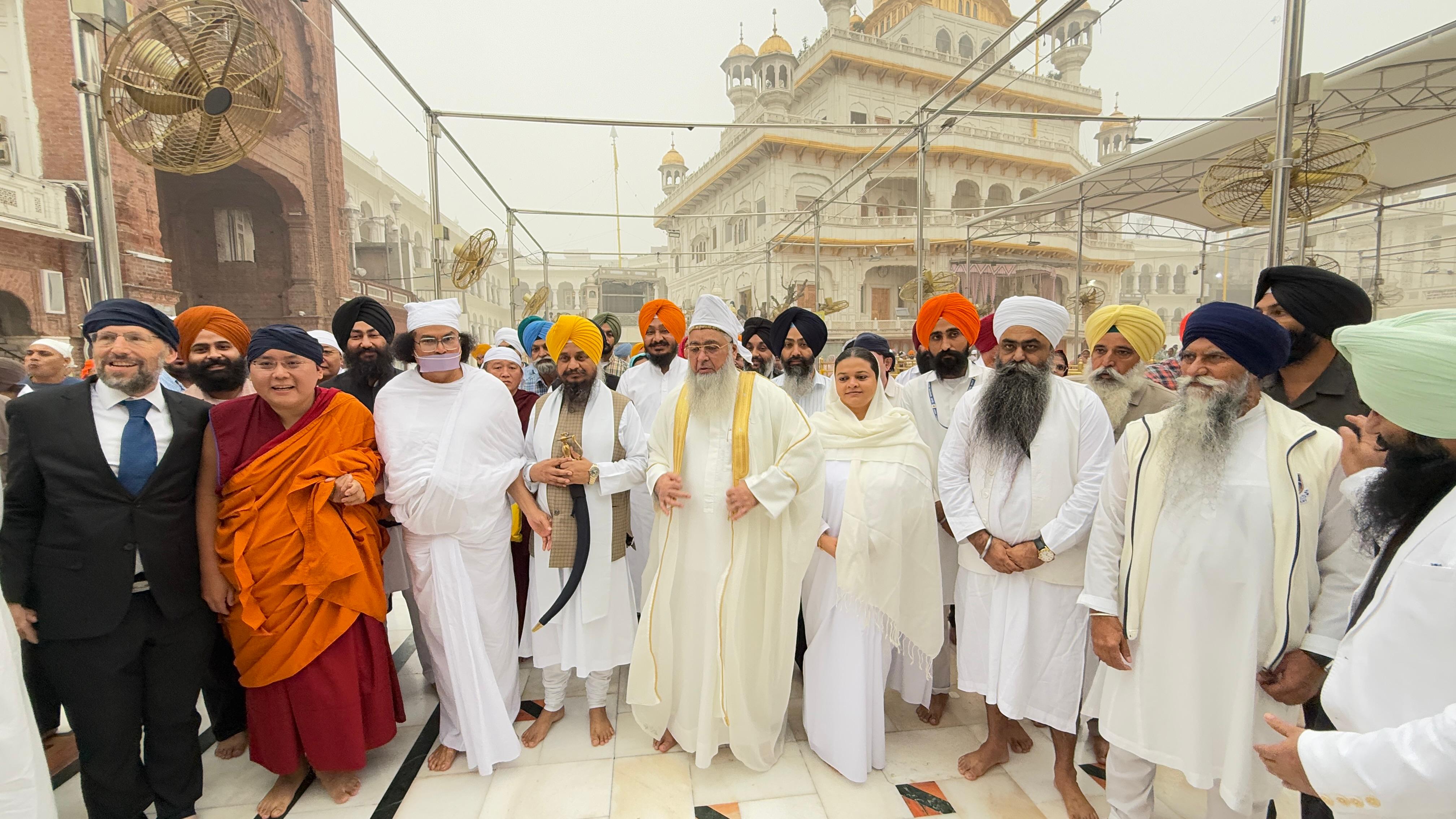
Rabbi Nagen at the Golden Temple in Amritsar: the Sikh 555th Purab Mubarak Smagam

6. How does Rabbi Joseph Albo contribute to the discussion?

Albo locates the roots of plurality of religions in his conception of the Noahide Law. He considers the Noahide law as not a static set of laws but a dynamic religious framework that evolves in accordance with national temperament, ethical sensibilities, and environmental conditions. He writes that it develops “according to their respective national differences”. The profound cultural variability among nations shapes how Noahide law is realized.

This concept is reminiscent of Rabbi Abraham Isaac HaKohen Kook’s vision of the evolution of the Oral Torah: “We feel that the unique character of the national spirit… is what lends the Oral Torah its unique form.” Religions, in this sense, can be viewed as a kind of “Oral Torah” for the Noahide law. Just as there are seventy facets of the Torah, the seventy nations each possess their own interpretations and expressions of the seven mitzvot.

7.You discuss pluralism and John Hick. Are you a pluralist? Do we all just have different names for one God?

Judaism acknowledges many names for God, each reflecting a different aspect of the Divine. Yet, there is but One God, who transcends form, time, and definition. What is essential is not the specific name used but the shared act of calling out to the One who is good and true. This unity is not diminished by the diversity of names humanity uses to refer to God; rather, it is enriched by it.

Allow me to share an insight that came to me while giving a keynote address in Amritsar, India, on the occasion of Guru Nanak’s 555th birthday. I quoted the biblical vision of humanity calling together in the name of God but offered a reflection inspired by Guru Nanak’s teaching that the One God has many names. In this light, we might rephrase the biblical verse to envision humanity calling together in the names of God.

Finally, I want to take this opportunity to thank you for introducing me, through conversations and through your groundbreaking books such as Judaism and Other Religions (2010), and Judaism and World Religions (2012) to the spectrum of approaches to other religions—from the wide embrace of pluralism to the firm stance of exclusivity.

8.What do you do with the exclusivist texts in Judaism?

The Talmud warns of the danger of turning the Torah into what it calls “a potion of death” instead of “a potion of life” (Yoma 72). This occurs when exclusionary and radical texts are elevated as the rule rather than recognized as exceptions. While such texts must still be acknowledged and addressed, they often reflect specific historical or cultural contexts that may no longer be relevant.

Judaism embraces a wide range of opinions on virtually every issue. It is our responsibility to navigate these perspectives, choose thoughtfully among them, and at times, firmly reject those that conflict with our moral convictions. Unfortunately, extremists are often empowered by moderates who mistakenly assume that extremist interpretations represent the most authentic expression of Judaism.

This debate—between what constitutes the rule and what remains the exception—is at the heart of my Beit Midrash for Judaism and Humanity. Our approach is not about reforming or rejecting halacha but about returning to its true fundamentals.

9.What is your vision of a mutual Nostra Aetate with Islam?

In 1965, the Second Vatican Council’s Nostra Aetate proclamation marked a transformative shift in Christian-Jewish relations. A similar bilateral effort is now urgently needed for Jewish-Muslim relations, particularly in the Middle East. The key question is: Will our identities connect us or divide us?

From the Jewish perspective, this requires the creation of formative documents presenting a Jewish theology of Islam. These documents should be widely disseminated within both Rabbinical and lay Jewish circles, as well as within Muslim communities. The foundational elements for such a theology already exist, but they must be further developed and articulated. The goal is to foster mutual respect and recognition of Islam’s legitimacy and to encourage Jews to see Muslims as partners in a shared narrative—a grand, unfolding story in which each community plays a vital role. Together, we can strive to fulfill visions such as humanity collectively calling upon the name of God and serving Him “shoulder to shoulder.” We hope and pray this approach can contribute to resolving conflicts in the Middle East, where religion plays a significant role.

The cornerstone of this approach is the affirmation of Islamic belief in God and His unity. As Maimonides stated, Muslims “unify God with proper unification, a unity that is unblemished.”

This foundation can be strengthened by emphasizing shared reverence for Abraham, stories of the Prophets, and other biblical figures, as well as shared values and religious practices. A comprehensive Jewish theology of Islam should also address the status of Muhammad, offering a nuanced perspective. Among Arab Muslims and Jews, there is even a recognition of shared ethnic heritage, providing additional common ground. These commonalities are essential building blocks for fostering mutual acknowledgment of the legitimacy and value of each other’s religious identities.

From the Muslim side, a similar effort is needed—a return to and affirmation of the Quran and Hadith’s clear acknowledgment of Jewish belief in God, the special status of Jews as Ahl al-Kitāb (“People of the Book”), and the Torah as a divinely granted guide to the Jewish people. This effort must include addressing claims of supersessionism and rejecting the notion that the current Torah is a forgery. Furthermore, it is vital to counter antisemitism fueled by misinterpretations of Quranic verses that critique certain Jews in specific historical contexts but are misapplied as blanket condemnations of all Jews. The Quran itself seeks to limit such critiques, explicitly stating, “They are not all the same.”

To advance this vision, I have composed an unpublished essay or monograph titled Jewish-Muslim Religious Fraternity. In this work, I call on global Muslim leaders to compose formative documents on these issues.

Shortly before his death, Fethullah Gülen, a leader of millions of Muslims through the Hizmet movement, authored such a document. This seminal text, available in Turkish, Hebrew, and English, addresses many of these critical points. It represents a significant step toward building bridges and fostering understanding between Jews and Muslims.

Allow me to conclude with a quote from the King of Morocco, Mohamad the 6th that inspires me in this endeavor:

The three Abrahamic religions were not created to be tolerant of one another out of some unavoidable fate or out of courtesy to one another. The reason they exist is to open up to one another and to know one another, so as to do one another good.

10. Why and how do we share Torah with non-Jews?

One of the great tragedies of religion occurs when exceptions are mistaken for the rule, and the true rule is ignored or forgotten. The issue of sharing Torah with humanity is a striking example of this. Bringing the light and wisdom of Torah to the world is not merely an option but a divine mandate for the Jewish people—a central role and responsibility rooted deeply in the Tanakh. The textual evidence for this mission is both explicit and overwhelming.

This chapter further illustrates how the sages (Chazal) reinforced this principle. The prevailing rule, as stated by Rabbi Meir, is that a non-Jew who studies Torah is like a Kohen Gadol (High Priest).

The exception, represented by Rabbi Yochanan, states that a non-Jew who studies Torah deserves death as a thief. This harsh view, however, is contextual as is for example the Talmudic critique of women studying Torah. Rabbi Yehiel Yaakov Weinberg explains that Rabbi Yochanan’s statement emerged in response to the early Christian use of Torah study to support replacement theology. Early Christians exploited their knowledge of Torah to claim that God had nullified His covenant with Israel and replaced it with a “spiritual Israel” (Christianity), effectively “stealing” the Jewish people’s identity. Similarly, the Rambam limited the prohibition to Muslims in his era, who studied Torah not with reverence but to discredit its authenticity.

When these specific contexts do not apply, the broader mandate—to share Torah with the world—remains intact. In our era, the time has come to fulfill the prophecy of exporting Torah from Zion to humanity.

Given the diversity of humanity, those engaged in the sacred mission of sharing Torah must consider the unique needs and perspectives of each culture they encounter.

For instance, when I was invited to teach Torah in China, I began by identifying topics relevant to Chinese culture. Through preliminary discussions, I learned that the Chinese place great importance on the Jewish approach to disagreement, encapsulated in the statement, “These and those are the words of the living God.” In a culture that values deference to authority and often views disagreement negatively, the Jewish embrace of diverse opinions as a blessing—expressing the seventy faces of Torah—was a novel and inspiring concept. Similarly, the Jewish emphasis on the intrinsic value of every individual within society resonated deeply.

Tailored engagement ensures that the eternal wisdom of Torah speaks meaningfully to the hearts and minds of people across the world, fulfilling its role as a light to the nations.

11.What good does dialogue accomplish? Does it really help?

My students sometimes ask me: “Rabbi Yakov, do you really think that just because you and an Imam meet and develop a relationship, that this will bring peace?” My answer is that it is not that such a meeting brings peace, but rather that it is already peace! When two people have a meaningful relationship, in which they connect from their inner essences, it is not just a path to shalom, it is shalom in itself. The goal is to scale this up by millions. I then call upon my students to become partners and create new relationships with the Other.  We need a massive partnership of leaders and lay people from both of our religions, and extensive grassroots encounters and educational initiatives to make Shalom and Fraternity ever broader and deeper between our communities.

Siddur Torat Chacham, a siddur Rashash by R. Yitzchak Meir Morgenstern

What are the Lurianic Kabbalistic intentions? How do they work and how does one read the baroque pictorial notations of a Lurianic siddur? This interview may be one of the first explanations in English that gets to the core of the matter. This is a very technical interview, very detailed, geared for those in the know.

This great review was written by Jeremy Tibbetts, a rabbi, who is the co-director of OU-JLIC for Anglos in Jerusalem and is the Director of Education for Yavneh, an intercampus leadership program. He is a student at Hebrew University in Jewish Thought, intending to focus on the Rashash and kavanot.

Earlier Kabbalistic intentions from the early Kabbalah until Rabbi Moses Cordovero (d.1570) provided a concurrent mental intention or visualization for the words of the prayerbook. The performance of the liturgy needed an extra level of intentionality.

Rabbi Isaac Luria, the Ari, (d.1572), in contrast, taught a doctrine of an innumerable array of spiritual entities, arranged in a vast enormous system. The prayer intentions were not directly related to the words, but rather, mental operations with this vast system.

Rabbi  Shalom Sharabi, known as the Rashash (born Yemen,1720, Jerusalem1777) reworked the Lurianic instruction as pictorial images and not sentences. The siddur depicted the kavanot instead of describing them. In order to do this, the Rashash utilized divine names to map out and represent the different spiritual structures that the kavvanot act upon. Sharabi’s style about the spiritual realms Tibbetts calls “near trance-like lists depicting the different layers of spiritual constructs.” For examples, see the 2 pictures below from the Rashash prayerbook.

A new edition of the Rashash siddur was composed by the contemporary Kabbalist R. Yitzchak Meir Morgenstern called Siddur Torat Chacham, a siddur Rashash by R. Yitzchak Meir Morgenstern (born 1967). A full presentation of Lurianic praybook intentions for 1678 pages. Tibbetts proclaims that this is “a groundbreaking achievement in the world of Jewish mysticism and in kavanot.”

For many, Rabbi Morgenstern is their contemporary teacher in kabbalah and his influence is immense on this generation and the generations to come, due to his large number of students and the many rabbis and Hasidim who study with him. In addition, he publishes voluminously, generally about fifty pages a week which come out as edited books. His method is to integrate divergent schools into a harmony assigning a different function or a relational position to each one. In this case, he integrates, the Kabbalah of Sarug, Yehudah Ashag, Rav Nahman, Ramchal, and the Komarno Rebbe into the Rashash.

Back in the infancy of this blog in 2010, I did a blog post on Derekh Yihud, which is, Morgenstern’s pamphlet of visualization meditations. (From what I hear, it is not a part of his current teachings and the visualizations are not found in this siddur).

For those looking to understand this practice as a system of meditation, then skip down to question #9 on the psychology of this practice, question #12 on the visualization method, question #13 on this practice, and question #15 on why should one engage in this practice. Some of you, or many of you, might want to read these answers before the more technical answers.  

I am especially proud of this interview because of the accurate and detailed information that it provides. In contrast, most mentions of the Lurianic intentions in English are vague intoned mentions, without content or context, of tzimzum, yihudim, kabbalistic trees, and sacred power. This interview fills in the needed details.

  1. What is the siddur of Rabbi Morgenstern?

The siddur Torat Chacham, a siddur Rashash by R. Yitzchak Meir Morgenstern shlit”a (born 1967), just saw its new complete reprint in a pocket-sized print (even though it is a remarkable 1678 pages!). The first printing of the siddur was a full decade ago. This is the ultimate siddur for a student of R. Morgenstern or Kabbalah more broadly: it’s a groundbreaking achievement in the world of Jewish mysticism and in kavanot.

2) What is the siddur of the Rashash?

R. Shalom Sharabi zy”a, also known as the Rashash (born Yemen,1720, died 1777 Jerusalem). In his early years, he decided to undertake an arduous journey to move to Eretz Yisrael. Initially this brought him to Bombay in India, where he settled for awhile and was first exposed to Penimiyut haTorah and the Zohar. Eventually, he ended up taking passage through to Baghdad, Damascus, and ultimately from there, to the Old City of Jerusalem. Eventually, he becoming the next rosh yeshiva of Beit El, where he began to showcase his new approach.

The siddur Rashash was, for the Rashash himself, first and foremost a personal project. One of his most monumental achievements in the world of Kabbalah at all is his siddur. He worked on it over his life, continually writing, erasing, and rewriting. He never taught from it or attempted to disseminate it in his lifetime. In that sense, using a siddur Rashash is really entering into the Rashash’s personal world of prayer. His students took his siddur after he passed away and began copying and eventually printing it for broader use. The standard siddur Rashash is built around the Rashash’s reworking of Lurianic kavanot as depictions and not sentences.

Before the Rashash’s siddurim, prayer books which contained Lurianic kavanot described in full sentences what the practitioner should intend. One of the Rashash’s key innovations as a post-Lurianic thinker was in laying out a new version of the siddur which depicted the kavanot instead of describing them. In order to do this, the Rashash utilized divine names to map out and represent the different spiritual structures that the kavanot act upon.

These punctuated divine names are considered by many of the Kabbalists to be ideal both because they minimize the concern of one imagining something physical when praying with kavanot and because the names always refer back to Hashem directly and prevent one from getting caught up in the various spiritual tikkunim one is attempting to perform. The shem Havayah is the shem ha’atzmi, a name which uniquely indicates Hashem’s infinitude, allows us to intend towards something discrete while maintaining a connection to the infinite and undefined Or Ein Sof which animates everything.

The siddur Rashash is largely concerned with describing spiritual worlds and largely unconcerned with explicitly treating human experience and life. The Rashash offers very little in the way of a phenomenology of kavanot despite creating a nine-volume prayer book which takes hours to complete and is used on a daily basis.

A hallmark of Sharabi’s innovative style is his ability to take the Arizal’s logic of the spiritual realms and apply it iteratively on every level, often leading to what can only be described as near trance-like lists depicting the different layers of spiritual constructs. This is closely tied with the doctrine of arachin or “relativity” for Sharabi, which reads the map of Lurianic Kabbalah as applicable in any level. Just as a person is from one perspective a child and from another perspective a parent, what we call Malchut in one context could be considered Binah or Keter in another context, and so in this view, the map of the worlds as sketched in Lurianic Kabbalah is more epistemological than ontological.

3) What is unique in the siddur of Rabbi Morgenstern and his approach to the Siddur Rashash?

R. Yitzchak Meir Morgenstern’s siddur Torat Chacham is innovative precisely for its attempt at reintegrating other strains of post-Lurianic thought with the kavanot of the Lurianic siddur edited by Vital.

Perhaps most starkly, the additions in the siddur draw heavily upon the Kabbalah of Rav Yisrael Sarug zy”a (late 16th century – mid 17th century), an early student of Luria. Sarug’s approach was mainly rejected because Rav Chaim Vital, the main pupil and disseminator of Lurianic Kabbalah, casts aspersion on him as an authentic student. Many Kabbalists saw the Sarugian approach to Kabbalah as irreconcilable with Vital’s description of Lurianic Kabbalah. In particular, Sarug had terminology that was largely absent in Vital’s writings about tzimtzum and what he envisioned a whole series of worlds called Olam haMalbush at the very beginning of creation which Vital doesn’t mention. Sarug’s writings deal largely with worlds which precede those described by R. Chaim Vital, Furthermore, Sarug’s account of creation deals at length with the Hebrew letters and their formation which is also absent from  Vital’s account.

Rav Morgenstern has been working for nearly 15 years to try to reconcile and reintegrate the two systems. Part of his research has trended towards the historical, attempting to unveil hidden connections that Rav Shalom Sharabi and his students may have had to Sarug’s version of Lurianic Kabbalah. Perhaps most notably, Rav Morgenstern suggests that Sharabi’s version of Etz Chaim had Sarugian writings appended to it, implying that he considered them authentic to the Lurianic-Vitalean set of writings and that he studied them.

R. Morgenstern leans heavily on Hasidut Chabad for this project, in part because Chabad and its various offshoots accepted Sarug’s Kabbalah. R. Morgenstern uses these writings to develop a trailblazing anthropocentric reading of Sarugian Kabbalah. R. Morgenstern connects the concepts of Sarugian Kabbalah to the different ratzonot within the Divine mind which are meant to be realized through the process of creation.

4) Can you give an example?

Some of the most central and longest kavanot in the standard siddur Rashash are when one raises divine sparks up so that they can be transformed into shefa for us. The Arizal himself did not specify each and every level that they ascend to, only that they go up to “to the greatest heights.” The Rashash did spell out all of these ascensions in his theoretical works, he did not include those steps in his siddur. R. Morgenstern maps out this full ascent and adds in for the first time these levels of Olam haMalbush which in his view are also activated as part of the Rashash’s system of kavanot.

5) What about his use of Ramchal, Sulam and Komarno?

Alongside these innovative inclusions, kavanot are brought throughout the siddur from Kabbalists such as the Ramchal zy”a (1707-1746) and the Sulam zy”a (1885-1954) without clearly stating how they should be integrated with the standard kavanot haRashash.

This becomes even more of a question in sections lsuch as tachanun, where each of the 13 attributes of compassion is matched with one of Rebbe Nachman zy”a’s (1772-1810) 13 sippurei ma’asiyot. There is lastly a notable change in the actual nusach of the siddur.

While an Ashkenazi nusach of the siddur Rashash does exist, Rav Morgenstern’s siddur reconstructs the nusach of Hasidut Komarno from the Shulchan haTahor, the first Komarno Rebbe zy”a’s (1806-1874) commentary on the Shulchan Aruch Orach Chaim (though notably in a few sparse places he writes that he prefers the Breslov approach to nusach instead). Thus the siddur becomes a sort of weave of numerous Kabbalistic streams, most of which have never been brought together before in this manner.

6) Why is this siddur unique in its Kabbalah?

Rav Morgenstern, inspired by Rav Moshe Schatz shlit”a, is a proponent of a sort of “Grand Unified Theory” of Kabbalah. He takes it as axiomatic that the different schools of Kabbalistic thought are in harmony, not dissonance. The Ramchal’s Kitzur Kavanot, the Hasidic Saraf Pri Etz Chaim or Pri Kodesh Hilulim, and the Rashash’s Rechovot HaNahar are essentially describing the same thing in different levels of meaning and detail in this view. But it’s not enough to say that they align with each other: it is not possible from this perspective to truly understand Kabbalah without bringing these schools together. Each one constitutes a puzzle piece in the mosaic of sod. Kabbalah becomes a discipline not only of knowledge acquisition, but of integration.

7) How is this process of harmonization shown in the siddur?

This siddur is a monumental achievement as the first one to truly embrace this approach of harmonization and to connect it with the Rashash, the most difficult and the most conservative of the post-Lurianic schools. For those more steeped in the world of the Arizal, the Rashash, and his beit Midrash, they’ll find many additions to the siddur from the Torat Chacham, one of the most difficult works of Kabbalah from the Rashash’s talmid muvhak R. Chaim de la Rossa zy”a (early 18th century – 1786). One prominent examples would be the insertion of the kavanah for mesirut nefesh before any part of tefillah where one raises up divine sparks.

While the Rashash would not necessarily disagree with these additions, the fact that they are not included in the original siddur indicates that they were not as critical unlike the many kavanot which were codified.

The new small edition of the siddur chol also contains hundreds of pages of notes and essays in the back which explain why the siddur is laid out as it is, often citing and invoking different disagreements amongst the talmidei haRashash.

8) Why would a yeshiva student or student of the Kabbalah want to own or use this?

It is one of the most comprehensive and mature works of R. Morgenstern and his beis medrash, which may be a reason in its own right to own it. It can serve as a valuable window into the inner prayer life of one of the greatest Kabbalists of our time. Additionally, it is perhaps the only truly integrated siddur for those who want to stand at the confluence of the different strains of Kabbalah, not only by bringing in Hasidut, but by including kavanot from everything from medieval works of Kabbalah like Brit Menucha to the Gra zy”a (1720-1797), Ramchal, Sulam, and more. In this regard, it will serve as a textbook and guidebook rather than an actual prayer book, offering notes on nusach or different Kabbalistic ideas to integrate into one’s own prayer. Others still will buy it out of aspiration, more to make sure they have one rather than risking it running out and having to wait for a reprint years later.

9) How does Rabbi Morgenstern explain the process of psychologically performing kavanot?

This is sort of the big question with kavanot haRashash in general. Just like in any other siddur Rashash, the instruction to the practitioner throughout the siddur is simply “veyichaven,” “intend” that the worlds and sefirot are interconnecting in a given permutations by that corresponding word of tefillah. However, the Kabbalists would not consider the siddur Rashash to be a visualization guide.

They would in all likelihood be averse to one picturing the spiritual structures and sefirot which are part of the Kabbalistic siddur.

Neither the Rashash in his time nor R. Morgenstern in this siddur told us exactly what that means mentally. In fact,  in R. Yekutiel Fisch’s Sod haChashmal Vol. 5, there is a lengthy “teshuva” from R. Morgenstern on the subject of kavanot which quotes the Rashash’s son, the Chai baShemesh zy”a (mid 18th century – 1808), echoing this desideratum: “even though we have intention according to our intellect, each person according to their level, we don’t know what the explanation of ‘intention’ is… and what is ‘intend’ or how one attains ‘intention’” (pg. 207).

Nonetheless, there is one clue which Rav Morgenstern offers us from the siddur’s introduction which sheds some light on this question. He champions the Torat Chacham’s idea (building on the Rashash) that an individual’s kavanah must work on three levels: klal gadol, klal beinoni, and prat. He sorts the three central schools that his siddur aims to integrate into these categories: the Kabbalah of R. Yisrael Sarug, which speaks about the highest worlds of any post-Lurianic school, is the klal gadol; the Kabbalah of R. Chaim Vital, centered on Atzilut and the tikkunim which most directly impact our own world, is the klal beinoni; and Hasidut, which deals with the lowest and smallest levels of human experience, is the prat.

10) Which of these levels does he emphasize?

Paradoxically, the prat smallest level of Hasidut brings us the highest in R. Morgenstern’s view. On the micro-spiritual level, each individual sefirah and level of spiritual existence experiences whatever is above it as Ein Sof. Said differently, the more one zooms in to the details of the spiritual structures of Kabbalah, the more one experiences the system as open and ever-expanding. This is why this perspective is the most suited to truly understanding the infinitude of the Ein Sof, as each level constitutes a new self-disclosement of the infinite revelations of Hashem. This is the unity which R. Morgenstern sees between Hasidut and the school of the Rashash: for both of them, the divine is in the details.

Returning to R. Morgenstern’s teshuva in Sod haChashmal, he offers several more insights into the psychology of kavanot. First, he explains that the Rashash’s innovation of depicting the kavanot as punctuated shemot Havayah over the prior Lurianic siddurim which explained each kavanah in words was rooted in the Rashash’s desire to not separate the kavanot from the Ein Sof. The mechaven must always hold an awareness of the infinitude of Hashem alongside the particular kavanah at hand.

11) Where does separation from physicality fit in?

He quotes the Shemen Sasson zy”a (1825-1903) who riffs off of the Shulchan Aruch in OC 98:1 in describing kavanah as “to strip one’s soul, to separate it from physicality, and to awaken the upper worlds… as explained in the kavanot of Shema at bedtime and in the secrets of dreams and prophecy.” This seems to be a dual kavanah.

While the latter part might have seemed obvious given the focus of the kavanot on the upper worlds, the former is not only a powerful statement of how the kavanot should impact a person’s embodied experience but also should indicate that through Kabbalistic prayer, one first directs one’s soul away from this world in order to impact the upper worlds.

He goes on to quote the Hasidic masters the Maor vaShemesh zy”a (1751-1823) and R. Pinchas of Koritz zy”a (1725-1791) alongside the pre-Lurianic Kabbalist R. Moshe Cordovero zy”a’s (1522-1570) on the ability of kavanot to “purify the mind and increase devekut,” even without proper understanding.

This devekut for R. Morgenstern is itself the awareness of the Ein Sof behind each and every kavanah. The need to hold the unity of the Ein Sof amidst the plurality and intricacy of kavanot is central for R. Morgenstern, so much so that he writes that if the extreme details of the siddur Rashash distract a person from this devekut, then they should not use it.

12) What is the role of emotion vs visualization?

The truth is that R. Morgenstern’s Torah contains both: in works like Derech Yichud, a Kabbalistic meditation guide that R. Morgenstern prepared over several years to attempt to integrate meditation and Kabbalah/Hasidut, you see that he leans very heavily into visualization-based meditation, and at the same time in many places in De’ah Chochmah leNafshechah, where R. Morgenstern’s weekly sichot are recorded, as well as in Bayam Darkecha, written and published by a close talmid of R. Morgenstern, the emphasis is strongly on the emotive and psychospiritual impact of kavanot.

As mentioned above, the siddur is not meant to be a visualization guide. R. Morgenstern’s siddur does contain additions though which at first glance seem to involve some form of visualization. For example, when ascending the different heichalot in Shacharit, he adds in detailed descriptions of their layout and appearance from the Zohar. There’s no “kavanah” added alongside them. This is also the case with other additions in the siddur, e.g. the sketching of the malbush at the end of sim shalom and the addition of parts of the mishkan in each beracha of the Amidah.

Even more radically, there are numerous yichudim (letter-based meditations) from the writings of the Kabbalists which have been added in, despite the near universal consensus in the world of Lurianic Kabbalah that even yichudim which utilize words or pesukim which appear in the siddur should not be added as part of the daily intentions. R. Morgenstern defended this practice previously in his haskamah to the siddur Sha’ar Ruach haKodesh which also added in yichudim, as well as in the essays appended to his siddur, based mostly on Ziditchov and Komarno Hasidut.

 The fact that no specific intention is written for any of them calls into question their exact purpose: their very inclusion in the prayer book would seem to suggest that they are included to be part of the kavanot in one form or another, yet without a particular intention, they can also be read as associative companions which are meant purely to enhance and deepen a non-visual experience of kavanot.

13) If kavvanot are not visualization then what are they? Are they just things to think about when reciting the liturgy, like reading a book of kabbalah simultaneously to reciting the siddur?

This is a really hard question! On the one hand, they’re not supposed to bring one to a form of contentless contemplation as done in meditating on the on the breath.  On the other side, they’re not a scholastic or academic exercise.

They are meant to be somehow performed and not just considered. I think also that the Kabbalists did not see them as liturgy in the same way that the siddur is. We aren’t communicating to God or requesting that God unify the worlds with the kavanot.

They saw the “intending self,” the part of the self which is associated with conscious intention, as the highest part of the self which could act on one’s body or soul. It is through deep focus, one can use the mind like a hand to move the upper worlds. Some of the Kabbalists note that these mental acts cannot be affected without reciting the actual words of prayer.  In other words, one contemplates and focuses in on the kavanot as they stand independently, and that also forms the intention for when I say that word or phrase in the siddur. So it creates its own form of non-imagistic meditative concentration around and through the words of tefillah.

14) Should one start with this siddur?

I think probably not. If one is interested in exploring kavanot in general but does not have the prerequisite experience with Etz Chaim, Sha’ar haKavanot, Rechovot haNahar and the like, the siddur Rashash is nearly impossible to use.

When a person wants to actually start learning how to use the siddur Rashash, R. Yechezkel Bing shlit”a’s Nekudot haKesef (who is himself thanked in the siddur Torat Chacham’s introduction for offering guidance as it was being made) and R. Gamliel Rabinowitz’s Tiv haRashash both explain the siddur in depth, even line by line in some cases.

 When I wanted to start learning how to use a siddur Rashash, what was first recommended to me was to start with a more basic siddur and commentary which would give me a sense of the Kabbalistic flow of tefillah. The siddur Keter Nehora (also called the Berditchever siddur), the Shelah’s siddur commentary, the Matok miDvash siddur, and the Yesod veShoresh haAvodah are all great starting points as they are not overly caught in the particularist mechanisms of kavanah.

R. Mechel Handler shlit”a, a living Kabbalist in Boro Park, has a recommended and ordered reading list in his Peticha leKavanot haRashash for anyone who wants to start using a siddur Rashash: he suggests the classic Sephardi Kabbalistic starting point of Otzrot Chaim with the Matok miDvash commentary, followed by Etz Chaim, then Sha’ar haKavanot Drushei Keriat Shema Drush Vav (called drush ha’ikkar by some), and ultimately delving into numerous seforim which focus on the different parts of tefillah.

 I would add that before opening Otzrot Chaim, I gained a lot from using introductory seforim like Siftei Chen, Yedid Nefesh, Klalei Hatchalat haChochmah, and R. Handler’s sefer mentioned above.

15) Why do Rashsash/Morgenstern kavvanot? What not play Dungeons and Dragons? Why use these Baroque notations in the 21st century? Just daven

I’ll suggest three answers based on the Kabbalistic tradition. The first is about the largest layer of ramifications that the kavanot can have. R. Shaul Dweck haKohen zy”a (1857-1933), a rosh yeshiva in the Rashash’s tradition, wrote that the redemption will come after a certain amount of nitzotzot, divine sparks scattered in the world through the vessel’s shattering, are raised up. However, through the performance of proper actions we can bring that redemption more quickly. In this view, the siddur is the guidebook to how we can open the world to greater connection to Hashem, it pulls the levers which allow the hashgacha to come to expression.

The second answer is that they work on the most individualized level. The Arizal writes in the introduction to Sha’ar haMitzvot that “according to the greatness of the joy in truth and inner good heartedness will they merit to receive the supernal light, and if they do this continuously, there is no doubt that ruach hakodesh will rest upon them.” There are two things which this quote communicates about the inner experience of kavanot: 1) the kavanot and one’s emotional state are intertwined and therefore emotion is therefore not disconnected from kavanot, and 2) there is a shift in one’s cognition through the performance of kavanot, through the receiving of this supernal light and ultimately through experiencing ruach hakodesh as part of them. According to another Lurianic source (Sha’ar haKavanot Drushei haShachar 1), this light enters the soul through the performance of kavanot.

I’m not an expert practitioner, but I do find that they bring a greater sense of attunement, presence, and a sense of devekut as well.

Lastly, these kavanot are a body of thought which is already “home-grown” within the Jewish tradition. The Kabbalists developed these kavanot with reference to the full gamut of Torah. So, if someone is seeking some kind of meditative experience out of prayer, this is one of the most expansive Jewish answers.

Wild Strawberries for Tisha B’Av

I just received an email that Drisha will be screening and discussing the Ingmar Bergman film Wild Strawberries at 4pm on Tisha beAv. I take this as another indication of our relating to God as a therapeutic deity.

In the 1970’s Conservative congregations spoke of Jewish history and the Holocaust on Tisha Be-av. Reading of Josephus and Ghetto diaries. During this time period, Rav Soloveitchik spoke of the ontic catastrophe of the destruction of the Temple and the existential state of acquiring emotions in a case of “old mourning” and turned it into a day of shiurim on mourning and the mikdash.
Flashy Rabbis gave lectures on “why do we still mourn now that we have a state of Israel?”

By the 1990’s Centrist Orthodoxy used the talks of Rav Soloveitchik to speak of Jewish History and the Holocaust, or discussing the halakhot of the land of Israel. Holocaust films were shown and protests are held at the UN and embassies. The halakhic God of Lonely Man of Faith gave way to a God of History, Land, and War.
On the more yeshivish side, there are lectures on hastening the geulah- either through not talking lashon hara or not doing any of the activities that hasten it.

In the last few years, there has been a shift to the brokenness of the world. Renewal announcements ask: How do we deal with the brokenness, trauma, and injustice in the world. Yeshivish announcements offer sessions on the destruction in our lives and restoring family and teens in trouble. And now Drisha is leading a discussion about Wild Strawberries, a movie in which the protagonist a retired medical professor sees his life as loveless and without meaning. He is haunted by memories, brought on by dreams and by people he meets, about the chances for love, family, and forgiveness that he messed up. Tisha Be-Av is a chance to undo psychic damage.

One path that is not being continued is the Tisha BeAv rally held several years ago in Jerusalem in which Rabbis Lichtenstein, Cherlow, Lau, and others as an occasion for justice. They denounced the lack of in Israel of worker’s rights, the human trafficking, the oppression of the poor, of the Arab other, of unfair business practices. The event did not have continuity. (Can someone send me the links from Haaretz, Ynet or the speeches?)
Rabbi SR Hirsch also emphasized the ethical since the prophets denounced Israel for its immorality.

As a side topic- Here is Reb Shlomo from 1992 asking for intimacy with God, to heal from the pain of the Holocaust, to rebuild the Temple. It’s longing is palpable.

It is possible to do everything G-d wants you to do and not to be intimate with G-d. You know, beautiful friends, Mount Sinai is where G-d told us what to do. But Jerusalem, the Holy Temple, is where we are intimate with G-d. The Holy Temple is the headquarters for being close to G-d and to each other. But when the house is destroyed, there is no place to be intimate anymore. And gevalt! Are we longing and crying to be intimate with G-d, with every Jew, with every word of the Torah, and, one day, with the whole world…On Tisha b’Av the Messiah comes. On Tisha b’Av until the Six Million you only heard the sound of the destruction of the Temple; you could not hear the footsteps of the Messiah. Today, the voice of destruction gets further and further away, the voice of the coming of the Messiah gets closer and closer. Let it be this year that the whole world will be fixed and G-d’s holy intimacy comes back into the world and into our lives. You know, beautiful friends, I’m so proud of our moshav and our shul because they are filled with prayers, with so much dancing and joy, but also with so many tears begging G-d for intimacy with every word of the Torah with every Jew, with every human being, with all of nature. I have a feeling it will be this year.

Shlomo offers an undifferentiated healing love- primordial and oceanic.
Viewing Wild Strawberries offers self-scrutiny of one’s wrong choices and how does one let go of hindrances that prevent healing. One sees that one’s choices are the cause of one’s meaninglessness, therefore a person needs to take responsibility, a therapeutic mussar.

Updated- One week later Drisha sent out an announcement that they will be showing a Holocaust movie and not Wild Strawberries.

Copyright © 2010 Alan Brill • All Rights Reserved

The New Metaphysicals Post #2

I had posted a few weeks ago about the new book by Courtney Bender called The New Metaphysicals about the current practice of new age in America.

My post received no comments even though it touches on many topics that come up whenever I post on Neo-Hasidism. Specifically, how the narratives of believers and those of historians or scientists do not match. Here is a review of the book by Andrew Perrin dealing with some of the issues from a different angle. First off, when do we say that these new age practitioners are loony? The 1950’s saw all kabbalah, hasidut as off limits and would scoff at negel wasser or Tu beshevat. But now that new age is everywhere and neo-hasidism is everywhere, when can you tell someone that his new explanation is daffy?

Perrin spends more of his time asking about authenticity. There is already a huge anthropology literature showing that practices revived in the 1980’s and 1990’s in the US, Korea, and Japan, are done in the name of authenticity, even when the performer has no claim to authenticity, even if the person has no continuity with the past, the practice did not characterize the past, and the practice is not done like the past. Perrin notes that even if the practitioner investigates the matter, evidence wont change anything because they have a Platonic idea of authenticity. A similar but not identical phenomena has occurred in Jewish law, where tradition (mesorah) is invoked by people with no direct link, only a theological link based on imagined institutional ones, no similar practice to the old country, and an explanation of the practice that flies in the face of the older interpretation.

Perrin’s question to Bender is how can university educated people not know the refutations to their positions and not understand that the very Ivy academies where they received their degrees would not accept this pseudo-science. Perrin concludes that Bender offers a glimpse of how people believe but not why they do and how they reconcile it with the world around them.

Perrin’s own start of an answer is that they think that not everything is known by the official standards of the academy and that they have access to an authentic source of knowledge. It is authentic because it comes from a different source, a truer source, and a truer conception of reality unharmed by empiricism.

The New Metaphysicals offers a peek into a world that I found at once pedestrian and strange, and the information that it gives us about so-called “spiritual but not religious” people is invaluable. The new agers, mystics, yoga instructors, and other metaphysicals whose words animate The New Metaphysicals seem quite foreign at first blush, and it’s to Professor Bender’s enormous credit that she theorizes the milieu without undermining the authenticity claims and struggles in which her subjects engage. At the same time, I found myself wanting more of a critical stance, a more thoroughgoing interrogation of the epistemologies that these subjects espoused.
Authenticity is a constant struggle for Bender’s subjects, amongst whom a common theme is the sense that their metaphysical pursuits offer something more real, more genuine, than the routine life of urban Cambridge, Massachusetts, where Bender conducted her fieldwork. Hans, for example, had developed an extensive theory of ethnic authenticity, applied as “the coloring, the embellishment” of generic shamanism, and had sought vainly for a sufficiently authentic Germanic shamanism to match his ethnic heritage. Along the way, though, he laments the fact that Native Americans, who constitute for him a kind of Platonic ideal of indigenous authenticity, don’t really seem that interested in his shamanic group
I found myself wanting more of this sort of critique. While I admire the self-control that enabled Bender to restrain herself from dismissing her subjects as just plain loony, many of them do go through remarkable rhetorical contortions to make the elements of their narratives fit together adequately. Many of these contortions map onto terrain that has been covered over the past century or so by sociological, anthropological, and cultural theorists agonizing over precisely the same chimerical authenticity that seems to motivate many of Bender’s subjects. Why do these academic critiques not carry the same weight among the metaphysicals?
Philippa, an astrologer, uses recognizably scientific language (gamma rays, matter, Pluto, Prozac, Ritalin, even “a wobble in Mercury’s orbit”) all to establish the reality of the planet Vulcan. Each of these individuals engages in reasoning that strikes me as essentially post hoc, selectively deploying observations, likely random in origin, as evidence for a predetermined conclusion.
I assume that, were Philippa to take her talk to the Astronomy department down the street, the evidence she mounts would be unlikely to convince the faculty there that Vulcan exists. So why the attempt at a common language? Why not just adopt a dismissive attitude toward observational evidence, claiming spiritual, metaphysical space for themselves and leaving material, physical space to the scientists? Bender’s narrative provides great insight into what the new metaphysicals believe and how they engage that belief, but why they believe it and how they reconcile that belief with the outlook of less-metaphysical friends, neighbors, and family, are open questions.
Read the rest of Perrin here.

Nahmanides’ appeal in his introduction to the Humash commentary to the 49 gates of wisdom known only to Moses, the traditions of the Torah as black fire on white fire, and one long name of God, and the scientific traditions known to Solomon and King Hizkiyah serve many of the same functions of undermining the science of the day and creating an alternative authority and authenticity. The widespread use of Nahmanides in late 20th century Judaism has helped foster and coalesces with this deeper authenticity.

So, why does the Jewish community accept pseudo-science? And what are the alternate forms of authenticity?
I know one neo-Hasidic haredi author who writes complete pop-psych but claims he is authentic because he tangentially copies Idel’s footnotes (And mine and Aryeh Kaplan’s and Scholem’s). There authenticity is his claim to know texts, even if not these texts.

How do our Jewish new age practitioners ignore Western canons and also claim Torah authenticity?

There is still much meaty discussion of the book at The immanent Frame- we will return to the book again later in the week.

An interview with Courtney Bender- New Metaphysicals

New Book on Spirituality- Courtney Bender, New Metaphysicals I have not read it yet, but it is on my list for the summer.

Bender paints spirituality as in process, looking forward, and created in places in do not ordinary consider religion. Spirituality is created at the intersection of several realms we ordinarily consider secular such as art, health, and vacation. Spirituality is entangled in daily life and in many relams that we demarcate as special. And it also exists in the house of worship- Spirituality is now offered as yoga classes or healing circles in traditional institutions.

Activities like Yoga can show up as secular, as spiritual and as religious. Journal writing or many forms of healing have that same spectrum. People ask me about Yoga and Judaism and I am beginning to see that the issue is more complex since the same practice can be presented or interpreted in multiple forms and the forms keep changing.

Bender also deals with how spirituality embraces fragments of neuroscience with a theosophical veneer creating an unorthodox science. The practitioners know that it is indeed unorthodox and violating conventional science but they continue to use it .

Bender notes that the new spiritually avoids placing itself in a historical context of the history of American theosophy and New Thought, but it also does not like any analysis of its ideas relative to the sources it works with. She notes that contemporary spirituality does not see itself in the scholarly literature written about it. I certainly find this true. Neo-Hasidism does not see that it is not teaching the original Hasidism anymore not does it want to know the pop-psych and culture -culture that it has let into Hasidism. Kabbalah Centre practitioners assume that all kabblah is a science taught by Moses about getting what you want in life, and kiruv Torah would not see itself in a work comparing it to Evangelicals.

An interview with Courtney Bender
posted by Nathan Schneider
Courtney Bender is an associate professor of sociology at Columbia University. Her latest book, The New Metaphysicals: Spirituality and the American Religious Imagination (University of Chicago Press, forthcoming in June), emerged from her research in Cambridge, Massachusetts among people whose “spiritual but not religious” practices and outlooks have been unaccounted for by conventional methods used to identify and study communities of belief.

NS: How do you do scholarship—and, in so doing, take account of history—about a community that denies its own historicity? I was struck by your claim that “the puzzle of spirituality in America cannot be solved by locating it in a history it refuses.”

CB: But what is puzzling about spirituality is that, even as the number of monographs on the topic grows, these histories don’t seem to resonate with contemporary people who call themselves spiritual, or with most scholars who look at its present manifestations. One reason for this is that the living practices of spirituality allow people to cultivate ways of being in time that are future-focused, or that situate practitioners in perennial time. All religious practices place people in time and in space. In this case, the spiritual practices that I trace do interesting things to the kind of narrative history that most historians write, so paying attention to these practices, and chronicling how they unravel and decouple from most recognizable historical narratives, is just as important. That’s what I have tried to do.
Looking at all of this, I embraced a study of entanglements because it demands different starting points for analyzing religious life: experience, discourse, meaning, and practice. We can ask how religious practices are produced or carried in secular contexts, and we can think about how to conduct research on religion in those settings in ways that do not presume that everything is sacralized, but that recognize that things are often a bit more complicated than we have made them out to be—I’d say a bit more interesting too.

NS: If not in such traditional, formal contexts, where does one find the markers of spirituality?
CB: Well, first I should say that we do indeed find markers of spirituality in traditional religious institutions. In an early chapter, I focus on a variety of sites in Cambridge where spirituality is produced: alternative medicine, the arts (particularly amateur arts), and also various religious groups. There is a lot of interaction among these.

But in The New Metaphysicals, I followed a number of practices that are sometimes spiritual, sometimes religious, and sometimes secular. Yoga is one, but a more intriguing case, and a favorite of mine, is the transformation of medium- and spirit-writing, and automatic writing (popular in the nineteenth- and early twentieth-century Spiritualist circles), to “flow writing” and cathartic writing. An even more intriguing practice that sits at the core of the book is the emergence of “religious experience”—which is taken up in legal and psychological literature, then carried and reproduced in secular discourse about the self and private belief. In other words, these practices are not firmly or primarily located within “religion” or “science” or “health” or “artistry.” Part of their power for my respondents is in the ways that their multiple locations, and multiple linked sites of reproduction, add to the sensation that they are “everywhere” and universal.

Yes, some of their ideas are often uncritical mixtures of nineteenth-century Theosophical ideas, what they learned from any number of alternative health practitioners, and whatever David Brooks says about neuroscience in his New York Times column. But most Americans hold some combination of ideas about science that include heavy doses of misunderstanding, rumor, hope, and imagination.

NS: For many religious Americans, though, sins against science come rooted in suspicion and omission. Those in your book seem prone, instead, to an overzealous embrace.
CB: Perhaps it would be fair to say that the people I met in Cambridge are aware of the fact that they are drawing on unorthodox combinations of science, religion, and philosophy—probably more so than many others. The unorthodoxy of their expectations about science’s possibilities, and its relation to the character and quality of the universe as a metaphysical whole, makes them more aware than others that the science they think about is an imagined one. That said, the great majority of them also insisted that their views would some day be vindicated. As they see it, true spiritual laws never change, and given their universality and generalizability, they will someday—soon—capture the attention of mainstream physicists and neuroscientists.

NS: In particular, do you mean to offer a critique, as sociological accounts of American metaphysical spirituality often have in the past?
CB: Offering a critique is not what gets me out of bed in the morning, to be honest.

Read Entire Interview Here

Religious not Spiritual

Priest Religious, But Not Really Spiritual
May 5, 2010 | ISSUE 46•18

BOSTON—Father Clancy Donahue of St. Michael Catholic Church told reporters Wednesday that while he believed in blindly adhering to the dogma and ceremonies of his faith, he tried not to get too bogged down by actual spirituality. “I’m not so much into having a relationship with God as I am into mechanically conducting various rituals,” Donahue said. “To me, it just feels empty to contemplate a higher power without blindly obeying canon law and protecting the church as an institution.” Donahue emphasized that although he did not personally agree with those who pondered the eternal, he had nothing against them.

From The Onion.

Arthur Green- Radical Judaism #2 of 5 parts

The first chapter is on Green’s quest for God.

Continued from part 1- here.

Continue to part 3 – here. Continue to part 4 here.
part 5 here

Green writes that he is a Jewish seeker looking for a lone path. He discusses his atheist upbringing and that he is seeking a middle path between atheism and theism, which he finds in his poetic pantheistic reading of Hasidism.

Green wants to be both a seeker and the spiritual leader of our age. His calling himself a seeker is a bit much at this point when Green sets himself up  as an exemplar and leader of our age.  Someone who is seeking does not write an article called “On Being Arthur Green” implying that one should learn from his wisdom – it was published when he first got to Hebrew College. One can only write an article like that at a pinnacle to share your wisdom. In addition, Green has been in the public eye and noted in the newspapers his whole life.

As a spiritual autobiography of someone who was in all the important places, there was little on his teachers at JTS or Brandeis. Nor on his classmates David Novak, Reuven Kimmelman, and  Byron Sherwin. Nothing as doctoral adviser at Penn or his being President of RRC. Nor a mention of being invited as a young academic to Peter Berger’s “other side of God” retreats or being one of the youngest involved in the Classics of Spirituality and World Spirituality series. Nothing on founding Shefa quarterly with Jonathan Omar-Man and Adin Steinsatz. And most surprisingly nothing on the founding of the first havurah while in grad school Havurat Shalom in Somerville, where along with his buddies Danny Matt, Michael Fishbane, James Kugel and Michael Strassfeld they set out to create a new Judaism for a new age. As a seeker he can claim to “still haven’t found what I am looking for” and not need to survey the past. But if he is offering wisdom that he holds as truth then the disestablishmentarianism is a bit jarring.

Green himself attributes his title Radical Judaism to the radical “God is dead” theology of the 1960’s. He claims that the holocaust and historical criticism ruptured his faith. He found his way back through the non-personal pantheistic hiding God of Hasidism and Kabbalah. He attributes his salvation in the writings of  Hilell Zeitlin (H”YD) who went from freethinking journalist to fervent Hasid and was uniquely able to interpret Hasidism through the eyes of Nietzsche, Schopenhauer, and Tolstoy. Zeitlin created an urbane Hasidism for his urban newspaper readers.

As a side point, Green’s Tormented Master followed the interpretive lines of Zeitlin and portrayed Rav Nahman as struggling with doubt and freethinking.  When Mendel Pierkaz gave a negative review of Green as “Hasidism for a new world” since it was based on Zeitlin, everyone was furious and even more furious when Piekarz reprinted his review.  The sacrilege was that Green was considered in America as the true university interpretation of Rav Nahman. Now Zvi Mark is the regnant academic work on Rav Nahman and has a different reading of Rav Nahman than Greens, and more people follow the interpretation of Rav Nahman by Rabbis Kenig, Schick, Arush and Schechter et al than academic works.

Green accepts his involvement in the psychedelic age and quaintly defines post-modernism as the rejection of modernity by the counter culture of the 1960’s  They sought to transcend the rational into the realm of myth, drugs, pantheism, and poetry. (Go read Art Green’s early psychedelic works under the pseudonym Itzhak Lodzer.)

Green accepts as another side to his thought that of religious humanism- Kafka, Buber, and Hebrew literature.

After almost 40 years, Green is not claiming identity of his thought with Heschel anymore. He does claim affinity to Tom Berry (d 2009) visionary advocate of evolutionary ecological development of human consciousness, human lifestyle, and our life on the planet. Berry is the near forgotten theologian of the Age of Aquarius and moon landing, who barely got obituaries last summer when he died. Green reminds people of Berry’s positions on our sitting on the edge of a new evolutionary moment where religion will no longer be literal. Like in 2001 Space Odyssey, the world is being thrust into the future and mankind needs to evolve with it.  Religion will now be a mystical pantheism of energy flow that God providentially directs. Yes, he believes this but just not literal the way fundamentalists or orthodox believe. This God is not the theistic God of the Protestant era but “God” – the force of the astro, geo, bio, psych, realms.

Many years ago, Green wrote an article in Shefa Quarterly on the need for a new Jewish theology deserves reprinting for its quest for remytholization over rationalism. Not shattered myths but learning to make the myths of Pesikta, Zohar, and Rav Nahman come live again. For a sense of what this new volume lacks in its discussion of myth compared to older Green writings, here are some excerpts from a NYT interview from 1989 about the new RRC prayer book. They give a sense of the kernel of the birth his rejection of rational for myth and learning to see religion as a progressive force.

While the notion of a ”chosen people” is still excluded from the new liturgy, the mention of miracles, like the splitting of the Red Sea, have been restored. Dr. Arthur Green, president of the Reconstructionist Rabbinical College and one of the editors of the new volume, said the ”language of myth” speaks powerfully to many people, even if they do not believe in the literal details. ”As myth, the ancient tale of wonder underscores the sense of daily miracle in our lives,” he said.

Dr. Green, the president of the college, said the prayer book was molded by events that began unfolding in the 1960’s, and ”our view of religion and its place in society have drastically changed” since then. The nation, he said, went from debates over ”Is God Dead?” to seeing the power of religion in the civil rights movement and in the movement to end the Vietnam War. ”We learned from the 60’s that religion can be a progressive social force for change,” he added.

Continue to part 3 – here.
Continue to part Four here
Continue to part 5 here.

Copyright © 2010 Alan Brill • All Rights Reserved

Alan Lew Z”L – Between Paul Williams and Paul Knitter

Rabbi Alan Lew, (1944- 2009) was the spiritual leader of San Francisco’s Congregation Beth Sholom. He was in the forefront of attempting to cultivate a spirituality bridging Judaism and Buddhism.

Lew’s coming of age as a Jew actually happened as he sought to deepen his Zen Buddhist practice. Disillusioned by the Judaism he’d experienced as a child, Lew was considering becoming ordained as a lay Buddhist priest. But he found himself unable to sew a priestly garment while on a retreat in the 1970s at Tassajara, a Zen center in Carmel Valley. As he meditated on that resistance, Lew said that “there was some sense of conflict between my being ordained as a Buddhist with my being Jewish.” It became a turning point, leading Lew toward Judaism, and ultimately to rabbinical school.

Lew seems to have a Buddhist view toward reality, its root metaphors without the religion itself. Life is a great sea of Being, an endless flow, we are all interconnected, and feel other people’s suffering. He formulates Judaism as mindfulness using the metaphor of “layered grid of awareness” as a bridge idea, both Buddhism and Judaism have a layer grid of awareness. Jewish prayer is about energy exchange and mindfulness.

That we are afloat in a great sea of being, an endless flow of becoming in which we are connected to all beings.” (This is Real, 16)
We die to the world every time we breathe out, and every time we breathe in, every time our breath returns to us of its own accord, we are reborn, and the world rises up into being again. (Ibid, 17)

Every spiritual tradition I am aware of speaks of a kind of layered mindfulness, a sensibility that works up and out of the body, to the heart and then to the mind and then finally to the soul. The Buddhist sutra On Mindfulness describes this kind of layered grid of awareness, and the Kabala, the Jewish mystical tradition, speaks of it too. According to the Kabala, we start out with our awareness in Asiyah – the world of physicality, the world of the body, our most immediately accessible reality. Then we become aware of the heart, yetzirah – the world of formation or emotion, that shadowy world between conception and its realization in material form. From there we move on to the world of pure intellect, Briyah, or creation, and then to Atzilut, the realm of pure spiritual emanation. (Ibid, 190)

I would visualize the words as an energy exchange – the words going up to God and God’s attention coming down. Prayer began bringing me to the same place my Zen practice had taken me… Before I prayed, I would study, in a prayer shawl and teffilin, sitting in half-lotus (One God Clapping, 154)

So yoga and directed meditation became part of the practice I offered at my synagogue. The meditation group changed the whole tenor of the Friday night minyan. Suddenly the service had great density and feeling… My goal was to help Jews deepen their Jewish practice with Buddhist-style meditation techniques, (Ibid 287)
Meditation and Jewish practice lead us to experience the oneness of all beings. We are all connected; each of us is created in the divine image, and other people’s suffering is our own. (Ibid 296)
But the first noble truth is that everything is suffering, and both Judaism and Buddhism insist that the only appropriate response to this suffering is to turn toward it, to attend to it. Avalokiteshvara, the Bodhisattva of Compassion, is “The Hearer of the Cries of the World,” and the Torah God is repeatedly described as hearing the cries of the oppressed. (Ibid 297)

I am used to the critique that Bu-Jews remove the religion from Buddhism and only leave the meditation However, I found in one review of Lew compare him unfavorably with Paul Williams, The Unexpected Way. So I read the latter work. Williams was a trained professor of Buddhism, familiar with the languages and the religion of Buddhism, who converted to Catholicism later in life. Williams study of Buddhism lead him to reject a religion without a theistic God, revelation, redemption, reward, and providence. He wrote a coherent, rational, and theological critique of Buddhism from a catholic point of view. The book was not one of those bad books for Jewish outreach kiruv that know neither Buddhism nor Judaism, and have little rationalism. This was a defense of theistic religion. Reading Lew in light of Williams, one is struck by the lack of any engagement with the theology of Judaism or Buddhism, beyond the metaphors. Lew comes off as more pragmatic than grasping the path of enlightenment, in either tradition. Or here is the debate in another context:

Rabbi LEW: It’s perfectly all right to use elements of one practice to nourish another, but you have to have a sense of what your central practice is, and you have to have integrity about following that path.
Nathan Katz practiced Buddhism for 15 years, and thinks there are irreconcilable differences between the two religions.
Professor NATHAN KATZ: I would say the fundamental difference between the two traditions is one is theistic and one is not. And even if you take the most esoteric, Judaic concepts of God, they still don’t reconcile with the Buddhist criticism of all concepts of God.

On the other hand, I just read Paul Knitter’s Without Buddha I Could Not Be A Christian. Knitter as a progressive catholic, ex-priest, boldly proclaims himself a syncretic who follows two religions. Knitter describes how his seminary students see it as adultery. Buddhism lets him give up the traditional categories of God, religious language, and revelation. The book harvests the last quarter century of American appreciation for Buddhism as a contribution for religion. Alan Lew avoided Buddha, Buddhist ritual, and Buddhist holidays and created what he called “Buddhist style” practices for import into Judaism. Knitter is not satisfied with Buddhist style and feels that accepting refuge in the Dharma does not conflict with being a Catholic.

Are there other solutions for Judaism? Are there other places to make the division between Judaism and Buddhism? For example, one of the sometimes readers of this blog who lives a haredi life in Brooklyn wants to write a book on non-dual Judaism from the sources of Judaism- Chabad, Rav Nahman, Nefesh HaHayyim, and Ramak. This would directly present Jewish thought, in a way that Lew does not. But at the same time, it would not reject the insights of seeing oneself in the Buddhist mirror. A Jewish theist who knows Kabbalah may not have to throw out the best that they see reflected elsewhere. Any thoughts?

Copyright © 2010 Alan Brill • All Rights Reserved

My New Book Just Came Out-Judaism and Other Religions

My book Judaism and Other Religions is to be officially released on March 2nd by Palgrave-Macmillan. But it is already available in the warehouse and available for purchase, Be the first one on your block to own one. Buy it now:

Click here to buy it at Amazon

Editorial Reviews

“This wide-ranging but carefully organized collection of Jewish thought about other religions constitutes an indispensable resource for Jews and non-Jews engaged in interreligious relations today and for Jews seeking to develop a text-based contemporary Jewish theology of religions for our global world. Brill accompanies his lucid presentations of each approach with insightful critiques that will help guide their contemporary applications.”—Ruth Langer, Associate Professor of Jewish Studies, Theology Department Associate Director, Center for Christian-Jewish Learning, Boston College

“Serious Jewish engagement with other religions has substantially deepened and widened in recent years, both stimulating and responding to an increasing interest in Judaism from within the other world religions. Brill’s book provides essential access to the classical sources within the Jewish tradition relevant to this encounter.”—Rabbi Dr. David Rosen, International Director of Interreligious Affairs, AJC

“This is an excellent work: reflective, engaging, well-written, and perhaps most important—timely. Brill knows both the theoretical foundations for interreligious dialogue and rabbinic approaches to ‘other religions.’ It is a fine piece of scholarship, and it is also creative in bringing together three fields of discourse in a way they have not before been aligned. It blends both traditional and modern thinking about interreligious dialogue, and it analyzes these materials convincingly.”—Nathan Katz, Professor of Religious Studies, Florida International University

Product Description

With insight and scholarship, Alan Brill crisply outlines the traditional Jewish approaches to other religions for an age of globalization. He provides a fresh perspective on Biblical and Rabbinic texts, offering new ways of thinking about other faiths. In the majority of volume, he develops the categories of theology of religions for Jewish texts. He arranges the texts according classification widely used in interfaith work: inclusivist, exclusivist, universalist, and pluralist.

Judaism and Other Religions is essential for a Jewish theological understanding of the various issues in encounters with other religions. With passion and clarity, Brill argues that in today’s world of strong religious passions and intolerance, it is necessary to go beyond secular tolerance toward moderate and mediating religious positions.

Click here to buy it at Amazon

There is a forthcoming sequel volume Judaism and World Religions, which will be available at the end of 2010.

Rabbi Morgenstern and Meditation

When someone mentions Jewish meditation to me the first thing I think of are the Haredi Kabbalitic mediators. I think of Y.M Erlanger who in his Sheva Eynayim and in classes in Heimishe Yeshivos is teaching Hasidut combined with Abulafia and I think of Yitzhak Meir Moregenstern who is reorganizing early Kabbalah, Ramak, Ari, and Abulafia as Hasidut. Erlanger’s starts with the statements in Sefer Habesht al Hatorah and introduces ever more esoteric material and at the end of the last volume, he introduces Abulafia with a warning that the material that he is about to teach is not for everyone, and not everyone should enter the Pardes, and even if you do enter this may not be for you. In contrast, Rabbi Morgenstern called Rav Itchie Mayer Morgenstern starts everyone on the real stuff.

R. Morgenstern is a Haredi descendant of the Kotzker and lived most of his life in England and has moved to Jerusalem and set up a Beit Midrash. You can find videos of him teaching and singing with Anglos on the web. See here, here and here.
He has attached a real following. He gives weekly public shiurim in kavvanot, in Komarno, and Ramhal. He has an email list serve for his Torah, his kabbalah, and for assorted teachings (Hebrew, English, and Yiddish). Send an email here to subscribe tc7@neto.bezeqint.net

He seems to have read some generic books on “How to Meditate” or “Meditation for Everyone” and in his work Derekh Yihud he reorganizes traditional kabbalistic practices into an order that reflects the general mediation world. The topics are sitting, breathing, visualizing, creating an avir in front of one, colors, and a unified vision. He freely takes pieces of Abulafia, Ramak, and early kabbalah to create a Jewish meditation manual in line with the non-Jewish ones. The work Derekh Yihud opens up a new path of reorganizing the older materials based on modern principles.

I see him as potentially the future. Rav Ashlag wrote in the 1930’s and took the meditation, medieval worldview and fantasy out of the Kabbalah and replaced it was science, communism, Schopenhauer, and a closed system. Now everything from the Kabbalah Centre to Bnai Baruch to Michael Leitman are his spiritual descendents. Rabbi Morgensten is teaching the young grandchildren of the Rebbes and many in Kolel and he also accepts the varied pneumatics of Jerusalem as his students. When all those students take their positions as Rebbes, Ramim, and teachers then the meditation format of breathing and visualization will be the tradition. If the trend continues, in 2050 this will be mainstream Kabbalah.

I had originally planned this post before my computer crash when I received the following two weeks ago. It offers a concise taste of Derekh Yihud. Morgenstern advises to close the eyes and see the hidden lights in order to achieve bliss. One turns from this world to the airspace and achieves a vision of the Throne. Lights, then hidden mind, and finally the source of the soul and the Throne.

When a Jew spends time in hisbodedus before his Creator, he closes his eyes so as not to be enticed by the illusory pleasures of this world because he doesn’t want to be connected to them.
When he closes his eyes in this way, he is able to see the brilliant hues that are rooted in the “hidden mind” of Mocha Sesima’ah, and he begins to derive pleasure from spiritual reality, from the fact that Hashem is revealed through a myriad of shades and hues of dveikus. He starts to feel Hashem’s light and glory within himself, and how all of the pleasures of this world are null and void, are like a mere sliver of light, compared with the delight of dveikus that is a composite of all possible forms of bliss.

So when a person seals his vision against the illusory nature of this world, he rises to the place of the “airspace” and its “membrane,” which is really the source of the human soul and its throne of glory. In that place it can be said, “From my flesh, I see G-d.” One begins to enjoy a vision of the ultimate Kisei HaKavod upon which the “form of a person sat.”
The final three plagues parallel these three states of dveikus:
First, a person must meditate and be misboded on the expansive Binah light of Hashem.
Then he must ascend to the place of the “hidden mind” which is the counterpart of the holy darkness of turning aside from this-worldly concerns to receive “light in all his dwellings.” With this, he destroys the klippah of the impure firstborn and rises further to the place of the “membrane of the airspace” and the “airspace” itself which correlates to the level of the Da’as of Atik and which reveals to him the source of his neshamah that “sits upon the throne.”
“It is revealed and known before Your Kisei HaKavod…” Meaning, through coming to the level of the Kisei HaKavod, we are able to subdue all of the klippos and utterly “smite Egypt through their firstborns.”

This past week he sent out a special Tu beShevat essay. He opens the essay stating that was asked why Hayyim Vital did not mention TuBeshevat and answers in the name of R. Haayim Cohen that it is a hidden quality. And when pressed why does everyone do it today? He turns to R. Aharon Halevi of Strashelye explaining that since we are lesser today everyone learns Kabbalah since they do not grasp the real depth anyway. The essay is a running account of his Torah and the questions he received Tu Beshevat-Shabbat Shrah. There are many interesting points in it including -We are told of the joy from the recent publishing of Vital’s alchemy and magic.

Copyright © 2010 Alan Brill • All Rights Reserved

Contemporary Orthodox Death

Doreen Rosman in her book The Evolution of the English Churches: 1500-2000 describes the early modern concern of religion as death centered. She asserts, “People’s passage from this life to the next and their entry to heaven were…matters of major concern.” Inherent in Rosman’s assertion is the idea that since people thought that most believers did not enter heaven, they had to work very hard to earn their eternal reward through belonging to con-fraternities, appealing to saints and to the beyond, engaging in magical rites, and practicing esoteric wisdom. Modernity changed that major preoccupation.

Michel Vovelle in his La mort et l’occident de 1300 à nos jours (1983) and Ideologies and Mentalities (1990) traces the slow process by which people in the 19th century stopped referring to the afterlife, how tombstones stopped having acute references to the next stage, and people no longer related to the next life as the longer part of one’s existence. Shadal in the beginning of the 19th century was already of a modern mind, yet the American Reform movement was still producing English guides to the afterlife based on Maavar Yabok at the end of the 19th century. Maurice Lamm’s The Jewish Way in Death and Mourning oriented modern Orthodoxy away from the traditional concern with the afterlife and claimed that there are no Jewish teaching on the afterlife.

Recently, I went to a funeral and the rabbi spoke about how the deceased will return to be at the wedding of the children and at the wedding we will invite the deceased back.

The formulation for this idea is the Zohar.

Even though the father and mother have left this world, the joy of the [wedding] is attended by all of its partners.. Because we have learned, when a person joins Hakadosh Baruch Hu to the joy of his [wedding], then Hakadosh Baruch Hu comes to Gan Eden and takes from there the other partners, the father and mother and brings them with Him to the joyous event. All are in attendance, and the people are unaware.

But modern circles do not generally follow the traditional Kabbalistic customs; they are not listed in Maurice Lamm’s Jewish Way in Love and Marriage. I emailed a number of my older, and more rationalist, pulpit rabbi friends to find out how customary this was. The general response that I received was that this started at modern weddings in the 1980’s and at that time it seemed surprising to them. It has grown more prevalent since then. Let me know if anyone has any more information about whether it would have been heard at a wedding in the 1970’s or how it came back in.

This comes back because of our current vision of the family staying together after death. There were several studies a decade ago that the American vision of the afterlife is where the family stays together. This was one of the attractions of Mormonism in 1980’s and 1990’s because that is a specific part of their teaching and firmly grounds the idea of family values.

It also comes from our acceptance of the long and complex process of mourning, beyond anything in the halakhah, where mourning becomes a process of temporary magical thinking. People continue to relate to their deceased long after the death. The most poignant reckoning with our current worldview is Joan Didion’s The Year of Magical Thinking (2005).

We claim to be rational and project magical thinking onto other religious groups, but we should first look at ourselves and the function the irrational has in our lives. (This may come up again when we return to Habermas’ critics who state that he does not give enough credit to the irrational.) The Zohar did not return because of the study of Kabbalah or haredi influence, rather from our own need to make sense of our losses.

Copyright © 2010 Alan Brill • All Rights Reserved

Jewish Meditation 1995-2005

Here is an account from The Forward that parallels what I have seen in the field. In the early and mid nineties there was a great desire for the technical aspects of meditation and Jewish meditation. Then, after only 5 years it started broadening into all forms of spirituality especially musical forms and emotional healing. And finally right before our eyes, it all stops around 2005. People started coming to a class listed as Jewish meditation and assumed that it has something to do with guitars, bongos and chanting. In 1995, people wanted meditation and came with Zen or Vipasssana backgrounds and then flash it was gone by 2005, leaving revivalism in its wake.

Even the local Buddhist center here in NJ, gave daily and weekly meditation classes in 2000 and now only offers a once a month introduction to Happiness, saving any serious meditation instruction for biannual retreats.

Chochmat HaLev came to life in the 1990s… One of these teachers, Rabbi Avram Davis, proposed creating a Jewish meditation center that could be a community resource…. Chochmat HaLev was launched, first as a series of classes in 1992 to 1993, and then as a nonprofit organization in 1995… In focusing on Jewish meditation, Gefen and Davis were at the forefront of a wave of interest in training a generation of Jewish “spiritual leaders,” who could bring meditation to their own congregations and lead meditation retreats and workshops for nonaffiliated Jews. So in addition to holding its own retreats and workshops, Chochmat pioneered a year-long leadership program with an initial cohort of 40 students.

Something happened on the communal meditation cushion, however. Joined by their interest in Jewish spirituality, the initial group felt a desire to pray together — a development that took Gefen by surprise. Davis, however, had thought of offering services from the beginning, because for him, Jewish meditation could exist only as part of a larger practice.

From the start, Davis led Chochmat’s services, distinguished by the constant thrum of a six-piece band composed of guitar, bass, drum set, keyboards and vocalists, its musical direction owed in equal parts to Rabbi Shlomo Carlebach, American rock and Moroccan beats. During a typical service, continuing today, participants dance in the aisles, clap, stomp their feet and sway with hands in the air, in an atmosphere most reminiscent of evangelical rapture

From 2000 to 2005, Chochmat HaLev functioned much like a cross between an institute for Jewish spirituality and an independent minyan.  Holding these two very different organizations together was a tight-knit, supportive community.

The year 2005 marked a crisis for Chochmat. The meditation school had essentially vanished. Aside from one year-long distance-learning program, the school was not offering more classes than an active synagogue. And because of its regular religious services, Chochmat was no longer seen as a non-denominational resource center: Its original mission was gone.

In 2005, the Chochmat board decided to become a functioning synagogue, and Avram Davis chose to leave.

Full version

Now Jewish meditation is once again for the few.People still do visualizations – part motivational part Neo-hasidic as a way to get psyched or as a means of bringing a moment of silence or a visualization into a regular service.  People are very sympathetic, “lets do it for a few minutes or a mini-course” and then let’s move on.

More on the year 2000 from the same author.

The year 2000 would see the establishment of the New York-based Institute of Jewish Spirituality, a Jewish meditation center run by Rabbi Sheila Pelz Weinberg; Makor Or, a San Francisco-based center founded by Rabbi Alan Lew (z’’l) and Norman Fischer; as well as a new emphasis on meditation at Elat Chayyim under Rabbi Jeff Roth and a burst of books on the topic (among them books by Gefen and Davis).

Ten years ago there was a meditation moment.

UPDATE – see the detailed rundown by Len Moskowitz in the Comments section. The comment shows that there is no diminution.
Copyright © 2010 Alan Brill • All Rights Reserved

The Emergent Church and Orthodoxy

There are a variety of post-modern turns to religion: including Post-modern Christianity, post-liberalism, emergent church, weak theology, post-evangelical, theology without Being, minimal theology, Paleo-orthodoxy, and radical orthodoxy. (Personally, I  do not necessarily agree with, or accept, or identify with any of them  except post-liberalism) Some of the new turns are liberal and some are orthodox.  Some are academic and some are popular. Some are ideas and some are social tends. And some are for everyone. while others are only for gen x and gen y – leaving the baby boomers out.  We live in a fluid decade where a Jew raised in the reform movement who starts wearing Zizit, putting on tefillin, and keeping Kosher can still be comfortable in Reform and where those raised Orthodox are still part of the social entity Orthodoxy regardless of believe or practice. Even within Orthodoxy, an ecstatic breslov Carlbachian, a scholarly interested in academic Talmud, a baby-boomer fighting what they perceive as chumrot, and someone advocating GLBT awareness- may or may not have anything in common with each other. .

Since my blog post on post –evangelicalism has generated an interest- I will offer a bit more on a related topic- The EMERGENT CHURCH. But when you read it, the question remains to map out where Judaism is similar and where it is different than the Evangelicals. As I asked in the first post: What needs to be added in the Jewish case? Are Jews playing themselves out in the same way? Where are the differences?
Here is the WIKI definition of the emergent church – I am not sure how it relates to Jews.

The emerging church (sometimes referred to as the emergent movement) is a Christian movement of the late 20th and early 21st century that crosses a number of theological boundaries: participants can be described as evangelical, post-evangelical, liberal, post-liberal, charismatic, neocharismatic and post-charismatic. Participants seek to live their faith in what they believe to be a “postmodern” society. Proponents of this movement call it a “conversation” to emphasize its developing and decentralized nature, its vast range of standpoints and its commitment to dialogue. What those involved in the conversation mostly agree on is their disillusionment with the organized and institutional church and their support for the deconstruction of modern Christian worship, modern evangelism, and the nature of modern Christian community.

The emerging church favors the use of simple story and narrative. Members of the movement often place a high value on good works or social activism, including missional living or new monasticism. Many in the emerging church emphasize the here and now. The movement favors the sharing of experiences via testimonies, prayer, group recitation, sharing meals and other communal practices, which they believe are more personal and sincere than propositional presentations of the Gospel.

I am not sure how much the younger generation of Jews are using narrative, are doing good works, charismatic, or creating a new monasticism.

There was a good article a full three years ago attempting to unpack the Emergent Church that will be helpful in comparing Jewish trends to Evangelical ones.

Five Streams of the Emerging Church

Scot McKnight | posted 1/19/2007

Following are five themes that characterize the emerging movement. I see them as streams flowing into the emerging lake. No one says the emerging movement is the only group of Christians doing these things, but together they crystallize into the emerging movement.

Prophetic (or at least provocative)

One of the streams flowing into the emerging lake is prophetic rhetoric. The emerging movement is consciously and deliberately provocative. Emerging Christians believe the church needs to change, and they are beginning to live as if that change had already occurred. Since I swim in the emerging lake, I can self-critically admit that we sometimes exaggerate.

Brian McLaren in Generous Orthodoxy: “Often I don’t think Jesus would be caught dead as a Christian, were he physically here today. … Generally, I don’t think Christians would like Jesus if he showed up today as he did 2,000 years ago. In fact, I think we’d call him a heretic and plot to kill him, too.” McLaren, on the very next page, calls this statement an exaggeration. Still, the rhetoric is in place..

Postmodern: Mark Twain said the mistake God made was in not forbidding Adam to eat the serpent. Had God forbidden the serpent, Adam would certainly have eaten him. When the evangelical world prohibited postmodernity, as if it were fruit from the forbidden tree, the postmodern “fallen” among us—like F. LeRon Shults, Jamie Smith, Kevin Vanhoozer, John Franke, and Peter Rollins—chose to eat it to see what it might taste like. We found that it tasted good, even if at times we found ourselves spitting out hard chunks of nonsense. Postmodernity is the collapse of inherited metanarratives (overarching explanations of life)

Jamie Smith, a professor at Calvin College, argues in Who’s Afraid of Postmodernity? (Baker Academic, 2006) that such thinking is compatible, in some ways, with classical Augustinian epistemology.

Others minister with postmoderns. That is, they live with, work with, and converse with postmoderns, accepting their postmodernity as a fact of life in our world. Such Christians view postmodernity as a present condition into which we are called to proclaim and live out the gospel.

They don’t deny truth, they don’t deny that Jesus Christ is truth, and they don’t deny the Bible is truth.

From a theological perspective, this fixation with propositions can easily lead to the attempt to use the finite tool of language on an absolute Presence that transcends and embraces all finite reality. Languages are culturally constructed symbol systems that enable humans to communicate by designating one finite reality in distinction from another. The truly infinite God of Christian faith is beyond all our linguistic grasping, as all the great theologians from Irenaeus to Calvin have insisted, and so the struggle to capture God in our finite propositional structures is nothing short of linguistic idolatry.

Praxis-oriented

Worship: I’ve heard folks describe the emerging movement as “funky worship” or “candles and incense” or “smells and bells.” It’s true; many in the emerging movement are creative, experiential, and sensory in their worship gatherings.

They ask these sorts of questions: Is the sermon the most important thing on Sunday morning? If we sat in a circle would we foster a different theology and praxis? If we lit incense, would we practice our prayers differently? If we put the preacher on the same level as the congregation, would we create a clearer sense of the priesthood of all believers?

Orthopraxy: A notable emphasis of the emerging movement is orthopraxy, that is, right living. The contention is that how a person lives is more important than what he or she believes. Many will immediately claim that we need both or that orthopraxy flows from orthodoxy. Most in the emerging movement agree we need both, but they contest the second claim: Experience does not prove that those who believe the right things live the right way. No matter how much sense the traditional connection makes, it does not necessarily work itself out in practice. Public scandals in the church—along with those not made public—prove this point time and again.

Missional: The foremost concern of the praxis stream is being missional. What does this mean? First, the emerging movement becomes missional by participating, with God, in the redemptive work of God in this world.  Second, it seeks to become missional by participating in the community where God’s redemptive work occurs. The church is the community through which God works and in which God manifests the credibility of the gospel.Third, becoming missional means participating in the holistic redemptive work of God in this world. The Spirit groans, the creation groans, and we groan for the redemption of God

Post-evangelical –-A fourth stream flowing into the emerging lake is characterized by the term post-evangelical. The emerging movement is a protest against much of evangelicalism as currently practiced. It is post-evangelical in the way that neo-evangelicalism (in the 1950s) was post-fundamentalist. It would not be unfair to call it postmodern evangelicalism. This stream flows from the conviction that the church must always be reforming itself.

The vast majority of emerging Christians are evangelical theologically. But they are post-evangelical in at least two ways.

Post-systematic theology: The emerging movement tends to be suspicious of systematic theology. Why? Not because we don’t read systematics, but because the diversity of theologies alarms us, no genuine consensus has been achieved, God didn’t reveal a systematic theology but a storied narrative, and no language is capable of capturing the Absolute Truth who alone is God. Frankly, the emerging movement loves ideas and theology. It just doesn’t have an airtight system or statement of faith.

Hence, a trademark feature of the emerging movement is that we believe all theology will remain a conversation about the Truth who is God in Christ through the Spirit, and about God’s story of redemption at work in the church. No systematic theology can be final.

In versus out: An admittedly controversial element of post-evangelicalism is that many in the emerging movement are skeptical about the “in versus out” mentality of much of evangelicalism. Even if one is an exclusivist (believing that there is a dividing line between Christians and non-Christians), the issue of who is in and who is out pains the emerging generation. This emerging ambivalence about who is in and who is out creates a serious problem for evangelism.

Political A final stream flowing into the emerging lake is politics. Tony Jones is regularly told that the emerging movement is a latte-drinking, backpack-lugging, Birkenstock-wearing group of 21st-century, left-wing, hippie wannabes. Put directly, they are Democrats. And that spells “post” for conservative-evangelical-politics-as-usual.

Now—where does this apply to the new generation of modern Orthodox Jews and where do they differ? Why? This is not Baby-boomer liberal Orthodoxy – so where is it going? Do not take this one article and treat it as the definitive word or as the best definition. Dont make it into a Truth. There are many other articles, books, and differing opinions on Emergents, especially since it is a conversation. It was chosen as a temporary quck -fix for clarity. But the question is where do Jews fit into the conversation? Which of these five points apply to Young Jews and which dont?

© Alan Brill 2010

Rick Warren’s new agenda:what we can learn from it?

Someone in the comments mentioned that my post was similar to a NYT op-ed and said it must be a meme going around. It is not a meme but that we all subscribe to the same list serves of religion information such as the Pew foundation that study and conduct surveys of religion in America. Orthodoxy, except for the truly sectarian, follows these trends as much as any other group does. So if you want to know the range of positions available at a given time they provide the guidelines. Orthodoxy will follow other similar conservative groups. Chief Rabbi Sacks is closer to Pope Benedict. NY Centrist Orthodoxy is closer to certain aspect of the Evangelicals and the Kiruv organizations are closest to other aspects of the Evangelicals.
At the end of last month, Pew held an interview with Rick Warren to let journalists know where things are going. Rick’s book, The Purpose Driven Life, is the best-selling nonfiction book in American history – over 30 million copies. That was the first quarter century of his career and corresponds to the religious turn in America. He has now turned to broader concerns. These are some of the directions and causes people will want from their Orthodoxy. Whoever gets there first will claim them

We do training of what we call the three legs of the stool: business leadership, church leadership and public leadership in government.
We have over 4,500 small groups. They meet in every city in Southern California.
The second signature issue of our church we started in 1993, 10 years later, and it is called Celebrate Recovery. Celebrate Recovery is a Bible-based recovery program. It’s similar to AA but it’s built on the actual words of Jesus.
The third signature issue we began in 2002, and that is our AIDS initiative for people infected and affected with AIDS.
The fourth signature issue we began in 2003. It’s called the P.E.A.C.E. Plan. It’s a global humanitarian effort to take on the five biggest problems on the planet: poverty, disease, illiteracy, corruption and conflict. P.E.A.C.E. stands for Promote reconciliation, Equip ethical leaders, “A” is assist the poor, “C” is care for the sick and “E” is educate the next generation.

Notice his working together with lay leadership and government agencies. He divides his Church into many focus groups “parents with a Downs child” “parents of an ADD child” “parents of twins.”
His work with AA was done in Judaism by Rabbi Abraham Twerski and several elements of the Engaged Yeshivish world, not YU. Centrist Orthodoxy does not relish the thought of working with addictions as part of the rabbinate. Aids treatment is not part of the community at all. Finally, the community does not make as its mission to fight poverty, disease, illiteracy, corruption, and conflict. This last one is where the future of American conservative religion lies.

WARREN: the future of the world is not secularism. The future of the world is religious pluralism, and we must learn to get along. It is not secularism. There was the myth in the 20th century that if we just educate people they won’t need God anymore.
I was the keynote speaker for ISNA, the Islamic Society of North America, which is the largest convention of Muslims. It was here in D.C. on the Fourth of July. There were 25,000 Muslims here in town, and they invited a non-Muslim to be the keynote speaker.

This affirmation of religious pluralism from an exclusivist Evangelical Christian is where things are going. And unlike the 1980’s and 1990’s where Evangelicals said “woe is me- the secularists are after us;” Rick Warren is now boldly going out into the world and trying to put relgion in the public sphere (Don’t confuse his position with that of First Things and David Novak.) Many college students participate in interfaith events as part of the post 9//11 world, even Orthodox. We have had orthodox Jews and Muslims discussing difficulties in dietary laws and hair covering, Catholics and Orthodox Jews holding joint Friday night dinners, and groups of several faiths meeting to each talk about their experiences- not theology or doctrine but personal narratives.

I have many, many who are gay leaders across the nation who have worked with me on AIDS. Kay and I have personally given millions of dollars – millions of dollars personally – to help people with HIV and AIDS. We’ve worked with all kinds of gay groups on these issues. I wrote those guys apologies and said, you guys know I didn’t mean this. Oh, we knew. We knew it, Rick.
But all of the criticism came from people who didn’t know me – 100 percent. Not a single gay leader who knew me personally criticized me. Not one. All of it came from people who didn’t know me personally because I didn’t have the relationship. That goes back to this thing about if you don’t have the relationship, where do you know where that guy’s head is anyway? He said that. He didn’t correct it. Well, that’s not their fault; that’s my fault.

My message is to the individual, and that is, every individual matters. I don’t care who you are or what you’ve done, what you claim to be or – you matter to God and you are loved unconditionally. You can’t make God stop loving you. Here’s my philosophy of life: If God gives me a choice to reject him or love him – because it’s not love if I’m forced to love him – if God gives me a choice to reject him or love him, then I’ve got to give everybody else that choice too. And that’s why I believe in America. I’ve got to give everybody the choice.

This is his philosophy on GLBT issues as an evangelical. He does not support Gay marriage but would not support the anti-legislation either. The press and the blogs love to tear him apart from both sides. The web is filled with statements hinging on his every word to see what he accepts or rejects. In contrast, Rev. Richard Cizik who was Vice President for the National Association of Evangelicals and was leading evangelicals toward ecology and global stewardship (another role model for orthodoxy) expressed his support for same sex unions and that he was closer to supporting same sex marriage and was forced to resign from his leadership position.

Melinda Gates, who was a friend of mine said, Rick, I get it. The church could be the distribution center for health care. I said, not only health care, for everything else. You can use it for education, you can use it – all five things that we’re talking about in the P.E.A.C.E. program. I said, let me give you an example.Then we started teaching them more things like how to dress a wound, all the way up to how to administer ARVs. Today, right now, I have 1,400 trained community health care workers – it will be over 1,500 by the end of December – in an area that had one doctor a year-and-a-half ago.

Notice he is friends with confirmed agnostic Melinda and Bill Gates. And when he asks for money it is not to build churches or parochial institutions but to offer health care in Africa. Young Jews like AJWS and Hazon.

Third is I added up all that the church had paid me in 25 years and I gave it all back. I knew I was being put under the spotlight, and I never wanted anybody to think that I do what I do for money. I don’t. I do it because I love Jesus Christ. And I love people.
We’re not going to change our lifestyle one bit. I still live in the same house I’ve lived in for 17 years. I drive a 10-year-old Ford truck. I bought my watch at Wal-Mart. I don’t own a boat, I don’t own a plane, I don’t own a vacation home. I didn’t want to be a televangelist. The second thing is seven years ago I stopped taking a salary from Saddleback Church, so I effectively retired.

See any Orthodox leaders going this route?

We lowered the age of the leadership body in our church by 16 years in one week. We had a group of pastors who have been with me pretty much since the start that we call our elders. Most of us are in our 50s, mid-50s, and we have led the church all these years. All along we’ve been mentoring the next generation, which is what I’m doing. I’m spending the rest of my life mentoring the next generation. We had a group of young guys who were in their 30s and a couple reaching 40, and in one week we turned over the leadership.

This is important for the change in leadership style– see this quiz that I posted a while ago.Take the Quiz

Jewish Sufis in Iran

Siman Tov Melammed: (before 1793- 1823 or 1828, nom de plume Tuvyah)  was an Iranian Jewish rabbi, poet and polemicist. He was the hakham, the spiritual leader of the community of Mashad and had to deal with a variety of religious tension of the era including forced disputations with Shii Imams. In 1839, the entire community was forced to convert to Islam. They lived as relatively secret Jews until the 20th century. Raphael Patai wrote a book on them Jadid al-Islam.

We usually associate Jewish-Sufism with Bahye ibn Pakuda, Avraham ben haRambam, and other Egyptian descendents of Maimonides such as David Maimuni or Joshua Maimuni. (These have been published by Paul Fenton with French translation and have not attained a wide readership.) Melammed’s writings are the tip of a much larger world of Jewish Sufi thought in Persia and Central Asia. Melammed wrote, in Persian, a philosophic and mystical poetic commentary on Maimonides thirteen principles called Hayat al Ruh; a sufi commentary on the Guide for the Perplexed. Within the large treatise, he wrote a poem in praise of Sufis.  Vera Moreen translated selections in 2000, (Queen Esther’s Garden, Yale UP , 2000) Below are 6 stanzas out of 30 (not to run a foul of fair usage laws.).

Melammed praises the Sufis for transcending their physical bodies and the habits of ordinary life to become servants of God. They are radiant and contented from their devotion to God and they lead other back through a straight path to God.

Description of the Pious Sufis Roused from the Sleep of Neglect

Godly and radiant like roses

The Sufis are, the Sufis,

Whose carnal soul is dead,

Doused their desires, the Sufis.

Firmly they grasp the straight path,

Leaders benevolent, guides

Of those who strayed are the Sufis.

Drunk with the cup and soul’s sweets,

With love of seeing the Unseen;

Without reins in both hands are the Sufis.

Dead to the world of the moment,

Alive to the hear after;

Full of merit and kindness are the Sufis.

God’s love is their beloved,

God’s affection their decoration,

And that which veils Him from the Sufis.

The most contented of beggars,

Avoiding rancor and dispute;

Freed from the Day of Punishment are the Sufis.

The issue must have been seriously debated because there is also a poem by an unknown Jacob against Jews becoming Sufis. The poem says to follow Moses, and his father Imran and to avoid the path of the famous Sufi Majnun. One should not relinquish one’s status as the chosen people for a universal faith.

Jacob: Against Sufis

O people of “Imran’s son”

Let not Satan deceive you,

Lest you forfeit religion and faiths;

My life for Moses’ life;

Whoever abandons his faith

Becomes a sage like Majnun,

Roaming about, confused;

My life for Moses’ life.

Bravely he is called a friend.”

But he turns common instead of chosen,

[Now] what religion can he call his own?

My life for Moses’ life.