My book, A Jewish Trinity: Contemporary Christian Theology through Jewish Eyes, has finally appeared. I thank my generous colleagues for some amazing blurbs for the book.
A Jewish Trinity: Contemporary Christian Theology through Jewish Eyes is a groundbreaking study that signifies a new development in the relation of Jews to Christianity. Alan Brill should be commended for the breadth and depth of his scholarship, as well as for his openness of mind and respectful approach to Christian tenets of faith. This is a unique achievement, and both Jews and Christians will greatly benefit from reading it. Yaakov Ariel, professor of religious studies, University of North Carolina–Chapel Hill
This book brims with generosity to Brill’s Christian interlocutors, grounded in his lifelong serious study of Christian texts and theologies and in his mastery of Jewish traditions. That such a book exists is a cause for rejoicing. Too often, Jewish and Christian thinkers avoid talking together in a constructively comparative way, due to a paralyzing fear of getting things wrong or being criticized by the other. This book is a treasure trove for future conversation, undertaken in a spirit of respect while avoiding a false syncretism. Matthew Levering, James N. Jr. and Mary D. Perry Chair of Theology, Mundelein Seminary, and author of Engaging the Doctrine of Israel
Alan Brill is central to the new age of Christian-Jewish theological dialogue and cooperation. Here, he shows his unique mastery of the greats of modern Christian theology. Brill reviews traditional Jewish and Christian background materials to modern positions to reveal fascinating parallels and important differences between Christian and Jewish theology. The book will be of great interest to Christians interested in comparisons between Jewish and Christian theology. In addition, it holds deep resources for work in constructive Jewish theology and contemporary Christian theology. Steven Kepnes, professor of world religions and Jewish studies, Colgate University
Brill’s approach to Christian and Jewish theologies as two vibrant, diverse, and constantly evolving traditions makes this book a true tour de force in comparative theology. Brill compellingly demonstrates that these two traditions coexist in a shared theological “neighborhood,” at times intersecting and at times diverging, without ever renouncing their common intellectual and spiritual milieu. A Jewish Trinity offers an inspiring, illustrative, and delightful journey into the multidimensional relationship between Christian and Jewish theologies, through which one can learn much about both oneself and the other. Karma Ben Johanan, Department of Comparative Religion, The Hebrew University of Jerusalem, and author of Jacob’s Younger Brother: Christian-Jewish Relations after Vatican I
Alan Brill is a master of Jewish and Christian sources, and this is a breakthrough book. He examines key Christian doctrines, showing commonality, difference, and intriguing unanswered questions arising from his comparative exercise. Brill keeps the conversation open and avoids any facile assimilation. Gavin D’Costa, professor of interreligious theology, Pontifical University of St Thomas Aquinas, Rome, and emeritus professor of Catholic theology, University of Bristol
The work of theological reflection in Jewish-Christian dialogue too often has been lop-sided, with Christian theological perspectives dominating. In this book, Alan Brill offers a Jewish counterweight, indicating new pathways for Jewish comparative theological reflections on core Christian doctrines. Such work is needed in order to propel the dialogue further. Daniel Joslyn-Siemiatkoski, Kraft Family Professor and director of the Center for Christian-Jewish Learning at Boston College, and author of The More Torah, the More Life: A Christian Commentary on Mishnah Avot
Alan Brill’s direct engagement of Christian systematic theology helps advance the profoundly important but neglected area of theological study in the dialogue called for by the Second Vatican Council. The book significantly deepens the theological dimension of contemporary Christian-Jewish dialogue. Matthew Tapie, associate professor of theology, and director of the Center for Catholic-Jewish Studies, Saint Leo University
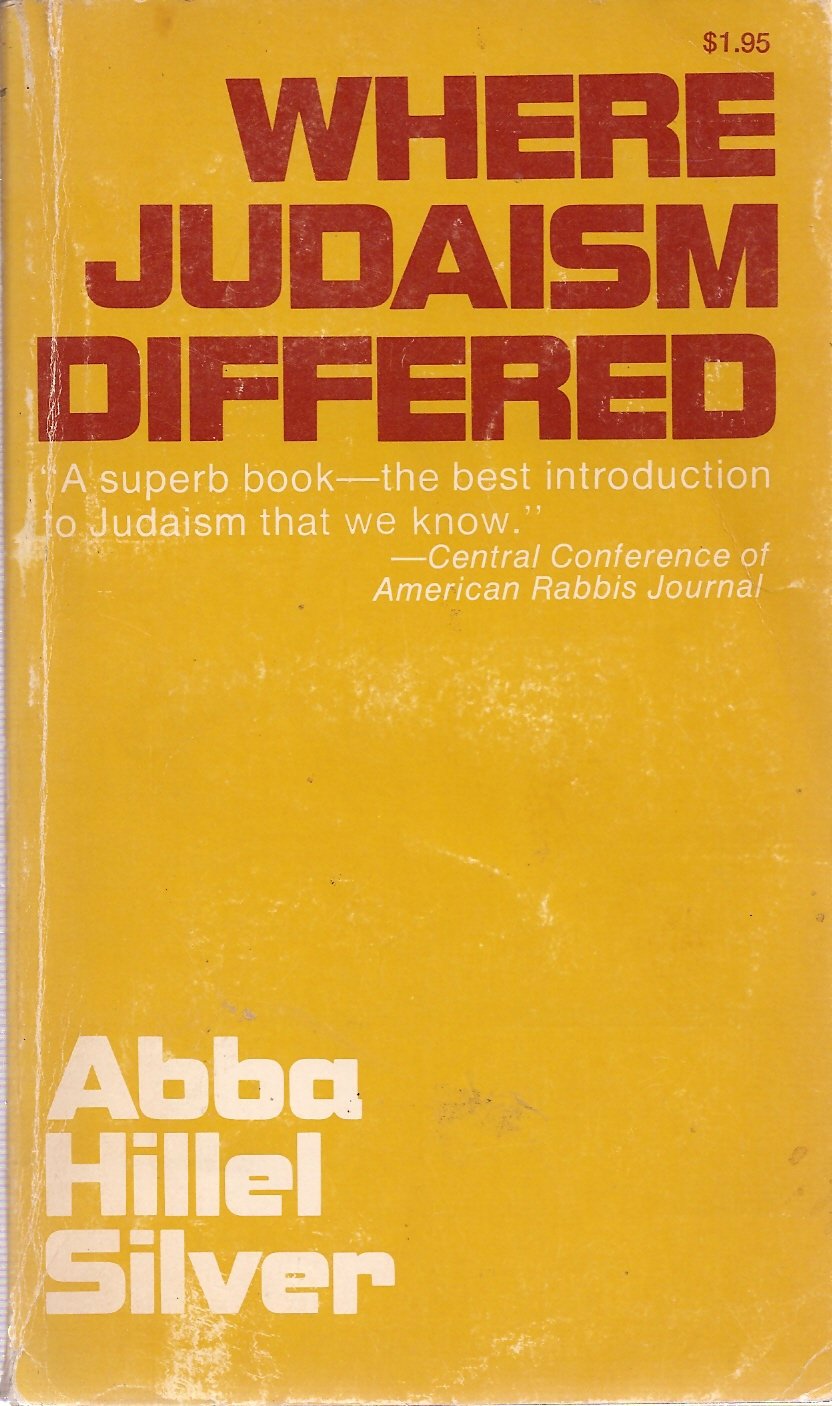
Before I continue my series on Rabbi Eliezer Melamed and post his views of Christianity and other religions, I will take a digression and present on the classic book by Rabbi Abba Hillel Silver, Where Judaism Differed (Macmillan, 1958). Rabbi Silver (d. 1963) was a renowned Reform Rabbi, a prolific author, orator, American Zionist leader, and fundraiser for the new state.. His most famous book, Where Judaism Differed, explained how Judaism is different from Christianity and other religions. The book was a pillar of the thinking of American Jewry. Whenever I explain my interfaith work to an older generation or explain what I am writing, I inevitably receive some form of Silver’s words in response. I teach in a program in Jewish Christian Studies, so I know there are hundreds of better books, yet Silver’s ideas that Judaism is completely the opposite of other religions still percolate in the writings of other authors such as Rabbi Yitz Greenberg or in sermons from all denominations, or are found on social media, hence these ideas are often the basis for much in ChatGPT. (We also have the opposite on ChatGPT that Judaism and Christianity share Biblical values, the commandments, and the Golden Rule.)
In short, Silver assumes that whatever Christianity teaches, Judaism is the opposite. According to Silver, Christianity is elite, and Judaism is democratic. Christianity is about sin and salvation; Judaism has no concern with sin and salvation. Christianity is ascetic, Judaism is not. Christianity is mythic and magical; Judaism is not. Christianity assumes that all is predetermined without free will, and Judaism offers free will and social progress. Christianity advocates celibacy, Judaism does not.
Original Cover 1956
Christianity accepts a Trinity, Original Sin, Incarnation, a personal messiah, miracles, redemption through God, a virgin birth, and the need for salvation of the soul. Judaism rejects these concepts and every theological idea in Christianity. Christianity is a mystery religion, while in Judaism, “the moral life and the aspirations of man are the “sacraments: of Judaism.” (210) Christianity is otherworldly and concerned for the afterlife; Judaism has no interest in eschatology.
Christianity and Islam, in Silver’s view, wanted to be free from the law, meaning to break free from ethics and morals. (Hence, Rabbi David Novak had to pen an essay explaining to Jews that Christianity is not antinomian).
In his words, only Judaism of all the religions of the world believes in human progress. (171). Only Judaism is kind to the poor, teaches humility, and has reverence for human life as shown in his comparisons to Roman Latin authors.
Silver paints the other religions in terms of their most monastic other-worldly forms and he is especially negative toward Hinduism and Buddhism seeing them as world denying, ascetic, and having little to teach. They are fatalistic and life is predetermined; this is his explanation of karma. These Dharmic religions are pessimistic, focus on suffering, and afflicting the body. He credits Christianity and Islam with many of these same negative attributes. (Once should compare Rabbi Kook’s fascinating correspondence with Rabbi Shmuel Alexandrov for a sharp contrast, in which the Russian rabbis have positive appreciation of Buddhism). He paints the Asian religions as lacking any moral teachings. Needless to say, this is an entirely erroneous characterization. I do not need to show that they have extensive teachings on ethics, family life, forgiveness, correct speech, correct actions, and working on personal virtue.
Silver paints Judaism as engaged in a continuous historic battle against idolatry, idolatrous Canaanites, against Hellenism, against ancient paganism, against Christianity, which for him is really just part of the synthesis with pagan Greco-Roman world, and against the otherworldly pagan Calvinists of our own time. In contrast, Judaism teaches sober morality, personal piety, and the “prophetic tradition of social progress”!!!! (85) This reading of Jewish history was canonized by Heinrich Graetz in his 19th-century classic History of the Jews and the reading of Christianity as Greco-Roman, not Judaic, was the definitive position of the German theologian Adolf von Harnack. Silver cites the historian George Foot Moore’s Judaism in the First Centuries of the Christian Era, but only seems to take from it that Judaism and God-fearers were “waging war with great energy against polytheism and idolatry.”
The book also typifies a Jewish trend of creating false historical genealogies crediting many aspects of Christianity to pagan influence. In 2025, I still see on social media, by people who should know better, the acceptance of the statement that Christmas Trees are from Roman paganism, a false statement, the earliest possible record is the 15th century, or that Easter/Pascha has anything to do with Ishtar.
In the end for Silver, Judaism is a pure ethical monotheism that is unique in believing in human progress. In the background of this, one hears echoes of Hermann Cohen’s views of Judaism as a unique monotheism striving toward messianic social progress but adapted for the popular pulpit. Judaism is the only religion not death-obsessed or about self-effacement, but rather affirming human progress.
The late 20th century popular Jewish maxims that Judaism does not engage with theology or have any theology, let this book linger long in people’s conceptions. Popular ideas that Judaism has no afterlife or eschatology dovetail with this book. I lose any ability to engage with the content of Rabbinic Judaism, midrash, Aggadah, kabbalah, or even medieval Jewish philosophy. Judaism is an abstraction and defined by negation of others. There is no message of the High Holy Days, the three festivals, Chanukah, prayer, or Jewish life.
To his credit, Silver was responding to several prior decades of liberal Jewish rabbis proclaiming that Judaism and Christianity taught a common universal message of prophetic ethics. However, his solution was to negate every idea of Christianity as the definition of where Judaism differed, without offering any serious positive theology of Judaism. Basically, being Jewish means rejecting a Christmas tree and every positive Christian value. The book was written in a different era, it was before Vatican II’s Nostra Aetate, and he was formed in the heyday of social progress of the first half of the 20th century.
A recent book on religious polemics portrays Silver as driven by the need for apologetics, to stem the tide of Jewish self-hatred, to respond to the stereotypes about Jews. (Jay Newman, Competition in Religious Life, 92). Silver’s work is “vitalized by the exaggeration and caricature that characterizes almost all apologetic works.” He excuses Judaism from all its weaknesses and finds the worst in other religions. He violates one of the prime directives in interfaith comparisons: Do not compare your best to their worst.
At the time of its release in 1956, the New York Times reviewed the book with praise for showing that Judaism is different than Christianity. The CCAR proclaimed that “the best introduction to Judaism that we know.” While a more cautious Felix A Levy, a Reform rabbi, praised the book as a new apologetic Hizzuk Emunah, referring to the 16th-century apologetic work by Isaac Troki, but faults him for leaving out revelation and halakha.
On the other hand, Lou H. Silverman, Professor of Jewish Literature and Thought at Vanderbilt University, in a 1958 review, faulted the book sharply for reducing Judaism to oppositional negation. Judaism is defined as not Pauline Christianity, but we do not learn at all how Rabbinic, philosophic, and mystical Judaism understood the same issues. Silverman opines that the book fails to do full justice to the texture of the tradition.
Silverman points out that the Jewish prayer book in any version is about God having sin, God’s mercy on us, and forgiving us. To say that Judaism has no sense of superiority or racial thinking and is the only universal religion rubs Silverman the wrong way. He points out that the Reform Union Prayer Book referred to the Jewish race until 1933 and it took until 1945 to remove the racial elements. Silverman as an exclamation, asks: Where is Yehudah Halevi, Franz Rosenzweig? Silverman asks: when Silver states that a concern with “eschatology represented a sharp deviation from Classical Judaism,” what does that even mean? Silverman notes that Silver certainly excludes explicit Rabbinic concerns. Silverman ends his review by wishing that Silver had written a confessional, mature statement of his beliefs as a Reform Jew, rather than just presenting Judaism as the negation of Christianity.
Msgr John M. Oesterreicher of the Institute of Judeo-Christian Studies at Seton Hall University wrote a nine-page negative review of the book. At the time, Oesterreicher was editing a journal called The Bridge which looked at similarities and differences between Judaism and Christianity, and was already working on the 1961 “Decree on the Jews” (Decretum de Iudaeis), which is considered the first draft of Nostra Aetate.
Oesterreicher points out that Silver removes any sense of the word of God or God’s call to Abraham, or Sinai, replacing those ideas with a prophetic Jewish religious genius and ideas that we follow Judaism as utilitarian, “opportune and useful for life.” He is especially irked that Silver refers to God as a due to the Jewish genius created the universal God idea, which Oesterreicher considers “not part of the truly Jewish vocabulary.”
Oesterreicher declares that “the light in Rabbi Silver’s book is not the light of scripture” and that he is at variance with Jewish tradition. For example, neither the Hebrew Bible nor Rabbinic texts see sin as degrading; rather, they have full theologies of sin, repentance, and atonement. (This is like Silverman’s critique above that you cannot state that Judaism has no eschatology). He also notes that Silver is against mysticism and mischaracterizes both Western and Eastern mysticism.
Oesterreicher obviously thinks Silver misreads and mischaracterizes Jesus, Paul, the New Testament, and Christian teachings in many places. For example, the Sermon on the Mount is clearly rabbinic in context and not to be relegated to foreign “Greco-oriental” values. Silver psychologizes Jesus’ disciples as unable to admit their teacher was arrested and killed so they go into psychological denial, delusion, and imagine him as still alive. Silver shows no knowledge of Jewish memra theology or the variety of first-century Jewish ideas.
In conclusion, Oesterreicher agrees that Judaism and Christianity are different and cites Silver approvingly that “to gloss over differences as a gesture of goodwill is a superficial act” (289) But that does not mean they are opposites. Rather, Oesterreicher ends by saying that the discussion of similarities and differences should be pursued with an “Untiring, even painfully, open eye.”
The digitized American Jewish Archives preserve the letters that Silver received from publishers about his book. Harper and Bros rejected it based on Reviewer #2. Simon and Shuster rejected it with a long letter including the following paragraph:
The third point is, I fear, a more sensitive one, but perhaps it would be best for our mutual understanding to state it baldly. All of us have been somewhat troubled throughout the book by the invidious comparisons of Christianity with Judaism. Enduring spiritual values, I feel, are self-demonstrative; they do not need to be singled out and lauded at the expense of something else. I realize that such comparisons have an enormous controversial value, but I also feel that they have the final effect of weakening your rich, positive statements, or detracting from the dignity of a great tradition. It is for this reason, as well as for the reason that such invidious comparisons may offend and repel people of other faiths, that I venture to suggest that you reconsider them.
In the end, Macmillan published it as written. But before publication, Silver had his friend Ludwig Lewisohn read the manuscript to offer comments. Ludwig Lewisohn (1882–1955), was a novelist, outspoken critic of Jewish assimilation, and a founding faculty member of Brandeis University.
Lewisohn flags the book’s thesis that history “manifests a clear upward movement in human development,” noting that this “seems to me violently contrary to historic experience and to negate by implication the special redemptive function or the Jewish people and the meaning of its martyrdom. I do not like to see concepts like “development” and “progress” applied to Jewish history. Unless we died for the eternal Law, what did we die for?” This defense of Western liberalization (so-called) has been totally invalidated by history. After the Holocaust, pre-war optimism seemed misguided.
Also noted is that Silver credits anything he does not like in Judaism to outside influences. Lewisohn writes: “Too much importance attached to the theories of Babylonian influences, etc. These are all grounded in malice, conscious or not, and the desire to eliminate the reproach of Judaism’s uniqueness.”
Once interesting observation from the book “Here, my eye catches one of those usages that lower tone. “Judaism has little sympathy with the spiritual lone wolf.” (138) That’s a screaming incongruity–like chalk scratching on a blackboard. And were not the prophets lonely and hence embattled souls?”
Lewisohn does not want to reject the spiritual and theological teaching of Judaism just to engage in negations. Lewisohn rejects the sharp contrast with Christianity
Of course. “original sin” in the Augustinian sense is nonsense. But does not Judaism, too, recognize deeply man’s rebellion against God? Is not therefore teshuvah the end and aim of life. And does not the classical liturgy make it clear that we need God’s grace–vayihi razon milfanecba. I’m frightened for the nobility and inwardness of Judaism when these things are stated after this fashion.
I’m sorry. I think the notion of “progress” in that sense –social progress without inner change-is totally discredited and Jews and Judaism will discredit themselves by clinging to it… The essence of the whole matter is in the Alenu. Progress means obedience to God’s Law and abstention from idolatry–of man, of State, of all the idols or the market-place. And that, thank God, is Judaism.
In conclusion, we are now blessed with sixty-five years of work showing the similarities and differences between Judaism and Christianity. We have fine works on the New Testament, Patristics, Rabbinic, medieval philosophy, and modern thought. No one would write like Abba Hillel Silver anymore. But the influence of this book remains vast in common understandings. I am still greeted with citations of this work. And if you want to judge the knowledge of Christianity by contemporary rabbis and Jewish thinkers, or the recent works showing a more open approach, the benchmark was already set low. So judge them, in this context.
For Rabbi Melamed, all religions have a spark of the divine, some of the light of the divine, and help the world advance toward its moral perfection. The religions of the world educate towards the moral foundations, “each religion according to its level.” Through accepting these points, Rabbi Melamed removed any stigma of other religions as needing to be negated or the need to call other religions as demonic, entirely false, or to teach a restrictive exclusivism where only Jews have religion. Rather, for most people in the world, Melamed thinks that “it is right for every person to continue in the faith of their fathers, because with the loss of faith, moral corruption increases.”
Rabbi Melamed also thinks that the religions of the world are progressing toward deeper and more abstract forms of understanding their religions, thereby removing “the dross of the crude material elements within it” allowing them to elevate their souls “to higher faith and morality.” Jews should not follow these religions; however, the religions of the world “serve as a moral and faith compass for all peoples.” Rabbi Melamed acknowledges that religious ideas are evolving and progressing to deeper understandings, the ancient and medieval forms of the religion that most people know from textbooks do not reflect current ideas in those religions. He has spoken with many people and read many books to overcome the essentializing of religions in ancient forms. I am always surprised at people who think other religions are where they were in 500 CE or even 1700 CE, but at the same time have a modern understanding of Judaism.
Rabbi Melamed’s fundamental starting point is the discussion in Rabbi Abraham Isaac Kook’s Le’Nevuchei Ha’Dor and his other books. However, Rabbi Melamed draws out the full potential implications in some of Rabbi Kook’s statements, going beyond the prior understandings to create a new broader vision, melding his views with those of Rabbi Kook. To highlight the contrasting understandings of Rabbi Kook, it is worth noting that Rabbi Zvi Yehudah Kook had views, also based on Rabbi Abraham Isaac Kook, that were deeply adversarial to Christianity and other religions, as were those of his student Rabbi Aviner. One should treat the use of Rabbi A. I. Kook and the explanation of the citations of Kook by Rabbi Melamed as innovative and expansive, blending the ideas of the Kook with contemporary application by Melamed.
Rabbi Kook wrote that the world’s religions serve a divine providential purpose, gradually elevating humanity towards its ultimate goal. There is an evolutionary unfolding of humanity from a crude understanding of God toward an abstract belief in one God. In the meantime, people need “a tangible belief in idols that provide them with basic principles of conduct and morality.” Therefore, Rabbi Kook thinks every religion has “a divine spark of morality that sustains it, through which it sets standards of good and evil” as they advance “towards the belief in divine unity “ (‘Le’Nevuchei Ha’Dor’, Chapters 8; 14:1).
Each religion contains a divine spark expressed “through different educational and cultural systems, aimed at improving human spirit and material conditions, the time and the world, the individual and the community (‘Orot: Ze’ron’im’, 6).Therefore, even concerning the lowest form of idolatry, “one cannot decide that the entire religion is erroneous,” as it may have been suitable for them in the past to uplift them somewhat. There are different levels among religions, and some are more refined “in morality, character, and conduct, and thus, their customs and idolatrous practices are not as detestable and filled with disgust as others” (‘Le’Nevuchei Ha’Dor’, 14:1; ibid, 39:1; ‘Rishon Le’Yaffo’, 91:1)
Even pagan and idolatrous religions may have served a purpose in their time. But no specific hierarchy is created. But the important element is the Divine spark in all things. God has a presence in the world and its cultures and is not limited to a single group.
The reason for this acceptance of other religions is based the idea that there is a natural division and diversity of nations, an idea going back to the Second Temple literature and continuing through the Middle Ages and beyond. Each nation has their own spirit, either angelically above, internally as their animating force, or as volkgeist. In Rabbi Kook’s writings, we have a grand vision of the elevation of all of humanity. We also have kabbalistic ideas of divine sparks in all things. Finally, we also have neo-Platonic ideas of all things upwardly aspiring to the divine. No longer is the discussion of other religions limited to Talmudic discussions of stones on the road for Mercury or statues of Aphrodite.
Rabbi Melamed explains Rabbi Kook’s idea to mean that even pagan religions serve a divine purpose and that even the representations of the gods through idols point to higher “values of truth and goodness.” Greek mythology teaches moral lessons. Melamed uses his textbook knowledge of Greek myths to state that even the gods are subject to Fate, thereby showing that there is a divine destiny and higher ethic even higher than the gods of the myths. For Melamed the “ancient myths where, despite the great power of the gods, it is limited, and they are subject to fate. Furthermore, their actions also affect their destiny, and any idol that crosses certain limits—such as excessive indulgence or pride, or extreme disregard for other gods—will be punished by more powerful, higher forces. These higher forces reflect a higher value system, in which a belief in the one true God is hidden.” Greek myths show a higher theistic vision and teach moral.
Whereas Rabbi Moses Feinstein, allowed the Greek myths only because the religion was dead and considered the myths as showing that the Greek beliefs were nonsensical, non-ethical, and immorally licentious, Rabbi Melamed, in contrast, following Rabbi Kook see the guiding hand of divine providence in the narratives as part of God’s plan for uplifting each nation of the world and that the very myths contain moral lessons. Rabbi Feinstein’s approach limits knowledge of God and morals to Jews, awash in an immoral world. Rabbi Melamed sees the knowledge of God in all nations and all nations are on a journey to ultimate perfection.
As most Jewish universalists, he quotes “For from the rising of the sun to its setting, My name will be great among the nations; and everywhere incense is going to be offered in My name, and a grain offering that is pure; for My name will be great among the nations, says the Lord of hosts” (Malachi 1:11). Showing that all religions are really worshiping the Biblical God in their various forms of worship. Rabbi Melamed is clearly an inclusivity, finding a place for other religions in categories of Torah, and he is Jewish-centered, but some of his ideas are moving to a universalism.
For example, Rabbi Melamed cites the Talmud to claim that all religions are worshiping the true high God of the Bible even if they use representation. “Our Sages explained that all idolaters refer to God as “Elah de’elahaya” – “God of gods” (Menachot 111a).”Despite using idols, “there was a deep-seated belief in a Supreme God, the source of truth and morality.” Most people were not on the level to recognize this, but there “were exceptional individuals who delved deeply into their faith and directed their primary prayers to the God of gods.” Hence, he can acknowledge the Ancient Greeks Neoplatonists, or the Hindu Upanishads, and others as expressing the best views of the era. Nevertheless, these religions improved “the values of truth and goodness in people’s hearts. In these paragraphs, he is beginning to sound more like Rabbi Menashe ben Israel or Rabbi Eliyahu Benamozegh.
Even more surpassing is that Rav Kook wrote that the sages of other religions even merited divine inspiration, (ruach ha’kodesh), a form of prophecy, through which they deepened their faith and educated their people. Rabbi Melamed accepts this. But in his printed book he cautiously does not mention the current discussions among these circles about acknowledging that Muhammad, Buddha, or Guru Nanak may have divine inspiration. The medieval position of Rabbi Nathaniel ibn Faymi (d. ~1165) that God sent prophets to all nations and establishes a religion for all nations, is becoming more accepted as a valid position. In general, one should compare Rabbi Melamed to Rabbi Yakov Nagen to get a sense of the current approaches- see Rabbi Yakov Nagen- here. One should note that Yehudah Halevi already called Plato, Aristotle, Hermes, and Zoroaster as divine (elokhi) and Maimonides granted Baalam the same prophetic status as the patriarch Jacob. Hence, even ancient pagans may have had some form of divine prophecy.
Rabbi Melamed cites the later pietistic Aggadah Tanna de-Vei Eliyahu: “I testify by Heaven and Earth that whether it is a man or woman, servant or maid, gentile or Israelite, ruach ha-kodesh rests upon him according to his deeds” (Ch. 9).The original Tanna de-Vei Eliyahu is a parallel of Galatians (3:28) “There is neither Jew nor Gentile, neither slave nor free, nor is there male and female…” But here in the Jewish Aggadic text, we have a greater universalism and a noticeable inclusion of all the people of the world in Holy spirit, which originally may have meant divine connection or inspiration corresponding to a Christian sense of the Holy Spirit but it is being understood in the 21st century as referring to prophecy, probably because the phrase Ruah Hakodesh is used in contemporary Rabbinic language to refer to prophetic inspiration and prophecy. Rabbi Kook added that it is possible that the leaders of religions even received heavenly assistance to perform miracles, so that their followers would accept the religion that advanced their moral state (‘Le’Nevuchei Ha’Dor’, 14; 46; 57).
Based on Rabbi Kook, Rabbi Melamed declares that one “should not denigrate other religions, including the more idolatrous ones.” This halakhic pronouncement seemingly undoes prior Rabbinic exhortation to make fun of idolatrous religions. Rabbi Kook taught that: “Such denigration is also against the very essence of faith and religion, and therefore, those who throw off the yoke will take the arguments and words of disparagement said about other religions and hurl them at Judaism, as happened in practice.” In making fun of another religion, the arguments against another religion can just as easily be turned around to attack Judaism causing Jews to lose their faith. Rabbi Kook taught: “we need to deepen our understanding of the value of other beliefs according to the Torah,” and show the greater and more comprehensive light that exists in the faith of Israel. In our age, greater respect for all religions leads to a stronger respect of the religious core of Judaism.
Should the nations continue in their idolatry? He answers, “even the exceptional individuals among the nations who knew that God is the “God of gods,” the source of all powers, did not abolish idol worship. This is because they knew that belief in one abstract God was too lofty, and without faith being applied to tangible forces called idols, and reinforced by rituals, they would not succeed in establishing the moral values that would elevate their people and religion.” People are not ready to worship without images and statues. This is the same answer given by the medieval Hindu scholastics Shankara, Ramanuja, or Madhva, that the people are not ready to give up their representation. It is also the answer given in the 20th century by Sarvepalli Radhakrishnan, philosopher and former President of India. Rather than the more traditional and popular Orthodox Midrash Says dualism of Torah consisting of all truths and morals contrasting with idolatry as immoral and lacking any truths, the other religions, even idolatry, serve to bring people to God. The religions of the world are on a sliding scale, very similar to what is taught in Hindu textbooks since the early Middle Ages and even in the 21st century.
Idols made of wood and stone still have the function of curbing evil inclination and keeping people from committing crimes. Even idolatrous rituals keep people on a virtuous path. At the same time, “if they continue to observe the laws of their religion, they could gradually ascend, until they merit reaching the true level of faith, drawn from the light of Israel. Therefore, according to their value, their religion has religious significance.” Rabbi Melamed concludes that “we can recognize and honor them for approaching the light of God, according to their own way.” It is important to note, that Rabbi Abraham Isaac Kook also wrote this about prior philosophic understanding of Torah, declaring that contemporary understandings of Jewish concepts need to evolve beyond the medieval.
Christianity and Islam
Rabbi Melamed follows Rabbi Kook that Christianity and Islam are not foreign worship because they were influenced by the Hebrew Bible and thereby show greater divine light. These two religions display “a further stage of progress in the process of purifying faith and morality, from crude idolatry, towards pure faith in God. And as noted above, they possibly have been granted prophecy and the performance of miracles
However, Christianity and Islam are flawed “in that they do not recognize the central role of Israel in revealing God’s word and blessing to the world, and instead, claim to replace them – while harming Jews. For him, “there is a necessity that over time, Christians and Muslims cleanse themselves of hatred of Israel, and become able to draw, from the source of Israel’s faith, illumination and guidance, according to what is appropriate and suitable for them for constant elevation and Tikkun Olam (repair of the world).” (Americans in the culture wars should take note that Rabbi Melamed used positively the word tikkun olam a word freely used by Rabbi Kook, Rebbe Nachman, Rabbi Ashlag, and other Eastern European rabbis- for citations of its use by traditional rabbis see here).
In conclusion, Rabbi Melamed states that even now, when there is still hatred by Christians and Muslims of Jews, and they still have problematic elements, it is still “proper to respect the foundations of faith and morality in their religion, through which they succeeded in elevating many people to have better qualities and to achieve love and fear of God.
Unlike those who differentiate Judaism’s attitude toward Christianity and Islam, Melamed notes “that Rabbi Kook consistently refers to Christianity and Islam equally. True, Islam is purer of idolatry, but apparently, this advantage is not decisive compared to the aspects in which Christianity is preferable to Islam.” Rabbi Abram Kook, in later decades when he was fighting the extensive Christian mission, has derogatory statements about Christianity, which were given emphasis by his son Rabbi Zvi Yehudah Kook.
Rabbi Melamed concludes that Christians and Muslims are obliged to continue in their religion. Once again quoting Rabbi Kook: “The religions founded on the basis of the Torah and the Prophets, certainly have an honored value, for those who hold to them are close to the light of God, and knowledge of His glory” (“LeNevuchei Ha’Dor” 14:1). Rabbi Melamed is creating some form of Religions of the Book, in which the three religions are all based on Torah.
they have “the great moral principles they took from the light of the Torah, which also strengthened in them, with greater vigor, the pure human feeling”. And by way of this, arose from them “individuals with a pure spirit, from whose gathering they will establish for themselves religious customs, which fulfill their destiny, to elevate the soul to good qualities, to love of God, and fear of Him. Therefore, they are certainly obligated to follow the ways of their legislators, who are held in their nation as holy men, according to their value and nature”. Therefore “it is proper for every person perfect in knowledge to understand, that those who engage in them, according to the tradition in their hands, are engaging in the service of God, according to their level” (ibid 8).
Rabbi Yakov Emden’s approach of seeing great moral value in them, especially Christianity, has been accepted by Rabbi Melamed. In the past, one found it in Isaac Baer Levinsohn, Rabbi Benamozegh, Rabbi SR Hirsch, and in Rabbi Kook. But now, it has become mainstream halakhah in Rabbi Melamed. It has also been extended from just Enlightenment era Christianity to all of Christianity and Islam.
Conversion
Rabbi Melamed quotes Rabbi Kook that each nation has its own unique religion and therefore, one should generally not convert. Rabbi Kook wrote (“Le’Nevuchei Ha’Dor” 8) that it is not proper for a person to convert from their religion, including members of idolatrous religions. Because every religion also expresses the social and national character through which it was formed, and one who leaves it, betrays their family, their people, and their good values.
According to Rabbi Kook, it is often beneficial to convert from a lower religion to Christianity or Islam, “because will grow from the recognition of the unity of God (which exists in Christianity and Islam) will, in any case, bring blessing to the whole world”. However, according to Rabbi Melamed, looking at 21st-century reality, this is not always true because sometimes religious ideas and virtues will be lost in the process of giving up native religion. “For we have learned that from every religion, one can remove the dross–until it remains clean of idolatry and bad qualities.” He cites the example of Hinduism, which has deep learning and morality and recognizes the one true divine source. Many times, “leaving it for Christianity or Islam may be considered a descent.” They lead less moral life or damage their spiritual lives.
Avodah Zarah Be-Shituf (Idolatry in Partnership)
Rabbi Melamed assumed that non-Jews are allowed shituf and in this he is quoting Rabbi Kook who wrote: “Noahides are not warned about shituf” (Shmoneh Kevatzim 8:44); and it is an aspirational goal for those who do not even have shituf” (Orot Yisrael ve’Techiyato 5). In addition, Rabbi Melamed singles out for accepting the same opinion on the permissibility of shituf for gentiles his predecessors Rabbi Charlap (Mei Marom 10:35; 12:32, 2), Rabbi Menachem Mendel the ‘Tzemach Tzedek’ (‘Derech Mitzvotecha’ ‘Mitzvat Achdut Hashem’ and Rabbi Menachem Mendel Schneerson, as well (Likutei Sichot 20 p. 16 nt 44). For a full discussion of his position, where he cites many opinions, including those who think shituf is forbidden to non-Jews, see Rabbi Melamed’s discussion here. But there is no need to email Rabbi Melamed (or me), the citations of those who think it is forbidden. He knows them and discusses them at the link
God Name will be One
In conclusion, Rabbi Melamed cites the universalism of Rabbi Kook, who advocated loving all humanity and all nations despite differences in religion or race. Moreover, he advocated for understanding the other nations, especially their religion, since it is central to nations. Rabbi Kook wrote: “Love for people should be alive in the heart and soul, loving every person, especially, and loving all nations.” Any expression of hatred towards gentiles is “only for the wickedness and filth in the world.” This love should be maintained “despite all changes in religious beliefs, opinions, and despite all distinctions of races and climates.” (Middot Ha-Ray’ah: Ahavah, 5).For Rabbi Melamed, one should “understand the views and characteristics of different nations and communities as much as possible, to establish how to build human love on practical foundations. Since religion is central to the spiritual and practical life of nations, Rabbi Melamed concludes that it is evident that Rabbi Kook’s intention also includes different religions. Thus, Israel will be able to fulfill its purpose, bringing the word of God and His blessing to the world
Finally, since all religions can elevate themselves, there is no aspiration for religions to be nullified; rather each religion has a unique hue, reflecting the special character of the people in which it was created. Thus, the vision is for each religion to purify itself of all its flaws and reveal its unique path in serving God and contributing blessings to the world. This is the prophetic vision of “I will remove their blood from their mouths and their abominations from between their teeth, and they shall remain even for our God” (Zechariah 9:7). And of “For then I will turn to the peoples a pure language that they may all call upon the name of the Lord, to serve Him with one accord” (Zephaniah 3:9). (This is unlike Prof Menachem Kellner’s Maimonidean universalism envisioning that all people will have to become Jews).
Ultimately, every nation will maintain their own religion but be elevated in the messianic vision. “Alongside each nation’s special devotion to its religion, humanity as a whole will be united through the connection of all nations to Israel and its center in Jerusalem, as it is said, ‘For My house shall be called a house of prayer for all peoples” (Isaiah 56:7).




 The Book of Doctrines and Opinions: