Category Archives: rabbis

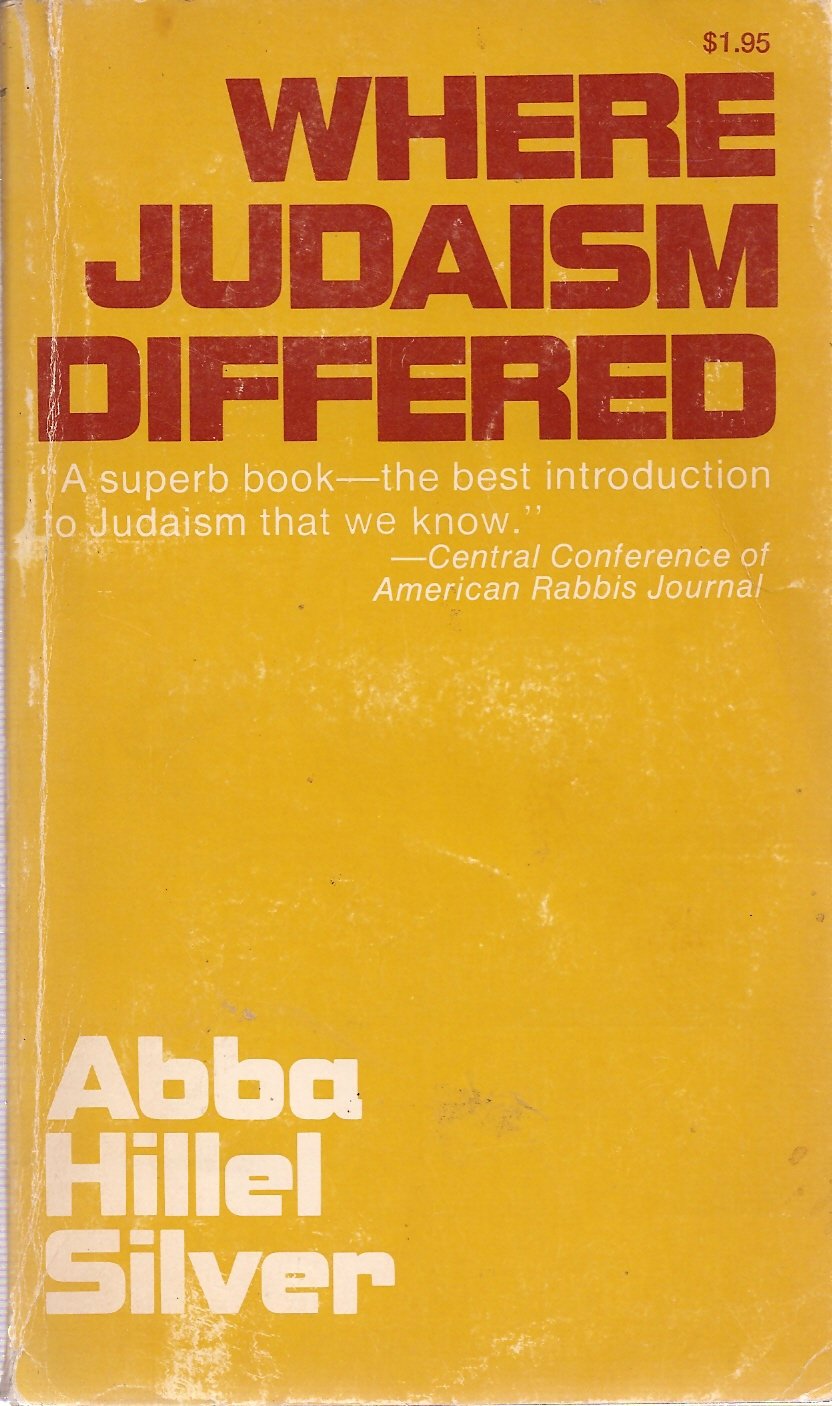
Where Judaism Differed, Abba Hillel Silver

Before I continue my series on Rabbi Eliezer Melamed and post his views of Christianity and other religions, I will take a digression and present on the classic book by Rabbi Abba Hillel Silver, Where Judaism Differed (Macmillan, 1958). Rabbi Silver (d. 1963) was a renowned Reform Rabbi, a prolific author, orator, American Zionist leader, and fundraiser for the new state.. His most famous book, Where Judaism Differed, explained how Judaism is different from Christianity and other religions. The book was a pillar of the thinking of American Jewry. Whenever I explain my interfaith work to an older generation or explain what I am writing, I inevitably receive some form of  Silver’s words in response. I teach in a program in Jewish Christian Studies, so I know there are hundreds of better books, yet Silver’s ideas that Judaism is completely the opposite of other religions still percolate in the writings of other authors such as Rabbi Yitz Greenberg or in sermons from all denominations, or are found on social media, hence these ideas are often the basis for much in ChatGPT. (We also have the opposite on ChatGPT that Judaism and Christianity share Biblical values, the commandments, and the Golden Rule.)

In short, Silver assumes that whatever Christianity teaches, Judaism is the opposite. According to Silver, Christianity is elite, and Judaism is democratic. Christianity is about sin and salvation; Judaism has no concern with sin and salvation. Christianity is ascetic, Judaism is not. Christianity is mythic and magical; Judaism is not. Christianity assumes that all is predetermined without free will, and Judaism offers free will and social progress. Christianity advocates celibacy, Judaism does not.

Original Cover 1956

Christianity accepts a Trinity, Original Sin, Incarnation, a personal messiah, miracles, redemption through God, a virgin birth, and the need for salvation of the soul. Judaism rejects these concepts and every theological idea in Christianity. Christianity is a mystery religion, while in Judaism, “the moral life and the aspirations of man are the “sacraments: of Judaism.” (210) Christianity is otherworldly and concerned for the afterlife; Judaism has no interest in eschatology.

Christianity and Islam, in Silver’s view, wanted to be free from the law, meaning to break free from ethics and morals. (Hence, Rabbi David Novak had to pen an essay explaining to Jews that Christianity is not antinomian).

In his words, only Judaism of all the religions of the world believes in human progress. (171).  Only Judaism is kind to the poor, teaches humility, and has reverence for human life as shown in his comparisons to Roman Latin authors.   

Silver paints the other religions in terms of their most monastic other-worldly forms and he is especially negative toward Hinduism and Buddhism seeing them as world denying, ascetic, and having little to teach. They are fatalistic and life is predetermined; this is his explanation of karma. These Dharmic religions are pessimistic, focus on suffering, and afflicting the body. He credits Christianity and Islam with many of these same negative attributes. (Once should compare Rabbi Kook’s fascinating correspondence with Rabbi Shmuel Alexandrov for a sharp contrast, in which the Russian rabbis have positive appreciation of Buddhism). He paints the Asian religions as lacking any moral teachings. Needless to say, this is an entirely erroneous characterization. I do not need to show that they have extensive teachings on ethics, family life, forgiveness, correct speech, correct actions, and working on personal virtue.  

Silver paints Judaism as engaged in a continuous historic battle against idolatry, idolatrous Canaanites, against Hellenism, against ancient paganism, against Christianity, which for him is really just part of the synthesis with pagan Greco-Roman world, and against the otherworldly pagan Calvinists of our own time. In contrast, Judaism teaches sober morality, personal piety, and the “prophetic tradition of social progress”!!!! (85) This reading of Jewish history was canonized by Heinrich Graetz in his 19th-century classic History of the Jews and the reading of Christianity as Greco-Roman, not Judaic, was the definitive position of the German theologian Adolf von Harnack. Silver cites the historian George Foot Moore’s Judaism in the First Centuries of the Christian Era, but only seems to take from it that Judaism and God-fearers were  “waging war with great energy against polytheism and idolatry.”

The book also typifies a Jewish trend of creating false historical genealogies crediting many aspects of Christianity to pagan influence. In 2025, I still see on social media, by people who should know better, the acceptance of the statement that Christmas Trees are from Roman paganism, a false statement, the earliest possible record is the 15th century, or that Easter/Pascha has anything to do with Ishtar.

In the end for Silver, Judaism is a pure ethical monotheism that is unique in believing in human progress. In the background of this, one hears echoes of Hermann Cohen’s views of Judaism as a unique monotheism striving toward messianic social progress but adapted for the popular pulpit. Judaism is the only religion not death-obsessed or about self-effacement, but rather affirming human progress.

The late 20th century popular Jewish maxims that Judaism does not engage with theology or have any theology, let this book linger long in people’s conceptions. Popular ideas that Judaism has no afterlife or eschatology dovetail with this book. I lose any ability to engage with the content of Rabbinic Judaism, midrash, Aggadah, kabbalah, or even medieval Jewish philosophy. Judaism is an abstraction and defined by negation of others. There is no message of the High Holy Days, the three festivals, Chanukah, prayer, or Jewish life.

To his credit, Silver was responding to several prior decades of liberal Jewish rabbis proclaiming that Judaism and Christianity taught a common universal message of prophetic ethics. However, his solution was to negate every idea of Christianity as the definition of where Judaism differed, without offering any serious positive theology of Judaism. Basically, being Jewish means rejecting a Christmas tree and every positive Christian value. The book was written in a different era, it was before Vatican II’s Nostra Aetate, and he was formed in the heyday of social progress of the first half of the 20th century.

A recent book on religious polemics portrays Silver as driven by the need for apologetics, to stem the tide of Jewish self-hatred, to respond to the stereotypes about Jews. (Jay Newman, Competition in Religious Life, 92). Silver’s work is “vitalized by the exaggeration and caricature that characterizes almost all apologetic works.” He excuses Judaism from all its weaknesses and finds the worst in other religions. He violates one of the prime directives in interfaith comparisons: Do not compare your best to their worst.

At the time of its release in 1956, the New York Times reviewed the book with praise for showing that Judaism is different than Christianity. The CCAR proclaimed that “the best introduction to Judaism that we know.” While a more cautious Felix A Levy, a Reform rabbi, praised the book as a new apologetic Hizzuk Emunah, referring to the 16th-century apologetic work by Isaac Troki, but faults him for leaving out revelation and halakha.

On the other hand, Lou H. Silverman, Professor of Jewish Literature and Thought at Vanderbilt University, in a 1958 review, faulted the book sharply for reducing Judaism to oppositional negation. Judaism is defined as not Pauline Christianity, but we do not learn at all how Rabbinic, philosophic, and mystical Judaism understood the same issues. Silverman opines that the book fails to do full justice to the texture of the tradition.

Silverman points out that the Jewish prayer book in any version is about God having sin, God’s mercy on us, and forgiving us. To say that Judaism has no sense of superiority or racial thinking and is the only universal religion rubs Silverman the wrong way. He points out that the Reform Union Prayer Book referred to the Jewish race until 1933 and it took until 1945 to remove the racial elements.  Silverman as an exclamation, asks: Where is Yehudah Halevi, Franz Rosenzweig? Silverman asks: when Silver states that a concern with “eschatology represented a sharp deviation from Classical Judaism,” what does that even mean? Silverman notes that Silver certainly excludes explicit Rabbinic concerns. Silverman ends his review by wishing that Silver had written a confessional, mature statement of his beliefs as a Reform Jew, rather than just presenting Judaism as the negation of Christianity.

Msgr John M. Oesterreicher of the Institute of Judeo-Christian Studies at Seton Hall University wrote a nine-page negative review of the book. At the time, Oesterreicher was editing a journal called The Bridge which looked at similarities and differences between Judaism and Christianity, and was already working on the 1961 “Decree on the Jews” (Decretum de Iudaeis), which is considered the first draft of Nostra Aetate.

Oesterreicher points out that Silver removes any sense of the word of God or God’s call to Abraham, or Sinai, replacing those ideas with a prophetic Jewish religious genius and ideas that we follow Judaism as utilitarian, “opportune and useful for life.” He is especially irked that Silver refers to God as a due to the Jewish genius created the universal God idea, which Oesterreicher considers “not part of the truly Jewish vocabulary.”

Oesterreicher declares that “the light in Rabbi Silver’s book is not the light of scripture” and that he is at variance with Jewish tradition. For example, neither the Hebrew Bible nor Rabbinic texts see sin as degrading; rather, they have full theologies of sin, repentance, and atonement. (This is like Silverman’s critique above that you cannot state that Judaism has no eschatology). He also notes that Silver is against mysticism and mischaracterizes both Western and Eastern mysticism.

Oesterreicher obviously thinks Silver misreads and mischaracterizes Jesus, Paul, the New Testament, and Christian teachings in many places.  For example, the Sermon on the Mount is clearly rabbinic in context and not to be relegated to foreign “Greco-oriental” values. Silver psychologizes Jesus’ disciples as unable to admit their teacher was arrested and killed so they go into psychological denial, delusion, and imagine him as still alive. Silver shows no knowledge of Jewish memra theology or the variety of first-century Jewish ideas.

In conclusion, Oesterreicher agrees that Judaism and Christianity are different and cites Silver approvingly that “to gloss over differences as a gesture of goodwill is a superficial act” (289) But that does not mean they are opposites. Rather, Oesterreicher ends by saying that the discussion of similarities and differences should be pursued with an “Untiring, even painfully, open eye.”
The digitized American Jewish Archives preserve the letters that Silver received from publishers about his book. Harper and Bros rejected it based on Reviewer #2. Simon and Shuster rejected it  with a long letter including the following paragraph:

The third point is, I fear, a more sensitive one, but perhaps it would be best for our mutual understanding to state it baldly. All of us have been somewhat troubled throughout the book by the invidious comparisons of Christianity with Judaism. Enduring spiritual values, I feel, are self-demonstrative; they do not need to be singled out and lauded at the expense of something else. I realize that such comparisons have an enormous controversial value, but I also feel that they have the final effect of weakening your rich, positive statements, or detracting from the dignity of a great tradition. It is for this reason, as well as for the reason that such invidious comparisons may offend and repel people of other faiths, that I venture to suggest that you reconsider them.

In the end, Macmillan published it as written. But before publication, Silver had his friend   Ludwig Lewisohn read the manuscript to offer comments. Ludwig Lewisohn (1882–1955), was a novelist, outspoken critic of Jewish assimilation, and a founding faculty member of Brandeis University.

Lewisohn flags the book’s thesis that history “manifests a clear upward movement in human development,” noting that this “seems to me violently contrary to historic experience and to negate by implication the special redemptive function or the Jewish people and the meaning of its martyrdom. I do not like to see concepts like “development” and “progress” applied to Jewish history. Unless we died for the eternal Law, what did we die for?” This defense of Western liberalization (so-called) has been totally invalidated by history. After the Holocaust, pre-war optimism seemed misguided.

Also noted is that Silver credits anything he does not like in Judaism to outside influences. Lewisohn writes: “Too much importance attached to the theories of Babylonian influences, etc. These are all grounded in malice, conscious or not, and the desire to eliminate the reproach of Judaism’s uniqueness.”

Once interesting observation from the book “Here, my eye catches one of those usages that lower tone. “Judaism has little sympathy with the spiritual lone wolf.” (138) That’s a screaming incongruity–like chalk scratching on a blackboard. And were not the prophets lonely and hence embattled souls?”

Lewisohn does not want to reject the spiritual and theological teaching of Judaism just to engage in negations. Lewisohn rejects the sharp contrast with Christianity

Of course. “original sin” in the Augustinian sense is nonsense. But does not Judaism, too, recognize deeply man’s rebellion against God? Is not therefore teshuvah the end and aim of life. And does not the classical liturgy make it clear that we need God’s grace–vayihi razon milfanecba. I’m frightened for the nobility and inwardness of Judaism when these things are stated after this fashion.

I’m sorry. I think the notion of “progress” in that sense –social progress without inner change-is totally discredited and Jews and Judaism will discredit themselves by clinging to it… The essence of the whole matter is in the Alenu. Progress means obedience to God’s Law and abstention from idolatry–of man, of State, of all the idols or the market-place. And that, thank God, is Judaism.

In conclusion, we are now blessed with sixty-five years of work showing the similarities and differences between Judaism and Christianity. We have fine works on the New Testament, Patristics, Rabbinic, medieval philosophy, and modern thought. No one would write like Abba Hillel Silver anymore. But the influence of this book remains vast in common understandings. I am still greeted with citations of this work. And if you want to judge the knowledge of Christianity by contemporary rabbis and Jewish thinkers, or the recent works showing a more open approach, the benchmark was already set low.  So judge them, in this context.

Rabbi Melamed on the Divine Spark in other religions

Continuing my discussion about Rabbi Melamed on Other Religions. I started with his statements on Hinduism and will now look at his broader premises- see “The Divine Spark among Other Religions”  and here “Rabbi Abraham Isaac Kook on Different Religions.” Once again, I will use the posted selective English translation because it is accessible; however, I do have the Hebrew original marked up with marginal notes and a full response.

      For Rabbi Melamed, all religions have a spark of the divine, some of the light of the divine, and help the world advance toward its moral perfection. The religions of the world educate towards the moral foundations, “each religion according to its level.” Through accepting these points, Rabbi Melamed removed any stigma of other religions as needing to be negated  or the need to call other religions as demonic, entirely false, or to teach a restrictive exclusivism where only Jews have religion.  Rather, for most people in the world, Melamed thinks that “it is right for every person to continue in the faith of their fathers, because with the loss of faith, moral corruption increases.”

      Rabbi Melamed also thinks that the religions of the world are progressing toward deeper and more abstract forms of understanding their religions, thereby removing “the dross of the crude material elements within it” allowing them to elevate their souls “to higher faith and morality.” Jews should not follow these religions; however, the religions of the world “serve as a moral and faith compass for all peoples.”  Rabbi Melamed acknowledges that religious ideas are evolving and progressing to deeper understandings, the ancient and medieval forms of the religion that most people know from textbooks do not reflect current ideas in those religions. He has spoken with many people and read many books to overcome the essentializing of religions in ancient forms. I am always surprised at people who think other religions are where they were in 500 CE or even 1700 CE, but at the same time have a modern understanding of Judaism.

      Rabbi Melamed’s fundamental starting point is the discussion in  Rabbi Abraham Isaac Kook’s Le’Nevuchei Ha’Dor and his other books. However, Rabbi Melamed draws out the full potential implications in some of Rabbi Kook’s statements, going beyond the prior understandings to create a new broader vision, melding his views with those of Rabbi Kook. To highlight the contrasting understandings of Rabbi Kook, it is worth noting that Rabbi Zvi Yehudah Kook had views, also based on Rabbi Abraham Isaac Kook, that were deeply adversarial to Christianity and other religions, as were those of his student Rabbi Aviner. One should treat the use of Rabbi A. I. Kook and the explanation of the citations of Kook by Rabbi Melamed as innovative and expansive, blending the ideas of the Kook with contemporary application by Melamed.

      Rabbi Kook wrote that the world’s religions serve a divine providential purpose, gradually elevating humanity towards its ultimate goal. There is an evolutionary unfolding of humanity from a crude understanding of God toward an abstract belief in one God. In the meantime, people need “a tangible belief in idols that provide them with basic principles of conduct and morality.” Therefore, Rabbi Kook thinks every religion has “a divine spark of morality that sustains it, through which it sets standards of good and evil” as they advance “towards the belief in divine unity “ (‘Le’Nevuchei Ha’Dor’, Chapters 8; 14:1).

Each religion contains a divine spark expressed “through different educational and cultural systems, aimed at improving human spirit and material conditions, the time and the world, the individual and the community (‘Orot: Ze’ron’im’, 6).Therefore, even concerning the lowest form of idolatry, “one cannot decide that the entire religion is erroneous,” as it may have been suitable for them in the past to uplift them somewhat. There are different levels among religions, and some are more refined “in morality, character, and conduct, and thus, their customs and idolatrous practices are not as detestable and filled with disgust as others” (‘Le’Nevuchei Ha’Dor’, 14:1; ibid, 39:1; ‘Rishon Le’Yaffo’, 91:1)

Even pagan and idolatrous religions may have served a purpose in their time. But no specific hierarchy is created. But the important element is the Divine spark in all things. God has a presence in the world and its cultures and is not limited to a single group.

      The reason for this acceptance of other religions is based the idea that there is a natural division and diversity of nations, an idea going back to the Second Temple literature and continuing through the Middle Ages and beyond. Each nation has their own spirit, either angelically above, internally as their animating force, or as volkgeist. In Rabbi Kook’s writings, we have a grand vision of the elevation of all of humanity. We also have kabbalistic ideas of divine sparks in all things. Finally, we also have neo-Platonic ideas of all things upwardly aspiring to the divine. No longer is the discussion of other religions limited to Talmudic discussions of stones on the road for Mercury or statues of Aphrodite.

      Rabbi Melamed explains Rabbi Kook’s idea to mean that even pagan religions serve a divine purpose and that even the representations of the gods through idols point to higher “values of truth and goodness.” Greek mythology teaches moral lessons. Melamed uses his textbook knowledge of Greek myths to state that even the gods are subject to Fate, thereby showing that there is a divine destiny and higher ethic even higher than the gods of the myths. For Melamed the “ancient myths where, despite the great power of the gods, it is limited, and they are subject to fate. Furthermore, their actions also affect their destiny, and any idol that crosses certain limits—such as excessive indulgence or pride, or extreme disregard for other gods—will be punished by more powerful, higher forces. These higher forces reflect a higher value system, in which a belief in the one true God is hidden.” Greek myths show a higher theistic vision and teach moral.

      Whereas Rabbi Moses Feinstein, allowed the Greek myths only because the religion was dead and considered the myths as showing that the Greek beliefs were nonsensical, non-ethical, and immorally licentious, Rabbi Melamed, in contrast, following Rabbi Kook see the guiding hand of divine providence in the narratives as part of God’s plan for uplifting each nation of the world and that the very myths contain moral lessons. Rabbi Feinstein’s approach limits knowledge of God and morals to Jews,  awash in an immoral world. Rabbi Melamed sees the knowledge of God in all nations and all nations are on a journey to ultimate perfection.

       As most Jewish universalists, he quotes  “For from the rising of the sun to its setting, My name will be great among the nations; and everywhere incense is going to be offered in My name, and a grain offering that is pure; for My name will be great among the nations, says the Lord of hosts” (Malachi 1:11). Showing that all religions are really worshiping the Biblical God in their various forms of worship. Rabbi Melamed is clearly an inclusivity, finding a place for other religions in categories of Torah, and he is Jewish-centered, but some of his ideas are moving to a universalism.

      For example, Rabbi Melamed cites the Talmud to claim that all religions are worshiping the true high God of the Bible even if they use representation. “Our Sages explained that all idolaters refer to God as “Elah de’elahaya” – “God of gods” (Menachot 111a).”Despite using idols, “there was a deep-seated belief in a Supreme God, the source of truth and morality.” Most people were not on the level to recognize this, but there “were exceptional individuals who delved deeply into their faith and directed their primary prayers to the God of gods.” Hence, he can acknowledge the Ancient Greeks Neoplatonists, or the Hindu Upanishads, and others as expressing the best views of the era. Nevertheless, these religions improved “the values of truth and goodness in people’s hearts. In these paragraphs, he is beginning to sound more like Rabbi Menashe ben Israel or Rabbi Eliyahu Benamozegh.

      Even more surpassing is that Rav Kook wrote that the sages of other religions even merited divine inspiration, (ruach ha’kodesh), a form of prophecy, through which they deepened their faith and educated their people. Rabbi Melamed accepts this. But in his printed book he cautiously does not mention the current discussions among these circles about acknowledging that Muhammad, Buddha, or Guru Nanak may have divine inspiration. The medieval position of Rabbi Nathaniel ibn Faymi (d. ~1165) that God sent prophets to all nations and establishes a religion for all nations, is becoming more accepted as a valid position. In general, one should compare Rabbi Melamed to Rabbi Yakov Nagen to get a sense of the current approaches- see Rabbi Yakov Nagen- here. One should note that Yehudah Halevi already called Plato, Aristotle, Hermes, and Zoroaster as divine (elokhi) and Maimonides granted Baalam the same prophetic status as the patriarch Jacob. Hence, even ancient pagans may have had some form of divine prophecy.

      Rabbi Melamed cites the later pietistic Aggadah Tanna de-Vei Eliyahu: “I testify by Heaven and Earth that whether it is a man or woman, servant or maid, gentile or Israelite, ruach ha-kodesh rests upon him according to his deeds” (Ch. 9).The original Tanna de-Vei Eliyahu is a parallel of Galatians (3:28) “There is neither Jew nor Gentile, neither slave nor free, nor is there male and female…” But here in the Jewish Aggadic text, we have a greater universalism and a noticeable inclusion of all the people of the world in Holy spirit, which originally may have meant divine connection or inspiration corresponding to a Christian sense of the Holy Spirit but it is being understood in the 21st century as referring to prophecy, probably because the phrase Ruah Hakodesh is used in contemporary Rabbinic language to refer to prophetic inspiration and prophecy. Rabbi Kook added that it is possible that the leaders of religions even received heavenly assistance to perform miracles, so that their followers would accept the religion that advanced their moral state (‘Le’Nevuchei Ha’Dor’, 14; 46; 57).

      Based on Rabbi Kook, Rabbi Melamed declares that one “should not denigrate other religions, including the more idolatrous ones.” This halakhic pronouncement seemingly undoes prior Rabbinic exhortation to make fun of idolatrous religions. Rabbi Kook taught that: “Such denigration is also against the very essence of faith and religion, and therefore, those who throw off the yoke will take the arguments and words of disparagement said about other religions and hurl them at Judaism, as happened in practice.” In making fun of another religion, the arguments against another religion can just as easily be turned around to attack Judaism causing Jews to lose their faith. Rabbi Kook taught: “we need to deepen our understanding of the value of other beliefs according to the Torah,” and show the greater and more comprehensive light that exists in the faith of Israel. In our age, greater respect for all religions leads to a stronger respect of the religious core of Judaism.

      Should the nations continue in their idolatry? He answers, “even the exceptional individuals among the nations who knew that God is the “God of gods,” the source of all powers, did not abolish idol worship. This is because they knew that belief in one abstract God was too lofty, and without faith being applied to tangible forces called idols, and reinforced by rituals, they would not succeed in establishing the moral values that would elevate their people and religion.” People are not ready to worship without images and statues. This is the same answer given by the medieval Hindu scholastics Shankara, Ramanuja, or Madhva, that the people are not ready to give up their representation. It is also the answer given in the 20th century by Sarvepalli Radhakrishnan, philosopher and former President of India. Rather than the more traditional and popular Orthodox Midrash Says dualism of Torah consisting of all truths and morals contrasting with idolatry as immoral and lacking any truths, the other religions, even idolatry, serve to bring people to God. The religions of the world are on a sliding scale, very similar to what is taught in Hindu textbooks since the early Middle Ages and even in the 21st century.

      Idols made of wood and stone still have the function of curbing evil inclination and keeping people from committing crimes. Even idolatrous rituals keep people on a virtuous path.  At the same time, “if they continue to observe the laws of their religion, they could gradually ascend, until they merit reaching the true level of faith, drawn from the light of Israel. Therefore, according to their value, their religion has religious significance.” Rabbi Melamed concludes that “we can recognize and honor them for approaching the light of God, according to their own way.” It is important to note, that Rabbi Abraham Isaac Kook also wrote this about prior philosophic understanding of Torah, declaring that contemporary understandings of Jewish concepts need to evolve beyond the medieval.

Christianity and Islam

Rabbi Melamed follows Rabbi Kook that Christianity and Islam are not foreign worship because they were influenced by the Hebrew Bible and thereby show greater divine light. These two religions display “a further stage of progress in the process of purifying faith and morality, from crude idolatry, towards pure faith in God. And as noted above, they possibly have been granted prophecy and the performance of miracles

      However, Christianity and Islam are flawed “in that they do not recognize the central role of Israel in revealing God’s word and blessing to the world, and instead, claim to replace them – while harming Jews. For him, “there is a necessity that over time, Christians and Muslims cleanse themselves of hatred of Israel, and become able to draw, from the source of Israel’s faith, illumination and guidance, according to what is appropriate and suitable for them for constant elevation and Tikkun Olam (repair of the world).” (Americans in the culture wars should take note that Rabbi Melamed used positively the word tikkun olam  a word freely used by Rabbi Kook, Rebbe Nachman, Rabbi Ashlag, and other Eastern European rabbis- for citations of its use by traditional rabbis  see here).

      In conclusion, Rabbi Melamed states that even now, when there is still hatred by Christians and Muslims of Jews, and they still have problematic elements, it is still “proper to respect the foundations of faith and morality in their religion, through which they succeeded in elevating many people to have better qualities and to achieve love and fear of God.

      Unlike those who differentiate Judaism’s attitude toward Christianity and Islam, Melamed notes “that Rabbi Kook consistently refers to Christianity and Islam equally. True, Islam is purer of idolatry, but apparently, this advantage is not decisive compared to the aspects in which Christianity is preferable to Islam.” Rabbi Abram Kook, in later decades when he was fighting the extensive Christian mission, has derogatory statements about Christianity, which were given emphasis by his son Rabbi Zvi Yehudah Kook.

      Rabbi Melamed concludes that Christians and Muslims are obliged to continue in their religion. Once again quoting Rabbi Kook: “The religions founded on the basis of the Torah and the Prophets, certainly have an honored value, for those who hold to them are close to the light of God, and knowledge of His glory” (“LeNevuchei Ha’Dor” 14:1). Rabbi Melamed is creating some form of Religions of the Book, in which the three religions are all based on Torah.

they have “the great moral principles they took from the light of the Torah, which also strengthened in them, with greater vigor, the pure human feeling”. And by way of this, arose from them “individuals with a pure spirit, from whose gathering they will establish for themselves religious customs, which fulfill their destiny, to elevate the soul to good qualities, to love of God, and fear of Him. Therefore, they are certainly obligated to follow the ways of their legislators, who are held in their nation as holy men, according to their value and nature”. Therefore “it is proper for every person perfect in knowledge to understand, that those who engage in them, according to the tradition in their hands, are engaging in the service of God, according to their level” (ibid 8).

Rabbi Yakov Emden’s approach of seeing great moral value in them, especially Christianity, has been accepted by Rabbi Melamed. In the past, one found it in Isaac Baer Levinsohn, Rabbi Benamozegh, Rabbi SR Hirsch, and in Rabbi Kook. But now, it has become mainstream halakhah in Rabbi Melamed. It has also been extended from just Enlightenment era Christianity to all of Christianity and Islam.

Conversion

Rabbi Melamed quotes Rabbi Kook that each nation has its own unique religion and therefore, one should generally not convert. Rabbi Kook wrote (“Le’Nevuchei Ha’Dor” 8) that it is not proper for a person to convert from their religion, including members of idolatrous religions. Because every religion also expresses the social and national character through which it was formed, and one who leaves it, betrays their family, their people, and their good values.

      According to Rabbi Kook, it is often beneficial to convert from a lower religion to Christianity or Islam, “because will grow from the recognition of the unity of God (which exists in Christianity and Islam) will, in any case, bring blessing to the whole world”. However, according to Rabbi Melamed, looking at 21st-century reality, this is not always true because sometimes religious ideas and virtues will be lost in the process of giving up native religion. “For we have learned that from every religion, one can remove the dross–until it remains clean of idolatry and bad qualities.” He cites the example of Hinduism, which has deep learning and morality and recognizes the one true divine source. Many times, “leaving it for Christianity or Islam may be considered a descent.” They lead less moral life or damage their spiritual lives.

Avodah Zarah Be-Shituf (Idolatry in Partnership)

Rabbi Melamed assumed that non-Jews are allowed shituf and in this he is quoting Rabbi Kook who wrote: “Noahides are not warned about shituf” (Shmoneh Kevatzim 8:44); and it is an aspirational goal for those who do not even have shituf” (Orot Yisrael ve’Techiyato 5). In addition, Rabbi Melamed singles out for accepting the same opinion on the permissibility of shituf for gentiles  his predecessors Rabbi Charlap (Mei Marom 10:35; 12:32, 2), Rabbi Menachem Mendel the ‘Tzemach Tzedek’ (‘Derech Mitzvotecha’ ‘Mitzvat Achdut Hashem’ and Rabbi Menachem Mendel Schneerson, as well (Likutei Sichot 20 p. 16 nt 44). For a full discussion of his position, where he cites many opinions, including those who think shituf is forbidden to non-Jews, see Rabbi Melamed’s discussion here.  But there is no need to email Rabbi Melamed (or me), the citations of those who think it is forbidden. He knows them and discusses them at the link

God Name will be One

In conclusion, Rabbi Melamed cites the universalism of Rabbi Kook, who advocated loving all humanity and all nations despite differences in religion or race. Moreover, he advocated for understanding the other nations, especially their religion, since it is central to nations.  Rabbi Kook wrote: “Love for people should be alive in the heart and soul, loving every person, especially, and loving all nations.” Any expression of hatred towards gentiles is “only for the wickedness and filth in the world.” This love should be maintained “despite all changes in religious beliefs, opinions, and despite all distinctions of races and climates.” (Middot Ha-Ray’ah: Ahavah, 5).For Rabbi Melamed,  one should “understand the views and characteristics of different nations and communities as much as possible, to establish how to build human love on practical foundations. Since religion is central to the spiritual and practical life of nations, Rabbi Melamed concludes that it is evident that Rabbi Kook’s intention also includes different religions. Thus, Israel will be able to fulfill its purpose, bringing the word of God and His blessing to the world

      Finally, since all religions can elevate themselves, there is no aspiration for religions to be nullified; rather each religion has a unique hue, reflecting the special character of the people in which it was created. Thus, the vision is for each religion to purify itself of all its flaws and reveal its unique path in serving God and contributing blessings to the world. This is the prophetic vision of “I will remove their blood from their mouths and their abominations from between their teeth, and they shall remain even for our God” (Zechariah 9:7).  And of “For then I will turn to the peoples a pure language that they may all call upon the name of the Lord, to serve Him with one accord” (Zephaniah 3:9). (This is unlike Prof Menachem Kellner’s Maimonidean universalism envisioning that all people will have to become Jews).

      Ultimately, every nation will maintain their own religion but be elevated in the messianic vision. “Alongside each nation’s special devotion to its religion, humanity as a whole will be united through the connection of all nations to Israel and its center in Jerusalem, as it is said, ‘For My house shall be called a house of prayer for all peoples” (Isaiah 56:7).

Marc Shapiro interview- Renewing the Old, Sanctifying the New

For more than a century, many of the writings of Rabbi Abraham Isaac Kook remained in manuscript, hidden away from the public eye.  The works of Rabbi Kook that were published in the interim had many passages removed from them. Only in the last quarter century have these original manuscript works been published. The Shemonah Kevatzim are the original notebooks that Rabbi David Cohen (the Nazir, d 1972) and Rabbi Zvi Yehuda (d. 1982) used to produce the standard editions of Rabbi Kook’s writings. In these notebooks, we see many passages that the editors left out of printed editions. And in Li-Nevukhei ha-Dor, we see a Rabbi Kook grappling with many of the religious issues of late nineteenth-century thought. These new works present to the reader a vista on a Rabbinic thinker struggling with many of the issues of fin de siècle modernity. In a recent book, Marc B. Shapiro presents choice quotes of these writings for an American Orthodox audience.  

Marc Shapiro’s new book is Renewing the Old, Sanctifying the New: The Unique Vision of Rav Kook (Littman Library of Jewish Civilization, 2024).  Marc B. Shapiro holds the Weinberg Chair in Judaic Studies at the University of Scranton, Pennsylvania. A graduate of Brandeis and Harvard universities, he is also the author of Between the Yeshiva World and Modern Orthodoxy: The Life and Works of Rabbi Jehiel Jacob Weinberg, 1884–1966 (1999); The Limits of Orthodox Theology: Maimonides’ Thirteen Principles Reappraised (2003); and Changing the Immutable: How Orthodox Judaism Rewrites Its History (2015), all published by the Littman Library. Shapiro produced many videos and podcasts about his work on Orthodox rabbis and their ideas; he is deeply appreciated by his audience.

In the book, Shapiro picks out many of Rabbi Kook’s major ideas that would be new to his audience including the challenges of modern science, treating the Bible in a non-literal way, the notion of natural morality as a counter to book law. his view of other religions, even acknowledging the possibility of alternate revelations, his idea of how a future Sanhedrin will update Jewish law, as well as his defense of Orthopraxy for those who cannot accept all the dogmas. Shapiro uses his vast knowledge of other Orthodox thinkers such as Chief Rabbi Yitzhak HaLevi Herzog (d. 1959) and Rabbi Yechiel Yaakov Weinberg (d.1966) to contextualizes Kook’s statements. The focus of the book is on topics of interest within English-speaking Orthodoxy (or of interest to Shapiro) and not on Kook’s use of Hegel and Schopenhauer, his views of history, or individualist views of creativity.  At many points, Shapiro contrasts Rabbi Kook to the limits within American Orthodoxy, or has personal asides where he directly speaks to American Orthodoxy. These ideas of Rabbi Kook from 100 years ago were influential in the formation of Religious Zionism, which developed sharply different from American forms of Orthodoxy.

Version 1.0.0

The ideas in the book have dozens of well-known interpretations in Religious Zionist thought, so the book would not be an innovation to them or their students. To take one example that I know well, Shapiro presents Kook’s ideas that the religions of the world are all part of the dew of the divine light and part of a Divine plan to uplift the world. Contemporary interfaith work, however, is already situated in a context where Rabbi Eliezer Melamed, Rabbi Oury Cherki, Rabbi Shlomo Amar, as well as my friend Rabbi Yakov Nagen, as well as many others, have been working for decades within Rabbi Kook’s framework to encounter other religions positively as part of a divine plan.

Another example: Shapiro cites that Rabbi Kook encouraged the study of Jewish thought, and only those trained in it should comment on Jewish thought. But Jewish thought is standard, in a Religious Zionist education consisting of at least the six thinkers of the Relgious Zionist canon Maimonides, Halevi, Maharal, Ramchal, Hayim of Volozhin, as well as mastery of Rabbi Kook’s writings. From there, one branches out to Midrash, Kabbalah, Hasidut, or even Franz Rosenzweig’s Star of Redemption. If one visits a Religious Zionist bookstore such as Dabri Shir, the majority of books are of Jewish thought. Shapiro’s book works as a foil to American Orthodoxy’s omission and is not meant to comprehend the way these statements of Rabbi Kook about Jewish thought are presented and lived by the culture of Jewish thought as understood by Religious Zionist Rabbis such as Rabbis Melamed, Avinar, Ariel, Bin Nun, Shagar and Cherlow, each in a unique manner.

The pleasure of the book, for me, is in the details and notes. Lots of citations to interesting quotes from books and a wealth of parallel ideas to Rabbi Kook. I had forgotten that Rabbi Kook had a responsa about Bahai and I learned that Rabbi Zini, the editor of Eliyahu Benamozegh (d.1900), ironically rejects the universalism of Benamozegh and of Rabbi Kook. I do wish that the book had engaged with the proximal context of Rabbi Kook, including universalist thinkers such as Rabbi Shmuel Alexanrov, a fellow Volozhin graduate with whom Kook corresponded about Buddhism, who had more radical views about other religions.

In many ways, this book continues Prof Marc Shapiro’s lifelong interest in showing the limits of Orthodox theology. Shapiro shows that Kook’s thought is broader than American Orthodox thought and that many of Kook ‘s ideas have parallels in other Orthodox Jewish thinkers whom Shapiro has written about, thereby creating or advocating a broader spectrum of ideas. I recommend reading some of his other articles here for a fuller discussion. For many American Modern Orthodox and Yeshivish readers, the book will be eye opening. They are already familiar with and appreciate Shapiro’s wide-ranging presentations of historical figures with Orthodoxy. They will welcome the book. The book is a fun and easy read for those interested in the topic, and is worthy of a long summer Shabbat afternoon to enjoy the book.

1. Why did you write the book?

Starting with the publication of Rav Kook’s Shemonah Kevatzim, we have been fortunate to see the release of a series of new books from Rav Kook, including Li-Nevukhei ha-Dor, his modern-day Guide of the Perplexed (though he didn’t give it that title himself). These writings, some of which were suppressed, cover a range of topics that I find particularly fascinating, and which have not been the focus of much writing on Rav Kook. In these works, Rav Kook expands upon ideas he mentions only briefly elsewhere, such as his views on sacrifices and the role of the religious masses.

I wrote this book because I am deeply intrigued by his unconventional views, but also because I thought others, particularly those within the Modern Orthodox community, would find them of great interest. Many had only known him as the prophet of religious Zionism. I believe the book has struck a chord because already several people have told me how surprised they are at the breadth of ideas Rav Kook explored. His openness to other religions is one example, but there are many more. Rav Kook brought originality into nearly everything he discussed, so it is no surprise that his newer books contain such fresh and thought-provoking insights.

2)  You discuss evolution and the long evolutionary sense of a long history, including events long before the Bible, such as the Pleistocene age, but you mention that it is already accepted in Modern Orthodox High School textbooks. So, why do we need thinkers from 100 years ago to justify what is already accepted?

I don’t think it is a matter of needing thinkers from a century ago to justify anything. What I aimed to do is expose people to the perspectives of rabbinic leaders like Rav Kook and R. Herzog on these matters. That, in itself, has value, even if it doesn’t have any immediate practical implications. Furthermore, while it is true that Modern Orthodox high school history classes may accept that human civilization predates the traditional Jewish dating, I have seen very little reckoning with this from an Orthodox theological perspective.

How can one reconcile the biblical chronology of human development with the findings of modern scholarship, which show that humanity existed long before the timeline outlined in the Bible? At one time, the Modern Orthodox world devoted significant effort to reconciling an ancient universe with the book of Genesis. These efforts often focused on dinosaurs and fossils, and sought to show that creation could have occurred billions of years ago even though the Torah’s literal account places the world’s creation at less than 6,000 years ago.

Yet R. Herzog was not troubled by an ancient universe. His focus was on the next step: If humanity’s creation and expansion predate the Torah’s account, then the early chapters of the Torah must be understood in a non-literal fashion.

Rabbi Herzog hoped to write a book to define the boundaries of non-literal interpretation in the Torah. Unfortunately, he never had the chance to do so. Had he written this book, he would have needed to determine when the Torah shifts from “mythic history” to actual historical events. With his knowledge of history and science, he would have approached events like the Flood and the Tower of Babel differently than his predecessors in the traditional world. In his letters, which I published in the book, you can see how he struggled with the challenge of determining how far a non-literal interpretation could be extended, particularly as such an approach would break with the traditional views held by earlier commentators.

3) Why are you addressing American Centrist Orthodoxy with Rav Kook’s view when he is not the major influence on the community?

It is true that Rav Kook is not the dominant influence in the community, but he does hold a significant influence, and hopefully, that influence will continue to grow. As I mention in the book, I believe that many of Rav Kook’s insights which have nothing to do with Religious Zionism, on topics such as the appropriate curriculum, the place of halakhah, secular studies, literalism in Torah interpretation, heresy, halakhic change, natural morality, and other areas, will be of particular interest to the Modern Orthodox community. Yet the book is not only directed to them. Rav Kook’s ideas should be fascinating to all readers, regardless of their background or affiliation.

4) You seemingly paint Rav Kook as a modernist, yet we know he gave very anti-secular studies directives to his inner circle of students.

I would not describe Rav Kook as a modernist, especially given the associations that term carries. However, I would agree that he should also not be regarded as a traditionalist. It is true that Rav Kook spoke about the importance of secular studies, but we cannot ignore the fact that the yeshiva he founded did not include them in its curriculum. Moreover, most of his students did not engage with secular disciplines, and Rav Kook did not actively encourage them to do so. Even R. Zvi Yehudah, who had broad interests in his early life, ultimately embraced a “Torah-only” lifestyle.

A similar question arises when we consider Rav Kook’s stance on academic Jewish studies. He definitely valued these areas, as seen in a 1908 letter to Rabbi Isaac Jacob Reines, whose yeshiva included secular studies. In the letter, Rav Kook expressed his intention to establish a yeshiva that would include the study of “Hokhmat Yisrael” (Iggerot ha-Re’iyah, vol. 1, p. 148). In a letter to R. Isaac Halevy, author of Dorot ha-Rishonim, R. Kook reaffirms the necessity for new approaches in scholarship, arguing that the traditional approach will not be able to stand against the forces seeking to tear down tradition (Iggerot ha-Re’iyah, vol. 1, p. 188). Despite these sentiments, however, Hokhmat Yisrael was never incorporated into his yeshiva’s curriculum.

R. Ari Chwat has written two articles documenting Rav Kook’s positive attitude toward modern scholarship (Talelei Orot, vols. 13 and 14). Chwat explains that Rav Kook ultimately recognized that, at that moment in time, other priorities needed more emphasis, such as Jewish nationalism and the study of the Bible and “Emunah”. As a result, his dream of including an Orthodox Hokhmat Yisrael in the curriculum had to be postponed. I think a similar reasoning can be applied to secular studies. Rav Kook certainly appreciated them, but incorporating them into his yeshiva’s curriculum seemed too far a step for him. For those who were already inclined to these fields, he would be supportive, but not in the sense of making them part of the curriculum or encouraging students who had no such inclinations.

5) You mention that Rabbi Kook’s soul was aspiring to prophecy, Ruah Hakodesh and spirituality, and in his writings he preferred those over Talmud. Are you advocating those spiritual soul building forms of Torah?

I am not advocating for any forms of Torah that focus on spiritual soul-building experiences, but some are inclined in that direction. For example, the Nazir who was focused on the renewal of prophecy, perhaps seeing how Rav Kook sensed that he might have failed in this area could have been too much of a “downer” for those who wished to renew the prophetic spirit and saw Rav Kook as their guide in this matter. If there are Religious Zionist thinkers in Israel today who seriously imagine a resumption of prophecy, they intend this to come about through the study of Kabbalah. In this regard, they would be following the tradition of Rav Kook as carried on by the Nazir, rather than by Rav Zvi Yehudah, who was a more “this-worldly” figure.

 I would simply note that Rav Kook himself had doubts about whether his own inner spiritual experiences were genuinely from God or simply creations of his imagination. In a passage that the Nazir—who himself was striving for prophecy—censored, Rav Kook wrote: “I listen and I hear from the depths of my soul, from among the feelings of my heart, the voice of God calling. I experience a great trembling; have I so descended to become a false prophet, to say God sent me when the word of God has not been revealed to me.” I find Rav Kook’s honesty in this passage very refreshing, as it reveals his own self-doubts.

6) Where is Rabbi Hertzog the same or different than Rabbi Abraham Isaac Kook?

R. Isaac Herzog, who succeeded Rav Kook as the Ashkenazic Chief Rabbi of Eretz Yisrael, was quite different from Rav Kook. Unlike Rav Kook, he had a deep secular education, was fluent in many languages—both ancient and modern—and was fully at home in academic Jewish studies. His works primarily focused on talmudic studies and Jewish law, mostly from a traditional perspective, but he also produced academic works. Unlike Rav Kook, Kabbalah was not a central feature of R. Herzog’s life.

Rav Kook, as we know, was very much a mystic whose thoughts and his thoughts spanned the spectrum of ideas. While he also wrote on Talmud and halakhah, he did not view this as his primary contribution. Rav Kook had no formal academic training and did not produce works that could be categorized as academic. When faced with a conflict between science and Torah, Rav Kook looked at scientific conclusions—based on his understanding—and sought to harmonize them with Torah. R. Herzog, on the other hand, was deeply engaged with understanding how historians and scientists arrived at their conclusions. He carefully examined historical and scientific texts and reached out to leading non-Jewish scholars to hear their perspectives.

7) You discuss the Bible as not literal. Can you explain?

 I try to place Rav Kook’s perspective within a larger context by examining how other figures have addressed the apparent conflicts between Torah and science or history. Given that Rav Kook’s approach may seem unconventional to many, I felt it was important to show how others have approached these issues, including medieval Maimonideans. Years ago, I discovered a number of letters from R. Herzog on this very topic, and the book provided an opportunity to explore how he addressed the issue.

R. Herzog’s primary concern was the biblical chronology. Modern science and history suggest that humanity has existed for a much longer period than the biblical account would indicate. R. Herzog’s first step was to determine whether there is any doubt regarding the modern scientific and historical conclusions. If there are any doubts, the biblical narrative can be understood literally. However, if there is no doubt about the scientific conclusions regarding the timeline of human history, he believed there is no choice but to interpret the Torah’s account in a non-literal way.

8) You seem to advocating both Orthopraxy and Social Orthodoxy. You seem to use Rabbi Kook to advocate for  Modern Orthodox who are lax in mizvot and non-believers because they send their kids to day schools and give to Jewish causes.

I am not advocating for Orthopraxy or Social Orthodoxy. What I highlight are important statements from Rav Kook in which he demonstrated an openness both to non-observant Jews and to observant Jews who did not subscribe to traditional Orthodox dogmas. While Rav Kook did not support either of these approaches, he saw ways in which these individuals could still be included within the community. What we today call Orthopraxy fits squarely within the framework Rav Kook mentions, namely, that those with heretical beliefs, as long as those beliefs do not have an impact in the real world, should not be regarded as heretics.

When it comes to non-observant Jews, an important distinction should be made. Rav Kook did not embrace all Jews simply because they were Jewish, which contrasts with the approach commonly found in today’s kiruv organizations. When Rabbi Jacob David Wilovsky challenged Rav Kook on his relationships with the irreligious—after all, there are the explicit halakhot about how to treat them—Rav Kook explained that there is a difference between those who are irreligious yet possess what he referred to as the segulah, and those who lack it. In a formulation that distances him from the Chabad approach, Rav Kook wrote, “I do not befriend all transgressors, but only those whom I feel have a great power of segulah within them” (Iggerot, vol. 2, p. 188).

Today, especially after October 7, we can clearly see that there are many irreligious Jews who have the segulah that Rav Kook spoke about. They take pride in their Jewish identity and are connected to the Jewish people and the State of Israel in various ways. These are the very people Rav Kook was referring to. We need not limit his words to the early pioneers, who were driven by an ethical vision and were willing to sacrifice so much for the Jewish people and the Land of Israel. Even more ordinary, “run-of-the-mill” Jews—such as those in bourgeois America—can be included in Rav Kook’s category of those who possess the segulah.

9) At the very end of your book, you point out that Rav Kook was against giving women the right to vote. But we have given women the right to vote. Therefore, we cannot accept everything he said. How do you determine what to take?

With every great thinker one will find teachings that are enduring and others that are transitory. When it comes to determining which parts of the Torah should be interpreted literally and which should not, Rav Kook acknowledges that there are no clear-cut markers, and that the intuitive sense of the Jewish people will ultimately provide the answer. I believe we must adopt the same approach when evaluating Rav Kook’s own teachings.

To return to the example you mentioned, while communal sentiments can shift, it is hard to imagine ever going back to an era in which the denial of women’s suffrage, as advocated by Rav Kook, is considered “the Jewish” approach. In this regard, as in many others, it is often the people’s intuitive sense that leads the way, and later rabbinic decisions simply give their imprimatur to the collective feelings of the community.

10) You write that you heard a shiur by a Centrist rabbi on the topic of “lo tehonem” (not to give a gentile a present or a compliment). You say that we have to let it drop. How do we determine what to drop since there are lots of things that are not modern values?

The issue here is not that we have to “let it drop.” It had already been dropped, and halakhic justification had been offered in justification of this. What we are facing today is an attempt to revive it, so to speak. Normally, when reviving a forgotten practice, the main concern is whether the community is prepared to adopt a greater stringency. However, in this case, the “stringency” challenges our ability to live a normal life within a modern democratic society. R. Jehiel Jacob Weinberg already wrote about the need to declare this type of halakhah no longer relevant. In a letter to Samuel Atlas, after mentioning some discriminatory laws, R. Weinberg wrote: “We must solemnly and formally declare that in our day, this does not apply. Meiri wrote this, but the teachers and rabbis whisper to their students that all of this was written because of the censor.”

11) Rav Kook speaks of the evolution of animals to higher states. What does that mean?

I see myself in the rationalist camp, and the idea that animals will evolve to a higher state of consciousness is something that is difficult for anyone with a rationalist perspective to accept. While Rav Kook certainly draws on Maimonides’ Guide for the Perplexed, we often see that his ideas diverge from those of Maimonides in significant ways.

However, even if one cannot accept Rav Kook’s perspective on this issue, we must understand it as part of his broader vision of the world evolving toward greater perfection. It is also worth noting that his suggestion that animals will advance to a higher level helps explain why he that believes consuming animals will eventually become impossible. We kill animals to eat but if they advance to a higher level then they will no longer be “animals” as we now know them. Similarly, in such a world, animal sacrifices would no longer be applicable. The animals would no longer be the same creatures that were originally commanded to be sacrificed, so the Torah’s commandments regarding sacrifices would no longer apply.

12) You seem to write about two forms of natural morality. Can you explain?

Rav Kook speaks of trusting the natural instincts of the religious masses, and of natural morality as an inner sense that should remain uncorrupted. These are simply two expressions of the same phenomenon. Rav Kook believes that natural morality reflects divine values because the soul itself is implanted by the divine. As such, its intuitive feelings arise from this divine source and should be seen as pure, rather than as sentiments to be dismissed.

Rav Kook even describes these inherent natural feelings as characterizing the Patriarchs, who lived in a pre-Torah era and were thus forced to strive for perfection without the guidance of the written Torah.

Rav Kook’s perspective on natural morality, especially as it pertains to the masses, is particularly refreshing. In yeshivot we are taught that in matters of Torah, all valuable knowledge flows from the rabbis to the people; it is a one-way street. Rav Kook, however, turns this into a two-way street, where the masses also have something significant to offer to Torah scholars. While in the Haredi world, the idea of Daas Torah is often contrasted with Daas Baalei Batim, Rav Kook sees the religious masses as preserving Torah truths that sometimes elude the Torah scholars. This leads to a more inclusive vision of Judaism, in which a broader segment of the population can contribute in meaningful ways.

13) How would you answer those who critique your position on studying Jewish thought by saying that only halakhic authorities should decide such issues?

Rav Kook identified a significant problem: There are individuals who possess great halakhic knowledge but lack a deep understanding of Jewish thought. As a result, these individuals tend to adopt a “stringent” stance on matters of Jewish belief. They assume that everything they believe is a principle of the Torah, and if anyone expresses a differing opinion, they regard that person as a heretic. Therefore, even if one argues that halakhic authorities should be the ones to decide such matters, it is crucial that they also be well-versed in Jewish thought—a combination that has historically been quite rare.

In general, however, I do not accept the premise that halakhic authorities can “poskin” on matters of Jewish thought the way they decide questions of kashrut or Shabbat. I also do not believe that a view “accepted” years ago can now be ruled out of bounds. While some more recent Orthodox authorities adopt this position, Maimonides rejected such a conception, and I believe it lacks logical sense. I discuss this issue in my article, “Is There a ‘Pesak’ for Jewish Thought?” available here.

Rav Yehuda Amital Z”L

This morning we mourn the death of Harav Yehuda Amital zt”l, a truly courageous and moral leader of our time.

Here is the opening of an article that I wrote about him a few years ago in my review of Rav Amital’s book “Worlds Destroyed Worlds Rebuilt: The Religious Thought of R. Yehudah Amital” (the essay originally appeared in the 2006 Edah Journal) :

* Rabbi Amital is a profound visionary driven by his memory of the past with a unique natural sense of Judaism. Yehudah Klein (later changed to Amital) was born in 1925 in Transylvania. As a boy he studied in heder and yeshiva and had only four years of elementary secular education; his teacher in Hungary was the Lithuanian R. Hayyim Yehudah Halevi, a student of R. Hayyim Ozer and of Reb Barukh Baer Leibowitz. R. Amital recounts a story of his youth in which he imagined a ball of fire in the sky. His vivid and active imagination took it as a messianic sign, and he persuaded his classmates to dance around a tree in celebration. R. Amital didn’t himself experience this envisioned messianic redemption, for in 1943 the Nazis deported him to a labor camp, and the rest of his family perished in Auschwitz. Upon his release, he came to Israel in December of 1944 and resumed his yeshiva studies, receiving ordination from R. Isser Zalman Meltzer and then married the latter’s granddaughter. R. Amital joined the Haganah and fought in the battles of Latrun and the Western Galilee. After the war, R. Amital became a rabbinic secretary in the Rabbinical Court in Rehovot, and two years later, he started giving a Talmud shiur in Yeshivat Ha-Darom together with his colleague Rabbi Elazar Mann Shakh.

While at Yeshivat Ha-Darom, R. Amital formulated the idea of the yeshivat hesder, which combines yeshiva study and military service. The exemption from army service granted to yeshiva students increased the friction between the religious and secular communities, so R. Amital created the yeshivat hesder to unite these two communities, as well as to illustrate the religious significance of the accomplishments of the new state. This decisive move shifted R. Amital from his haredi background to a religious Zionist affiliation and distinguished his teachings from those of his colleague Rav Shakh, who came to lead the anti-Zionist yeshiva ideology at the Ponovitch Yeshiva in Benei Beraq. For R. Amital, there was no turning back: the secular state was a reality. The hesder form of Religious Zionism became a distinct variety of Modern Orthodoxy, one that consisted of helping to build the state under labor Zionism, and combining Torah study with army service. (One should note the difference between this form of religious Zionism and Hirsch’s diaspora keeping of mitsvot, Hildesheimer’s academic study of Talmud, or American suburbanization).

Propelled by Holocaust memories, R. Amital became a force in the building of the modern state of Israel, and, after the liberation of the Gush Etzion in the Six-Day War of 1967, Rabbi Amital founded the yeshiva in Kefar Etzion. (In 1971, R. Amital invited R. Aharon Lichtenstein to join him as Rosh Yeshiva.) R. Amital later led the politically liberal religious party Meimad and served as a cabinet minister. He publicly displayed his pain over the 1973 and 1982 wars, especially the loss of some of his earliest students, and raised three generations of primarily Israeli students, teaching them to think independently, sensitively and subtly about the complex issues of morality, piety and politics that the modern Israeli faces. His combination of simple interpersonal directness and complex inner theology makes him, to quote a recent Ha’aretz article, “a simple Jew… a rare breed” and one from whom American Jews can learn much.

Rabbi Ronen Lubitz as potential Chief Rabbi of Haifa

According to Maariv, Ronen Lubitz, the Rabbi of Kibbutz Nir Etzion potentially could be the new Chief Rabbi of Haifa, to replace Rabbi Shaar Yashuv Cohen. Lubitz was part of the wave of the New Religious Zionists, that includes Rabbis Cherlow, Bigman, Gilad, Benny Lau, who wrote programmatic essays a decade ago in Deot, Amudim and Akdamot about the future of Religious Zionism and who formed Tzohar, as a more progressive rabbinical organization.

Lubitz, who is less well known in America than the others, has already stated to Maariv that he seeks for greater tolerance of gays in synagogue and that he accepts the compromise of accepting that entertainment remains open on Shabbat.

A decade ago he wrote a programmatic article on what is “modern religious orthodoxy” called in Hebrew AD”M (Orthodoxy ha-Dati haModerni. For my American readers I must point out that he is referring to an Israeli phenomena and not an American phenomena. With the rise of the aforementioned New Religious Zionists in the early 1990’s due to the breakdown of the older state-building and collective vision of the older religious Zionists, these younger rabbis turned to individualism and started calling themselves “modern.” (Note: Religious Zionism and Modern Orthodoxy are not co-extensive and have different origins and trajectories. Too big a topic for here). This group of Religious Zionists have no connection or sympathy with Haredim since they attend separate schools and form identity through army service. Rav Cherlow even advocates not learning Haredi seforim. The article seeks to distance AD”M from the Religious Nationalism of Merkaz Harav such as the followers of Rav Aviner.

Man Searches for Meaning (Again) in Deot 7 April 2000

Lubitz offers chapters toward a Orthodox Dati ha-Moderni AD”M
We need to seeks our way. We used to have a clear path but not anymore. AD”M is between the national religious camp and the religious liberals, the former-associated with Rav Aviner-are connected to Religious Zionism but lack modernity and the latter embrace modernity but are sociologically separate from Religious Zionism.

How do we relate to modernity? Confrontation, combination, synthesis, or even intergrafted?
Now we have the new issues raised by Postmodernity where ideas are contingent. In the National Religious group many run away back to certainty and Haredi life. If modernity does not work the default is to reject it and seek certainty.

Ronen Lubitz defined the struggles of the New Religious Zionists as consisting of five elements.
Five characteristic of modern Orthodoxy (he mean Israeli Datiim Hadashim or AD”M, don’t confuse with America)

(1) One needs to choose life- nothing in the fullness of the secular world should be foreign to Judaism.
We need to identify with Western culture and still keep mizvot in their fullness. Correct action is required but we allow many opinions so we are more orthoprax than orthodox. (I am not sure if he means these terms in the American usage.-read the Hebrew) We embrace doubt pluralism, contingency, there is no one opinion or theology. Sometimes a moment of holiness in the secular and sometimes a moment of secular in the holiness- “there is nothing as whole as a broken awareness”

(2) Doubt is serious; misgivings about observing mizvot, skepticism about belief, and questioning of Torah are all to be taken seriously.

(3) Observant Jews can lead a normal life, and not conform to an ideal life. It is OK to relax with normal entertainment or to enter any profession. Legitimacy for modernity to permeate your life the way Israeli nationalism used to permeate lives. Torah Study does not override tasting and being part of the world.

(4) There is a pluralism of truth, without a reconciliation of halakhah, mahshavah, and secular studies. AD”M does not see a contradiction of Torah and the pluralism of scattered and fragmented truth. In this we differ from the National Religious who treat western culture as fact and try to keep out its values. Every month they have a new worry, reaction, and restriction. We openly accept human rights, autonomy, freedom, equality. We recognize that Western culture contributed to the advancement of humanity, therefore we seek to ground these values in Torah. In time, we will succeed in integrating post-modernism as well.

(5) We need to live in a religious language but we need a new religious language since the old language does not serve us anymore.

Interesting other piece about Lubitz protesting for human rights in China from 2008

In a small town in northern Israel Rabbi Ronen Lubitz is very happy to welcome his congregation’s leavened bread. It’s a token of solidarity to remember the days when the Jews had to cross the desert without it after they were freed from Egypt.But this year Rabbi Lubitz is adding something more to this ancient tradition. He’s asking everyone in his congregation to sign a petition against human rights abuses in China. His hope… to have his community know about the persecution of Falun Gong in mainland China.
[Ronen Lubitz, Rabbi of Nir Ezion]:
“I decided this year to use this opportunity to let people know about what’s going on in China. The persecution and torturing of the Falun Gong, and the prohibition of very basic civil rights to the people of China. I think it’s very much connected to the basic ideas of Pesach (Passover). Because during Pesach we celebrate our freedom. Our freedom as people, as a nation. Our freedom as individuals.”

“I go in the way of Rabbi Kook. He talked a lot about our duty to love all human beings and he spoke about our Passover, our Pesach as a sign of freedom to all humanity…I would like to wish the people in China and in other places in the world that this spring of our nation will be a sign for spring for them as well.”

Oslo Conference and Catechisms

I had a conference in Oslo this past week and had planned to blog from there but there was not enough stable wifi. i did not get a chance to post “be back soon.” And I have learned that no one has time for blogs on the day before a holiday. I will give conference details in the next post(s) but a few random thoughts.

I stayed in the same retreat center where the Oslo accords were signed. There was an eerie little shrine to the signing with a group photo of a very happy smiling Rabin. (I wanted to do a Yom Yerushalayim posting from there.)

I was in Oslo itself for their national day when they became independent from Denmark a hundred years ago. However, their rabbinic leadership have been four generations of Melchiors. (The current rabbi of Oslo is MK Melchior’s son.)

For a sense of the Jewish community in Denmark before WWII, I recommend “A Rabbi Remembers “ by Marcus Melchior ; translated from the Danish by Werner Melchior. New York : L. Stuart, c1968. Most people read the memoir for the Holocaust sections; I read it for its portrayal of Western European Orthodoxy. Where a kid who has only had Jewish catechism classes decides he likes synagogue life and wants to become a rabbi. He goes to the Berlin Orthodox seminary where he learns Talmud for the first time as part of the preparatory program (2 years) and then enters the seminary program. One does not get an image of the seminary as a hotbed of academic scholarship, more synagogue skills and high church sermonics. Even when Rabbi Marcus returns to Denmark, he writes that he is little interested in teaching and more interested in the synagogue aspects.

We can use a study of Western European Orthodoxy- a great PHD topic–where congregants only knew Judaism from the catechism they studied during religion time in public school (1-4 periods a week) and then may have also had to take a course on creating a Jewish home before they married. There are many of these catechisms and reflect different concerns than our usual casting of Germanic Orthodoxy in terms of ideological classes.

Notebook learning

I just came back from a simcha and while there spoke to a old-time senior RIETS person, always good to catch up on the insider baseball on recent events from his perspective.
Along the way he noted:
“Guys dont really learn anymore. They do it to be part of a group and fill their notebooks with the content of shiur. They dont ask questions, they are not sharp or analytic anymore.” Rav Gorelik or “Rav Romm would call on you and you were expected to think to answer a question on the spot.” “Today over half the shiurim require no thinking. Guys just listen and write.” In the old days, you would have been criticized for such unthinking passivity.
To which I replied: “But this happened entirely under your watch.You were there for the entire change.”

So who is responsible for such changes? Do we attribute it to the will of the students?external forces? Should this rabbi have spoken up? Would it have helped?

This same RIETS figure noted that numerically women’s learning in Modern Orthodoxy has stayed constant. They may have moved from one institution to another in NYC and choose different programs in Israel but the numbers overall are stable. At that point we got into the above conversation that men’s learning has also plateaued.

Arthur Green- Radical Judaism #2 of 5 parts

The first chapter is on Green’s quest for God.

Continued from part 1- here.

Continue to part 3 – here. Continue to part 4 here.
part 5 here

Green writes that he is a Jewish seeker looking for a lone path. He discusses his atheist upbringing and that he is seeking a middle path between atheism and theism, which he finds in his poetic pantheistic reading of Hasidism.

Green wants to be both a seeker and the spiritual leader of our age. His calling himself a seeker is a bit much at this point when Green sets himself up  as an exemplar and leader of our age.  Someone who is seeking does not write an article called “On Being Arthur Green” implying that one should learn from his wisdom – it was published when he first got to Hebrew College. One can only write an article like that at a pinnacle to share your wisdom. In addition, Green has been in the public eye and noted in the newspapers his whole life.

As a spiritual autobiography of someone who was in all the important places, there was little on his teachers at JTS or Brandeis. Nor on his classmates David Novak, Reuven Kimmelman, and  Byron Sherwin. Nothing as doctoral adviser at Penn or his being President of RRC. Nor a mention of being invited as a young academic to Peter Berger’s “other side of God” retreats or being one of the youngest involved in the Classics of Spirituality and World Spirituality series. Nothing on founding Shefa quarterly with Jonathan Omar-Man and Adin Steinsatz. And most surprisingly nothing on the founding of the first havurah while in grad school Havurat Shalom in Somerville, where along with his buddies Danny Matt, Michael Fishbane, James Kugel and Michael Strassfeld they set out to create a new Judaism for a new age. As a seeker he can claim to “still haven’t found what I am looking for” and not need to survey the past. But if he is offering wisdom that he holds as truth then the disestablishmentarianism is a bit jarring.

Green himself attributes his title Radical Judaism to the radical “God is dead” theology of the 1960’s. He claims that the holocaust and historical criticism ruptured his faith. He found his way back through the non-personal pantheistic hiding God of Hasidism and Kabbalah. He attributes his salvation in the writings of  Hilell Zeitlin (H”YD) who went from freethinking journalist to fervent Hasid and was uniquely able to interpret Hasidism through the eyes of Nietzsche, Schopenhauer, and Tolstoy. Zeitlin created an urbane Hasidism for his urban newspaper readers.

As a side point, Green’s Tormented Master followed the interpretive lines of Zeitlin and portrayed Rav Nahman as struggling with doubt and freethinking.  When Mendel Pierkaz gave a negative review of Green as “Hasidism for a new world” since it was based on Zeitlin, everyone was furious and even more furious when Piekarz reprinted his review.  The sacrilege was that Green was considered in America as the true university interpretation of Rav Nahman. Now Zvi Mark is the regnant academic work on Rav Nahman and has a different reading of Rav Nahman than Greens, and more people follow the interpretation of Rav Nahman by Rabbis Kenig, Schick, Arush and Schechter et al than academic works.

Green accepts his involvement in the psychedelic age and quaintly defines post-modernism as the rejection of modernity by the counter culture of the 1960’s  They sought to transcend the rational into the realm of myth, drugs, pantheism, and poetry. (Go read Art Green’s early psychedelic works under the pseudonym Itzhak Lodzer.)

Green accepts as another side to his thought that of religious humanism- Kafka, Buber, and Hebrew literature.

After almost 40 years, Green is not claiming identity of his thought with Heschel anymore. He does claim affinity to Tom Berry (d 2009) visionary advocate of evolutionary ecological development of human consciousness, human lifestyle, and our life on the planet. Berry is the near forgotten theologian of the Age of Aquarius and moon landing, who barely got obituaries last summer when he died. Green reminds people of Berry’s positions on our sitting on the edge of a new evolutionary moment where religion will no longer be literal. Like in 2001 Space Odyssey, the world is being thrust into the future and mankind needs to evolve with it.  Religion will now be a mystical pantheism of energy flow that God providentially directs. Yes, he believes this but just not literal the way fundamentalists or orthodox believe. This God is not the theistic God of the Protestant era but “God” – the force of the astro, geo, bio, psych, realms.

Many years ago, Green wrote an article in Shefa Quarterly on the need for a new Jewish theology deserves reprinting for its quest for remytholization over rationalism. Not shattered myths but learning to make the myths of Pesikta, Zohar, and Rav Nahman come live again. For a sense of what this new volume lacks in its discussion of myth compared to older Green writings, here are some excerpts from a NYT interview from 1989 about the new RRC prayer book. They give a sense of the kernel of the birth his rejection of rational for myth and learning to see religion as a progressive force.

While the notion of a ”chosen people” is still excluded from the new liturgy, the mention of miracles, like the splitting of the Red Sea, have been restored. Dr. Arthur Green, president of the Reconstructionist Rabbinical College and one of the editors of the new volume, said the ”language of myth” speaks powerfully to many people, even if they do not believe in the literal details. ”As myth, the ancient tale of wonder underscores the sense of daily miracle in our lives,” he said.

Dr. Green, the president of the college, said the prayer book was molded by events that began unfolding in the 1960’s, and ”our view of religion and its place in society have drastically changed” since then. The nation, he said, went from debates over ”Is God Dead?” to seeing the power of religion in the civil rights movement and in the movement to end the Vietnam War. ”We learned from the 60’s that religion can be a progressive social force for change,” he added.

Continue to part 3 – here.
Continue to part Four here
Continue to part 5 here.

Copyright © 2010 Alan Brill • All Rights Reserved

‘Sephardic’ Halakhah? The Attitude of Sephardic Decisors to Women’s Torah Study

Here is a nice article summarizing the state of the field on the relationship of Sephardic Jewish Law and modernity. It is one of those article that one can read and then pretend to know what one is talking about. Fuchs summarizes those who see the Sefardi world as more lenient and the critics of the position. He presents the work of both Binyamin Brown and Zvi Zohar. Bibliographies are also given for the state of Rav Ovadiah Yosef studies and the attitude of sephardi poskim toward women. It has the liberal Rav Mesas and the the stricter Rab Batzri.

The article is from the legal perspective but we still lack a good article from the historical perspective. We successfully situate the challenges of German poskim in German history of the enlightenment, this topic needs a similar approach. From the 1880’s until the 1950’s the Islamic modernists were in the forefront creating many very liberal fatwa, especially in Egypt. Then there was a return to more conservative opinions and women started wearing the chador again. Egypt was a center of modernism, other countries less so. When Rav Ohana was alive and when Rav Ovadiah started it was the era of modernism. Yet, the latter disliked the laxity of the Jewish modernists in Egypt but was very liberal with the North African development town Jews in Israel. The article does not deal with Israeli sociology.


‘Sephardic’ Halakhah? The Attitude of Sephardic Decisors to Women’s Torah Study: A Test Case

Ilan Fuchs
Tulane University, Jewish Studies Program December 31, 2009
Bar Ilan Univ. Pub Law Working Paper No. 02-10

Abstract:
This paper examines Sephardic rabbinic attitudes to women’s religious studies, and more specifically, advanced Talmud study. I draw on Halakhic texts written in the second half of the 20th century by leading Sephardic rabbis that immigrated to Israel. I first examine the terms Mizraxi and Sephardic and explain on what grounds I find reason to compare the rabbis discussed. I argue that there is no monolithic Sephardic halakhic tradition and that the rabbis discussed hail from diverse communities that experienced and reacted to western and secular influences in unique ways. I then describe how these rabbis reacted to changes in women’s religious and secular education, changes they were forced to confront as their communities were exposed to changing values and social realities. Examining how Sephardic rabbis have responded to the challenge of women’s Torah study allows us to test the claim that the Sephardic halakhic tradition is more flexible and tolerant of change than the Ashkenazi orthodox halakhic tradition.

ht/Religious Clause

One could compare some of these tensions to the fatwa of Muhammad Sayyid Tantawy, the recently deceased head of Al-Azhar University and grand Imam of the al-Azhar Mosque in Egypt. He was against female Imams and mixed events. Yet, he issued a fatwa allowing Muslim girls in France to take off their headscarves while attending school.
In October 2009, Tantawy launched a campaign against the Niqāb (the full-face veil which covers the entire body except for the eyes, increasingly worn by women in Egypt) by personally removing the Niqāb of a teenage girl (after she failed to remove it) at a secondary school affiliated to Al-Azhar University, He had asked the teenage girl to remove her veil saying: “The Niqāb is a tradition, it has no connection with law” He then instructed the girl never to wear the Niqāb again and promised to issue a fatwa against its use in schools. He then told the girl “So if you were even a little beautiful, what would you have done then?”

Copyright © 2010 Alan Brill • All Rights Reserved

Jewish respect and admiration for Muslim religiosity

Here is something from last week by Zvi Zohar, Jewish respect and admiration for Muslim religiosity

A full English translation of the original account is here. The original Hebrew article, with extensive footnotes was “An Awesome Event in the City of Damascus” in Tolerance in Religious Traditions (Shlomo Fisher ed., 2008).

Here I consider one such source, found in the writings of Rabbi Yitzhak Farhi of Jerusalem (1782-1853). It tells of a relationship between two outstanding men in late 18th century Damascus: a great Sufi sheikh and the Chief Rabbi of Damascus.
One of the two heroes of Farhi’s tale, the Sufi sheikh, attained great mastery of the Seven Wisdoms, i.e., the body of universal human knowledge. Since a person’s perfection is contingent upon mastery of these wisdoms, the sheikh was more perfect than all the Jews of his generation, with the exception of the rabbi of Damascus, who was his equal and even slightly his superior in the realm of universal wisdom.

But the Seven Wisdoms are of course only one aspect of religious perfection: the highest form of religious accomplishment is the encounter with God and closeness to Him. In this realm, the realm of religious-mystical experience, it emerges quite clearly from Rabbi Farhi’s account that the sheikh was on a higher level than the rabbi. In that account, it was the sheikh who guided the rabbi along the paths of mystical experience, by way of the garden and the pool, until their joint entry into the Holy of Holies to encounter the Divine Reality reflected in the holy name YHVH. The words on the golden tablet they gazed upon were: “I envision YHWH before me always”. This formula is to be found in every synagogue. Yet as related by Farhi, the one who actualised the promise born by this verse, the person who was indeed able to envision in his consciousness “He Who Spoke and the universe was created”, was not the Jewish rabbi but the Muslim sheikh.

At the end of their joint journey, the rabbi shed copious tears, acknowledged the sheikh’s advantage in this crucial realm, and concluded: “It is becoming upon us to do even more than that”.

Rabbi Yitzhak Farhi, addressing his audience in Jerusalem and the Ottoman Empire in the fourth decade of the 19th century, presented the Sufi sheikh as an ideal spiritual figure reaching the greatest heights of awe of God.
And above all else, there are shared elements and a partnership in the mystical experience itself—and in the joint focus of this experience: “He Who Spoke and the universe was created”. Not a Muslim God, and not a Jewish God, but the God of all existence, the Creator of all.

* Zvi Zohar is a professor of Sephardic Law and Ethics at Bar Ilan University, a Senior Research Fellow at the Shalom Hartman Institute of Advanced Judaic Studies in Jerusalem. A full translation, analysis and discussion of Rabbi Farhi’s account will soon be published in Jewish Studies Quarterly under the title “The Rabbi and the Sheikh”.
Read Full op-ed Version here.

Update: I received a comment of Islamaphobia with an IP number from the Israel Tel Aviv Ministry-of-finance. Dont they at least tell people not to make such statements from work? Or at least not in English?

R. Bernard Lander, Officer Krupke, and Rav Moshe Feinstein

Rabbi Bernie Lander A”H died last week. He was from the G.I Generation also called the Greatest Generation. They lived through the depression, WWII, and the rise from the tenements of NY to middle class. They tended to seek solutions in social sciences and thought of law as social realism. He came of age in the Judaism of the 1930’s atheistic and Communist fleeing from religion. His writings followed the Chicago school of social science, which looked at society based on class, caste, and place of immigrant settlement.

Lander’s Phd and book was on what to do with juvenile delinquents. The short films Dead End Kids and Bowery Boys were intended to portray what downtown Jews were like. The Chicago school considered that juvenile delinquency portrayed in these films was due to the breakdown of the social fabric of family, school, religion, and community. Think of the song “Gee, Officer Krupke” from West Side Story where the kids are blamed by judge, social worker, psychologist, and police. Lander in his Towards an Understanding of Juvenile Delinquency blamed the breakdown on inter-group conflicts, like between the Sharks and the Jets. Bear in mind that West Side story was originally to be Jews and Irish in a rumble. Lander always thought in terms of class and social structure. He advocated education for the lower classes. In the 1960’s, he followed the ideas of alienation. “My conclusion,” he said, “was that the rioting was a reflection of how students were being treated as automatons. There was no relationship between students and university anymore. They were rioting against the depersonalization of American education.

Lander had been working on social issues since he worked for Mayor La Guardia to serve on a Civil Rights commission in 1941 and “from 1961 to 1969, Rabbi Dr. Lander researched poverty at Notre Dame, a Catholic University” He researched the juvenile delinquents and poverty of Spanish Harlem. His answer was education [and the Church]. He wrote a report on the need for government funding for education and housing for the Lavanburg Corner House for delinquents. “Dr. Lander pioneered no-frills education when adult education for the working class was in its infancy.”

So when he created Touro, he was thinking in terms of class and caste and creating a school for urban ethnic lower class Jews. “Touro, which was created in part on the model of more than a dozen small Catholic colleges interspersed throughout New York, was Lander’s way of enabling tradition-minded Jews to acquire a college education without having to go through the secularizing and depersonalized university machine.” Currently, Jews have forgotten about the class issues and see everything as religious ideology.

Lander as a member of the Greatest Generation saw things in terms of class, while the silent generation who were the major leaders of Modern Orthodoxy saw things in terms of the stable suburbia of the 1950’s. The Silent Generation catered to the middle class, spoke of liberal arts, and avoided getting their hands dirty with [gentiles or] social problems. By the 1980’s, modern Orthodoxy was already catering to a predominately second generation college, while Lander, still aiming at first generation college, understood that in social terms without an education then you don’t have social stability. If one is not thinking about religious ideology but about class, then there was little difference between his schools in 123st and Adam Clayton Powell Jr Blv in Harlem and his Brooklyn campuses.(If anyone from Touro is reading this and wants to commission a full 20 page article, then let me know).

Rabbi Lander dealt with more American social issues, had more exposure to gentiles, and had a more dynamic vision than the younger YU products who assumed the 1950’s would last forever. Most of the thinkers of the 1950’s Conservative movement were forged in the Greatest Generation, while modern Orthodoxy was more of a Silent generation movement (except for the older rabbis such as Rackman and Israel Miller).

The last time I saw Rabbi Lander was March 2009 was when the Catholic Cardinals came for their annual visit and were hosted by Touro. The topic was to “train young believers in modernity, to train young believers in tradition.” There was a tour of the Holocaust museum and a plan to work together on Holocaust education, a discussion of current issues, and then speeches over dinner of fellowship and working together. It was a far cry from the responsa of Rav Moshe Feinstein from over 40 years prior. (I have the teshuvah at hand, as well as Aleksandrov and the Dali Lama in Hebrew, as part of my forthcoming BOOK TWO)

19 Adar I, 5727 – March 1, 1967 To my honored friend, Rabbi Dov Ber Lander
Regarding the matter that you promised to attend the meeting on the 23rd of Adar I where Catholics and Protestants together with Jews from the Synagogue Council of America and Rabbis from the Rabbinical Council of America will meet. Even though you will only speak general words, it is obvious and clear that this is a severe prohibition of appurtenances of idolatry.

For a plague is now spreading in many places because of the new pope (Pope Paul VI) whose only intention is to move all Jews away from their holy and pure faith to accept the Christian Faith. For it is easier to accomplish this through these methods than through hate and murder that previous popes have used. Therefore any dealing with them even on general matters and all [the more so] actual coming close for a meeting is forbidden with the severe prohibition of “coming close to idolatry.” There is also a prohibition of enticing and leading astray.”
Even if you and the other rabbis who go there will be careful with your words and you will also not flatter the priests and their faith as do the Reform and Conservative rabbis, who entice and lead others to go astray, many people will learn from them that it is permitted to go to the events such as the lectures of the missionaries.

Furthermore, you should not even send a letter there expressing what you planned on saying for any interaction with them further assists their evil plans. It is also forbidden to participate in any manner in meetings like these for I heard that they want to have in Boston and Rome. Anyone who joins with them will be considered one who entices and leads astray the Jewish people. For this that the Catholic missionaries tried so hard for all these years and had very little success, but through these rabbis who lack knowledge who want to join with them, it is possible that many will apostate. We cannot justify the one who entices by saying this was not his intention; he is guilty of a capital offense in this act and all that consequences. .

Therefore, do not be concerned with not keeping your promise to attend and speak. For on the contrary, perhaps through this that you do not go on account of the prohibition, perhaps others will not go and you will bring merit to the community. Your Friend, Moshe Feinstein.

Based on David Ellenson, “Two Responsa of Rabbi Moshe Feinstein.” Chronicle of Hebrew Union College, Volume LII, Nos. 1 and 2, Fall 2000-2001.

When reading Rav Moshe, did you agree with his visceral reactions? Do you think that Rabbi Bernard Lander who had been working for Notre Dame thought that all Catholic clergy were out to convert the Jews? Do you think that he thought that in 2009 when hosting the Cardinals

When the septuagenarian Orthodox Rabbis who proudly proclaim that they follow Rav Soloveitchik, were busy flattering the Cardinals and discussing how they have been good friends for decades and how much they trust the Cardinals- were they still in the apprehensiveness of the 1960’s? Were these senior Orthodox rabbis, for whom the Catholic clergy are old and trusted friends, still viewing the meetings as a hidden missionary agenda? When those Jews who work in community organizing are continuously working with Catholic clergy in social projects, are they still waiting for the conversionary speech? What about when Orthodox rabbis or Orthodox organizations state that Catholic social theology and Halakhah are the same on marriage and that they should work with their Catholic friends in banning same-sex marriage? Are they still expecting missionary activity after the joint worldview statement? How about when Orthodox rabbis eagerly listen, and then applaud wildly, when Pastor Hagee tells them that God will bring the Jews to Israel where they will even convert after the wars of Gog and Magog?
Is the change just due to the Culture Wars and new found Islamophobia or is there something more?

Copyright © 2010 Alan Brill • All Rights Reserved

Rabbi Morgenstern and Meditation

When someone mentions Jewish meditation to me the first thing I think of are the Haredi Kabbalitic mediators. I think of Y.M Erlanger who in his Sheva Eynayim and in classes in Heimishe Yeshivos is teaching Hasidut combined with Abulafia and I think of Yitzhak Meir Moregenstern who is reorganizing early Kabbalah, Ramak, Ari, and Abulafia as Hasidut. Erlanger’s starts with the statements in Sefer Habesht al Hatorah and introduces ever more esoteric material and at the end of the last volume, he introduces Abulafia with a warning that the material that he is about to teach is not for everyone, and not everyone should enter the Pardes, and even if you do enter this may not be for you. In contrast, Rabbi Morgenstern called Rav Itchie Mayer Morgenstern starts everyone on the real stuff.

R. Morgenstern is a Haredi descendant of the Kotzker and lived most of his life in England and has moved to Jerusalem and set up a Beit Midrash. You can find videos of him teaching and singing with Anglos on the web. See here, here and here.
He has attached a real following. He gives weekly public shiurim in kavvanot, in Komarno, and Ramhal. He has an email list serve for his Torah, his kabbalah, and for assorted teachings (Hebrew, English, and Yiddish). Send an email here to subscribe tc7@neto.bezeqint.net

He seems to have read some generic books on “How to Meditate” or “Meditation for Everyone” and in his work Derekh Yihud he reorganizes traditional kabbalistic practices into an order that reflects the general mediation world. The topics are sitting, breathing, visualizing, creating an avir in front of one, colors, and a unified vision. He freely takes pieces of Abulafia, Ramak, and early kabbalah to create a Jewish meditation manual in line with the non-Jewish ones. The work Derekh Yihud opens up a new path of reorganizing the older materials based on modern principles.

I see him as potentially the future. Rav Ashlag wrote in the 1930’s and took the meditation, medieval worldview and fantasy out of the Kabbalah and replaced it was science, communism, Schopenhauer, and a closed system. Now everything from the Kabbalah Centre to Bnai Baruch to Michael Leitman are his spiritual descendents. Rabbi Morgensten is teaching the young grandchildren of the Rebbes and many in Kolel and he also accepts the varied pneumatics of Jerusalem as his students. When all those students take their positions as Rebbes, Ramim, and teachers then the meditation format of breathing and visualization will be the tradition. If the trend continues, in 2050 this will be mainstream Kabbalah.

I had originally planned this post before my computer crash when I received the following two weeks ago. It offers a concise taste of Derekh Yihud. Morgenstern advises to close the eyes and see the hidden lights in order to achieve bliss. One turns from this world to the airspace and achieves a vision of the Throne. Lights, then hidden mind, and finally the source of the soul and the Throne.

When a Jew spends time in hisbodedus before his Creator, he closes his eyes so as not to be enticed by the illusory pleasures of this world because he doesn’t want to be connected to them.
When he closes his eyes in this way, he is able to see the brilliant hues that are rooted in the “hidden mind” of Mocha Sesima’ah, and he begins to derive pleasure from spiritual reality, from the fact that Hashem is revealed through a myriad of shades and hues of dveikus. He starts to feel Hashem’s light and glory within himself, and how all of the pleasures of this world are null and void, are like a mere sliver of light, compared with the delight of dveikus that is a composite of all possible forms of bliss.

So when a person seals his vision against the illusory nature of this world, he rises to the place of the “airspace” and its “membrane,” which is really the source of the human soul and its throne of glory. In that place it can be said, “From my flesh, I see G-d.” One begins to enjoy a vision of the ultimate Kisei HaKavod upon which the “form of a person sat.”
The final three plagues parallel these three states of dveikus:
First, a person must meditate and be misboded on the expansive Binah light of Hashem.
Then he must ascend to the place of the “hidden mind” which is the counterpart of the holy darkness of turning aside from this-worldly concerns to receive “light in all his dwellings.” With this, he destroys the klippah of the impure firstborn and rises further to the place of the “membrane of the airspace” and the “airspace” itself which correlates to the level of the Da’as of Atik and which reveals to him the source of his neshamah that “sits upon the throne.”
“It is revealed and known before Your Kisei HaKavod…” Meaning, through coming to the level of the Kisei HaKavod, we are able to subdue all of the klippos and utterly “smite Egypt through their firstborns.”

This past week he sent out a special Tu beShevat essay. He opens the essay stating that was asked why Hayyim Vital did not mention TuBeshevat and answers in the name of R. Haayim Cohen that it is a hidden quality. And when pressed why does everyone do it today? He turns to R. Aharon Halevi of Strashelye explaining that since we are lesser today everyone learns Kabbalah since they do not grasp the real depth anyway. The essay is a running account of his Torah and the questions he received Tu Beshevat-Shabbat Shrah. There are many interesting points in it including -We are told of the joy from the recent publishing of Vital’s alchemy and magic.

Copyright © 2010 Alan Brill • All Rights Reserved

Rick Warren’s new agenda:what we can learn from it?

Someone in the comments mentioned that my post was similar to a NYT op-ed and said it must be a meme going around. It is not a meme but that we all subscribe to the same list serves of religion information such as the Pew foundation that study and conduct surveys of religion in America. Orthodoxy, except for the truly sectarian, follows these trends as much as any other group does. So if you want to know the range of positions available at a given time they provide the guidelines. Orthodoxy will follow other similar conservative groups. Chief Rabbi Sacks is closer to Pope Benedict. NY Centrist Orthodoxy is closer to certain aspect of the Evangelicals and the Kiruv organizations are closest to other aspects of the Evangelicals.
At the end of last month, Pew held an interview with Rick Warren to let journalists know where things are going. Rick’s book, The Purpose Driven Life, is the best-selling nonfiction book in American history – over 30 million copies. That was the first quarter century of his career and corresponds to the religious turn in America. He has now turned to broader concerns. These are some of the directions and causes people will want from their Orthodoxy. Whoever gets there first will claim them

We do training of what we call the three legs of the stool: business leadership, church leadership and public leadership in government.
We have over 4,500 small groups. They meet in every city in Southern California.
The second signature issue of our church we started in 1993, 10 years later, and it is called Celebrate Recovery. Celebrate Recovery is a Bible-based recovery program. It’s similar to AA but it’s built on the actual words of Jesus.
The third signature issue we began in 2002, and that is our AIDS initiative for people infected and affected with AIDS.
The fourth signature issue we began in 2003. It’s called the P.E.A.C.E. Plan. It’s a global humanitarian effort to take on the five biggest problems on the planet: poverty, disease, illiteracy, corruption and conflict. P.E.A.C.E. stands for Promote reconciliation, Equip ethical leaders, “A” is assist the poor, “C” is care for the sick and “E” is educate the next generation.

Notice his working together with lay leadership and government agencies. He divides his Church into many focus groups “parents with a Downs child” “parents of an ADD child” “parents of twins.”
His work with AA was done in Judaism by Rabbi Abraham Twerski and several elements of the Engaged Yeshivish world, not YU. Centrist Orthodoxy does not relish the thought of working with addictions as part of the rabbinate. Aids treatment is not part of the community at all. Finally, the community does not make as its mission to fight poverty, disease, illiteracy, corruption, and conflict. This last one is where the future of American conservative religion lies.

WARREN: the future of the world is not secularism. The future of the world is religious pluralism, and we must learn to get along. It is not secularism. There was the myth in the 20th century that if we just educate people they won’t need God anymore.
I was the keynote speaker for ISNA, the Islamic Society of North America, which is the largest convention of Muslims. It was here in D.C. on the Fourth of July. There were 25,000 Muslims here in town, and they invited a non-Muslim to be the keynote speaker.

This affirmation of religious pluralism from an exclusivist Evangelical Christian is where things are going. And unlike the 1980’s and 1990’s where Evangelicals said “woe is me- the secularists are after us;” Rick Warren is now boldly going out into the world and trying to put relgion in the public sphere (Don’t confuse his position with that of First Things and David Novak.) Many college students participate in interfaith events as part of the post 9//11 world, even Orthodox. We have had orthodox Jews and Muslims discussing difficulties in dietary laws and hair covering, Catholics and Orthodox Jews holding joint Friday night dinners, and groups of several faiths meeting to each talk about their experiences- not theology or doctrine but personal narratives.

I have many, many who are gay leaders across the nation who have worked with me on AIDS. Kay and I have personally given millions of dollars – millions of dollars personally – to help people with HIV and AIDS. We’ve worked with all kinds of gay groups on these issues. I wrote those guys apologies and said, you guys know I didn’t mean this. Oh, we knew. We knew it, Rick.
But all of the criticism came from people who didn’t know me – 100 percent. Not a single gay leader who knew me personally criticized me. Not one. All of it came from people who didn’t know me personally because I didn’t have the relationship. That goes back to this thing about if you don’t have the relationship, where do you know where that guy’s head is anyway? He said that. He didn’t correct it. Well, that’s not their fault; that’s my fault.

My message is to the individual, and that is, every individual matters. I don’t care who you are or what you’ve done, what you claim to be or – you matter to God and you are loved unconditionally. You can’t make God stop loving you. Here’s my philosophy of life: If God gives me a choice to reject him or love him – because it’s not love if I’m forced to love him – if God gives me a choice to reject him or love him, then I’ve got to give everybody else that choice too. And that’s why I believe in America. I’ve got to give everybody the choice.

This is his philosophy on GLBT issues as an evangelical. He does not support Gay marriage but would not support the anti-legislation either. The press and the blogs love to tear him apart from both sides. The web is filled with statements hinging on his every word to see what he accepts or rejects. In contrast, Rev. Richard Cizik who was Vice President for the National Association of Evangelicals and was leading evangelicals toward ecology and global stewardship (another role model for orthodoxy) expressed his support for same sex unions and that he was closer to supporting same sex marriage and was forced to resign from his leadership position.

Melinda Gates, who was a friend of mine said, Rick, I get it. The church could be the distribution center for health care. I said, not only health care, for everything else. You can use it for education, you can use it – all five things that we’re talking about in the P.E.A.C.E. program. I said, let me give you an example.Then we started teaching them more things like how to dress a wound, all the way up to how to administer ARVs. Today, right now, I have 1,400 trained community health care workers – it will be over 1,500 by the end of December – in an area that had one doctor a year-and-a-half ago.

Notice he is friends with confirmed agnostic Melinda and Bill Gates. And when he asks for money it is not to build churches or parochial institutions but to offer health care in Africa. Young Jews like AJWS and Hazon.

Third is I added up all that the church had paid me in 25 years and I gave it all back. I knew I was being put under the spotlight, and I never wanted anybody to think that I do what I do for money. I don’t. I do it because I love Jesus Christ. And I love people.
We’re not going to change our lifestyle one bit. I still live in the same house I’ve lived in for 17 years. I drive a 10-year-old Ford truck. I bought my watch at Wal-Mart. I don’t own a boat, I don’t own a plane, I don’t own a vacation home. I didn’t want to be a televangelist. The second thing is seven years ago I stopped taking a salary from Saddleback Church, so I effectively retired.

See any Orthodox leaders going this route?

We lowered the age of the leadership body in our church by 16 years in one week. We had a group of pastors who have been with me pretty much since the start that we call our elders. Most of us are in our 50s, mid-50s, and we have led the church all these years. All along we’ve been mentoring the next generation, which is what I’m doing. I’m spending the rest of my life mentoring the next generation. We had a group of young guys who were in their 30s and a couple reaching 40, and in one week we turned over the leadership.

This is important for the change in leadership style– see this quiz that I posted a while ago.Take the Quiz

Off to Tres Cultures in Sevilla

I will update this when I have something in English. Human Dignity is a cross cultural way, somewhat euphemistic way , of bringing up religious liberty, religious freedom,  minority rights, and respect for other faiths. I do not have to speak at this one, so I have it easier. I do not know why the website does not even have anything for Tuesday, Dec 8th.

La Fundación Tres Culturas acogerá durante los días 9 y 10 de diciembre este encuentro, en el que importantes líderes de las tres religiones monoteístas se reunirán por primera vez.

De este modo, está confirmada la intervención de los cardenales Kasper y Tauran,  y el metropolitano Emmanuel Adamakis, entro otros. Así pues, dada la relevancia de los asistentes como su alta participación (se congregarán alrededor de 25 líderes religiosos), podemos entender este encuentro como una oportunidad única para desarrollar un trabajo sustancial en una atmósfera de confianza mutua.

Estas jornadas se centrarán, como asunto general, en las implicaciones de la dignidad humana para las tres tradiciones monoteístas. A partir de esta cuestión troncal, se desarrollarán tres subtemas: La santidad de la vida; ¿absoluta o limitada?; Reconciliando la responsabilidad individual o comuna; y Derechos Humanos y libertad de religión.

Las sesiones tendrán lugar a puerta cerrada, a fin de propiciar el clima de diálogo entre los diferentes ponentes.

Wednesday, December 9
10:00 – 11:30 h. Opening Session
12:00 – 13:15 h. Presentation of a Jewish, Christian and Muslim speaker
about the human dignity
17:30 h. Plenary Session for organizing the three workshops
17:45 – 18:00 h. Three workshops according to the sub-themes:
1. Sanctity of Life: Absolute or Qualifieded?
2. Reconciling Individual and Communal Responsibility?
3. Human Rights and the Freedom of Religion

The Lubavitcher Rebbe on Transcendental Meditation

Back in July 1979,  a rabbi sitting outside on a porch in the Catskils, with a friend or older bachur, he was listening to the Fabrengen. I was called over to listen to it because the Rebbe was speaking about Transcendental Meditation, he assumed that I would be interested.  I was not particularly enthralled since all I heard was “avodah zarah,”  “idols, incense and gurus” “worship of the sun and moon,” “it is OK for doctors to teach.” At the time, I felt that it did not reach the issues and was too removed, too Biblical, and was not really showing understanding.  Beyond that he treated TM as a pathology to be dealt with by physicians. He did not want any connection of meditation to Kabbalah.  Yet, for some reason I still remember the event, the cloudy evening, and my reaction, especially my disappointing mulling it over for some time that evening.

Yesterday, someone sent me a question on Yoga and Judaism, and after an initial email the response reminded me of the Rebbe’s sicha.

So here an audio- video of the original.

The Rebbe compares TM to the avodah zarah of the sun and the moon. The Rebbe does not address other religions but deals with the issue as part of the problem of cults. He wants the creation of something new called “Jewish meditation” to wean people away from TM. It should be seen as a medical problem and should only be taught by someone who  knows the laws of avodah zarah. It is interesting that the Rebbe is careful not to call all of it “ruah tumah” or “klipot nogah.” Rather, the problem is the incense, bowing, and the false gods or treating the guru as a deity. The patriarch Abraham is portrayed as engaged in solitude, yet the Rebbe does not want this new invention of Jewish meditation connected to Kabbalah, it should be done clinically by physicians.

Here are selections from the translation.

There in an issue, which is connected with the physical and psychological health of many Jews, that demands attention. It is quite possible that these words will have no effect. Nevertheless, the health of a Jew is such an important matter, that efforts should be made even when there is not a sure chance of success.

This issue is the idea of meditation. Meditation has its roots in the very beginning of the Jewish heritage. The Torah commentaries explain that Avraham and the other patriarchs chose to be shepherds so that they could spend their time in solitude.

The sun, the moon, and the stars are necessary for life of earth. They bring about manifold goodness. However, they also have been worshipped as false gods. One might ask (as the Talmud asks): “Since they have been worshipped as false gods, shouldn’t they be destroyed? However, should G-d destroy the world because of the foolishness of the idol-worshipers?” The same concept applies in regard to meditation. Though essentially good, meditation can also be destructive. There are those who have connected meditation to actually bowing down to an idol or a man and worshipping it or him, bringing incense before them etc.

The cults have spread throughout the U.S. and throughout Israel as well.

They have called it by a refined name “transcendental meditation” i.e. something above limits, above our bounded intellects. However, they have also incorporated into the procedures the bringing of incense and other practices that are clearly “Avodah Zorah,” the worship of false gods.

Since we are living within the darkness of Golus, many Jewish youth have fallen into this snare. Before they became involved with this cult, they were troubled and disturbed. The cult was able to relate to them and bring them peace of mind. However, their meditation is connected with Avodah Zorah, burning incense and bowing to a Guru, etc. Since the aspects of idol worship are not publicized, there are those who have not raised their voices in protest. They don’t know if such a protest would be successful and since no one has asked them, why should they enter a questionable situation.

Two conditions must be taken into consideration: 1) meditation should only be used by those who need it. A healthy person doesn’t need meditation. On the contrary, if he begins to meditate he will hurt his psychological health. The only meditation that all should carry out is one which is part of one’s service to G-d, for the Shulchan Aruch states that before each prayer one must meditate on “the greatness of G-d and the humble state of man.” However, that meditation is done with a fixed time and a fixed intent. Its goal is not to calm one’s nerves. 2) The meditation must be based on a Kosher idea or a Torah concept e.g. Shema Yisroel, the meanings of the prayers. Thus, this will bring one to an awareness of the greatness of G-d and the humble nature of man.

Also, since as in all treatments, the healer gains a certain amount of control over his patient, we must take care that the professional who is leading the meditation have a clear and well defined knowledge of what is permitted according to the Shulchan Aruch, what leads to Avodah Zorah, etc.

Even in Yerushalayim, the holy city, such a center has been established. I, myself, received a brochure from such an institution. It was professionally produced, containing pictures and a description of how in Yerushalayim, a center for meditation has been set up. They purchase American addresses, and send them this brochure. It makes a powerful impression and arouses curiosity. Thus, we can see how serious the situation is.

In view of this situation, psychologists, psychoanalysts, etc. have a holy duty to advance their knowledge of meditation, and work to develop a Kosher program. Furthermore, since we live in a country in which publicity plays a large role, efforts must be made to publicize the treatment in the broadest means possible.

Furthermore, this treatment should not be connected with any side issues. There are those who maintain that meditation must be connected with the secrets of Torah. Meditation on the secrets of Torah is very important, particularly in the present age when the Wellsprings of Chassidus must be spread outwards. However, the subject at hand is different. There are Jews who are involved in “Avodah Zorah,” worship of false gods, who must be saved. This is the first priority. If one begins by teaching the secrets of Torah, it is extremely likely that the majority of them will not respond. Even the few who might show an interest should be separated from “Avodah Zorah” first.

We cannot sit and wait practically until someone asks to be helped. We have to approach those who are afflicted and speak their language, without mixing in any other Mitzvos. Our object should be merely the Mitzvah of healing their troubled psyches.

Each one of us knows such a doctor. We can interest a doctor in such activities, and he will find a way to attract those who have fallen into these snares.

In all the other exiles, the redemption did not involve the entire Jewish people. However, the Messianic redemption will reach every Jew. The prophet Isaiah (27:12) declares: “You will be collected one by one” from even the furthest extremes of Golus. These efforts to draw Jews away from the Golus of “Avodah Zorah” will help hasten the fulfillment of the prophecy. The Talmud states that all the appointed times for Moshiach’s coming have passed, and everything depends on Teshuvah. When the Jewish people do Teshuvah, they will immediately be redeemed.

In 1979, The Rebbe had a yehidus with a couple from Australia, where he said the same thing.

Already in the prior year in 1978, the Rebbe turned to a doctor to help him with this request to develop meditation without idolatry. It gets reprinted around the web as if the Rebbe was answering a question from the doctor rather, in fact, the Rebbe was seeking out the doctor. Notice the Rebbe’s citation of  the Federal Court case.and his assumption that much of this is already part of medical practice. I did include parts that are similar to the Sicha- full version here, and here. We can see the Rebbe’s thought in formation

By the Grace of G-d Teveth, 5738
In as much as these movements involve certain rites and rituals, they have been rightly regarded by Rabbinic authorities as cults bordering on, and in some respects actual, Avodah Zarah (idolatry). Accordingly Rabbinic authorities everywhere, and particularly in Eretz Yisroel, ruled that these cults come under all the strictures associated with Avodah Zarah, so that also their appurtenances come under strict prohibition.

Moreover, the United States Federal Court also ruled recently that such movements, by virtue of embracing such rites and rituals, must be classifies as cultic and religious movements. (Of. Malnak V. Maharishi Mahesh Yogi, U.S.D.C. of N.J. 76-341, esp. pp. 36-50, 78)On the other hand, certain aspects of the said movements, which are entirely irrelevant to religious worship or practices, have a therapeutic value, particularly in the area of relieving mental stress.

It follows that if these therapeutic methods – insofar as they are utterly devoid of any ritual implications – would be adopted by doctors specializing in the field of mental illness, it would have two-pronged salutary effect: Firstly, in the view of the fact that these methods are therapeutically effective, while there are, regretfully, many who could benefit from such treatment, this is a matter of healing of the highest order, since it has to do with mental illness. It would, therefore, be very wrong to deny such treatment to those who need it, when it could be given by a practicing doctor.

Secondly, and this too is not less important, since there are many Jewish sufferers who continue to avail themselves of these methods though the said cults despite the Rabbinic prohibition, it can be assumed with certainty that many of them, if not all, who are drawn to these cults by the promise of mental relief, would prefer to receive the same treatment from the medical profession – if they had a choice of getting it the kosher way. It would thus be possible to save many Jews from getting involved with the said cults.

It is also known, though not widely, that there are individual doctors who practice the same or similar methods at T.M. and the like. However, it seems that these methods occupy a secondary or subordinate role in their procedures. More importantly, there is almost a complete lack of publicity regarding the application of these methods by doctors, and since the main practice of these doctors is linked with the conventional neurological and psychiatric approach, it is generally assumed that whatever success they achieve is not connected with results obtained from methods relating to T.M. and the like; results which the cults acclaim with such fanfare.

In light of the above, it is suggested and strongly urged that:

Appropriate action be undertaken to enlist the cooperation of a group of doctors specializing in neurology and psychiatry who would research the said methods with a view to perfecting them and adopting them in their practice on a wider scale.

All due publicity be given about the availability of such methods from practicing doctors.

This should be done most expeditiously, without waiting for this vital information to be disseminated through medical journals, where research and findings usually take a long time before they come to the attention of practicing physicians. This would all the sooner counteract the untold harm done to so many Jews who are attracted daily to the said cults, as mentioned in the opening paragraph.

In conclusion: This memo is intended for all Rabbis, doctors, and layman who are in a position to advance the cause espoused herein, the importance of which needs no further elaboration.