Category Archives: interfaith

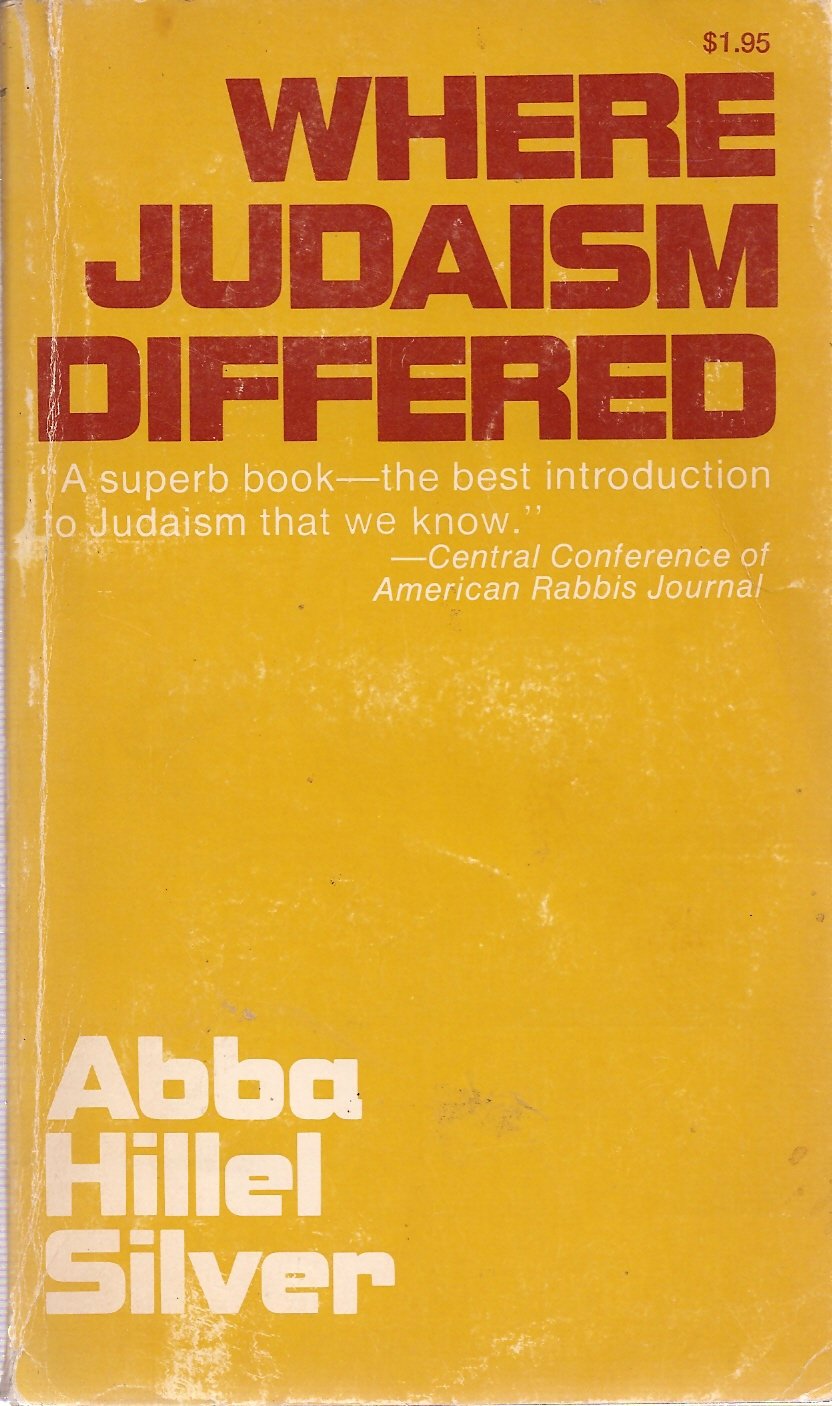
Where Judaism Differed, Abba Hillel Silver

Before I continue my series on Rabbi Eliezer Melamed and post his views of Christianity and other religions, I will take a digression and present on the classic book by Rabbi Abba Hillel Silver, Where Judaism Differed (Macmillan, 1958). Rabbi Silver (d. 1963) was a renowned Reform Rabbi, a prolific author, orator, American Zionist leader, and fundraiser for the new state.. His most famous book, Where Judaism Differed, explained how Judaism is different from Christianity and other religions. The book was a pillar of the thinking of American Jewry. Whenever I explain my interfaith work to an older generation or explain what I am writing, I inevitably receive some form of  Silver’s words in response. I teach in a program in Jewish Christian Studies, so I know there are hundreds of better books, yet Silver’s ideas that Judaism is completely the opposite of other religions still percolate in the writings of other authors such as Rabbi Yitz Greenberg or in sermons from all denominations, or are found on social media, hence these ideas are often the basis for much in ChatGPT. (We also have the opposite on ChatGPT that Judaism and Christianity share Biblical values, the commandments, and the Golden Rule.)

In short, Silver assumes that whatever Christianity teaches, Judaism is the opposite. According to Silver, Christianity is elite, and Judaism is democratic. Christianity is about sin and salvation; Judaism has no concern with sin and salvation. Christianity is ascetic, Judaism is not. Christianity is mythic and magical; Judaism is not. Christianity assumes that all is predetermined without free will, and Judaism offers free will and social progress. Christianity advocates celibacy, Judaism does not.

Original Cover 1956

Christianity accepts a Trinity, Original Sin, Incarnation, a personal messiah, miracles, redemption through God, a virgin birth, and the need for salvation of the soul. Judaism rejects these concepts and every theological idea in Christianity. Christianity is a mystery religion, while in Judaism, “the moral life and the aspirations of man are the “sacraments: of Judaism.” (210) Christianity is otherworldly and concerned for the afterlife; Judaism has no interest in eschatology.

Christianity and Islam, in Silver’s view, wanted to be free from the law, meaning to break free from ethics and morals. (Hence, Rabbi David Novak had to pen an essay explaining to Jews that Christianity is not antinomian).

In his words, only Judaism of all the religions of the world believes in human progress. (171).  Only Judaism is kind to the poor, teaches humility, and has reverence for human life as shown in his comparisons to Roman Latin authors.   

Silver paints the other religions in terms of their most monastic other-worldly forms and he is especially negative toward Hinduism and Buddhism seeing them as world denying, ascetic, and having little to teach. They are fatalistic and life is predetermined; this is his explanation of karma. These Dharmic religions are pessimistic, focus on suffering, and afflicting the body. He credits Christianity and Islam with many of these same negative attributes. (Once should compare Rabbi Kook’s fascinating correspondence with Rabbi Shmuel Alexandrov for a sharp contrast, in which the Russian rabbis have positive appreciation of Buddhism). He paints the Asian religions as lacking any moral teachings. Needless to say, this is an entirely erroneous characterization. I do not need to show that they have extensive teachings on ethics, family life, forgiveness, correct speech, correct actions, and working on personal virtue.  

Silver paints Judaism as engaged in a continuous historic battle against idolatry, idolatrous Canaanites, against Hellenism, against ancient paganism, against Christianity, which for him is really just part of the synthesis with pagan Greco-Roman world, and against the otherworldly pagan Calvinists of our own time. In contrast, Judaism teaches sober morality, personal piety, and the “prophetic tradition of social progress”!!!! (85) This reading of Jewish history was canonized by Heinrich Graetz in his 19th-century classic History of the Jews and the reading of Christianity as Greco-Roman, not Judaic, was the definitive position of the German theologian Adolf von Harnack. Silver cites the historian George Foot Moore’s Judaism in the First Centuries of the Christian Era, but only seems to take from it that Judaism and God-fearers were  “waging war with great energy against polytheism and idolatry.”

The book also typifies a Jewish trend of creating false historical genealogies crediting many aspects of Christianity to pagan influence. In 2025, I still see on social media, by people who should know better, the acceptance of the statement that Christmas Trees are from Roman paganism, a false statement, the earliest possible record is the 15th century, or that Easter/Pascha has anything to do with Ishtar.

In the end for Silver, Judaism is a pure ethical monotheism that is unique in believing in human progress. In the background of this, one hears echoes of Hermann Cohen’s views of Judaism as a unique monotheism striving toward messianic social progress but adapted for the popular pulpit. Judaism is the only religion not death-obsessed or about self-effacement, but rather affirming human progress.

The late 20th century popular Jewish maxims that Judaism does not engage with theology or have any theology, let this book linger long in people’s conceptions. Popular ideas that Judaism has no afterlife or eschatology dovetail with this book. I lose any ability to engage with the content of Rabbinic Judaism, midrash, Aggadah, kabbalah, or even medieval Jewish philosophy. Judaism is an abstraction and defined by negation of others. There is no message of the High Holy Days, the three festivals, Chanukah, prayer, or Jewish life.

To his credit, Silver was responding to several prior decades of liberal Jewish rabbis proclaiming that Judaism and Christianity taught a common universal message of prophetic ethics. However, his solution was to negate every idea of Christianity as the definition of where Judaism differed, without offering any serious positive theology of Judaism. Basically, being Jewish means rejecting a Christmas tree and every positive Christian value. The book was written in a different era, it was before Vatican II’s Nostra Aetate, and he was formed in the heyday of social progress of the first half of the 20th century.

A recent book on religious polemics portrays Silver as driven by the need for apologetics, to stem the tide of Jewish self-hatred, to respond to the stereotypes about Jews. (Jay Newman, Competition in Religious Life, 92). Silver’s work is “vitalized by the exaggeration and caricature that characterizes almost all apologetic works.” He excuses Judaism from all its weaknesses and finds the worst in other religions. He violates one of the prime directives in interfaith comparisons: Do not compare your best to their worst.

At the time of its release in 1956, the New York Times reviewed the book with praise for showing that Judaism is different than Christianity. The CCAR proclaimed that “the best introduction to Judaism that we know.” While a more cautious Felix A Levy, a Reform rabbi, praised the book as a new apologetic Hizzuk Emunah, referring to the 16th-century apologetic work by Isaac Troki, but faults him for leaving out revelation and halakha.

On the other hand, Lou H. Silverman, Professor of Jewish Literature and Thought at Vanderbilt University, in a 1958 review, faulted the book sharply for reducing Judaism to oppositional negation. Judaism is defined as not Pauline Christianity, but we do not learn at all how Rabbinic, philosophic, and mystical Judaism understood the same issues. Silverman opines that the book fails to do full justice to the texture of the tradition.

Silverman points out that the Jewish prayer book in any version is about God having sin, God’s mercy on us, and forgiving us. To say that Judaism has no sense of superiority or racial thinking and is the only universal religion rubs Silverman the wrong way. He points out that the Reform Union Prayer Book referred to the Jewish race until 1933 and it took until 1945 to remove the racial elements.  Silverman as an exclamation, asks: Where is Yehudah Halevi, Franz Rosenzweig? Silverman asks: when Silver states that a concern with “eschatology represented a sharp deviation from Classical Judaism,” what does that even mean? Silverman notes that Silver certainly excludes explicit Rabbinic concerns. Silverman ends his review by wishing that Silver had written a confessional, mature statement of his beliefs as a Reform Jew, rather than just presenting Judaism as the negation of Christianity.

Msgr John M. Oesterreicher of the Institute of Judeo-Christian Studies at Seton Hall University wrote a nine-page negative review of the book. At the time, Oesterreicher was editing a journal called The Bridge which looked at similarities and differences between Judaism and Christianity, and was already working on the 1961 “Decree on the Jews” (Decretum de Iudaeis), which is considered the first draft of Nostra Aetate.

Oesterreicher points out that Silver removes any sense of the word of God or God’s call to Abraham, or Sinai, replacing those ideas with a prophetic Jewish religious genius and ideas that we follow Judaism as utilitarian, “opportune and useful for life.” He is especially irked that Silver refers to God as a due to the Jewish genius created the universal God idea, which Oesterreicher considers “not part of the truly Jewish vocabulary.”

Oesterreicher declares that “the light in Rabbi Silver’s book is not the light of scripture” and that he is at variance with Jewish tradition. For example, neither the Hebrew Bible nor Rabbinic texts see sin as degrading; rather, they have full theologies of sin, repentance, and atonement. (This is like Silverman’s critique above that you cannot state that Judaism has no eschatology). He also notes that Silver is against mysticism and mischaracterizes both Western and Eastern mysticism.

Oesterreicher obviously thinks Silver misreads and mischaracterizes Jesus, Paul, the New Testament, and Christian teachings in many places.  For example, the Sermon on the Mount is clearly rabbinic in context and not to be relegated to foreign “Greco-oriental” values. Silver psychologizes Jesus’ disciples as unable to admit their teacher was arrested and killed so they go into psychological denial, delusion, and imagine him as still alive. Silver shows no knowledge of Jewish memra theology or the variety of first-century Jewish ideas.

In conclusion, Oesterreicher agrees that Judaism and Christianity are different and cites Silver approvingly that “to gloss over differences as a gesture of goodwill is a superficial act” (289) But that does not mean they are opposites. Rather, Oesterreicher ends by saying that the discussion of similarities and differences should be pursued with an “Untiring, even painfully, open eye.”
The digitized American Jewish Archives preserve the letters that Silver received from publishers about his book. Harper and Bros rejected it based on Reviewer #2. Simon and Shuster rejected it  with a long letter including the following paragraph:

The third point is, I fear, a more sensitive one, but perhaps it would be best for our mutual understanding to state it baldly. All of us have been somewhat troubled throughout the book by the invidious comparisons of Christianity with Judaism. Enduring spiritual values, I feel, are self-demonstrative; they do not need to be singled out and lauded at the expense of something else. I realize that such comparisons have an enormous controversial value, but I also feel that they have the final effect of weakening your rich, positive statements, or detracting from the dignity of a great tradition. It is for this reason, as well as for the reason that such invidious comparisons may offend and repel people of other faiths, that I venture to suggest that you reconsider them.

In the end, Macmillan published it as written. But before publication, Silver had his friend   Ludwig Lewisohn read the manuscript to offer comments. Ludwig Lewisohn (1882–1955), was a novelist, outspoken critic of Jewish assimilation, and a founding faculty member of Brandeis University.

Lewisohn flags the book’s thesis that history “manifests a clear upward movement in human development,” noting that this “seems to me violently contrary to historic experience and to negate by implication the special redemptive function or the Jewish people and the meaning of its martyrdom. I do not like to see concepts like “development” and “progress” applied to Jewish history. Unless we died for the eternal Law, what did we die for?” This defense of Western liberalization (so-called) has been totally invalidated by history. After the Holocaust, pre-war optimism seemed misguided.

Also noted is that Silver credits anything he does not like in Judaism to outside influences. Lewisohn writes: “Too much importance attached to the theories of Babylonian influences, etc. These are all grounded in malice, conscious or not, and the desire to eliminate the reproach of Judaism’s uniqueness.”

Once interesting observation from the book “Here, my eye catches one of those usages that lower tone. “Judaism has little sympathy with the spiritual lone wolf.” (138) That’s a screaming incongruity–like chalk scratching on a blackboard. And were not the prophets lonely and hence embattled souls?”

Lewisohn does not want to reject the spiritual and theological teaching of Judaism just to engage in negations. Lewisohn rejects the sharp contrast with Christianity

Of course. “original sin” in the Augustinian sense is nonsense. But does not Judaism, too, recognize deeply man’s rebellion against God? Is not therefore teshuvah the end and aim of life. And does not the classical liturgy make it clear that we need God’s grace–vayihi razon milfanecba. I’m frightened for the nobility and inwardness of Judaism when these things are stated after this fashion.

I’m sorry. I think the notion of “progress” in that sense –social progress without inner change-is totally discredited and Jews and Judaism will discredit themselves by clinging to it… The essence of the whole matter is in the Alenu. Progress means obedience to God’s Law and abstention from idolatry–of man, of State, of all the idols or the market-place. And that, thank God, is Judaism.

In conclusion, we are now blessed with sixty-five years of work showing the similarities and differences between Judaism and Christianity. We have fine works on the New Testament, Patristics, Rabbinic, medieval philosophy, and modern thought. No one would write like Abba Hillel Silver anymore. But the influence of this book remains vast in common understandings. I am still greeted with citations of this work. And if you want to judge the knowledge of Christianity by contemporary rabbis and Jewish thinkers, or the recent works showing a more open approach, the benchmark was already set low.  So judge them, in this context.

Rabbi Melamed on the Divine Spark in other religions

Continuing my discussion about Rabbi Melamed on Other Religions. I started with his statements on Hinduism and will now look at his broader premises- see “The Divine Spark among Other Religions”  and here “Rabbi Abraham Isaac Kook on Different Religions.” Once again, I will use the posted selective English translation because it is accessible; however, I do have the Hebrew original marked up with marginal notes and a full response.

      For Rabbi Melamed, all religions have a spark of the divine, some of the light of the divine, and help the world advance toward its moral perfection. The religions of the world educate towards the moral foundations, “each religion according to its level.” Through accepting these points, Rabbi Melamed removed any stigma of other religions as needing to be negated  or the need to call other religions as demonic, entirely false, or to teach a restrictive exclusivism where only Jews have religion.  Rather, for most people in the world, Melamed thinks that “it is right for every person to continue in the faith of their fathers, because with the loss of faith, moral corruption increases.”

      Rabbi Melamed also thinks that the religions of the world are progressing toward deeper and more abstract forms of understanding their religions, thereby removing “the dross of the crude material elements within it” allowing them to elevate their souls “to higher faith and morality.” Jews should not follow these religions; however, the religions of the world “serve as a moral and faith compass for all peoples.”  Rabbi Melamed acknowledges that religious ideas are evolving and progressing to deeper understandings, the ancient and medieval forms of the religion that most people know from textbooks do not reflect current ideas in those religions. He has spoken with many people and read many books to overcome the essentializing of religions in ancient forms. I am always surprised at people who think other religions are where they were in 500 CE or even 1700 CE, but at the same time have a modern understanding of Judaism.

      Rabbi Melamed’s fundamental starting point is the discussion in  Rabbi Abraham Isaac Kook’s Le’Nevuchei Ha’Dor and his other books. However, Rabbi Melamed draws out the full potential implications in some of Rabbi Kook’s statements, going beyond the prior understandings to create a new broader vision, melding his views with those of Rabbi Kook. To highlight the contrasting understandings of Rabbi Kook, it is worth noting that Rabbi Zvi Yehudah Kook had views, also based on Rabbi Abraham Isaac Kook, that were deeply adversarial to Christianity and other religions, as were those of his student Rabbi Aviner. One should treat the use of Rabbi A. I. Kook and the explanation of the citations of Kook by Rabbi Melamed as innovative and expansive, blending the ideas of the Kook with contemporary application by Melamed.

      Rabbi Kook wrote that the world’s religions serve a divine providential purpose, gradually elevating humanity towards its ultimate goal. There is an evolutionary unfolding of humanity from a crude understanding of God toward an abstract belief in one God. In the meantime, people need “a tangible belief in idols that provide them with basic principles of conduct and morality.” Therefore, Rabbi Kook thinks every religion has “a divine spark of morality that sustains it, through which it sets standards of good and evil” as they advance “towards the belief in divine unity “ (‘Le’Nevuchei Ha’Dor’, Chapters 8; 14:1).

Each religion contains a divine spark expressed “through different educational and cultural systems, aimed at improving human spirit and material conditions, the time and the world, the individual and the community (‘Orot: Ze’ron’im’, 6).Therefore, even concerning the lowest form of idolatry, “one cannot decide that the entire religion is erroneous,” as it may have been suitable for them in the past to uplift them somewhat. There are different levels among religions, and some are more refined “in morality, character, and conduct, and thus, their customs and idolatrous practices are not as detestable and filled with disgust as others” (‘Le’Nevuchei Ha’Dor’, 14:1; ibid, 39:1; ‘Rishon Le’Yaffo’, 91:1)

Even pagan and idolatrous religions may have served a purpose in their time. But no specific hierarchy is created. But the important element is the Divine spark in all things. God has a presence in the world and its cultures and is not limited to a single group.

      The reason for this acceptance of other religions is based the idea that there is a natural division and diversity of nations, an idea going back to the Second Temple literature and continuing through the Middle Ages and beyond. Each nation has their own spirit, either angelically above, internally as their animating force, or as volkgeist. In Rabbi Kook’s writings, we have a grand vision of the elevation of all of humanity. We also have kabbalistic ideas of divine sparks in all things. Finally, we also have neo-Platonic ideas of all things upwardly aspiring to the divine. No longer is the discussion of other religions limited to Talmudic discussions of stones on the road for Mercury or statues of Aphrodite.

      Rabbi Melamed explains Rabbi Kook’s idea to mean that even pagan religions serve a divine purpose and that even the representations of the gods through idols point to higher “values of truth and goodness.” Greek mythology teaches moral lessons. Melamed uses his textbook knowledge of Greek myths to state that even the gods are subject to Fate, thereby showing that there is a divine destiny and higher ethic even higher than the gods of the myths. For Melamed the “ancient myths where, despite the great power of the gods, it is limited, and they are subject to fate. Furthermore, their actions also affect their destiny, and any idol that crosses certain limits—such as excessive indulgence or pride, or extreme disregard for other gods—will be punished by more powerful, higher forces. These higher forces reflect a higher value system, in which a belief in the one true God is hidden.” Greek myths show a higher theistic vision and teach moral.

      Whereas Rabbi Moses Feinstein, allowed the Greek myths only because the religion was dead and considered the myths as showing that the Greek beliefs were nonsensical, non-ethical, and immorally licentious, Rabbi Melamed, in contrast, following Rabbi Kook see the guiding hand of divine providence in the narratives as part of God’s plan for uplifting each nation of the world and that the very myths contain moral lessons. Rabbi Feinstein’s approach limits knowledge of God and morals to Jews,  awash in an immoral world. Rabbi Melamed sees the knowledge of God in all nations and all nations are on a journey to ultimate perfection.

       As most Jewish universalists, he quotes  “For from the rising of the sun to its setting, My name will be great among the nations; and everywhere incense is going to be offered in My name, and a grain offering that is pure; for My name will be great among the nations, says the Lord of hosts” (Malachi 1:11). Showing that all religions are really worshiping the Biblical God in their various forms of worship. Rabbi Melamed is clearly an inclusivity, finding a place for other religions in categories of Torah, and he is Jewish-centered, but some of his ideas are moving to a universalism.

      For example, Rabbi Melamed cites the Talmud to claim that all religions are worshiping the true high God of the Bible even if they use representation. “Our Sages explained that all idolaters refer to God as “Elah de’elahaya” – “God of gods” (Menachot 111a).”Despite using idols, “there was a deep-seated belief in a Supreme God, the source of truth and morality.” Most people were not on the level to recognize this, but there “were exceptional individuals who delved deeply into their faith and directed their primary prayers to the God of gods.” Hence, he can acknowledge the Ancient Greeks Neoplatonists, or the Hindu Upanishads, and others as expressing the best views of the era. Nevertheless, these religions improved “the values of truth and goodness in people’s hearts. In these paragraphs, he is beginning to sound more like Rabbi Menashe ben Israel or Rabbi Eliyahu Benamozegh.

      Even more surpassing is that Rav Kook wrote that the sages of other religions even merited divine inspiration, (ruach ha’kodesh), a form of prophecy, through which they deepened their faith and educated their people. Rabbi Melamed accepts this. But in his printed book he cautiously does not mention the current discussions among these circles about acknowledging that Muhammad, Buddha, or Guru Nanak may have divine inspiration. The medieval position of Rabbi Nathaniel ibn Faymi (d. ~1165) that God sent prophets to all nations and establishes a religion for all nations, is becoming more accepted as a valid position. In general, one should compare Rabbi Melamed to Rabbi Yakov Nagen to get a sense of the current approaches- see Rabbi Yakov Nagen- here. One should note that Yehudah Halevi already called Plato, Aristotle, Hermes, and Zoroaster as divine (elokhi) and Maimonides granted Baalam the same prophetic status as the patriarch Jacob. Hence, even ancient pagans may have had some form of divine prophecy.

      Rabbi Melamed cites the later pietistic Aggadah Tanna de-Vei Eliyahu: “I testify by Heaven and Earth that whether it is a man or woman, servant or maid, gentile or Israelite, ruach ha-kodesh rests upon him according to his deeds” (Ch. 9).The original Tanna de-Vei Eliyahu is a parallel of Galatians (3:28) “There is neither Jew nor Gentile, neither slave nor free, nor is there male and female…” But here in the Jewish Aggadic text, we have a greater universalism and a noticeable inclusion of all the people of the world in Holy spirit, which originally may have meant divine connection or inspiration corresponding to a Christian sense of the Holy Spirit but it is being understood in the 21st century as referring to prophecy, probably because the phrase Ruah Hakodesh is used in contemporary Rabbinic language to refer to prophetic inspiration and prophecy. Rabbi Kook added that it is possible that the leaders of religions even received heavenly assistance to perform miracles, so that their followers would accept the religion that advanced their moral state (‘Le’Nevuchei Ha’Dor’, 14; 46; 57).

      Based on Rabbi Kook, Rabbi Melamed declares that one “should not denigrate other religions, including the more idolatrous ones.” This halakhic pronouncement seemingly undoes prior Rabbinic exhortation to make fun of idolatrous religions. Rabbi Kook taught that: “Such denigration is also against the very essence of faith and religion, and therefore, those who throw off the yoke will take the arguments and words of disparagement said about other religions and hurl them at Judaism, as happened in practice.” In making fun of another religion, the arguments against another religion can just as easily be turned around to attack Judaism causing Jews to lose their faith. Rabbi Kook taught: “we need to deepen our understanding of the value of other beliefs according to the Torah,” and show the greater and more comprehensive light that exists in the faith of Israel. In our age, greater respect for all religions leads to a stronger respect of the religious core of Judaism.

      Should the nations continue in their idolatry? He answers, “even the exceptional individuals among the nations who knew that God is the “God of gods,” the source of all powers, did not abolish idol worship. This is because they knew that belief in one abstract God was too lofty, and without faith being applied to tangible forces called idols, and reinforced by rituals, they would not succeed in establishing the moral values that would elevate their people and religion.” People are not ready to worship without images and statues. This is the same answer given by the medieval Hindu scholastics Shankara, Ramanuja, or Madhva, that the people are not ready to give up their representation. It is also the answer given in the 20th century by Sarvepalli Radhakrishnan, philosopher and former President of India. Rather than the more traditional and popular Orthodox Midrash Says dualism of Torah consisting of all truths and morals contrasting with idolatry as immoral and lacking any truths, the other religions, even idolatry, serve to bring people to God. The religions of the world are on a sliding scale, very similar to what is taught in Hindu textbooks since the early Middle Ages and even in the 21st century.

      Idols made of wood and stone still have the function of curbing evil inclination and keeping people from committing crimes. Even idolatrous rituals keep people on a virtuous path.  At the same time, “if they continue to observe the laws of their religion, they could gradually ascend, until they merit reaching the true level of faith, drawn from the light of Israel. Therefore, according to their value, their religion has religious significance.” Rabbi Melamed concludes that “we can recognize and honor them for approaching the light of God, according to their own way.” It is important to note, that Rabbi Abraham Isaac Kook also wrote this about prior philosophic understanding of Torah, declaring that contemporary understandings of Jewish concepts need to evolve beyond the medieval.

Christianity and Islam

Rabbi Melamed follows Rabbi Kook that Christianity and Islam are not foreign worship because they were influenced by the Hebrew Bible and thereby show greater divine light. These two religions display “a further stage of progress in the process of purifying faith and morality, from crude idolatry, towards pure faith in God. And as noted above, they possibly have been granted prophecy and the performance of miracles

      However, Christianity and Islam are flawed “in that they do not recognize the central role of Israel in revealing God’s word and blessing to the world, and instead, claim to replace them – while harming Jews. For him, “there is a necessity that over time, Christians and Muslims cleanse themselves of hatred of Israel, and become able to draw, from the source of Israel’s faith, illumination and guidance, according to what is appropriate and suitable for them for constant elevation and Tikkun Olam (repair of the world).” (Americans in the culture wars should take note that Rabbi Melamed used positively the word tikkun olam  a word freely used by Rabbi Kook, Rebbe Nachman, Rabbi Ashlag, and other Eastern European rabbis- for citations of its use by traditional rabbis  see here).

      In conclusion, Rabbi Melamed states that even now, when there is still hatred by Christians and Muslims of Jews, and they still have problematic elements, it is still “proper to respect the foundations of faith and morality in their religion, through which they succeeded in elevating many people to have better qualities and to achieve love and fear of God.

      Unlike those who differentiate Judaism’s attitude toward Christianity and Islam, Melamed notes “that Rabbi Kook consistently refers to Christianity and Islam equally. True, Islam is purer of idolatry, but apparently, this advantage is not decisive compared to the aspects in which Christianity is preferable to Islam.” Rabbi Abram Kook, in later decades when he was fighting the extensive Christian mission, has derogatory statements about Christianity, which were given emphasis by his son Rabbi Zvi Yehudah Kook.

      Rabbi Melamed concludes that Christians and Muslims are obliged to continue in their religion. Once again quoting Rabbi Kook: “The religions founded on the basis of the Torah and the Prophets, certainly have an honored value, for those who hold to them are close to the light of God, and knowledge of His glory” (“LeNevuchei Ha’Dor” 14:1). Rabbi Melamed is creating some form of Religions of the Book, in which the three religions are all based on Torah.

they have “the great moral principles they took from the light of the Torah, which also strengthened in them, with greater vigor, the pure human feeling”. And by way of this, arose from them “individuals with a pure spirit, from whose gathering they will establish for themselves religious customs, which fulfill their destiny, to elevate the soul to good qualities, to love of God, and fear of Him. Therefore, they are certainly obligated to follow the ways of their legislators, who are held in their nation as holy men, according to their value and nature”. Therefore “it is proper for every person perfect in knowledge to understand, that those who engage in them, according to the tradition in their hands, are engaging in the service of God, according to their level” (ibid 8).

Rabbi Yakov Emden’s approach of seeing great moral value in them, especially Christianity, has been accepted by Rabbi Melamed. In the past, one found it in Isaac Baer Levinsohn, Rabbi Benamozegh, Rabbi SR Hirsch, and in Rabbi Kook. But now, it has become mainstream halakhah in Rabbi Melamed. It has also been extended from just Enlightenment era Christianity to all of Christianity and Islam.

Conversion

Rabbi Melamed quotes Rabbi Kook that each nation has its own unique religion and therefore, one should generally not convert. Rabbi Kook wrote (“Le’Nevuchei Ha’Dor” 8) that it is not proper for a person to convert from their religion, including members of idolatrous religions. Because every religion also expresses the social and national character through which it was formed, and one who leaves it, betrays their family, their people, and their good values.

      According to Rabbi Kook, it is often beneficial to convert from a lower religion to Christianity or Islam, “because will grow from the recognition of the unity of God (which exists in Christianity and Islam) will, in any case, bring blessing to the whole world”. However, according to Rabbi Melamed, looking at 21st-century reality, this is not always true because sometimes religious ideas and virtues will be lost in the process of giving up native religion. “For we have learned that from every religion, one can remove the dross–until it remains clean of idolatry and bad qualities.” He cites the example of Hinduism, which has deep learning and morality and recognizes the one true divine source. Many times, “leaving it for Christianity or Islam may be considered a descent.” They lead less moral life or damage their spiritual lives.

Avodah Zarah Be-Shituf (Idolatry in Partnership)

Rabbi Melamed assumed that non-Jews are allowed shituf and in this he is quoting Rabbi Kook who wrote: “Noahides are not warned about shituf” (Shmoneh Kevatzim 8:44); and it is an aspirational goal for those who do not even have shituf” (Orot Yisrael ve’Techiyato 5). In addition, Rabbi Melamed singles out for accepting the same opinion on the permissibility of shituf for gentiles  his predecessors Rabbi Charlap (Mei Marom 10:35; 12:32, 2), Rabbi Menachem Mendel the ‘Tzemach Tzedek’ (‘Derech Mitzvotecha’ ‘Mitzvat Achdut Hashem’ and Rabbi Menachem Mendel Schneerson, as well (Likutei Sichot 20 p. 16 nt 44). For a full discussion of his position, where he cites many opinions, including those who think shituf is forbidden to non-Jews, see Rabbi Melamed’s discussion here.  But there is no need to email Rabbi Melamed (or me), the citations of those who think it is forbidden. He knows them and discusses them at the link

God Name will be One

In conclusion, Rabbi Melamed cites the universalism of Rabbi Kook, who advocated loving all humanity and all nations despite differences in religion or race. Moreover, he advocated for understanding the other nations, especially their religion, since it is central to nations.  Rabbi Kook wrote: “Love for people should be alive in the heart and soul, loving every person, especially, and loving all nations.” Any expression of hatred towards gentiles is “only for the wickedness and filth in the world.” This love should be maintained “despite all changes in religious beliefs, opinions, and despite all distinctions of races and climates.” (Middot Ha-Ray’ah: Ahavah, 5).For Rabbi Melamed,  one should “understand the views and characteristics of different nations and communities as much as possible, to establish how to build human love on practical foundations. Since religion is central to the spiritual and practical life of nations, Rabbi Melamed concludes that it is evident that Rabbi Kook’s intention also includes different religions. Thus, Israel will be able to fulfill its purpose, bringing the word of God and His blessing to the world

      Finally, since all religions can elevate themselves, there is no aspiration for religions to be nullified; rather each religion has a unique hue, reflecting the special character of the people in which it was created. Thus, the vision is for each religion to purify itself of all its flaws and reveal its unique path in serving God and contributing blessings to the world. This is the prophetic vision of “I will remove their blood from their mouths and their abominations from between their teeth, and they shall remain even for our God” (Zechariah 9:7).  And of “For then I will turn to the peoples a pure language that they may all call upon the name of the Lord, to serve Him with one accord” (Zephaniah 3:9). (This is unlike Prof Menachem Kellner’s Maimonidean universalism envisioning that all people will have to become Jews).

      Ultimately, every nation will maintain their own religion but be elevated in the messianic vision. “Alongside each nation’s special devotion to its religion, humanity as a whole will be united through the connection of all nations to Israel and its center in Jerusalem, as it is said, ‘For My house shall be called a house of prayer for all peoples” (Isaiah 56:7).

Marc Shapiro interview- Renewing the Old, Sanctifying the New

For more than a century, many of the writings of Rabbi Abraham Isaac Kook remained in manuscript, hidden away from the public eye.  The works of Rabbi Kook that were published in the interim had many passages removed from them. Only in the last quarter century have these original manuscript works been published. The Shemonah Kevatzim are the original notebooks that Rabbi David Cohen (the Nazir, d 1972) and Rabbi Zvi Yehuda (d. 1982) used to produce the standard editions of Rabbi Kook’s writings. In these notebooks, we see many passages that the editors left out of printed editions. And in Li-Nevukhei ha-Dor, we see a Rabbi Kook grappling with many of the religious issues of late nineteenth-century thought. These new works present to the reader a vista on a Rabbinic thinker struggling with many of the issues of fin de siècle modernity. In a recent book, Marc B. Shapiro presents choice quotes of these writings for an American Orthodox audience.  

Marc Shapiro’s new book is Renewing the Old, Sanctifying the New: The Unique Vision of Rav Kook (Littman Library of Jewish Civilization, 2024).  Marc B. Shapiro holds the Weinberg Chair in Judaic Studies at the University of Scranton, Pennsylvania. A graduate of Brandeis and Harvard universities, he is also the author of Between the Yeshiva World and Modern Orthodoxy: The Life and Works of Rabbi Jehiel Jacob Weinberg, 1884–1966 (1999); The Limits of Orthodox Theology: Maimonides’ Thirteen Principles Reappraised (2003); and Changing the Immutable: How Orthodox Judaism Rewrites Its History (2015), all published by the Littman Library. Shapiro produced many videos and podcasts about his work on Orthodox rabbis and their ideas; he is deeply appreciated by his audience.

In the book, Shapiro picks out many of Rabbi Kook’s major ideas that would be new to his audience including the challenges of modern science, treating the Bible in a non-literal way, the notion of natural morality as a counter to book law. his view of other religions, even acknowledging the possibility of alternate revelations, his idea of how a future Sanhedrin will update Jewish law, as well as his defense of Orthopraxy for those who cannot accept all the dogmas. Shapiro uses his vast knowledge of other Orthodox thinkers such as Chief Rabbi Yitzhak HaLevi Herzog (d. 1959) and Rabbi Yechiel Yaakov Weinberg (d.1966) to contextualizes Kook’s statements. The focus of the book is on topics of interest within English-speaking Orthodoxy (or of interest to Shapiro) and not on Kook’s use of Hegel and Schopenhauer, his views of history, or individualist views of creativity.  At many points, Shapiro contrasts Rabbi Kook to the limits within American Orthodoxy, or has personal asides where he directly speaks to American Orthodoxy. These ideas of Rabbi Kook from 100 years ago were influential in the formation of Religious Zionism, which developed sharply different from American forms of Orthodoxy.

Version 1.0.0

The ideas in the book have dozens of well-known interpretations in Religious Zionist thought, so the book would not be an innovation to them or their students. To take one example that I know well, Shapiro presents Kook’s ideas that the religions of the world are all part of the dew of the divine light and part of a Divine plan to uplift the world. Contemporary interfaith work, however, is already situated in a context where Rabbi Eliezer Melamed, Rabbi Oury Cherki, Rabbi Shlomo Amar, as well as my friend Rabbi Yakov Nagen, as well as many others, have been working for decades within Rabbi Kook’s framework to encounter other religions positively as part of a divine plan.

Another example: Shapiro cites that Rabbi Kook encouraged the study of Jewish thought, and only those trained in it should comment on Jewish thought. But Jewish thought is standard, in a Religious Zionist education consisting of at least the six thinkers of the Relgious Zionist canon Maimonides, Halevi, Maharal, Ramchal, Hayim of Volozhin, as well as mastery of Rabbi Kook’s writings. From there, one branches out to Midrash, Kabbalah, Hasidut, or even Franz Rosenzweig’s Star of Redemption. If one visits a Religious Zionist bookstore such as Dabri Shir, the majority of books are of Jewish thought. Shapiro’s book works as a foil to American Orthodoxy’s omission and is not meant to comprehend the way these statements of Rabbi Kook about Jewish thought are presented and lived by the culture of Jewish thought as understood by Religious Zionist Rabbis such as Rabbis Melamed, Avinar, Ariel, Bin Nun, Shagar and Cherlow, each in a unique manner.

The pleasure of the book, for me, is in the details and notes. Lots of citations to interesting quotes from books and a wealth of parallel ideas to Rabbi Kook. I had forgotten that Rabbi Kook had a responsa about Bahai and I learned that Rabbi Zini, the editor of Eliyahu Benamozegh (d.1900), ironically rejects the universalism of Benamozegh and of Rabbi Kook. I do wish that the book had engaged with the proximal context of Rabbi Kook, including universalist thinkers such as Rabbi Shmuel Alexanrov, a fellow Volozhin graduate with whom Kook corresponded about Buddhism, who had more radical views about other religions.

In many ways, this book continues Prof Marc Shapiro’s lifelong interest in showing the limits of Orthodox theology. Shapiro shows that Kook’s thought is broader than American Orthodox thought and that many of Kook ‘s ideas have parallels in other Orthodox Jewish thinkers whom Shapiro has written about, thereby creating or advocating a broader spectrum of ideas. I recommend reading some of his other articles here for a fuller discussion. For many American Modern Orthodox and Yeshivish readers, the book will be eye opening. They are already familiar with and appreciate Shapiro’s wide-ranging presentations of historical figures with Orthodoxy. They will welcome the book. The book is a fun and easy read for those interested in the topic, and is worthy of a long summer Shabbat afternoon to enjoy the book.

1. Why did you write the book?

Starting with the publication of Rav Kook’s Shemonah Kevatzim, we have been fortunate to see the release of a series of new books from Rav Kook, including Li-Nevukhei ha-Dor, his modern-day Guide of the Perplexed (though he didn’t give it that title himself). These writings, some of which were suppressed, cover a range of topics that I find particularly fascinating, and which have not been the focus of much writing on Rav Kook. In these works, Rav Kook expands upon ideas he mentions only briefly elsewhere, such as his views on sacrifices and the role of the religious masses.

I wrote this book because I am deeply intrigued by his unconventional views, but also because I thought others, particularly those within the Modern Orthodox community, would find them of great interest. Many had only known him as the prophet of religious Zionism. I believe the book has struck a chord because already several people have told me how surprised they are at the breadth of ideas Rav Kook explored. His openness to other religions is one example, but there are many more. Rav Kook brought originality into nearly everything he discussed, so it is no surprise that his newer books contain such fresh and thought-provoking insights.

2)  You discuss evolution and the long evolutionary sense of a long history, including events long before the Bible, such as the Pleistocene age, but you mention that it is already accepted in Modern Orthodox High School textbooks. So, why do we need thinkers from 100 years ago to justify what is already accepted?

I don’t think it is a matter of needing thinkers from a century ago to justify anything. What I aimed to do is expose people to the perspectives of rabbinic leaders like Rav Kook and R. Herzog on these matters. That, in itself, has value, even if it doesn’t have any immediate practical implications. Furthermore, while it is true that Modern Orthodox high school history classes may accept that human civilization predates the traditional Jewish dating, I have seen very little reckoning with this from an Orthodox theological perspective.

How can one reconcile the biblical chronology of human development with the findings of modern scholarship, which show that humanity existed long before the timeline outlined in the Bible? At one time, the Modern Orthodox world devoted significant effort to reconciling an ancient universe with the book of Genesis. These efforts often focused on dinosaurs and fossils, and sought to show that creation could have occurred billions of years ago even though the Torah’s literal account places the world’s creation at less than 6,000 years ago.

Yet R. Herzog was not troubled by an ancient universe. His focus was on the next step: If humanity’s creation and expansion predate the Torah’s account, then the early chapters of the Torah must be understood in a non-literal fashion.

Rabbi Herzog hoped to write a book to define the boundaries of non-literal interpretation in the Torah. Unfortunately, he never had the chance to do so. Had he written this book, he would have needed to determine when the Torah shifts from “mythic history” to actual historical events. With his knowledge of history and science, he would have approached events like the Flood and the Tower of Babel differently than his predecessors in the traditional world. In his letters, which I published in the book, you can see how he struggled with the challenge of determining how far a non-literal interpretation could be extended, particularly as such an approach would break with the traditional views held by earlier commentators.

3) Why are you addressing American Centrist Orthodoxy with Rav Kook’s view when he is not the major influence on the community?

It is true that Rav Kook is not the dominant influence in the community, but he does hold a significant influence, and hopefully, that influence will continue to grow. As I mention in the book, I believe that many of Rav Kook’s insights which have nothing to do with Religious Zionism, on topics such as the appropriate curriculum, the place of halakhah, secular studies, literalism in Torah interpretation, heresy, halakhic change, natural morality, and other areas, will be of particular interest to the Modern Orthodox community. Yet the book is not only directed to them. Rav Kook’s ideas should be fascinating to all readers, regardless of their background or affiliation.

4) You seemingly paint Rav Kook as a modernist, yet we know he gave very anti-secular studies directives to his inner circle of students.

I would not describe Rav Kook as a modernist, especially given the associations that term carries. However, I would agree that he should also not be regarded as a traditionalist. It is true that Rav Kook spoke about the importance of secular studies, but we cannot ignore the fact that the yeshiva he founded did not include them in its curriculum. Moreover, most of his students did not engage with secular disciplines, and Rav Kook did not actively encourage them to do so. Even R. Zvi Yehudah, who had broad interests in his early life, ultimately embraced a “Torah-only” lifestyle.

A similar question arises when we consider Rav Kook’s stance on academic Jewish studies. He definitely valued these areas, as seen in a 1908 letter to Rabbi Isaac Jacob Reines, whose yeshiva included secular studies. In the letter, Rav Kook expressed his intention to establish a yeshiva that would include the study of “Hokhmat Yisrael” (Iggerot ha-Re’iyah, vol. 1, p. 148). In a letter to R. Isaac Halevy, author of Dorot ha-Rishonim, R. Kook reaffirms the necessity for new approaches in scholarship, arguing that the traditional approach will not be able to stand against the forces seeking to tear down tradition (Iggerot ha-Re’iyah, vol. 1, p. 188). Despite these sentiments, however, Hokhmat Yisrael was never incorporated into his yeshiva’s curriculum.

R. Ari Chwat has written two articles documenting Rav Kook’s positive attitude toward modern scholarship (Talelei Orot, vols. 13 and 14). Chwat explains that Rav Kook ultimately recognized that, at that moment in time, other priorities needed more emphasis, such as Jewish nationalism and the study of the Bible and “Emunah”. As a result, his dream of including an Orthodox Hokhmat Yisrael in the curriculum had to be postponed. I think a similar reasoning can be applied to secular studies. Rav Kook certainly appreciated them, but incorporating them into his yeshiva’s curriculum seemed too far a step for him. For those who were already inclined to these fields, he would be supportive, but not in the sense of making them part of the curriculum or encouraging students who had no such inclinations.

5) You mention that Rabbi Kook’s soul was aspiring to prophecy, Ruah Hakodesh and spirituality, and in his writings he preferred those over Talmud. Are you advocating those spiritual soul building forms of Torah?

I am not advocating for any forms of Torah that focus on spiritual soul-building experiences, but some are inclined in that direction. For example, the Nazir who was focused on the renewal of prophecy, perhaps seeing how Rav Kook sensed that he might have failed in this area could have been too much of a “downer” for those who wished to renew the prophetic spirit and saw Rav Kook as their guide in this matter. If there are Religious Zionist thinkers in Israel today who seriously imagine a resumption of prophecy, they intend this to come about through the study of Kabbalah. In this regard, they would be following the tradition of Rav Kook as carried on by the Nazir, rather than by Rav Zvi Yehudah, who was a more “this-worldly” figure.

 I would simply note that Rav Kook himself had doubts about whether his own inner spiritual experiences were genuinely from God or simply creations of his imagination. In a passage that the Nazir—who himself was striving for prophecy—censored, Rav Kook wrote: “I listen and I hear from the depths of my soul, from among the feelings of my heart, the voice of God calling. I experience a great trembling; have I so descended to become a false prophet, to say God sent me when the word of God has not been revealed to me.” I find Rav Kook’s honesty in this passage very refreshing, as it reveals his own self-doubts.

6) Where is Rabbi Hertzog the same or different than Rabbi Abraham Isaac Kook?

R. Isaac Herzog, who succeeded Rav Kook as the Ashkenazic Chief Rabbi of Eretz Yisrael, was quite different from Rav Kook. Unlike Rav Kook, he had a deep secular education, was fluent in many languages—both ancient and modern—and was fully at home in academic Jewish studies. His works primarily focused on talmudic studies and Jewish law, mostly from a traditional perspective, but he also produced academic works. Unlike Rav Kook, Kabbalah was not a central feature of R. Herzog’s life.

Rav Kook, as we know, was very much a mystic whose thoughts and his thoughts spanned the spectrum of ideas. While he also wrote on Talmud and halakhah, he did not view this as his primary contribution. Rav Kook had no formal academic training and did not produce works that could be categorized as academic. When faced with a conflict between science and Torah, Rav Kook looked at scientific conclusions—based on his understanding—and sought to harmonize them with Torah. R. Herzog, on the other hand, was deeply engaged with understanding how historians and scientists arrived at their conclusions. He carefully examined historical and scientific texts and reached out to leading non-Jewish scholars to hear their perspectives.

7) You discuss the Bible as not literal. Can you explain?

 I try to place Rav Kook’s perspective within a larger context by examining how other figures have addressed the apparent conflicts between Torah and science or history. Given that Rav Kook’s approach may seem unconventional to many, I felt it was important to show how others have approached these issues, including medieval Maimonideans. Years ago, I discovered a number of letters from R. Herzog on this very topic, and the book provided an opportunity to explore how he addressed the issue.

R. Herzog’s primary concern was the biblical chronology. Modern science and history suggest that humanity has existed for a much longer period than the biblical account would indicate. R. Herzog’s first step was to determine whether there is any doubt regarding the modern scientific and historical conclusions. If there are any doubts, the biblical narrative can be understood literally. However, if there is no doubt about the scientific conclusions regarding the timeline of human history, he believed there is no choice but to interpret the Torah’s account in a non-literal way.

8) You seem to advocating both Orthopraxy and Social Orthodoxy. You seem to use Rabbi Kook to advocate for  Modern Orthodox who are lax in mizvot and non-believers because they send their kids to day schools and give to Jewish causes.

I am not advocating for Orthopraxy or Social Orthodoxy. What I highlight are important statements from Rav Kook in which he demonstrated an openness both to non-observant Jews and to observant Jews who did not subscribe to traditional Orthodox dogmas. While Rav Kook did not support either of these approaches, he saw ways in which these individuals could still be included within the community. What we today call Orthopraxy fits squarely within the framework Rav Kook mentions, namely, that those with heretical beliefs, as long as those beliefs do not have an impact in the real world, should not be regarded as heretics.

When it comes to non-observant Jews, an important distinction should be made. Rav Kook did not embrace all Jews simply because they were Jewish, which contrasts with the approach commonly found in today’s kiruv organizations. When Rabbi Jacob David Wilovsky challenged Rav Kook on his relationships with the irreligious—after all, there are the explicit halakhot about how to treat them—Rav Kook explained that there is a difference between those who are irreligious yet possess what he referred to as the segulah, and those who lack it. In a formulation that distances him from the Chabad approach, Rav Kook wrote, “I do not befriend all transgressors, but only those whom I feel have a great power of segulah within them” (Iggerot, vol. 2, p. 188).

Today, especially after October 7, we can clearly see that there are many irreligious Jews who have the segulah that Rav Kook spoke about. They take pride in their Jewish identity and are connected to the Jewish people and the State of Israel in various ways. These are the very people Rav Kook was referring to. We need not limit his words to the early pioneers, who were driven by an ethical vision and were willing to sacrifice so much for the Jewish people and the Land of Israel. Even more ordinary, “run-of-the-mill” Jews—such as those in bourgeois America—can be included in Rav Kook’s category of those who possess the segulah.

9) At the very end of your book, you point out that Rav Kook was against giving women the right to vote. But we have given women the right to vote. Therefore, we cannot accept everything he said. How do you determine what to take?

With every great thinker one will find teachings that are enduring and others that are transitory. When it comes to determining which parts of the Torah should be interpreted literally and which should not, Rav Kook acknowledges that there are no clear-cut markers, and that the intuitive sense of the Jewish people will ultimately provide the answer. I believe we must adopt the same approach when evaluating Rav Kook’s own teachings.

To return to the example you mentioned, while communal sentiments can shift, it is hard to imagine ever going back to an era in which the denial of women’s suffrage, as advocated by Rav Kook, is considered “the Jewish” approach. In this regard, as in many others, it is often the people’s intuitive sense that leads the way, and later rabbinic decisions simply give their imprimatur to the collective feelings of the community.

10) You write that you heard a shiur by a Centrist rabbi on the topic of “lo tehonem” (not to give a gentile a present or a compliment). You say that we have to let it drop. How do we determine what to drop since there are lots of things that are not modern values?

The issue here is not that we have to “let it drop.” It had already been dropped, and halakhic justification had been offered in justification of this. What we are facing today is an attempt to revive it, so to speak. Normally, when reviving a forgotten practice, the main concern is whether the community is prepared to adopt a greater stringency. However, in this case, the “stringency” challenges our ability to live a normal life within a modern democratic society. R. Jehiel Jacob Weinberg already wrote about the need to declare this type of halakhah no longer relevant. In a letter to Samuel Atlas, after mentioning some discriminatory laws, R. Weinberg wrote: “We must solemnly and formally declare that in our day, this does not apply. Meiri wrote this, but the teachers and rabbis whisper to their students that all of this was written because of the censor.”

11) Rav Kook speaks of the evolution of animals to higher states. What does that mean?

I see myself in the rationalist camp, and the idea that animals will evolve to a higher state of consciousness is something that is difficult for anyone with a rationalist perspective to accept. While Rav Kook certainly draws on Maimonides’ Guide for the Perplexed, we often see that his ideas diverge from those of Maimonides in significant ways.

However, even if one cannot accept Rav Kook’s perspective on this issue, we must understand it as part of his broader vision of the world evolving toward greater perfection. It is also worth noting that his suggestion that animals will advance to a higher level helps explain why he that believes consuming animals will eventually become impossible. We kill animals to eat but if they advance to a higher level then they will no longer be “animals” as we now know them. Similarly, in such a world, animal sacrifices would no longer be applicable. The animals would no longer be the same creatures that were originally commanded to be sacrificed, so the Torah’s commandments regarding sacrifices would no longer apply.

12) You seem to write about two forms of natural morality. Can you explain?

Rav Kook speaks of trusting the natural instincts of the religious masses, and of natural morality as an inner sense that should remain uncorrupted. These are simply two expressions of the same phenomenon. Rav Kook believes that natural morality reflects divine values because the soul itself is implanted by the divine. As such, its intuitive feelings arise from this divine source and should be seen as pure, rather than as sentiments to be dismissed.

Rav Kook even describes these inherent natural feelings as characterizing the Patriarchs, who lived in a pre-Torah era and were thus forced to strive for perfection without the guidance of the written Torah.

Rav Kook’s perspective on natural morality, especially as it pertains to the masses, is particularly refreshing. In yeshivot we are taught that in matters of Torah, all valuable knowledge flows from the rabbis to the people; it is a one-way street. Rav Kook, however, turns this into a two-way street, where the masses also have something significant to offer to Torah scholars. While in the Haredi world, the idea of Daas Torah is often contrasted with Daas Baalei Batim, Rav Kook sees the religious masses as preserving Torah truths that sometimes elude the Torah scholars. This leads to a more inclusive vision of Judaism, in which a broader segment of the population can contribute in meaningful ways.

13) How would you answer those who critique your position on studying Jewish thought by saying that only halakhic authorities should decide such issues?

Rav Kook identified a significant problem: There are individuals who possess great halakhic knowledge but lack a deep understanding of Jewish thought. As a result, these individuals tend to adopt a “stringent” stance on matters of Jewish belief. They assume that everything they believe is a principle of the Torah, and if anyone expresses a differing opinion, they regard that person as a heretic. Therefore, even if one argues that halakhic authorities should be the ones to decide such matters, it is crucial that they also be well-versed in Jewish thought—a combination that has historically been quite rare.

In general, however, I do not accept the premise that halakhic authorities can “poskin” on matters of Jewish thought the way they decide questions of kashrut or Shabbat. I also do not believe that a view “accepted” years ago can now be ruled out of bounds. While some more recent Orthodox authorities adopt this position, Maimonides rejected such a conception, and I believe it lacks logical sense. I discuss this issue in my article, “Is There a ‘Pesak’ for Jewish Thought?” available here.

Rabbi Eliezer Melamed on Hinduism

The Israeli rabbinic world has finally begun to take account of the religions of the world, especially Hinduism and Buddhism, and has recently declared that they have the same status as Christianity.  

      Rabbi Eliezer Melamed, of Yeshivat Har Beracha, who is considered one of the leading halakhic authorities of the Religious Zionist world,d has recently issued a new volume of his comprehensive presentation of Jewish law entitled Emunah veMitzvotav (Faith and its Commandments), (Har Berakhah, 2025). In the new volume, Melamed presents a Jewish legal view of other religions, specifically Christianity, Islam, Hinduism, and Buddhism. To write these chapters, he consulted with several outside experts who were knowledgeable about both halakha and other religions (including myself).  I will discuss these views of Hinduism in this blog post and will deal with his approach to Buddhism, Christianity, and Islam in later blog posts. I will also cite the English summaries on the Yeshiva’s website so everyone can follow, even though I have the Hebrew original.

      The bottom-line conclusion is the Christianity, Hinduism, and Buddhism have been declared by Rabbi Melamed as forms of the halakhic category of shituf (associating something else with God), a category formulated because some Medieval Ashkenaz legal authorities who in their perception saw that Christian had the same Biblical God as Judaism but associated God with something else, Jesus.  The innovation in this book about Asian religions is that he treats the statues and images in Hinduism and Buddhism in the same manner as Christianity. He is decisive that for non-Jew,s “according to most halakhic authorities, there is no prohibition against practicing idolatry b’shituf. Therefore, as long as the idol worshiper also directs his worship to the one God above all the gods, he does not violate any prohibition.”

      Melamed naturally holds that this form of worship through images, intermediaries, and statues, where offerings are made and incense burned, is forbidden to Jews.  For him, the second commandment not to have images is addressed to Jews only because they have a special status. Non-Jews can have images, statues, and intermediaries (See Nahmanides Ex 20: 3).

      Many of us have been explaining for years that Hinduism today is not worshipping many gods. This was decaled in the Jewish- Hindu Rabbinic summits in 2007-2009, which was signed by the Chief rabbi and various rabbinic figures, but they have never been translated into Hebrew. He acknowledges that contemporary “Hinduism believes in a supreme source for all the gods.” This is a new start for a halakhic understanding of Asian religions, to treat them as believer in one supreme being. On some level already twenty five years ago, Rabbi Adin Steinsaltz was stating that Hinduism and Buddhism are monotheistic enough for halakhah.

      Even more importantly, Rabbi Melamed shows a great appreciation for the gifts of Hinduism, including meditation, religious pluralism, imagination, arts, personal expression, beauty, and sensitivity to all living beings.

It is important to note that the immense richness in Hinduism… the important place given to meditation that enables deep inner listening, has created an especially pluralistic position toward different religions and rituals…  From the wealth of thought and imagination about man and his soul, they can offer humanity an abundance of personal expression, and ways of dealing with the challenges of existence. Thus, the pluralism within Hinduism will coalesce into a movement toward the correction of the world and will not dissipate, wasting precious energy in vain. The rich and magnificent art that developed in India in literature, poetry, painting, sculpture, architecture, music, and more, will inspire people from all nations to add beauty and pleasure to the world. They will also be able to provide the world with the special sensitivity they developed toward all living creatures and plants, based on respect for all beings, and a desire not to harm them. The more they adhere to belief in one God and morality, the more they will channel this sensitivity toward the overall movement of correcting and redeeming the world.

This is an impressive acknowledgment from a halakhic rabbi, and he placed this statement in the middle of his legal discussion. This will be the mainstream position of his followers for decades to come.

      On the other hand, Melamed needlessly includes an essentialist reading of Hinduism from Christian sources explaining how they used to be demonic, worship idols, and of low morals. He reproduces the classic early 20th century Christian reading of world religions where each one is to found defective.  In this reading, Hindus are polytheists (a Protestant word) and demonic because 1 Corinthians 10: 20 affirms that Gentiles do sacrifices to demons and not to God. Following this line of thinking, he credits Hinduism with offering to demons. Yet, official forms of Hinduism since antiquity did not consider appeasement of various malicious spirits- Asuras and Rakshasas- as official Hinduism or as demonic. At best, they were forest spirits to be appeased when entering their realms. In contrast, Judaism has a large number of shedim, mazikim, ruhim, and lilin. The Talmud is filled with discussions of these beings and how to avoid, appease them, or even see them. We have many magical bowls and magical formula from the Rabbinic world. (see here in my interview with Prof Harari) The scapegoat ritual, as presented by Nahmanides, was to appease the demonic evil side, a clear act of demonic worship. Some have a custom at circumcision to place food for the spirits, and there are lots of Jewish customs of spilling water or wine to appease the spirits.

      In a similar manner, he condemns Hinduism for its former human sacrifice. But this practice is uncertain and may, or may not, have ever existed in the Bronze Age. Or it may have been done by marginal cults or non-Hindus. Yet, the Bible is explicit that Abraham thought he was to sacrifice his son, Jephthah sacrificed his daughter (Judges 11), there was the cult of Moloch, and King Ahaz sacrificed his son (2 Kings 16:3) and so did King Manasseh (2 Chronicles 33:6). If these Biblical stories are not normative, then the Hindu examples are equally not normative except through the colonial Christian gaze.

      Imagine if a Hindu would present Judaism as superstitious compared to modern Hinduism and trace how Judaism evolved from human sacrifice to a religion still inferior to Hinduism. This was the actual way that the Hindu Neo-Vedanta modernists such as Swami Dayananda, Swami Vivekananda, and the Scholar Surendranath Dasgupta saw Judaism as primitive compared to Hinduism and that Judaism is blind to its own idolatry and human sacrifice. (I dealt with it here and in my book).  They said this a full century ago, based on Christian anti-Judaism, we should not be hearing these things today. Jews do not see the Bronze Age idolatry of the Bible as in continuity with Rabbinic Judaism (circa 200 BCE to 200 CE), even if we claim cultural continuity. Hindus do not shy away from acknowledging that the Indus Valley Bronze age culture had primitive elements, even if they are not in continuity with the Upanishads religion (circa 200 BCE-200 CE)

      Rabbi Melamed also thinks the advancement of Hinduism in the modern era was due to the encounter with the ideas of Biblical Judaism as mediated by Christianity and Islam, which allowed them to find the best in their own tradition. “When it encountered fundamental ideas like those in the teachings of Judaism, about belief in one God and the moral imperative to correct man and society, it was able to give them a central place, as they resonated with deep currents that had existed within it for ages… Hinduism survived with vitality, as it has the ability to absorb lofty ideas, and progress through them.” Melamed is explicitly following the evolutionary thought of Rabbi Kook who wrote: “In every religion, there is a divine spark of morality that sustains it, through which it sets standards of good and evil. Thus, humanity can gradually advance towards the belief in divine unity and its moral teachings (‘Le’Nevuchei Ha’Dor’, Chapters 8; 14:1).” But Melamed adds that the “encounter with monotheism” from “the values of the Bible, whether consciously or unconsciously, became fundamental values in Hindu culture, based on which modern Indian society tries to build itself in the areas of governance, law, education, science, and economics.” He does not realize that in most of these fields, the Indian civilization was already advanced in antiquity; he has a British colonialist gaze.  We should note that the same Hindu modernists of a century ago ascribed the rise of the Biblical Abraham as based on the more advanced Hindu culture of the Vedas. And that many Modern Hindu thinkers of the early 20th century, including Swami Sivananda, the modernist teacher of Yoga, wrote that Judaism is derived from Zoroastrianism which itself is a corruption of the Vedic religion. Hence, the Abrahamic religions are Vedic at their core.

      To his credit, Rabbi Melamed accepted the ancient Upanishads quote proving Hindu theism from the Rabbinic author, Rabbi Yissachar Hyman, who wrote a Hebrew book called Judaism and Hinduism.

A student asks the sage: “How many gods are there?” The sage replies: “Three thousand three hundred and thirty-three.” The student says: “Yes, of course, but how many gods are there really?” The sage replies: “Thirty-three.” The student says: “Yes, of course, but how many gods are there really?” The sage replies: “Three.” The student says: “Yes, of course, but how many gods are there really?” The sage replies: “One and a half.” The student says: “Yes, of course, but how many gods are there really?” The sage replies: “One.”

It is an important quote for him to acknowledge that Hinduism did not just discover a single supreme being in the modern era. But Rabbi Melamed then has nothing to connect it with hisotriclaly or conceptually, hence he treats it as a hidden idea needing to be revealed in modernity through Biblical influence. However, the idea of one Supreme Being is in the Bhagavad Gita (~200 CE) and in the years 700-1000 CE, all the major religious commentaries and philosophers, including Sankara, Ramanuja, and Madhva, each taught a single divine being. It is like skipping in your understanding of Judaism from the Bible to modernity, thereby bypassing the Talmud and Maimonides.

      Nineteenth-century Europeans used to write that Jews had no ethics, certainly not compared to Christianity, and the Europeans did not think that Hindus had ethics either. Rabbi Melamed reproduces this Western critique of Hinduism ,not realizing that the same books said Judaism had little ethics. He does not seem to know about the extensive Hindu systems of ethics, hospitality, responsibility, duty, and of repentance,

      The need to bring up the caste system in ancient Hinduism was unnecessary and served no halakhic purpose or any purpose in contemporary discussions. It would be like a book on Judaism, starting with various difficult Biblical texts about marrying off a minor daughter or a discussion of contemporary Judaism, starting with Jews are divided into 12 tribes and the Levites don’t own land.

      In sum, Rav Melamed, because of his acceptance and stature has changed the discussion n Hinduism. His treating Hinduism as shituf and acknowledging the gifts of Indian culture is a huge advancement. It is certainly better than the Rabbis who declare anything from Hindu culture as forbidden or declare that it has an impure spirit hovering over it, or who use Wikipedia drivel to declare everything polytheistic. Rav Melamed is even better than those who use Joseph Campbell’s (or Heinrich Zimmer’s) universal vision of the ancient Aryans as polytheistic heroes, which has little to do with the actual Hindu religion. And we have certainly moved beyond the 2006 sheitel hair controversy, where the Rabbi just asked how it compares to the Mercury worship mentioned in the Talmud. (For more, see here).

      The article on the Yeshivat Har Beracha website includes a picture of a lined-up row of Ganesha statues waiting to be bought for use in worship. I am not sure that I would include such a picture of deities. Yeshivat Har Beracha would certainly not post a picture of a crucifix or even of a nativity scene. The fact that they posted a picture of a row of Ganesha statues indicates that the process of acceptance and integration of Hinduism is far from over. (Update: In response to my blog post, they changed the picture to someone meditating.)

Rabbi Dr. Yakov Nagen on Interfaith

My friend, colleague, and fellow interfaith traveler Rabbi Dr. Yakov Nagen recently had his book “God Shall be One” – Reenvisioning Judaism’s Approach to Other Religions (Maggid Press, 2024) translated into English. Rabbi Nagen directs the Ohr Torah Stone’s Blickle Institute for Interfaith Dialogue and Beit Midrash for Judaism and Humanity, in addition, he is the Executive Director of the Ohr Torah Interfaith Center. He is also a  Ra”M in Yeshivat Otniel.

The book His Name is One was actually only half written by Rabbi Nagen, the other half was written by his colleagues Rabbi Sarel Rosenblatt and Dr. Assaf Malach. They discuss Yehudah Halevi, Meiri, Emden, Benamozegh, Rav Kook, and Manitou. However, Rabbi Nagen wrote the essays given the book shape and character, providing an interfaith vision for the Institute. The book is a compendium of their Beit Midrash for Judaism and Humanity.

For those who want to know more about the prior work of Rabbi Nagen on spirituality and Torah study, you can read two prior interviews on this blog about his work. The first interview is on his book of spirituality, Be, Become, Bless(2019). The second interview was on his approach to Torah study focusing on his books Water, Creation and Divinity: Sukkot in the Philosophy of Halacha [Hebrew] (Giluy 2008) and The Soul of the Mishna (Maggid Press, 2021).

My interview focuses on some of the issues in the book and some that go beyond the book. Most notably, beyond the book, is that Rabbi Nagen advocates creating a mutually agreed document similar to Nostra Aetate between Judaism and the Muslim world. Just as the Catholic Church renounced antisemitism and recontextualized Judaism as the root of Christianity, so too Jews and Muslims, as religious leaders not as political leaders, need to create a document of mutual acceptance and recognition. (See question #9 below)

In the book “God Shall be One”, Nagen looks to the 15th century thinker Rabbi Jospeh Albo to create an acceptance of a plurality of religions. In addition, Nagen accepts that Judaism acknowledges many names for God, each reflecting a different aspect of the Divine. Yet, there is but One God, who transcends form, time, and definition. He also advocates sharing Torah with the wider world.

 And most striking, he uses Rabbi Nathaniel ibn Fayumi, to accept that God sends prophets to other religions and as a way to say that other religions may have a God given mandate through their own prophets.  Nagen also lets people know that there are currently halakhic rabbis such as Rabbi Eliezer Melamed who are also going in this direction based on Melamed’s unpublished manuscript about other religions.

Nagen acknowledges that we do have problematic and exclusivity statements about other religions in Jewish texts. But he states that” It is our responsibility to navigate these perspectives, choose thoughtfully among them, and at times, firmly reject those that conflict with our moral convictions. Unfortunately, extremists are often empowered by moderates who mistakenly assume that extremist interpretations represent the most authentic expression of Judaism.”

A key element in Rabbi Nagen’s approach is his looking to an eschatological end of days when we fulfill the verse, “On that day, God shall be One and His Name One” (Zechariah 14:9). A messianic vision where we all call on the name of God in His Oneness, in which all religions are unified in this call to acknowledge the singularity of God. Our goal is to see that now or at least work towards that goal. Even though I attend interfaith events with Rabbi Nagen My own interfaith work of acknowledging diversity, universalism, wisdom in other religions, and the need for understanding is non-eschatological. I may return to this on the blog as I am finishing my book on religious diversity.  (forthcoming Fortress Press,2027).

As an aside, as a personal pet peeve. Talking about rabbinic opinions toward interfaith of the 1960’s is like talking about the opinions LBJ, Moshe Dayan, Humphrey, and Khrushchev, when asked about contemporary politics of 2025. If you are interested in interfaith, then please learn about the major rabbis and thinkers involved in interfaith of the last 20 years, instead of rehearsing thoughts of sixty years ago. For example, start your discussion with Rabbi Yakov Nagen.

Finally, Rabbi Nagen’s interfaith work proceeds from a deep love of humanity, following in the footsteps of Rav Kook. In a passage of Rav Kook, which Nagen quotes

Ahavat Olam, love of all worlds, all creations, and all types of life…fills the heart…The devout among people…hope for the happiness of all, wish for the light and joy of all…when they come among the dwellings of humanity, and they find divisions of nations, religions, sects, and opposing ambitions, they try with all their might to include everything, to unite and bring together” (Shemonah Kevatzim 1:101).

Rabbi Nagen with Muhammad Al -Issa , Secretary General of the Muslim World League

God Shall be One-Interview with Rabbi Yakov Nagen

  1. Why did you write the book?

The prophetic vision for humanity’s destiny calls upon the Jewish people to play a significant role in fostering global fraternity centered on belief in and service to one God. This vision is embedded the daily prayers of religious Jews, which conclude with the recitation of the Aleinu, which expresses the aspiration for all humanity to acknowledge God and call upon His name, fulfilling the verse, “On that day, God shall be One and His Name One” (Zechariah 14:9).

However, that day will not come until we reimagine interreligious relations with our non-Jewish brothers and sisters. The Jewish people have a unique role to play, in part as Judaism forms the foundation of Christianity and Islam, which together encompass most of the globe. Even smaller religions, like Sikhism, and massive Eastern traditions have been influenced directly or indirectly by the Abrahamic faiths through the forces of globalization.

There is need for a book to present a Jewish theology of religions that is deeply rooted in traditional sources while addressing contemporary challenges and dynamics. Our book presents paradigms—that see value, meaning and significance of other religions within a Jewish framework. Awaking consciousness to these issues and transforming it into a living reality is a long path but it is essential to define where we are aspiring to reach.

Globalization is an undeniable reality, and the pressing question is how we, as Jews, engage with the broader world. Will our inner religious identity be an integral part of this encounter, or will it be sidelined? Today, the greatest threat to religiosity is the secular materialism of the West. Standing alongside other religions to confront this shared challenge can strengthen all faiths, including Judaism. In our globalized, secular world, interreligious engagement has the potential to make both religiosity and Jewish identity more, not less, meaningful.

2. Do you think it will have any affect since there are so many Jews who have negative views to other religions?

The greatest obstacle I see within the religious Jewish community is not negativity but indifference and apathy. What is needed is to awaken people, their eyes and hearts, to recognize how deeply rooted and essential this vision is, along with a defined approach for moving forward.

I see the awakening to these aspects of the Jewish people’s role and destiny as parallel to the Zionist endeavor. The return to Zion was a core value in Judaism, but for centuries its practical realization was neglected. Gradually, this dimension grew more prominent in Jewish awareness, leading to a transformative change in both the Jewish people and the world. Similarly, we must now address why an insular approach of the past should evolve in light of contemporary realities.

3, How is this tied into God’s name shall be one?

A shared belief in and consciousness of One God is redemptive theologically but also meaningful on a deeply human level. Within the monotheistic religions, when we recognize—both in our minds and in our hearts—that the God we believe in, love, and pray to is the same God who loves others and is worshiped by them, our faith can profoundly transform our interpersonal relationships. This understanding foster empathy, unity, and a shared sense of purpose, bridging divides and elevating human connection through a shared devotion to the Divine.  

Encounters with other Abrahamic religions highlight the centrality of Judaism in their narratives and can deepen Jewish pride and identity. When a Jew meets a Christian who regards Jews as their “older brother” or a Muslim who sees them as part of the “people of the book” (ahl al-kitāb) who received the Torah from Heaven, the reflection of Judaism’s significance in the eyes of the Other reinforces our collective sense of responsibility. Large portions of humanity model their lives on Abraham and perpetuate his legacy, a fact that adds universal significance to Jewish life.

We must raise critical questions, such as: What do I truly envision as the fulfillment of what I pray for each day in the Aleinu? Once this question is posed in a context as this, it cannot be ignored, and its repeated reinforcement through daily prayer ensures its prominence in our consciousness.

4.Can we treat Rabbi Nathaniel ibn Fayumi who wrote that God sends a prophet to each nation as normative?

Rabbi Nathaniel b. Rabbi Fayyumi (ca. 1090 – ca. 1165) was the leader of Yemenite Jewry and the author of Bustān al-Uqūl, a Judeo-Arabic work of theology and ethics. Maimonides himself referred to Rabbi Nathaniel with the honorific “our master and teacher,” a testament to his esteemed standing in Jewish thought. Rabbi Yosef Kapach has noted that Fayyumi’s ideas had a profound influence on Maimonides’ Guide for the Perplexed.

Fayyumi embraced the possibility of prophecy for non-Jews as part of the unfolding of religious history. He argued that just as the one true God of Judaism sent prophets to various nations before the giving of the Torah, it is possible that God continued to send prophets afterward, “so that the world would not remain without religion.”

In more recent times, Rabbi Abraham Isaac Kook expressed comparable ideas, which scholars attribute to the influence of Fayyumi. In contemporary discourse, two leading rabbis from the religious Zionist mainstream, Rabbi Eliezer Melamed and Rabbi Uri Sherki, have invoked Fayyumi’s writings to underpin their theological perspectives on other religions, particularly Islam.

5.Does Judaism recognize the multiplicity of the world’s religions, not just Christianity and Islam?

I personally emphasize a perspective that acknowledges the legitimacy of religiosity as an expression of an innate human drive—to seek out and connect with the divine.

These religious gestures arise from below, shaped by human initiative, rather than being solely delivered from above. Judaism’s foundational idea is that human beings are not merely passive recipients of divine revelation but active partners with God in shaping reality and religious expression. This principle is evident in the actions of Abel, who initiated a sacrificial offering to God, and the generation of Enosh, who began to call upon God’s name. Such examples underscore the collaborative and dynamic nature of human-divine interaction in religious life.

We do not confine the legitimacy and respect of a religion to whether it stems from a specific divine revelation but instead evaluate religiosity based on its spiritual and moral content, the number of possible expressions becomes inherently unlimited. What truly matters is not whether Judaism is explicitly credited as the source of inspiration but whether the fundamental values and beliefs are fulfilled within the context of that religion. If these core principles are upheld, the potential ways to express and realize them are boundless. Diversity, much like the beauty found in nature, is a profound blessing.

Rabbi Yehuda Leon Ashkenazi employs a powerful metaphor to convey this idea: the diverse identities of humanity are like a bouquet of flowers, each contributing its unique beauty to the whole. The role of the Jewish people, he suggests, is to serve as a unifying force, binding these flowers together to create a harmonious and radiant arrangement.

To illustrate this from a non-Abrahamic tradition, I hold deep respect and appreciation for the Sikh religion. This respect arises from acknowledging that, like Judaism and Islam, Sikhism shares a belief in the One God, Creator of the Universe, and its core values align with many teachings of the Torah. The existence of different forms and focuses in fulfilling these values is, in itself, a blessing that can inspire others.

For example, I am moved by the Sikh greeting, Sat Sri Akal, which means, “I see the eternal truth of God within you.” This resonates deeply with the Jewish belief in humanity being created in the image of God. Similarly, I admire the Sikh tradition of hospitality and openness to others. The Golden Temple, open to all, features no images or statues of the divine but instead houses the original copy of their foundational scripture, the Guru Granth Sahib. I see this sacred space not as a dedication to “their” God but to “our” God—the universal Creator.

In this, I take joy in the fulfillment of the words of the prophet Malachi:
“From where the sun rises to where it sets, My name is honored among the nations, and everywhere incense and pure oblation are offered to My name” (Malachi 1:11).

Rabbi Nagen at the Golden Temple in Amritsar: the Sikh 555th Purab Mubarak Smagam

6. How does Rabbi Joseph Albo contribute to the discussion?

Albo locates the roots of plurality of religions in his conception of the Noahide Law. He considers the Noahide law as not a static set of laws but a dynamic religious framework that evolves in accordance with national temperament, ethical sensibilities, and environmental conditions. He writes that it develops “according to their respective national differences”. The profound cultural variability among nations shapes how Noahide law is realized.

This concept is reminiscent of Rabbi Abraham Isaac HaKohen Kook’s vision of the evolution of the Oral Torah: “We feel that the unique character of the national spirit… is what lends the Oral Torah its unique form.” Religions, in this sense, can be viewed as a kind of “Oral Torah” for the Noahide law. Just as there are seventy facets of the Torah, the seventy nations each possess their own interpretations and expressions of the seven mitzvot.

7.You discuss pluralism and John Hick. Are you a pluralist? Do we all just have different names for one God?

Judaism acknowledges many names for God, each reflecting a different aspect of the Divine. Yet, there is but One God, who transcends form, time, and definition. What is essential is not the specific name used but the shared act of calling out to the One who is good and true. This unity is not diminished by the diversity of names humanity uses to refer to God; rather, it is enriched by it.

Allow me to share an insight that came to me while giving a keynote address in Amritsar, India, on the occasion of Guru Nanak’s 555th birthday. I quoted the biblical vision of humanity calling together in the name of God but offered a reflection inspired by Guru Nanak’s teaching that the One God has many names. In this light, we might rephrase the biblical verse to envision humanity calling together in the names of God.

Finally, I want to take this opportunity to thank you for introducing me, through conversations and through your groundbreaking books such as Judaism and Other Religions (2010), and Judaism and World Religions (2012) to the spectrum of approaches to other religions—from the wide embrace of pluralism to the firm stance of exclusivity.

8.What do you do with the exclusivist texts in Judaism?

The Talmud warns of the danger of turning the Torah into what it calls “a potion of death” instead of “a potion of life” (Yoma 72). This occurs when exclusionary and radical texts are elevated as the rule rather than recognized as exceptions. While such texts must still be acknowledged and addressed, they often reflect specific historical or cultural contexts that may no longer be relevant.

Judaism embraces a wide range of opinions on virtually every issue. It is our responsibility to navigate these perspectives, choose thoughtfully among them, and at times, firmly reject those that conflict with our moral convictions. Unfortunately, extremists are often empowered by moderates who mistakenly assume that extremist interpretations represent the most authentic expression of Judaism.

This debate—between what constitutes the rule and what remains the exception—is at the heart of my Beit Midrash for Judaism and Humanity. Our approach is not about reforming or rejecting halacha but about returning to its true fundamentals.

9.What is your vision of a mutual Nostra Aetate with Islam?

In 1965, the Second Vatican Council’s Nostra Aetate proclamation marked a transformative shift in Christian-Jewish relations. A similar bilateral effort is now urgently needed for Jewish-Muslim relations, particularly in the Middle East. The key question is: Will our identities connect us or divide us?

From the Jewish perspective, this requires the creation of formative documents presenting a Jewish theology of Islam. These documents should be widely disseminated within both Rabbinical and lay Jewish circles, as well as within Muslim communities. The foundational elements for such a theology already exist, but they must be further developed and articulated. The goal is to foster mutual respect and recognition of Islam’s legitimacy and to encourage Jews to see Muslims as partners in a shared narrative—a grand, unfolding story in which each community plays a vital role. Together, we can strive to fulfill visions such as humanity collectively calling upon the name of God and serving Him “shoulder to shoulder.” We hope and pray this approach can contribute to resolving conflicts in the Middle East, where religion plays a significant role.

The cornerstone of this approach is the affirmation of Islamic belief in God and His unity. As Maimonides stated, Muslims “unify God with proper unification, a unity that is unblemished.”

This foundation can be strengthened by emphasizing shared reverence for Abraham, stories of the Prophets, and other biblical figures, as well as shared values and religious practices. A comprehensive Jewish theology of Islam should also address the status of Muhammad, offering a nuanced perspective. Among Arab Muslims and Jews, there is even a recognition of shared ethnic heritage, providing additional common ground. These commonalities are essential building blocks for fostering mutual acknowledgment of the legitimacy and value of each other’s religious identities.

From the Muslim side, a similar effort is needed—a return to and affirmation of the Quran and Hadith’s clear acknowledgment of Jewish belief in God, the special status of Jews as Ahl al-Kitāb (“People of the Book”), and the Torah as a divinely granted guide to the Jewish people. This effort must include addressing claims of supersessionism and rejecting the notion that the current Torah is a forgery. Furthermore, it is vital to counter antisemitism fueled by misinterpretations of Quranic verses that critique certain Jews in specific historical contexts but are misapplied as blanket condemnations of all Jews. The Quran itself seeks to limit such critiques, explicitly stating, “They are not all the same.”

To advance this vision, I have composed an unpublished essay or monograph titled Jewish-Muslim Religious Fraternity. In this work, I call on global Muslim leaders to compose formative documents on these issues.

Shortly before his death, Fethullah Gülen, a leader of millions of Muslims through the Hizmet movement, authored such a document. This seminal text, available in Turkish, Hebrew, and English, addresses many of these critical points. It represents a significant step toward building bridges and fostering understanding between Jews and Muslims.

Allow me to conclude with a quote from the King of Morocco, Mohamad the 6th that inspires me in this endeavor:

The three Abrahamic religions were not created to be tolerant of one another out of some unavoidable fate or out of courtesy to one another. The reason they exist is to open up to one another and to know one another, so as to do one another good.

10. Why and how do we share Torah with non-Jews?

One of the great tragedies of religion occurs when exceptions are mistaken for the rule, and the true rule is ignored or forgotten. The issue of sharing Torah with humanity is a striking example of this. Bringing the light and wisdom of Torah to the world is not merely an option but a divine mandate for the Jewish people—a central role and responsibility rooted deeply in the Tanakh. The textual evidence for this mission is both explicit and overwhelming.

This chapter further illustrates how the sages (Chazal) reinforced this principle. The prevailing rule, as stated by Rabbi Meir, is that a non-Jew who studies Torah is like a Kohen Gadol (High Priest).

The exception, represented by Rabbi Yochanan, states that a non-Jew who studies Torah deserves death as a thief. This harsh view, however, is contextual as is for example the Talmudic critique of women studying Torah. Rabbi Yehiel Yaakov Weinberg explains that Rabbi Yochanan’s statement emerged in response to the early Christian use of Torah study to support replacement theology. Early Christians exploited their knowledge of Torah to claim that God had nullified His covenant with Israel and replaced it with a “spiritual Israel” (Christianity), effectively “stealing” the Jewish people’s identity. Similarly, the Rambam limited the prohibition to Muslims in his era, who studied Torah not with reverence but to discredit its authenticity.

When these specific contexts do not apply, the broader mandate—to share Torah with the world—remains intact. In our era, the time has come to fulfill the prophecy of exporting Torah from Zion to humanity.

Given the diversity of humanity, those engaged in the sacred mission of sharing Torah must consider the unique needs and perspectives of each culture they encounter.

For instance, when I was invited to teach Torah in China, I began by identifying topics relevant to Chinese culture. Through preliminary discussions, I learned that the Chinese place great importance on the Jewish approach to disagreement, encapsulated in the statement, “These and those are the words of the living God.” In a culture that values deference to authority and often views disagreement negatively, the Jewish embrace of diverse opinions as a blessing—expressing the seventy faces of Torah—was a novel and inspiring concept. Similarly, the Jewish emphasis on the intrinsic value of every individual within society resonated deeply.

Tailored engagement ensures that the eternal wisdom of Torah speaks meaningfully to the hearts and minds of people across the world, fulfilling its role as a light to the nations.

11.What good does dialogue accomplish? Does it really help?

My students sometimes ask me: “Rabbi Yakov, do you really think that just because you and an Imam meet and develop a relationship, that this will bring peace?” My answer is that it is not that such a meeting brings peace, but rather that it is already peace! When two people have a meaningful relationship, in which they connect from their inner essences, it is not just a path to shalom, it is shalom in itself. The goal is to scale this up by millions. I then call upon my students to become partners and create new relationships with the Other.  We need a massive partnership of leaders and lay people from both of our religions, and extensive grassroots encounters and educational initiatives to make Shalom and Fraternity ever broader and deeper between our communities.

Joseph Weiler, traditional Jew, defends the freedom to affix a Crucifix

Joseph H. H. Weiler, expert in international law, who has more degrees -earned and honorary- than almost anyone else has written a piece defending the freedom the affix a crucifix. Some of my readers may know him because he is mainly situated at NYU and is a traditional Jew. I was once on a panel with him post 9/11. In the post-EU world, one part of the EU can hold another part to its standards. The placing of a crucifix was brought to court of European Court of Human Rights and banned in school use. Italy appealed the ban. Below is part of the defense of the Crucifix by Joseph Weiler.

13. Consider a photograph of the Queen of England hanging in the classroom. Like the Cross, that picture has a double meaning. It is a photo of the Head of State. It is, too, a photo of the Titular head of the Church of England. It is a bit like the Pope who is a Head of State and Head of a Church. Would it be acceptable for someone to demand that the picture of the Queen may not hang in the school since it is incompatible with their religious conviction or their right to education since – they are Catholics, or Jews, or Muslims? Or with their philosophical conviction – they are atheists? Could the Irish Constitution or the German Constitution not hang on a class room wall or be read in class since in their Preambles we find a reference to the Holy Trinity and the Divine Lord Jesus Christ in the former and to God in the latter? Of course the right of freedom from religion must ensure that a pupil who objects may not be required actually to engage in a religious act, perform a religious ritual, or have some religious affiliation as a condition for state entitlements. He or she should certainly have the right not to sing God Save the Queen if that clashes with their world view. But can that student demand that no one else sing it?

21. Today, the principal social cleavage in our States as regards religion is not among, say Catholics and Protestants, but among the religious and the ‘secular’. Secularity, Laïcité is not an empty category which signifies absence of faith. It is to many a rich world view which holds, inter alia, the political conviction that religion only has a legitimate place in the private sphere and that there may not be any entanglement of public authority and religion. For example, only secular schools will be funded. Religious schools must be private and not enjoy public support. It is a political position, respectable, but certainly not “neutral.” The non-laique, whilst fully respecting freedom of and from religion, embrace some form of public religion as I have already noted. Laïcité advocates a naked public square, a classroom wall bereft of any religious symbol. It is legally disingenuous to adopt a political position which splits our society, and to claim that somehow it is neutral.

23. If the social pallet of society were only composed of blue yellow and red groups, than black – the absence of color – would be a neutral colour. But once one of the social forces in society has appropriated black as its colour, than that choice is no longer neutral. Secularism does not favour a wall deprived of all State symbols. It is religious symbols which are anathema.

24. What are the educational consequences of this?
25. Consider the following parable of Marco and Leonardo, two friends just about to begin school. Leonardo visits Marco at his home. He enters and notices a crucifix. What is that?’, he asks. ‘A crucifix – why, you don’t have one? Every house should have one.’ Leonardo returns to his home agitated. His mother patiently explains: ‘They are believing Catholics. We are not. We follow our path. Now imagine a visit by Marco to Leonardo’s house. ‘Wow!’, he exclaims, ‘no crucifix? An empty wall?’ “ We do not believe in that nonsense” says his friend. Marco returns agitated to his house. ‘Well’, explains his mother, ‘We follow our path.” The next day both kids go to school. Imagine the school with a crucifix. Leonardo returns home agitated: ‘The school is like Marco’s house. Are you sure, Mamma, that it is okay not to have a crucifix?’ That is the essence of Ms. Lausti’s complaint. But imagine, too, that on the first day the walls are naked. Marco returns home agitated. ‘The school is like Leonardo’s house,’ he cries. ‘You see, I told you we don’t need it.’

27. Make no mistake: A State-mandated naked wall, as in France, may suggest to pupils that the State is taking an anti-religious attitude. We trust the curriculum of the French Republic, to teach their children tolerance and pluralism and dispel that notion. There is always an interaction between what is on the wall and how it is discussed and taught in class. Likewise, a crucifix on the wall, might be perceived as coercive. Again, it depends on the curriculum to contextualize and teach the children in the Italian class tolerance and pluralism. There may be other solutions such as having symbols of more than one religion or finding other educationally appropriate ways to convey the message of pluralism.

Read the whole thing here.

Notice his definitions of the open society, tolerance and pluralism. A lack of religion in the public sphere is itself a religious decision. Also note how far the defense of the crucifix has no connection to medieval polemics or even the polemics of the age of tolerance and the Enlightenment. One is not proving either side right or wrong, nor is one conflating liberal tolerance with pluralism. Many modern orthodox Jews still respond to questions in medieval terms or attempting to fit Enlightenment tolerance into the classic positions. Neither one is where current discussions of human rights start.

Any thoughts on his arguments? Would Judaism agree? Would Judaism seeking a place to defend its own religious liberty in the US agree?

Jewish -Islamic Encounter: Death of Sheikh Bukhari and rise of US encounter

Two items in the paper of importance to the Jewish-Muslim encounter.

Sufi sheikh who preached nonviolence laid to rest
By LAUREN GELFOND FELDINGER.

In a small and ancient family plot attached to his ancestral home in Jerusalem’s Old City, regional Sufi leader Sheikh Abdul Aziz Bukhari was laid to rest on Tuesday at age 61, after a long struggle with heart disease. He was head of the mystical Naqshabandi Holy Land Sufi Order.

A longtime proponent of nonviolence and interfaith unity, Bukhari found his inspiration in Islamic law and tradition, as well as in the writings of Mohandas Gandhi, Martin Luther King Jr. and Nelson Mandela. “The stronger one is the one who can absorb the violence and anger from the other and change it to love and understanding. It is not easy; it is a lot of work. But this is the real jihad,” he once told the Globaloneness Project in an interview.

His teachings and practices put him in danger and under great stress that over the years harmed his health, said Sheikh Ghassan Manasra of Nazareth, whose father heads the regional Holy Land Qadari Sufi Order. “Sheikh Bukhari influenced lots of people, worked hard to bridge the religions and cultures; and his teaching is keeping part of the youth on the right path. We worked together for many years and succeeded many times and failed many times and decided to stay on the [path] of God to bring peace, tolerance, harmony and moderation,” he said.

“But on both sides, Jewish and Muslim, there are moderates but also extreme people, and our work was very dangerous, with a lot of pressure and stress until now, and I think this explains, in part, his heart problems.”

Bukhari later also got involved in the Interfaith Coordinating Council in Israel, the Interfaith Encounter Association, and the Sulha Peace Project, and in 2007 launched the “Jerusalem Hug” every June 21, where Israelis, Palestinians and foreigners of all faiths form a human chain of prayer around the Old City.

During Operation Cast Lead, Bukhari initiated a delegation of Arab youth and religious leaders to show solidarity with the students and teachers in Sderot and to share the pain of his own family’s experience in Gaza.
“He was really special,” Rabbi Tzion Cohen, a native of Sderot who is chief rabbi of the Shaar Hanegev region, said of their meeting.
“Despite his own great pain for his family, and despite the fact that some of the group got heated up during the discussion, he and his wife remained gentle and patient and so very kind. I was truly impressed by their pleasantness.”

Muslim-Jewish engagement is growing in the United States, with the greatest expansion during the past two years, a new report found

Even as the political situation in the Middle East continues to heat up, more groups dedicated to Muslim-Jewish education, dialogue and joint social action are being formed, according to the report issued by the Center for Muslim-Jewish Engagement in Los Angeles, a partnership between Hebrew Union College, Omar Ibn Al Khattab Foundation and the University of Southern California. The data were collected from two surveys conducted in November 2009.

More than 70 percent of these groups have emerged since 9/11. Of those, half were created in the past 24 months. Half of the groups have no staff or budget, demonstrating a heavy reliance on volunteerism. Fifty percent of existing groups raise less than $250 a year, according to the report.

Many of the newest groups emerged from the Weekend of Twinning, a two-year-old project of the Foundation for Ethnic Understanding that has brought together more than 200 mosques and synagogues for weekends of joint activity. Seventy percent of the mosques and synagogues that took part in the 2009 weekend say they have developed ongoing relationships.

From Bergen County to Istanbul

Here is an interesting interfaith moment of a frum couple from Bergen county finding themselves on Turkish TV. I knew of this as soon as it occurred but was waiting for the You Tube. The couple are interested in Jewish Muslim reconciliation and were in correspondence with Adnan Oktar (Harun Yahya) and visited him and found themselves recorded for posterity. Adnan Oktar (Harun Yahya) is the leading Turkish creationist rejecting secular Turkey and the more rational Islamic approaches. Adnan Oktar (Harun Yahya) has a rich debate around him on the web. Look at his wiki page and the Anti-Wiki pages. and hate sites against him. Was he anti-Semitic and then saw the light after a prison term and is now pushing for Jewish-Muslim reconciliation? Was he imprisoned and placed in a psycho ward as a set-up victim of the state or did he deserve it? Here is a critical article.

Update
Gil Amminadav writes to me after reading the links on this post.

“We had read some of the allegations against Harun Yahya before (as well as his group’s responses), but nothing as emphatic as that Humanist article! It was a very well-written piece. If we had read all of this before agreeing to meet with him, I can’t say that it would have changed anything; we believe that part of the purpose of cultivating a sensitivity towards negative and defamatory speech is to remind us that, when all is said and done, there is quite a lot said, and not nearly as much actually known. Even with truth to a single allegation, we are not interested in judging, we are interested in working. Another’s personal failures serve to remind us of our own – narcissism is hardly a unique trait. All in all, the man struck us as sincerely interested in promoting friendship and fellowship, from within his own cultural context, and for that we give him much credit and hope that he inspires others to do the same, God willing. If he has an imbalanced sexuality or mistreats others in any way, then we hope that God brings him “a healing of soul and a healing of body,” and that anyone who feels harmed by him is brought the same.”

“Elana and Gil Amminadav run Derusha Publishing, an indie publishing house based in New Jersey. Among their publications is Hakham Jose Fauer’s recent book. “So here are these young Jewish seekers who didn’t realize they were going to broadcast our conversation until we actually sat down. I am not sure what to make of it. This stuff is going on all the time. Here is the TV interview in two parts.

From the transcript:

Look. See how Islam resembles Judaism? The fact they resemble one another stems from their being the same in the faith of the Prophet Abraham (pbuh) and very ancient Sunna, insha’Allah.

GIL AMMINADAV: Yes, even more. It is a river and everyone drinks from the river. And some people drink from here and some people drink from there. But it is the same river. Beyond Abraham (pbuh), Ishmael (pbuh), Isaac (pbuh) and Jacob (pbuh) and all these beyond today, you have people drinking from the same river and know. Unfortunately, it seems we have seen a lot of people, unfortunately a lot of Israeli, has forgotten. We are supposed to be the people of memory but we have forgotten. But we are now remembering

GIL AMMINADAV: We have a sheikh, a tzadik (righteous teacher). His name was Rabbi Nachman ben Feiga, very nice person. He talks about the flip (sudden change) from this world order to the next world order. Inthe blink of an eye. No guns, no tanks, no missiles, just prayer

ELANA AMMINADAV: We also find that a lot of times we are looking forsomething called mussar, like instruction on how we can change ourselves. So when we find a Holy Book that teaches us or that points out things that might be problems in our people. Like things in the Qur’an talk about how the Jews might have worshipped their Rabbis. So then we can look at ourselves and say, why someone would say that to us, and that can teach us how to change and how to make ourselves better.

Gil’s statement afterward:

“We believe it is worthwhile for human beings to see the benefit in making religion a positive, unifying, and enriching force in their lives and in their relationships.  Meetings between those people who speak the language of friendship are key components of the widespread change unfolding around us.  We were honored to reflect upon the sanctity of Judaism, Islam, and other expressions of humanity’s relationship with God, for those who find sanctity in them, with Mr. Harun Yahya, a delightful, spiritually-sensitive educator and communal leader in Istanbul.  We hope that as human beings recognize more of each other in themselves, we will enter the next chapter of human history with a liberating new vision of the future.”


For a sense of how common this is becoming. Harun Yahya has had many Israeli guests on his show
including members of the current attempted Sanhedrin. A national Haredi yearning for the Ottoman Empire?

From the transcript:
The video is here:

RABBI ABRAHAMSON: Hello, my name is Benyamin Abrahamson. I am an orthodox Chassidic Jew from Israel. And I work as a historian or a kind of consultant to the court in Jerusalem that Rabbi Hollander is talking about. Mostly people here know me from my
endless discussions about the similarities between the Islam and Jewish customs. I enjoy talking about the Hadiths, Tabari, Ibn Hisham and al-Waqidi, and talking about the kings of Himyar as I much as I enjoy talking about the Midrash Rabbah, the Midrashei Geulah,
Rambam, Tosefos or the Shulchan Aruch. I like very much to talk about the common shared customs between Islam and Judaism, about the similarities in architecture between the masjid and the synagogue, between the similarities of the calendar, holidays and customs. But it is
clear to me that there is more than just similarities, that they obviously go back to a common root and a common faith.

So what do we make of this reapproachment? It is not the commonality of Jews living in Arab lands or of neighbors. It is not exactly dialogue, theology, or formulated views. And it is happening on the margins. Help me make sense of the implications. I do not want to discuss the people involved, just the encounter.

Passover Seder Through Muslim Eyes

It has been an annual sighting in the newspapers for the last four years, several Muslim appreciations of Passover. This holiday and the exodus from Egypt is discussed in the Koran. These human interest pieces allow modern Muslim to show their interfaith and tolerance credentials. The first is one of the best on the web, the second is the one that came to my attention as this year’s syndicated version, the third is a famous one from an Egyptian author 2007 that made the Israeli papers.

Out of Egypt By Prof. Shahul Hameed

Many Jews may be surprised to learn that Islam as preached by Muhammad (peace be upon him) was the same religion preached by Abraham, as well as of all other prophets mentioned in the Torah and the Bible. Muslims honor all the prophets of the Jews – Abraham, Jacob, Joseph, Moses, David and Solomon among others – as their own prophets.

Here is how Allah ordered Muhammad to follow the religion of the Patriarch Abraham:

[And lastly, We have inspired thee, O Muhammad, with this message: Follow the creed of Abraham, who turned away from all that is false, and was not of those who ascribe divinity to aught beside God.] (An-Nahl 16:23)

In fact, the most important belief that unites Muslims and Jews is the faith in the One God as the Creator, Sustainer and Law-Giver of the universe. Both religions teach the need for establishing the Law of God on earth, so that there will be peace and harmony flourishing everywhere.

As Muslims have a Shari`ah (Law) to live by, the Jews have their Halakha (a compendium of laws, based on the Torah).

It is particularly noteworthy that in the Quran, there is no story that is recounted as many times and with as much emphasis, as the story of the bondage of the Children of Israel and their subsequent deliverance from Egypt’s Pharaoh. The Quran quotes Moses as saying to his people:

[O my people! Remember the blessings which God bestowed upon you when he raised up prophets among you, and made you your own masters, and granted unto you favors such as He had not granted to anyone else in the world.] (Al-Mai’idah 5:20)

It was Moses, with the help and guidance of God Almighty, who led them out of Egypt towards a land of promise. Allah in the Quran says what means:

[O children of Israel! Remember those blessings of Mine with which I graced you, and how I favored you above all other people. And guard yourselves against a day when no soul will in aught avail another, nor will intercession be accepted from it, nor will compensation be received from it, nor will they be helped. And remember the time when We saved you from Pharaoh’s people, who afflicted you with cruel suffering, slaughtering your sons and sparing only your women — which was an awesome trial from your Sustainer; and when We cleft the sea before you, and thus saved you and caused Pharaoh’s people to drown before your very eyes] (Al-Baqarah 2:47-50)

The story is narrated elsewhere in the Quran, where we may read these verses:

[We took the Children of Israel across the sea: Pharaoh and his hosts followed them in insolence and spite. At length, when overwhelmed with the flood, he said: “I believe that there is no god except Him Whom the Children of Israel believe in: I am of those who submit to Allah.” It was said to him: “Ah, now? But a little while before, wast thou in rebellion! and thou didst mischief and violence! This day shall We save thee in the body, that thou may be a sign to those who come after thee! but verily, many among mankind are heedless of Our Signs!”

We settled the Children of Israel in a beautiful dwelling-place, and provided for them sustenance of the best: it was after knowledge had been granted to them, that they fell into schisms. Verily Allah will judge between them as to the schisms amongst them, on the Day of Judgment.] (Yunus 10:90-93)

The torments inflicted on the Children of Israel by the Pharaoh were continuous and harsh; and so God sent His prophets Moses and Aaron (peace be upon them) to warn the tyrant that he should stop the oppression of the Children of Israel and free them.

But he was arrogant and refused to free the Jewish slaves, until the last of the plagues God sent as punishment. The first-born of both man and beast were destined to fall down dead on that fateful night. Pesach, or Passover, means protection in Hebrew, and the name refers to this last of the plagues sent by God to the Egyptians. While the Egyptians suffered this plague, the angel of death passed over the houses of the Israelites. To protect themselves, the Israelites had marked their homes with lamb’s blood so that the angel of death could easily “pass over” their homes.

Under guidance from God, the Israelites fled Egypt; while the Pharaoh and his men pursued them. It seemed like their journey would end at the Red Sea which prevented their escape.

But a miracle happened when Moses struck the water with his staff: The waves of the Red Sea parted and the Israelites hurried along the passage between the parted waves. Pharaoh and his soldiers followed; but by the time the Israelites reached the other shore, the sea closed in engulfing their pursuers. Thus the Israelites were delivered from bondage, and the Pharaoh and his people perished.

Muslims are in sympathy with the Jewish celebration of the Pesach, as the fast on `Ashura’ amply demonstrates. When the Prophet Muhammad came to Madinah on the tenth of the lunar month of Muharram, he found that the Jews there were fasting.

The Prophet asked them why they were fasting on this day, and they explained that it was the day that God saved the Children of Israel from the Pharaoh, and that Moses fasted in thanks on this day. The Prophet said, “We have more claim to Moses than you.” He fasted on that day and commanded Muslims to fast on the day. (Al-Bukhari)

Professor Shahul Hameed is a consultant to the Reading Islam Website. He also held the position of the President of the Kerala Islamic Mission, Calicut, India. He is the author of three books on Islam published in the Malayalam language. His books are on comparative religion, the status of women, and science and human values.

StarTribune.com March 23, 2010
Passover Seder Through Muslim Eyes By Zafar Siddiqui

This past Sunday, I attended an interfaith Seder at the Temple of Aaron synagogue in St. Paul. It was a beautiful event. By the end of the Seder meal, I could not but come to a conclusion that the story of Moses (peace be upon him) and his followers’ struggle against the tyranny of the Pharaoh will continue to inspire countless people, communities, and countries in seeking the freedom and dignity that God bestowed on the children of Adam.

It may come as a surprise to a lot of people that Muslims observe the fast of ‘Ashura to commemorate the day when God delivered Moses (peace be upon him) and his followers from slavery. The day of ‘Ashura falls on the 10th day of the Muslim month of Muharram.

Moses is called Musa in Arabic. He is also called “Kalim Allah” (One who spoke with God). He is the most mentioned prophet in the Qur’an. The Muslim narrative about the exodus story is detailed and has a strong parallel to the Biblical narrative. Some excerpts from the Qur’an are given below.

Moses’ Childhood
“And We had already conferred favor upon you another time, when We inspired to your mother what We inspired, [Saying], ‘Cast him into the chest and cast it into the river, and the river will throw it onto the bank; there will take him an enemy to Me and an enemy to him.’ And I bestowed upon you love from Me that you would be brought up under My eye.

[And We favored you] when your sister went and said, ‘Shall I direct you to someone who will be responsible for him?’ So We restored you to your mother that she might be content and not grieve. And you killed someone, but We saved you from retaliation and tried you with a [severe] trial. And you remained [some] years among the people of Madyan. Then you came [here] at the decreed time, O Moses.” (20: 38-41)

The Burning Bush
“And has the story of Moses reached you? – When he saw a fire and said to his family, “Stay here; indeed, I have perceived a fire; perhaps I can bring you a torch or find at the fire some guidance. And when he came to it, he was called, “O Moses, indeed, I am your Lord, so remove your sandals. Indeed, you are in the sacred valley of Tuwā. And I have chosen you, so listen to what is revealed [to you]. Indeed, I am God. There is no deity except Me, so worship Me and establish prayer for My remembrance.” (20: 9-14)

Moses and his brother Aaron confront Pharaoh
“So go to him and say, ‘Indeed, we are messengers of your Lord, so send with us the Children of Israel and do not torment them. We have come to you with a sign from your Lord. And peace will be upon he who follows the guidance.” (20:47)

Moses and his duel with Pharaoh’s magicians
“They said, “O Moses, either you throw or we will be the first to throw.” He said, “Rather, you throw.” And suddenly their ropes and staffs seemed to him from their magic that they were moving [like snakes]. And he sensed within himself apprehension, did Moses. God said, “Fear not. Indeed, it is you who are superior. And throw what is in your right hand; it will swallow up what they have crafted. What they have crafted is but the trick of a magician, and the magician will not succeed wherever he is.” So the magicians fell down in prostration. They said, “We have believed in the Lord of Aaron and Moses.” (20: 65-70)

Freedom at last
“And We had inspired to Moses, “Travel by night with My servants and strike for them a dry path through the sea; you will not fear being overtaken [by Pharaoh] nor be afraid [of drowning].” So Pharaoh pursued them with his soldiers, and there covered them from the sea that which covered them.” (20: 77-78)

As I was going through the Haggadah at the Seder, these parallel narrations came to my mind. In a world where injustices, occupations, and wars abound, the story of Moses gives us hope that God will never let any injustice thrive for long. The challenges may seem like the veritable sea in front of us, but, as a follower of Moses, I believe that nothing is impossible for God. Peace is inevitable.

Hesham A. Hassaballa is a Chicago physician and columnist for Beliefnet.com and Media Monitors Network (MMN). He is author of “Why I Love the Ten Commandments,” published in the book “Taking Back Islam: American Muslims Reclaim Their Faith” (Rodale Press).

And here is a link to one from 2007 that made the Israeli papers because it acknowledged the plight of Arab Jews and the Jewish lineage of many current Arabs.

In an article on the Arab reformist websites Aafaq (April 9, 2007) and Middle East Transparent (April 8, 2007), Egyptian author Hisham Al-Tuhi rejects the view that Muslims should not convey holiday greetings to non-Muslims on their holidays, reviews the history of Jews in Arab countries in the 20th century, and wishes Jews still living in Arab countries a happy Passover.

The Jews Who Remain “Still Celebrate Their Holidays in Silence, Forgotten… Is Not the Least We Can Say to Them: Jewish Arabs Happy Passover!?”

“Despite this despite the nationalization, the expulsion, the banishment, the bombings, the racism, the enmity, and the marginalization; despite their being reviled with the ugliest abuse in the prayers of the Muslims, in all of the Arab mosques and in some of the churches; despite their being called infidels and cursed, and being accused of treason, in the books, the newspapers, and the TV stations, [both] governmental and private despite all this, they still live in Egypt, Iraq, Yemen, Bahrain, Tunisia, Morocco, Libya, Syria, Lebanon, Algeria, and in other countries of the Arab Middle East!

“And they still celebrate their holidays in silence, forgotten. And they still passionately love their countries who treated them cruelly, and will no accept any substitute [for them].

“Is not the least we can say to them: Jewish Arabs happy Passover!?”

Rabbi Eliezer Ashkenazi on Pour out thy Wrath

Rabbi Eliezer Ashkenazi (1513-1585), rabbi in Egypt, Italy and Poland, was a rational thinker and major influence in his era. He wrote an important Biblical commentary and defended the traditional medieval rationalism against Maharal. The following passage played a role in subsequent early modern legal discussions and seems to have been forgotten in twentieth century discussions. Ashkenazi removes his, and our, current gentiles from the curse.

“Pour out thy wrath upon the nations”

Some of the Gentiles among whom we are exiled under their protection have thought that God forbid we are cursing them.

It only applies to the nations that do not know Him, that deny the Exodus from Egypt because they don’t accept the miracles and wonders. It is quite clear that the Gentiles among whom we are exiled all know about the Exodus and believe in it, and know its details…We only curse the idol worshipers who don’t believe in creation and who destroyed the Temple, not the nations who became Edom and Ishmael (Christianity and Islam) because they were still not created…But now our Gentiles and the Ishmaelites know God, and acknowledge the Exodus, forefend for us to curse them from our religion.
And when we do curse those who afflict us and unjustly persecute us, that curse is not from our religion, forefend, but as a person who curses one who afflicts another…
Our holy Torah announces this in the name of the head of the faithful [Abraham] that God does not desire this, as it is written, “Will you destroy the righteous with the wicked?” And the master of the prophets [Genesis 18:23] said, “One person will sin and the whole community should be cut off?” And from the writings it is clarified that we are not allowed from our religion to curse nations that acknowledge the Exodus from Egypt and know God even if they have not received the Torah…
That is why it was not permitted for Israel to conquer the land of Canaan until after the Exodus, that even after they know about God they did not believe or accept….

Rabbi Ashkenazi acknowledges that Gentiles accept God, creation and even the providential Exodus story. Ashkenazi draws a distinction between the negative attitude toward Gentiles in the Talmud and the attitude toward contemporary Christians by stating that Gentiles at the time of the Temple were idolaters without a belief in God. He further distances himself from prior teachings of contempt by stating that the curses that the Midrash heaps upon Rome have no connection to the later nations of Edom. Ashkenazi proclaims that Jews do not curse others. Even when Christians persecute Jews, the persecution stems not from their religion but from unfortunate occurrences between people. One cannot hold a people accountable for the injustice of some of them, and certainly one cannot hold their religion responsible for the injustice committed by certain members of it.

Ashkenazi also explains the four sons as the wise son is Isaac, the wicked son is Christianity, the simple son is Jacob, and the son that does not know how to ask is Islam. There is a recent dissertation written under the direction of Menachem Kellner on Ashkenazi, Neta Ecker, Universalism in the Thought of Rabbi Eliezer Ashkenazi” Unpublished Dissertation Haifa University 2010)

The importance of this passage of Rabbi Eliezer Ashkenazi is that it is quoted as a source text by R. Moshe Rivkes in the eighteenth-century as a general halakhah.

The rabbis of the Talmud meant by the term ‘idolaters’ the pagans who lived in their time, who worshipped the stars and the constellations and did not believe in the Exodus from Egypt and in the creation of the world out of nothing. But the nations under whose benevolent shadow we, the Jewish nation, are exiled and are dispersed among them, they do believe in the creation of the world out of nothing and the Exodus from Egypt and in the essentials of faith, and their whole intention is toward the Maker of heaven and earth, as other authorities have written…
So rather than a prohibition not to save them [if they were idolaters], on the contrary, we are required to pray for their welfare as Rabbi Eliezer Ashkenazi wrote at length on the passage from the Passover haggadah “Pour out thy Wrath.” King David prayed to God to pour out his wrath on the idolater who did not believe in creation from nothing or the signs and wonders that God performed for us in Egypt and at the giving of the Torah. The nations
In whose shadow we live and under whose wings we are protected do believe in all of this. Therefore, we are always required to pray for the welfare and success of the kingdom and the ministers, in all their provinces. Indeed, Maimonides ruled according to Rabbi Joshua, that the pious of the nations have a portion in the world to come. (Be’er haGolah to Hoshen Mishpat 425:5)

Translation and comments – Copyright © 2010 Alan Brill • All Rights Reserved

Alan Lew Z”L – Between Paul Williams and Paul Knitter

Rabbi Alan Lew, (1944- 2009) was the spiritual leader of San Francisco’s Congregation Beth Sholom. He was in the forefront of attempting to cultivate a spirituality bridging Judaism and Buddhism.

Lew’s coming of age as a Jew actually happened as he sought to deepen his Zen Buddhist practice. Disillusioned by the Judaism he’d experienced as a child, Lew was considering becoming ordained as a lay Buddhist priest. But he found himself unable to sew a priestly garment while on a retreat in the 1970s at Tassajara, a Zen center in Carmel Valley. As he meditated on that resistance, Lew said that “there was some sense of conflict between my being ordained as a Buddhist with my being Jewish.” It became a turning point, leading Lew toward Judaism, and ultimately to rabbinical school.

Lew seems to have a Buddhist view toward reality, its root metaphors without the religion itself. Life is a great sea of Being, an endless flow, we are all interconnected, and feel other people’s suffering. He formulates Judaism as mindfulness using the metaphor of “layered grid of awareness” as a bridge idea, both Buddhism and Judaism have a layer grid of awareness. Jewish prayer is about energy exchange and mindfulness.

That we are afloat in a great sea of being, an endless flow of becoming in which we are connected to all beings.” (This is Real, 16)
We die to the world every time we breathe out, and every time we breathe in, every time our breath returns to us of its own accord, we are reborn, and the world rises up into being again. (Ibid, 17)

Every spiritual tradition I am aware of speaks of a kind of layered mindfulness, a sensibility that works up and out of the body, to the heart and then to the mind and then finally to the soul. The Buddhist sutra On Mindfulness describes this kind of layered grid of awareness, and the Kabala, the Jewish mystical tradition, speaks of it too. According to the Kabala, we start out with our awareness in Asiyah – the world of physicality, the world of the body, our most immediately accessible reality. Then we become aware of the heart, yetzirah – the world of formation or emotion, that shadowy world between conception and its realization in material form. From there we move on to the world of pure intellect, Briyah, or creation, and then to Atzilut, the realm of pure spiritual emanation. (Ibid, 190)

I would visualize the words as an energy exchange – the words going up to God and God’s attention coming down. Prayer began bringing me to the same place my Zen practice had taken me… Before I prayed, I would study, in a prayer shawl and teffilin, sitting in half-lotus (One God Clapping, 154)

So yoga and directed meditation became part of the practice I offered at my synagogue. The meditation group changed the whole tenor of the Friday night minyan. Suddenly the service had great density and feeling… My goal was to help Jews deepen their Jewish practice with Buddhist-style meditation techniques, (Ibid 287)
Meditation and Jewish practice lead us to experience the oneness of all beings. We are all connected; each of us is created in the divine image, and other people’s suffering is our own. (Ibid 296)
But the first noble truth is that everything is suffering, and both Judaism and Buddhism insist that the only appropriate response to this suffering is to turn toward it, to attend to it. Avalokiteshvara, the Bodhisattva of Compassion, is “The Hearer of the Cries of the World,” and the Torah God is repeatedly described as hearing the cries of the oppressed. (Ibid 297)

I am used to the critique that Bu-Jews remove the religion from Buddhism and only leave the meditation However, I found in one review of Lew compare him unfavorably with Paul Williams, The Unexpected Way. So I read the latter work. Williams was a trained professor of Buddhism, familiar with the languages and the religion of Buddhism, who converted to Catholicism later in life. Williams study of Buddhism lead him to reject a religion without a theistic God, revelation, redemption, reward, and providence. He wrote a coherent, rational, and theological critique of Buddhism from a catholic point of view. The book was not one of those bad books for Jewish outreach kiruv that know neither Buddhism nor Judaism, and have little rationalism. This was a defense of theistic religion. Reading Lew in light of Williams, one is struck by the lack of any engagement with the theology of Judaism or Buddhism, beyond the metaphors. Lew comes off as more pragmatic than grasping the path of enlightenment, in either tradition. Or here is the debate in another context:

Rabbi LEW: It’s perfectly all right to use elements of one practice to nourish another, but you have to have a sense of what your central practice is, and you have to have integrity about following that path.
Nathan Katz practiced Buddhism for 15 years, and thinks there are irreconcilable differences between the two religions.
Professor NATHAN KATZ: I would say the fundamental difference between the two traditions is one is theistic and one is not. And even if you take the most esoteric, Judaic concepts of God, they still don’t reconcile with the Buddhist criticism of all concepts of God.

On the other hand, I just read Paul Knitter’s Without Buddha I Could Not Be A Christian. Knitter as a progressive catholic, ex-priest, boldly proclaims himself a syncretic who follows two religions. Knitter describes how his seminary students see it as adultery. Buddhism lets him give up the traditional categories of God, religious language, and revelation. The book harvests the last quarter century of American appreciation for Buddhism as a contribution for religion. Alan Lew avoided Buddha, Buddhist ritual, and Buddhist holidays and created what he called “Buddhist style” practices for import into Judaism. Knitter is not satisfied with Buddhist style and feels that accepting refuge in the Dharma does not conflict with being a Catholic.

Are there other solutions for Judaism? Are there other places to make the division between Judaism and Buddhism? For example, one of the sometimes readers of this blog who lives a haredi life in Brooklyn wants to write a book on non-dual Judaism from the sources of Judaism- Chabad, Rav Nahman, Nefesh HaHayyim, and Ramak. This would directly present Jewish thought, in a way that Lew does not. But at the same time, it would not reject the insights of seeing oneself in the Buddhist mirror. A Jewish theist who knows Kabbalah may not have to throw out the best that they see reflected elsewhere. Any thoughts?

Copyright © 2010 Alan Brill • All Rights Reserved

Jewish respect and admiration for Muslim religiosity

Here is something from last week by Zvi Zohar, Jewish respect and admiration for Muslim religiosity

A full English translation of the original account is here. The original Hebrew article, with extensive footnotes was “An Awesome Event in the City of Damascus” in Tolerance in Religious Traditions (Shlomo Fisher ed., 2008).

Here I consider one such source, found in the writings of Rabbi Yitzhak Farhi of Jerusalem (1782-1853). It tells of a relationship between two outstanding men in late 18th century Damascus: a great Sufi sheikh and the Chief Rabbi of Damascus.
One of the two heroes of Farhi’s tale, the Sufi sheikh, attained great mastery of the Seven Wisdoms, i.e., the body of universal human knowledge. Since a person’s perfection is contingent upon mastery of these wisdoms, the sheikh was more perfect than all the Jews of his generation, with the exception of the rabbi of Damascus, who was his equal and even slightly his superior in the realm of universal wisdom.

But the Seven Wisdoms are of course only one aspect of religious perfection: the highest form of religious accomplishment is the encounter with God and closeness to Him. In this realm, the realm of religious-mystical experience, it emerges quite clearly from Rabbi Farhi’s account that the sheikh was on a higher level than the rabbi. In that account, it was the sheikh who guided the rabbi along the paths of mystical experience, by way of the garden and the pool, until their joint entry into the Holy of Holies to encounter the Divine Reality reflected in the holy name YHVH. The words on the golden tablet they gazed upon were: “I envision YHWH before me always”. This formula is to be found in every synagogue. Yet as related by Farhi, the one who actualised the promise born by this verse, the person who was indeed able to envision in his consciousness “He Who Spoke and the universe was created”, was not the Jewish rabbi but the Muslim sheikh.

At the end of their joint journey, the rabbi shed copious tears, acknowledged the sheikh’s advantage in this crucial realm, and concluded: “It is becoming upon us to do even more than that”.

Rabbi Yitzhak Farhi, addressing his audience in Jerusalem and the Ottoman Empire in the fourth decade of the 19th century, presented the Sufi sheikh as an ideal spiritual figure reaching the greatest heights of awe of God.
And above all else, there are shared elements and a partnership in the mystical experience itself—and in the joint focus of this experience: “He Who Spoke and the universe was created”. Not a Muslim God, and not a Jewish God, but the God of all existence, the Creator of all.

* Zvi Zohar is a professor of Sephardic Law and Ethics at Bar Ilan University, a Senior Research Fellow at the Shalom Hartman Institute of Advanced Judaic Studies in Jerusalem. A full translation, analysis and discussion of Rabbi Farhi’s account will soon be published in Jewish Studies Quarterly under the title “The Rabbi and the Sheikh”.
Read Full op-ed Version here.

Update: I received a comment of Islamaphobia with an IP number from the Israel Tel Aviv Ministry-of-finance. Dont they at least tell people not to make such statements from work? Or at least not in English?

Does the Church ‘Get’ the Holocaust? A Response to Kevin Madigan

I agreed to give a Jewish response to the following paper by the Harvard historian Professor Kevin Madigan at a recent conference. The papers have just been published. Madigan spoke as a historian and I spoke about memory. For those interested in the topic, the papers provide a full bibliography in the footnotes.
Kevin Madigan, Has the Papacy ‘Owned’ Vatican Guilt for the Church’s Role in the Holocaust?
Alan Brill, Does the Church ‘Get’ the Holocaust? A Response to Kevin Madigan

Here are my conclusions. If you want more information then see the original papers or if you want to enter the discussion, then please read the original papers first.

A few concluding observations
(1) There is a sincere attempt by the Vatican for reconciliation, and reconciliation is indeed the goal.

(2) There is also a sincere attempt by the Vatican for moral reckoning of antisemitism; however, they also have other forefront concerns, including the pastoral, liturgical, and doctrinal life of the Church.

(3) I completely agree with Professor Madigan’s conclusions to the question about historic reckoning. Nevertheless, issues should not be conceptualized only in the present.

(4) However, the understanding of Jewish Holocaust memory is intermittent. Most of the time the Holocaust is understood as a Jewish tragedy, though Vatican speeches may not reveal this understanding. When going to a Holocaust memorial to show respect to the Jewish people while
accompanied by a group of Jews, Church representatives need to understand that the Holocaust is not the “30 million people killed by the fascists” nor is it a “universal problem of inhumanity and evil in the world.” For Jews, it is a war against six million Jews as Jews, with the Jews singled out for extermination. At a minimum this is demanded by diplomacy and propriety; at best it requires empathy for Jewish memory. There is a noticeable lack of a personal empathy and empathetic regret.

(5) Is there an understanding by the Church of the Jewish sense of the Tremendum? Do they “get” the Jewish silence, bereft of theological answers? Do they “get” the rupturing of Jewish faith, leaving a sense of Jewish brokenness? The answer is no. Few Jews evoke the eternal
covenants as a comfort
.
(6) Finally, current Church statements made in light of the Holocaust, are not addressing the past 2000 years of Christian anti-Judaism. Fr. Edward Flannery’s observation in the Introduction to his book The Anguish of the Jews” still holds true: Christians have torn from their history
books the pages that Jews have memorized.

From one of the sections that I was particularly interested in:
Pope Benedict conceptualizes the Holocaust using the critical theory of the Frankfort School, especially that of Theodore Adorno and Jürgen Habermas… He speaks to the Historikerstreit, occuring in the 1980s which debated the role of the Holocaust in history. He sides with Adorno and Habermas against Nolte and Fest. But this discussion does not in any way respond to Jewish memory.
Neither does his discussion of the Holocaust in Spe Salvi (In Hope We Are Saved) which asserts that the horrible injustices of history should not have the final word. There must finally be true justice. But that, in the words the Pope quotes from Adorno, would require a world “where not only present suffering would be wiped out, but also that which is irrevocably past would be undone.” This would mean the resurrection of the dead (no. 42). God now reveals his true face in the figure of the sufferer who shares man’s God-forsaken condition by taking it upon himself. This innocent sufferer has attained the certitude of hope: there is a God, and God can create justice in a way that we cannot conceive, yet we can begin to grasp it through faith. Yes, there is a resurrection of the flesh. (42-43)

In Benedict’s theological works on the Christian meaning of modernity, especially as typified by the Holocaust, his goal is to provide salvific hope before a rampant loss of values. Jewish memory of the Holocaust is not addressed. When Pope Benedict considers the theological
issues of the Holocaust he thinks of Adorno’s question and the pastoral answer of crucifixion and resurrection. He does not think of recent Jewish Holocaust theologians. In this, Pope Benedict is similar to many Orthodox Jewish theologians, who are not interested in historicity or Holocaust theology, and are more concerned with either the eternal values of the halakhah or the pastoral need to spread Judaism. They hear a commanding voice from Sinai and Zion and not from Auschwitz. Thus, it would be unfair to ask Benedict to adopt specific positions in Holocaust theology or to place the Jewish-Christian relationship at the center of his theology. He is a pastoral leader for Catholics, and he has a vision for their doctrinal, liturgical, and institutional needs. It is fair, however, to expect him to address the specific Jewish memory of the Holocaust when he is speaking to a Jewish audience at a Jewish sponsored event, such as at Yad Vashem.

If you have never read the Studies in Jewish Christian relations before, especially since it does not show up in google search, here is the first issue from 4 years ago, which is a good place to start.

Review of Zolli’s Il Nazareno

A review just appeared in Italian, and is online in translation, by the Jewish Historian Anna Foa of “Il Nazareno” by Rabbi Zolli.  Jews do not usually want to discuss the case of the Chief Rabbi of Rome who converted to Catholicism after the war and became Eugenio Zolli. The review attempts to situate his views within trends in Jewish scholarship and what was being taught at the various seminaries and Jewish academies. Unlike the German Jewish authors (geiger, Buber) and later Israeli authors (Klausner) who painted Jesus as a liberal Jew, Zolli stresses the discontinuity of the two faiths. Christianity as forgiveness and love.

“All by myself, I read the Gospel, and experienced measureless delight. What a surprise I received in the middle of the green lawn: ‘But I say to you: Love your enemies.’ And from the height of the cross: ‘Father, forgive them.’ The New Testament really is a covenant… brand new! Everything in it seemed to me to have an extraordinary importance. Teachings like: ‘Blessed are the pure of heart’ and the prayer from the cross draw a line of demarcation between the world of ancient ideas and a new moral cosmos. Yes! Here there arises a new world. Here are delineated the sublime forms of the Kingdom of Heaven, of the persecuted who have not persecuted in return, but have loved.”

On the other hand, he warned the Jewish community of Rome of the true treat of the Nazis and wanted to declare a total state of emergency and the Jewish community leaders did not see the need. “One cannot deny that the measures he suggested — such as the closing of the temple and of the oratories, the general alarm, and many other things — would have saved the lives, if not of all, of very many Jews.”

Full version of book review

Interview with the editor

The rabbi who studied Jesus by Anna Foa

The book “Il Nazareno” by Eugenio Zolli appeared in 1938, published by the Istituto delle Edizioni Accademiche in Udine. Israel Zolli, who would later become Eugenio, was at the time chief rabbi in Trieste, and had not yet become – as he would a year later – chief rabbi of Rome in the place of Rabbi David Prato,

Seven years later, in February 1945, causing great scandal in the Italian Jewish world and a great stir in the non-Jewish community as well, Israel Zolli converted to Catholicism, taking Pope Pacelli’s name with baptism, and thus becoming Eugenio Zoll.

A volume about Jesus Christ written by a prominent rabbi, then, destined a short time later, in spite of this book and the vague whiff of heresy that surrounded him for many years, to become the leading rabbi of the Roman Jewish community.

Is the book a prefiguring of the author’s later journey, an anticipation of his subsequent baptism? Or does it reflect a journey of exegetical studies, with attention to the figure of Jesus Christ, undertaken by much European Jewish exegetical thought beginning in the second half of the nineteenth century?

The rabbi from Trieste writes about Jesus and about relations between early Christianity and the rabbinical culture of the time with accents and ideas not dissimilar from those of his teachers at the rabbinical college of Florence, Chayes and Margulies, and raising far less serious controversies than Joseph Klausner’s book on “Jesus the Nazarene,” which at its publication in Hebrew in Jerusalem in 1921 was attacked by both Orthodox Jews and Christians…

This area of study was very popular with Jewish scholars all over Europe, and in particular with those from Germany, heirs of the Science of Judaism and linked with the reformed currents, which strongly emphasized the Jewishness of Jesus and highlighted the correspondences between rabbinical Judaism and early Christianity. But it was also a favorite of Christian scholars, especially Protestant ones, in nineteenth-century Germany, in the setting of the school of Tubingen and of the later schools of liberal theology, and was assimilated, at the beginning of the new century, by modernist Catholic scholars.

Italian Jewish culture did not share this attention to the historical figure of Christianity, to the Jewish categories of its preaching, and to its Jewish roots in general.

R. Bernard Lander, Officer Krupke, and Rav Moshe Feinstein

Rabbi Bernie Lander A”H died last week. He was from the G.I Generation also called the Greatest Generation. They lived through the depression, WWII, and the rise from the tenements of NY to middle class. They tended to seek solutions in social sciences and thought of law as social realism. He came of age in the Judaism of the 1930’s atheistic and Communist fleeing from religion. His writings followed the Chicago school of social science, which looked at society based on class, caste, and place of immigrant settlement.

Lander’s Phd and book was on what to do with juvenile delinquents. The short films Dead End Kids and Bowery Boys were intended to portray what downtown Jews were like. The Chicago school considered that juvenile delinquency portrayed in these films was due to the breakdown of the social fabric of family, school, religion, and community. Think of the song “Gee, Officer Krupke” from West Side Story where the kids are blamed by judge, social worker, psychologist, and police. Lander in his Towards an Understanding of Juvenile Delinquency blamed the breakdown on inter-group conflicts, like between the Sharks and the Jets. Bear in mind that West Side story was originally to be Jews and Irish in a rumble. Lander always thought in terms of class and social structure. He advocated education for the lower classes. In the 1960’s, he followed the ideas of alienation. “My conclusion,” he said, “was that the rioting was a reflection of how students were being treated as automatons. There was no relationship between students and university anymore. They were rioting against the depersonalization of American education.

Lander had been working on social issues since he worked for Mayor La Guardia to serve on a Civil Rights commission in 1941 and “from 1961 to 1969, Rabbi Dr. Lander researched poverty at Notre Dame, a Catholic University” He researched the juvenile delinquents and poverty of Spanish Harlem. His answer was education [and the Church]. He wrote a report on the need for government funding for education and housing for the Lavanburg Corner House for delinquents. “Dr. Lander pioneered no-frills education when adult education for the working class was in its infancy.”

So when he created Touro, he was thinking in terms of class and caste and creating a school for urban ethnic lower class Jews. “Touro, which was created in part on the model of more than a dozen small Catholic colleges interspersed throughout New York, was Lander’s way of enabling tradition-minded Jews to acquire a college education without having to go through the secularizing and depersonalized university machine.” Currently, Jews have forgotten about the class issues and see everything as religious ideology.

Lander as a member of the Greatest Generation saw things in terms of class, while the silent generation who were the major leaders of Modern Orthodoxy saw things in terms of the stable suburbia of the 1950’s. The Silent Generation catered to the middle class, spoke of liberal arts, and avoided getting their hands dirty with [gentiles or] social problems. By the 1980’s, modern Orthodoxy was already catering to a predominately second generation college, while Lander, still aiming at first generation college, understood that in social terms without an education then you don’t have social stability. If one is not thinking about religious ideology but about class, then there was little difference between his schools in 123st and Adam Clayton Powell Jr Blv in Harlem and his Brooklyn campuses.(If anyone from Touro is reading this and wants to commission a full 20 page article, then let me know).

Rabbi Lander dealt with more American social issues, had more exposure to gentiles, and had a more dynamic vision than the younger YU products who assumed the 1950’s would last forever. Most of the thinkers of the 1950’s Conservative movement were forged in the Greatest Generation, while modern Orthodoxy was more of a Silent generation movement (except for the older rabbis such as Rackman and Israel Miller).

The last time I saw Rabbi Lander was March 2009 was when the Catholic Cardinals came for their annual visit and were hosted by Touro. The topic was to “train young believers in modernity, to train young believers in tradition.” There was a tour of the Holocaust museum and a plan to work together on Holocaust education, a discussion of current issues, and then speeches over dinner of fellowship and working together. It was a far cry from the responsa of Rav Moshe Feinstein from over 40 years prior. (I have the teshuvah at hand, as well as Aleksandrov and the Dali Lama in Hebrew, as part of my forthcoming BOOK TWO)

19 Adar I, 5727 – March 1, 1967 To my honored friend, Rabbi Dov Ber Lander
Regarding the matter that you promised to attend the meeting on the 23rd of Adar I where Catholics and Protestants together with Jews from the Synagogue Council of America and Rabbis from the Rabbinical Council of America will meet. Even though you will only speak general words, it is obvious and clear that this is a severe prohibition of appurtenances of idolatry.

For a plague is now spreading in many places because of the new pope (Pope Paul VI) whose only intention is to move all Jews away from their holy and pure faith to accept the Christian Faith. For it is easier to accomplish this through these methods than through hate and murder that previous popes have used. Therefore any dealing with them even on general matters and all [the more so] actual coming close for a meeting is forbidden with the severe prohibition of “coming close to idolatry.” There is also a prohibition of enticing and leading astray.”
Even if you and the other rabbis who go there will be careful with your words and you will also not flatter the priests and their faith as do the Reform and Conservative rabbis, who entice and lead others to go astray, many people will learn from them that it is permitted to go to the events such as the lectures of the missionaries.

Furthermore, you should not even send a letter there expressing what you planned on saying for any interaction with them further assists their evil plans. It is also forbidden to participate in any manner in meetings like these for I heard that they want to have in Boston and Rome. Anyone who joins with them will be considered one who entices and leads astray the Jewish people. For this that the Catholic missionaries tried so hard for all these years and had very little success, but through these rabbis who lack knowledge who want to join with them, it is possible that many will apostate. We cannot justify the one who entices by saying this was not his intention; he is guilty of a capital offense in this act and all that consequences. .

Therefore, do not be concerned with not keeping your promise to attend and speak. For on the contrary, perhaps through this that you do not go on account of the prohibition, perhaps others will not go and you will bring merit to the community. Your Friend, Moshe Feinstein.

Based on David Ellenson, “Two Responsa of Rabbi Moshe Feinstein.” Chronicle of Hebrew Union College, Volume LII, Nos. 1 and 2, Fall 2000-2001.

When reading Rav Moshe, did you agree with his visceral reactions? Do you think that Rabbi Bernard Lander who had been working for Notre Dame thought that all Catholic clergy were out to convert the Jews? Do you think that he thought that in 2009 when hosting the Cardinals

When the septuagenarian Orthodox Rabbis who proudly proclaim that they follow Rav Soloveitchik, were busy flattering the Cardinals and discussing how they have been good friends for decades and how much they trust the Cardinals- were they still in the apprehensiveness of the 1960’s? Were these senior Orthodox rabbis, for whom the Catholic clergy are old and trusted friends, still viewing the meetings as a hidden missionary agenda? When those Jews who work in community organizing are continuously working with Catholic clergy in social projects, are they still waiting for the conversionary speech? What about when Orthodox rabbis or Orthodox organizations state that Catholic social theology and Halakhah are the same on marriage and that they should work with their Catholic friends in banning same-sex marriage? Are they still expecting missionary activity after the joint worldview statement? How about when Orthodox rabbis eagerly listen, and then applaud wildly, when Pastor Hagee tells them that God will bring the Jews to Israel where they will even convert after the wars of Gog and Magog?
Is the change just due to the Culture Wars and new found Islamophobia or is there something more?

Copyright © 2010 Alan Brill • All Rights Reserved