Tag Archives: judaism

Rabbi Dr. Yakov Nagen on Interfaith

My friend, colleague, and fellow interfaith traveler Rabbi Dr. Yakov Nagen recently had his book “God Shall be One” – Reenvisioning Judaism’s Approach to Other Religions (Maggid Press, 2024) translated into English. Rabbi Nagen directs the Ohr Torah Stone’s Blickle Institute for Interfaith Dialogue and Beit Midrash for Judaism and Humanity, in addition, he is the Executive Director of the Ohr Torah Interfaith Center. He is also a  Ra”M in Yeshivat Otniel.

The book His Name is One was actually only half written by Rabbi Nagen, the other half was written by his colleagues Rabbi Sarel Rosenblatt and Dr. Assaf Malach. They discuss Yehudah Halevi, Meiri, Emden, Benamozegh, Rav Kook, and Manitou. However, Rabbi Nagen wrote the essays given the book shape and character, providing an interfaith vision for the Institute. The book is a compendium of their Beit Midrash for Judaism and Humanity.

For those who want to know more about the prior work of Rabbi Nagen on spirituality and Torah study, you can read two prior interviews on this blog about his work. The first interview is on his book of spirituality, Be, Become, Bless(2019). The second interview was on his approach to Torah study focusing on his books Water, Creation and Divinity: Sukkot in the Philosophy of Halacha [Hebrew] (Giluy 2008) and The Soul of the Mishna (Maggid Press, 2021).

My interview focuses on some of the issues in the book and some that go beyond the book. Most notably, beyond the book, is that Rabbi Nagen advocates creating a mutually agreed document similar to Nostra Aetate between Judaism and the Muslim world. Just as the Catholic Church renounced antisemitism and recontextualized Judaism as the root of Christianity, so too Jews and Muslims, as religious leaders not as political leaders, need to create a document of mutual acceptance and recognition. (See question #9 below)

In the book “God Shall be One”, Nagen looks to the 15th century thinker Rabbi Jospeh Albo to create an acceptance of a plurality of religions. In addition, Nagen accepts that Judaism acknowledges many names for God, each reflecting a different aspect of the Divine. Yet, there is but One God, who transcends form, time, and definition. He also advocates sharing Torah with the wider world.

 And most striking, he uses Rabbi Nathaniel ibn Fayumi, to accept that God sends prophets to other religions and as a way to say that other religions may have a God given mandate through their own prophets.  Nagen also lets people know that there are currently halakhic rabbis such as Rabbi Eliezer Melamed who are also going in this direction based on Melamed’s unpublished manuscript about other religions.

Nagen acknowledges that we do have problematic and exclusivity statements about other religions in Jewish texts. But he states that” It is our responsibility to navigate these perspectives, choose thoughtfully among them, and at times, firmly reject those that conflict with our moral convictions. Unfortunately, extremists are often empowered by moderates who mistakenly assume that extremist interpretations represent the most authentic expression of Judaism.”

A key element in Rabbi Nagen’s approach is his looking to an eschatological end of days when we fulfill the verse, “On that day, God shall be One and His Name One” (Zechariah 14:9). A messianic vision where we all call on the name of God in His Oneness, in which all religions are unified in this call to acknowledge the singularity of God. Our goal is to see that now or at least work towards that goal. Even though I attend interfaith events with Rabbi Nagen My own interfaith work of acknowledging diversity, universalism, wisdom in other religions, and the need for understanding is non-eschatological. I may return to this on the blog as I am finishing my book on religious diversity.  (forthcoming Fortress Press,2027).

As an aside, as a personal pet peeve. Talking about rabbinic opinions toward interfaith of the 1960’s is like talking about the opinions LBJ, Moshe Dayan, Humphrey, and Khrushchev, when asked about contemporary politics of 2025. If you are interested in interfaith, then please learn about the major rabbis and thinkers involved in interfaith of the last 20 years, instead of rehearsing thoughts of sixty years ago. For example, start your discussion with Rabbi Yakov Nagen.

Finally, Rabbi Nagen’s interfaith work proceeds from a deep love of humanity, following in the footsteps of Rav Kook. In a passage of Rav Kook, which Nagen quotes

Ahavat Olam, love of all worlds, all creations, and all types of life…fills the heart…The devout among people…hope for the happiness of all, wish for the light and joy of all…when they come among the dwellings of humanity, and they find divisions of nations, religions, sects, and opposing ambitions, they try with all their might to include everything, to unite and bring together” (Shemonah Kevatzim 1:101).

Rabbi Nagen with Muhammad Al -Issa , Secretary General of the Muslim World League

God Shall be One-Interview with Rabbi Yakov Nagen

  1. Why did you write the book?

The prophetic vision for humanity’s destiny calls upon the Jewish people to play a significant role in fostering global fraternity centered on belief in and service to one God. This vision is embedded the daily prayers of religious Jews, which conclude with the recitation of the Aleinu, which expresses the aspiration for all humanity to acknowledge God and call upon His name, fulfilling the verse, “On that day, God shall be One and His Name One” (Zechariah 14:9).

However, that day will not come until we reimagine interreligious relations with our non-Jewish brothers and sisters. The Jewish people have a unique role to play, in part as Judaism forms the foundation of Christianity and Islam, which together encompass most of the globe. Even smaller religions, like Sikhism, and massive Eastern traditions have been influenced directly or indirectly by the Abrahamic faiths through the forces of globalization.

There is need for a book to present a Jewish theology of religions that is deeply rooted in traditional sources while addressing contemporary challenges and dynamics. Our book presents paradigms—that see value, meaning and significance of other religions within a Jewish framework. Awaking consciousness to these issues and transforming it into a living reality is a long path but it is essential to define where we are aspiring to reach.

Globalization is an undeniable reality, and the pressing question is how we, as Jews, engage with the broader world. Will our inner religious identity be an integral part of this encounter, or will it be sidelined? Today, the greatest threat to religiosity is the secular materialism of the West. Standing alongside other religions to confront this shared challenge can strengthen all faiths, including Judaism. In our globalized, secular world, interreligious engagement has the potential to make both religiosity and Jewish identity more, not less, meaningful.

2. Do you think it will have any affect since there are so many Jews who have negative views to other religions?

The greatest obstacle I see within the religious Jewish community is not negativity but indifference and apathy. What is needed is to awaken people, their eyes and hearts, to recognize how deeply rooted and essential this vision is, along with a defined approach for moving forward.

I see the awakening to these aspects of the Jewish people’s role and destiny as parallel to the Zionist endeavor. The return to Zion was a core value in Judaism, but for centuries its practical realization was neglected. Gradually, this dimension grew more prominent in Jewish awareness, leading to a transformative change in both the Jewish people and the world. Similarly, we must now address why an insular approach of the past should evolve in light of contemporary realities.

3, How is this tied into God’s name shall be one?

A shared belief in and consciousness of One God is redemptive theologically but also meaningful on a deeply human level. Within the monotheistic religions, when we recognize—both in our minds and in our hearts—that the God we believe in, love, and pray to is the same God who loves others and is worshiped by them, our faith can profoundly transform our interpersonal relationships. This understanding foster empathy, unity, and a shared sense of purpose, bridging divides and elevating human connection through a shared devotion to the Divine.  

Encounters with other Abrahamic religions highlight the centrality of Judaism in their narratives and can deepen Jewish pride and identity. When a Jew meets a Christian who regards Jews as their “older brother” or a Muslim who sees them as part of the “people of the book” (ahl al-kitāb) who received the Torah from Heaven, the reflection of Judaism’s significance in the eyes of the Other reinforces our collective sense of responsibility. Large portions of humanity model their lives on Abraham and perpetuate his legacy, a fact that adds universal significance to Jewish life.

We must raise critical questions, such as: What do I truly envision as the fulfillment of what I pray for each day in the Aleinu? Once this question is posed in a context as this, it cannot be ignored, and its repeated reinforcement through daily prayer ensures its prominence in our consciousness.

4.Can we treat Rabbi Nathaniel ibn Fayumi who wrote that God sends a prophet to each nation as normative?

Rabbi Nathaniel b. Rabbi Fayyumi (ca. 1090 – ca. 1165) was the leader of Yemenite Jewry and the author of Bustān al-Uqūl, a Judeo-Arabic work of theology and ethics. Maimonides himself referred to Rabbi Nathaniel with the honorific “our master and teacher,” a testament to his esteemed standing in Jewish thought. Rabbi Yosef Kapach has noted that Fayyumi’s ideas had a profound influence on Maimonides’ Guide for the Perplexed.

Fayyumi embraced the possibility of prophecy for non-Jews as part of the unfolding of religious history. He argued that just as the one true God of Judaism sent prophets to various nations before the giving of the Torah, it is possible that God continued to send prophets afterward, “so that the world would not remain without religion.”

In more recent times, Rabbi Abraham Isaac Kook expressed comparable ideas, which scholars attribute to the influence of Fayyumi. In contemporary discourse, two leading rabbis from the religious Zionist mainstream, Rabbi Eliezer Melamed and Rabbi Uri Sherki, have invoked Fayyumi’s writings to underpin their theological perspectives on other religions, particularly Islam.

5.Does Judaism recognize the multiplicity of the world’s religions, not just Christianity and Islam?

I personally emphasize a perspective that acknowledges the legitimacy of religiosity as an expression of an innate human drive—to seek out and connect with the divine.

These religious gestures arise from below, shaped by human initiative, rather than being solely delivered from above. Judaism’s foundational idea is that human beings are not merely passive recipients of divine revelation but active partners with God in shaping reality and religious expression. This principle is evident in the actions of Abel, who initiated a sacrificial offering to God, and the generation of Enosh, who began to call upon God’s name. Such examples underscore the collaborative and dynamic nature of human-divine interaction in religious life.

We do not confine the legitimacy and respect of a religion to whether it stems from a specific divine revelation but instead evaluate religiosity based on its spiritual and moral content, the number of possible expressions becomes inherently unlimited. What truly matters is not whether Judaism is explicitly credited as the source of inspiration but whether the fundamental values and beliefs are fulfilled within the context of that religion. If these core principles are upheld, the potential ways to express and realize them are boundless. Diversity, much like the beauty found in nature, is a profound blessing.

Rabbi Yehuda Leon Ashkenazi employs a powerful metaphor to convey this idea: the diverse identities of humanity are like a bouquet of flowers, each contributing its unique beauty to the whole. The role of the Jewish people, he suggests, is to serve as a unifying force, binding these flowers together to create a harmonious and radiant arrangement.

To illustrate this from a non-Abrahamic tradition, I hold deep respect and appreciation for the Sikh religion. This respect arises from acknowledging that, like Judaism and Islam, Sikhism shares a belief in the One God, Creator of the Universe, and its core values align with many teachings of the Torah. The existence of different forms and focuses in fulfilling these values is, in itself, a blessing that can inspire others.

For example, I am moved by the Sikh greeting, Sat Sri Akal, which means, “I see the eternal truth of God within you.” This resonates deeply with the Jewish belief in humanity being created in the image of God. Similarly, I admire the Sikh tradition of hospitality and openness to others. The Golden Temple, open to all, features no images or statues of the divine but instead houses the original copy of their foundational scripture, the Guru Granth Sahib. I see this sacred space not as a dedication to “their” God but to “our” God—the universal Creator.

In this, I take joy in the fulfillment of the words of the prophet Malachi:
“From where the sun rises to where it sets, My name is honored among the nations, and everywhere incense and pure oblation are offered to My name” (Malachi 1:11).
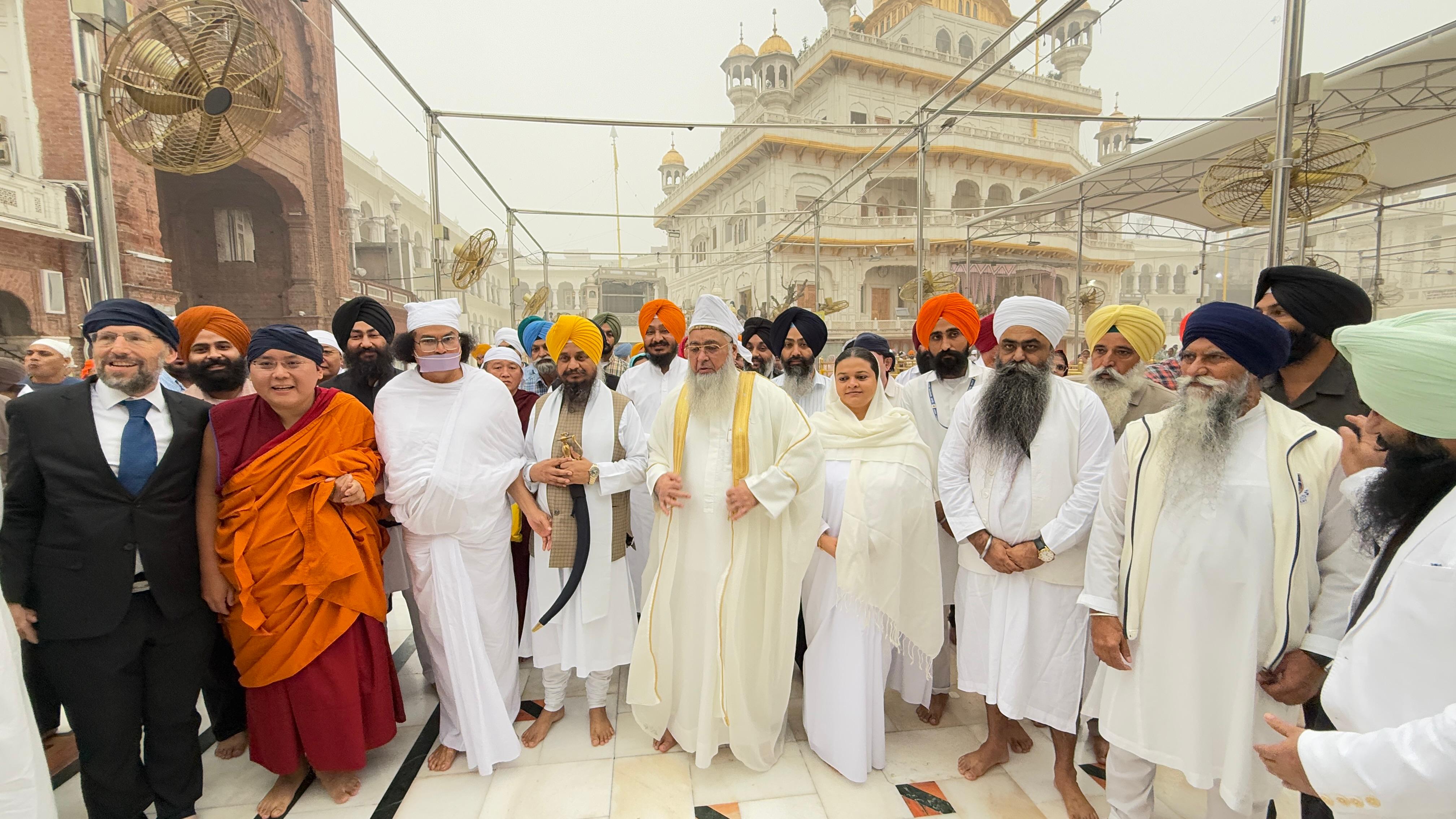
Rabbi Nagen at the Golden Temple in Amritsar: the Sikh 555th Purab Mubarak Smagam

6. How does Rabbi Joseph Albo contribute to the discussion?

Albo locates the roots of plurality of religions in his conception of the Noahide Law. He considers the Noahide law as not a static set of laws but a dynamic religious framework that evolves in accordance with national temperament, ethical sensibilities, and environmental conditions. He writes that it develops “according to their respective national differences”. The profound cultural variability among nations shapes how Noahide law is realized.

This concept is reminiscent of Rabbi Abraham Isaac HaKohen Kook’s vision of the evolution of the Oral Torah: “We feel that the unique character of the national spirit… is what lends the Oral Torah its unique form.” Religions, in this sense, can be viewed as a kind of “Oral Torah” for the Noahide law. Just as there are seventy facets of the Torah, the seventy nations each possess their own interpretations and expressions of the seven mitzvot.

7.You discuss pluralism and John Hick. Are you a pluralist? Do we all just have different names for one God?

Judaism acknowledges many names for God, each reflecting a different aspect of the Divine. Yet, there is but One God, who transcends form, time, and definition. What is essential is not the specific name used but the shared act of calling out to the One who is good and true. This unity is not diminished by the diversity of names humanity uses to refer to God; rather, it is enriched by it.

Allow me to share an insight that came to me while giving a keynote address in Amritsar, India, on the occasion of Guru Nanak’s 555th birthday. I quoted the biblical vision of humanity calling together in the name of God but offered a reflection inspired by Guru Nanak’s teaching that the One God has many names. In this light, we might rephrase the biblical verse to envision humanity calling together in the names of God.

Finally, I want to take this opportunity to thank you for introducing me, through conversations and through your groundbreaking books such as Judaism and Other Religions (2010), and Judaism and World Religions (2012) to the spectrum of approaches to other religions—from the wide embrace of pluralism to the firm stance of exclusivity.

8.What do you do with the exclusivist texts in Judaism?

The Talmud warns of the danger of turning the Torah into what it calls “a potion of death” instead of “a potion of life” (Yoma 72). This occurs when exclusionary and radical texts are elevated as the rule rather than recognized as exceptions. While such texts must still be acknowledged and addressed, they often reflect specific historical or cultural contexts that may no longer be relevant.

Judaism embraces a wide range of opinions on virtually every issue. It is our responsibility to navigate these perspectives, choose thoughtfully among them, and at times, firmly reject those that conflict with our moral convictions. Unfortunately, extremists are often empowered by moderates who mistakenly assume that extremist interpretations represent the most authentic expression of Judaism.

This debate—between what constitutes the rule and what remains the exception—is at the heart of my Beit Midrash for Judaism and Humanity. Our approach is not about reforming or rejecting halacha but about returning to its true fundamentals.

9.What is your vision of a mutual Nostra Aetate with Islam?

In 1965, the Second Vatican Council’s Nostra Aetate proclamation marked a transformative shift in Christian-Jewish relations. A similar bilateral effort is now urgently needed for Jewish-Muslim relations, particularly in the Middle East. The key question is: Will our identities connect us or divide us?

From the Jewish perspective, this requires the creation of formative documents presenting a Jewish theology of Islam. These documents should be widely disseminated within both Rabbinical and lay Jewish circles, as well as within Muslim communities. The foundational elements for such a theology already exist, but they must be further developed and articulated. The goal is to foster mutual respect and recognition of Islam’s legitimacy and to encourage Jews to see Muslims as partners in a shared narrative—a grand, unfolding story in which each community plays a vital role. Together, we can strive to fulfill visions such as humanity collectively calling upon the name of God and serving Him “shoulder to shoulder.” We hope and pray this approach can contribute to resolving conflicts in the Middle East, where religion plays a significant role.

The cornerstone of this approach is the affirmation of Islamic belief in God and His unity. As Maimonides stated, Muslims “unify God with proper unification, a unity that is unblemished.”

This foundation can be strengthened by emphasizing shared reverence for Abraham, stories of the Prophets, and other biblical figures, as well as shared values and religious practices. A comprehensive Jewish theology of Islam should also address the status of Muhammad, offering a nuanced perspective. Among Arab Muslims and Jews, there is even a recognition of shared ethnic heritage, providing additional common ground. These commonalities are essential building blocks for fostering mutual acknowledgment of the legitimacy and value of each other’s religious identities.

From the Muslim side, a similar effort is needed—a return to and affirmation of the Quran and Hadith’s clear acknowledgment of Jewish belief in God, the special status of Jews as Ahl al-Kitāb (“People of the Book”), and the Torah as a divinely granted guide to the Jewish people. This effort must include addressing claims of supersessionism and rejecting the notion that the current Torah is a forgery. Furthermore, it is vital to counter antisemitism fueled by misinterpretations of Quranic verses that critique certain Jews in specific historical contexts but are misapplied as blanket condemnations of all Jews. The Quran itself seeks to limit such critiques, explicitly stating, “They are not all the same.”

To advance this vision, I have composed an unpublished essay or monograph titled Jewish-Muslim Religious Fraternity. In this work, I call on global Muslim leaders to compose formative documents on these issues.

Shortly before his death, Fethullah Gülen, a leader of millions of Muslims through the Hizmet movement, authored such a document. This seminal text, available in Turkish, Hebrew, and English, addresses many of these critical points. It represents a significant step toward building bridges and fostering understanding between Jews and Muslims.

Allow me to conclude with a quote from the King of Morocco, Mohamad the 6th that inspires me in this endeavor:

The three Abrahamic religions were not created to be tolerant of one another out of some unavoidable fate or out of courtesy to one another. The reason they exist is to open up to one another and to know one another, so as to do one another good.

10. Why and how do we share Torah with non-Jews?

One of the great tragedies of religion occurs when exceptions are mistaken for the rule, and the true rule is ignored or forgotten. The issue of sharing Torah with humanity is a striking example of this. Bringing the light and wisdom of Torah to the world is not merely an option but a divine mandate for the Jewish people—a central role and responsibility rooted deeply in the Tanakh. The textual evidence for this mission is both explicit and overwhelming.

This chapter further illustrates how the sages (Chazal) reinforced this principle. The prevailing rule, as stated by Rabbi Meir, is that a non-Jew who studies Torah is like a Kohen Gadol (High Priest).

The exception, represented by Rabbi Yochanan, states that a non-Jew who studies Torah deserves death as a thief. This harsh view, however, is contextual as is for example the Talmudic critique of women studying Torah. Rabbi Yehiel Yaakov Weinberg explains that Rabbi Yochanan’s statement emerged in response to the early Christian use of Torah study to support replacement theology. Early Christians exploited their knowledge of Torah to claim that God had nullified His covenant with Israel and replaced it with a “spiritual Israel” (Christianity), effectively “stealing” the Jewish people’s identity. Similarly, the Rambam limited the prohibition to Muslims in his era, who studied Torah not with reverence but to discredit its authenticity.

When these specific contexts do not apply, the broader mandate—to share Torah with the world—remains intact. In our era, the time has come to fulfill the prophecy of exporting Torah from Zion to humanity.

Given the diversity of humanity, those engaged in the sacred mission of sharing Torah must consider the unique needs and perspectives of each culture they encounter.

For instance, when I was invited to teach Torah in China, I began by identifying topics relevant to Chinese culture. Through preliminary discussions, I learned that the Chinese place great importance on the Jewish approach to disagreement, encapsulated in the statement, “These and those are the words of the living God.” In a culture that values deference to authority and often views disagreement negatively, the Jewish embrace of diverse opinions as a blessing—expressing the seventy faces of Torah—was a novel and inspiring concept. Similarly, the Jewish emphasis on the intrinsic value of every individual within society resonated deeply.

Tailored engagement ensures that the eternal wisdom of Torah speaks meaningfully to the hearts and minds of people across the world, fulfilling its role as a light to the nations.

11.What good does dialogue accomplish? Does it really help?

My students sometimes ask me: “Rabbi Yakov, do you really think that just because you and an Imam meet and develop a relationship, that this will bring peace?” My answer is that it is not that such a meeting brings peace, but rather that it is already peace! When two people have a meaningful relationship, in which they connect from their inner essences, it is not just a path to shalom, it is shalom in itself. The goal is to scale this up by millions. I then call upon my students to become partners and create new relationships with the Other.  We need a massive partnership of leaders and lay people from both of our religions, and extensive grassroots encounters and educational initiatives to make Shalom and Fraternity ever broader and deeper between our communities.

Siddur Torat Chacham, a siddur Rashash by R. Yitzchak Meir Morgenstern

What are the Lurianic Kabbalistic intentions? How do they work and how does one read the baroque pictorial notations of a Lurianic siddur? This interview may be one of the first explanations in English that gets to the core of the matter. This is a very technical interview, very detailed, geared for those in the know.

This great review was written by Jeremy Tibbetts, a rabbi, who is the co-director of OU-JLIC for Anglos in Jerusalem and is the Director of Education for Yavneh, an intercampus leadership program. He is a student at Hebrew University in Jewish Thought, intending to focus on the Rashash and kavanot.

Earlier Kabbalistic intentions from the early Kabbalah until Rabbi Moses Cordovero (d.1570) provided a concurrent mental intention or visualization for the words of the prayerbook. The performance of the liturgy needed an extra level of intentionality.

Rabbi Isaac Luria, the Ari, (d.1572), in contrast, taught a doctrine of an innumerable array of spiritual entities, arranged in a vast enormous system. The prayer intentions were not directly related to the words, but rather, mental operations with this vast system.

Rabbi  Shalom Sharabi, known as the Rashash (born Yemen,1720, Jerusalem1777) reworked the Lurianic instruction as pictorial images and not sentences. The siddur depicted the kavanot instead of describing them. In order to do this, the Rashash utilized divine names to map out and represent the different spiritual structures that the kavvanot act upon. Sharabi’s style about the spiritual realms Tibbetts calls “near trance-like lists depicting the different layers of spiritual constructs.” For examples, see the 2 pictures below from the Rashash prayerbook.

A new edition of the Rashash siddur was composed by the contemporary Kabbalist R. Yitzchak Meir Morgenstern called Siddur Torat Chacham, a siddur Rashash by R. Yitzchak Meir Morgenstern (born 1967). A full presentation of Lurianic praybook intentions for 1678 pages. Tibbetts proclaims that this is “a groundbreaking achievement in the world of Jewish mysticism and in kavanot.”

For many, Rabbi Morgenstern is their contemporary teacher in kabbalah and his influence is immense on this generation and the generations to come, due to his large number of students and the many rabbis and Hasidim who study with him. In addition, he publishes voluminously, generally about fifty pages a week which come out as edited books. His method is to integrate divergent schools into a harmony assigning a different function or a relational position to each one. In this case, he integrates, the Kabbalah of Sarug, Yehudah Ashag, Rav Nahman, Ramchal, and the Komarno Rebbe into the Rashash.

Back in the infancy of this blog in 2010, I did a blog post on Derekh Yihud, which is, Morgenstern’s pamphlet of visualization meditations. (From what I hear, it is not a part of his current teachings and the visualizations are not found in this siddur).

For those looking to understand this practice as a system of meditation, then skip down to question #9 on the psychology of this practice, question #12 on the visualization method, question #13 on this practice, and question #15 on why should one engage in this practice. Some of you, or many of you, might want to read these answers before the more technical answers.  

I am especially proud of this interview because of the accurate and detailed information that it provides. In contrast, most mentions of the Lurianic intentions in English are vague intoned mentions, without content or context, of tzimzum, yihudim, kabbalistic trees, and sacred power. This interview fills in the needed details.

  1. What is the siddur of Rabbi Morgenstern?

The siddur Torat Chacham, a siddur Rashash by R. Yitzchak Meir Morgenstern shlit”a (born 1967), just saw its new complete reprint in a pocket-sized print (even though it is a remarkable 1678 pages!). The first printing of the siddur was a full decade ago. This is the ultimate siddur for a student of R. Morgenstern or Kabbalah more broadly: it’s a groundbreaking achievement in the world of Jewish mysticism and in kavanot.

2) What is the siddur of the Rashash?

R. Shalom Sharabi zy”a, also known as the Rashash (born Yemen,1720, died 1777 Jerusalem). In his early years, he decided to undertake an arduous journey to move to Eretz Yisrael. Initially this brought him to Bombay in India, where he settled for awhile and was first exposed to Penimiyut haTorah and the Zohar. Eventually, he ended up taking passage through to Baghdad, Damascus, and ultimately from there, to the Old City of Jerusalem. Eventually, he becoming the next rosh yeshiva of Beit El, where he began to showcase his new approach.

The siddur Rashash was, for the Rashash himself, first and foremost a personal project. One of his most monumental achievements in the world of Kabbalah at all is his siddur. He worked on it over his life, continually writing, erasing, and rewriting. He never taught from it or attempted to disseminate it in his lifetime. In that sense, using a siddur Rashash is really entering into the Rashash’s personal world of prayer. His students took his siddur after he passed away and began copying and eventually printing it for broader use. The standard siddur Rashash is built around the Rashash’s reworking of Lurianic kavanot as depictions and not sentences.

Before the Rashash’s siddurim, prayer books which contained Lurianic kavanot described in full sentences what the practitioner should intend. One of the Rashash’s key innovations as a post-Lurianic thinker was in laying out a new version of the siddur which depicted the kavanot instead of describing them. In order to do this, the Rashash utilized divine names to map out and represent the different spiritual structures that the kavanot act upon.

These punctuated divine names are considered by many of the Kabbalists to be ideal both because they minimize the concern of one imagining something physical when praying with kavanot and because the names always refer back to Hashem directly and prevent one from getting caught up in the various spiritual tikkunim one is attempting to perform. The shem Havayah is the shem ha’atzmi, a name which uniquely indicates Hashem’s infinitude, allows us to intend towards something discrete while maintaining a connection to the infinite and undefined Or Ein Sof which animates everything.

The siddur Rashash is largely concerned with describing spiritual worlds and largely unconcerned with explicitly treating human experience and life. The Rashash offers very little in the way of a phenomenology of kavanot despite creating a nine-volume prayer book which takes hours to complete and is used on a daily basis.

A hallmark of Sharabi’s innovative style is his ability to take the Arizal’s logic of the spiritual realms and apply it iteratively on every level, often leading to what can only be described as near trance-like lists depicting the different layers of spiritual constructs. This is closely tied with the doctrine of arachin or “relativity” for Sharabi, which reads the map of Lurianic Kabbalah as applicable in any level. Just as a person is from one perspective a child and from another perspective a parent, what we call Malchut in one context could be considered Binah or Keter in another context, and so in this view, the map of the worlds as sketched in Lurianic Kabbalah is more epistemological than ontological.

3) What is unique in the siddur of Rabbi Morgenstern and his approach to the Siddur Rashash?

R. Yitzchak Meir Morgenstern’s siddur Torat Chacham is innovative precisely for its attempt at reintegrating other strains of post-Lurianic thought with the kavanot of the Lurianic siddur edited by Vital.

Perhaps most starkly, the additions in the siddur draw heavily upon the Kabbalah of Rav Yisrael Sarug zy”a (late 16th century – mid 17th century), an early student of Luria. Sarug’s approach was mainly rejected because Rav Chaim Vital, the main pupil and disseminator of Lurianic Kabbalah, casts aspersion on him as an authentic student. Many Kabbalists saw the Sarugian approach to Kabbalah as irreconcilable with Vital’s description of Lurianic Kabbalah. In particular, Sarug had terminology that was largely absent in Vital’s writings about tzimtzum and what he envisioned a whole series of worlds called Olam haMalbush at the very beginning of creation which Vital doesn’t mention. Sarug’s writings deal largely with worlds which precede those described by R. Chaim Vital, Furthermore, Sarug’s account of creation deals at length with the Hebrew letters and their formation which is also absent from  Vital’s account.

Rav Morgenstern has been working for nearly 15 years to try to reconcile and reintegrate the two systems. Part of his research has trended towards the historical, attempting to unveil hidden connections that Rav Shalom Sharabi and his students may have had to Sarug’s version of Lurianic Kabbalah. Perhaps most notably, Rav Morgenstern suggests that Sharabi’s version of Etz Chaim had Sarugian writings appended to it, implying that he considered them authentic to the Lurianic-Vitalean set of writings and that he studied them.

R. Morgenstern leans heavily on Hasidut Chabad for this project, in part because Chabad and its various offshoots accepted Sarug’s Kabbalah. R. Morgenstern uses these writings to develop a trailblazing anthropocentric reading of Sarugian Kabbalah. R. Morgenstern connects the concepts of Sarugian Kabbalah to the different ratzonot within the Divine mind which are meant to be realized through the process of creation.

4) Can you give an example?

Some of the most central and longest kavanot in the standard siddur Rashash are when one raises divine sparks up so that they can be transformed into shefa for us. The Arizal himself did not specify each and every level that they ascend to, only that they go up to “to the greatest heights.” The Rashash did spell out all of these ascensions in his theoretical works, he did not include those steps in his siddur. R. Morgenstern maps out this full ascent and adds in for the first time these levels of Olam haMalbush which in his view are also activated as part of the Rashash’s system of kavanot.

5) What about his use of Ramchal, Sulam and Komarno?

Alongside these innovative inclusions, kavanot are brought throughout the siddur from Kabbalists such as the Ramchal zy”a (1707-1746) and the Sulam zy”a (1885-1954) without clearly stating how they should be integrated with the standard kavanot haRashash.

This becomes even more of a question in sections lsuch as tachanun, where each of the 13 attributes of compassion is matched with one of Rebbe Nachman zy”a’s (1772-1810) 13 sippurei ma’asiyot. There is lastly a notable change in the actual nusach of the siddur.

While an Ashkenazi nusach of the siddur Rashash does exist, Rav Morgenstern’s siddur reconstructs the nusach of Hasidut Komarno from the Shulchan haTahor, the first Komarno Rebbe zy”a’s (1806-1874) commentary on the Shulchan Aruch Orach Chaim (though notably in a few sparse places he writes that he prefers the Breslov approach to nusach instead). Thus the siddur becomes a sort of weave of numerous Kabbalistic streams, most of which have never been brought together before in this manner.

6) Why is this siddur unique in its Kabbalah?

Rav Morgenstern, inspired by Rav Moshe Schatz shlit”a, is a proponent of a sort of “Grand Unified Theory” of Kabbalah. He takes it as axiomatic that the different schools of Kabbalistic thought are in harmony, not dissonance. The Ramchal’s Kitzur Kavanot, the Hasidic Saraf Pri Etz Chaim or Pri Kodesh Hilulim, and the Rashash’s Rechovot HaNahar are essentially describing the same thing in different levels of meaning and detail in this view. But it’s not enough to say that they align with each other: it is not possible from this perspective to truly understand Kabbalah without bringing these schools together. Each one constitutes a puzzle piece in the mosaic of sod. Kabbalah becomes a discipline not only of knowledge acquisition, but of integration.

7) How is this process of harmonization shown in the siddur?

This siddur is a monumental achievement as the first one to truly embrace this approach of harmonization and to connect it with the Rashash, the most difficult and the most conservative of the post-Lurianic schools. For those more steeped in the world of the Arizal, the Rashash, and his beit Midrash, they’ll find many additions to the siddur from the Torat Chacham, one of the most difficult works of Kabbalah from the Rashash’s talmid muvhak R. Chaim de la Rossa zy”a (early 18th century – 1786). One prominent examples would be the insertion of the kavanah for mesirut nefesh before any part of tefillah where one raises up divine sparks.

While the Rashash would not necessarily disagree with these additions, the fact that they are not included in the original siddur indicates that they were not as critical unlike the many kavanot which were codified.

The new small edition of the siddur chol also contains hundreds of pages of notes and essays in the back which explain why the siddur is laid out as it is, often citing and invoking different disagreements amongst the talmidei haRashash.

8) Why would a yeshiva student or student of the Kabbalah want to own or use this?

It is one of the most comprehensive and mature works of R. Morgenstern and his beis medrash, which may be a reason in its own right to own it. It can serve as a valuable window into the inner prayer life of one of the greatest Kabbalists of our time. Additionally, it is perhaps the only truly integrated siddur for those who want to stand at the confluence of the different strains of Kabbalah, not only by bringing in Hasidut, but by including kavanot from everything from medieval works of Kabbalah like Brit Menucha to the Gra zy”a (1720-1797), Ramchal, Sulam, and more. In this regard, it will serve as a textbook and guidebook rather than an actual prayer book, offering notes on nusach or different Kabbalistic ideas to integrate into one’s own prayer. Others still will buy it out of aspiration, more to make sure they have one rather than risking it running out and having to wait for a reprint years later.

9) How does Rabbi Morgenstern explain the process of psychologically performing kavanot?

This is sort of the big question with kavanot haRashash in general. Just like in any other siddur Rashash, the instruction to the practitioner throughout the siddur is simply “veyichaven,” “intend” that the worlds and sefirot are interconnecting in a given permutations by that corresponding word of tefillah. However, the Kabbalists would not consider the siddur Rashash to be a visualization guide.

They would in all likelihood be averse to one picturing the spiritual structures and sefirot which are part of the Kabbalistic siddur.

Neither the Rashash in his time nor R. Morgenstern in this siddur told us exactly what that means mentally. In fact,  in R. Yekutiel Fisch’s Sod haChashmal Vol. 5, there is a lengthy “teshuva” from R. Morgenstern on the subject of kavanot which quotes the Rashash’s son, the Chai baShemesh zy”a (mid 18th century – 1808), echoing this desideratum: “even though we have intention according to our intellect, each person according to their level, we don’t know what the explanation of ‘intention’ is… and what is ‘intend’ or how one attains ‘intention’” (pg. 207).

Nonetheless, there is one clue which Rav Morgenstern offers us from the siddur’s introduction which sheds some light on this question. He champions the Torat Chacham’s idea (building on the Rashash) that an individual’s kavanah must work on three levels: klal gadol, klal beinoni, and prat. He sorts the three central schools that his siddur aims to integrate into these categories: the Kabbalah of R. Yisrael Sarug, which speaks about the highest worlds of any post-Lurianic school, is the klal gadol; the Kabbalah of R. Chaim Vital, centered on Atzilut and the tikkunim which most directly impact our own world, is the klal beinoni; and Hasidut, which deals with the lowest and smallest levels of human experience, is the prat.

10) Which of these levels does he emphasize?

Paradoxically, the prat smallest level of Hasidut brings us the highest in R. Morgenstern’s view. On the micro-spiritual level, each individual sefirah and level of spiritual existence experiences whatever is above it as Ein Sof. Said differently, the more one zooms in to the details of the spiritual structures of Kabbalah, the more one experiences the system as open and ever-expanding. This is why this perspective is the most suited to truly understanding the infinitude of the Ein Sof, as each level constitutes a new self-disclosement of the infinite revelations of Hashem. This is the unity which R. Morgenstern sees between Hasidut and the school of the Rashash: for both of them, the divine is in the details.

Returning to R. Morgenstern’s teshuva in Sod haChashmal, he offers several more insights into the psychology of kavanot. First, he explains that the Rashash’s innovation of depicting the kavanot as punctuated shemot Havayah over the prior Lurianic siddurim which explained each kavanah in words was rooted in the Rashash’s desire to not separate the kavanot from the Ein Sof. The mechaven must always hold an awareness of the infinitude of Hashem alongside the particular kavanah at hand.

11) Where does separation from physicality fit in?

He quotes the Shemen Sasson zy”a (1825-1903) who riffs off of the Shulchan Aruch in OC 98:1 in describing kavanah as “to strip one’s soul, to separate it from physicality, and to awaken the upper worlds… as explained in the kavanot of Shema at bedtime and in the secrets of dreams and prophecy.” This seems to be a dual kavanah.

While the latter part might have seemed obvious given the focus of the kavanot on the upper worlds, the former is not only a powerful statement of how the kavanot should impact a person’s embodied experience but also should indicate that through Kabbalistic prayer, one first directs one’s soul away from this world in order to impact the upper worlds.

He goes on to quote the Hasidic masters the Maor vaShemesh zy”a (1751-1823) and R. Pinchas of Koritz zy”a (1725-1791) alongside the pre-Lurianic Kabbalist R. Moshe Cordovero zy”a’s (1522-1570) on the ability of kavanot to “purify the mind and increase devekut,” even without proper understanding.

This devekut for R. Morgenstern is itself the awareness of the Ein Sof behind each and every kavanah. The need to hold the unity of the Ein Sof amidst the plurality and intricacy of kavanot is central for R. Morgenstern, so much so that he writes that if the extreme details of the siddur Rashash distract a person from this devekut, then they should not use it.

12) What is the role of emotion vs visualization?

The truth is that R. Morgenstern’s Torah contains both: in works like Derech Yichud, a Kabbalistic meditation guide that R. Morgenstern prepared over several years to attempt to integrate meditation and Kabbalah/Hasidut, you see that he leans very heavily into visualization-based meditation, and at the same time in many places in De’ah Chochmah leNafshechah, where R. Morgenstern’s weekly sichot are recorded, as well as in Bayam Darkecha, written and published by a close talmid of R. Morgenstern, the emphasis is strongly on the emotive and psychospiritual impact of kavanot.

As mentioned above, the siddur is not meant to be a visualization guide. R. Morgenstern’s siddur does contain additions though which at first glance seem to involve some form of visualization. For example, when ascending the different heichalot in Shacharit, he adds in detailed descriptions of their layout and appearance from the Zohar. There’s no “kavanah” added alongside them. This is also the case with other additions in the siddur, e.g. the sketching of the malbush at the end of sim shalom and the addition of parts of the mishkan in each beracha of the Amidah.

Even more radically, there are numerous yichudim (letter-based meditations) from the writings of the Kabbalists which have been added in, despite the near universal consensus in the world of Lurianic Kabbalah that even yichudim which utilize words or pesukim which appear in the siddur should not be added as part of the daily intentions. R. Morgenstern defended this practice previously in his haskamah to the siddur Sha’ar Ruach haKodesh which also added in yichudim, as well as in the essays appended to his siddur, based mostly on Ziditchov and Komarno Hasidut.

 The fact that no specific intention is written for any of them calls into question their exact purpose: their very inclusion in the prayer book would seem to suggest that they are included to be part of the kavanot in one form or another, yet without a particular intention, they can also be read as associative companions which are meant purely to enhance and deepen a non-visual experience of kavanot.

13) If kavvanot are not visualization then what are they? Are they just things to think about when reciting the liturgy, like reading a book of kabbalah simultaneously to reciting the siddur?

This is a really hard question! On the one hand, they’re not supposed to bring one to a form of contentless contemplation as done in meditating on the on the breath.  On the other side, they’re not a scholastic or academic exercise.

They are meant to be somehow performed and not just considered. I think also that the Kabbalists did not see them as liturgy in the same way that the siddur is. We aren’t communicating to God or requesting that God unify the worlds with the kavanot.

They saw the “intending self,” the part of the self which is associated with conscious intention, as the highest part of the self which could act on one’s body or soul. It is through deep focus, one can use the mind like a hand to move the upper worlds. Some of the Kabbalists note that these mental acts cannot be affected without reciting the actual words of prayer.  In other words, one contemplates and focuses in on the kavanot as they stand independently, and that also forms the intention for when I say that word or phrase in the siddur. So it creates its own form of non-imagistic meditative concentration around and through the words of tefillah.

14) Should one start with this siddur?

I think probably not. If one is interested in exploring kavanot in general but does not have the prerequisite experience with Etz Chaim, Sha’ar haKavanot, Rechovot haNahar and the like, the siddur Rashash is nearly impossible to use.

When a person wants to actually start learning how to use the siddur Rashash, R. Yechezkel Bing shlit”a’s Nekudot haKesef (who is himself thanked in the siddur Torat Chacham’s introduction for offering guidance as it was being made) and R. Gamliel Rabinowitz’s Tiv haRashash both explain the siddur in depth, even line by line in some cases.

 When I wanted to start learning how to use a siddur Rashash, what was first recommended to me was to start with a more basic siddur and commentary which would give me a sense of the Kabbalistic flow of tefillah. The siddur Keter Nehora (also called the Berditchever siddur), the Shelah’s siddur commentary, the Matok miDvash siddur, and the Yesod veShoresh haAvodah are all great starting points as they are not overly caught in the particularist mechanisms of kavanah.

R. Mechel Handler shlit”a, a living Kabbalist in Boro Park, has a recommended and ordered reading list in his Peticha leKavanot haRashash for anyone who wants to start using a siddur Rashash: he suggests the classic Sephardi Kabbalistic starting point of Otzrot Chaim with the Matok miDvash commentary, followed by Etz Chaim, then Sha’ar haKavanot Drushei Keriat Shema Drush Vav (called drush ha’ikkar by some), and ultimately delving into numerous seforim which focus on the different parts of tefillah.

 I would add that before opening Otzrot Chaim, I gained a lot from using introductory seforim like Siftei Chen, Yedid Nefesh, Klalei Hatchalat haChochmah, and R. Handler’s sefer mentioned above.

15) Why do Rashsash/Morgenstern kavvanot? What not play Dungeons and Dragons? Why use these Baroque notations in the 21st century? Just daven

I’ll suggest three answers based on the Kabbalistic tradition. The first is about the largest layer of ramifications that the kavanot can have. R. Shaul Dweck haKohen zy”a (1857-1933), a rosh yeshiva in the Rashash’s tradition, wrote that the redemption will come after a certain amount of nitzotzot, divine sparks scattered in the world through the vessel’s shattering, are raised up. However, through the performance of proper actions we can bring that redemption more quickly. In this view, the siddur is the guidebook to how we can open the world to greater connection to Hashem, it pulls the levers which allow the hashgacha to come to expression.

The second answer is that they work on the most individualized level. The Arizal writes in the introduction to Sha’ar haMitzvot that “according to the greatness of the joy in truth and inner good heartedness will they merit to receive the supernal light, and if they do this continuously, there is no doubt that ruach hakodesh will rest upon them.” There are two things which this quote communicates about the inner experience of kavanot: 1) the kavanot and one’s emotional state are intertwined and therefore emotion is therefore not disconnected from kavanot, and 2) there is a shift in one’s cognition through the performance of kavanot, through the receiving of this supernal light and ultimately through experiencing ruach hakodesh as part of them. According to another Lurianic source (Sha’ar haKavanot Drushei haShachar 1), this light enters the soul through the performance of kavanot.

I’m not an expert practitioner, but I do find that they bring a greater sense of attunement, presence, and a sense of devekut as well.

Lastly, these kavanot are a body of thought which is already “home-grown” within the Jewish tradition. The Kabbalists developed these kavanot with reference to the full gamut of Torah. So, if someone is seeking some kind of meditative experience out of prayer, this is one of the most expansive Jewish answers.

Maimonidean Theistic Naturalism: Do we use it?

There is a mild debate in Israel over a little introduction to medieval thought published by Prof Shalom Sadik who advocates a Maimonidean rational naturalism and Rabbi Shmuel Ariel who presents a religious critique

Prof Sadik in his book A Call For The Revival of Religious Philosophy. [Hebrew] (Keriah le’techiyah shel Hafilosofia Hadatit), a related English book by Sadik came out last year  Maimonides A Radical Religious Philosopher(2023)

Sadik presents many of the basics ideas of the Guide of the Perplexed as an esoteric document: the eternality of the world, that miracles are natural events, that God does not violate the course of nature, providence is naturalistic, and Mosaic prophecy is an act of his own cognition. These are standard understanding of the Guide debated by Samuel Ibn Tibbon, ibn Falquera, Albalag, Efodi, Narboni, Anatoli, Gersonides, and other Maimonideans/Averroists within Jewish thought. These are also affirmed by most modern scholars of Maimonides’s thought.

In contrast, Rabbi Ariel assume that these ideas are outside of the limits of accepted Jewish thought, that mizvot assume that one is doing them to serve a theistic God, and that Judaism is primarily about belief in the principles of Judaism. These ideas should certainly not be taught at yeshiva.

Prof Sadik points out that Crescas and Albo already show that we do not exclude people for their philosophic beliefs. However, Sadik points out that much of Kabbalah as well as Hasidut would be outside the pale of Maimonidean thought as foreign worship since they contain the wrong conception of God.

Sadik and Ariel produced an unedited Hebrew document on their discussion, but there are more pieces of the discussion on social media.  

This discussion produced long threads on social media debating the topic, but it was almost entirely about Hasidic thought and how the personified God who is moved by human action is the Jewish opinion and how now in our age Hasidut or Rabbi Kook is the horizon of Jewish thought along with a literal reading of the Bible and Yehudah Halevi’s Kuzari. Rav Nachman of Breslov has become the norm. It was as if no one knew about Maimonides and the method that medieval Jewish thought treated the Bible in a way to remove the literal anthropomorphism.

What really struck me, was that it seemed almost no one had heard of the medieval thinkers, as if no one knew the Guide of the Perplexed and its esoteric teachings and the assumption that these medieval thinkers were not part of the canon of Jewish thought. Yet, these texts and ideas are taught in every department of Jewish thought. They are a pillar of mastery of Jewish philosophic texts. No one on social media could offer a defense of medieval theistic naturalism or understood how important they are for understanding Jewish thought and intellectual history.

In order to present the issue, I asked six experts on medieval Jewish thought: Do you see the medieval Jewish rationalists and naturalists as them as important for Jewish thought and thinking? How important are medieval rationalism and the Maimonidean/Averroiest Jewish commentaries. I asked each participant for just two paragraphs so that you get a taste of the diverse justifications of these thinkers.  Those who answered were Professors Zev Harvey, Yehuda Halper, Daniel Rynhold, Sarah Pessin, Y. Tzvi Langermann, and Lawrence Kaplan. They are presented in the order in which they replied to my query. Go and Study.

From my perspective, these naturalistic ideas are already in Abraham Ibn Ezra’s commentaries, Shlomo Ibn Gabirol’s piyyutim, and Isaac Arama, Akedat Yitzhak. These works are certainly in the canon. And these ideas are needed to understand the dialectic in later works including Kabbalists such as Nahmanides, Yakov bar Sheshet, Maharal, Shelah, and the Vilna Gaon. In addition, these of works generated several Maimonidean controversies in 1230’s, 1288, 1300-1305, and then later in 16th century Eastern Europe. The study of these debates reveals the contours of Jewish thought.

Furthermore, these rational thinkers are studied to produce new Jewish thinking in every generation. They have produced many forms of Jewish thought including Kantian and Hegelian reading of Judaism, process theology, philosophic contemplation, theistic skepticism, theistic naturalism, and Barthian versions. Almost every generation returns to Maimonides and his commentaries to develop Jewish philosophic thinking.

Zeev Harvey, Emeritus Professor of Jewish Philosophy, Hebrew University  

Radical Philosophy and Mainstream Judaism

The genius of Jewish Thought is its cosmopolitanism and pluralism.  It is written in seventy languages and ranges from radical rationalism to radical mysticism.  Maimonides, like Rabbi Shmuel Ariel after him, believed that Judaism can be defined by dogmas.  However, as Mendelssohn said, the only truly good things that came from his 13 Principles are the beautiful piyyut Yigdal and the great books by Hasdai Crescas, Joseph Albo, and Isaac Abrabanel, which criticized those Principles and suggested different approaches. 

 It was Ibn Gabirol who brought radical philosophy into the Synagogue with his Adon OlamAzharot, and Keter Malkhut.  Ibn Ezra and Gersonides brought it into Mikraʾot Gedolot.  Maimonides’ Guide of the Perplexed is the most influential book in Jewish philosophy, and traditional Jews usually read it in Ibn Tibbon’s Hebrew translation, together with the radical Commentaries of Narboni, Kaspi, and Efodi.  The presence of radical philosophy in mainstream Judaism is clear and significant.   

Last February I was invited to give a series of seven shiʿurim on the philosophy of Rabbi Hasdai Crescas at the “Kerem” center in Brooklyn.  Founded by Reb Joel Wertzberger and directed by Harav ha-Gaon Yonoson Marton, “Kerem” is a group of Satmar rabbis and scholars who are wholly committed to the Satmar derekh, but interested in learning about different approaches.  Among other Israeli academics who have spoken there are Moshe Halbertal, Yair Lorberbaum, Benjamin Porat, Elhanan Reiner, and Shai Wozner.  James Diamond of Canada has also spoken there.  I was not surprised to find that the Satmar ḥasidim were well versed in Sefer Or Ha-Shem and other medieval philosophic books.  However, I was surprised when they asked me pertinent questions about the most recent writings of young Israeli scholars – not only Shalom Sadik but also more controversial authors, like Micah Goodman and Israel Netanel Rubin.  I have no doubt that in the eyes of the Satmars Rabbi Ariel’s belief that the State of Israel is atḥalta de-geʾulah is far more problematic than Professor Sadik’s views on hashgaḥah.    

Yehuda Halper, Dept of Jewish Philosophy. Bar Ilan University

Following Al-Farabi and Averroes, medieval Jewish philosophers turned to Aristotelian logical works to develop a notion of what modern logicians call second-order knowledge. This kind of knowledge is knowing that you know something. Al-Farabi had associated the Aristotelian demonstration, the pinnacle of logical argument and the foundation of mathematical and scientific reasoning, with certainty, i.e., knowing that you know what has been demonstrated. Thinkers of the Ibn Tibbon family and later commentators on Aristotelian thought adopted the demonstration as the ideal basis for math and science, but recognized that there are very few, if any proper demonstrations in Biblical or Talmudic works. Rather what we might find in those works are portrayals of beliefs whose verification is less than certain. They often looked to other forms of argument, such as dialectic, rhetoric, and poetics, to describe the arguments of such works. That is, thinkers like Jacob Anatoli and Moses Ibn Tibbon, focused on the form of Biblical and Talmudic claims and took them as non-demonstrative, but often persuasive by using other forms of argument. Using these techniques they were able to differentiate in fairly technical terms argumentative techniques for religious and scientific purposes.

Students today often think of belief as something inherently irrational, as essentially opposed to scientific or justified knowledge. As such, they seem to think that people cannot reason about belief. The medieval Aristotelians exemplify ways in which humans can reason about belief, even beliefs that are not scientific or scientifically provable. In fact, I believe that everyone can benefit from greater use of reasoning, in public, in private, about religion, about science, in general.

Daniel Rynhold, Dean & Professor of Jewish Philosophy, Yeshiva University

It’s difficult to attribute immense historical importance to the thinkers you mention since they are little studied by the Jewish masses. Some are likely unknown to the average yeshiva bochur, and even in the academy, with the possible exception of Gersonides, they are only studied by specialists in medieval thought. However, they are incredibly important (again, particularly Gersonides given that his biblical commentaries place his works – even if unopened – on the shelves of many Batei midrash alongside the classical and oft-studied commentators) for modelling a path for a relatively silent but sizable enough minority in the Orthodox Jewish world. And that path is one that allows halakhic study and commitment to sit side by side with a theology that veers far from the mainstream. It troubles me when such approaches are not accommodated. It’s not that those opposed to such philosophies need to accept them. But however difficult it is for some to understand how those non-mainstream philosophies can support halakhic commitment, for people of a certain religious sensibility, it is only those theologies that can inform their religious commitments. One person’s heresy is another’s “divrei elokim hayyim” as anyone who has, for example, read both Ramban and Rambam can attest.

Sarah Pessin, Professor of Philosophy, University of Denver

The question of rationalism in a thinker like Maimonides is itself wrapped up in a pre-modern sense of ‘the rational’ where ‘the rational’ includes a depth of commitment to logic, math, and science, yes, but all at once also to ethics and theology. It’s a wonderful Greco-Islamo-Jewish framework for seeing the hand of God and with it the heart of divine wisdom in the details of botany and also in the invitation to minister with respect to neighbors. Living a life b’zelem, in this context, is living a life which aspires to a hint of God’s wisdom and a trace of God’s goodness all at once such that a life of Torah and a life of science and life of ethics are all intertwined parts of a life-with-God.

Yes Torah—and yes Torah because yes wisdom and ethics; for the attentive person-of-God, the Torah is a gift just as our God-given talents of intellect and virtue are gifts. When in doubt, the Torah guides—but if the Torah appears to guide against reason and virtue, it’s a fine indicator that we’ve made a wrong turn.

While different in epistemological frameworks from a modern thinker like Buber, I think Maimonides would agree with Buber’s take on “theomania” as the error humans make when we are so excited to meet God (or relatedly, so confident that we have already met God) that we feel confident overlooking responsibilities to neighbors. I think Judaism–and also, humanity in general–is richer for Maimonides’ ancient sense of reason–shared by Greek, Islamic, Christian, and other thinkers–which features the sort of wisdom that imitates God’s wisdom not only of head but of heart, inspiring and inviting a life of religion-with-science-with-goodness-to-neighbors that mirrors the generosity of God’s overflowing hesed

Y. Tzvi Langermann, Professor Emeritus, Bar Ilan University

It is impossible for me anyway to answer questions about relevancy without thinking about how the figures you mention are relevant to me, on a personal rather than professional level. I find inspiration and guidance in the thought of many figures across the cultures and ages, especially Maimonides. In this context the most important point is this: Maimonides wrote a guide for the perplexed–a book whose aim is not to inculcate doctrine but to show the way. It is fundamental to Judaism that there is only one Truth–with a capital T, because God is al-Haqq, the Truth, but each individual must make his/her own struggle or journey to approximate the Truth as best as one can. Maimonides’ chief aid is in coaching us how to avoid errors along the path.For this reason Maimonides, and not a few other medieval thinkers, are relevant–chief among them, Yehudah ha-Levi who, in my understanding, is no less rational than Maimonides.

The proof of the pudding is in the eating., Maimonides is clearly still relevant. The questions are how and why. To the best of my understanding of Maimonides’ historical setting and intellectual milieu, the question, rationalist or not, is out of place. Making this a focus of discussion is another example of the ubiquitous yet unavoidable act of imposing contemporary categories (whose parameters are not clear to me even in contemporary terms) on historical actors from another world. Yet this faux pas is unavoidable precisely because there is, for whatever reasons, great intellectual interest and, I submit, societal and political significance, in exploring the questions associated with rationality and its presumed opponents and slugging out the answers. Maimonides is brought into this exchange because his rich written legacy offers material for discussion and, yes, prooftexts, for the different positions–of course, when the material is translated (since most of it is in Arabic) and explicated. Finding support or at least solace in a towering authority (and yes, authority matters for everyone, admit it or not) certainly is helpful.

Prof Lawrence Kaplan, McGill University

For the radical Maimonideans, Maimonides’ view of the relationship between philosophy and religion is a prime example of what Prof. Carlos Fraenkel refers to as “philosophical religion.”  That, Maimonides, to some extent, seems to be an adherent of philosophical religion is, in my view, undeniable. He identifies the highest and most profound teachings of Judaism, the account of creation and the account of the chariot, with the philosophical natural and divine sciences, and for him the highest and ultimate goal of Judaism is the knowledge, love, and fear of God based on reason. Moreover, Maimonides sharply differentiates between the welfare of the soul, correct beliefs in simplified or imaginative form prescribed for the multitude on the basis of authority, and perfection of the soul, the intellectual knowledge of God based on reason designed for the elite (Guide 1:33, 3:27). 

And though he never says so explicitly, he intimates that observance of the commandments of the Torah, both commanded practices and commanded beliefs, inasmuch as they are accepted on authority, cannot endow one with perfection of the soul, though they can point one in the direction of attaining perfection of the soul, if one has the ability, through the use of one’s intellect.

Still, if one takes Maimonides at face value, it seems he cannot be viewed as an adherent of philosophical religion tout court, as say was Averroes.  Here the radical Maimonideans, pushing Maimonides’ claim that the Guide is an esoteric work to its limits, argue that, despite his protestations, Maimonides in truth subscribed to the Aristotelian view of eternity and thus did not allow for the possibility of miracles understood supernaturally, whereby God suspends the natural order, even if only temporarily, through an act of will. Rather the biblical “miracles” are just wondrous acts, whose natural causes we do not understand. Along these lines and, more significant, for the radical Maimonideans such basic biblical doctrines as prophecy and providence have to be understood purely naturalistically, the more literal, personal, and supernaturalist presentation of these doctrines in the Bible just being an accommodation to the limited understanding of the multitude.

 Unlike the radical Maimonideans, I see no reason to question Maimonides’ sincerity in affirming that creation is more probable than eternity. Still, I believe that one should not exaggerate the differences between the view that takes Maimonides’ affirmation of creation at face value and the radical Maimonidean view. For even according to the Maimonidean view of creation, the world is not just an expression of an act of divine will, but also of divine wisdom.   This being so, the primary path to knowledge and love of God (See Hilkhot Yesodei ha-Torah 2:2) is not through knowledge of God’s miracles, as Halevi or Nahmanides maintain, but knowledge of God’s wisdom as revealed in the orderly and law-like processes of nature. And included in these law-like natural processes are the phenomena of both prophecy and providence which, for Maimonides, operate naturalistically.

Prayer without Hope – Rabbi Shagar

For those who bought the new volume of Rabbi Shagar translations which I edited with Levi Morrow (Maggid – Koren 2024). There was one small 1500 word section that was removed from the book by the Rav Shagar publication committee as pushing limits. You will see how Rabbi Shagar fused Rabbi Nahman of Breslov with Derrida.

I translated it back in 2017 with a 1600 word introduction. For my explanation and introduction, look at the original post. If you use it in the classroom, you will appreciate my 2017 introduction. It also has a link to the Hebrew. But for the rest of you who bought the book, print out the translation below and place it in your volume, This translation has been updated by Levi Morrow from the 2017 translation.

Praying without Hope*

Rabbi Naḥman of Bratslav and Jacques Derrida both taught that prayer—and faith, for that matter—is only possible through absolute renunciation—praying without hope or future. Rabbi Naḥman wrote: “Pray without any intent for personal benefit, without thinking about yourself at all, as if you did not exist, as written in the verse, ‘It is for your sake that we are slain all day long’ (Psalms 44:23).”[1] Derrida’s version: “Prayer does not hope for anything, not even from the future.”[2]

Prayer without hope does not demand the typical religious self-sacrifice, in which a person nullifies his self and his needs in favor of God. Rather, it embodies self-sacrifice in that the purest prayer is situated in its impossibility, as total self-sacrifice, purposeless suicide.

According to Derrida, prayer turns “to the other without future hope, only towards the past. It returns, without a future. However, despite this, you pray. Is this possible?” If this is so, we might ask: why, indeed, should you pray?

Is it possible to pray without hope, not just without any request, but while renouncing all hope? If we agree that this prayer, pure prayer, cleansed of all hope, is possible, would that not mean that the prayer’s essence is connected to this despair, to this lack of hope? […] I can imagine a response to this terrifying doubt: even then, at the moment when I pray without hope, there is hope within the prayer. I hope, minimally, that someone takes part in my prayer, or that someone hears my prayer, or someone understands my hopelessness and despair. Thus, despite everything, there is still hope and future. But perhaps not. Perhaps not. At least perhaps. For me, this too is a terrifying state of prayer.[3]

Prayer is empty mechanical speech, but in some form or another, it cuts through what Rabbi Naḥman called “the empty space” thereby overcomes the gap, even though it remains in the negative space of complete silence:

It requires you to affirm two opposites concrete existence (yesh) and nothingness (ayin). The empty space comes from the contraction (tsimtsum), as if God had removed himself from that space, as if there was no divinity there, otherwise it would not be empty […]. But in the absolute truth, there must be divinity there despite this […] and therefore it is impossible to understand the idea of the empty space until the future yet to come.[4]

Even though both of them recognize the impossibility of prayer, Rabbi Naḥman and Derrida do the opposite—they pray. Paraphrasing Maimonides’ statement that God “exists, but is not in existence,”[5] Derrida and Rabbi Naḥman ask: Cannot nothingness also be existence? Is it possible to pray without hoping? Is it possible to despair of hope and thereby to receive it, as a despairing hope? Then there is a hope and a future, and someone hears my voice. The connection to Maimonides is not incidental. Derrida saw the idea of negative attributes—Maimonides’ negative theology—as the basis for deconstruction, and thus also for prayer.[6] Similarly for Rabbi Naḥman: “this is prayer, for when we call to God with the attributes of flesh and blood, and it is improper to describe and call to God with attributes and praises and words and letters.”[7]

Many found Derrida’s statements about prayer incredibly shocking for “the philosopher who for years was considered the standard-bearer of anti-metaphysical radicalism, the guru of believers in materialism lacking any ‘beyond.’”[8] Indeed, Derrida was forced to defend himself from criticism by thinkers including Jurgen Habermas, according to whom he was nothing less than a Jewish mystic.[9]

Is this claim not correct? Derrida’s worldview is far from rationalist or anchored in philology. His deconstructive games sometimes seem, not coincidentally, like Kabbalistic-Hasidic homilies. He defended himself, claiming that his project was “a deconstruction of the values underlying mysticism,”[10] and in this, he was correct. However, Habermas’ accusations are not wiped away or even confronted by Derrida’s claim, since the passage from deconstruction to mysticism is not just possible, but is, perhaps, obvious. Derrida’s project denied all positivity, but this orientation clears the way for the mystical leap, for the hope “that someone takes part in my prayer […] At least perhaps.” The difference between Derrida and the mystic is a matter of pathos. Someone once said that the mystic and atheist say the same thing, “nothing.” The difference is that the mystic says it with a capital “N,” with a feeling of tremendous freedom that breaks him loose from the constraints of reality. Meanwhile the atheist says it as a dispirited, “terrifying possibility.”

Rabbi Naḥman and Derrida expressed—perhaps better than anyone else—the gap, the différance between the word and what we expect to accomplish.[11] This empty space is the source of the structural contradictions of reality itself, what Rabbi Naḥman called “the questions without answers.”[12] And yet they prayed?! This miracle happens in present tense. This moment has no external justification—it is an event, rather a result. This is grace that presents a possibility, a possibility for prayer without promise: “Prayer is when we call to God using flesh and blood qualities. He is then present for us in our calling to him. This is the grace of God. Without the grace of God, it would be improper to describe and call to God with attributes and praises and words and letters.”[13]

The question becomes one of grace, and paradoxically this grace depends on the human renunciation of the will to transcend. Self-acceptance, giving up on transcendence, “is not true or false. It is, word for word, prayer.”[14]

Self-sacrifice, suicide, is a condition for prayer because it liberates a person not just from the language, but from its logic as well. Prayer is therefore divine grace because it is impossible and yet occurs, or at least, perhaps occurs. This “perhaps” is important, because the “perhaps” elevates prayer to the realm of worldly possibilities—it therefore exists, if only as a possibility. Does someone hear and take part in the prayer with me? Perhaps, and this alone is enough to create hope. I pray, but am I certain that I will be answered? No, I am not certain. I am also not certain that I will not, but the prayer does something. Someone hears. Who is this someone? We say “God,” but this word lacks any independent meaning. It is enough for me that “I” hear, but who is the “I” that hears? I believe in the deep “I”, an “I” with a transcendental horizon. This is what the Hasidim called the root of the soul. Where there is an “I” like this, there is God.

The problem of attributes to which Rabbi Naḥman made reference denotes the impossibility of language actually doing what it claims to do, actually making contact with the Real. If I understand God as something that exists outside of me, I have strayed from the Real. Indeed, psychological reduction of faith is possible when faith is raised to the Lacanian Real.

However, reaching the Real requires the human renunciation of the will to transcend itself, and only after this is it correct to say that this “someone” is the “I”.


* Based on the edited version by Yishai Mevorach and published in The Remainder of Faith, 41–44.

[1] Rabbi Naḥman of Bratslav, Likkutei Moharan I 15:5.

[2] Jacques Derrida, Guf Tefillah tr. Michal Govrin (Tel Aviv: Mekhon Mofet Vekav Adom Keheh/Hakibuts Hame’uḥad, 2013), 87.

[3] Ibid.

[4] Naḥman of Breslov, Likkutei Moharan I 64:1.

[5] Moses Maimonides, Guide for the Perplexed I:57. Unlike Maimonides, Derrida rejects the second part of Maimonides’ teachings, which believes in the knowledge of God, in the unity of the knower, the knowing, and the known, in the possibility of “if I knew him, I would be him,” which according to Derrida is simply death.

[6] Derrida was not familiar with the theory of attributes from Maimonides himself. See Gideon Ofrat, The Jewish Derrida, 68.

[7] Rabbi Naḥman, Likkutei Moharan I 15:5.

[8] Michal Govrin, “An Open Closure: Without End, or Closing” [Hebrew], Ha’aretz – Culture and Literature Edition, October 22, 2004. The article was written following Derrida’s death.

[9] Ofrat, The Jewish Derrida, 112.

[10] Cited in Ofrat, The Jewish Derrida, 111.

[11] In the language of Rabbi Naḥman, “there needs to be a separation, so to speak, between the filling and the surrounding. If not, then all would be one. However, through the empty space, from where God contracted his divinity, so to speak, and in which God created all of Creation, the empty space has come to encompass the world, and God surrounds all worlds, surrounding even the empty space […] and in the middle appears the empty space from where God withdrew his divinity, so to speak” (Rabbi Naḥman, Likkutei Moharan I 64:2).

[12] Ibid.

[13] Rabbi Naḥman, Likkutei Moharan I 15:5. Based on this paradox of impossible prayer as the only possibility of prayer, the possibility of a miracle, Rabbi Naḥman and Derrida claim that they are the only people who really pray.

[14] Jacques Derrida, cited in Govrin, “An Open Closure.”