Category Archives: Uncategorized

Fulbright Senior Scholar Award in Varanasi

Greetings from Varanasi, India. An ancient town with continuous residence of the same people since the 6th century BCE and possibly continuous since the 13th century BCE. The town is also known as Kashi (its ancient name) and Benares (its Hindu name). This is the city that that you see in the pictures where thousands come out to bath in the Ganges and everyone waiting in line on the ghats (the staircases down to the river).

ghat

I am here as a Fulbright Senior Scholar for a while.

I am staying at the Benares Hindu University, the oldest and largest in Asia, a university founded in the colonial period by the Annie Besant. The campus is twice the size of Central Park and arranged as buildings set back among hibiscus and jasmine flowers. Picture the original vision of Givat Ram of the separate buildings behind the library. Now multiple it several fold. Most of the campus is for technology, agriculture, and medicine so the size of the Arts and Sciences section that I have to deal with is not that bad.

bhu campus

Below is the library.

BHU library

Now that I am settled, the blog will resume with its regular posts. I am nine and a half hours ahead of DST and will be ten and a half hours ahead of EST. Power in this part of the country is spotty. I arrived during the cyclone when everything was worse. All forms of internet and wifi are also spotty. Even in an internet café the power or wifi can go at any time; the locals take it in stride. I will only be checking email and monitoring comments once a day around 5-AM EST, if there is wifi. I may get there as early as 2 AM EST but don’t count on it. The University has blocked Facebook.

My project here in India is three-fold. First, to go back and add some clarity to the Jewish Hindu encounters of 2007, 2008, and 2009. Let’s see how much they understood of each other and how much the Hindu side, the Hindu Dhrarma Acharya Sabha led by Swami Dayananda Saraswati, was representative of broader opinions. Here is a full set of documents from the encounters. (The online were from the right wing Hidutva parties.)

Second, to explain what is Judaism. There is almost no knowledge of the Judaism here and not even basic Jewish books. In a future post, I will show how bad it is. They basically only know Jews from the New Testament, Shakespeare, Marx, and the Holocaust. In their reading of Abraham and Isaac, Judaism grew out of a human sacrifice cult. Or if you asked them to explain Judaism they will start with Judaism of pillars in high places, soothsaying, golden calves and battles against Baal, we just evolved from there. Conversations usually start, with my being asked if the Jews are like the Pareses and then concluding with a question if we are part of Christianity.

Third, to explain back home the complexity of Hinduism(s). We are equally unaware of them. Unless you have a recent degree in the field, much of the Hinduism in the introductory American textbooks is based on the colonial era presentations, eclectic mixtures of ancient citations, 10th century texts, obscure cults, and ethnography of the populous. All of them having little to do with the current religion of your radiologist or IT specialist who is outsourcing your job, so please avoid the stereotypes or fragments of knowledge. I will be visiting Tirupati in the South where the shaitel hair comes from and other places around the country. If you have any specific research questions then email privately,

This town is not on the “Hummas-trail” of visiting Israelis since it is dedicated to education and ritual not to fun and freedom. I may post on the hummas trail in the future.

Varanasi is not the modernizing high tech part of India. It can take a half hour to go one km due to the sheer mass of people, with their bicycles and packages moving among the rickshaws, cows, dogs, 10 year olds on motorbikes, potholes, pushcarts, paupers, and holy men. Mark Twain say it all: “Benaras is older than history, older than tradition, older even than legend and looks twice as old as all of them put together”.

I am not the only one around this year or doing this activity. I cannot attend it but there will be a conference of scholars from Brandeis and Tel Aviv University explaining contemporary Judaism next month in Delhi , they have been doing this for several years already.

From 2007-2009
Below are some earlier thoughts from 2009
In 2000, the World Council of Religious Leaders was formed at the Millennium World Peace Summit. The objective of this new Council was the offering of the collective wisdom of the faith traditions toward the resolution of global problems. The Council’s secretary general Bawa Jain has been very active fostering the Hindu-Jewish dialogue.

In 2007, the first Jewish Hindu Summit took place in Delhi, India where both sides affirmed that their “respective Traditions teach that there is One Supreme Being who is the Ultimate Reality, who has created this world in its blessed diversity and who has communicated Divine ways of action for humanity, for different peoples in different times and places.”

A second Hindu-Jewish Leadership Summit took place in Jerusalem, February, 2008. In this meeting they went further in their declarations and deemed Hinduism and Judaism as a shared “Creator and Guide of the Cosmos.” The Jewish delegation also accepted that true Hindus accept One Supreme Being and do not think that the representations are idols.” Hindus do not worship ‘gods’ and idols.’ The Hindu relates to only the One Supreme Being when he/she prays to a particular manifestation.”

In 2009, The Hindu representatives all shared a common perception of Christians as engaged in aggressive mission and that Christians have a hidden conversionary agenda in interfaith activity with Hindus. Even now in the US, the Hindus complain that they face aggressive missionary campaigns. They felt that with Jews they can share non-proselyting discussions. In addition, the Hindu representatives pointed to the lost of life by over 5 million Hindus in persecution by Muslim invaders because they chose not to convert. And now face an Islamist Islamic force both within and without India. Analogies to Jews and Israel were tacitly a given. In 2000 years there has been no indigenous anti-Semitism in India, which received unanimous applause at the meeting.

As part of the new multifaith America, the Hindus representatives emphasized that they can learn from Jews about community building as a Diaspora minority in America. More importantly, they wanted to fight anti-Hinduism and change the derogatory descriptions of Hinduism in textbooks.
The two substantive interfaith themes, reiterated from the first two summits, was the Hindu understanding of God and the swastika. The Swamis reiterated that they worship a single supreme being and that they are not polytheistic. And that they earnestly wanted Jews to know that the Swastika is an ancient Hindu symbol of auspicious times, which originally had nothing to do with Nazis.
Some of the Hindu leaders were too religious to be in the same room as women, while others gladly shared the podium with female Hindu leaders. Some would only have the fresh fruit, since they would not eat anything cooked in our utensils.

Why now?
In the post 9/11 world India and Israel have had a rapid rapprochement, pushing aside the prior 50 years of tensions. And as stated above, this is intertwined with the recent political and military links between Israeli and Indian, consisting of arms sales, joint intelligence, and work toward trade agreements. It is curious to ponder that Swamis who do not eat any sentient being are creating a safe backdrop for arms sales.
For the Swamis and rabbis involved there is great excitement to engage in encountering another religion with which one does not have any negative historical baggage.
It is connected to the over 40, 000 Israeli youth who visit India each year. As these youth mature, they are conceptualizing their Jewish religion with their perceptions of Hinduism. In the US, it allows the Jewish community to have a sister Diaspora religion.

Reflections on the Pew Survey

When Rav Soloveitchik was teaching the beginning of Yoreh Deah, which excludes those who do not observe the mizvot or those who spitefully cede from the community, he told a story of how men who attended Yom Kippur balls and ate on Yom Kippur later in life become members of his Chevra Shas. He had a keen sense of reversals and surprise endings.

My post on the Pew survey was up five minutes after we were allowed to reveal its data, and consisted of a collection of the factoids, but it was not yet a piece of reflection. It turns out that even though the margin of error for the entire survey, was +/- 3%, the margin of error for the Orthodox data turns out to be +/- 12.4%, explaining the surprising and wildly outlying data. Yet, the overall directions and proportions remain correct. In addition, much of the data was descriptive as opposed to predictive because of the generational and terminological differences.

But what do I think the results mean?

I share the same reaction as Professor Jonathan Sarna which is that one does not have prophecy about the future. No one would have predicted that the Conservative movement would be the largest group in 1920 and likewise, no one could have predicted the return of Ultra-Orthodox in 1955. In 1960, modern Orthodoxy was the least educated and poorest of the three denominations not the most professional and with the most high incomes.

One of the few certainties in history is its unpredictability and the ever present reversals yet there are unexpected returns. Some who threw off all Judaism in 1880s were by the 1920s, integrated into the newly established Jewish community. In the 1930s, many who thought religion was going to die and that keeping ritual was old-fashioned, returned post-Korean War to the suburbs and affiliated with a house of worship. The Jewish community did this if for no other reason than because their Christian neighbors were affiliating. Assimilated Jews isolated in North Dakota and Arizona became aware of their Judaism as soldiers and used the GI Bill to settle in Jewish-dense Long Island and Los Angeles.

Two decades after Harvey Cox’s 1966 declaration of The Secular City, we were in the midst of a return to traditional religion that no one foresaw. Soviet Jewry has returned twice; first, when the secular Communist era Jews received a large influx of more traditional Polish Jews when Eastern Poland was absorbed by Russia and then again when the over-whelming majority immigrated to Israel and the US. Who would have dreamed of it?

Historians used to teach Hanson’s Law from the “The Problem of the Third Generation Immigrant” in that we would say, “What the son wishes to forget the grandson wishes to remember.” If one generation seeks to integrate into the melting pot, the next one returns. It does not serve as a useful analytic tool anymore but when taught it at least gave you sense of reversals in Jewish history.

Jewish Identity

When do people assimilate to the point of forgetting the past? Usually, in the case of Judaism, the answer to that question lies in times of cultural and economic oppression as well as around a time that conversion offers a possibility of escape. For example, Ottoman Empire Jews converted to escape the oppressive poll tax during the period of decline. European Jewry converted during the time between 1780 and 1815 (and well into 1900) to escape the exclusion from the social, economic, and cultural worlds.

The Jews often assimilated when they did not have enough Jewish markers in their lives. In his comparison of the Jews of China and India, Nathan Katz notes that the former assimilated away because they used Chinese cultural forms for their Judaism, while the latter kept to Jewish forms.

But in America, 94% of all Jews are proud of their Judaism! Jews are at a social, financial, and cultural peak and do not have significant restriction. Who would have thought fifty years ago that there would be more Jews in Congress and other establishment benchmarks than Episcopalians? That is a success

American Jewish identity has always had universal benchmarks and its own forms of “nones”. Currently, these Jews define themselves as being funny, smart, and wealthy. In the 1950s, bastions of secular anti-religious Jewish thought such as Commentary Magazine, made the hallmarks of being a Jew to be alienation, outsider pariah status, and to have universal social justice values. During the 1990s, the benchmarks were fighting Anti-Semitism, Holocaust commemoration and supporting Israel.

In a great blog post by Rokhl (whom I do not know), she pointed out that in AJC’s commissioned Lakeville study as the typical American Jewish suburb done in the early 1950’s by Marshall Sklare, et. al. . where they predicted the demise of Orthodoxy, the criteria for being a good Jew were, in order,

Lead an ethical and moral life,
Accept his being a Jew and try not to hide it
Support all humanitarian causes
Promote civic betterment and improvement in the community
Gain respect of Christian neighbors
Help the underprivileged improve their lot
Know the fundamentals of Judaism
Work for equality for Negroes

So do not blame this generation for stressing the universal. She also notes “Public opinion surveys some years ago indicated that hardly 18% of American Jews attended religious services at least once a month.” -Will Herberg, 1950

Problems
The biggest problem in the survey, as pointed out by the sociologist Ari Kelman, was that when discussing Jewish-not-by-religion, the survey did not show any “deep understanding of the ways in which Jews-not-by-religion understand and engage in Jewish life.” Kelman notes “that the survey asked Jews of no religion to offer a denominational affinity for themselves, even when denominationalism is really a way of distinguishing between religious choices…It would be like asking someone who is lactose intolerant to choose her favorite kind of cheese.”

The survey has a false religion and culture distinction. As noted by Rabbi Joshua Hammerman, the survey shows the continuing truth of Mordechai Kaplan for American Jewry. “Jewish peoplehood, culture and civilization are the prime motivators of Jewish pride and connection.” However, in the past peoplehood and civilization were considered Judaism itself. In fact, the Conservative movement defined affiliation as peoplehood for decades. The survey had a funny meeting of a the Pew’s Protestant separation of peoplehood and religion, with the Jewish consultants Orthodox bias of stressing ritual observance.

If I would want to add one extra breakdown to the survey, I would add location. The sociologist Steven M. Cohen, who worked on the survey, notes on many occasions that zip code is destiny. In Bergen County, as the third lowest intermarriage rate in the country, a non-affiliated Jew is more likely to marry a Jew that an affiliated Jew in a zip code with few Jews. As shown by the noted Princeton sociologist Robert Wuthnow, intermarriage is due to proximity close enough to fall in love not from a failing interest in religion.

And most important for the Orthodox statistics, Chabad should have been separated from Ultra-Orthodoxy because their eclectic mixture of practices has little in common with Satmar. Much of American Jewry of all denominations has a secondary affiliation with Chabad.

Changes
The most significant statistic is the high rate of marrying those of another faith. But even those Jews are proud of their Jewishness. There is a joke going around this year that the predominate religion among this year’s Harvard freshmen is “half-Jewish”. Rather than spinning the story as one of the loss of American Jewry, the challenge for everyone should be how to increase Jewish markers in this demographic.

The survey shows that the denominations are not as they used to be and people dont define in institutional terms. When the current configurations of the denominations came to be in late 1950s they had clear imagined lines of demarcation for their social constructions. If you lived in Newark you were Orthodox, uneducated, and poor or if you were acculturated, you moved to Caldwell or South Orange and choose a Conservative congregation to balance tradition and change. If you were wealthy you sought to become more Protestant in lifestyles in order to break the still prevalent glass ceiling for Jewish participation in American life, so you choose to move to Summit and affiliate Reform- think of Roth’s Goodbye Columbus. But now it does not sort out that way. To use an Orthodox example, modern Orthodoxy has the highest percentage of high income and the highest college rate. Or Orthodox progressives and Reform conservative have been out of place for a long time. (For a devastating treatment of all the movements- see Volokh)

In the 1950s everyone went to synagogue as part of suburbanization, the same way Methodists went to Church. Modern Orthodoxy did well in the 1970s and 1980s by emphasizing Shabbos table warmth, home life and study rather than synagogue. But everyone now needs to think about should be emphasized in an age that has little patience for institutional religion. During this religious recession, organized institutional synagogues have a bad reputation. As noted, even Orthodoxy has 22% that claims to have no affiliation.

The major change shown in the survey was that Jews have finally internalized the post Nostra Aetate change in Christianity and have lost their fear of Christian practices and sancta. American Jewry’s relationship with Christianity will become the same sort of symbiosis that Jews showed in Islamic land when Jews prayed in Mosques, went to dhikr, and became Sufis.

All Jewish movements and leaders have to address the issues of half-Jews, “nones,” and synagogue decline. There should be some serious listening and responding in new ways by rabbis. But more likely, we will repeat what we did in the past which is to copy the solutions of Protestants and Catholics use to reach out to their nones.

Conclusion
Judaism theology in its traditional form affirms the divine promise of the eternity of the Jewish people. Despite persecutions, assimilation, and upheavals we assume, “He who is the Glory of Israel does not lie or change his mind; for he is not a human being, that he should change his mind” (I Samuel 15:29). We don’t know God’s thoughts on the cunning of history, its dialectics, and reverses.

The covenant of God with the Patriarchs (Brit Avot) has full expositions, in many thinkers including Yehudah Halevi, Marahal, Rabbi Abraham Isaac Kook, as well as by Nachman Krochmal and Leo Baeck. In 1962, the author Arthur A. Cohen wrote a profound work, The Natural and the Supernatural Jew which offered a theory describing the natural secular existence of the Jew has metaphysical elements of God’s providence and a promise of eternity. There are many aspects to debate in the book, especially from an Orthodox point of view, but when 94% of the Jews surveyed by Pew, including those intermarried are proud of their Judaism, it affirms Cohen’s point.

However, I find the response of some rabbis to the Pew survey as going against the Jewish idea of the Patriarchal covenant. Their commitment to the identity politics of their Orthodoxy is a denial of the mission of Israel. Their narrow sense of the Jewish community as limited to their provincial approach is closer to the approach of a Jehovah Witness, who thinks only their small group will be saved in the end of days. These Jews may have assimilated more due to the culture wars by denying a fundamental tenet of Judaism than those with Christmas Trees.

Rav Soloveitchik distinguished between the Sinai covenant that teaches what a Jew should do and the Patriarchal covenant (Brit Avot) – the “I’ awareness of the Jew. 94% of the Jews in the entire study had that awareness. Rabbi Soloveitchik clearly stated that precedence goes to the Patriarchal covenant. How do we learn about this covenant? Rabbi Soloveitchik answered that we learn through exemplarity; Abraham was kind to strangers and argued for justice.

(This is a first draft that may have changes in the next day or two)

An Interview with Dr. Shai Secunda about The Iranian Talmud

The contextual study of the Talmud has generally focused on the Greco-Roman historical context. Asher Gulak in the field of Mishpat Ivri compared Roman and Talmudic Law, Boaz Cohen as a Talmudist compared concepts, and historian Shaye Cohen of Harvard situates Rabbinic family law in Roman context. In contrast, Chief Rabbi Herzog rejected the very idea of comparison. However for many, there was a standoff for decades between Erwin R. Goodenough who saw Judaism entirely enculturated in pagan Greco-Roman culture and Saul Lieberman who limited the influence to legal terms. Now, with the turn to cultural studies, Daniel Boyarin and others return the field to situating Rabbinics as part of a Greco-cultural world.

But what of Babylonian influence on the Talmud? Technically, we are speaking of the Sasanian dynasty that took power from the Parthians in 226 CE. It was bureaucratically centered in Mesopotamia which had a majority of Aramaic speakers, including Jews, Christians, and Mandeans, but also a ruling Persian speaking population. Their religion was Zoroastrian. Most scholars of the Talmud only made brief note of the context, leaving the discussion mainly to those in the field of religion.

They either saw Zoroastrian religion as polluting the pure ethics of the prophets or a conduit of perennial wisdom. They attributed much of the worldview unique to the Babylonian Talmud to this influence, including Talmudic magic, sorcery, angelology, demons as well as menstruation and purity laws. They also noted that Adam and Eve in the Bavli reflect the Iranian Mashya (man) and Mashyana, the Iranian Adam (man) and Eve. R. C. Zaehner, a professor of Eastern religions, argues for Zoroastrianism’s direct influence on Jewish eschatological myths, especially the resurrection of the dead with rewards and punishments.

The Hungarian Alexander Kohut, who edited and vastly expanded the classic 11th-century talmudic dictionary, the Arukh, and filled it with Persian etymologies, and was fascinated by the world of Zoroastrian angelology and demonology, charted many correspondences between the Persian system and its Jewish counterpart. The Austrian talmudist Isaac Hirsch Weiss was drawn to parallels between Zoroastrianism and the Talmud; he listed a number of critical areas in which, he argued, the rabbis had adopted Persian practices. Just as interesting, in other places Weiss claimed to have found signs of resistance—instances in which rabbis established practices specifically as a means of precluding certain “Persianisms.”

A Galician scholar Joshua Heschel Schorr wanted to reform his religion radically by subjecting it to the rules of logic and a rationalistic approach. Schorr did not see in the ancient Iranian tradition an admirable “natural” religion or otherwise sagacious philosophical system. In Schorr’s orientalism, the Zoroastrian “Bible,” or Avesta, was filled with strange and preposterous superstitions. Any parallel he found between the Avesta and the Bible or Talmud was a sign of corruption in the latter and a reason for excision and reform.

In general, the Iranian element has been relatively slighted. Jacob Neusner began to frame some of his research in terms that encompassed the study of Sassanian Babylonia; in 1982, the late E.S. Rosenthal urged the mastery of Middle Persian, the Sassanian lingua franca, as a gateway to Talmud study. However recently Isaiah Gafni, the historian had a student Geoffrey Herman who is developing the Iranian historical context and Yaakov Elman, the Talmudist has a student Shai Secunda who is publishing a book giving an introduction to the Iranian situated Talmud, called appropriately The Iranian Talmud. (University of Pennsylvania Press)[go order it]

Shai Secunda is a scholar at the Martin Buber Society of Fellows at the Hebrew University of Jerusalem, a graduate of Ner Yisrael and a PhD from BRGS. He wrote his dissertation on “Dashtana – ‘Ki derekh nashim li'” : a study of the Babylonian rabbinic law of menstruation in relation to corresponding Zoroastrian texts,” which will be the topic of his second book. This semester he is teaching at Hebrew University “Women, Ritual and Religion in Late Antique Judaism.” In his forthcoming article “Zoroastrian and Rabbinic ‘Genealogies’ of Menstruation: Medicine, Myth, and Misogyny” he writes

The gender politics of textual production dictate that for the most part, ancient religious works which have survived into modern times were produced by and for men. When women are the subject of these texts, it is always through the male gaze. Hence female physiological processes, like menstruation, are often interpreted via male physiognomy, and the normative body is usually the male body. When we look at the way menstruation is depicted in male-authored texts, we find that at the very least the phenomenon is a source of wonder, if not always revulsion and misogyny.

For Sasanian rabbis and Zorasterian dadwars, menstruation was a physiological phenomenon accompanied by a set of prohibitions and purification practices… This paper will attempt a “genealogy” of menstruation in Judaism and Zoroastrianism that will include hitherto neglected texts like the Zand ī fragard ī jud-dēw-dād. The picture that emerges is one of intersecting discourses, many of which betray interaction between the two communities, yet also differences in outlook that remained.

1) Why is what you do exciting and interesting? How is what you do different than the fictional source critic David Malter from Potok?

I am blessed to be able to get up each morning, sit down in an office lined with books and a up-to-date computer, and read the same texts that Jews have been obsessing over for so long, and yet think about the infinite new and (I hope) important things that remain to be said – from the level of what the actual text (or texts) is, to how the text was produced, how it relates to its historical context, how it continued to affect Jews in the middle ages, and what it still means to Jews – and non-Jews – today.

Talmudic Scholars such as “Malter” and Halivni are, ironically, very traditional scholars. They charted out a specific derekh ha-limud – no simply task – and stuck with it to the very end. It may be at variance with yeshivish views of the Talmud and mesorah, but you find that even when pure yeshiva bochurim start reading Meqorot u-Mesorot, they quickly find their way. Prior approaches were not really engaged in other disciplines beyond philology – such as literary theory, feminist criticism, history of religions, etc. I’m trying to do more integrating across the humanities – history of religions, literary theory, gender, etc. And I acknowledge that this desire for integration is one of the (many) things Neusner did for the field. Also, and this is no false modesty, Halivni and Lieberman were iluyim, while I am just someone who tries to work hard and hone a set of integrated methods for productively reading rabbinic literature.

shai-book cover

2) What does adding the Iranian context add?

However, the Iranian Talmud focuses on Zoroastrian texts written in Middle Persian (an ancestor of the Modern Persian spoken by Iranians today) because to my mind this to my mind is the most promising site of comparison. On the most basic level, the linguistic context of Iran undoubtedly influenced the Bavli. We have for example a few hundred Iranian – usually Middle Persian – loanwords in Babylonian Jewish Aramaic. Quite simply, knowing Iranian languages leads to a more accurate understanding of the Bavli when it uses these loanwords.

A favorite loanword of mine, the word פיקאר (dispute), shows up in the best textual witnesses to a story in Taanit 24b. The printed edition and less reliable manuscripts have the rather bland עסק דברים (dealings), which probably originated as a late gloss on the rare Iranian term. In the story, King Shapur II’s mother, Ifra Hormiz, is actually telling her son to avoid disputing the Jews, not simply having dealings with them.

Crucially, the linguistic connections can act as a gateway to appreciating more profound interactions between the Bavli and other Iranian texts from the same period, offering the Bavli’s literary context. In terms of my example from Taanit, an Iranian text that may have been part of the Sasanian “Book of Kings” describes Shapur II’s efforts to engage all of his subjects in disputes (pahikārišn). The talmudic storyteller was apparently tapping into the same literary tradition. I have other examples in the book that show that the amoraim and/or talmudic redactors were aware of Iranian (probably oral) texts and participated in the production of Sasanian “literature.”

While these textual intersections are interesting, usually when the public learns about people like me working on the Bavli’s Iranian context, they want to hear about sexy, direct, and unassailable evidence of Zoroastrian influence on halakha or core theological concepts. The truth is rarely that simple, but awareness of the Iranian context does help us appreciate the protracted development of certain, sometimes central Jewish institutions. I discuss at length some talmudic beliefs about hell in the book. My friend Yishai Kiel has suggested, in a Festschrift in honor of Yaakov Elman, that the Bavli’s insistence on wearing a ‘tallit qatan’ even when one would not otherwise be obligated to do so may have been influenced by the similar Zoroastrian requirement to tie the kustig- a ritual belt. These are nice explanations that account for some of the Bavli’s novel beliefs and requirements, although the mechanics about how this sort of influence might have operated needs to be worked out.

3) How does your approach relate to traditional Gemara learning and halakhah
There are traditionalists who see the Bavli as virtually God-given. As the old wort goes, אמר מר stands for אמר משה רבנו. My book The Iranian Talmud is an academic book and not specifically directed at this community, though I did try to write it in a relatively accessible manner.

Anyone that understands how halakha actually works knows that it doesn’t stand or fall by demonstrating that a halakhic institution is based on a misinterpretation of a gemara, a printing error, or possible evidence of foreign influence. The real challenges to halakha for modern Jews do not come from philology or history of religions, rather from profound shifts in our cultural assumptions, for example the equality of women.

Historical context leads to a much fuller experience of Talmud Torah. As for those who think that Talmud cannot have a cultural context because it is the mesorah, I’m not sure my theology would work for them. Nevertheless, I think most yeshivaleit have a notion of “the hashgacha made it develop that way.” Which means you can still study how the “hashgacha” made it develop.

4) How is this different than the work done on Greco-Roman influence on the Talmud by Boaz Cohen, Shaya J. D. Cohen, and others?
Well for one, Classics is a far more developed field, and Talmudists have been engaged with it on a high level for longer. So the Cohens and their colleagues are able to build scholarship on a much stronger foundation. But more importantly, the centrality of ritual in everyday Zoroastrian life and the discursiveness of Middle Persian legal and exegetical literature is profoundly different from the vast majority of Greco-Roman literature. Many of the surviving Middle Persian texts simply “feel” more rabbinic. They deal with subjects like impurity and more specifically the transmission of impurity in three-dimensional space. After learning Ohalot, you can really appreciate what they are trying to do. And this is just one example among manny. Also, Middle Persian literature contains disputes that are at times structured kind of like basic talmudic sugyot. Plus, they have a complex exegetical relationship with “Scripture,” namely, the Avesta.
Academics have also expressed some skepticism, and are weary of terms like “influence” and what they represent. Indeed, so am I. In the last chapter of the book I try to develop some methods of reading that focus on the texts themselves, and which show how we must first chart the internal development of rabbinic (and Zoroastrian) texts before considering how they might have interacted with relevant Iranian parallels.

5) How is the Talmud closer to Sasanian law than Roman law?
This is one of the most fascinating aspects of law in Iran. While relatively early on in the history of Roman law, civil law was no longer the domain of the priests, in Sasanian law many of the jurists that show up in ritual discussions are also ruling in what we would call purely civil contexts. Legal systems that have two-way traffic between ritual and civil domains develop in interesting ways. I actually think it’s one of the things that make halakha what it is and so fascinating. It’s because of this two way traffic that, for example, property rights invade the ritual sphere in halakha – think the mitzvah of taking arba minim which must be, legally, owned. Similarly, the role that ‘intention’ comes to play in non-ritual halakha, I believe, is at least partially indebted to the ritual side of rabbinic law. We find some of the same features in Zoroastrian / Sasanian law.

6) In your article in Nashim, you show that the du-partzufim of the Talmud refers to an Iranian story and not the Greek story? Why is that important?

I respond there to Daniel Boyarin’s suggestion in his influential book, Carnal Israel, that the midrash about Adam and Eve being created as a kind of two-sided androgyne was a rabbinic response to Neo-platonic ideas. By comparing the midrash not just with Classical sources, but also with texts from across the Indo-European spectrum – including Iranian – I argue that in fact, the rabbis weren’t explicitly, polemically rejecting Neo-platonic ideas by describing a physical Adam-Eve creature in Eden, but participating in a version of the Indo-European myth. This is clear since other versions of the myth show up in, for example, late antique Zoroastrian texts that were not at all Neo-Platonic. Practically speaking, this awareness means that we need to stop thinking of classical Judaism (up until Judaism today)as something that emerged from an encounter between Jerusalem and Athens. There also is Pumbedita and the Sasanian winter capital, Ctesiphon. (see article)

7) What are the best things to come out in the field in the 30 years since the early work of Shamma Friedman?
There’s so much that has happened beyond Talmudic source-criticism. Some of the developments that I appreciate the most include the rabbinic literature + literary/folk theory school, which in Israel took off with the late Dov Noy and Yonah Frankel, and was advanced in Israel especially by Galit Hasan-Rokem and Josh Levinson and in the US by Jeffrey Rubenstein and others too. The new generation of law and narrative people is quite exciting, such as Barry Wimpfheimer and Moshe Simon-Shoshan, and Hasan-Rokem’s student, Dina Stein, who is the best practitioner of Talmud and Theory out there.

Gender also comes to mind. We have, apart from Boyarin, scholars such as Tal Ilan who has devoted enormous resources to feminist history and commentary, and Ishay Rosen-Zvi who has melded philology and gender criticism in fascinating ways. It’s great to see how along with more awareness of feminist critiques in the broader community, academic talmudists are hard at work thinking about how to use feminist concerns to read rabbinic texts more productively. I hope that more of the academic work on gender will make its way into the broader community, and also that vice versa, the community’s concerns and interest will encourage and dialog with scholarship. This is already happening to an extent.

Interestingly, also during this time the philologists have finally published important editions of classical rabbinic texts. Menahem Kahana’s dream edition of Sifrei Bamidbar was produced and finally published. It will set the standard for the foreseeable future. It is based on decades of running after every scrap of manuscript evidence in the world – from the great British libraries to the former Soviet houses of learning – and then writing an extensive commentary (which is not fully published yet) that takes into account every relevant parallel. When you pick up the edition you can see that the manuscript variants and parallel texts make an enormous difference in understanding the basic meaning of the midrash. Most importantly, Kahana has devoted years of thinking about how to make an edition that is both exacting, accurate, and accessible.

And after a decades-long delay, virtually every scrap of parchment on which Talmudic literature is written is classified in a three volume catalog. This was a project that dates back to the beginnings of Talmud scholarship at the Hebrew University, which survived years when only Israeli soldiers were stationed on Mount Scopus, and which was the life’s work of one of the century’s greatest Talmudists – Yaakov Sussman. The catalog is briefly discussed on the Talmud blog (http://thetalmudblog.wordpress.com/2012/06/05/shavua-hasefer-2012/)

And the biggest thing that happened in the last thirty years? One word – digitization. It changed everything: How we conduct research using multi-variable searches, how we read and manipulate the talmudic text, etc etc. Along with Elli Fischer I hope to write a book, that began as a review of the Artscroll Talmud app at the Jewish Review of Books, that will look at digitization and Jewish learning. (link: http://jewishreviewofbooks.com/articles/83/brave-new-bavli-talmud-in-the-age-of-the-ipad/)

8) Have you taken up an interest in Zoroastrianism? Do you have a desire to visit Iran or know more about its culture?
I am very interested in Zoroastrianism, and publish in Iranian studies journals, sometimes without direct mention of Jewish studies. I am also interested in the modern day religion which is struggling to survive. I also am interested in modern day Iran and have been lucky enough to have some – very limited – contact with Iranists working in Iran today. And I have literally dreamed about walking around Tehran. I fervently hope that I one day will be able to do so while awake. The rich world of Iranian Jewish cultural production fascinated me as well, especially the great Judeo-Persian poets. All that said, I am professionally only engaged with rabbinic lit on the one hand, and pre-Islamic Iranian studies on the other.

Pew Report on American Jewry- Some Observations

The Pew Research Center just released a major 200 page study of American Jewry including both demography and affiliation. If the Jewish community could not afford or agree on a major study, then the Pew foundation picked up the slack. Here are some of the statistic that I found interesting. The Forward has a nice general article that shows thought and has comments from professionals.

Pew estimates that there are 6.7 million American Jews overall, including 5.3 million adults.

Jews make up a smaller percentage of America due to Hispanic immigration, and the percentage of Jews by religion among Hispanics is even lower than in the general public. On the other hand, there have been two major waves of Jewish immigrants from the former Soviet Union in recent decades, and as a result,the share of Jewish adults who are foreign-born today (14%) is only a little lower than the share of all U.S.

Despite the changes in Jewish identity in America, 94% of U.S. Jews say they are proud to be Jewish. Three-quarters of U.S. Jews also say they have “a strong sense of belonging to the Jewish people.”

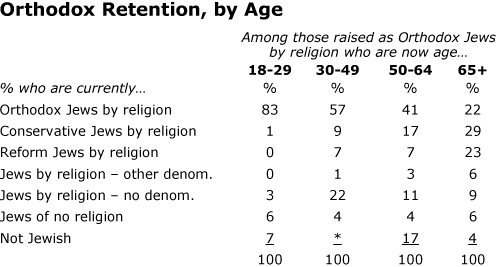
The survey tolls the end of the triumphalist sense of an Orthodox return. The losses from Orthodoxy are several times larger than the gains. The survey finds that approximately one-quarter of people who were raised Orthodox have since become Conservative or Reform Jews, Just 7% of Jews raised in the Reform movement have become Conservative or Orthodox, and just 4% of those raised in Conservative Judaism have become Orthodox. This was despite the millions spent on an army of kiruv workers during those years.

The big news is that 17% of the 20-somethings have left Orthodoxy but a whopping 43% left Orthodoxy from the millennial and gen x generations, and these younger generations were raised after the triumphal rise of a more committed Orthodoxy. Old news was that 59% of the baby boomers raised Orthodox left, but that was a different era when many were non-observant Orthodox to start.

drop-out rate

Rates of intermarriage among Jews are perhaps most directly comparable to rates of intermarriage among other relatively small U.S. religious groups, such as Mormons and Muslims. Same basic statistics no more or less just proportional to our numbers.

One-in-ten Jews identify with Orthodox Judaism (10%), including 6% who belong to Ultra-Orthodox groups and 3% who are Modern Orthodox. This would yield 670, 000 Orthodox Jews. 202, 000 Modern Orthodox, 403, 000 Ultra-Orthodox. (From other studies we have a percentage of over 75% of this Hasidim and less than 25% yeshivish, maybe as low as 16%. The yeshiva world makes much noise for its size.). and we have 101, 000 of other including Sfardim, Edot Hamizrah, Israelis, immigrants from Latin America and the Former Soviet Union who self-identify as Orthodox but not as Modern Orthodox or Ultra-Orthodox.

Here is a shocker. When asked: Can you be Jewish and not believe in God? The following numbers said yes. Notice that Modern Orthodoxy has the least concern for God. (Hashem Yirachem!)
Ultra-Orthodox 50 Modern Orthodox 70 Conservative 56 Reform 66
When asked about their own belief in God as yes, somewhat/unsure, or no, we have 19% of Modern Orthodox as unsure and 3 % as outright deniers.
Ultra-Orthodox 96 , 2, 1,
Modern 77 19 3
Conservative 41, 46, 9
Reform 29, 47, 20

Here is a little tidbit- only 76% of Ultra-Orthodox avoid handling money on Sabbath

Here is another good tidbit when asked whether they attend a non-Jewish religious services at least few times a year, both Modern and ultra Orthodox have 15% that do, but with note that it is negligible in high density area like Brooklyn. So it is much higher than 15 % in small towns.

Should Homosexuality be accepted? Ultra-Orthodox 20% Modern Orthodox 50%. On one hand, this is a divide between the two groups but at the same time a dividing point in the modern camp.

How many went to college? Ultra-Orthodox 25 Modern 65 Conservative 62 Reform 61. Modern Orthodoxy is the highest but in line with the other denominations.

But the biggest and most significant question is do you have household income of $150,000+, placing you in the top 8%. Ultra-Orthodox 24, Modern 37, Conservative 23, Reform 2 9. Modern Orthodoxy is the wealthiest and living in a disproportionate bubble that is wealthier than Reform.

The demographic of Ultra-Orthodox yields only a 4.1 live birth number and if you remove those who leave Orthodoxy and those who die or never produce children, then we have a rough statistic that a statistical couple would only produce three ultra-Orthodox offspring. A far cry from the false numbers in the kiruv literature.

Finally, the Reform movement is growing and the Conservative movement is shrinking rapidly. But the Forward received a wise email from Prof. Sarna.

For Jonathan Sarna, a professor of Jewish studies at Brandies University who also advised the Pew study, the grim statistics facing the Conservative movement could be good for its members. Comparing the movement’s situation to that of the Orthodox movement in the 1950s and the Reform movement in the ’30s, relative lulls preceding large growth, Sarna said that the apparent collapse could force the movement into creative reinvention. It would be “wise to hedge all predictions,”

Go read the report.

Fourth Year of the Blog

This blog celebrated its fourth anniversary this past week during hol ha-moed.  Last year, I forgot to notice the third year milestone.

Over this time the posts have gotten longer and more like articles than short posts. People print and read them as articles. Or they note them and get to them a week or two later.

The original content was to reflect the tension between philosophy and lived religion, hence the title taken from Saadyah was to reflect the tension of philosophy –which Saadyah calls Emunot, things we cognitively accept– and the world of actual lived religion with its sects, personal opinions, and cultural forms- which he calls Deot, things based on character and predilection.

I did less philosophy this year because the discussions and papers about Torah min Hashamayim took a lion’s share of time.  These posts got the blog included on a list of the top fifty blogs on the Bible. I also did less interfaith and parallels to Christianity because the general online world is more aware of the similarities of the Jewish and American Christian world and more aware of how much interfaith encounter, exchange, and discussion goes on even in Orthodoxy, but without the word dialogue.  We had a long run on popular culture and Orthodoxy.

I do not post as much on the current religious recession. Even outreach professional have mainly lost their millenarian triumphalism and are acknowledging the loss and fallout from religion, as well as recognizing how much the community let its image be tarnished.

Currently, my main big project is a book on the Varieties of Modern Orthodoxy 1780-2000, which I hope to shop for publishers in 2015 and publish in 2017. It is on theology and not social history, institutional history, or polemics. It will be based on my 2005 YU course available here- tinyurl.com/4brqh The project has grow much larger than the original course and I have modified the dozen categories in a more narrative approach. I have some other project that I am working on that I will post by the end of Oct.

Those academics and clergy that want an interview about your books or a guest post, then please let me know. I would be glad to oblige qualified people. Please don’t be shy. Everyone has enjoyed the process.

Thank you for your readership. However, if you want to comment, your comment must actually reflect that you needed to read the post to make the comment and you must be a reader of academic works. If that violates your opinion of the world, then this is not the place to hang out.  (Please see the rules for comments.) And because of unscrupulous people, I cannot accept untraceable comments anymore.  I need a real email that can be verified with a fixed IP address (no malinator). I really dont want to have to install a sign-up for comments.

Also dont forget to buy, or have your institution buy, my two recent books Judaism and Other Religions; Judaism and World Religion. or directly from me.

Here are my posts of the past year that received the biggest readership
Conversation with James Kugel about Revelation
Prof Tamar Ross on Revelation and Biblical Criticism
Interview with Prof. Jacob Wright of Emory University
Post-Orthodoxy
Sarah Benor on Orthodox Culture
Interview with Eliyahu Stern author of The Genius: Elijah of Vilna and the Making of Modern Judaism
Prof Brian Klug on Revelation and Torah from Heaven

These posts had many readers but no way near as big as the top 7
Rabbi Soloveitchk on Original Sin
Rabbi David Stav on Popular Culture– Bein HaZmanim
Robert Wuthnow, The God Problem
Conversation with James Kugel- A Follow-Rabbi Immanuel Jakobovits and Christiaan Barnard
Rabbi Yitzchak Meir Morgenstern on Vayishlach: Meditation, Fiery Prayer, Divine in the Material World—Also Some Possible RIETS news.
The new Haredi Hasidism – Zilberstein, Erlanger, Morgenstern, Kluger, and Schwartz
Prof. Joshua Berman Returns for a Follow-Up Interview on Biblical Law
Could Louis Jacobs have been accepted?
Why Maimonides Matters – Kenneth Hart Green- Part I
Peter Schafer responds to Daniel Boyarin.
Orthodox Jewry and the Civil Rights Movement

Most popular of the first three years
Half Shabbos
Interview with David M. Carr- Current state of Bible Scholarship
Cremation and Modern Jewish History
Rabbi Morgenstern and Meditation
Daniel Boyarin and Orthodoxy: An Interview
Arthur Green- Radical Judaism #2 of 5 parts
Aryeh Kaplan: a lost homily from his Iowa pulpit and outreach at SUNY-Albany

Runner-ups of the first three years
The Lubavitcher Rebbe on Transcendental Meditation
Joseph Weiler, traditional Jew, defends the freedom to affix a Crucifix
Is there a Post-Orthodox Judaism that Corresponds to Post Evangelical?
Rav Shagar – Movie tribute to his life and thought
Richard Kearney, Anatheism: Returning to God after God.
Critique of Kugel #1
Arthur Green responds to Daniel Landes
Religion as a Chain of Memory – Daniele Hervieu-Leger
Redemption through Judaism: A Shabbat Guest of Frankist Lineage
Rabbi Riskin declares Christians have entered through revelation into a special relationship with the God of Israel
New unpublished Rav Kook
An Interview with Rabbi Shai Held
Arthur Green- Radical Judaism #1 of 5 posts
Rav Soloveitchik- Religious Definitions of Man and his Social Institutions (1959) Part 3 of 7
Peter Schafer responds to Daniel Boyarin.
Passover Seder Through Muslim Eyes
Rabbi Riskin engages Christians in dialogue about our “United Mission” (updated)Interview with Charlie Buckholtz, co-author of new book with David Hartman
Rabbi Jonathan Sacks- Introductory Speaker for Pope Benedict.
An interview with Professor Samuel Fleischacker
Half-Shabbos goes Viral for Real (Updated)
Herbert Loewe on British Orthodoxy 1915
The new Haredi Hasidism – Zilberstein, Erlanger, Morgenstern, Kluger, and Schwartz
Women, Kabbalat Shabbat and 23 years.
A chat with Rabbi Shlomo Einhorn

Dr. John Connelly at Seton Hall this Sunday

In honor of its sixtieth anniversary the Institute of Judaeo-Christian Studies is hosting the Msgr. John M. Oesterreicher Conference at Seton Hall University on September 22, 2013- This Sunday.
The conference is free and open to the public and will feature a keynote lecture at 3:30 in the Beck rooms by Dr. John Connelly, Professor in the Department of History at the University of California, Berkeley and author of From Enemy to Brother: The Revolution in Catholic Thinking on the Jews, 1933 -1965 (Harvard University Press, 2012),
His talk will be followed by “Reflections” by Gregory Baum, McGill University, Quebec, Canada who together with Cardinal Bea and Msgr.Oesterreicher were instrumental in the creation of the first draft of Nostra Aetate.
There will be closing comments from Rabbi Noam Marans of the AJC.

The day will open with three introductory presentations starting at 1:00PM:
 “John Oesterreicher’s Response to French and Italian Antisemitism” by Cristiana Facchini, University of Bologna, Italy
 “Catholic-Jewish Relations during the Six Day War” by Jason Olson, Brandeis University, Waltham, Massachusetts
 “‘Death of God’ thinkers and Jewish and Christian responses” by Peter H. Greene, University of Notre Dame, Notre Dame, Indiana

Here is an excerpt from the book.
Here John Connelly provides a nice summary of his own book here at the Forward.
The Forward readers asked many questions about the topic of the book and I was asked to respond to their queries here.

Rav Yuval Cherlow composes prayer for the situation in Syria

A group of religious-Zionist Bnei Akiva youth started organized prayers on behalf of Syrian civilians who are at risk due to the ongoing civil war in their country. The prayer initiative, which began with the Bnei Akiva volunteers who are doing a year of national civilian service in Petach Tikva, has now spread. .

While Judaism teaches that any individual can pray to God and be heard, prayers said together as a group can have special power. The young volunteers also wished to have a formal prayer to say, in order to ask for divine mercy with the best possible wording.

They asked Rabbi Yuval Cherlow, a leading figure in the religious-Zionist world and the head of the Petach Tikva hesder yeshiva, to help them find the ideal wording for their request for divine assistance for Syrian civilians.

Rabbi Cherlow suggested that Psalm 37 and Psalm 120 would be particularly appropriate for the occasion. Both psalms speak of the plight of the innocent righteous when evil men plot against them.

Rabbi Cherlow also wrote his own prayer, which is beautifully translated by Elli Sacks of Modi’in (be sure to give Sacks credit). Here is the original Hebrew. Read in English about story here.

Master of the universe, who makes peace on high

Though we are not accustomed to new formal prayers, we can no longer look at the slaughter taking place in Your world and fail to pray about it. Though we know that both sides in the war are guilty of wanton bloodshed, we are unable to keep silent when so many who are beyond the circle of conflict have fallen victim.

We beseech You in prayer to arouse in the killers their basic humanity and evoke mercy in their hearts, that they may recognize that we are all created in the image of God, and that there are limits even to human cruelty. May You bring to pass what is written in Your Torah: “He who sheds the blood of man, by man his blood shall be shed, for in God’s image was man created.”

Grant us the wisdom to know how to act in this hour of distress, when the dark face of humanity’s evil inclination is once again fully exposed and we are unsure how to stand against it. Enable us to act with all our energies to prevent bloodshed in Your world, above all in the Holy Land and its environs, as it is written in Your Torah: “You shall not pollute the land where you are for blood pollutes the land; and the land will not expiate the blood shed upon it, but with the blood of he that shed it.”

May God who makes peace on high, make peace upon us and upon all Israel, and let us say amen.

Orthodox Jewry and the Civil Rights Movement

In honor of the 50th anniversary of the “I have a dream speech,” here are selections from an unpublished BA thesis on the role of Orthodox Jews, Orthodox Rabbis, and YU students in the Civil Rights movement.It is not exhaustive because there were other Orthodox Rabbis such as Danny Landes of Pardes who spent the night in jail.

“Justice, Justice You Will Pursue?” Orthodox Jewry and the Civil Rights Movement, 1954-1970
A Thesis Presented By Lora Rabin Dagi, Bachelor of Arts with Honors, Harvard University, March 2006

On March 21, 1965, Reverend Dr. Martin Luther King, Jr. led thousands of marchers from Selma to Montgomery, Alabama in a political move that would ultimately lead to the Voting Rights Act of 1965. Though Rabbi Dr. Abraham Joshua Heschel’s presence at the front of the crowd has graced photographs of the event ever since, the story of Rabbi Saul Berman’s imprisonment in a Selma jailhouse just days before seems to have drawn a smaller audience.

Rabbi Berman was arrested on the Jewish fast day of Ta’anit Esther, which fell that year on March 17. At nightfall, when the fast ended, Rabbi Berman was not able to break his fast on prison food, for it did not meet traditional Jewish dietary restrictions; a friend rummaged through Rabbi Berman’s suitcase and brought back the salami upon which Rabbi Berman was hoping to break fast. This friend also found another cylindrical item in the suitcase – a scroll containing the text of Megillat Esther, the tale of a Jewish girl who became queen of a massive kingdom and saved her people from certain destruction. Both the salami and the Megillat Esther proved to be of great use to Rabbi Berman: having broken the fast, Rabbi Berman celebrated Purim, a holiday commemorating the story of Megillat Esther, by reading the scroll out loud to “about 250 people” crowded into the jail. One can imagine the power reverberating throughout the room as a young Orthodox rabbi, far from his congregation, read an ancient narrative recounting the deeds of a Jewish queen who saved her people from an enemy within the government – a story that could easily resonate with a group of people hoping to save blacks from their own government’s voter registration prejudices.

Just two years before, rabbinical degree in hand, Rabbi Berman arrived in Berkeley, California ready to work at Congregation Beth Israel. For the five years he served there, Rabbi Berman worked to better the rights of blacks in Berkeley and beyond. He returned to Berkeley after the 1965 Selma-Montgomery March determined to become more engaged with local civil rights politics. Though Berkeley’s high school was integrated, its lower education public school district lines were drawn in a way that separated white and non-white students. According to Rabbi Berman, two opposing forces were at work at once: one group wished to redraw the school lines so as to integrate the lower schools, while another group hoped to create a second high school that would essentially keep students segregated. Rabbi Berman primarily toiled to integrate the schools, though the community agenda additionally dealt with issues of free speech and, ultimately, the Vietnam War.

Rabbi Berman’s case, though not the norm for the majority of Orthodox Jews in America, is by no means unique. Rabbis and some Orthodox laymen throughout the United States of America not only endorsed the Civil Rights Movement, but also worked to end racism against blacks

Rabbi Berman’s colleague in New York, Rabbi Irving (Yitz) Greenberg, also contributed to the Civil Rights Movement. Along with his wife, Rabbi Greenberg first supported the Movement through donations to “various civil rights groups and voting for candidates that were sympathetic to the [Movement];” soon, the two were “attending rallies or special demonstrations” for the improvement of the status of blacks in American society. As a faculty member at Yeshiva University, a Modern Orthodox institution in New York City, Rabbi Greenberg took the opportunity to bring in speakers who discussed various aspects of the Civil Rights Movement. As a rabbi of the Riverdale Jewish Center, an Orthodox congregation, Rabbi Greenberg “spoke passionately” about the Movement’s necessity.

Finally, Rabbi Greenberg involved himself in HaTza’ad HaRishon, a controversial and ultimately unsuccessful group founded for the benefit of so-called black Jews. Certain American communities of blacks were presenting themselves as Jews, though the Orthodox community did not accept them as such. For instance, the Commandment Keepers Congregation of the Living God, based in Harlem, NY, identified itself as a sect of Judaism, though petition for institutional acceptance failed. Established in 1964, HaTza’ad HaRishon, or “The First Step,” hoped “to serve the Jewish social, cultural, and educational needs of New York’s Israelites, to unify their communities, and to integrate Black Jews into…mainstream” Judaism. It funded and organized social gatherings, Israeli dancing, “activities with other [white] Jewish youth groups,” prayer events, financial aid and placement in Jewish schools, educational discussion-based seminars, and edifying liaisons to white Jews who would discuss the existence of black Jewish communities. In addition, the group provided access to Orthodox conversion resources, should its members desire to ensure their full acceptance by all parts of the Jewish community. Ultimately, between incredibly charged questions of Jewish legitimacy, authority, and conversion, this group collapsed. HaTza’ad HaRishon, though not the norm, represents both the race-blind aspect of Jewish conversion, and the fact that at least some Orthodox Jews did not view blacks through the lens of ‘absolute other.’

In New York, Rabbi Greenberg was joined by the young Tsvi Blanchard, not yet a rabbi. Rabbi Blanchard was heavily involved by the late 1950s, and continued to take part in the Movement until the year after the 1965 Selma-Montgomery March. Splitting his time between college and yeshiva (a traditional Jewish institution of learning) in St. Louis, Rabbi Blanchard worked hard in Missouri and around his home in Rochester, New York to further the Movement’s goals. In St. Louis, he “was involved in redeveloping areas of the black ghetto.” In addition, Rabbi Blanchard participated in the boycotting and picketing of Woolworth’s and Eastman Kodak. The Woolworth’s story is fairly well known: in 1960, four black students started a sit-in at a Greensboro Woolworth’s to protest segregated seating; within weeks, the “Greensboro four” had inspired sit-ins and picketings across the country. In contrast, the Eastman Kodak narrative dealt with employment issues: Rabbi Blanchard joined Saul Alinsky, community organizer extraordinaire, to challenge Rochester’s Eastman Kodak to hire more black workers. At the same time, Rabbi Blanchard involved himself in “a whole series of various and sundry picketings of racist speakers,” and supported “black self-organization efforts” such as those surrounding the Kodak protest. The Selma-Montgomery March both highlights and marks the final stage of Rabbi Blanchard’s activity in this paper’s time period.

Even the South, homeland of the Jim Crow laws and their overt supporters, hosted at least two Orthodox rabbis who quietly worked to promote the message of the Civil Rights Movement. One rabbi from Atlanta chooses to remain anonymous, but writes that he participated casually throughout the time period; for instance, he would occasionally deliver sermons supportive of the Movement. At times he would host observant Jewish activists who had recently been released from jails in Atlanta, Birmingham, Montgomery and elsewhere. Finally, this rabbi took part in “informal discussion groups” on the matter. Another Southern rabbi, Rabbi Louis Tuchman of Durham, North Carolina, followed a similar pattern. Though his congregation hired him specifically because he was not a Civil Rights activist, Rabbi Tuchman was preaching pro-integration by 1957. He specifically incorporated the themes of freedom during the Jewish Purim and Hannukah holidays, relating the holidays to the black quest for full integration. Unfortunately for Rabbi Tuchman, that same year his congregation moved to the suburbs and to Conservative Judaism.

Rabbi Tuchman and his anonymous colleague in Atlanta deserve special recognition for their work. According to Mark Bauman, fewer than forty Orthodox rabbis served congregations in the South in 1954. The states of “Alabama, Arkansas, Kentucky, North Carolina, and Mississippi…claimed a total of three Orthodox rabbis,” and no Orthodox rabbis served Florida communities apart from those in Miami and Miami Beach. Bauman posits that the “limited” involvement of Orthodox rabbis in the South corresponds to the small number of Orthodox rabbis actually present. This theory relies upon only one incidence of Orthodox involvement noted in his book’s collection; however, one cannot ignore the fact that some forms of informal involvement may prove quite difficult to trace. For instance, more than one or two Orthodox rabbis may have presented this controversial topic to their congregants through holiday sermons. Since participation in the Civil Rights Movement can include actions outside of a certain model of 1960s volunteering, the judgment of ‘limited’ involvement may be based upon somewhat incomplete evidence.

Some, such as Chicago’s Rabbi Ahron Soloveichik, were better known; this leading Orthodox scholar passionately discussed the basis for equality in halakhah in the keynote address at a national convention for Orthodox affiliate Young Israel.
By 1964, supposedly motivated by competition for “allegiance of the young” liberals flocking to Conservative and Reform denominations, the Rabbinical Council of America publicly declared its support for the Civil Rights Movement. Young Israel, another Orthodox group, had already backed the Movement in a 1962 editorial. The Orthodox Union, in turn, preceded Young Israel by agreeing with a “strongly liberal” plan for “civil rights and civil liberties” in the 1950s, and it continued to support the “civil rights gains of blacks” throughout the 1960s.

Yeshiva University Students: The Civil Rights Movement and Other Priorities

Without question, YU students actively discussed the Civil Rights Movement, though not necessarily right away. The record for the 1950s is largely silent on the matter, and aside from late-night dorm-room conversations and a short editorial despairing over the bigotry extant at the University of Alabama, there may not have been much debate over the plight of blacks in America. However, analysis of student publications shows that by the beginning of the 1960s, students often discussed and educated themselves about the Movement. For instance, in 1961, Stern students listened to a Nigerian leader maintain the need for blacks and whites to work together. They later had the opportunity to hear the administrative assistant of the NAACP’s Executive Secretary speak about the history, purpose, methods, and goals of that prominent organization. In 1964, the YC Yavneh, an “Orthodox Jewish students organization,” hosted a panel on the Civil Rights Movement.

An entire supplementary edition of The Observer was dedicated to questions on the causes of black rioting, theoretical solutions to help alleviate racial tension, comparisons between blacks and Jews in the United States, and comparisons between blacks and Israeli-Arabs. In fact, from 1967 onwards, black rioting and episodes of black anti-Semitism clearly affected the rhetoric on campus. Musing over the previous summer’s black riots, one YC student wondered whether there was any possibility of calming the revolts. The editor of HaMevaser, the “official student publication of the religious divisions” of YU, acknowledged that SNCC had rejected Jews, yet felt that “a true religious person” could not blame all blacks for the actions of SNCC and its partners. Another Observer supplementary edition addressed issues of Black Power, Jewish racism, Jewish withdrawal from the black-Jewish dialogue, and black anti-Semitism. That same month, the grassroots campus publication Pulse published an author who was discouraged with the fact that black rioting and anti-Semitism had led some Jews to equate the push for black equality with extreme violence and fear, and thus to unsettling memories of the Holocaust. Rather than step away from American black society, this author hoped to encourage interracial discourse and the dissolution of negative black stereotypes among Jews. Still another student, disgusted with the turn of events, claimed that the Civil Rights Movement had generated a “Frankenstein” of violent militants.

YU students did not simply discuss the Civil Rights Movement; they also actively pursued its goals. For example, in 1960, YU was a member of the Metropolitan Students for Non-Violent Civil Rights Action, and YU students protested Woolworth’s Southern lunch counter policies by picketing and distributing leaflets in front of a New York branch. The next year, YU students started a tutoring program in a local public school; this program served as a model for other colleges. One wholeheartedly dedicated Stern student published her memoirs of the March on Washington, where Reverend Dr. Martin Luther King, Jr. gave his famous “I Have a Dream” speech; she later reported on a Washington, D.C. conference on apartheid, Southern segregation, and Northern discrimination. This student soon worked with other Yavneh leaders to organize a “mass boycott of New York City public schools,” in which Yavneh members taught freedom schools and picketed throughout Harlem and Washington Heights. In fact, YU even donated the use of one of its buildings for the endeavor. By the late 1960s, over 100 YC students were tutoring through the Yeshiva University Neighborhood Youth Corps (YUNYC), and SC started its own version of the same.

YU as an institution encouraged a positive perspective on the Civil Rights Movement. In 1961, it awarded an “honorary Doctor of Laws degree” to Chief Justice Earl Warren, who was quite influential in the 1954 vote to end segregation.

In addition, its medical school application did not ask for a photograph, and thus had color-blind admissions. This fact is noteworthy in a country whose medical schools were not fully open to blacks until 1966. Starting in 1969, the medical school’s King-Kennedy Medical Program subsidized lower-income blacks as they prepared their pre-medical curriculum, so that they could later improve medical care in their ghetto communities. That same year, a black Jewish YC freshman discussed his identity in The Commentator; clearly, a black Jewish student in the College was not only tolerated, but openly accepted.
Though the institution seems to have acknowledged certain values of the Civil Rights Movement, a vocal group also begged its contemporaries to work with caution. For instance, one student responding to the Woolworth’s protest unashamedly critiqued the Student Council for officially backing the picketing: because of this backing, the Student Council had turned YU students into unwilling representatives of all East-coast Jews. Rabbi Lichtenstein, a major figure in the school, felt that Orthodoxy’s slow response to issues such as the Civil Rights Movement was due to an appropriate sense of prudence; still others felt YU could not afford to critique society publicly when it was just proving the possibility of living religiously and functioning fully within America.

Yet another group of students may not have formulated extensive opinions on the Civil Rights Movement at all. Throughout the timeframe, The Commentator and The Observer published articles scorning the supposedly commonplace apathetic student lifestyle. Whether deriding the student body for voting half-heartedly, if at all, in the Student Council elections, or simply condemning students for displaying “indifference” towards non-academic activities, student leaders at SC and YC despaired over the seemingly “contagious” apathy displayed by their classmates. This laziness does not necessarily point to an entire generation of bookworms.

In May of 1961, The Observer reported that nearly half the graduating class was already married, and two women had already borne children. Interest in femininity encouraged the young women to bring a special instructor on “posture, hair care, make-up, and fashion” to the school three times during the 1963 to 1964 school year.

David b. Joshua Maimonides’s use of Suhrawardi’s Sufi idea of attentive Illumination—-courtesy of Prof. Paul Fenton

People seemed to like the Jewish- Derwish photo from 1922 but there is much more Jewish-Sufism out there, even beyond Bahye or Avraham b. Maimonides. The scholarship for the last half century on the family of Moses Maimonides has produced a new shelf of books in halakhah, letters, exegesis, and Sufism. And we have works by those who followed them or asked them questions. Those who published the material are publishing the texts for the first time from manuscript and are dedicated to editing other manuscripts. Currently, there is no synthetic work bringing all this data together in order to provide a narrative of the 250 years of Egyptian Jewish intellectual life after Maimonides.

Here is a text David ben Joshua Maimonides or ibn Maimoni, that would be 1) Maimonides 2) son- Abraham (Nagid) 3) 3rd generationDavid (Nagid), Obadia (The Treatise of the Pool) 4) 4th generation Abraham 5) fifth generation Moshe (Nagid),Joshua (Nagid), and finally 6) six generation David (Nagid) 14th-15th century).

David (b. ~1335), succeeded his father Joshua Nagid of the Egyptian community in 1355, being the last of the Maimonidean dynasty to have held this office. David left Egypt and took up residence in Syria for a number of years (ca. 1375-1386), in the cities of Aleppo and Damascus. During this period he continued, however, to be known and revered as “David ha-Nagid, head of the Yeshivah.”Nagid David’s wrote a commentary on his great great grandfather Maimonides’ Mishneh Torah in Judeo-Arabic. “The commentary is preceded by two laudatory poems in honor of Ibn Sina and another celebrating the virtues of Awhad al-Zaman (al-Baghdadi).”

Nagid David’s Al-Murshid ila al-Tafarrud wa-l-Murfid ila al-Tajarrud, was translated by Fenton into Hebrew as Maqalat fi derek ha’Chasidut, and also into French. The work guides the individual through the“spiritual stations to the exalted plane of Chasidut;” “it is the spiritual itinerary of the devotee which culminates in prophetical gnosis.” This work, Fenton explains, is “thoroughly imbued with Sufi ideology and terminology.” Finally, we see amongst the vast library of works attribute to Nagid David, that the work of Ibn al-`Arif (1088 – 1141) is cited as part of the collection of his copyings. In the Cairo Geniza shows from the numerous copies the famous Sufi Al-Hallaj (c. 858 – 922) and the writings of ibn al Arabi. A Genizah letter addressed and answered by Nagid David tells of Jews attending the meditation and zhikr (Heb: hazkarah) retreats of Sufi Shaykh Yusuf al-`Ajami al-Qurani (d. 1367), who supervised a zawiya hermitage on the Qarafa as-sugra Muslim cemetery east of Cairo. For more, see Fenton, Paul B.. “The Literary Legacy of David ben Joshua, Last of the Maimonidean Negadim.” The Jewish Quarterly Review 75, 1 (1984): 1-56.

Now here is a quote from Nagid David when he developed a Jewish-Sufi version of Suhrawardi’s concept of illumination through luminous intuitions, divine sparks, and mental flashes. This state is attained through constant contemplation, intense remembrance of God, and diminution of food and sleep. Thereupon, these lights shine upon his pure heart and an irradiance awakens an inner desire to receive this divine blaze and angelic flashes. For more on Persian mystic Suhrawardi (1151-1191)- see a website dedicated to him here, and Stanford E of P here and wiki here. And for those looking for Tishrei reading- here. We dont have a photograph of Nagid David in his Dervish clothes.

Of the first station [of the spiritual path] which is that of illumination (zehîrût).

The Hebrew term zehîrût (‘meticulousness’) can have two meanings. Firstly, it can signify ‘scrupulousness’, through striving to reach the goal by deploying painstaking efforts or by abandoning thoughtlessness and renouncing a life of leisure.
Secondly, it can signify ‘enlightenment’ as in the expressions of brightness (zôhar) in the verses ‘The Enlightened will shine as brightness of the firmament’ (Dan. 12:3), and ‘brightness as the colour of amber’ (Ezek. 8:2). Hence the term zehîrût designates illumination and the individual who reaches this station is called zâhîr or ‘illuminate’. The latter refers to the seeker of the soul’s enlightenment and the spirit’s illumination through luminous intuitions, divine sparks, and mental flashes.

This [state] comes about through constant contemplation of the angelic world, intense remembrance of God, subtle meditation of the world of sanctity, and diminution of food and sleep. Thereupon, these lights shine upon his pure heart in accordance with his progress through the successive stages and stations, each more noble and exalted than its predecessor.
For spiritual effort and illumination lead to further enlightenment and irradiance, awakening an inner desire to receive this holy effulgence, divine blaze and angelic flashes, and inciting the individual to prepare himself for their encounter. Each arousal is conducive to illumination and each illumination is conducive to further arousal. On this account our Sages stated: ‘illumination leads to zeal’ (TB ‘Abodâh Zârâh 20b), i.e. this station is conducive to the following one.

Commentary
The present text is a translation from the Judaeo-Arabic work al-Murshid ila t-tajarrud or ‘Guide to Detachment’ by David b. Joshua Maimonides (Egypt circa 1335-1410), last known nagîd (community leader) belonging to the famous Maimonides’ dynasty. The Guide to Detachment is a practical manual for the spiritual life divided into progressive stages based on the Talmudic dictum by R. Phineas b. Ya’ir : “Study leads to meticulousness, meticulousness leads to zeal, zeal leads to cleanliness, cleanliness leads to restraint, restraint leads to purity, purity leads to holiness, holiness leads to meekness, meekness leads to fear of sin, fear of sin leads to saintliness, saintliness leads to the holy spirit, the holy spirit leads to life eternal. Saintliness is the greatest of all of these” (TB ‘Abôdâh Zârâh 20b). The author construes these principles as the stages of the spiritual path or ladder of ascension similar to those found in Sufi manuals.

In this opening chapter, he specifies the prerequisites necessary to embarking upon the spiritual path. Having already discussed the initial prerequisite of knowledge, for ‘the ignorant cannot be pious’ (Aboth 2, 6), David Maimonides presents a very original interpretation of the term zehîrût (‘meticulousness’). In addition to its classical meaning of the ‘attentiveness’ which stems from knowledge, he lends it the sense of ‘enlightenment’. Interestingly, he uses as a locus probans the verse used in the opening passage of the Zohar, of ‘Book of Brightness’! However, David’s inspiration here is not Kabbalistic but Sufic, ultimately deriving from the ishrâqî or ‘illuminative’ spirituality of Suhrawardi (executed in 1191), for whom progress in speculative knowledge and spiritual illumination are intimately bound. Thus the starting point of spiritual awareness is a spark, an illumination which serves as a catalyser for the quest. This spark results from a meditative attitude – ‘constant contemplation of the angelic world’, ‘intense remembrance of God’, ‘subtle meditation of the world of sanctity’, – coupled with a corporeal discipline involving the reducing of one’s physical needs such as food and sleep.

Taken from here at the Elijah School

Jewish Sufi Dervishes 1922

jewish dervishes
Jewish dervishes Agha-Jaan Darvish and his brother, patriarchs of the Darvish family. Tehran, Iran, c.1922.

“Because of its specific association with Sufism and its ensuing identification with Islam, dervishhood is an order comprised almost exclusively of Muslim practitioners.
The two Jewish dervishes pictured here in this rare photograph are among the very few who had successfully been integrated into the order without converting to Islam.
Like the Jewish practitioners of a traditional Iranian sport in the houses of strength (zurkhaneh) — a sport that is profoundly intertwined with Islamic ritual — these dervishes represent a uniquely Iranian hybrid of Judaism and Islam.

Each of the Jewish dervishes seen here is displaying emblematic accouterments of dervishhood:
1) The cloak, an outward sign of his state.
2) A kashkul (begging bowl) often made of such materials as mother-of-pearl.
3) A gourd, a coconut shell, or carved wood suspended from the wrist by a chain.
4) A tabarzin (short axe or hatchet) carried in the right hand and intended to fend off wild animals or highway robbers.
5) A chanta (patched bag) slung over the shoulder to carry essential items.
6) Takht-e pust (skin bed), a small mat made of animal skin that served as his bed while traveling.
7) A long rosary.”

Photograph and caption from Esther’s Children: A Portrait of Iranian Jews, edited by Houman Sarshar.

For more on the Iranian Sufi orders, see here and here
For more pictures from Sufis from the era – here.

h/t touba.tumblr

رویش های ایرانی یهودی، تهران ۱۹۲۲
به دلیل رابطه تصوف با درویشگری و عجین بودن آن با اسلام، درویش بودن به نوعی مختص مسلمانان بود. در این عکس نادر، دو یهودی که با حفظ مذهب خود به خرقه ی دراویش درآمده اند به نمایش گذاشته شده

Datlash & Hardal according to Rav Shagar

Recently, the committee publishing the works of Rav Shagar z”l published a collection of Rav Shagar’s writings on post-modernity in a volume called Luhot veShivrei Luhot (2013). The essays were given as talks during the last five years of Shagar’s life and appeared in various out of the way conference proceedings or Religious Zionist journals. I am still processing the other essays which directly relate to theology however, there was a free-standing essay given at Maaleh Film School in 2007 which deals with those who are leaving observance and becoming DATLASH, a Hebrew acronym whose initials stand for dati le’she’avar (formerly religious).

Rav Shagar blames the parents and the establishment as opposed to those younger members who become Datlash and disassociate with Religious Zionism as he believes the latter has no choice in separating. Referring exclusively to Israel, he sees the generation of 1950s grandparents as having a tepid religion as part of their Mizrachi Relgious Zionsim. The children in the 1970s rebelled by creating the dedicated religious world of the Hesder Yeshiva, where everything was from derived directly the Book which thereby negated the living familial and communal religion. The grandchildren, having grown up with the sterile world of Judaism by the Book, were left with two choices: either increase the ritual obsession through becoming Hardal or give up the sterile religion by becoming DATLASH. Surprisingly, Rav Shagar thinks that Hardal is a relinquishment of the Relgious Zionist project of openness and fulfillment in the real world, while Datlash is a return to a basic sense of religion.

luhot

Rav Shagar opens and closes the essay acknowledging that while a child who chooses a datlash life brings immense pain to the parents, the older generation is to blame. The essay encompasses numerous cultural references to movies, TV, books that I am leaving out for my readers who have not seen the Maaleh films of the late 1990s. But it is nonetheless noteworthy that the Hardal world considers the world of movies and popular culture as forbidden, yet he used them for his teaching.(for more see, my review of Rabbi Stav.)

Rav Shagar cites a study by Mordechai Barlev (1998) on the graduates of religious Zionist high schools and their leaving religion. Unlike the rejection of religion to become a secular Israeli (hiloni) of prior generation, here the problem is the influence of the modern world on religious youth.

BarLev notes a phenomenon of “inner secularization” on some of the youth even though they stayed in the religious Zionist world. They didn’t change their manner of dress or take off kippah, rather they live lives that are secular in existence and secular in cultural. Even if the high school graduate does not watch TV on Shabbat and even if he goes to shul, the spirit and focus of his Shabbat is still a Shabbat of newspapers and secular books like his secular neighbor. If we compare these religious Zionist youth to a mesorati home that is traditional but not-religious in which they light candles and makes Kiddush, one finds there is little difference in their life. These graduates are now called dati-lite

Rav Shagar discusses two recent films. In the first movie, a widow has three daughters, one datlash, one Hardal, and one dati-lite. Shagar blames the old-time Mizrachi world for not giving enough emphasis to Torah or religion. (AB- the recently deceased reform Rabbi Herbert Wiener made a similar point in 1964 when he visited the land of Israel expecting to find a religious revival and instead found little interest in religion.)

The Second movie is focuses on a rabbinical father, a member of the Gush Emunim settlement movement who was also part of the religious revival that came in the 1980s. The father is portrayed as dogmatic and rigid, therefore his son rebels. The symbolism of the movie is setting a dog free on Yom haAtzmaut to show the need for greater freedom and naturalism in Religious Zionism.

Rav Shagar asks: What is nature of becoming secular (hilon) today? Our secular concepts of today are not those of once upon a time; the politics of today are not the Marxist politics of yesteryear. The new generation is something new, they are datlash. Today, unlike in the 1950s, one is not simply becoming secular from a loss of faith, an inability to believe in God, or even in the face of enticements or opportunities in secular world. It is just that religious Zionism is not relevant anymore in the lives of formerly Zionist youth; what we can see from the rise in datish is that religion slowly and reticently falls away. It is a social problem in which religion fell away from real experience.
The Hesder Religious Zionist World is a community of arbitrating and evaluation every action because lives are to be conducted and lived by the book. Even lived faith and religiosity has loss all spontaneity in one’s quest to do what the book says.

Today, according to Rabbi Shagar, we have lost all connection between the living voice of the prophets and the proclaimed political messianic age. The vision of Rav Kook once sustained the yishuv; now religion is an ideology. Some flee from it and others embrace the extra stringencies and obsession with modesty. Datlash and hardal are two sides of the same problem. The Hardal will end religious Zionism and the datlah only see part of the problem.

How are the hardalnikim different than the classical becoming haredi? In the Torani community of Hardal, there is an avoidance of learning the secular attributes and the former become artificially rigid and dogmatic to fight the secular. Since fighting the secular does not come to them naturally because of their open upbringing they create new rigid position on practices like modesty. For Rav Shagar, this creates a contradiction between the openness at the core of the religious Zionist project and Hardal isolation, sectarianism, and dogmatism

Rav Kook spoke of a revolution, a Torat Eretz Yisrael, based on hagshamah (working the land), and today, we need to seek new values beyond the Shtible. Now religious Zionism became dogmatic, frozen, and uprooted from life. The artificial strictness causes its younger members to flee.

The secular and religious are in continuity since most datlash are still connected to their religious home and upbringing. They form their own enclaves. Religion (Dat) is part of the name and very essence of datlash. The ex-religious group remains religious in social group yet give up belief and practice; however, members do not become completely secular like the 1950s.- Therefore there is continuity between religion and secular. The continuity is also found among the dati-lite who keep the social norms of kippah and synagogue even if they don’t pray or daven daily or say blessings. The difference of the two groups Datlash and Dati-lite is watching a movie on Friday night TV or the occasional travel on Shabbat.

However, the real definition and distinction is self-identification. Rav Moshe Tzvi Neriah said about the earlier secularization, “I worry more when a boy takes off his kippah than when he stops putting on tefillin.” It is all a self-identification. The psychological differences are great even if tefillin is from the Torah and kippah is only a custom. The former is a loss of identification while the latter is only laziness.

The datlash has no sense of victory or a new era or triumph; they know the grass is not completely greener on the secular side. There is a loss of religious identity more than a loss of halakhic observance (compared to the Dati-lite). This loss of identity is not just existential but also shown in body and society. There is a willingness to take off clothes in street, such as removal of a polo shirt which never done by a religious Zionist guy even if not technically forbidden. A datlash is not a removal of mizvot as much as a removal of restrictions. It is also the loss of connection to religious Zionist community. There is a removal of God and holiness from their frame of reference. For the sake of heaven (leshem shamayim) and sanctifying the physical as taught in religious Zionism is now seen as obsessive, rather than uplifting. Hardal is as oppressive as the Haredi society, and both think mizvot are the entire purpose of life.

Rav Shagar says that light and dark are mixed in the lives of the datlash. Their throwing off the yoke gets them more in touch with life. They are now paradoxically secular but with a connection to religion. They are creating secular study halls or traveling on Shabbat to study midrash and hasidut. As it says: “It is better that they leave me but keep my Torah.” They are Datlash because they found the prior generation lacking and regain connection and identification with Torah, paradoxically by leaving. They need to leave to find holiness and cleaving to God.

Datlashim are still in the margins of the religious Zionist community. They want a more fluid and softer religion – they want traditionalism – they want the soul of mizvot without the imposed unnatural rigor imposed by the yeshivot. n Yeshiva, we were taught to mock and disregard traditionalism and to reject our parents and their actions. For Yeshiva, baal batish- if it was not based on text was to be avoided. For Rav Shagar, the traditionalism was in many ways much better than the Hardal approach. Traditionalism has the soul of a lived religion, a lived chain of tradition. For Rav Shagar, “even though I think we need to keep every detail in the Shulkhan Arukh- it is the traditionalism that is the soul of the Shulkhan Arukh.”
Datlash is in some ways more advanced or a more vanguard approach tothe religious Zionists community, one that lost its roots. The observance of the Datlash after they separate from Relgious Zionism is in some ways more connected to Torah and mizvot. Rav Shagar sees hope in them and their children for the true holy rebellion.

There is much in this Israeli perspective that is different from the United States- on post-Orthodoxy-see here. Also in Israel, I must point out that there is an unpublished Hebrew PhD by Ari Engelberg that shows that indeed datlash is empirically a new group between religious and secular. His research shows that the historicity of the Torah does not play a big role for them. The Datlash have a new age holistic sense of religion, not in continuity with their former particularistic providential God of Yehudah Halevi and Rav Kook. Rav Shagar elsewhere in this book shares sympathy with a more universal holistic sense of God that he calls post-modern, but we will discuss that in a future post (or for those who live in Bergen county there will be a hug bayit on the sefer at my place Shabbat 5:45 for the next 5 shabbatot, excluding YK-contact offline).

Interview with Prof. Jacob Wright of Emory University

I am amazed that the current discussion about the academic study of the Bible is so uninformed on both sides. Somebody out there must not have read my interview with David Carr, or even tried to read his book.

As background, the problems of the Bible go back to the tenth and eleventh century Islamic critiques of the Bible by Ibn Hazm and others. Second, modern figures such as Spinoza and Jean Astruc sought to understand the Bible as a human book using the same tools that we use to understand Greek and Roman books. And in the 19th century, Wellhausen popularized a theory that the Pentateuch had four authors. But the important part of his theory was that the ritual and priestly material was a priestly Pharisaic digression from the original pure faith of the prophets necessitating Christianity for a restoration. Hence, Solomon Schechter called it higher anti-Semitism, David Zvi Hoffman showed that Leviticus is not in contradiction to the rest of the story, Kaufman showed that the prophets assumed the priestly material, and Cassuto showed based on Sumerian and Akkadian sources that the divisions fail.

Well, Wellhausen was writing a century ago, with the aforementioned defenses all formulated in a post WWI climate. For at least forty years the field was already given to authors such as Gunkel who assumes the Bible is legend, the way Gilgamesh is legend. And Martin Noth who assumed most of the narrative was formulated originally as oral traditions- read here. Questions of redaction were not tied to Wellhausen, or even literary documents, but to oral traditions.

What do historians currently think about the context of the Bible? They assume that it was written between 720 BCE and 587 BCE, between the destruction of the Northern Kingdom destruction of Jerusalem, with some editing until the end of Ezra’s life circa 440 BCE. (Minimalists make it more recent and Evangelicals defend the chronological dates.) They work from parallels to Assyrian texts, the nature of script, linguistics, and reconstructed context of author. Little of this has anything to do with literary doublets. If you want to reject historical criticism, then start learning ancient linguistics and texts contemporary to the Bible. No harmonization of passages changes this dating nor does anything from Cassutto or Hoffman affect it. (However, Prof. Josh Berman is seeking to shift the discussion from Assyrians to the Hittites in 1300 BCE, an effort that may be accepted by the Orthodox but does not promise to have much of an impact on the experts. But it is better than refuting Kugel, who is not a historian of ancient Israel or source critic so the critique does not help.)

This past May there was a major conference at Hebrew University on “Convergence and Divergence in Pentateuchal Theory;” if you are interested in these topics, then that was the place to be. The conference opened up with a clear statement that there are three approaches: a Documentary approach (not based on Wellhausen but on Noth and others) where there are separate documents; a Supplementary approach, where a single document get more and more complex; and a Fragmentary approach, where we cannot separate out authors or layers anymore.

Finally returning to Cassuto, he may have rejected Wellhausen but he accepted historical context, showing that all the numbers and genealogies in Genesis do not correspond to ages and events, rather are stylized number, ten generations, twelve children. He does this by reading the ancient parallels to the Biblical story.

With this background, our blog is delighted to welcome Dr. Jacob L. Wright of Emory University, Associate Professor of Hebrew Bible at Emory University’s Candler School of Theology and the Director of Graduate Studies in Emory’s Tam Institute of Jewish Studies. Wright is considered to be one of the most perspicacious interpreters of biblical literature working in the field today. His first book, Rebuilding Identity: The Nehemiah Memoir and Its Earliest Readers, was awarded a Templeton prize for the best first books in religion and theology. (I hope to have a follow-up post where he describes this book and his forthcoming one.) His bio was covered here at theTorah.com.

Wright is a member of a Young Israel congregation:

I’m a member of a Modern Orthodox shul (Young Israel of Toco Hills), and I usually reveal to my audience—whether it be during a shiur or at a Shabbat meal—how various biblical scholars think about the problems posed by the text. Indeed, I think it is condescending and disingenuous not to be forthright in this regard. In my experience, most observant Jews are eager to learn about the fascinating research conducted in biblical studies.

At Emory, Wright has supervised the dissertation of Rabbi Zev Farber who wrote on the traditions behind the book of Joshua.

Wright studied under Prof. Reinhard G.Kratz, who wrote The Composition of the Narrative Books of the Old Testament. Kratz argues that there are long narratives but that they do not coincide with the conventional sources and that they were heavily supplemented.(Since the dating is already assumed to be late, the Orthodox apologists are only proving a later single strong editorial hand when they resolve contradictions.)

1) Why is Cassuto irrelevant for current Biblical historians?
Cassuto’s book, The Documentary Hypothesis and the Formation of the Pentateuch, is a work that many Orthodox Jews read as a response to biblical “higher criticism.” Its value for scholars in biblical studies is however quite limited: The work may contain several valuable insights, but when scholars consult it today, it is primarily from the perspective of the history of research.
Why isn’t it a standard work? There are two basic reasons:

First, most of us in the field are completely convinced that the Torah, and with it, the rest of the Tanakh, is a work of many generations of authors. There are not many points of consensus in biblical studies, but this is certainly one. If, for one reason or another, you’re not willing to accept the Pentateuch’s multi-authorship as a PhD student, you will usually choose a topic that is safe from engagement with these historical concerns.

Second, Cassuto’s book responds to a view of the Pentateuch’s origins that many working in the field today would not embrace. Most have long rejected some of the basic tenets of the Documentary Hypothesis, with its demarcation of four continuous sources and its understanding of Israel’s history that underpins the whole theory.

Some scholars still defend the theory. And many who do are American Jews. The reason why is because the epicenter of research on the Bible’s composition history remains in Continental Europe. Scholars there work with fundamentally different premises from those informing the classical Documentary Hypothesis and comes to much different conclusions from the ones Cassuto has in view in his critique.

So what does this all mean for us? If you read Cassuto as a response to “critical biblical scholarship,” find it all convincing, and then conclude that it’s perfectly reasonable to assume to date the Torah to the time of Moses, you have failed to come to terms with the way that leading scholars for the past three decades have thought about the Torah’s prehistory.

2) Why is the Pentateuch basically ascribed by scholars to the 8th to 6th centuries?
When we trace the Pentateuch’s/Torah’s origins to these centuries, we mean that many of its constituent components were put into writing at this time. These components include the stories of the Patriarchs/Matriarch cycles, the Joseph Novella, the Exodus-Conquest account, and the cores of the law codes (Deuteronomic Code, Holiness Code, and much of the Priestly legislation). The Torah continued to undergo revisions (many of which were quite significant) for the next couple of centuries.
Some of the Torah’s contents may predate these centuries. It seems quite possible that rudimentary legends of the Patriarchs/Matriarchs, of Moses, of Miriam, of Joshua, etc., as well as many of the laws (especially in the so-called Covenant Code) are older than the 8th century.

Why would the basic features of the Torah have assumed literary shape from the late 8th century and thereafter? It is because this is when the states of Israel and Judah faced momentous political challenges.
The Assyrian armies conquered the kingdom of Israel in 722 BCE. The earliest biblical authors realized that if Israel were to survive this political catastrophe, it would be in a new form: as a people without a king. Now the kings of Israel may have been the ones who originally promulgated accounts of Yhwh’s great deeds, such as the Exodus story. After all, Israel’s kings would have seen themselves as the representatives of the state’s chief deity, as was the case in directly neighboring lands. Yet what sets the pace for the formation of the biblical tradition is a demotion of the king and a shift of attention to the people as a whole (“all Israel”) under the aegis of its God. Judahite authors, already before their subjugation to Babylon in 587 BCE, inherit this “demotic” project from Israel.

The Torah is the beginning of a longer history (stretching from Breishit to Melakhim) that tells how Israel emerged and existed for a long time as a people before its kings established centralized states. The history ends with the demise of these states, affirming the central message: All Israel is in direct covenant with its God. Its kings are, accordingly, not essential to its identity and its survival. What’s determinative is the nation’s corporate adherence to the conditions of the covenant (the mitzvot).

This message, which pervades the Torah and the rest of the history, is the reason why the Torah owes its penultimate form to the 8th-6th centuries, the time when Israel and Judah ceased to be ruled by native kings.

3) What function did the Pentateuch have in society that required it to be written?
My response to this question draws directly on the points I made in the preceding one. The Torah assumes the role once played by Israel’s and Judah’s erstwhile kings, who demarcated political borders and sought to establish a collective identity for their subject. In this sense, the Torah is to be seen as a project of re-imagining Israel as a people that owes its origins and survival not to its kings (as the special representatives of the nation’s God), but rather to its God directly, and the covenant between that God and the nation as a whole (mediated solely by a prophet).
The biblical authors were seeking to fashion an unprecedented corporate identity that was able to consolidate and sustain subjugated, dispersed communities. In inventing “a people of the book,” they were guided by the intuition that disparate groups inevitably coalesce into united community as they engage in the reading of a shared text. Their efforts in collecting, editing, and expanding these writings resulted in an exceptionally rich corpus of literature, which attracted dispersed communities of readers and formed them into one people. The Bible’s model of peoplehood embraces a significant measure of diversity, an ideal exemplified in the weaving together of competing ideologies and perspectives. Although Bible is a heavily edited work, it does not speak with a single voice. Instead of one view, the biblical authors set forth a common text.

4) Can you say more about how the origin of the Pentateuch relates to biblical history?
As we can see from early 19th century Germany and Italy, as well as from postbellum America, historians have had a critical role to play in modern political unification. They remind their readers that their fraternity predates the dissension and strife of the present. The goal of the biblical historians however was not to build a large and powerful state. What motivated them was rather the desire to consolidate a fragmented population in the face of discontinuity, displacement, and rupture.
As the first step toward an inclusive national identity, the biblical writers claimed that the states of Israel and Judah have common origins in a united kingdom. It was a great sin that caused this unity to split into two states.

Later generations of biblical authors went much further. Their expanded narrative situated the period of the political union in an extensive family history. In compiling their account, they sought to transcend divisions and demonstrate how ostensibly unconnected pasts are each part of a larger yet nevertheless unified story. The major figures of the Bible—the Patriarchs/Matriarchs, Moses and Miriam, Joshua and Caleb, etc.—represent rival traditions and competing communities. By grafting them into a single family tree and constructing an extensive unbroken narrative, the biblical authors paved the way for the corresponding communities and factions to come together as one people.
This narrative history set a precedent for the formation of other parts of the biblical corpus. The authors of the Pentateuch inserted into the national narrative a body of written laws. They formed this collection, once again, by combining what were originally separate, and in some cases competing, law codes. As we can see in the histories of England and America, the merging of disparate and rival law codes is an important step in the formation of a united people.

5) So what is your take on the Documentary Hypothesis?
As I noted, much of the most important work on the formation of the Pentateuch continues to be conducted in Continental Europe or by scholars directly influenced by their research. Their tendency is to be skeptical about the number of sources that comprise the canonical Torah. Most begin by isolating what belongs to P (the Priestly source) and then proceed to identify what remains as “pre-P,” “post-P,” or a supplement directly to the independent P source. Some are reticent to assign the remaining material to continuous sources or running narratives. Thus, most deny that a pre-P source—either the Yahwist (J source) or the Elohist (E source)—ever connected the Exodus account to the Patriarchal narratives. These two conceptions of Israel’s origins must have competed with each other until a very late point, being brought together for the first time either by P or by circles that directly anticipated P.

The tendency here has been to conceive of the entire Pentateuch in terms of discrete blocks of material that were chained together at late stages. This tendency needs to be held in check though. It seems unlikely that the exodus account ever existed independently from the conquest account found in the Book of Joshua. When God tells Moses in Exod 3:8 that he intends to bring his people from Egypt to another land, the narrative does not reach denouement until that happens under the leadership of Joshua. Hence I cannot accept the proposals that the portions of Exod 1-15 were gradually concatenated with other blocks of materials to form a larger narrative.

Today the traditional Documentary Hypothesis is witnessing a revival among Pentateuchal scholars in America. Thus, the division between the Patriarchal narratives and the Exodus account is now indisputable from a Continental perspective, but is completely dismissed by those who defend the Documentary Hypothesis and has barely been the subject of discussion.

Now there are many cases, especially in portions of Numbers, where we witness overlapping narrative threads. It’s difficult to ascribe these threads to disparate supplements, as Continental scholars are wont to do. Yet it’s also difficult to ascribe these overlapping threads to continuous sources. They surface in discrete episodes, but they don’t seem to be connected from one episode to the next.
It’s noteworthy that the episodes in question are considered by many scholars to be late compositions. What this may mean is that we have something in line with the phenomenon of “Rewritten Bible” from the late Second Temple period: As the Torah began to exert wider influence in the Second Temple period, multiple versions of prominent episodes proliferated. Instead of opting for one or the other recession, later generations incorporated pieces from what was available to them.

6) If I give you a Biblical text, how can you know if it is from the 13th century BCE? 8th century BCE? Or 6th century?
This is a big question, so let’s take one example: Jacob’s departure to Padanaram in Genesis 27-28. The older narrative presents Jacob fleeing after he deceived his father and brother. The later P narrative (Gen 27:46-28:9) offers a much different reason for his voyage: Esau marries Hittite women, and this causes anxiety for Rebekah. In response, Isaac exhorts Jacob to not marry a Canaanite woman and sends him to Rebekah’s family in Padanaram so that he would find a bride among Laban’s daughters.

The differences between these two accounts are easy to discern. And it’s also easy to see how they relate to each other. The P version must be later because it seeks to resolve an issue posed by non-P version: Jacob, the great patriarch of Israel, was not forced to flee for his life after his objectionable behavior in securing his father’s blessing. Rather his father sent him away so that he wouldn’t mimic Esau’s objectionable behavior in marrying Hittite women.
Now some scholars take issue with scholarly consensus by claiming that P was composed before the Babylonian exile (587 BCE). But their arguments fail to convince the majority of experts. In this case, the issue is clear-cut: Intermarriage emerges as a major concern in the post-exilic period (see esp. the Book of Ezra-Nehemiah). Such was not the case when Israel and Judah enjoyed territorial sovereignty.
Embracing a simplistic division of sources, one might argue that a pre-exilic text like Deuteronomy 7 also proscribes intermarriage. But scholars have long argued—for independent reasons!—that that chapter is both late and heavily supplemented.

7) In your Huffington Post piece “The Myth of Moses” on the supplemental additions to the story of Moses, how do you know it is legend and not historically accurate or at least historically based? How do you know, and how can you know, what the ancient readers thought needed rectification?

I don’t know anything for certain. And, more importantly, I don’t think the biblical authors arbitrarily made up stories. Like the makers of later midrashic legends who treated textual difficulties by integrating/harmonizing all the facts of Mikra, the biblical writers were quite conservative. They faced problems in the text, and they sought solutions that address those problems with the least amount of invention.

Thus in the case of Moses, they needed to explain why Israel’s leader has an Egyptian name and grew up at the Egyptian court. (My approach here, it should be noted, reveals the earliest facts about Moses that the biblical authors are working with.) To address the problem, they show that Moses was not an Egyptian, but a good Israelite—and a Levite at that. He bore an Egyptian name and lived at the Egyptian court because there was a problem with his birth. Drawing on a mythic motif that is well attested in the ancient Near East, the biblical authors tell how a Levite man impregnates a Levite woman who already has a daughter. The circumstances surrounding the birth are not clear, as the authors wanted to avoid presenting his parents in an overtly negative light. In any case, Moses is abandoned in the Nile, discovered there by the Pharaoh’s daughter, given a name by her, and then brought to the Egyptian court.

A later generation of readers/authors had problems with this explanation, since it presents the nation’s venerated leader as the product of what seem to be illicit relations. Acting conservatively, they did not eradicate the earlier account but revised it by composing a preface to the story. Now we know that Moses’s mother didn’t abandon him because of issues with his birth. Rather, the Egyptian king ordered that all Israelite male newborns be tossed into the Nile. His mother technically complies with the king’s orders, since he had said nothing about placing the boys in life preservation devices before depositing them in the Nile.

The secondary preface is clever, yet it doesn’t completely eradicate the problems and it creates new ones. For example, it’s strange that the Egyptian princess recognizes that Moses is a Hebrew child but can get away with raising him at the court when the king had decreed the death of all Hebrew male infants. Also the new preface doesn’t explain the origins of Moses’s sister: the text suggests that he is the first child produced by the union of his father and mother. As to be expected, the rabbis recognized the problem, and they added another layer of interpretation—the story of Moses’s sister, now explicitly identified as the prophetic figure Miriam, chastising her father for refusing to have sexual relations with her mother after the Pharaoh’s decree.

So what my interpretation does is reveal how the problems with the identity of the historical Moses provoked a progression of literary solutions, from the earliest biblical authors to Chazal. This approach does a much better job of explaining the complexities of the text than the attempt to isolate three separate sources that emerged in absolute isolation from each other, as defenders of the Documentary Hypothesis argue. Perhaps many of your readers will find the solution offered by Chazal to be even better than mine.

8) How can one be a shomer Torah uMizvot and accept historical criticism?
Our aim should be to embrace the truth instead of engaging in apologetics. There’s absolutely no doubt in the academic community that the Torah emerged over time. One should not think that scholars in biblical studies are out to destroy faith. If some within our communities have trouble with the findings of experts (whether it be in the natural sciences or biblical studies), then they need to deal with it, instead of looking for some marginal defense attacking outdated versions of the Documentary Hypothesis written by people who know very little about current Pentateuchal research.

Let me assure you: there are many of us who are firmly committed to living a life of shomer torah umitzvot, and who are not at all bothered by the historical origins of the Torah and, indeed, have an even deeper awe and reverence for the Torah because of these historical origins.

Why is that the case? Put most succinctly, when we understand how the biblical authors responded to catastrophic defeat and destruction by developing a very sophisticated road map for the future, by reinventing Israel in many ways, and by creating what we now take for granted as nationhood we can’t help being in deeper awe of the Torah’s power and potential to keep deeply divided communities on the same “daf” and to offer them a vision of hope for the future. That is, after all, what drives the biblical project: bringing together rival communities to form a common people. And that explains why the biblical authors overcame the elitist temptation of choosing just one law code or one tradition of Israel’s origins, and instead synthesized competing law codes and traditions to form a common law collection and narrative history (even if it meant including many contradictions and tensions between these formerly independent writings).
The Torah is not divine. HaShem is, and “hu Ehad.” Is the Torah authoritative? Absolutely. But is it divine? No.


Paperback of Judaism and Other Religions- requests needed

My publisher is finally getting around to issuing an inexpensive paperback edition of my book Judaism and Other Religions. My editor needs me to collect emails from professors or teachers who would want an inexpensive edition for classroom use. The editor has to collect them and submit it to the financial side of the firm. If you are interested in a paperback edition to come out this fall, then please send me a personal email listing your affiliation, not a comment.

Elul: Returning to HaShem– The new Haredi Hasidism

Two weeks ago I posted about the new Haredi Hasidism – Zilberstein, Erlanger, Morgenstern, Kluger, and Schwartz. For those who want a taste of this new movement there is a new pamphlet put out for Elul 2013 by Rabbi Chaim Kramer’s Breslov Research Institute. They are edited to be readable and edit out the original oral style. Here are some selections, read them and let me know what you think. Educators, why do you think people are turning to this?

Elul: Returning to HaShem Here is the pdf.
Rabbi Morgenstern works with the Breslov emphasis on prayer and overcoming hindrances. Rabbi Kluger works with the Breslov idea of confession amplifying it into a form of self-therapy in conversation with God.

ENTERING INTO THE AVODAH OF TESHUVA -Yitzchok Myer Morgenstern

Every Jew wants to repent and achieve every good and holy thing, but the moment he looks toward others around him he falls into doubt. When we pay too much attention to those around us, we lose our inspiration because living inspired is considered unusual.

a person must instead focus on the holiness of the tzaddikim of his generation, not just his normal acquaintances, and not even just the tzaddikim of his generation but the greatest tzaddikim of all the generations.

Even when a person feels inspired to serve Hashem, nevertheless the sitra achra interrupts him and tries to tempt him away from his purpose with all sorts of nonsense. The person strays blindly after these temptations …

Yet if a person is not sufficiently the master of his own appetites, the sitra achra quickly overwhelms him when he descends to do the avodah that draws him, like a predator rising from the depths.

The main purpose of our existence is to understand and know Hashem wherever we find ourselves. When we do this, we uplift and reveal Hashem’s presence from within the lower worlds
The first step in the process of genuine repentance is simplicity, as Rebbe Nachman said many times. One must be wary of stoking the heart into a state of burnout, because an overabundance of oil will quench the flame altogether

The most elementary level of approaching dveikus is through the letters of Torah study and prayer themselves, since Hashem enclothes Himself in countless garments until He is actually enclothed by the holy letters that we can read black on white. Even though this garment is relatively coarse, nevertheless we must begin by seeking dveikus at this level. We must contemplate them in the manner of accepting upon ourselves the yoke of heaven—this is the avodah of bearing the yoke of Torah and prayer expressed through the letters.

one can then rise to the next level of feeling love and awe of Hashem.

When one stands to pray, he must forget about everything, and only think of Hashem alone and bind himself to the letters of Hashem’s Torah and prayers. He must forget himself and all that he lacks.
Even so, one must be sure not to jump levels or abandon the path of simplicity, because this provokes the sitra achra. The Komarna Rebbe taught that true dveikus completely destroys all of the klippos and rectifies one’s soul through all of its former incarnations going all the way back to Adam HaRishon.

During this month of Elul we must learn to be “experts at running”—to rise to the level of the greatest of tzaddikim through full repentance—and at the same time we must be “experts at returning”—to move slowly and gradually in accordance with our level, so that the sitra achra does not cause us to fall.

ASERES YEMEI TESHUVAH – A TIME TO REPENT – Avraham Tzvi Kluger
TESHUVAH FROM WITHIN
Every year during Elul and the Aseres Yemei Teshuvah, we try our best to do teshuvah, to improve in areas in which we are deficient and undertake to do better the next year. Yet often, after the year has passed, we find ourselves in the same place, trying to correct the same issues we’d dealt with the previous year.We wonder, “Where did all my resolutions go? What happened with my sincere teshuvah?”

True repentance is the rectification of the root of sin. It is tackling the underlying problem, the thoughts and emotions that caused the sin, as it it written, “The evil one shall abandon his way and the wicked one his thoughts, and he shall return to Hashem, and He shall have mercy on him.” We must correct the faulty mindset that led us to sin,

sin, is also a result, an external symptom indicating something faulty inside a person. Undertaking to improve one’s behavior without addressing the underlying cause of that behavior is like a sick person taking a painkiller instead of healing the illness itself. What we need to change is our general attitude and perspective in life
To repent means to change one’s inner essence.

RETURNING TO OUR TRUE GOAL
The general root cause of all sin is that a person forgets his true purpose in life and makes his own desires his purpose.
The cause of sin is that a person forgets the purpose of his creation and becomes caught up in the trivialities of this world,

CONFESSION
As part of the teshuvah process, we are required to confess and express our repentance in words so that it emanates from the soul into our practical lives; the internal change should become something distinct and tangible that we could indeed put into practice. As we said, there is also a deeper kind of confession, the inner implication of this mitzvah. We can use the power of speech to reveal hidden roots in our soul.

Our holy sefarim extol the importance of intimate and natural conversation with Hashem, in the manner one talks to a friend. With time, a Jew learns to discern Hashem’s messages and answers in the form of thoughts that surface in his mind, thus enabling him to conduct a “conversation” with the Ribono shel Olam. We need to become accustomed to expressing ourselves naturally and openly to Hashem, even for a few short moments, on a regular, everyday basis and gradually develop a natural, open relationship with the Ribono shel Olam.

Through this intimate conversation and close connection with Hashem, we will be able to discover deficiencies that we couldn’t have identified on our own. Unwittingly, people tend to fool themselves, as they are afraid to face their shortcomings. Acknowledgement of one’s true situation could lead a person to despair, for he would think he is undesirable to Hashem in this way, chas veshalom. That’s why he will try to evade it. But when we maintain a close, regular relationship with Hashem, His closeness and love becomes so clear and tangible to us that even when we become aware of our most severe weaknesses, it is still evident to us that Hashem is with us,

Let us take the example of a woman who is habitually late for candlelighting on erev Shabbos. Somehow, she always finds herself rushing to complete last-minute chores after the siren signifying the imminent approach of Shabbos has sounded. Even If she resolves firmly to begin ushering in Shabbos on time, she will, in fact, remain with the same mindset and with the same challenge, and it is doubtful that she will be able to keep to her commitment.

The first basic step of her repentance would be to acknowledge and clarify for herself that her true foremost goal in life is to do Hashem’s will and reveal His honor. This clarity and true desire will help her withstand her challenges. Her priorities have changed; her inner desire has been revealed and her external desires have become less significant. On Erev Shabbos, she will repeatedly remind herself, “Ribono shel Olam, all I want is to do Your will.” This will give her the strength she needs to drop some of her expectations and greet Shabbos on time and in a relaxed frame of mind.

If she is accustomed to talking to Hashem, she can try to pinpoint the specific cause of the problem so she can solve the root of the issue. She might find a quiet moment and open up to Hashem: “Ribono shel Olam, what is really going on? Why am I always so pressured on Friday and cramming in more and more things to do?” She would pause for a moment to allow her thoughts to flow freely, and then express her thoughts: “What is really pressuring me on Friday?” After another moment of calm, she will realize, “I’m pressured because I want to make sure I am measuring up as a good and efficient balabusta. I do not like to admit it, but I’m not really so concerned about kevod Shabbos; it’s more my perfectionism that drives me. I want the Shabbos meals and the house to be just so.” But then she will become aware of inner thoughts that have been concealed even from herself, and she will express them in words: “Actually, I can’t really say that I don’t care about kevod Shabbos. I do care.

it is a relief to finally have the problem in front of her in plain view. It’s like having a load taken off her chest. She can now reframe the thoughts that were the root of the problem. She now realizes that she has to prepare for Shabbos the way Hashem wants. The following Friday, she will easily detect her pressure for perfection and be able to find within herself the true desire to do Hashem’s will. Now, with Hashem’s help, she is able to live with the correct mind-set and embracing the right goals.

As a second example, let us take a woman who often feels slighted by a neighbor’s or sister-in-law’s attempts to correct her or give her advice about her children’s chinuch or home-related issues, and finds herself talking lashon hara about them. Resolving not to speak lashon hara will achieve little.
But if she regularly talks to the Ribono shel Olam in a natural fashion, she will be able to solve the root of the problem together with Him.

She will then “listen” to her thoughts and discover deeper levels inside herself: ” I feel she looks down on me, underestimates my skill and understanding – and I can’t take that!” Then, with help of Hashem, she will try to pinpoint the source of the problem: “I really shouldn’t care so much what others think about me. You, Ribono shel Olam, know me best, and You know the truth. What do I care what my neighbor thinks about me?” With this new awareness, she will be able to change her inner reaction to her neighbor’s criticism, and thus reach true repentance.

This is an English translation of the chapter Aseres Yemei Teshuvah from the sefer Oscha Avakeish – taken from the shiurim of Harav Avraham Tzvi Kluger, shlit”a. The Hebrew sefer was published by Mechon Pe’eir Yisrael, Beis Hamidrash Nezer Yisrael, Beis Shemesh.

Other Topics
The pamphlet has discussions of Rav Nachman’s teachings on repentance and a nice write up of the Breslov customs for Elul from Dovid Sears. The essay by Nisson Dovid Kivak, and important Breslov teacher of the aforementioned new Hardi Hasidim was not appropriate for an excerpt. But the pamphlet has a great piece by Rabbi Elazar Mordechai Kenig from Breslov of Tzfat, an important voice of 21st century Breslov.

ravkenig

TESHUVA AND DESIRE –Elazar Mordechai Kenig
The foundation of our Divine service is ratzon/desire. Our ratzon/desire to come close to G-d and to please Him should always be strong. It may be the case that in general we desire to do what G-d asks of us and yet one should know that not all desires are equal. In a matter of a few minutes, we may experience tremendous differences and distinctions in our ratzon/desire. Nonetheless, the guiding principle is constantly to desire and yearn for G-d.

Reb Noson says that it is impossible to describe in writing the greatness of our ratzon and yearning to do the Will of G-d. He explains that the entire reason the soul is compelled to descend from the upper worlds into this physical world is only for the sake of ratzon. Only here can we merit to attain complete and perfect desire for HaShem and His Torah.

MATERIAL DESIRES
Moreover, without material desires, we would be overwhelmed by our innate desire for G-d – we wouldn’t want to be here at all. The desire of the soul to return to her source is so all-consuming that existence within a body would be impossible even for a short time. Therefore, G-d created us with a need to sustain ourselves through eating and drinking. This allows the soul to exist in the body, despite its innate and intense desire for G-d.

THE MITZVOS AND DESIRE
Reb Noson explains that it was out of G-d’s loving-kindness, that He gave us the 613 mitzvos of the Torah. The mitzvos purposefully involve material things. The essence of every mitzvah is that it is an articulation of the Creator’s Will.

Since the 613 mitzvos are an expression of G-d’s chesed, loving kindness, through their observance we can experience G-d’s love and desire for us, His people. In this light, we can understand that the Torah and mitzvos were not given in order to make our lives burdensome. Rather, the opposite is true. We should rejoice in them, since G-d gave them to the Jewish people in order to benefit us.

Therefore, a person needs to be very careful not to fall into selfishness and physical desire. If
he does, he creates a blemish in the Ratzon D’Kedushah, Holy Desire. This is why it is important to make do with a minimum of material things in this world, in order to prevent blemishing Holy Desire. Through simplicity and wholeheartedness, a person can fulfill G-d’s Will even through physical things, by using them according to the laws of the Torah.

Anger, too, flows from one’s blemished desires. When we are worthy to elevate all our desires to G-d’s ratzon, then we live in tranquillity, without anger or jealousy. We know that if G-d wants to give us something, He will give it; if He gives it to someone else, this, too, is His Desire. With this awareness, we can experience all of the other person’s pleasure and happiness without jealousy. Hate, anger, and jealousy all come from blemished desire.

Even when one stumbles by not acting according to G-d’s Desire, there is a spiritual remedy: teshuva -repentance, or return. The first step of teshuva is regret. One realizes that he would have been better off if he had not acted a certain way. He acknowledges that he really has no desire for what he did. Through teshuva, a person can repair anything.

Rebbe Nachman, tells us that it is forbidden to despair. Our misdeeds originated with blemished desire and now through teshuva and increasing our desire we can actually come to an even stronger desire for G-d.

When a person realizes that this world amounts to nothing, he will not be drawn after worldly materialism and cravings. Then even whilst feeling very distant from HaShem, it is in this distance, a person can begin to long and yearn for G-d. Through regret and teshuva, a person has the power to repair all blemishes.

Rest of the pamphlet- Elul: Returning to HaShem

Rules for Mizvot- Rabbi Avraham Danzig

Once upon a time, Eastern European Jews spoke of Torah and Mizvot, not halakhah. One studies Torah and performs mizvot. The halakhah was in the codes and the mizvah was the performance in the moment. This performance had to have a balance, follow rules, and involve the whole individual. For R. Hayyim of Volozhin, mizvot affected the higher worlds, sustained the cosmos, and were for the sake of God. For Chabad, mizvot were to connect oneself to God.

In time for Elul, here is a performance list of mizvot written by Rabbi Avraham Danzig (1748-1820), author of the Hayyei Adam (Chai Adom)(1804), which was the Lithuanian halakhah work for 150 years. I found a translation earlier this year by Reuven Brauner and decided it would be a good post. The translation below was checked against the original in siman 68 here, it is based on his but modified when needed.

25 Rules For Performing Mitzvot

1. ONE MUST NOT PASS OVER A MITZVAH THATCOMES TO YOUR HAND FIRST TO PERFORM ANOTHER MITZVAH
One must perform whichever Mitzvoh he comes across first. One must not leave one Mitzvoh aside to perform another Mitzvoh, even if he intends to perform the first one at a later time. Certainly, one must not set one Mitzvoh aside to perform another one and not return and do the first. Example: Although one should put his Tallis on before putting on his Tefillin, if he pulls his Tefillin out of his bag first, he should put them on before his Tallis.

2. A MITZVAH MUST NOT BE TREATED IN A DISGRACEFL MANNER
This means that:
a) One should not perform a Mitzvah in a light-headed manner and in a dishonorable way.
b) One should not be ashamed of or embarrassed about performing a Mitzvah. Nor should one be concerned about getting his hands dirty.
c) One should not derive ancillary benefit from the object used performing a Mitzvah while he is performing the Mitzvah. Thus, one cannot use his Tzitzit while they are attached to the Tallit to tie something.

3. MITZVOT MUST NOT BE GROUPED TOGETHER
Two Mitzvot must not be performed together as one since he will be unable to perform each one with the same level of attentiveness.
Example: The same cup of wine should not be used for both Birkas Hamozon and Sheva Brochos.

4. WHEN IN THE MIDST OF PERFORMING ONE MITZVOH, ONE IS EXEMPT FROM PERFORMING ANOTHER ONE

This is true if any effort must be invested in order to perform the second mitzvah. But, if no special effort is involved in performing the second mitzvah then, it too, must be done. The Rambam and the Geonim disagree and say that one is exempt from the second mitzvah even if there is no effort involved in order to perform it.

Example #1: “Agents of Mitzvoh” (Shilichei Mitzvoh) are exempt from sitting in a Succah,. This applies even at night when they are not traveling,

5. ONE SHOULD PERFORM MITZVOT IN THE MOST BEAUTIFUL WAY HE CAN
One should be invested in every mitzvah with all his strength to perform it in the most pleasant way possible.
One should always pick the best and choicest object available to perform the mitzvot.

6. ONE SHOULD PERFORM THE MITZVAH AT THE EARLIEST TIME POSSIBLE

7. IT IS BETTER TO PERFORM A MITZVAH YOURSELF THAN BY MEANS OF AN AGENT

8. ONE SHOULD ALWAYS PERFORM THE ENTIRE MITZVOH AND NOT JUST A PORTION OF IT
If one begins a mitzvah, it is he who should complete it. Chazal have said that a mitzvah is “called by the name” of the one who completes it.

9. ONE SHOULD INTENT TO FULFILL ONE’S OBLIGATION AS WE ESTABLISHED “MIZVOT REQUIRE INTENTION (KAVVANAH)”This refers to a Torah Commandment. However, a Rabbinical Commandment does not require intention to fulfill it.
Someone who performs a mitzvah expressly not to fulfill it, does not fulfill it.
Examples: One does not fulfill his requirement if he merely read Krias Shma or Remembered Amalek without intent of performing a Mitzvoh. But, if he blew Shofar (for music), or ate Matzoh (not knowing that it is Pesach), or waved a Lulav and Esrog in the Halochically-correct manner, even without the intent of fulfilling a Mitzvoh, he fulfills the Mitzvoh.
EVEN ACCORDING TO THE ONE WHO SAYS THAT MITZVOT DO NOT REQUIRE INTENTION, THAT IS ONLY FOR AN ACTION BUT FOR A MIZVAH THAT IS ONLY WORDS, EVERYONE AGREES THAT IT NEEDS INTENTION.

10. A MITZVAH MUST NOT COME ABOUT AS A RESULT OF A TRANSGRESSION

11. ANY MITZVAH WHICH CAN BE PERFORMED AS A GROUP WITH OTHER PEOPLE SHOULD BE DONE WITH OTHERS AND NOT ALONE AS IT SAYS “THE KING’S GLORY IS WITH MULTITUDES “(Proverbs 14:28)

12. ONE SHOULD PERFORM A MITZVOH METICULOUSLY WITH ALL ITS DETAILS AND PARTICULARS

13. ONE SHOULD HAVE NO GREATER JOY THAN IN THE PERFORMANCE OF A MITZVAH

14. ONE SHOULD RUN AFTER AND PURSUE MITZVOT

15. ONE SHOULD BE EAGER AND ANTICIPATE FOR THE NEXT OPPORTUNITY TO PERFORM A MITZVAH

16. ONE SHOULD PREFERABLY NOT DO A MITZVAH WITHOUT PAYING

17. ONE SHOULD PERFORM MITZVOHS BECAUSE OF HIS LOVE OF GOD-NOT FOR AN ULTERIER MOTIVE FOR THIS WORLDLY BENEFIT.
He should not perform a mitzvah because he feels obligated to do so and wishes to absolve himself of it, and it is a burden for him. Rather he should perform the mitzvah out of love.and feel that even if he would not have been commanded to perform it, he would have yearned to do it in order to give pleasure to God.

18. ONE SHOULD ALSO PERFORM MITZVOT OUT OF AWE
Even rational Mitzvot, such as Positive Commandments like Charity and Honoring Parents, and Negative Precepts such as Theft and Illicit Relations should not be performed or avoided because one believes they are rational. Rather, he should perform them because of his fear of the God Who commanded him to observe these matters.

19. ONE MUST PERFORM A MITZVOT EVEN IF HE HAS TO SPEND A TENTH OF HIS WEALTH

20. ONE SHOULD PARTICULARLY DO THOSE MITZVOT OTHER PEOPLE ARE NOT DOING
If we neglect them, these Mitzvot cry out, “How terrible we must be that we have been forsaken!” and become Accusers against us.

21. THINGS MAY ASCEND IN HOLINESS, BUT MAY NOT DESCEND FROM HOLINESS
For this reason worn-out “Objects of Holiness” are archived, such as old Mezuzahs, Tefillin and their straps and bags, and certainly Sifrei Torah. However, “Objects Used for a Mitzvah” must not be used for something ignominious such as using a worn Tallit for some secular purpose.

22. A POSITIVE COMMANDMENT DEFERS A NEGATIVE COMMANDMENT, BUT ONE POSITIVE COMMANDMENT DOES NOT DEFER A POSITIVE AND NEGATIVE COMMANDMENT

23. IT IS FORBIDDEN TO ADD A NEW MITZVAH TO THE EXISTING MITZVOHS
This is only true if one intentionally wishes to “add” a Mitzvah, such as saying that it is a Mitzvah to sit in the Succah on Shemini Atzeres or or if one wears both Rashi and Rabbeinu Tam Tefillin simultaneously and says that both are Kosher. However, if one merely sits in the Succah on Shemini Atzeres or eats because of the doubt that this might actually be the Seventh Day or wears both pairs of Tefillin because he is in doubt and says that if one is Kosher then the other is not, it is permitted.

One may not add to a mitzvah, such as adding a fifth string to his Tzitzis or a fifth section to his Tefillin. Just as it is forbidden to add to the Mitzvot, it is forbidden to subtract from the Mitzvohs, such as making Tzitzis out of three strings or taking only three species on Succos.

24. LAW OF THE BRANCH
A mitzvah may have a “Branch”, defined as a second mitzvah which should be performed before he performs the first one. Now, if the Branch does not, post factum, hinder the performance of the first mitzvah, then he should do the Branch mitzvah first, if he can. But, if he has no possibility of doing the Branch mitzvah first, and since it is not a hindrance to the performance of the first mitzvah, he may perform the first mitzvah straight-away.
Example: When bringing a Sacrifice, Semichoh (laying of the hands) must antecede slaughtering, but if it was not done, it will not disqualify the validity of the Sacrifice.

25. THE ONE WHO PERFORMS MITZVOT PROPERLY WILL KNOW NO EVIL DUE TO THE MITZVAH
One should not do mitzvot hastily and abruptly. Rather, he should perform them cautiously and with forethought. One should prepare himself in advance for their performance and not do them hurriedly and in a sudden rush, for one who does so will be unable to perform the mitzvah properly.
That is why we say “Behold I am ready and prepared to do the mizvah”(hineni muchan umezuman). And that why we call the God of Israel not to enter into the mizvah suddenly.

(The capital and lower case usage in this list does not correspond to the block and Rashi script of the original text, unless it made a difference in meaning I left Reuven Brauner’s eclectic use of large and small cases.- see the original here siman 68.)