Author Archives: Alan Brill

The Rabbi and the Buddhist Monk

“All mystics speak the same language, for they come from the same country,” declares Rabbi Shmuel Braun. There is a mystic reality greater than any religion. This is the position of perennialism or perennial wisdom, a perspective in spirituality that views all of the world’s religious traditions as sharing a single core or origin from which all doctrine has grown.

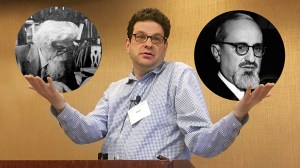
Rabbi Shmuel Braun  is a Chabad educated rabbi who has been teaching Chassidus around the NY-NJ area.  In this video, he is having a conversation with Ajahn Sona, abbot of the Birken Forest Buddhist Monastery. Braun is, by his own admission, a perrennialist.  He states that all of the world’s religions are about seeking the core of religion the oneness and non-duality of reality.

Rabbi Braun originally studied at Ner Israel Rabbinical College and Brisk Yeshiva in Jerusalem eventually found his spiritual home in Chabad. Now as a Modern Orthodox Chassidic, he looks to wider religious horizons including Buddhism.

In this sweet discussion with the Buddhist Abbot, Rabbi Braun does not actually discuss Buddhism or any commonalities of faith. Rather, he focuses the discussion on the realm where all religions are the same. He calls this the realm of Pre-Faith, with explicit Heschel influence.  “We are all united in silence.” “We are all the same inside.” “Language is confining.” “God is beyond language.” For him, there is no name for God, all the names of God are just human attempts to speak of God.

Since God is beyond language and reason, the way to God is by mean of meditation. Judaism is about practice of the mizvot. We do mizvot to bring the infinite divine into our world. But also a reaching up to the infinite, the eyn sof. The words “boundless” and “infinite” are the same words used to describe Buddhist Nirvana showing their commonality. Buddhism is just this universal truth. Braun generally sounds more Vedanta than Buddhist. God is not a being or an existant, rather God is existence itself.

In the Second Temple period, according to Braun, everyone meditated but the techniques were lost due to the Anti-Semitic persecution of exile. But we have tefillah to guide us; we should treat prayer as meditative. But we were not let with clear instructions.  He knew of the writings of the Piesetzna Rebbe on stilling the mind, but how does one connect to it? He found the answer in classes by Rabbi Dovid Weiss, who gives classes in Israel on Vipassana for Orthodox Jews.  Weiss openly labels his class as Vipassana and even has approbations from Hardal rabbis. (see Rabbi Weiss’s interview with Tomer Persico.) Weiss’s classes turned him onto meditation.

Personally, I am not a perennialist, but this is still a sweet video.  Forty years ago, these positions of Buddhist –Jewish encounter would have been seen as part of Jewish Renewal, influenced by Reb Zalman, or really pushing the traditional envelope. See for example, Harold Heifetz, Zen and Hasidism : The Similarities between Two Spiritual Disciplines (1978) or even Harold Kasimow’s Beside Still Waters: Jews, Christians, and the Way of the Buddha (2003). Now, it has made itself at home even in the Haredi world. Tomer Persico in his various articles has shown the influence of Buddhist meditation on diverse Haredi rabbis, including Rabbi Erez Moshe Doron, Rabbi Avraham Tzvi Kluger, Rabbi Itchie Mayer Morgenstern, and the aforementioned Rabbi Dovid Weiss. I dealt with Rabbi Avraham Yurovitch,

Braun stresses that many Jews are attracted to Buddhism, and we need to allow Jews (he adds- “and all people”) to feel God.  Therefore, we need to bring some of the Buddhist teachings to help the contemporary Jew.  Braun is one of at least a half dozen NY-NJ Chabad trained figures seeking a following for their spirituality teachings. The others give classes, write books, make podcasts and have tisches. So too Braun, who is seeking to found an organization called SOUL- Seekers of Unity and Love – to be beyond religion and teach the ineffable source of all religions – the mystery and transcendence beyond anything we can speak or articulate.  We wish him mazal and auspicious good fortune.


Interview with Rabbi Alon Goshen-Gottstein Part II

Rabbi Dr. Alon Goshen-Gottstein has opened himself up to the wisdom of the East, specifically Hindu religious thought. He studied with Swami Chidananda of the Sivananda Ashram and at the Sadhana Kendra Ashram and worked together with Sri Sri Ravi Shankar  In addition, he visited the ashrams of other noted leaders.  Goshen-Gottstein feels is that Judaism is in crisis. Torah needs more god talk, more spiritual focus, and to create a focus on ultimate reality. This interview is a continuation from Part I – here.

Alon- all religions
(Rabbi Alon Goshen-Gottstein is the first person on the left of the picture)

Goshen-Gottstien asks: “how much is this really an encounter with Hinduism. What I describe in my journey is increasingly a movement away from rituals, ideas and symbols into the realm of spirituality that transcends religions, and perhaps should therefore not be presented as Hindu at all.” There is for him, a spirituality, that transcends any specific form.

In his The Jewish Encounter with Hinduism, he notes that among those whose have experiences with both religions, the two religions are not being mixed. Rather, most with Jewish background “have dropped their Hindu identity upon return to Judaism.” Yet, he could see the integration into Judaism of “various yogic or mantric japa practices.” In his view, “such individuals would certainly be returning back to Judaism with a more expansive understanding of the religious life and possibly of God than many of their Jewish co-religionists. “

Goshen-Gottstein has been grappling with this question for decades and some of his ideas that go beyond this interview can be found here on Jewish-Hindu relations, here on his own encounter, and here on the Hindu-Jewish dialogue. 

The most important point of the interview, from my opinion, is that “[m]ost Jews… do not devote much time, or are incapable of the kind of God-talk that Hindus cultivate.”

So my question is to consider if this is similar to Bahye ibn Pakuda and his extensive integration of Sufism? And what are the categories of this influence from another religion. We have no trouble using the wisdom of Christian thinkers such as Aquinas, Kierkegaard, Barth, or Tillich to understand Judaism. But how do we learn from the wisdom in the theological thinking in the other religions.

Wisdom – Theistic Piety

The most mild usage is that of intellectual wisdom.

In 2009, Rabbi Aharon Lichtenstein (Zt”l d. 2015) Rosh Yeshiva at Yeshivat Har Etzion gave a discourse for over an hour on the Bhagavad Gita as an illustration of the Torah’s concept of duty.  For him, the Torah teaches the need to do the right action without worry for the results similar to Nishkam Karma. “To action alone hast thou a right and never at all to its fruits; let not the fruits of action be thy motive; neither let there be in thee any attachment to inaction”(Bhagavad Gita 2.47) He also used it to teach the need for the Torah scholar to have self-control , discipline, and freedom from attachment.   “With the body, with the mind, with the intellect, even merely with the senses, perform action toward self-purification, having abandoned attachment. He who is disciplined in Yoga, having abandoned the fruit of action, attains steady peace. ( 2.48). Here, the Gita did not provide new content or thoughts patterns, it provided as language for discussion.

Similarly, Rabbi Eliezer Berkovits, in his work God, Man, and History, asks about the inherent chasm between the human person and the Divine in the encounter with God. To emphasize his point, he surprisingly quotes the Bhagavad Gita on human smallness before the divine: “Suppose a thousand suns were to arise tomorrow in the sky?” (33) For Berkovits, God’s infinite greatness remains beyond human understanding, creating an abyss between the human person and God. However, unlike Berkovits, classical Hindu commentators believe that this gap can be bridged on a personal level through meditation and enlightenment. Furthermore, for the Hindu the infinite divine takes on manifestations to help bridge the gap.

Learning from the Other

A different approach goes beyond language to actually learning from the other faith to gain greater perspective. A binocular or bifocal vision allows one to see deeper trends in one’s own faith. For those attracted to Asian traditions of meditation this can contribute to one’s own faith through reclaiming lost traditions.

Rabbi Aryeh Kaplan popularized the statement of Rabbi Menashe ben Israel (17th century Amsterdam) that the gifts of Abraham to his concubines were the Asian religions. But Kaplan held that “Idolatrous and other occult practices often shed light on the prophetic methods.” (Innerspace 109, 115). Hence, he often used books about practices in other religions to figure out Jewish practices. We read books about Asian religions to reclaim Jewish practices.

Integration

Rabbi Yoel Glick, whom I interviewed a few years, (see the links here and here) goes further to integrate a Hindu approach into Jewish texts and practices creating a Judaism of God centered spirituality. Rabbi Glick teaches the wisdom of Ramana Maharshi and Sri Ramakrishna in a Jewish form. Goshen-Gottstein see this as an important perspective both in the interview and in his book.

The current Christian and Muslim communities in the USA are asking many of these same questions in terms of meditation, yoga, and Asian theology. We have to thank Rabbi Goshen-Gotstein for his Jewish insights into these questions. The interview stresses the impact of great swamis as great spiritual leaders on his life. If I had wanted more from him, it would have been greater autobiographic details in vivid specifics of how it changed the minute of his spiritual life, including specific practices and specific concepts.

As a final point, last week on March 28 Swami Sarvapriyananda of the Vedanta society spoke at Seton Hall and I was the respondent. The Swami was introducing what he called his modern reform Hinduism to students whose home Hinduism was ritual and Temple based. He acknowledged the differences. My response was the need to always compare like to like. We compare Hindu mystics to Jewish mystics, Hindu legalists to Jewish legalists, and Hindu rationalists to Jewish rationalists.  And quoting Chief Rabbi Jonathan Sacks, I said we have to respect our differences and not to elide our differences. When we received questions from the audience, he answered one of them by stating that he was asked the same question by Rabbi Alon Goshen-Gottstein.

Kumbh Mela2

  1. What does it mean to acknowledge a rich spiritual life in another faith?

How do we understand religion? All too often, we have a view of religion as a set of beliefs, moral instruction, and actions. Yet, all too often, we do not take into account the quality of relationship with God that individuals attain in a religion.  How one’s faith is lived allows the formation of a relationship with God as what may be described as a living God. Contact with the living God has a powerful transformative impact on the person. We may describe how this contact transforms the individual as the spiritual life.

Let me give an example from Judaism. I argue that Judaism is in crisis. This means that for the overwhelming majority of Jews, Judaism is not a vehicle for living a spiritual life in the sense just described. Such a life is surely available within Judaism, but only within small circles or spiritual groups that seek it. For the most part, Jews are more concerned with Jewish survival, education, observance, people and state. The spiritual life focused on God, a conscious relationship with God and growing in a spiritual relationship are low on the collective value scale.

Herein is a key to two dimensions of Judaism’s relationship with Hinduism. In part, this is what Hinduism has to offer us, if only by way of the example of a religious culture that does make God more central to its concerns than present-day Judaism does. From another perspective, appreciating the fullness of the spiritual life that is possible in Hinduism would shift the view of Jews from the question of the forms of worship of Hinduism, which are obviously strange and foreign to Jewish sensibilities, to the broader spiritual concerns that Jews and Hindus share.

  1. When did you fascination with Hinduism start?

My own initial fascination with Hinduism owes to street encounters with one brand of Hinduism, popularly known as Hare Krishna, that was visible on street corners of major cities in the 1980s and ’90s. One cannot consider this a real encounter, even if it engaged my fascination, and led me to visits to temples and to conversations with faithful. Of course, it was an encounter of sorts. It involved curiosity, learning, dialogue and contact with practitioners. But this early teenage kind of engagement did not really affect me. The contact remained external, even if fascinating.

Taking up transcendental meditation (TM) in my early twenties might be considered a step toward a fuller encounter, especially as it was accompanied by many hours of study of the teachings of Maharishi Mahesh Yogi, either through books or recorded videos. Certainly, meditation is a means of going deeper into a tradition. It forces one to make one’s own whatever experience is being attained through meditation, and if that experience is related to another faith tradition, then it could be a way of interiorizing, possibly owning, something of that tradition.

This form of meditation, however, was offered as a universal approach that was not religious and essentially not particularly Hindu. Even if the initiation ceremony followed Hindu conventions, and even if Maharishi wrote a commentary on Hinduism’s most popular text, the Bhagavad Gita, the practice, message and mindset, had been abstracted into a universalism from its Hindu particularity.It was a teaching that taught a path to oneself, not to another tradition. If nothing else, I was introduced to TM by a group of mostly secularized Israelis, for many of whom this functioned as a substitute religious identity, but who lacked the depth of the fullness of a religious tradition that they could represent to others.

  1. Can you explain your journey into Hindu ashram culture?

One approach to Hinduism is what you call Ashram culture. Ashrams are spiritual centers where live-in conditions offer the opportunity for full dedication to the spiritual life. They are typically organized around a great teacher, alive or one who has passed away. They contain some mix of teaching, ritual, meditation, service, community life and they seek to offer a comprehensive approach to the spiritual life as the goal and purpose of life. To compare them to what we know in Judaism, they are not synagogues or houses of study, though both activities take place there. They are closer to monasteries, though the discipline is often much laxer than in Christian monasteries.

Ashrams are closely associated with teachers, gurus, and monks. Broadly speaking, outside of the home, which is an important site for the practice of religion, ashrams and temples are the two main institutional expressions of Hindu religious life. Whereas a temple is organized primarily around the deity, the ashram is organized primarily around the teacher, lineage and the dedication to a form of the religious life. Ashrams are hugely diverse in terms of the activities that take place in them.

My first visit to India was to an ashram of a contemporary Hindu teacher, Sri Sri Ravi Shankar. It also included visits to the ashrams of other noted leaders, such as Sai Baba and concluded with the ashram with which I maintain ties until this day, the Sivananda Ashram.

In the course of my years of visiting India, I have visited dozens of Ashrams, some of which did not even go by that name, but which were ashrams in functional terms.

Ashram culture is a where one encounters Hindu dedication to the spiritual life. The following thought occurs to me. Let us consider the purposes of religion. One purpose is to receive blessing in various aspects of one’s life – what the Zohar calls “children, life and livelihood.” One turns to God for the needs of life. The other purpose of religion is to transform oneself to attain the highest goal of religion, which is self-transformation, liberation, going beyond the limitations of material life and entering the fullness of a relationship with the divine.

From my experience, schematically speaking, temples serve the first set of goals; ashrams the latter. Exceptions abound in both directions, but the overall characterization gives us a sense of the institution. So, if you wish to get a handle on how Hindus dedicate themselves to the spiritual life, the practices they undertake, the ideas they share and how they organize their religious life around teachers, teachings and practices with the goal of attaining what they often refer to as “God Realization”, then ashrams are the place to go to.

  1. Why are Israelis attracted to ashram life?

I think the answer is contained in the previous questions. A meaningful number of Israeli travelers to India travel there for spiritual reasons. If they seek the spiritual life, they will usually not find it in Hindu temples that cater to the local Hindu population. They require a structured approach to the spiritual life, as set forth by teachers who offer a teaching and a path. This they will only find in ashrams.

Some ashrams have a high concentration of Israeli visitors, such as Sadhana Kendra Ashram, near Dehradun. The resident teacher, Chandra Swami, has been to visit Israel several times. He practices a form of Hinduism (he would claim he is not even practicing Hinduism, but something beyond the specificity of Hinduism) that is devoid of elements of worship and is focused almost exclusively on meditation.

This makes it easy for Israelis to be enriched by the Ashram experience without compromising their identity. However, Israelis are found in many other places in India. All ashrams that belong to gurus who travel to the west and have western following have Israeli residents, some of whom are even in positions of leadership. Israelis, Jews more broadly, are spiritual seekers. If they do not find their nourishment in Judaism, they will turn elsewhere.

India is an important destination in such a spiritual quest. There are several reasons. One is that India does not come with some of the negative baggage associated historically with other religions. A second reason owes to the ability of Hindu teachers to present their teachings as spirituality, rather than as religion, thus minimizing the conflict between competing identities.

  1. Can you share something about Swami Chidananda, the disciple of Swami Sivananda?

I wish I could communicate in words the feeling of being in this man’s presence. The intensity of energy and feeling, the uplifting of one’s internal orientation and internal quest, that occurred simply by being in his presence, are the stuff of which stories of tzaddikim and masters of faith in all traditions are made. One knows the presence when one is in it and someone who has not experienced being in the presence of a great soul or spiritual teacher will simply not understand the overwhelming energizing and the transformation one undergoes simply by being in the presence of some individuals.

My first encounter with him was as part of a group meeting. I, and others, had been sitting on the floor. He was seated in his chair.  When it came time to talk to me, Swamiji did something startling. Before talking to me, he descended from his chair, and positioned himself on a level with me for our conversation. Here I was, a rabbi of another tradition. He would not talk to me from a position of greater height.

The impression this gesture made was tremendous. It was a gesture that captured the essence of this man, something I came to appreciate later through the reading of many of his books and watching dozens of hours of his teaching. The hallmark of this contemporary teacher was humility, the kind of humility that grows from the fullness of knowledge of divine presence and that translates itself into a meticulous care taken in human relations. I do not think I ever saw or felt the depth of humility in practice as during that brief moment when Swami Chidananda descended to sit facing me.

For me, the encounter with Swami Chidananda is not over. It is alive when I visit him, or nowadays his home, that is maintained as a sacred place, since he passed away in 2008. But it is also alive inside me. To touch the spirit and to be a model means that his example of humility and wisdom in action and his approach to the spiritual life can inform my internal horizons, together with the testimony of the great Jewish teachers. His presence remains real, and so he remains a teacher.

My question is how much is this really an encounter with Hinduism. What I describe in my journey is increasingly a movement away from rituals, ideas and symbols into the realm of spirituality that transcends religions, and perhaps should therefore not be presented as Hindu at all. This may be so. But then at the very least it would be a recognition that there is a spiritual reality that transcends religious particularity and that can communicate across religions. Such an understanding allows us to cultivate respect, appreciation and admiration for figures of another religion, where affirmation of existing boundaries would have the opposite effect. This in itself is no small feat.

Religious teachers speak the language of the tradition and bring its particularity to light, in light of their own experience and person. Therefore, Hinduism as taught by a Chidananda has a very different valence not only from classroom Hinduism but also from what other academic and religious teachers could offer. It is a full reading of the tradition, supported by a high point of spiritual and existential fulfillment. It allows a full encounter with the tradition itself, enhancing respect and understanding, even as it is a force for the transformation of spirit for the outsider who is lucky enough to be invited in.

  1. What do Jews and Judaism gain from the encounter?

Heschel has said that had Judaism gone east rather than west, to the Ganges rather than to Athens, it would have had a different course for its evolution. Religions grow and part of their growth occurs through contact with the other. Hinduism is a relatively new other and contains significant opportunities for growth for Jewish thought. Hindu thought and how it configures the religious life around God’s presence, in an immanentist context, provides many interesting philosophical and theological challenges.

Jewish theology is largely at a standstill. Throughout the ages, Jewish thought grew from its encounter with other religious cultures. Today, science is the significant other, not another religious tradition. I think Hinduism can play the role that Greek culture, Islam and Christianity played in earlier periods, in stretching Jewish thought.

On the personal level, Jews are finding in the Indian religious life a welcome alternative to what they perceive as the rigidity, authoritarianism and politicization of their own religion. Never mind that the same problems plague Hinduism as well. It’s all about perceptions. Because the forms of Hinduism to which many Jews are exposed do offer an alternative to some of the ills of Judaism, some Jews have found their spiritual path through Hinduism.

There are, then, two modalities for what Judaism can receive. The first is a function of the ongoing growth between religious traditions. The second, relating to the spiritual journey of individuals, is a function of Judaism’s present day crisis. The two dimensions come together in the recognition that Judaism does face a crisis in its relation to God, with other values having eclipsed God and the relationship with Him. Hinduism either already is or can become an important conversation partner and source of inspiration. Given that the great majority of gurus do not wish to make souls for Hinduism, but rather to help aspirants on the spiritual path, Jews could make their way back to Judaism enriched by their encounter with Hinduism.

  1. Should Jews go to the Kumbh Mela? Should they bath in the river?

The public image of the Kumbh Mela is governed by picturesque images of exotic sadhus, often naked, dipping in the confluence of Indian rivers. In fact, the Kumbh Mela is very different. It is, more than anything, a great learning camp, where different religious groups camp out and spend a month or so with their spiritual teacher. It is more like yarchei kala than anything else. Going to the Kumbh is therefore a wonderful opportunity for learning about the diversity of Hindu groups as well as of how they are united in the act of coming together and in the practices of the Kumbh.

The Kumbh is very impressive, but without command of the language and ability to partake of the teachings, one can only benefit from a fraction of what goes on. When I visited the Kumbh Mela I was interested in meeting the famous preacher Murari Bapu. I had heard much about him and I know he touches millions in his sermons. I sat through several hours of his teaching. I did not understand anything he said, but I learned a lot. I learned about how teaching and song combine; how teaching moves to prayer; how a teacher and community interact and more. In some ways, this was similar to what I knew from Judaism; in some ways there were new nuances and new dynamics. It was enriching. It allowed me to appreciate this great teacher in context. Still, most of what goes on in the Kumbha Mela is beyond the understanding of the outsider, which is in fact why there are so few outsiders who attend the event.

As regards bathing in the river, it is a question of motivation, and in part a halachic question. Overall, I avoid engaging in rituals of another religion, which is also true for bathing in the Kumbh, if undertaken as participation in the ritual of another religion. However, as I go to the mikveh regularly in preparation for Shabbat, I did find myself bathing alongside Hindus who were engaged in similar activities (though not carried out as fully and as strictly as Jewish mikveh practice). Such a moment is a moment of solidarity across religions, recognizing our common quest for purification and transcendence. I have experienced such moments in other contexts, for example at the Golden Temple in Amritsar, where Sikhs bathe.

  1. Do you then espouse a form of multiple religious identity, being both Hindu and Jewish?

I certainly would not proscribe multiple religious identities. In forty years of study of and fascination with Hinduism, I could never say of myself that I have a multiple religious identity. Even when I am in ashram, my path is Jewish, as is my practice, even my meditation practice. But I do recognize that there are Jews whose lives have taken other paths.

Could I see multiple religious identities for them? Much depends on how one defines Hinduism and the engagement to it. As I describe it in The Jewish Encounter with Hinduism, most Jews who have engaged Hinduism have not cultivated a strong Jewish identity or have dropped their Hindu identity upon return to Judaism. I could see ways of upholding certain practices and integrating them within one’s Jewish identity. This could include various yogic or mantric japa practices. Such individuals would certainly be returning back to Judaism with a more expansive understanding of the religious life and possibly of God than many of their Jewish co-religionists.

Most Jews, as stated, do not devote much time, or are incapable of the kind of God-talk that Hindus cultivate.

Within the parameters of a multiple religious identity that does not consider both components of equal value, I could see a theoretical possibility where some individuals would return to Judaism as their primary identity and bring back to it some of the spoils that were gained through their spiritual process and struggle within Hinduism.

  1. Why is Rabbi Yoel Glick’s work important?

Glick is one contemporary spiritual teacher who seeks to live and teach a Judaism with God at the center. He has found a very unique voice that draws from the treasures of Jewish spirituality, especially from Hassidic teachers. But he has also been inspired by some of the great masters of the Hindu tradition, such as Ramana Maharshi and Sri Ramakrishna. His is not a case of multiple religious belonging, but it is a case of being able to draw from the wisdom of those teachers and to deliver a message of Judaism that is either in dialogue with the teachings of those teachers or that draws in different proportions from the wisdom of both traditions. This is a unique balance and one that addresses head on the spiritual crisis of Judaism, its need to return to God at the center, and also makes room for getting “help” from Hindu sources for this process.

  1. How do you deal with the diversity of Hinduism and what role do your direct encounters play?

There is extreme diversity of forms of Hindu religious life. Some Hindus may never visit an ashram; some Hindus may never go to Temple; some Hindus may not have a guru; some may never read scripture. And yet all come under that broad umbrella called Hinduism. It is a great challenge for the outsider to get a handle on Hinduism given this diversity.

Given the problem of diversity of Hindu positions, we have two fundamental paths we could take. The one is to relate to these traditions in their diversity, as a series of religious phenomena, avoiding reference to the broad, and admittedly somewhat artificial umbrella term of “Hinduism”. The other is to seek to understand the broader phenomena in terms that are broad enough to be representative.

Situations such as the dialogue of the Chief Rabbinate with Hindu leadership require some kind of representative conversation partner. The Hindu side came to this dialogue featuring a broad spectrum of Hindu voices. Reading the transcripts of those dialogues one realizes they were nevertheless united in some important ways relating to the fundamentals of their faith.

My journey involved not only entry into the ashram world, but also very close personal associations with Hindu leadership, through my work with the Elijah Board of World Religious Leaders.

Let me recount one moment that will illustrate how broader understandings cut across the diversity of schools. I recall sitting in a hotel room in Cordoba, Spain just as the Elijah Board was established, with Sri Sri Ravi Sankar and one of the leaders of the Madhva stream of Hinduism, Sugunendra Theerta Swami, and discussing what idols and images meant to them. Needless to say, for a Jew this is a cardinal question and one that had to be explored in dialogue with authoritative practitioners.

Engaging religious leaders has provided an opening to what is most meaningful to those leaders in Hinduism, the heart of their faith, their practice and their message for others. As it turns out, the diversity of philosophical positions concerning metaphysical unity or multiplicity was quite inconsequential to that conversation in Cordoba. Both leaders affirmed the same fundamental view of God, the absolute, representation, images, immanence etc. You would not know they belonged to different schools. The same took place during the Jewish-Hindu summits. The same has also been true of my extensive conversations with leaders of diverse streams of Hinduism.

Projecting my understanding back to them, hearing how they conceptualized matters, following their arguments, suggested that fundamental commonalities far outweighed the particularities of philosophical, ritual or devotional schools. Since many such exchanges did not take place in “diplomatic” interreligious contexts, I must conclude that there is a significant religious and philosophical agreement about fundamentals of the faith, notwithstanding many differences.

Thus, I would state that what I write of Hinduism is descriptive of far more than the Advaita Vedanta that I often appeal to. Even if one would put forth the view of a historically diverse Hinduism, to me the living Hinduism of today’s teachers and practitioners is of greater consequence, and this suggests some fundamental commonalities. It seems reasonable to me to appeal to contemporary teachers as far as understanding Hinduism for present Jewish purposes is concerned. I appeal for the validity of my Judaism to the great spiritual teachers who have inspired me, even if some of them lived in the 20th century. I do not see why another religion cannot be dealt with along similar lines.

Interview with Alon Goshen-Gottstein on Same God, Other God: Judaism, Hinduism and the Problem of Idolatry

Do Jews and Hindus worship the same God? Moses Mendelssohn argued over two centuries ago that Hindus were not polytheists but monotheists who worship God through a system of symbols misunderstood by Westerners. Mendelssohn argued that images of the divine in Hinduism are symbolic the same way the rabbinic stories of the cherubim embracing are symbolic. An outsider would misconstrue the story of the cherubs, so too Westerners misconstrue the symbolic nature of Hinduism, which is actually part of their healthy human understanding of God.  Drawing on traditional categories, Mendelssohn thought the Bible only forbids imagery to Jews as Nahmanides taught and he extended the tosafist idea of shituf (association) to Hinduism. Rabbi Dr. Alon Goshen-Gottstein returns to this approach in two recent books.

samegod

Rabbi Dr. Alon Goshen-Gottstein studied at Yeshivat Har Etzion and has a PhD in Rabbinics from Hebrew University has devoted his career to interfaith work as founder and director of the Elijah Interfaith Institute. The first book is The Jewish Encounter with Hinduism (New York: Palgrave, Macmillan 2016) and the second book is Same God, Other God: Judaism, Hinduism and the Problem of Idolatry (New York: Palgrave, Macmillan 2016). He is also the editor of Jewish Theology and World Religions (The Littman Library 2012).

This interview will be in two parts; the first part will discuss the questions of Same God, Other God  and the second part will be about Goshen –Gottstein’s actual encounter with Hinduism. This interview raises many important issues. If you want to write a response or want to ask both of us questions then email.

Comparisons

Yale professor Miroslav Volf in a significant book Allah: A Christian Response (HarperOne 2012) asks if Christians and Muslims worship the same God starts by separating the question into a series of questions. Do we have the same referent for God? Do we have the same descriptions? Do they have the same attributes?  Were they accepted as historically similar? Is the worship style similar? Medieval thinkers such as Saadyah, Aquinas, or Farabi could see the same God is they affirm a unity based on the classic arguments for the divine. Volf created a method for asking these question in our age when scholastic thought does not have the same resonance.

Alon Goshen-Gottstein wrote an fine essay concerning Judaism and Christianity responding to the book’s argument, “God  Between Christians and    Jews   Is    it    the    Same God?”(available online) in Do We Worship the Same God?: Jews, Christians, and Muslims in Dialogue edited by Miroslav Volf. In addition, Goshen-Gottstein wrote some of the finest essays on the topic of comparisons with Christianity “God the Father in Rabbinic Judaism and Christianity” (2003)  and “Judaisms and Incarnational Theology”(2002)

Four Jewish Opinions

Alon Goshen-Gottstein’s method in his book on Hinduism is to ask what the halakhic figures of Maimonides, Nahmanides, Tosfot and Meiri would say about similarities between the faiths.  According to Goshen-Gottstein, Maimonides’ oneness of God can be compared to a proper understanding of Vedanta’s oneness. As a philosophic monotheist, there can only be one God regardless of the name and worship style. In the case of Hinduism,  Maimonides’ negative theology has great commonality with Shankara’s Vedantic theology, but not the varied theologies of the individual devas -deities. (136)

The Tosafot concept of shituf, according to Goshen-Gottstein, means that non-Jews are not bound by the strict criteria of Jewish monotheism or the demand for exclusive worship of God. They may worship another being alongside God, the saints, Jesus or a deva.

Goshen-Gottstein gives special attention to Nahmanides’ who limit the lack of representation of God to Jews alone.  Thereby, it leaves the other religions with  “room for a rich mythical, imaginative and artistic life, that is particular to any given religious tradition, while balancing it with a more abstract, philosophical, if we will “pure” understanding of God.” For Goshen-Gottstein, “[a]ccording to this perspective, it may indeed be that Hindus worship various gods who are not the same as our God. Nevertheless, such worship may be legitimate and appropriate for them.

The thirteenth century Provencal Rabbi Menachem Meiri created a new category of the “ways of religion” based on its moral teachings, which Goshen-Gottstein perceptively divides this position into two aspects, the acknowledgment of non-Jewish forms of worship and the importance of moral teachings.  Goshen-Gottstein plots a new course by expanding the Meiri into a statement of the acceptance of multiple ways to relate to God.

If we follow the Meiri, Hinduism is definitely a religion bound by the ways of religion and belongs in the same category as Islam and Christianity. For Goshen-Gottstein, “Hinduism provides us with an alternative way of configuring religious belief and moral duty.” This is because all “the fundamental details of belief –God, unity, power- may be recognizable, they appear in different combinations, carrying different weight within the overall system and operating in different ways as they interact with the moral order.” As long as we see the basics of Jewish religious principles in another faith then is monotheistic and moral enough to be respected by Jews.

Goshen-Gottstein creatively reaches to create a new category, a general respect for the “overall structure and value of their religious and spiritual life” found in other faiths. He encourages the reader to bracket out the technical halakhic questions of foreign worship in order to see a common religious goal. Jews can judge the other faiths as sharing common philosophical arguments concerning Gods being, negative theology, actions, and attributes.

Goshen-Gottstein develops from these positions a theory of religious imagination. For him, in this bold theory, the differences between religious ideas and symbols can be seen as the workings of religious imagination. This theme is a strong undercurrent to the book, partially discussed in many chapters, which should have been an independent section.

He models himself on Chief Rabbi Herzog’s statement that Christians elevated Jesus to a level of divinity as an act of their religious imagination and that halakhah permits these imaginative flourishes to gentiles. Goshen-Gottstein  develops that into a broad concept of viewing the role of imagination in religion as our culturally diverse differences, meaning that our theological differences can be ascribed to imagination.  If one accepts this extension of Rabbi Herzog, the other religions are not false gods or others gods, rather, the religious imagination at work. In Goshen-Gottstein’s estimation, the Hindu gods Krishna and Shiva can be treated the same way Herzog treated Jesus, that is, as acts of religious imagination rather than other gods.

Beyond this, he makes imagination a value in the full religious life rather than a hindrance. Just as there are rabbis who allow Jews who need to visualize God during worship as a concession to the strength of the imagination, so too non-Jews should be allowed even greater freedom in their religious imagination, even within their images of God, even if they are false images.

Alon Goshen Gottstein writes: “we might consider the specific manifestations of deities in Hinduism as part of what God has allotted this people, not through astral governance, but through the expressions of their religious imagination.“ The goal would be to “leave room for a rich mythical, imaginative and artistic life, that is particular to any given religious tradition, while balancing it with a more abstract, philosophical, if we will “pure” understanding of God.” For Goshen-Gottstein, “[a]ccording to this perspective, it may indeed be that Hindus worship various gods who are not the same as our God. Nevertheless, such worship may be legitimate and appropriate for them.

Later in the book, Goshen-Gottstein moves beyond his broad interpretations of the Shituf and Meiri  to a theory of religious imagination and the religious personality, which includes “those expressions of moral and spiritual excellence that constitute religious perfection: humility, service, loving-kindness, compassion…”. In turn,  “it can further be extended to formative experiences of God, as these register within human awareness and as these shape the religious personality.”

Goshen- Gottstein poses the question of what are signs by which one can recognize that a religion has true contact with God and extending Meiri from morality to religious life. We approach other religions looking to recognize God’s presence, especially mystical presence, and to see “traces of contact with God.”  It would be non-generous to think that Jews have holiness but other religions have self-interest. We all share a common life of faith and recognize God’s presence. (144-145)

By the end of the book Goshen-Gottstein has advanced Meiri’s thought beyond his own rational starting point to the foundation of a more mystically oriented understanding of divine presence something between Paul Tillich or Bernard McGinn, in which a legitimate religion can be considered as anything having  a presence of God, a dimension of contact with the divine.  If the goal was raise a halakhic discussion, then the work has moved far from it.

Essentialism

The book however suffers from an essentialist approach to Hinduism. Tamar Reich, a Hinduism scholar with academic background in Judaism & Kabbalah, in her review of the book in the journal Pardes points out what she regards as the limitations of the work. “Advaita Vedanta theology resonates with the author’s Hasidic acosmistic leanings. This is very well, but it blinds him, in my view, to most of what Hinduism, for better and for worse, has been and is. He is less interested in the Sub-Continent’s rich pantheon, sacred narrative and religious poetry, theology of sacrifice, great temple architecture and art and devotional and social-protest movements.” I concur; the Hinduism in this book does not accord with what I know from my time teaching and studying in a department of Hinduism in India, rather it reflects Goshen-Gottstein’s own internalization of Advaita- Vedanta from his time with important Hindu teachers. (For more discussion, see part II of this interview- next week).

From Rejection to Acceptance

Most Christians accepted Miraslav Volf’s analysis of the issues of comparing conceptions of God. However, Evangelicals generally rejected it because the Muslim or Hindu views of God do not offer salvation and grace even if God is the same referent and same attributes. Goshen-Gottstein goal is to move from a Jewish Haredi rejectionist position toward his own reading of the Meiri and Nahmanides. Hence, frames his work using the Egyptologist Jan Assmann who claims that the religion of the Bible, and by extension Judaism, draws a sharp line between true and false religions, claiming that all other religions are false. Assman extends his claim, thinking that Biblical faith requires they be hated, persecuted, and destroyed as rivals, parodies, or perversions of the one true faith.

However, Mark S. Smith, professor at NYU, rejected Assmann’s claims and in fact Biblical and Hellenistic Jews translated the God of the Bible into corresponding to the God of their neighbors. He also points out that they could recognize other national gods as valid for Israel’s neighbors. “For from the rising of the sun to its setting my name will be great among the nations, and in every place incense will be offered to my name, and a pure offering. For my name will be great among the nations, says the LORD of hosts.” (Malachi 1:11)

From my own work, Jews were able to find an ability to translate the Jewish God into the divine ideas of theos and Allah around them. For example, the  letter of the Jewish Annas to Seneca from the 4th century, is a purported Jewish letter to a pagan. He accepts that the pagan philosophic God and the God of the Bible are one. God is the father of all mortals is invisible to humans. However, Annas, the Jew attacks those who worship images that are nothing but images of their own desires.

The medieval philosophers readily translate between faiths such as Saadyah who writes of the Brahmins. Or Shem Tov Falquera already  in the 13th century adumbrates a theory in which everyone believes in one God but the many deities are due to the religious imagination.

And in the age of exploration in the 17th century, Menashe ben Israel rejected the explorers labeling the nations of Asia as superstitious and pagan, rather he quoted “For from the rising of the sun to its setting my name will be great among the nations, and in every place incense will be offered to my name, and a pure offering. For my name will be great among the nations, says the LORD of hosts.” (Malachi 1:11)

During the colonial era, Chief Rabbi of Britain Joseph H. Hertz (1872–1946) stated that the heathens were not held responsible for a false conception of God and “were judged by God purely by their moral life.”  For Hertz, “a primitive stage of religious belief” can still form “part of God’s guidance of humanity.” Even in their primitive version, [they] are serving the one true God (Malachi. 1:11)

All of these historical points are to emphasize that there has been discussions in the past about other religions, Asian religions and pagan practice, albeit not much about Hinduism. Yet, it was not a  blanket condemnation of other religions or a sharp denunciation without translation. Goshen-Gottstein sees a direct line from Chief Rabbi Hertzog to himself. In the end, however, his position is a more developed Mendelssohn position. Finally, while an important book, the volume suffers from dense overwritten chapters which should have been trimmed from the Yeshiva casuistry that makes this work difficult to the reader without the requisite background as well as the many repetitions.

I acknowledge that my comments are some insider’s perspective, coming from my own concern with the topic. This is especially true since my own very different book, Rabbi on the Ganges: A Jewish Hindu Encounter (Lexington 2019) will be out this Fall 2019. Rabbi Prof Daniel Sperber has a forthcoming book on Hinduism and Avodah Zarah that will offer a contrast to this volume, so hold your breath before making final judgments. (Here is a recent article of Sperber’s) We have to thank Alon Goshen-Gottstein for producing strong Jewish theological analysis of the topic and the book should be read by all those interested in the topic, eventually together with my book and Rabbi Sperber’s forthcoming volume. Enjoy the interview. Stay tuned for part II next week.

Rabbi-Dr.-Alon-Goshen-Gottstein

  1. How is the tosfot concept ot Shituf helpful for a Jewish understanding of Hinduism?

Let me begin perhaps by defining what “shituf” is. “Shituf” is the position developed in the late middle ages by Jewish legal authorities who sought to legitimate Christian worship of God for Christians, while maintaining it is still forbidden for Jews. The position assumes there are two standards of proper approach to God – one for Jews, the other for non-Jews. Non-Jews are not bound by the strict criteria of Jewish monotheism or the demand for exclusive worship of God. What this means is that they may worship another being alongside God, the saints or Jesus himself. This provided Jews with a means of affirming the validity of Christianity for Christians, while continuing to affirm it is forbidden for Jews.

In the case of Hinduism, I have personally done very little to extend it because Rabbinic authorities have raised the possibility that what holds true for Christianity can hold true for Hinduism as well. The first to raise this possibility was the first Chief Rabbi of the State of Israel, Rabbi Y.I.Herzog. He made the point tentatively, stating he didn’t know that much about Hinduism, but it seemed to him that the construct could be applied to Hinduism as well. The point was also made by Rabbi Adin Steinsaltz, who affirmed the “shituf” position by arguing that non-Jews are not expected to hold by the same standards that Jewish monotheism does. This softer or compromised monotheism he was willing to apply to Hinduism.

The basic argument would be that while Hindus may worship various forces of nature, deities, being or humans considered divine, they nevertheless do have a sense of a divinity beyond, and that therefore these are worshipped along with that absolute Supreme beyond.

If one thinks in terms of “Shituf”, then one could read the statement signed by the Chief Rabbinate and Hindu leadership, cited below, in these terms. The Hindu worships the Supreme, while worshipping in fact nature, concrete objects or individuals. Actually, in the case of Hinduism the argument to permit “shituf” may be stronger than with reference to Christianity, inasmuch as there is a conscious articulation of the principle that the Absolute Supreme Being manifests as those beings. Therefore, the Hindu acknowledges that it is not those beings that are being worshipped alongside God, but rather God who is worshipped in or as those beings.

But, frankly I find the category of “Shituf” not fully adequate to the task at hand.

  1. What contribution does Nahmanides make to our evaluation of Hinduism?

Ramban develops a theory of Avoda Zara in his commentary on the ten commandments (Exodus 20). According to Ramban there are different levels of what constitutes Avoda Zara.

In a manner analogous to the tosafot’s notion of permissibility of Shituf for non-Jews, Ramban develops a theory of permissibility of worship of other beings for non-Jews, provided they remain aware of the existence of the Supreme Being. He grounds this in a theory of distribution of divine providence to nations through their governing angels. Non-Jews are allowed to worship the celestial beings who provide for them. Why should it forbidden to them? The only thing is that they need to remember that beyond these angels is the one God who put it all in place. Jews, by contrast, may not worship other beings, because they are God’s lot and therefore exclusive allegiance is owed to God and cannot be compromised.

The advantage of Ramban’s position is that it does not require simultaneous worship of the absolute God while also worshiping a created being. In that, it avoids some of the theoretical problems associated with “Shituf”, which may not accurately reflect the beliefs of either Christians or Hindus, even if it is helpful to a Jewish theological discussion. On the other hand, however, is the difficulty that Ramban’s theory assumes a cosmic ordering, wherein different nations worship the angel or star that has been divinely allotted to them.

  1. Meiri helpful to understand Hinduism?

Rabbi Menachem Hameiri seeks to establish what a legitimate religion is; reversing the procedure of first establishing what is foreign worship. For Meiri a legitimate religion is one that has some knowledge of God, that by virtue of such knowledge assures a morally ordered society and that aids humans in their overall moral improvement and evolution. The key thing for Meiri is that details of faith, theology and ritual do not matter. Once one has it basically right, the details that one gets wrong don’t change the big picture. It is a very tolerant view that has great capacity to contain theological and religious disagreement, highlighting instead what is common between religions. In one way, that commonality is the commonality of the moral life.

Ultimately, valid religions all reference the same God. That they have different conceptions, names, myths and rituals does not detract from the fact that it is the one same God that is worshipped in different religions.

Moreover, Meiri subscribes to a theory of progress, wherein idolatry is something of the past and most religions have outgrown it. Because Meiri paints his theological picture in very broad strokes, I see no reason why Hinduism would not be included within this view of other religions. I think Meiri would consider Hinduism a valid religion. It has a notion of God. God ties into the moral order, though in ways that are different, perhaps parallel, to how God and the moral order are tied in Judaism. It has an idea of a morally ordered society and it aids the human person in advancing past his or her material inclinations, as proper religion should.

In my book, I expand the Meiri’s position as considering moral living as the measure of recognizing the validity of other religions. Meiri’s  argument is that God is known through a particular dimension of human life  – the moral order – that serves as proof for a particular religion knowing him. This argument can be extended to other dimensions of the spiritual life. We may consider various expressions of the spiritual life as indications of the presence of God in a given religion. People of deep faith, mystics and saints manifest various qualities. A partial list would include love (of God and other), humility, generosity, altruism, joy and much more. A true religious life forms the individual in particular ways and these in turn can serve as confirmation for a given religion of the nature of God-as known and worshipped.

  1. So do Jews and Hindus mean the same thing when they speak of God?

Well, yes and no. It really depends on which Hindus position one speaks about. But let me give you a Jewish answer – do Jews and Jews mean the same thing when they speak of God? In other words, how much flexibility or pluralism do we assume in our notion of God and when do differences in theological view necessitate declaring the god of another person (or religion) a different god.

The question of how we know that two people, even of the same faith, really refer to the same God, is not always that simple to answer. Naming helps, and sharing scriptures and stories also helps. But these cannot always cover up for theological differences. Sometimes two people from different religions may be closer in their understanding of God than two members of the same faith. One would therefore have to establish the criteria by means of which one knows that two people are speaking of the same God.

Here Meiri’s criterion of the moral life is so crucial.  By your fruits you shall know them, not by their theological declarations. I would push the argument one step further and refer to the spiritual life as a criterion for the knowledge of God. Ultimately, the “yes and no” answer may be the only answer we can give, even with reference to any two individuals.

  1. How do you apply the notion of religious imagination with reference to Hindu faith?

As I suggest, it is possible to construct an argument for God being the same in Judaism and Hinduism, based on authorities such as the Meiri, who applies moral criteria for the establishment of the identity of God. While this resolves many contemporary challenges in practical terms, it does leave us with the difficulty of reconciling God, as he is known in Judaism and the various descriptions of God and gods in Hinduism.

The problem is less extreme in cases where forces of nature or people are worshipped. But what most Hindus refer to as God has elements of the fantastic – either by way of description of the deity or in terms of what is ascribed to God or gods in stories and myths told of them. Do these then undermine the possibility of affirming God in both traditions as the same God? Not necessarily.

This is where a theory of the religious imagination comes in. I suggest we can develop a theory of religious imagination that respects the workings of this faculty of the human person and recognizes its contribution to the religious life. Imagination is instrumental in giving expression to our deepest quest, in guiding us to truths and realities that we cannot attain without it and to integrating mind and heart in religious experience. Without imagination, much of the vitality of the religious life would be lost.

Now, we can recognize that imagination operates differently in different religious cultures, as we see in the art and artifacts produced in different cultures, and specifically religious cultures.

It serves instrumental needs. Looking at it in instrumental terms means we put aside the valuation of whether the portrayal through the imagination is correct. Rather, we ask if it produces good fruit. If it does, we accept its beneficial consequences and bracket the question of its truth content.

I rely on Jewish sources that are willing to make that move internally. For instance, in Hassidic sources we find reliance on Rabad’s refusal to reject someone who considers God in anthropomorphic terms and to call him a min. One important Hassidic teacher, the Piasetzner Rebbe, turns this into a recommendation to cultivate anthropomorphic imagination if it is beneficial for the beginner to cultivate a desired attitude to God. Such internal acceptance of “false” imagination for beneficial purposes can be extended more broadly to recognizing the beneficial consequences of the religious imagination in other religions and religious cultures.

  1. How does Maimonides’ approach help us in relating to Hinduism.

I think Maimonides’ thought and Hinduism needs to be understood in two ways. The first is to compare Vedanta to Maimonides’ view of God and consider the convergence. The second is a consideration of how Maimonides is more concerned with philosophic concepts of unity than practice.

Rambam offers us a baseline definition of Avoda Zara and conditions much of Jewish attitude to other religions. He is the champion of the view that Christianity is Avoda Zara. It would stand to reason that what holds for Christianity would apply also to Hinduism with its multiple deities and the use of image worship. Rambam is therefore not the most promising resource for considering ways of accepting Hinduism as non-Avoda Zara.

Still, a conversation between Rambam and Hindu thought is interesting, in theological terms, even if these do not necessarily affect the practical outcome, the pesak. Hinduism offers an entirely different structure from the one that informs Rambam’s understanding of Avoda Zara. For Rambam Avoda Zara is based on the worship of intermediaries, given a mistaken understanding of divine will. One is worshiping another being instead of worshiping God. This assumes a clear distinction between God and non-God and a theory of intermediaries that leads to the worship of the latter. Hinduism operates with an entirely different structure. As the Hindu-Jewish summit declaration states, the Hindu does not worship another being per se, as he or she worships the many beings, real and imaginary, that are worshipped. Rather, it is God alone that is worshipped, as he is made manifest in these beings. The entire approach to Hinduism as Avoda Zara shifts if one considers that intentionality and awareness are directed to God, rather than to non-God.

I recently heard a wonderful story of the Magid of Dubna, in the context of approaching Avoda Zara. An impostor came to town a week before the Magid of Dubna and received great honor, as well as the monies that would have gone to the Magid of Dubna. When the Magid came to town the people were in shock as they had given all their money to the impostor. The Magid comforted them saying – be not disheartened. Even if you honored someone else, in your own minds it was me you were honoring.

  1. What was lacking by both sides of the Jewish-Hindu encounters in 2007-2009?

Hindus, led by Swami Dayananda, sought to resolve the problem of Hinduism as idolatry by claiming that “the Hindu” only worships the absolute, or Supreme Being, even if such worship is expressed through worship of other beings. It was certainly an important clarification from the perspective of Jewish participants and allowed them to shift their attitude to Hindu participants from one of suspicion of idolaters to a more appreciative and respectful approach.

The rabbis were willing to sign onto a document that affirmed that Hinduism and Judaism shared the recognition of One Supreme Being, Creator and Guide of the Cosmos; shared values; and similar historical experiences. “It is recognized that the One Supreme Being, both in its formless and manifest aspects, has been worshipped by Hindus over the millennia. This does not mean that Hindus worship “gods” and “idols.” The Hindu relates to only the One Supreme Being when he/she prays to a particular manifestation.”

Rabbi Daniel Sperber who is writing an important book on  Jewish view of Hinduism based on what the Hindus taught is an extreme expression of this change in attitude. But for most of the Jewish participants, I don’t think that they really considered that the Jewish category of Avoda Zara had been addressed by the explanations offered by the Hindu party.

In my understanding of the rabbis involved, personally I do not think that even if they signed a declaration affirming that the Hindu only worships the Supreme Being, I don’t think any of them had intended to declare that the charge of Avoda Zara was off the table.

  1. How does the work of Jan Assman help us move beyond medieval Jewish positions?

Jan Assman is a scholar of Egyptian religion, who has been fascinated with the issue of monotheism and how religions of the ancient world related to each other. His work is important for me because it allows me to explore from a historical perspective the question of “same God” in antiquity.

If you can identify means of translating the name of God from one system to another, you uncover a deeper commonality. Of course, one must distinguish between the ability to do so in a polythetistic and in a monotheistic context. Nevertheless, even the monotheistic context still requires such work of translation. Consider some parts of America where you may find support for the notion that “Allah is not God” and some places where it is a given that “Allah is God.”

Jews are not used to discussing the “same God” issue. I think that beginning to ask the question of the same God is an important theological step and it is particularly important in the context of doing theology of religions against the backdrop of improved relations between faiths. A new framing of the question allows us to get past places where the theological discussion seems stuck. No less importantly, it opens the door to deeper respect, and the possibility of mutual and reciprocal learning and inspiration.

Probably the most important conceptual move that I make in Same God, Other god, and I am certainly not the first to make it, is to shift the discussion from a discussion of whether another religion is “other”, foreign, strange, all synonyms of idolatry, to whether another religion, or rather its God is the same.

Classification as Avoda Zara sends  a religion to the divine recycle bin and renders it senseless to reflect on the relative import of such world religions. The halakhic category devalues the other religions in that traditionally Jews concluded that there is nothing of value to be learned or received from that religion.

Theoretically, one may believe in the same God but still be culpable of Avoda Zara, on technical or conceptual grounds. For instance, there are halachic voices that consider Islam to be Avoda Zara, even though it believes in the same God as Judaism. However, the likelihood is that once the God of another religion is recognized as the same, the charge, or the intensity of the charge of idolatry drops.  Maimonides on Islam is a case in point. His recognition of Islam’s God as the same God as Judaism, on grounds of a philosophical understanding of monotheism, leads him to exempt Islam from the charge of Avoda Zara.

  1. Who defines Hinduism for these discussions?

During the infamous sheitel controversy, a rabbinic emissary was dispatched to determine what Hindus believed. This emissary questioned believers. His procedure then was to approach ordinary believers in order to determine what the beliefs of the faith are. This in turn led him to declare Hindus as idolaters, which in turn led to major international manifestations of Jewish rejection of Hindu faith. The halachic authorities who engaged the subject at the time, notably R. Menashe Klein, tackled the question of who speaks for Hinduism and whether it should be defined by its practitioners or by its sages and scholars.

So the question is who speaks for Hinduism. Should one consider the voice of the sages, the learned, the leaders or should one consider the faith of the man and woman in the temple?

While I am personally in favor of having theologians and religious professionals speak for the religion, one cannot fully divorce the perspective of the sages from that of the common worshipper. To do so would mean we have in fact two different religions, that of the scholar and that of the common person. I have therefore also been concerned about capturing the attitude of the common Hindu person.

One of the challenges we as Jews would have looking at Hinduism is how much of a gap can be tolerated between the views of religious elites and those of the masses and consequently whether our “issues” with Hinduism are theological (differences with the elites) or focus more on different educational perspectives, with Judaism showing greater care for the education of the masses.

In the interim I can state that it is not at all the case that understanding there is ultimately one God is a conviction that only scholars and sages hold by. It is also prevalent among the masses, though by no means universally, based on hundreds of conversations I have conducted.

Eitan Fishbane on The Art of Mystical Narrative: A Poetics of the Zohar

For admirers of the Zohar, the work is a delight to study. What is the attraction of this work?  It opens the reader into a Judaism of great possibilities- possibilities of mysticism, of visions, of the afterlife, of prayer, and of creatively reworked midrashim. Much of the joy of reading comes from following the band of mystics as they wander the countryside encountering supernal beings and revealing a hidden reality. Many have noted in passing the medieval courtly background to these stories- the maiden in the tower, the heroic suitor, spending a night in a secluded castle, or an unexpected teller of tales-, which provides vivid color and richness to the drama. We now have to thank Eitan Fishbane for writing a guide to reading the Zohar as medieval literature, as a mystical narrative.

Eitan Fishbane is associate professor of Jewish thought at the Jewish Theological Seminary (JTS). His earlier book As Light Before Dawn: The Inner World of a Medieval Kabbalist (Stanford University Press, 2009 ) explored the mystical thought of Isaac ben Samuel of Akko especially prayer, meditative concentration, mental intention and chains of authority. His recent book, The Art of Mystical Narrative: A Poetics of the Zohar (Oxford University Press, 2018) is a masterpiece of opening up the Zohar to literary analysis including characterization, dramatic speech, structural framing.

fishbane- book

The 2017-2018 academic year was a bumper crop for Zohar studies producing ten serious studies on the Zohar, each one making a significant innovative contribution. Future studies of the Zohar will never be the same and the field will now start from a very different place than before. The works are so extensive that I have still not gone through this new shelf of books; actually not a shelf but a guilt inducing pile on my floor. Among the recent books are  Melila Hellner-Eshed’s Seekers of the Face : the Secrets of the Idra-Rabba (The Great Assembly) of the Zohar [Hebrew] (2017), Ronit Meroz’s The Spiritual Biography of Rabbi Simeon bar Yochai–An Analysis of the Zohar’s Textual Components [Hebrew] (2018), Oded Yisraeli, Temple Portals: Studies in Aggadah and Midrash in the Zohar [English edition], and Yonatan Benarroch’s Sava and Yanuka : God, the Son, and the Messiah in Zoharic Narratives [Hebrew] (2018). (For my 2016 interviews with Joel Hecker and Daniel C. Matt on translating the Pritzker edition of the Zohar, see here and here.)

Nevertheless, Fishbane’s study stands out for the moving of the study of the Zohar from the provincial realm of Jewish thought to the wider realm of medieval literature and Andalusian history. The book is innovative for letting us see what we always knew, that the Zohar tells a good story. Fishbane contextualizes the Zohar in its Castilian  milieu showing influence and parallel with Jewish and non-Jewish works such as Yehudah Al-Harizi’s Takhkemoni, Yitzhak Ibn Sahulah’s Meshal Kadmonim , Alfanso X of Castille’s sponsoring of the collection Cantigas de Santa Maria and Juan Ruiz’s Libro se Buen Amor.

Treating the Zohar as literature was already implicit in Peter Cole’s amazing anthology The Poetry of Kabbalah (Yale University Press, 2014) and in David Stern & Mark Jay Minsky’s Rabbinic Fantasies (1990). However, Fishbane sets it forth as a sustained study of literary criticism.

The book’s topics include: Zohar as a classical work, the role of performance and theatricality in the Zohar, as well as gestures and drama. This drama relies on a magic realism of sheltering trees, astounding cave discoveries, spirit birds, and magical herbs. In each of these, Fishbane analyses structural flow, rhetorical devices, and time sequence. He also used the method of narrative ethics to explain the role of ethics in the Zohar in which the ethic comes from the narrative and not from Kabbalistic symbolism. The book’s chapters have a clear, and sometimes heavy, didactic element in which he explains the literary term and quotes from literary critics who define the term before applying the terms to the Zohar.

The highlight of the book are the last two chapters correlating the poetics of the Zohar with both Jewish and Christian Spanish literature. He relied on this context earlier in the book when he compares the theatricality of the Zohar to the symbolic importance of gestures in medieval Christian liturgical drama and when he discussed the symbolism of the rose. I do however wonder whether the last chapters should have been placed in the beginning. First, give me the Spanish context and then show how each stylistic trait fits into this context, rather than detailing many stylistic traits and then surprising the reader by showing that is a medieval Spanish style.

Fishbane’s book is limited to the section of the Zohar that scholars colloquially called “guf haZohar.” This section is the product of a few circles of kabbalists working over a period of several decades in the late thirteenth century, possibly as a Castilian fellowship. His analysis does not include the over thirty other parts of the Zoharic corpus including the heihhalot, matnitin, Tikkune Zohar, Sitrei Otiot, or Idra. Fishbane says that he hopes to treat some of these other sections in a possible sequel.

The book deserves big congratulations. It is a well-done important book, a significant piece of scholarship, a game changer in Zohar studies. The book will change the manner in which Zohar will be taught in American universities and in adult education classes. I enjoyed reading it, so will your students. Woe to those who think this book is a mere monograph, happy are those who seen the great value in this book.

  1. Why do you like the Zohar? 

I find the Zohar to be endlessly fascinating, intellectually exciting, aesthetically and spiritually alluring. Like so many others, I have been drawn to this magnetic text since the earliest days of my studies and continue to return to it as a great work that reflects the summit of Jewish spiritual creativity and theological imagination.

There is much depth and beauty in these philosophical texts, but the Zohar speaks to the spiritual and theological yearnings of the poetic soul. Just as those of a certain artistic and spiritual bent turn to poetry instead of the more analytic nature of prose, so too does the Zohar beat with the pulse of spiritual artistry, brushing against the borders of the ineffable and the sublime in religious thought and experience.

2) Where are you differing from prior scholarship on the Zohar as literature?

This book is the first full-scale attempt to study the Zohar through methodologies inspired by literary and aesthetic criticism, notable — in part — as an effort to elucidate the text as a work of literary art. I think it is fair to say that no one has attempted or accomplished this prior to The Art of Mystical Narrative.

To be sure, there have been article-length efforts in this direction, and the work of Yehudah Liebes certainly pioneered the emphasis upon the crucial importance of the story of R. Shimon and his circle as the heart of the Zohar.

However, there is a great difference between work that explores the zoharic story and doing for the Zohar what Alter and Sternberg did for the Hebrew Bible, or what Kugel, Stern, Rubenstein (or Hasan-Rokem, Levinson, and Wimpfheimer) did for rabbinic literature.  I developed a multifaceted literary studies methodology for reading the Zohar and this, I suggest, is the innovative contribution of my work.

3) How does the Zohar compare to the Hebrew literature of its time?

One of the key new contributions of the book is my attempt to locate zoharic narrative within the broader landscape of medieval Iberian fiction and poetry, both Jewish and Christian. I specifically focus on the structural form of the frame-tale as a literary device in this time and place.

Isaac Ibn Sahula (b. 1244) wrote two separate works which embody the twin literary concerns of the Zohar, prose narrative and kabbalah. The first was his rhymed prose narrative, entitled Meshal ha-Kadmoni, and the other an explicitly kabbalistic commentary on the Song of Songs. But other key Jewish works compared in the book that seem similar to the Zohar include the Tahkemoni of Yehudah Al-Harizi and the Sefer Sha’ashuim of Joseph Ibn Zabara.

Though consideration of various thematic and structural criteria, I show how our understanding of the Zohar is enriched by considering it as a literary work that employs techniques and conventions of related contemporary non-mystical texts.

4) How does the Zohar compare to the general literature of its time?

Two non-Jewish parallels that I consider as influences on the Zohar are the Libro de Buen Amor (The Book of Good Love) of Juan Ruiz, and the Cantigas de Santa Maria of King Alfonso X El Sabio. Based on my literary analysis of select passages and parallels in the Zohar, I argue that the Zohar appears to have absorbed key features that were part of the larger folkloric and textual culture of this time and place.

One striking example is the source of the famous zoharic advocating against accepting the pure literalism of the Torah (where the wise are advised to look beneath the garments of Torah, and even within her body to the mystical soul of Torah). The source is the the prologue of Juan Ruiz to the Libro de Buen Amor, wherein the author exhorts his reader not to think that his book, which tells tales of seemingly crude lust and debauchery is truly only about the literal kind of lust that it appears to be. In truth the book is meant to teach figuratively about the mystery of divine love.

Ruiz puts it in the following way (The Art of Mystical Narrative, pp. 400-401):

Do not think that this is a book of foolish nonsense (Non cuidedes que es libro de necio devaneo), and do not take as a joke anything that I recite in it, for, just as good money can be stowed in a worthless purse, so in an ugly-looking book lies wisdom that is not uncomely (assí en feo libro yaze saber non feo).

The fennel seed, on the outside blacker than a cooking pot, is very white inside, whiter than ermine; white meal lies within black covering (blanca farina yaze so negra cobertera); sweet white sugar lies inside the humble sugarcane.

Under the thorn lies the rose (So la espina yaze la rosa), a noble flower; in ugly letters lies the wisdom of a great teacher (en fea letra yaze saber de grand dotor)…, under a bad cloak lies good love (assí so mal tabardo yaze el buen amor).

Because the beginning and root of all good is the Holy Virgin Mary, therefore I, Juan Ruiz, Archpriest of Hita, first of all composed a song about her seven Joys…” (Willis, ed., Juan Ruiz, Libro de Buen Amor, pp. 14–15)

In Chapter 6 (The Art of Mystical Narrative, p. 403), I compare these remarks with the much discussed zoharic passage about literalism and mystical meaning in interpreting the Torah. These include lines such as:

“Those fools, when they see someone in a good-looking garment, look no further”;

“Fools of the world look only at that garment, the story of Torah”; and

“Whoever thinks that the garment is the real Torah and not something else, may his spirit expire! He will have no share in the world that is coming!” (Zohar 3:152a)

5) What is the role of dramatization in the Zohar?

One of my core arguments in the book is that the stories of the Zohar are a kind of dramatic literature. In the process of speaking mystical secrets and encountering one another, the characters enact a near-theatrical mode of expression, performing their deep ambivalence and excitement over the disclosure of hidden matters.

The Zohar depicts performative fictional scenes as the context in which the homiletical mysticism is delivered and received. This dramatic element should be seen in the larger context of medieval frame-narratives—a convention of the intersecting literary worlds into which the Zohar was born.

6) What is the role of gestures?

A key aspect of this performative literature is the varied use of physical gestures to express emotion as well as to mark the rhythm and boundaries of different scenes and moments in the narrative. Such gestures include weeping, prostration, kissing, the raising and laying on of hands, sitting, standing, and walking.

Moshe Barasch studied “the language of gesture” among medieval visual artists— particularly in the paintings of the late thirteenth- and early fourteenth- century Italian master Giotto di Bondone (1266/7–1337). Barasch considered the ways in which medieval painters and sculptors utilized similar types of dramatic gesture that were employed in the Christian mystery plays of the period: forms of physical movement that often had to substitute for the spoken word, given that the majority of audience members would view the performance from a significant distance and without a set stage. This gave rise to a cluster of well-established, even stereotypical, gestures that could be interpreted by the audience from afar. Barasch develops the argument that Giotto is representative of dominant sociocultural views, around the year 1300, regarding the potent meaning of gestures in several intersecting realms of social relations, ritual performance, and literary imagination.

Perhaps most applicable to our present inquiry into the zoharic use of gesture, however, is Barasch’s observation— filtered somewhat through later Renaissance characterizations of Giotto’s work—that what “is striking about Giotto’s gestures is not only the aesthetic quality of variety, but their ability to show the figure’s inner life.”

Gestures in the Zohar frequently signify and dramatize interior emotional states; the authors of the Zohar utilize physical expression in their characters to communicate or reveal some inner thought or feeling that the narrators typically will not articulate in an omniscient fashion.” (86) And consider the following representative passage from the Zohar itself:

“R. Elazar came forth, placed his head between the knees of his father and told the story. R. Shimon became afraid and wept. R. Shimon wept and said: “From what I have heard, I too fear the Holy One blessed be He!” He raised his hands to his head and exclaimed: “How is it that you have merited to see R. Hamnuna Sava, Light of the Torah, face to face, and yet I have not merited it!” He fell on his face and saw [R. Hamnuna] uprooting mountains and lighting candles in the palace of the King Messiah.”(Zohar 1:7b)

7) How does soliloquy, embedded performance, and setting replace narration?

Like other literary dramatists the authors of the Zohar use the rhetorical device of dramatic monologue or soliloquy to convey the interiority of thought and emotion without inserting omniscient narration. More common than hearing a third-person narrator say, “character so-and-so felt or thought…,” a character will erupt in a monologue — much like a Shakespearean soliloquy uttered as audible interior thought — to communicate his own inner process and feeling.

The theatrics of disclosure, relations among the disciples, as well as the rhetoric of reverence for the master—all of these are realized by the narrator through a cluster of compositional techniques, each of which is effected through the use of dramatic monologue and dialogue. As the disciples encounter one another on their pedestrian journeys through the Galilean roads, and even more so, when they come before the master (R. Shimon) to receive the disclosure of kabbalistic wisdom, they exclaim about the overwhelming character of these secrets, the elevating and terrifying power involved in hearing their revelation.

Through the representation of dramatic speech, the zoharic narrators construct character intent; the modalities of monologue and dialogue serve as indirect methods for the authors to convey subtext and the interiority of emotion to the reader. (p57)

8) What is the role of encounters on the road?

Most of the Zohar’s narrative action takes place on the road of the characters’ journey through a fictionalized ancient Galilee in quest of mystical wisdom. Along this path, Rabbi Shimon bar Yohai and his disciples will often encounter a person whom they hastily judge to be a simpleton and devoid of any mystical wisdom that they might receive. This expectation is generally turned on its head in a narrative process that I refer to as the poetics of recognition. This dramatic uncovering of true character locates the Zohar in the literary landscape of its time and place, where non-mystical storytellers also frequently utilize this literary motif.

As we see in the following passage from the Zohar:

“R. Hiyya and R. Yosi were walking in the desert. . . . After a while, they saw a man who was approaching with a load in front of him. R. Hiyya said: “Let’s walk on. Perhaps this man is a Gentile or an ignoramus, and it is forbidden to join with him on the way.” R. Yosi said: “Let’s sit here and see if perhaps he is a great man.”

After a while he passed before them and said: “In roughness of crossing, the cluster of this companionship is essential!9 I know another way—let’s turn away from this one. I must tell you so that I am not guilty before you, so that I do not violate what is written (Lev. 19:14): Before the blind you shall not place a stumbling block. For you are like blind men on the road, and you shouldn’t endanger your lives.” R. Yosi said: “Blessed is the Compassionate One that we waited here!” (Zohar 2:49a–49b)

In this instance, R. Hiyya’s initial skepticism is proven to be hasty and inaccurate, for the mysterious stranger turns out to be a wise man who is also able to save the mystical companions from danger on the road. As the text continues in the voice of R. Yosi:

“Didn’t I tell you that he is a great man?”

He opened and said (Prov. 3:13): “Happy is the person who finds wisdom, the person who attains understanding. Happy is the person who finds wisdom—like me, who found you and came to know a word of wisdom from you.

The person who attains understanding— like me, who waited for you, to join with you. This is the person for whom the Holy One blessed be He prepares, on the road, the face of Shekhinah. About this it is written (Prov. 4:18): The path of the righteous is like gleaming light, shining ever brighter until full day.”

9) What is the role of the rose in the Zohar? How does that compare to medieval literature?

The rose in the Zohar typically symbolizes Shekhinah, the tenth of the divine sefirot. In the Zohar characters encounter roses in their travels, leading to theological reflections. In the book, I discuss evocative comparative correlations to the symbolism of the rose in broader medieval literature, including in the class work, Roman de la Rose. One textual case from the Zohar is particularly instructive (Art of Mystical Narrative, p. 173):

He who wanders among the roses. (Song 2:!6) Just as this rose is red and its waters are white, so too does the Holy One blessed be He conduct His world from the Attribute of Judgment to the Attribute of Compassion. And it is written (Is. 1:18): If your sins are like crimson, they can turn white as snow.

Abba was walking along the road, and with him was R. Yizḥaq. As they were walking, they happened upon some roses. Abba took one in his hands and walked on. R. Yosi met them, and said: “Surely Shekhinah is here, and I see that what is in R. Abba’s hands [is there] to teach great wisdom. For I know that R. Abba did not take this [rose] but for to show wisdom.” Abba said: “Sit, my son. Sit.” They sat. R. Abba inhaled the smell from that rose and said: “Surely the world’s existence depends upon scent! For we have seen that the soul’s existence [also] depends upon scent. And this [is the reason for the inhalation of the aroma of ] the myrtle [leaves] at the departure of Shabbat.”

He opened and said (Song 2:16): “My beloved is mine, and I am his—he who wanders among the roses. Who caused it to be that I am my beloved’s and that my beloved is mine? It is because He conducts His world through roses.

Just as the rose has a scent—it is red, and when it is distilled it turns to white, and still its scent never alters—so too does the Holy One blessed be He conduct His world in this way. For was this not the case, the sinner could not endure. The sinner is called ‘red,’ as it is said (Is. 1:18): If your sins are like crimson, they can turn white as snow.” (Zohar 2:20a)

As I note in my analysis of this passage:

The characters who are presented in this passage serve to dramatize the process of metaphysical discovery within the structures and forms of the physical realm—through their interaction and speech they theatricalize the hermeneutical claims made in a homiletical voice on either side of the narrative piece. In this respect, the con- tents of the fiction and the exegesis are clearly integrated; R. Abba’s reflection on the cosmic meaning latent in the color and aroma of the rose fleshes out and clarifies the interpretive argument.

10) How is Zohar magical realism and personified nature?

Supernatural happenings in the world are represented as though they are perfectly normal and even realistic phenomena. At the very least, however, the authors of the Zohar believed that the world inhabited by R. Shimon and his disciples was an enchanted one — where, for example, a character wandering in the desert happens upon a gargantuan tree with a cave opening at its base. This opening reveals steps leading into a mysterious underworld overseen by a magical guardian, leading into a pathway of countless trees where souls fly on their way to the Garden of Eden.

The Zohar is indeed populated with such supernatural realia- magic, magic birds, especially eagles, spirit guides, magic herbs, creating an ambience of enchanted and mysterious spirituality and otherworldly sensation

Encounters with nature play a key role in the literary and mystical imagination of the zoharic authors. For the Zohar, the natural elements of the earthly realm refract higher mysteries about Divinity, and the wandering movement of the text is situated in the outdoor setting of the natural world.

For example, R. Shimon and his disciples are located beneath the shade of a tree on the shores of the Sea of Galilee, and through a series of associations this mundane experience leads to rumination upon the supernal tree of life in the Divine Garden of Eden, to a sefirah represented by the royal pavilion (Apiryon) built by King Solomon from the cedars of Lebanon. Nature functions as a symbolic allusion to the supernatural; the physical points the mystic to the metaphysical.

11) What is the tension of road/cave or quests/stability?

The narratives of the Zohar are marked by the ongoing quest of the road, by the recurrent motif of mobility. This is interspersed with moments of pause and stillness, whether sitting in a field to pray or study, or entering a cave only to discover a hidden mystical manuscript therein.

In some cases, this newly discovered manuscript is imbued with heavenly magic and secrecy, erupting into fire and flying away from their hands upon reading it.

We also see several scenes where the zoharic characters stop for the night in a roadside inn — a phenomenon that was relatively widespread in late thirteenth century Spain, especially in light of recent royal edicts to provide such lodging to travelers. These nights spent at an inn also often prove to be times of mystical discovery in the depths of the night.

12)   If this is the Zohar, then why read Zohar instead of Lord of Rings, Harry Potter, or Game of Thrones?

Certainly, it is a unique literary world unto itself, which is not reducible to these later instances of fantastic storytelling. But it does share certain features with the magical classics you mention here, the creation of a paranormal universe in which characters are transported beyond the bounds of our normal expectations within natural law.

13)      How is forgiveness portrayed? How is it a form of narrative ethics?

The Zohar gives the theme of idealized forgiveness is given a prominent place. The authors of the Zohar tell the tale of a character who experiences miraculous divine intervention, saving his life, because of his high virtue in always forgiving others for any wrong they may have committed against him. The Zohar compares this character to the biblical persona of Joseph who was called a righteous man precisely because of his ability to forgive his brothers for the grievous wrong they committed against him. Through this exemplum narrative, the reader of the text is guided toward the virtue of radical empathy and love, modalities of artistic evocation that the philosopher Martha Nussbaum has shown to be the foundations of moral instruction. In the language of the Zohar (The Art of Mystical Narrative, pp. 287-290):

“Rabbi Abba was sitting at the gateway of the gate of Lod. He saw a man come and sit in a dugout in a mound of earth. He was weary from the road, so he sat and fell asleep there. Meanwhile, [Rabbi Abba] saw a snake that was moving toward [the man].

Out came a honey badger, oozing an excretion, and killed it. When the man awoke, he saw that snake dead before him. He stood up, just as that dugout collapsed into the depths below, and he was saved.

Rabbi Abba came forward to him and said: “Tell me what you do, for behold the Holy Blessed One has performed these two miracles for you! It wasn’t for nothing !” The man said to him: “All my days, no person in the world ever did me evil without my reconciling with him and forgiving him.

And if I could not reconcile with him, I would not climb into bed until I forgave him and all those who hurt me. All of my days I never cared about the evil that they did to me. Not only that, but from that day on, I strive to do good to them.”

Rabbi Abba wept and said: “The deeds of this one are even greater than those of Joseph! As for Joseph, they were surely his brothers, and he had to have compassion for them. But what this one has done is greater than Joseph! It is fitting that the Holy Blessed One performs miracle upon miracle for him!” (Zohar 1:201b)

Narrative ethics is a mode of discourse in which a moral ideal is portrayed through story, often serving to stir understanding and compassion in the reader, helping her to realize how she ought to behave. As Martha Nussbaum has argued, art holds the power to evoke such ethical guidance in a way that philosophical analysis cannot. Art may move us to regard our fellow human beings with love and empathy. The Zohar too partakes of this widespread genre, and it is through its storytelling that the mystics often convey their highest moral ideals — conceptions of value and virtue that are, for them anyway, inextricable from mystical theology.

14)      How is hospitality portrayed?

Hospitality is a revered virtue, dramatized in the Zohar through exemplary narratives and then textured with homilies of mystical-moral midrash. In one remarkable instance (The Art of Mystical Narrative, pp. 317-321), which is actually the source of our contemporary use of the term ushpizin (guests) for the sukkah, the Zohar tells the story of R. Hamnuna Sava who would invoke the presence of the divine sefirot into his sukkah.

Rav Hamnuna Sava, when he would enter the sukkah, he would rejoice and stand inside at the opening, and say: ‘Let us invite the Guests!’ He would set the table, stand on his feet, recite a blessing, and say: In sukkot you shall dwell, O seven days. Sit, exalted Guests, sit! Sit, Guests of faith, sit!

He would raise his hands in joy and say: ‘Happy is our portion, happy is the portion of Israel!’ For YHVH’s portion is His people, Jacob His own allotment (Deut. 32:9). Then he would sit.” (Zohar 3:103b)

The narrator adds, however, that it is imperative that one who invites these divine forces into his sukkah must give their portion of physical food to the actual human poor in his community, that he must provide a place for the hungry at his own sukkah table. The impoverished person here serves as the embodied form of divine presence, and the Zohar is clear that such charity and hospitality is necessary for the divine guests to remain in his sukkah.

For one who has a portion in the holy seed sits in the shade of faith to receive guests; to rejoice in this world and in the world that is coming. Nevertheless, he must bring joy to the poor. And what is the reason for this? Because the portion of those Guests whom he has invited belongs to the poor.

And he who sits in this shade of faith, inviting those supernal Guests, Guests of Faith, but doesn’t give [the poor] their portion, [the supernal Guests] all get up and leave him, saying (Prov. 23:6): Do not eat the bread of a stingy man, do not crave his delicacies.

It follows that the table he has set is his own, and not that of the Holy One blessed be He. About him it is written (Malachi 2:3): I will strew dung upon your faces, the dung of your festivals. Your festivals, and not My festivals. Woe to that person when those Guests of Faith get up from his table!” (Zohar 3:103b–104a)


Hipster Hasidic Pop-Art

Two years ago, I spoke at Van Leer Jerusalem Institute (VLJI) on contemporary spirituality about the use of pop-psych and contemporary non-Jewish spirituality in American Orthodox Jewish spirituality.  I presented a range from  Aryeh Kaplan’s use of Huxley to Abraham Twerski’s 12 step and self esteem psychology to those Orthodox spirituality books of the 21st century who are using Anne Lamont, Tony Robbins, and various new age concepts.

One of the attendees at the conference was Noa Lea Cohn, an Israeli graduate student in art history who wanted to apply my research to her field of contemporary orthodox art. I sent her a half dozen emails of bibliography on various aspects of the topic. In turn, she asked me to write an introduction for an exhibition catalog of a show she was curating on Hasidic pop -art as part of the Jerusalem Biennale called “Popthodox / Black Humor.”  

She called the exhibition Black Humor after the Israeli slang expression for the ultra-Orthodox, who are called “blacks” for the dominant color of their clothes, and exposes for the first time a new pop art genre called Pophoddox. The exhibition  wanted to show a two-way view: interior and exterior. The exhibition’s artists “use introspective, inner humor that belongs to the public in which they belong to the thin nuances within it. On the other hand, humor enables them to direct an external critical eye on themselves” as a “self-conscious stranger.”For her, it showed the sociological processes taking place under the radar in ultra-Orthodox society.

I was already familiar with several of the artists and already actually had a prepared lecture with a handout with some of the art as part of my Hasidut class.  Below was my short entry in the exhibition catalog. (There were several other entries more concerned with the art itself.)

Hipster Hasidic Pop-Art –Alan Brill

The Baal Shem Tov taught that the Creator is found in all things and that one should serve God in all of one’s ways. Hence, some Hasidic groups, especially Chabad, encourage their followers to use their God-given talents to serve the Almighty. Following this expansive view, some contemporary Orthodox artists serve God through creativity and individuality.

Contemporary Hasidism is not outside of culture nor does it have to bridge the worlds of art and Orthodoxy. Rather, Orthodoxy is embedded in the wider culture around it. One should not conceive of Chabad adherents as otherworldly nineteenth-century mystics, unfamiliar with technology and new ideas. Rather they are media savvy enough to create advertisements, appear on Oprah, and host non-Jewish Hollywood stars in their fundraisers. Hasidim walk the same streets, buy the same consumer goods, and use the Internet as everyone else. Media, graphic design, and popular culture are everywhere in their daily lives.

In recent years with Chabad’s strong emphasis on outreach, its adherents have become masters at using popular culture to bring in unaffiliated Jews. They might almost be considered another form of modern Orthodoxy in that they adopt a modern sense of urban life, media use, and material culture. In order to reach people they have created a rich world of popular psychology, motivational posters, graphic design, and cool evenings devoted to the cutting edge in food, eyeglasses, or design. Many young Chabad Hasidim work in web design or online marketing, so they are well aware of recent trends and are conversant with Photoshop.

One does not have to go to art school to learn about the official pop art of the 1960s. Rather, people with open eyes appreciate the graphic designs that are all around them. The famous designs of the 1960s of Milton Glazer, Peter Max, and Robert Indiana continue to inspire artistic descendants to create pop art on packaging, on housewares, on children’s toys, and on city streets. In living their embedded life in the vibrancy of New York City, Chabad Hasidim are exposed to the pop styles of Keith Haring, David Hockney, and Barbara Kruger. From daily life, they know of the commercialized images of commodified art such as famous cartoon characters, as well as the pop use of them.

Strictly religious cultures create an interest inversion: the more religious it is, the more a particular group has to create its own art. The paradox is that the more the Orthodox community becomes part of an open society, the more it partakes of the general secular culture, and the more it experiences its own sectarianism. When this happens, it must descend into the realm of popular culture in order to produce more accessible products for the Orthodox community.[1]

Since the 1990s there has been a trans-Atlantic hipster subculture of young creatives who distinguish themselves by their quest for authenticity, especially in material culture, as well as by a lifestyle distinguished by its rejection of mass produced consumerism.[2] Journalists noted a subtrend of cross acculturation of Chabad Hasidism and hipster subculture in which the former were seen to adopt various cultural affinities similar to the local hipster subculture.[3] In the hipster Hasidic pop art trend, they have given up the more sentimental and romantic images of dancing Hasidim done as illustrative realism in favor of depicting their authentic lives with the contemporary popular culture they live within

Those in the world of Hasidic hipster religious pop art do not think that art has to have an overt outreach message and be adaptable for a worship service. Rather, they strive for emotional vibrancy and honesty. In this approach, there is a need to be able to see eyn od milvado, all things as connected to God, as a total celebration of Judaism. Many young Orthodox Jews note “there is nothing besides Him” as their religion on Facebook. The question is not whether or not pop art should be used to convey a religious message; rather anything can be used, as long as one believes it will lead to authenticity and commitment.

This is part of the larger trend of religion and religious art around them. Just as Hasidim appeal to finding God in all things, contemporary hipster Evangelicals appeal to the in-dwelling of the Holy Spirit in the riches of art, even art that does not line up with their theology. Many Evangelical pastors are following the lead of hipster trendsetters blurring the lines of cool and religion.

Evangelicals want to leave behind the early decades when, owing to their sole focus on outreach, religious art was fuddy-duddy, kitsch, and unconcerned with broader trends. They are even ironic about these earlier trends. Now they can portray Christian images as pop art with hipster sensibility. Conversely, they offer a redemptive gesture toward the objects of the recent past, in this case pop art.[4]

Hipster Christian pop art culture makes extensive use of the hipster interpretive tool of irony and suspicion of popular mainstream culture, thereby allowing multiple perspectives. For some, this is a path for moving out of the constraining community. For others it is a limited rebellion against conservative elements. Hipster Christianity sends mixed signals.[5]

hipster-christianity-jesus1-1024x527

The Hasidic pop art in this exhibit shows a similar spectrum from the colorful to the mild rebellion to the critique of the system. Some use the art as a criticism of their social limits and some are already pointing outward toward new lives. They are not all inside the system; rather, there are those who are completely in the system, those who have minor adaptations to the system, and others who are already looking at the community with a sense of distance.

On the one hand, we have Moully with his goal of showing that Hasidim are not homogeneous and that they can appreciate color and pop art. His emphasis is on individuality and creativity. Moully was even featured on a program featuring Oprah’s exploration of the Hasidic community of Crown Heights in 2012. Her religious teachings of individual spiritual journey are filtering down into Orthodoxy. (Notice the Individuality of the Orange Socks.)

orange-socks-moully-art3

On the other hand, we have those who use their art for more sustained social criticism. Shai Azouly shows the incongruity of Hasidic life with many ordinary aspects of daily living even when not prescribed by religious law or tradition. The Hasid with a well-coiffed poodle highlights a contradiction between the community’s aesthetic and social practices and the wider world, while his image of Hasidim gathered around a museum exhibition of a dinosaur illuminates the problematics in the Hasidic intellectual world.

poodle-shay

In a similar perspective, Yiddy Lebowits draws attention to professions that are currently not associated with being Hasidic, such as doctor, fireman, astronaut, or tai chi instructor. The art allows one to push against the current aspirational limits of the community.

rebbe-fish

We see a very different approach in the bricolage of Yom Tov Blumenthal, who portrays a football player as getting his power from Kabbalah, as indicated by the magical emblems all over his uniform. The image plays with the meaning of power and strength: does strength actually come from religious ritual or can this ritual be compared to secular strength.

yom+tov+blumenthal-player

Finally, Anshie Kagan’s defining “Hashem is here” with the digital icon of a pinpoint in the way places are defined on a GPS or foursquare is highly insightful for its misplaced concreteness and irony, which leads us to reconsider what it means when we say God is here.

hashem+is+here

In the work of all of these artists, the use of pop designs allows for an isolated individual image without background or landscape. In many ways, this is a reflection of the artists themselves grappling with issues beyond their Hasidic backgrounds. In the absence of meta-narratives, atomized individuals follow media inspired mini-trends. The show thrives on the fact that nothing is black and white. Even when it is ironic, it acknowledges that there is also a post-ironic.

Postmodern religion, including much of Chabad, accepts its role as a commodity more than as authentic spirituality. But the semi-ironic gives place for the non-commodified change in people’s lives. The pop art leads to utopian change through its use of irony, immanence, and individuality. The art re-establishes a critical distance between the individual and his society, and recognizes the need for an examination of the material condition of the religious life. Popular culture plays, and will continue to play, an increasing role in Orthodoxy, as one needs products that relate to the first-person journey through life.

[1] Many of these ideas are further developed in Alan Brill, “The Emerging Popular Culture and the Centrist Community,” in Developing a Jewish Perspective on Culture. Ed. by Yehuda Sarna. (New York: Yeshiva University Press, 2014) 16–66.

[2] Bjørn Schiermer, “Late-Modern Hipsters: New Tendencies in Popular Culture,” Acta Sociologica 57:2 (October 8, 2013) 167–181; Linton Weeks, “The Hipsterfication of America” (November 17, 2011) https://www.npr.org/2011/11/16/142387490/the-hipsterfication-of-america (accessed October 12, 2018).

[3] Nicole Greenfield, “Birth of Hipster Hasidism?” Religion Dispatches (February 2, 2012).

[4] James Bielo, Emerging Evangelicals: Faith, Modernity, and the Desire for Authenticity (New York: NYU Press, 2011), showed how the quest for authenticity of the 1960s counterculture fed into the turn to Evangelical Christianity in later decades. There is a similar connection in Judaism.

[5] Brett McCracken, Hipster Christianity: When Church and Cool Collide (Grand Rapids, MI: Baker Book House, 2010).

Nick Rynerson, “The Problem with Writing Off ‘Un-Christian’ Art,” MAR 12, 2013 christandpopculture.com (accessed October 12, 2018).

Interview with Daniel Reiser –  Imagery Techniques in Modern Jewish Mysticism

Rabbi Kalonymus Kalman Shapira of Piacetzna (1889-1943), also known as the “Rebbe of the Warsaw Ghetto” left behind a series of books on educating teenagers and newly married men, a diary of his Holocaust sermons, and variety of visualization techniques that he used in his work to create a modern Chassidus in the 1920’s and 1930’s.

Rabbi Kalonymus Kalman emphasized the use of imagination and vision within Torah. We are to imagine the events in the weekly Torah study as if we are there and with vivid imagery, we imagine the Biblical stories in sermons, we use the vivid element of the midrash to teach and we are to engage in specific techniques of visualization to achieve closeness to God. We can even, if needed, image God for praying. This visionary quality is what gives his tragic Holocaust sermons delivered in the Warsaw ghetto such pathos. Daniel Reiser wrote his dissertation and subsequent book on these visionary meditations. The book was translated last year.

reiser2

Dr. Daniel Reiser is the director of the Department of Jewish Thought at Herzog Academic College and a Senior Lecturer in the Department of Religious and Spiritual studies at Zefat Academic College. He received his PhD in Jewish Studies from the Hebrew University of Jerusalem.

His book Imagery Techniques in Modern Jewish Mysticism (deGruyter, 2018)   analyzes and describes the development and aspects of imagery techniques. In Reiser’s opinion these techniques, in contrast to linguistic techniques in medieval Kabbalah and in contrast to early Hasidism, have all the characteristics of a full screenplay, a long and complicated plot woven together from many scenes. Reiser compares Rabbi Kalonymus Kalman Shapira’s techniques to those of his contemporary Menachem Eckstein and to Musar visualization techniques. The Hebrew edition won The World Union of Jewish Studies Matanel Prize for the best book  in Jewish Thought published during the years 2013-2014.  Here is the Table of Contents.

Reiser’s work on Rabbi Kalonymous Kalman Shapira visualization lead to his editing of a new edition of the Warsaw ghetto sermons.

To return to the visualization method of the Piesetzna, he exhorted his students not to limit oneself to one’s first image, rather to cultivate an entire imagery approach to Torah. “Train yourself to expand your thinking, and relate all that you know about the Temple” to your mental image of the Temple. One should think that this Temple image is “the place where God’s Presence can literally be seen and which the Torah commands us to visit three times a year. Why? In order to behold the countenance of the Lord God of hosts.”

These visualization of the themes of prayer and of the weekly Torah study are a continuous activity.  The Piesetzna advocates: “even at times other than the regular prayers, it is recommended that a person practice such imagery, so that when it is time to pray, he will be able to conjure such an image immediately… Even in your spare time, think of such images, so that when you are at prayer it will be as though you are standing in the Temple, etc. Thus, when you come to pray, it will be easier to arouse fervor within yourself.

Rather than a Judaism of emotions, volition, or intellect, neo-chassidic enthusiasm, submission to the law, or conceptual analysis of Torah, here we have a fourth option. A Torah of the imagination. Reiser shows how this Torah of the imagination is linked to a renewal of prophecy in early 20th century Jewish thought.

Reiser, however, does not deal with the basics of Kalonymous Kalman’s thought, presupposing his reader knows them already. He also does not address the full life and corpus of the Piesetzna limiting himself to his techniques. For those unfamiliar with the corpus of the Piesetzna, I highly recommend the book by Ron Wacks available in Hebrew as Lahavat Eish Kodesh and in English as 36 online lessons on the VBM.

This blog has dealt with many of these issues before including Tomer Persico’s broad survey book on Jewish meditation and Menachem Ekstein’s visualization techniques. I also published observations when I returned from a conference on meditation (here and here) and have dealt with Aryeh Kaplan in three posts.  There is still much to write about the Piesetzna and there are several fine unpublished dissertations on his spirituality.

Unfortunately, the English edition of the book costs a fortune therefore the causal English readers will likely rely on the popular and much less reliable presentations on this topic. One final note, the book is very Israeli. It focuses on tracing the ideas to prior texts.It is very unlike current approaches in contemplation studies which are interdisciplinary explorations of psychology, neuroscience and comparative religion.  American graduate programs also integrate practice, critical subjectivity, and character development, this thesis is very rational. For an example of the American approach, see here.

reiser

  1. How did you get interested in Rabbi Kalonymus Kalmish Shapira?

When I was 21, I went into a store of old and used books in Jerusalem. I saw a small booklet there, at a cost of 1 NIS. It was written on it The Obligation of the Students, Warsaw 1932. The year and location and of course the price drew my attention and caused me to buy the book. I was then drawn to the author’s unique language, full of pathos and ethos. That was the beginning.

Subsequently, it was not easy to get the rest of his books but with the help of a friend I acquired the book “Hachsharat Ha’avrechim” and his other books. I immediately saw that this was an unusual figure, full of spirit and relevant. And the rest was history.

2. What is Kalonymous Kalman Shapira’s conception of prophecy?

Rabbi Kalonymus Kalmish Shapira associates imagery exercises done in contemporary times with prophecy. Practicing guided imagery develops a new internal sense, and with that new talent people will be able to gain prophecy.

According to the Shapira, biblical prophecy has two sides to it, the personal and the social. The Prophet has an individual personal attachment to God. However, at the same time his influence has an impact on the surrounding society. His interest in prophecy is both – personal and to influence others to seek prophecy.

The essence of prophecy is a constant cleaving with God, which makes it possible for man to achieve Holy Spirit. Kalonomous Kalman describes this in terms of light: the prophet is filled with the “light of God.” He thus serves as a projector for the dissemination of light to society, which is “full of splendor, they radiate brightness” (El Adon).

Since the prophet is filled with light, he wants to bring it to the people, to let it radiate. Biblical prophecy bring a message to society which is its radiation. It is not a personal enlightenment as in Buddhism. but always with a message. One can call it Jewish spiritual enlightenment or Jewish prophecy in that it always has a social message. Yorem Jacobson assumed this was also true about early Hasidism.

3. What is the role of imagination in Kalonymous Kalman Shapira’s thought?

For Kalonymous Kalman Shapira imagination has 2 roles: (1) To prepare man for prophecy (2) To empower any religious experience, that is, to transform any normative religious experience into a more powerful experience which is called a mystical experience.

Similar to the role of hot pepper placed in food to enhance its taste so is imaginative imagery added to other experiences such as Torah study, prayer, dance and music and makes them an experience of contact with the divinity.

4. What role does imagination play for Rabbi Shapira in Torah and prayer?

Shapira stresses that Torah study is not just intellectual and informative learning. Imagery makes learning experiential. Anyone who imagines that he lives far away from his father for many years and suddenly receives an envelope with a letter from his father will obviously be moved and shaken when he opens the envelope and then reads the letter eagerly, over and over again. Thus, one who imagines that learning Talmud is to receive a love letter from God, then all his learning will be full of experience. He will have more motivation to learn. In other words, the imaginative faculty enables empowering Torah learning from an intellectual act to an experiential one.

The same applies to prayer. Institutional prayer is routine and sometimes boring – imagination can “light” it and make it relevant. You cannot compare those who say routinely and banally “And we will be our descendants … We all know your name and learn your Torah for its own sake,” to those who say this while they imagine their children one by one and plead that they will continue their parent’s tradition.

5. How did Kalonymous Kalman Shapira come to these ideas?

Good question. The first role of imagination, namely, the preparation of the prophecy, is based on medieval Jewish philosophy, and especially on Maimonides, who discusses in the Guide for the Perplexed the vital and central role of the “imaginative faculty” in the phenomena of prophecy. Maimonides spoke only theoretically while Shapira offered practical exercises to realize this vision.

The second role of imagination in the empowerment of a religious experience – I do not know – it seems original. Although Rabbi Shapira based his techniques on early Kabbalah and Hasidism, his enormous project – the addition of imagination to every action and religious action – is original and has no serious precedents.

In prior centuries, we can only find traces of such an emphasis on imagination in Abulafia’s school of Kabbalah, which use linguistic imagery techniques, where you imagine the Hebrew letters and different linguistic variations.

At the beginning of Hasidism, we find similar imagery techniques. However, they are characterized by being limited to one short scene such as imagining oneself jumping into the fire to die a maryrs death, by R. Elimelech of Lizhensk.  I am not aware of full imagery techniques of an entire imagined script, as Shapira developed. (In my opinion, a script that is not inferior to a modern full movie).

6) What role does imagination play in his meditation techniques?

Shapira’s Imagery exercises are meditation! (I define meditation as a human effort to reach an experience of divine presence). This is not the current [Vipassana] Buddhist type of meditation of emptying the consciousness but a meditation of mind filling, which has strong roots in Judaism, as Tomer Persico showed in his book on Jewish meditation.

Yet even with antecedents in Jewish meditation practice Shapira is unique in his approach. He brought the imagery exercises in Judaism to a highpoint beyond any antecedents. We mentioned above that he developed very long imaginative exercises similar to a cinema script, which was never done before him. In this he was groundbreaking.

He also has imagery exercises that I would call sub-categories of prophecy, but not a direct prophecy. In these exercises one imagines God in one way or another and thus man demonstrates and presents God in his private life. (See #7)

7)      Why does Shapira allow one to visual God? What does God look like?

Shapira permits in one case an imaginal corporealization of God. He even uses halakhic terminology in order to grant halakhic justification to the practice.

 A person, who is in such a situation at the beginning of his growth and expansion of his thought, can rely on the Rabad (Rabbi Abraham ben David of Posquières), who comments that a physical being who utilizes images, may visualize this…  As for you, as a member of the fraternity, in a time of distress you should visualize yourself standing before the Throne of Glory, praying and beseeching from God like a son who cries and pleads before his father(Benei Maḥshavah Ṭovah, 18-20).

Mostly Shapira does not go that far in this visualization and prefers not to imagine God as an image but rather uses – what I call – imaginal substitutions. For example, he suggested contemplating the heavens and similar entities as a barrier separating prayer from God. By doing so, one can indirectly turn to God and stand before him, without needing to directly engage with the problem of corporealization of God. Or he encourages visualize the Holy Name of the tetragrammaton, which is an old technique that goes back to the Hekhalot literature.

Shapira radically pointed out quite radically a visualization of God, an insight that Rabbi Kook also insisted on.

Even though an error in divine matters is very damaging, nevertheless, the primary aspect of the damage,which is drawn from the flawed concepts, is not actualized, to the point that one who has [these flawed conceptions] is to have a soul-death (mitat ha-neshamah), only when he actualizes [them] in deed … However, as long as the matter is in an abstract form, this is not a fundamental heresy (aqirah). And in this we are close to R. Abraham ben David’s reasoning, in which he objected to Maimonides’ calling someone who believes in God’s corporeality a heretic (min).We can agree that as long as the man who corporealizes does not make an idol or [a physical] image, behold, he has not completed his thought, and it still remains in the company of the spirit, which is not able to be considered heresy and a departure from religion. Abraham Isaac ha-Kohen Kook, Shemonah Qevaṣim (Jerusalem: Mossad Harav Kook, 2004), 1:8–9

The Torah forbids the making of a statue/icon – an actual action and object but they do not reject the use of mental images. Imagination is permitted because it is abstract and is not really a materialization of God. Shapira permits to imagine God as light, and stresses that his halachic permission is just post factum for those who need it to pray more deliberately (with Kavvanah) but should not be used ideally.

 8) What do you like most about Kalonymus Kalmish Shapira? 

I like his honesty. He shares with the reader his dilemmas, which he does not hide, and his difficulties. This type of writing is not too common in Jewish-Orthodox writings. In addition, dealing intensively with prophecy surprised me – especially in the 20th century and especially the desire to renew it – and not just for elite individuals, but he designated and assigned prophesy also for simple people.

9)      What are the imagery techniques in Menachem Ekstein’s writings?

In 1921 a short Hebrew book was published in Vienna, entitled Tena’ei HaNefesh LeHasagat HeHasidut [Mental Conditions for Achieving Hasidism] by Rabbi Menachem Ekstein (1884-1942). The author was a Dzików Hasid, from Rzesów in the center of western Galicia, who immigrated to Vienna following World War I. The reader will immediately notice that modern issues of psychology, such as self-awareness, split mind, and complex, daring “guided imagery” exercises, appear and play a central role in this book.

Ekstein’s imagery exercises are a kind of an astral journey in which a person imagines himself flying in the sky and wandering through the world and seeing everything from above – continents, states, animals, seas and lakes and humans. These exercises are very universal and very long.

At first sight they do not seem to have any religious aspects, however they are intended to bring the person to an experience of integration with creation, and creation is presented as a reflection of God.

In addition, he develops Ratso va-Shov (running and returning) exercises in which the person imagines something, enters it psychologically and then imagines the opposite. For example: a person imagines the great joy of a wedding and as in a good dream he really experiences the joy and the love. Then suddenly he imagines the opposite – the couple divorcing, with great anger and bitterness. These exercises are designed by Ekstein to develop full control over our feelings. When a person wants, then he is happy and when he wants, he is sad.

10)      What are the musar techniques in the Lithuanian Yeshivot? How are they different than Shapira’s?

In the Musar movement, Imagery techniques were used, but not for the purpose of attaining adherence to God or achieving an experience of religious amazement, but rather for developing concern and fear from “the great and terrible day of judgment.”

Israel Lipkin of Salant (1810-1883), the founder of the Musar movement said:

The wicked know that their path leads to death, but they have fat on their kidneys that prevents that realization from entering their hearts… . And it can only be established through the expansion of the soul’s ecstasy, expanding the idea through sensory imagery, (Israel Lipkin, Or Yisra’el, ed. I. Blazer (1900), 29 (letter 7).

The imagery techniques revolve around the imagery of death. A person imagines his bitter end and therefore distanced himself from sin and idleness.

Lipkin’s student, R. Simḥah Zissel (Broida) Ziv (1824-1898), also emphasized this and taught the use of visual contemplation for the obtainment of fear, “for fear is built upon images (ṣiyurim);”

He shall remember the day of his death’ that our sages spoke of… meaning, he shall remember a [visual] depiction (ṣiyur) of the day of his death, and so shall he visualize all types of sufferings, how much he will suffer for transgressing the laws of the Torah, and this is very beneficial for being cautious of sin.  (Ḥokhmah u-Musar (1957), 383; 56-57)

Nevertheless, it is possible to find in the Musar movement more positive elements – such as creating a religious impression in the human psyche and deepening living faith. Already Lipkin called on several occasions for the use of the imaginative faculty in connection to experience in general, and excitement in learning in particular, “[One should] learn with burning lips, with a proper idea, a broad imagination (be-ṣiyur) broadening all matters, and bring within him proximate images, until the heart will become impassioned, to whatever degree.”(Or Yisra’el, 22).

11)   What have you found of similarities to mesmerism and modern psychology such as Théodule-Armand Ribot 1839-1916 in Eastern European visualization techniques?

Mesmerism was the name given by German doctor Franz Mesmer in the 18th century to what he believed to be an invisible natural force, “supernal fluid” (“fluidum”),  possessed by all living things. He believed that by controlling this fluid he can heal physical and psychological illnesses. In addition, he held of the existence of a hidden power that exists in the world and passes from one person to another and allows one person’s unconscious to influence another (“suggestion”).

The French psychologist Theodola-Armand Ribot (1839-1916) published essays on the creative imagination in 1900 (Essai sur l’imagination créatrice, translated into Hebrew in 1921). His model of “creative imagination” in which imagination creates the world around us rather than vice versa in which the world molds our imagination. Usually a person sees a certain reality and then imagines it. For example, in many dreams a person dreams of events that he has seen and experiences in his life. That is, imagination is an imitation of reality. However, the “creative imagination” model maintains that in some cases imagination precedes reality and that man can imagine something that he has never actually seen. For example, No one has actually seen an angel in real life and then described it using his imagination. Rather the imagination is primary, it creates the angel.  In this case, a vision of an angel is not imitating reality but rather creating it! we write about angels we pain them etc. and this reality is drawn from the imagination.

These ideas French and German ideas clearly appear in Menachem Ekstein’s doctrine. By using these concepts, Rabbi Yekutiel Aryeh Kamelhor, Ekstein’s Rabbi and teacher, explains the “elevation of the Soul,” (Aliyat Neshama) which is the phenomenon described in the Baal Shem Tov’s famous letter which he wrote to Israel (in 1744) to his brother-in-law. In that letter the Baal Shem Tov describes the elevation of his soul to the upper spiritual worlds – what he saw and what he heard.

Hasidic Jews had access to these ideas via their precis in M. A. Zilbershtrom, “Ha-Hipnaṭizmos,” (Hypnotism) in Kenneset ha-Gedolah, ed. Yiṣḥaq Sovelski (Warsaw: Ḥayyim Kelter, 1889), 41-56. In this Hebrew article, Zilbershtrom delineates the history of hypnosis, beginning with Franz Mesmer until its current state.

Natan Ophir has shown an interesting similarity between Shapira’s silencing technique and elements found in the “self-remembering” teachings of Georges Ivanovich Gurdjieff (1866-1949) and his pupil Peter Demianovich Ouspensky (1878–1947). But in my book, I disagreed with these parallels since I consider Gurdjieff’s method as having phenomenological differences and I did not see direct influence. Yet, it was an interesting possibility.

12)   Do you practice these techniques? Do you teach people these techniques?

No. My students at Zefat Academic College complain to me, asking: how can I write about imagery techniques with great enthusiasm without practicing them? They say it’s like writing about love without experiencing love. My answer is that they may be right, but I am not perfect. It just does not suit me. I am too rational to practice imagery or any other kind of meditation. I’m a kind of a “Litvak” who is interested in Hasidism. I find in Hasidism amazing psychological insights, but I am not the type seeking for emotional experiences and therefore I am far from any kind of spiritual journeys.

13)   How does your approach differ from others who have written on Rabbi Kalonymus Kalmish Shapira?

Zvi Leshem dealt with the full range of the practices of Shapira. He dealt with the imagery of the Piaseczner, along with other practices such as melody, drinking alcohol, dance, etc. However, I did not relate to imagery as another practice alongside other practices, but rather as a practice that adds to all other practices, similar to hot pepper that you add to other things and empower their own taste. I applied the concept of “empowerment”, which I learned from Jess Hollenbeck’s studies. To empower any religious experience, that is, to transform any normative religious experience into a more powerful experience which is called a mystical experience.

14) How did you move from the imagery techniques to work on Rabbi Kalonymus Kalmish Shapira’s Holocaust writings?  Do you find the Holocaust work just as satisfying as the visualization writing?

I came to it accidentally!! I went to the Jewish archives in Warsaw to examine his mystical writings written before the Holocaust, and then I saw that the printing edition of his sermons from the time of the Holocaust was unreliable. So, I understood that a new edition was needed. Believe me, I did not really enjoy working on it, but I have done it in order to have a revised and reliable edition as the author would want it to be.

Dealing with these sermons was heartbreaking and tormenting for me. I do not recommend this for anyone. Writing about visualization was uplifting but dealing with the Holocaust was the opposite. In spite of this fact – without any rational explanation – I cannot escape research of the Holocaust. The more I run away from it the more it chases me. I found more and more materials dealing with the holocaust that I must publish, and I am asked to referee papers in Holocaust studies and etc.


Tomer Persico Responds to Rabbi Pesach Wolicki

Here is the third of a series of responses to Rabbi Pesach Wolicki’s Biblical centered Judaism that converges with Christian Zionists. The first response by Rabbi Arie Folger was here.  The second response was by Nechemia Stern and the third is by Tomer Persico.

Tomer Persico is the Koret Visiting Assistant Professor of Jewish and Israel Studies, Dept. of Near Eastern Studies, Berkeley Institute for Jewish Law and Israel Studies, Center for Jewish Studies at U. C. Berkeley, and Shalom Hartman Institute Bay Area Scholar in Residence. He is also the author of  Jewish Meditation: The Development of Spiritual Practices in Contemporary Judaism [Hebrew] which we dedicated two long blogs to an interview about his book – Part I and Part II

Tomer-Persico

Evangelical Christian Zionists 

The Jewish Religious-Zionist and Evangelical-Zionist romance is heartwarming. After two millennia of a tense, at times absolutely deadly, relationship, it is certainly a comfort to see the hatchet buried and old bygones be bygones. As is well known, a lively romance includes a subtle play of revealing and concealment. I do however believe that Rabbi Wolicki has invested a bit too much on the concealing side. He is certainly right when he says that “there are many different kinds of Christian Zionists”, and indeed, many of them are not deeply invested in end-time predictions and visions of the coming Armageddon. And yes, most of Christian Zionism is about being a part of the simple fulfillment of the words of biblical prophets on the return of the people of Israel to their promised land.

But when he states that “Christian Zionists [don’t] think about the Book of Revelations end game nearly as much as Jews think they do” it’s important to understand which Christian Zionists we are talking about. If we’re talking about the many volunteers working in different centers in settlements in Judea and Samaria, that might be true. But if we are talking about their leaders, it is false in at least a few important examples.

Let’s take two prominent Christian Zionist leaders – the ones that President Trump chose to speak at the inauguration of the new US embassy in Jerusalem: Pastors John C. Hagee and Robert James Jeffress Jr.. Hagee is founder and chairman of the Christians United for Israel organization, and Jeffress is a passionate supporter of Israel and Israel’s right-wing government.

Both have also written quite a lot about what they foresee in Israel’s future. In his 2015 book (whose sub-headline did not age well) Countdown to the Apocalypse: Why ISIS and Ebola Are Only the Beginning, Jeffress writs that “There is a Millennium coming. Jesus is going to sit on the throne of David in Jerusalem”. Based on the bible Jeffress predicts that “a future invasion of Israel by certain nations to the north and east of Israel” and insists that “It won’t be long now”.

Hagee strikes a similar tune. According to his 2006 book Jerusalem Countdown “The final battle for Jerusalem is about to begin. Every day in the media you are watching the gathering storm over the State of Israel”. Hagee is much more detailed then Jeffress. He predicts a “nuclear showdown with Iran”, aided by Russia, that will “sweep the world toward Armageddon”. Some of the Jews in Israel will be saved, some not. All shall be free from their “spiritual blindness […] concerning the identity of Jesus Christ as Messiah”, as Christ will be descending from heaven. “I believe”, Hagee sums up, “that my generation will live to see Him sitting on the throne of King David on the Temple Mount in the city of Jerusalem.”

These are very clear words. Both Jeffress and Hagee expect the terrible war of Armageddon quite soon, and the Jewish people to become quite Christian. It is one thing to say that notwithstanding a few theological disagreements we, as Jews, appreciate the support of these generous Christians and agree to delay the argument over the exact scenario of the End of Days to the end of days. It is another thing to pass over these disagreements and present a harmonious picture of a mutual messianic path and/or vision. No such mutual path or vision exists.

Rabbi Wolicki writes that “there is a lot more talk of the Christian beliefs in rapture and the millennial kingdom from Jews who are suspicious of Christian motives than there is among Christian Zionists”, but I think that two whole books on the rapture and the millennial kingdom from two central Christian Zionist figures is not something we can brush gently under the rug.

One last thing. Rabbi Wolicki says that he “categorically reject[s] the notion that Islam believes in the same God as we do”, and that only Jews and Christians actually believe in the same God. But Pastor Jeffress differs. In the book mentioned above he writes that “As followers of Christ, we do not share a ‘generic’ God with other religions […] Jews, Christians, and Muslims believe in one God, but not in the one, true God. All three believe in one God, but not in the same God.” It seems others can play this triumphalist game.

Now, I’m not going to deny Rabbi Wolicki’s main point on this subject: yes, Muslims do not take the Hebrew Bible to be a canonized text the way Christians do. But perhaps our objective should be finding what’s mutual between the religious traditions, not what they’re antagonistic about, and certainly not bicker about who’s got the best God. The latter path is taken by those who wish to keep the antagonism alive, and it’s a pity that our Christian friends are that kind of people.

Nehemia Stern responds to Rabbi Pesach Wolicki

Here is the second of a series of responses to Rabbi Pesach Wolicki’s Biblical centered Judaism that converges with Christian Zionists. The first response by Rabbi Arie Folger was here. 

Nehemia Stern has a PhD in Religious Studies from Emory University. His research focuses on contemporary forms of Jewish religious Zionism in Israel. Currently he is a Post-Doctoral Fellow and Adjunct lecturer in the Sociology and Anthropology Department at Ariel University in Samaria. We featured on the blog Dr. Stern’s MA thesis on Post-Orthodoxy and the changes of 21st century Orthodoxy in 2010 and the thesis is now available online

s200_nehemia.stern

In a recent article of Stern’s, he showed how the direct turn to the Bible in Religious Zionist circles is parallel the early Zionist turn. The Bible is now being used as a direct source to debate conscientious objection to military service in which “Biblical texts are often intimately intertwined in particular social and political contexts that are “publically manipulated, pushed and pulled by different social actors.” In his article, Stern compares the Israeli use of the Bible to the work of James Bielo in his studies of the Evangelical community in which Bielo shows the “social life of the Scriptures’” (2009). Working off his ethnographic studies of Christian Evangelical Bible study groups, Bielo argues that “the social life of the Bible” is not simply a matter of reading and exegesis but includes various forms of action in the world’ (2009, 160).

In his response below, Stern offer a variety of directions to think about this Evangelical and Religious Zionist convergence.

Christian and Jewish Religious Zionism: Between an ‘Oy Gevalt’ and a ‘Hallelujah’

By Nehemia Stern

Jews have been debating the fine line between ‘inter-faith’ and ‘intra-faith’ relations with Christianity since about the time Saul (later Paul) saw the light and fell to the ground on his way to Damascus. Currently, with the establishment and flourishing of the State of Israel, and the return of the Jewish People to their native lands, a conversation that was perhaps cut off prematurely has since reemerged, and with renewed vigor.

Rabbi Pesach Wolicki forcefully argues that the relationship between Christian Zionism and Jewish religious Zionism is an intra-faith one that “expands upon common points of faith and builds the relationship around what is shared”.   According to Wolicki, what is shared between Christian and Jewish religious Zionism is not necessarily a similar theological attempt to “understand and systematize” our understanding of God, but rather a focus on some of the same foundational Biblical and prophetic texts. Both Jewish religious Zionists in Israel and Evangelical Christian Zionists share similar ways of interpreting scriptural lessons as well as “the role that people of faith play in historical processes”. The return of Jewish sovereignty to the Land of Israel is the precondition for this ‘intra-faith’ relationship.

As an anthropologist of religion who has specifically focused on religious Zionism in Israel, I have to ask: when does a close resemblance between two faiths turn into something uncomfortably familiar? Anthropologists love cross-cultural observations, so I’d like to make a few.

Both Christian and Jewish religious Zionists see in the reestablishment of Jewish statehood after 2000 years of exile a fulfillment of Biblical prophecy. For Jewish religious Zionists this return creates an opportunity to refocus educational and religious attention to the biblical text itself. Rabbi Wolicki used the phrase Bible-believing invoking a Protestant sense of sola scriptura. Similar to evangelical Christians (and Martin Luther’s scriptural return), some Jewish religious Zionists directly engage with biblical stories and biblical characters in ways that sometimes marginalize accepted rabbinic tradition. In contemporary Israel this technique is called Tanach b’gova einayim or reading the Bible at eye level- reading the Bible outside of the traditional commentaries. Here the faults and foibles of characters like Jacob, Samson, or David are critical in understanding the Bible’s moral, social, or political lessons. This technique is controversial among some Jewish religious Zionists precisely because it forces the classical medieval biblical interpretations of Rashi, Ramban, Ibn Ezra etc. to take second place to a straightforward reading of scripture.

In a recent academic article of mine titled The Social Life of the Samson Saga in Israeli Religious Zionist Rabbinic Discourse, I demonstrated how various groups of religious Zionists debate their own contemporary political differences through their interpretations of the Biblical tales of Samson. These ‘eye level’ interpretations I argued, are a textual method through which religious Zionists debate not just the narrative of Samson itself but also the very current political and moral questions surrounding issues like personal vengeance towards Palestinians, assimilation, and sexual impropriety. The social life of passages of the Bible becomes a means by which to justify or critique the violence of  Israel’s contemporary Hilltop Youth. For example, a minor textual difference in how the Meforshim (the classical medieval Rabbinic commentators) read Samson’s final call for vengeance in Judges 16:28 can be used by more modern observers to justify violent acts of personal vengeance against Palestinians just as they can also serve as the basis for more statist responses to terror.

Evangelical Christians generally share a similar relationship with Biblical texts. They too seek an unmitigated experience of the Bible centering on a straightforward reading of the text itself.  Their readings of the first few chapters of Genesis for example resonate with just as much political force in political debates surrounding issues of abortion, stem cells, or even educational funding for evolution studies. And I dare say, the consequences of these interpretations can sometimes be just as violent.

Indeed, the relationship between Evangelical Christianity and Religious Zionism may run even deeper than modes of biblical interpretation.  As Rabbi Wolicki noted “the largest most vocal group” of Christian Zionists are dispensationalists. Dispensationalism isn’t a sect, a religious movement, or a denomination. Dispensationalism is a way of reading the Bible and interpreting history (which itself is always a way of commenting on the present and of predicting the future).  In a nutshell, dispensationalism offers a progressive understanding of God’s role in the salvation of humanity, in which the end time is slowly revealed. Redemption becomes a gradually unfolding process that is divided into epochs or dispensations. In each, God presents humanity with a different road to salvation toward the end time.  Humanity fails to fully realize the opportunity, is punished, which in turn begins a new dispensation.

For dispensationalists, the Jewish people are the agents through which this end-time process is meant to unfold, yet their specific contribution to salvation is up for debate. For some Christian dispensationalists, the Jewish rejection of Jesus’ messiahship critically hindered the ultimate redemption. At the same time, God’s original covenant with Abraham (and thus the Jews) was never nullified, making both the Jews and the Church two distinct and theologically legitimate entities. Whether or not ultimate the end-time salvation requires Jewish conversion is left vague for some evangelical Christians.

Those conversant with religious Zionist thought -especially as expounded by Rabbi Abraham Isaac HaKohen Kook, his son Tzvi Yehuda, and their many contemporary disciples – might see something familiar here. This messianic brand of Israeli religious Zionism views the drama of redemption (which admittedly, is somewhat different from ‘salvation’) as an overarching mystical and historical process. My favorite example of this kind of thinking can be seen in how Rav Abraham Isaac Kook gave historical, ethical, and redemptive significance to the mass slaughters of the First World War. As he wrote in the Lights of War, a collection of notes published in the years following the conflict;

We were thrown out of world politics by a force that had within it an inner will, until such a happy time when it would be possible to administer a kingdom without evil and barbarity. This is the era that we are hoping for. It is obvious that in order to achieve it, we have to awaken with all our strength, and use all the means that the era brings. Everything is in the hand of the creator, but the delay is necessary, for our souls are sick of the terrible sins of the kingdoms in this era. And now the time has come, it is very close. The world is becoming sweetened, and we can already prepare ourselves for that moment when we can manage our kingdom on the foundations of Goodness, Wisdom, Righteousness, and the clarified illumination of the divine.

For Rav Kook, the forceful exile of the Jewish People was one stage in a larger mystical and ethical drama. It allowed the renaissance of Jewish nationalism to occur at a time where the violence and barbarity that characterized the trenches of WWI, were coming to an end. Much like Woodrow Wilson’s ‘the war to end all wars’, the naivete of this prediction, doesn’t take away from its theological and ethical force. What Rav Kook is implying here, is that the Jewish People slowly move through a series of mystical and moral stages which ultimately lead to nothing less than world redemption. The reestablishment of Jewish sovereignty in the Land of Israel is the precondition for this process.

Interestingly for religious Zionists in the Kookian mode, the role of non-Jews is just as ambiguous as that of Jews for dispensationalists. Where do the nations of the world (including Palestinians) fit into the grand process of redemption?  For Rav Kook were the vast casualty lists, the blight of war in general, or of Sin itself, just an unfortunate means to a better future? Can violence and suffering be so easily sanctified? For many religious Zionists these are open question with real world political implications.

Rabbi Wolicki was certainly consistent in questioning Rabbi Joseph B Soloveitchik’s non-messianic “interpretation of the State of Israel and the ingathering of exiles”. In contrast, mystical and messianic religious Zionism in the framework of Rav Kook offers a vision of redemption that is structurally quite similar to Christian Zionist dispensationalism. Rav Soloveitchik was extremely skeptical of these sorts of progressive messianic redemptive claims. For him, the State of Israel was less an outcome of mystical messianism than it was a pragmatic expression of a renewed Jewish power and political presence after the Holocaust – which itself was a sign of God’s continued love for his people.

Indeed, in my anthropological fieldwork I met many mystical and messianic religious Zionist rabbinic figures in Israel who criticized this aspect of Rav Soloveitchik’s thought. They felt his philosophy simply did not offer an uplifting worldly vision – something they were so used to hearing in Rav Kook’s thought. In their view how could one not see a progressively redemptive message in the Jewish drama of the twentieth century? These religious Zionist debates between followers of the ideologies of Rav Kook and Rav Soloveitchik, are really two modes of viewing God’s hand in the tragedies and triumphs of his people in the 20th century, and they play themselves out in Rabbi Wolicki’s worldview expressed in his interview.  It is curious though, that many who support a closer theological relationship between Christian Zionism and Religious Zionism come out of an American Modern Orthodox context, where Rav Soloveitchik’s skepticism towards messianic Zionism (and inter-faith dialogue) simply cannot be ignored.

Little ethnographic research has been done on how religious Zionists in Israel reflect on the similarities between themselves and evangelical Christianity. It is possible that some religious Zionists have intuited echoes of this intra-faith paradigm and these similarities have aroused a healthy debate regarding the relationship between Evangelical Christianity and religious Zionist communities in Judea and Samaria.

Not all mystical and messianic religious Zionists are as enthused by the close relationship – both pragmatic and philosophical – between their own communities and the many evangelical Christians who visit and volunteer within their West Bank communities. Rabbi Shlomo Aviner of the Ateret Cohanim Rabbinic seminary for example has forbidden accepting monetary donations from Christian organizations writing that, “It is there ticket into the nation of Israel to convert us”. Indeed, Rabbi Aviner went further and claimed that American Evangelical Christians who support Israel politically, also “love our souls, and want to bring us to them. Politics – yes. Business – yes. Friendship – no. Money – no.”

Conversely, in 2011, a hilltop community adjacent to the settlement of Har Bracha, objected to the presence of Evangelical Christian volunteers living and working within their neighborhood. The Rabbi of that settlement, Eliezer Melamed however, has come out in support of these volunteers. “Judaism does not intend to cancel or destroy other religions but to raise them up to the source of Israel [presumably a universal kind of divinity] …there is a process of transcendence that has not been seen yet in Christianity. Therefore, with all of the necessary caution, it is our spiritual and moral duty to relate to this process in the most positive manner possible”.

There is this great scene in the Frisco Kid, where Gene Wilder playing Rabbi Avram Belinski had just escaped from being accosted and robbed by two highwayman. He’s wandering around tired, lost and hungry in the wilderness. Suddenly in the distance he sees a group of farmers wearing black hats and long black frock coats. He runs towards them shouting “Landsmen! Landsmen!”. A they embrace and begin to speak a similar Germanic language that is unintelligible to both, he sees a book with a cross. With an “Oy Gevalt”, Reb Avram promptly faints. Sometimes that which seems most familiar can also feel the most threatening.

Jewish and Christian religious Zionists share certain political goals and have a common outlook on social and cultural life both in the United States and in Israel. It’s only natural that an alliance advancing conservative principles and policy goals would form between the two. But the relationship that Rabbi Wolicki describes as “intra-faith” is a world apart from this kind of policy pragmatism.  While he doesn’t like talking theology’, what he is actually describing are two extremely similar theological modes of understanding the divine role in the universe. It’s understandable that this might be worrying to some Orthodox Jews

I think there is much to be gained from a deeper engagement with Christian Zionism and with Christianity in general. Yet, I would however just like to offer a word of anthropological warning. Cultural dialogue is never a one-way street. It’s somewhat naïve to think that religious Zionists can open up ‘yeshivas’ for evangelical Christians, give presentations at churches, invite volunteers to live and work within Jewish communities without being at all being influenced by Evangelical Christianity. It’s never a one-way street.

Recently, a Neo-Hasidic research contact of mine in a Northern West Bank Settlement posted a Facebook status where he came out in favor of wishing Christians a ‘Merry Christmas’. “There is a brotherhood between us, and this shouldn’t alarm us”, he wrote. “I am happy to wish them a happy holiday, full of joy and brotherhood. That together we will move the entire world towards the eternal divine values of respect for others, love of man, and that we will defeat the darkness that covers the earth”. In this case who would object to the common values of respect and love for one’s fellow man? And what religious person would deny that these values have their source in some spark of divinity?

But here lies the catch. This formulation of common divine values assumes a common understanding of divinity. There is and will be increasing Christian influence from these Jewish- Christian contacts and commonalities. I’m not entirely sure that Israeli religious Zionism is ready for the immense repercussions that will come out of this. Religious Zionism can’t expect to influence, without something being reciprocated or transformed. What are we risking when our dialogue with Evangelical Christianity moves beyond pragmatism and beyond even abstract cross-cultural curiosity, to touch upon the experience of faith itself? Our answer might necessitate a little bit more of Reb Avram’s “Oy Gevalt”.

Rabbi Arie Folger Responds to Rabbi Pesach Wolicki

Here is the first of a series of responses to Rabbi Pesach Wolicki’s Biblical centered Judaism that converges with Christian Zionists. Read the original interview first.

Rabbi Arie Folger is the Chief Rabbi of Vienna since 2016, prior to that he was rabbi of the Israelitische Gemeinde Basel in Switzerland since the beginning of 2003 and various other congregations including Munich and Frankfort.  Rabbi Folger’s semicha is from Rabbi Isaac Elchanan Theological Seminary. He also earned an MBA at New York University. Folger is heavily involved in Jewish-Christian interfaith work and could be considered Orthodoxy’s point man on the topic. My introduction will give some of his prior statements in order to contextualize his response to Rabbi Wolicki.

folger

Between Rome and Jerusalem

Folger was a major force in the drafting and editing on the 2017 Orthodoxy response to Nostrae Aetate Between Jerusalem and Rome Reflections on 50 Years of Nostra Aetate, a document that has not gotten enough publicity in the Orthodoxy community. Folger was appointed  by the Standing Committee of the Conference of European Rabbis to chair the committee and draft the document, with significant input from committee members. From the inception, the goal was to include also the RCA and the Chief Rabbinate of Israel. It is the first such documents signed by major Orthodox rabbinic organizations. (Here is the document and here is his statement on how the document came to about). I was hoping to blog about it but never got to it.

The document has a strong Hirschian universalism of a single human family but God chose the Jews to be alight unto the nations. At the same time, it works to stay with the guidelines of Rav Soloveitchik. According to Rabbi Folger, the document was directly inspired by Sforno and Rav Menachem Leibtag on “You shall be a kingdom of priests”  as well as Rav Hirsch’s view on what the original Divine plan for humanity

The most important paragraph of the entire document is in the middle. When the document acknowledges that after fifty years, they are willing to acknowledge that it was not a stealth act of mission, rather a sincere change in the Church. Now they are our friends whom we share tolerance, respect, and solidarity.

They declare a new fraternal relationship with Catholics despite theological differences. “Therefore We Declare despite the irreconcilable theological differences, we Jews view Catholics as our partners, close allies, friends and brothers in our mutual quest for a better world blessed with peace, social justice and security.”

The  Hirschian sense that Jews are a light unto the nations which does not mean that all good is done or taught by Jews, rather that Jews have to foster humanity’s appreciation and their own performance of “holiness, morality, and piety.” Meaning that there can be holiness and piety among the Catholics and we should appreciate it.

The document at three points affirms the inclusivism of the medieval thinkers, that we share common beliefs Creation, Exodus, and the Bible and in another place in this short document it says we share the Bible and the idea of an ultimate redemption. “We acknowledge that this fraternity cannot sweep away our doctrinal differences;   it   does,   rather,   reinforce   genuine   mutual   positive dispositions towards fundamental values that we share, including but not limited to reverence for the Hebrew Bible.”

The next paragraph has a different language and instead of using the concept of “values we share” uses the word “common beliefs in the divine origin of the Torah.”  “Despite profound theological differences, Catholics and Jews share common beliefs in the Divine origin of the Torah and in the idea of an ultimate redemption, and now, also, in the affirmation that religions must use moral behavior and religious education — not war, coercion, or social pressure — to influence and inspire.”

However, the document reaffirms doctrinal differences that Rabbi Wolicki elides. Folger’s document on behalf of Orthodoxy writes: The theological differences between Judaism and Christianity are profound. The core beliefs of Christianity that center on the person of “Jesus as the Messiah “and the embodiment of the “second person of a triune God” create an irreconcilable separation from Judaism.

Emeritus Pope Benedict XVI article in Communio

This past summer July 2018, Emeritus Pope Benedict XVI article in Communio that created ambiguities. Rabbi Folger became the Jewish community’s voice in response. Folger wrote an article entitles  Danger for the dialogue? [Published in Jüdische Allgemeine, July 19, 2018.]  The part needed for this interview is when the Emeritus Pope wrote that: “Insofar as Jews and Christians interpret the Torah differently and live their laws differently, this is due to other readings and theologies, but both are committed to the text.” Meaning that we share the Bible but interpret it differently, as if both are valid options. A progressive view for a head of the Catholic Church.

However, Folger responded: “This reinterpretation is neither acceptable nor meaningful to Jews nor does it correspond to Halacha. We are two different, independent faith communities. And yet we profess our brotherhood together…An important principle of interreligious dialogue is that we recognize each other’s autonomy and respect our respective boundaries.” This paragraph is the crux of the difference between Rabbis Wolicki and Folger.

And he reiterated that: “even in the sentences from the Vatican that are the most favorable to Jews, there is always talk of the covenant of Abraham and never of the covenant of Moses or of the covenant on Sinai. “

Emeritus Pope Benedict responded to Rabbi Folger about the need to talk theology not for the purpose of convincing one another but for understanding. He wants Christians to share christological interpretations of the Bible not because he hopes we will accept them, but because he hopes we will understand them.  Benedict states that we will not agree with each other until the end of history.  That is a major admission from a conservative Catholic theologian. As difficult as it is for him to commit not to missionize Jews, he found the words to do exactly that.

Rabbi Folger responded: “We share common values, ​​and both respect the Hebrew Bible. Even if we interpret several passages differently, we have a common foundation here.”

But acknowledge the importance of a dialogue of understanding between the faiths.

Although, as a student of several of Rabbi Joseph Ber Soloveitchik’s students, I have much greater affinity for your third point (to engage the moral sensitivities of society and to better protect religious people and their religious freedom) than for theological dialogue, which Rav Soloveitchik rejected, I find your invitation to pursue a more modest goal potentially more appealing, since you do not advocate a dialogue in which we try to convince each other but a dialogue to understand each other

folger and schonborn
(Rabbi Folger and Cardinal Christoph Schönborn)

Let’s Continue to Respect (and Recognize) Difference

I thank Rabbi Prof. Brill for letting me respond to a recent interview he conducted with Rabbi Wolicki, in which the latter professes a far greater openness towards interfaith prayer and towards Christians than Orthodoxy is comfortable with. Indeed, while I consider some of his ideas daring and even worthwhile, I must object to other ideas of his. (As a little aside I should add that I have never met Rabbi Wolicki, nor do I know his organization. I am engaging the issues purely on the intellectual merit as they were stated in the interview published on the blog.)

Interfaith Prayer

Rabbi Wolicki disagrees with the Orthodox aversion to interfaith prayers. Wolicki feels that we should revise our aversion to interfaith prayer. He is particularly keen to hold prayer assemblies with Christian and chant psalms together. To buttress this approach, he cites Maimonides that when the Beit haMikdash (the Temple on the Temple Mount in Jerusalem) stood, we were bidden to accept sacrifices not just from Jews, but from all people, including idolaters, along with citing a decision by Rabbi Moshe Feinstein allowing participation in neutral prayer in public school as long as the prayers were not camouflaged Christian texts.

I beg to differ. Wolicki conflates two different issues. When the Rambam writes about gentiles, even idol worshippers making offerings, he is not talking about an interfaith service. Even Rav Moshe, who discusses common neutral prayer in a setting in which participation is unavoidable, is not discussing an interfaith service. What people object to in an interfaith service, is that representatives of various faiths lead prayers, either solo or a public group. Interfaith prayer is generally less particularistic than what each faith would do on its own, a stripped down of forms particular to any specific faith. It is either still deeply connected to the different faith communities involved, or it is so bland as to no longer be recognizable as prayer.”

Let me restate that in more practical terms. I am quite involved in interfaith action and I oppose interfaith prayer. However, ever since becoming a senior rabbi sixteen years ago, I have consistently participated in prayer with gentiles, simply because gentiles also visit synagogues and some of them join with us in prayer. Sometimes clergy of other faiths, including but not limited to Catholic and Evangelical clergy, have visited synagogues where I have served and they have joined in to prayers as well. (My policy as to whether they may do so only in neutral garb or also in clerical attire differs based on event and based on what synagogue we are talking about, though mostly they attended in neutral clothing).

But all those cases were about gentiles joining in in Jewish prayer not a joint service. That is precisely what the Rambam writes about when discussing the offerings of gentiles. Gentiles may offer sacrifices in the Temple regardless of whether they are already monotheists or are idol worshippers, but when they bring such sacrifices, they do so on the halakhic terms of the Jewish Temple service, and though for close to two thousand years the Temple lays in ruins, when they join in with Jewish prayer, at least outwardly they do so according to halakhic decorum.

The kind of interfaith prayer we oppose, however, is one which each group offers its own prayers, or the leaders of each confession acts in turn as prayer leader, or we simply each demonstrate what prayer in our respective faiths looks like. Let’s face it, can you imagine the Rambam supporting a Hindu priest to act as the Kohen in our Beit haMikdash? How about a fully robed Cardinal as chazan for Mussaf? No? Didn’t think so, either. The Cardinals I know and with whom I have broken bread and shared a podium aren’t running to invite me to run the mass, either, nor to recite the Kedusha of Mussaf in church.

Wolicki will surely reply that the only kind of interfaith prayer he suggests accepting is one where the texts are shared such as Psalms and the setting neutral. Still, he’s having the gentiles as full participants, surely with leadership roles. That is patently not what the Rambam had in mind.

But I can offer him an alternative. Let him invite the gentiles to shul to silently join in with the public in the silent Jewish recitation of Pesukei deZimra. And I suggest that we open this experience to all gentiles, not just to Christians. (I share with him the expectation that Christians will be more likely to want to take up this offer, for some of the reasons he stated, namely that we share a holy text – even when we disagree how to read it – and we share some foundational values based on that shared text).

Christian Zionists

Rabbi Wolicki thinks that Christian Zionists’ support for Israel isn’t conditioned on their desire to usher about the Second Coming, nor is it in his opinion conditioned upon a desire to bring about the conditions that will make masses of Jews accept Jesus as savior, but it is rather what we may term in a good way a naive appreciation for the Hebrew Bible, which both Christians and Jews see as the embodiment of the Word of G-d. According to Wolicki, it is their love of Scripture and their conviction that the Bible is true and relevant that makes them support Israel and Jews, and they do so unconditionally, with no ulterior motives.

To that I may say that I have met a lot of fine Christians of various denominations who fill the above description of Christian Zionists, who simply celebrate the fulfillment of biblical prophecies, and have no afterthoughts. But I also met numerous other Christians who see this as a sign that they must step up their missionary activity. Even mainline churches that openly disavow mission to Jews still support church organizations that either directly or indirectly missionize Jews. The same Protestant and Evangelical groups that profess an undifferentiated love of Jews and Israel also fund Messianic Jews & Jews for Jesus either directly or (usually) a little less directly.

There is a reason that in the statement Between Jerusalem and Rome, we played up the statement of the Catholic Church’s Papal Committee on Religious Relations with the Jews disavowing missionizing Jews, because (a) it is a major achievement in our relationship with the Catholic Church, and (b) because we want other Christians to listen and understand what a truly respectful relationship entails.

Thus we wrote:

In its recent reflections on Nostra Aetate, “The Gifts and Calling of God are Irrevocable,” the Pontifical Commission  … proclaimed that “the Catholic Church neither conducts nor supports any specific institutional mission work directed towards Jews.” Though the Catholic Church has not disavowed witnessing to Jews, we understand that it has nonetheless shown understanding and sensitivity towards deeply held Jewish sensibilities, and distanced itself from active mission to Jews.

And:

We ordinarily refrain from expressing expectations regarding other faith communities’ doctrines. However, certain kinds of doctrines cause real suffering; those Christian doctrines, rituals and teachings that express negative attitudes toward Jews and Judaism do inspire and nurture anti-Semitism. Therefore, to extend the amicable relations and common causes cultivated between Catholics and Jews as a result of Nostra Aetate, we call upon all Christian denominations that have not yet done so to follow the example of the Catholic Church and excise anti-Semitism from their liturgy and doctrines, to end the active mission to Jews, and to work towards a better world hand-in-hand with us, the Jewish people.

And frankly, though achieving support for Israel is important, I am not willing to do that at the cost of endangering Jews’ spiritual well-being. Giving missionaries more opportunities to prey on Jews, or just emboldening them by making them feel they are conquering more ground, is simply out of the question. Or as I put it sometimes, we have excellent relationships with some faith groups, but there are also numerous faith groups out there who either don’t like us, or love us too much.

On the other hand, probably like Wollicki, I am not bothered by Christians not adopting a dual theology. I do not engage in interfaith work to create a single warm and fuzzy common religion, but rather insist on respecting our respective differences. Some differences cannot be bridged. I refer you to the Document Between Jerusalem and Rome for some key unbridgeable differences between Judaism and Christianity. Pope emeritus Benedict XVI listed a few others in his famous summer 2018 paper, Gnade und Berufung ohne Reue (Grace and Calling with no Regret).

We highlighted that:

The theological differences between Judaism and Christianity are profound. The core beliefs of Christianity that center on the person of “Jesus as the Messiah“ and the embodiment of the “second person of a triune God” create an irreconcilable separation from Judaism. The history of Jewish martyrdom in Christian Europe serves as tragic testimony to the devotion and tenacity with which Jews resisted beliefs incompatible with their ancient and eternal faith, which requires absolute fidelity to both the Written and Oral Torah. Despite those profound differences, some of Judaism’s highest authorities have asserted that Christians maintain a special status because they worship the Creator of Heaven and Earth Who liberated the people of Israel from Egyptian bondage and Who exercises providence over all creation.

The doctrinal differences are essential and cannot be debated or negotiated; their meaning and importance belong to the internal deliberations of the respective faith communities. Judaism, drawing its particularity from its received Tradition, going back to the days of its glorious prophets and particularly to the Revelation at Sinai, will forever remain loyal to its principles, laws and eternal teachings.  Furthermore, our interfaith discussions are informed by the profound insights of such great Jewish thinkers as Rabbi Joseph Ber Soloveitchik,  Rabbi Lord Immanuel Jakobovits, and many others, who eloquently argued that the religious experience is a private one which can often only be truly understood within the framework of its own faith community.

Pope emeritus Benedict XVI highlighted what is often termed Fulfillment Theology, the claim that Jesus fulfilled certain precepts of the Torah in such a way that they should now be fulfilled in a christological manner. Thus, Christians see the sacrificial service of the Beit haMikdash as being metamorphosed by the Crucifixion and now applying to Jesus. Needless to say, we Jews have no use for such reinterpretations. Indeed, in his letter to me, Benedict / Ratzinger acknowledged that he won’t convince Judaism to accept such readings as legitimate, and only wants to share them so we can understand how Christians see themselves, but without expectation of Jews granting legitimacy to christological readings.

When faced with the reality that most Evangelicals still hew to Replacement Theology, Wolicki bemoans that “the world of Christian academia is a problem.” He believes that many Christians would be open to a different theology that is less antagonistic to Jews and Israel. Wolicki also points out that many Christians hold an intermediate position – alas one we still take issue with – that does not agree that Jews were somehow superseded, but yet find that in many individual aspects of the Law, Christological understandings have superseded the Jewish understandings. In Rabbi Wolicki’s opinion, meeting live Jews and hearing us explain our positions will humanize Jews in their eyes and open up the possibility that they move away from Replacement Theology and even that they minimize the impact and extent of their Fulfillment Theology.

Here I am with Wollicki. Rejecting Replacement Theology and promoting instead a Fulfillment Theology is exactly the kind of thinking Benedict XVI / Joseph Ratzinger proclaimed in his summer 2018 essay.

I responded to Benedict in a private communication that was eventually published by Communio in German, French and some other language editions (the latest I obtained was in Slovenian), I did not take issue with his fulfillment theology, because I understand how difficult it is for the church to justify theologically that Jews have their own eternal and unbroken covenant with G-d. Even as I obviously disagree with the christological interpretation, I understand that Christians need to find a way to make their new philosemitic attitude be justified in terms of ancient scriptures and to make theological sense.

I only took issue in my earlier article Gefahr für den Dialog? (A Danger for Dialogue?) in the Jüdische Allgemeine with Benedict / Ratzinger’s desire to share christological readings with Jews, a desire he moderated in his letter to me.

Even as Cardinal Ratzinger, the pope emeritus, staked out claims I cannot agree with, he formulated them that way so as to fight against the legitimacy of replacement theology. In turn, I respect certain interfaith boundaries that prevent me from getting too involved in lecturing Christians how to understand their own theology. The only exception I make is for the kind of replacement theology that has practical consequences of fostering antisemitism.  Replacement Theology has birthed quite a lot of antisemitism throughout the ages, which expressed itself in violent ways, in deligitimization of Jews and Judaism (and now of Israel) and in missionizing Jews.

Hence, I am supportive of Wolicki’s reaching out to seminaries so they meet live Jews, get to talk to them and sensitizing them to the ravages of religiously motivated delegitimization of Jews and Judaism throughout the ages. Based on what Wollicki writes about his efforts at having Christians meet Jews, I have no issue with this aspect and even applaud the effort.

However, Wolicki puts in my opinion too much stock in the belief to Evangelicals that Scripture is more important than theology. To a particular segment of Evangelicals, that may be true, but other Evangelicals think very differently.

Rabbinic literature and Theology
When asked how he wants to read the Bible regarding the State of Israel, Wolicki not only sees in the modern state an affirmation of G-d’s eternal covenant with the Jewish People and particularly an affirmation of the covenant regarding the Holy Land, but rather as the definite onset of the Messianic Era. In order to be so sure and consider us so far along into the Messianic Era, Wolicki explicitly disregards the arguments from Jewish theology and Rabbinic Literature.

Rabbi Wollicki is clear in his wanting us to read Tanach without taking the writings of Rabbinic literature and Jewish thought into account. Protestants do that, but sola scriptura isn’t a particularly Jewish attitude. Our thought wasn’t suspended in a vacuum between the concluding canonization of Tanach and the establishment of the State of Israel. We instead have Mesorah, the tradition.

Rav Soloveitchik argues in his relevant homily “Two Banks of the River” in Chamesh Derashot (in English The Rav Speaks) that we constantly risk substituting new ideas for what has faithfully remained with us and nourished us and kept us existing as a community for thousands of years. But discarding the old for the new isn’t what we traditionally faithful Jews do. Instead, as Rav Soloveitchik writes, we build bridges between the two banks of the river, or try to.

Wollicki rejects the relevance and the appropriateness of engaging in theology, including the traditional categories of  hashkafa, machshava, aggada etc. But Rav Soloveitchik is more important than ever.

On the role of miracles in our lives, Wolicki proclaims that “a miracle is a deviation from the laws of nature for God’s purposes. … What’s trickier is identifying those contemporary events that qualify. … The role of miracles is what we choose it to be.” Here, too, in general terms, I am with Wollicki. There are miracles and we are often blinding ourselves before their existence.

But this raises thorny theological issues such as, what do we expect a miracle to be like I don’t like the excessive emphasis on the supernatural quality of miracles. But I am basing myself on Rabbinic thought and Jewish theology.

On the contrary, the miracles performed by Moshe, Eliyahu and Elisha are unique, unlike other prophets. Maimonides states, it is not miracles that convinced our ancestors; prophecy did. Clearly miracles are not reasons to believe, but they are reasons to be thankful and can serve the purpose to breaking non-belief.

Wolicki considers atheism to be very similar to paganism, in that both consider us subservient to forces of nature and find discussions about morality and virtue irrelevant to this relationship with nature. I agree. Right and wrong are a product of ethical monotheism. G-d being the one and only power and expecting us humans to act in a certain manner is what made a universal morality possible. This is a Torah teaching, something we spread in the world. My teacher, Rabbi J. David Bleich, likes to emphasize that atheism possesses some of the very same problems are paganism, for both are kofer be’ikar.

Biblical Partners
Wolicki thinks Christians are our biblical partners with whom we are to rebuild the world in accordance with the biblical blueprint, even though they read the bible as modulated by the New Testament and end up reading Tanach often very differently than we do. I agree that we have a special relationship with Christians, but I cannot see how the extent to which Wolicki wants to take this special relationship makes any sense.

In my conversations with Catholic bishops, cardinals and theologians, I have found that they agreed with my analysis (actually David Berger’s), that for all their rejection of superssessionism and their profession of acceptance of Jews’ eternal covenant with G-d, there are limits to how far they go. They only ever accept such matters that they can successfully incorporate theologically. For example, they profess that the covenant of Abraham is eternal, but they are almost entirely quiet about the covenant of Moses or Sinai.

I’d expect Orthodox Jewish thinkers to be no less aware of the limits of how far we can reasonably go. Christians share with us the veneration of Tanach as the Word of G-d, but we fundamentally disagree how to read it. Christians share with us a number of biblical values and draw inspiration from some of the same stories. We both agree that there is one G-d, Creator of heaven and earth and Who took the People of Israel out of Egypt.

But we disagree as to the nature of G-d, whether He would or could ever be incarnate in the flesh, and these are among the unbridgeable differences between our faiths. We call the Catholics in Between Jerusalem and Rome “our partners, close allies, friends and brothers in our mutual quest for a better world blessed with peace, social justice and security.” But we are not going to be building the Beit haMikdash together.

Wolicki believes that his attempt to get Christians to recognize G-d’s ongoing covenant with the Jewish People and to get them to praise Him for the miracles of the Return to Zion would be appreciated by Rambam, were he alive today. To buttress his argument, he cites the passage where Rambam says that Christianity and Islam, though wrong about many theological truths, are nonetheless playing an important role in preparing all of humanity to accept monotheism and the truth of Torah.

I see no significant problem with the above. However, Wolicki, and I will of course disagree how to fulfill the ideas in this section.  As we write in Between Jerusalem and Rome:

As God chose Avraham, and subsequently Yitzchak and Yaakov, He entrusted them with a dual mission: to found the nation of Israel that would inherit, settle and establish a model society in the holy, promised land of Israel, all while serving as a source of light for all mankind.

Islam
I must disagree about his portrayal of Islam. Whether or not Islam believes in the same G-d as we do, is a halakhic question, to be analyzed with halakhic tools and methodology. The poskim disagree with Wolicki.

Wolicki, however, cannot bring himself to see anything positive in Islam. I beg to differ. Just because some or many Muslims adhere to their own kind of replacement theology and just because some or many see themselves as in conflict with Jews over the sovereignty over the Holy Land, does not mean that they are devoid of positive impact.

Maimonides’ positive attitude towards Muslims is because Rambam believes theology to be very important. Their theology is closer to Judaism, especially their view of God. His hope was apparently that Islamic theology would spread understandings that would lead to people rejecting some aspects of Christian theology, thereby bringing people closer to Jewish theology. Just like Rambam expected Christian respect for the Hebrew bible to make people more receptive to the Hebrew Bible’s message.

Wolicki reads Psalms as poetry, as holy poetry, and finds that by approaching Psalms that way, he can access additional layers of meaning. I agree. When I worked on the RCA Siddur, we approached Tehillim pretty much the same way. We drew on Rav Hirsch and Malbim, but also on Daat Mikra and the luminaries of Michlelet Herzog. But we always checked with our Jewish theology, with our Mesorah, to make sure we do not mistakenly go out on a limb.

Explaining Judaism to Christians 
In reaching out to Christians to make them discover Jews and revise any negative attitudes they may have, Wolicki “don’t spend much time or energy explaining Judaism. That’s not my goal. … the goal is really to connect over what we share.” I do not think it is possible to be “making Christians think differently and more respectfully of Jews and Judaism” without explaining how we Jews read the Bible, which is absolutely through the lens of our living and uninterrupted interpretive tradition and its legal application through Talmud and Halacha.  On account of the Rambam cited above, I only reluctantly discuss the Oral Law, which is a corpus that is not held in common by Jews and Christians, but some of it must be shared to allow them to become acquainted with who we are and what we stand for.

Conclusion

In conclusion, I want to highlight the importance of theology. It is all to easy to get high on account of some positive development in Christian theology and exegesis that appreciated some Jewish insights or respects some Jewish sensibilities. But by ignoring the real differences between different faiths, we neither respect each other properly, nor do we do our own faith justice. In the process, we also fail to maximize the potential of the interfaith relationship, which lies not in some warm and fuzzy ecumenism, but rather in using a strong vector for living out our common values for the betterment of society. Rather than deceive myself by singing psalms together in the mistaken belief that this is what Rambam meant regarding accepting sacrifices from gentiles, I much rather fight poverty, fight for religious freedom, defend the rights to shechita, mila, freedom of access to worship and freedom for religious education, fight for peace, against potentially violent religious extremism and against secularist prejudices against religious people.

Interview with Rabbi Pesach Wolicki of CJCUC –Cup of Salvation

Three years ago, I read an op-ed By Rabbi Pesach Wolicki justifying the creation of a joint Jewish -Christian liturgical service “The Day to Praise,” an event where Christians were invited into an Orthodox synagogue in Jerusalem to partake in a Hallel service to celebrate Yom Haatzmaut.  The service was conducted by members of the Jewish community affiliated with the Center for Jewish-Christian Understanding and Cooperation (CJCUC) under the auspices of Rabbi Shlomo Riskin. The op-ed fully clarified their approach. Wolicki in the following years wrote more op-eds on related topics including an op-ed justifying a Christmas tree in the Haifa University cafeteria.  I found them a wonderful resource clearly explained for use in an interfaith context.

Earlier this year, Rabbi Wolicki published a book on the Hallel Psalms (113-118) as a theology for Jewish-Christian understanding entitled Cup of Salvation: A Powerful Journey Through King David’s Psalms of Praise. The book discusses an approach to religion of praise and worship for all that God does in our lives. Prof. Brad Young of Oral Roberts University wrote a glowing review. “It is the praise given for the miraculous deliverance at Passover and now for the establishment of the State of Israel. It is meaningful for the Christian community because it is connected to the hymn sung at the Last Supper.”

This interview has elicited several responses. The first of which is by Rabbi Arie Folger- here  The second by Dr. Nechemia Stern is here.  And the third response is by Tomer Persico.
wolicki -cup

I enjoyed Wolicki’s book and consider his approach as important as an exemplar of one of the new models of Religious Zionist/Modern Orthodox thinking. Many are concerned with the Modern Orthodox ideology of this decade of the culture wars, gender issues,  or Neo-Chassidus, however there is a large contingent  turning to a direct reading of the Bible for its prophecies of return to the land. They are creating Jewish Bibles modeled after the Scofield Bible with the prophecies in a different color, they are creating a yeshiva for Christian Zionists with a full schedule of classes, and they are creating joint projects in the West Bank. including some staffed by Christians. One of Wolicki’s colleagues at the CJCUC, David Nekrutman recently did a degree at the fervently Evangelical Oral Roberts University in Oklahoma on the Holy Spirit guiding our Biblical ancestors. And of course, there is the Christian edition of the Jerusalem Post geared for Evangelicals.

Rabbi Pesach Wolicki serves as the Associate Director of the Center for Jewish-Christian Understanding & Cooperation, CJCUC along with David Nekrutman, the Executive Director. He attended York University and his ordination is from the Chief Rabbinate. Prior to joining CJCUC, Rabbi Wolicki served for twelve years as Dean of Yeshivat Yesodei HaTorah, a post secondary program. Previously, Rabbi Wolicki served as a communal rabbi in the Orthodox synagogues in Fairfield, Connecticut and Newport News, Virginia.  He was raised in Montreal, where his father Rabbi Yosef Wolicki served as a pulpit rabbi. Rabbi Wolicki and his wife Kate live in Beth Shemesh with their eight children.

Wolicki is part of The Center for Jewish-Christian Understanding and Cooperation a division of Ohr Torah Stone. CJCUC’s activities include lectures and Bible studies with visiting Christian tour groups. They do about 150 of these per year. They also visit churches and seminaries throughout the world. These visits usually involve a Bible study or talk relating to the State of Israel. They also host leadership trips to Israel. They also act as  advocates on behalf of the Christian minority in Israel. This includes speaking out in the media when Christians and Christian sites are vandalized by Jews, and by writing op-eds designed to sensitize the Israeli population to the Christian minority. And most notably they host a major “Day to Praise” worship event on Yom Haatzmaut every year at which Jews and Christians come together to sing Hallel and celebrate the State of Israel.

The CJCUC produces a podcast called Cup of Salvation and I recommend starting with this overview podcast from last year on their view of Jewish-Christian relations. 

The interview accidentally did not include a discussion of the basic premise that Rabbi Wolicki accepts that Avodah Zarah- foreign worship “as it pertains to Jews is different from what constitutes Avodah Zarah for a non-Jew.  The normative position of Halacha is that Christianity is not forbidden Avodah Zara for non Jews according to Tosafot, the Rema, and the Shach.” For the Rema, when they refer to G-d, they mean G-d. Hence, for Wolicki Christianity is not foreign worship, Yet, he notes “that these opinions were rendered centuries ago. Christian theology and doctrine have developed significantly since the Rema’s time.

Wolicki’s defense of the Christmas tree said that for the sake of argument even if Christianity is pure idolatry form the standpoint of Jewish law, why would it be forbidden to sit and eat in the presence of a Christmas tree?” Jewish law only prohibits benefiting from Icons and idols that are worshiped, or items used as adornment, or used in worship.  For Wolicki, “A Christmas tree is neither worshiped nor does it serve any function in the context of worship. It is not an icon representing the deity and it does not adorn any idol.”

Despite all this sincerity and effort, Rabbi Wolicki has been the object of attacks in the newspapers by Rabbis who see these activities as idolatrous. “The Day to Praise” Hallel service was “branded by one Chief Rabbi of Jerusalem as” a worship that “sickens his stomach” and a “strange fire.” To which Wolicki politely responds that

Given the 2000 year history of Church antagonism to the Jewish people, the shock of Christians coming into synagogue to partake in a service understandably evokes powerful visceral responses. Many people had the gut reaction that this must be wrong and that there certainly must be some Halacha prohibiting it. The consensus among those critical of the event is that inasmuch as Christianity is Avodah Zarah it is forbidden to pray with together with Christians. Others simply said that interfaith prayer is generally forbidden without even inquiring about or even being willing to hear what exactly was done at the event. Some accused me of blurring the lines between Jews and Christians, which could lead to assimilation, as well as endorsing and enabling Christian evangelizing of Jews.

Wolicki own position shows the commonality of the two Biblical faiths. This is a new era. The 20th century produced many works on their differences and lack of commonality including Abba Hillel Silver, Leo Baeck, Trude Weiss-Rosmarin, Emmanuel Levinas, and Rabbi Soloveitchik.  In my childhood, Rabbi Eliezer Berkovits’ rejection of Christianity was widespread in which “Judaism is Judaism because it rejects Christianity, and Christianity is Christianity because it rejects Judaism.” Wolicki is important as an Orthodox exemplar of this new era, a change from opposites to commonality.

The return to the Bible has had many forms in the modern era. The Reform movement returned to a Biblical prophetic ethical monotheism, the secular Zionists read the Bible as a cultural treasure and in praise of realistic politics of battles, heroes, and strategy, and the Enlightenment read the Bible as a model of language and poetry. I cannot emphasize enough how much this interview is reflective of a return to the Bible as a Biblical form of religious Zionism that I see growing in Modern Orthodoxy with its treating Israeli history as miraculous and a fulfillment of prophecy in a way akin to Christian Zionism,. This view of living in a millenarian end time focused on a Biblical understanding of the Israeli state is growing.

I am not comfortable with this worldview that almost seems a different religion than my Judaism. I live in a world of Jewish theology in tradition, an overarching rabbinic culture of Jewish philosophy and Kabbalah, of continuity of community and interpretation, as well as many ways of knowing God besides scripture. His rejection of eight hundred years of Maimonides interpretation in favor of excluding Islam is perplexing. The hermeneutical certainty of an author who claims in the interview to love semiotics and Russian formalism is naive. But his speaking regularly to Christians without reference to the Talmud, halakhah or post-Biblical Judaism is against the grain of my role as to informing non-Jews of the Rabbinic tradition and its differences from Christianity. If anyone wants to write a sustained intellectual response, then please contact me.

The interview below presented so much more than I anticipated. I expected a discussion of how to accept Christianity in a post- reconciliation era in which the discussion would focus on a universal commonality or a focus of Christmas trees and other cultural symbols. I also expected a précis of the book on how to read the Psalms as describing a living force in our lives and history. Based on Wolicki’s op-eds, I expected an updated version of Rabbi Samson Raphael Hirsch who considered  that the family celebration of Christmas eve should be recognized by Jews as an “echo of Jewish bliss” (Echo jüdische Seligkeit) and not problematic to a Jew with a solid Jewish education. (Jeschurun 4. Jahrgang (1858), 399).

Instead, I received a fully worked out Biblical worldview, which dismisses post-Biblical Jewish thought and experience.  Wolicki presented a Biblical centered worldview of fulfillment of God’s promises, miracles, personal prayer, and  deep relationship to Evangelical forms of Christianity, even to the point of explicitly considering the relationship to Christian Zionism as an intra-religious discussion more than an inter-religious one.

1) Why are you in favor of interfaith prayer? What should that prayer consist of?

Let’s start with the end of the story. For every Bible believing Jew the ultimate goal is the redemption of the world. This redemption is described differently by different prophets, but the basic idea is the same. In Isaiah’s words, the goal is to reach a state wherein “knowledge of God covers the earth as water covers the sea,” or in the words of Zephaniah, when “all are calling on the name of the Lord and serving Him shoulder to shoulder.” The goal is for the entirety of humanity believing in and worshipping the same God – the God of Israel. That’s the game that we’re playing.

Joining in prayer with those who are not Jewish is not a deviation from our mission. In its ideal form, it represents the realization of that mission.

The question, then, is whether or not we embrace expressions or realizations of this idea that are, from a Jewish theological perspective, imperfect and incomplete. Is the complete cleansing of gentile theology of any hint of anything problematic from a Jewish perspective a precondition for shared worship?

Rav Moshe Feinstein has a fascinating responsum on the subject of gentile prayer. The question asked of him was whether or not it is permissible for Jewish students attending public school to participate in the prayers that are recited in school together with the general population of non-Jewish students. He makes the case that it is a mitzvah for non-Jews to pray, inasmuch as it is a basic expression of faith in God in which they are obligated. Hence, so long as the liturgy being recited is not overtly Christian, there is no problem whatsoever with the joint prayer. He states that the nature of the belief on the mind of the gentile as opposed to the Jew during that shared prayer is of no concern to us. Rav Moshe prohibits the joint prayer only in a case when the liturgy was composed in a specifically Christian manner. Neither is he concerned with problematic appearances – mar’it ayin – as he states, “Jews are not suspected of praying to other gods.”

In this responsum, Rav Moshe was discussing a prayer that was composed by gentiles in a gentile context. So why would there be an issue for Jews and gentiles to praise God together using the text of Psalms or a liturgy composed by Jews for the occasion and conducted in a context controlled and orchestrated by Jews?

This responsum reminded me of the Rambam’s ruling in Mishne Torah regarding sacrifices. When discussing offerings in the Temple that are permitted to be brought by non-Jews, Rambam explicitly states that a non-Jew may bring an offering “even if he is an idol worshiper.” Meaning that regardless of how one would define Christianity, regardless of one’s position on the status of Christianity as avodah zarah, were the Temple to be rebuilt today, there would be no problem for Christians to offer their sacrifices in the Temple in Jerusalem.

When I speak to Jewish audiences about my work, I often quote that Rambam and ask them a simple question. I say to them, “You pray every day for the Temple to be rebuilt. Are you prepared for the Temple to be rebuilt? Are you prepared to come to Jerusalem to bring an offering and find busloads of Christian tourists lining up to bring their offerings? Are you prepared for the vast majority of people worshipping in the Temple being non-Jews?”

Isaiah spoke of the Temple as a ‘house of prayer for all nations.’ Isaiah knew that there are a lot more of them than there are of us. If you have a problem with this, you have a problem with Isaiah.”  Now obviously, Jews and gentiles do not bring the same offerings and are not doing the same things in the temple, but then, neither are Kohanim (priests) and non-Kohanim.

The Jewish people are called upon to be a “kingdom of priests.” If we are the kingdom of priests, who is the flock? I think that Jews are uncomfortable with this aspect of our identity. I think that this is a result of so many centuries of circling the wagons and carefully passing the baton of survival to the next generation. We forgot who we really are.

Rav Moshe was dealing with a prayer in schools. He wasn’t concerned about what definition of God the gentile students had on their minds, so long as the prayer was not overtly Christian. What about a worship service set by Jews, framed by rabbis, led by them? What about a prayer for a shared purpose?

We conduct joint Christian and Jewish praise and worship events on Yom Haatzmaut. There is separate seating and everyone wears head coverings. The format of the event is as follows: a short explanatory dvar Torah on the Psalm was given by a Jew, a Christian read the Psalm in English or Spanish, followed by a musical interlude referencing the Psalm. Six psalms, six divrei Torah, and six songs, with Rabbi Riskin opening and concluding the service with messages stressing the importance of Christian support of Israel and the miracle of the State of Israel in our lifetime.

Both the Jews and the Christians in the room are there for the same reason. All present see the State of Israel as the work of God in fulfillment of the Biblical promise to return His people Israel to their land. All present are praising the God who made those promises for the same reason on the same day. The words they are using are from Psalms. What’s more, one of those Psalms explicitly speaks of “all nations and all peoples” praising God for his abundant kindness to Israel. Frankly, I am surprised by Jews who have a problem with it.

2) Are your views of politics similar to the Christian Zionist pre-millennial dispensation? For both you and them, the messianic events are starting now and we encourage an active role and a dominionism.

Christian Zionists and Jewish Religious Zionists share a definition of the modern State of Israel. Deuteronomy 28-30 describes a lengthy dispersion of Israel followed by an unprecedented return to the land where they will become “more numerous and more prosperous than [their] ancestors.” Recognition that these are no longer prophecies of the future but describe the reality of Jewish history in our time is the basis for any shared view of politics.

The UW Madison historian Dan Hummel touched on this in his excellent essay published by Aeon. The Christian Zionist – Jewish Religious Zionist relationship is not really an interfaith relationship in the traditional understanding of the term. It’s not a relationship based on the liberal idea of tolerance for and acceptance of the value of the difference of the other’s faith system. It’s more of an intra-faith relationship; it seeks and expands upon common points of faith and builds the relationship around what is shared. My understanding is that Christian Zionism is not primarily a political movement. It’s a theological redefinition of Christianity which leads directly to a Bible based Zionism which then produces political activity.

It’s funny, there is a lot more talk of the Christian beliefs in rapture and the millennial kingdom from Jews who are suspicious of Christian motives than there is among Christian Zionists. Christian Zionism is a lot simpler than people make it out to be. God has kept His promises to Israel. The modern State of Israel is the embodiment of that, hence prior supersessionist theology must be mistaken.

What follows from that is a desire to be on board with what is happening with Israel. I don’t think that Christian Zionists think about the Book of Revelations end game nearly as much as Jews think they do. Christian Zionists, as a group, are much more drawn to the Hebrew Bible than their fellow Christians.

I should point out that not all Christian Zionists are pre-millenial dispensationalists. Yes, that’s the largest most vocal group, but there are many different kinds of Christian Zionists. I speak to traditional Baptists, Presbyterians, Methodists, even Catholics who would call themselves Christian Zionists. They work through the theological issues differently from the stereotypical Evangelical flag waving Zionist. It’s in this more traditional Christian world that I believe there is the most work to be done developing support for Israel. The theological and social issues are different, but there is a lot of depth to their search for answers. For all thinking Christians in virtually all denominations, the State of Israel filled with millions of Jews from every corner of the earth is a theological challenge that must be faced. I believe that Jewish participation in that journey is critical to steering it in a positive direction.

To answer your question directly, yes. We have a similar framework of understanding the reality of Israel today and the role that people of faith play in historical processes. To me, the real question is for those Jews who profess faith in the God of the Bible but do not share this view. Do they not take the prophecies of the restoration of Israel seriously? Do they think that the fulfillment of Deuteronomy 30 is not underway?

I think that many people of faith are afraid of eschatology. I think that many see eschatological thinking as quaint at best, delusional at worst, especially among my friends in the more intellectual Orthodox Jewish community.

3) How do you see following the Bible regarding the State of Israel?

I believe that the issue lies at the heart of the divide between those who recognize the State of Israel as the fulfillment of God’s Biblical promises to Israel and those who do not.

When those people of faith who do not embrace the State of Israel as a fulfillment of God’s Biblical promises make their case, what arguments do they make? They say that it can’t be the redemption because of X or Y in the Rabbinic literature or in Jewish thought. They point out that it makes no sense. For example, “How could the redemption come through non-believing Sabbath violators?” They don’t make their case based on scripture. They reject the eschatological view because it does not sit well theologically.

In contrast, listen to religious Zionists. The case is primarily a Biblical and prophetic one. They’ll directly quote Deuteronomy, Isaiah, Zechariah; regardless of logical flaws that would seem to mitigate against it.

In the more modern Orthodox camp there is a weight given Rav Soloveichik’s interpretation of the State of Israel and the ingathering of exiles, which is very problematic. I refer to his discomfort with identifying the state in Biblically redemptive terms. Rav Soloveichik passed away 25 years ago. He wrote his opinions on the state decades before that. A lot has happened; a lot of prosperity, a lot more population growth. Are we bound by an interpretation of the current reality based on a perspective from close to seventy years ago? Must we turn every perspective from great theologians of the past into an unassailable axiom?

It’s the same on the Christian side, in which, they argue from theology. Paul called God’s continued relationship with Israel a mystery, but supersessionists think they have it all figured out. They laugh at Christian Zionists for being theological simpletons. They’re not simpletons. They see things through a scriptural rather than theological lens. So, what do you do when historical processes seem to be clearly fulfilling Biblical prophecy and it upsets the apple-cart of your theology? Do you reinterpret the events in a way that compromises the integrity of scripture to keep your theology intact or do you revisit your theology because of what God is doing on earth? Is Biblical prophecy subservient to theology or the other way around?

Intellectual people think in terms of theology. But what is theology? Theology is the human attempt to understand, explain, and systematize God. But God is not a theologian. God does not speak that language. God communicates with us in two ways; prophecy and history – what He says and what He does. Theology tries to take everything that God says and does and make sense of it. But here’s the problem. God never promised us that we can figure Him out. In fact, He says just the opposite. “My thoughts are not your thoughts; My ways are not your ways,” doesn’t mean simply that God knows things that He hasn’t told us yet. It means that His ways and thoughts – what He does and what He says – are to some degree incomprehensible to us. At the very least, they are beyond our full understanding. To my Christian friends I make this point by quoting Augustine’s definition of theology; faith seeking understanding. We delude ourselves when we start thinking that theology is more than that; that we have achieved certainty.

On the Jewish side, we ought to remember that the rabbinic idea of lo bashamayim hi – it is not in heaven – refers only to matters of Jewish law. God is not bound by our theology. Why not just look at reality and ask, which opinion in chazal looks like it’s playing out? We don’t get to pasken on the course of history.

4) Most Evangelicals like Oral Roberts University still assume an exclusivist position that salvation is only through Christ as a personal savior, they still hold a replacement theology that when Jesus came, he replaced Judaism, and that Jews are still responsible for the crucifixion.  How can you ignore that and have you made any progress in their changing their views?

The world of Christian academia is a problem. There has been a fair amount of media attention given to polls that indicate that younger generation Evangelicals are less inclined to be pro-Israel. Many think it’s because of the influence of mainstream media and popular culture. I disagree. These same younger Evangelicals are still Republicans and are still pro-life. Those views are not from mainstream media.

A few years ago, we started noticing that the Christian Zionist community was aging. A standard stereotype that we found was that we’d go into a church and the senior pastor, typically in his 50s or 60s, would be staunchly pro-Israel. His younger associate pastor, on the other hand, a recent seminary graduate, would be more stand-offish in the relationship. We did some research. We collected the reading lists for the theology departments of 100 Evangelical seminaries. What we found was that even in the Evangelical world, even in denominations that we would think would be the pro-Israel soft spot, the reading lists were dominated by replacement theology. Jews don’t realize that whether or not a Christian is going to be pro-Israel is not primarily a political question. It’s theological.

We have since made it a priority to try to develop relationships with as many seminaries as we can. I regularly lecture at Evangelical seminaries where they will let me in. Thankfully, as an Orthodox rabbi who knows how to speak to Christians, I am an exotic creature. So, they are usually happy to have me.

The relationship is where it begins. I know this may sound strange to Jews. Why would someone change their theology based on a relationship? Well, it matters a lot. Supersessionist thinking is not taught in this direct “God is done with the Jews. We’ve replaced them” kind of way. It’s more subtle than that.

They don’t call it replacement or supersessionism. They call it fulfillment; that Jesus fulfilled the Torah and therefore the law is no longer binding. They don’t talk too much about Judaism. This subtlety is important. It leaves the door open for nuances and modifications in their thinking. Most importantly, when I speak and teach a piece of Scripture, sharing insights from the original Hebrew, with the professor giving me respect, it changes the way those students see Jews and Judaism.

At CJCUC we just began a very important program. Part of our research revealed that the vast majority of Christian academics teaching theology and Bible have never been to Israel. They have never come face to face with the realities on the ground. It’s impossible to overstate how critical a visit to Israel is in changing a Christian’s thinking about Israel and the Jewish people. We decided to start bringing these academics to Israel. These are the people who are training the next generation of pastors and leaders. In January 2019 we will host our first group. Besides seeing the important Biblical sites, they will be meeting with numerous leading Jewish scholars. Not to mention, that our staff will be with them, developing those personal relationships throughout the trip.

Is the theology taught in the classroom a problem? Yes. But in the end of the day, Scripture is more important to most Evangelicals in the pews than theology.

5) What is a personal relationship with God?

I love this question. As a Jew who spends a lot of time with Christians, I find myself discussing this issue quite often. I also love the question because no Christian would ever ask it. It’s a very Jewish question.

I think the best guidebook for our relationship with God in all of its facets is Psalms. Elation, theological contemplation, suffering, praise, nationalism, fear, love; the entire range of thoughts and emotions relating to God is expressed in Psalms.

To keep things simple, we live our lives of faith in different dimensions; thought and emotion, fear and love. These different dimensions require balance. We have a personal dimension to our faith; our prayer experience, our own private struggles, our own personal moral standing before God, our own mortality; these are things that concern every person of faith.

At the same time, we have a broader context in which we connect with God. History, covenantal relationship to the nation of Israel, the repairing of the world to bring all humanity to knowledge of God. There is a universal mission and goal.

You can count the lines in our daily liturgy that speak in the singular on one hand. Everything is about we, the Jewish people. There’s very little personal. But it’s all over Psalms. Read elohai netzor recited after the Amidah three times a day. It’s deeply personal. The danger in all of this is that for so many Jews there is very little development of a personal relationship. And we need it.

6) What is the role of miracles in our lives?

What is a miracle? A miracle is a deviation from the laws of nature for God’s purposes. That’s the easy part. What’s trickier is identifying those contemporary events that qualify.

I remember during the 1991 Gulf War when the scuds were raining down on Israel there was a lot of talk of miracles. There was a news item on Israeli TV that I’ll never forget. A building in Tel Aviv, or thereabouts, was hit by a missile. The building was mostly destroyed. But there was one piece of the building that somehow was untouched. There was an elderly woman who had not made it to the bomb shelter who was in that part of the building at the time. She came away without a scratch. She was not a religious woman. She made that abundantly clear. When asked on camera for her reaction to what happened she was adamant. “Zeh lo nes! Zeh LO NES!” She was insistent that this was not a miracle. It gave new meaning to the rabbinic dictum, ain baal hanes maker beniso (the one who benefits from a miracle does not recognize the miracle) – in other words, the last one to recognize a miracle is the one that it’s happening to.

And this is the key to answering your question. The role of miracles is what we choose it to be. Here again, the more intellectual set gets uncomfortable. Miracles in Tanach? Fine. Miracles in our lives, in modern Israel, in the history of the last 100 years? Skepticism. As long as it’s not too close to home people are more willing to embrace God’s actual activity in the world. It’s almost as if so much of the Modern Orthodox intellectual set is really Spinoza in orientation with an allowance for an inner spiritual life  of neo-Chasidism. But a God who is actually alive and active in history? Not so much.

7) How is atheism and secular culture the new paganism?

In the introductory essay to the classic academic work on the Ancient Near-East, The Intellectual Adventure of Ancient Man, Henri Frankfort described the difference between the ancient pagan and the modern secularist. Ancients and moderns alike see man as “imbedded in nature and dependent upon cosmic forces.” The difference between them, in Frankfort’s words, is that, “for modern, scientific man the phenomenal world is primarily an ‘It’; for ancient man it is a ‘Thou’.” Later in the book, John Wilson and Thorkild Jakobsen make the point that the concepts of morality and ethics as we know them – the idea that there is an objective “right” and a “wrong” – did not come into being until very late in the game in ancient cultures. The relationship with the gods – the governing forces – was one of crass pragmatism. If I do this and this, my crops will grow and the gods will leave me alone. If I do that, they will be angry and there will be suffering. “Right” and “wrong” were really just about what is practically wise or orderly vs. what was ineffective or chaotic.

This is the crux of the issue. Are we subservient to the forces of nature; forces that do not seek our well-being and do not direct the course of history? Or are we in a worshipful relationship with a God who has a plan, who loves humanity, and has endowed us with the ability to master nature for higher purposes; a God whose traits we seek to emulate?

Today, it’s no longer the “Thou” of the pagan gods, but the world view is essentially the same. It ends up in the same place. The forces of nature are all that there is. These forces neither care about us nor do they imply any moral necessities; only pragmatic ones.

8) Does your book teach a universalism in which all the nations work to build God’s kingdom or is there a special relationship with Christianity to the exclusion of Islam, Hinduism, Buddhists, or Agnostic-secular Westerners?

I believe that there is a special relationship with Christianity. I don’t see how there can be a place for non-Biblical faiths in the building of God’s kingdom as described by Zechariah, “And the Lord (YHVH) shall be king over all the earth. On that day the Lord (YHVH) shall be one and His name shall be one.” If someone professes belief in a god other than the God of Israel, the God of the Bible, how are we partners in building His kingdom?

I categorically reject the notion that Islam believes in the same God as we do. I think the explanation is quite straightforward. What do we know about God? How do we define Him? We are not a faith system based on some Aristotelian derivation of the concept of a Higher power. We have never actually seen God face to face. Our religion is based, first and foremost, on the authority of Scripture. We know Him through Scripture. If I say something about God – what He said or what He wants from us – that contradicts Scripture, then I am wrong. Outside of the scripture we have no description of God.

It follows that a religious system that rejects our text cannot claim to believe in the same god as we do.

Sure, they can say it, but it’s meaningless. Muslims and Jews believe in the same God. Really? But my book has God doing, wanting, and saying A, B, and C and their book has Allah doing, wanting, and saying X, Y, and Z. How is that the same God? Again, we only define and derive who God is by what He told us about Himself. If you have a different list, it’s not the same God.

The fact that Muslims assume that Allah is the God of the Bible – a theological position taken by Muhammad – does not obligate me to accept their assumptions. Let’s say, for example that someone decided that Zeus is actually the only god, and guess what? – he’s the same god as the Jews worship, I would never accept that.

This is where the relationship with Christianity is different and more complicated. We share the Bible with Christianity. Christians, like Jews, believe that every word of the Bible is divinely inspired. They share our belief in the God of Abraham, Isaac, and Jacob; the God of Sinai, or Jeremiah, Isaiah, and Ezekiel.

9) How is this supported by Maimonides? Isn’t your reading against the grain of others?

Quite frankly, I don’t think that what I said represents a Maimonidean way of thinking. Maimonides saw theology as primary, not necessarily Scripture. He pretty much says this in the Guide. At the same time, while Maimonides is certainly the most famous and most studied Jewish theologian, much of mainstream Jewish theology is decidedly not Maimonidean. Accordingly, while I wouldn’t claim that my thoughts on Islam are consistent with the Rambam that does not inherently invalidate my thinking.

That said, it is certainly worthwhile to look at this issue through the lens of Maimonides. I believe that even in his writings on Christianity and Islam there are nuances that are often overlooked.

Of course, theologically speaking for the Rambam, Judaism is closer to Islam than it is to Christianity. Rambam ruled unequivocally that Christianity is avodah zarah and that Islam is not, distancing Christianity from Judaism in a way that is not applicable to Islam.

But the Rambam discusses Christianity and Islam in other contexts apart from their theology. For example, in Mishneh Torah Hilchot Melachim ch. 11, Rambam famously discusses Jesus and Christianity. After explaining why Jesus was clearly not the Jewish Messiah, he goes on to say that despite the disaster that Christianity brought upon the Jewish people in the past, the purpose of Christianity and Islam are,

“solely in order to pave the path for the king Messiah and to repair the entire world to serve Hashem together… How so? The entire world has now been filled with the concept of the Messiah, the concepts of the Torah, and the concepts of the commandments. These matters have spread to the most distant lands and to many primitive nations.”

Whenever I share this passage with a Jewish audience, I get surprised reactions. People are aware that the Rambam held Christianity to be idolatrous. They find it counter-intuitive that he would say that a religion that is avodah zarah exists “solely in order to pave the path for the king Messiah.” But this passage is not about theology. We make a mistake if we conflate theology and eschatology. The Rambam clearly had no problem putting Islam and Christianity on equal footing eschatologically regardless of the fact that one is idolatrous and the other is not.

I believe that this same conflation is in play when people read the well known responsum of the Rambam permitting teaching “the commandments and commentaries” – mitzvoth uperushim – to Christians while prohibiting such teaching to Muslims. The Rambam is not talking about theological closeness. He’s talking about how productive or counter-productive such teaching would be. These are not the same thing.

His reasoning is fascinating. Since Christians share a faith in the authenticity of our Bible, there is a possibility that they will respect what they are being taught as an explanation of the text. Perhaps it will open their eyes to a new understanding and bring them closer to us. Muslims, on the other hand, do not share our scripture and therefore will reject anything that differs from their own beliefs. There is nothing to gain in the process.

In this specific context, whether a religion is idolatrous or not is, frankly, irrelevant to the ruling of the Rambam. He’s talking about effectiveness in helping to cleanse these religions of their mistakes.  Since Christians respect and share faith in our Bible, there is more to be gained in the teaching. What the Rambam is saying is that even though Islam is closer to us theologically, Christianity is closer to us Scripturally. So, when it comes to teaching Scripture there is greater chance for positive effect than there is with Muslims.

To put what I see as a special relationship with Christianity another way, Psalms 126 and 117 both speak of multitudes among the nations praising the God of Israel for restoring the nation of Israel to our land. Why and how would there be multitudes among the nations who would praise our God for that? How would they even know about Him? Why would they see our in-gathering as the fulfillment of a divine promise? Obviously, the premise is that they must know about Him and His promises to us. Well, here we are. We’ve been restored.

The exile is winding down and sure enough, there are multitudes among the nations that praise the God of Israel for restoring us to our land. And it isn’t multitudes of Buddhists, Muslims, or Noahides. It’s Christians. I think that if the Rambam were alive to see this he would say, “That’s exactly what I had in mind.” I know he included Islam as playing a similar role as Christianity, but he didn’t explain how that works. He did refer to the spreading of the Bible, obviously referring to the Christian role. How the Muslims “pave the path” for the Messiah is less clear to me.

10) What is the meaning of the Psalms?

Psalms was written with prophetic inspiration. These are not just the personal laments, prayers, and praises of individuals. They speak a universal language for all people in all times. When there are Psalms that are overtly eschatological, they are painting a picture for all the generations to come of what the end game looks like. The history in Psalms is a description not of the events themselves but of the human reaction to the great unfolding of God’s plan. Psalms describes our experience in faith of what God does in our lives and in the world.

What is uniquely me about the book is the analysis of Psalms as coherent poetry. I have always loved studying Psalms and always felt that the classical commentaries did the Psalms a disservice by using basically the same exegetical approach that they use for the rest of Scripture. Psalms is a very different book.

Psalms are poems. They are meant as poems and ought to be treated as poems. Most commentaries ignore this fact. For example, when an unusual word is chosen over the more common alternative, all of the classical commentaries will be satisfied by simply making it clear that the word means what it does. Not one of the traditional commentaries that I found address the simple question, “Why was this word chosen over the more common word? What nuances does this word carry from its other uses?” These are poetry questions. Poetry assumes multiple layers of association in the choice of words. It assumes a certain flow of ideas from beginning to middle to end of a poem. None of these issues are addressed by the classical commentaries. The Malbim and Rav Hirsch approach these issues at times but not consistently or thoroughly.

I was a literature major. I enjoyed the classes that most literature majors hate; literary criticism, semiotics – I loved that stuff. I particularly connected with the approach of the Russian formalists and their emphasis on both seeking repeating motifs and divorcing the text from writer’s intent. Interestingly, Rav Kook, in his brilliant introduction to Ein Ayah makes the case for this approach to Aggadata. My approach to exegesis was profoundly affected by this part of my education.

11) The Christian Zionists know almost nothing about the Talmud, Rabbinic Judaism, and halakhah. Is there any goal of correcting this lack or pointing out our differences?

I don’t spend much time or energy explaining Judaism. That’s not my goal. When I am asked a question or am faced with a misconception, I respond. But the goal is really to connect over what we share; to recognize that we share a lot more than anyone on either side realizes. Along with that is the goal of helping Christians to think differently and more respectfully of Jews and Judaism.  I think that this is an important objective.

Over and over again, I have seen how the inclination to proselytize Jews is weakened the more they build a relationship of respect with Jews. When a Christian begins seeing us as a source of teaching, as an authority that they want to learn from, it makes it much more difficult for them to keep thinking that they need to change me. In many cases, the relationship challenges them and I consider that a good thing.

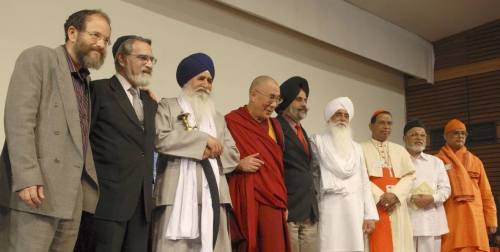
 

Rabbi Aryeh Kaplan on Experience, Consciousness, and Method

In this post, we will look at Rabbi Aryeh Kaplan’s views on consciousness, experience, and visionary mental images. His broad view of altered states of consciousness incorporated 4-D and 5-D space, hallucinogens, and learning to form steady mental images. In his discussion of forming a mental golem, he puts many of these ideas together.  He also describes the goal as seeking spiritual energy though mizvot or through attaining the non-verbal consciousness of hokhmah. His discussion of Ezekiel incorporates many of his broad views on the topic of consciousness incorporating removing the static of the mind, sensory deprivation, the flood of past memories, bright light, and then the state of nothingness and synesthesia.  Finally, we discuss his rejection of non-Jewish meditation even as he is busy mastering books about it and we conclude with his willing to re-script the Kabbalah for women.

This is part VI in a series on Rabbi Aryeh Kaplan- see Part IPart II, Part III , Part IV and Part V for prior biographic discussion much of which has already been incorporated into Wikipedia.

aryeh kaplan pic
(Oil painting by Rabbi Kaplan)

Rabbi Aryeh Kaplan during one of his classes mentions how as a child he saw colors when people spoke, a common altered state of consciousness called synesthesia. In his book Jewish Meditation, he mentions his own eureka moment of figuring out a physics problem while taking a bath, and elsewhere he discusses how he uses “rebbono shel olam” as a mantra (he really meant japa). All of these, Kaplan called meditation. In general, he called any altered states of consciousness, synesthesia, telepathy, psychic powers, hypnosis, and opening the door of perception as meditation. Mediation is not mindfulness but the higher states of consciousness.

This is similar to the classic Moody Blues album, In Search of a Lost Chord (1968) where the lost chord of meditation is about attaining a higher state of consciousness, which includes music, art, LSD, philosophy, spiritual states, Eastern religion, and visualization.  Writing with a sense of this counter culture, Kaplan proclaimed that his works on meditation is only to be practiced by those pure and elevated. Yet, “we are living now in a time of breaking barriers. Everything that people always assumed to be impossible is becoming possible in our time. God may be teaching us a very important lesson with this: we are capable of doing things we never thought possible.” (Innerspace 167) Our age needs to know about the higher wisdom, the lost chord.

Kaplan treats Kabbalah as a meditative state, by which he means an altered state of consciousness. This generally means, for Kaplan, the ability to form mental images, whether in physics or kabbalah. Hence, his discussion of visualizing the divine name in his book Jewish Meditation becomes a synecdoche for a wide range of mental imagining.

The previous section explained how to use the letter arrays together with the divine Name as a meditative device.  One of the manifestations of higher meditative states (as well as some drug-induced states) is hallucinogens, where one can voluntarily form mental images.  These mental images appear to be real and substantial.  When a person is in a normal state of consciousness, he may be able to form mental images, but they are weak, transient, and blurred by mental static.  In contrast, the images formed in a meditative state appear solid, substantial, and real. (Sefer Yetzirah 133)

Kaplan’s works repeatedly refer to hallucinogens, which he does not primarily mean drugs, even though they are mentioned, but the ability to reach these states of forming images. He even asks at the start of Meditation and the Bible, whether prophecy is due to hallucinogens. Kaplan claims hallucinogens give the ability to “voluntarily form mental images.” For Kaplan, forming images is best done in a meditative state

However, when Rabbi Aryeh Kaplan was teaching Sefer Yetzirah, he said of the images of the kabbalah “it’s like tripping on LSD, grooving on black. If you do not have familiarity with these states of consciousness, then you wont understand what I am saying .” Several of those attending the class called out that they had familiarity. (taped class with psychologists – Jan 22, 1979). . Then, in such a state, one can imagine arrays of letters and divine names.

Jeffrey Kripal, the Rice University scholar of religion describes the approach to religion of the Romanian scholar of religion, Ioan Couliano (d. 1991) who taught at University of Chicago,  in ways very similar to Kaplan’s approach. For Couliano, the study of these practices has to be done from within, which means the leaving of three dimensional space toward four dimensions and beyond, these phenomenon brake our normal categories of time and space, leading us to the fantastic, complex, and strange. Kaplan consistently described kabbalah as five dimensional space and giving powers

The study of Kabbalah is a study of consciousness not a study of cultural texts, hence Kaplan gathered around him a core group of psychologists to understand these texts, not textual scholars or rabbinic scholars. And his method was to read a passage in a Kabbalistic text and translate it into terms of psychological and paranormal consciousness without seeking to contextualize that passage in the rest of the medieval kabbalistic book or in other kabalistic books.  His working assumption is that the original fantastic prophetic meanings were lost and the only way to find them was by discussing the passage with people who knew about consciousness.

Kaplan found the texts of the Sefer Yetzirah, Rabbi Abrhaam Abulafia, Rabbi Eleazar of Worms, Isaac of Acco and Hayyim Vital’s Shaar Ruah Hakodesh and Shaar Gilgulim as most valuable for this project. He did not find early kabbalists or much of the theosophic kabbalah as spiritual. Surprisingly, he did not find Chabad as mystical or meditative because, in his opinion, it had no higher wisdom or working with spiritual energy. In his classes, he claims to be able to derive all of Zoharic from Sefer Yetziarah. He also said in one of his 1979 classes that he had not looked at the Ari’s Etz Hayyim since 1970.

Golem of the Mind

The prime example of a meditative use of imagery is the creation of a golem. Moshe Idel in his book, Golem: Jewish Magical and Mystical Traditions on the Artificial Anthropoid describes how for members of the ecstatic school of Kabbalah, most notably Abraham Abulafia, the creation of the golem was a mental act of creation. Kaplan uses the ideas of Abulafia and applies them to texts elsewhere that took the creation of the Golem literally, such as Rabbi Eleazar of Worms. Kaplan uses this imaginary approach of Abulafia to describe the creation of mental images, the most important one being a golem, which he identifies with the astral body, as described by Eleazar of Worms and Hayyim Vital. Kaplan actually gives instructions for this process based on his idea that hokhmah is non-verbal and binah is verbal and confused. One enters the real of Nothingness at the height of hokhmah, there one can create things.  The magical is a sign of entering the higher states of consciousness.

It is out of this Tohu, this state of confused Binah consciousness, that one must create a palpable image.  There are many images that can be produced, but the most common is the mental Golem, the astral body.  The initiate thus “forms palpable substance (mamash) out of chaos.”  This implies attaining a state of Chakhmah consciousness.  The Kabbalists thus note that the word Golem has a numerical value of 73, the same as that of Chokhmah. In the process one visualizes the sefirtot by a process of carving hem in one’s mind as a form of visible air. Notice again the point that I am making that he treats the word meditation as the activity of carving sefirot in the mind.  The golem is the background for the carving of the sefirot.

In order to accomplish this, one must enter fully into the realm of Nothingness.  This is the highest level of Chakhmah consciousness, bordering on Keter.  One therefore begins with “nonexistence,” which is Nothingness.

When one reaches this level, he can actually make something “that actually is” (yeshno) or “existence.”  He can actually bring about results in the universe of Asiyah, which can then be reflected in the physical world.  In making a Golem, this would correspond to the state of consciousness required before the metal image could be imposed on the clay, bringing it to life. (Sefer Yetzirah 134)

]It is in this state of consciousness that one can visualize the Sefirot as “great pillars.”  One “carves” them out, this meaning that the image of the Sefirah is seen separately, totally filling the consciousness.  Even though the Sefirot are totally ineffable and indescribable, when a person is in this state of consciousness, he can “carve” them out.  They are then perceived as solid pillars, made of transparent air.  Like the air, the Sefirot are still invisible, but in this state of consciousness, even the air can become visible. (Sefer yetzirah 135 )

For Kaplan, in this process of visualization, one mentally forms each of the 22 part of the body culminating in putting them together as a golem. Kaplan thinks the ultimate goal is to combine the 22 visualizations into a full body. Notice that he turns Abulafia and Eleazar of Worms into a sense that these are instructions for today and he describes how to do it. One carves letters int he mind, the way he descbied carving the Tetragrammaton in other places in his writings. He concludes with the potential for still creating a physical golem.

He used each of the 22 letters to form a mental image of a different part of the body.  Each part of the body can thus be formed separately.  The ability to complete separate parts, however, does not prove mastery of the method of Sefer Yetzirah.  The final proof of mastery is the ability to assemble all these 22 objects into a single body.

This is the process of completing a mental Golem.  The initiate must not only form all the parts, but he must actually assemble them.  This means that while he is engaged in the meditation to create one part, he must not lose his mental image of the parts that he formed earlier.  As each part of the image is formed, it must be retained in the mind, with subsequent images added to it, part by part.  The amount of mental discipline, as well as the advanced nature of the meditative technique required for this, is virtually beyond description.

The creation of a mental Golem is therefore a culmination of the arts of Sefer Yetzirah, as well as a test to determine if one has mastered them.  This did not involve the actual creation of a physical Golem, sine this was only done on very special occasions. (Sefer Yetzirah 136)

For many, Kaplan’s writings were an Orthodox version of Moshe Idel’s ideas about Abulafia’s views.  Kaplan clearly did not rely on Idel because of the older and inferior texts used and the many weak readings of Abulafia in Kaplan. But an example of a an Abulafia truism, quoted in the name of Kaplan, is that for Kaplan similar to Abulafia and Idel divides “the kabbalah is divided into three categories, the theoretical, the meditative, and the magical.”  Thereby rejecting Scholem’s focus on the symbolic sefirot. Once again note the definition of meditation used by Kaplan, “meditative kabblah deals with the use of divine names, letter permutations, and similar methods to reach higher states of consciousness, and as such, comprises a kind of yoga.” (Sefer Yetzirah ix) But Kaplan delivers excitement for his readers through also using descriptions similar to the Tibetan material about an astral body made in mental visualization described by W. Y. Evans-Wentz. Tibetan Yoga and Secret Doctrines (1935).

Spiritual Energy

In general, Kaplan is looking for the power and spiritual energy of the Kabbalah, the way that 1950’s American books on Indian thought picked out the passages on kundalini and chakras. When he was writing, the then current English writings on kabbalah did not emphasized these aspect of spiritual energy at all. For example, Kaplan notes that the position of uplifted hands played an important role in the priestly blessing. As a source, he gives the Bahir, which explains “that the reason for this is because the ten uplifted fingers parallel the ten sefirot and can therefore draw spiritual energy from them. This same position is also used by Rabbi Abraham Abulafia…”  (Meditation and the Bible, 70).  Elsewhere, he reiterates this as  “raised hands to focus spiritual energy.” He translates the theurgy and concern for sefirot into a more generic “spiritual energy”  moving quickly from sefirot to meditative kabbalah allowing the reader to think of kundalini or tai chi.

This is also the way Kaplan paints Rabbi Isaac Luria. “Very often, the Ari used to take a passage from the Zohar and meditate on it, perhaps repeating it over and over like a mantra, until the inner meaning was revealed to him.” (6) Kaplan skips from Abulafia and Rabbi Isaac of Acco to the writings of Rabbi Hayyim Vital, with little attention to the Zohar and theosophic Kabbalah which he finds too poetic and too anthropomorphic, but he credits this poetry to our not understanding its secrets. For him, Zohar is only poetry without the Ari. “The Ari’s teaching could be called the atomic theory of the Zohar: everything begins to make sense. One can go deeper and deeper, as far as the human mind can delve, and it will always yield new treasures. “(6)

Even the concept of sefirot, or the sefirah of malkhut, he makes into spiritual energy. Based on a passage in the Pseudo Raavad (Yosef ben shalom Ashkenazi) commentary on Sefer Yetzirah, he considered the word sefirot and the Livnat haSapir under the divine throne as based on the jewel sapphire, which is the jewel of the third eye, where humans can see visions.

Reaching Non-Verbal Consciousness

In all of his discussions, he accepts the known opinion of Aldous Huxley that the goal of altered states of consciousness is to remove all the noise of everyday life blocking the higher wisdom, a super normal perspective. The goal is to get to non verbal hokhmah consciousness that is higher than verbal binah consciousness.

Try for a moment to stop thinking.  You remain completely conscious, but there are not verbal thoughts in your mind.  If you are an average person, you may be able to maintain such a state for a few seconds, but immediately your mind begins to verbalize the experience.  You might say to yourself, “I am not thinking of anything.”  But as soon as you do this, of course, you actually are thinking of something.

For those few second, however, you have experience nonverbal Chakhmah consciousness.  If you work at this exercise, you can gradually learn how to extend the time in which you are in this state.  It is like a heavy pendulum, the longer you push it back and forth, the further it will swing.  Similarly, the more you learn to oscillate between verbal Binah consciousness and nonverbal Chakhmah consciousness, the deeper you will reach into the latter, and the longer you will be able to maintain this state. (Sefer Yetzirah 40)

It is very difficult to experience pure, nonverbal thought.  As soon as a person attempts to clear his mind of thought, he immediately begins to think, “Now I am not thinking of anything.”  The state of Wisdom or Chakhmah consciousness is one of pure nonverbal thought, which is very difficult to attain.

It is in an attempt to attain the state of Chakhmah consciousness that the various meditative methods are used.  Thus, mantra meditation attempts to clear the mind of reverie by filling it with the repeated words of the mantra.  Similarly, contemplation pursues the same goal by filling the mind with the contemplated object. (Sefer Yetzirah 39)

Theosophic Kabbalah is really about consciousness of knowing the harmony or resonance of sefirot and the word.  He gives a method or path of meditation-magic. First one binds oneself to the object, then one perceives its spiritual nature and evaluates the object.

When a person has an awareness of the Sefirot, he can then “examine” anything in creation and determine the Sefirah to which it pertains.  As he becomes proficient in doing this, he can use various things to strengthen his attachment to their associated Sefirah.  When the Sefer Yetzirah was first written, each individual had to do this on his own.  Now, however, there are many lists which associate various things and ideas with their appropriate Sefirot, and these can be used as aides in binding oneself to them.

The Sefer Yetzirah is also indicating here that when a person perceives the true spiritual nature of a thing, he also elevates that thing spiritually.  “Standing” refers to such elevation.  The expression, “make each thing stand” therefore says that when one “probes from them,” he elevates the thing that he probes. (Sefer Yetzirah 40-41)

kaplan-ncsy 1975-shelly lang
(At a 1975 NCSY Shabbaton with Shelly Lang)

Turn on, Tune in, and become a Prophet

One has to go within to activate one’s neural equipment in order to become sensitive to the many and various levels of consciousness. One needs to “Turn on” to the higher consciousness, and then one is to “Tune in” to interact harmoniously with the world around you – externalize, materialize, express your new internal perspectives. He reflects Aldrous Huxley description of the need to “Turn on and Tune in” (using Leary’s phrase).

Meditation does two things: it relaxes the mind’s reactions to all external stimuli and thus quiets down all the internal thought processes and normal reverie. In an ordinary state of consciousness the mind is filled with static. If you wish to see this static, just close your eyes for a few minutes. You will see a rapidly changing series of superimposed images which constitute a steady stream of internal stimuli. As long as you are seeing and hearing your own reveries, as long as you are talking to yourself, you are not going to hear God’s voice.  You have to quiet down all the mind’s internal messages to itself, which is a very difficult undertaking…

This is like trying to get a very weak radio signal and picking up a lot of static. If you have a good radio, you can tune it, cut down the static, and pick up a clear signal. Similarly, high-level meditation requires that you first eliminate all mental static. You may then be able to pick up a very faint signal that you cannot really hear. The next step is to carefully start tuning up the volume. Now imagine what will happen if your mind is not controllable yet when you turn up the volume. You will get your signal…the static will actually cause a devastating shock. (Innerspace 149-150)

Kaplan gave classes on the opening chapter of Ezekiel based on this approach. “Ezekiel saw five things: a storm wind, a great cloud, a fire, a Glow and Chasmal. According to the Zohar, the first four were Klipot, husks or barriers that Ezekiel had to experience before getting the vision. (Innerspace 149). For Kaplan, the storm wind is the aforementioned static.

The cloud  is sensory deprivation and the deautomation of complete focus. The psychologists Charles Tart and Arthur Deikamn were in their research working on these states in the 1960’’s.

“You have to quiet your mind even more. What do you see, then, when you get rid of all internal stimuli and quiet down the mind completely? Nothing, A very frightening nothing, an empty nothing.” “A sensory deprivation that is amplified a million times. You feel this overwhelming frightening nothingness.” (Innerspace 151)

It has been said that the best way to describe absolute nothingness is to speak of it as “what you see behind your head.”  Since vision does not exist in the back of the head, what one sees there is absolute nothingness.  If I ask you what you see behind your head, you answer that you see nothing.  Contemplating on what one sees behind one’s head is therefore a good way to learn how to visualize absolute nothingness. (Innerspace 89)

The fire is the experience of being flooded by all of one’s past memories; once again ideas based on Huxley.

Imagine you start feeling a closeness to God and realize that God knows everything about you and everything you ever did.  You are standing naked before God, with your memory wide open, completely transparent, without any jamming mechanism or reducing valve to diminish its force.  You remember everything you every did and see it in a new light.  You see it in the light of the unshaded spirit, or, if you will, in God’s own light that shines from one end of creation to the other.  The memory of every good deed will be the sublimest of pleasures and most delightful bliss imaginable. (Innerspace 151)

But your memory will also be open to all the things of which you are ashamed.  The wrongs you committed burn; they are very painful, but it is worse than physical pain.  It is not even like a psychological pain that you could hide or run away from.  There is no possibility of rationalization, no dismissing it, no escaping it.  It is a pain that is there. (Innerspace 152)

The glow is according to Kaplan, a brilliant black light

Imagine a black that is as vivid as a blinding sun.  Now in an ordinary state of consciousness you could not imagine it.  In a meditative state you can.  You can imagine a black that becomes deeper and deeper and glows and radiates and becomes blindingly bright. (152)

Finally, the vision of the Chasmal  is the speaking silence of the top of hokhmah, which is keter as a speaking silence  or the often discussed synesthesia, or the Buddhist Nothingness, (which I discussed in the last post). Most discussions place synesthesia at a lower stage of consciousness, but Kaplan places it at top. He situates his own childhood experience as within the prophetic.

Meditative Mathematics

A completely different form of meditative experience are his forays into the visualization of complex analysis in math, his discussions of the topological concept of a Rieman Sphere. As a given throughout his writings, Kaplan assumed that the Kabbalah was up to date about the physical world and working with five dimensional space, in practice four dimensional. Math problems and topology were treated as meditations and a vital form of forming mental images.

When we view the Sefirot as being ten directions in a five-dimensional continuum, we can also interpret this in another manner.  Every pair of Sefirot defines an infinite line, extended infinitely in both directions.  The end points of such an infinite line, however, come together and meet once again in the “point at infinity.”  This is a fact recognized by mathematicians, and considerable use of the “point at infinity” is found in complex analysis, the calculus of complex numbers.

In our three-dimensional continuum, we can likewise extend all lines outward infinitely.  The end points of all these lines would then be an infinite sphere surrounding all space.  However, each opposing pair of lines would meet at the point at infinity, and therefore, all ongoing times must meet at this point. Thus, in one sense, the entire three-dimensional space continuum can be seen as surrounded by an infinite sphere.  In another sense, however, this entire infinite sphere can also be represented by a single point- the point at infinity.  A point, however, is infinitely small.  Thus the point at infinity can be seen as being both infinitely large and infinitely small at the same time. (Sefer Yetzirah 58- 59)

One can use this as a meditation.  Try to imagine the sphere at infinity and the point at infinity, and attempt to perceive how they are actually one.  You will then see that your usual conception of space and extension are not as simple as you believe. (Sefer Yetzirah 59)

Other Religions and Meditation

Kaplan was adamant and unyielding to all those who asked him about TM and other Eastern techniques that they were “foreign worship” (avodah zara).

Kaplan, however, saw the practices of other faiths as deriving form Judaism. He popularized the statement of Rabbi Menashe ben Israel (17th century Amsterdam) that the gifts of Abraham to his concubines were the Asian religions. He thought that the ancient Canaanite practice of worshiping a sacred grove or asherah was based on the Kabbalistic tree. Or that Rav Hai Gaon’s statement that the hekhalot were done by placing one’s ead between one’s legs became the ancient pagan worship of dust.

Realizing the importance of the tree symbolism in prophetic meditations, the idolaters attempted to emulate it. They actually planted trees which would serve as the object of their meditations and visions…. Through such Asherah trees, they hoped to ascend the spiritual Tree, which they most probably saw as the Tree of Life.” (107) In his speculative etymologies, Ashera is from the root shur- to see or have a vision of the tree.  “This ‘tree’ is often said to refer to the entire array of the Sefirot…ascending through this array plays a key role in prophetic meditation.”

“We often find counterparts of prophetic methods in idolatrous practices, since in many cases, the idolaters attempted to emulate the prophetic schools. A possible hint that this position was used among the idolatrous prophets is found in the Talmudic teaching that certain pagan Arabs used to “bow down to the dust of the feet….However, it would appear that some pagans viewed the prophetic position, where the great mystics sat with their head between their knees, and assumed that they were contemplating their toes, or the like. They adopted this practice and it gradually degenerated to the worship of the “dust of their feet.” (71)

Yet, Kaplan held that “Idolatrous and other occult practices often shed light on the prophetic methods.” (Innerspace 109, 115). Hence, he often used books about practices in other religions to figure out Jewish practices. We read books about Asian religions to reclaim Jewish practices which were primary.

Gender

Finally, Perle Besserman, one of his long time students, and the one who promoted him for his radio and TV interviews, asked him about the role of gender in these experiences in that it always was a male mystic who identified with the male zeir anpin making love to female shekinah. Kaplan answered that after we figure out the visualizations for men, we can figure out a useful visualization for females. It should be noted, that in the 1970’s, Kaplan was one of the few teachers within the Orthodox world who regularly taught women and encouraged them to study the Talmud, Oral law, and Kabbalah.

As a side point, Perle was among the cadre of his students who complained that Kaplan was more interested in theory than meditative practice, that he was not teaching meditation rather explaining Ezekiel. She therefore  returned to Eastern practices becoming a Buddhist practitioner and teacher.

Judging from the overtly sexual language reminiscent of a Tibetan tantra text, I noted that the Sefer Bahir seemed to suggest that the union of male and female sefirot not only be visualized but literally enacted in sexual intercourse. Informing Aryeh that I was uncomfortable with the idea of a female Kabbalist visualizing herself reflected in the “great bearded male continence” and making love to her husband in the form of the shekhinah, I asked if there was a way we might re-configure Rabbi Nehumiah’s meditation for women.

“Sure,” Aryeh replied. “But it’ll have to wait until we’ve deciphered all the meditations in their original form first.” (Perle Besserman, A New Kabbalah for Women 73)

Coda

Kaplan interprets the four elements of medieval thought- fire, water, air, and earth-in modern terms. Fire is the electromagnetic force, water is the strong nuclear force of mesons, air is the weak nuclear force, and earth is gravity. For him, these, in turn, correspond to the four letters of the Tetragrammaton. The forces of physics are the meditative forces. (Sefer Yetzirah 145-146). How does he make such leaps of connection?

This is not just our question, but was already a question when he was giving the classes. When discussing the Kabbalisitic image of the “Black Fire” of the Torah, Kaplan explained it as a black hole of negative energy. To which, one of the psychologists in the class asked: “Where are you finding this in the text?”

In the next class this question comes up again to which he answers with a verbal wink. Kaplan defined the sefirot as a three-dimensional spatial continuum of spiritual, time, and space implying that our goal is to get to the four dimension.  After this definition, he was asked: “Is that your own original analysis? To which Rabbi Kaplan answered: “A little bit  …. But it is Sefer Yetzirah”

Rabbi Aryeh Kaplan’s God

To continue with the discussion of Rabbi Aryeh Kaplan’s method, we turn to his view of God.  In these passages we see Kaplan portray God as computer system, as a cloud containing the data of our memories, and as a system of providence in which God does not reveal himself. God is also portrayed as an abstract principle similar to math. But ultimately, he thinks God is beyond our categories, similar to Buddhist Nothingness, and is only know through an expansion of consciousness. Should we follow his method and take the medieval philosophy and Kabbalah and adapts them for 21st century cosmology. Kaplan remains a theist with the traditional attributes of God including volition, but he uses computers, consciousness, and Buddhism to explain God instead of Aristotle or Kant.

This is part V in a series on Rabbi Aryeh Kaplan- see Part IPart II, Part III  and Part IV for prior biographic discussion much of which has already been incorporated into Wikipedia. There will be Part VI within the next two weeks.

if you were god

I listened to the audio of the classes on which the book Sefer Yetzirah was based. In the discussion, he defined meditation as an expansion of consciousness, alternately he said “I believe that meditation is the channeling of the spiritual energy.” This expansion of consciousness is not mystical or intellectual but a third item called expansion of consciousness. That consciousness give the adept knowledge of God.

In the tapes, he discussed the Rabbi Elazar of Worms, Sodei Razaya meditation I discussed in the last post. comparing Sodei razaya to complex analysis in calculus, where according to him, infinite lines come together. At that point of infinite, there is insight. He compares it to the expansion of consciousness in  Zen Buddhism when is hit by one’s teacher.  One of the people in the class said this consciousness is like the force from Star Wars. Kaplan added it is was similar to hypnosis and they discussed the bio-feedback levels. Kaplan quoted in the discussion to explain consciousness Alan Watts, Andrew Greeley’s book on Ecstasy and Aldous Huxley.

Huxley’s two essays appear as a single book “The Doors of Perception”  “Heaven and Hell”, they both played a major role in Rabbi Aryeh Kaplan’s thinking. Whereas most Jews who learned to meditation in the 1970’s tended to mean practices like TM or Zen, Kaplan definition of meditation was about opening to a higher consciousness, a unified state bringing everything together allowing a new insight into reality, an opening of windows to a deeper understanding. In various places, Kaplan used the word meditation as a synonym for mysticism, magic, and altered states of consciousness.  But the fact that he talked about meditation was enough for many in the 1970’s even if he did not teach meditation techniques beyond visualize letter, rebono shel olam and the slow shema. His practice was basic but letting people know about the extent of advanced texts and the potential within Torah was eye opening.

Before I go further, I must point out that Huxley points out that the way to maintain this consciousness with human relations, chores, charity, and compassion is by the right living and constant attention shown in the religious life, properly understood.  For Huxley, “Ideally, everyone should be able to find self-transcendence in some form of pure or applied religion.”  This seems to be an influence on Kaplan’s view of mizvot.

I am also finding that Rabbi Aryeh Kaplan’s NCSY pamphlet “The Real You” is predominantly based on Aldrous Huxley’s Door of Perception /Heaven and Hell discussion of mescaline and consciousness opening. It seems the strategy was that we are going to keep kids off of drugs by saying they can have altered states of consciousness, synestheia, and opening their door of perception by knowing about Kabbalah. Huxley sees our minds as holding more data than we are aware of and the goal is to attain a higher consciousness to gain access to these levels of self.

In his pamphlet, The Real You, Kaplan asks the big questions about the soul and afterlife. Few ask those questions in Orthodoxy and fewer give cogent answers.

Here we see Kaplan’s contribution of reading and translating Kabbalah into modern cosmology. In this case, the nature of our souls as presented by R. Hayyim Vital is entirely digested and explained that for our era when the medieval kabbalah means that our minds are computers and God is the backup of the data.  In 2018 terms, our minds are mother boards that can be removed from one computer and placed into another one keeping the data intact. God is the cloud where we keep our data.  So that after we die, God holds our memory and personal identity the way the cloud holds your data after your devise dies. In everything that follows in this blog post, ask yourself if you think that was a good way to put medieval cosmology into 20th century terms. If he had lived longer, he probably would have loved string theory.

Kaplan turns reincarnation and gilgul into more modern theory of memory. This definition allowed him to completely reject Indian forms of reincarnation because those do not keep your memory and personality intact.  He was adamant to reject the opinions of those students coming to his classes with a more TM universal sense of soul that reincarnates without memory and personality. Kaplan, in contrast, argues that Judaism is about personality.  Since we are memory, Kaplan found it useful to explain heaven and hell as based on confronting our memories of past events, similar to Huxley.

A brain transplant raises enough questions. How about a memory transfer?

GOD’S MEMORY

What happens then when a person dies?  God does not forget, and therefore all of this information continues to exist, at least in God’s memory.

(An allusion to this is also found in the Kaballah. Gan Eden or Paradise is said to exist in the sefirah of Binah — the divine understanding. This may well be related to the concept of memory. Souls, on the other hand, are conceived in the sefirah of Daas — knowledge. One may say that while we live, we exist in God’s knowledge; after death we exist in His memory.)

This sum total of the human personality existing in God’s memory is what lives on even after man dies…

CUTTING DOWN AT STATIC

In “The Doors of Perception,” Aldous Huxley quotes Prof. C.D. Broad’s comments on this. He says that every person is capable of remembering everything that has ever happened to him. He is able to perceive everything that surrounds him. However, if all this information poured into our minds at once, it would overwhelm us. So the function of the brain and nervous system is to protect us and prevent us from being overwhelmed and confused by the vast amount of information that impinges upon our sense organs. They shut out most of what we perceive and remember. All that would confound us is eliminated and only the small, special selection that is useful is allowed to remain.

Huxley explains that our mind has powers of perception and concentration that we cannot even begin to imagine. But our main business is to survive at all costs. To make survival possible, all of our mind’s capabilities must be funneled through the reducing valve of the brain.

Much of what we know about this static is a result of research done with drugs that eliminate it. According to a number of authorities, this is precisely how the psychedelic drugs work.

The disembodied soul spends much of its time learning how to focus. It is now seeing without physical eyes, using some process which we do not even have the vocabulary to describe. The Kabbalists call this frightening process Kaf HaKela

If God is guarantor of memory, a form of a data cloud, then where does a theory of God fit into all of this? For Kaplan, God wanted to bestow goodness on the world through letting human have freedom and make moral judgement on their own. Hence, he had to hide himself, only operating the world by means of the Kabbalist system of four world and sefirot.

If we were to imagine the spiritual domain, therefore, it could be described as an infinitely huge spiritual computer. This computer is programmed to fulfill God’s one ultimate purpose of bestowing good upon his creation. The main difference between the spiritual domain and a computer is that the components of the former consist of intelligent, sensitive, spiritual beings. (Innerspace 8)

Below, God is portrayed as computer, specifically as a computer feedback system where God as the highest world of Atzilut is the CPU and the lower divine worlds are the memory, program, and peripheral equipment of the computer. Providence works only through this Star Trek type deity. Yet, if you read the passage slowly, you will see that Kaplan is, in his mind, working with Ramchal’s Derech Hashem, a volume he had translated a few years before.

A computer system can provide us with an analogy to the constant interplay between the spiritual and the physical.  The programmer sitting at the console corresponds to the “Man” of Atzilut.  The CPU, Central Processing Unit, is the brain and memory bank of the computer, corresponding to Beriyah, the world of thought.  Suppose that the computer is programmed to control traffic lights throughout a large metropolitan area.  Transmission lines would then be coming out of the CPU, connecting it to traffic lights all over the city.  These transmission lines correspond to the universe of Yetzirah.  The traffic lights themselves are the peripheral equipment.  These lights correspond to the world of Asiyah, controlling traffic in the physical world.

We mentioned that the relationship between the physical and the spiritual is always dynamic.  Accordingly, God’s providential direction of the universe never ceases.  He is always acting in the world, guiding events based on our actions.  In effect, therefore, this is a “two-way” process with a built-in feedback loop to allow for changes in programming.  On the one hand, God is directing an ongoing input into the universe, irregardless of our actions.  On the other hand, God looks at what we do, judges it, and puts into the universe what He decides is appropriate relative to what we do.

In our model of the computer, the peripheral equipment will also contain this feedback loop.  On the one hand, the traffic lights are programmed to control traffic automatically.  On the other, sensors will record traffic flow.  For example, if the traffic on one street is blocked, the sensors will detect this, giving rise to a green-light command from the CPU to get the traffic flowing again. (Innerspace 34)

maxresdefault

Later in the same volume, we are offered contrasting views of God. The first, God as Being to whom we relate to personally as an at of anthropomorphism. The second is God as an ever present immaterial Principle, the same way 1+1=2. A principle valid everywhere that avoids anthropomorphism and exists outside of time and space.  This is a God of mathematics. Kaplan concludes, that God as Principle is also inexact and only a mental construct. Instead, Kaplan seeks an image of God via meditation as a ground of existence. God is only know in this higher state of consciousness between verbal and non-verbal. Here is where computers meet Huxley and Buddhism.

We can speak of God as the Creator of the universe, thus conceiving of Him as a “Being.”  On the other hand, we can speak of God as the creative Force that gives existence to the universe, thus conceiving of Him as an abstract “Principle.”  The main thing that characterizes God as a being is that we can relate to Him personally. When we view God as the Creator and Master of the universe we are ascribing anthropomorphic concepts to Him that are most fitting to an omnipotent sentient being. (Innerspace 98)

The main thing that characterizes a principle, on the other hand, is that there is no place where it does not exist. This is like taking a mathematical principle such as 1+1=2. This simple equation is a good example of something that does not exist in space, and yet, at the same time, exists everywhere.

For many reasons, therefore, it would be useful to think of God as a principle rather than a being.  For one thing, it would make it readily understandable how He exists outside of space and time and yet fills all space and time.  For another, an idea such as this breaks down the stereotyped anthropomorphic concepts that people have about God. (Innerspace 98)

Actually, both “principle” and “being” are approximations that we use because the mind has no categories into which it can place God It may be that third, intermediate category would be a better approximation, but the mind has no example of it. Nevertheless, through meditation, one can gain a glimmer of the nature of this third category.  This involves a deliberate oscillation between verbal and non-verbal states of consciousness.  It is alluded to in the Sefer Yetzirah’s statement that one should emulate the living angels (Chayot) who are constantly “running and returning” (Ezekiel 1:14). (98-99)

Thus, when we commune with God, it is as if we are in touch with existence itself, but at the same time speaking to it as if it were a being to whom we can relate. Still, we realize that God is more than this. He is the infinite Being and absolute Principle that allows existence to be. (Innerspace 99)

Even within this system, we have still cannot grasp this God who is beyond our understanding, called  Atik Yomin, the Ancient of Days. We only know the lower  aspect of the divine called Arikh Anpin, the Long Face of mercy and compassion

Even if we say that God can place restraints on Himself, we still have an unknown will that transcends our understanding why He is placing restraints on Himself.

In essence, therefore, we see that God’s will has two aspects in relation to us.  On the one hand, we cannot fathom God’s will because it originates at a level that completely transcends our logic.  This is the level of Atik Yomin, the Ancient of Days, which is totally unknown and goes back before anything can be thought of.  On the other hand, there is a part of God’s will that operates through logic.  This involves God’s constricting His will so that man can have some understanding of Him.  This is the level of Arikh Anpin, the Long Face of mercy and compassion. (Innerspace, 100)

Kaplan identified this unknown aspect of God who is beyond our understanding with the Buddhist concept of Nothingness. He said that the ideas of Ayin and Effes was Nothingness. He did this years before Daniel C Matt wrote a famous article making that equation. Kaplan’s sources were books on Zen Buddhism, where the Nothingness is the emptiness of satori, a higher consciousness. He did not seem to know Theravada Buddhism.

As the text notes, this represents the unity that preceded the concept of number.  It introduces a device very much like Zen koan, asking, “Before one, what do you count”?  What is the number that precedes all number?

Both the point at infinity and the koan are meant to train the mind to visualize absolute nothingness.  The Ari notes that Keter, the highest of the Sefirot, is often designated by the word Ayin, meaning “nothing.”  The Infinite Being, the level above Keter, cannot even be designated by this word.  The only word that can be used is Effes, which, according to the Ari, denotes a nothingness that thought (Binah) cannot grasp at all. (Sefer Yetzirah 89)

As in many places in his book, the Ari, Rabbi Isaac Luria was used to explain a word in Sefer Yetzirah and the entire Kabbalistic concept needs to be grounded in modern categories.

Rabbi Kaplan was strict to keep his entire discussion within a rational framework of Saadiah’s and Maimonides’ rational theology of avoidance of anthropomorphisms. God does not sit as we do, rather sitting means God lowers his providential power to interact with the world.

As discussed earlier (1:4), when we speak of God as “sitting,” it means that He is lowering His essence so as to be concerned with His creation.  His Throne is the object upon which He sits, and hence, it denotes the vehicle of such lowering and concern.

While “sitting” is a lowering that one does on one’s own initiative, prostrating oneself and bowing is a lowering that one does because of a higher power.  The tools of God’s concern are the Sefirot, since it is through them that He directs the universe.  As a result of the concept of God’s Throne, the Sefirot must also lower their essence and interact with the lower world.  The Sefer Yetzirah therefore says, “before His Throne they prostrate themselves.” (56)

These quotes are from his Kabbalistic works. For his more popular views, see As if you were God and Handbook of Jewish Thought


Rabbi Aryeh Kaplan – Creating 20th Century Jewish Meditation

This is part IV in a series on Rabbi Aryeh Kaplan- see Part I, Part II, and Part III for prior biographic discussion much of which has already been incorporated into Wikipedia. There will be Parts V and Part VI within the next two weeks, maybe even later this week.

How did Rabbi Aryeh Kaplan take an obscure medieval Ashkenaz description of the Godhead and turn it into a meditative practice of infinite space similar to the 1960’s understanding of meditation? Answer: The same way Swami Vivekananda took the medieval Kurma Purana and turned it into modern meditation about sitting straight and focusing. Should we follow his method and take the plethora of kabbalsitic texts published by scholars and adapt them as 21st century meditation? What if this had been the path into modernity for Judaism the way it was for Neo-Hinduism? What if the Reform and Orthodox movements of 1910 had turned to transcendental idealism to create a meditative Torah?

SY- cover

Kaplan’s approach to producing a Jewish meditation is what he calls the “practice of verbal archaeology.”  He assumes the prophets were meditating to reach prophecy, which basically stopped after Ezekiel. Now, one can only do verbal archaeology by looking at meaning of words as translated in older commentaries which may preserve the true meaning. (Meditation and the Bible). Among the older commentaries are the works of the Kabbalists.

The early 13th century Sodei Razaya by Rabbi Eleazer of Worms (also called Rokeach) describes God’s Glory and the limitless Creator above. Within the book are a few paragraphs about the infinite of the Creator and the need to direct our hearts to the ten limitless dimensions when addressing God. They are the Sublime, depth, above and below, east west, north, south, past, future, good, evil), a spatial approach to God, rather than the more familiar scholastic philosophers who discuss God’s essence and attributes. The next paragraph after the ten dimensions moves quickly to the relevant point that God does not appear to us as these limitless dimensions but rather as the ever changing shekhinah. Most academic scholarship focuses either on the abstractness of the Creator or on visualizing the shekhinah/kavod. In contrast, Kaplan turns the presentation of the creator into a meditation on Infinite Space. I specifically choose this passage rather than the hundreds of other possible passages in Aryeh Kaplan because it shows the gap between the scholarly reading of a cryptic text and Kaplan’s reading.

The creator has no limit, boundary or appearance. If He possessed a limit the way every creature has limits, how could he be in the midst of all and not be touched by all…

Every blessing requires one to think in one’s heart for intention to Our Father in Heaven. To consider the unity of the ten directions and there is no other. By what means? Consider the sublime (lit. above) without giving end to ones thoughts. Rather, think of the creator as sublime (above) and none else and the impossibility of understanding Him. Similarly, below into the depth, the depth who can fathom, and none else. He is impossible to understand.

Think of the expanses of the sky and below as well as the directions of east, west, north and south. Think about before the world from the beginning until the end [lemaaleh]. Do not place a limit to your thoughts that you think about the creator. Rather, He exists from the primordial past until now, there is none other. Similarly, for the end of days, from now until forever.

Begin thinking from the beginning of time without limit to your thought except He is God and there is none else. Similarly, for the ends of the depth of good and depths of bad, which show beneficence to the good and to destroy the bad. To exist in exaltedness and variations. The creator is completely desire and filled with knowledge and power.

We find changes in the Shekhinah [appearing] sometimes as a young man and sometimes as an old man. Know that the reason is because the Kavod (glory) appears to the prophets according to the needs of the moment.   (Sodei Razaya 40-41)

Aryeh Kaplan in his book Sefer Yetzirah turns these intentions to the infinite Creator- Father in Heaven into mental and nonverbal meditations on infinite.  The Sefer Yetzirah speaks of depths of the world in Mishanh 1:5. Kaplan identifies those depths with the Kabbalistic sefirot and with the depths described by Rabbi Eleazar of Worms.

Kaplan converts Eleazar of Worms into meditation by adding the imperative “to picture” and the instructions about letting “the mind travel.” Kaplan in his introduction to the book wrote that he is translating the book as statements but that he really feels all statements of Sefer Yetzirah are imperatives. He also places the ten dimensions as a temporal sequence. He also removes reference to this as done at the time of prayer or to the personified Father in Heaven.”

The Sefer Yetzirah does not speak of directions, but of depths, an idea that if difficult to understand and far from one’s comprehension, is also said to be deep….

Although the depths of these directions is infinite, it can be described mentally. The first technique involves verbal thought… Gradually, then, once can learn to depict these infinite depths non-verbally.

The first exercise is to try to depict the “depth of beginning.” Attempt to picture an infinity of time on the past. Let the mind travel back to a moment ago, and an hour ago, a day ago, a year ago, continuing until you reach a level where you are trying to imagine an infinity ago. Then do the same with regard to the future.

The next exercise involves trying to imagine good and infinite evil. The limits are pure ideas, which cannot be verbalized.

Finally, one must imagine the limits of the spacial [sic] dimensions. One must perceive the height of the sky and beyond the sky. The depth of the earth and beyond the earth.

In this manner, one gradually trains the mind to depict the infinite.  (48-9)

These exercises are actually described by R. Eliezer of Wormes [sic] (355 ftnt 112)

Kaplan took an obscure medieval text and made it sound like a 20th century meditative path.

His idiom was contemporary for the 1970’s in which the higher states of meditation were about infinite space. The American scholar, Harvard psychologist Daniel Goleman in his pioneering works on meditation portrayed meditation “the need for the meditator to retrain his attention” not the softer forms of mindfulness currently practiced. Goleman also focused on Buddhist meditation on infinite space as starting in the 5th level of Buddhist meditation.

Just as important, Anagarika Brahmacari Govinda in his Foundations of Tibetan Mysticism (New York : Samuel Weiser, Inc., [1958, 1975] p. 117 also portrays this infinite space. This was not the era of meditation as mindfulness, rather meditation was considered as great acts of mental focus.

However, Kaplan did not actually teach these techniques in his classes nor did he practice them. He did not create a meditative school. Most of those who came to him because they were interested in Asian meditative techniques returned to their Hindu and Buddhist teachers, even among some of his closest students. His accomplishment was presenting texts only known by scholars and only discussed in their harder to find articles in the public domain. And for the last forty years, English language books on Jewish spirituality are indebted in his popular presentations and adaptations.

Rabbi Aryeh Kaplan’s method of popularizing obscure and cryptic texts, for example taking a 13th century text and presenting it in 20th century terms should be seen as part of broader methods. Instead of contextualizing that maneuver in the culture of the 1960’s and 1970’s, where NCSY meets TM,  his texts are similar to the work of Swami Vivekananda, the Hindu teacher who revolutionized the way the West thought of Hinduism with his appearance at the 1893 World Parliament of Religions. Vivekananda’s works took millennium old texts and breathed new life into them by creating a modern method of meditation. He argued that Hinduism is not temple worship to statues but a modern cultivation of the mind, an activity eminently progressive form of New Thought and philosophic idealism. Largely because of him, we use the words mantra and yoga in English. Almost anything taught by today’s Ashram leaders is based on Vivekanada’s method of modernizing prior texts.

Vivekananda took a few pages of the medieval work Kurma Purana, a long work of legend, mythology, geography, pilgrimage, and theology, as his base by which to abstract a system of meditation. According to the Kurma Purana, yoga (which in this context means meditation as purifying the mind) gives knowledge and identity with God.  Here is the medieval version.

From yoga comes knowledge; knowledge, again, helps the yogi to obtain freedom. He who combines in himself both yoga and knowledge─with him the Lord is pleased. Those who practice maha-yoga [meditation on the Self] either once a day, or twice, or thrice, or always─know them to be gods. Yoga is divided into two parts: one is called abhava-yoga, and the other, maha-yoga. That in which one’s self is meditated upon as a void and without qualities is called abhava-yoga. That in which one sees one’s self as blissful, bereft of all impurities, and as one with God is called maha-yoga. (Quoted in Raja-Yoga, by Swami Vivekananda)

Vivekanada turns the medieval work into directions for modern people by telling them to sit straight, have positive thoughts, chant a mantra, visualize space, flames, one’s heart, and God. Rather than a medieval language we have a modern physics language of “makes one’s mind a channel for thought waves.”

Sit in a straight posture. The next thing to do is to send a current of holy thought to all creation. Mentally repeat: “Let all beings be happy; let all beings be peaceful; let all beings be blissful.” So do to the east, south, north, and west. The more you practice this, the better you will feel. You will find at last that the easiest way to make ourselves healthy is to see that others are healthy, and the easiest way to make ourselves happy is to see that others are happy.

Another meditation is given: Think of a space in your heart, and think that in the midst of that space a flame is burning. Think of that flame as your own soul. Inside the flame is another effulgent light, and that is the Soul of your soul, God. Meditate upon that in the heart.

Then the wise man should meditate upon the luminous, benign form of the Lord…Then he must meditate upon his oneness with the luminous form of the Lord.  Lastly, he must let the form vanish and meditate upon the Atman. (591, 620)

Meditation is cultivating a single thought reminiscent of the subject of meditation by repeating it over and over again. By following the same method and concentrating on the same subject at the same center of consciousness, that single thought becomes a giant thought-wave. In course of time the mind develops a channel for that thought-wave and the practice becomes effortless. No practice, however mechanical or intermittent, is ever lost.

Kaplan used the language of mantra and meditation that Vivekanada bequeathed to the English language. Many of these same adaptation techniques in his translations of a medieval text were done by Rabbi Aryeh Kaplan.

Now imagine, if Kaplan had lived in 1900 and wrote works against Western and Eastern European Jewry arguing that a modern Judaism should be meditative and about the elevation of the mind. Further imagine if he had established in 1910 dozens of meditation centers and centers for Jewish Innerspace or a modern denomination of meditation. If he had done this, then we would now know Judaism as a meditation religion. Modern Jewish thought might have been about consciousness and mind cultivation.

However, Kaplan himself would have not actually done this since he did not practice or teach the meditations, such as the one above. He would as part of a public presentation teach his audience to say the shema slowly, to visualize the divine name, and/or repeat ribono shel olam. But the 1000’s of meditations in his work, he did not practice or teach as meditative paths. If he had not died, he would have been more interested in string theory in the kabbalah than a Jewish ashram.

Now let us return to Kaplan’s interest in visualizing the infinite where verbal and non-verbal meet. As noted above, much of this comes from the psychologist Goleman and Lama Anagarika Govinda’s work on Tibetan Buddhism. But was the latter a valid source of meditative knowledge? Why did Kaplan gravitate to that work? Lama Anagarika Govinda (1898-1985), polymath scholar, mystic, writer, painter and poet, was not a real lama, rather a German philosopher and artist who moved in India and thought Buddhism was the path to enlightening our minds and leading to creativity. Govinda thought Buddhism was the best form of German Lebensphilosophie “philosophy of life” to produce a superior person.

Govinda wrote essays on the relationship of time and space and the need to reach a point of infinite space above these categories. For Govinda, “all the powers and faculties of the universe are within us, unless we have activated them through practice or made them accessible through training they will never become realities that influence our life.” He wanted us to combine the potentials of the unconscious mind or depth conscious mind with that of our rational conscious mind.  For him, “as little as we can live by the intellect alone, can we live by the “unconscious” alone.” For Govinda, meditation means “putting ourselves into a state of intuitive receptiveness, in which the gates of the past and the present are open to the mind’s eye. “

The above foray into Vivekananda and Govinda offer a basis for understanding Kaplan’s amazing adaptation of Rabbi Eleazar of Worms. Hoever, Kaplan has many more influences including Aldrous Huxley, Charles Tart, Werner Heisenberg, Sir John Woodroffe, and W. Y. Evans-Wentz.

Academic scholarship in its discussions of Ashkenaz Piety and early kabbalah translate many passages about contemplative visualization done in that era. The soul must visually imagine or think about the creator, the glory and images of sacred space.

If we were to continue Kaplan’s method, how would we modernize these other passages? Here are some passages from E. Wolfson’s Through a Speculum that Shines- Vision and Imagination in Medieval Jewish Mysticism, Princeton University Press, 1994. How would Kaplan have read them as imperatives and as about cultivating the mind?  Kaplan did not read texts as visions, he did not a visionary path but one of internalization and mental contemplations. Kaplan also removed as much as possible any anthropomorphism or direct visions of God. So, if we wanted to apply his method, how would he have scripted the following texts?

Eleazar of Worms,

A person should not think only about the glory that appears opposite the exalted throne but rather about the Creator of all who manifests His glory to those who are righteous in their hearts, for He is one and nothing resembles Him, blessed be He, and thus He ‘is near to all who call Him’ (Ps., 145-18).

The Creator is outside the images (mar’ot) and within them..

Since it is written ‘For I fill both heaven and earth’ (Jer. 23-24), why does one need to pray in a Synagogue or in the Temple? Yet, there is a place in which the Holy One, blessed be He, shows the created glory to the prophet according to the need of the hour. One might ask- how can one bow down to something created? And consider these verses- It is written, ‘For I granted many visions, and through the prophets was imaged’ (Hosea 12-11)… Rather the [vision] is nothing but a wonderful image (dimyon) and it appears as if he actually saw but it is nothing but a strong image. It is written, ‘upon this semblance of a throne there was the semblance of a human form’ (Ezek. 1-26); so too here [in the case of Isaiah] it is only an image.

Two responses to Rabbi Shai Held- Prof Sam Fleischacker and Rabbi Zach Truboff  

Welcome back after the holidays. Before Rosh Hashanah, I posted an exceptionally good interview with Rabbi Shai Held on his moral musar as shown in his Biblical commentary- Torah of the Heart. A Torah of chesed- compassion, gratitude, responsibility, respect for others, loving the stranger,and hearing the pain of others. Rabbi Shai Held presented a journey to develop our moral character until we are ethical beings like Abraham. Here are two responses to the interview. I wanted to post the responses before Sukkot for continuity but it was not to be.

Gratitude-rock

The two responses both appreciate the turn to ethics and musar but have opposite premises about the nature of ethics.

The first response of Prof Sam Fleischacker, who has posted on this blog before, agrees with Held’s message but wants a more rigorous grappling with the philosophic issues.  (1) What is the role of justice in the system? He is especially emphasizing the cold role of law, din, and justice. (2) Why Jewish love of fellow? Every great teacher has a similar message, so what resources does Judaism offer to make us good that other traditions do not. (3) How can we overcome self-deception? How can we move from knowing what to do to actually doing it?

The second response of Rabbi Zach Truboff lauds Held as grounding morality in a covenantal theology of God’s love thereby rejecting a purely autonomous ethic. Truboff also likes the emphasis on gratitude, lovingkindness, and a renewal of moral language. However, Truboff finds that there are times where Held’s approach downplays Divine command and the land of Israel, both themes of his own teachers.

chesed

#1 Response of Prof Sam Fleischacker

I am very sympathetic to Rabbi Held’s project.  I have argued in my own work that, as Held puts it, “Torah without ethics is not Torah at all, but … Torah that’s only ethics is … incomplete” (that’s the core idea in my Divine Teaching and the Way of the World and The Good and the Good Book, discussed here and here on this blog).  I also agree whole-heartedly that this aspect of Torah tends to be missing from (Orthodox) day-schools and yeshivot today, which “accentuate the particular to such an extent that the universal human [is] often lost.”  Held brings out the universal beautifully and he has a gift for close readings that unearth rich and subtle implications:  his use of Ibn Ezra on Exodus 22:21-3, and interpretation of Ezekiel 29:3, in the interview, are especially nice examples of this.

My own local rabbi has also been using Held’s commentaries in his drashot:  a terrific one on the word tzur, for God, in Haazinu formed the basis of his talk recently. From what I heard, and from the readings in the interview, I look very much forward to acquiring and using The Heart of Torah.

But there were places in the interview where I felt a deeper grappling with the tradition of non-Jewish moral philosophy could be helpful.  Below are some examples.

1) Held talks in the interview about our duties to the poor and the stranger entirely in terms of chesed:  love, kindness, compassion — the warm, emotional virtues.  What happened to justice — the cold, rational virtue that can sometimes lead to far more comprehensive and effective ways of helping people on the margins of society than any warm feelings towards them?  In his lectures on ethics, Immanuel Kant writes that giving alms to the poor “flatters the giver’s pride” while “demeaning” those to whom the alms are given, adding that beneficence to others should “be commended as a debt we owe, [rather] than as a piece of kindness and generosity.”  I’ve always found this admonition very powerful.  It makes clear, among other things, that we owe aid to poor and oppressed people whom we don’t particularly like as well as to the ones who touch our heartstrings.  (For a fascinating non-Kantian version of this thought, see Sarah Pessin’s critique of a politics of love at https://politicaltheology.com/americas-love-problem/).  Perhaps we could say that helping people out of justice is a form of love (chesed), but it’s probably better to distinguish din from chesed and appreciate the great moral value of the former as well as the latter.

2) Held is understandably annoyed by people who respond to his teachings by saying, “So, basically, you’re saying I should be a good person.”  But I’d like to hear more about how he means to fend off this dismissive reaction.  In the interview, we are given some wonderful readings of texts, but at the end of the day, they all seem to say, “Be loving” (or at most:  “Devote yourself to a loving God, which will enable you to be loving.”)  And if that is the end of the story, a dismissive shrug seems not inappropriate.

To be sure, it’s highly intriguing to present Judaism as centered around love:  that’s how we Jews usually think of other religions, not our own.  But by the same token, Judaism is hardly the only religion or philosophy that teaches the importance of love.  Christianity teaches it, and Buddhism teaches it, and Frances Hutcheson and Gandhi taught it.  What is distinctive about Judaism that should lead Jews, or anyone else, to turn to it for a message of love?  Why bother with Torah as a source for such a teaching, rather than just cultivating a kind heart — or turning to the Gospels or Gandhian satyagraha?

In a way, this is one instance of a larger problem faced by all moral teachers, whether in a religious or a philosophical context:  how do we make what we have to say interesting?  The most important ethical prescriptions are fairly obvious, after all.  Don’t deceive;  don’t be violent;  be kind;  help those in distress.  None of this is exactly news.  What is interesting, what is deeply disturbing, is that we all, regularly, fail to live up to these prescriptions — often rationalizing our failings to ourselves rather than correcting them.  Why do we do this?  How can we stop doing it?  What can a text or tradition teach us that will help us carry out the duties that we all know we should carry out?  If Held can answer these questions, he will do us a great service.  Telling us just what we ought to do, by contrast, is not very exciting.

3) One issue that can make a moral teaching interesting is the way it deals with the issue of self-deception — a pervasive source of our failure to live up to the demands of morality.  (“I don’t need to be honest to him,” I tell myself, “He did _______ to me”, where the blank is filled in with a self-serving description of a harm that I have blown up into an excuse for bad behavior.)  Self-deception is also a particular danger for moral philosophers themselves.  All too easily, we who teach morality convince ourselves that the fact that we talk a good game is enough to excuse us from actually behaving in decent fashion to the people around us.

That said, there are fascinating discussions of self-deception in moral philosophy.  Søren Kierkegaard makes the danger that one’s teaching will come apart from one’s life a central theme of his Concluding Unscientific Postscript.  Before him, Bishop Butler gave two wonderful sermons on self-deception (one of these focused on Balaam) and Adam Smith devoted a brilliant chapter to it in his Theory of Moral Sentiments.  Kant also makes illuminating remarks on it and I think it is an subterranean, but crucial, theme of Plato’s Republic.  I’m curious about whether Held takes up this theme, and if so, how.  There are characters in the Torah who seem to exemplify self-deception:  Pharaoh, of course (see, especially, Exodus 10:7-11, for a paradigm of bad behavior rationalized as good), and perhaps also Korach and Dathan and Abiram.  It would be interesting to see if the Torah’s way of dealing with self-deception contributes to a distinctive moral philosophy — and a moral philosophy that helps us actually carry out our duties rather than telling us simply what they are.

All-you-need-is-love

#2 Response of Rabbi Zach Truboff  

The German Enlightenment philosopher Immanuel Kant vehemently argued that the moral law was not be found in Divine revelation or religious traditions, rather was accessible to any rational agent. An act was good if it could be applied universally. Kant had little use for the

God of the Bible who commands subservience. Once it could be shown that morality was not dependent on religion, doors were opened even wider for those who wanted to abandon traditional Judaism.

Shai Held often cites a statement coined by Michael Wyschograd that the story of Judaism in the last two centuries is predominantly a “Judaism of self-liquidation” (Body of Faith, 181).  If the most important aspect of Judaism is its ethical message and that message can be found outside of religion, then why would one remain committed to outdated religious beliefs and practices? If anything, Wyschograd argues, modern thinkers assert that the “liberation from God constitutes the purification of the ethical. The ethics of religion it is maintained, is an ethics of punishment. But without God, the ethical is obeyed for its own sake, and this is surely a higher stage of the ethical” (181).

Even for those who ostensibly choose to remain committed to Judaism, Kant’s shadow lingers.

However, a Jewish theology authentically rooted in the Bible’s world view must by necessity push back against the revolution initiated by Kant.

The Biblical narrative repeatedly shows us that God can never be divorced from the good. Held’s shows that the story of the Torah begins with a God of life who creates human beings in His own image and affirms their unconditional dignity. Most importantly, the God of life is also a God of love who chooses to share His love with the descendants of Abraham. God’s love means “we are asked to love God in return. More than that, we are asked to love those who God loves: the neighbor and the stranger” (xxx). The Bible singles out God’s love for the vulnerable and oppressed, asking us to do the same.

The moral imperative created by God’s love is not limited only to the life of the individual but rather penetrates all aspects of society. For the God of love, there can be no separation between the moral and religious realms. Rather, “To embrace the covenant between God and Israel is to be summoned to embody the good and the holy” (xxix). God’s love is also essential to understanding that the good must always be at the heart of Torah.

Held cites the midrash, which emphatically states that, “The beginning of the Torah is lovingkindness, the middle of the Torah is lovingkindness, and the end of the Torah is lovingkindness” (296). The Torah begins with God clothing Abraham and Sara after exiling them from the Garden of Eden and it ends with God burying Moses after his death. In the middle, God visits Avraham while he is in need of healing after undergoing circumcision.  In effect, this expresses the idea that “The very essence of Torah, the sages thus insist, is a God of love and kindness who calls Israel to love and kindness” (296).

Deeply aware that such statements often end up as little more than empty platitudes, Held instead argues that it must be read as a radical challenge to all those who hold the study of Torah to be among the highest of Judaism’s ideals.  With powerful prose, he explains:

“Torah can elicit staggering degrees of goodness and generosity of spirit; it can motivate us to love when hate seems much easier, to care for the pain of others when indifference seems the surer path. But Torah can also be made to serve the opposite ends: It can serve to deepen selfishness and self-involvement; it can be cited to bolster chauvinism and cultivate hate… The Torah we learn and teach should help us become kinder, more generous, more empathic and willing to give; if it merely buttresses our biases and hardens our hearts, then it is simply not Torah” (298).

Mussar and Middot

Throughout nearly every essay in The Heart of Torah, Held contemplates various ways in which the Bible helps point us towards moral transformation. Held’s focus on ethics has coincided with a renewed interest in Mussar by many segments of the American Jewish community. At a time when most Jews lack a common moral language, an emphasis on character enables a broader discourse that transcends denominational boundaries.

Held draws inspiration from the Biblical interpretations of the Mussar masters famous for their harsh critique of traditional Jewish practice. For example, when God demands of Moshe that Israel must be annihilated for the sin of the Golden Calf, God highlights the stiff-necked character of the Jewish people even more than the transgression of idol worship (Exodus 32:9-10). Rabbi Nosson Tzvi Finkel, the Alter of Slobodka, explains that, “From here we see that defect in character is even worse than a defect in action- more serious even than a grave sin like idolatry” (203-204). According to Held, “What Finkel is suggesting- in the most dramatic possible terms- is that Judaism is concerned not just with what we do, but also with who we are. Jewish ethics is focused not just on conduct but also on character. From a Jewish perspective, character matters, and the cultivation of good character lies at the heart of religious life” (204).

Held returns often to the idea of gratitude. For the Bible, gratitude is fundamental to the religious personality. Unlike other attributes, it is inherently relational and therefore is always directed towards another, whether it be our fellow human beings or God.

I found myself particularly drawn to a close reading that he offers of the narrative of Leah, a reading that  illustrates the complexity and significance of gratitude. Held is aware that it is all too easy to see Leah as a pathetic character in the context of the narratives of Bereshit. Despite the knowledge that she was not chosen by her husband, she still yearns for his love. It is her hope that by providing him children, she will finally win Jacob’s affection.

Held cites a strange Talmudic claim that until this moment no human being had truly expressed authentic gratitude. He explains that this makes sense if we recognize that Leah’s gratitude is unique because it is accompanied by terrible disappointment. With the birth of Judah, she has come to the conclusion that Jacob will never love her as she desires. Nevertheless, in the midst of her pain she has also come to recognize with gratitude the good she has experienced.

From her example, Held draws an important lesson, one that resonates with me more and more as the years pass.

“Disappointment need not preclude gratitude, and nor need gratitude crowd out the very real possibility of disappointment. Judaism does not ask us to choose one feeling or the other, but rather makes space- indeed, seeks to teach us to make space- for the sheer complexity and contradictoriness of human experience. Who better than Leah to teach us that a broken heart can also have moments of profound fullness” (63).

Can the God of Love also be a God of Law?

A focus on “loving the stranger” and character can be morally uplifting, but does the Bible have anything to say about the role of Jewish law in moral life?

For a religious thinker such as Held who focuses on the idea of covenant, it is surprising that command is minimally addressed in his essays. Held’s call for a return to a God centered morality is to be lauded, but one must question whether such an approach is even possible without repeatedly emphasizing that the God who loves is also the God who commands.

For Held, God’s love is so foundational to the covenant that it precedes and at times takes priority over and above God’s commandments.

However, Held’s own teacher, Jon D. Levenson, makes clear that the love of God can never be separated from obedience to God’s commands. After carefully analyzing a series of Biblical verses that describe the Jewish people’s love for God, Levenson explains that “’Those who love [the Lord],” it would seem, are synonymous with those who “keep His commandments’… Love, so understood, is not an emotion, not a feeling, but a cover term for acts of obedient service” (The Love of God, 4).

Levenson also turns to the writings of Franz Rosenzweig to show that on an existential level, God’s love can never be separated from a sense of command that accompanies it.  Rosenzweig asks: “Can love then be commanded? Is love not a matter of fate and of being deeply touched, and if it is indeed free, is it not sheerly a free gift? (Galli, 190.) Rosenzweig answers with the following: “Yes, of course, love cannot be commanded; not third party can do so, but the One can. The commandment of love is not an alien commandment; it is nothing other than the voice of love itself” (Galli, 191.)

Levenson writes that “love makes man com[e] out of the boundaries of his ego.” (Levenson, 190.) We live at a time when a rampant culture of social media combines with a pervasive philosophy of radical individualism to trap so many within the walls of their own ego.  We would do well to remember the ways in which Divine love at the heart of the covenant serves not only to inspire us but also engenders a sense of command that can help us transcend our selfishness.

Covenantal Morality and the Land of Israel

One particular line of thought also deserves further development within Held’s writing. As stated by Prof. Alan Brill in his original interview, there are times when Held’s philosophy seems to “desiccate the elements of historical narrative and collective nationalism from the Biblical text.”

It is hard to claim that love is at the heart of covenant without also making clear that the Land of Israel is an essential part of it as well.

This is clearly the case from even just a straightforward reading of the Torah in which the land of Israel serves as both a symbol and guarantee of God’s covenantal relationship with the Jewish people. However, this is also true on a philosophical level as well.

In the words of Yitz Greenberg, another mentor of Held’s, “God calls his covenantal people into existence to serve as a paradigm and witness to the true nature of and destiny of human life… This people needs land, security, health; it is affected by war, drought, death; it must meet the challenges and temptations of existence as best as it can” (Land, People, and Faith: A Dialectical Theology, 62.) In the end, Held’s Biblical theology of morality tends to focus on the individual, and in doing so, ignores the ways in which the Jewish people’s collective moral development is rooted in the attempt to build a just and moral society together in the Promised Land.

What exactly is to be found at the heart of Torah?

Held’s essays are full of penetrating insights into the Biblical text, and his covenantal vision of God’s love is a perspective that many will find stirring. However, there is an additional reason that makes “The Heart of Torah” a compelling work, Rabbi Soloveitchik explains that his own philosophical and theological explorations of the Biblical text are at the end of the day an attempt at “finding my own acute problems and questions, my own torturing anxieties and fears, my own inspiriting hopes and aspirations in the story of Biblical heroes. The detection of one’s own self in Biblical man is an exciting experience… It is a redemptive and enhancing awareness” (4). Rabbi Soloveitchik’s words remind us that while God and morality may be found at the heart of Torah, we must also find ourselves there as well.

Shai Held’s essays retain a quality rarely found in most contemporary Jewish scholarship, because they are infused with his own fears, his dilemmas, his hopes, and his dreams. Reading his writings is an exciting experience, and if it helps nudge even just a few to open their hearts a little wider to both God and the good, it is perhaps a redemptive one as well.

Interview with Shai Held- The Heart of Torah

“The world is built on chesed” (Psalm 89:3), best translated when dealing with Jewish thought as loving-kindness, or a loving approach towards other people. Maharal (d. 1609) sees our acts of chesed as flowing from the chesed shown to us by God. This is made a principle teaching of musar teachers of Judaism, especially those including Rabbi Eliyahu Dessler in his Miktav mi-Eliyahu and Rabbi Sholom Noach Berezovsky in his Netivot Shalom. The emphasis is that it is not enough to do acts of chesed, but one must be a chesed personality.

Rabbi Dr. Shai Held considers that chesed as love and kindness is the core of his Biblical message, along with the corollaries of gratitude and responsibility toward others.  The “heart of Torah,” of the Torah and of all religion is “about softening our hearts and learning to care.” To present these ideas, Held has recently published a two volume set, The Heart of Torah, Essays on the Weekly Torah Portion: Genesis and ExodusThe Heart of Torah, Essays on the Weekly Torah Portion: Leviticus, Numbers, and Deuteronomy both (The Jewish Publication Society, 2017). Shai Held is President, Dean. and Chair in Jewish Thought at the Hadar Institute. Rabbi Held has twice graced this blog with interviews. Seven years ago, he was interviewed as an introduction to Hadar and then in 2013 he was interviewed about his book Abraham Joshua Heschel: The Call of Transcendence. Much that I could say in this introduction was already covered in the prior interviews.

held-cover

In the interview below, I treated the book less as a Biblical commentary and more as a musar book exhorting us to lead a life of showing chesed. The two volumes allowed Held to work out his moral vision. I tried to capture that moral vision in the interview. In many ways, I see this work of Held’s as a midpoint on the theoological way to his next book to be published by Farrar, Straus, &Giroux (forthcoming in two years) about the centrality of love in Jewish theology, spirituality, and ethics. For Held, Judaism is, at heart, a story about a God of love who summons us to lead lives of love.

How do you know that one has this obligation of showing chesed? For Rabbi Saadiah Gaon, these imperatives are known through reason and intuition,  for the Musar masters, following Maharal, these imperatives are a divine decree of how the world is structured, and for the Religious Zionist Moshe Unna, they are a conscious choice to read the texts in a moral, rather than immoral way. Held accepts all of these approaches in his moral theory.

Another major point in the ethical theory in the book, similar to the musar masters use of Maharal, is that God’s love for Israel is not on account of Abraham or Israel’s merits but is “pure grace.” God chooses humanity, Abraham, or Israel as an act of giving of himself. In addition, biblical chosenness requires a higher degree of demand, accountability and moral responsibility.  In Held’s reading, that choosiness in the Biblical message is not limited to Jews, rather it extends to humanity.

In addition, Held emphasizes the dialectic of God’s as both transcendent and immanent. God is known in both forms. But he does not work with the midrashic-kabbalictic-musar dialectic of din and rahamin, judgment and mercy,  and hate and love. His vision is on the love. At points, the volumes can be sermonic and moralistic as a work of musar homilies. But he is motivated by a sincere quest to restore the concern with chessed to the Jewish community. The reader should also be aware that the style of the writing is of long independent essays with footnotes, to scholarship, to Christian theologians, and to many commentaries. The work is not short paragraphs to read in synagogue, but something to savor on the long Friday nights of the winter.

Chesed is not just volunteering for a synagogue chesed project or writing a check. For Held, chesed is an entire approach to life. One is to be like Abraham, an embodiment of chesed. When one hears about events in the news, or government policy, or the affliction of contemporary poor and afflicted then one should respond from the responsibility of living a life of chesed.

In this book, when Held writes about society, the discussion in this book goes to the ideal Edenic society and not the realistic politics in our 21st century American long after Eden. In our after Eden American life, Held affirms that attacks on “other people’s humanity is by definition an assault on God.”  Nevertheless, this book with its emphasis on a Biblically mandated concept of human dignity lets the reader understand the basis behind his reactions to contemporary American politics. This is how to respond to God’s gift to us by showing responsibility to act with chesed. Held certainly has an ideal communal project, but his political vision is best known from his public actions and posts on social media.

If one wanted an Existential reading of the weekly Torah portion, then one turns to Martin Buber. If one wants a psychoanalytic literary reading, one turns to Aviva Zorenberg, If one want a Neo-Hasidic reading, one turns to Arthur Green (among others). If you want a reading about continuity of a covenant people, one looks at Jonathan Sacks. But if one wants a modern ethical reading, this is the book.

In the amusing picture below featured in the local paper, Held is portrayed as balancing in his thought the works of Rabbis Heschel and Soloveitchik. After this book, we should add a third picture to the image showing him also balancing the musar masters. Held’s book is an appropriate book to buy for the High Holy Days and then to be used throughout the rest of the year.  Or at least, print out this long interview to read during this penitential period.We can certainly use a moral vision.

HeldDoubleHandedVer21
(Larry Yudelson/Graphics: Jerry Szubin/The New Jersey Jewish Standard)

1)      What is the role of Hesed and Compassion in the Chumash?

I have always been struck by one particular law in parashat Mishpatim.  The Torah declares: “If you take your neighbor’s garment in pledge, you must return it to him before the sun sets” (Exodus 22:25).  So far, so good– a concrete law aimed at protecting the impoverished borrower.  But what follows is unexpected, and frankly stunning: “It is his only clothing, the sole covering for his skin.  In what else shell he sleep?” (22:26).

Rather than just laying down the law, the Torah makes an emotional appeal– understand the predicament of the poor and respond in ways that reflect that understanding.  This is not the kind of language that one would expect to find in a dry code of law.  It’s as if the Torah can’t contain itself, can’t limit itself to delineating the laws.  It is unwilling just to demand that we act in ways that are sensitive to the plight of the needy; it wants more from us, and so it reaches in and makes a claim on our emotional life, on our inner world: you have to care about people, even and especially those who are powerless, and all too often forgotten and neglected.

The same type of emotional logic animates the prohibition on oppressing the ger, or stranger/sojourner, in Mishpatim: “You shall not oppress the ger,” says the Torah, “for you know what it feels like to be a ger.” Why so?  “Because you yourselves were gerim in the land of Egypt” (23:9).  Here again we are commanded not just to avoid oppressing the stranger, but also to avoid doing so at least in part with a deep understanding of the experience he or she is presently enduring.  (As Rabbi Eliyahu Mizrahi notes, it’s important to be clear: the experience of suffering in Egypt is not the source of the law.  After all, no one can legitimately say, “Well, I wasn’t a stranger in Egypt, therefore this prohibition does not apply to me.”  Rather, I think, our experience– or better, the way we choose to remember our experience– intensifies a moral obligation that is always already in place.)

What we see in both these laws, and in many other places in the Torah, is a commitment to compassion as a virtue, as a disposition integrating both emotion and action.  If we care for people but do nothing for them, then our care is not really care.  Conversely, if we act on people’s behalf but feel nothing for them, we have done concrete good (returned their garment, treated them with dignity), but we have not yet reached the Torah’s ideal of integrating emotion and action.

The same will be true in Rabbinic texts where the mitzvah to walk in God’s ways is interpreted both in terms of virtues/character traits– “just as God is merciful, so too should you be merciful, etc.– Sifre Devarim, Ekev 49), and in terms of actions– “just as God clothes the naked, visits the sick, etc. so too must you clothe the naked, visit the sick, etc. (Sotah 14a).  As Rambam notes in Sefer HaMitzvot (Aseh #8), we are bidden to emulate God both in concrete actions and in “noble attributes.”

Ultimately, from a religious perspective, compassion becomes a kind of ethos, a way of carrying ourselves in the world and responding to other people in moments of suffering and vulnerability.  The fact that the Sages call this walking in God’s ways points to its enormous importance but also to its difficulty– growing in compassion and the capacity/willingness/eagerness to be present with others when they suffer is the task of a lifetime.  And there is no higher form of serving God than this.

2)      What is the role of human responsibility in the chumash?

I think the answer to this question is wonderfully encapsulated in another law from parashat Mishpatim:  “You (plural) shall not ill-treat any widow or orphan.  If you (singular) do mistreat them, I will heed their outcry as soon as they cry out to Me, and My anger shall blaze forth and I will put you (plural) to the sword, and your wives shall become widows and your children orphans” (Exodus 22:21-23).  Ibn Ezra was struck by an obvious grammatical anomaly in the text: why do the verses move back and forth between addressing Israel in the plural and addressing the individual oppressor in the singular?  His answer is at once arresting and daunting: the Torah wants to teach us that the legal status of those who witness oppression and keep silent is equivalent to the legal status of those who commit the oppression themselves.

Put in more contemporary language, the Torah wants to teach us that there is no such thing as an innocent bystander.  If we see cruelty and abuse and we do nothing about it, then we too are implicated in the crime.  (Imagine how differently we would all live if we truly took what Ibn Ezra is saying to heart.)  In other words, we are responsible even we ourselves do not directly participate in the oppression.

This is true all the more so, presumably, when we ourselves behave in ways that are unacceptable.  As I show in the book, Bereishit repeatedly holds characters accountable and exacts retribution from them when they act in problematic ways.  Perhaps most famously and powerfully, Yaakov pays for his act of deceit (taking the blessing from his brother by deceiving his father) doubly– when Lavan deceives him into marrying a woman he does not love, and when his brothers deceive him into believing his beloved son is dead.  As the Mishnah puts it, “A person is always responsible/accountable [for their actions]” (Bava Kamma 2:6).

3)      What is the role of gratitude?

One of the most fundamental intuitions a religious person has, I think, is the sense that none of us did anything– none of us could ever have done anything– to earn the gifts of life and consciousness.  As the Rambam, following R. Saadia Gaon, notes, the existence of the world is entirely an unearned gift, as a hesed or grace, that which we receive although we did nothing to deserve it (See Guide 3:53).  The urge to worship and serve God begins, very often, with the realization that we did not create ourselves (Bereishit Rabbah 100:1, following the ketiv of Psalm 100:3, “[God] created us, and not we ourselves.” ) Perhaps not surprisingly, according to the book of Yehezkel, Pharaoh, the great biblical villain, brazenly declares that he did indeed create himself—see Ezekiel 29:3 (The Hebrew “ani asitini” can be rendered either as “I created it [the Nile] for myself” or as “I created myself.”

Why is this so important?  Because the religious person begins with an awareness of how much she has been given, and therefore of how much she owes.  It is not a coincidence that for the past several hundred years, Jews have begun their day with the first word we utter being ”grateful” (modeh, or modah).

The main point about gratitude, as I understand it, is that it is not just a feeling that I have that I’m glad that x or y happened.  Gratitude is constituted, in part, by an urge to repay or pay forward what the giver (or Giver) has given to us.

As Rav Yitzhak Hutner wonderfully puts it, when someone does an act of hesed for us, a seed of hesed is planted within us, and if it is allowed to flourish and blossom properly, it cannot but elicit more hesed from us.  In other words, hesed flows through the world, from God to us and onward to others.  To borrow an image from Maharal, we must not become dams that impede the onward flow of God’s gifts.  That’s why, as I’ve argued in the Heart of Torah and as I argue at greater length in the book I’m currently writing, from a Jewish perspective gratitude and generosity are inextricably intertwined.

4)      Your commentary seems almost a musar book about compassion gratitude, and responsibility.Do you have a worked out moral path or path of growth behind your exegesis?

I don’t think I yet have a worked out moral path in the way I suspect you have in mind.  What I have, so far at least, is a series of mandates that have the potential to help us grow kinder, more compassionate, and more generous.

That includes things like cultivating gratitude through awareness of breath (if you find it hard to access gratitude, notice your next inhalation and ask, who made that?– see Rabbi Levi in Bereishit Rabbah 14:11).  It includes working to restore the flow so that gratitude becomes generosity, and asking ourselves on a regular basis what it is within us that blocks or impedes the onward flow of Hashem’s hesed.  It is also crucial to develop an awareness of our own suffering and wounds so that we do not inflict them upon others (I take “you know what it feels like to be a stranger” not just in the indicative but also an imperative).  We also have to learn to sit with fear so that we don’t flee opportunities to be with people in their pain.  More generally, we have to believe, in our guts and not just in our minds, that we are in part authors of our own character, shapers of our stories who decide what to learn from past experiences, etc.

I think a lot of one of the ideas attributed to the Kotzker: we are forbidden to ever see ourselves as finished products.  We are capable of growing in love and kindness.  Yalkut Reuveni offers an beautiful reading of the idea that God wants to create us “in our image, after our likeness.”  God creates us in God’s image (tzelem), he says, but whether we become a likeness (demut) is in our own hands.  That is not a bad description of the spiritual life as a whole: a journey from tzelem, which is a fact, to demut, which is a project, a task, and an aspiration.

5)   How is Torah an ethical challenge?

We learn from Tanakh that God loves widows, orphans, and strangers.  God sees those whom other tend to neglect, or worse, exploit.  (Recall what Hagar, “oppressed” by Sarah– Genesis 16:6– calls God: “You are the God who sees me.”)  To worship a God who loves the vulnerable is to strive to love the vulnerable ourselves.

One of my greatest anxieties as a religious person is that I don’t know whether I’ve ever truly served this God, the God who loves the weak and downtrodden and summons me to do the same.  And since I want to love God and serve God, I have to strive to do just that, hard as it is, demanding as it is, unpopular as it might make me in some quarters.

And then there’s the mitzvah of walking in God’s ways.  The God of Torah asks us to live lives of hesed, of love and kindness and compassionate presence with others.

Every once in a while, when I teach sources about this aspiration, someone will try to blow it off with a platitude like “So, basically, you’re saying I should be a good person.”  But this is a profoundly cynical response, one that indicates an unwillingness to really hear the challenge Torah lays down before us.

In a world suffused with suffering, are we committed to visiting the sick and comforting the mourners even when it’s inconvenient, or tiring, and even when it scares us?  In Ashrei (Psalm 145) we say that “God is good to all” and “God’s mercy is upon us all.”  We usually take that to mean that God is merciful to all of God’s creations, but in a stunning passage in Bereishit Rabbah it is taken differently:  God is good to all, and God has given of God’s capacity for mercy to all of us, so that we are capable of treating others with compassion.

As Musar teachers like Rabbi Yehezkel Levenstein teach, that is real devekut, or cleaving to God.  We attach ourselves to God’s mercy and become merciful ourselves.  Needless to say, this is far more demanding than “be a good person.”

6)   Can Judaism be reduced to ethics?

I think morality and concern for others is at the heart of religious life, but it most certainly does not exhaust it.   The idea that Judaism is ultimately only about ethics is a distortion of Torah (I admit I much prefer it to some other common distortions of Torah, but it is still a distortion).  In the long run a Judaism that is only about ethics, even radicalized ethics, is an assimilatory, self-liquidating Judaism

But I want to be clear here: the answer is not to swing to the other pole.  Michael Wyschogrod writes at one point that “ethics is the Judaism of the assimilated.”  Well yes, but (as he well knew) it is also at the heart of the Judaism of Moshe Rabbeinu, of Amos and Hoshea, and of Rabbi Akiva and the Rambam.   Torah without ethics is not Torah at all.  But Torah that’s only ethics is an incomplete Torah too.  We have to live inside that tension, not attempt to dissolve it.

7)      Can you explain God’s love and the relationship of love to Torah?

Rabbi Akiva teaches that every human being is beloved simply because we were created in the image of God.  Note: we are loved by God before we do or accomplish anything in the world.  God creates us, cares about us, wants us to flourish, and has expectations of us.  We don’t earn God’s love; rather, we strive to live up to it.

This idea has revolutionary implications.  First, if we are, all of us, loved by God, then we don’t need to spend our lives competing and comparing ourselves with others.  We can cultivate an ayin tovah, a generous eye, and we can avoid envy and schadenfreude, because other people’s successes don’t undermine us or call our worth into question.  In other words, having a sense of being loved by God enables us to more fully fulfill the mitzvah of ahavat ha-rei’a, loving our neighbor.

Judaism has always treasured the life of the mind, and the Beit Midrash has accordingly been one of the centers of our religious life as a people.  But without developing the heart, without growing our capacity for compassion, and love, and mercy, we will be humanly stunted, and hence our Torah will be, at best, a distorted reflection of God’s Torah.  Remember: Hazal say that “the beginning and end of Torah is love and kindness” and this is a statement of what Torah is truly for, and what it’s ultimately about.  A God who loves us summons us to live lives of love.

8) What is the role of anxiety, anguish, and struggle in the religious life?

Torah is about relationship with God, and yet our world can appear totally godless.  One of the reasons I fell in love with Tanakh is that it is so honest about the tension—it often feels like a chasm– between the story it tells about the world, on the one hand, and much of what we experience, on the other.  Faced with enormous, unbearable suffering, Tanakh does not revert to a “gam zu le-tovah (this too is for the good) theology” but instead protests and screams.  One psalm tells us that the Guardian of Israel does not sleep, yet another laments, “Wake up!  Why do you sleep, O Lord?!”  The anguish of that psalmist is part of biblical faith, and it is part of our lives.

In the modern world, our questions are not new, but some of the answers we are willing to consider are.  Writhing in pain, the author of Psalm 44, for example, could ask why God had forgotten God’s people; when we writhe similarly, the possibility that there is just nobody out there looms real to most of us.  We fear not only that God has abandoned us, but that the sky might be empty, as it were, that there might not be a God at all.   And so our anxiety and anguish has a different texture than the anxiety and anguish of ages past.

9)      How can moderns without a yeshiva background love Torah? What do you say to those contemporary Jews who think Torah study is only for the day school educated?

I almost never talk to Jews about learning Torah.  What I attempt to do instead is to invite them into the conversation itself, ask them to experience being inside the conversation rather than standing outside it and looking in on it (or looking down at it).  It’s like the difference between hearing a friend describe someone he thinks you should meet and actually meeting them.  The latter is so much more real, and so much more powerful.  That, and that alone, gives you a real sense of what Torah is.

There have been occasions when a day school-educated Jew has asked me, with some condescension, whether I really believe it’s possible to learn Torah with Jews who have little or no Jewish textual education.  And my answer is that as long as you have a heart, a soul, and a mind, you can learn Torah.  Now, the deeper you want to go, the more you have to learn the language (both literally and metaphorically), but you can encounter Torah and be transformed by it without that too.  And conversely, by the way, you can spend years in a Beit Midrash and not really learn Torah in the sense that I mean it, with a truly open heart and a truly open mind.  Recall the well-known quip of the Kotzker, “I know how many times you’ve been through shas, but how many times has it been through you?”

When I learn with Jews who do not have vast background in Jewish learning, one of my hopes that they will each catch at least a brief glimpse of heaven from the Torah and that will inspire them to want to make Torah more deeply their own.

10)      What is the role of your quotes from scholarship and history of the Ancient Near East, if in the end you always give a modern ethical reading?

Well, first, I think there are theological and ethical dimensions of the text which we cannot fully understand without considering its ancient Near Eastern context.  For a long time, I kicked and screamed against this position, but now it seems obviously correct to me.

Let’s return to Genesis 1 for a moment.  The Torah teaches that we are all created in God’s image.  But a look at the context reveals the idea in all its revolutionary glory.  In other places in the ancient Near East, it is the king of a society who is created in the image of the god that that society worships.  That means, in part, that he is destined from creation to mediate God’s blessings to everyone else, and to rule over them.  The Torah comes along and says, It is not the king who is created in God’s image, it is every human being on the face of the earth.  This is a radical democratization of an ancient notion and what it means is that we are all royalty, all kings and queens, and that none of us is destined from creation to rule over the rest of us.

This also translates to the realm of moral responsibility.  In much of the ancient world, it is the king who is responsible to look out for the widow and the orphan.  But in Tanakh moral responsibility is democratized– you and I too are responsible for the fate of the downtrodden.

The same democratization takes place in terms of the Jewish people.  Instead of the king alone being God’s son– see Psalm 2 for a biblical reflection of this idea– all of Israel are now considered God’s children– banim atem.

I would also add– and I mean this sincerely– that I don’t set out looking for a modern ethical reading.  I set out to read, to learn, to struggle with the text.  Very often, that process leads me to, and leaves me with, a modern ethical challenge.  But that’s not because I care about ethics but because Torah does.  Now, I am not naive– I realize that we bring who we are and what we care about to our encounter with Torah and that these exert great influence on what we find there.  But I still think a certain kind of integrity and radical openness in reading is necessary.  Otherwise, why bother reading at all?

11)      Can you explain your use of Moshe Unna concept of Jewish humanism?

Moshe Unna (1902-1989) was a fascinating person, a visionary of a kind of religious Zionism that has largely and tragically now passed from the world.  He was a Member of Knesset from the NRP and a founder of the religious peace movement (it’s more or less impossible to imagine such a combination today).

In addition, he was a serious educator and educational theorist.  He worried that Torah could be interpreted in all kinds of different ways, some that would sanctify God’s name and others that would desecrate it.  More concretely, he believed that Torah sources could be marshaled to demand love and justice and moral goodness but also that they could be used to legitimate hatred and bigotry and every form of cruelty.  We know from the Talmud that Torah can be an elixir of life but that it can just as easily become a deathly poison (Yoma 72b).

But Unna felt that as inheritors of tradition we need to be conscious of our moral commitments as we go about interpreting sources.  Without that, we will open the door to all kinds of barbarism being perpetrated in our name, and even worse, in the name of God and God’s Torah.   So he stated, without equivocation or apology, that those who interpret Torah ought to be committed to a kind of Jewish humanism– a commitment to the dignity, worth, and moral standing of every human being, and a resolve to interpret Torah accordingly.

Unna’s formulation is stark and powerful, but it also dovetails with the ideas of many other Jewish thinkers.  He was not a Kookian but Rav Kook also talked about how yirat shamayim must never lead you to act in ways that you know are inhumane and immoral; yirat shamayim that leads you to act less morally than you’d have acted without it is what he calls yirat shamayim pesulah, an illegitimate fear of God.

Rabbi Shlomo Aviner, who is at the opposite end of the spectrum from Unna on almost every conceivable issue, argues similarly that we needed Avraham before Moshe because without a prior commitment to hesed and moral goodness (Avraham), Torah (Moshe) would be a dangerous and potentially even toxic thing.

I think about Unna’s ideas often as I read sources, because I believe we are mandated to ask ourselves at all times: are we reading in the most humane, compassionate ways we can?  This is not a secular import to tradition– far from it, I think it’s the natural consequence of believing that we interpret in order to serve a God of love, hesed, and moral goodness.

12) You seem to desiccate the elements of historical narrative and collective nationalism from the Biblical text. Is this intentional?

That’s an interesting question and one that I’ve struggled with myself as I look back on the 101 essays that make up the book. Consciously or not, my goal was to find something striking about the text that would leave people with a non-cliché challenge of some sort– an action to take, a new way to think, a feeling to cultivate, or whatever.  That ended up yielding a fairly ethical approach rather than a historical or national one.  It’s not that I don’t think the latter two are important– quite the contrary; it’s that given the nature of the project I was engaged in, they ended up taking a backseat.

I am increasingly drawn to and preoccupied with questions of moral philosophy. Universal questions- about compassion, and gratitude, and the quest for a more just, equitable society- tend to end up front and center, while some of the more particularistic pieces of Jewish theology, which are in fact crucial to me, end up getting short shrift.  This a problem I feel I need to attend to in my writing and thinking.

Autobiographically, I’ve come to realize that I am still seeking to make space for some of the things I felt were missing from my own religious education.   Some of the schools I attended– day schools, yeshivot in Israel, etc.– accentuated the particular to such an extent that the universal human was often lost.  (I also witnessed no small measure of explicit racism in various yeshivot.)  When I came to understand over time just how distorted a picture of Jewish theology that really is, I set out to highlight some of those more submerged themes.  Yet, most of my teaching takes place within the American Jewish community, which presently struggles with too much emphasize on universalism so that the particular threatens to become submerged (a trend of which I have been extremely critical).  That requires some re-calibrating on my part, I think.

13)   Which are your favorite Jewish sources to use?

In terms of classical commentaries, I’ve always felt somewhat more drawn to Talmudic and midrashic elaborations of biblical stories than I have to medieval commentaries. I regularly consult and learn from the latter, but the midrashic openness, playfulness, willingness to look at a problem from multiple angles simultaneously and to flirt with the theologically outlandish make the latter more compelling to me.  I could happily spend my life just reading Bereishit and Bereishit Rabbah together. Ruth and Ruth Rabbah is another stunningly provocative pair.

I love the moments when classical commentators discuss ethical issues. So, for example, Radak on Genesis 16:6, where (in the wake of Ramban) he argues that when we finally have the power to cause suffering to someone who has hurt us, the ethical ideal is to refrain; or Ibn Ezra’s insistence that the purpose of Torah is to “straighten out our emotions,” or his claim about innocent bystanders that I mentioned above, etc.

I find myself frequently coming back to the commentaries of Abravanel, Netziv, R. Samson Raphael Hirsch, and Malbim. In terms of Musar, my interests (reflected more in my current book project than in The Heart of Torah) are in more recent musar figures:  R. Eliyahu Lopian, R. Yehezkel Levenstein, R. Chaim Friedlander, and R, Shlomo Wolbe.  In all kinds of ways, I inhabit a very different universe from theirs, but I consistently learn a lot from them and feel challenged by them to grow as a person and as a Jew.