Tag Archives: jewish meditation

Lurianic Kavvanot: from Vital to Rashash to Zhidichov-Jeremy Tibbetts

What are the Lurianic Kabbalistic intentions? How do Lurianic kavvanot work and how does one read the baroque pictorial notations of a Lurianic siddur? This is a very technical interview, very detailed, geared for those in the know. This is my second interview with Jeremy Tibbetts on Lurianic Kavvanot. It is a continuation of his contribution from 10 months ago introducing the kavvanot in Siddur Torat Chacham, a Siddur Rashash by R. Yitzchak Meir Morgenstern

This great article was written by Jeremy Tibbetts, a rabbi, who is the co-director of OU-JLIC for Anglos in Jerusalem and is the Director of Education for Yavneh, an intercampus leadership program. He is a student at Hebrew University in Jewish Thought, intending to focus on the Rashash and kavanot.

In this introduction, he walks us through the conceptual development of the kavvanot, starting the journey with Rabbi Isaac Luria (The Arizal, 1534-1572) who moved to Safed in 1569, where he lived and taught for three years. In those final years, R. Chaim Vital (1542-1620) learned from him and devoted the rest of his life, spent largely in Damascus, to developing a proper exposition of Lurianic Kabbalah.

A century after Vital died, R. Shalom Shar’abi or the Rashash (1720-1777) head of the Yeshivat Beit El became  a new link in the chain of Lurianic transmission, focusing on divine names and pictorial representations of the kavvanot. In addition, he focused on the immanence of the Eyn Sof in the practice. Finally,  the Hasidic rabbi R. Tzvi Hirsch of Ziditchov or the Ziditchover (1763-1861) focused more on the human experience, more on the human transformation, and how we become transformed into the divine qualities. 

  1. What are kavvanot?

Kavvanot are intentions to concentrate on when reciting the words of prayer or performing commandments (mitzvot). Often they focus on intangible realms and their particularities which are impacted by the kavvanot. The instructions are described in theoretical works or depicted in specialized prayer books. The Kabbalistic worldview hinges on the idea that the devotional mind can change the cosmos and the self at the same time.

Most people do not know about the kavvanot, due to access and accessibility. Regarding the former, the full set of Lurianic writings did not leave the land of Israel for over a century after Vital’s passing. As for the latter, Lurianic Kabbalah is extremely complex. Kavvanot necessitate erudite expertise in it and the ability to apply the most generalized principles and specific details of the system at once. Gershom Scholem considered Lurianic Kabbalah to be one of the most complex systems of thought in existence.

Kavvanot are not meant to undo or replace the simple meaning (pshat) of the supplications of prayer. Though one’s kavvanot take them to other realms, the practice must remain prayer fundamentally for it to work. Kavvanot work on the principle that as one gets to the peak of the experience, the more intentions there are to perform. The amount of kavvanot per word increases dramatically the more one prays.

2. For Hayim Vital, why do kavvanot?

Rabbi Isaac Luria told R. Chaim Vital that his kavvanot should focus on completing the worlds, yet at the same time, Luria understood the positioning of the worlds to directly impact human cognition and comprehension. These two aspects of completing the cosmos and attaining comprehension together are considered the fulfillment of humanity’s purpose.

For Vital, the ultimate outcome of kavvanot is to connect the light of the Infinite (Ein Sof) to our world, and then we need to draw it into vessels that can allow for non-overwhelming contact with infinite divine. Hence, “reducing the light is the ultimate intent of fixing the worlds (tikkun)” (Etz Chaim 9:4).

Kavvanot rectify the shattering of the vessels (shevirat hakeilim), whose broken pieces constitute our imperfect physical and spiritual reality. Our world is fundamentally broken, and as long as we do not do the fixings (tikkunim) necessary to fix it, evil and injustice will remain manifest. The tikkunim create partzufim, an infinite vessel made of ten sefirot which each contain ten sefirot and so on ad infinitum. These vessels, being infinite, can capture the light of the Ein Sof. Repairing these shattered vessels through kavvanot is the necessary prerequisite to making the light of the Ein Sof manifest within them.

This process of rectification followed by revelation also occurs within the individual. One grows spiritually as they perform the kavvanot, even in a semi-literal sense: they can fix and shine the light of holiness into the soul, and in their most idealized form, add completely new layers to it. Vital writes in Sha’ar haGilgulim that “when a righteous individual intends a complete and good intention (kavvanah), they can draw down a new soul” (Sha’ar haGilgulim Hakdamah #6).

There is a synchronicity between the completion of the worlds and of the self because the macrocosmic structure of the worlds and the microcosmic structure of the self mirror and influence each other. The fact that one of the names that Vital gives for the influx of Divine light into the partzufim is consciousness (mochin) is not coincidental. Corresponding to the upper sefirot of Chochmah, Binah, and Da’at, the mochin fill the “heads” of the partzufim before permeating the lower vessels too. As we strengthen and fill the partzufim, there is a direct impact on our consciousness in kind: “all of the forgetfulness that a person has is drawn from these lesser mochin. Whoever can, through their actions, draw them down below [to their proper place] by drawing in the greater mochin which push them… will have wondrous recollection in Torah and will understand the secrets of Torah.” (Etz Chaim 22:3).

This passage describing the interconnection between the ontological level of mochin and the commensurate mental outcomes of drawing them in was already considered extremely consequential in the early reception history of Lurianic writings.

  • 3. For Vital, what is the difference between Intention (kavven) and envision (letzayer)?

Vital states explicitly that “one should intend” (veyikhaven) when describing daily prayer kavvanot. However, in a few places, such as in the intentions for the blessing after meals (birkat hamazon), he deploys a different term: “in the first blessing, from start to finish, envision (yetzayer) before your eyes [the Hebrew letters] aleph, lamed, hey” (Sha’ar haKavvanot Drushei Shabbat Seder Erev Shabbat) For each of the four blessings, one envisions one of the letters of the name ADNY spelled out. Letzayer is extremely uncommon in writings on kavvanot and extremely common in writings on yichudim. Both can be contrasted in Vital’s writings with changes in the worlds which occur without our intention automatically (mimeileh).

Lechaven is a specific type of intention. Vital writes that “you should intend and think in your thoughts” (Sha’ar haKavvanot Drush Kabbalat Shabbat #1). It occurs in the mind. These kavvanot are focused and thought-based but not imagistic. Kavvanah is an applied form of thought.

In normal waking life, thoughts pass in and out of our mind quickly with little perceivable consequence for the world around us. Kavvanot are the practice of taking thought and using it to affect the spiritual worlds like our hands would affect the physical world around us. As one contemporary commentator writes, “one must intend actively, not just think in their thoughts that the matter occurs of its own accord (me’eilav)” (Sha’ar Ruach haKodesh Im Peirush Sha’arei Chaim by R. Chaim Asis, Vol. 2 pg. 561).

The experiential impact from this focused type of kavvanah has two aspects. First, as discussed above, the actual technique of utilizing the focused intentional mind as an experiential component linking between the worlds’ spiritual states and our own cognitive states. One finds oneself at the bottom of a chain of divine illumination.

There is another aspect though, discussed in the recitation of the Kedusha, when many of the tikkunim of the daily prayers have been completed: “When saying ‘the world is filled with God’s glory,’ which is a secret of Malchut, intend [vatechaven] that we are the children of Malchut and we receive holiness from our mother. Therefore, intend to absorb yourself within Malchut to receive the holiness drawn onto her” (Sha’ar haKavvanot Drushei Chazarat HaAmidah #3). The ultimate type of kavvanah is not visual revelation but absorptive transformation. At its peak, one is no longer acting on the worlds as something external but as something internal.

We reclaim our place in the constellation of worlds and “when drawing the supernal holiness to the Blessed One,” one can “draw an aspect of this holiness onto themselves as well… they are sanctified and God is sanctified with them and within them” (ibid.). The focus on fixing the upper realms, in particular the lower partzufim and Malchut above all, is not a blockage to experience but a gateway to experience, a reveling in the intangible effusion of the divine.

  • 4. Are Kavvanot individualized?

Kavvanot must be individualized. Vital writes that he was instructed to intend based on where his “soul is drawn from,” and so he must intend through one kavvanah particularly, and not the others” (Sha’ar haKavvanot Drushei Pesach #11). So too, the practice of meditating on combinations of divine names (yichudim) requires that one intend “according to their soul root” (Sha’ar Ruach haKodesh Yichud #12), expressed by punctuating the names differently.

This elevated type of knowledge, to identify the roots of different people’s souls, is exceedingly rare: R. Chaim Vital records that even great Kabbalists such as the Alshich, R. Eliyahu de Vidas, and Vital himself relied on the Arizal to inform them of their soul’s root. This could be conveyed in very basic terms, as one of the ten sefirot; more complexly as corresponding to a body part of Adam haRishon, who contained all souls in his pre-sin state; or more convoluted still, as part of a chain of prior reincarnations whose challenges in life recur and contour the tikkunim incumbent on them, such as when Vital writes that “the spark of Rabbi Akiva is closest to me out of all, and everything which happened to him happened to me” (Sha’ar haGilgulim Ahavat Shalom ed. pg.157).

In addition, the practice of kavvanot necessitates attention to our situational context and the world outside of us. If we do not pray with people who we are close to and whose challenges in life are understood intimately by us, the Arizal states that our prayers “will not bear fruit” (Sha’ar haKavvanot Drushei Birkot haShachar). Time and locale affect the mystical formulae of kavvanot

  • 5. What is the role of simchah in kavvanot?

Joy (simchah) has a central role in the efficacy of kavvanot. Vital writes at the beginning of Sha’ar haKavvanot Drushei Birkot haShachar that “it is forbidden for one to pray in sadness, and if they do so, then their soul (nefesh) cannot receive the supernal light which is drawn down to them at the time of prayer… the essential benefit and wholeness and attainment of the holy spirit depends on this matter.” One’s emotional state directly affects their soul’s ability to receive divine light.

Vital calls prayer the fulfillment of the mitzvah to “love your neighbor as yourself.” In particular, “if a person has knowledge and comprehension to know and be familiar with their fellow’s soul (neshama), and if there is something that is troubling their fellow, each one must join into their pain.”

6. Explain the three classes of kavvanot: perceptions, illuminations, and tikkunim.

Vital delineates three main classes of kavvanot and yichudim: hasagah (perception), he’arah (illumination), or tikkun. Yichudim of all three of these types are integrated into the practice of kavvanot,

The yichudim “to perceive some perception [hasagah]” (Sha’ar Ruach haKodesh Ahavat Shalom ed. pg. 39) center on a variety of prophetic practices and experiences that one can undergo. For example, these yichudim allow one who “has an awakening due to a soul which speaks with them… and doesn’t have the strength to bring out words from potentiality to actuality” (ibid., pg. 14). In another yichud in this section based on the name of the angel Metatron, Vital proscribes one to “close and shut their eyes and to isolate themselves [titboded] for one hour, and then intend to this yichud” (ibid., pg. 16). This also includes yichudim performed on the graves of righteous individuals to allow for “the cleaving of your soul to their soul” (ibid., pg. 33). At the height of this technique, one intends to sacrifice their soul, “raising up your soul combined with the soul of that righteous one” (ibid., pg. 34). When the hasagot of the Arizal are discussed in this work, they relate to his access to supernatural knowledge, such as the appearing of Hebrew letters on individual’s faces which indicate their merits or iniquities, dream interpretation, or the ability to learn secrets from the chirping of birds and the beating of a person’s heart (ibid., pgs. 51-61).

The second class of yichudim “clarify and illuminate [ta’ir] one’s soul to be a ready vessel to receive the supernal light continuously” (ibid., pg. 39). These yichudim are introduced by discourses on perfecting one’s character traits and ritual observance. These techniques strengthen the connection a person has to their individual soul, such as yichudim in which one contemplates being made in the tzelem Elohim [divine image] and how the body is constructed from divine names (ibid., pgs. 43-44). These yichudim utilize the soul as a bridge to greater experiences of spirituality and sanctity, like  intentions to draw the sanctity of Shabbat into each weekday (ibid., pg. 45).

The  third class “were given to human beings to repent” (ibid., pg. 61) and delineate the cosmic and individual impact of one’s transgressions. In these yichudim, Vital often records both an explanation of the disrepair caused in the worlds by a given transgressive act and then prescribes a series of penitential practice like fasting or rolling in snow alongside yichudim that one must perform. Gematriot [alphanumerical values of letters] feature prominently. For example, the tikkun for anger requires undertaking 151 fasts, the gematria of anger in Hebrew. During these, one intends to a form of the divine name Ehyeh which has a gematria of 151 as well (ibid., pg. 73).

7. How are Kavvanot arranged?

There is an inner lexicon, logic, and grammar to the kavvanot. They flow sequentially one into the next and cannot be performed out of order or be changed. Texts on kavvanot enumerate a variety of cognitive acts that are acceptable. The intentional mind can do a number of acts. It can draw effusion down (hamshacha), raise up (Aliyah) nitzotzot from among the kelippot, integrate (lichlol) its own soul with a given spiritual structure to elevate oneself spiritually, and much more.  For the Arizal, their transformative potential lay specifically in how they change the worlds, a byproduct of which is a shift in human cognition.

One should nor pick single kavvanot out of theit logic and grammar. However, there is a machloket (disagreement) between Sephardi and Ashkenazi Kabbalists: the former say that whenever one learns a kavvanah they should begin to utilize it, while the latter say that one should only start practicing after having covered the entire system (Rav Morgenstern’s Netiv Chaim pg. 34). But both would look down upon any method of learning which focused exclusively on meditating on the self and which would exclude the change to the worlds.  The Arizal himself maintains that one’s essential intention should be to the upper realms rather than the lower.

  • 8. For R. Shalom Shar’abi, the Rashash, what is the purpose of kavvanot?

The Rashash looked down on attempts by other authors to speak about divine worship in an experiential register, as he believed that their attempts to do so effaced the Torah and did not reflect its true depth. The experiential is so lofty that it’s purposefully excluded from an esoteric work which plumbs the secrets of the universe and the nature of divinity. The Rashash intentionally wrote tersely. He states “I was brief regarding divine service in places where it would have been fit to expand a bit. This statement is true, for I made it brief purposefully (lechatchila).” (Nahar Shalom 34a).

Yet, he states that the work of kavvanot, focused on external cosmic worlds, gives way to an experience of connection and divine service because they are one and the same.

“All of our prayers are to the Ein Sof… according to the measured amount of clarification (birur) that one clarifies and raises up [of the sparks of divinity]… from partzuf to partzuf until the highest heights where they are fixed and return to be drawn down as mochin…  then the ohr Ein Sof encased within, the spark and intermediary, is present and descends into every partzuf, from level to level to the end of all levels… then relative to us, we are justified in using names (kinuyim) [to address the Ein Sof directly]… and so too in the souls [narancha”i]” (34a).

The righteous individual is the vessel made physical; humanity is the partzuf which is trying to reconstitute itself, through a descent of the cosmic into the physical which causes it to “mitaveh” [congeal] (Etz Chaim 5:2). Our physical world is spirituality congealed. 

Based on Vital’s Sha’arei Kedusha, the Rashash hints further at the inner world cultivated through kavvanot. He calls the state of being where we cannot perceive the Ein Sof  “slumber,” but through the devotional life of kavvanot, one can “awaken” the soul and perceive the Ein Sof (Nahar Shalom 39a). This state of wakefulness is one where the individual is attentive to the presence of Ein Sof in all things through their soul.

Rabbi Shalom Sharabi -Rashash

9. How is the Rashash different than Vital?

For Vital, the journey of the kavvanot of prayer is relatively linear: as one progresses from the beginning of the siddur to the peak of it at the Amidah, one is ascending in the worlds, and tachanun marks the inflection point where one begins to descend back towards our lived reality. Ein Sof is relevant in a theoretical sense to the entire project as we strive to connect to Ein Sof, but the essence becomes the medium of spiritual structures which we can tangibly access.

For the Rashash  there is an immanent experience of Ein Sof which is possible because of prayer and that continues beyond it. Vital’s writings and the siddurim produced before the Rashash rarely, if ever, deal with Ein Sof directly.

The Rashash saw all of Vital’s writings as one fully unified corpus. Even concepts like the divine self-contraction (tzimtzum) with which creation began, largely beyond the scope of kavvanot in Vital’s conception, return to the foreground in the Rashash’s system.

Vital writes that the ultimate intent for creation was for the Ein Sof “to be called  ‘compassionate’ and ‘gracious” (Etz Chaim 1:2). However, these terms which come up at the beginning of creation rarely recur in Vital’s writings on kavvanot or yichudim. Some commentators took these to be primarily of philosophical import alone for understanding the nature of reality and Being.

For the Rashash, even these seemingly theoretical statements are eminently practical understandings of kavvanot. Understanding the creation of the world as driven by the desire of the Ein Sof to acquire names is necessarily part of the contemplative practice of kavvanot, to experience Ein Sof within us, allowing us to recognize its attributes and to channel that into our prayer.

This difference influenced many of the innovations of the Rashash in laying out his siddur. Unlike previous versions of the Lurianic prayerbook, which formulated the kavvanot primarily as instructions, the Rashash’s siddur depicts each instruction with a series of divine names that symbolize the different layers of light affected throughout kavvanot. The deepest layer is “light (Orot)… the names of the lights are the souls (narancha”i) and are always the same… and never change at all… and the blessed Or Ein Sof is encased within them” (printed in Rav Yaakov Moshe Hillel’s Sfat Hayam Sefirat haOmer pgs. 276-277).

10. Are the Rashash’s kavvanot tikkun or hasagah?

For Vital, hasagah can be considered a consequence of tikkun. What we get from fixing the worlds allows us to continue to fix them even better.The system is cyclical.  For the Rashash, the two could almost be said to be identical.

The Rashash believed that if we are truly meant to be considered as part of the cosmic realms, and if our experiences and perceptions fit into this schema, then tikkun and hasagah are basically identical, two perspectives on the same phenomenon.  A person who practices this properly reveals the infinity of their soul within their body and wakefully encounters the Ein Sof within everything, especially themselves. The experience is immanent and relational and deeply unitive. The individual’s unity with the Ein Sof leads us to perceive that “all is made into one unity… in the secret of ‘I have placed Hashem before me always’” (Nahar Shalom 34a). Wakefulness is a contemplative state where our inner world is permeated with the experience of Ein Sof.

In the ultimate stage of tikkun, this experience becomes a metaphysical reality. The Rashash explains that Adam haRishon’s body originally extended across all the spiritual realms. The upper realms were literally his inner world, and they in turn were a container for Ein Sof. In true tikkun, we have a hasagah of what this was like.

11. For the 19th century R. Tzvi Hirsch of Ziditchov what is the purpose of kavvanot?

Just like in Vital’s writings and in the Rashash’s, for the Ziditchover, tikkun and hasagah are coterminous. Similar to the Rashash, the Ziditchover states that divine names are the key to connecting to the Ein Sof, as “our essential weapons [to purify the world] are the blessed names, to unify in them the vitality and the souls of every world… and the names are the soul of the sefirot, and the Ein Sof is the soul of the names” (Pri Kodesh Hilulim 2b).

Unlike the Rashash, the Ziditchover writes openly about the personal transformation that one must undergo in order to practice kavvanot properly. Through learning Kabbalah, one can understand how to “imitate” them in our thought patterns and actions.  We must utilize the Lurianic writings as maps for how to develop our spiritual self as we approach the Ein Sof. Ultimately, one ascends high enough to essentially transcend the normative practice of Lurianic kavvanot and enters into a state of mind where they can pray in true connection to the Ein Sof. The kavvanot are the gateway to this altered consciousness.

12. What is the role of the Eyn Sof for Zidichov? 

A person directly relates to the immanence of the Ein Sof. The Ziditchover writes that the Ein Sof is revealed in the world through our actions: “drawing the Ein Sof into the divine names makes it become  ‘that which permeates all worlds’ (memaleh kol almin) through the power of its essential holiness. Without this, the Ein Sof is removed from the world and its holiness… then the Ein Sof would not be called ‘creator of all worlds’” (Pri Kodesh Hilulim 3b). But there is also a strong mental element as well: the Ein Sof is “the thought which descends into the world of emanation (Atzilut, the highest world)” (Pri Kodesh Hilulim 1b). One’s thoughts change in the kavvanot of this world.

13, Explain intentional kavvanah vs reflective kavvanah according to the Ziditchover.

 In the Ziditchover’s understanding, the light of the three lower worlds represents one’s thoughts, and the vessels represent one’s actions. One’s prayers are focused and intentional in the worlds of action, formation, or creation, which are called “the worlds of separation.” The divine light is not truly unified with the vessels that contain the light.

[The mind as it manifests when one is in the worlds of separation is not different from the mind that one exhibits in daily life: to focus on one thought, an individual has to continuously redirect their attention back to that thought as the mind naturally wanders, trying to keep its train of thought moving. In this state, the kavvanot are external to the mind. Hence, he writes that “the act of kavvanah shows a likeness to the world of creation” (Pri Kodesh Hilulim 2a).

In contrast, the higher world of emanation (atzilut) is called “the world of unity.” It exhibits total unity between light and vessel, hence the intentions performed there are reflective of this. In the world of emanation, one must change thought itself to a reflective internal practice. He characterizes this form of thought unified with action as essentially reflexive: “for when a person eats, they need not think first how to chew with their lips, nor how to lift their legs to walk” (Pri Kodesh Hilulim 1b).

There are two ways that this plays out. First, the desired result of prayer happens automatically, because one’s thought and the related action are completely unified. He writes that when one prays for healing in this state, “one does not direct thoughts to interpret ‘heal us” or certainly not to intend that there will be healing for them. It requires no intention because the healing is done on its own” (Pri Kodesh Hilulim 2b). This elevated state of mind unlocks the mental potential to create whatever change we wish to see in the world.

Furthermore, the embodied nature of them as a practice blurs the lines between the body and soul. In this state, the Ziditchover states that in prayer “at times, they will raise their right hand, and we then know that the vitality desires wisdom [as wisdom, hokhmah, is associated with the right side],  or he will raise their left hand, and we know that the soul and vitality desires to enrich itself.” (Pri Kodesh Hilulim 3b). In this elevated state of kavvanah associated with the world of emanation, new and timely kavvanot will also emerge as one observes their own body’s movements and interprets the meanings. Connecting to the immanent Ein Sof opens up a wellspring of creativity to create these new kavvanot.

14. How do the Rashash and the Ziditchover differ in their understanding of how kavvanot work mentally?

For the Ziditchover, when one practices kavvanot in the worlds of separation, one must constantly direct their mental activity to particular intentions. These are external, needing to constantly be reintroduced throughout the practice. As the mind wanders naturally, one must continuously reintroduce the thought of “intend.” Once one arrives to the level where thought and action are unified, one’s mental and physical activity is unified and needs no conscious redirection: all of one’s actions are the state of kavvanah. However, one can observe one’s physical activities and “learn” from consciously what is subconsciously expressed by the body’s movement in the act of intention.

As for the Rashash, the more one practices the kavvanot, the more one’s soul (the inner seat of the Ein Sof) expands within and controls the body. Thus, one’s internal and external perceptions are transformed as one sees the Ein Sof within and without. Without this understanding, one is called “asleep,” and one who fully achieves it is “awake.” The perception of a person who experiences this wakefulness not only sees the Ein Sof externally, but also internally as well.

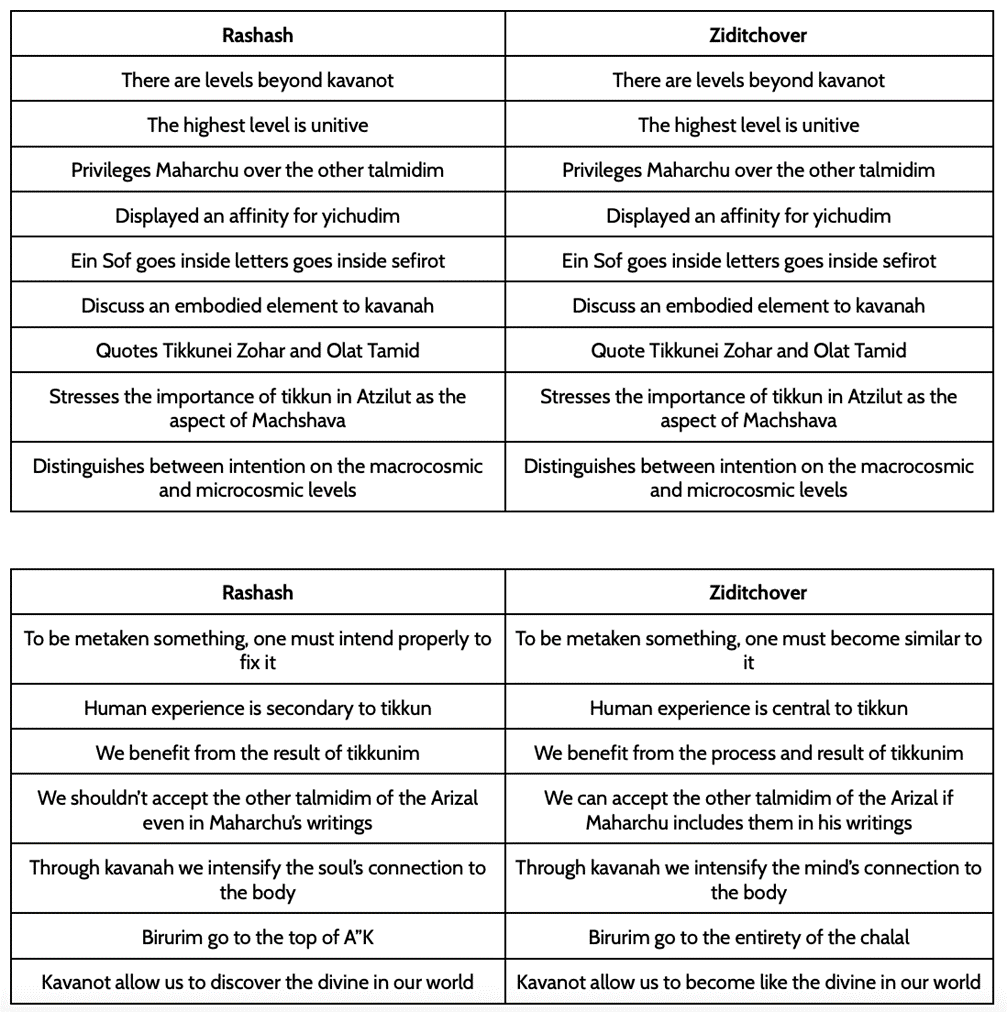
When comparing the Ziditchover’s and Rashash’s approaches to kavvanot, we find many important similarities. These include quoting shared source material, relevant historical leanings or beliefs related to kavvanot, and more. At the same time, we see important differences in the mechanics of the kavvanot and their results. It would be accurate to characterize the similarities as more theoretical beliefs about kavvanot and the differences as pertaining to practical elements. The first chart shows the similarities and the second chart shows the differences.
Screenshot

15. What is the subjective experience of kavvanot?

I can only really say at this point how it feels to me. The focus that kavvanot necessitate becomes an opportunity to slow down and savor the experience of prayer. Doing them for long enough strengthens my concentration and makes me more aware also of my body and my surroundings. Time feels slowed during this practice. I find that doing them draws my attention to a pleasant feeling in my body, particularly in my head. Over time, I have ascribed personal understandings and feelings to different kavvanot—there are parts that I connect with more, during which I feel more deeply.

Even though kavvanot are very mentally active and I am trying to follow the instructions of the siddur, my inner monologue is not only the words on the page but associations or prayers that I connect to these parts. It is an energizing and activating practice. They can awaken a feeling of intensity and passion, of movement even. I think of this as hitlahavut. Often, I will take a deep breath and pause for a moment within the practice and find myself awash in an “oceanic feeling,” one of calm and connection. This is what I think of as deveikut.

Siddur Torat Chacham, a siddur Rashash by R. Yitzchak Meir Morgenstern

What are the Lurianic Kabbalistic intentions? How do they work and how does one read the baroque pictorial notations of a Lurianic siddur? This interview may be one of the first explanations in English that gets to the core of the matter. This is a very technical interview, very detailed, geared for those in the know.

This great review was written by Jeremy Tibbetts, a rabbi, who is the co-director of OU-JLIC for Anglos in Jerusalem and is the Director of Education for Yavneh, an intercampus leadership program. He is a student at Hebrew University in Jewish Thought, intending to focus on the Rashash and kavanot.

Earlier Kabbalistic intentions from the early Kabbalah until Rabbi Moses Cordovero (d.1570) provided a concurrent mental intention or visualization for the words of the prayerbook. The performance of the liturgy needed an extra level of intentionality.

Rabbi Isaac Luria, the Ari, (d.1572), in contrast, taught a doctrine of an innumerable array of spiritual entities, arranged in a vast enormous system. The prayer intentions were not directly related to the words, but rather, mental operations with this vast system.

Rabbi  Shalom Sharabi, known as the Rashash (born Yemen,1720, Jerusalem1777) reworked the Lurianic instruction as pictorial images and not sentences. The siddur depicted the kavanot instead of describing them. In order to do this, the Rashash utilized divine names to map out and represent the different spiritual structures that the kavvanot act upon. Sharabi’s style about the spiritual realms Tibbetts calls “near trance-like lists depicting the different layers of spiritual constructs.” For examples, see the 2 pictures below from the Rashash prayerbook.

A new edition of the Rashash siddur was composed by the contemporary Kabbalist R. Yitzchak Meir Morgenstern called Siddur Torat Chacham, a siddur Rashash by R. Yitzchak Meir Morgenstern (born 1967). A full presentation of Lurianic praybook intentions for 1678 pages. Tibbetts proclaims that this is “a groundbreaking achievement in the world of Jewish mysticism and in kavanot.”

For many, Rabbi Morgenstern is their contemporary teacher in kabbalah and his influence is immense on this generation and the generations to come, due to his large number of students and the many rabbis and Hasidim who study with him. In addition, he publishes voluminously, generally about fifty pages a week which come out as edited books. His method is to integrate divergent schools into a harmony assigning a different function or a relational position to each one. In this case, he integrates, the Kabbalah of Sarug, Yehudah Ashag, Rav Nahman, Ramchal, and the Komarno Rebbe into the Rashash.

Back in the infancy of this blog in 2010, I did a blog post on Derekh Yihud, which is, Morgenstern’s pamphlet of visualization meditations. (From what I hear, it is not a part of his current teachings and the visualizations are not found in this siddur).

For those looking to understand this practice as a system of meditation, then skip down to question #9 on the psychology of this practice, question #12 on the visualization method, question #13 on this practice, and question #15 on why should one engage in this practice. Some of you, or many of you, might want to read these answers before the more technical answers.  

I am especially proud of this interview because of the accurate and detailed information that it provides. In contrast, most mentions of the Lurianic intentions in English are vague intoned mentions, without content or context, of tzimzum, yihudim, kabbalistic trees, and sacred power. This interview fills in the needed details.

  1. What is the siddur of Rabbi Morgenstern?

The siddur Torat Chacham, a siddur Rashash by R. Yitzchak Meir Morgenstern shlit”a (born 1967), just saw its new complete reprint in a pocket-sized print (even though it is a remarkable 1678 pages!). The first printing of the siddur was a full decade ago. This is the ultimate siddur for a student of R. Morgenstern or Kabbalah more broadly: it’s a groundbreaking achievement in the world of Jewish mysticism and in kavanot.

2) What is the siddur of the Rashash?

R. Shalom Sharabi zy”a, also known as the Rashash (born Yemen,1720, died 1777 Jerusalem). In his early years, he decided to undertake an arduous journey to move to Eretz Yisrael. Initially this brought him to Bombay in India, where he settled for awhile and was first exposed to Penimiyut haTorah and the Zohar. Eventually, he ended up taking passage through to Baghdad, Damascus, and ultimately from there, to the Old City of Jerusalem. Eventually, he becoming the next rosh yeshiva of Beit El, where he began to showcase his new approach.

The siddur Rashash was, for the Rashash himself, first and foremost a personal project. One of his most monumental achievements in the world of Kabbalah at all is his siddur. He worked on it over his life, continually writing, erasing, and rewriting. He never taught from it or attempted to disseminate it in his lifetime. In that sense, using a siddur Rashash is really entering into the Rashash’s personal world of prayer. His students took his siddur after he passed away and began copying and eventually printing it for broader use. The standard siddur Rashash is built around the Rashash’s reworking of Lurianic kavanot as depictions and not sentences.

Before the Rashash’s siddurim, prayer books which contained Lurianic kavanot described in full sentences what the practitioner should intend. One of the Rashash’s key innovations as a post-Lurianic thinker was in laying out a new version of the siddur which depicted the kavanot instead of describing them. In order to do this, the Rashash utilized divine names to map out and represent the different spiritual structures that the kavanot act upon.

These punctuated divine names are considered by many of the Kabbalists to be ideal both because they minimize the concern of one imagining something physical when praying with kavanot and because the names always refer back to Hashem directly and prevent one from getting caught up in the various spiritual tikkunim one is attempting to perform. The shem Havayah is the shem ha’atzmi, a name which uniquely indicates Hashem’s infinitude, allows us to intend towards something discrete while maintaining a connection to the infinite and undefined Or Ein Sof which animates everything.

The siddur Rashash is largely concerned with describing spiritual worlds and largely unconcerned with explicitly treating human experience and life. The Rashash offers very little in the way of a phenomenology of kavanot despite creating a nine-volume prayer book which takes hours to complete and is used on a daily basis.

A hallmark of Sharabi’s innovative style is his ability to take the Arizal’s logic of the spiritual realms and apply it iteratively on every level, often leading to what can only be described as near trance-like lists depicting the different layers of spiritual constructs. This is closely tied with the doctrine of arachin or “relativity” for Sharabi, which reads the map of Lurianic Kabbalah as applicable in any level. Just as a person is from one perspective a child and from another perspective a parent, what we call Malchut in one context could be considered Binah or Keter in another context, and so in this view, the map of the worlds as sketched in Lurianic Kabbalah is more epistemological than ontological.

3) What is unique in the siddur of Rabbi Morgenstern and his approach to the Siddur Rashash?

R. Yitzchak Meir Morgenstern’s siddur Torat Chacham is innovative precisely for its attempt at reintegrating other strains of post-Lurianic thought with the kavanot of the Lurianic siddur edited by Vital.

Perhaps most starkly, the additions in the siddur draw heavily upon the Kabbalah of Rav Yisrael Sarug zy”a (late 16th century – mid 17th century), an early student of Luria. Sarug’s approach was mainly rejected because Rav Chaim Vital, the main pupil and disseminator of Lurianic Kabbalah, casts aspersion on him as an authentic student. Many Kabbalists saw the Sarugian approach to Kabbalah as irreconcilable with Vital’s description of Lurianic Kabbalah. In particular, Sarug had terminology that was largely absent in Vital’s writings about tzimtzum and what he envisioned a whole series of worlds called Olam haMalbush at the very beginning of creation which Vital doesn’t mention. Sarug’s writings deal largely with worlds which precede those described by R. Chaim Vital, Furthermore, Sarug’s account of creation deals at length with the Hebrew letters and their formation which is also absent from  Vital’s account.

Rav Morgenstern has been working for nearly 15 years to try to reconcile and reintegrate the two systems. Part of his research has trended towards the historical, attempting to unveil hidden connections that Rav Shalom Sharabi and his students may have had to Sarug’s version of Lurianic Kabbalah. Perhaps most notably, Rav Morgenstern suggests that Sharabi’s version of Etz Chaim had Sarugian writings appended to it, implying that he considered them authentic to the Lurianic-Vitalean set of writings and that he studied them.

R. Morgenstern leans heavily on Hasidut Chabad for this project, in part because Chabad and its various offshoots accepted Sarug’s Kabbalah. R. Morgenstern uses these writings to develop a trailblazing anthropocentric reading of Sarugian Kabbalah. R. Morgenstern connects the concepts of Sarugian Kabbalah to the different ratzonot within the Divine mind which are meant to be realized through the process of creation.

4) Can you give an example?

Some of the most central and longest kavanot in the standard siddur Rashash are when one raises divine sparks up so that they can be transformed into shefa for us. The Arizal himself did not specify each and every level that they ascend to, only that they go up to “to the greatest heights.” The Rashash did spell out all of these ascensions in his theoretical works, he did not include those steps in his siddur. R. Morgenstern maps out this full ascent and adds in for the first time these levels of Olam haMalbush which in his view are also activated as part of the Rashash’s system of kavanot.

5) What about his use of Ramchal, Sulam and Komarno?

Alongside these innovative inclusions, kavanot are brought throughout the siddur from Kabbalists such as the Ramchal zy”a (1707-1746) and the Sulam zy”a (1885-1954) without clearly stating how they should be integrated with the standard kavanot haRashash.

This becomes even more of a question in sections lsuch as tachanun, where each of the 13 attributes of compassion is matched with one of Rebbe Nachman zy”a’s (1772-1810) 13 sippurei ma’asiyot. There is lastly a notable change in the actual nusach of the siddur.

While an Ashkenazi nusach of the siddur Rashash does exist, Rav Morgenstern’s siddur reconstructs the nusach of Hasidut Komarno from the Shulchan haTahor, the first Komarno Rebbe zy”a’s (1806-1874) commentary on the Shulchan Aruch Orach Chaim (though notably in a few sparse places he writes that he prefers the Breslov approach to nusach instead). Thus the siddur becomes a sort of weave of numerous Kabbalistic streams, most of which have never been brought together before in this manner.

6) Why is this siddur unique in its Kabbalah?

Rav Morgenstern, inspired by Rav Moshe Schatz shlit”a, is a proponent of a sort of “Grand Unified Theory” of Kabbalah. He takes it as axiomatic that the different schools of Kabbalistic thought are in harmony, not dissonance. The Ramchal’s Kitzur Kavanot, the Hasidic Saraf Pri Etz Chaim or Pri Kodesh Hilulim, and the Rashash’s Rechovot HaNahar are essentially describing the same thing in different levels of meaning and detail in this view. But it’s not enough to say that they align with each other: it is not possible from this perspective to truly understand Kabbalah without bringing these schools together. Each one constitutes a puzzle piece in the mosaic of sod. Kabbalah becomes a discipline not only of knowledge acquisition, but of integration.

7) How is this process of harmonization shown in the siddur?

This siddur is a monumental achievement as the first one to truly embrace this approach of harmonization and to connect it with the Rashash, the most difficult and the most conservative of the post-Lurianic schools. For those more steeped in the world of the Arizal, the Rashash, and his beit Midrash, they’ll find many additions to the siddur from the Torat Chacham, one of the most difficult works of Kabbalah from the Rashash’s talmid muvhak R. Chaim de la Rossa zy”a (early 18th century – 1786). One prominent examples would be the insertion of the kavanah for mesirut nefesh before any part of tefillah where one raises up divine sparks.

While the Rashash would not necessarily disagree with these additions, the fact that they are not included in the original siddur indicates that they were not as critical unlike the many kavanot which were codified.

The new small edition of the siddur chol also contains hundreds of pages of notes and essays in the back which explain why the siddur is laid out as it is, often citing and invoking different disagreements amongst the talmidei haRashash.

8) Why would a yeshiva student or student of the Kabbalah want to own or use this?

It is one of the most comprehensive and mature works of R. Morgenstern and his beis medrash, which may be a reason in its own right to own it. It can serve as a valuable window into the inner prayer life of one of the greatest Kabbalists of our time. Additionally, it is perhaps the only truly integrated siddur for those who want to stand at the confluence of the different strains of Kabbalah, not only by bringing in Hasidut, but by including kavanot from everything from medieval works of Kabbalah like Brit Menucha to the Gra zy”a (1720-1797), Ramchal, Sulam, and more. In this regard, it will serve as a textbook and guidebook rather than an actual prayer book, offering notes on nusach or different Kabbalistic ideas to integrate into one’s own prayer. Others still will buy it out of aspiration, more to make sure they have one rather than risking it running out and having to wait for a reprint years later.

9) How does Rabbi Morgenstern explain the process of psychologically performing kavanot?

This is sort of the big question with kavanot haRashash in general. Just like in any other siddur Rashash, the instruction to the practitioner throughout the siddur is simply “veyichaven,” “intend” that the worlds and sefirot are interconnecting in a given permutations by that corresponding word of tefillah. However, the Kabbalists would not consider the siddur Rashash to be a visualization guide.

They would in all likelihood be averse to one picturing the spiritual structures and sefirot which are part of the Kabbalistic siddur.

Neither the Rashash in his time nor R. Morgenstern in this siddur told us exactly what that means mentally. In fact,  in R. Yekutiel Fisch’s Sod haChashmal Vol. 5, there is a lengthy “teshuva” from R. Morgenstern on the subject of kavanot which quotes the Rashash’s son, the Chai baShemesh zy”a (mid 18th century – 1808), echoing this desideratum: “even though we have intention according to our intellect, each person according to their level, we don’t know what the explanation of ‘intention’ is… and what is ‘intend’ or how one attains ‘intention’” (pg. 207).

Nonetheless, there is one clue which Rav Morgenstern offers us from the siddur’s introduction which sheds some light on this question. He champions the Torat Chacham’s idea (building on the Rashash) that an individual’s kavanah must work on three levels: klal gadol, klal beinoni, and prat. He sorts the three central schools that his siddur aims to integrate into these categories: the Kabbalah of R. Yisrael Sarug, which speaks about the highest worlds of any post-Lurianic school, is the klal gadol; the Kabbalah of R. Chaim Vital, centered on Atzilut and the tikkunim which most directly impact our own world, is the klal beinoni; and Hasidut, which deals with the lowest and smallest levels of human experience, is the prat.

10) Which of these levels does he emphasize?

Paradoxically, the prat smallest level of Hasidut brings us the highest in R. Morgenstern’s view. On the micro-spiritual level, each individual sefirah and level of spiritual existence experiences whatever is above it as Ein Sof. Said differently, the more one zooms in to the details of the spiritual structures of Kabbalah, the more one experiences the system as open and ever-expanding. This is why this perspective is the most suited to truly understanding the infinitude of the Ein Sof, as each level constitutes a new self-disclosement of the infinite revelations of Hashem. This is the unity which R. Morgenstern sees between Hasidut and the school of the Rashash: for both of them, the divine is in the details.

Returning to R. Morgenstern’s teshuva in Sod haChashmal, he offers several more insights into the psychology of kavanot. First, he explains that the Rashash’s innovation of depicting the kavanot as punctuated shemot Havayah over the prior Lurianic siddurim which explained each kavanah in words was rooted in the Rashash’s desire to not separate the kavanot from the Ein Sof. The mechaven must always hold an awareness of the infinitude of Hashem alongside the particular kavanah at hand.

11) Where does separation from physicality fit in?

He quotes the Shemen Sasson zy”a (1825-1903) who riffs off of the Shulchan Aruch in OC 98:1 in describing kavanah as “to strip one’s soul, to separate it from physicality, and to awaken the upper worlds… as explained in the kavanot of Shema at bedtime and in the secrets of dreams and prophecy.” This seems to be a dual kavanah.

While the latter part might have seemed obvious given the focus of the kavanot on the upper worlds, the former is not only a powerful statement of how the kavanot should impact a person’s embodied experience but also should indicate that through Kabbalistic prayer, one first directs one’s soul away from this world in order to impact the upper worlds.

He goes on to quote the Hasidic masters the Maor vaShemesh zy”a (1751-1823) and R. Pinchas of Koritz zy”a (1725-1791) alongside the pre-Lurianic Kabbalist R. Moshe Cordovero zy”a’s (1522-1570) on the ability of kavanot to “purify the mind and increase devekut,” even without proper understanding.

This devekut for R. Morgenstern is itself the awareness of the Ein Sof behind each and every kavanah. The need to hold the unity of the Ein Sof amidst the plurality and intricacy of kavanot is central for R. Morgenstern, so much so that he writes that if the extreme details of the siddur Rashash distract a person from this devekut, then they should not use it.

12) What is the role of emotion vs visualization?

The truth is that R. Morgenstern’s Torah contains both: in works like Derech Yichud, a Kabbalistic meditation guide that R. Morgenstern prepared over several years to attempt to integrate meditation and Kabbalah/Hasidut, you see that he leans very heavily into visualization-based meditation, and at the same time in many places in De’ah Chochmah leNafshechah, where R. Morgenstern’s weekly sichot are recorded, as well as in Bayam Darkecha, written and published by a close talmid of R. Morgenstern, the emphasis is strongly on the emotive and psychospiritual impact of kavanot.

As mentioned above, the siddur is not meant to be a visualization guide. R. Morgenstern’s siddur does contain additions though which at first glance seem to involve some form of visualization. For example, when ascending the different heichalot in Shacharit, he adds in detailed descriptions of their layout and appearance from the Zohar. There’s no “kavanah” added alongside them. This is also the case with other additions in the siddur, e.g. the sketching of the malbush at the end of sim shalom and the addition of parts of the mishkan in each beracha of the Amidah.

Even more radically, there are numerous yichudim (letter-based meditations) from the writings of the Kabbalists which have been added in, despite the near universal consensus in the world of Lurianic Kabbalah that even yichudim which utilize words or pesukim which appear in the siddur should not be added as part of the daily intentions. R. Morgenstern defended this practice previously in his haskamah to the siddur Sha’ar Ruach haKodesh which also added in yichudim, as well as in the essays appended to his siddur, based mostly on Ziditchov and Komarno Hasidut.

 The fact that no specific intention is written for any of them calls into question their exact purpose: their very inclusion in the prayer book would seem to suggest that they are included to be part of the kavanot in one form or another, yet without a particular intention, they can also be read as associative companions which are meant purely to enhance and deepen a non-visual experience of kavanot.

13) If kavvanot are not visualization then what are they? Are they just things to think about when reciting the liturgy, like reading a book of kabbalah simultaneously to reciting the siddur?

This is a really hard question! On the one hand, they’re not supposed to bring one to a form of contentless contemplation as done in meditating on the on the breath.  On the other side, they’re not a scholastic or academic exercise.

They are meant to be somehow performed and not just considered. I think also that the Kabbalists did not see them as liturgy in the same way that the siddur is. We aren’t communicating to God or requesting that God unify the worlds with the kavanot.

They saw the “intending self,” the part of the self which is associated with conscious intention, as the highest part of the self which could act on one’s body or soul. It is through deep focus, one can use the mind like a hand to move the upper worlds. Some of the Kabbalists note that these mental acts cannot be affected without reciting the actual words of prayer.  In other words, one contemplates and focuses in on the kavanot as they stand independently, and that also forms the intention for when I say that word or phrase in the siddur. So it creates its own form of non-imagistic meditative concentration around and through the words of tefillah.

14) Should one start with this siddur?

I think probably not. If one is interested in exploring kavanot in general but does not have the prerequisite experience with Etz Chaim, Sha’ar haKavanot, Rechovot haNahar and the like, the siddur Rashash is nearly impossible to use.

When a person wants to actually start learning how to use the siddur Rashash, R. Yechezkel Bing shlit”a’s Nekudot haKesef (who is himself thanked in the siddur Torat Chacham’s introduction for offering guidance as it was being made) and R. Gamliel Rabinowitz’s Tiv haRashash both explain the siddur in depth, even line by line in some cases.

 When I wanted to start learning how to use a siddur Rashash, what was first recommended to me was to start with a more basic siddur and commentary which would give me a sense of the Kabbalistic flow of tefillah. The siddur Keter Nehora (also called the Berditchever siddur), the Shelah’s siddur commentary, the Matok miDvash siddur, and the Yesod veShoresh haAvodah are all great starting points as they are not overly caught in the particularist mechanisms of kavanah.

R. Mechel Handler shlit”a, a living Kabbalist in Boro Park, has a recommended and ordered reading list in his Peticha leKavanot haRashash for anyone who wants to start using a siddur Rashash: he suggests the classic Sephardi Kabbalistic starting point of Otzrot Chaim with the Matok miDvash commentary, followed by Etz Chaim, then Sha’ar haKavanot Drushei Keriat Shema Drush Vav (called drush ha’ikkar by some), and ultimately delving into numerous seforim which focus on the different parts of tefillah.

 I would add that before opening Otzrot Chaim, I gained a lot from using introductory seforim like Siftei Chen, Yedid Nefesh, Klalei Hatchalat haChochmah, and R. Handler’s sefer mentioned above.

15) Why do Rashsash/Morgenstern kavvanot? What not play Dungeons and Dragons? Why use these Baroque notations in the 21st century? Just daven

I’ll suggest three answers based on the Kabbalistic tradition. The first is about the largest layer of ramifications that the kavanot can have. R. Shaul Dweck haKohen zy”a (1857-1933), a rosh yeshiva in the Rashash’s tradition, wrote that the redemption will come after a certain amount of nitzotzot, divine sparks scattered in the world through the vessel’s shattering, are raised up. However, through the performance of proper actions we can bring that redemption more quickly. In this view, the siddur is the guidebook to how we can open the world to greater connection to Hashem, it pulls the levers which allow the hashgacha to come to expression.

The second answer is that they work on the most individualized level. The Arizal writes in the introduction to Sha’ar haMitzvot that “according to the greatness of the joy in truth and inner good heartedness will they merit to receive the supernal light, and if they do this continuously, there is no doubt that ruach hakodesh will rest upon them.” There are two things which this quote communicates about the inner experience of kavanot: 1) the kavanot and one’s emotional state are intertwined and therefore emotion is therefore not disconnected from kavanot, and 2) there is a shift in one’s cognition through the performance of kavanot, through the receiving of this supernal light and ultimately through experiencing ruach hakodesh as part of them. According to another Lurianic source (Sha’ar haKavanot Drushei haShachar 1), this light enters the soul through the performance of kavanot.

I’m not an expert practitioner, but I do find that they bring a greater sense of attunement, presence, and a sense of devekut as well.

Lastly, these kavanot are a body of thought which is already “home-grown” within the Jewish tradition. The Kabbalists developed these kavanot with reference to the full gamut of Torah. So, if someone is seeking some kind of meditative experience out of prayer, this is one of the most expansive Jewish answers.

Meditation Conference

The organizers of the meditation conference assumed meditation was a means of sitting and saying a verbal focus which would lead to calm, well-being, and better health. They wanted to find out how this truth of meditation plays itself out in the religions and cultures of the world. Instead, they found themselves with over fifty experts on meditation techniques in Buddhism, Hinduism, Daoism, Islam, Christianity, and Judaism saying that this definition of meditation is not found in the traditional texts or traditional meditation communities. There was a feeling that Western people, in America and Europe, have an idea of meditation and speak of meditation as a know entity that was unknown to the academics in the field.

We felt that we could have used a panel session on where this idea of mediation came from and how in the last 35 years in has become part of Western religion and spirituality. In short, we pieced together that the theosophists and translators of the sacred books of the east created a version of mediation as psychology. In the 1970’s when TM and Zen became popular as well as reading the older works, then we get a flurry of books on “what is meditation.” By the 1980’s we can speak of the “meditation of poetry”, the “meditation of surfing” the “meditation of yoga” or the “meditation of Chabad fabrengen” A rightful possession of American spirituality that Americans wont let experts take away from them. Herbert Benson created the relaxation response and formulated meditation as a form of calm and healthy wellbeing. But this definition is not a traditional one. This was further removed from any tradition by psycho neurology that used its own definitions not accepted by any known religion- except contemporary spirituality. Even frum jews love to use the word when it does not correspond to anything in traditional texts.

So the conference ran as follows:

The calmness of meditation is claimed to be based on the Indic concept of Samadhi, but Samadhi is not calmness, rather a secession of emotions, desires, thoughts, and brain functions so one can transcend the world. Indian and Buddhism meditation is not about calmness and wellness- it is about pain and suffering and rubbing your nose in the inevitability of suffering. Zen is not very calm and includes sweat inducing koans, being hit by the Roshi, unquestioning tasks, and pain. Jewish texts on hitbddedut and kavvanah are about coming closer to God sometimes via ecstasy and emotional upheaval.

The modern definition takes out the purpose of meditation in India or China which is to either escape the world or seek enlightenment. And it has little to do with the Jewish and Islamic themes of God in the heart, or the Tibetan and Daoist alchemical techniques for longevity. After the presentation on vipassana, any vestiges of the opening premises were gone. Vipassana was originally the national ideal of Burma for a educated well cultivated approached to stoically wait for the British colonialists to leave. It was then modernized in the Vietnam War, but still little to do with the current practice of that name. There was little respect for the Dalai Lama at the conference with his promising this-worldly happiness and well being for those who meditate, when his own Tibetan traditions do not teach that.

There was a general consensus that most current practices performed in the west were recent. They were either from the term of the 20th century and involved modernization and Westernization. We find Buddhists reading William James and rediscovering new techniques in manuscript. Then there are new versions of the 1960’s. Finally, there was consensus that anyone claiming tradition and authority in the US teaching “meditation” in the modern sense was either a charlatan or a student of one. Trust those who either acknowledge they are doing something modern or those who don’t promise calm and well being. Everyone saw a decrease in interest in traditional forms of meditation since the 1990’s becuase everyone now knows that they want this new Western meditation – but they want it with a Yoga, Hasidic, or QiGong veneer.

From a Jewish point of view, this means that Ramak, Ari”zl, Chabad, and Rav Nahman all have versions of hitbodedut, hitbonenut, kavvanah, and yihud but there is nothing gained conceptually or linguistically by calling them meditation and they have little to do with any clinical calming technique. (it might have briefly made sense in the 1970’s when stolid religion was breaking down and the BT world was aiming in this realm.) The reliance of the Piesetzna and Menachem Eckstein on modern psychology is par for the course-as is Aryeh Kaplan’s reading of the Dover Publishing Co. books from the early 20th century on Tibetan and Chinese meditation. And sitting for mindfulness before davening is not Buddhist, not Jewish, not Indian but it is American new age spiritual. Sitting before davening has little to do with the Ramak or Ari”zl.

By the end we concluded that there is use for term like visualization, body techniques, or mental apophasis.
One can speak of a Jewish kavvanah of the Ramak as a form of visualization. But it does not share the formal aspects of sitting of the Zen tradition and it lacks the ending of mental facilities like Samadhi and it lack to goal to escape the world of most Buddhist practices. It does not have the mental requirements of Jnana. Yet, there is more to the analogy than just visions since it does take one to a place above the “pain of this world” creating some very weak similarity to Jnana and Samadhi. But the goal of daat and berakhah are very unYogic. One can also find close similarities to Sufis and certain out of context Daoist similarities.

Now what? We shall see if they get funding for follow-up conferences.

[Natan – I know that your approach disagrees. I have read your material so you don’t have to send it to me again as comments.]

Cordovero on the nature of Prayer

For those following the more pietistic discussion on Ramak’s prayer, here is some more for discussion. The first text is on devekut. The second text is on the inability of prayer to rise without ascending level by level through the known levels. One cannot prayer directly to the Eyn Sof. Any reactions or insights? I am delivering a conference paper next week on the topic, so all observations are helpful. Any insights to the meditation process?

Devekut

“Through these mysteries, a man is able to cleave to his master with will…”
A person can cleave to Him through directing his will to the mystery of the sefirot, the Tetragrammaton, and the [other] Divine names. One who does not know the mystery of how to cleave to Him will not have the ability to grasp (beit ahizah), because His place of grasping is through His sefirot, His precious names and holy Tetragrammaton.
“In directing the heart to know the wisdom of His dominance in the highest mystery.” The dominance of hokhmah is a wondrous mystery. The first way to reach a state of cleaving to the Divine (devekut) is through the study of the mysteries of the Torah and the understanding of the hidden secrets in the Torah.
The second is “when he worships his Master in prayer,” that is, the mystery of prayer and the way of cleaving to Him.
“He will cleave like a flame in a coal”—for man’s will and soul that ascend from the walls of his heart will certainly be bound to the supernal palaces. Thus, man should first meditate on repairing malkhut, Her repairs are the mystery of the palaces, which bind and cleave together with malkhut like a flame bound in a coal, while his soul and meditation are a flame from the coal that is malkhut. Similarly, the palaces that spread out from and cleave to Her are like a flame spreading out from amidst the coal, yet cleaving to it. Because of this, the [palaces] return to their source and are swallowed up in Her through his soul that returns and is swallowed in its source. With the soul’s ascent, the [palaces] are raised as well, since only through the soul can they spread out below. Now this is the mystery of man’s intention and breath of his mouth created from the vapor of his mouth and the soul (neshamah) arising through breath (neshimah), that they cleave and return to their source. If it happens that the palaces, and further, the hizonim, spread out from there, he should meditate on binding and unifying her specifically from the palace of paved sapphire (livnat hasappir) and higher. There is the beginning of holy cleaving, binding themselves in unification.

Ascent of prayers

When the Shekhinah is completely filled with prayers, then the prayers rise and ascend to a place where there is no pain and no lack.
The purpose of ascent into worship of God is so the prayer should reach this place. Some people meditate in times of need, as it is written, “Israel are wise in that they know how to pray in times of need.” However, better and more meritorious is he who raises all of his prayers there [even not in a time of need].
This form of worship is more desirable because it does not come out of pain or need, but rather from cleaving through worship to the true Object of worship.
The masses think that the intention reaches there by itself; they are completely outside the palace, so that when they call the king from afar, the king does not answer them.
Rather, it is necessary to call to the gatekeeper. The gatekeeper takes them in his hand and brings them into the control of the princes, from prince to prince of each palace, until they are brought to the king in his chamber, where they will find Him and bring their needs before Him.
For those who pray or cleave to Ein Sof by itself, their goal remains far from them. He is only close to the one who knows His palaces and gatekeepers.
Indeed, for those who speak to the gatekeeper which is the attribute of malkhut, the attribute will bring them to the higher attributes higher, level after level through all the levels.
These people will certainly enter to the King, Ein Sof, the Root of all roots, in His room, a wondrous place, and speak with Him, in the mystery of the ascent of prayer. Immediately, it will be powerful.

Copyright © 2010 Alan Brill • All Rights Reserved

Teaching Meditation

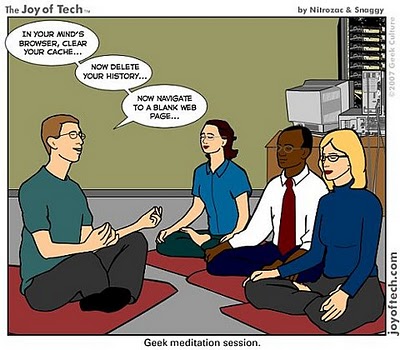
The cartoon seeks to make fun, but I find it quite serious. Is there any other way to teach meditation than in the language of those you are teaching. If one teaches a kavvanah from Rabbi Isaac the blind or Rabbi Moses Cordovero does one teach medieval cosmology and medieval science to explain it? What if it is a once a week meditation class and one wants to get down to practice. Should one use the language of bittul or of “clear your cache and history? Should one imagine light at the bottom of emanation or a blank web page? Is this modernizing into new age like neo-hasidism or the only way to do things?

Rabbi Morgenstern and Meditation

When someone mentions Jewish meditation to me the first thing I think of are the Haredi Kabbalitic mediators. I think of Y.M Erlanger who in his Sheva Eynayim and in classes in Heimishe Yeshivos is teaching Hasidut combined with Abulafia and I think of Yitzhak Meir Moregenstern who is reorganizing early Kabbalah, Ramak, Ari, and Abulafia as Hasidut. Erlanger’s starts with the statements in Sefer Habesht al Hatorah and introduces ever more esoteric material and at the end of the last volume, he introduces Abulafia with a warning that the material that he is about to teach is not for everyone, and not everyone should enter the Pardes, and even if you do enter this may not be for you. In contrast, Rabbi Morgenstern called Rav Itchie Mayer Morgenstern starts everyone on the real stuff.

R. Morgenstern is a Haredi descendant of the Kotzker and lived most of his life in England and has moved to Jerusalem and set up a Beit Midrash. You can find videos of him teaching and singing with Anglos on the web. See here, here and here.
He has attached a real following. He gives weekly public shiurim in kavvanot, in Komarno, and Ramhal. He has an email list serve for his Torah, his kabbalah, and for assorted teachings (Hebrew, English, and Yiddish). Send an email here to subscribe tc7@neto.bezeqint.net

He seems to have read some generic books on “How to Meditate” or “Meditation for Everyone” and in his work Derekh Yihud he reorganizes traditional kabbalistic practices into an order that reflects the general mediation world. The topics are sitting, breathing, visualizing, creating an avir in front of one, colors, and a unified vision. He freely takes pieces of Abulafia, Ramak, and early kabbalah to create a Jewish meditation manual in line with the non-Jewish ones. The work Derekh Yihud opens up a new path of reorganizing the older materials based on modern principles.

I see him as potentially the future. Rav Ashlag wrote in the 1930’s and took the meditation, medieval worldview and fantasy out of the Kabbalah and replaced it was science, communism, Schopenhauer, and a closed system. Now everything from the Kabbalah Centre to Bnai Baruch to Michael Leitman are his spiritual descendents. Rabbi Morgensten is teaching the young grandchildren of the Rebbes and many in Kolel and he also accepts the varied pneumatics of Jerusalem as his students. When all those students take their positions as Rebbes, Ramim, and teachers then the meditation format of breathing and visualization will be the tradition. If the trend continues, in 2050 this will be mainstream Kabbalah.

I had originally planned this post before my computer crash when I received the following two weeks ago. It offers a concise taste of Derekh Yihud. Morgenstern advises to close the eyes and see the hidden lights in order to achieve bliss. One turns from this world to the airspace and achieves a vision of the Throne. Lights, then hidden mind, and finally the source of the soul and the Throne.

When a Jew spends time in hisbodedus before his Creator, he closes his eyes so as not to be enticed by the illusory pleasures of this world because he doesn’t want to be connected to them.
When he closes his eyes in this way, he is able to see the brilliant hues that are rooted in the “hidden mind” of Mocha Sesima’ah, and he begins to derive pleasure from spiritual reality, from the fact that Hashem is revealed through a myriad of shades and hues of dveikus. He starts to feel Hashem’s light and glory within himself, and how all of the pleasures of this world are null and void, are like a mere sliver of light, compared with the delight of dveikus that is a composite of all possible forms of bliss.

So when a person seals his vision against the illusory nature of this world, he rises to the place of the “airspace” and its “membrane,” which is really the source of the human soul and its throne of glory. In that place it can be said, “From my flesh, I see G-d.” One begins to enjoy a vision of the ultimate Kisei HaKavod upon which the “form of a person sat.”
The final three plagues parallel these three states of dveikus:
First, a person must meditate and be misboded on the expansive Binah light of Hashem.
Then he must ascend to the place of the “hidden mind” which is the counterpart of the holy darkness of turning aside from this-worldly concerns to receive “light in all his dwellings.” With this, he destroys the klippah of the impure firstborn and rises further to the place of the “membrane of the airspace” and the “airspace” itself which correlates to the level of the Da’as of Atik and which reveals to him the source of his neshamah that “sits upon the throne.”
“It is revealed and known before Your Kisei HaKavod…” Meaning, through coming to the level of the Kisei HaKavod, we are able to subdue all of the klippos and utterly “smite Egypt through their firstborns.”

This past week he sent out a special Tu beShevat essay. He opens the essay stating that was asked why Hayyim Vital did not mention TuBeshevat and answers in the name of R. Haayim Cohen that it is a hidden quality. And when pressed why does everyone do it today? He turns to R. Aharon Halevi of Strashelye explaining that since we are lesser today everyone learns Kabbalah since they do not grasp the real depth anyway. The essay is a running account of his Torah and the questions he received Tu Beshevat-Shabbat Shrah. There are many interesting points in it including -We are told of the joy from the recent publishing of Vital’s alchemy and magic.

Copyright © 2010 Alan Brill • All Rights Reserved

Jewish Meditation 1995-2005

Here is an account from The Forward that parallels what I have seen in the field. In the early and mid nineties there was a great desire for the technical aspects of meditation and Jewish meditation. Then, after only 5 years it started broadening into all forms of spirituality especially musical forms and emotional healing. And finally right before our eyes, it all stops around 2005. People started coming to a class listed as Jewish meditation and assumed that it has something to do with guitars, bongos and chanting. In 1995, people wanted meditation and came with Zen or Vipasssana backgrounds and then flash it was gone by 2005, leaving revivalism in its wake.

Even the local Buddhist center here in NJ, gave daily and weekly meditation classes in 2000 and now only offers a once a month introduction to Happiness, saving any serious meditation instruction for biannual retreats.

Chochmat HaLev came to life in the 1990s… One of these teachers, Rabbi Avram Davis, proposed creating a Jewish meditation center that could be a community resource…. Chochmat HaLev was launched, first as a series of classes in 1992 to 1993, and then as a nonprofit organization in 1995… In focusing on Jewish meditation, Gefen and Davis were at the forefront of a wave of interest in training a generation of Jewish “spiritual leaders,” who could bring meditation to their own congregations and lead meditation retreats and workshops for nonaffiliated Jews. So in addition to holding its own retreats and workshops, Chochmat pioneered a year-long leadership program with an initial cohort of 40 students.

Something happened on the communal meditation cushion, however. Joined by their interest in Jewish spirituality, the initial group felt a desire to pray together — a development that took Gefen by surprise. Davis, however, had thought of offering services from the beginning, because for him, Jewish meditation could exist only as part of a larger practice.

From the start, Davis led Chochmat’s services, distinguished by the constant thrum of a six-piece band composed of guitar, bass, drum set, keyboards and vocalists, its musical direction owed in equal parts to Rabbi Shlomo Carlebach, American rock and Moroccan beats. During a typical service, continuing today, participants dance in the aisles, clap, stomp their feet and sway with hands in the air, in an atmosphere most reminiscent of evangelical rapture

From 2000 to 2005, Chochmat HaLev functioned much like a cross between an institute for Jewish spirituality and an independent minyan.  Holding these two very different organizations together was a tight-knit, supportive community.

The year 2005 marked a crisis for Chochmat. The meditation school had essentially vanished. Aside from one year-long distance-learning program, the school was not offering more classes than an active synagogue. And because of its regular religious services, Chochmat was no longer seen as a non-denominational resource center: Its original mission was gone.

In 2005, the Chochmat board decided to become a functioning synagogue, and Avram Davis chose to leave.

Full version

Now Jewish meditation is once again for the few.People still do visualizations – part motivational part Neo-hasidic as a way to get psyched or as a means of bringing a moment of silence or a visualization into a regular service.  People are very sympathetic, “lets do it for a few minutes or a mini-course” and then let’s move on.

More on the year 2000 from the same author.

The year 2000 would see the establishment of the New York-based Institute of Jewish Spirituality, a Jewish meditation center run by Rabbi Sheila Pelz Weinberg; Makor Or, a San Francisco-based center founded by Rabbi Alan Lew (z’’l) and Norman Fischer; as well as a new emphasis on meditation at Elat Chayyim under Rabbi Jeff Roth and a burst of books on the topic (among them books by Gefen and Davis).

Ten years ago there was a meditation moment.

UPDATE – see the detailed rundown by Len Moskowitz in the Comments section. The comment shows that there is no diminution.
Copyright © 2010 Alan Brill • All Rights Reserved

The Lubavitcher Rebbe on Transcendental Meditation

Back in July 1979,  a rabbi sitting outside on a porch in the Catskils, with a friend or older bachur, he was listening to the Fabrengen. I was called over to listen to it because the Rebbe was speaking about Transcendental Meditation, he assumed that I would be interested.  I was not particularly enthralled since all I heard was “avodah zarah,”  “idols, incense and gurus” “worship of the sun and moon,” “it is OK for doctors to teach.” At the time, I felt that it did not reach the issues and was too removed, too Biblical, and was not really showing understanding.  Beyond that he treated TM as a pathology to be dealt with by physicians. He did not want any connection of meditation to Kabbalah.  Yet, for some reason I still remember the event, the cloudy evening, and my reaction, especially my disappointing mulling it over for some time that evening.

Yesterday, someone sent me a question on Yoga and Judaism, and after an initial email the response reminded me of the Rebbe’s sicha.

So here an audio- video of the original.

The Rebbe compares TM to the avodah zarah of the sun and the moon. The Rebbe does not address other religions but deals with the issue as part of the problem of cults. He wants the creation of something new called “Jewish meditation” to wean people away from TM. It should be seen as a medical problem and should only be taught by someone who  knows the laws of avodah zarah. It is interesting that the Rebbe is careful not to call all of it “ruah tumah” or “klipot nogah.” Rather, the problem is the incense, bowing, and the false gods or treating the guru as a deity. The patriarch Abraham is portrayed as engaged in solitude, yet the Rebbe does not want this new invention of Jewish meditation connected to Kabbalah, it should be done clinically by physicians.

Here are selections from the translation.

There in an issue, which is connected with the physical and psychological health of many Jews, that demands attention. It is quite possible that these words will have no effect. Nevertheless, the health of a Jew is such an important matter, that efforts should be made even when there is not a sure chance of success.

This issue is the idea of meditation. Meditation has its roots in the very beginning of the Jewish heritage. The Torah commentaries explain that Avraham and the other patriarchs chose to be shepherds so that they could spend their time in solitude.

The sun, the moon, and the stars are necessary for life of earth. They bring about manifold goodness. However, they also have been worshipped as false gods. One might ask (as the Talmud asks): “Since they have been worshipped as false gods, shouldn’t they be destroyed? However, should G-d destroy the world because of the foolishness of the idol-worshipers?” The same concept applies in regard to meditation. Though essentially good, meditation can also be destructive. There are those who have connected meditation to actually bowing down to an idol or a man and worshipping it or him, bringing incense before them etc.

The cults have spread throughout the U.S. and throughout Israel as well.

They have called it by a refined name “transcendental meditation” i.e. something above limits, above our bounded intellects. However, they have also incorporated into the procedures the bringing of incense and other practices that are clearly “Avodah Zorah,” the worship of false gods.

Since we are living within the darkness of Golus, many Jewish youth have fallen into this snare. Before they became involved with this cult, they were troubled and disturbed. The cult was able to relate to them and bring them peace of mind. However, their meditation is connected with Avodah Zorah, burning incense and bowing to a Guru, etc. Since the aspects of idol worship are not publicized, there are those who have not raised their voices in protest. They don’t know if such a protest would be successful and since no one has asked them, why should they enter a questionable situation.

Two conditions must be taken into consideration: 1) meditation should only be used by those who need it. A healthy person doesn’t need meditation. On the contrary, if he begins to meditate he will hurt his psychological health. The only meditation that all should carry out is one which is part of one’s service to G-d, for the Shulchan Aruch states that before each prayer one must meditate on “the greatness of G-d and the humble state of man.” However, that meditation is done with a fixed time and a fixed intent. Its goal is not to calm one’s nerves. 2) The meditation must be based on a Kosher idea or a Torah concept e.g. Shema Yisroel, the meanings of the prayers. Thus, this will bring one to an awareness of the greatness of G-d and the humble nature of man.

Also, since as in all treatments, the healer gains a certain amount of control over his patient, we must take care that the professional who is leading the meditation have a clear and well defined knowledge of what is permitted according to the Shulchan Aruch, what leads to Avodah Zorah, etc.

Even in Yerushalayim, the holy city, such a center has been established. I, myself, received a brochure from such an institution. It was professionally produced, containing pictures and a description of how in Yerushalayim, a center for meditation has been set up. They purchase American addresses, and send them this brochure. It makes a powerful impression and arouses curiosity. Thus, we can see how serious the situation is.

In view of this situation, psychologists, psychoanalysts, etc. have a holy duty to advance their knowledge of meditation, and work to develop a Kosher program. Furthermore, since we live in a country in which publicity plays a large role, efforts must be made to publicize the treatment in the broadest means possible.

Furthermore, this treatment should not be connected with any side issues. There are those who maintain that meditation must be connected with the secrets of Torah. Meditation on the secrets of Torah is very important, particularly in the present age when the Wellsprings of Chassidus must be spread outwards. However, the subject at hand is different. There are Jews who are involved in “Avodah Zorah,” worship of false gods, who must be saved. This is the first priority. If one begins by teaching the secrets of Torah, it is extremely likely that the majority of them will not respond. Even the few who might show an interest should be separated from “Avodah Zorah” first.

We cannot sit and wait practically until someone asks to be helped. We have to approach those who are afflicted and speak their language, without mixing in any other Mitzvos. Our object should be merely the Mitzvah of healing their troubled psyches.

Each one of us knows such a doctor. We can interest a doctor in such activities, and he will find a way to attract those who have fallen into these snares.

In all the other exiles, the redemption did not involve the entire Jewish people. However, the Messianic redemption will reach every Jew. The prophet Isaiah (27:12) declares: “You will be collected one by one” from even the furthest extremes of Golus. These efforts to draw Jews away from the Golus of “Avodah Zorah” will help hasten the fulfillment of the prophecy. The Talmud states that all the appointed times for Moshiach’s coming have passed, and everything depends on Teshuvah. When the Jewish people do Teshuvah, they will immediately be redeemed.

In 1979, The Rebbe had a yehidus with a couple from Australia, where he said the same thing.

Already in the prior year in 1978, the Rebbe turned to a doctor to help him with this request to develop meditation without idolatry. It gets reprinted around the web as if the Rebbe was answering a question from the doctor rather, in fact, the Rebbe was seeking out the doctor. Notice the Rebbe’s citation of  the Federal Court case.and his assumption that much of this is already part of medical practice. I did include parts that are similar to the Sicha- full version here, and here. We can see the Rebbe’s thought in formation

By the Grace of G-d Teveth, 5738
In as much as these movements involve certain rites and rituals, they have been rightly regarded by Rabbinic authorities as cults bordering on, and in some respects actual, Avodah Zarah (idolatry). Accordingly Rabbinic authorities everywhere, and particularly in Eretz Yisroel, ruled that these cults come under all the strictures associated with Avodah Zarah, so that also their appurtenances come under strict prohibition.

Moreover, the United States Federal Court also ruled recently that such movements, by virtue of embracing such rites and rituals, must be classifies as cultic and religious movements. (Of. Malnak V. Maharishi Mahesh Yogi, U.S.D.C. of N.J. 76-341, esp. pp. 36-50, 78)On the other hand, certain aspects of the said movements, which are entirely irrelevant to religious worship or practices, have a therapeutic value, particularly in the area of relieving mental stress.

It follows that if these therapeutic methods – insofar as they are utterly devoid of any ritual implications – would be adopted by doctors specializing in the field of mental illness, it would have two-pronged salutary effect: Firstly, in the view of the fact that these methods are therapeutically effective, while there are, regretfully, many who could benefit from such treatment, this is a matter of healing of the highest order, since it has to do with mental illness. It would, therefore, be very wrong to deny such treatment to those who need it, when it could be given by a practicing doctor.

Secondly, and this too is not less important, since there are many Jewish sufferers who continue to avail themselves of these methods though the said cults despite the Rabbinic prohibition, it can be assumed with certainty that many of them, if not all, who are drawn to these cults by the promise of mental relief, would prefer to receive the same treatment from the medical profession – if they had a choice of getting it the kosher way. It would thus be possible to save many Jews from getting involved with the said cults.

It is also known, though not widely, that there are individual doctors who practice the same or similar methods at T.M. and the like. However, it seems that these methods occupy a secondary or subordinate role in their procedures. More importantly, there is almost a complete lack of publicity regarding the application of these methods by doctors, and since the main practice of these doctors is linked with the conventional neurological and psychiatric approach, it is generally assumed that whatever success they achieve is not connected with results obtained from methods relating to T.M. and the like; results which the cults acclaim with such fanfare.

In light of the above, it is suggested and strongly urged that:

Appropriate action be undertaken to enlist the cooperation of a group of doctors specializing in neurology and psychiatry who would research the said methods with a view to perfecting them and adopting them in their practice on a wider scale.

All due publicity be given about the availability of such methods from practicing doctors.

This should be done most expeditiously, without waiting for this vital information to be disseminated through medical journals, where research and findings usually take a long time before they come to the attention of practicing physicians. This would all the sooner counteract the untold harm done to so many Jews who are attracted daily to the said cults, as mentioned in the opening paragraph.

In conclusion: This memo is intended for all Rabbis, doctors, and layman who are in a position to advance the cause espoused herein, the importance of which needs no further elaboration.

Can Kabbalah be translated into a modern idiom?

I found an interesting article written for  the BBC from a transpersonal psychologist in England The essence of Jewish meditation By Professor Les Lancaster The very nice and sensitive essay shows the problems in trying to translate Kabbalah on meditation in modern terms.

It lets me ask about the process of presenting Jewish kavvanot to a modern audience.

The basic worldview for the kabbalist is the sefirotic chart, arranged as concentric circles, a Jacob’s ladder or chain of being, expressed with medieval philosophic language.  A kabbalist’s view of God and the world was arranged in nestled chains, God emanates into the world. This cosmology of chains is not just a points on a cord, but vast realms, lights, and colors, a realm to transverse, a way of marking off distance. This cosmology was accepted as based on the Jewish tradition, the experiential truth of the method, and as part of accepting the theology of the Kabbalah.  This worldview, for them, was as corrigible as a map. Meaning that unlike a dream where no incorrect dream, Kabbalah is a vision correctable based on the writings and visions of others. For the kabbalists the kabbalistic worldview is objective, subject to correct and incorrect turns, and offers a reproducible mental world. One chooses one path, one worldview, and follows it. The traditional meditator does not credit the human mind or imagination with these depths, rather he starts with a map obtained through the study of Kabbalah.

But I am trying to pin down how we get from my description of the past to the following:

What is Jewish meditation?

It involves shifting the centre of gravity of the mind away from the sense of ‘I’ which normally dominates our goals. Like all meditative practices, Jewish mystical techniques are directed towards enhancing this second form of thinking. At the same time, these practices cultivate an awareness of the divine presence in all things.
The objective of meditation is to engage with these deeper currents.

One of the major texts of Kabbalah, the 12th-century Bahir, writes that the biblical prophet Habakkuk ‘understood God’s thought.’ It tells us:
“Just as human thought has no end, for even a mere mortal can think and descend to the end of the world, so too the ear also has no end and is not satiated.”
Jewish mystical practices enable us to use thought to ‘descend to the end of the world’, that is, to plumb the depths where mind and physical reality are no longer separate.

The goals of Jewish meditation
-heighten one’s understanding of the Torah
-develop an understanding of ritual and other religious observances
-give direction to prayer
-increase one’s awareness of others’ needs

One of the oldest texts that describes Jewish meditation practices is the Sefer Yetsirah. Consider the following extract:
“Ten dimensions of nothingness. Their measure is ten to which there is no end.
A depth of beginning, a depth of end; a depth of good, a depth of evil; a depth of above, a depth of below; a depth of east, a depth of west; a depth of north, a depth of south.
The unified Master – God faithful King – rules over all of them, from His holy dwelling place, until eternity of eternities.”
The meditation based on this passage entails consciously building up a deep sense of your place in relation to the dimensions.

The meditation continues with the first of the six directions of space. What is immediately above you? Air… the ceiling… other rooms… the roof… birds… sky… vastness of space… the infinite that cannot be formed in the mind…
It is as if you generate a beam of light from within that is gradually extended further and further whilst, at the same time, maintaining your awareness of the centre, the heart as the source of light… And then continue into the remaining directions. You may glimpse your inner core suspended at the heart of a web of infinite interconnections.

We have the idea of limitless expanse, which was originally sefirot, treated as the depths of the mind. I understand the need for the psychology. Yet what happens to the Neoplatonic depth? Identifying mind and physical reality has a bit of a countercultural sound to it. Gone is the need to go through an ascent to reach God either by chambers, cosmos, worlds, souls. The author, similar to the popular pamphlets issued by the school of the Magid of Mezerich pushed away the meditation of the Kabblah. Early Hasidism thought that though emotional enthusiasm one could ascend through all the worlds, sefirot, and chambers. Here entering the depth of one’s mind has the same effect.

I get confused by the goals. Does it help by giving one esoteric knowledge? Does it mean viewing one’s mitzvot and prayer as taking place in the kabbalistic cosmology?  And why claim it will make one more sensitive to the needs of others. At least, Buddhists will distinguish between jhana (knowledge) and metta (love-kindness). Here it seems everything is blurred.

In his use of Sefer Yetzirah, we have the conversion of a scientific-cosmological text into a meditation on space. Deep of divinity becomes depth of the soul.In this modern version, one looks into the inner core of the self, the heart, and the limits of the ordinary mind. One is not told about the traditional phrases “fixed order of lights” “the infinity of God” or the need to identify with the Divine will.”

I find much of our presentations of Kabbalah on the popular level to be modern psychology. I do think we need to use modern psychology and not medieval psychology, but what are the boundaries for a successful translation? Many of the popular Orthodox presentations are straight pop-psych and new age. What is the limit in modernizing the medieval?

Hat tip: Solitude– it cites the full version. For the original BBC- here