Category Archives: liturgy

Lurianic Kavvanot: from Vital to Rashash to Zhidichov-Jeremy Tibbetts

What are the Lurianic Kabbalistic intentions? How do Lurianic kavvanot work and how does one read the baroque pictorial notations of a Lurianic siddur? This is a very technical interview, very detailed, geared for those in the know. This is my second interview with Jeremy Tibbetts on Lurianic Kavvanot. It is a continuation of his contribution from 10 months ago introducing the kavvanot in Siddur Torat Chacham, a Siddur Rashash by R. Yitzchak Meir Morgenstern

This great article was written by Jeremy Tibbetts, a rabbi, who is the co-director of OU-JLIC for Anglos in Jerusalem and is the Director of Education for Yavneh, an intercampus leadership program. He is a student at Hebrew University in Jewish Thought, intending to focus on the Rashash and kavanot.

In this introduction, he walks us through the conceptual development of the kavvanot, starting the journey with Rabbi Isaac Luria (The Arizal, 1534-1572) who moved to Safed in 1569, where he lived and taught for three years. In those final years, R. Chaim Vital (1542-1620) learned from him and devoted the rest of his life, spent largely in Damascus, to developing a proper exposition of Lurianic Kabbalah.

A century after Vital died, R. Shalom Shar’abi or the Rashash (1720-1777) head of the Yeshivat Beit El became  a new link in the chain of Lurianic transmission, focusing on divine names and pictorial representations of the kavvanot. In addition, he focused on the immanence of the Eyn Sof in the practice. Finally,  the Hasidic rabbi R. Tzvi Hirsch of Ziditchov or the Ziditchover (1763-1861) focused more on the human experience, more on the human transformation, and how we become transformed into the divine qualities. 

  1. What are kavvanot?

Kavvanot are intentions to concentrate on when reciting the words of prayer or performing commandments (mitzvot). Often they focus on intangible realms and their particularities which are impacted by the kavvanot. The instructions are described in theoretical works or depicted in specialized prayer books. The Kabbalistic worldview hinges on the idea that the devotional mind can change the cosmos and the self at the same time.

Most people do not know about the kavvanot, due to access and accessibility. Regarding the former, the full set of Lurianic writings did not leave the land of Israel for over a century after Vital’s passing. As for the latter, Lurianic Kabbalah is extremely complex. Kavvanot necessitate erudite expertise in it and the ability to apply the most generalized principles and specific details of the system at once. Gershom Scholem considered Lurianic Kabbalah to be one of the most complex systems of thought in existence.

Kavvanot are not meant to undo or replace the simple meaning (pshat) of the supplications of prayer. Though one’s kavvanot take them to other realms, the practice must remain prayer fundamentally for it to work. Kavvanot work on the principle that as one gets to the peak of the experience, the more intentions there are to perform. The amount of kavvanot per word increases dramatically the more one prays.

2. For Hayim Vital, why do kavvanot?

Rabbi Isaac Luria told R. Chaim Vital that his kavvanot should focus on completing the worlds, yet at the same time, Luria understood the positioning of the worlds to directly impact human cognition and comprehension. These two aspects of completing the cosmos and attaining comprehension together are considered the fulfillment of humanity’s purpose.

For Vital, the ultimate outcome of kavvanot is to connect the light of the Infinite (Ein Sof) to our world, and then we need to draw it into vessels that can allow for non-overwhelming contact with infinite divine. Hence, “reducing the light is the ultimate intent of fixing the worlds (tikkun)” (Etz Chaim 9:4).

Kavvanot rectify the shattering of the vessels (shevirat hakeilim), whose broken pieces constitute our imperfect physical and spiritual reality. Our world is fundamentally broken, and as long as we do not do the fixings (tikkunim) necessary to fix it, evil and injustice will remain manifest. The tikkunim create partzufim, an infinite vessel made of ten sefirot which each contain ten sefirot and so on ad infinitum. These vessels, being infinite, can capture the light of the Ein Sof. Repairing these shattered vessels through kavvanot is the necessary prerequisite to making the light of the Ein Sof manifest within them.

This process of rectification followed by revelation also occurs within the individual. One grows spiritually as they perform the kavvanot, even in a semi-literal sense: they can fix and shine the light of holiness into the soul, and in their most idealized form, add completely new layers to it. Vital writes in Sha’ar haGilgulim that “when a righteous individual intends a complete and good intention (kavvanah), they can draw down a new soul” (Sha’ar haGilgulim Hakdamah #6).

There is a synchronicity between the completion of the worlds and of the self because the macrocosmic structure of the worlds and the microcosmic structure of the self mirror and influence each other. The fact that one of the names that Vital gives for the influx of Divine light into the partzufim is consciousness (mochin) is not coincidental. Corresponding to the upper sefirot of Chochmah, Binah, and Da’at, the mochin fill the “heads” of the partzufim before permeating the lower vessels too. As we strengthen and fill the partzufim, there is a direct impact on our consciousness in kind: “all of the forgetfulness that a person has is drawn from these lesser mochin. Whoever can, through their actions, draw them down below [to their proper place] by drawing in the greater mochin which push them… will have wondrous recollection in Torah and will understand the secrets of Torah.” (Etz Chaim 22:3).

This passage describing the interconnection between the ontological level of mochin and the commensurate mental outcomes of drawing them in was already considered extremely consequential in the early reception history of Lurianic writings.

  • 3. For Vital, what is the difference between Intention (kavven) and envision (letzayer)?

Vital states explicitly that “one should intend” (veyikhaven) when describing daily prayer kavvanot. However, in a few places, such as in the intentions for the blessing after meals (birkat hamazon), he deploys a different term: “in the first blessing, from start to finish, envision (yetzayer) before your eyes [the Hebrew letters] aleph, lamed, hey” (Sha’ar haKavvanot Drushei Shabbat Seder Erev Shabbat) For each of the four blessings, one envisions one of the letters of the name ADNY spelled out. Letzayer is extremely uncommon in writings on kavvanot and extremely common in writings on yichudim. Both can be contrasted in Vital’s writings with changes in the worlds which occur without our intention automatically (mimeileh).

Lechaven is a specific type of intention. Vital writes that “you should intend and think in your thoughts” (Sha’ar haKavvanot Drush Kabbalat Shabbat #1). It occurs in the mind. These kavvanot are focused and thought-based but not imagistic. Kavvanah is an applied form of thought.

In normal waking life, thoughts pass in and out of our mind quickly with little perceivable consequence for the world around us. Kavvanot are the practice of taking thought and using it to affect the spiritual worlds like our hands would affect the physical world around us. As one contemporary commentator writes, “one must intend actively, not just think in their thoughts that the matter occurs of its own accord (me’eilav)” (Sha’ar Ruach haKodesh Im Peirush Sha’arei Chaim by R. Chaim Asis, Vol. 2 pg. 561).

The experiential impact from this focused type of kavvanah has two aspects. First, as discussed above, the actual technique of utilizing the focused intentional mind as an experiential component linking between the worlds’ spiritual states and our own cognitive states. One finds oneself at the bottom of a chain of divine illumination.

There is another aspect though, discussed in the recitation of the Kedusha, when many of the tikkunim of the daily prayers have been completed: “When saying ‘the world is filled with God’s glory,’ which is a secret of Malchut, intend [vatechaven] that we are the children of Malchut and we receive holiness from our mother. Therefore, intend to absorb yourself within Malchut to receive the holiness drawn onto her” (Sha’ar haKavvanot Drushei Chazarat HaAmidah #3). The ultimate type of kavvanah is not visual revelation but absorptive transformation. At its peak, one is no longer acting on the worlds as something external but as something internal.

We reclaim our place in the constellation of worlds and “when drawing the supernal holiness to the Blessed One,” one can “draw an aspect of this holiness onto themselves as well… they are sanctified and God is sanctified with them and within them” (ibid.). The focus on fixing the upper realms, in particular the lower partzufim and Malchut above all, is not a blockage to experience but a gateway to experience, a reveling in the intangible effusion of the divine.

  • 4. Are Kavvanot individualized?

Kavvanot must be individualized. Vital writes that he was instructed to intend based on where his “soul is drawn from,” and so he must intend through one kavvanah particularly, and not the others” (Sha’ar haKavvanot Drushei Pesach #11). So too, the practice of meditating on combinations of divine names (yichudim) requires that one intend “according to their soul root” (Sha’ar Ruach haKodesh Yichud #12), expressed by punctuating the names differently.

This elevated type of knowledge, to identify the roots of different people’s souls, is exceedingly rare: R. Chaim Vital records that even great Kabbalists such as the Alshich, R. Eliyahu de Vidas, and Vital himself relied on the Arizal to inform them of their soul’s root. This could be conveyed in very basic terms, as one of the ten sefirot; more complexly as corresponding to a body part of Adam haRishon, who contained all souls in his pre-sin state; or more convoluted still, as part of a chain of prior reincarnations whose challenges in life recur and contour the tikkunim incumbent on them, such as when Vital writes that “the spark of Rabbi Akiva is closest to me out of all, and everything which happened to him happened to me” (Sha’ar haGilgulim Ahavat Shalom ed. pg.157).

In addition, the practice of kavvanot necessitates attention to our situational context and the world outside of us. If we do not pray with people who we are close to and whose challenges in life are understood intimately by us, the Arizal states that our prayers “will not bear fruit” (Sha’ar haKavvanot Drushei Birkot haShachar). Time and locale affect the mystical formulae of kavvanot

  • 5. What is the role of simchah in kavvanot?

Joy (simchah) has a central role in the efficacy of kavvanot. Vital writes at the beginning of Sha’ar haKavvanot Drushei Birkot haShachar that “it is forbidden for one to pray in sadness, and if they do so, then their soul (nefesh) cannot receive the supernal light which is drawn down to them at the time of prayer… the essential benefit and wholeness and attainment of the holy spirit depends on this matter.” One’s emotional state directly affects their soul’s ability to receive divine light.

Vital calls prayer the fulfillment of the mitzvah to “love your neighbor as yourself.” In particular, “if a person has knowledge and comprehension to know and be familiar with their fellow’s soul (neshama), and if there is something that is troubling their fellow, each one must join into their pain.”

6. Explain the three classes of kavvanot: perceptions, illuminations, and tikkunim.

Vital delineates three main classes of kavvanot and yichudim: hasagah (perception), he’arah (illumination), or tikkun. Yichudim of all three of these types are integrated into the practice of kavvanot,

The yichudim “to perceive some perception [hasagah]” (Sha’ar Ruach haKodesh Ahavat Shalom ed. pg. 39) center on a variety of prophetic practices and experiences that one can undergo. For example, these yichudim allow one who “has an awakening due to a soul which speaks with them… and doesn’t have the strength to bring out words from potentiality to actuality” (ibid., pg. 14). In another yichud in this section based on the name of the angel Metatron, Vital proscribes one to “close and shut their eyes and to isolate themselves [titboded] for one hour, and then intend to this yichud” (ibid., pg. 16). This also includes yichudim performed on the graves of righteous individuals to allow for “the cleaving of your soul to their soul” (ibid., pg. 33). At the height of this technique, one intends to sacrifice their soul, “raising up your soul combined with the soul of that righteous one” (ibid., pg. 34). When the hasagot of the Arizal are discussed in this work, they relate to his access to supernatural knowledge, such as the appearing of Hebrew letters on individual’s faces which indicate their merits or iniquities, dream interpretation, or the ability to learn secrets from the chirping of birds and the beating of a person’s heart (ibid., pgs. 51-61).

The second class of yichudim “clarify and illuminate [ta’ir] one’s soul to be a ready vessel to receive the supernal light continuously” (ibid., pg. 39). These yichudim are introduced by discourses on perfecting one’s character traits and ritual observance. These techniques strengthen the connection a person has to their individual soul, such as yichudim in which one contemplates being made in the tzelem Elohim [divine image] and how the body is constructed from divine names (ibid., pgs. 43-44). These yichudim utilize the soul as a bridge to greater experiences of spirituality and sanctity, like  intentions to draw the sanctity of Shabbat into each weekday (ibid., pg. 45).

The  third class “were given to human beings to repent” (ibid., pg. 61) and delineate the cosmic and individual impact of one’s transgressions. In these yichudim, Vital often records both an explanation of the disrepair caused in the worlds by a given transgressive act and then prescribes a series of penitential practice like fasting or rolling in snow alongside yichudim that one must perform. Gematriot [alphanumerical values of letters] feature prominently. For example, the tikkun for anger requires undertaking 151 fasts, the gematria of anger in Hebrew. During these, one intends to a form of the divine name Ehyeh which has a gematria of 151 as well (ibid., pg. 73).

7. How are Kavvanot arranged?

There is an inner lexicon, logic, and grammar to the kavvanot. They flow sequentially one into the next and cannot be performed out of order or be changed. Texts on kavvanot enumerate a variety of cognitive acts that are acceptable. The intentional mind can do a number of acts. It can draw effusion down (hamshacha), raise up (Aliyah) nitzotzot from among the kelippot, integrate (lichlol) its own soul with a given spiritual structure to elevate oneself spiritually, and much more.  For the Arizal, their transformative potential lay specifically in how they change the worlds, a byproduct of which is a shift in human cognition.

One should nor pick single kavvanot out of theit logic and grammar. However, there is a machloket (disagreement) between Sephardi and Ashkenazi Kabbalists: the former say that whenever one learns a kavvanah they should begin to utilize it, while the latter say that one should only start practicing after having covered the entire system (Rav Morgenstern’s Netiv Chaim pg. 34). But both would look down upon any method of learning which focused exclusively on meditating on the self and which would exclude the change to the worlds.  The Arizal himself maintains that one’s essential intention should be to the upper realms rather than the lower.

  • 8. For R. Shalom Shar’abi, the Rashash, what is the purpose of kavvanot?

The Rashash looked down on attempts by other authors to speak about divine worship in an experiential register, as he believed that their attempts to do so effaced the Torah and did not reflect its true depth. The experiential is so lofty that it’s purposefully excluded from an esoteric work which plumbs the secrets of the universe and the nature of divinity. The Rashash intentionally wrote tersely. He states “I was brief regarding divine service in places where it would have been fit to expand a bit. This statement is true, for I made it brief purposefully (lechatchila).” (Nahar Shalom 34a).

Yet, he states that the work of kavvanot, focused on external cosmic worlds, gives way to an experience of connection and divine service because they are one and the same.

“All of our prayers are to the Ein Sof… according to the measured amount of clarification (birur) that one clarifies and raises up [of the sparks of divinity]… from partzuf to partzuf until the highest heights where they are fixed and return to be drawn down as mochin…  then the ohr Ein Sof encased within, the spark and intermediary, is present and descends into every partzuf, from level to level to the end of all levels… then relative to us, we are justified in using names (kinuyim) [to address the Ein Sof directly]… and so too in the souls [narancha”i]” (34a).

The righteous individual is the vessel made physical; humanity is the partzuf which is trying to reconstitute itself, through a descent of the cosmic into the physical which causes it to “mitaveh” [congeal] (Etz Chaim 5:2). Our physical world is spirituality congealed. 

Based on Vital’s Sha’arei Kedusha, the Rashash hints further at the inner world cultivated through kavvanot. He calls the state of being where we cannot perceive the Ein Sof  “slumber,” but through the devotional life of kavvanot, one can “awaken” the soul and perceive the Ein Sof (Nahar Shalom 39a). This state of wakefulness is one where the individual is attentive to the presence of Ein Sof in all things through their soul.

Rabbi Shalom Sharabi -Rashash

9. How is the Rashash different than Vital?

For Vital, the journey of the kavvanot of prayer is relatively linear: as one progresses from the beginning of the siddur to the peak of it at the Amidah, one is ascending in the worlds, and tachanun marks the inflection point where one begins to descend back towards our lived reality. Ein Sof is relevant in a theoretical sense to the entire project as we strive to connect to Ein Sof, but the essence becomes the medium of spiritual structures which we can tangibly access.

For the Rashash  there is an immanent experience of Ein Sof which is possible because of prayer and that continues beyond it. Vital’s writings and the siddurim produced before the Rashash rarely, if ever, deal with Ein Sof directly.

The Rashash saw all of Vital’s writings as one fully unified corpus. Even concepts like the divine self-contraction (tzimtzum) with which creation began, largely beyond the scope of kavvanot in Vital’s conception, return to the foreground in the Rashash’s system.

Vital writes that the ultimate intent for creation was for the Ein Sof “to be called  ‘compassionate’ and ‘gracious” (Etz Chaim 1:2). However, these terms which come up at the beginning of creation rarely recur in Vital’s writings on kavvanot or yichudim. Some commentators took these to be primarily of philosophical import alone for understanding the nature of reality and Being.

For the Rashash, even these seemingly theoretical statements are eminently practical understandings of kavvanot. Understanding the creation of the world as driven by the desire of the Ein Sof to acquire names is necessarily part of the contemplative practice of kavvanot, to experience Ein Sof within us, allowing us to recognize its attributes and to channel that into our prayer.

This difference influenced many of the innovations of the Rashash in laying out his siddur. Unlike previous versions of the Lurianic prayerbook, which formulated the kavvanot primarily as instructions, the Rashash’s siddur depicts each instruction with a series of divine names that symbolize the different layers of light affected throughout kavvanot. The deepest layer is “light (Orot)… the names of the lights are the souls (narancha”i) and are always the same… and never change at all… and the blessed Or Ein Sof is encased within them” (printed in Rav Yaakov Moshe Hillel’s Sfat Hayam Sefirat haOmer pgs. 276-277).

10. Are the Rashash’s kavvanot tikkun or hasagah?

For Vital, hasagah can be considered a consequence of tikkun. What we get from fixing the worlds allows us to continue to fix them even better.The system is cyclical.  For the Rashash, the two could almost be said to be identical.

The Rashash believed that if we are truly meant to be considered as part of the cosmic realms, and if our experiences and perceptions fit into this schema, then tikkun and hasagah are basically identical, two perspectives on the same phenomenon.  A person who practices this properly reveals the infinity of their soul within their body and wakefully encounters the Ein Sof within everything, especially themselves. The experience is immanent and relational and deeply unitive. The individual’s unity with the Ein Sof leads us to perceive that “all is made into one unity… in the secret of ‘I have placed Hashem before me always’” (Nahar Shalom 34a). Wakefulness is a contemplative state where our inner world is permeated with the experience of Ein Sof.

In the ultimate stage of tikkun, this experience becomes a metaphysical reality. The Rashash explains that Adam haRishon’s body originally extended across all the spiritual realms. The upper realms were literally his inner world, and they in turn were a container for Ein Sof. In true tikkun, we have a hasagah of what this was like.

11. For the 19th century R. Tzvi Hirsch of Ziditchov what is the purpose of kavvanot?

Just like in Vital’s writings and in the Rashash’s, for the Ziditchover, tikkun and hasagah are coterminous. Similar to the Rashash, the Ziditchover states that divine names are the key to connecting to the Ein Sof, as “our essential weapons [to purify the world] are the blessed names, to unify in them the vitality and the souls of every world… and the names are the soul of the sefirot, and the Ein Sof is the soul of the names” (Pri Kodesh Hilulim 2b).

Unlike the Rashash, the Ziditchover writes openly about the personal transformation that one must undergo in order to practice kavvanot properly. Through learning Kabbalah, one can understand how to “imitate” them in our thought patterns and actions.  We must utilize the Lurianic writings as maps for how to develop our spiritual self as we approach the Ein Sof. Ultimately, one ascends high enough to essentially transcend the normative practice of Lurianic kavvanot and enters into a state of mind where they can pray in true connection to the Ein Sof. The kavvanot are the gateway to this altered consciousness.

12. What is the role of the Eyn Sof for Zidichov? 

A person directly relates to the immanence of the Ein Sof. The Ziditchover writes that the Ein Sof is revealed in the world through our actions: “drawing the Ein Sof into the divine names makes it become  ‘that which permeates all worlds’ (memaleh kol almin) through the power of its essential holiness. Without this, the Ein Sof is removed from the world and its holiness… then the Ein Sof would not be called ‘creator of all worlds’” (Pri Kodesh Hilulim 3b). But there is also a strong mental element as well: the Ein Sof is “the thought which descends into the world of emanation (Atzilut, the highest world)” (Pri Kodesh Hilulim 1b). One’s thoughts change in the kavvanot of this world.

13, Explain intentional kavvanah vs reflective kavvanah according to the Ziditchover.

 In the Ziditchover’s understanding, the light of the three lower worlds represents one’s thoughts, and the vessels represent one’s actions. One’s prayers are focused and intentional in the worlds of action, formation, or creation, which are called “the worlds of separation.” The divine light is not truly unified with the vessels that contain the light.

[The mind as it manifests when one is in the worlds of separation is not different from the mind that one exhibits in daily life: to focus on one thought, an individual has to continuously redirect their attention back to that thought as the mind naturally wanders, trying to keep its train of thought moving. In this state, the kavvanot are external to the mind. Hence, he writes that “the act of kavvanah shows a likeness to the world of creation” (Pri Kodesh Hilulim 2a).

In contrast, the higher world of emanation (atzilut) is called “the world of unity.” It exhibits total unity between light and vessel, hence the intentions performed there are reflective of this. In the world of emanation, one must change thought itself to a reflective internal practice. He characterizes this form of thought unified with action as essentially reflexive: “for when a person eats, they need not think first how to chew with their lips, nor how to lift their legs to walk” (Pri Kodesh Hilulim 1b).

There are two ways that this plays out. First, the desired result of prayer happens automatically, because one’s thought and the related action are completely unified. He writes that when one prays for healing in this state, “one does not direct thoughts to interpret ‘heal us” or certainly not to intend that there will be healing for them. It requires no intention because the healing is done on its own” (Pri Kodesh Hilulim 2b). This elevated state of mind unlocks the mental potential to create whatever change we wish to see in the world.

Furthermore, the embodied nature of them as a practice blurs the lines between the body and soul. In this state, the Ziditchover states that in prayer “at times, they will raise their right hand, and we then know that the vitality desires wisdom [as wisdom, hokhmah, is associated with the right side],  or he will raise their left hand, and we know that the soul and vitality desires to enrich itself.” (Pri Kodesh Hilulim 3b). In this elevated state of kavvanah associated with the world of emanation, new and timely kavvanot will also emerge as one observes their own body’s movements and interprets the meanings. Connecting to the immanent Ein Sof opens up a wellspring of creativity to create these new kavvanot.

14. How do the Rashash and the Ziditchover differ in their understanding of how kavvanot work mentally?

For the Ziditchover, when one practices kavvanot in the worlds of separation, one must constantly direct their mental activity to particular intentions. These are external, needing to constantly be reintroduced throughout the practice. As the mind wanders naturally, one must continuously reintroduce the thought of “intend.” Once one arrives to the level where thought and action are unified, one’s mental and physical activity is unified and needs no conscious redirection: all of one’s actions are the state of kavvanah. However, one can observe one’s physical activities and “learn” from consciously what is subconsciously expressed by the body’s movement in the act of intention.

As for the Rashash, the more one practices the kavvanot, the more one’s soul (the inner seat of the Ein Sof) expands within and controls the body. Thus, one’s internal and external perceptions are transformed as one sees the Ein Sof within and without. Without this understanding, one is called “asleep,” and one who fully achieves it is “awake.” The perception of a person who experiences this wakefulness not only sees the Ein Sof externally, but also internally as well.

When comparing the Ziditchover’s and Rashash’s approaches to kavvanot, we find many important similarities. These include quoting shared source material, relevant historical leanings or beliefs related to kavvanot, and more. At the same time, we see important differences in the mechanics of the kavvanot and their results. It would be accurate to characterize the similarities as more theoretical beliefs about kavvanot and the differences as pertaining to practical elements. The first chart shows the similarities and the second chart shows the differences.
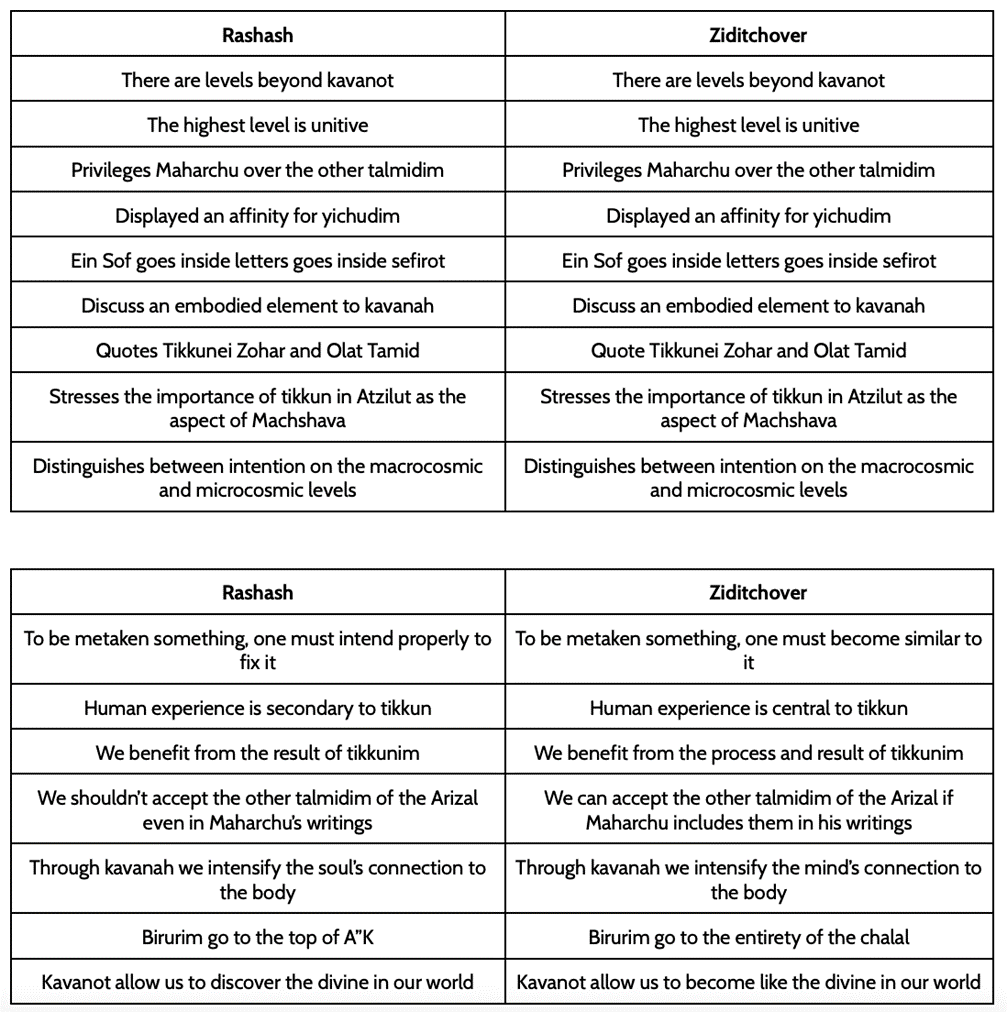
Screenshot

15. What is the subjective experience of kavvanot?

I can only really say at this point how it feels to me. The focus that kavvanot necessitate becomes an opportunity to slow down and savor the experience of prayer. Doing them for long enough strengthens my concentration and makes me more aware also of my body and my surroundings. Time feels slowed during this practice. I find that doing them draws my attention to a pleasant feeling in my body, particularly in my head. Over time, I have ascribed personal understandings and feelings to different kavvanot—there are parts that I connect with more, during which I feel more deeply.

Even though kavvanot are very mentally active and I am trying to follow the instructions of the siddur, my inner monologue is not only the words on the page but associations or prayers that I connect to these parts. It is an energizing and activating practice. They can awaken a feeling of intensity and passion, of movement even. I think of this as hitlahavut. Often, I will take a deep breath and pause for a moment within the practice and find myself awash in an “oceanic feeling,” one of calm and connection. This is what I think of as deveikut.

Siddur Torat Chacham, a siddur Rashash by R. Yitzchak Meir Morgenstern

What are the Lurianic Kabbalistic intentions? How do they work and how does one read the baroque pictorial notations of a Lurianic siddur? This interview may be one of the first explanations in English that gets to the core of the matter. This is a very technical interview, very detailed, geared for those in the know.

This great review was written by Jeremy Tibbetts, a rabbi, who is the co-director of OU-JLIC for Anglos in Jerusalem and is the Director of Education for Yavneh, an intercampus leadership program. He is a student at Hebrew University in Jewish Thought, intending to focus on the Rashash and kavanot.

Earlier Kabbalistic intentions from the early Kabbalah until Rabbi Moses Cordovero (d.1570) provided a concurrent mental intention or visualization for the words of the prayerbook. The performance of the liturgy needed an extra level of intentionality.

Rabbi Isaac Luria, the Ari, (d.1572), in contrast, taught a doctrine of an innumerable array of spiritual entities, arranged in a vast enormous system. The prayer intentions were not directly related to the words, but rather, mental operations with this vast system.

Rabbi  Shalom Sharabi, known as the Rashash (born Yemen,1720, Jerusalem1777) reworked the Lurianic instruction as pictorial images and not sentences. The siddur depicted the kavanot instead of describing them. In order to do this, the Rashash utilized divine names to map out and represent the different spiritual structures that the kavvanot act upon. Sharabi’s style about the spiritual realms Tibbetts calls “near trance-like lists depicting the different layers of spiritual constructs.” For examples, see the 2 pictures below from the Rashash prayerbook.

A new edition of the Rashash siddur was composed by the contemporary Kabbalist R. Yitzchak Meir Morgenstern called Siddur Torat Chacham, a siddur Rashash by R. Yitzchak Meir Morgenstern (born 1967). A full presentation of Lurianic praybook intentions for 1678 pages. Tibbetts proclaims that this is “a groundbreaking achievement in the world of Jewish mysticism and in kavanot.”

For many, Rabbi Morgenstern is their contemporary teacher in kabbalah and his influence is immense on this generation and the generations to come, due to his large number of students and the many rabbis and Hasidim who study with him. In addition, he publishes voluminously, generally about fifty pages a week which come out as edited books. His method is to integrate divergent schools into a harmony assigning a different function or a relational position to each one. In this case, he integrates, the Kabbalah of Sarug, Yehudah Ashag, Rav Nahman, Ramchal, and the Komarno Rebbe into the Rashash.

Back in the infancy of this blog in 2010, I did a blog post on Derekh Yihud, which is, Morgenstern’s pamphlet of visualization meditations. (From what I hear, it is not a part of his current teachings and the visualizations are not found in this siddur).

For those looking to understand this practice as a system of meditation, then skip down to question #9 on the psychology of this practice, question #12 on the visualization method, question #13 on this practice, and question #15 on why should one engage in this practice. Some of you, or many of you, might want to read these answers before the more technical answers.  

I am especially proud of this interview because of the accurate and detailed information that it provides. In contrast, most mentions of the Lurianic intentions in English are vague intoned mentions, without content or context, of tzimzum, yihudim, kabbalistic trees, and sacred power. This interview fills in the needed details.

  1. What is the siddur of Rabbi Morgenstern?

The siddur Torat Chacham, a siddur Rashash by R. Yitzchak Meir Morgenstern shlit”a (born 1967), just saw its new complete reprint in a pocket-sized print (even though it is a remarkable 1678 pages!). The first printing of the siddur was a full decade ago. This is the ultimate siddur for a student of R. Morgenstern or Kabbalah more broadly: it’s a groundbreaking achievement in the world of Jewish mysticism and in kavanot.

2) What is the siddur of the Rashash?

R. Shalom Sharabi zy”a, also known as the Rashash (born Yemen,1720, died 1777 Jerusalem). In his early years, he decided to undertake an arduous journey to move to Eretz Yisrael. Initially this brought him to Bombay in India, where he settled for awhile and was first exposed to Penimiyut haTorah and the Zohar. Eventually, he ended up taking passage through to Baghdad, Damascus, and ultimately from there, to the Old City of Jerusalem. Eventually, he becoming the next rosh yeshiva of Beit El, where he began to showcase his new approach.

The siddur Rashash was, for the Rashash himself, first and foremost a personal project. One of his most monumental achievements in the world of Kabbalah at all is his siddur. He worked on it over his life, continually writing, erasing, and rewriting. He never taught from it or attempted to disseminate it in his lifetime. In that sense, using a siddur Rashash is really entering into the Rashash’s personal world of prayer. His students took his siddur after he passed away and began copying and eventually printing it for broader use. The standard siddur Rashash is built around the Rashash’s reworking of Lurianic kavanot as depictions and not sentences.

Before the Rashash’s siddurim, prayer books which contained Lurianic kavanot described in full sentences what the practitioner should intend. One of the Rashash’s key innovations as a post-Lurianic thinker was in laying out a new version of the siddur which depicted the kavanot instead of describing them. In order to do this, the Rashash utilized divine names to map out and represent the different spiritual structures that the kavanot act upon.

These punctuated divine names are considered by many of the Kabbalists to be ideal both because they minimize the concern of one imagining something physical when praying with kavanot and because the names always refer back to Hashem directly and prevent one from getting caught up in the various spiritual tikkunim one is attempting to perform. The shem Havayah is the shem ha’atzmi, a name which uniquely indicates Hashem’s infinitude, allows us to intend towards something discrete while maintaining a connection to the infinite and undefined Or Ein Sof which animates everything.

The siddur Rashash is largely concerned with describing spiritual worlds and largely unconcerned with explicitly treating human experience and life. The Rashash offers very little in the way of a phenomenology of kavanot despite creating a nine-volume prayer book which takes hours to complete and is used on a daily basis.

A hallmark of Sharabi’s innovative style is his ability to take the Arizal’s logic of the spiritual realms and apply it iteratively on every level, often leading to what can only be described as near trance-like lists depicting the different layers of spiritual constructs. This is closely tied with the doctrine of arachin or “relativity” for Sharabi, which reads the map of Lurianic Kabbalah as applicable in any level. Just as a person is from one perspective a child and from another perspective a parent, what we call Malchut in one context could be considered Binah or Keter in another context, and so in this view, the map of the worlds as sketched in Lurianic Kabbalah is more epistemological than ontological.

3) What is unique in the siddur of Rabbi Morgenstern and his approach to the Siddur Rashash?

R. Yitzchak Meir Morgenstern’s siddur Torat Chacham is innovative precisely for its attempt at reintegrating other strains of post-Lurianic thought with the kavanot of the Lurianic siddur edited by Vital.

Perhaps most starkly, the additions in the siddur draw heavily upon the Kabbalah of Rav Yisrael Sarug zy”a (late 16th century – mid 17th century), an early student of Luria. Sarug’s approach was mainly rejected because Rav Chaim Vital, the main pupil and disseminator of Lurianic Kabbalah, casts aspersion on him as an authentic student. Many Kabbalists saw the Sarugian approach to Kabbalah as irreconcilable with Vital’s description of Lurianic Kabbalah. In particular, Sarug had terminology that was largely absent in Vital’s writings about tzimtzum and what he envisioned a whole series of worlds called Olam haMalbush at the very beginning of creation which Vital doesn’t mention. Sarug’s writings deal largely with worlds which precede those described by R. Chaim Vital, Furthermore, Sarug’s account of creation deals at length with the Hebrew letters and their formation which is also absent from  Vital’s account.

Rav Morgenstern has been working for nearly 15 years to try to reconcile and reintegrate the two systems. Part of his research has trended towards the historical, attempting to unveil hidden connections that Rav Shalom Sharabi and his students may have had to Sarug’s version of Lurianic Kabbalah. Perhaps most notably, Rav Morgenstern suggests that Sharabi’s version of Etz Chaim had Sarugian writings appended to it, implying that he considered them authentic to the Lurianic-Vitalean set of writings and that he studied them.

R. Morgenstern leans heavily on Hasidut Chabad for this project, in part because Chabad and its various offshoots accepted Sarug’s Kabbalah. R. Morgenstern uses these writings to develop a trailblazing anthropocentric reading of Sarugian Kabbalah. R. Morgenstern connects the concepts of Sarugian Kabbalah to the different ratzonot within the Divine mind which are meant to be realized through the process of creation.

4) Can you give an example?

Some of the most central and longest kavanot in the standard siddur Rashash are when one raises divine sparks up so that they can be transformed into shefa for us. The Arizal himself did not specify each and every level that they ascend to, only that they go up to “to the greatest heights.” The Rashash did spell out all of these ascensions in his theoretical works, he did not include those steps in his siddur. R. Morgenstern maps out this full ascent and adds in for the first time these levels of Olam haMalbush which in his view are also activated as part of the Rashash’s system of kavanot.

5) What about his use of Ramchal, Sulam and Komarno?

Alongside these innovative inclusions, kavanot are brought throughout the siddur from Kabbalists such as the Ramchal zy”a (1707-1746) and the Sulam zy”a (1885-1954) without clearly stating how they should be integrated with the standard kavanot haRashash.

This becomes even more of a question in sections lsuch as tachanun, where each of the 13 attributes of compassion is matched with one of Rebbe Nachman zy”a’s (1772-1810) 13 sippurei ma’asiyot. There is lastly a notable change in the actual nusach of the siddur.

While an Ashkenazi nusach of the siddur Rashash does exist, Rav Morgenstern’s siddur reconstructs the nusach of Hasidut Komarno from the Shulchan haTahor, the first Komarno Rebbe zy”a’s (1806-1874) commentary on the Shulchan Aruch Orach Chaim (though notably in a few sparse places he writes that he prefers the Breslov approach to nusach instead). Thus the siddur becomes a sort of weave of numerous Kabbalistic streams, most of which have never been brought together before in this manner.

6) Why is this siddur unique in its Kabbalah?

Rav Morgenstern, inspired by Rav Moshe Schatz shlit”a, is a proponent of a sort of “Grand Unified Theory” of Kabbalah. He takes it as axiomatic that the different schools of Kabbalistic thought are in harmony, not dissonance. The Ramchal’s Kitzur Kavanot, the Hasidic Saraf Pri Etz Chaim or Pri Kodesh Hilulim, and the Rashash’s Rechovot HaNahar are essentially describing the same thing in different levels of meaning and detail in this view. But it’s not enough to say that they align with each other: it is not possible from this perspective to truly understand Kabbalah without bringing these schools together. Each one constitutes a puzzle piece in the mosaic of sod. Kabbalah becomes a discipline not only of knowledge acquisition, but of integration.

7) How is this process of harmonization shown in the siddur?

This siddur is a monumental achievement as the first one to truly embrace this approach of harmonization and to connect it with the Rashash, the most difficult and the most conservative of the post-Lurianic schools. For those more steeped in the world of the Arizal, the Rashash, and his beit Midrash, they’ll find many additions to the siddur from the Torat Chacham, one of the most difficult works of Kabbalah from the Rashash’s talmid muvhak R. Chaim de la Rossa zy”a (early 18th century – 1786). One prominent examples would be the insertion of the kavanah for mesirut nefesh before any part of tefillah where one raises up divine sparks.

While the Rashash would not necessarily disagree with these additions, the fact that they are not included in the original siddur indicates that they were not as critical unlike the many kavanot which were codified.

The new small edition of the siddur chol also contains hundreds of pages of notes and essays in the back which explain why the siddur is laid out as it is, often citing and invoking different disagreements amongst the talmidei haRashash.

8) Why would a yeshiva student or student of the Kabbalah want to own or use this?

It is one of the most comprehensive and mature works of R. Morgenstern and his beis medrash, which may be a reason in its own right to own it. It can serve as a valuable window into the inner prayer life of one of the greatest Kabbalists of our time. Additionally, it is perhaps the only truly integrated siddur for those who want to stand at the confluence of the different strains of Kabbalah, not only by bringing in Hasidut, but by including kavanot from everything from medieval works of Kabbalah like Brit Menucha to the Gra zy”a (1720-1797), Ramchal, Sulam, and more. In this regard, it will serve as a textbook and guidebook rather than an actual prayer book, offering notes on nusach or different Kabbalistic ideas to integrate into one’s own prayer. Others still will buy it out of aspiration, more to make sure they have one rather than risking it running out and having to wait for a reprint years later.

9) How does Rabbi Morgenstern explain the process of psychologically performing kavanot?

This is sort of the big question with kavanot haRashash in general. Just like in any other siddur Rashash, the instruction to the practitioner throughout the siddur is simply “veyichaven,” “intend” that the worlds and sefirot are interconnecting in a given permutations by that corresponding word of tefillah. However, the Kabbalists would not consider the siddur Rashash to be a visualization guide.

They would in all likelihood be averse to one picturing the spiritual structures and sefirot which are part of the Kabbalistic siddur.

Neither the Rashash in his time nor R. Morgenstern in this siddur told us exactly what that means mentally. In fact,  in R. Yekutiel Fisch’s Sod haChashmal Vol. 5, there is a lengthy “teshuva” from R. Morgenstern on the subject of kavanot which quotes the Rashash’s son, the Chai baShemesh zy”a (mid 18th century – 1808), echoing this desideratum: “even though we have intention according to our intellect, each person according to their level, we don’t know what the explanation of ‘intention’ is… and what is ‘intend’ or how one attains ‘intention’” (pg. 207).

Nonetheless, there is one clue which Rav Morgenstern offers us from the siddur’s introduction which sheds some light on this question. He champions the Torat Chacham’s idea (building on the Rashash) that an individual’s kavanah must work on three levels: klal gadol, klal beinoni, and prat. He sorts the three central schools that his siddur aims to integrate into these categories: the Kabbalah of R. Yisrael Sarug, which speaks about the highest worlds of any post-Lurianic school, is the klal gadol; the Kabbalah of R. Chaim Vital, centered on Atzilut and the tikkunim which most directly impact our own world, is the klal beinoni; and Hasidut, which deals with the lowest and smallest levels of human experience, is the prat.

10) Which of these levels does he emphasize?

Paradoxically, the prat smallest level of Hasidut brings us the highest in R. Morgenstern’s view. On the micro-spiritual level, each individual sefirah and level of spiritual existence experiences whatever is above it as Ein Sof. Said differently, the more one zooms in to the details of the spiritual structures of Kabbalah, the more one experiences the system as open and ever-expanding. This is why this perspective is the most suited to truly understanding the infinitude of the Ein Sof, as each level constitutes a new self-disclosement of the infinite revelations of Hashem. This is the unity which R. Morgenstern sees between Hasidut and the school of the Rashash: for both of them, the divine is in the details.

Returning to R. Morgenstern’s teshuva in Sod haChashmal, he offers several more insights into the psychology of kavanot. First, he explains that the Rashash’s innovation of depicting the kavanot as punctuated shemot Havayah over the prior Lurianic siddurim which explained each kavanah in words was rooted in the Rashash’s desire to not separate the kavanot from the Ein Sof. The mechaven must always hold an awareness of the infinitude of Hashem alongside the particular kavanah at hand.

11) Where does separation from physicality fit in?

He quotes the Shemen Sasson zy”a (1825-1903) who riffs off of the Shulchan Aruch in OC 98:1 in describing kavanah as “to strip one’s soul, to separate it from physicality, and to awaken the upper worlds… as explained in the kavanot of Shema at bedtime and in the secrets of dreams and prophecy.” This seems to be a dual kavanah.

While the latter part might have seemed obvious given the focus of the kavanot on the upper worlds, the former is not only a powerful statement of how the kavanot should impact a person’s embodied experience but also should indicate that through Kabbalistic prayer, one first directs one’s soul away from this world in order to impact the upper worlds.

He goes on to quote the Hasidic masters the Maor vaShemesh zy”a (1751-1823) and R. Pinchas of Koritz zy”a (1725-1791) alongside the pre-Lurianic Kabbalist R. Moshe Cordovero zy”a’s (1522-1570) on the ability of kavanot to “purify the mind and increase devekut,” even without proper understanding.

This devekut for R. Morgenstern is itself the awareness of the Ein Sof behind each and every kavanah. The need to hold the unity of the Ein Sof amidst the plurality and intricacy of kavanot is central for R. Morgenstern, so much so that he writes that if the extreme details of the siddur Rashash distract a person from this devekut, then they should not use it.

12) What is the role of emotion vs visualization?

The truth is that R. Morgenstern’s Torah contains both: in works like Derech Yichud, a Kabbalistic meditation guide that R. Morgenstern prepared over several years to attempt to integrate meditation and Kabbalah/Hasidut, you see that he leans very heavily into visualization-based meditation, and at the same time in many places in De’ah Chochmah leNafshechah, where R. Morgenstern’s weekly sichot are recorded, as well as in Bayam Darkecha, written and published by a close talmid of R. Morgenstern, the emphasis is strongly on the emotive and psychospiritual impact of kavanot.

As mentioned above, the siddur is not meant to be a visualization guide. R. Morgenstern’s siddur does contain additions though which at first glance seem to involve some form of visualization. For example, when ascending the different heichalot in Shacharit, he adds in detailed descriptions of their layout and appearance from the Zohar. There’s no “kavanah” added alongside them. This is also the case with other additions in the siddur, e.g. the sketching of the malbush at the end of sim shalom and the addition of parts of the mishkan in each beracha of the Amidah.

Even more radically, there are numerous yichudim (letter-based meditations) from the writings of the Kabbalists which have been added in, despite the near universal consensus in the world of Lurianic Kabbalah that even yichudim which utilize words or pesukim which appear in the siddur should not be added as part of the daily intentions. R. Morgenstern defended this practice previously in his haskamah to the siddur Sha’ar Ruach haKodesh which also added in yichudim, as well as in the essays appended to his siddur, based mostly on Ziditchov and Komarno Hasidut.

 The fact that no specific intention is written for any of them calls into question their exact purpose: their very inclusion in the prayer book would seem to suggest that they are included to be part of the kavanot in one form or another, yet without a particular intention, they can also be read as associative companions which are meant purely to enhance and deepen a non-visual experience of kavanot.

13) If kavvanot are not visualization then what are they? Are they just things to think about when reciting the liturgy, like reading a book of kabbalah simultaneously to reciting the siddur?

This is a really hard question! On the one hand, they’re not supposed to bring one to a form of contentless contemplation as done in meditating on the on the breath.  On the other side, they’re not a scholastic or academic exercise.

They are meant to be somehow performed and not just considered. I think also that the Kabbalists did not see them as liturgy in the same way that the siddur is. We aren’t communicating to God or requesting that God unify the worlds with the kavanot.

They saw the “intending self,” the part of the self which is associated with conscious intention, as the highest part of the self which could act on one’s body or soul. It is through deep focus, one can use the mind like a hand to move the upper worlds. Some of the Kabbalists note that these mental acts cannot be affected without reciting the actual words of prayer.  In other words, one contemplates and focuses in on the kavanot as they stand independently, and that also forms the intention for when I say that word or phrase in the siddur. So it creates its own form of non-imagistic meditative concentration around and through the words of tefillah.

14) Should one start with this siddur?

I think probably not. If one is interested in exploring kavanot in general but does not have the prerequisite experience with Etz Chaim, Sha’ar haKavanot, Rechovot haNahar and the like, the siddur Rashash is nearly impossible to use.

When a person wants to actually start learning how to use the siddur Rashash, R. Yechezkel Bing shlit”a’s Nekudot haKesef (who is himself thanked in the siddur Torat Chacham’s introduction for offering guidance as it was being made) and R. Gamliel Rabinowitz’s Tiv haRashash both explain the siddur in depth, even line by line in some cases.

 When I wanted to start learning how to use a siddur Rashash, what was first recommended to me was to start with a more basic siddur and commentary which would give me a sense of the Kabbalistic flow of tefillah. The siddur Keter Nehora (also called the Berditchever siddur), the Shelah’s siddur commentary, the Matok miDvash siddur, and the Yesod veShoresh haAvodah are all great starting points as they are not overly caught in the particularist mechanisms of kavanah.

R. Mechel Handler shlit”a, a living Kabbalist in Boro Park, has a recommended and ordered reading list in his Peticha leKavanot haRashash for anyone who wants to start using a siddur Rashash: he suggests the classic Sephardi Kabbalistic starting point of Otzrot Chaim with the Matok miDvash commentary, followed by Etz Chaim, then Sha’ar haKavanot Drushei Keriat Shema Drush Vav (called drush ha’ikkar by some), and ultimately delving into numerous seforim which focus on the different parts of tefillah.

 I would add that before opening Otzrot Chaim, I gained a lot from using introductory seforim like Siftei Chen, Yedid Nefesh, Klalei Hatchalat haChochmah, and R. Handler’s sefer mentioned above.

15) Why do Rashsash/Morgenstern kavvanot? What not play Dungeons and Dragons? Why use these Baroque notations in the 21st century? Just daven

I’ll suggest three answers based on the Kabbalistic tradition. The first is about the largest layer of ramifications that the kavanot can have. R. Shaul Dweck haKohen zy”a (1857-1933), a rosh yeshiva in the Rashash’s tradition, wrote that the redemption will come after a certain amount of nitzotzot, divine sparks scattered in the world through the vessel’s shattering, are raised up. However, through the performance of proper actions we can bring that redemption more quickly. In this view, the siddur is the guidebook to how we can open the world to greater connection to Hashem, it pulls the levers which allow the hashgacha to come to expression.

The second answer is that they work on the most individualized level. The Arizal writes in the introduction to Sha’ar haMitzvot that “according to the greatness of the joy in truth and inner good heartedness will they merit to receive the supernal light, and if they do this continuously, there is no doubt that ruach hakodesh will rest upon them.” There are two things which this quote communicates about the inner experience of kavanot: 1) the kavanot and one’s emotional state are intertwined and therefore emotion is therefore not disconnected from kavanot, and 2) there is a shift in one’s cognition through the performance of kavanot, through the receiving of this supernal light and ultimately through experiencing ruach hakodesh as part of them. According to another Lurianic source (Sha’ar haKavanot Drushei haShachar 1), this light enters the soul through the performance of kavanot.

I’m not an expert practitioner, but I do find that they bring a greater sense of attunement, presence, and a sense of devekut as well.

Lastly, these kavanot are a body of thought which is already “home-grown” within the Jewish tradition. The Kabbalists developed these kavanot with reference to the full gamut of Torah. So, if someone is seeking some kind of meditative experience out of prayer, this is one of the most expansive Jewish answers.

Wild Strawberries for Tisha B’Av

I just received an email that Drisha will be screening and discussing the Ingmar Bergman film Wild Strawberries at 4pm on Tisha beAv. I take this as another indication of our relating to God as a therapeutic deity.

In the 1970’s Conservative congregations spoke of Jewish history and the Holocaust on Tisha Be-av. Reading of Josephus and Ghetto diaries. During this time period, Rav Soloveitchik spoke of the ontic catastrophe of the destruction of the Temple and the existential state of acquiring emotions in a case of “old mourning” and turned it into a day of shiurim on mourning and the mikdash.
Flashy Rabbis gave lectures on “why do we still mourn now that we have a state of Israel?”

By the 1990’s Centrist Orthodoxy used the talks of Rav Soloveitchik to speak of Jewish History and the Holocaust, or discussing the halakhot of the land of Israel. Holocaust films were shown and protests are held at the UN and embassies. The halakhic God of Lonely Man of Faith gave way to a God of History, Land, and War.
On the more yeshivish side, there are lectures on hastening the geulah- either through not talking lashon hara or not doing any of the activities that hasten it.

In the last few years, there has been a shift to the brokenness of the world. Renewal announcements ask: How do we deal with the brokenness, trauma, and injustice in the world. Yeshivish announcements offer sessions on the destruction in our lives and restoring family and teens in trouble. And now Drisha is leading a discussion about Wild Strawberries, a movie in which the protagonist a retired medical professor sees his life as loveless and without meaning. He is haunted by memories, brought on by dreams and by people he meets, about the chances for love, family, and forgiveness that he messed up. Tisha Be-Av is a chance to undo psychic damage.

One path that is not being continued is the Tisha BeAv rally held several years ago in Jerusalem in which Rabbis Lichtenstein, Cherlow, Lau, and others as an occasion for justice. They denounced the lack of in Israel of worker’s rights, the human trafficking, the oppression of the poor, of the Arab other, of unfair business practices. The event did not have continuity. (Can someone send me the links from Haaretz, Ynet or the speeches?)
Rabbi SR Hirsch also emphasized the ethical since the prophets denounced Israel for its immorality.

As a side topic- Here is Reb Shlomo from 1992 asking for intimacy with God, to heal from the pain of the Holocaust, to rebuild the Temple. It’s longing is palpable.

It is possible to do everything G-d wants you to do and not to be intimate with G-d. You know, beautiful friends, Mount Sinai is where G-d told us what to do. But Jerusalem, the Holy Temple, is where we are intimate with G-d. The Holy Temple is the headquarters for being close to G-d and to each other. But when the house is destroyed, there is no place to be intimate anymore. And gevalt! Are we longing and crying to be intimate with G-d, with every Jew, with every word of the Torah, and, one day, with the whole world…On Tisha b’Av the Messiah comes. On Tisha b’Av until the Six Million you only heard the sound of the destruction of the Temple; you could not hear the footsteps of the Messiah. Today, the voice of destruction gets further and further away, the voice of the coming of the Messiah gets closer and closer. Let it be this year that the whole world will be fixed and G-d’s holy intimacy comes back into the world and into our lives. You know, beautiful friends, I’m so proud of our moshav and our shul because they are filled with prayers, with so much dancing and joy, but also with so many tears begging G-d for intimacy with every word of the Torah with every Jew, with every human being, with all of nature. I have a feeling it will be this year.

Shlomo offers an undifferentiated healing love- primordial and oceanic.
Viewing Wild Strawberries offers self-scrutiny of one’s wrong choices and how does one let go of hindrances that prevent healing. One sees that one’s choices are the cause of one’s meaninglessness, therefore a person needs to take responsibility, a therapeutic mussar.

Updated- One week later Drisha sent out an announcement that they will be showing a Holocaust movie and not Wild Strawberries.

Copyright © 2010 Alan Brill • All Rights Reserved

R. Moshe Cordovero on the Amidah.

R. Yosef Karo writes that he followed the kavvanot of the Ramak.

In contrast, to Provençal method where there is an ascent to tiferet or binah. In Cordovero’s method, as mentioned above, the shekhinah itself is raised and the entire system collapses up like the folding up of a telescope. One folds shekhinah up beyond nezah and hod which makes her the same as tiferet, not that there is only tiferet or that she merged into tiferet, but that she has been raised to the point of tiferet.  From tiferet, the shekhinah together with tiferet receive from an influx from binah. There is  loss of differentiation and integration within binah. This ascent during the silent prayer allows the entrance and then the merging of the soul into the supernal realms.

The passage contains the division of ADNY into AY, the Infinite oneness found within ten sefirot showing unity of keter, tiferet, and malkhut, and DN the forces of judgment and materiality showing the emanation process as privation from the Divine goodness.

Here we have words of the amidah especially the name A-donai (A-d-n-y) divided into Aleph for the top three sefirot, and daled-nun as judgment of the world, and yod as the ten sefirot. The infinite light (aleph) above descends to the earthy world of judgment (daled-nun) through the means of the ten sefirot (yod). The infinite light cascades down in emanation as the discrete units of the three Divine names, E-hyah, Y-H-V-H, and A-donai.

ADNY, this name is malkhut.

Meditate that She is now higher than nezah and hod, as She is silently rising between the two shepherds during the unification of the recitation of the Shema. The mystery of prayer is their literal union, that they completely unite. The individual is silent because the union is in silence. Voice (kol), tiferet, is not heard outside at all,. The mystery of this verse is to open the door of the palace for the worshiper to enter inside. Thus, he knocks on the opening of the palace gate, holy of holies, in order to enter inside, to unify and bind. As it is known, inside the palace is malkhut, bound with the three fathers whose mystery is love (ahavah).

One knocks and says, “my Lord” (ADNY), who is malkhut, as she is the aspect bound in the mystery of daled nun that she is the mystery of alef, which is the name eh-yeh in binah and the mystery of yud, which is Y-H-V-H in tiferet. This is why she is called Ado-nai, tied to three names, Eh-yeh, Y-H-V-H, Ado-nai on nezah and hod.

“My lips” are nezah and hod;

“open” (tiftah) from inside the palace. These are the openings of palace of the gates of righteousness so that I may enter them and praise Y-H (Psalms 118:19).

“and my mouth” (u’fi) for through the opening of the lips the mouth is formed, which is malkhut. Since She does not have a mouth without open lips, immediately you will see malkhut.

Immediately, “will express” (yaggid), from the side of hokhmah, which is the mystery of gimmel daled, seven sefirot GYD, a drop from the brains that are drawn down in the mystery of semen that shoots like an arrow.

First Blessing

The goal of the first blessing of the silent amidah is to draw down from binah into the lower sefirot of yesod and malkhut.

The following paragraph is a note written above the liturgy, so that the reader does not misunderstand the process and think that one is still just connecting the lower to the higher sefirot, The entire first berakhah is not only in binah, but in the depths of binah; while the other mentioned sefirot are all within binah. The imagery is of the infinite king, a cosmic deity, who is so great, that there are many aspects (bekhinot) , called inner limbs. This passage is not included in the first Rosh Hashanah commentary  and may be by another hand, but it does express the characteristics of the practice of the Cordovero intentions.

This entire blessing is in the depths of binah until “shield of Abraham” that She descends into hesed. Whenever it says that [the pray-er] goes down into malkhut and the avot, it is all hidden in binah. For the first blessing is the first principle of the king, and all the higher inner limbs are included in it. Thus, she will have many aspects.

Cordovero wrote notes above the words Bless and You explaining how the blessings within the amidah work.  He reiterates that his method is to go from top to bottom during blessings drawing down from the eyn sof to malkhut.

“Bless” During the amidah, one should direct “bless” down from the Ein Sof to yesod including all ten sefirot from the Source of everything. The power to bring down influence from on high until malkhut below depends on thought.

This is why the Zohar says that one should not start at the level of “Your face,” so that you do not admonished, God forbid. Should he start “bless” from bottom-up, standing in din, then the going bottom-up is din. Rather, start from the top and go before His face below; this is the mystery of “blessed” from top-down to repair it beforehand with influx and sweetening its judgments.

Energy is drawn down from the top three sefirot to the middle six, first as keter, hokhmah, and binah into tiferet, then in the middle blessings one draws daat the animating vitality of the world into the twelve-sided version of tiferet, and in the concluding blessings of the amidah one brings the spiritual energy into malkhut.

Yesod includes yesod malkhut (YM) from keter until yesod seals this world of yesod malkhut from the world of the male, spreading top-down.

Blessed (Barukh)

Malkhut is the world of the female. Alef (A) is keter; tav (T) is hesed, binah, gedulah, gevurah; hei (H) is tiferet until malkhut.

Are You (Atah; ATH)

Tiferet, which binds together male and female from the bottom up.

Lord (Y-H-V-H)

Ein Sof keter of keter:

yud hei vav hei (YUD HY VYV HY); [72]

alef hei yud hei (ALF HA YUD HA); [143]

yud hei vav hei (YUD HA VAV HA); [45]

alef dalet nun yud (ALF DLT NUN YUD). [#zzz]

Bind head to head YAHH-VYHHhokhmah and binah.

Bind body to body YAHD-UNHYtiferet and malkhut.

Binah

Our God (e-lo-heinu)

Hokhmah that lights up binah

And God of (vei-lo-hei)

In the mystery of her three roots, gedulah, gevurah and tiferet inside her.

Our fathers (avoteinu)

Hesed of hokhmah bound in hesed of binah.

God of (e-lo-hei) Abraham (avraham)

Gevurah of hokhmah bound in gevurah of binah.

God of (elo-hei) Isaac (yizhak)

Tiferet of hokhmah bound in tiferet of binah.

And God of (vei-lo-hei)  Jacob (ya’akov).

Mystery of three fathers revealed in the great binah of gedulah

The God  (ha-e-l) The great (ha-gadol)

Gevurah

The mighty (ha-gibbor)

Tiferet

And the awesome (ve-ha-nora)

To bring them influence and blessing from the source of the right of keter, called or zah, the mystery of yud in the name yud hei vav hei (YUD HY VYV HY) [72]

God on high (e-l elyon)

Who brings influence from hokhmah to binah

Benefactor of (gomeil)

Hasadim that are great and give light, that her aspect is from the right, hesed; and all the aspects from her side are kind

Great kindness (hasadim tovim)

From the source of binah of keter, which is the name alef hei yud hei (ALF HA YUD HA) [143]

And possesses all (vekoneih ha-kol)

The sprouting of three fathers, all hasadim from the highest white light.

And remembers the kindness of the fathers (vezokheir hasdei avot)

Mystery of the name yud hei vav hei (YUD HA VAV HA) [45] of keter, vav of the name of arikh anpin and keter revealed

And brings redemption (u’meivi go’eil)

Nezah and hod, children of the three fathers

To the sons (livnei) of their sons (veneihem)

Meditate on spreading the last letter hei in the name Y-H-V-H of keter

For the sake of His name (lema’an shemo)

From there, spreading out the exiled malkhut who will be bound between two arms.

In love (be’ahavah).

Now return to unify from bottom to top through hokhmah and binah as one. Malkhut bound with malkhut of keter.

King (melekh)

Tiferet bound to tiferet of keter yud hei vav hei (YUD HA VAV HA) [45]

Helper (ozeir)

Gevurah bound in the name Eh-yeh of keter

And savior (u-moshia)

Hesed bound in the mystery of the highest hesed of keter, yud hei vav hei (YUD HY VYV HY).[72]

And Shield (u-magein).

Yesod including all ten sefirot from the world of the male

Blessed (barukh)

Malkhut including all ten sefirot from the world of the female

Are You (atah)

Going up to unite in keter until Ein Sof

Lord (Y-H-V-H)

YAHD-UNHY; YAHA-VYHH;

alef dalet nun yud (ALF DLT NUN YUD); [#zz]

yud hei vav hei (YUD HA VAV HA);[45]

alef hei yud hei yud hei vav hei (ALF HA YUD HA YUD HY VYV HY).[#]

Bind three fathers of malkhut in hesed to bring everything out from binah and bring them to hesed.

Shield of Abraham (magein avraham).


Copyright © 2010 Alan Brill • All Rights Reserved

Rabbi Eliezer Ashkenazi on Pour out thy Wrath

Rabbi Eliezer Ashkenazi (1513-1585), rabbi in Egypt, Italy and Poland, was a rational thinker and major influence in his era. He wrote an important Biblical commentary and defended the traditional medieval rationalism against Maharal. The following passage played a role in subsequent early modern legal discussions and seems to have been forgotten in twentieth century discussions. Ashkenazi removes his, and our, current gentiles from the curse.

“Pour out thy wrath upon the nations”

Some of the Gentiles among whom we are exiled under their protection have thought that God forbid we are cursing them.

It only applies to the nations that do not know Him, that deny the Exodus from Egypt because they don’t accept the miracles and wonders. It is quite clear that the Gentiles among whom we are exiled all know about the Exodus and believe in it, and know its details…We only curse the idol worshipers who don’t believe in creation and who destroyed the Temple, not the nations who became Edom and Ishmael (Christianity and Islam) because they were still not created…But now our Gentiles and the Ishmaelites know God, and acknowledge the Exodus, forefend for us to curse them from our religion.
And when we do curse those who afflict us and unjustly persecute us, that curse is not from our religion, forefend, but as a person who curses one who afflicts another…
Our holy Torah announces this in the name of the head of the faithful [Abraham] that God does not desire this, as it is written, “Will you destroy the righteous with the wicked?” And the master of the prophets [Genesis 18:23] said, “One person will sin and the whole community should be cut off?” And from the writings it is clarified that we are not allowed from our religion to curse nations that acknowledge the Exodus from Egypt and know God even if they have not received the Torah…
That is why it was not permitted for Israel to conquer the land of Canaan until after the Exodus, that even after they know about God they did not believe or accept….

Rabbi Ashkenazi acknowledges that Gentiles accept God, creation and even the providential Exodus story. Ashkenazi draws a distinction between the negative attitude toward Gentiles in the Talmud and the attitude toward contemporary Christians by stating that Gentiles at the time of the Temple were idolaters without a belief in God. He further distances himself from prior teachings of contempt by stating that the curses that the Midrash heaps upon Rome have no connection to the later nations of Edom. Ashkenazi proclaims that Jews do not curse others. Even when Christians persecute Jews, the persecution stems not from their religion but from unfortunate occurrences between people. One cannot hold a people accountable for the injustice of some of them, and certainly one cannot hold their religion responsible for the injustice committed by certain members of it.

Ashkenazi also explains the four sons as the wise son is Isaac, the wicked son is Christianity, the simple son is Jacob, and the son that does not know how to ask is Islam. There is a recent dissertation written under the direction of Menachem Kellner on Ashkenazi, Neta Ecker, Universalism in the Thought of Rabbi Eliezer Ashkenazi” Unpublished Dissertation Haifa University 2010)

The importance of this passage of Rabbi Eliezer Ashkenazi is that it is quoted as a source text by R. Moshe Rivkes in the eighteenth-century as a general halakhah.

The rabbis of the Talmud meant by the term ‘idolaters’ the pagans who lived in their time, who worshipped the stars and the constellations and did not believe in the Exodus from Egypt and in the creation of the world out of nothing. But the nations under whose benevolent shadow we, the Jewish nation, are exiled and are dispersed among them, they do believe in the creation of the world out of nothing and the Exodus from Egypt and in the essentials of faith, and their whole intention is toward the Maker of heaven and earth, as other authorities have written…
So rather than a prohibition not to save them [if they were idolaters], on the contrary, we are required to pray for their welfare as Rabbi Eliezer Ashkenazi wrote at length on the passage from the Passover haggadah “Pour out thy Wrath.” King David prayed to God to pour out his wrath on the idolater who did not believe in creation from nothing or the signs and wonders that God performed for us in Egypt and at the giving of the Torah. The nations
In whose shadow we live and under whose wings we are protected do believe in all of this. Therefore, we are always required to pray for the welfare and success of the kingdom and the ministers, in all their provinces. Indeed, Maimonides ruled according to Rabbi Joshua, that the pious of the nations have a portion in the world to come. (Be’er haGolah to Hoshen Mishpat 425:5)

Translation and comments – Copyright © 2010 Alan Brill • All Rights Reserved

Pour out thy Love Upon the Nations and Miriam at the Seder-Updated

Years ago before the computerized library age, I was asked to check if a certain library in Europe possibly had a copy of a small book “Shefokh Ahavatkha” by Chaim Bloch, the famous Neturei Karta forger. Bloch claimed in another work that he wrote such work and it provided evidence for a medieval tradition of “Pour out thy Love upon the nations.” Since he forged the Anti-Zionist letters and was involved in the Kherson forgeries, it was more of a wild goose chase. What is interesting is that in recent years both the Mekhon Hartman Haggadah and the Midrasha Oranim include the forged version in their haggadot, with a very mild caveat that “scholars debate the issue.” They like the universal sentiment regardless of its source. To see it in the Hartman’s Haggadah see pages 142-143 in A Different Night.

This year I noticed that in 2009 an Israeli paper helped spread the false story as true, So I was gratified to see there is a nice article by Rabbi David Golinkin on the topic. Golinkin also has a nice discussion of the custom of dressing up a Elijah, but his discussion of the forged Maharal Haggadah and the prayer for salvation did not catch that one of prime reasons for the forged Maharal Haggadah was to spread the Kotzker-Izbitz practice of drinking a fifth cup.

In Hatza’ah L’Seder, a new Israeli Haggadah published by the staff of the Midrasha at Oranim Teachers’ College in 2000, the following addition appears after the three traditional Shefokh verses:

A piyyut which exhibits a different attitude to non-Jews (found in a Haggadah manuscript from the early 16th century):

Pour out your love on the nations who know You
And on kingdoms who call Your name.
For the good which they do for the seed of Jacob
And they shield Your people Israel from their enemies.
May they merit to see the good of Your chosen}
And to rejoice in the joy of Your nation.

This prayer was first published by the bibliographer Naftali Ben-Menahem in 1963. It was supposedly discovered by Rabbi Hayyim Bloch (1881-ca. 1970) in a beautiful manuscript on parchment from the estate of Rabbi Shimshon Wertheimer (1658-1724).

The Haggadah was supposed to have been edited in Worms in 1521 by “Yehudah b”r Yekutiel, the grandson of Rashi”, but the manuscript was lost during the Holocaust.

However, a number of scholars have pointed our that this prayer was probably invented by Hayyim Bloch himself, who was born in Galicia and later moved to Vienna (ca. 1917) and New York (1939). He was one of the rabbis who published the Kherson letters attributed to the Besht and his disciples, which later turned out to be forgeries. He also published a letter from the Maharal of Prague, whose authenticity was already disproved by Gershom Scholem.

Finally, from 1959-1965 he published three volumes containing over 300 letters of great rabbis opposed to Zionism, but Rabbi Shemuel Hacohen Weingarten has proved that these “letters” were invented by Rabbi Bloch himself. Therefore, we may assume that “Shefokh Ahavatkha” was not composed in Worms in 1521, but rather by Rabbi Hayyim Bloch ca. 1963.

On the other hand, the traditions of connecting Miriam to the Seder are traditional as are customs connecting Bitya to the Seder. From an article in Ynet in 2006.

The most basic practice was a piece of fish placed on the Seder plate to commemorate Miriam.

We have two cooked foods on the seder table – an egg and a shank bone.The Talmud explains this as reflecting the holiday’s two sacrifices, the special Paschal lamb and the general holiday offering.

It turns out, however, that the number of dishes at the seder wasn’t fixed.

Rabbi Sherira Gaon of 10th-century Babylon noted a custom of putting three foods on the plate.
“Those three cooked foods are fish, meat, and an egg corresponding to the foods that Israel will eat in the Time to Come; fish corresponding to Leviathan, egg to Ziz (an enormous mythic and fabulous bird), meat corresponding to wild bull.” The foods symbolizes the mythic creatures from the realms of sea, air and land that will be eaten in the Meal of the Righteous in the Messianic times.

A second reason offered by R. Sherira , however, is one that resonates more strongly with our generation: “There are those who put an additional cooked food in memory of Miriam, as it says, “And I sent before you Moses, and Aaron, and Miriam” (Micah 6, 4). According to this, Miriam and the role she fulfilled in the redemption from Egypt is represented by the third cooked food on the seder table.

Another rabbi cognizant of the importance of women to the Passover story was Rabbi Abraham Grate of Prague. His 1708 Haggadah commentary explained several seder rituals, including the initial hand washing, as referring to Pharaoh’s daughter Bitya and her rescue of Moses from the Nile.

And if these proto-feminist commentaries are from relatively forgotten sources, how to explain the fact that a basic interpretation of haroset revolves around women – and almost nobody knows it? According to the Talmud, haroset is in memory of the apple tree, and Rashi in his commentary makes reference to the midrash in which, the women would go to their working husbands and would conceive children between the fields. When the women were ready to give birth, they would leave their homes out of fear of the Egyptians. They would lie underneath the apple trees and give birth. Apple haroset, then, is about the fact that the Jewish women did not lose hope in those difficult times.

Update- It turns out that Jonathan Sacks also has the pc version of “pour out your love.” but he puts it below the line as an “there is a manuscript.” The Tabori JPS haggadah places this version in the introduction

The official source is Heichal l’divrei chakhamim upithgameihem (1948) where Bloch adduces this quote, and in the extensive footnote
says he published a reproduction of this page-and the shaar of the manuscript in his fictitious book Der Judenhas. Here is the source Look at both pages 591 and 592.

Marc-Alain Ouaknin, Haggadah

One of the most interesting commentaries on the haggadah of the last decade was the one by
Rabbi Marc-Alain Ouaknin, Haggadah: The Passover Story (Paperback)

Ouaknin, a follower of Levinas and Lacan who teaches at Bar Ilan, when he is not busy writing profitable coffee table books, does some serious engagement with contemporary French thought, especially in his The Burnt Book. For him, the Talmudic project of the Eastern European beit midrash has no closure, ever changing, ever forgetful and driven by desire. He freely mixes R. Hayyim of Volozhin, Rav Nahman, Reb Zadok with psychoanalysis, symbolist poetry, and semiotics. Ouaknin has a reading of Judaism as indeterminacy. “Man must reject the illusion of thinking that life is already written and the way is drawn.” He are various fragments from the web that give some indiation of his approach to the Passover haggadah.

My favorite section is his explanation of Yachatz, breaking the middle matzah, as the Lacanian Real sending us on our quest through the seder for our ever receding Real , creating a symbolic order in the Lacan sense. Breaking the matzah creates an open space for our symbolic registry to occur. We are throw in the seder just as we are thrown into our quest for the recovery of the real.

On the telling of the Passover story, he writes:
“The words of telling emerge from that break, from the empty place left between the two pieces of matzah.”
The act of telling the story of the Exodus occurs through an exchange of conversation and ideas. We take the one whole matzah and break it in half because discussion and conversation occur when there is a minimum of two — me and the other.

On opening the door for Elijah, Ouaknin quotes the story in which Elijah goes alone to a cave on Mount Horev in the desert. God brings a great wind, and then an earthquake, and then a fire—but God was not in any of these. Instead, after the fire, he finds God in ‘a still, small voice.’ (1 Kings 19:11-13) Ouaknin comments that one must reach the level of Elijah, self-forgetfulness in the desert.

One must have sharpened one’s hearing, to be led to the absolute level of attention, to become capable of perceiving such a tenuous breath. One must have sounded oneself, have explored oneself in the darkest places of consciousness, to the furthest of thoughts, to have made the circuit of one’s inner domain many times, in constantly growing but nevertheless tightening circles, so as to attain the intimate desert of self-forgetfulness, to be able to be stroked lightly, touched, visited by such an inaudible sigh.
The point of concluding the seder with opening the door for Elijah is to signify that this journey in ‘the intimate desert of self-forgetfulness’ is the ultimate intention of the seder. While we aim to find ourselves on seder night, to reconnect with the story of our people and see ourselves as having personally left Egypt, remembering who we are paradoxically requires losing ourselves at the same time.

For his approach to “my forefathers worshiped idols” he quotes J.L. Marion about idols as false forms that distort reality and fill in the gap between us and the divine.
What the idol tries to reduce is the gap and the withdrawal of the divine… Filling in for the absence of the divinity, the idol brings the divine within reach, ensures its presence, and, eventually, distorts it. Its completion finishes the divine off… The idol lacks the distance that identifies and authenticates the divine as such–as that which does not belong to us, but which happens to us. (Ouaknin, The Burnt Book, p. 65)

Lord Jonathan Sacks on the Siddur

1] When I think of certain prayer books commentaries, I sometimes think of them with a few words. Hirsch – moral aspiration, Birnbaum – historical anti-Semitism Artscroll – Hashem centered,   Rebbe – attachment to God

For Sacks, the words are hope, faith, and dignity.

Full disclosure – I received a copy from the publisher after my last post on the idea of witness in his thought. In short, my reaction is that his books are generally well crafted and delivered publicly, but here we have short comments not fully explained or justified.

2]  Collective Prayer

His message throughout the siddur is collective faith, we join with others. Prayer concerns the past and future of the community, the people Israel. The prayer is adoration and praise for God – our highest aspirations for the Jewish people. He favors Yehudah Halevi– prayer shows a God of history and human events. We learn from prayer the need to maintain faith, hope, dignity, and pride.

What is prayer? Prayer changes us – it is self-fulfillment He opens the book with a definition that prayer is conversation with God and never actually uses that definition in the book. From his commentary, prayer is listening and shaping oneself from the liturgy. Symbols need meditations therefore many do the yehi ratzon (cf. Hirsch).

His commentary is not very spiritual, emotional, or experiential, despite his use of these words. For example, he states the repetition of the amidah is the peak of religious experience because it contains the kedushah which was based on prophetic and mystic visions. Liturgy is not experience or experiential. Nor will one find much solace or human struggle in the prayer book.

Like the commentaries on Book of Common Prayer – he offers Biblical teachings applied in everyday life. The book is not very Rabbinic.

The commentary on the weekday shaharit is on the history of the liturgy and on the Shabbat shaharit is more theological.

3] Justice

His vision is that prayer will teach us personal and social responsibilitie. There is a cosmic moral standard of justice  God’s eternal values for the affairs of humankind-are justice to the oppressed, food to the hungry, freedom to captives, and hope to those at the margins of society.” Korban (sacrifice) is the pledging of ourselves to do his will. Peace the ultimate hope of monotheism. [Wow – this is nice universalism and good ethical monotheism- will it mold Orthodoxy?]

He writes: We believe that “The world is the product of single will , not the blind clash of conflicting elements”.[what of divine mandated clashes and exclusivism?]

He writes “Havdalah means making distinctions”, “to make order out of chaos, God wants us to be creative.” That is great homiletic but will it encourage the production of what the wider world calls creativity?

4] Revelation

Sacks writes that in contrast to the universal demands on Jews, Revelation is particular – it is our covenant of love with God – a relationship.Torah is our written constitution, collective memory, and record of covenant- not just sacred literature The message, however, of revelation is the universal justice, compassion, inalienable rights for the downtrodden.[This is the point were I find this commentary as selected quotes from his books on global ethics. Nothing is substantiated or justified here but they are justified in the books.In addition, the books come from speeches delivered in public to answer a need. These comments have no criteria for their inclusion.]

5] Christian locutions

a) Sacks writes that Resurrection is hope “ Jews kept hope alive, hope kept the Jewish people alive.”We have a divine promise and hope defeats tragedy

This is one of my pet peeve – tikvah and spes are not the same even if both translated as hope.

The former word tikvah is restoration –

[There is a debate of Radak and Ramban is if has the same meaning as kav – to make a line.]

Nahmanides says that just as a blueprint has lines drawn so too our tikvah for the national redemption is already drawn. Christian meaning of spes is of unseen things, the future, as part of the supernatural virtues of faith hope, and charity. For Christians hope is a virtue, for Jews, God (or Torah) has kept up Jewish hope for the redemption. One hopes in God, one does not hope as a virtue.

Sacks uses the word in several places in the Christian sense  and even has locutions like faith, hope, and dignity – cf the Christian faith, hope and charity

The use of the word hope in this sense is also used often in Shakespeare

b) On page 146 – he writes we are your witnesses, the bearers of your name. (Jews don’t use it like this)- see my prior post

c) He uses the phrase “free air of hope” – page 152 coined by the Irish theologian George Tyrrell (1861 – 1909).

6] He views religious language as metaphor

In many places he has a variant of the following: God is unknowable and belong words – the goal is to get behind words.

7] As a book

Well…A large number of quotes are quite cryptic – he likes good phrases better than good comments. Many times one cannot make out what it means. The full ideas in other books are here reduced to bon mots. Comments sometimes say “it may be” “may reflect” – so the effect is a more of a homily than a commentary.

Sometimes he cites his sources – in one case there are three cited names in a single  passage—and then there are many pages without a single citation. Yet, in his other works he cites the author of the interpretation. It seems arbitrary.

8] Sources and comparisons

a) On the topic of liturgy and spontaneity, he surprisingly does not use the usually rabbinic passages on keva and kavvanah but discusses the topic through passages the in Bible. Source seems to be an unnamed book on the Bible or early Rabbinics.

b) He cites historical material from a much much earlier decade with any new insight- he does not references to Yakovson (Jacobson), Abrahams, Elbogen or other works that he relies on.

c) Conspicuous in its absence is the Lubavitcher Rebbe since Sacks relied heavily on the Rebbe in earlier works and adapted a volume of the Rebbe on parashah. But Sacks makes prayer thankfulness and adoration – and does not follow the Rebbe that prayer is connection to God.

d) Sacks noticeably quotes Rav Soloveitchik in his introduction, as if to claim continuity or authenticity, but does not follow his approach to prayer in the commentary.For Soloveitchik, Prayer is the personal existential cry in which there is personal redemption through the tefilot and more importantly, the Torah give us words that raise us above our natural inarticulate grunts of animals.

e) Isaiah Berlin on negative freedom and positive freedom – is unattributed here, and presented as Hazal. In addition, he states that Jews as eternal from Tolstoy (in an earlier work he credited the citation to Hertz quoting Tolstoy) This quote of Tolstoy is also in Isaiah Berlin.But quoting that Jews are eternal from Tolstoy—and not from Krokhmal, Kook, Rosenzweig or Reines—reduced it to a bon mot.

f) In Alenu, he explains “leTaken Olam bemalkhut Shadai” as Lurianic tikkun – is it from Elliott Dorff in My People’s Prayer Book?

9] The sections in the introduction on study, mysticism, and history was less than adequate and quite vague. The section on mysticism could be from more than half a century ago. It has a tone of “Mysticism devalues world”

He takes Kabbalat Shabbat from Elbogen recognized by Elbogen’s its mistaken reliance on Solomon Schechter.  And one is not inspired to confidence when he writes that the source of Ushpezin is a nebulous “Jewish mystical tradition.”

10]  Now what of his frequent citation of Franz Rosenzweig on creation, revelation, redemption? I don’t get this one.

This triad is originally from Hermann Cohen where the triad is a divine meaning to creation in the natural order, the revelation of ethics in the human mind, and human work to make the world a better place. (One finds this Cohen triad occasionally in Rav Soloveitchik;s homilies.)

For Rosenzweig, it is God presence as meaning that negates nihilism, revelation is human love for God, and the liturgical fulfillment of eternity. Prayer along with poetry and love are means to let us be existentially human. For Gershom Scholem, it is a creation of emanation and tzimtzum, revelation of creativity and antinomianism, and redemption through apocalyptic change.

But for Sacks, it is God in nature, God revealed in Torah and prayer, and our redemption in history and life. Where is this mild version from and why bother linking it to Rosenzweig? I have not checked yet, but Netiv Binah by Jacobson and Taamei Hamizvot by Heinneman both combine Hirsch and Rosenzweig into a milder form.

Yet the way Sacks frames the triad it can just as well be Albo’s God, Revelation, and Reward or Cordovero’s God, Torah and Israel. There is a triad in Rabbinic thought and liturgy and in the Rabbinic reading of the Bible which has been formulated different ways in different eras. (see Max Kadushin’s Organic Thinking on this thinking in triads) I am not sure why Sacks attributed his reading to Rosenzweig when Albo or Cordovero would have better served his needs.

But then I found on the web a position similar to Sacks—“Rabbi Shlomo Wolbe explained that mans’ relationship with G-d is three-dimensional; we know Him through His creation, His revelation at Sinai, and His promise of redemption.” Did both Sacks and Wolbe take it from Jacobson or Heinneman? Or another secondary source produced by German Jewry? Hmm..

In short, I like the Orthodox universalism, but will stick to reading his longer works,

Service for Thanksgiving Day 1945 – Rabbi David de Sola Pool

For those who can still get their congregations to add a service this week:

Here is the 1945 Minhat Todah- Service for Thanksgiving Day, Congregation Shearith Israel, NY by Rabbi David de Sola Pool.

Happy Holiday- Let me know if anyone uses it.

Thanksgiving Service- 1945 Rabbi de Sola Pool (pdf of full service)

There are several good sermons from Rabbi Leo Jung for Thanksgiving Sabbath and a couple of shiurim on the web from Rav Soloveitchik from the Wednesday on the eve of Thanksgiving. Here is one of my favorites from Nov. 22, 1975

Update 2017 

in 2016, I posted a 1905 service for the Sabbath before Thanksgiving written by Rev H. Pereira Mendes of the Spanish- Portuguese synagogue of NY

And in 2014, I posted the Thanksgiving service from Kehilath Jeshurun 1940 and prayer from Rabbi Joseph Lookstein.

Avot, Ibn Ezra, and Being a Mentch

This year Haaretz did not translate their 2009 Rosh Hashanah Jewish culture supplement with its book reviews. The Hebrew edition had some interesting articles, including one by Etkes and a funky one by Haviva Pedaya. But this week they did translate their November 2009 literary supplement. There was a certain gentleness to all their choices. Here are three of the reviews.

The first review is on the new edition of Pirkei Avot that has been a runaway bestseller this Fall. It reminds us of the Israeli project of creating a Jewish cultural heritage, when the books by Dvir and Bialek Presses: Sefer HaAgadah, Sefer HaZemanin on the holidays, Mishnat HaZohar Sifrei Dorot, were on every shelf. They let the Jewish reader approach the Jewish classics outside of yeshiva, orthodoxy, and authority, the way we approach penguin paperback classics. So it is nice to know that the Pirkei Avot is a best seller. Dinur, creator of the Israeli educational curriculum, Beit Hatefuzot, and Yad VaShem, created the older edition. The review has a nice sense of the role of Avot and rabbinic literature on our proverbs and wisdom.

The art of succinct statements By Zvia Walden

Pirkei Avot: Perush Yisraeli Hadash , edited and annotated by Avigdor Shinan Yedioth Ahronoth Books and the Avi Chai Foundation,

“A fundamental challenge facing our generation — living in a country that also happens to be our ances­tral homeland — is figuring out the proper ways to preserve the spiritual and moral image of the individual and society in Israel.” Does this not sound very contemporary and disturbingly relevant? Yet these words were written in 1972 by Prof. Ben-Zion Dinur, who served as Israel’s third minister of education (1951-1955 ) and who initiated the draft­ing of the Martyrs’ and Heroes’ Remembrance Law in 1953, which officially established Yad Vashem. That same year, Dinur was also responsible for the law that established public education in Israel, in the wake of which the various ideological streams were united into a single school system.

Dinur made the preceding observation in the introduction to his annotated and explicated edition of Tractate Avot of the Mishna, that is, Pirkei Avot (Sayings of the Fathers ). He noted that he had begun work on the edition back in 1917-18, when he was teaching at the Tarbut teachers training college in Kiev. He continued his efforts when he served as a lecturer at the Hebrew teachers seminar in Jerusalem (today the David Yellin Teachers College). Which is to say that Israel once had a liberal-minded education minis­ter, one who had actually taught (for years ) in teachers training schools. He diligently prepared his commentaries from a his­torical perspective, because he believed that knowledge of their context was crucial for under­standing their content. Imagine if we had cabinet ministers like that today.

Shinan’s new commentary on Pirkei Avot has featured prom­inently on the Israeli bestseller lists for weeks.

How can one explain the suc­cess of a volume such as Shinan’s? Is it due to the ever-growing thirst to “preserve the spiritual and moral image of the individual and society in Israel,” as Dinur had it? Or is it due to the acces­sible writing style of the editor, a professor of Hebrew literature at the Hebrew University? Or, per­haps native Hebrew speakers are attracted to this edition because Shinan chose to devote much at­tention to the Hebrew text and to connecting the tractate to names, places and landscapes in Israel, while sufficing with only a brief survey of Pirkei Avot’s tradi­tional commentators?

Phrases from Pirkei Avot have penetrated deep into modern Hebrew, even if many of those doing the quoting are unaware of where they first appeared.. Many Hebrew speakers in Israel might quote the phrase, “Love work, and hate lordship,” but few know its continuation, “and make not thyself known to the government” (chapter 1:10 )

The late Levi Eshkol be­longed to the generation that was familiar with the phrase, “The ledger is open and the hand is writing,” but many of the Young Turks working at the Finance Ministry today, who may well believe that “the workmen are sluggish,” have no idea that “the master of the house is urgent” (2:18). We are part of a generation that has become cut off from its cultural roots; we must carry out the difficult work to amend the situation.

The second book reviewed is the Yesod Mora, a perennial Jewish classic on the need to have a broad education and the nature of mizvot. The book has fallen out of fashion in our era. Science, linguistics, mathematics, and philosophy were integrated into Torah. Ibn Ezra rejects the number 613 for the mizvot. He also criticizes the various Biblical and Talmudic scholars of his era for a too provincial education and worldview. Hananel Mack offers us the hypothetical of conjuring up the book that Ibn Ezra would write against the scholars of 2009.

Thirteen gates to infinity By Hananel Mack

Yesod Mora Abraham Ibn Ezra, edited by Uriel Simon Bar-Ilan University Press (Hebrew ), 272 pages, NIS 115

One of Ibn Ezra’s late works is “Yesod Mora Vesod Hatorah” (“Foundation of Awe and the Secret of the Torah” ), commonly called by the first two words of its name, a book dedicated to examining the essence of the commandments and their place in religious thought and at the foundation of Jewish belief.

According to the editor, Prof. Uriel Simon, an expert in research of the Bible and its com­mentaries, particularly the works of Ibn Ezra: ” His thinking is disjointed and jumpy, his arguments emotional, argumentative and associative, and his phrasing too abbrevi­ated, tending toward suggestion.”

According to him, a wise per­son’s approach to the holy writings and to religious philosophy requires a broad edu­cation encompassing all the branches of science, and must reject narrow-minded expertise in specific fields at the expense of others. This cosmopolitan position pre­vents those who do not share the breadth of Ibn Ezra’s perspective from properly understanding his writings, particularly those pertaining to philosophy and sci­ence.

According to Simon, “The first chapter is dedicated to a detailed proof of the re­ligious need for multidisciplinary educa­tion.” Toward that end, Ibn Ezra describes four types of “learned men of Israel” who specialize in narrow and defined fields of Torah and wisdom study but are unable to see the whole ensemble, and for whom, for this reason, even their fields of specializa­tion are found wanting.

Most of the remaining chapters deal with the Jewish religious mitzvot and their place in the system of belief and knowledge. Unlike other medieval books on the commandments, such as those of Rabbis Saadia Gaon, Maimonides and Nachmanides, here there is no discussion of halakha — religious law — and its minu­tiae; rather, the discussion is entirely on a theoretical level. Chapter two deals with the numbering of the commandments, wherein the scholar presents and criti­cizes the systems of several earlier “com­mandment-counters.”

Especially interesting is the status of the number 613, the traditional total number of all the commandments. The source of that enumeration is the homi­letical sermon of the Talmudic sage Rabbi Shamlai…Unlike many other homiletical sermons, this one was accepted with great serious­ness, although there were some who saw in Shamlai’s words a tale not to be taken too seriously; Ibn Ezra belonged to the lat­ter.

The afterword added to the new edition deals with the text’s polemical side. Simon draws to­gether the main points of criticism, some of it bitter, leveled by Ibn Ezra against the majority of learned scholars in Israel and Christian Europe, and to a lesser extent also those in Spain, for their tendency to over-specialization and for their lack of systematic education in the sciences.

Contemporary readers are invited to imagine the criticism, tongue-lashing and overt disdain that would have been elicit­ed from Ibn Ezra had he foreseen current trends in the world of Torah and yeshiva study.

Finally, an interview with Michael Wex, author of “Born to Kvetch.” “Just Say Nu,” and this fall “How to Be a Mentsh (and Not a Shmuck ) (Harper, 224 pages, $24 ). Wex discusses how Yiddish culture valued character, being a mentch, and being.ehrliche.  They use to say frumkeit is for the galah, a yid is ehrliche. And a litvish lamdan was called a “tzelemer kop.” Wax points out the role of Pirkei Avot, that the average Jew was not learned and to avoid khnoykishkay.

Questions & Answers: A conversation with Michael Wex

Judaism is all about refinement of character and becoming a better person; if performing ritual or ceremonial com­mandments or studying all day is not mak­ing you a better person, then there’s some­thing wrong with the way you’re doing it. And we’ve got a couple of thousand years of popular ethical manuals, starting with Pirkei Avot, to help show average people the right way to do things.

Post-Holocaust we’ve been given a rosy picture of pre-Hitler life in Europe, in which every Jew was a talmid haham [learned person]. That just wasn’t the case. People stammered out the prayers, but didn’t necessarily know that they meant. Much of the joke with Sholom Aleichem’s Tevye is that he’s always mistranslating biblical verses and rabbinic sayings, and people still argue about whether or not he — Tevye, I mean — was supposed to be doing so on purpose. What you got as a sort of counterbalance to the traditional exaltation of scholarship, was this idea that character is as important as anything else. This is re­ally just an idea that was re-expressed, that regained prominence, in early Hasidism. I talk a little about earlier instances of it, and the way people looked at things. In part it’s the idea about having the basic Jewish common sense to know when something of anything is too much. You look at some­thing like the story in the Talmud about the destruction of Jerusalem, about Kamtso and Bar Kamtso. Ultimately it turned on a piece of khnoykishkayt [hypocritical sanc­timoniousness], about being punctilious about the wrong things at the wrong time.

Lord Jonathan Sacks on the concept of Witness-Updated

Lord Jonathan Sacks has a style that addresses his Anglican listeners and at the same time addresses his Jewish audience.

Jews generally speak of Torah, avodah, gemilat hasadim; or God, Revelation and olam haba;  or God, Torah, and Israel; and now creation-revelation-redemption. All sets point back to Torah.

Christians use the words witness, mission, covenant, proclamation- all about good news to be brought to the world.   “witness.” in their reading of Israel’s covenant history: means the proclamation and exchange of views held with conviction.

Jonathan Sacks has discussed “witness” as a theological concept in almost all of his books.

In his 1992 Crisis and Covenant, he writes,  “An early rabbinic commentary put the point audaciously: ‘ “You are My witnesses, says the Lord, and I am God” (Isaiah 43:12)” (28) In this work he uses the word the way Emil Fackenhim does, we as witnesses to the destruction of our people in the holocaust and now we give witness by the survival of the Jewish people. Our news to the world is the survival of the Jewish people.

In 1997, he writes “Somehow the Jewish people would be the people in whose daily lives the will of G-d, and in whose collective history the presence of G-d would be particularly evident.  You could look at Jews and see G-d.  In that magnificent phrase in Isaiah: “you are my witnesses, Isaiah 43:10, says G-d and so it happened.” Jews are witnesses to God’s existence.”  This is a Jewish version of the Christian doctrine of the witness; Jews point to God and the original revelation to humanity.

But Jews usually assume the verse talks to Jews about their own redemption   As examples, Rashi explains the witness as Abraham and Jacob testifying to their promise for Israel’s redemption and Radak explains that the prophet testifies that just as Sanherib was destroyed so too all of Israel’s enemies will vanish and Israel will be redeemed. Or the use of it for the haftarah of Bereshit is that just as God created the world he is true to his promise to redeem Israel.

A decade later in his Dignity of Difference, Sacks writes “ But from here on he will focus on one family, and eventually one people, to be his witnesses and bearers of his covenant.”(52) The argument is that undifferentiated pluralism leads to totalitarianism, but God chose a single people, the Jews, to teach the world that each people is unique and that there is a pluralism of diversity of different peoples. But the locution is more Christian, Jews are to witness and bear the covenant of Gods’ designs.

None of the Jewish commentators ad loc interpret it in that direction

In his Heal a Fractured World, he writes that we witness to Godnot by seeking to convert those of another faith, but simply by reaching out to embrace the image of God in another human being, by seeing the image of God in another human being (47) We have Levinas adapted as an answer to the Christians who seek to convert those of another faith.

Finally, in his recent siddurThe Jewish people … have … been singled out for the most exalted mission ever entrusted to mankind: to be witnesses, in ourselves, to something beyond ourselves: to be God’s “signal of transcendence” in a world in which his presence is often hidden (Siddur p. xxiv).

Jews have Mission to mankind for the presence of God. Hmm… I did a quick online check of the 19 letters to see if Hirsch used it that way, and from my quick check of 19 Letters- Rabbi Hirsch limits witness- Edut to contexts of duty and service of mankind toward God. God is know through the natural order, duty is the Jewish message. I need to check other works of Hirsch and Hertz. But here in Sack’s prayer book the very knowledge of God is the Jewish mission. Is this more Anglican or Jewish?

Update

I checked the commentary of Dr Mendel Hirsch on the Haftarot (called by most people as the commentary of the father) on the relevant verses in Isaiah. Dr. Hirsch comments that only man has will to act on a higher calling of righteousness. Only through zedek will people realize the nature of reality consisting of freedom from  material slavery in order to live in happiness and freedom. We are a light to the nations when there will be righteousness in the governments. The concept of witness is that the proof of every historical fact rests , on people who were there, on tradition The Jewish people have witnessesed the rise and fall of the nations around them. You were all at the going out from Egypt, which proves a world of providential care. You are witness to your revelation becuase you saw God’s hand in history.

Hmm..Hirsch does not seem like Sacks. I will check the essays if I get a chance.

Kallir for Shmini Atzeret – The Rabbinic View of Rain

I am still thinking about the 9th century. Here is  an article that give the rabbinic background on the science of rain for the piyyutim for Shmini Atzeret.

Aleph: Historical Studies in Science and Judaism Volume 9, Number 1, 2009

Clouds, Rain, and the Upper Waters: From Bereshit Rabbah to the Piyyuṭim of Eleazar be-rabbi Qillir

Michael Rand

In two Qillirian piyyuṭim for Shemini Atzeret—one seder yeṣirah and one rahi—we observe the glimmer of an attempt to explain the origin of rain in a rational scientific manner. In this regard they are unique among pre-classical and classical sidrei yeṣirah (and rahiṭim) for rain, which treat the role of water and precipitation

We may observe first of all that although the rabbinic account makes use of the basic assumptions of its biblical counterpart—the existence of two cosmic reservoirs (Ber. Rab. 4:3–5) and the importance of clouds in distributing water (Ber. Rab. 13:10–11)—it is more naturalistic, in that it does not envision God as being actively involved in each and every act of rainmaking, but rather as having set up a process that continues to function autonomously, independent of His direct intervention. The rabbinic account also shows a greater interest in the structure and disposition of the heavenly reservoir: it is suspended by the Divine logos [] (Ber. Rab. 4:3, 4), like a heated pool covered by a dome (Ber. Rab. 4:5), etc.

The most important aspect of the rabbinic view, that on which all the other speculations are predicated, is that the process that causes precipitation is unidirectional The upper waters are the source of the rain; but no matter how much it rains, the total amount of water in the heavenly reservoir is never diminished. This assertion is backed up by the analogy of the sweating man who, according to the sage, does not lose any weight (Ber. Rab. 4:4).The rabbinic view of precipitation as a one-way process with its source in a cosmic reservoir goes hand in hand with the absence of any notion of evaporation (and condensation)… The absence of a concept of evaporation, together with a notion of clouds as hollow vessels designed to transport water droplets

From this analysis, it is apparent that our piyyuṭim weave a narrative out of several of the midrashim cited above. In doing so, they combine views that are logically incompatible, so that whereas their narrative may be (in some measure) comprehensive, it is not internally consistent: The contribution made by the piyyuṭ literature with regard to the question of internal coherence is to underscore the incompatibility of the various midrashic accounts by inserting them in a narrative framework, which is something that piyyuṭ only rarely does.

Sukkot Misc from the 9th and 20th centuries

Sukkot is the holiday of the 6th to 9th centuries: Hoshanot are from this period, according to Goldschmidt. As is the custom of waving the lulav in 6 directions.

First, Some random 6th -9th century ideas

Guilt and treating the sukkah as exile, not as presense.

Said R’ El’azar bar Maryom: Why do we make a sukkah after Yom Kippur? To teach you that on Rosh Hashanah The Holy One, Blessed Be He, sits in judgment on all mankind, and on Yom Kippur He signs the verdict. Perhaps Israel’s sentence is exile; therefore they make a sukkah and exile themselves from their homes to their sukkah Pesikta of Rav Kahana Parasha 2 addenda, Mandelbaum 457)

Don’t go to Great Adventure or other entertainment for chol hamoed.

The festivals make a difference between the nations and Israel: the nations eat and drink, and go to the circus and the theater, and anger the Lord by their words and deeds; Israel eats and drinks and goes to the houses of prayer to praise His name and to the houses of study  to learn His glory. Pesikta 340-1

Vicarious atonement for the nations

Just as this dove atones for sins, so does Israel atone for the nations, for all those seventy bulls which are sacrificed on the festival are on behalf of the seventy nations, so that the world not be bereft of them, as is written (Psalms 109) “They answer my love with accusation but I am all prayer” Midrash Shir Hashirim Rabba 1.

“All seventy bulls that Israel used to sacrifice on the festival were for the seventy nations of the world, so that they not be removed from the world, as it is said: ‘They answer my love with accusation, but I am all prayer’ (Ps. 109:4). That is, now they are protected by prayer instead of sacrifice.” Pesikta de Rav Kahana (par. 30)

And now 1000 years later, three very different fin de siècle 20th century ideas

1] Chief Rabbi Dr Jonathan Sacks writing that the sukkah helps us identify with the poor of “Calcutta and Caracas.” Dignity of Difference 112

2 The sixth Lubavitcher Rebbe, Rabbi Yosef Yitzchak Schneersohn (1880-1950) spoke of seven “chassidic ushpizin” as well: the Baal Shem Tov, the Maggid (Rabbi DovBer of Mezeritch), and the first five rebbes of Chabad: Rabbi Schneur Zalman of Liadi, Rabbi DovBer of Lubavitch, Rabbi Menachem Mendel (the “Tzemach Tzeddek”), Rabbi Shmuel, and Rabbi Sholom DovBer.

Where I was for one or the meals the debate was between the method starting with the Besht or now should they start with the Alter Rebbe and end with the 7th Rebbe. This seems more widespread than I thought. Have the Biblical Ushpizin lost their resonance?

3] Old time R Shlomo Carlebach moving he six directions from cosmology or sefirot to personal experience of religion.  link

First, face right. Right in Kabbalah signifies the attribute of hesed, kindness, mercy, overwhelming beneficence. Do you find it too hard to be generous? Or are you suffering from an excess of generosity, of kindness, of love? ”

Then face left. Left in Kabbalah is gevurah – strength, strict judgment, limits. Gevurah is Isaac – bound for sacrifice on Mount Moriah, unflinching, accepting of judgment. Take this opportunity to think of the limits, the judgments in your life. Are your circumstances too confining? Do you need more boundaries, or fewer? Do you need more strength? This is an opportunity to invite God to help you fix the limits in your life.

Next, face straight ahead: tiferet, or beauty. This is the balance, where the beneficence and the boundaries are in their proper proportions. It is Jacob, it is the middle course.

Then, look up. Can you connect with God? What’s the holiness you need in your life? How high can you rise this year?

Then, aim down. This is about groundedness, about your foundations. And it’s about your ability to find the buried treasures, under your feet; the truths buried in the dirt.

Finally, backwards. The essence of repentance is being able to go back and fix your past  by your coming to terms with it

I find these three approaches to be quite different: the metonymic ethical, the binding to a saint, and the introspective.

Avodah: Priests, Angels, and bestiaries

AVODAH: An Anthology of Ancient Poetry for Yom Kippur (2006) YAHALOM, Joseph, SCHWARTZ, Michael D.

I finally got to read the excellent work Avodah – a beautiful translation of the various versions of the Avodah for Yom Kippur.

The book shows that the avodah piyyut, even though it is based on the Mishnah, makes the avodah a narrative entirely about the priests. It removes the Mishnah’s granting to the Sages the ability to give oversight to the priests. It also removes the Sages’ distrust of priestly groups.

Here we have more theology of 6th to 9th century. The book focuses on tracing these images to DSS and Heikhalot and offers little on the actual 6th-9th centuries

In all the versions, the world was created to worship God in the Temple and they give a history of the world including early creatures. The book points out how the use of  myth and mythos in the piyyut. Adam was originally of great size and appearance and was originally worshiped by the other creatures. The piyyutim describe how the high priest overcame the hostility of the angels, but from a theology perspective I missed any reference to the debates of Scholem, Idel, and Schaffer.

Is this still relevant? Well, we still use the version called Ata Konanta  but we do not use versions like “Az be en Kol” which describe rivers of fire, cosmic ice, demigods, and adam kadmon.

For an alternative reading, see  Rav Soloveitchik on the Avodah

“Unetaneh tokef” – Who wrote it?

In the beginning of the web era, Haaretz still commissioned academic Judaica articles before every Jewish holiday. They made great printouts to take to shul.

In 2002, Yosef Yahalom wrote a concise article showing that the piyyut is originally a conclusion to a piyyut by Yannai  later attached to Kalir and was not written by R. Amnon in Ashkenaz.

The piyyut, or sacred poem, “Unetaneh tokef kedushat hayom” (“Let us recount the power of the holiness of this day”), is one of the central and most thrilling texts in the liturgy of the High Holy Days.

This text was written by Yanai’s most celebrated student, Elazar Hakalir.

A year later Hananel Mack wrote a follow up article, less certain which Byzantium author wrote the poet. But Mack shows that the vision of the angels themselves being judged is a theme of Kedusha, so the piyyut was originally a ending poem to a kedushah piyyut.

Additional corroboration for the claim that the liturgical poem `Unetaneh Tokef’ was written during the period of Yanai and Elazar Hakalir and not, as tradition says, by Rabbi Amnon of Mainz.

However, here we hear for the first time of the fate shared by heavenly beings and humans, who are all judged on Judgment Day – that is, on Rosh Hashanah and, apparently, also on Yom Kippur, which is also a judgment day and is also mentioned in the body of the piyyut.

This topic is a reminder that we do not have a good book on the theology of Judiasm 600-1100, the great age of Piyyut and Aggadic Midrash.

Yahalom

Mack

Update 2010- Haaretz is no longer giving free access to the articles.