Author Archives: Alan Brill

Paperback of Judaism and Other Religions- requests needed

My publisher is finally getting around to issuing an inexpensive paperback edition of my book Judaism and Other Religions. My editor needs me to collect emails from professors or teachers who would want an inexpensive edition for classroom use. The editor has to collect them and submit it to the financial side of the firm. If you are interested in a paperback edition to come out this fall, then please send me a personal email listing your affiliation, not a comment.

Elul: Returning to HaShem– The new Haredi Hasidism

Two weeks ago I posted about the new Haredi Hasidism – Zilberstein, Erlanger, Morgenstern, Kluger, and Schwartz. For those who want a taste of this new movement there is a new pamphlet put out for Elul 2013 by Rabbi Chaim Kramer’s Breslov Research Institute. They are edited to be readable and edit out the original oral style. Here are some selections, read them and let me know what you think. Educators, why do you think people are turning to this?

Elul: Returning to HaShem Here is the pdf.
Rabbi Morgenstern works with the Breslov emphasis on prayer and overcoming hindrances. Rabbi Kluger works with the Breslov idea of confession amplifying it into a form of self-therapy in conversation with God.

ENTERING INTO THE AVODAH OF TESHUVA -Yitzchok Myer Morgenstern

Every Jew wants to repent and achieve every good and holy thing, but the moment he looks toward others around him he falls into doubt. When we pay too much attention to those around us, we lose our inspiration because living inspired is considered unusual.

a person must instead focus on the holiness of the tzaddikim of his generation, not just his normal acquaintances, and not even just the tzaddikim of his generation but the greatest tzaddikim of all the generations.

Even when a person feels inspired to serve Hashem, nevertheless the sitra achra interrupts him and tries to tempt him away from his purpose with all sorts of nonsense. The person strays blindly after these temptations …

Yet if a person is not sufficiently the master of his own appetites, the sitra achra quickly overwhelms him when he descends to do the avodah that draws him, like a predator rising from the depths.

The main purpose of our existence is to understand and know Hashem wherever we find ourselves. When we do this, we uplift and reveal Hashem’s presence from within the lower worlds
The first step in the process of genuine repentance is simplicity, as Rebbe Nachman said many times. One must be wary of stoking the heart into a state of burnout, because an overabundance of oil will quench the flame altogether

The most elementary level of approaching dveikus is through the letters of Torah study and prayer themselves, since Hashem enclothes Himself in countless garments until He is actually enclothed by the holy letters that we can read black on white. Even though this garment is relatively coarse, nevertheless we must begin by seeking dveikus at this level. We must contemplate them in the manner of accepting upon ourselves the yoke of heaven—this is the avodah of bearing the yoke of Torah and prayer expressed through the letters.

one can then rise to the next level of feeling love and awe of Hashem.

When one stands to pray, he must forget about everything, and only think of Hashem alone and bind himself to the letters of Hashem’s Torah and prayers. He must forget himself and all that he lacks.
Even so, one must be sure not to jump levels or abandon the path of simplicity, because this provokes the sitra achra. The Komarna Rebbe taught that true dveikus completely destroys all of the klippos and rectifies one’s soul through all of its former incarnations going all the way back to Adam HaRishon.

During this month of Elul we must learn to be “experts at running”—to rise to the level of the greatest of tzaddikim through full repentance—and at the same time we must be “experts at returning”—to move slowly and gradually in accordance with our level, so that the sitra achra does not cause us to fall.

ASERES YEMEI TESHUVAH – A TIME TO REPENT – Avraham Tzvi Kluger
TESHUVAH FROM WITHIN
Every year during Elul and the Aseres Yemei Teshuvah, we try our best to do teshuvah, to improve in areas in which we are deficient and undertake to do better the next year. Yet often, after the year has passed, we find ourselves in the same place, trying to correct the same issues we’d dealt with the previous year.We wonder, “Where did all my resolutions go? What happened with my sincere teshuvah?”

True repentance is the rectification of the root of sin. It is tackling the underlying problem, the thoughts and emotions that caused the sin, as it it written, “The evil one shall abandon his way and the wicked one his thoughts, and he shall return to Hashem, and He shall have mercy on him.” We must correct the faulty mindset that led us to sin,

sin, is also a result, an external symptom indicating something faulty inside a person. Undertaking to improve one’s behavior without addressing the underlying cause of that behavior is like a sick person taking a painkiller instead of healing the illness itself. What we need to change is our general attitude and perspective in life
To repent means to change one’s inner essence.

RETURNING TO OUR TRUE GOAL
The general root cause of all sin is that a person forgets his true purpose in life and makes his own desires his purpose.
The cause of sin is that a person forgets the purpose of his creation and becomes caught up in the trivialities of this world,

CONFESSION
As part of the teshuvah process, we are required to confess and express our repentance in words so that it emanates from the soul into our practical lives; the internal change should become something distinct and tangible that we could indeed put into practice. As we said, there is also a deeper kind of confession, the inner implication of this mitzvah. We can use the power of speech to reveal hidden roots in our soul.

Our holy sefarim extol the importance of intimate and natural conversation with Hashem, in the manner one talks to a friend. With time, a Jew learns to discern Hashem’s messages and answers in the form of thoughts that surface in his mind, thus enabling him to conduct a “conversation” with the Ribono shel Olam. We need to become accustomed to expressing ourselves naturally and openly to Hashem, even for a few short moments, on a regular, everyday basis and gradually develop a natural, open relationship with the Ribono shel Olam.

Through this intimate conversation and close connection with Hashem, we will be able to discover deficiencies that we couldn’t have identified on our own. Unwittingly, people tend to fool themselves, as they are afraid to face their shortcomings. Acknowledgement of one’s true situation could lead a person to despair, for he would think he is undesirable to Hashem in this way, chas veshalom. That’s why he will try to evade it. But when we maintain a close, regular relationship with Hashem, His closeness and love becomes so clear and tangible to us that even when we become aware of our most severe weaknesses, it is still evident to us that Hashem is with us,

Let us take the example of a woman who is habitually late for candlelighting on erev Shabbos. Somehow, she always finds herself rushing to complete last-minute chores after the siren signifying the imminent approach of Shabbos has sounded. Even If she resolves firmly to begin ushering in Shabbos on time, she will, in fact, remain with the same mindset and with the same challenge, and it is doubtful that she will be able to keep to her commitment.

The first basic step of her repentance would be to acknowledge and clarify for herself that her true foremost goal in life is to do Hashem’s will and reveal His honor. This clarity and true desire will help her withstand her challenges. Her priorities have changed; her inner desire has been revealed and her external desires have become less significant. On Erev Shabbos, she will repeatedly remind herself, “Ribono shel Olam, all I want is to do Your will.” This will give her the strength she needs to drop some of her expectations and greet Shabbos on time and in a relaxed frame of mind.

If she is accustomed to talking to Hashem, she can try to pinpoint the specific cause of the problem so she can solve the root of the issue. She might find a quiet moment and open up to Hashem: “Ribono shel Olam, what is really going on? Why am I always so pressured on Friday and cramming in more and more things to do?” She would pause for a moment to allow her thoughts to flow freely, and then express her thoughts: “What is really pressuring me on Friday?” After another moment of calm, she will realize, “I’m pressured because I want to make sure I am measuring up as a good and efficient balabusta. I do not like to admit it, but I’m not really so concerned about kevod Shabbos; it’s more my perfectionism that drives me. I want the Shabbos meals and the house to be just so.” But then she will become aware of inner thoughts that have been concealed even from herself, and she will express them in words: “Actually, I can’t really say that I don’t care about kevod Shabbos. I do care.

it is a relief to finally have the problem in front of her in plain view. It’s like having a load taken off her chest. She can now reframe the thoughts that were the root of the problem. She now realizes that she has to prepare for Shabbos the way Hashem wants. The following Friday, she will easily detect her pressure for perfection and be able to find within herself the true desire to do Hashem’s will. Now, with Hashem’s help, she is able to live with the correct mind-set and embracing the right goals.

As a second example, let us take a woman who often feels slighted by a neighbor’s or sister-in-law’s attempts to correct her or give her advice about her children’s chinuch or home-related issues, and finds herself talking lashon hara about them. Resolving not to speak lashon hara will achieve little.
But if she regularly talks to the Ribono shel Olam in a natural fashion, she will be able to solve the root of the problem together with Him.

She will then “listen” to her thoughts and discover deeper levels inside herself: ” I feel she looks down on me, underestimates my skill and understanding – and I can’t take that!” Then, with help of Hashem, she will try to pinpoint the source of the problem: “I really shouldn’t care so much what others think about me. You, Ribono shel Olam, know me best, and You know the truth. What do I care what my neighbor thinks about me?” With this new awareness, she will be able to change her inner reaction to her neighbor’s criticism, and thus reach true repentance.

This is an English translation of the chapter Aseres Yemei Teshuvah from the sefer Oscha Avakeish – taken from the shiurim of Harav Avraham Tzvi Kluger, shlit”a. The Hebrew sefer was published by Mechon Pe’eir Yisrael, Beis Hamidrash Nezer Yisrael, Beis Shemesh.

Other Topics
The pamphlet has discussions of Rav Nachman’s teachings on repentance and a nice write up of the Breslov customs for Elul from Dovid Sears. The essay by Nisson Dovid Kivak, and important Breslov teacher of the aforementioned new Hardi Hasidim was not appropriate for an excerpt. But the pamphlet has a great piece by Rabbi Elazar Mordechai Kenig from Breslov of Tzfat, an important voice of 21st century Breslov.

ravkenig

TESHUVA AND DESIRE –Elazar Mordechai Kenig
The foundation of our Divine service is ratzon/desire. Our ratzon/desire to come close to G-d and to please Him should always be strong. It may be the case that in general we desire to do what G-d asks of us and yet one should know that not all desires are equal. In a matter of a few minutes, we may experience tremendous differences and distinctions in our ratzon/desire. Nonetheless, the guiding principle is constantly to desire and yearn for G-d.

Reb Noson says that it is impossible to describe in writing the greatness of our ratzon and yearning to do the Will of G-d. He explains that the entire reason the soul is compelled to descend from the upper worlds into this physical world is only for the sake of ratzon. Only here can we merit to attain complete and perfect desire for HaShem and His Torah.

MATERIAL DESIRES
Moreover, without material desires, we would be overwhelmed by our innate desire for G-d – we wouldn’t want to be here at all. The desire of the soul to return to her source is so all-consuming that existence within a body would be impossible even for a short time. Therefore, G-d created us with a need to sustain ourselves through eating and drinking. This allows the soul to exist in the body, despite its innate and intense desire for G-d.

THE MITZVOS AND DESIRE
Reb Noson explains that it was out of G-d’s loving-kindness, that He gave us the 613 mitzvos of the Torah. The mitzvos purposefully involve material things. The essence of every mitzvah is that it is an articulation of the Creator’s Will.

Since the 613 mitzvos are an expression of G-d’s chesed, loving kindness, through their observance we can experience G-d’s love and desire for us, His people. In this light, we can understand that the Torah and mitzvos were not given in order to make our lives burdensome. Rather, the opposite is true. We should rejoice in them, since G-d gave them to the Jewish people in order to benefit us.

Therefore, a person needs to be very careful not to fall into selfishness and physical desire. If
he does, he creates a blemish in the Ratzon D’Kedushah, Holy Desire. This is why it is important to make do with a minimum of material things in this world, in order to prevent blemishing Holy Desire. Through simplicity and wholeheartedness, a person can fulfill G-d’s Will even through physical things, by using them according to the laws of the Torah.

Anger, too, flows from one’s blemished desires. When we are worthy to elevate all our desires to G-d’s ratzon, then we live in tranquillity, without anger or jealousy. We know that if G-d wants to give us something, He will give it; if He gives it to someone else, this, too, is His Desire. With this awareness, we can experience all of the other person’s pleasure and happiness without jealousy. Hate, anger, and jealousy all come from blemished desire.

Even when one stumbles by not acting according to G-d’s Desire, there is a spiritual remedy: teshuva -repentance, or return. The first step of teshuva is regret. One realizes that he would have been better off if he had not acted a certain way. He acknowledges that he really has no desire for what he did. Through teshuva, a person can repair anything.

Rebbe Nachman, tells us that it is forbidden to despair. Our misdeeds originated with blemished desire and now through teshuva and increasing our desire we can actually come to an even stronger desire for G-d.

When a person realizes that this world amounts to nothing, he will not be drawn after worldly materialism and cravings. Then even whilst feeling very distant from HaShem, it is in this distance, a person can begin to long and yearn for G-d. Through regret and teshuva, a person has the power to repair all blemishes.

Rest of the pamphlet- Elul: Returning to HaShem

Rules for Mizvot- Rabbi Avraham Danzig

Once upon a time, Eastern European Jews spoke of Torah and Mizvot, not halakhah. One studies Torah and performs mizvot. The halakhah was in the codes and the mizvah was the performance in the moment. This performance had to have a balance, follow rules, and involve the whole individual. For R. Hayyim of Volozhin, mizvot affected the higher worlds, sustained the cosmos, and were for the sake of God. For Chabad, mizvot were to connect oneself to God.

In time for Elul, here is a performance list of mizvot written by Rabbi Avraham Danzig (1748-1820), author of the Hayyei Adam (Chai Adom)(1804), which was the Lithuanian halakhah work for 150 years. I found a translation earlier this year by Reuven Brauner and decided it would be a good post. The translation below was checked against the original in siman 68 here, it is based on his but modified when needed.

25 Rules For Performing Mitzvot

1. ONE MUST NOT PASS OVER A MITZVAH THATCOMES TO YOUR HAND FIRST TO PERFORM ANOTHER MITZVAH
One must perform whichever Mitzvoh he comes across first. One must not leave one Mitzvoh aside to perform another Mitzvoh, even if he intends to perform the first one at a later time. Certainly, one must not set one Mitzvoh aside to perform another one and not return and do the first. Example: Although one should put his Tallis on before putting on his Tefillin, if he pulls his Tefillin out of his bag first, he should put them on before his Tallis.

2. A MITZVAH MUST NOT BE TREATED IN A DISGRACEFL MANNER
This means that:
a) One should not perform a Mitzvah in a light-headed manner and in a dishonorable way.
b) One should not be ashamed of or embarrassed about performing a Mitzvah. Nor should one be concerned about getting his hands dirty.
c) One should not derive ancillary benefit from the object used performing a Mitzvah while he is performing the Mitzvah. Thus, one cannot use his Tzitzit while they are attached to the Tallit to tie something.

3. MITZVOT MUST NOT BE GROUPED TOGETHER
Two Mitzvot must not be performed together as one since he will be unable to perform each one with the same level of attentiveness.
Example: The same cup of wine should not be used for both Birkas Hamozon and Sheva Brochos.

4. WHEN IN THE MIDST OF PERFORMING ONE MITZVOH, ONE IS EXEMPT FROM PERFORMING ANOTHER ONE

This is true if any effort must be invested in order to perform the second mitzvah. But, if no special effort is involved in performing the second mitzvah then, it too, must be done. The Rambam and the Geonim disagree and say that one is exempt from the second mitzvah even if there is no effort involved in order to perform it.

Example #1: “Agents of Mitzvoh” (Shilichei Mitzvoh) are exempt from sitting in a Succah,. This applies even at night when they are not traveling,

5. ONE SHOULD PERFORM MITZVOT IN THE MOST BEAUTIFUL WAY HE CAN
One should be invested in every mitzvah with all his strength to perform it in the most pleasant way possible.
One should always pick the best and choicest object available to perform the mitzvot.

6. ONE SHOULD PERFORM THE MITZVAH AT THE EARLIEST TIME POSSIBLE

7. IT IS BETTER TO PERFORM A MITZVAH YOURSELF THAN BY MEANS OF AN AGENT

8. ONE SHOULD ALWAYS PERFORM THE ENTIRE MITZVOH AND NOT JUST A PORTION OF IT
If one begins a mitzvah, it is he who should complete it. Chazal have said that a mitzvah is “called by the name” of the one who completes it.

9. ONE SHOULD INTENT TO FULFILL ONE’S OBLIGATION AS WE ESTABLISHED “MIZVOT REQUIRE INTENTION (KAVVANAH)”This refers to a Torah Commandment. However, a Rabbinical Commandment does not require intention to fulfill it.
Someone who performs a mitzvah expressly not to fulfill it, does not fulfill it.
Examples: One does not fulfill his requirement if he merely read Krias Shma or Remembered Amalek without intent of performing a Mitzvoh. But, if he blew Shofar (for music), or ate Matzoh (not knowing that it is Pesach), or waved a Lulav and Esrog in the Halochically-correct manner, even without the intent of fulfilling a Mitzvoh, he fulfills the Mitzvoh.
EVEN ACCORDING TO THE ONE WHO SAYS THAT MITZVOT DO NOT REQUIRE INTENTION, THAT IS ONLY FOR AN ACTION BUT FOR A MIZVAH THAT IS ONLY WORDS, EVERYONE AGREES THAT IT NEEDS INTENTION.

10. A MITZVAH MUST NOT COME ABOUT AS A RESULT OF A TRANSGRESSION

11. ANY MITZVAH WHICH CAN BE PERFORMED AS A GROUP WITH OTHER PEOPLE SHOULD BE DONE WITH OTHERS AND NOT ALONE AS IT SAYS “THE KING’S GLORY IS WITH MULTITUDES “(Proverbs 14:28)

12. ONE SHOULD PERFORM A MITZVOH METICULOUSLY WITH ALL ITS DETAILS AND PARTICULARS

13. ONE SHOULD HAVE NO GREATER JOY THAN IN THE PERFORMANCE OF A MITZVAH

14. ONE SHOULD RUN AFTER AND PURSUE MITZVOT

15. ONE SHOULD BE EAGER AND ANTICIPATE FOR THE NEXT OPPORTUNITY TO PERFORM A MITZVAH

16. ONE SHOULD PREFERABLY NOT DO A MITZVAH WITHOUT PAYING

17. ONE SHOULD PERFORM MITZVOHS BECAUSE OF HIS LOVE OF GOD-NOT FOR AN ULTERIER MOTIVE FOR THIS WORLDLY BENEFIT.
He should not perform a mitzvah because he feels obligated to do so and wishes to absolve himself of it, and it is a burden for him. Rather he should perform the mitzvah out of love.and feel that even if he would not have been commanded to perform it, he would have yearned to do it in order to give pleasure to God.

18. ONE SHOULD ALSO PERFORM MITZVOT OUT OF AWE
Even rational Mitzvot, such as Positive Commandments like Charity and Honoring Parents, and Negative Precepts such as Theft and Illicit Relations should not be performed or avoided because one believes they are rational. Rather, he should perform them because of his fear of the God Who commanded him to observe these matters.

19. ONE MUST PERFORM A MITZVOT EVEN IF HE HAS TO SPEND A TENTH OF HIS WEALTH

20. ONE SHOULD PARTICULARLY DO THOSE MITZVOT OTHER PEOPLE ARE NOT DOING
If we neglect them, these Mitzvot cry out, “How terrible we must be that we have been forsaken!” and become Accusers against us.

21. THINGS MAY ASCEND IN HOLINESS, BUT MAY NOT DESCEND FROM HOLINESS
For this reason worn-out “Objects of Holiness” are archived, such as old Mezuzahs, Tefillin and their straps and bags, and certainly Sifrei Torah. However, “Objects Used for a Mitzvah” must not be used for something ignominious such as using a worn Tallit for some secular purpose.

22. A POSITIVE COMMANDMENT DEFERS A NEGATIVE COMMANDMENT, BUT ONE POSITIVE COMMANDMENT DOES NOT DEFER A POSITIVE AND NEGATIVE COMMANDMENT

23. IT IS FORBIDDEN TO ADD A NEW MITZVAH TO THE EXISTING MITZVOHS
This is only true if one intentionally wishes to “add” a Mitzvah, such as saying that it is a Mitzvah to sit in the Succah on Shemini Atzeres or or if one wears both Rashi and Rabbeinu Tam Tefillin simultaneously and says that both are Kosher. However, if one merely sits in the Succah on Shemini Atzeres or eats because of the doubt that this might actually be the Seventh Day or wears both pairs of Tefillin because he is in doubt and says that if one is Kosher then the other is not, it is permitted.

One may not add to a mitzvah, such as adding a fifth string to his Tzitzis or a fifth section to his Tefillin. Just as it is forbidden to add to the Mitzvot, it is forbidden to subtract from the Mitzvohs, such as making Tzitzis out of three strings or taking only three species on Succos.

24. LAW OF THE BRANCH
A mitzvah may have a “Branch”, defined as a second mitzvah which should be performed before he performs the first one. Now, if the Branch does not, post factum, hinder the performance of the first mitzvah, then he should do the Branch mitzvah first, if he can. But, if he has no possibility of doing the Branch mitzvah first, and since it is not a hindrance to the performance of the first mitzvah, he may perform the first mitzvah straight-away.
Example: When bringing a Sacrifice, Semichoh (laying of the hands) must antecede slaughtering, but if it was not done, it will not disqualify the validity of the Sacrifice.

25. THE ONE WHO PERFORMS MITZVOT PROPERLY WILL KNOW NO EVIL DUE TO THE MITZVAH
One should not do mitzvot hastily and abruptly. Rather, he should perform them cautiously and with forethought. One should prepare himself in advance for their performance and not do them hurriedly and in a sudden rush, for one who does so will be unable to perform the mitzvah properly.
That is why we say “Behold I am ready and prepared to do the mizvah”(hineni muchan umezuman). And that why we call the God of Israel not to enter into the mizvah suddenly.

(The capital and lower case usage in this list does not correspond to the block and Rashi script of the original text, unless it made a difference in meaning I left Reuven Brauner’s eclectic use of large and small cases.- see the original here siman 68.)

Shavuot Night Syndrome

I was learning on Shavuot night with a small group in my house and we discussed Rabbi Yosef Karo’s magid (his angelic or divine visitor)vision in Salonika in 1534. One of the participants who was a former head of psychiatry at a major hospital -think Oliver Sacks type of doctor- said that he has seen this text lead to what he called Shavuot night syndrome. Haredi adolescents who study the “Holy books (seforim hakedoshim)” and expect a revelation or a magid or other angelic visitor for their efforts in piety and ascetic theology. Instead, they get anxiety and breakdown, which requires them to come to him as patients. I said we should apply for an NIH to study Shavuot Night syndrome.

A similar phenomena called Jerusalem Syndrome is found among people who go to Jerusalem and think they are the messiah,a prophet, or a Biblical figure. There are criteria to use to determine real from pathological, but this makes a case worth looking into. Here is a nice article on the topic. Below is the text responsible for the syndrome, it is also the source for the traditional tikkun to be recited on Shavuot night. Many important rabbinic figures during the period 1500- 1830 including the Vilna Gaon had magidim and heavenly voices.

Shavuot Night in Salonika 1534
Rabbi Shlomo HaLevi Alkabetz- author of Lekha Dodi

The pious one [Rabbi Yosef Karo] and I resolved to make a mighty effort to keep sleep from our eyes on Shavuot night, and not to stop learning for even one second. Thank God we were successful. When you hear what transpired, it will enliven your souls.
For the night of Shavuot, this is the order of study I prepared…. [Verses from Scripture *] All this we did in a spirit of great fear and awe, with melody and trepidation. But what will be told next won’t be believed.
After all the verses, we recited aloud all the Mishnah’s of Zera’im (the first of the Six Orders), and then we started again, learning it in the way of true learning, and we completed two tractates. At that moment, the Creator graced us and we heard a great voice coming from Rabbi Karo, the words unintelligible. The people nearby heard but could not understand. The voice was very pleasing but at the same time was growing continually stronger, and we fell on our faces from the great awe. No one dared to lift his eyes and face to see.

The voice spoke:

Fortunate are you…because you took it upon yourselves to crown Me… “Listen my beloved, those who most glorify the Creator, my loved ones, peace to you. Fortunate are you and fortunate are those that bore you. Fortunate are you in This World and fortunate you will be in the World to Come, because you took it upon yourselves to crown Me on this night. It has been many years since my crown has fallen, and there has been no one to comfort Me. I had been cast to the dust embracing the filth, but now you have restored the crown.

Strengthen yourselves my dear ones; forge ahead my beloved; be happy and joyous, and know that you are among the exalted. You merited to be in the King’s palace. The voice of your Torah and breath of your mouths arose before God and pierced through the surroundings and many firmaments, until the messenger-angels on high were quieted, and the fire-angels hushed and all God’s lofty army listened to your voices.

I am the Mishna that admonishes mankind. I have come to speak to you. If only there were ten of you, you would have ascended higher. Even so, you have elevated yourselves and those who bore you. You are fortunate, my dear ones, for because of you, sleep passed from the eyes of those who bore you. I have been summoned this night through those gathered in this great and prestigious city. You are not like those lying on their beds, sleeping a sleep that is one-sixtieth of death, besmirching their beds. You bound to the One and have pleased Him.

If you could imagine even one thousandth myriad of my pain, no joy could enter your hearts, no laughter could escape your mouths, considering that on your account I have been cast to the dust. Therefore, strengthen and fortify yourselves my children, my dear ones who glorify Me. Do not halt your efforts, for the thread of kindness is drawn to you, and your Torah is sweet before Him.

Therefore, stand my sons, my dear ones, on your feet and elevate me. With a loud voice, as on Yom Kippur, declare, ‘Blessed is the name of his glorious kingdom for ever and ever.'” Move to the Land of Israel…Do not value your belongings, for you will partake of the best of the supernal levels…

Standing on our feet, we recited aloud, as bidden. The voice then resumed:

Fortunate are you, my children. Return to your learning and do not stop one minute. Move to the Land of Israel, because not all times are equal, and there is no preventing salvation, whether by much or by a little. Do not value your belongings, for you will partake of the best of the supernal levels.
And if you desire and will obey, the choicest of that land you will consume. Therefore, hurry and travel there for I am the cause that sustains you, and will continue to sustain you. Peace to you in your houses, and peace in all there is to you. Eternal God gives strength to His people and blesses them with peace’.

The lack of a quorum had imposed a severe limitation, as we were told. They answered that they would afford us this opportunity on the second night (of Shavuot): we would join and be ten. We consented even though we had slept not a wink the first night.

On this occasion, however, the voice did not wait until we started to recite the Mishna. Nor did it wait until midnight (as it had the night before, when it began exactly at midnight), but it made itself heard immediately. As we were reading the verses of Shema, the voice of our cherished one knocked and began, “Listen my dear ones, those most glorifying God. Arise! And raise those who are lying in dust, through the mystical secret “of the dust from Above”. Many matters of wisdom He taught,

After another half an hour, we returned to studying the secrets of Torah. Exactly at midnight, the Voice returned a second time, teaching for over an hour and a half. These matters continued at great length. All who were present, resolved to turn to God with all their might.

Yoga as a Torah Shiur

One of the local synagogues posted an announcement recently about Yoga classes in the memory of the deceased, as if Yoga has replaced Torah as a way to raise his soul (le’ilui nismat). Here again we have popular culture entering unseen and modifying our basic assumptions. It also shows openness to a foreign culture/ another religion that passes under the radar. That yoga is now a practice that one can dedicate the way one dedicates mishnayot is fascinating, syncretism found in the oddest places.

Shalom Yoga with BNOT – Tuesday nights at 8:00 PM sharp in the Bnai Yeshurun Social Hall (Rabbi Steven Pruzansky]. Classes are dedicated to the memory of ———-.

American Yoga of the 1950’s was a form of calisthenics desiccated of its Indian origins, the new age brought some of the religion back into it and now the training of Yoga teachers in ashrams in India-or even MA programs in India- restore yoga to its original context. Any given yoga class can fall anywhere on the spectrum
Recently, the San Diego County Superior Court said, on July, 1, 2013, that kids taught yoga in school would not be aware of the religious elements, so it does not violate religion in a Public School- see here and here. I assume the synagogue accepts the court’s reasoning. On the other hand, the Hindu American Foundation while applauding the decision for distinguishing between two types of yoga, as a physical exercise and as a holistic spiritual path. Nevertheless advocates for Hindus in America to “Take Back Yoga” and generally find these kitschy titles like “Shalom Yoga” to be offensive. As a side point, we are now watching how Hinduism, like Judaism, which declares itself an entire way of life fit itself into the American Protestant concepts of religion.

This topic has come up on this blog several times, One, Two, Three, Medieval

And here is the article by Tzvi Freidman that went missing from Chabad.org when the BT’s went after him.

Is Yoga kosher? By Tzvi Freeman

Question:
Is yoga considered an idolatrous practice because it started out as a Hindu practice? What if one meditates on words of Torah or Psalms while practicing yoga?

Answer:
We’ve been getting this question quite a bit lately, most likely due to all the “Kosher Yoga” classes sprouting up.
The short answer is, no it is not prohibited. If it would be, the marathon, too, would be prohibited. So would wine and meat. In fact, so would any benefit from the sun, the moon, the ocean, the wind, fire and air, water and earth–all would have to be outlawed, since all of these have been either the object or device of pagan worship.

But they are all still kosher. Why? Because, as the Talmud rhetorically asks, “Because of fools, should we destroy G‑d’s world?”

Meaning that G‑d put all these things here with a function and a purpose. Unlike the idols and temples erected by idolaters, they were here before Adam was created. It was the mistake of Adam’s offspring to consider them autonomous beings—but that in no way changes the purpose for which G‑d made them.
The same with Yoga: When G‑d created the human being, He made innate to this creature’s nature that he would be able to stretch and relax in ways that would provide him greater resilience and mastery over his own body. While the Hellenists were running marathons and the Chinese were developing martial arts, the people in India developed this art of Yoga–each people according to their particular climate and social structure. It was inevitable that each culture associated these discoveries to their beliefs–just as they had associated wine and feasting. But because of this, should we outlaw a benefit G‑d placed purposely in His world for us?

Solomon the Wise wrote, “He made everything fit for its time.” Everything G‑d put in this world is necessary, nothing is extra. If the benefits of Yoga exist, it means that at some point in time people will need them—for good purposes, for the purposes for which we were created, to bring us and our world closer to our Creator and to an active connection with Him.

The same applies to those forms of meditation that can be useful in developing the mind and in relaxation. All of these must be used, stripped of their association with Hindu deities and the like, for the purpose for which they were originally placed in the world–to better serve its Creator and know Him in all our ways.

(It’s worthwhile to note that the true Hindu masters recognized that there is truly only a single oneness behind all of reality. Their mistake was principally in their presentation to the common people, allowing them to be misled into worship of literally hundreds of deities. Maimonides discusses this at length in the first chapter of his Laws of Idolatry.)

In Yoga, there are a few postures and sequences that are difficult to strip of their Hindu context. I’m thinking in particular of a sequence called the “sun salute.” None of these are indispensable.
In Transcendental Meditation, a commercialized hodge-podge of Hindu techniques and ideas, the initiated are assigned “secret” mantras. These are actually names of Hindu deities and are assigned according to age and gender. A Jew is prohibited from any mention of such names. But again, these can be replaced with kosher chants.

In general, any of these practices to the extreme will be detrimental. They have a place in healing, attuning and empowering the human being. But they must not be made an end in themselves. The Torah teaches us that a soul is sent into this world to act, to create change, to transform the physical reality–not to escape it. If any of these practices assists you to do so, good. But when they become a means of escape, disassociation or “transcendence” of this reality in which we have been placed, they become counter-productive–and often psychologically hazardous.

You suggested meditating on words of Torah while practicing Yoga. However, much of Yoga practice demands releasing the mind from attachment and focus, while at other times, the focus is directed toward the activity at hand. My suggestion is that you immerse your mind in Torah study before practicing Yoga, so that thoughts of Torah will be ringing around in your mind spontaneously as you practice. The Rebbe gave this advice to someone whose doctor advised him to exercise each day.
Since, as I wrote, many people are asking this question, I hope you don’t mind if we post this answer for all to read. Undoubtedly, we’ll get some more suggestions on kosherizing Yoga.

The new Haredi Hasidism – Zilberstein, Erlanger, Morgenstern, Kluger, and Schwartz

I was recently asked by a YU person about how the sharp rise of Hassidus at YU in the last eight years relates to American Neo-Hasidism of Reb Zalman, Art Green, Boteach, and the Kabbalah Center (the inclusion of the latter two shows how clueless he was), which he assumed must obviously be closely related. I said that it was not related in any significant way. The YU Hasidic Hevra all admit to reading the Neo-Hasidic works at some point but their connection to hasidus came from trips to Tzfat, to Chabad, to Meron and most importantly regular connection to the five major Hasidic thinkers, all in their 40’s or 50’s, Rabbis Zilberstein, Erlanger, Morgenstern, Kluger, and Schwartz- who are galvanizing a new generation.

This is essential for grasping the direction that YU’s new Mashgiah Ruhani- who is himself influenced by these figures-will lead the institution. In another few years, the rigorous halakhic parents of Bergenfield may find their children looking at them as religiously marginal because they lack the requisite Hasidic piety.

In the course of trying to explain the current scene, I found an article by Yoni Garb that addresses this new phenomenon for those not in the loop. Here are some selections.
Jonathan Garb- MYSTICAL AND SPIRITUAL DISCOURSE IN THE CONTEMPORARY ASHKENAZI HAREDI WORLDS Journal of Modern Jewish Studies Vol 9, No. 1 March 2010, pp. 17–36

The intensification of mystical and spiritual discourse amongst the Haredim has been largely overlooked by the emerging field of research on contemporary Kabbalah. the main schools of contemporary haredi mysticism are described, focusing on three Ashkenazi worlds in Israel: Hasidism, “Lithuanians”, and trans-haredi figures. New networks of younger leaders are identified as directing their followers away from standardized forms of generic haredi identity and towards inner-directed spirituality, which enables forms of mystical specialization. This plurality, resulting from dramatic demographic expansion, justifies the claim that scholars should move towards speaking of haredi “worlds”. The new leaders, openly addressing the unique needs of this generation, subtly critique accepted mores, as well as phenomena that most Haredim regard as signs of success.

Hasidic Networks

R. Tzevi Maier Zilberberg, head of the Nahalat Ya‘aqov fellowship in Jerusalem. Zilberberg is a prime example of an emerging Hasidic form of leadership, which breaks from dynastic and sectarian patterns to establish a trans- Hasidic world.Born into a Ger Hasidic family in the United States, Zilberberg has become one of the most influential contemporary Hasidic leaders or mashpi‘im (“influencers”).
Although he himself does not function as rebbe in the technical sense (as in accepting kvitlach or written supplications), Zilberberg nonetheless enjoys a following far wider than that of many rebbes.

The heart of his influence lies in the talks given before and after (and significantly extending) the Sabbath. These are attended by hundreds of listeners from virtually all Hasidic sects, as well as Lithuanian scholars, a scattering of Religious Zionists, and newly observant adherents.
The talks have been published in two media: one is the series of seven volumes published anonymously as Divrei Hizuk [words of strengthening]. These include five volumes, written in a mixture of Hebrew and Yiddish, on the weekly Torah portions. The second medium, which is quantitatively more significant, is a vast and ever-increasing series of MP tracks, which includes numerous talks (including talks in English) delivered by Zilberberg over the last decade in other locations, including many yeshivot in the United States, where he is in great demand as a speaker. It further undercuts the utility of the classical book-centred approach for the study of contemporary Kabbalah in general.

Zilberberg’s teaching is not kabbalistic in the classical or technical senses. He does not extensively quote from the classical writings of Jewish mysticism, and usually prefaces such quotes with the assertion that he is not aspiring to deal with mysteries, which “are beyond us”,

The collection of talks published as Sihot Hithazkut: Be‘Inyanei Diyun Lekaf Zekhut addresses the imperative of favourably judging others, whether individuals or collectives. Against the background of the fragmented and often harshly polemical nature of haredi public life, one can discern here a subtle critique of prevailing socio-political trends, which further accounts for Zilberberg’s harmonizing function as a trans-Hasidic figure.

“Once a Jew merits growth, he understands that one cannot interpret a Jew by his Study Hall or by his clothing or by a certain custom, as all this is only externality and this is a great foolishness and emptiness.”
“When one defines another Jew only through externals such as where he learnt or to which Zaddik he goes or what hat he wears… this becomes his reality and then my reality is also transformed into these things and the internal is lost.”

The second trope in Zilberberg’s addresses is expressed in a recent volume dedicated to the weeks of shovavim, six weeks which classical kabbalistic sources already set aside as a period of repentance.
The other is the application of these earlier statements to the specific and mostly psychological challenges of our generation, which is often described as exceptionally shvach, or weak and thus requiring special strengthening. Indeed, a useful starting point for understanding contemporary Hasidic discourse, as part of the history of the present, is to examine its various descriptions of the present, usually conceived in terms of “the last generation”.

R. Yitzhaq Moshe Erlanger is more of a classical kabbalist than Zilberberg, as he studied for an extensive period in the major Ashkenazi kabbalistic Yeshiva, Sha‘ar Hashamayyim, which can be seen as a major hub for twentieth-century haredi networks. Erlanger…presents kabbalistic digressions in a smaller and special font, together with the injunction that these passages are not intended for the general reader. Erlanger creates a two-tiered text, which demonstrates the known dialectic of esotericism, as it simultaneously contains and invites curiosity. Erlanger’s works are nonetheless similar to Zilberberg’s, both in their focus on the festivals, to which he dedicates two volumes in this series, and also in repeated discussions of the special needs of the current generation. As opposed to Zilberberg’s diagnosis, Erlanger writes of the positive opportunities of this generation, as follows: “most certainly there are also tremendous powers that only our generation can attain”. Another is the development of an independent youth culture, itself a result of the demographic explosion in the haredi world. However, one should bear in mind that the advisors that Erlanger is referring to, starting with himself, are actually quite young for a society accustomed to leaders in their nineties (such as the above-mentioned R. Elyashiv).

One of the youngest of these is the 43-year-old [now, 47] R. Yitzhaq Maier Morgenstern, head of the kabbalistic yeshiva Torat Hakham. Like the previously mentioned figures, Morgenstern conducts his classes in the new centre of haredi life in Jerusalem, the Tel Araza neighborhood. Morgenstern, who grew up and acquired his initial Jewish education in England, studied for several years with Erlanger at Sha‘ar Hashamayyim (thus demonstrating the general sociological pattern of formation of networks preceding the outward success of their members) and is in close contact with Zilberberg. He is the most kabbalistic of these figures, as is apparent both in his voluminous (and anonymously published) yearbook, Yam Hahokhma, as well as his slightly more popular D’ei Hokhma Lenafshekha (distributed in Hebrew, English, Yiddish, and French). These demonstrate a truly impressive synthesis of classical and often technical kabbalistic sources. On the scholastic level, Morgenstern’s main innovation is a kabbalistic reinterpretation of talmudic and halakhic texts, the most ambitious project of this nature ever essayed. Similarly to Milikowsky (AB- known as the Amshinover), Morgenstern is renowned for his lengthy prayers. These include a unique mix of kabbalistic techniques (kavvanot and yihudim), and the slightly audacious device of halting for Hasidic melodies (nigunim) at key points in the liturgy.

This delicate combination of the conservative and the radically hypernomian is also apparent in his resistance to the growing presence of alternative medicine and Far Eastern meditation techniques in the spiritual landscape of many haredi worlds, especially amongst the newly observant, as well as women, who turn to these fields as a new avenue for financially supporting their husband’s career of full-time learning. Despite his official position, in which one can discern subtle shifts, Morgenstern himself writes quite openly of what can be described as meditation, trance, and breath control, and as a result he has magnetized haredi counsellors with a background in alternative methods.

A final member of this network is a disciple of Morgenstern R. Avraham Tzevi Kluger, of the new haredi centre in Beit Shemesh…Kluger has anonymously published two specialized volumes, Nezer David, similar to Morgenstern’s writings in style and structure. However, he has published a collection of popular essays, entitled Divrei Hakhamim Benahat, which originally appeared in the mass-circulation haredi daily Hamodi‘a (which some say were edited by a student named Barukh Lev). Kluger’s main contribution is a strong espousal of inner-directed spirituality, accompanied by a critique of achievement-oriented study and practice.

Indeed, in an intriguing historiosophical move, he writes that the original Hasidic teachings were revealed prophetically, with the needs of the current generation in mind! Like Erlanger, Kluger emphasizes the positive qualities of this generation, which he describes in rather kabbalistic terms as “souls of inner quality”. In a very subtle manner, Kluger links this bold claim to his critique of the standard haredi comportment and to the positive effect of the addition of the newly observant to this world.

We have here not merely a challenge to standardized observance and learning, afforded by the fresh perspective of voluntary adherence. Rather, it is a generational critique of the senior scholars and leaders, on the part of a member of the emerging network of Morgenstern and Zilberberg, all currently in their 40s. At the same time, Kluger reflects the seeping in of contemporary and global spiritual influences in the direction of inner-directed spirituality, through the mediation of the newly observant.

Although in general I focus here on the developments in Israel, which are the most vibrant, one should mention some figures in the American Hasidic world, such as R. Moses Wolfson of Boro Park and the late R. Samuel Kraus, author of Siftei Hen, a popular interpretation of kabbalistic concepts in the light of Hasidic inner work.

Trans-haredi networks
Beyond the Hasidic and Lithuanian networks, one can observe the emergence of transharedi figures, whose influence extends beyond any specific centre or circle, as well as basing their ideas on a variety of sources, rather than any specific tradition.

R. Itamar Schwartz of the elitist and fast-growing haredi town of Kiryat Sefer (Modi‘in ‘Ilit) near Jerusalem. Although Schwartz was initially trained in the Lithuanian world, at an early age he went on his own path, and began anonymously publishing a series of original works on the ways of the worship of God, which acquired the title Bilvavi Mishkan Evne (“In my heart I will build a sanctuary”, based on a poem by the sixteenth-century pietist R. Eliezer Azikri). The first volumes were an unique development of the methods and ideas of the musar movement and received approbations from several leading Lithuanian and Hasidic figures, including kabbalists from the Sha‘ar Hashamayyim yeshiva. However, one of these letters, by the young Hasidic rebbe R. Yitzhaq Menachem Weinberg of Tolne, an intriguing figure in his own right, criticized the glaring absence of Hasidic sources. As a result, Schwartz expanded his repertoire to include Hasidic and later Sephardic sources.

One expression of his success is the adoption of his methods by spiritual directors in several yeshivot, in Israel and in the United States. Another is his enthusiastic reception in the world of the newly observant, as expressed in psychological books of his directed at the secular world, a popular website, and a book on the process of return to Judaism written by a student.

The key to the progressive spiritual path that he maps out is a transformation of self-awareness and identity, in which one comes to perceive oneself primarily as a soul, experienced as a concrete reality. Schwartz describes spiritual guidance as a process that helps the seeker to “reach” his soul, as “whoever has not tasted the feeling of his soul has never tasted the true taste of life”. Elsewhere, he describes this self-revelation of the depth of the soul as the revelation of the personal Messiah. Schwartz closely relates his other major theme— the purification of the heart—to this shift. The heart is purified through revealing one’s true will and desire, which is that of the soul. Schwartz bases the detailed spiritual practice, which he recommends, on the formative decision to set aside a daily period for deep contemplation (indeed, his website includes a poll asking the surfers if they do so).

He stresses that this choice must be taken in face of the culture of speed and haste, which for him is the “greatest problem” of the generation. The centrality of individual psychic life necessitates an individualistic structuring of spiritual guidance. Some souls require the more intellectualistic Lithuanian approach, whilst others are of the “soul root” of Hasidism.In other words, one’s spiritual nourishment is dictated not by familial or social identity, but by individual psychological inclinations.

The key to the progressive spiritual path that he maps out is a transformation of self-awareness and identity, in which one comes to perceive oneself primarily as a soul, experienced as a concrete reality. Schwartz describes spiritual guidance as a process that helps the seeker to “reach” his soul, as “whoever has not tasted the feeling of his soul has never tasted the true taste of life”.Elsewhere, he describes this self-revelation of the depth of the soul as the revelation of the personal Messiah.Schwartz closely relates his other major theme— the purification of the heart—to this shift. The heart is purified through revealing one’s true will and desire, which is that of the soul.Schwartz bases the detailed spiritual practice, which he recommends, on the formative decision to set aside a daily period for deep contemplation (indeed, his website includes a poll asking the surfers if they do so). He stresses that this choice must be taken in face of the culture of speed and haste, which for him is the “greatest problem” of the generation.

The centrality of individual psychic life necessitates an individualistic structuring of spiritual guidance. Some souls require the more intellectualistic Lithuanian approach, whilst others are of the “soul root” of Hasidism. In other words, one’s spiritual nourishment is dictated not by familial or social identity, but by individual psychological inclinations.

Under the tutelage of figures such as the above-mentioned Shach (1898–2001) and Alter’s successor, R. Yisra’el (1894–1977), the haredi world focused on ideological and halakhic uniformity, rather than on individual creativity. These forms were both expressed and enhanced by the emergence of the figures described here, who do not aspire to any political or institutional sway (indeed, some of them, most notably Morgenstern, have joined the growing movement to boycott Israeli political life).

Maimonides on Mosaic Revelation-Prof. Lawrence J. Kaplan

Prof. Lawrence Kaplan–who was part of the distinguished group that meet at Yarnton Manor, Oxford to discuss current theological issues–put forth his view of Maimonides on Mosaic Revelation, as expressed in prior articles that he had written. One can use Prof. Kaplan’s presentation to help in the current discussions of the origin of the Bible.

Maimonides in his Guide of the Perplexed dealt with the question of anthropomorphisms. In the first chapters, the great eagle taught that all emotions and all physical movement when applied to God are not to be taken literally. God’s foot, hand, and finger are anthropomorphic; God’s anger, regret, and pleasure are anthropomorphic; and even God’s sitting, rising, looking, hearing are anthropomorphic. The second part of the Guide applies this approach to the big theological issues of creation and prophecy, how we can understand these in a non-anthropomorphic way. What does it mean to say that God spoke at Sinai?

Maimonides on Mosaic Revelation-Prof. Lawrence J. Kaplan

Before I specifically discuss Mosaic revelation, let me make very briefly a more general point about prophecy in general. Maimonides sought a naturalistic explanation for theological events, including prophecy. When he wrote “Know that the true reality and quiddity of prophecy consists in its being an overflow overflowing from God, may He be cherished and honored, through the intermediation of the active intellect onto the rational faculty in the first place and then onto the imaginative faculty” (G 2.36, P 369), the whole first part of this definition “an overflow overflowing from God, … through the intermediation of the active intellect” is window dressing, since it elides the fact that, for Maimonides, everything that happens in the world, for example the fact that a plant grows, is owing to an overflow overflowing from God through the intermediation of the active intellect. Thus, Maimonides in Guide 2:12 draws an explicit analogy between God’s overflow being responsible for everything that comes into existence in time and God’s overflow of wisdom onto the prophets.

What is important is what the overflow perfects. The key part of the definition of prophecy then is its conclusion: “onto the rational faculty in the first place and then onto the imaginative faculty.” True, some have argued that only ordinary, non-Mosaic prophecy is naturalistic, while Mosaic prophecy is miraculous, but there does not appear to be any basis for their view. Now to Mosaic revelation.

In two of my articles I have argued that Maimonides’ true esoteric position, as hinted at in the Guide of the Perplexed, regarding the origin of the Torah, the divine Law differs from his exoteric position, as set forth in the Introduction to Helek: Thirteen Principles of Faith, Eighth Principle. In the Introduction to Helek Maimonides states that Moses received the entire contents of the Torah word for word from God like a scribe taking down dictation, in the Guide he suggests, though does not state explicitly, that Moses should viewed as the author of the Torah.

Briefly, Maimonides’ view, as it emerges from the Guide, is as follows.
Maimonides in Guide 1:54, equates Moses’ apprehension of the attributes of action with his cognition of the cosmos. More specifically, Moses apprehended “the nature [of all existing things] and the way they are mutually connected so that he [Moses] [knew] how He [God] governs them in general and detail.” This apprehension on the part of Moses was a purely intellectual grasp of God’s governance as manifested in the scientific order of the cosmos, that is to say, to use terminology suggested by Rabbi Joseph B. Soloveitchik, of the ontological law. The revealed law for Maimonides, I would suggest, emerged out of Moses’ purely intellectual grasp of the ontological law. How so? To answer this let us look at the continuation of Maimonides’ discussion.

Maimonides goes on to say “Scripture has restricted itself to mentioning only the thirteen characteristics although Moses apprehended … all His actions because these [thirteen characteristics] are the actions proceeding from Him …in respect to giving existence to human beings and governing them. This was Moses’ ultimate object in his demand [“Show me Thy ways”], the conclusion of what he says being `that I may know Thee … and consider that this nation is Thy people’ (Exod.33: 13)—that is, a people for the government of which I need to perform actions that I must seek to make similar to Thy actions in governing them.” Thus though Moses attained intellectual knowledge of the totality of the cosmic order (“all His actions,” “all existing things”), he was particularly concerned with the actions of the cosmic order as they impinged upon man. For Moses’ goal was to imitate the actions whereby God governed man, i.e., the thirteen characteristics, by performing actions similar to God’s and thereby governing the people. In a word, Moses’ political governance of Israel was an imitation of the divine cosmic governance of mankind.

But what were the actions that Moses performed, actions that were similar to, that imitated the divine actions? Maimonides does not tell us. I maintain that, for Maimonides, the actions that Moses had to perform in governing the people similar to God’s actions in governing mankind, or to put the matter another way, Moses’ act of Imitatio Dei, par excellence, was the formulation, the legislation, of the revealed Law. That is, Moses, through an act of pure intellectual cognition, grasped the scientific functioning of the cosmos, the ontological law; he apprehended God‘s governance of all things and man in particular. Then, in a second act, Moses, using his imagination, translated that intellectual apprehension of the ideal divine pattern of governance, of the perfect ontological law of the cosmos, into ethico-political categories and produced the revealed Law. The revealed Law is thus distinct from though intimately related to the ontological law, for the revealed law is a perfect imitation in ethico-political terms of the ideal ontological law.

My position was independently arrived at as well by the distinguished Maimonidean scholar Howard Kreisel, who in his book Maimonides’ Political Thought (Albany, New York, 1999), p. 15, states, referring to Guide 1:54, “In this passage … Maimonides alludes the view that the legislation of the law is the product of Moses’ `translation’ of the theoretical knowledge of all existence into a system of ideal rule in the human context.”

Despite the striking differences between Maimonides’ exoteric and esoteric positions regarding the origin of the Torah, what they have in common is the claim that “the Law is replete with wisdom in all its parts.”

My full argument on behalf of my position can be found in Lawrence Kaplan “`I Sleep, but My Heart Waketh: Maimonides’ Conception of Human Perfection,” The Thought of Moses Maimonides, edited by I. Robinson, L. Kaplan and J. Bauer (Lewiston, Maine, 1991), pp. 137-145, and idem, “Maimonides and Soloveitchik on the Knowledge and Imitation of God,’’ Moses Maimonides (1138-1204): His Religious, Scientific, and Philosophical Wirkungsgeschichte in Different Cultural Contexts, eds. Gorg Hasselhoff and Otfried Fraise (Ergon Verlag, 2004), pp. 491-523.

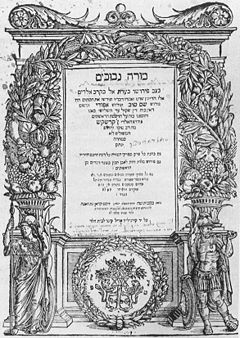
240px-Guide_for_the_Perplexed_by_Maimonides

For those who want some more on the general process of prophecy in Maimonides and the influence of Farbi, here is are sections from the Stanford Encyclopedia of Philosophy

4.5 Prophecy: Overflow, Actualization, Fitness, and the Naturalized Divine

The active intellect is a divine intermediary. Not only is it a cosmic overflow whose ultimate source is God Himself, and not only does it stands as governor of sublunar existence and key illuminating source in all human intellection, but active intellect is additionally identified as the divine intermediary for prophecy. As Maimonides notes,

Know that the true reality and quiddity of prophecy consists in its being an overflow overflowing from God, may He be cherished and honored, through the intermediation of the active intellect… (G 2.36, P 369)
And, drawing upon the epistemological ideas found in his Islamic philosophical milieu, he describes this process further in terms of active intellect’s causing the human intellect to “pass from potentiality to actuality ” (G 2.38, P 377).

At the heart of this epistemology and its notion of human receptivity (the human must receive an overflow of intelligibles from active intellect) there emerges additionally a notion of human fitness: human happiness is, as al-Farabi says, “given to the possible beings capable of receiving it” (PR, N1 35). For al-Farabi, human beings possess different natural dispositions, leaving some of them unable—by their very nature—to ever rise to the level of human perfection:

Prophecy is a natural phenomenon, stemming precisely from the cosmological structure of reality and the epistemological/psychological structure of human minds. The prophet is, in this context, the person whose ability to receive the overflow from active intellect is especially superb. And, following on this naturalized tradition of prophecy, there will be different levels of prophecy—as well as different levels of providence—corresponding to different levels of engagement with the overflow from active intellect.[32]

Following this naturalizing tendency further, we might note the fluid back and forth between natural and supernatural descriptions of the active intellect and other cosmic processes: In this context, the angels (the divine emissaries, as it were) are identified with the separate intellects, and active intellect in particular emerges as the bearer—or even, messenger—of prophecy to the human intellect. In this spirit, we find in Maimonides and in his Islamic predecessors descriptions of the active intellect in divine terms. For example, returning to the context in which Maimonides explains the Biblical notion (Genesis 1:26-27) of man’s being created in the image of God in terms of man’s possession of an intellectual faculty, we find the description of the active intellect—whence man’s own intellect receives its power—as a “divine intellect”:

…It was because of this something, I mean because of the divine intellect (al-‘aql al-ilâhî) (Munk 1931, 15) conjoined (al-muttasil) (Munk 1931, 15) with man, that it is said of the latter that he is in the image of God and in His likeness…[33]

It is in this spirit that we can approach Maimonides’ own account of active intellect as a divine overflow responsible for prophecy. Following al-Farabi’s idea above, Maimonides speaks of the perfected human as being as having his intellect in most full contact with the active intellect, speaking in terms of “the intellect that God made overflow (afâda) (Munk 1931, P 16) unto man” (G 1.2, P 24). And with al-Farabi, Maimonides too identifies this most perfected human intellectual state as the state of prophecy. Speaking of prophecy as active intellects’ mediation of divine overflow onto man, Maimonides adds,
…This is the highest degree of man and the ultimate term of perfection that can exist for his species… (G 2.36, P 369)

While the mechanics of active intellect point to a naturalizing tendency in Maimonides’ philosophical treatment of prophecy, we must not lose sight of what at least prima facie appears in 2.32 to be a more robust role for God in this story. “The opinions of people concerning prophecy are like their opinion concerning the eternity of the world or its creation in time…” (G 2.32, P 361) After addressing two other views of prophecy (one of which is described as the completely naturalized view held by the philosophers), Maimonides goes on to recount the “opinion of our Law,” which he contrasts from the completely naturalized view as follows:

Maimonides’ view on the exact mechanics of prophecy—and the precise role, if any, of God in that mechanics—is open to scholarly debate.[36] It is in part difficult to know for certain what Maimonides has in mind here since, as above in the case of creation, there are arguably different ways—some more naturalized than others—that one might understand Maimonides’ notion of “divine Will,” and hence, arguably different ways that one might understand the import of the above claim from 2.32.

Responses to Comments –Kenneth Hart Green

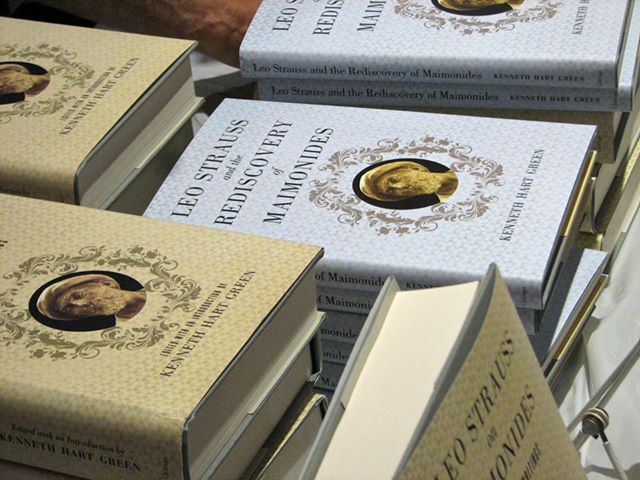
(AB- We have three responses here, a fascinating old-time modern Orthodox discussion of truth, faith, Biblical criticism, tolerating heretics, along with the need for serious Maimonidean investigation, a discussion of Maimonides in the Nineteenth century, and finally the nature of Straussianism and Orthodoxy. This post continues from Interview Part II here and assumes Prof. Green’s books Leo Strauss on Maimonides: The Complete Writings , and Leo Strauss and the Rediscovery of Maimonides.)

Reply to Saul Shajnfeld:
He wants to know: What would Maimonides have thought of us? And how would he have responded to our dilemmas? He seems to ask these questions with the aim of wondering whether Rambam did not hold a position which is altogether deficient for dealing with our modern situation and dilemmas.

It seems to me Saul asks two fundamental questions, (1) on the basis of Rambam’s position, are we not required to ostracize kofrim [heretics] in the sense of the ḥerem? (2) Is faith a sufficient basis on which to sustain modern Judaism?

(1) True, the challenges raised by the Higher Criticism (putting to one side the unprecedented discoveries of modern science about nature) are severe. This remains a problematic issue that it is not so simple to just deny, although denial probably is the most favored escape by some traditionalists. And if, as I tend to agree with him, the attempts so far made to salvage the idea of the divine Torah by those who accept the Higher Criticism are highly questionable at best, it seems we will have to continue to struggle with this challenge (whether or not we admit we are doing so). Maimonides would have been in favor of intellectual honesty, which excellence of mind dedicated to truth requires. However, he also believed we need to maintain certain doctrinal positions, and we also need to be able to rationally criticize the claims of reason.

However much we may want to disagree with the results of the Higher Criticism, we cannot close our minds to serious challenges, which this remains, and we cannot shirk the responsibility to think. (Even so, it is a question that it is still not disreputable to raise: whether the Higher Criticism is quite as solid as a science, which problem pertains to any sort of historical knowledge, and hence what its cognitive status truly is.)

Besides this, Maimonides would also seem to teach that the absolute duty to search cannot lead us to abandon the belief in the divine character of the Torah, in the sense of its being “Torah min ha-Shamayim.” So we are fully entitled to continue to doubt the veracity of the Higher Criticism as science (which serious scholars like Umberto Cassuto did); but even so, we are also not entitled as honest thinkers to ignore it as a challenge, or to pretend that history is something completely fictional, partisan, or polemical.

This is a dilemma and challenge which cannot be escaped, however much we may wish to bury our heads in the sand of dogma. We must consider the works of those who struggle with it, and respect their efforts, even if we cannot accept their results. We are intellectually protected for the moment, as a sort of extenuating ground for our persisting with legitimate doubts about it, by the continued hypothetical character of much of what presents itself as the Higher Criticism, however historically probable its advocates might legitimately claim it to be. (It’s not called the “Documentary Hypothesis” for nothing. The defenders of the Higher Criticism show it remains hypothetical by the nature of their defenses, which I can only urge readers to consider open-mindedly and honestly, but also critically.)

I can’t offer a definitive solution on a blog to this or any other problem (e.g., the age of the universe, the historicity of the flood, etc.), but I can only suggest a tentative “Maimonidean” approach to them: it is one which refuses to surrender our belief and which continues to press our doubts about the solidity of the results of modern science and historical scholarship; but it is also one in which we must open our minds carefully and critically to different and new ways of interpreting the texts which are not excessively literalistic, as Maimonides urged, if we are to penetrate what I called, in one of my nine points about why Maimonides matters, the “hidden depths” of the Torah.

Saul obviously carries much weight on his shoulders. As for whether Genesis 1-11 is myth, I do not believe Orthodoxy can say that, whatever the rabbi to whom he refers may say about this. Our difficulties with the Higher Criticism are precisely because as Jews we must take history seriously and cannot avoid it, since history is a crucial given basis of our faith and tradition. For a wonderful attempt to show how a modern rational (Maimonidean) approach to Genesis is possible, I recommend again Strauss’s article (as I already mentioned in part 1 of my post), “On the Interpretation of Genesis.” It’s a sort of intensive exegesis of the first three chapters of Bereshit, in the manner of our medieval sages, which they did so well, and which Strauss shows can still be done today.

I cannot claim to know what Rambam would do or say were he alive today, but I can perhaps say what I believe he would have done: he would have worked to save the tradition by rethinking it in light of the current state of knowledge, in terms which are consistent with fidelity to tradition, with intellectual honesty, and with spiritual excellence. (This is the venerable effort of rethinking that that I can’t dismiss, as Saul did, as mere “retrenching.”) I’m sure Maimonides would have been happy to teach at MIT or Harvard, but even if he were to have done so—with his deeply-held and deeply-grounded convictions about the search for truth in human life and about the perennial wisdom of Judaism with respect to human nature—it would not have allowed him to surrender to a radical secular modernism, which claims to have surpassed the truth of religion, since nothing shows the truth of religion to have been “refuted” by modern science or philosophy.

2. Yes, Rambam affirms that emunah in Hashem is essential, but as he also simultaneously affirms, this is not the same thing as emes—the truth. Truth, for Maimonides, is highest, but faith is an aid in our struggle toward it, points us in the right direction, and morally sustains us along the way, besides being necessary to make human society possible and decent.

I call it in the last chapter of my book (in the spirit of Strauss): “the Maimonidean revolution: Western tradition as reason and revelation.”

Such a life dwelling in spiritual tension is too difficult perhaps for most people, but this doesn’t make it less Maimonidean for that reason, at least for those who are capable of it. Their numbers are much greater in our time than could have been possible in his time, because education is much broader: at least the possibilities of enlightenment are much broader, if one has a soul which is equipped for it. More is expected of those who possess the intellectual resources, the quality of soul, the native ability, and the right circumstances to search and to struggle toward the goal. His addressee in the Guide is his student, Rabbi Joseph; and Maimonides urges us toward him as a model (if limited) student-searcher. He seems to be saying to his readers: you should imitate him; and like him ultimately you should transcend yourself and your own limits, and so following Maimonides as our highest model of the searcher.

Yes, as Saul claims, perhaps it’s “easier . . . for a thoughtful, educated Jew today to be a heretic that to be a believer”—but according to Strauss’s Maimonides (and Strauss himself, I would add), it’s not “more rational,” as Saul would also like to claim. “Easier” is one thing; “more rational” is something else entirely. In fact, Rambam’s challenge to us is to never take the easy way, but to pursue the truth, which is hard, since it is not given to us in textbooks or simple articles of faith as dogma. He demands of those who can, to ever keep in the mind the almost exclusive way to God, which is through knowledge of the truth, and which is the high road of intellectual excellence.

As Maimonideans in the modern world (which world I am confident he would’ve embraced), I believe that for him he would have made it an imperative for authentic Jewish teachers and leaders not to ostracize kofrim, neither for the “crime” of exercising their intelligence, nor for the “crime” of doubting or lacking emunah. I cannot promise that this modern Maimonidean imperative of decency toward honest searchers is or will be always obeyed, because not all Jewish teachers and leaders are “authentically Jewish” as he understood those terms. Even in the medieval period, Maimonides didn’t believe in being harsh toward the Karaites, although he clearly diverged from them on what Judaism is.

The function of his “13 roots” today is to be a guide to Jewish faith, rather than a rigid straightjacket, since we cannot prudently judge our situation to be in an essential way the same as his, and he would have called us to judge prudentially. But if Maimonides were to appear in modern guise, I believe he would instead call those of us who can, to lead the difficult life of walking the tightrope between faith and doubt, always open to the truth from whatever source it derives, but also willing to doubt whether what seems to be (secular) “truth” is actually so, and so calling for fidelity to the Jewish tradition.

The authentic Jewish faith, as Maimonides understood it (beyond the “13 roots”), is never the same thing as denying the most serious questions or avoiding the deeper problems.

Response to Prof Kohler and Prof. Kaplan

Professor Kohler rehearses in public a debate we’ve already conducted in private. So I hope it will not be amiss if I repeat how I ventured to reply to him on a previous occasion

If you read my book, I think you will see that I was aware (as Strauss was aware) of the revived interest in Maimonides among 19th century Wissenschaft des Judentums scholars. If nothing else, it reached a high point with Salomon Munk. Yet Strauss was also highly critical of Munk’s Maimonides, never mind of those who even less adequately preceded and followed, since they were much too ensconced in and dependent on modern thought in their approaches to Maimonides. Munk’s misstep was “historicism” (based on the modern belief in progress), which closed him to the unique nature of Maimonides’ thought.

As you say, these 19th century scholars (of which Munk was only one) “had good reasons to emphasize the Guide’s relevance for their own agenda.” More to the point here in response to your comment, precisely because they “used” Maimonides “for their own agenda,” as you so well put it, according to Strauss they did not see Maimonides as he actually was, and they did not understand him as he understood himself. This means that he would have only partly supported their agenda; the other part also would have criticized their agenda. To see this would have required them to see Maimonides whole, and at a deeper level. Strauss, if I may so put it, conceived of himself as more closely conforming with Maimonides’ own agenda in presenting his thought.

Strauss also was interested in Maimonides as a philosopher, i.e., as an original thinker, whom he believes no one really took seriously perhaps until Hermann Cohen, as Spinoza had made sure was the case by his harsh attack, since he was trying to bury Maimonides. (To be sure, Strauss was well aware of Salomon Maimon, who had not been blinded by Spinoza.) He thought Cohen understood Maimonides better than anyone since Spinoza, but Cohen did so by putting Maimonides in his own shadow, and hence used him highly selectively, if he did not badly distort him, while claiming to revere him. Those other 19th century scholars who “used Maimonides for their own agenda,” made had him perhaps a little more palatable to moderns than Spinoza had made him, but not much. The point of my Rediscovery is to show how the real

Maimonides helped Strauss, precisely as a philosopher. This is the point at which I think we diverge (and here I’m presenting Strauss’s view): not that anyone read Maimonides, but that no one read him seriously as a thinker, so as to allow him to judge modern thought, rather than act as past authority for modern changes.
As for Professor Kaplan’s comment, we could together write a tremendously long list of leading modern Jewish thinkers who sincerely claimed a deep affinity with Maimonides.

By the way, this is a curious and noteworthy fact: in Judaism, the moderns claimed a medieval as their model. It is dramatically different from modern Western philosophic thought rooted in Christian tradition: not one modern Western philosopher I can think of (who was not already a Thomist), would have claimed the medieval Thomas Aquinas’s legacy as the basis for his specifically modern philosophic thought. It is in this sense alone that Professors Kohler and Kaplan are right: modern Jewish thinkers often set the medieval thinker Maimonides as their ideal—which shows a unique of modern Jewish history, and makes it completely different.

However, my chief point—and for this one will have to consult my two new books—is absolutely not the same as theirs. My chief point is that Leo Strauss was radically different from any of these modern Jewish thinkers, because his approach to reading Maimonides was closely based on Maimonides’ own writings as well as on his modus operandi.

By the way, one subsidiary but still remarkable difference between Strauss and all the others was his eagerness to use the great medieval meforshim [commentators] on Maimonides, not as a mere footnote (as was the case with almost all the other modern Jewish thinkers), but as essential guides to the Rambam’s true teaching and often hidden meaning. Professor Kaplan recognizes this in a certain measure by admitting that Strauss hit the target in his critique of Cohen’s Maimonides, since Cohen made his impressive attempt to use Maimonides for a modern agenda only by disregarding Maimonides’ medieval context.

My leading view is that Leo Strauss (unlike anyone else) used Maimonides not to advance the cause of the moderns (as did everyone else), but he recurred to Maimonides for the purpose of standing in judgment on the cause of the moderns and of calling them to account, as well as of drawing on Maimonides for aid to help in the correction of the misdirections of the moderns. Strauss neither employed Maimonides as an ostensible authority for modern change, nor did he wield him as a battering ram against “fundamentalists” (if I may utilize an anachronistic term).

Reply to Rabbi Ira Rohde.

Rabbi Rohde asks why I didn’t discuss in greater detail what Maimonidean esotericism means for Strauss. The talk, on which blog post is based, was a popular talk. I didn’t feel it was the right context in which to discuss the sort of issues Rabbi Rohde raises, and I still don’t think so. I thought it would be less obscure and more helpful for most people to present the broader picture of Maimonides as seems to be implied by Strauss’s pioneering approach, as the right way to first make contact with the deeper issues, and I still do.

Certainly Strauss gives a very different account of Maimonides than that presented by David Hartman, and this difference revolves around how seriously to take the esoteric dimension and what its implications are. (As Eric rightly notes in a subsequent comment on Ira’s remarks, Hartman in 2009 admitted his true opponent all those years was not the Straussian reading of Maimonides, which is plausible and worth arguing about, but rather Prof. Yeshayahu Leibovitz’s approach, which is diametrically opposed to Hartman’s own. Leibovitz rejects the view of the Torah as based on an intellectual content, and hence he also rejects the exegetical search for contemporary meaning in halakha, since simple obedience to the law should be quite sufficient. Fackenheim once described Leibovitz’s view to me as “Prussian Judaism.”)

Rabbi Rohde makes an interesting statement of a plausible account of what Strauss means by Maimonidean esotericism, and he bases it on Allan Bloom’s approach. What he has expressed might be the basis for further, stimulating discussion in a different context, in which complexities and subtleties are better dealt with.

Jewish Orthodoxy for Strauss probably meant something like how Maimonides defined it—but since Maimonides was medieval and we’re modern, it can’t be precisely for us as he defined it (as Strauss recognized about Maimonides). Indeed, no version of Orthodoxy today is Maimonidean pure and simple: too much has happened in the subsequent centuries for anyone to follow him on every point.

In a previous reply to a comment, I mentioned that although Strauss couldn’t observe Orthodoxy, he defended the notion that Modern Orthodoxy in the form of Religious Zionism is the Jewish position with the most integrity today. (See his Hillel lecture, “Why We Remain Jews” [1962], in Jewish Philosophy and the Crisis of Modernity.) This is not to say or to imply that he dismissed or diminished the other forms of Judaism (religious and secular), each of which I believe he thought may play an essential role in the dialectics of Jewish life today. But in his view, none in this array of significant forces in the life of contemporary Judaism possess the same potential level of integrity—perhaps because they do not cling to both sides of the dialectic as vigorously as it does.

Why Maimonides Matters —Kenneth Hart Green-Part II

This post continues from Part I here. The post is a continuation of the nine points that Prof Green emphasizes in Maimonides. Here are the concluding four points as well as four great replies to comments, including replies to Micha, Moti, and Maimonides on prophecy. This is a very long post with the best at the replies, so print it out and enjoy.

By now you should have all bought for yourselves or your synagogues his books, one volume of Strauss essays and one volume of Green’s analysis to guide us. The former book is Leo Strauss on Maimonides: The Complete Writings , the latter is Leo Strauss and the Rediscovery of Maimonides.

KenGreen-Strauss

[6] Balance: According to the Maimonidean world-view, religion itself is in need of balance, in need of a moderate attitude. It has a tendency to lean toward extremism in the service of God. Now, someone may contend: surely God demands an absolute totality of surrender of the mind and will by each person. Not according to Maimonides: he’s the classic advocate for “the golden mean,” for not losing one’s sense of a complete and balanced perspective on life, which religion requires as much as anything else, and which keeps things in equipoise or well balanced. We live in a time in which extremist positions are considered more authentic, in which certain forces on the right and on the left like to push things to an extreme, both in the religious community, and in general secular society. Maimonides represents a wisdom which rejects both religious extremism and radical secularism.

[7] Moral Ideals Maimonides unconditionally rejects moral relativism (which he knew and encountered in a rudimentary form in his society), and he confirms the core moral ideals and teachings which are essential to Jewish religion as being of an absolute character. The dominance of moral relativism in the contemporary West is one of the most serious challenges facing anyone who wishes to adhere to Jewish law and moral teachings.
The Guide defines man in certain terms, beginning with the first chapter (1.1). Man is the being who is created in the image of God (as the very first chapter of the Torah states unambiguously), a key element which makes moral imperatives to be of an absolute character, since they follow from the “divine image.” Man is also the being whose intellect is the most God-like aspect of his being. It sets the standard for everything else, and everything is ranked in terms of it, which also tends toward an absolute goal and which defines man by its perfection.
But in order to achieve excellence of the mind, the character and soul must be properly trained in the right way, so as not to be sent on the wrong course (see Guide 1.34 and 2.23); the telos of human perfection requires certain ways toward it, which the Torah carefully defines and helps us to achieve, if we grasp what it is aiming for. These things are of a fixed character, and we must follow the rules which help us to become what we are meant to be according to the Torah.

It’s often difficult to withstand the arguments and allure of contemporary culture, which Judaism often must stand in judgment of—although prudently and with reason. Maimonides would likely say that these core ideals and basic teachings are as wise today as they were in the past, although this is not to deny that some of them may have to be adapted to so as to be in accord with the better modern realities. Of course, Maimonides insisted in his time, and he presumably would have expected it of us in our time, that such adaptations must be done with the greatest caution, care, and reserve, so that these adaptations do not lose or compromise those core values and meanings which the Jewish tradition has managed to preserve through the centuries.
The temptation to reject university philosophy or academia as wholly sunk in relativism is a powerful temptation for the religious Jew. But relativism has not pervaded all aspects of the contemporary university, or even contemporary philosophy—they are not of its essence. There are still many good and sound people teaching.

The fact remains: the university is the main repository of knowledge, and so we must utilize it if we are to perfect our minds and to encompass its knowledge in ourselves, as Maimonides directed us to do. Perhaps we must use it carefully, but use it we must. But this must be regarded as a challenge to us, and not a reason to hide from the academic world.
We are commanded to make the world better; we can do so only by teaching our children well and arming them spiritually against relativism, and by ourselves helping to fight the relativist faith, which will be antithetical to us, if we allow the world to surrender to it. We should not capitulate, but enter the university world, or the world of philosophy, ready to present our case confidently and articulately. We must grasp the good and leave the bad; we cannot pretend that this relativistic attitude will not infect us, if we do not work actively to excise it by studying the good.

[8] Politics: Maimonides asserted the value, meaning, and even imperative character of political wisdom, for Jews as well as for everyone else. Jews are not exempt from politics, even if in his day they did not possess political power. Whatever their circumstances, they must engage with the world, and must not withdraw from the world, and if possible, they must participate in the political order. One of the ways is to make themselves aware of and to study the political wisdom of the ancients as worthwhile for, and not opposed to, their Judaism. They must see it as a basic element that complements and/or challenges the teachings of the Hebrew Bible. Indeed, for Maimonides, Jewish life and Jewish teachings demand, for those capable of it, an understanding of the political, and for those free to do so it requires their participation in the political order, whether Jewish or non-Jewish. Politics is capable of being an ennobling pursuit or calling, and it is a requisite element in any decent human life, which is an idea that is fully accepted and endorsed by the Torah.

Thus, in his “Letter on Astrology,” which he wrote to the Jews of Marseilles, Maimonides faults the ancient Jews of the Second Temple era for turning to astrology, which he regarded as a kind of idolatry, instead of “learning the arts of war and conquest.” (I so confidently draw this conclusion about Maimonides’ view of politics from these remarks because he regarded the military arts as a subsection of the political arts and sciences.)

Sinat ḥinam [groundless hatred (among ourselves)], i.e., the traditional explanation for our defeat, seems to have been a smaller sub-cause for Maimonides, encompassed in the larger error of turning to magic or astrology, rather than rational interpretation as the best way to analyze our historical situation, ourselves, and our enemies. In Maimonides’ view, a high degree of political realism and prudence is imperative, as commanded by the Torah itself, if for no other higher reason than for the practical survival of the Jews and Judaism.

I don’t think in one’s wildest imagination that Maimonides could be accused of militarism, or could be accused of asking the Jews to cultivate militarism. This is to completely misread him, although I suppose I can perceive how he could be so misread. First of all, to repeat what I already said, military matters are always subordinate to political matters for Maimonides, and politics should be geared toward the pursuit of justice, peace, freedom, and wisdom, which prevents militarism however defined. One need only read “Sefer Shoftim” at the end of the Mishneh Torah to know that this is true for Maimonides. However, based on the centuries of galut, in which Jews tended to regard the very idea of concern with an army as entirely foreign to them, hence they also tended to despise military matters as goyishe sachen.

Maimonides made a very simple point, in his day and for the future (whatever one may make of his historical judgment about the Second Temple period): if the Jews are to be free, which is what the Messiah promises, and if freedom is to lead to the higher spiritual perfection for which it is ultimately aimed, it can only happen if we ever keep in mind that this freedom needs to be preserved and protected, and we are the only ones who can do the preserving and protecting if it is to be our freedom as a people. The Messiah will lead an army, and it will be an army of Jews, not mercenaries or gentiles. He will bring about the messianic state by conquering the enemies of the Jews. Is that militarism? I don’t think so.

But permit me to make one purely personal comment that readers can disregard if they do not wish to consider my own personal opinion about contemporary life: the state of Israel is a Jewish society in the full and proper sense that it has never become militaristic, whatever its hostile critics or enemies, both within the Jewish people and without, have accused it of. It has acted in the spirit of Maimonides. And yet it has never forsaken and despised or ignored the duty to “learn the arts of war” as a moral necessity of a free society if it is to survive.

[9] Zionism: I will venture to say that Maimonides anticipated Zionism, and pronounced a blessing on it in advance. Look at the last couple of chapters of the last book of the Mishneh Torah, in “Sefer Shoftim,” where the messianic age represents simply the return of the Jews to their own land, the land of Israel, by the hand of a great leader inspired by God. This leader will bring them back not by miracles, but by military conquest, will liberate the Jews from their oppression in exile, and will establish a free Jewish state. (To be sure, in its perfected and ultimate form, the Anointed one will also rebuild the Jerusalem temple and restore the Davidic kingship.) In other words, the legitimate end of a return of the Jews to their land, which is what the Messiah is for, will come about by human effort, and by natural means, and by Jewish historical and political participation in the process.

To be sure, Maimonides would surely not have declared the state of Israel a messianic state in any perfected and ultimate sense (as no one else I know of would declare), since no Messiah brought it about, and the other things I mentioned have not followed. But he would surely not have been bothered by a return to the land of Israel by human hands (albeit aided by devotion to God’s unchanged promises), since he could have viewed this as the first step in a historical process, which is entirely legitimate in terms of the classical Jewish sources

For the first five points- see part I here.

Four Multi-part Questions from the Comments

1] Answers to Comments of Moti:
First, of course Strauss didn’t invent the esoteric reading of the Guide; he never claimed he did. Yes, it began during Maimonides’ own life, and especially with his contemporary and Hebrew translator, Shmuel ibn Tibbon, and continued as the dominant reading for about six centuries. Strauss not only never claimed otherwise, but instead what he claimed was to revive a way of reading the Guide which had been forgotten, ignored, or even denied by modern scholars and thinkers. Solomon Maimon in the mid-18th century was probably the last modern to know about it or even to acknowledge it, even though he didn’t carry it very far.

Strauss thought it was worth paying most careful attention to how Maimonides had expressed himself in his book about what he was doing, how he was doing it, and why he was doing it. Thus, Strauss focused laser-like on Maimonides’ claim to be writing with utmost, meticulous care for each minute point, each word, and even each silence (not to mention employing deliberate contradictions), which though Maiminides declared these things, most modern scholars had chosen to regard them as irrelevant, or at best as some sort of medieval peccadillo or perversity of Maimonides, which should be passed over with an embarrassed silence. Strauss rejected this as an approach that could not do even the most elementary justice to “the great eagle.” So I also can’t accept that the issue of whether anyone has “has proved Strauss wrong about Maimonides’ esotericism” is a “straw man” argument.

Second, did Strauss turn off, or turn on, more readers to the Guide? I must say (even with the complexities of his prose), I’ve got no doubt that he turned on many, many more than he may have turned off. But Strauss also knew this act of seriously reading Maimonides’ book is a big commitment for anyone, as Maimonides intended it to be: he was unusual for concerning himself mainly with the “exceptions” (i.e., the few genuinely “perplexed”), who normally have to fend for themselves—the one in ten-thousand as he puts it. In other words, the reader of the Guide desired by Maimonides must be serious about thinking, about careful reading, and about dedication to or persistence in the search for truth.

Thus I would say those who were turned off were probably so affected as much, if not much more, because of the deliberate difficulty of Maimonides’ own book as by any difficulty of Strauss’s writings. But Masimonides aimed ultimately for an elite only, i.e., for those elevated suffering souls—educated, deeply confused, and yet capable of deep thought and potentially leaders of the Jews—whom he hoped to cure, to guide, and to “perfect.”

I believe the evidence supports the fact of Strauss being single-handedly responsible for reviving interest in Maimonides as a serious and perennial thinker of profundity, and in the Guide as a book of serious and perennial thought, which he claimed to be of utmost relevance to modern people, both religious and secular—a very, very unusual claim.

Third- Were the products of Strauss’s reading, i.e., the proportions as he divided them between exotericism and esotericism in approaching the Guide, appropriate and accurate? This is the great issue that remains unresolved and continues to provoke discussion as well as argument. I repeat again here what I have concluded in LS and the Rediscovery of Maimonides, although in gist, I try to make the case that Strauss’s Maimonides remains of the utmost and even urgent usefulness to contemporary Jewish and philosophic thought. True, it is two separate topics which I have combined, and which I never denied: “why Maimonides matters” and “why Leo Strauss matters.” I’ve presented the former as seen in light of the latter: Strauss matters if for no other reason because he helps us to perceive why Maimonides matters. But this is also because I believe that no one else makes Maimonides matter as much as does Strauss.

On the simplest level, what am I saying? What we can do now, if we remain genuinely open-minded—beyond controversial assertions, and beyond dogmatic acceptance by one side, or dogmatic rejection by the other—is to continue studying Maimonides’ Guide together with Strauss’s commentary, and try to answer the question about Strauss’s reading as each one of us must do for ourselves.

2] Answer to Comemnts of Micha: Micha brings three issues to light, each of which requires a separate response: the Rorschach test; science; Aristotle.

To say Strauss utilized the esoteric so as to turn the Moreh into a Rorschach test is to say that he did with this book whatever his unconscious mind told him to do, or whatever he thought our unconscious minds would do with it. As a result, only a psychoanalyst or perhaps a political psychologist can make sense of his reading: it was a projection of his own thought, if not of his own personality, or even of his own neuroses; or it allowed each of us to project what we want or need on it as a blank screen.

I just don’t think it’s adequate to deal with a serious thinker and scholar like Strauss, or with any other serious thinker and scholar, as tends to happen if what they say is portrayed as an expression of their unconscious mind or motives, or of his readers’ unconscious mind or motives, perhaps as manipulated or controlled by the analyst: it’s too reductionist, it’s too dismissive, and it conveniently alleviates us of the difficult task of the labor of thinking, which requires us to make sense of, to probe, and to penetrate by great efforts what a serious thinker may have to teach us, and how we may be helped in our thinking by his thinking.

As for science, Maimonides believed in it as passionately as did any of the moderns. To call it mere “natural philosophy” and so to dismiss it as somehow unlike what we do as “genuine” science (although admittedly modern and premodern science operate differently) is only a fragmentary solution to a deeper problem, a sort of Karl Popper-like escape from the challenges of philosophy, to which science will always remain beholden.

And it also has not dealt with or confronted the radical criticism of modern science, which is known by the name of “Nietzsche,” and which continues to plague modern scientists who think about the grounds for what they do, and the comprehension of nature and human reason which it implies. (Consider Thomas Nagel’s recent Mind and Cosmos, which argues for some sort of notion of teleology [!] as requisite in order to make sense of biology, even or especially of the biology based on Darwin. If plausible, Aristotle may not be quite so totally obsolete as modern science wished to pretend.) So it seems we haven’t escaped Greek as well as medieval thought so completely, even with all of the wonderful developments of modern science in all of its manifold stages.

Some ideas seem to be perennial even about nature, and “progress” is not the complete truth. The most plausible solution to the problem seems to be the need to rethink what science is, and why we pursue it. To say: “Aristotelian thought barely advanced in the 1,500 years” prior to the Rambam is to know too little about the history of science following Aristotle.

Modern science no doubt stresses evidence-based conclusions, and a spirit of progress, among other things, as primary methodical factors; but Maimonides (scientifically) challenged the medieval Aristotelians precisely on the basis of the visible evidence (i.e., the movements of the heavens); and he acknowledged the progress of science in the past, as much as he hoped for its likely progress in the future. (As he put it, someone else may in future show rationally how to escape from the impasse which the conflict between Ptolemaic astronomy and Aristotelian physics had made a scandal of medieval science, for he could not resolve it; however, he believed he did better than his predecessors, precisely because he based his criticism of the Aristotelians on what is observed, like any modern: see Guide 2.24.)

The challenge which faces us isn’t, fundamentally speaking, so very different from the challenge which faced Rambam—although this is not to forget the point I already acknowledged, that some of Rambam’s science undoubtedly is or will have to be obsolete for us. But I don’t believe that Maimonides would’ve been bothered by this in the slightest. In fact, Rambam was not in any sense averse to the progress of science, and he urged it on, accepting whatever it produced—so long as it is genuinely knowable as science.

This matter of Aristotle is a major issue, not as to science alone, but rather as to theology. Micha has isolated a serious obstacle to a modern appreciation of Rambam; but this is not because Maimonides was quite the orthodox Aristotelian that Micha seems to think he was. Strauss was certainly much concerned with showing how Maimonides’ thought was quintessentially linked with Plato’s thought (through Farabi), which helped to ground his world-view; his point was that this Platonism had not been sufficiently appreciated, because everyone tends to automatically view Aristotle as the thinker who exercised the deepest influence on him.

But the truest or deepest issue, as Micha recognizes, is: what is the relation between philosophic theology and biblical theology in Maimonides’ thought? By the way, contra Micha, Maimonides did not think it was a matter of how much thought counts; he believed thought was the characteristic of biblical theology or faith as much as it was of philosophic theology or science. We need rigorous thought to reach God; he only wondered how far thought could carry us in knowing God, irrespective of whether the thought is grounded in philosophy or the thought is grounded in Tanakh (i.e., prophecy) as well as our Sages.

To be sure, Maimonides neither diminished ethics and morality, nor did he forget the element of will (or “personality”) in God; but though he accepted these points, even so he viewed intellectual excellence as man’s supreme perfection, together with other factors (as characterizes the prophet). In other words, this makes it his view that ethics and Divine will must be seen in the light of what rigorous thought can comprehend of them. Modern philosophy has trouble with this notion of the supremacy of thought, since it regards the passions as supreme—which is not necessarily a reason to reject Maimonides, since as Strauss argues, he may be better able to deal deeply and comprehensively with our spiritual dilemmas and so to help us with them, than any available modern alternative. This is something to which we should give serious consideration, especially if one takes the full measure of our spiritual dilemmas, as Strauss tried to do, that being the key point of departure at which we should begin our reflections on Maimonides.

3] A Facebook query- “I wonder how this differs from Conservative Judaism, which had the guts years ago to recognize all the problems in OJ, and start out on a different path.
But if it evolves, then what we have received is not what Moshe was taught, as it’s been revised in response to changing times and new discoveries. How then is it anything but an evolved religion based on ancient myth and lore, and, if so, how can it demand our adherence and allegiance?”

Answer to Query #3- No doubt Conservative Judaism has done better than most modern Jewish religious movements in theologically confronting the problem of history. Yet in doing so, it has also often allowed itself to be swallowed by history, or it has succumbed to historicism, being unable to defend clearly those fundamental truths which transcend history for Judaism. Even so, the issue which you raise is not just an issue for Conservative Judaism alone. History and historical study is based on facts and has discovered facts, even if some Orthodox thinkers believe that they can avoid the consequences of this issue by resorting to dogmatic assertions, which do not establish themselves as facts by being frequently repeated, or by being enforced as law. The attempt to deny facts is not a sound approach for any version of Judaism; besides everything else, it’s self-defeating. And Maimonides surely would have thought so. The matter only concerns whether the facts discovered (or claimed) by history are genuine facts, or only so-called facts, i.e., hypotheses, speculations, or constructions. Historical-factual change as “progress” is only a certain way of construing such change or those facts. Strauss writes with much subtlety on the complex issue of “progress” in Maimonidean thought in his “Introductory Essay” to the Guide.

You ask about what to do with “an allegedly continuous mesorah . . . [which nevertheless] evolves. But if it evolves, what we have received is not what Moshe was taught,” since to revise, to respond to change, and to admit discoveries is apparently to abandon what Moses taught—if, it seems, we make the change by disregarding what Moses taught. Jewish tradition always construed legitimate change as continuous with what Moshe taught. To be sure, these are complex issues, but they do not need to defeat a philosophically serious Orthodoxy. Every Orthodox thinker who is honest knows about “change” in the tradition; as everyone admits (other than Karaites), we don’t do everything which is in the written Torah, because we also have an oral Torah. So change is not the issue (it’s almost a non sequitur); the tradition has always changed; the issue is, whether it’s good or bad change, change for the better or for the worse.

Much depends on what the basis for the change is, as to whether it’s for the better or for the worse in terms of the truths that are at the source of tradition in the Torah—and we need great thinkers (like Maimonides) to tell us this. The matter might also be summarized as: “legitimate” change vs. “illegitimate” change; lawful change vs. change which breaks or diminishes the law. But we all know that this too can be disregarded in emergency spiritual-historical situations (as Maimonides states at the beginning of the Guide, and as Judah ha-Nasi claims in the Mishnah). This too is not simple, because that fact about the past cannot be used to justify whatever change we today may happen to want or to think justified.

For they were extraordinary men; our difficulty is that this way of construing our situation, of framing our choice—“to progress toward the good,” or “to save the authentic, unchanged tradition,” which results in “progressives” (those who wish to change the tradition in a certain direction construed as “progress”) arrayed against “fundamentalists” (those who wish to unconditionally defend the tradition against any change whatsoever however slight)—is just too crude a formulation of thought, in view of what the Jewish tradition is and has been, to deal with the complexities of our situation, as Maimonides teaches us.

Query #4 What is Mosaic prophecy for Maimonides? In the Guide, Maimonides asserts that the greatest prophet, Moshe, is a humanly perfected, divinely guided human individual who receives the communication of truths and of laws from God through the human mind, which through this perfected prophetic capacity is immediately translated into imaginative language for non-prophetic human beings. The source is God.

Prophecy is, I believe, still a useful element of Maimonidean thought for us today, because it points us to how we should try to comprehend the phenomenon of prophets and prophecy in the context of human nature and the human mind. For prophets and prophecy are still something most of us want to make sense of, in terms which we can accept as cognitively compelling. We want to know how it corresponds with human nature and the human mind while not abandoning its connection with transcendent forces, with Divine aid.

But you may ask: how should we make sense of the “active intellect” if we not do adhere to Rambam’s science. This is a difficulty of some profundity; I certainly don’t believe that we can subscribe to the literal concept of the “active intellect” as linked with a celestial sphere, which is obviously as he believed in it. But what is most to be noticed is: he insisted prophecy is in accord with nature, which God created; God expresses His will via nature. Thus, even if we do not follow Maimonides on his precise notion of the “active intellect,” something of it is still relevant in our world. What? We still wonder, how do we make sense of great geniuses (an Einstein or a Newton or even a Shakespeare) and great leaders (a Churchill or a Lincoln or even a Ben-Gurion)? (I raise this not unreasonable parallel, even if I acknowledge that geniuses and great leaders are not quite the same thing as prophets.) Great truths do seem still to somehow “descend on us from on high,” as it were, from some mysterious beyond, even if only occurring “in” the human mind, which however much we investigate we still cannot explain.

Our current neuroscience as tends toward materialist reductionism seems evidently deficient at this point; we too are still in search of the non-material factor that makes sense of the human mind and how it works, never mind which interprets genius and the like for us. One solution to what was Maimonides’ problem as much as it is ours, is to resort to the simple element of faith in prophets, which is traditional. But even if we continue to hold to the value amd meaning of science in comprehending God’s world and His truths, we are entitled to maintain our doubts about any materialist reductionism as current science might seem to proclaim; and we may hope the search for the transcendent or non-material factor will be uncovered in the mere comprehension of what the mind is. And since we do not yet know better (in the spirit of Maimonides’ argument for creation), we are entitled to call (in anticipation) the non-material thing which would seem to be required to make sense of the mind—and which may also help us to comprehend how great truths are conveyed to us—“divine.”

According to Maimonides we must allow ourselves to be aided by science if we are to properly and truthfully elucidate what the Torah means by the word “prophet.” This is the only way, according to Maimonides, that we are able to maintain our intellectual integrity and honesty, which for him are the conditions of religious exceptionality as much as they are of natural human excellence. In other words, what Maimoinides’ account of prophecy might still be able to show us is not precisely what we should understand by prophecy as he literally understood it, but rather how we should understand it, in the sense of the form of thinking about the world and God which we require to preserve theological honesty and integrity.

For part I of this interview- see here.

Rabbi Dr. Zev Farber on Faith and Biblical History

Very few rabbis have both a PhD in humanities and also functioned as a Dayyan (Isidor Grunfled, Herzog, Bleich). Zev Farber has a PhD in Biblical history and yadin yadin. He just published a manifesto of his beliefs on faith and criticism. It is a well thought out position paper of what he believes. Here are some excerpts totaling about a third of the essay. This is the time to compare his position to that of Kugel, Ross, Berman, and the others. The discussion here is to be about the theological and philosophic issues, not the denominational ones. I placed his concluding section first, then followed the order of the essay.

AVRAHAM AVINU IS MY FATHER:THOUGHTS ON TORAH, HISTORY, AND JUDAISM– Rabbi Zev Farber

Beyond strict adherence to halakha, part of being a Torah observant—or Orthodox—Jew is believing in the divinity of the Torah, that the Torah is devar Hashem, the word of God. In this essay I have tried to describe how this is possible while still embracing the findings and methods of modern academic scholarship which appear to me to be convincing. What is “the sum of the matter”? Here are my beliefs in short.

I believe in Torah Min Ha-Shamayim, that the Torah is from heaven, and that the entirety of the book is nevua (prophecy) and represents the encounter between God and the people of Israel.
I believe in Torah mi-Sinai, meaning the uniqueness of the Torah as being of a higher order than any other work in its level of divine encounter. The story of the revelation at Sinai in the Torah I understand as a narrative depiction of a deeper truth—the Torah is God’s book and the divine blueprint for Israel and Jewish life.

I believe that the Torah is meant to be as it is today and that all of its verses, from “Timnah was a concubine” (Gen. 36:12) to “I am the Lord your God,” are holy.
I believe that halakha and Jewish theology must develop organically from Torah interpretation and not by excising or ignoring any part of the Torah or Chazal’s interpretation.

The sum of the matter, when all is said and done: Every generation has its challenges, both intellectual and social. As committed observant Jews, it is our job to keep the tradition alive by adapting the message of God to respond to these challenges, without fear and without apology, but with intellectual honesty, ethical sensitivity, and spiritual integrity. We must always be ready to face our Creator and our Torah with open minds and open hearts. Only in this way will we succeed in facilitating the growth of Torah observance in our day and allow the Torah and its message to flourish.

THE PARADIGM SHIFT

Our engagement with Torah cannot remain stagnant as the world continues to turn. Our Torah has proven to be timeless, but this doesn’t mean that it remains the same. Chazal call the Torah a torat chayim, a living Torah. Living implies growing; living implies continued vibrance.

As has happened many times in human history, the world is going through a Kuhnian paradigm shift in its understanding of its past and the foundations of its religious identity.What was once thought to be history may, in the light of developing understanding about history, science and society, now be understood as mnemohistory, a technical term which means the study of constructed memory.

This shift goes deeper than questioning miracles or allegorically interpreting tales such as the Garden of Eden with its talking snake. It runs deeper than the realization that the Torah contains difficult and seemingly contradictory accounts of certain events. Over the past few decades, much of the narrative of ancient Israel’s origins, from the patriarchs to the conquest, including the Exodus, the wilderness experience and Sinai, have proven problematic to reconstruct as historical. Certain accounts have been subject to re-characterization as legend or constructed memory, and not necessarily historical fact.

Fundamentalist objections to this paradigm shift include those who cast aspersions on historians or professors of religion, those who espouse conspiracy theories about a war on God, and those who intimate that the so-called objective scientific approach is anything but.

Nevertheless, many traditionally-observant Jews wish for an engagement with Torah free of apologetics and irrational claims. Can our religious way of life and our faith that we are part of some larger divine plan survive the loss of its “historical” underpinnings, now relegated to the status of legend or narrative allegory by the vast majority of academic historians? I believe the answer to this question is a resounding yes!

ENCOUNTERS WITH ACADEMIC STUDIES
Since my teenage years, I have been aware of the tension between academic biblical studies and Torah mi-Sinai as presented by some of my teachers. For years, as I was mastering my yeshiva studies, I put these concerns aside with the implicit understanding that I would return to them when I became more grounded in traditional learning. Eventually, in my mid-twenties, I signed up to study biblical history at Hebrew University.

As I began my studies, I started to learn Tanakh with the historical-critical approach. As I deepened my facility with this methodology, I realized that I was constantly engaged in apologetics with myself, subscribing to readings of texts and theories that I would not be included to subscribe to if it were any other subject and if my beliefs were not at stake. This was intolerable to me since if I could not be honest with myself, I was lost before I started.

Over these years, I became proficient in the nuts and bolts of ancient history and academic biblical interpretation, learning Sumerian, Akkadian, Ugaritic, Egyptian, Greek and Latin so that I could read important material in the original.6 I learned about source criticism, redaction criticism, form criticism, literary theory, and a variety of other tools that academic biblical scholars use when studying the text.7 As I became more adept at this, I began to notice a myriad of problems. I will offer here some illustrative examples.

TAKING STOCK
So where does this inquiry leave me? First, it appears that the Torah is a layered document. While I am not convinced of the documentary hypothesis (JEPD) per se, it seems that the Torah has evident signs of being an edited work which makes use of multiple sources and contains layers of redaction. The Torah contains inconsistencies both in its laws as well as its narratives and lists. At first I toyed with the possibility that these might be literary devices, but this only works for some of the examples (and not for many of them).

Second, religious practices as well as aspects of the Jewish belief system have changed and developed over the generations. The Oral Torah explanation proffered by the rabbis, i.e. that all of the practices not found in the Bible were either told to Moses directly at Sinai or are derived from midrashic reading of text, does not even begin to realistically address the religious changes Judaism has gone through in a believable way.

THE MISTAKE OF BINARY THINKING
Faced with this awareness, I turned back to my religious self (which I had kept on hold for a few years) and asked whether this new perspective should change anything about my lifestyle and commitments.

I realized that some Jewish thinkers are caught in a binary system: either every word of the Torah was literally dictated by God to Moses, hence perfect, or the Torah was written by people, hence flawed. I wish to abandon the binary system and offer something else: a faith-position of sorts.

In my world-view, humans have the capacity to function in more than one mode. There is a mode where the person is totally on his or her own, and there is a mode where the person encounters the divine and channels it in some way. I understand this mode to be related to the traditional concepts of nevua (prophecy) and ruah ha-kodesh (holy spirit). I will call it prophetic mode. These different modes themselves are probably not binary; I imagine that a person can be in prophetic mode to a greater or lesser degree, depending on his or her level of inspiration and spiritual sensitivity.

The same is true of the Torah, I believe, which is the prophetic mode at its most sublime. If there are contradictions which cannot be answered by literary readings, this is because they reflect the respective understandings of different prophets channeling the divine message in their own way; each divine encounter refracts the light of Torah from the same prism but in a distinct way. To adapt an idea I heard from a wise mentor, if the Borei Olam (Creator) can fashion a universe in which pond-scum can eventually evolve into Rabbi Akiva, then how much more so can God create a mesorah in which distinct documents, traditions, redactional comments, and other sources can evolve into the Torat Hashem (God’s Torah).

THE WAVE THEORY
Revelation derives from the channeling of divine through human conduits. Although I consider nothing in the Torah to be specious, the insights of the Torah must be framed in a way sensitive to the context specific nature of revelation. If one wishes to uncover its message, the Torah must be studied in depth and in relation to the historical reality of the ancient world in which it formed.

I believe that people over the years, through some sort of divine encounter, have been given insight into God’s plan for Israel / the Jews and that these things were put into writing by the various prophets who experienced them and their disciples. Over time these revelations are synthesized and reframed. In the beginning this was how the Torah and the other books of Tanach were compiled. Over time the process moved on to the creation of other works, including the core works of Oral Torah like the Mishna and the Talmud.

In my view, Judaism is essentially a wave that eternally sends the messages of God. However, in order to understand how to apply these messages we must understand how any given halacha or ideal functioned in any given society, particularly the original society, ancient Israel. When we understand this, we can “subtract” the societal elements to see the ideas in their relative purity and reapply them to our times. Waves, however, require continuity. For this reason, it is vital to understand how the Torah functioned in every generation since Moshe in order to do this right. This requires serious study and thought.

MNEMOHISTORY VERSUS HISTORY
Once upon a time, history and lore were closely intertwined. Legends and myths, blended with nuggets of cultural memory, explained the distant past.

But matters did not—could not—stop there. The Torah traces the lineage of Israel’s first founding father, Abraham, back to Noah. But if Noah is not a historical character, what about Abraham? Additionally, it is hard to ignore the symbolic elements of many of the Abraham stories. Many of his sons—if not all of them—founded their own nations. Scholars began to realize that the family history being offered in the Torah was really a schematic attempt—the technical term is etiological narrative—of the Israelite writers or story tellers to explain the relationships between themselves and their neighbors.

The same holds true of the description of the development of Israel. The idea that the twelve tribes of Israel were formed by the twelve sons of Jacob has all the appearances of a schematic attempt of Israelites to explain themselves to themselves: “We are all one family because we are all children of the same father.” These Torah stories are not history, the recording of past events, they are mnemohistory, the construction of shared cultural-memory through narratives about the past.

Given the data to which modern historians have access, it is impossible to regard the accounts of mass Exodus from Egypt, the wilderness experience or the coordinated, swift and complete conquest of the entire land of Canaan under Joshua as historical. At what point biblical historiography and ancient history begin to overlap in significant ways remains highly contested—some would say with the accounts of the United Monarchy (the period of Saul, David and Solomon) others with the account of the Northern king, Omri (beginning in the late tenth century). However, even when historiography and biblical history overlap, they are hardly one and the same.

CRITIQUE OF THE STANDARD REACTION
The stories of the Torah have meaning and significance irrespective of their historicity. The Torah has holiness as the Israelite and Jewish encounter with God even after one realizes that the idea of God dictating it entirely and word-for-word to Moses on Mount Sinai is troublesome.

This vision of Torah may appeal to some but, ironically, I find it both unappealing and even sacrilegious. The Sages tell us that the Torah predates creation—although I understand this as a non-literal claim, it implies that the Torah had no choice but to turn out the way it did. The stories were destined to be told, irrespective of the historicity of its characters and their actions.

MNEMOHISTORY: TORAH AS SACRED LORE
Many may feel a pang of fear when sacred stories of the past are referred to as lore—when mnemohistory is understood as something different than factual history. However, the most powerful force in most societies is not history. Societies are driven by their lore—their legends and their stories.

The same is true for biblical stories and characters. The stories of the Torah reflect the ways the prophets of old refracted their encounters with divine wisdom through the prism of mnemohistorical narrative. Adam is the story about why humans are here, and Noah is the story about the precariousness of our position and the existential need to be good people in order for our existence to have meaning. The stories of the Patriarchs and Matriarchs are about who we (Israel/Jews) are as a people and how we found God/God found us; the Exodus and Conquest tell us about Israel’s mission as a nation and our covenantal relationship with God. (Read the Full Version-Here)

Why Maimonides Matters – Kenneth Hart Green- Part I

Have you ever wanted to truly understand the esotericism of the Guide of the Perplexed? Are you having difficulties pinning down the positions of Leo Strauss. Now, we have the recently published works of Kenneth Hart Green, one volume of texts and one volume of analysis to guide us. The former book is Leo Strauss on Maimonides: The Complete Writings , the latter is Leo Strauss and the Rediscovery of Maimonides. The volume of texts is invaluable and includes newly transcribed and newly translated works of Strauss as well as collecting all his essays on Maimonides. The volume of analysis offer a cogent and clear presentation of both Maimonides and Strauss. The books are both a labor of love and are serious pieces of scholarship that deserve a serious reading. To launch his new book, Green gave a talk at Beth Avraham Yoseph of Toronto Congregation 27 June 2013. I divided his talk into two parts and added a few queries, which Green graciously answered. (Part II- is here.)

“Why Maimonides Matters.”
Maimonides should very much matter to us. Appreciating this is something which has been aided, in both its Jewish and its universal dimensions, particularly by the modern Jewish thinker Leo Strauss.

Prior to Strauss, Maimonides was viewed as an antiquated medieval figure—though revered by a select group of scholars for his achievements which occurred in the distant past—but nevertheless not particularly relevant to modern Judaism, never mind to modern people in general. However, Strauss refused to accept this judgment about Maimonides and instead presented arguments for the contemporary and enduring worth of Maimonides as a Jewish thinker.

Learned Jews always took Maimonides seriously, and never ceased studying his works. But this was a rarefied interest. Leo Strauss changed all of that. Strauss did what he could to put Maimonides in the very center of contemporary Jewish and philosophical discussion, and made him a thinker of the utmost relevance to modern Judaism, as well as to modern thought in general. He argued that his essential thought is most timely because it is most timeless.

In the years 1928-30 in Germany, Strauss established himself as a modern Jewish scholar by writing and publishing his first book, Spinoza’s Critique of Religion. However, it is not a typical modern book on Spinoza. Strauss disagreed with most Jewish thinkers of his day who believed that the revolutionary ideas of Spinoza had demonstrated religion to be wrong or false, and by implication proved Maimonides to be no longer relevant. In fact, Strauss showed in his book that Spinoza had not refuted religion or Maimonides. Indeed, this further led him to prove that Maimonides’ essential position had basically (although not in every respect) managed to withstand the storms of Spinoza’s modern criticisms. His next book, Philosophy and Law: Contributions to the Understanding of Maimonides and His Predecessors, (Schocken Press: 1935) presented his unique reading of Maimonides, claiming the immediate relevance of Maimonides’ medieval thought to modern Jews.

At a later time in the USA, Strauss’s teaching and writing exercised an influence on the nascent movement known as neo-conservatism, which is known in US political circles primarily for its pro-Americanism, its pro-Zionism, and its general opposition to moral relativism. However, Strauss never saw himself as a “conservative” per se, and always considered himself a “classical liberal”; he did not involve himself in politics, or express his opinions in what could be called a political tract, but kept them private.

I should also mention that, pretty much single-handedly, Strauss was responsible for bringing together the parties who produced the famous English translation of Maimonides’ Guide of the Perplexed [Moreh ha-Nevukhim in Hebrew]. Strauss made sure that the translation was done by his old friend Shlomo Pines, a great linguist of Hebrew and Arabic who was a professor at the Hebrew University of Jerusalem, and who shared Strauss’s admiration for Maimonides’ great book. Strauss also wrote a long and elaborate introduction to the translation. It was published in 1963, making this year, 2013, the fiftieth anniversary of its publication,

So following Leo Strauss’s rediscovery, what is it about Maimonides that makes him so timeless? I have organized my answer to this question into a number of points, nine to be exact: (AB- Five of the nine are below, the next four will be posted after the weekend.)

[1] Science and Religion: Maimonides dedicated himself to the heroic effort to reconcile or harmonize science and religion, faith and philosophy. In fact, one could say that he is still the model for anyone today who takes these issues seriously, not necessarily for the content of what he did, but for how he did it. The main point is: he considered both science and religion to convey elements of truth, which means they each need one another if they are to grasp the entirety of truth. It’s not so much God that is the issue; for him, the true philosopher also recognizes God; this conflict is focused mainly on what sort of God they believe in: a God who creates, i.e., the God of the Bible, or a God who rules through nature, i.e., the God to whom the philosopher or the scientist subscribes.

Science and religion may on occasion contradict one another, and then we have to consider the issues very carefully; there is no formula for simple reconciliation: each issue of conflict needs separate reflection, not automatic acceptance or knee-jerk rejection. Contrary to what some may think, however, Maimonidean thinking is based on a kind of open-mindedness, which for him is as absolutely crucial to the religious attitude as it is to the scientific or secular attitude. In other words, one might say that Maimonides is the father of “Torah uMadda” and “Torah ve-Hokhmah” (“Torah and wisdom”). So in this sense, Maimonideanism is very much alive, if constantly threatened from two sides.

–Question: Can you say a bit more about a God of nature and the process of reconciliation.

–Answer: Maimonides is not unsympathetic to the God of nature, and (Aristotelian) science as he knew it seems to virtually assume such a God; it is the highest inference about things, drawn from what causes or is responsible for what is in our world, as the highest ordering Principle, which is essential to make full sense of nature. But as he admits, the God of the reconciliation is not the God whose will also operates, or at an even higher level, whose true and full Being is a mystery to human beings.

The reconciliation occurs not by denying the causal system, which evidently operates in nature, but by positing a first cause beyond the natural causal system, i.e., the universe, which created it or set it in motion. Creation cannot be “proven,” according to Maimonides’ great intellectual honesty, which makes it a belief; however, neither can the (Aristotelian) so-called scientific belief in eternity of the universe be philosophically or scientifically demonstrated.In fact, Maimonides offers a very subtle view of miracles, which he conceives to have been built, as it were, by God into the created order.

While most of what Maimonides says about God has to be put in terms of attributes which are negated, the mysterious God who encompasses but also transcends and somehow is responsible for nature is a reasonable conception to believe, if we consider an exemplary human being like Moses (among the prophets, but the highest of them), who testifies to His existence by his excellence and by what he is able to be and to become, and to do for his fellow human beings, i.e., bringing them a supreme law to help them perfect themselves.

[2] Hidden Depths: Maimonides held a view of the Torah, of Judaism, that it contains hidden depths and concealed wisdom, and as a result that it can provide us with new insights and ideas in response to the exigencies of contemporary life, whatever they may be. These hidden depths offer the resources to respond to the most current philosophic, scientific, moral, religious, and political challenges. This is something that Strauss helps us to perceive, because he rediscovered what Maimonides called the “esoteric” dimension of the Torah, i.e., things lie beneath the surface. Through it, the Torah, Judaism, although to be cherished for its old wisdom, is also a sort of “renewable resource” for the Jewish people. But this is because some of its deepest thoughts are deliberately hidden, and must wait for the right moment to emerge.

Maimonides considered the hidden depths to subsist in the Torah not because he was a mystic. We find them if we seek for them by the proper methods: the evidence and human reasoning supports it (although of course these cannot be said to prove it definitively). Some believe that this is to compromise the historical character of the Torah. And no doubt it is a belief. But for Maimonides this hidden depth is the most reasonable thing to believe, if we base ourselves on evidence. Why? The Torah has shown itself capable of being receptive to scientific truth, however great may be the changes to scientific truth.
Leo Strauss has written an insightful article on how, by a close exegesis of the first three chapters of the Book of Genesis, one may discover a credible modern philosophical perspective, which is certainly close to a Maimonidean perspective. (Strauss’s lecture, “On the Interpretation of Genesis,” appears in Jewish Philosophy and the Crisis of Modernity, pp. 359-76.)

Despite popular and scholarly critics, no one has “proved Strauss wrong” about Maimonides’ esotericism. In fact, no one has even gotten rid of the manifest and most obvious textual evidence which he used to ground his position. To be sure, he has had numerous critics, on the left and on the right; but I challenge anyone to show that Strauss’s position has been demonstrated to be a simple “error,” whatever difficulties may ensue from this position. He’s still closer to Maimonides’ text, to what Rambam says he will do and how he will write in the Guide/Moreh, than his critics have been willing to honestly acknowledge.

[3] Intelligence: Drawing on the last point, Maimonides emphasizes that in order to penetrate those depths, the Jews must cultivate intelligence, education, perfection of the intellect, and pursuit of knowledge, which encompasses everything in the world that it is worthwhile to know. This is not a guarantee that intelligence will be used well, but there is no hope of achieving wisdom without it, and religion can help to morally guide knowledge in the right direction. In Maimonides’ view, these things of the mind elevate people toward God, and therefore he maintains that they are very much not inimical to religion. In fact, for him the path of knowledge and intelligence is the high road to God.

Certainly one of the chief ways of reaching excellence of the intellect, as religious Jews, is mastery of the traditional texts, devoted learning, and deep knowledge of our classical sources. But it is also the case that this cultivation of the mind will have to occur on several levels, if human intelligence is to be fully and properly cultivated, i.e., in the university classroom, in the scientific laboratory, in reading seriously on our own, and in discussing ideas and exploration for the comprehensive truth with others who are engaged in the same spiritual search.

[4] Law: Maimonides makes the unqualified affirmation that Jewish law—and, truth to be told, law in general (in the spirit of the seventh Noaḥide Laws)—is required for leading a good life, not only for the Jews, but also for people in general. The wiser the law, and how it is applied, the better for the people which allows itself to be guided by it. Law is one of the most humanizing and civilizing forces in the world. He is not saying that law is everything; he would say that Judaism as a religion is something greater than law; but to get to that “something greater,” to that higher end—which higher end, in his opinion about the educational function of the Torah, is to make better and more perfect human beings—law is one of the best means available, and Jews are blessed to possess a law which is quintessentially wise.

Maimonides thought Biblical-Talmudic law is better than any alternative because it is humanly wiser, but this is not to say that other laws cannot reach a respectable level of humane exegesis if interpreted wisely.

My main point was to highlight Maimonides’ defense of the idea of law, which makes him relevant to us because we moderns occasionally imagine various utopian schemes and scenarios either in which man and human society can function well in the absence of law, or in which we can use law to achieve or legislate utopia that then tempts us to either overestimate or underestimate law. This defense of the idea of law, if properly comprehended and implemented, is the case for Maimonides even though he is conscious of the fact that there are better and worse legal systems. He is also keenly aware of some of the problems or limits of law (e.g., Guide 3.34), i.e., the need to adapt law properly; the question of how to carefully and conservatively change it so as not to subvert it; what to do if law is not good for the individual, since it always designed mainly for a collective, etc., etc.

[5] Popular Religion: One of the strongest attributes of Maimonides was his skepticism (to put it mildly) about folk beliefs and about superstitious customs, rituals, and traditions, which he viewed as a form of idolatry. These are strong words! He was not willing to tolerate such practices and beliefs as harmlessly naïve and foolish notions of ignorant or simple-minded people, and hence to be indulgent toward them, but rather he viewed them as potential threats to the core teachings of the Torah. This is because he believed that these are vestiges or relics of ancient idolatry that had clung to the Jews due to their intellectual and moral weakness, as well as to the failures of their leaders and teachers. He believed the Torah had been given to the Jews to abolish such bogus folk beliefs and superstitious customs, rituals, and traditions, which are not less dangerous than false theological beliefs to which Judaism is opposed, since they are part and parcel of the same falsehoods.

Today we have amulets, red strings, horoscopes, fortune-tellers (dare I say, even going to holy men for braches?). Maimonides would have regarded such things as part of the superstitious weaknesses of all human beings that must be resisted especially by Jews, and that Judaism exists to help cure the world of them, rather than succumbing to its temptations. By the way, he had good grounds in the Torah itself for the rejection of witchcraft, magic, etc. (See Menachem Kellner’s recent book, Maimonides’ Confrontation with Mysticism.)

KenGreenbook

Question: Was Strauss an atheist as portrayed in some of the popular articles?
Answer: Absolutely not, as I understand him. (He was an intelligent critic of atheism, which he regarded as a dogmatic belief based on exaggerated criticisms of religion.) Nevertheless this accusation has been leveled at Strauss by some of his critics or opponents, and it has been echoed—though in a quite different sense—by some of his friends and students. I’m not sure on what basis Suzanne Klingenstein made such a charge, other than as she may have repeated what she heard someone else say about Strauss. (By the way, Rabbi Dr. Israel Drazin has already responded very wisely and articulately to a charge leveled against Strauss by Suzanne Klingenstein, which distorts his words about Maimonides.)

Nevertheless, this issue has divided the Straussians themselves, which is quite different from what his critics and opponents may say about him. Professor Harry V. Jaffa describes the divide as between two camps, “West Coast” and “East Coast” Straussians. The former say Strauss affirmed the truth of religion; and the latter say Strauss denied the truth of religion, but he did defend it as politically essential and requisite to any healthy society—which in itself is a far cry from any of the current atheisms known today. I’m rather dubious about whether it’s really a geographical issue; but if we leave the terms as Jaffa puts them, I’m “West Coast” (even though I’ve lived my entire life on the eastern side of North America—and even there never quite on the “Coast.”)

One may refer fruitfully to several of the essays in the 95-year-old Jaffa’s most recent book: Crisis of the Strauss Divided: Essays on Leo Strauss and Straussianism, East and West. I wrote an earlier book, Jew and Philosopher: The Return to Maimonides in the Jewish Thought of Leo Strauss (SUNY Press, 1993), in which I analyzed Strauss’s thought on this matter, and concluded there that he’s what I called a “cognitive theist”; I stand by that analysis and designation twenty years later (pp. 26-27; 167 note 27; 237 note 1; 239 note 2). This makes Strauss certain about a belief in God, which is perhaps closer to what Strauss himself calls the “rational or natural theology of Maimonides”; but nevertheless it also leaves him fully open to the truth of revelation, to the God who performs miracles, which open-mindedness he considers essential to anyone who knows what truth is. As he might have put it: nothing has ever refuted God the Creator.

In the “Introduction to Maimonides’ The Guide of the Perplexed,” which is a University of Chicago lecture Strauss gave in 1960, and which I transcribed for the first time for the new book (Leo Strauss on Maimonides: The Complete Writings), he is much bolder in confessing his own position, for he says there (p. 420):

Fundamentally our problem is still the same as his [i.e., Maimonides’]. [That is to say, our as well as his fundamental problem remains the same, which is] to see how we can live as thinking Jews, how we can reconcile reason or science with the Jewish faith, which we affirm in one way or another by the very fact that we are Jews.

On this basis we are entitled to learn the utmost from Maimonides, whether or not we can agree with him on everything (which as reasonable people obviously we can’t do, whether we‘re talking about his physics as it is stated in the first four chapters of the “Sefer ha-Madda” in the Mishneh Torah, or to his medicine and medical advice, which is no doubt dated).

Strauss remained a fully committed Jew all of his life (even though not necessarily a fully observant Jew, although he was raised Orthodox); and he avows here in this passage that I just quoted that this means he affirmed the Jewish faith, “in one way or another.” If some people might be inclined to set up a Jewish inquisition, and suspect every Jewish thinker or even every Jewish person, and to examine or interrogate them for how much, or how precisely, they believed in every article of the faith as defined by Maimonides, I can’t vouch for what the exact result would have been in the case of Leo Strauss. But I also don’t think that this is a very Jewish thing to do. Rather, we should judge Strauss by his actions; and in terms of these, we would see that he was a profoundly loyal Jew during his entire life.

The talk and discussion is continued in Part II available here.

Robert Wuthnow, The God Problem

There is a new book by Robert Wuthnow, from Princeton’s Institute for Advanced Studies, one of America’s leading sociologists of religion, called The God Problem: Expressing Faith and Being Reasonable. Wuthnow observes that while the United States is one of the most highly educated societies on earth, it is also one of the most religious. This one is an empirical study of how Americans can be both believers and rationalists at the same time. But the book is also a theological work of how “cultural theology” works.

From the blurbs:

America is a nation with both unusually high levels of educational attainment and unusually high levels of religious belief and behavior. The God Problem considers religion as people experience it, relying heavily on common threads from 165 interviews conducted in 2006-2007 that show how “well-educated, thoughtful Americans have found a way of having their cake and eating it too: affirming their faith while also maintaining their belief in reason” (p.3).

Wuthnow’s approach relies on the earlier work done by many scholars and through popular surveys to measure religion, while also seeking to move toward new clarity through analysis of how people use language to overcome that which he terms the God problem – a seemingly paradoxical relationship between faith and reason. For example, in a chapter on prayer Wuthnow explains how six language devices – schema alignment, ontological assertion, contingency referents, domain juxtaposition, code switching, and performative competence – enable thoughtful people to pray without being drawn into deep theological considerations about the nature of the divine.

Rather than attempting to construct philosophically sound and/or theological deep answers to the problem of theodicy (why a good and powerful God allows bad things to happen to good people) most people simply deny that the divine is involved in planning events humans consider to be big scary catastrophes, and functions more like a “CEO who keeps the universe under control but lets people make their own decisions for good or for ill” (p.143). In a similar manner, most religious people believe that heaven exists and is a wonderful place yet limit any attempts to further explain that reality by using provisional language that often relies heavily on biblical authority and through appropriate expressions of doubt and uncertainty.

Wuthnow think the problem of how Americans can have dogmatic beliefs and at the same time be rational lies in language. For him, “the secret does not lie in mental compartmentalism, as critics of American culture sometimes argue, or in a failure of the educations system.” Nor does he think that the combination of faith and reason is wishful thinking, bad logic, or mindless intuitive yearning. His study shows that believers who use God language people do have serious doubts. So believers have two goals to maintain their devout belief and at the same time not sounding like an untutored bigot. Wuthnow places the line between Evangelicals and other true believers from Fundamentalist on whether one is willing to sound like an untutored bigot or idiot.

Criticism that religion is irrational have been voiced by the new atheists, but it appears the American middle class has managed to forge a path between fanaticism and atheism. They know, as Wuthnow claims, that while belief in God is often associated with irrational, uninformed, undemocratic, destructive, and fraudulent behavior, one shouldn’t assume that nonbelief is free from such ills. He gives the reader greater insight into how the average educated middle-class American thinks about religion. According to Wuthnow, the antagonism of academics toward religion isn’t representative of the general public. Generally speaking, the American middle class exhibits a laissez-faire attitude that is more conducive to frank discussions about faith.

The recent critics of religion are correct – there is a God problem. How can people accept God without being an idiot. So God is quite problematic, intellectually, morally- God is not the nice guy, religion is un-provable. So how do believing Americans seen well-informed, reasonable, and democratic

The recent dogmatic religion may be well versed in own religion but usually nothing else. They have shut out the last 200 years of the critiques of religion, the existence of other faiths, or even the challenge of art, music or science. They are not open to new ideas, do not advocate free inquiry, or pursuit of ideals. In general, they defend at all costs wisdom from the past. Religious believers who are conservative are by nature anti-democratic because democracy needs people to defend their faith through rational means. But in their case, they preach dogma that cannot be questioned based on Divine authority.

It is not impossible to be religious persona and well informed – think of Sir Isaac Newton but the approach of synthesis is not the current era.

Wuthnow also points out and should be noted that college does not make American’s more skeptical or losing faith. In the 1970’s when believers were first generation college it lead to a secularization but now in 2013, where students are second and third generation college – combining their faith and professional education is the norm.

So how do Americans believe?

First, religion gets watered down and shallow.-God is considered as a buddy and the Bible as instruction manual for a happy life. Believers in the US consider their conservative views as a form of positive thinking and popular psychology. When they say “we want a miracle” think of it as spoken by a football coach, it’s a pep talk. (think of all the Orthodox popular psych and tips for living)

Second, they do not really understand their religion. They have little knowledge of philosophy, theology, or the meaning of their words outside their utilitarian usage. And there is no incentive to be more thoughtful. America’s middle class are void of thoughtful reflection, oblivious to sound theological instruction, or simply lack good answers to the bigger questions that have no utilitarian relation to everyday life. (anyone teaching Albo or even Berkovits anymore?)

Wuthnow turns to linguistics and cultural sociology. He shows that everyday religious language is not set apart, we engage in multiple circles and have a heteroglossia of combining household language, science and religion in the same conversation. Wuthnow points to six phenomena that allow belief. (1)schema alignment- when asked to explain a concept it will always correspond to the givens of science. God healing or helping is always through the natural order.
(2)ontological assertion- we say we don’t understand God or no one really knows what these theological things mean.
(3) contingency referents- we did not do our part or other events interfered
(4) domain juxtaposition –prayer and science as two realms; or one is giving a halakhic shiur without reference to the outside world
(5) code switching- I take the religious language as a different code such as from my interior life or my spirituality.
(6) performative competence- the religious act was an end in itself.

Are Americans who pray about ending hurricanes nuts? No. They treat it as either ending through natural means, or we don’t understand but we are commanded to do it, we need to do our part to help and prayer reminds us, or the prayer serve to maintain a spiritual sense of providence. In sum, ”Middle class Americans have found a way to pray that neither violates their basic intellectual integrity nor threatens to be in any way socially disruptive . There is an implicit uncertainty.”
The key is to imagine God as a powerful and beneficent other without turning God into a magical image that insults an educated person’s intelligence. Not for a miracle but to give people strength, psychological not mechanical. Today’s believers are highly self-aware that anthropomorphic conversation with God is different than science.

To talk reasonably about God, Americans find ways to affirm that they believe in God’s existence, but at the same time steer clear of assertions that claim too much knowledge of God, or that make God too much like a human person, or that too dramatically contravene standard ways of thinking about the natural world and human behavior. (299)

Returning to the discussions of the importance of popular culture for those committed to faith, Wuthnow found that shifts in the discussion of religion often involve injecting humor to “break the spell.” They introduce something completely out of context, betraying ambivalence, discomfort, or uncertainty regarding a topic. Wuthnow’s study reveals a certain ambiguity about the faith that is more shaped by the shared vocabulary of popular culture than by Orthodox beliefs.

The “God problem,” as it were, is that affirming faith seemingly requires us to find ways to make clear that we aren’t bigoted, dogmatic, stupid, thoughtless, and heartless. In other words, one needs to find a middle path between dogmatism and atheism in order to be considered reasonable in American culture. According to Wuthnow, it seems that thoughtful, well-educated persons have figured out a way to be informed and devout by relying on multivocality—using the rhetoric of society’s pluralistic speech community—when discussing issues of faith.

From Peter Berger’s review:
Peter Berger- Why Americans Don’t Think God Talk is Weird

Robert Wuthnow says modern believers maintain a creative tension between the worldviews of naturalism and religion.

There are two polemical edges to the book. Less central, and mainly of interest to other social scientists, is Wuthnow’s suspicion of survey methods in the area of religion. Surveys rely on structure questionnaires; much of the time we don’t understand what the answers mean unless we actually talk to the people who gave them. (By the way, I share the suspicion—without denying that surveys, if used judiciously, can indeed disclose some religious realities.) Wuthnow uses a very sophisticated methodology of so-called “discourse analysis”—semi-structured interviews, followed by a careful examination of the language used by the interviewees. Essentially, this is the sort of approach used by anthropologists, leading to what Clifford Geertz (another Princeton social scientist) called “thick description.”

Faith in America (and by implication in any modern society) occurs in a context of culturally instituted “norms of reasonableness.” These norms are expressed in a discourse which does not presuppose supernatural interventions. Religious people do assume such interventions—indeed, they regularly pray for them—but they try to speak about them in terms compatible with the naturalist norms. While many people say that, in principle, they believe that God can perform miracles, they do not usually assume that he does so apart from natural processes. For example, religious people often pray for healing, and they believe that God may answer such prayers—but not usually by a miracle, but rather through natural processes of remission, or by the skill of a surgeon, or the efficacy of medication. Thus there occurs a “mingling of languages.” Needless to say, there are some religious people in America who refuse this mingling of discourses and militantly reject the naturalist one. But they are a minority, and even they will revert to the naturalist discourse if they find themselves in the emergency room of a hospital.

In other words, most people want to be “reasonable”—the opposite of being “wacko” or “weird.” As an example of something widely perceived as not being reasonable, Wuthnow discussed an incident that happened in 1985: The famous evangelist Pat Robertson claimed that his prayer caused a hurricane to alter its course away from his headquarters in Virginia. Andy Rooney, as a televised representative of the “norms of reasonableness,” called Robertson “wacky” and “crazy as bedbugs.” Another way of putting this is to say that Americans are religious without believing in magic.

Wuthnow makes an important point: While the schema of faith can persist and co-exist in the same mind with the schema of natural reason, it is the latter which is taken for granted in most of ordinary life. Wuthnow calls it the “default condition”—that is, one has recourse to it automatically and one falls back to it unless one can explain (to oneself as much as to others) why the religious discourse also applies. “Default” means that it does not have to be explained, it is simply given; it is the deviations from it that must be explained. If one cannot do this, one risks being seen as “wacko” or “weird” by others .

Could Louis Jacobs have been accepted?

Below is a summary of a much longer paper I gave in Oxford in January. There are many more names, people, and issues in the full version of the paper. This gives you a gist.

Louis Jacobs expected to publicly teach Biblical criticism while remaining an Orthodox pulpit rabbi. Was it axiomatic that in order to accept the higher biblical criticism you need to leave Orthodoxy or was Jacobs needlessly attacked by his critics for acceptable positions? This paper will explore the question from a descriptive historical perspective based on rabbis from 1920-1960 and then situate Jacobs in that historical framework. Specifically, it will seek out answers as to why he thought he could be both Orthodox and simultaneously accepting of biblical criticism. This paper will also look at and agree with those who disagreed with his position and believed he crossed a religious line.

This paper does not assume that the definition of Orthodoxy is the same for all countries and decades. According to Mark Noll, a scholar of Protestantism, during the first half of the twentieth century this question separated American and British Evangelical Protestants. In the United States, there was a less academic critique of religion rather congregants turned to pastors; academics were not conventionally accepted clergy. Hence, even mild academic critique was not tolerated from the pulpit in the United States.

In contrast, English academic dons were in fact viewed as members of the clergy and of the House of Lords. The Evangelical and Anglican Church turned to academics for answers, but fully aware of their simultaneous role as pastors, the academic critique was not sharp. The professors were not accidentally religious, but conservative Protestants who need to confront scholarship. They accepted a realistic and historical approach to the text, while preserving its divinity. We find a similar distinction between the countries when we look at Jewish authors.

A. Precursor Hayyim Hirschenson
Hayyim Hirschenson, creative thinker and rabbi of Hoboken, declared Biblical criticism the main issue of our time to solve. Hirschenson thought higher criticsm was completely false and heretical. But he concludes it would not be necessary for the Orthodox Jew to boycott the Hebrew University if some of its professors espouse the cause of Higher Criticism because of religious tolerance. Hirschenson suggests (Maiki Ba-Kodesh, Vol. I and II, St. Louis, 1919-1921) that the main objection in the Talmudic sources to the rejection of the doctrine of “Torah from Heaven” is that, such a rejection, impugns the honesty of Moses by suggesting that he claimed to write something he had not received from God. In a long essay, he shows that we can accept ascription of much of the Pentateuch to other hands as longs as we maintain- that Torah is from heaven, a position very similar structurally to Heschel’s 1960 position.

B. Hebrew University
When Hebrew University was established in the 1920s, its founders sought a Professor of Bible who was competent in both rabbinic worlds and with Biblical criticism. They first selected the Chief Rabbi of Vienna, Hirsch Peretz Chajes (d. 1927). He was a Gemenide rabbi with Orthodox training who accepted biblical criticism. Already there was protest that Hebrew University could not accept a biblical critic, so he withdrew his candidacy. Israel Levi said in the name of the British Lord Rothchild that there will be no bible chair for someone who accepts Biblical criticism. Greater tolerance was allowed for observant Orthodox professors to have liberal views in their seminaries than was given at Hebrew University.

Hebrew University found a compromise by finding lecturers who rejected the Documentary Hypothesis but accepted a predominately human formation of the bible such as Segal, Tur-Sinai, Seligmann and Kaufman.

C. From Moshe Seidel to Mordechai Kaplan: The creation of the Conservative Movement

The proximal background to the Jacobs Affair was the divide between Orthodox and Conservative movements in the United States.

Moshe Seidel taught bible at the Orthodox Rabbi Isaac Elhanan Rabbinical seminary in the 1920s and 1930s.Seidel sought to push the limits of Orthodoxy by wanting to teach Biblical criticism. He also corresponded with Rabbi Kook about Biblical criticism and brought Rav Kook to visit the United States. Rav Kook held that there is no cause for dealing with this heresy, which constitutes total falsehood, and he wrote to his disciple, Rab Moshe Seidel, asking him not to engage in resolving the contradictions posited by Biblical Criticism, but rather continue to observe the holiness of the Divine Torah as an integral unit.

Seidel had several major students who transferred from RIETS to JTSA and became the founders of the Conservative movement, especially Jacob Agus and Ben Zion Bokser (who, not coincidentally, wrote the first two books in English about Rabbi Kook). Agus and Bokser were also the two sides on the permissibility to drive on the Sabbath, each on opposite sides. Bokser, remaining true to Seidel, mildly accepted Biblical criticism and believed that God spoke words to humans but there was a human element.

Agus, in contrast, influenced by Mordechai Kaplan, maintained men were inspired by God and wrote based on their own perception: “We recognize that the divine light in scripture is necessarily clouded by the contingent passions and limits of the human agents of revelation.”

Agus also polished the isolated bon-mot from Franz Rosenzweig’s passage about R as Rabbanu, to falsely imply that Rosenweig was concerned with biblical criticism. Rather, Rosenzweig was concerned with revelation and holiness, not the historical text.

Just as a student of William James knows how to put every “religious experience” into the correct cubbyhole of the psychology of religion, and a Freudian student can analyze the experience into its elements of the old yet ever new story, so a student of Wellhausen will trace every commandment back to its human, folkloristic origin…
“Where we differ from orthodoxy is in our reluctance to draw from our belief in the holiness or uniqueness of the Torah, and in its character of revelation, any conclusions as to its literary genesis and the philological value of the text as it has come down to us.

My full discussion will include Solomon Goldman, another product of RIETS who became a leading student of Kaplan’s, was the protagonist in the major court case that started the separation of the two movements. Goldman rejected the Documentary Hypothesis but assumed the Bible was a human document.

D. American Orthodox reaction
The modern Orthodox reaction that became dominant in the early 1950s made the acceptance of the revelation of Torah directly from God into the dividing line between the Conservative Movement and Orthodoxy. A great variety of statements were issued by Mizrachi and other thinkers condemning the Conservative movement’s stance on revelation and Biblical criticism. Fox, Berkovits, Wurzburger all focused on the existential commitment. This culminates in the conclusion that held true in the United States that the concept an “Orthodox biblical scholar is an oxymoron.”

Wurzburger wrote: “This is an existential choice we cannot abdicate to anyone else. . . . In the final analysis, cognitive factors cannot resolve the question whether to accept or reject religious faith; it is a purely subjective decision . . . we cannot escape responsibility for choosing the categories with which we seek to understand our world.”

This reaction did not differentiate between liberal and conservative approaches, between the approach of Agus and Bokser, or between naturalism and supernaturalism. The position of American modern Orthodoxy was not sufficiently nuanced to analyze British Jewry.

E. England – Rabbi Hertz and Herbert Loewe
David Ruderman, the historian of Early Modern Jewry, states that most British Jews knew their own formulation of Judaism only through a massive English translation project, couched in English non-Hebraic terms. This produced their religious attitudes and behaviors, reflective of upper class English Protestants. British Orthodoxy was more academic and open-minded than in the United States and tolerated progressive thought as long as they deferred to the Anglican church- or in this case, the United Synagogue. Therefore, a Reform leaning preacher like Rev Morris Joseph who accepted Biblical criticism and had Reformist views of ritual was tolerated by the United Synagogue as long as he did not make waves.

But what about those that considered themselves Orthodox? Rabbi J.H. Hertz, in his well-known commentary on the Pentateuch, wrote that “Judaism stands or falls with its belief in the historical actuality of the Revelation at Sinai”

However, Herbert Loewe, reader in Semitics at Oxford was in tension with Chief Rabbi Hertz for his acceptance of Biblical criticism, but it did not write him out of Orthodoxy accepted that there was real person Moses who received revelation and was a significant author, but not all of the text is from him. Loewe thinks that the Biblical text was recreated by Josiah after losses of material. Loewe accepted an “inherent revelation” in which great eternal moral values are adapted for their age. In the introduction to a Rabbinic Anthology by his son Raphael, he credits his father with a commitment to the Bible and Orthodoxy not for sentimentality but as the germ of ethical values and theological notions of Rabbinic Judaism.

J. Abelson, leader of a congregation had a similar position and is cited by Jacobs.

F. Cohen and Epstein

Let us turn to the direct antecedent of Jacobs and works that were available in every United Synagogue member congregation.

Abraham Cohen (1887-1957) was the editor of the Soncino Books of the Bible and participated in the Soncino translation of the Talmud and Midrash. He most notably, explained his views in the essay, “The Message of the Bible.” The work demonstrates Cohen’s comprehension of the Bible.

The essay opens with a broad introduction that the Bible is a library of books, heterogeneous, and not speaking one word. The Biblical authors wrote based on their expectations for the times and current events, as well as based on their personal circumstances. What holds all these books together is their “unity of principle” in teaching “the revelation of God’s will as the controlling force in the life of man and laws for the government of the Israelite community.” The Bible provides individual and collective testimonies to the saving power of God. The book blends religion and morality with history

The Bible shows the need for revelation and teaches not only the limitation of human intellect but also the inadequacy of reason for understanding the mysteries of the universe and human living. Cohen follows the natural theology of the early 20th century. The message of scripture does not depend for its vitality on belief in doctrines but “upon its claim to be the communication of God to man.” This revelation was made through four media, nature, direct utterance, indirect intimation, and human experience.”

The first category of revelation includes the natural phenomena of those who know of God’s eternity, wisdom, infinite power, and mercy and leads to the second category of prophets: “To Moses, as well as to Israel, revelation assumed this direct form and in this respect he was an exception…the corpus of religious and ethical teaching and social legislation which he was instrumental in delivering to Israel from God is known as Torah.” Prophets were not just preachers but rather “they had consciousness that they were the spokesmen of God.” Following this, the third category, God is deduced from contemporary events.. The forth category is direct human experience where we sense God.

Cohen rejects the 19th century Protestant Biblical criticism which denigrated Judaism as a tribal legalistic and priestly religion that was rejected by the prophets. He rejects the critics who claim that there was evolution from the primitive Judaism to the developed prophets. Furthermore, he shows that one cannot use the divine name to separate the Pentateuch into authors. Cohen also shows that there are not two voices in the Bible one in favor of priest cult and one against. Yet, Cohen writes of the Garden of Eden that “this allegory framed in language understandable by the primitive mind”

Cohen’s Jewish statement that, “The revelation of God’s will as the controlling force in the life of man […] tThe Bible provides individual and collective testimonies to the saving power of God” is not far from the Anglican-Catholic definition that, “The authentic record of God’s revelation to man and is a revelation valid for all men and all time. In the Bible we have God’s revelation of Himself, His saving activity, and moral demands.”

G. Epstein
Isidore Epstein (1894–1962) was Orthodox rabbi and rabbinical scholar in England the editor of the Soncino English translation of the Babylonian Talmud. Epstein’s major work, The Faith of Judaism, offers a rational exposition of the doctrinal foundations of the Jewish region. Judaism must be founded to “make sense and answer to the rationality which is fundamental to human nature.” And his second allegiance is to the Jewish people in which the author as a “son of a people” must report on the “objective revelation of God in history involving the whole community of Israel. Epstein is dismissive of the recent turn to a religion of humanism, he is dismayed by those Jews who turn to Dewey, Mordechai Kaplan, or Julian Huxley.

The importance of Sinai was to confirm with human eyes the mission of Moses. Sinai gave him authority and thereby it gave authority to the Oral Law throughout the ages. Other prophets are now limited in what they can say and are limited to interpreting God’s word to Moses. Revelation is the foundation of all vital religion because it is needed to assert the existence of personal relationship to God. “If this is true of religion in general, it is at least equally true of the religion of Israel, out of which all higher religions have proceeded.”

Revelation is a psychological experience which implies the inter-penetration of the infinite mind of God and the mind of man.” If there is a personal god then it must be able to find entrance into finite minds. But it remains a mystery as to how and this communication of God does not denote interference into the natural course of things.

Both Cohen and Epstein leave opening in the Sinai Revelation for a human element. The instructors at Jew’s College were similar to the right wing of the American Conservative movement.

H. Louis Jacobs

The question becomes quite simply: why exactly did Jacobs think his views would be accepted?

In 1957, Jacobs was just a little more critical than the later discussed Epstein and Cohen because he rejected natural theology, and acknowledged that parts of the Bible are primitive.“The real significance of the Jewish religion lies in its ascent, in the height which it has reached and maintained, and not in the rudimentary forms out of which it has risen.”

How do we evaluate what is truly Biblical, he maintained that, “[I]it will be asked, if there are higher and lower teachings in the Bible how are we to recognize which are higher and which lower, how are we to distinguish between the eternal and the ephemeral? The answer is, surely, that the distinction is perceived by the human heart and worked out in Jewish tradition.” His views are dependent on sensing God in history; we sense through historical change what is no longer acceptable.

Dayyan Grunfeld’s complaints were not the issue because for example, he underlining Jaocb’s passage about the late date of the book of Daniel, was a position accepted by Epstein and Cohen. Jew’s College was positive historical not Hirschian.

However, between the years 1964 and 1965, Jacob’s writings had taken a turn out of Orthodoxy and began writing passages closer to Jacob Agus, a liberal position even within the American Conservative movement. Now, six years later it the bible a human work and you cannot study Semitics without acknowledging that. In the pages of the Jewish Chronicle, he threw down a gauntlet that if you don’t agree with him you are a fundamentalist, either/or.

Some of these views were already expressed orally since 1958, and he was in conversation with the NY JTSA to become part of their rabbinical faculty. But the influential editor of the Jewish Chronicle, William Frankel who wanted the United Synagogue to be more like the American Conservative movement goaded Jacobs ever to the left.

When Biblical criticism and historical scholarship generally have done their work the picture which emerges with the greatest clarity is of a human work, produced as all other human works are produced and thus amenable to literary analysis and philological investigation, which does not impart anything like infallible information.

Some Reform congregations today tend to hold similar views and in so far as they do are very close to our position. In the United States we would belong to the ranks of the Conservatives.

In discussing difficult biblical passages the rabbi can introduce his congregation to the idea of demythologizing.

By 1965, he already spoke about the difficulty of seeing a divine element in entire parshiot and that we have to grasp the demythologized message of the Bible. He also wanted criticism to be discussed from the pulpit, a position that was rejected by the Conservative movement and still frowned upon even among Reform preachers.

And by 1973, Louis Jacobs agrees with the Reform theologian Jacob Joseph Petuchowski that there was an existential meeting of the Jews and God, a human experience that produced no content. “God did “command” them but not by direct communication – as in the traditional view – but through the historical experiences of the people of Israel… The various propositions are, then, not themselves revelation but are the by-product of revelation.” Bible is primitive work does not offer direct moral guidance. He remained Masorati and was not Reform)

To reconstruct the development of the Genesis narratives is probably impossible now and a strong element of guesswork is involved in any attempted reconstruction. But something of the following would appear to be not too far from the truth. Out of the early myths, tribal movements and ancient traditions, the Genesis narratives were woven and told originally in the form of saga. These traditional stories were eventually put together to form the more or less continuous narrative we have in Genesis as part of the Heilsgeschicht, the sacred history in which God makes His covenant with the Patriarchs and their descendants… The various propositions are, then, not themselves revelation but are the by-product of revelation.

Even when discussing the ethical system of Saadia who considered that in the “revealed Scripture we have the precise details of how ethical norms are to be applied in concrete situations.” Jacobs commented: “But such a solution is not open to anyone who, under the influence of biblical criticism, cannot see the biblical laws as direct divine guidance of this kind.”

Jacob’s ideas were not unfairly rejected as un-Orthodox. And if his ideas were accepted it would not have created a more modern Orthodoxy, rather a British United Synagogue closer to the liberal side of the American Conservative movement. Jacobs was a liberal theologian operating against an Orthodox background.

The reaction to the Jacob’s affair, however, made the more historical approaches of Epstein, Cohen, Hirschenson, and even Loewe fade from the scene. This paper only covers until 1973. It does not discuss anything about today or evaluate contemporary thinkers.

Orthodoxy and Popular Culture

The Orthodox Forum in 2011 was on Orthodoxy and popular culture is about to be published. My article contains much of the material discussed in my blog posts from Fall 2010 and early 2011, such as cruise ship religion and the disneyfication of American religion. The embedding of Orthodoxy in popular culture has changed traditional religion more than all the ideological topics that people debate about. Because of the topic, I intentionally had a good time with the project. This final version is 51 pages! You can print it out as a fitting reading as everyone begins their long weekend of popular culture – BBQ, picnics, swimming, fireworks, and amusement parks. Below are parts of the opening paragraphs and outline.

The Emerging Popular Culture and the Centrist Community-Alan Brill

I have been asked to comment on the role of popular culture in contemporary modern Orthodoxy in light of the current research by social scientists and cultural critics. This paper should serve as an introduction to the current literature on the topic along with a few descriptive observations. That being said, the views in this work should not to be taken as sociological generalizations. A quantified survey would be needed to start the process of analysis.Studies of the approach to popular culture in our current individual communities as well as historical communities in Italy, Eastern Europe, and Germany are a desideratum for showing not just the official ideologies but also actual lived practice.

This paper will ultimately suggest that the changes in society have definitely changed the conceptual framework. Popular culture is considered intrinsic to a particular community, regardless of size, and thus should not be viewed as an external or deviant activity. This notion relates to both high and low culture in complex ways.
1. By stating brief, starting definitions of high, middlebrow, and low culture, there will be a clear distinction between terms.
2. T he contributions of Michel de Certeau, John Fiske, and Gordon Lynch are crucial in the creation of the concept of popular culture. This section explains that Torah is not something separate from popular culture but rather that Torah becomes popular culture, and vice versa.
3. T he contributions of Nancy Ammerman and Skye Jethani show the combination of suburbia, life, and popular culture, thus creating Torah suburbia. If the Centrist community has defined itself as requiring earning in the top 6 percent of U.S. income, then to fulfill one’s “station and its duties” as part of upper-middle-class suburbia, one becomes part of popular culture and consumerism.
4. T he contribution of Pierre Bourdieu to current concepts of social distinction and what it means for the Centrist Torah community. Bourdieu’s followers, namely Annette Lareau and Ann Swidler, offer insight into the upper-middle-class concepts of parenting, schooling, and everyday life.
5. T he biggest change has been in the rise and advancement of technology. We look at generation theory to explain to the older audience the role of the new media for both Generation Y and Generation
6. T here has been a change to culture in our era of postsecularization, globalization, and spirituality. We now say that religion is immanent within society. Charles Taylor and Robert Wuthnow define the theory of secularism as having a religion immanent in one’s own life as a personal “meaning and moral order.” Among the changes are pop culture forms of religion, which serve a dramaturgical function and contribute to the widespread defining and experiencing of religion vis-à-vis music and art.
7. This turn toward meaning and moral order has led to the success of evangelicals and Orthodoxy. This leads to a discussion of Christian rock and Oprah as showing the religious uses of music, TV, and prosperity gospel. Religion itself is part of popular culture and serves the needs of spirituality and certainty.
8. We turn to H. Richard Niebuhr and Christian Smith to answer: How do we conceptualize religion and culture? Has the turn to religion changed our American culture?
9. Concluding observations. What is the relationship between Centrism and popular culture?
10. A personal coda on high culture.

Prof. Tamar Ross responds to the comments.

I would like to thank readers for their thoughtful comments.

  1. The initial problem I seek to resolve is how to defend the traditional Jewish belief in TMS (Torah min haShamayim), when faced with evidence that appears to contradict it.  Beyond the usual difficulties (challenges to the notion of divine authorship on grounds of erroneous content, questionable morality, and a complicated literary genesis which testifies to evolutionary historical development), I am especially troubled by the very notion of divine revelation as verbal communication – given that language is a distinctly human activity, inevitably rooted in a particular perspective and cultural bias. My solution is to regard belief in revelation as an “as if” statement, a useful fiction (or, in Maimondian terminology, a “necessary truth”) whose purpose is to represent and engender certain attitudes rather than to describe an objective occurrence.  I see this understanding as closely related to views of religion as commitment to a range of doctrines and norms which serve as a cultural-linguistic filter constructing the way we view the world, rather than as an objective account of reality – metaphysical or otherwise.
  2. I think that most believers in the past adopted such an attitude unreflectively, understanding belief in TMS simply as loyalty to the Torah and to the way of life that it propagates, without delving into overmuch detail regarding its doctrinal content.  However, when such an attitude is adopted consciously as a blanket response to new loss of innocence, conducting day to day life according to its guidelines could be more problematic.  This has driven me to develop a theory of revelation (as unfolding through time and the development of human understanding) and a picture of God (as both immanent and transcendent) that might counteract such difficulties, by conflating the dichotomy between divine reality and human input.
  3. In such a view, questions such as that of Joebug (“why would God structure aII world with ongoing revelation based on an imperfect morality?  Why not just start with good ethics to begin with?”) are inappropriate.  The whole picture of God is of process, rather than personalist, so that questions of intent and motive are out of place, except when speaking on a certain level of mitzidenu.
  4. As I see it, the main critique of my position, expressed by a variety of posters, is that I am trying to dance at too many weddings at once.  In the eyes of such critics, I would do far better adopting an approach of bifurcation, as represented by the later Wittgenstein’s language game theory, recognizing that religious discourse has its own rules, and is therefore immune to questions raised by scientific inquiry.
  5. The truth of the matter is that I start out with this position. The sub-title of the paper I am writing on the topic (“Orthodoxy and the Challenge of Modern Biblical Criticism”) is: “Some Notes on the Importance of Asking the Right Question”.  This is because I begin with the same position as Brian Klug, who – in the wake of the later Wittgenstein – seeks to emphasize that the meaning of belief in a scientific and religious context is not the same.  In the first instance, it is a statement based on empiric evidence.  In the second, it is a profession of allegiance and commitment.  
    But, as opposed to Evanston Jew’s analogy, I do not see the two realms as separate, self-contained locations speaking different languages, with only high traveling costs as the problem.  A more appropriate analogy is a Jewish ghetto, situated alongside other distinctive communities, within a larger municipal framework.  Ghetto members speak their own language amongst themselves, but are often called upon to adopt a more universal tongue when engaging with their neighbors. The language of the neighbors also seeps into ghetto territory and infiltrates their native tongue.  Because of such  overlaps, which intensify considerably in an age of increased mobility and globalization, Evanston Jew’s (and Josh Stadlan’s?) suggestion that we “try to patch together an overriding picture that will clarify our frequently conflicting intuitions” into some form of “reflective equilibrium” simply by adopting different rules of inference for religious and secular worlds can only go so far. (And as an aside to Josh Stadlan: I have no more problem than you do with “suggesting that certain parts of the Bible were originally political polemics, etc.”, and only  retroactively appropriated as d’var Hashem, but I would certainly be interested in hearing more of your take on the matter).
  6. Another recurring criticism of my views is their impenetrability.  I sympathize with objections to use of jargon, and must admit that I found similar difficulty in deciphering the meaning of some of my critics, so I apologize if I have fallen into the same trap.  I also realize the limits of an over-sophisticated theology.  But although philosophical speculation is not the religious bread and butter of most believers, I do believe that its general thrust is being developed intuitively on the ground, where the true destiny of any theology is really determined.  This can be discerned, for example, in an increased interest in mysticism, in the interconnected nature of all that exists, and in a variety of spirituality that is unmediated by reason and more formal institutional structures.
  7. In response to Chavrusamatch – my decision whether to interpret revelation, as well as other miraculous events of the exodus literally or metaphorically is one that is determined exclusively by scientific evidence and not by doctrine.  This policy is close to that of the medieval rationalists, who – in the words of Maimonides – “try to reconcile the Law and reason, and wherever possible consider all things as of the natural order” – succumbing “only when something is explicitly identified as a miracle, and reinterpretation of it cannot be accommodated” (Ma-amar tehiyat hametim).  But I am even more sympathetic with the approach of R. Kook who contends that as the world progresses, what was previously defined as miracle now becomes nature, with new miraculous horizons taking their place, and his rather casual response to the question of limits.  When asked just how far non literal interpretations can be extended, he suggests leaving the answer to this question to the “clear sense of the nation” which “finds its paths not in isolated bits of evidence, but in general impressions”.
  8. As for objections to the claim that my theological approach relies only on later thinkers, I disagree.  True, the allegorical interpretation to the doctrine of Tzimtzum is a recent development from the 17th century onwards, but suggestions regarding the fluid nature of Torah, the subjectivity of human perceptions of God and His word (including that of Moshe Rabbenu), the attunement of Torah to history, and even cognizance of the constructive nature of religious belief, can be traced from Hazal onwards (for more detailed discussion, see chapter 10 of my book: Expanding the Palace of Torah). But I also do not believe that we are utterly bound by precedent in developing new ideas. As I have already stated, reference to Tzimtzum shelo k’peshuto does not mandate acceptance of kabbalistic metaphysics lock, stock and barrel.  Issues of realism versus non-realism are a perennial philosophical theme, and have assumed many forms.  Nevertheless, the Misnagdic and Hassidic concept of layered levels of consciousness that indicate layered levels of reality is instructive.
  9. Questions were raised regarding the repercussions of a cumulative view of revelation on traditional Talmud Torah.  I contend that accepting the revelation at Sinai as a foundational myth rather than a historical fact does nothing to diminish its formal role as the foundation for any subsequent interpretive activity.  I admit that a cumulative view is more hospitable to innovation, rejecting positivist efforts to establish THE definitive view of Torah on any particular issue.  But such open-endedness is still committed to the centrality of the Torah text and to working with the traditional categories and methods of the past, even as these are altered by new contexts.
  10. Another serious question raised by a view of revelation as humanly determined (i.e., as dependent upon human recognition rather than a divine bang on the head) is that of criteria – i.e., how do I adjudicate between competing truth claims?  Ostensibly, a simple believer can rely on the unequivocal truth of his religious tradition as the direct word of God, whereas I can only appeal to the grip that its picture has upon me and my identity.  But I must point out that even the simple believer’s identification of TMS as an inescapable truth is a subjective one that could have been otherwise.  The only solution to relativism or subjectivism, as has been suggested, is pragmatic – but a pragmatism that is informed by a willingness to learn from other points of view and to incorporate these, when necessary, into one’s own perspective.
  11. In response to SK, I daresay the willingness of most baalei Teshuva to change their pre-Orthodox personal convictions regarding ethical behavior has more to do with an attraction to the Orthodox lifestyle and what it offers than with any purportedly objective argument, and it is this that leads them to view Torah as truth.